

Page 1
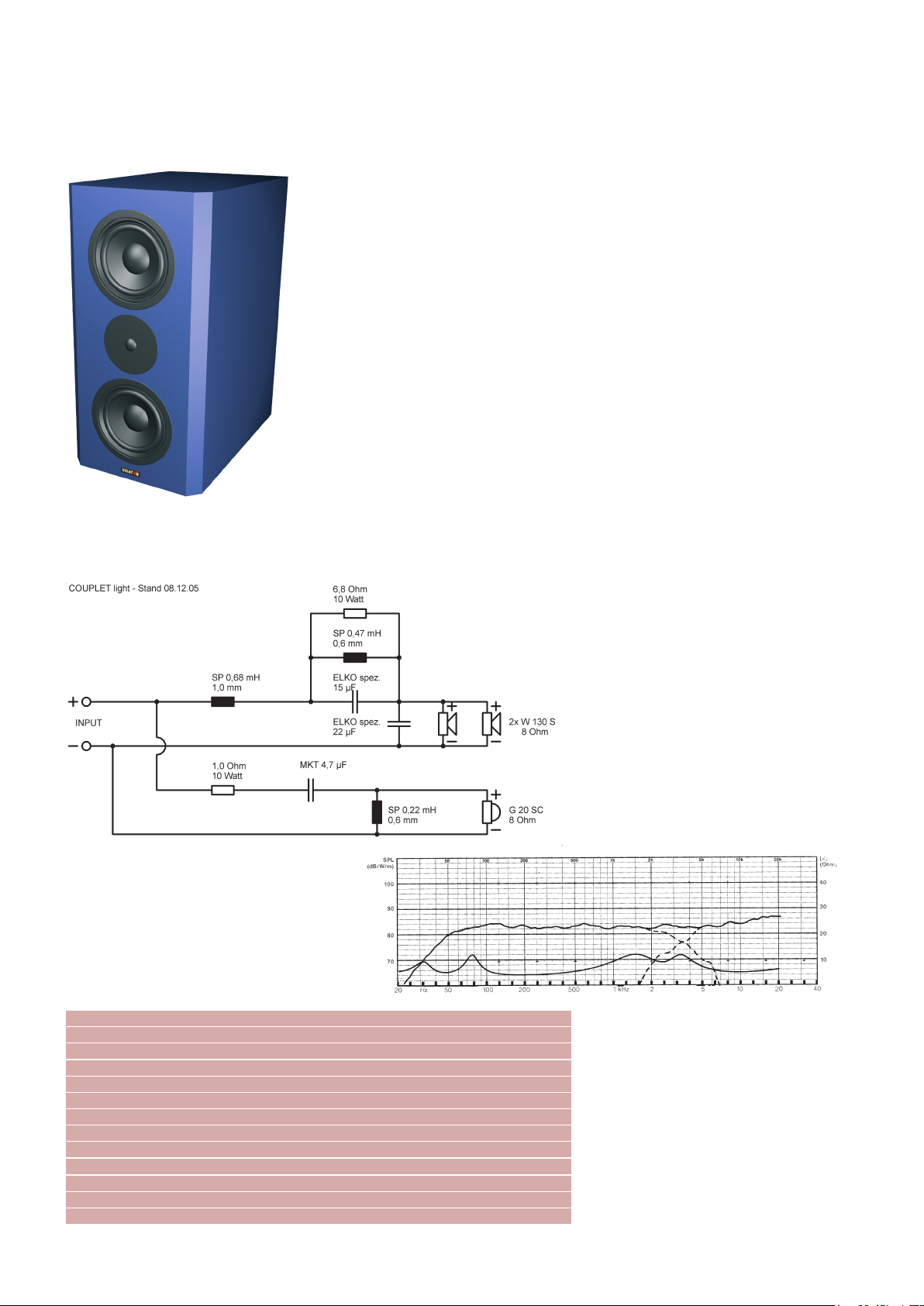
couplet lIGht
Eigenschaften und Klang
Die C
ouplet lIGht
ist eine kompakte Box
in D‘Appolito-Konfiguration. Sie kann als
Regalbox oder frei auf Ständern aufgestellt werden. Im Unterschied zur Original-Couplet kommen hier zwei W 130 S
als Tieftöner zum Einsatz. Der Hochtöner
sowie die Gehäuseabstimmung mit dem
strömungsgünstigen Bassreflexrohr BR
25.50 wurden unverändert übernommen.
Das Ergebnis ist eine Box, die im gesamten Frequenzbereich nahezu linear
arbeitet. Durch den besonders ausgewogenen Mitteltonbereich wird jedes Detail
eines Musikstücks klar wiedergegeben.
Das hervorragende Rundstrahlverhalten
führt zu besonders räumlicher Musikwiedergabe und punktgenauer Abbildung
einzelner Instrumente oder Stimmen.
Aber auch das Bassfundament kommt
nicht zu kurz. Kurzum, die C
ouplet lIGht
ist eine Box, die richtig Spaß macht.
Characteristics and sound properties
The co u p l et lI G h t is a compact
D‘Appolito configuration shelf speaker.
It can be used as a shelf-top speaker
or mounted on free-standing supports.
In contrast to the original c
ouplet
system uses two W 130 S as woofers.
The tweeter and the cabinet design with
its flow-optimised BR 25.50 bass reflex
tube have been taken over unchanged.
The result is a speaker that maintains its
linear characteristics right across the frequency range. Due to the well balanced
medium range, the fine details of music
reproduction, in particular, comes across
particularly clearly. The excellent omnidirectional sound distribution creates a
particularly room-filling music reproduction and clear location of each individual instrument or voice. The lowest-range
bass comes across equally powerfully. In
short, the c
ouplet lIGht
is a speaker that
is really good fun.
, this
Nennbelastbarkeit Rated power 100 W
Musikbelastbarkeit Maximum power 160 W
Nennimpedanz Nominal impedance 4 Ω
Übertragungsbereich Frequency response (–10 dB) 40–30
000 Hz
Mittl. Schalldruckpegel Mean sound pressure level 83 dB (1 W/1 m)
Trennfrequenz Cut-off frequency 3500 Hz
Gehäuseprinzip Principle of Housing Bassreflex / bass reflex
Gehäusemaße Cabinet
Nettovolumen Net volume 25 l
Höhe Height 460 mm
Breite Width 235 mm
Tiefe Depth 350 mm
66 HiFi Bauvorschläge 2008
Page 2
couplet lIGht
Bestückungsliste für 1 Box
Der Bausatz enthält alle in dieser Bestückungsliste aufgeführten Bauteile,
jedoch kein Gehäuse.
Hochtöner G 20 SC - 8 Ω 1 St.
Tieftöner W 130 S - 8 Ω 2 St.
Frequenzweiche „Couplet lIGht“
Bassreflexrohr BR 25.50
(volle Länge) 1 St.
Anschlussklemme ST 77 1 St.
Dämpfungs- Polyestermaterial wolle 1 Btl.
Holzschrauben 3,5 x 19 mm 4 St.
Senkkopfschrauben 3,5 x 25 mm 18 St.
Kabel 2 x 1,5 mm² 1,5 m
Component parts list for 1 box
The kit includes all the components listed
here but not the cabinet.
Tweeter G 20 SC - 8 Ω 1 pc.
Woofer W 130 S - 8 Ω 2 pcs.
Crossover „couplet lIGht“
Bass reflex tube BR 25.50
(full length) 1 pc.
Terminal ST 77 1 pc.
Damping Polyester
material wool 1 bag
Wood screws 3.5 x 19 mm 4 pcs.
Countersunk
screws 3.5 x 25 mm 18 pcs.
Cable 2 x 1.5 mm² 1.5 m
Aufbau
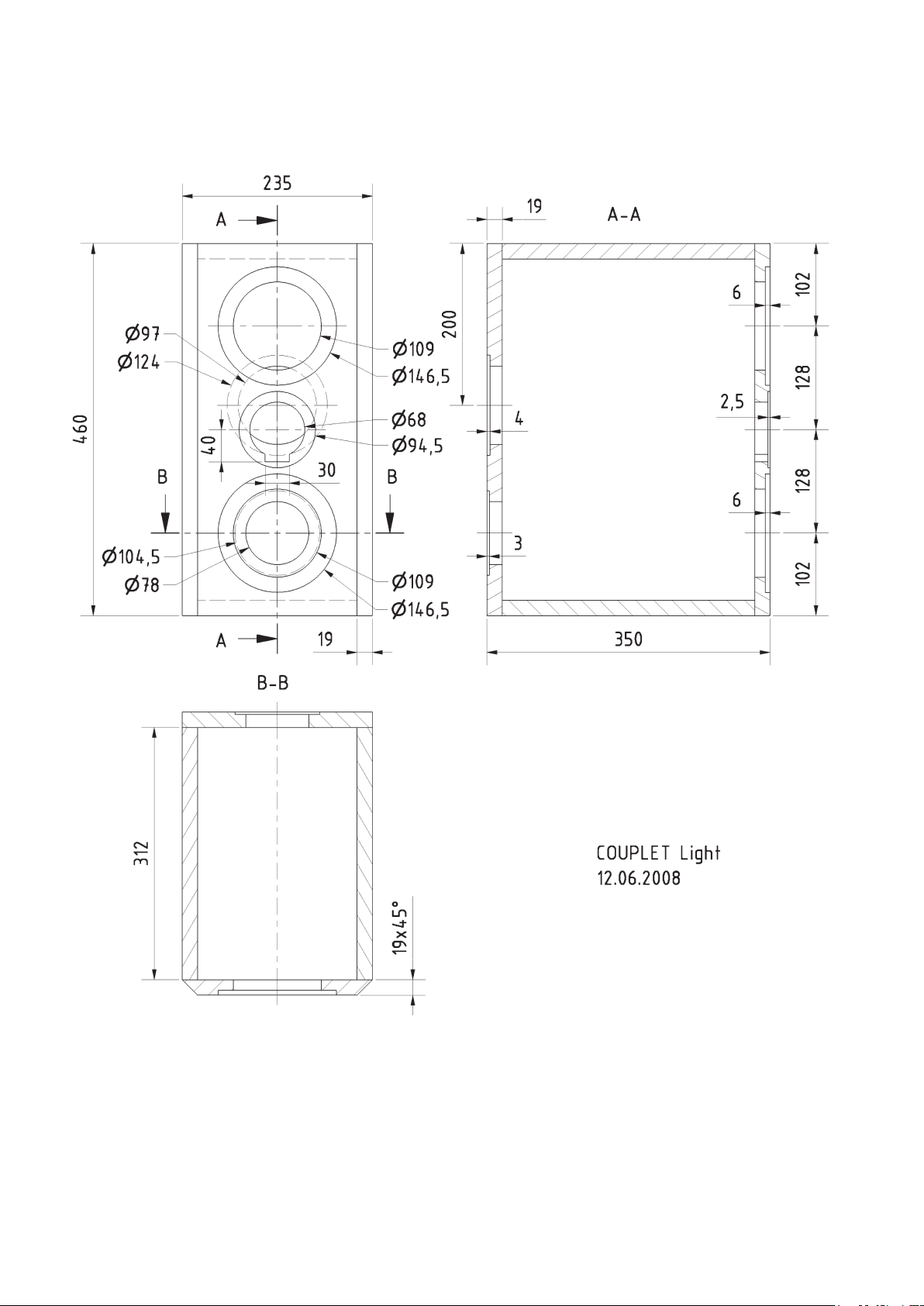
Die zugeschnittenen Gehäuseteile aus
19 mm starken Span- oder MDF-Platten
werden auf Stoß verleimt. Die Fasen an
der Schallwand können mit einer auf
45°-Gehrung eingestellten Stich- oder
Handkreissäge geschnitten werden oder
nachträglich mit einem Schwingschleifer angebracht werden. Anschließend
werden die Öffnungen der Chassis, des
Bassreflexrohres und des Terminals herausgesägt.
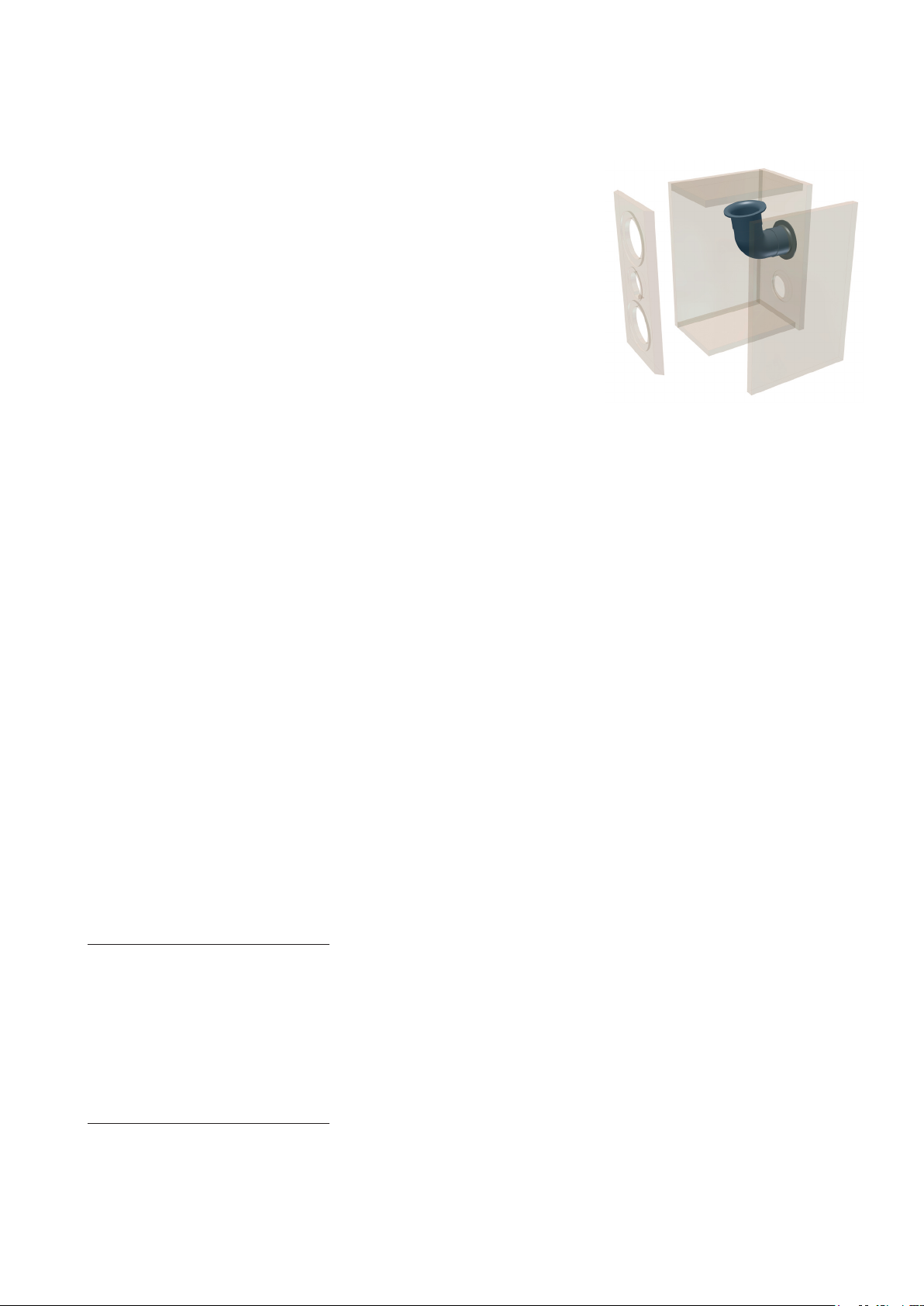
Aufgrund der kleinen Schallwandöffnungen ist es schwierig, die Frequenzweiche im Inneren der Box zu befestigen. Man könnte die Bodenplatte herausnehmbar montieren. Einfacher ist
es aber, die Frequenzweiche in Dämpfungsmaterial einzuwickeln und sie durch
die untere Schallwandöffnung auf den
Boden der Box zu legen.
Bei der Bestückung ist zu beachten,
dass mit dem Bassreflexrohr begonnen
wird. Um den inneren Trompetenflansch
durch die Öffnung des oberen Tieftöners
stecken zu können, muss der Flansch
beidseitig ca. 5 mm abgeflacht werden.
Construction
All the cabinet panels are cut from 19 mm
chipboard or medium density fibreboard,
butt-jointed and glued. The chamfers on
the baffle can be applied with a power
jig or circular saw set to 45° or applied
later using an orbital sander.
Bedämpfung
Das Dämpfungsmaterial wird locker im
Gehäuse verteilt. Der Bereich um die
Öffnung des Bassreflexrohres bleibt frei.
Inner damping
The damping material is loosely arranged
below the bass reflex tube in the cabinet
in such a way that the area around the
vent remains free.
Zuschnittliste für 1 Box
Teile Maße (mm) Anzahl
Material: 19 mm Spanplatte oder MDF
Front, Rückwand 460 x 235 2
Seiten 460 x 312 2
Deckel, Boden 197 x 312 2
Cabinet parts list for 1 box
Parts Size (mm) Quantity
Material: 19 mm MDF or chipboard
Front, rear panel 460 x 235 2
Side panels 460 x 312 2
Top, bottom panel 197 x 312 2
HiFi Bauvorschläge 2008 67
Next, cut out the openings for the drivers,
the bass reflex tube and the terminals.
Due to the small size of the cut-outs
in the baffle, it is difficult to mount the
crossover inside the speaker cabinet.
It would be possible to make the base
removable. However, it is easier to wrap
the crossover in damping material and
place it through the lower cut-out in the
baffle on the floor of the cabinet. When
you begin fitting the drivers, start with the
bass reflex tube. In order to be able to
get the inner trumpet flange through the
opening for the upper subwoofer it will
be necessary to carefully remove about
5 mm from both sides of the flange.
Page 3
couplet lIGht
68 HiFi Bauvorschläge 2008
 Loading...