

Page 1
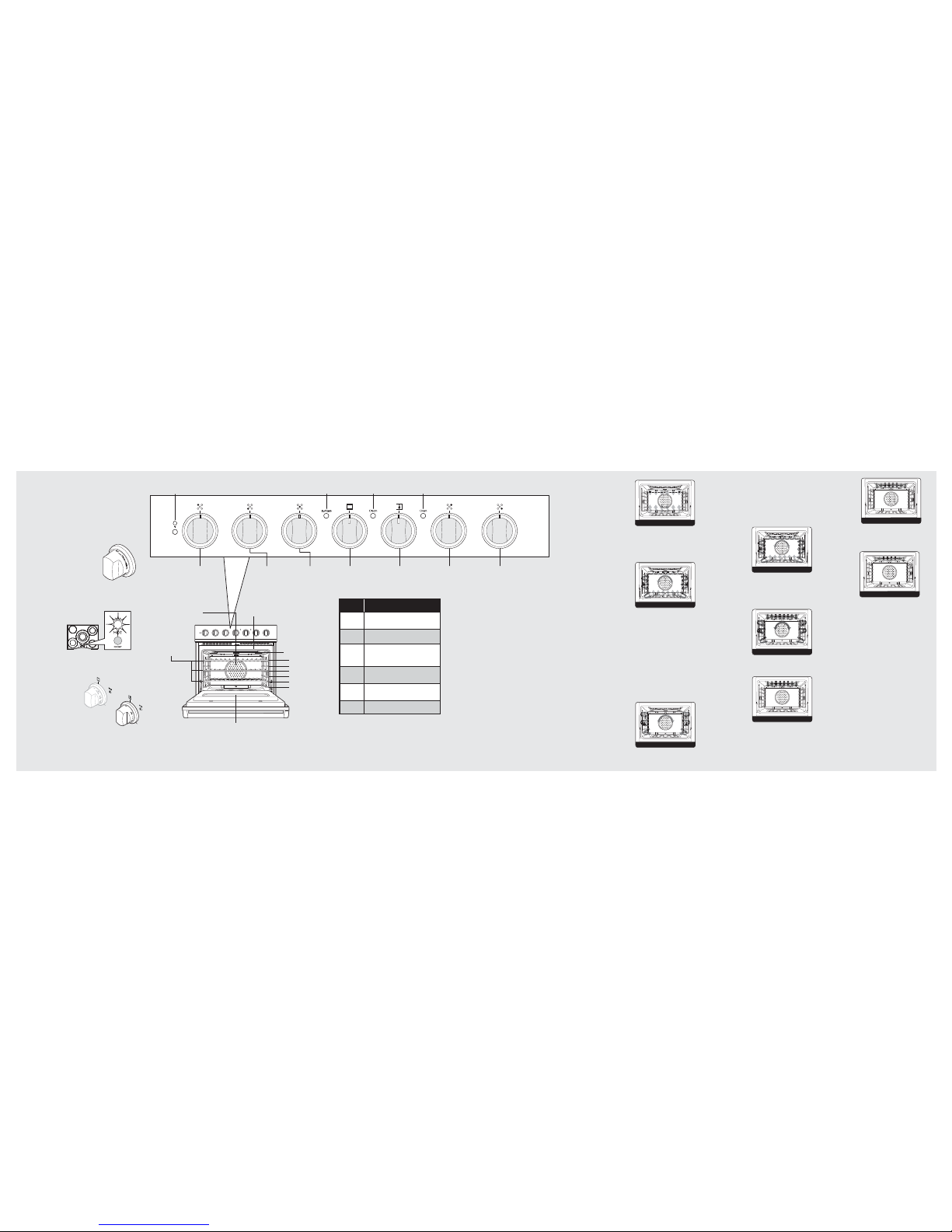
Surface Operation
Controls
BAKE (TwoElement Bake)
Full power heat is
radiated from the bake
element in the bottom
of the oven cavity and
supplemental heat is
radiated from the broil
element. This function
is recommended for single rack baking. Many cookbooks
contain recipes to be cooked in the conventional manner.
Conventional baking/roasting is particularly suitable for
dishes that require a high temperature. Use this setting for
baking, roasting, and casseroles.
CONV BAKE
(Convection
Bake)
The bottom element
operates at full power,
and the top broil
element operates at
supplemental power.
The heated air is
circulated by the
motorized fan in the rear of the oven providing a more
even heat distribution. This even circulation of air equalizes
the temperature throughout the oven cavity and eliminates
the hot and cold spots found in conventional ovens. A
major benefit of convection baking is the ability to prepare
food in quantity using multiple racks—a feature not
possible in a standard oven.
When roasting using this setting, cool air is quickly
replaced, searing meats on the outside and retaining more
juices and natural flavor on the inside with less shrinkage.
With this heating method, foods can be baked and roasted
at the same time with minimal taste transfer, even when
different dishes are involved, such as cakes, fish or meat.
The hot air system is especially economical when thawing
frozen food. Use this setting for baking and roasting.
TRU CONV
(TruConvec™)
The rear element only
operates at full power.
There is no direct heat
from the bottom or top
elements. The
motorized fan in the
rear of the oven
circulates air in the
oven cavity for even heating. Use this setting for foods that
require gentle cooking such as pastries, souffles, yeast
Oven Settings
two-element bake
convection bake
TruConvec™
About the Cooktop Surface Elements
Single radiant elements will have one round outline
pattern shown on the cooktop and should be used
when cooking with smaller cooking vessels. Dual
radiant elements allows the user to set the smaller
inner element alone or both the inner and outer
elements may be used together when using medium
to larger sized cookware. Triple element allows the
use to set the smaller inner element, both inner and
middle elements or all three elements if using larger
sized cookware such as a stock pot.
Single Front or Rear
Element
Push in and turn the control knob
counterclockwise to the desired
setting. The element will cycle on
and off to maintain the desired heat
setting. When finished, turn all
controls to “OFF.”
Hot Surface Indicator Lights
The range has five hot surface indicator lights. They
are located in the front center of the glass rangetop.
The hot surface indicator light will glow
red when the corresponding element is
heated. The light will
remain on after
turning off the
control knob until
the corresponding
element has
cooled to a safe
temperature.
Oven
Functions
Preheat
For best results, it is
extremely important that
you preheat your oven to
the desired cooking temperature
before placing food items in the oven
to begin cooking. In many cooking
modes, partial power from the broiler is used
to bring the oven to the preheat temperature.
Therefore, placing food items in the oven during the
preheat mode is not recommended. The Viking Rapid
Ready™ Preheat System is engineered so that the
oven is brought to the desired set temperature in a
manner which will provide the optimum cooking
environment based on the selected cooking mode in
the shortest possible time.
Interior Oven
Light Switch
Left Rear Burner
Control Knob
(1,200 watt)
Left Front Burner
Control Knob
(2,000 watt)
Oven
Function
Selector Knob
Oven
Temperature
Control Knob
Right Rear Burner
Control Knob
(2,000 watt)
Center Burner
Control Knob
(3,200 watt)
Right Front Burner
Control Knob
(1,200 watt)
Oven
Indicator
Light
Self-Clean
Indicator
Light
Surface
Indicator
Light
Broil element
Oven light
6
5
4
3
2
1
TruConvec™ element
(behind baffle)
(3) Oven racks
Concealed bake element
Surface Heat Settings* Oven Functions
• BAKE (Two-Element Bake)
Use this setting for baking, roasting, and casseroles.
• CONV BAKE (Convection Bake)
Use this setting to bake and roast foods at the same time
with minimal taste transfer.
• TRU CONV (TruConvec™)
Use this bake setting for multi-rack baking for
breads, cakes, cookies (up to 6 racks of cookies
at once).
• CONV ROAST (Convection Roast)
Use this setting for roasting whole turkeys, whole chickens,
hams, etc.
• CONV BROIL (Convection Broil)
Use this setting to broil thick cuts of meat.
• HI BROIL
Use this setting for broiling dark meats at 1” thickness or
less where rare or medium doneness is desired.
• MED BROIL
Use this setting for broiling white meats such as chicken or meats
greater than 1” thick that would be over-browned in high broil.
• LOW BROIL
Use this setting for delicate broiling such as meringue.
• SELF CLEAN
Use this function to clean oven.
• Convection Dehydration (TRU CONV)
Use this function to dehydrate fruits and vegetables.
• Convection Defrost (TRU CONV)
Use this function to defrost foods.
MED BROIL
Inner and outer broil
elements pulse on
and off to produce
less heat for slow
broiling. Allow about
4 inches (10 cm)
between the top
surface of the food
and the broil element. Slow broiling is best for chicken
and ham in order to broil food without over-browning it.
Use this setting for broiling small and average cuts of
meat.
LOW BROIL
This mode uses only
a fraction of the
available power to
the inner broil
element for delicate
top-browning. The
inner broil element is
on for only part of
the time. Use this setting to gently brown meringue on
racks 3 or 4 in 3-4 minutes.
Convection Dehydration
This oven is designed not only to cook, but also to
dehydrate fruits and vegetables.
1. Prepare the food as recommended.
2. Arrange the food on drying racks (not included with
the oven; contact a local store handling speciality
cooking utensils).
3. Set the appropriate low temperature and turn the
selector to “TRU CONV”.
Convection Defrost
1. Place the frozen food on a baking sheet.
2. Set the temperature control to “OFF”.
3. Turn the selector to “TRU CONV”.
Self-Clean Cycle
This range features a self-cleaning cycle. During this cycle,
the oven reaches elevated temperatures in order to burn
off soil and deposits. A powder ash residue is left in the
bottom of the oven after completion of the self-clean
cycle. See
Use and Care Manual
for self-clean cycle
instructions.
medium broil
low broil
breads, quick breads, and cakes. Breads, cookies, and other
baked goods come out evenly textured with golden crusts.
No special bakeware is required. Use this function for single
rack baking, multiple rack baking, roasting, and preparation
of complete meals. This setting is also recommended when
baking large quantities of baked goods at one time.
CONV ROAST (Convection Roast)
The convection
element runs in
conjunction with the
inner and outer broil
elements. The
reversible convection
fan runs at a higher
speed in each
direction. This transfer
of heat (mainly from
the convection element) seals moisture inside of large
roasts. A time savings is gained over existing, single fan
convection roast modes. Use this setting for whole turkeys,
whole chickens, hams, etc.
CONV BROIL (Convection Broil)
The top element
operates at full power.
This function is exactly
the same as regular
broiling with the
additional benefit of
air circulation by the
motorized fan in the
rear of the oven.
Smoke is reduced
since the airflow also reduces peak temperatures on the
food. Use this setting for broiling thick cuts of meats.
HI BROIL
Heat radiates from
both broil elements,
located in the top of
the oven cavity, at full
power. The distance
between the foods
and the broil elements
determines broiling
speed. For fast
broiling, food may be as close as 2 inches (5 cm) to the
broil element. Fast broiling is best for meats where rare to
medium doneness is desired. Use this setting for broiling
small and average cuts of meat.
convection roast
convection broil
high broil
O
V
EN
F
U
N
CTI
O
N
O
VEN
TEMPE
R
A
TUR
E
Heat
Setting
Use
Simmer
Melting small quantities
Steaming rice
Simmering sauces
Low
(setting 2)
Melting large quantities
Med Low
(settings 3-4)
Low-temperature frying (eggs, etc.)
Simmering large quantities
Heating milk, cream sauces, gravies,
and puddings
Med
(setting 5)
Sautéing and browning, braising,
and pan-frying
Maintaining slow boil on large quantities
Med High
(settings 7-8)
High-temperature frying
Pan broiling
Maintaining fast boil on large quantities
High
Boiling water quickly
Deep-fat frying in large cookware
*Note: The above information is given as a guide only.
You may need to vary the heat settings to suit your
personal requirements.
Page 2
F21194 EN (051513)
VIKING RANGE, LLC
111 Front Street • Greenwood, Mississippi
38930 USA • (662) 455-1200
Warning and Important Safety Instructions
appearing in this manual are not meant to cover all
possible conditions and situations that may occur.
Common sense, caution, and care must be exercised
when installing, maintaining, or operating the
appliance.
ALWAYScontact the manufacturer about problems or
conditions you do not understand.
Recognize Safety Symbols, Words, Labels
Read and follow all instructions before using this
appliance to prevent the potential risk of fire, electric
shock, personal injury or damage to the appliance as
a result of improper usage of the appliance. Use
appliance only for its intended purpose as described
in this manual.
To ensure proper and safe operation:Appliance
must be properly installed and grounded by a
qualified technician. DO NOT attempt to adjust,
repair, service, or replace any part of your appliance
unless it is specifically recommended in this manual.
All other servicing should be referred to a qualified
servicer.
WARNING
TIPPING HAZARD
To reduce the risk of the
appliance tipping, it must be
secured by a properly installed
anti-tip bracket(s). To make sure the bracket has
been installed properly, look behind the range with
a flashlight to verify proper installation engaged in
the rear top left corner of the range.
• THIS RANGE CAN TIP
• INJURIES TO PERSONS CAN RESULT
• INSTALL ANTI-TIP DEVICE PACKED WITH
RANGE
• SEE INSTALLATION INSTRUCTIONS
WARNING
DO NOT use commercial oven cleaners inside the
oven. Use of these cleaners can produce hazardous
fumes or can damage the porcelain finishes.
WARNING
To avoid risk of property damage,
personal injury or death; follow
information in this manual exactly to
prevent a fire or explosion. DO NOT
store or use gasoline or other flammable vapors
and liquids in the vicinity of this or any appliance.
WARNING
ELECTRICAL SHOCK HAZARD
DO NOT
touch a hot oven light bulb with
a damp cloth as the bulb could break.
Should the bulb break, disconnect power
to the appliance before removing bulb to avoid
electrical shock.
WARNING
ELECTRICAL SHOCK HAZARD
Disconnect the electric power at the
main fuse or circuit breaker before
replacing bulb.
WARNING
BURN OR ELECTRICAL
SHOCK HAZARD
Make sure all controls are OFF and oven
is COOL before cleaning. Failure to do
so can result in burns or electrical shock.
CAUTION
To avoid sickness and food waste, DO NOTallow
defrosted food to remain in the oven for more than
two hours.
NOTICE
DO NOT turn the Temperature Control on during
defrosting. Turning the convection fan on will
accelerate the natural defrosting of the food
without the heat.
WARNING
BURN HAZARD
The oven door, especially the glass, can
get hot. Danger of burning: DO NOT
touch the glass!
CAUTION
You must carefully check the food during the
dehydration process to ensure that it does not
catch fire.
CAUTION
BURN HAZARD
When self-cleaning, surfaces may get
hotter than usual. Therefore, children
should be kept away.
CAUTION
DO NOT store items of interest to children over
the unit. Children climbing to reach items could
be seriously injured.
DANGER
Hazards or unsafe practices which WILL result
in severe personal injury or death
WARNING
Hazards or unsafe practices which COULD result in
death, severe personal injury or property damage
CAUTION
Hazards or unsafe practices which COULD
result in minor personal injury.
All safety messages will identify the hazard, tell you
how to reduce the chance of injury, and tell you what
can happen if the instructions are not followed.
WARNING
NEVER use appliance as a space heater to heat or
warm a room to prevent potential hazard to the user
and damage to the appliance. Also, DO NOTuse the
range top or oven as a storage area for food or
cooking utensils.
CAUTION
DO NOT heat empty cookware or let cookware boil
dry. The cookware can absorb an excessive
amount of heat very quickly, resulting in possible
damage to the cookware and ceramic glass.
WARNING
This range features a self-cleaning cycle. During
this cycle, the oven reaches elevated temperatures
in order to burn off soil and deposits. A powder ash
residue is left in the bottom of the oven after
completion of the self-clean cycle.
Note: DO NOT use commercial oven cleaners
inside the oven. Use of these cleaners can
produce hazardous fumes or can damage the
porcelain finishes. DO NOT line the oven with
aluminum foil or other materials. These items can
melt or burn during a self-clean cycle, causing
permanent damage to the oven.
Important Safety Notice and Warning
The California Safe Drinking Water and Toxic
Enforcement Act of 1986 (Proposition 65) requires the
Governor of California to publish a list of substances
known to the State of California to cause cancer or
reproductive harm, and requires businesses to warn
customers of potential exposures to such substances.
Users of this appliance are hereby warned that when
the oven is engaged in the self-clean cycle, there may
be some low-level exposure to some of the listed
substances, including carbon monoxide. Exposure to
these substances can be minimized by properly
venting the oven to the outdoors by opening the
windows and/or door in the room where the appliance
is located during the self-clean cycle.
Important notice regarding pet birds:
NEVER keep pet birds in the kitchen or in rooms
where the fumes from the kitchen could reach. Birds
have a very sensitive respiratory system. Fumes
released during an oven self-cleaning cycle may be
harmful or fatal to birds. Fumes released due to
overheated cooking oil, fat, margarine and overheated
non-stick cookware may be equally harmful.
About Your Appliance
• Avoid touching oven vent area while oven is on and
for several minutes after oven is turned off. When
the oven is in use, the vent and surrounding area
become hot enough to cause burns. After oven is
turned off, DO NOT touch the oven vent or
surrounding areas until they have had sufficient time
to cool.
• Other potentially hot surfaces include range top,
areas facing the range top, oven vent, surfaces near
the vent opening, oven door, areas around the oven
door and oven window.
• The misuse of oven doors (e.g. stepping, sitting,
or leaning on them) can result in potential hazards
and/or injuries.
Heating Elements and Glass Ceramic
Cooking Surfaces
• Surface areas on or adjacent to the unit may be hot
enough to cause burns.
• NEVER touch oven heating elements, areas near
elements, or interior surfaces of oven.
• Heating elements may be hot even though they are
dark in color. Areas near elements and interior
surfaces of an oven may become hot enough to
cause burns.
• During and after use, DO NOT touch or let clothing
or other flammable material contact surface of unit
or areas near unit, heating elements, or interior
surfaces of oven until they have had sufficient time
to cool.
• DO NOT COOK ON BROKEN COOKING
SURFACE– If cooking surface should break,
cleaning solutions and spillovers may penetrate the
broken cooking surface and create a risk of electric
shock. Contact a qualified technician immediately.
CAUTION
DO NOT touch the exterior portions of
the oven after self-cleaning cycle has
begun, since some parts become
extremely hot to the touch!
During the first few times the self-cleaning feature
is used, there may be some odor and smoking
from the “curing” of the binder in the high-density
insulation used in the oven. When the insulation is
thoroughly cured, this odor will disappear. During
subsequent self-cleaning cycles, you may sense
an odor characteristic of high temperatures.
KEEP THE KITCHEN WELL-VENTED DURING
THE SELF-CLEAN CYCLE.
NOTICE
Avoid any damage to oven vents. The vents need
to be unobstructed and open to provide proper
airflow for optimal oven performance.
NOTICE
The Cooling Fan should be operating when the
unit is in operation. If you notice the cooling fan is
not operating or you observe unusual or excessive
noise coming from the cooling fan, contact a
Viking Authorized Service Center before
continuing operation. Failure to do so can result in
damage to the oven or surrounding cabinets.
CAUTION
To prevent possible damage to cabinets and
cabinet finishes, use only materials and finishes
that will not discolor or delaminate and will
withstand temperatures up to 194° F (90° C). Heat
and moisture resistant adhesive must be used if the
product is to be installed in laminated cabinetry.
Check with your builder or cabinet supplier to make
sure that the materials meet these requirements.
Freestanding 30”W. Electric
Self-Clean Range
Quick Reference
Warnings
Warnings
(cont.) Warnings (cont.)
 Loading...