

Viking Built-In Electric Warming Drawers, Built-In Electric Warming Drawer Quick Reference Manual
Page 1
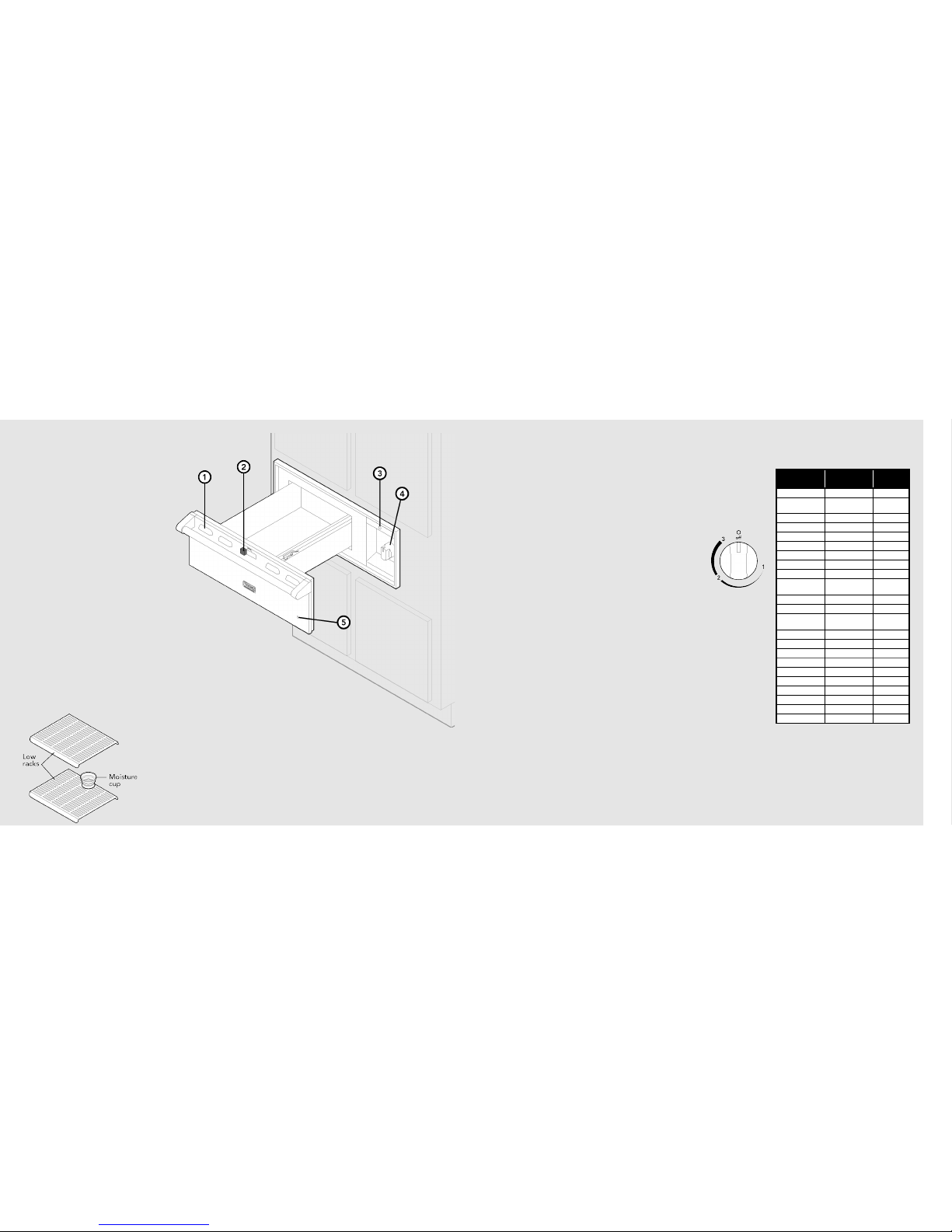
Drawer Operation
The warming drawer keeps hot cooked foods at
serving temperature.
Turn the control knob clockwise to the desired setting.
The element will cycle on and off to maintain the
desired heat setting. When finished turn the control to
“OFF.”
Note: The majority of foods are held at a medium
setting to maintain a serving temperature.
Moist Heat (VEWD models only)
1. Place low racks in warming drawer.
2. Fill the moisture cup with 1/2 cup water and place
the cup in the rear center opening of the low rack.
3. Place the food or cookware with food directly on
the rack.
4. Turn the control knob to the desired heat setting
and close the drawer.
5. Slide the moisture control to the right to close the
vents which seals in the heat.
Use moist heat when proofing breads and keeping
foods moist such as casseroles, meats, and sauces.
Dry Heat
1. Place the food or cookware with food in the empty
drawer pan.
2. Turn the control knob to the desired heat setting
and close the drawer.
3. Slide the moisture control to the left to open the
vents which allows the moist heat to escape.
Use dry heat when warming dishes and keeping foods
crispy such as pies, breads and fried foods.
Warming Element
Temperature Settings
The knob is used to select the
temperature of the drawer and
is located on the right side of
the control panel. The “1”
setting represents low, “2”
represents medium, and “3”
represents high. The majority
of foods are held at a medium
setting to maintain a serving temperature. However,
your own preference may be for hotter foods.
Proofing
Yeast dough can be proofed in the warming drawer.
Place the dough in a bowl.
Place the bowl on the low rack in the drawer. Fill
the moisture cup half full with water and place in the
opening in the rear center of the low rack. Turn the
temperature control to the lowest setting to facilitate
the fermentation time. A towel should be placed over
the dough to minimize surface drying. The dough
should remain in the warming drawer until it has
doubled in size and a slight depression remains
when the surface is touched gently with a finger.
Warming Plates
To warm serving bowls and plates, place temperature
control on a low setting. Place the empty dishes on
the low rack to raise them off the bottom of the
drawer. If you want hotter dishes or want to heat
fine china, please check with the manufacturer of the
dishes for their maximum heat tolerance.
Temperature
Control
Cooking Guide
Features
Indicator Light
The indicator light is located above the
temperature control knob on the Custom model
and below the temperature control knob on the
Designer model. The drawer indicator light will
glow red when the drawer element is heated. The
light will cycle on and off as the temperature is
maintained.
Suggested Heat Settings
The information below is given as a guide only. You
may need to vary the heat settings to suit your
personal requirements.
Food
Temperature
Settings
Moisture
Settings
Bacon 2 – 3 –
Beef, medium
and well done
2 +
Beef, rare 1 – 2 +
Bread, hard roll 2 –
Bread, soft rolls 2 –
Casseroles 2 +
Cooked cereal 2 +
Dough, proofing 1 +
Eggs 2 +
Fish, seafood
(baked)
2 +
Fried foods 3 –
Fruit 2 +
Gravy, creamed
sauces
2 +
Ham 2 +
Pancakes, waffles 2 – 3 +
Pies, one crust 2 +
Pies, two crust 2 –
Pizza 2 – 3 halfway
Pork 2 +
Potatoes, baked 3 halfway
Potatoes, mashed 2 +
Poultry 2 – 3 +
Vegetables 2 –
1. Vents
2. Moisture Selector Control
3. ON/OFF Indicator Light
4. Temperature Control Knob
5. Drawer Indicator Light
Page 2
F20665B EN (082012)
VIKING RANGE CORPORATION
111 Front Street • Greenwood, Mississippi
38930 USA • (662) 455-1200
Warnings
Warning and Important Safety Instructions appearing
in this guide are not meant to cover all possible
conditions and situations that may occur. Common
sense, caution, and care must be exercised when
installing, maintaining, or operating the appliance.
ALWAYS contact the manufacturer about problems or
conditions you do not understand.
Recognize Safety Symbols, Words, Labels
Read and follow all instructions before using this
appliance to prevent the potential risk of fire, electric
shock, personal injury or damage to the appliance as
a result of improper usage of the appliance. Use
appliance only for its intended purpose as described
in this guide.
To ensure proper and safe operation:
Appliance must be properly installed and grounded
by a qualified technician. DO NOT attempt to adjust,
repair, service, or replace any part of your appliance
unless it is specifically recommended in this guide. All
other servicing should be referred to a qualified
servicer.
To Prevent Fire or Smoke Damage
• Be sure all packing materials are removed from the
appliance before operating it.
• Keep area around appliance clear and free from
combustible materials, gasoline, and other
flammable vapors and materials.
• Many aerosol-type spray cans are EXPLOSIVEwhen
exposed to heat and may be highly flammable.
Avoid their use or storage near an appliance.
• Many plastics are vulnerable to heat. Keep plastics
away from parts of the appliance that may become
warm or hot. DO NOT leave plastic items in the
drawer as they may melt or soften if left too close
to a heating element.
• Combustible items (paper, plastic, etc.) may ignite
and metallic items may become hot and cause
burns. DO NOT pour spirits over hot foods.
About your Appliance
• DO NOT touch the heating elements or interior
surface of the drawer while it is in use. Use handles
or knobs.
• DO NOT store flammable materials in drawer.
Heating Elements
• Use only dry potholders. If moist or damp
potholders are used, steam from potholders could
cause a steam burn. DO NOT let potholders touch
hot heating elements located under the drawer. DO
NOT use a towel or bulky cloths in place of
potholders.
• Use care when opening the drawer. Let hot air or
steam escape (open vent) before removing or
replacing food.
• DO NOT place food in unopened containers in the
drawer. Pressure could build up and cause the
container to burst.
• NEVER use the appliance for other than intended
use.
• DO NOT use water on grease fires. Smother fire or
flame or use dry chemical or foam-type
extinguisher.
• DO NOT use aluminum foil to line the drawer. It is
an excellent heat insulator and will trap heat
beneath it. This will upset the performance and can
damage the interior finish.
• Always place warming racks in desired position
while drawer is cool.
• Keep drawer closed when not in use.
• DO NOT place items exposed to cooking oils in
your warming drawer. Items contaminated with
cooking oils may contribute to a chemical reaction
that could cause a load to catch fire.
• DO NOT install or store indoor models where they
will be exposed to the weather.
Viking Quick Reference Guide
Built-In Electric Warming Drawers
(Indoor and Outdoor Models)
D A N G E R
Hazards or unsafe practices which WILL result in
severe personal injury or death
W A R N I N G
Hazards or unsafe practices which COULD result
in severe personal injury or death
C A U T I O N
Hazards or unsafe practices which COULD
result in minor personal injury.
All safety messages will identify the hazard, tell you
how to reduce the chance of injury, and tell you what
can happen if the instructions are not followed.
C A U T I O N
DO NOTuse plastic wrap to cover foods placed in
the drawer, nor to keep foods warm that are
wrapped or placed in plastic containers for heating.
Plastics can melt onto the drawer if they are in direct
contact. If melted onto the drawer, they can be very
difficult to remove.
C A U T I O N
DO NOT use any cleaning agent with chlorine or
chlorine compounds on stainless steel finish.
Chlorine and chlorine compounds are corrosive to
stainless steel.
W A R N I N G
To avoid risk of property damage,
personal injury or death; follow
information in this manual exactly to
prevent a fire or explosion. DO NOT
store or use gasoline or other flammable vapors
and liquids in the vicinity of this or any appliance.
W A R N I N G
NEVER use this appliance as a space heater to heat
or warm the room. Doing so may result in carbon
monoxide poisoning and overheating of the drawer.
C A U T I O N
All special ordered brass parts are coated with an
epoxy coating. DO NOT use brass cleaners or
abrasive cleaners on any brass parts. All brass body
parts should be wiped regularly with hot soapy
water. When hot soapy water will not do the job, use
every day household cleaners that are not abrasive.
W A R N I N G
To avoid sickness and food waste, do not allow
defrosted food to remain in the drawer for more
than two hours.
W A R N I N G
BURN OR ELECTRICAL
SHOCK HAZARD
Make sure all controls are OFF and
drawer is COOL before cleaning. Failure
to do so can result in burns or electrical
shock.
W A R N I N G
If the information in this manual is not followed
exactly, a fire or explosion may result causing
property damage, personal injury or death.
W A R N I N G
NEVER cover any slots, holes or passages in the
drawer or cover an entire rack with materials such
as aluminum foil. Doing so blocks air flow through
the oven and may cause carbon monoxide
poisoning. Aluminum foil linings may also trap heat,
causing a fire hazard.
 Loading...