

Page 1
www.metaldetectors.co.uk
Metal Detectors
1 Angela Street
Mill Hill, Blackburn
BB2 4DJ
t: +44 (0)1254 55887
f: +44 (0)1254 676901
User Manual
Thank you for your choice in purchasing a
VIKING 6 Metal Detector. It is important that
you read the following instructions carefully
so that you obtain the maximum benefit and
success from your detector.
The VIKING 6 is a non-motion, discriminating
metal detector. This simply means that the
search head does not need to be kept in motion
for detection to take place. Also, unwanted target
objects can be ignored by the detector.
Getting Started
Unpack The Detector
There are two main sections. The 'S' shaft, onto
which is mounted the control box, and the
bottom shaft with the search head.
Assemble The Detector
Slide the lower shaft into the 'S' shaft, wrapping
the cable snugly, but not tightly, round the shaft.
When correctly aligned it will click into 1 of 3
positions.
Tighten the coupling
Turn the coupling to the 'lock' position as
indicated by the arrow. This makes a rigid
connection between the two parts of the shaft.
Insert Battery
The detector takes a single PP3 (square) 9V
battery. This is placed in the battery
compartment on the back of the control box.
ENSURE THE BATTERY IS INSERTED THE
CORRECT WAY ROUND
Push the drawer back into the detector until it
clicks. Please note the drawer can only be
inserted the one way.
Your detector is now ready for use
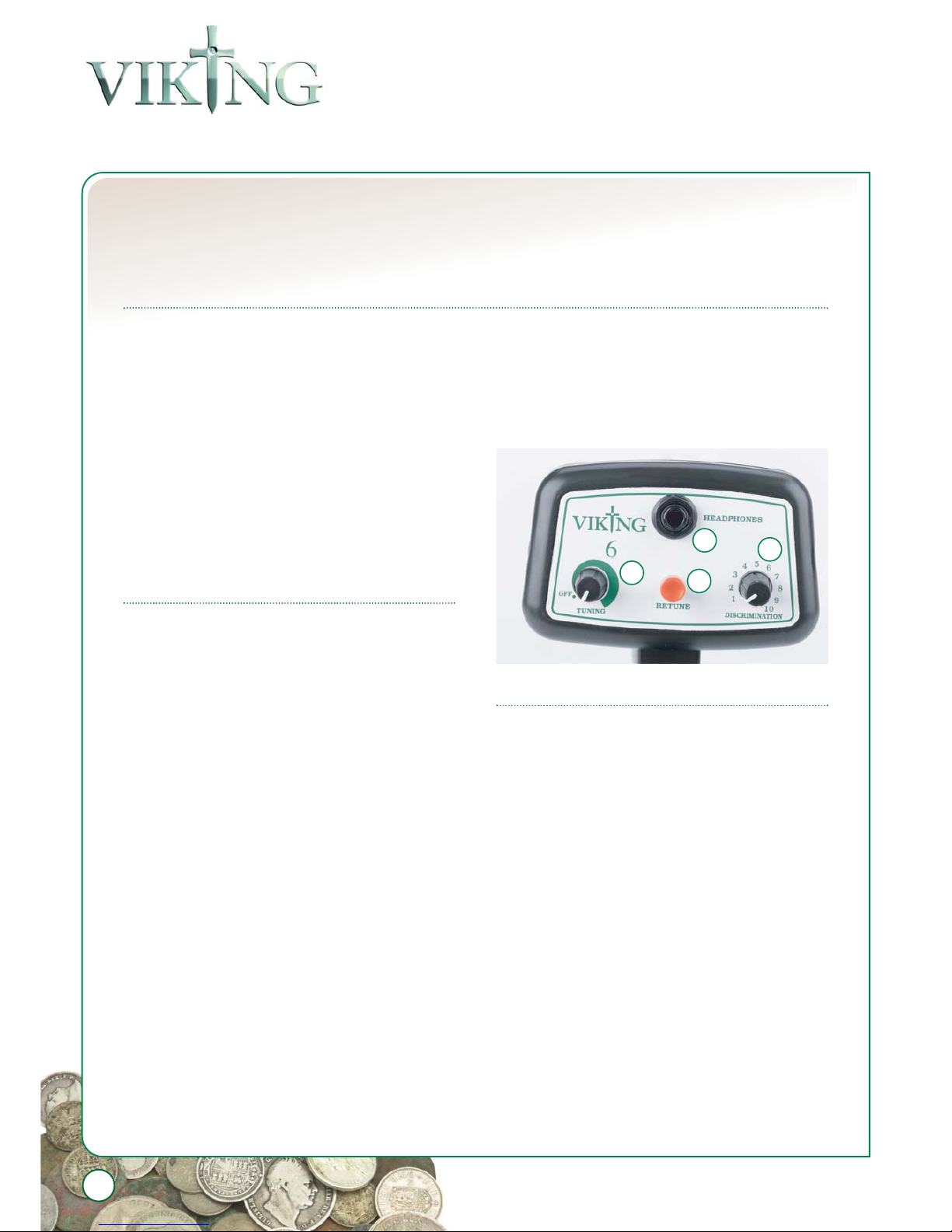
The VIKING 6
The VIKING 6 has the control box mounted on
top of the shaft allowing easy access to the
controls.
1. Tuning Control
2. Discrimination Control
3. Retune Pushbutton
4. Headphone Socket
1. Tuning Control
Turning this control clockwise switches the
detector on and tunes the detector to the correct
point known as the THRESHOLD. The term
THRESHOLD is explained later.
2. Discrimination Control
This control sets the amount of
DISCRIMINATION required. At setting '0' the
detector will detect all metals other than very
Viking 6
1
4
1
3
2
Page 2

www.metaldetectors.co.uk
Metal Detectors
1 Angela Street
Mill Hill, Blackburn
BB2 4DJ
t: +44 (0)1254 55887
f: +44 (0)1254 676901
small pieces of iron. The further up the scale the
control is set, the more objects will be rejected.
On a high setting only the most conductive
objects will be found. It should be noted that if
the control is set too high, then modern coinage
and other desirable objects will be rejected.
3. Retune Pushbutton
This is held down when tuning the detector to
THRESHOLD. It is also pressed and released to
retune to THRESHOLD if the detector drifts out
of tune.
4. Headphone Socket
The headphone socket accepts a standard ¼"
stereo jack plug. Plugging in stereo headphones
automatically disconnects the loudspeaker.
Headphones will give slightly more sensitivity as
they cut out external noises which can interfere
with your ability to detect objects.
Using Your Detector
1. Set the discrimination control to the desired
level (to begin with it is probably advisable to set
this at '0' until you have become more familiar
with the controls).
2. While holding the detector, position the
search head approximately 5cm (2") from the
ground and parallel to it, making sure that the
search head is kept away from any metal.
3. Keeping the RETUNE pushbutton pressed,
turn the tuning control clockwise until a faint
sound is heard (Maximum sensitivity on any
metal detector of this type is achieved when the
sound is just audible). This point is known as
THRESHOLD. Release the RETUNE pushbutton
and the detector is tuned.
4. With your detector now correctly tuned, you
will notice that lowering the search head to the
ground makes the faint sound from the speaker
fade away. Similarly, raising the search head
causes the sound to increase. This is a normal
reaction to the ground and does not necessarily
indicate the presence of lack of buried objects
(See GROUND EFFECT).
5. By maintaining a constant distance between
the search head and the ground, commence by
slowly walking forward, scanning the ground in
an arc. A slow scanning speed is best, as this
helps to hear the weak signals produced by
deeper buried objects.
6. On hearing a sharp note, this is an indication
that a small metallic object is present. A long
note is an indication of a larger object. Strength
of note is also dependent on the depth of the
target object.
If you wish to alter the position of the
DISCRIMINATION control, simply press the
RETUNE pushbutton and at the same time alter
the control to the desired number, then release
the pushbutton.
When DISCRIMINATION is used, you may hear
a sharp, quick signal if the search head touches
or passes extremely close to an object that
would usually be rejected. This is a false signal
but, to make sure, raise the head slightly and
pass over the object again. Only good objects
will continue to respond.
Ground Effect
The ground contains quantities of magnetic iron
oxides, of which some soils are more prolific
than others. Magnetic iron oxides create a
phenomenon known as 'ground effect'.
2
Page 3

www.metaldetectors.co.uk
Metal Detectors
1 Angela Street
Mill Hill, Blackburn
BB2 4DJ
t: +44 (0)1254 55887
f: +44 (0)1254 676901
If you are experiencing any problems not covered by the above see opposite page for details of our warranty / repair service.
On inland sites, this effect is known as 'negative'.
With this type of ground effect, the normal faint
threshold signal required to commence a search,
disappears as the search head is lowered to the
ground. Maintaining a constant height between
the search head and the ground reduces this
effect.
On beaches, a 'positive' ground effect is
experienced. This is caused by the conductivity
of the ground in salt-water areas. When this
effect occurs, the threshold signal becomes
louder as the search head is lowered to the
ground. Applying some discrimination will reduce
the effect of 'positive' ground.
Effects of Temperature
The VIKING 6 is a highly sensitive instrument
and therefore can be affected by variations in
temperature. Whilst the detector is extremely
stable in constant temperatures, it can take up to
15 minutes to acclimatise. For example, if it has
been in a hot car and is then brought into a
cooler climate for use, THRESHOLD drift may be
experienced until the circuit cools down to the
ambient temperature of its surroundings. Similar
effects may be experienced if the detector is
operated in the shade and then brought out into
bright sunlight. In cases of drift, momentarily
pressing the RETUNE pushbutton will bring the
detector back to THRESHOLD.
3
Problem Possible Cause Remedy
No sound from speaker Battery Check battery is good &
inserted correctly
Headphones connected Remove headphones
Unit does not detect Incorrect Tuning Hold RETUNE pushbutton
and adjust TUNING
controlErratic Operation
Cable detection Wrap cable snugly round
shaft
Battery Check battery is good &
inserted correctly
Threshold Drift Sudden Temperature Change Allow detector time to
acclimatise.
Page 4

www.metaldetectors.co.uk
Metal Detectors
1 Angela Street
Mill Hill, Blackburn
BB2 4DJ
t: +44 (0)1254 55887
f: +44 (0)1254 676901
Caring For Your Detector
In order to keep your machine in good condition,
please take the following precautions:
• When using in bad weather, protect the
electronics in the control box by wrapping in
a waterproof bag.
• Clean your detector regularly and ensure the
shaft is free from dirt, especially sand. Use a
damp cloth with mild detergent, but make sure
no water gets into the control box.
• If the detector is stored for long periods
remove the batteries. If they leak or corrode
they could cause serious damage to the
detector.
• Always choose a well-known brand of battery.
Warranty Service
Return of the enclosed guarantee card entitles
the original purchaser to a full 2-year guarantee
from the original purchase date. This covers
parts and labour, excluding batteries. This does
not, however, cover postage of the unit to or from
our factory. This must be paid by the owner of the
detector.
In the unlikely event that you do need to return
the detector to us, please pack it securely along
with a letter explaining the problem and a
cheque for £6.00 to cover return carriage and
insurance to:
Viking Metal Detectors
1 Angela Street
Mill Hill
Blackburn
Lancs.
BB2 4DJ
Please make cheques payable to Viking Metal
Detectors. If you are unsure about the fault
please give us a call on (01254) 55887 and we
will be happy to advise you.
4
Page 5

www.metaldetectors.co.uk
Metal Detectors
1 Angela Street
Mill Hill, Blackburn
BB2 4DJ
t: +44 (0)1254 55887
f: +44 (0)1254 676901
Code of Conduct for
Responsible Detector Users
1. Do not trespass. Ask permission before
venturing onto any private land.
2. Respect the country code. Do not leave gates
open when crossing fields. Do not damage crops
or frighten animals.
3. Do not leave a mess. It is perfectly simple to
extract a coin, or other small object, buried a few
inches under the ground without digging a large
hole. Use a sharpened trowel or knife to cut a
neat flap (Do not remove the plug of earth
completely from the ground), extract the object,
replace the soil and grass carefully. Even you will
have difficulty in finding the spot again.
4. Help to keep Britain tidy - and help yourself.
Bottle tops, silver paper and tin cans are the last
thing you should throw down again. It is possible
you will find yourself digging them up again in
the future. Do yourself and the community a
favour by taking the junk you find to the nearest
litter bin.
5. If you discover any live ammunition or other
lethal objects such as an unexploded bomb or
mine, do not touch it. Mark the site carefully and
report the find to the local police and landowner.
6. Report all unusual, historical finds to the
landowner.
7. Familiarise yourself with the law relating to
archaeological sites. Remember it is illegal for
anyone to use metal detectors on a scheduled
ancient monument unless permission has been
obtained from the historic buildings and ancient
monuments commission. Also acquaint yourself
with the practice of treasure trove.
8. Remember that when you are out with your
metal detector you are an ambassador for your
hobby. Do nothing that may give it a bad name.
9. Never miss an opportunity to show and
explain your detector to anyone who asks about
it. Be friendly. You could pick up some useful
clues to the whereabouts of another site. If you
meet another detector user, introduce yourself.
You may learn much about the hobby from each
other.
5
 Loading...