

Page 1
INTERAaM
View-Master®
Interactive
Vision™
Television
System
(VMIV)
Installing
and
Operating
Instructions
Note
to
Parents/Guardians
2
Setting
Up
6
Operating
the
System
20
Trou
ble·Shooting
22
Care
and
Maintenance
24
Page 2
CAUTION-ELECTRICALLY
OPERATED
PRODUCT:
Not
recommended
for
children
under
3
years
of
age.
As
with
all
electrical
products,
precautions
should
be
observed
dUring
handling
and
use
to
prevent
electric
shock.
AC
Adapter:
Input:
120
VAC,
60
Hz.
Output:
16
VAC, C.T.,
800
rnA.
System
Requirements:
1.
The
VCR
must
be
VHS
format.
2.
The
VCR
must
have
AUDIO OUT
and
VIDEO OUT
jacks.
Almost
all
VCRs
are
equipped
with
these,
but
you
should
check
the
back
of
your
VCR
to
be
sure.
If
your
VCR
does
not
have
AUDIO OUT
and
VIDEO OUT
jacks,
please
call
1-800-292-9843,
between
the
hours
of
7:30
a.m.
and
4:00
p.m.
Pacific
time,
and
you
will
be
sent.
at
no
cost
to
you, a special
adapter
that
will
enable
you
to
connect
and
use
the
system.
Page 3
CONTENTS
Note
to
Parents/Guardians
2
Important
Safety
Tips
5
Setting
up
6
What
We
Provide
6
What
You
Provide 7
Step-
By-Step
Installation
8
Abbreviated
Instructions
(for
the
technically
inclined)
9
A
Note
on
Stereo
18
Operating
the
System
20
Starting
Up
20
Starting
and
Stopping
20
Replaying
an
Interaction
20
Pausing
21
Rewinding
and
Fast
Forwarding
21
Adjusting
Sound
Levels 21
Quitting
21
Trouble-Shooting
~
22
Care
and
Maintenance
24
FCC
Regulations
25
I
Page 4
NOTE
TO
PARENTS/GUARDIANS
Dear
Parents/Guardians:
View-Master®
Interactive
Vision™
Television
System
(VMIV)
offers a two-way
television
viewing
experience
that's
both
entertaining
and
educational.
Your
child
will
play
games,
constnlct
songs
and
stories,
and
respond
to
questions
asked
by
his
or
her
favorite
TV
and
movie
characters,
who
will
react
differently
according
to
the
answers.
To
help
your
child
get
the
most
out
of
VMIV,
please
read
this
booklet
completely
before
you
operate
the
system.
The
booklet
contains
the
following
major
sections:
•
SETTING
UP.
VMIV
connects
to
your
VCR
and
1V
for a
one-time
setup.
Once
connected,
it
remains
ready
to
play
and
does
not
interfere
with
regular
1V
and
VCR
viewing.
Setting
up
the
system
is
very
simple
with
most
video
system
configurations.
Pages
6-19
contain
clear
instructions
and
diagrams
to
help
you
connect
VMIV
to
your
system.
•
OPERATING
THE
SYSTEM.
This
section
explains
briefly
how
to
start,
stop,
pause,
rewind
or
fast-forward
VMIV.
Each
interactive
videocassette
provides
instructions
on
the
use
of
the
Electronic
Controller
with
its
joystick
and
buttons.
VMIV
is
an
electrically
operated
product;
there-
fore,
each
time
your
child
is
ready
to
play,
we
recommend
that
you
switch
on
your
VMIV,
VCR
and
1V
and
insert
the
interactive
videocassette.
However,
if
your
child
is
old
enough
to
work
a VCR,
you
may
wish
to
go
over
the
OPERATING
section
(pages
20-21}
with
him
or
her.
It
is a good
idea
to
re-read
the
OPERATING
section
after
you
have
played
an
interactive
videocassette
a few
times.
2
Page 5
NOTE
TO
PARENTS/GUARDIANS
•
TROUBLE-SHOOTING.
In
the
unlikely
event
you
have
a
problem
in
operating
the
View-
Master®
Interactive
Vision
™
Television
System,
this
section
provides
suggestions
for
remedying
the
problem.
We
also
recommend
that
you
remain
with
your
child
the
first
time
he
or
she
operates
the
system.
That
way,
you
will
be
able
to
share
in
the
child's
enjoyment
as
well
as
ensure
that
everything
is
working
smoothly.
We
hope
you
and
your
family
enjoy
View-Master®
Interactive
Vision™
Television
System
and
the
unique
interactive
1V
experience
it
provides.
Please
keep
these
instructions
handy
for
future
reference,
and
remember
to
send
in
your
Warranty
Registration
Card
within
ten
days
of
purchase.
If
you
have
any
questions
or
problems
that
are
not
answered
in
this
booklet,
please
call
us
at
our
toll-free
customer
service
hot
line,
1-800-292-9843,
between
the
hours
of
7:30
a.m.
and
4:00
p.m.
Pacific
time.
3
Page 6

4
Page 7
IMPORTANT
SAFETY
TIPS
Important
Safety
Tips
•
Observe
Warnings.
Read
all
safety
and
operating
instructions
before
operating
the
system,
and
all
warnings
on
system
components
should
be
observed.
•
Power
Sources.
The
system
should
be
connected
only
to
the
AC
Adapter
supplied
with
this
product
(see
SETTING
UP).
•
Object
and
Liquid
Entry.
Care
should
be
taken
so
that
small
objects
do
not
fall
and
liquids
are
not
spilled
into
system
components.
•
Temperature.
System
components
should
not
be
exposed
to
extreme
heat
or
cold.
•
Ventilation.
Your
VMIV Video
Processor
has
ventilation
openings
in
its
cabinet
to
release
heat
generated
during
operation.
Blocking
these
openings
can
cause
heat
build-
up
inside
the
unit,
causing
failures
that
may
result
in
a fire
hazard.
For
protection,
avoid
obstructing
the
ventilation
openings
with
any
foreign
objects.
5
Page 8
SETTING
UP
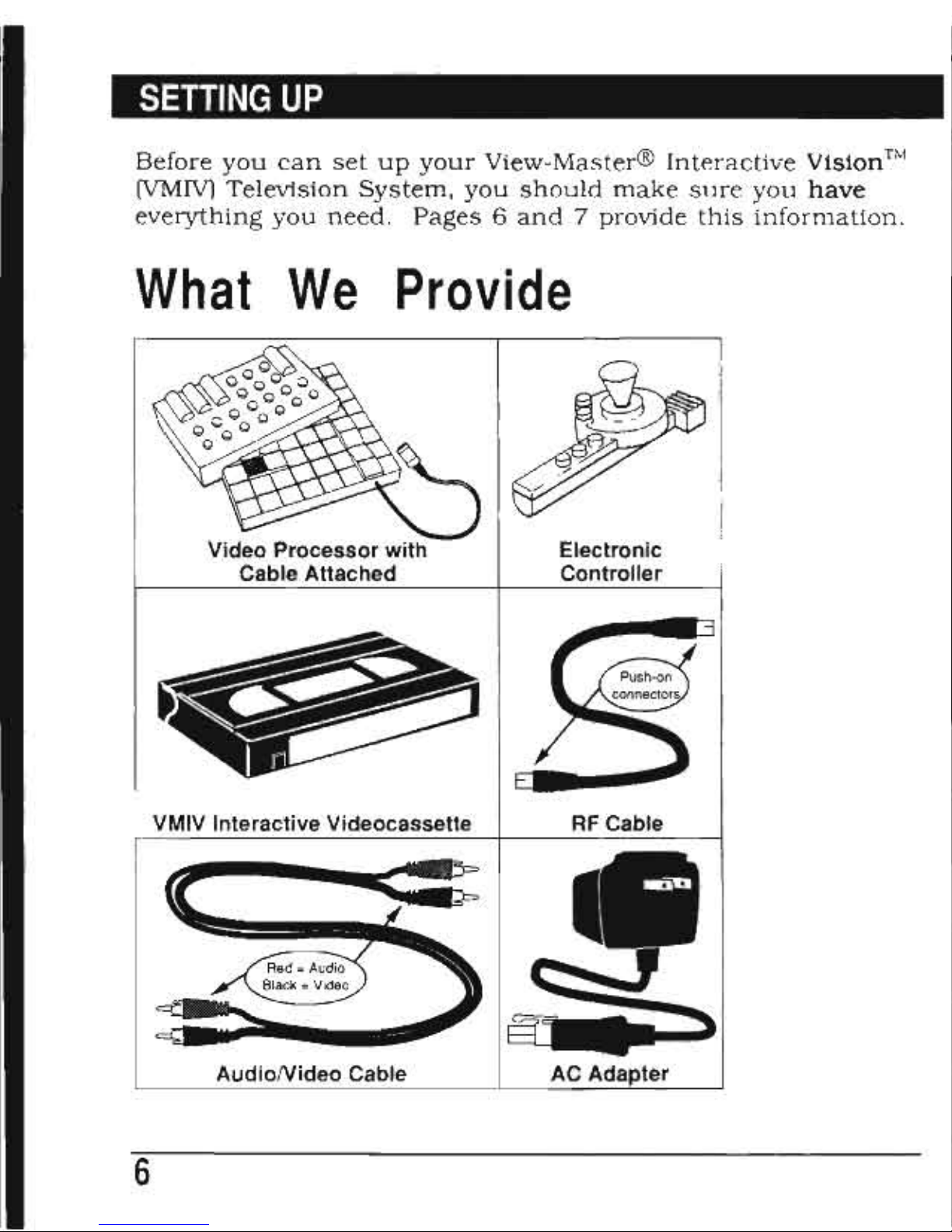
Before
you
can
set
up
your
View-
Master®
Interactive
Vision
™
(VMN}
Television
System,
you
should
make
sure
you
have
everything
you
need.
Pages
6
and
7
provide
this
information.
What
We
Provide
Video Processor with Electronic
Cable Attached
Controller
VMIV Interactive Videocassette
RF
Cable
AudioNideo Cable
AC Adapter
6
Page 9
I
SETTING
UP
What
You
Provide
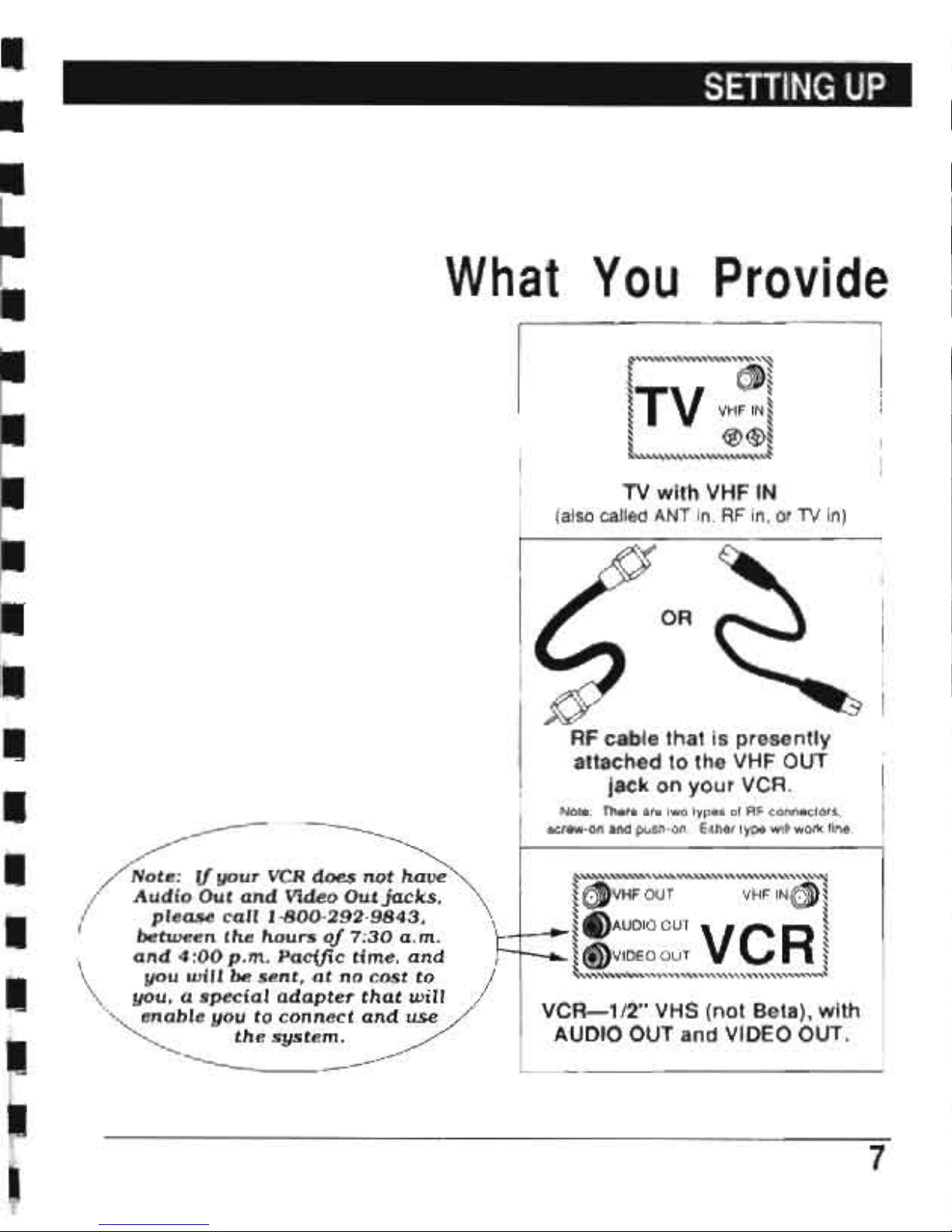
Note: ifyour
VCR
does
not
have
Audio
Out
and
Video
Out
jacks,
please
call
1-800-292-9843,
between
the
hours of7:30
a.m.
and
4:00
p.m.
Pacljic
time,
and
you
will
be
sent,
at
no
cost
to
you, a special
adapter
that
will
enable
you
to
connect
and
use
the
system.
TV
with
VHF
IN
(also called ANT in,
RF
in, or TV in)
RF
cable that
is
presently
attached
to
the VHF OUT
jack
on
your
VCR.
Note: There
are
two types
of
RF
connectors,
screw-on and push-on. Either type will
worK
fine.
VCR-1/2"
VHS (not Beta), with
AUDIO OUT and VIDEO OUT.
7
Page 10

SETTING
UP
Step-By-Step
Installation
1.
Turn
off
your
VCR
and
TV.
2.
Adjust
switch
settings:
•
Channel
switches
on
the
back
of
VCR
and
the
View-Master®
Interactive
Vision™ Television
/stem
(VMN)
should
both
be
set
to 3 or
4.
•
The
1V
should
be
tuned
to
the
same
channel
(either 3 or
4).
3.
Connect
the
Electronic
Controller
Unit.
Take
the
black
cable
attached
to
the
front
of
the
VMN
Video
Processor,
and
attach
it
to
the
Electronic
Controller
Unit
with
its
joystick
and
buttons.
A
small
rib
has
been
added
to
make
sure
the
plug
fits
only
in
one
position.
Align
the
plug
carefully.
8
Page 11

SETTING
UP
4.
Find
the
cable
attached
to
your
VCR
at
the
jack
labelled
VHF
OUT.
(Depending
on
the
VCR,
this
jack
may
also
be
called
RF
OUT,
OUT
to
IV,
IV
OUT,
or
something
similar.)
See
what
the
other
end
of
that
cable
is
attached
to.
If
the
cable
connects
...
A.
B.
C.
D.
...directly
to
your
1V
(for
stereo
lV,
see
D.
below)
...to
a
cable
converter
box
...to a switch
box
to
which a cable
converter
box,
electronic
game
or
home
computer
is
also
connected
-
..,
to
your
stereo
1V,
with
audio
and
video
cables
also
attached
(Please
read
"A
Note
on
Stereo,"
page
18)
I
See
Page
10
.
I
See
Page
12.
1
-
SeePage
14.
1
I
See
Page
16.
I
Abbrevi'ated
Instructions
(for
the
technically
inclined)
•
From
the
viewpoint
of
signal
flow.
the
View-Master@
Interactive
Vision™
(VMIVl
should
always
be
positioned
immediately
after
the
VCR.
Television
System
•
When
the
VMIV
is
turned
off,
the
RF
signal
is
passed
through
(via RF IN
and
RF
OUT)
to TV
without
being
modified.
•
Interactive
videocassettes
are
encoded
for
interactions.
Code.
graphics.
and
sound
for
the
games
and
other
interactions
are
passed
to
VMIV
for
processing.
This
data
travels
via
AUDIO/VIDEO (RCA cables) from
the
VCR to
VMIV.
•
VMIV
sends
its
signal
to
the
TV via
the
RF cable.
9
Page 12

SETTING
UP
Configuration
A:
Your
VCR
connects
directly
to
your
TV.
Your
current
configuration
looks
something
like
this:
~":,:,:,:,
..
,:":,:,:":,..,:,"""'S
~"""""""""""""""""~
Antenna
~
d)~..
~~
da01d}=~~VHFOUT
VHFIN~~o~able
~
TV
VHF
IN
~
OR
~
eAUDIO
OUT
~
~
@®~
......
---
Dis~onnect
this
~
~VIDEO
OUT VCR
~
"
~
cable
at
VCR S t:!fU
~
""""""""""""~
~"""""""""""""""""""
Configuration
A,
Without
VMIV
•
Disconnect
the
cable
attached
to
the
VHF
OUT
jack
on
the
VCR.
•
Attach
that
cable
to
the
View-Master®
Interactive
Vision™
Television
System
as
illustrated
on
the
next
page.
10
Page 13

•
Attach
the
other
cables
as
illustrated
below.
CH. :
LJ
(Q)
t1)
JJ,
1 2 3
Ii]
RFOUT RFIN e
~
m
AUO
AUDIO IN VIDEO IN
AC
SETTING
UP
'I
~",
..
\""",..\""""" ..,..,..""""",..""",..",
..
,~
AnI. 0 r
~
~O
VHF OUT
~
~
Cable
~~
VHF
INQJJ
~~
~
4'\AUDIO
OUT
~
~
...
~
~W1
VCR~
~
<l)VIDEO
OUT
I
~
~"""""""""""""""""~
I
Configuration
A,
With
VMrV
Connected
I
I
I
I
11
Page 14

SETTING
UP
Configuration
B:
Your
VCR
connects
to
a
cable
converter
box.
If
the
cable
attached
to
the
VHF
OUT
jack
on
your
VCR
goes
to a cable
converter
box
instead
of
straight
to
the
1V.
your
current
configuration
looks
something
like
this:
Antenna
""""""""""""""""",,~
~~
~
or
cable
~
0I
VHF
OUT
VHF
IN
~
~
...
~~
~~
~
..,AUDIO
OUT
~
~
VCR~
~
<i»VIDEO
OUT
~
s...""""""""""""""""",'l
Configuration
8,
Without
VMIV
•
Disconnect
the
cable
attached
to
the
VHF
OUT
jack
on
the
VCR.
•
Attach
that
cable
to
the
View-Master®
Interactive
Vision™
Television
System
as
illustrated
on
the
next
page.
12
Page 15

SETTING
UP
•
Attach
the
other
cables
as
illustrated
below.
To TV
...
~""""""""~""""""""""~
~
CABLE
IN~~
s
~
~
CON'VERTER
~
s~
~
~tQl0UT
BOX
~
~""""""""""""""""""'~
(Must be set
to
3 or
4,
whichever
is
not broadcast
in
your area)
CH.3
e
]
123
4
(Q)
(Q)
4'\
~
ID
RFOUl
RFIN
.,
WI
AUO
AUDIO IN VIDEO IN
~""""'
.." """"""""" ..",
""""'"
""""'~
Ant.
0 r
~
~VHF
OUT
~
~
Cable
~~
VHFINtQI~"'"
~
_AUDIO
OUT
~
~
~
<l)VIDEO
OUT
VCR~
~
~"""""""""""""""""~
Conf,iguration
'8,
With
VMIV
Connected
13
I
Page 16

SETTING
UP
Configuration
C:
Your
VCR
connects
to
a
switch
box.
If
the
cable
attached
to
the
VHF OUT
jack
on
your
VCR
goes
to a
switch
box
instead
of
straight
to
the
1V,
your
current
configuration
looks
something
like
this:
~"""':,
..
,:,:,:,,",..,:,:,,""",..,:,,'..,
..
,:,:,,":,:,:,:,,~
From cable converter box, electronic
~
~~
game, home computer, etc. ,
~
IN
~~
...
'\"""""""""""""""""'"
Antenna
S
~
~
SWITCH BOX
~
S
~
~
~
~
QJvVHF
OUT
SAS\
~
or cable
VHF
IN~
~
...
~s
'
~
~
~
..,AUDIO
OUT
~
T.TV
~((JOUT
IN®l~
~<iDVIDEOOUT
VCR~
~~"""""""""""""""""'~
s.""""""""""""""""",-'
Configuration
C,
Without
VMIV
•
Disconnect
the
cable
attached
to
the
VHF
OUT
jack
on
the
VCR.
•
Attach
that
cable
to
the
View-Master®
Interactive
Vision™
Television
System
as
illustrated
on
the
next
page.
14
Page 17

SETTING
UP
•
Attach
the
other
cables
as
illustrated
below.
~"""
..
,:,:,:,"'..,:,:,':,:,""'..,..,:,'..,:,:,..,..,:,.,:,..,:"
From
cable
converter
box,
electronic
~ ~
~
~~
game,
home
computer,
etc.
~
IN
IQJP~
,.
~"""""""""""""""""~
Ant. or
~ ~ ~
~O
VHF OUT
~
Cable
~
SWITCH BOX
~
~~
VHFIN(Q)~~
~
~
~
AS.'\AUDIO OUT
~
To TV
~
~
~II'IJ
VCR~
~d)
OUT
IN
~~
~
C!DVIDEO
OUT
~
•
~~"""""""""""""""""""
~"""""""""""""""""~
II
w
AC
CH.:
DC)
(Q)
RFOUT
RF
IN
@D
e
AUDIO IN VIDEO IN
123
li:l
AUD
(Must
be
switched to VMIV input) .
Configuration
C,
With
VMIV
Connected
I
Page 18

SETTI~JG
UP
Configuration
0:
Your
VCR
connects
to
a
stereo
TV,
with
audio
and
video
cables
also
attached.
If
the
cable
attached
to
the
VHF
OUT
jack
on
your
VCR
goes
to a stereo
1V,
and
you
also
have
audio
and
video
cables
connecting
the
VCR
to
the
1V,
your
current
configuration
looks
something
like
this:
~'''''''''''''''''''''''''''''':~
~"""""""""""""'''''''''''~
Antenna
~
~s
~~
~
or cable
~
VHF
INlQI~
~tQ;vVHF
OUT VHF
IN6)
~
...
~
TV AUDIO 1
INe~
~
t)AUDIO
1 OUT
~
~,6'\~
~
4"\
~
~
AUDIO 2
IN..,~
~
\UJAUDIO
2 OUT
~
~
VIDEO
IN<iD~
~.II!!!8ii~IBIlIBIlIl!!Z~~~i8Sii1888s4i
II~~
<i)VIDEO
OUT VCR
~
s.."""""""",,-,,,,,,,,,,~
~""""""""""""""""'-,~
Configuration
D"
Without
VMIV
•
Disconnect
the
cable
attached
to
the
VHF
OUT
jack
on
the
VCR.
Attach
that
cable
to
the
View-Master®
Interactive
Vision™
Television
System
as
illustrated
on
the
next
page.
•
Also
disconnect
the
audio
~i·Wl
!
and
video
cables
from
the
.......
;.:.
VCR.
Refer
to
pages
18-19
~II
&*
for a note
on
how
to
utilize
these
cables
to
maintain
stereo
capability.
16
Page 19

SETTING
UP
•
Attach
cables
as
illustrated
below.
'(Note: To
maintain
stereo
capability,
please
read
"A
Note
on
Stereo"
on
pages
18-19.)
VMIV
CH:
LJ
'
12
~T
~
~
(i) i
AUD
AUDIO IN VIDEO
IN
AC
Configuration
D,
With
VMIV
Connected
See "A Note
on
Stereo"
on
page 18.
17
I
Page 20

SETTING
UP
A
Note
on
Stereo
No
matter
what
type
of
stereo
configuration
you
have,
you
will
be
able
to
use
the
View-Master®
Interactive
Vision
™
Television
System
(VMIV)
with
no
problem.
•
If
your
TV
has
MTS
(multi
-channel
television
sound)
capability,
broadcast
stereo
will
be
transmitted
to
the
TV
through
the
RF
cable
as
normal.
• If
your
stereo
or
Hi-Fi
TV
receives
its
audio
and
video
signal
from
the
VCR's
AUDIO
OUT
and
VIDEO OUT
jacks,
then
you
can
install
the
VMIV
as
diagrammed
on
page
17
for
normal
monaural
operation.
The
VIDEO OUT
and
one
of
the
AUDIO OUT
signals
will
be
diverted
to
the
VMN,
and
a
monaural
(or MTS)
RF
signal
will
be
transmitted
to
the
TV.
•
To
maintain
Hi-Fi
or
stereo
capability,
you
can
purchase
two
addi
tiona!,
inexpensive
RCA
V-connector
cables
(illustrated
at
the
right)
which
are
readily
available
in
most
consumer
electronics
stores.
Install
them
as
ill
ustra
ted
in
the
diagram
on
page
19.
18
Page 21

SETTING
UP
A
Note
on
Stereo
(continued)
Ant. or
~"""""""""""""""""~
~~
~
Cab1le
~
0J;;IVHF OUT
VHF
INcQJ
~~
~
.4'\AUDIO
1 OUT
~
~~
~
s
AS.\
s
~VAUDIO
2 OUT
~
~t5.\
VCR~
~
\!U
VIDEO OUT
~
s..""""""""""""""""",\
VMIV
CH':
EJ
•
123
6)
~
[L]
AF
OUT RFIN
~
e
1m
AUD
AUDIO
IN
VIDEO
IN
AC
Configuration
0,
With
VMIV
and
Stereo
•
When
the
Y-connectors
have
been
installed,
you
will
have
I
two
different
sets
of
input
to
the
1V.
Your
1V
probably
I
has
a
switch
in
the
front
panel
for
choosing
between
these
input
options.
To
operate
the
VMIV,
you
will
set
the
1V
to
ANT IN,
VHF
IN,
1V
IN,
or
RF IN,
and
you
can
simply
switch
to
EXT
IN
or
VIDEO
IN
for
normal
stereo
operation.
19
I
Page 22

OPERATING
THE
SYSTEM
Starting
U'p
1.
Slide
the
square
switch
to
tum
the
View-
Master®
Interactive
Vision™
Television
System
(VMIV)
on.
2.
Tum
the
TV
and
VCR on.
Tune
the
TV
to
channel 3 or
4.
to
match
the
switch
settings
on
your
VCR
and
VMIV.
3.
Insert
the
interactive
videocassette
into
the
VCR.
4.
Press
"Play"
on
the
VCR. (Note:
In
these
operating
instructions.
all
videotape
operations.
such
as
playing.
pausing.
rewinding.
and
fast
forwarding.
apply
to
controls
on
your
VCR.)
5.
The
first
time
you
use
any
interactive
videocassette.
be
sure
to
view
the
instructions
at
the
beginning.
Starting
and
Stopping
• Yellow
stripes
appear
on
the
video from
time
to
time
as
indicators
for good
points
to
start
or
restart
the
tape.
The
best
place
to
start
or
stop
the
tape
is
during
the
display
of
these
yellow
stripes.
You
can
start
the
tape
from
anywhere.
but
if
the
yellow
stripes
are
not
visible
at
your
starting
point.
the
interactive
features
of
the
tape
may
not
function
immediately.
Replaying
an
Interaction
1.
Find
the
interaction
you
want
to replay.
2.
Rewind
the
tape
to
the
first
set
of
yellow
stripes
before
that
interaction.
3.
Play
the
tape
at
normal
speed.
Yellow stripes
appear
at
the
edges of your
TV screen
20
Page 23

-
-----
-
OPERATING
THE
SYSTEM
Paus,ing
•
The
best
place
to
pause
is
when
you
can
see
the
yellow
stripes:
the
system
will
function
normally
when
you
resume
play. If
you
pause
at
other
places
on
the
tape.
some
interactive
features
of
the
tape
may
be
temporarily
suspended.
Remember.
pausing
should
not
be
used
frequently.
because
it
will
gradually
degrade
any
videotape.
Rew'inding
and
Fast
Forwarding
•
The
yellow
stripes
that
appear
on
the
video
from
time
to
time
prOVide a
starting
point
to
replay
an
interaction.
If
you
fast-forward
or
rewind
the
tape
to a
point
where
the
yellow
stripes
are
visible.
then
the
interaction
that
starts
after
that
stripe
display
will
work
normally.
•
To
replay
the
entire
video.
you
should
rewind
to
the
first
set
of
yellow
stripes.
•
You
can
rewind
or
fast
forward
to a favorite
interaction
by
searching
until
you
see
the
yellow
stripes
on
the
screen
just
before
that
interaction
begins.
Adjusting
Sound
Levels
•
Some
VCRs
may
require a simple
adjustment
to
make
the
sound
levels
equal.
The
audiO
switch
(on
the
back
of
the
VMN
Video
Processor)
is
factory-set
to
audio
level 1.
If
dUring
play
you
notice a .marked
difference
in
volume
(for
example.
if
the
sound
is
loud
and
then
too
soft),
try
an
audio
switch
setting
of 2 or
3.
Quitting
•
If
you
are
done.
rewind
the
videocassette
the
entire
way,
eject
the
tape.
place
it
in
its
protective
sleeve.
and
turn
off
the
VMIV.
Remember-
rewinding
completely
will
prolong
the
life
of
any
videocassette.
•
Your
TV
and
VCR
will
now
operate
normally.
21
Page 24

TROUBLE-SHOOTING
Symptom
Possible
Remedy
I
get
no
picture
on
my
IV
screen.
Make
sure
the
TV
and
VCR
are
both
turned
on
and
the
power
cords
are
plugged
in.
Turn
the
VMIV
on
and
off;
see
if
this
has
any
I
,effect
on
the
picture.
If it
has
no
effect,
your
I
cables
are
not
connected
properly.
Return
to
the
appropriate
SEITING
UP
diagram
to
double-check
your
cable
connections.
I
get a clear
picture
but
no
sound.
I
Check
your
TV
volume.
The
audio
cable
may
not
be
connected
properly.
Note: If
your
TV
has a setting
for HRC,
this
has a special
encoding
for
the
audio
signal
which
is
incompatible
with
the
VMIV.
Do
not
use
HRC;
use
settings
for
antenna
or
cable
(CATV).
The
receiving
mode
on
your
,TV
must
be
set
to
channel 3 or
4.
I
The
audio
is
sometimes
louder
and
sometimes
quieter.
Adjust
the
audio
switch
(on
the
back
of
the
VMIV
Video
Processor)
to a different
setting.
The
audio
makes a "crackling"
sound.
I
Adjust
the
tracking
knob
on
your
VCR
Refer
to
your
VCR
manual
for
details.
The
sound
is
sometimes
on
and
sometimes
off
Check
the
connections
of
the
audio
cables.
Regular
TV
programs
or
VCR
videos
don't
play.
Turn
off
the
VMIV
Video
Processor.
Check
the
configuration
of
the
following
cables:
{I)
The
cable
from
VHF
OUT
on
the
,VCR to
RF
IN
on
the
VMIV:
and
(2)
the
cable
from
RF
OUT
on
the
VMIV
to
VHF
IN
on
the
TV.
(Return
to
the
appropriate
SE1TING
UP
diagram
to
double-check
your
cable
connections.)
I
22
Page 25

TROUBLE-SHOOTING
Symptom
Possible
Remedy
VMN
is
turned
off.
but
my
1V
only
works
on
Channel
3.
Turn
off
your
VCR.
The
interactive
tape
plays,
but
I
:
can't
get
any
interaction.
I
I
I
I
Make
sure
the
VMIV Video
Processor
is
turned
on.
With
VM1V
connected, I can't
get
stereo
on
the
1V.
Refer
to
"A
Note
on
Stereo."
page
18.
Interactive
functions
don't
work.
I
Start
the
interactive
tape
at
the
beginning
or
at
the
yellow
stripes.
Picture
isjuzzy,
has
no
color,
has
snow,jitters
or
noise
lines.
I
Make
sure
the
switch
settings
on
the
back
of
the
1V,
the
VCR,
and
the
VMIV
are
all
set
to
3
or
4 {whichever
is
not
broadcast
in
your
area}. I
If all
the
switch
settings
are
on
the
same
number,
and
you
are
still
experiencing
problems,
you
may
be
getting
local
broadcast
interference.
Try
changing
the
switch
settings
to
the
alternate
channel.
Customer
Support
If
none
of
the
above
remedies
correct
the
problem,
call
our
toll-free
hot
line
for
customer
service
at
1-800-292-9843,
between
the
hours
of
7:30
a.m.
and
4:00
p.m.
Pacific
time.
I
23
Page 26

CARE
AND
MAINTENANCE
Care
and
Maintenance
• Do
not
use
any
Power
Adapter
other
than
the
AC
Adapter
included
with
the
View-Master®
Interactive
Vision
TYI
Television
System
(VMIV).
• Always
turn
the
Video
Processor
Power
Switch
OFF
when
not
in
use.
•
It
is
not
recommended
that
you
unplug
the
Remote
Control
Cable
from
the
Electronic
Controller
Unit
once
it
is
connected.
However,
if
your
Electronic
Controller
Unit
needs
cleaning,
turn
off
the
Video
Processor
and
unplug
the
Remote
Control
Cable.
Then
you
may
wipe
the
Electronic
Controller
Unit
with a damp
cloth.
(Do
not
spray
cleaners
or
water
on
the
unit.)
Then
plug
it
back
in.
• Do
not
disassemble
or
attempt
to
repair
VMlV.
Doing
so
will
automatically
void
all
warranties.
•
Periodically
examine
the
VMlV
components
for
potential
hazards,
and
be
sure
to
repair
or
replace
any
potentially
hazardous
parts.
• Allow
proper
ventilation
for
the
Video
Processor
while
the
system
is
in
use.
Do
not
obstruct
heat
vents
on
the
Video
Processor
by
placing
objects
(magazines,
newspapers,
etc.)
on
top
of
it.
•
During
operation,
do
not
place
the
Video
Processor
o~
any
"soft"
surface
(bed,
sofa,
pillow, etc.)
that
might
block
the
air
vents
on
the
bottom
of
the
unit.
•
Rewind
all
your
videocassettes
completely
in
order
to
keep
them
in
the
best
condition.
•
Store
VMIV
Interactive
Videocassettes
i.n
their
protective
sleeves
when
not
in
use.
24
Page 27

FCC
REGULATIONS
FCC
Regulations
This
system
generates
and
uses
radio
frequency
energy,
and
if
not
installed
and
used
properly,
that
is,
in
strict
accordance
with
the
manufacturer's
instructions,
may
cause
interference
to
radio
and
television
reception.
It
has
been
type
tested
and
found
to
comply
with
the
limits
for a
Class
B
computing
device
in
accordance
with
the
specifications
in
Subpart
H
of
Part
15
of
FCC
Rules,
which
are
designed
to
provide
reasonable
protection
against
such
interference
in a residential
installation.
However,
there
is
no
guarantee
that
interference
will
not
occur
in a particular
installation.
]f
this
equipment
does
cause
interference
to
radio
or
television
reception,
which
can
be
detennined
by
turning
the
eqUipment
off
and
on,
the
user
is
encouraged
to
try
to
correct
the
interference
by
one
or
more
of
the
following
measures:
•
Reposition
the
antenna
on
the
radio
or
TV
that
is
experiencing
interference.
•
Relocate
VMIV
with
respect
to
the
radio
or
TV
that
is
experiencing
in
terference.
• Move VMIV
away
from
the
radio
or
TV
that
is
experiencing
interference.
•
Plug
VMIV
into a different
outlet
so
that
VMIV
and
the
radio
or
TV
are
on
different
circuits.
•
Plug
VMIV
into a three-prong
isolation
adapter
(available
in
an
electrical
supply
store).
25
Page 28

View-Master®
Interactive
Vision™
Television
System
and
Program
Software
©1988
IDEAL.
INC
..
a
subsidiary
of View-Master Ideal
Group.
Inc
..
Box 100.
Portland.
OR
97207
View-Master®
Interactive
Vision™
is
based
upon
concepts
developed
by
AC1V. Inc.
U.S.
and
Foreign
Patents
Pending.
View-Master®
Interactive
Vision™
Television
System
Installing
and
Operating
Instructions
©1988
View-Master Ideal
Group.
Inc.
Printed
in
U.S.A.
Assembled
in
the
U.S.A. from
domestic
and
foreign
components.
Package
labelled
to
show
countries
of origin.
I
 Loading...