

Page 1

VERTU Constellation Quest
Reference Manual
Page 2

Contents
Preface- - - - - - - - - - - - - - - - - - - - - - - - - - - - - - - - - - - - - - - - 5
Conventions used in this guide....................................................................... 5
Health and safety - - - - - - - - - - - - - - - - - - - - - - - - - - - - - - - - 6
General........................................................................................................... 6
Operating environment ................................................................................... 6
Electronic devices .......................................................................................... 6
Battery safety ................................................................................................. 7
Wall charger safety......................................................................................... 7
Taking care of your phone - - - - - - - - - - - - - - - - - - - - - - - - - 8
General........................................................................................................... 8
Battery............................................................................................................ 8
Ceramics and sapphire .................................................................................. 8
Leather ........................................................................................................... 8
Metal .............................................................................................................. 9
Introducing your Vertu phone - - - - - - - - - - - - - - - - - - - - - 10
Access codes ............................................................................................... 10
Getting help and support .............................................................................. 11
Getting started- - - - - - - - - - - - - - - - - - - - - - - - - - - - - - - - - 12
Vertu package contents................................................................................ 12
Vertu phone layout - front ............................................................................. 12
Setting up your phone .................................................................................. 14
Home key ..................................................................................................... 18
My Key ......................................................................................................... 18
Dedicated keys............................................................................................. 19
Select keys ................................................................................................... 19
QWERTY keyboard...................................................................................... 19
Status bar icons............................................................................................ 20
Lower status bar icons.................................................................................. 20
Commands and audible indicators ............................................................... 21
Setting up your phone - - - - - - - - - - - - - - - - - - - - - - - - - - - 22
Setting up your phone for the first time ......................................................... 22
Vertu Startup Wizard .................................................................................... 22
Switch........................................................................................................... 23
Home screen and clock - - - - - - - - - - - - - - - - - - - - - - - - - - 24
Home screen ................................................................................................ 24
Information area ........................................................................................... 24
Dynamic Information area............................................................................. 27
Notification zone........................................................................................... 27
Media feeds.................................................................................................. 27
Menu.............................................................................................................29
Task viewer ...................................................................................................30
Control panel.................................................................................................30
Setting up your personal and business preferences......................................31
Security- - - - - - - - - - - - - - - - - - - - - - - - - - - - - - - - - - - - - - 32
Security Settings ...........................................................................................32
Phone and SIM card security ........................................................................32
Other security measures: restricting calls......................................................34
Certificate manager.......................................................................................34
Protected Content: Digital Rights Management (DRM) .................................35
View and edit security modules .....................................................................36
Browser security ...........................................................................................36
Call functions and Call Log - - - - - - - - - - - - - - - - - - - - - - - 37
Making a call .................................................................................................37
Speed dialing ................................................................................................38
Answering a call ............................................................................................39
In-call options ................................................................................................40
Voice mail .....................................................................................................41
Multiparty calls ..............................................................................................41
Call barring....................................................................................................42
Call settings ..................................................................................................42
Call forwarding ..............................................................................................43
Network.........................................................................................................44
Licenses........................................................................................................45
Call Log.........................................................................................................46
Making a video call........................................................................................47
Video sharing ................................................................................................48
Video sharing settings...................................................................................48
Share live video or video clips .......................................................................48
Accept an invitation .......................................................................................49
Contacts - - - - - - - - - - - - - - - - - - - - - - - - - - - - - - - - - - - - - 50
About Contacts .............................................................................................50
Working with contacts ...................................................................................50
Creating a new contact..................................................................................50
Send Contact information..............................................................................50
Editing a contact............................................................................................51
Deleting a contact .........................................................................................52
Contact groups..............................................................................................52
Copy and Duplicate (Manage) Contacts .......................................................53
Contacts memory ..........................................................................................54
2
Page 3

Contents
Service numbers .......................................................................................... 54
Contacts settings.......................................................................................... 55
Messages- - - - - - - - - - - - - - - - - - - - - - - - - - - - - - - - - - - - - 56
Message alerts ............................................................................................. 56
Messaging folders ........................................................................................ 57
Organize messages ..................................................................................... 57
Text messages ............................................................................................. 57
Multimedia messages................................................................................... 58
Emails........................................................................................................... 59
Speech messages and Message Reader ..................................................... 60
Presentations ............................................................................................... 60
Service messages ........................................................................................ 60
Cell broadcast .............................................................................................. 61
Messaging settings....................................................................................... 61
Email - - - - - - - - - - - - - - - - - - - - - - - - - - - - - - - - - - - - - - - - 64
Setting up your email accounts..................................................................... 64
Email settings ............................................................................................... 68
Vertu Services - - - - - - - - - - - - - - - - - - - - - - - - - - - - - - - - - 71
Vertu Concierge ........................................................................................... 71
Vertu Technical Support ............................................................................... 71
Vertu Remote Assist ..................................................................................... 71
Vertu Select.................................................................................................. 72
City Brief....................................................................................................... 72
Vertu Downloads .......................................................................................... 72
Registration .................................................................................................. 72
Calendar - - - - - - - - - - - - - - - - - - - - - - - - - - - - - - - - - - - - - 73
Calendar entries ........................................................................................... 73
Calendar settings ......................................................................................... 77
Camera - - - - - - - - - - - - - - - - - - - - - - - - - - - - - - - - - - - - - - 79
Camera setup ............................................................................................... 81
Working with captured images and videos ................................................... 82
Connectivity- - - - - - - - - - - - - - - - - - - - - - - - - - - - - - - - - - - 84
Data connections and access points ............................................................ 84
Network settings........................................................................................... 84
Wireless LAN................................................................................................ 85
Active data connections ............................................................................... 86
Sync ............................................................................................................. 86
Bluetooth connectivity .................................................................................. 87
Remote SIM mode ....................................................................................... 89
PC connections.............................................................................................89
Ovi Suite........................................................................................................90
Net Settings ..................................................................................................90
Working with the Internet - - - - - - - - - - - - - - - - - - - - - - - - 91
Internet..........................................................................................................91
Network destinations.....................................................................................91
Media feeds ..................................................................................................93
Web settings .................................................................................................95
Office Tools- - - - - - - - - - - - - - - - - - - - - - - - - - - - - - - - - - - 96
Active Notes..................................................................................................96
Calculator......................................................................................................96
File manager .................................................................................................97
Quickoffice ....................................................................................................97
Converter ......................................................................................................97
Zip Manager..................................................................................................98
PDF Reader ..................................................................................................98
Dictionary ......................................................................................................98
Notes ............................................................................................................99
Intranet..........................................................................................................99
Gallery- - - - - - - - - - - - - - - - - - - - - - - - - - - - - - - - - - - - - - 100
Gallery main view ........................................................................................100
Sound clips .................................................................................................100
Streaming links............................................................................................100
Presentations ..............................................................................................100
Songs..........................................................................................................101
Images ........................................................................................................101
Video clips...................................................................................................101
View images and videos..............................................................................101
Active toolbar ..............................................................................................102
Albums ........................................................................................................103
Tags ............................................................................................................103
Slide show...................................................................................................103
Edit images .................................................................................................104
Edit videos ..................................................................................................104
Print images ................................................................................................104
Home Network - - - - - - - - - - - - - - - - - - - - - - - - - - - - - - - 106
View and share media files..........................................................................107
Copy media files..........................................................................................108
Home synchronization.................................................................................108
3
Page 4

Contents
Media - - - - - - - - - - - - - - - - - - - - - - - - - - - - - - - - - - - - - - - 109
Radio.......................................................................................................... 109
Music Player............................................................................................... 111
Ovi music.................................................................................................... 112
Recorder .................................................................................................... 112
Share online ............................................................................................... 112
RealPlayer.................................................................................................. 114
Video center ............................................................................................... 115
Maps - - - - - - - - - - - - - - - - - - - - - - - - - - - - - - - - - - - - - - - 116
Welcome to Maps....................................................................................... 116
My position ................................................................................................. 116
Change the look of the map........................................................................ 117
Download and update maps....................................................................... 117
Using the compass ..................................................................................... 117
About positioning methods ......................................................................... 118
Find places ................................................................................................. 118
Favorites..................................................................................................... 119
Synchronize your Favorites ........................................................................ 119
Share location ............................................................................................ 120
Drive and Walk ........................................................................................... 120
Get traffic and safety information ................................................................ 121
Maps shortcuts ........................................................................................... 123
Map Settings .............................................................................................. 123
Positioning- - - - - - - - - - - - - - - - - - - - - - - - - - - - - - - - - - - 125
Positioning (GPS) ....................................................................................... 125
Application Manager - - - - - - - - - - - - - - - - - - - - - - - - - - - 129
Application Manager .................................................................................. 129
Remove applications and software............................................................. 130
Personal Settings - - - - - - - - - - - - - - - - - - - - - - - - - - - - - 131
Profiles ....................................................................................................... 131
Personalize the home screen ..................................................................... 132
Change the display theme .......................................................................... 132
Audio themes ............................................................................................. 133
Desk stand ................................................................................................. 133
Accessories - - - - - - - - - - - - - - - - - - - - - - - - - - - - - - - - - - 134
Battery........................................................................................................ 134
Wall charger ............................................................................................... 134
Data cable .................................................................................................. 135
SD card ...................................................................................................... 135
AV cable......................................................................................................135
Vertu Wired Headset...................................................................................136
Common accessory settings .......................................................................136
Maintenance - - - - - - - - - - - - - - - - - - - - - - - - - - - - - - - - - 137
Update software..........................................................................................138
Printing - - - - - - - - - - - - - - - - - - - - - - - - - - - - - - - - - - - - - 139
Printing........................................................................................................139
Troubleshooting - - - - - - - - - - - - - - - - - - - - - - - - - - - - - - 141
Specifications - - - - - - - - - - - - - - - - - - - - - - - - - - - - - - - - 143
Shortcuts - - - - - - - - - - - - - - - - - - - - - - - - - - - - - - - - - - - 144
Shortcuts.....................................................................................................144
Warranty and legal information- - - - - - - - - - - - - - - - - - - 146
Manufacturer’s limited warranty ..................................................................146
SAR Notice – RM-582V...............................................................................148
FCC/Industry Canada notice .......................................................................148
Declaration of conformity ............................................................................149
Export controls ............................................................................................149
Notices........................................................................................................149
Licenses......................................................................................................149
EU recycling notice .....................................................................................150
Passive Near Field Communication Device ................................................150
Glossary - - - - - - - - - - - - - - - - - - - - - - - - - - - - - - - - - - - - 151
Index - - - - - - - - - - - - - - - - - - - - - - - - - - - - - - - - - - - - - - - 153
4
Page 5
Preface
Preface
This wireless device is approved for use on EGSM 900 MHz, GSM 850/1800/
1900 MHz, and WCDMA Bands I, II, V, and VI. Contact your service provider for more
information about networks.
To use a device, you must have service from a wireless service provider. Some
features are not available on all networks; other features may require that you make
specific arrangements with your service provider to use them. Network services
involve transmission of data. Check with your service provider for details about fees
in your home network and when roaming on other networks. Your service provider
can explain what charges will apply.
Your service provider may have requested that certain features be disabled or not
activated in your device. If so, these features will not appear on your device menu.
Your device may also have customized items, such as menu names, menu order, and
icons.
To use any features in this device other than the alarm clock, the device must be
switched on.
When using the features in this device, obey all laws and respect all local customs,
privacy, and the legitimate rights of others, including copyrights.
Copyright protection may prevent some images, music, and other content from being
copied, modified, or transferred.
Content owners may use different types of digital rights management (DRM)
technologies to protect their intellectual property, including copyrights. This device
uses various types of DRM software to access DRM-protected content. With this
device, you can access content protected with WMDRM 10 and OMA DRM 2.0. If
certain DRM software fails to protect the content, content owners may ask that its
access to new DRM-protected content be revoked. Revocation may also prevent
renewal of the relevant DRM-protected content already in your device. Revocation of
DRM software does not affect the use of content protected by other types of DRM or
the use of non-DRM-protected content.
Remember to make backup copies or keep a written record of all important
information stored in your device.
Conventions used in this guide
WARNING: Indicates important information relating to safety.
IMPORTANT: Indicates important information not relating to safety.
NOTE: Indicates a point to be aware of when using your Vertu phone.
TIP: Represents useful information, such as a quick way to access a
feature.
Menu Represents text that appears on your Vertu phone’s display, for
example, “From the Home screen, select Menu.”
Copyright © Vertu 2010. All rights reserved.
Reproduction, transfer, distribution, or storage of part or all of the contents in this
document in any form without the prior written permission of Vertu is prohibited. Vertu
operates a policy of continuous development. Vertu reserves the right to make
changes and improvements to any of the products described in this document
without prior notice.
Under no circumstances shall Vertu be responsible for any loss of data or income or
any special, incidental, consequential, or indirect damages howsoever caused.
The contents of this document are provided as is. Except as required by applicable
law, no warranties of any kind, either expressed or implied, including, but not limited
to, the implied warranties of merchantability and fitness for a particular purpose, are
made with respect to the accuracy, reliability, or contents of this document. Vertu
reserves the right to revise this document or withdraw it at any time without prior
notice. The availability of particular products may vary by region. Please check with
Vertu C on c i er g e .
Vertu and the V logo are trademarks or registered trademarks. Other product and
company names mentioned herein may be trademarks or registered trademarks of
their respective owners.
5
Page 6

Health and safety
Health and safety
WARNING: Read the following simple guidelines. Not following them may
be dangerous or illegal.
General
• Do not attempt to dismantle the phone or any of its accessories. Only qualified
service personnel should repair your Vertu phone and its accessories.
• Do not touch the phone, battery, or wall charger with wet hands.
• Keep your Vertu phone and all parts and accessories out of the reach of small
children and pets. The SIM card and other small parts cause a choking hazard.
• Use only batteries and accessories approved by Vertu for use with this particular
model. The use of any other types may invalidate any approval or warranty, and
may be dangerous. In particular, use of unapproved chargers or batteries may
pose a risk of fire, explosion, leakage, or other hazard. For availability of approved
accessories, please check with your dealer.
• The bundled battery and wall charger are only for use with your Vertu phone.
Do not use this battery or charger with any other device.
• Before connecting your Vertu phone to another device, read the supporting
documentation to confirm that the other device is compatible.
Operating environment
• Observe all local safety regulations regarding the use of cell phones while driving.
• Pull off the road and park before making or answering a call.
• Do not stop on the shoulder of a freeway to answer or make a call, except in an
emergency.
• If using an integrated handsfree device, make sure the phone is securely placed in
its holder.
• Do not place the phone on the passenger seat or where it can break loose during
a collision or sudden stop.
• Only qualified personnel should install the device in a vehicle. Faulty installation or
service may be dangerous. For more information, consult your vehicle
manufacturer or representative.
• Vehicle air bags inflate with great force. Do not place objects, including either
installed or portable wireless equipment, in the area over the air bag or in the air bag
deployment area.
• Switch off your Vertu phone when refueling.
• Do not handle your Vertu phone when operating machinery.
• Switch your Vertu phone off if you are entering a hospital or health-care facility.
Medical equipment may be affected by phone use.
• Switch your Vertu phone off when travelling on an aircraft. The phone signal may
interfere with systems in the aircraft. You are legally bound to comply with this
recommendation.
• Switch your Vertu phone off in any facility where posted notices prohibit phone use.
Always follow building regulations governing phone use.
• Switch your Vertu phone off when blasting is in progress, and observe all provided
guidelines and regulations.
• Switch your Vertu phone off in areas with potentially explosive atmospheres, such
as fuel storage areas and spray paint facilities.
• Keep your Vertu phone away from fuel and chemicals.
Electronic devices
• If you wear a pacemaker, or are in the company of someone who does, you should
be aware that there is a small risk of cell phone use interfering with the operation of
the pacemaker. You should contact your doctor or the manufacturer of the
pacemaker for more information. If you have any reason to suspect that
interference is taking place, switch off your phone immediately.
• Persons with pacemakers should keep the phone more than 6 inches (15 cm) from
the pacemaker when the phone is on.
• Persons with pacemakers should not carry the phone in a breast pocket.
• Persons with pacemakers should use the ear opposite the pacemaker to minimize
the risk of interference.
• Mobile phone use may interfere with some hearing aids. If this happens, you
should contact your service provider or doctor for further information.
• Mobile phone use may interfere with the functionality of inadequately shielded
medical devices. Consult a physician or the device manufacturer to ensure safe
procedures are used.
• Mobile phone use may interfere with the functionality of any inadequately shielded
electronic system in a motor vehicle. Examples include air bags and fuel injection
systems. You should contact the manufacturer of the vehicle or system to ensure
that the system is properly shielded.
• Note that excessive sound pressure from earphones and headphones can cause
hearing loss. Consequently before you use any device with earphones and
headphones you should make sure that the volume levels are adjusted to a
comfortable level.
6
Page 7

Battery safety
• Stop using the battery if you detect any abnormalities, such as odor, discoloration,
or heat during use, charging, or storage.
• Do not use your Vertu phone with a damaged battery.
• Do not short-circuit the battery. Accidental short-circuiting can occur when a metallic
object causes a direct connection between the + and - terminals of the battery.
• Do not touch the battery terminals.
• Do not leave the battery in areas of extreme cold or heat.
• Do not store your Vertu phone in, or near, direct heat sources such as radiators.
This could cause the battery to overheat and explode.
• Never soak the battery in water or any other liquid.
• Never attempt to open the battery. The battery contains substances that may be
harmful if swallowed or allowed to come into contact with unprotected skin.
• In the unlikely event of a battery leak, be careful to keep the battery fluid away from
your eyes and skin. If the fluid does come into contact with eyes or skin, flush
thoroughly with clean water and consult a doctor.
• Do not dispose of the battery in a fire.
• Do not dispose off the battery in a regular waste container. The battery contains
toxic chemicals and must be disposed off appropriately. Contact your local
authorities for more information.
Health and safety
Wall charger safety
• Do not use a damaged or worn charger. The use of a damaged or worn charger
could result in electric shock, burns, or fire.
• Do not bend or twist the cable of the charger.
• Do not pull on the connected data cable to remove the charger plug from a socket.
Grasp the plug directly when unplugging the charger to avoid damaging the cable.
• Do not touch the pins of the plug when connecting or disconnecting it from a power
source.
• Never charge your Vertu phone when the connection point is damp or wet.
• Chargers must only be used in dry conditions. They should never be used when
damp or wet.
• Do not place heavy objects on the charger.
• When the charger is not in use, disconnect it from the power source.
7
Page 8

Taking care of your phone
Taking care of your phone
Your Vertu products have been crafted from some of the finest materials, and care
should be taken to keep them in good condition. Damage caused to your Vertu phone
by failing to observe these care instructions is not covered by the warranty.
• Only use a soft, clean cloth to clean your Vertu phone. Do not use chemicals,
detergents, abrasive substances, or any liquids. Use a cotton swab to clean the
camera lens.
General
• Always use your Vertu phone in the intended manner. Incorrect use may affect
performance.
• To avoid permanent damage to your Vertu phone, use only Vertu-approved
batteries and accessories.
• The bundled battery and wall charger are only for use with your Vertu phone.
Do not use this battery or charger with any other device. This could cause
permanent damage to the device, battery, or charger.
• Use only batteries and accessories approved by Vertu for use with this particular
model.
• Before connecting your Vertu phone to another device, read the supporting
documentation to confirm that the other device is compatible.
• Keep your Vertu phone and all parts and accessories out of the reach of small
children and pets.
• Do not allow your Vertu phone, battery, or accessories to come into contact with
liquids or moisture. If your Vertu handset accidentally gets wet, dry it completely
with a soft, absorbent cloth before removing the back cover. Remove the battery
and leave all parts to dry naturally. Do not apply heat.
• Do not use or store your Vertu phone in dusty or dirty locations.
• Do not use or store your Vertu phone in hot or cold areas.
• Do not open your Vertu phone unless absolutely necessary. Before replacing the
back cover, ensure that the interior of the phone and the back cover seals are dry,
clean, and free of any foreign objects.
• Do not mishandle or abuse your Vertu phone.
• Do not apply paint or similar substances to your Vertu phone.
• Interference may affect the performance of your Vertu phone. This is normal and
the phone should operate normally once you move away from the source of the
interference.
• If your Vertu phone or any of the accessories are not working as they should,
please consult your dealer. They can provide you with the expert assistance you
require.
• Do not attempt to disassemble your Vertu phone. Only Vertu-authorized personnel
should service the phone.
Battery
• Do not leave the battery connected to the charger and power source for longer than
necessary. This will result in repeated short charging, which will reduce battery
performance and life span. Disconnect the charger when the battery is full.
• Do not leave the battery in areas of extreme cold or heat. This could affect the
performance and lifetime of the battery. A device with a hot or cold battery may not
work temporarily. The battery's optimum performance is in an ambient temperature
between +59°F (+15°C) and +77°F (+25°C).
• Only remove the battery with the phone switched off.
Ceramics and sapphire
Ceramics and sapphire are very hard materials, but are also brittle and can be
scratched by harder materials or objects. They can also be damaged if dropped.
• Avoid contact between your Vertu phone and hard materials, such as diamond
jewelry, nail files, abrasives, and mineral crystals.
• Do not drop or knock your Vertu phone on hard surfaces.
• Avoid repeated rubbing of your Vertu phone against hard surfaces.
Leather
All Vertu leather products are made by expert craftsmen. Each leather hide is unique
and has natural markings that should be considered part of the individuality of fine
leather. All leather can be damaged and should be treated with care.
• Avoid exposing your Vertu phone to water and high humidity.
• Avoid dropping, knocking, or rubbing your Vertu phone against hard surfaces.
• Do not expose your Vertu phone to extreme temperatures.
• Avoid contact between your Vertu phone and oily substances, makeup, or solvents.
8
Page 9

Metal
Vertu metals are finished to a high standard and care needs to be taken to maintain
their appearance.
• Avoid contact between your Vertu phone and chemicals such as solvents, alkaline
and acid solutions, cola-based drinks, and salt water. If contact occurs, wipe with a
clean, soft cloth as soon as possible.
• Avoid contact between your Vertu phone and sharp objects.
• Avoid dropping or knocking your Vertu phone on hard surfaces.
• Do not use metal polishes on your Vertu phone.
Hallmarks
If you own a gold Vertu phone, the hallmarks are stamped on your phone to
authenticate the precious metal used. Precious metal is tested to ensure that the
purity of the alloy conforms to the exacting standards of the European Convention
mark used under the jurisdiction of the Swiss Assay Office.
The hallmark is made up of several stamps, each of which have an individual
meaning. The stamp is located adjacent to the Vertu logo on the back cover of your
phone.
The assay stamp is made up of five marks as follows:
• Serial number.
• Vertu brand mark.
• Common control mark denoting the European Convention mark - 750 (18 carat
gold) in scales.
• Fineness (purity) mark - AU750, (18 carat gold).
• St. Bernard dog’s head - the Swiss Assay mark.
Taking care of your phone
9
Page 10

Introducing your Vertu phone
Introducing your Vertu phone
Your new Vertu phone is a feature-rich smartphone with a QWERTY keyboard plus a
high-resolution, VGA, 640 x 480 pixel screen. The phone includes a desktop-like
email client, a highly functional Web browser, and the ability to multitask. Such
flexibility makes it an ideal business tool as well as a phone that is highly capable for
managing your personal activities.
• The feature-rich clock automatically displays your local time and, when you travel,
both your local time at home and the time in your current time zone.
• The network time function automatically maintains accurate time.
• The analog clock displays appointments and alarms, helping you with time
management at a glance.
• A Notification area displays information about recent messages, emails, and
missed calls.
• Quick access to the Vertu City Brief feature allows you to quickly find information
about your home or other city.
• The Concierge button gives you access to the Concierge service and technical
support. Both services are available by voice or email. Use Concierge services for
all your lifestyle needs, and contact Technical Support for any technical issues
concerning your phone.
• News feeds and Vertu Select feeds are displayed on the home screen, keeping
you up to date with the latest news and developments.
• Assisted GPS (A-GPS) along with global maps and navigation software makes it
easy for you to find your way to unfamiliar locations.
• This Vertu phone includes a 5-megapixel camera with autofocus, a media player,
and FM radio.
• 40-GB (8+32) memory is available to store your personal data, including photos
and music.
Access codes
For further assistance with access codes and security, refer to “Security Settings” on
page 32 or contact Vertu Technical Support for help.
• Personal identification number (PIN) code — This code protects your SIM card
against unauthorized use. The PIN code (4–8 digits) is usually supplied with the
SIM card. After three consecutive incorrect PIN code entries, the code is blocked
and you need the PUK code to unblock it.
• UPIN code — This code may be supplied with the USIM card. The USIM card is
an enhanced version of the SIM card and is supported by 3G mobile phones.
• PIN2 code — This code (4–8 digits) is supplied with some SIM cards and is
required to access some functions in your device.
• Lock code (also known as security code) — The lock code helps you protect your
device against unauthorized use. The preset code is 12345. You can create and
change the code and set the device to request the code. Keep the new code
secret and in a safe place separate from your device. If you forget the code and
your device is locked, you should contact Technical Support. Additional charges
may apply, and all the personal data in your device may be deleted. For more
information, contact Vertu.
10
Page 11

Introducing your Vertu phone
• Personal unblocking key (PUK) code and PUK2 code — These codes (8 digits)
are required to change a blocked PIN code or PIN2 code, respectively. If the
codes are not supplied with the SIM card, contact the network service provider
whose SIM card is in your device.
• UPUK code — This code (8 digits) is required to change a blocked UPIN code. If
the code is not supplied with the USIM card, contact the network service provider
whose USIM card is in your device.
IMEI number
International mobile equipment identity (IMEI) number — This number (15 or 17
digits) is used to identify valid devices on the GSM network. Phones that are stolen
or lost can be blocked from accessing the network. The IMEI number for your phone
is found in the battery compartment under the battery.
The serial number for your phone is stamped on the battery cover.
Getting help and support
To find out more about using your phone, or if you are unsure how your phone should
function, there are a number of ways you can get help.
• Contact Technical Support. You can call or email Vertu Technical Support using
the Concierge key.
• Contact Vertu Concierge, there to assist you with any issue. Concierge offers
personal and sophisticated Help facilities by phone as well as email.
• Use the In-device Help or this user guide.
• Setup wizards available on the phone in Menu > Ctrl. Panel > Sett. wizard help
you with registration and email installations.
If you cannot resolve an issue, do one of the following:
• Restart the device: switch off the device and remove the battery. After about a
minute, replace the battery, and switch on the phone.
• Restore the original factory settings.
• Update your device software. (See “Update software” on page 138.)
If your issue remains unresolved, contact Vertu Concierge or your Vertu dealer.
Before returning your device back for any reason, always back up your data.
In-device Help
Your Vertu phone contains an internal Help system to assist you with using the phone.
1. Most functions have contextual Help available in Options > Help. This provides
the quickest way to get immediate assistance.
2. You can also access the complete Help function by selecting Menu > Help >
Help. This Help contains a search function, which is accessed using Options >
Search.
3. To change the size of the Help text, select Options > Increase font size or
Decrease font size.
4. You may find links to related topics at the end of the Help text. If you select an
underlined word, a short explanation is displayed. Help texts use the following
indicators:
Link to a related Help topic.
Link to the application being discussed.
To switch between Help texts and an application open in the background, select
Options > Show open apps. and the desired application appears.
SD Card
A removable SD card is normally pre-installed in your Vertu phone. It contains the
Reference Manual in PDF format in supported languages as well as additional
software.
11
Page 12
Getting started
Getting started
Vertu package contents
1 Vertu Constellation Quest phone RM-582V
2 Battery: BP-4LV (Li-ion)
1 Micro USB wall charger (multi-region) - AC31
1 V Collection wired stereo headset
1 AV cable – CA-163V
1 Polishing cloth
2 Micro USB – USB data cables (one each for data connection and charger) –
CA101-V
132-GB memory card
The package contents may vary slightly according to regional regulations.
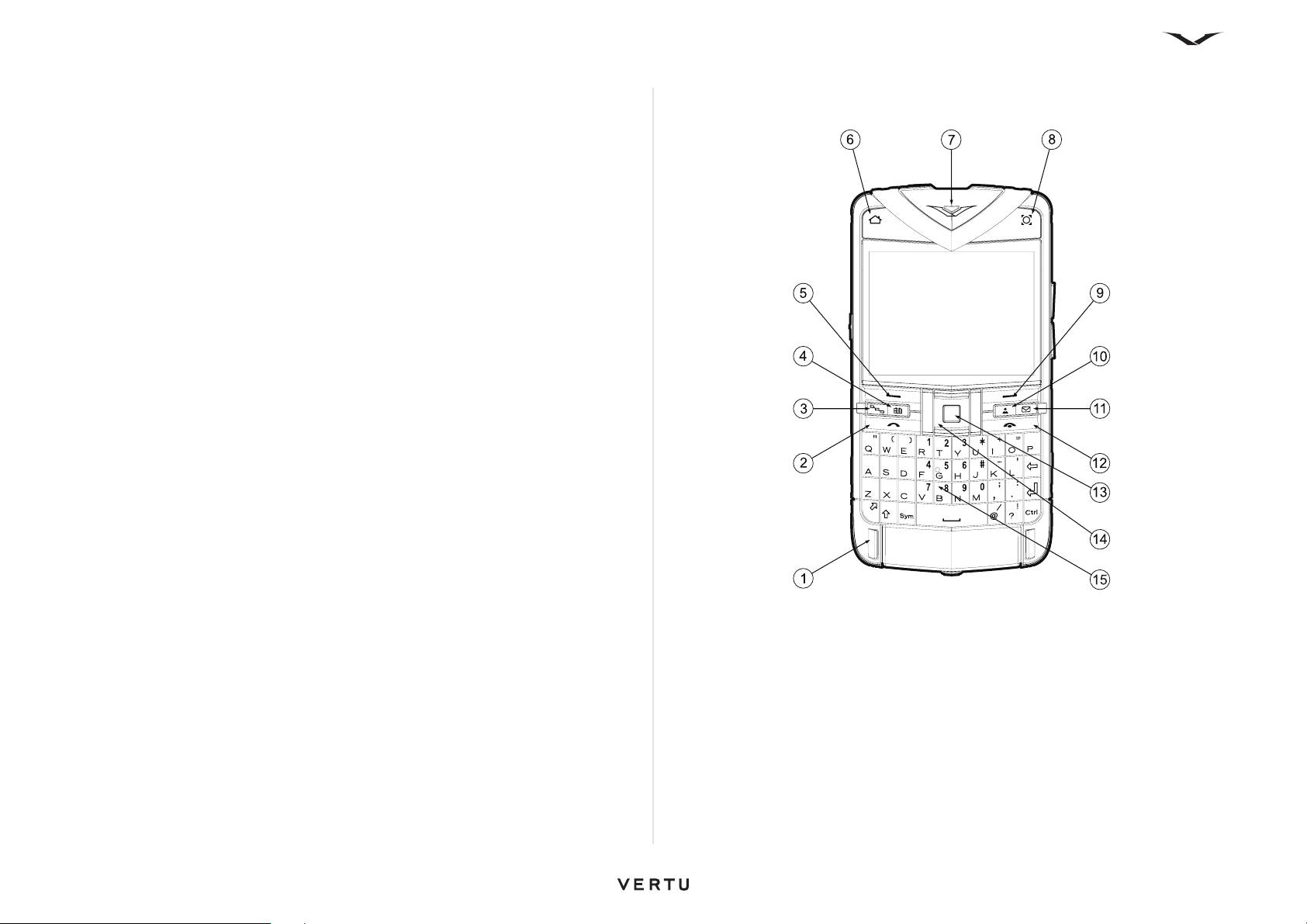
Vertu phone layout - front
12
Page 13
Vertu phone layout – back Vertu phone – left and right views
Getting started
Top view
13
Page 14
Getting started
Keys
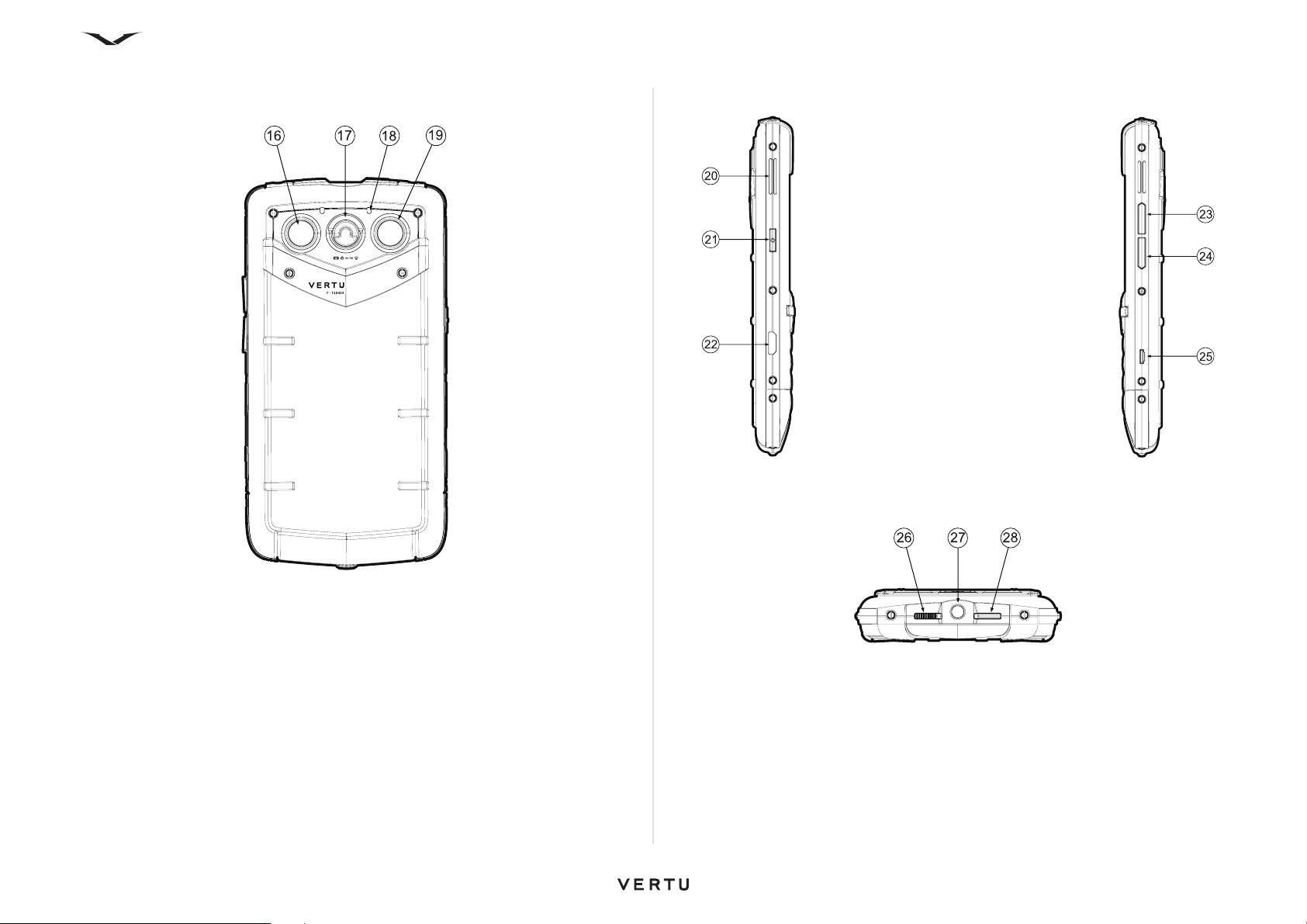
Label No. Keys
1Microphone
2 Call key
3 Menu
4 Calendar
5 Left Select key
6 Home key
7 Earpiece
8 My Key
9 Right Select key
10 Contacts
11 Email
12 End key
13 Middle Select key
14 Scroll keys (four way)
15 QWERTY keyboard
16 Camera
17 D-ring release for back cover
18 Secondary microphone
19 Flash/Flashlight
20 Loudspeaker
21 Vertu Concierge key
22 USB port
23 Volume increase
24 Volume decrease
25 Strap attachment point
26 Keypad lock
27 3.5-mm audio socket
28 Power key
Setting up your phone
Inserting the SIM card and battery
WARNING: Always switch the phone off and disconnect the charger before
touching the battery.
WARNING: Keep the SIM card out of the reach of small children.
IMPORTANT: The SIM card and its contacts are easily damaged. Be
careful when handling, inserting, or removing the SIM card.
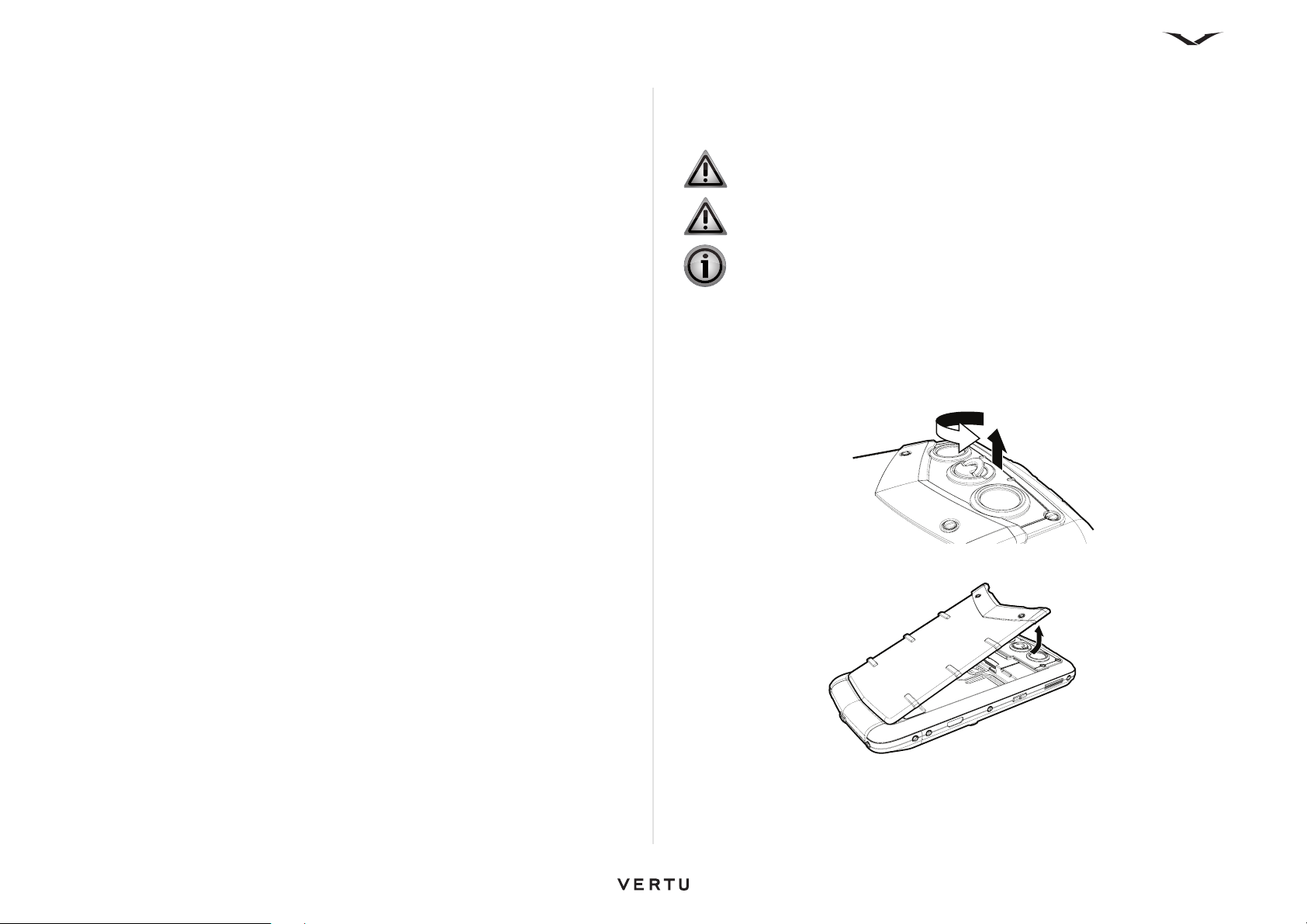
Removing the back cover
With the back of the Vertu phone facing you, lift the D-ring with your fingernail.
Hold the D-ring between your thumb and forefinger and turn it counterclockwise a
quarter of a turn until the cover pops open.
Gently lift off the back cover as shown.
14
Page 15
Getting started
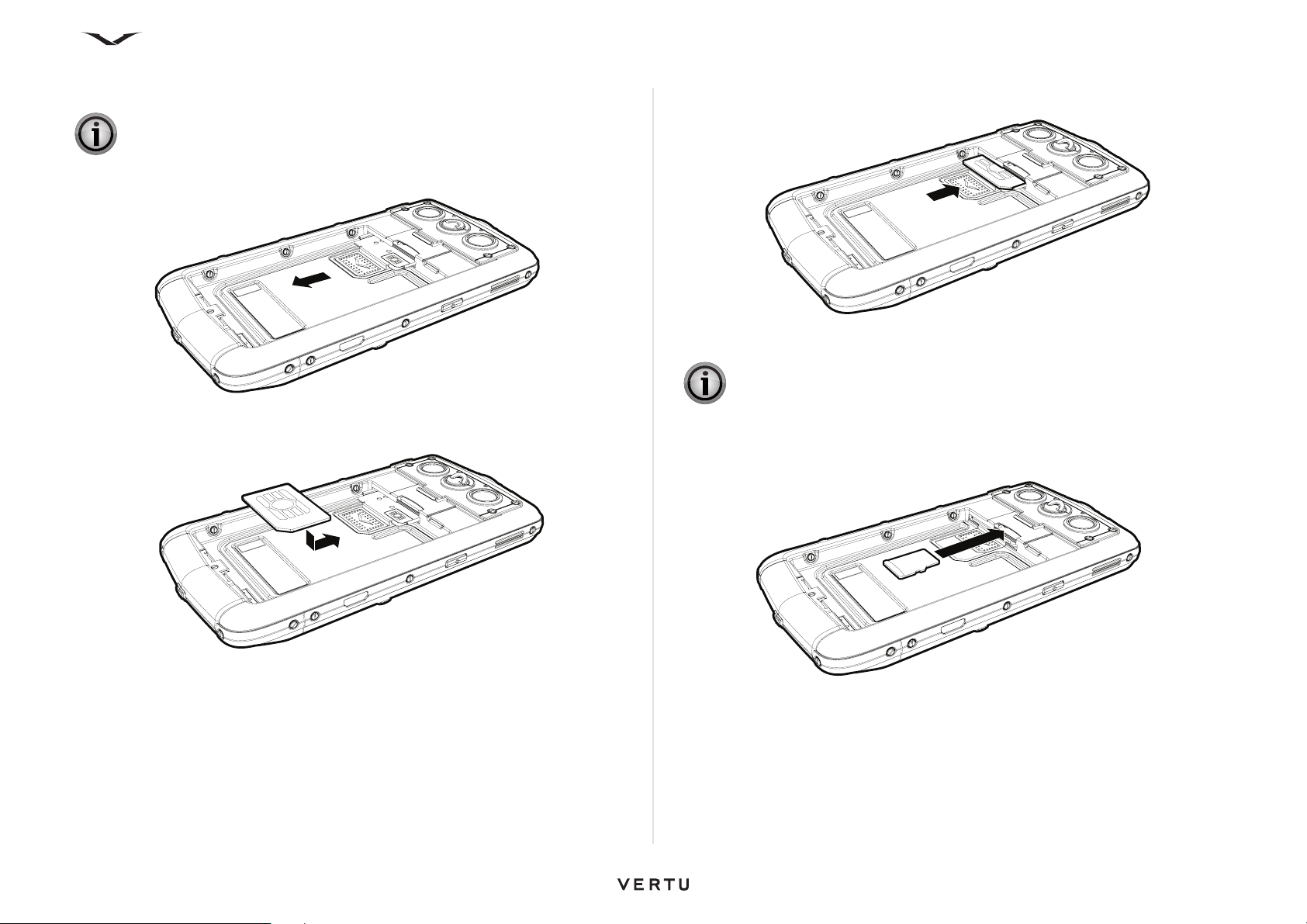
Inserting the SIM card
IMPORTANT: Always switch the phone off before inserting or removing the
USIM/SIM card.
Slide the SIM card tray backwards.
Insert the SIM card into the SIM card tray, making sure that the beveled corner is
located at the bottom right and the gold contact area is facing upwards.
Slide the SIM card holder back into the body of the phone until it is fully inserted.
Inserting the memory card
IMPORTANT: Always switch the phone off before inserting or removing a
memory card.
Insert the memory card into the slot just above the SIM card tray, making sure that the
gold contacts are facing downwards. Avoid touching the contacts of the memory card.
15
Page 16
Getting started
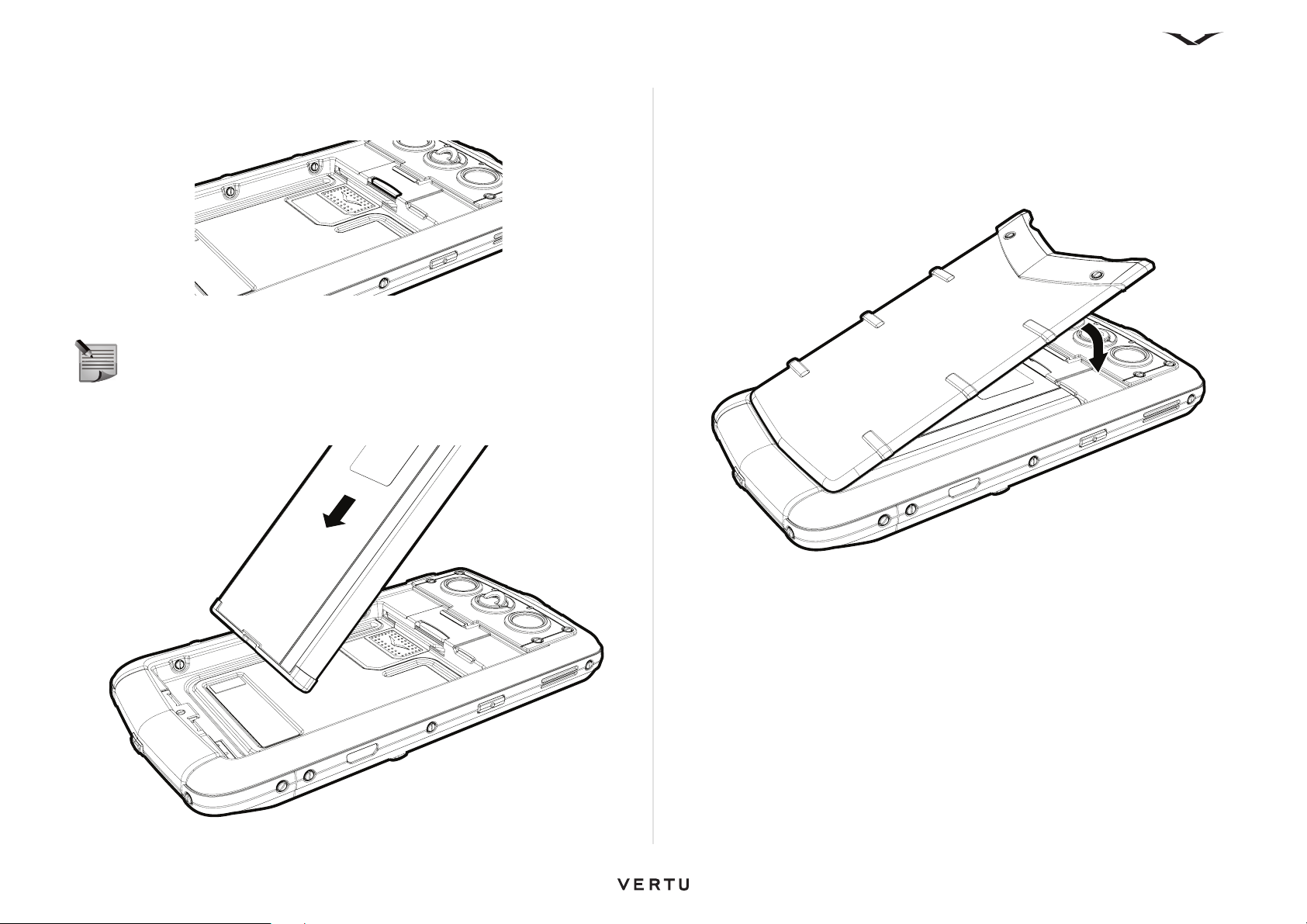
Push the card completely so that it locks into position. To retrieve the memory card,
push the card further into the slot; it will then unlock and slide out to make it easy to
remove.
Inserting the battery
NOTE: Ensure that the SIM and memory card are positioned correctly
before replacing the battery.
Locate the battery with the three terminals facing downwards. Position the battery so
that the battery contacts align with the contacts present in the phone compartment,
then place the battery into the housing.
Replacing the back cover
Place the two tangs at the base of the back cover in their corresponding slots in the
body of the phone.
Lower the back cover into position and press gently until it clicks into place. The cover
should close tightly using only light pressure.
16
Page 17
Getting started
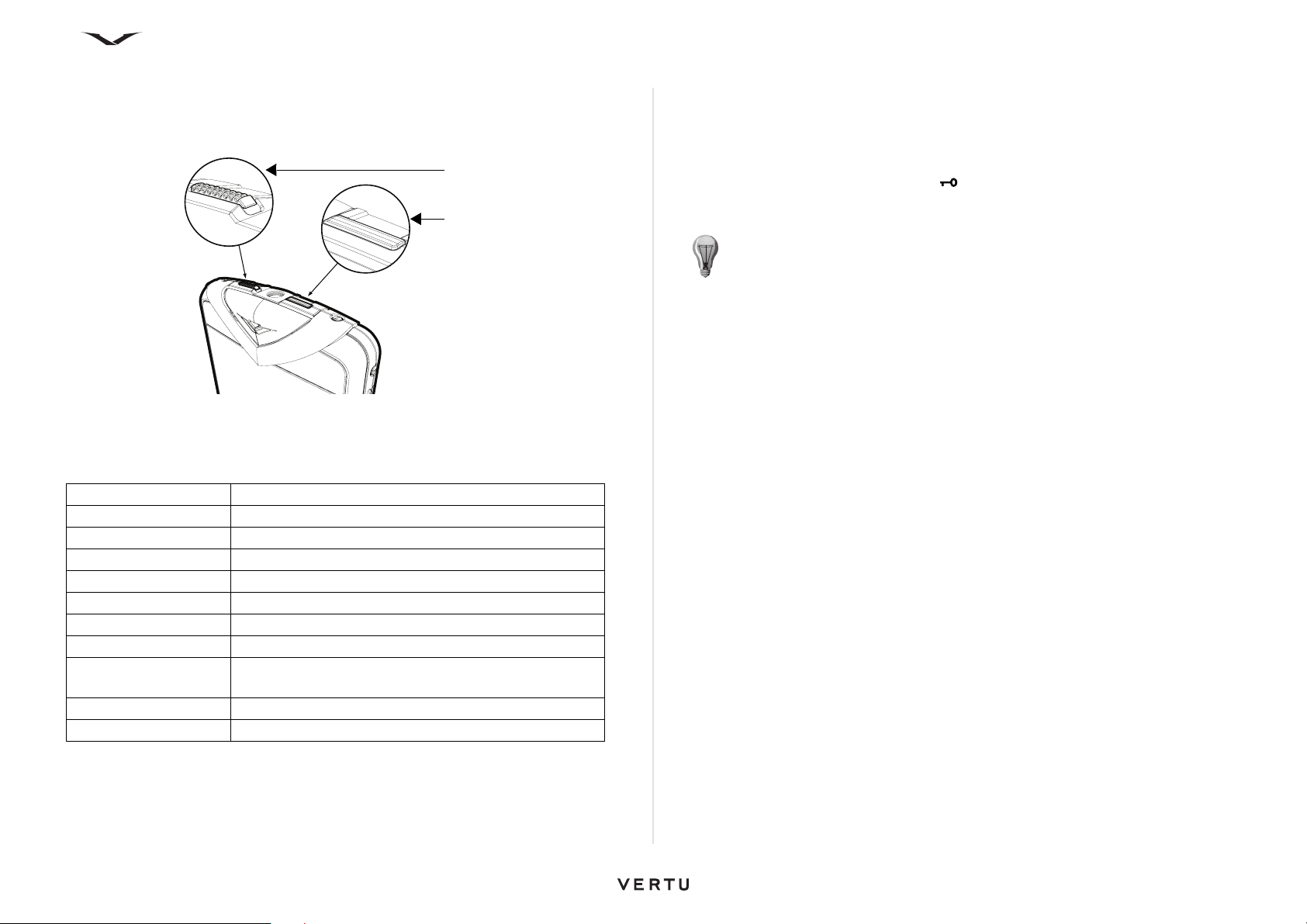
Switching on your Vertu phone
Press and hold the Power key (shown below) to switch on your Vertu phone.
Keypad lock
Power key
The battery may need charging when you first receive your Vertu phone. Use the
micro USB cable to connect to the charger or PC to charge the phone.
A list of options appears when you press the Power key:
Options Description
Switch off Switches off the phone
Lock keypad Locks the keypad
General Activates the General profile
Silent Activates the Silent profile
Meeting Activates the Meeting profile is activated
Outdoor Activates the Meeting profile is activated
Pager Activates the Meeting profile is activated
Offline Puts the phone in offline mode (in this mode, you are
no longer connected to the network)
Lock phone Locks the phone
Activate power saving Switches to power saving mode
Locking and unlocking the keypad
You can lock the keypad on your Vertu phone to prevent operating them accidentally.
The keypad lock (shown above) slides to lock the keypad. Slide it again to free the
keypad lock.
When the keypad is locked, a key icon appears. When you receive an incoming
call, the keypad lock is automatically released. When the call is ended, the keypad
relocks.
TIP: You can also lock the keypad by pressing the Left Select key, followed
by the Right Select key.
Automatic keyguard
Set the keyguard to automatically lock the keypad when the phone has not been used
for a set time period.
To set up automatic keyguard:
1. On the home screen, select Menu > Ctrl. Panel > Settings > General >
Security > Phone and SIM card > Keypad Autolock Period.
2. Press the Middle Select key and either enter a time in minutes for the autolock
period or select None if you do not want to use this feature.
For more information on phone security, refer to “Security Settings” on page 32.
17
Page 18

Getting started
Home key
The Home key is located at the top left of your phone. A single press of the Home key
brings you back to the Home screen from anywhere.
The Home key flashes in a number of different ways depending on the status of your
phone.
Indicator Explanation
White pulsing light Phone is on but inactive
Green pulsing light Battery is charging
Solid green Battery fully charged
Red flashing light Battery is low and needs recharging
Blue flashing light An event has occurred, such as a new message, missed call,
or email
Red double flashing Voice call is on mute
My Key
My Key is a user configurable key that you can set up to provide quick access to up
to four applications of your choice.
My Key is located on the top right side of your phone.
To set up My Key:
1. If you are setting up My Key for the first time, pressing My Key displays four fields
where you can select an application to be added for each field.
2. Press the Middle Select key for an application location, select an application from
the list, then press OK.
18
3. It is possible to select None for any of the four choices, or simply make only one
active.
To select an application using My Key:
1. Press My Key, and the drop-down menu appears.
2. Use the Up and Down scroll keys to move between the icons, and press the
Middle Select key to open the desired application.
To access the My Key function, select Menu > Ctrl. Panel > Settings > General >
Personalization > My Key.
Page 19
Getting started
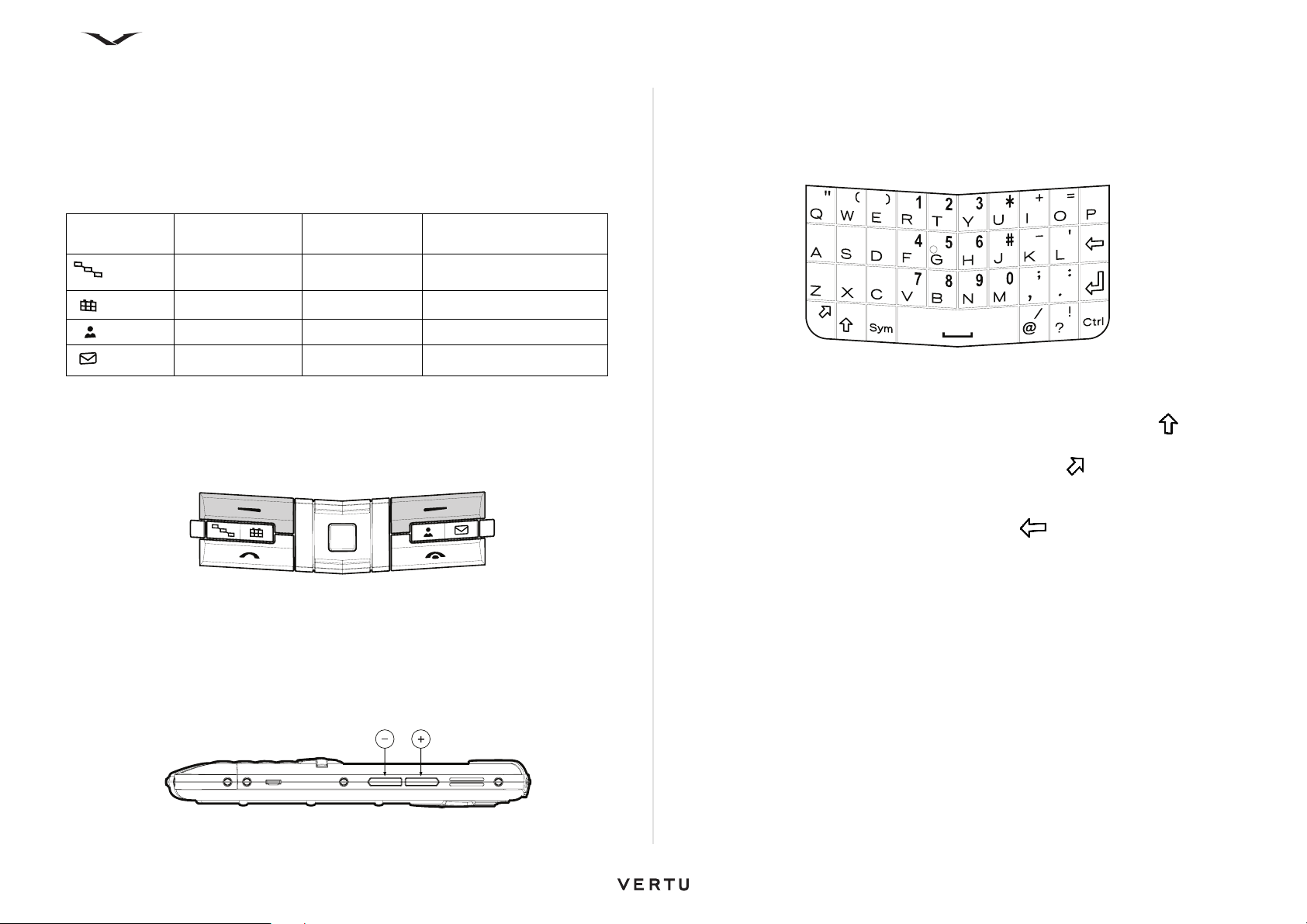
Dedicated keys
The Menu, Calendar, Contacts, and Email keys are the default dedicated keys.
These dedicated keys give you quick access to certain applications and tasks. Each
key has been assigned to an application or a task. The keys respond differently to a
short or long press.
The default settings for dedicated keys are shown below:
Dedicated
keys
Certain keys are user configurable.
To c on fi gu re a k ey, se le c t Menu > Ctrl. Panel > Settings > General >
Personalization > One-touch key.
Key number
(see Page 14)
3 Menu Open applications
4 Calendar New meeting
10 Contacts New contact
11 Email New email
Short press
opens
Long press opens
Select keys
The Left Select and Right Select keys allow you to choose the options shown at the
bottom of the display, directly above each Select key.
Volume keys
You can increase or decrease the Volume by pressing the volume keys on the right
side of your phone. See keys below, + (volume high) and - (volume low).
QWERTY keyboard
Your Vertu phone uses a QWERTY keyboard. You can change the software
language. Refer to Menu > Ctrl. Panel > Settings > General > Personalization >
Language, then select Phone language and Writing language.
Writing text with the keyboard
• To insert punctuation marks, press the corresponding key or a combination of keys.
• To switch between the different character cases, press the Shift key .
• To insert digits or characters printed at the top of keys, press and hold the
corresponding key, or press and hold the Function key , then press the
corresponding key.
• To lock the keyboard in Numbers mode, press the Function key twice.
• To delete a character, press the Backspace key .
• To delete several characters, press and hold the Backspace key.
• To insert characters and symbols that are not shown on the keyboard, press the
Sym key, which displays two screens with special characters
• To copy text, press and hold the Shift key, then scroll to highlight the word, phrase,
or line of text you want to copy. Press Ctrl + C. To insert the text into a document,
move to the position in the document you want, then press Ctrl + V.
• To change the writing language, press Shift + Sym, or, alternatively, when using
the keyboard to write text, select Options > Input options > Writing language,
then choose a language from the options.
• To activate predictive text input, select Options > Input options > Activate
prediction.
To set up settings for auto-completing words, text correction level, and number
matches, select Options > Input options > Settings.
19
Page 20
Getting started
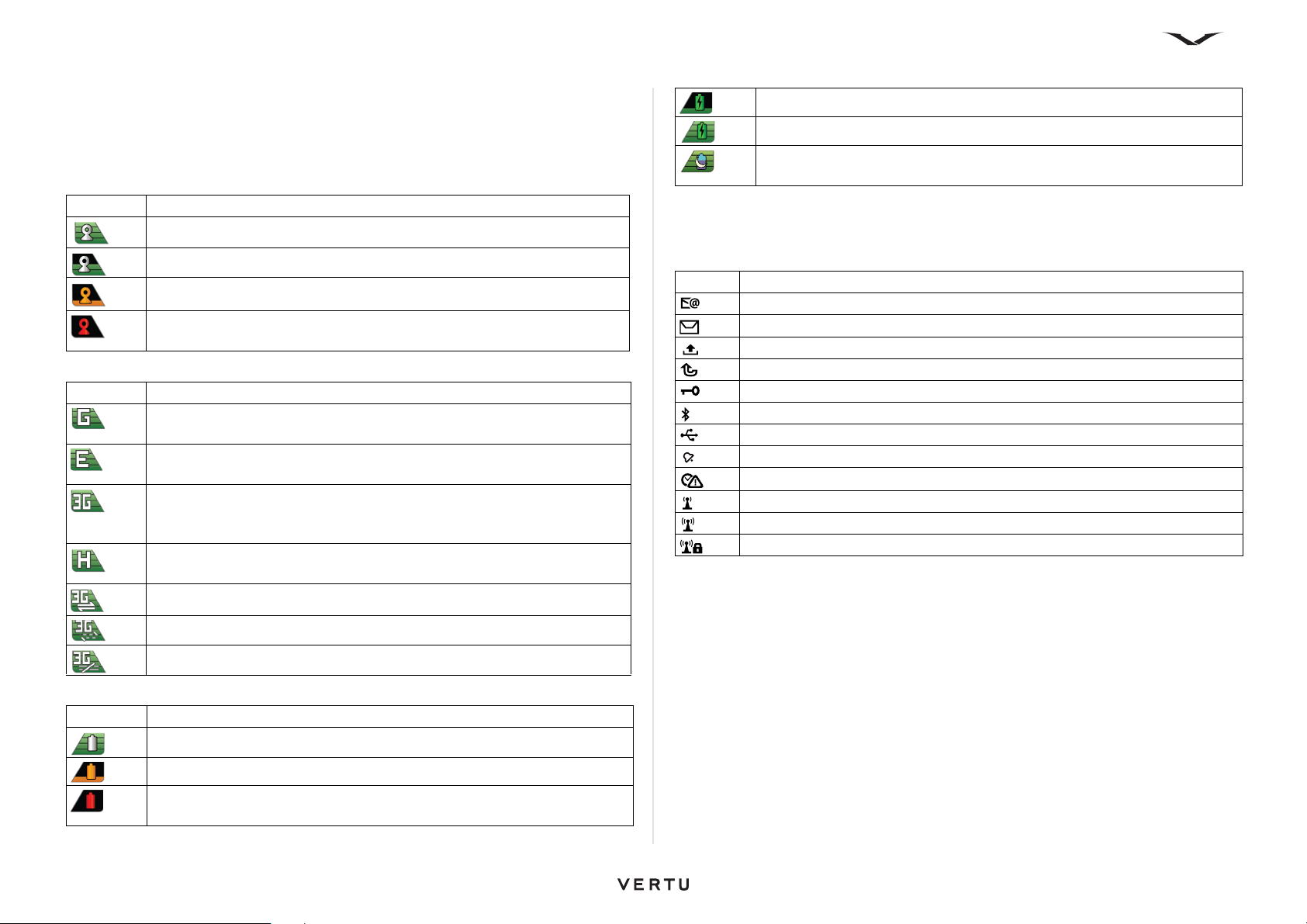
Status bar icons
Top status bar
Displays signals, data connectivity, and battery status icons along with the date.
Signal indicator icons
Indicator Explanation
Four-level signal indicator, currently showing the signal at full strength.
Signal strength adequate, at half strength.
Signal strength is low
Displays when there is no signal, the phone is operating in offline mode,
or no SIM is present in the phone.
Data connectivity icons
Indicator Explanation
GPRS (General Packet Radio Service) is part of the GSM cell phone
standard.
EGPRS data connection available. Enhanced GPRS. EGPRS is similar
to GPRS, but it enables faster connection.
3G data connection is available. 3rd generation mobile
communications is a digital system for mobile communications that
provides increased bandwidth.
HSDPA data communication is available. HSDPA (High-Speed
Downlink Packet Access) is an enhanced version of 3G.
3G data communication is active.
Battery is charging, but the battery state is low.
Battery is charging and is now full. The charger can be disconnected.
Power saver mode active. (Press the Power key and select Activate
power saving).
Lower status bar icons
A variety of icons appear in the lower status bar. Each icon displays when a certain
state is active; some examples are shown in the table below.
Icons Explanation
New email notification.
New message.
Message is in outbox.
Missed calls.
Keypad locked.
Bluetooth is enabled.
USB connection is active.
One or more alarms are set.
Accurate time server is not available.
WLAN connection available.
WLAN connection active.
WLAN secure connection active.
Battery indicator icons
Indicator Explanation
20
3G data communication is suspended.
3G data communication is not available.
Battery is fully charged.
Battery is low.
Critical state where battery is about to run out. The red symbol displays
without bars.
Page 21

Getting started
Commands and audible indicators
This section describes useful commands and indicators that add flexibility to your
phone.
Turn to silence calls or alarms
When the sensors in your device are activated, you can silence incoming calls or
snooze alarms by turning your phone face down.
To define the turning options, select Menu > Ctrl. Panel > Settings and General >
Sensors > Turning control.
Flashlight
The camera flash can be used as a flashlight. To switch the flashlight on or off, on the
Home screen, press and hold the space bar.
WARNING: Do not point the flashlight at anyone's eye.
Accessing a phone feature using a voice command
Using voice recognition, your Vertu phone can dial contacts and access phone
features when you use voice commands.
To initiate a voice command:
1. From the home screen, press and hold the Right Select key until you hear a tone
2. Say the voice command.
TIP: If you have a headset connected, press and hold the headset button
until you hear a tone.
Setting up voice commands
Select Menu > Ctrl. Panel > Phone > Voice comm.
Voice comms. displays all the functions you can access with voice commands. Voice
comms. also allows you to set the voice command you want to use for each function,
or you can accept the default command prompted by the system.
Audible indicators
Your Vertu phone can be set to generate an audible signal when a particular event
occurs. For example, when an email arrives at your phone, you can select a specific
tune or set a generated voice alert. You can also set the phone to silent for specific
events. This function is set using Audio Themes.
It is useful when you are using a headset and cannot view your Vertu phone.
For information on setting up voice alerts, refer to Menu > Ctrl. Panel > Themes >
Audio themes.
If you select voice alert, enter the text that will be read out by your phone or accept
the default text.
You can access the following features on your Vertu phone by saying them as voice
commands:
• Individual contacts – say the name.
• General, Silent, Meeting, Outdoor profiles, and so forth.
• Voice recorder (see Voice recorder in Menu > Media > Recorder).
• Messaging functions, including Messaging, new emails, read emails, and so forth.
• Organizer functions, including Calculator, Calendar, and Clock
• Call voice mailbox, but note you can only call mailboxes if the function is
supported by your service provider.
21
Page 22
Setting up your phone
Setting up your phone
Setting up your phone for the first time
When your Vertu phone is switched on for the first time, the first item displayed is
Registration. The phone then takes you through the terms and conditions and Startup
wizard. This wizard is designed to help you input the necessary settings as quickly
and simply as possible.
When the Startup wizard has completed successfully, the email setup wizard
immediately follows, allowing you to set up your first email account.
NOTE: If there is no SIM card in the phone on boot up, the system
automatically sets the default date and time, and the Setup wizard does not
run. Once you have inserted your SIM card, the Setup wizard runs.
IMPORTANT: When you are setting up your phone for the first time, make
sure that you are in range of your service provider so that the system can
configure the phone correctly. If a connection is not available, full
registration cannot take place.
This chapter also describes Switch, which is an application to help you copy content,
such as phone numbers, addresses, calendar items, and images, from a compatible
phone to your new Vertu phone.
Vertu Startup Wizard
When your Vertu phone is switched on for the first time, you are taken through a few
simple steps to set up your phone. Prior to setup, you must insert a valid SIM card into
your Constellation Quest and be in a location with cellular data connectivity.
You will first be asked to accept the terms and conditions. This will automatically
enable the phone to use the core features of your Constellation Quest.
You will then be asked to register the product, which is essential for enabling the
extensive free services offered on your Constellation Quest. If you are already a
registered customer, you must enter your user name and password. If not,
registration is quick, as all you have to do is enter a few details. To complete the
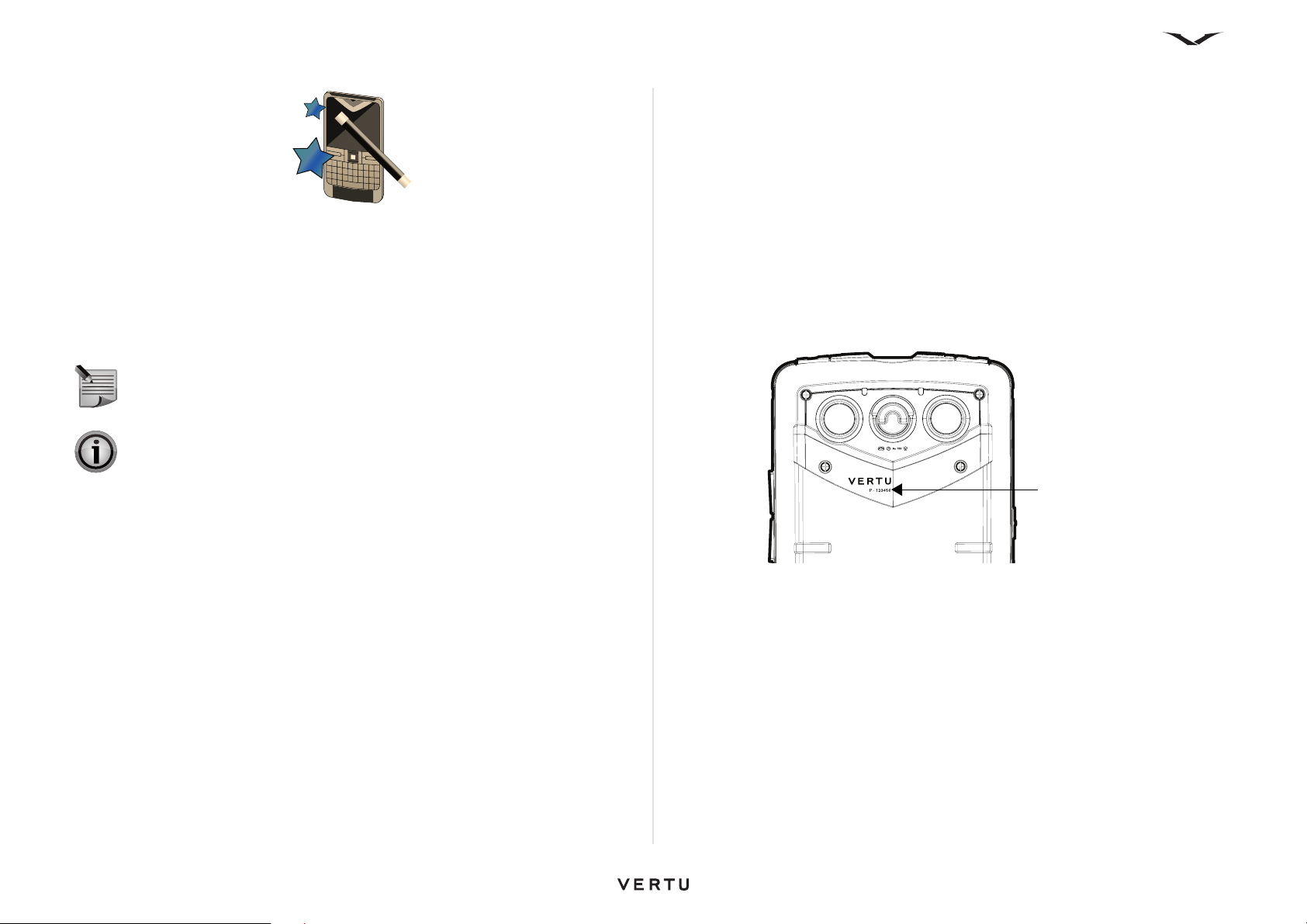
registration process, you must enter the serial number of your Constellation Quest,
which can be found on the battery cover at the back of the phone.
Serial Number
Registering your Vertu phone
Vertu aims to provide you with the very best service possible. To enable us to do this,
please register your Vertu phone.
Normally your phone will be registered during the setup process using the Vertu
Setup wizard, but there are alternative ways to register your phone:
• Call Vertu Concierge using the dedicated key on your phone.
• Register at the www.vertu.me website.
Selecting City Brief or Vertu Select will launch the registration process if the system
detects that your phone has not yet been registered.
22
The Email wizard is now launched so you can configure the email accounts you want
to use on the phone.
If you want to reapply any settings, just run the Sett. wizard located in Menu > Ctrl.
Panel.
Setting up your email accounts
Once the registration process is complete, your email accounts are normally set up
using the Email setup wizard. However, if you do not want to set up your email
accounts at this time, you can do it later. The Email setup wizard appears in the
Information area of the Home screen if no email account is set up during startup.
The wizard helps you set up your Vertu.Me account, corporate email account, or
personal accounts. You can have up to five personal accounts. When setting up an
account, you must enter your user name and password.
Page 23

Setting up your phone
You can choose to synchronize your contacts, calendar, and tasks on your phone with
either your corporate account or with your Vertu.me account.
Refer to the Email section for more information.
If you skip the wizard process, you can manually open the wizard later. On the Home
screen, select Menu
> Ctrl. Panel > Sett. wizard.
Switch
Transfer content
You can use the Switch application to copy content, such as phone numbers,
addresses, calendar items, and images, from your previous phone to your present
Vertu phone, provided the two phones are compatible.
The type of content you can transfer depends on the model of the phone from which
you want to transfer content. If that phone supports synchronization, you can
synchronize data between the devices. Your device notifies you if the other phone is
not compatible.
If the other phone cannot be switched on without a SIM card, you must insert a SIM
card into it. When your phone is switched on without a SIM card, the Offline profile is
automatically activated, and transfer can take place.
Transfer content for the first time
1. To retrieve data from the other phone for the first time, on your phone, select
Menu > Ctrl. Panel > Switch.
2. Select the connection type you want to use to transfer the data. Both devices
must support the selected connection type.
3. If you select Bluetooth connectivity as the connection type, connect the two
phones. To have your phone search for phones with Bluetooth connectivity,
select Continue. Select the phone from which you want to transfer content. You
are asked to enter a code on your phone. Enter a code (1 to 16 digits), then select
OK. Enter the same code on the other phone, then select OK. The phones are
now paired.
Some earlier phones may not have the Switch application. In this case, the
Switch application is sent to the other phone as a message. To install Switch on
the other phone, open the message, and follow the instructions on the screen.
4. On your phone, select the content you want to transfer from the other phone.
Once the transfer has started, you can cancel it and continue later.
Content is transferred from the memory of the other phone to the corresponding
location in your phone. The transfer time depends on the amount of data to be
transferred.
Synchronize, retrieve, or send content
Once data has been transferred for the first time, you can select one of the following
options to start a subsequent transfer. The process depends on the model.
Select Menu > Ctrl. Panel > Switch.
• Synchronize data in a two-way process, provided the other phone supports
synchronization. If an item is deleted in one phone, it is deleted in both. You cannot
restore deleted items with synchronization.
• Retrieve content from the other phone.
With retrieval, content is transferred from the other phone to your phone. You may
be asked to keep or delete the original content in the other phone, depending on
the phone model.
• Send content from your phone to your other phone
If you cannot send an item, depending on the type of the other phone, you can add
the item to the Vertu folder, to C:\Vertu or E:\Vertu in your phone. When you select
the folder to transfer, the items are synchronized in the corresponding folder in the
other phone, and vice versa.
Use shortcuts to repeat a transfer
After a data transfer, you can save a shortcut with the transfer settings to the main
view to repeat the same transfer later.
To edit the shortcut, select Options > Shortcut settings. For example, you can
create or change the name of the shortcut.
A transfer log is shown after every transfer. To view the log of the last transfer, select
a shortcut in the main view and Options > View log.
Handle transfer conflicts
If an item to be transferred has been edited in both phones, the phone attempts to
merge the changes automatically. If this is not possible, there is a transfer conflict.
Select Check one by one, Priority to this phone, or Priority to the other phone
to solve the conflict.
23
Page 24
Home Screen and Clock
Home screen and clock
Home screen
The Home screen displays a clock, an information area, a dynamic zone, and Web
feeds in the Notification zone.
Icons and indicators appear in the status bars, providing information about the status
of your Vertu phone.
Use the scroll keys to move the focus around the Home screen.
Press the Middle Select key when the focus is on a feature you want to open.
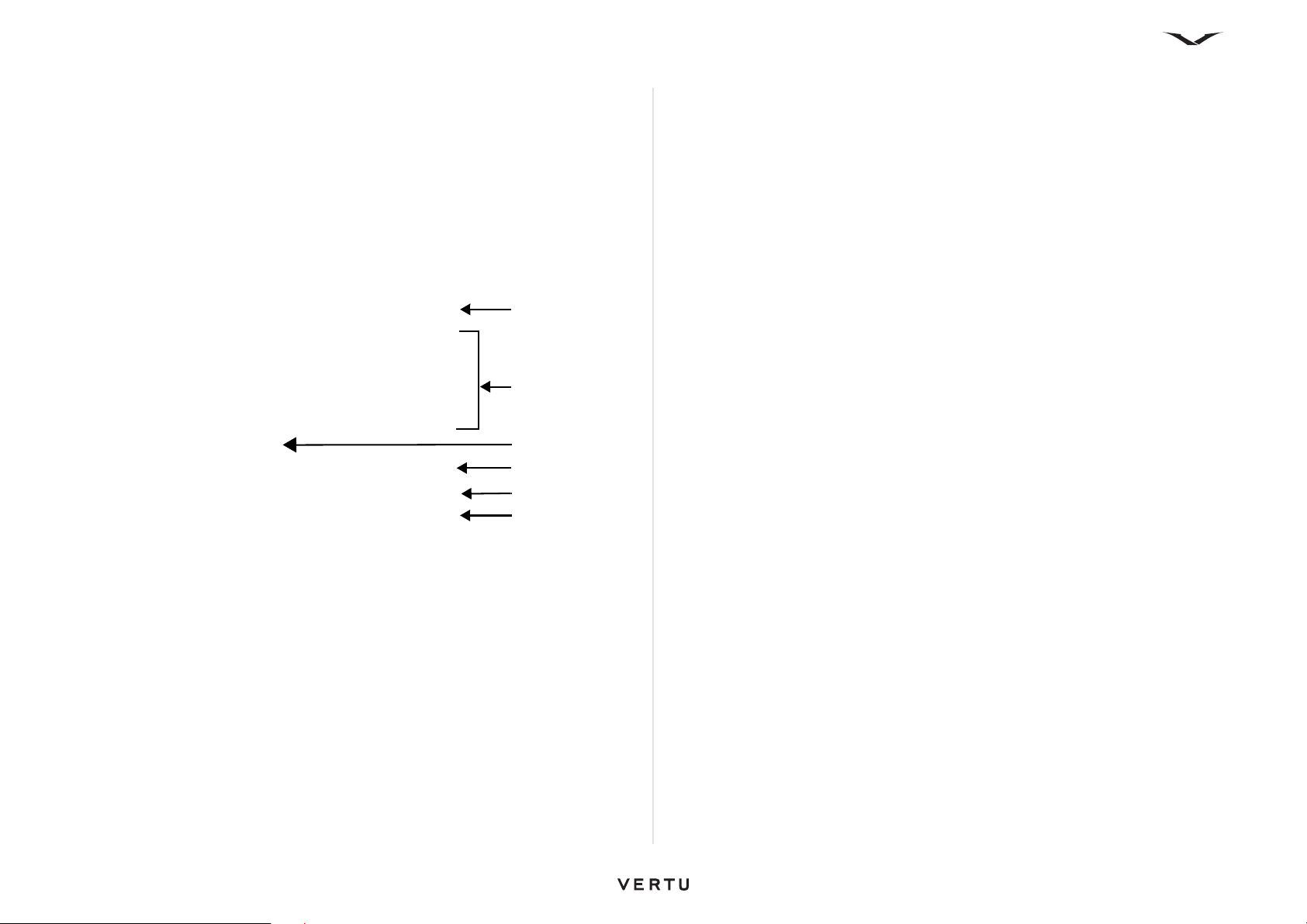
The Home screen contains the following areas:
1. Top status bar
2. Information area
3. Clock
4. Dynamic Information area
5. Notification zone
6. Lower status bar
The status bar icons are described in the chapter “Getting Started.”
1
2
3
4
5
6
Information area
The following three items are displayed in the Information Area, when the phone is
first started:
• The Set up email wizard displays when the phone is first started.
• WLAN scan off is displayed. This function provides access to the WLAN
application, which allows you to search for WLAN networks.
• Calendar displays with the message “No appointments” when your phone is first
set up.
If you have set up at least two email accounts, the top two information areas display
notifications from the accounts.
The information area below displays calendar appointments. The time of the next
appointment is shown.
Setting up the Information area on the home screen
There are a number of applications that can be displayed in the Information area. You
can choose which applications you would like to display as follows:
1. Select Menu > Ctrl. Panel > Settings > General > Personalization > Standby
mode > Mode settings > Home screen applications.
2. Select the options that you want displayed on the screen. Note that there are 13
items or more that can be selected, and the system prioritizes the items that are
displayed following the hierarchy shown in the Home screen applications
menu. Thus, you may select an item, but it will only be displayed when its priority
becomes high enough. You may, therefore, need to deselect items to ensure that
an item is displayed.
3. Note that this function controls the display of media feeds and message alerts as
well.
24
Page 25
Home Screen and Clock
Clock
The clock has the following features:
• Displays time and date in either analog or digital format.
• Displays alarms set for the next 12 hours (analogue display only).
• Displays free and busy periods taken from the Calendar, around the clock bezel
(analog display only)
• Uses the automatic time feature to keep accurate time.
• Displays the local time or, if you are roaming, displays both the local time and the
time in your home location.
WARNING: The date and time are normally set by the automatic time
feature and should not be tampered with.
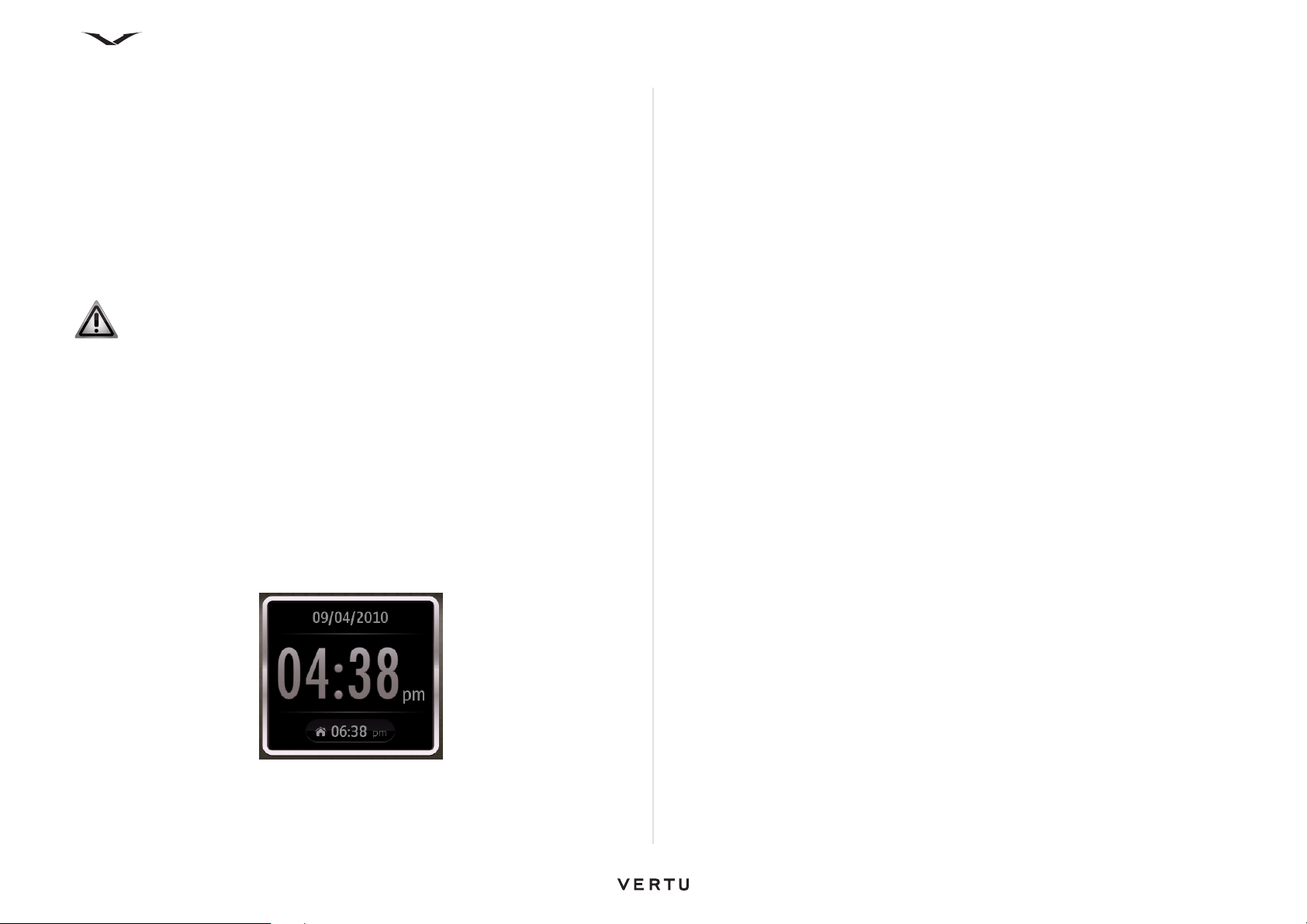
Analog Clock, showing local time and home time (digital)
Digital Clock showing local time in the large digits and home time in small digits.
To change the clock time and set alarms on the home screen
To access the clock, scroll to the left or right to highlight the clock, then press the
Middle Select key.
The Clock application appears with emphasis on the current Time.
Use the Left and Right scroll keys to display one of the three options: Time, Alarms,
and World clock.
To change the date and time settings from the main menu
Clock, date, and time settings are accessed as follows.
From the Menu > Ctrl. Panel > Settings > General > Date and time, or
Menu > Ctrl. Panel > Clock > Options > Settings.
Change the settings as necessary.
Clock – Alarms
To set an alarm:
1. With the Clock application open, in either the Time or Alarms tab, select
Options > New alarm.
2. Scroll to Alarm time:, then select the time for the alarm.
3. Scroll to Description, then change the alarm text, if desired.
4. Scroll to Repeat. By default, the alarm is set to Within 24 hrs, which means the
alarm is only valid during the next day. Press the Middle Select key and select an
alternative option, if desired; the alarm can be repeated daily, weekly, on
workdays, or not repeated.
5. Press Done to save the alarm. Set additional alarms, if desired.
6. The display shows when the next alarm is due to activate.
Clock alarms and appointments
The clock, alarm and the world clock are all accessed via the clock, from the Home
screen
Any meetings or appointments set are displayed in the analog clock, as shown below.
Analog clock showing alarm at 7 o’clock.
25
Page 26

Home Screen and Clock
Analog clock showing busy from 3 to 4 o'clock.
To reset an alarm
1. If you want to reset an alarm, click on the Options, then select Reset alarm.
Press Done when you have made your changes.
To remove an alarm
1. Highlight the alarm you want to delete.
2. Select Options > Remove alarm, then press Yes when prompted.
Set alarm ringtones
The selected alarm ringtone applies to all alarms.
1. Open the clock function.
2. Select Options > Settings > Clock alarm tone, then select an alarm in the
displayed list.
3. Press Back to exit the Settings.
World Clock and Dual Time
The Clock allows you to see timings of different locations in the world clock.
To add a specific location to your world clock, select, Clock > World clock >
Options > Add location. It gives you a list of places you can view the time for.
Selecting a particular place adds the location along with the current time at that place.
You can change the clock settings by Clock > World clock > Options > Settings.
This provides you with various options like setting the time zone, setting the home
location, date and time format, clock type, and so on.
The clock includes a dual time handling system that comes into effect when you travel
away from either:
• Your home country
• Your home time zone
Your phone handles the location using the mobile carrier code of the current network
to obtain the current time, plus, if necessary, access to an online service for greater
accuracy.
By default, both digital and analog clocks display the home time in digital format
within the current clock zone. On returning to the home location, the clock will switch
back to the single clock, only showing a single current time.
Automatic Time settings
The automatic time feature keeps the phone clock accurate, and means that you do
not need to set the time or date manually at different locations (but the SIM card must
be present in the phone). When enabled, this sets the system clock to the local UTC
value, from which the necessary GMT offsets are applied automatically to present the
correct time and date.
If there is a problem with the automatic time update system, a warning icon
appears in the lower status bar to cover various situations such as:
• The current and home time and the current location are unknown so the time
cannot be updated.
• On first power-up, after agreeing to the terms and conditions, the mobile phone
network was out of reach.
• Travelling to a country with multi-time zone and where the geographic location is
unknown.
• Clock is believed to be inaccurate due to length of time since the last successful
synchronization.
The automatic time setting function can be turned on or off.
1. From the clock application > Options > Settings > Automatic time update.
Or: Menu > Ctrl. Panel > Settings > General > Date and time > Automatic
time update.
2. When the setting is turned On, the following applies:
• The Vertu clock automatically sets the time.
• The phone is in dual time handling mode.
NOTE: If the automatic clock is out of service, an icon displays on the
bottom status panel notifying you that current time is inaccurate.
NOTE: On factory reset or restore you can re-set the clock options from the
Setup wizard. If you skip the wizard or do not agree with the terms and
conditions, then you must set the clock manually. However, you can still
activate the automatic update feature from the Date and time feature in the
Settings menu, as described above.
26
Page 27
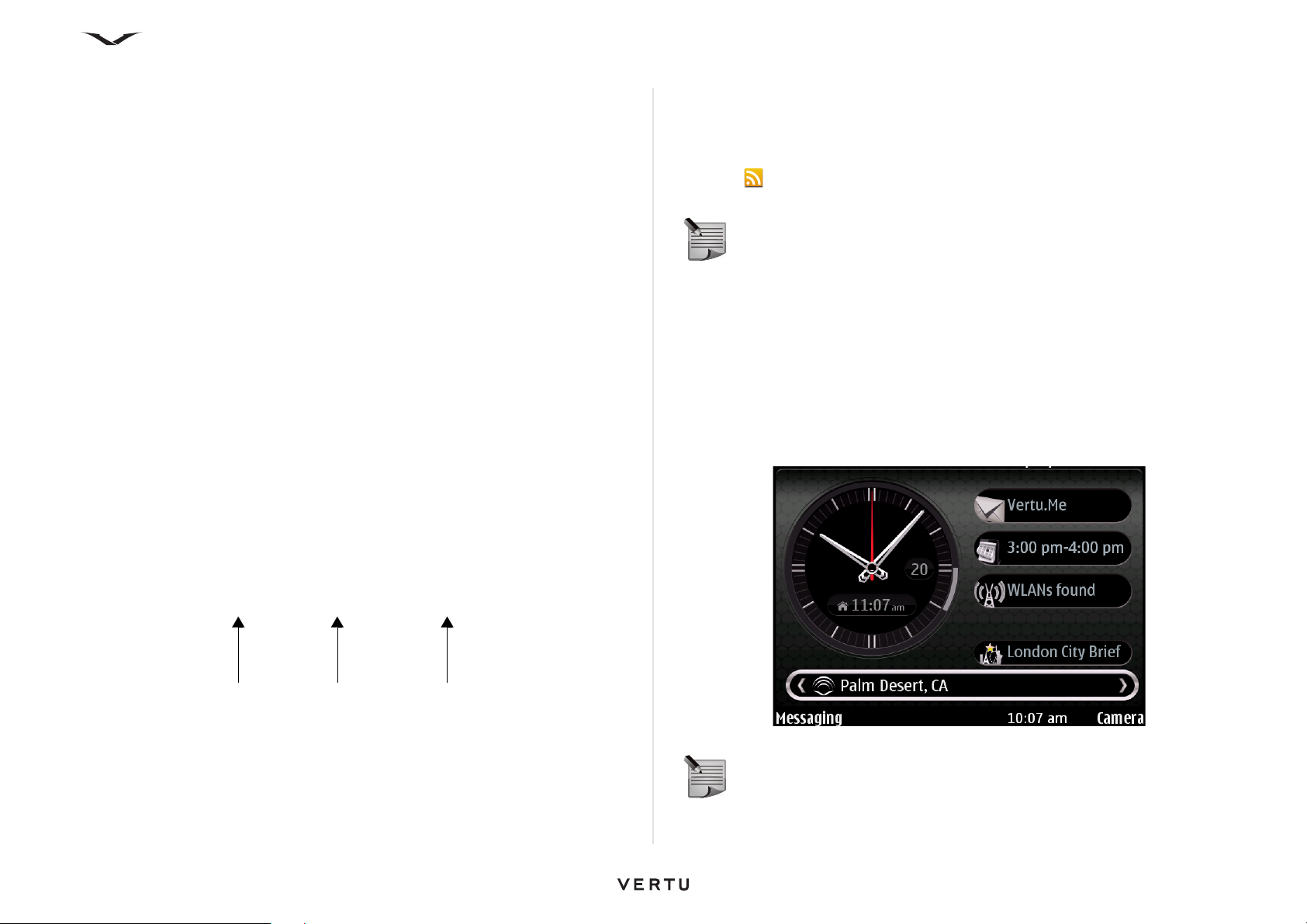
Home Screen and Clock
Dynamic Information area
This area shows either City Brief, Music Player, or Radio. If neither the Music
Player or Radio is active, then the City Brief link is displayed.
Notification zone
The notification zone is dynamic and displays information about calls, messages, and
news feeds.
By default, the notification zone displays information about recent unread messages,
emails, and missed calls. News feeds are displayed when no outstanding items of
higher priority are present.
To view a notification:
1. Scroll to the box, then press the Middle Select key to open it. A box is only visible
if there are items present.
2. The example below displays three notifications; for missed calls, presence of
new messages and voice mail.
Media feeds
Media Feeds allows you to easily follow news headlines and your favorite news feeds.
Media feeds are commonly found on news sites, blogs, and wiki pages. Media feeds
are also known as RSS feeds or Web feeds and are identified on Web pages by the
RSS icon .
NOTE: When the phone is set up for the first time, the voice mail notification
appears in the Notification zone. Media feeds will only display when
notifications for messages, missed calls, and voice mail are cleared.
Reading a media feed
1. Use the scroll keys to highlight the Media feeds area.
2. Scroll left or right through Media feeds to view the latest headlines.
3. Press the Middle Select key to view a list of Media Feeds items.
4. Select a media feed and press the Middle Select key again to view the news
feed, which can be opened in a Web page.
5. The list of news feeds also gives you an opportunity to select other news items.
Missed call Unread messages Voice mail
NOTE: Alternatively, Media feeds can be opened from Menu >
Applications > Media feeds.
27
Page 28

Home Screen and Clock
WARNING: When using Media feeds, outside of your home network,
roaming charges may be imposed by the network operator. Such changes
can vary considerably depending on the operator.
To disable roaming, from the Media feeds panel, select Options >
Settings > Roaming behavior > Disabled.
Download media feeds
Media feeds can be downloaded from the Latest headlines panel.
1. Highlight Media feeds in the Home screenand press the Middle Select key to
take you to the Latest headlines.
2. Scroll up or down and select the media feed you want to download.
3. Press the Middle Select key and a summary of the page downloads.
4. The item can be opened directly when it is downloaded using the Middle Select
key.
5. Press Back to exit the application.
To subscribe to a media feed from the browser
1. Open the Web page, locate the RSS icon, then select it with the Middle Select
key.
2. A message, Subscribe to feed? is displayed. Then, select Yes.
3. The feed is displayed in the Media feeds panel.
To subscribe to a media feed manually
1. Highlight Media feeds in the Home screen, then press the Middle Select key
to take you to the Latest headlines.
2. Select Options > Feed list. The Media feeds panel appears.
3. Select Options > Feed subscriptions, and the Subscribe to feeds panel
appears.
4. Select Options > Add manuallyand enter the URL of the media feed.
5. Press Add. The system validates the feed and adds it to the list or displays a
warning message.
Auto update of Media Feeds
Turn Media Feeds off in the Settings menu.
1. Highlight Media feeds in the Home screen, then press the Middle Select key to
take you to the Latest headlines.
2. Select Options > Feed list. The Media feeds panel appears.
3. Choose
4. Select Back until you exit the function.
Options
>
Settings
>
Automatic update
, and select a time interval or
Off
Organizing your media feeds
This function enables you to create folders and move your Web feeds into relevant
folders.
1. Highlight Media feeds in the Home screen, then press the Middle Select key to
take you to the Latest headlines.
2. Select Options > Feed list. The Media feeds panel appears.
3. To add a folder, press Options > Add folder, enter a folder name, then press OK.
4. To move an item, highlight it, then press Options > Move. Press the Middle Select
key and the system displays the possible locations for the Web feed. Select the
relevant folder and press Move when the item is moved to the relevant location.
Sorting media feeds
Media feeds can be sorted by time or name.
1. When in one of the Media Feeds panels, select Options > Sort by and select
either Name or Time.
2. The Media feeds on the panel are sorted accordingly.
Adding predefined feeds to the display
1. Proceed up to step 2 in Organizing your Media feedss.
2. Press Options > Feed subscriptions.
3. The Subscribe to feeds panel appears.
4. Scroll through the list and select items. This is a toggle function; you can select
or deselect an item with the Middle Select key. Alternatively, highlight an entry
and press Options > Subscribe or (Unsubscribe). Items within this list cannot
be deleted.
The feeds icon is grayed out when an item is de-selected.
5. Once an option has been selected, it is included in the media feeds.
6. Press Back to exit Subscribe to feeds. Save the changes when prompted. The
system may take a moment to complete your requests.
.
28
Page 29
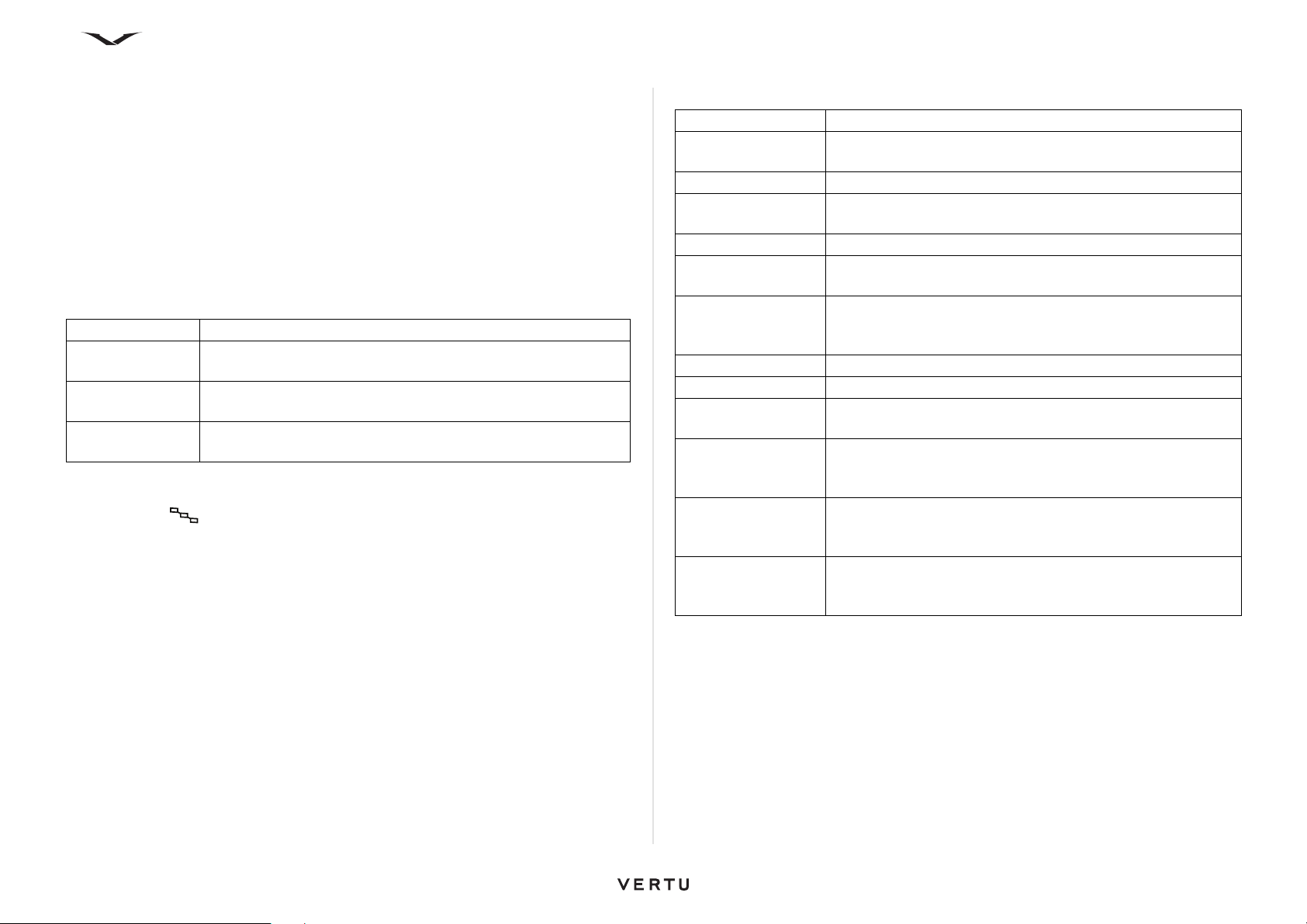
Deleting media feeds
Note that you cannot delete news items; you can only delete the feeds.
1. Proceed up to step 2 in Organizing your Media Feeds.
2. Highlight the item you want to delete. Press Options > Delete. Press the Middle
Select key and the items are deleted.
Media Feeds settings
1. Highlight the Media feeds in the Home screen and press the Middle Select key
to take you to the Latest headlines page.
2. Press the Options > Settings. The Settings options are shown in the table below.
Memory in use Select where to store data.
Automatic
update
Internet access
point
Roaming
behavior
Select the frequency of automatic updates, or turn off the
feature.
Set the access point for data transfer. Options includes Always
ask, so you can select the most appropriate route.
Deactivate the Media Feeds data connection when not in your
home network.
Menu
The Menu key displays all the top-level categories within your phone. From
here, you can access all functions and applications.
Home Screen and Clock
Application Function
Calendar Enables you to keep track of your appointments, meetings,
and special events.
Contacts Holds the information of all your contacts.
Log Displays information about missed, received, and dialed
calls.
Web Features rich Web browser
Messaging Use messaging to send and receive text, multimedia, data,
audio, and email messages.
Media Provides access to functions that let you work with images,
videos, music, and sound clips and listen to the radio. You
can also post your images online.
Ctrl. Panel Used for setting up your phone.
Help Provides access to online Help for your phone.
Applications View and manage the software packages installed on your
phone.
Maps Use Maps to locate your position, cities, streets, and
services. You can also plan and execute driving and walking
routes.
Office Includes tools for handling documents, presentations, and
spreadsheets, including a text editor, calculator, conversion
program, and PDF reader, among others.
Vertu Provides access to Vertu Select, City Brief, Vertu
Concierge, Technical Support, Remote Assist, Download,
and Registration.
29
Page 30
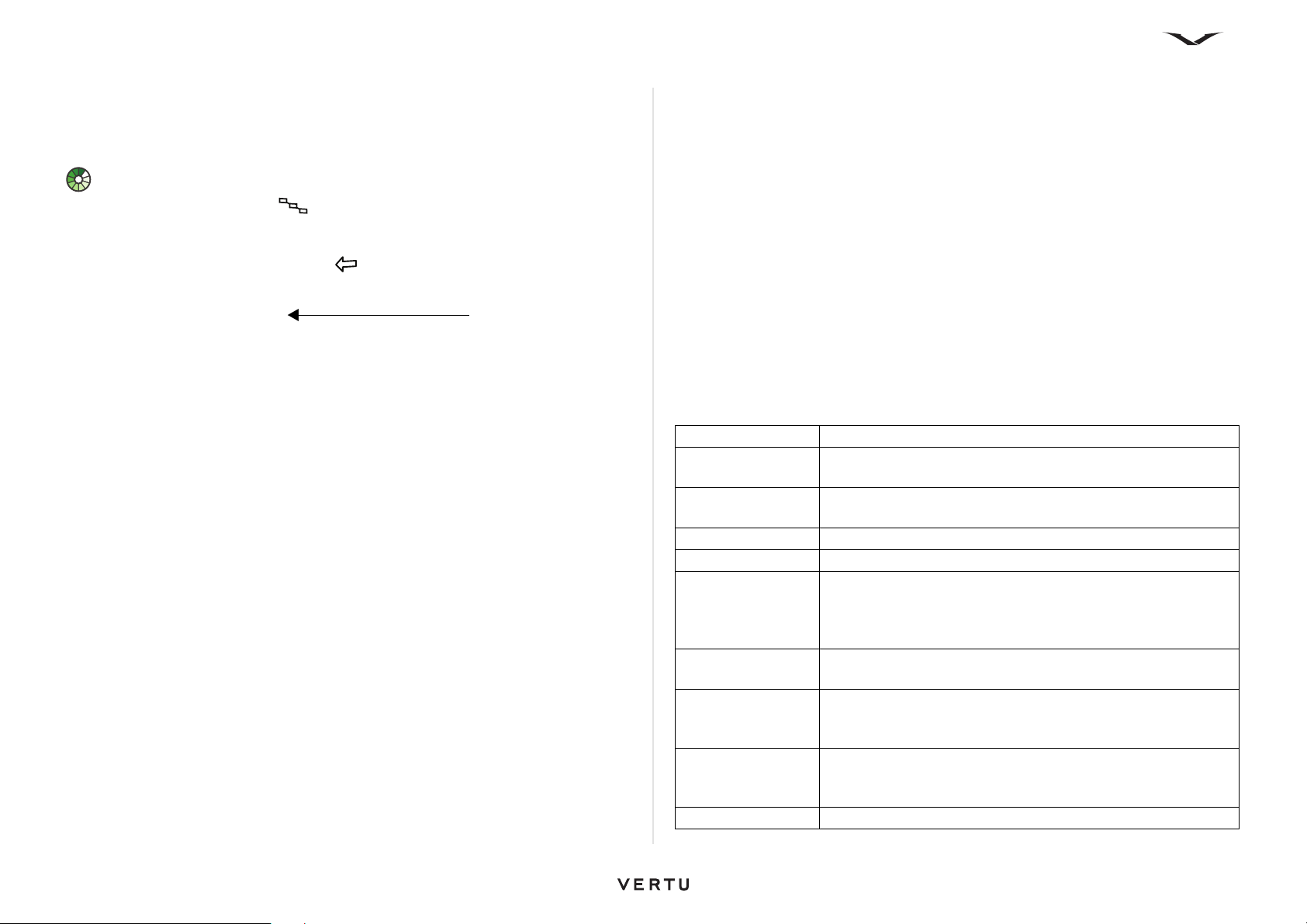
Home Screen and Clock
Task viewer
Your Vertu phone can run more than one application at a time. Open applications are
indicated with a small green and white circle at the top of the application, as shown
below.
A long press on the Menu key, displays all the Open applications. Use the
Right or Left scroll key to highlight an application. Press the Middle Select key to go
to that application. To exit the application, highlight the application with the Right or
Left scroll key and press the Delete key on your keypad.
Open
Application
To reduce power consumption and extend battery life, it is best to quit applications
you are not using.
Control panel
The Control panel provides access to the functions used for setting up your Vertu
phone. They are covered in detail in this user guide in their separate chapters.
Applications Function
Connectivity Sets up connectivity to other devices through Bluetooth,
WLAN, USB, and so forth.
Phone Sets up all aspects of the phone, including voice mail, speed
dialing, encryption, and synchronization.
App. Mgr. Download, install, and manage applications.
Themes Set up themes and wallpapers.
Settings Sets up functions including Date & time settings,
Personalization, Telephone, Connection, and
Applications for configuring the Camera, Calendar, and
other features.
Profiles Set up profiles, such as Meeting, Silent, Outdoor, and
Pager, to suit your needs.
Switch Transfer data (such as contacts and calendar items) from a
compatible Vertu phone, which is useful when setting up your
new Vertu phone.
Modes Switch between business and personal modes. Use Modes
to select how you want your home screen to appear in each
mode.
Clock Set up time and date, alarms, time zone, and home location.
30
Page 31

Printers Set up a printer for your phone.
Sett. wizard Access the setup wizard for registration and email setup.
Net settings Sets up VoIP services.
Setting up your personal and business preferences
You can switch between two home screen views, one for your personal use and
another for business.
To toggle between Personal and Business home screen views, select Menu > Ctrl.
Panel > Themes > General >, then select a view.
To set up your Personal and Business modes, refer to refer to “Email account
preferences” on page 67.
Home Screen and Clock
31
Page 32

Security
Security
Your Vertu phone has a number of security features that help to prevent:
• Unauthorized use of your Vertu phone when your SIM card is inserted.
• Unauthorized use of your Vertu phone if a different SIM card is inserted.
• Unauthorized use of your SIM card in another phone.
Security Settings
Your phone's Security module provides the security functions. It manages four
security areas.
Select Menu > Ctrl. Panel > Settings > General > Security.
Phone and SIM
card
Certificate
management
Protected content Adjusts your settings for DRM protected content
Security module Manages your security module
Adjusts the security settings for your device and SIM card.
See “Phone and SIM card security” on page 32
Manages your security certificates
See “Certificate manager” on page 34
See “Protected Content: Digital Rights Management (DRM)”
on page 35
See “View and edit security modules” on page 36
Phone and SIM card security
PIN code
The PIN code protects your device from unauthorized use. The PIN code is supplied
with the SIM card.
When the PIN code security feature is active, you must enter the PIN code each time
you switch on your Vertu phone. If you previously used your SIM card in another
phone, the code is the same.
IMPORTANT: The SIM card will be blocked if you enter an incorrect PIN
code three times in a row.
If this happens, you must contact your service provider to obtain the PUK
(PIN Unblocking Key), then enter it into your phone.
The PUK cannot be changed. If you enter an incorrect PUK 10 times in a
row, your SIM card will be permanently blocked.
NOTE: The default setting for the PIN code security feature is defined by
your service provider. Some service providers do not allow you to disable
the PIN code request.
PIN code request
To activate or deactivate the PIN code security feature:
1. From the Home screen, select Menu > Ctrl. Panel > Settings > General >
Security > Phone and SIM card > PIN code request.
2. Select On to enable the PIN code request, or Off to disable it.
3. Enter the PIN code (which must be 4 to 8 digits long), then select OK.
A confirmation message is displayed.
To change the PIN code
To prevent accidentally dialing emergency numbers, avoid using codes that are
similar to emergency numbers.
Codes are displayed as asterisks. When you change a code, enter the current code
then the new code twice.
32
NOTE: To change the PIN code, the PIN code request must be set to On.
1. From the Home screen, select Menu > Ctrl. Panel > Settings > General >
Security > Phone and SIM card > PIN code.
2. Press the Middle select, and when prompted, enter the current PIN code, then
select OK.
3. When prompted, enter the new PIN code, then select OK.
4. Enter the new PIN code again for verification, then select OK. A confirmation
message is displayed.
Page 33

Security
PIN2 code
The PIN2 code is used to protect the advanced user functions of your SIM card, for
example, fixed dialing. The PIN2 code must not be the same as the PIN code.
NOTE: The PIN2 code is supplied with some SIM cards. For more
information, contact your service provider.
To change the PIN2 code:
1. From the Home screen, select Menu > Ctrl. Panel > Settings > General >
Security > Phone and SIM card > PIN2 code
2. Press the Middle select, and when prompted, enter the current PIN2 code, then
select OK.
3. When prompted, enter the new PIN2 code, then select OK.
4. Enter the new PIN2 code again for verification, then select OK. A confirmation
message is displayed.
IMPORTANT: The PIN2-protected features of your SIM card will be
blocked if you incorrectly enter your PIN2 code a number of times, normally
after three consecutive attempts.
If this happens, you must contact your service provider to obtain the PUK2
(PIN2 Unblocking Key). Enter this into your phone to unblock the PIN2
code and restore your SIM card’s full functionality.
Keypad autolock period
This function allows you to set the keypad to lock automatically after a defined period.
1. On the Home screen, select Menu > Ctrl. Panel > Settings > General >
Security > Phone and SIM card > Keypad autolock period.
2. Press the Middle select, then either enter a time in minutes for the autolock
period, or select None if you do not want to use this feature.
Phone autolock period
To set a timeout after which the device is automatically locked and can be used only
if the correct Lock code is entered. When the device is locked, you can still answer
incoming calls, and calls may still be possible to the official emergency number
programmed into your device.
1. On the Home screen, select Menu > Ctrl. Panel > Settings > General >
Security > Phone and SIM card > Phone autolock period.
2. Press the Middle select key, then enter a number for the timeout in minutes, or
select None if you do not want to use this feature.
3. Enter the Lock code when prompted.
Lock code
The lock c ode is used to unlock the device. To avoid u nauthorized use of your device,
change the lock code.
To set a new lock code for the phone autolock function:
1. On the Home screen, select Menu > Ctrl. Panel > Settings > General >
Security > Phone and SIM card > Lock code.
2. The preset Lock code is 12345. Enter the current code and then the new code
twice. The new code can be 4 to 255 characters long. Letters and digits can be
used, and both uppercase and lowercase letters are accepted.
3. The device notifies you if the Lock code is not properly formatted.
Lock if SIM card changed
To lock the phone if you change your SIM card, select Menu > Ctrl. Panel > Settings
> General > Security > Phone and SIM card > Lock if SIM card changed.
To prevent the use of your device with an unauthorized SIM card, select Change >
Yes. The device now asks for the Lock code every time a new SIM card is inserted.
Remote phone locking
To lock your phone though your phone is not with you, select Menu > Ctrl. Panel >
Settings > General > Security > Phone and SIM card > Remote phone locking.
To enable locking of your phone with a text message, if your phone is lost or stolen
select Enabled. Write the locking message. You may need to enter the Lock code
to change this setting. To use a remotely locked device again, enter the Lock code.
33
Page 34

Security
Closed user group
NOTE: Closed user groups are only available if they are supported by your
service provider.
A closed user group is a network service that allows you to restrict incoming and
outgoing calls to the specific groups. Contact your service provider for more
information about using this feature.
NOTE: When outgoing calls are limited to closed user groups, calls may be
possible to the emergency numbers programmed in your Vertu phone, for
example, 000, 08, 110, 112, 118, 119, 911, and 999, or other official
emergency numbers.
Select Menu > Ctrl. Panel > Settings > General > Security > Phone and SIM card
> Closed user group.
Select Default to activate the groups agreed to by your network operator, or On to
enter the index number of another group.
Confirm SIM services
Select Menu > Ctrl. Panel > Settings > General > Security > Phone and SIM card
> Confirm SIM services.
To display the confirmation messages sent between the device and the network
when you use network services supported by your SIM card, select Change > Yes.
Other security measures: restricting calls
Call barring
Fixed dialing
NOTE: Fixed dialing is only available if it is supported by your service
provider.
Fixed dialing is a network service that allows you to restrict outgoing calls to the
numbers you specify in a fixed dialing list. Contact your service provider for more
information about using this feature.
Certificate manager
Select Menu > Ctrl. Panel > Settings > General > Security > Certificate
management.
Digital certificates are used to verify the origins of software but do not guarantee
safety. There are a number of different certificates available:
1. Authority certificates
1. Trusted site certificates
2. Personal certificates
3. Phone certificates
During a secure connection, a server may send a server certificate to your device.
Upon receipt, it is cross-checked with an authority certificate stored in your device.
You receive notification if the identity of the server is not authentic or if you do not have
the correct certificate in your device.
You can download a certificate from a Web site or receive a certificate as a message.
Certificates should be used when you connect to an online bank or a remote server
to transfer confidential information. They should also be used if you want to reduce
the risk of viruses or other malicious software, and to check the authenticity of
software you download and install onto your device.
TIP: When you add a new certificate, check its authenticity.
NOTE: Call barring is only available if it is supported by your service
provider.
Call barring is a way of controlling calls and maintaining phone call security. Refer to
“Call barring” on page 42.
34
Page 35

Security
View certificate details
You can only be sure of the correct identity of a server when the signature and validity
period of a server certificate have been checked.
To view certificate details, open a certificate folder, then select a certificate and
Options > Certificate details.
One of the following notes may appear:
Certificate not
trusted
Expired
certificate
Certificate not
valid yet
Certificate
corrupted
You have not set any application to use the certificate. You may
want to change the trust settings.
The period of validity has ended for the selected certificate.
The period of validity has not yet begun for the selected
certificate.
The certificate cannot be used. Contact the certificate issuer.
Certificate trust settings
Select Menu > Ctrl. Panel > Settings > General > Security > Certificate
management.
Trusting a certificate means that you authorize it to verify Web pages, email servers,
software packages, and other data. Only trusted certificates can be used to verify
services and software.
IMPORTANT: Even if the use of certificates makes the risks involved in remote
connections and software installation considerably smaller, they must be used
correctly in order to benefit from increased security. The existence of a
certificate does not offer any protection in itself; the certificate manager must
contain correct, authentic, or trusted certificates for increased security to be
available. Certificates have a limited lifetime. If Expired certificate or
Certificate not valid yet is displayed, even if the certificate should be valid,
check that the current date and time in your device are correct.
Before changing any certificate settings, you must make sure that you really
trust the certificate owner and that the certificate really belongs to the listed
owner.
To change the trust settings, select a certificate and Options > Trust settings. Scroll
to an application field, then press the scroll key to select Yes or No. You cannot
change the trust settings of a personal certificate.
Depending on the certificate, a list of applications that can use the certificate is
displayed.
Symbian installation New Symbian operating system application.
Internet Email and graphics.
App. Installation New Java application.
Online certif. check Online certificate status protocol.
VPN Applicable to the VPN.
Protected Content: Digital Rights Management (DRM)
Other devices can send you media files that are protected by usage rights and for which
you need activation keys. Some activation keys contain unique IDs that allow the media
file provider to track the sending device. Some providers use this service to reward
people who distribute their media files to others who buy usage rights for the files.
Protected content allows you to choose whether providers of media objects
protected by usage rights are allowed to track transfers and transactions of the objects.
1. Select Menu > Ctrl. Panel > Settings > General > Security > Protected
content.
2. To allow media file providers to track the files sent to you, select Yes in Track
protected object.
3. To save your setting, select Back.
Background
Content owners may use different types of digital rights management (DRM)
technologies to protect their intellectual property, including copyrights. This device
uses various types of DRM software to access DRM-protected content. With this
device, you can access content protected with WMDRM 10 and OMA DRM 2.0. If
certain DRM software fails to protect the content, content owners may ask that its
access to new DRM-protected content be revoked. Revocation may also prevent
renewal of the relevant DRM-protected content already in your device. Revocation of
DRM software does not affect the use of content protected by other types of DRM or
the use of non-DRM-protected content.
License acquisition Options are Automatic or Confirm first
Allow usage reporting Yes or No
Track protected object Yes or No
License deletion “License store is not yet full. Delete licenses anyway?”
Options are Yes or No.
35
Page 36

Security
View and edit security modules
Security modules usually contain security certificates and public and private keys and
improve security of network connections. Security modules also allow you to use
digital certificates.
Select Menu > Ctrl. Panel > Settings > General > Security > Security module.
• To view or edit a Security module, select the module from the list.
• To view detailed information about a security module, select Options > Security
details.
• To edit the PIN codes for the security module, open the module, then select
Module PIN to edit the PIN code for the Security module or Signing PIN to edit
the PIN code for digital signatures. You may not be able to change these codes for
all security modules.
• The key store contains the contents of the security module. To delete the key
store, select Options > Delete. You may not be able to delete the key store of all
security modules.
Browser security
Security features may be required for some services, for example, online banking or
shopping. For such connections, you need security certificates and possibly a
security module, which may be available on your SIM card. For more information,
contact your service provider.
36
Page 37

Call functions and Call Log
Call functions and Call Log
Making a call
Before making a call, check that you have a good signal and the battery is charged.
Making a call from the home screen
To make a call from the Home screen:
1. Using the keypad, enter the phone number you want to call. To delete a digit,
press the backspace key.
2. Press the Call key.
3. To end the call (or to cancel the call attempt), press the End key.
Pressing the End always ends a call, even if another application is active.
If you press the Middle Select key instead of the Call key, you can make a Voice call,
Video call, or save the number to Contacts.
In addition, you can make a call in Number mode or Alpha mode. Use Number
mode for most calls, while Alpha mode is selected when alphanumeric characters
are appropriate, such as for Internet calls. This is a toggle function.
Making an emergency call
WARNING: Your Vertu phone, like any wireless phone, operates using
radio signals, wireless and landline networks, and user-programmed
functions. Because of this, connections under all conditions cannot be
guaranteed. Therefore, you should never rely solely on a wireless phone for
essential communications, for example, medical emergencies.
WARNING: If certain features are in use, you may need to turn them off
before you can make an emergency call. For more information, contact
your service provider.
To make an emergency call:
1. Press the Home key to return to the Home screen.
2. Enter a valid emergency number, for example, 000, 08, 110, 112, 118, 119, 911,
or 999.
WARNING: Emergency numbers vary by location and those listed above
may not be supported by your service provider.
3. Press the Send key.
NOTE: When making an emergency call, remember to give all the
necessary information as accurately as possible.
NOTE: Remember that your phone may be the only means of
communication at the scene of an accident—do not end the call until you
are sure that it is appropriate to do so.
Making a call from Contacts
To make a call from Contacts:
1. Press the Contacts key to access your Contacts.
2. Locate the required contact by scrolling to the desired name, or enter the first
letters or characters of the name in the “Type to search" field to narrow the search.
3. Scroll to the required number, then press the Call key.
Making a call from the call logs
To make a call from the call logs:
1. From the Home screen, press the Call key, and use the left and right scroll keys
to move between Missed calls, Received calls and Dialed numbers.
Alternatively, select Menu > Log and then select the call category.
2. Select Recent calls.
3. Scroll to the required name or number, then press the Call key to make the call.
4. Alternatively, press the Options key for alternative actions, such as Create
message.
WARNING: Some networks require a valid SIM card to be in the phone in
order to make emergency calls.
37
Page 38

Call functions and Call Log
Calling the last dialed number
To call the last dialed number, press the Call key twice.
TIP: If you have a headset connected, you can call the last dialed number
by pressing the headset button twice (depending on the headset type).
Automatic redial
Occasionally, a call may not connect because your network is experiencing heavy
traffic or the party called is busy. With the automatic redial feature activated, your
Vertu phone redials the number up to 10 times, and notifies you when the network is
available.
To activate automatic redial:
1. Select Menu
2. Select On by pressing the Middle Select key.
> Ctrl. panel > Settings >Phone > Call> Automatic redial.
Making a call using voice dialing
Using voice recognition, your Vertu phone can dial contacts and access menu items
in response to your voice commands. These commands do not depend on the
speaker’s voice, so you do not need to record voice tags in advance.
TIP: Voice dialing works best for long unique names.
To make a call to a contact using voice dialing:
1. From the Home screen, press and hold the Right Select key until you hear a tone.
If you have a headset connected, press and hold the headset button until you hear
a tone.
2. Say the name of the contact you want to call.
3. Select the required contact in the displayed list. Your Vertu phone automatically
dials the number.
4. If you do not select a contact in the list within five seconds, the first option is
automatically dialed.
TIP: If the contact you want to call is not listed, select Quit to exit voice
dialing.
Speed dialing
Speed dialing lets you quickly dial numbers from the Home screen. You can save up
to eight numbers in your speed dial list.
Activating speed dialing
To activate speed dialing:
1. Select Menu > Ctrl. panel > Settings > Phone > Call > Speed dialing.
2. Select On by pressing the Middle Select key.
Assign a number to the speed dial list
To assign a phone number to one of the number keys (2–9):
1. Press the Contacts key.
2. Scroll to the required number, open it, then select Options > Assign speed dial.
3. Select the speed dial number to assign to the phone number. A confirmation
message is displayed.
NOTE: Speed dial number 1 is reserved for calling your voice mailbox.
Making a call using speed dialing
To make a call using Speed dialing:
From the Home screen, simply press and hold the numeric key assigned to the
required phone number.
Deleting a speed dial
To delete a speed dial:
1. Press the Contacts key.
2. Scroll to the required number, open it, then select Options > Remove speed
dial.
3. Select Yes to confirm the deletion.
38
Page 39

Call functions and Call Log
Answering a call
To answer an incoming call:
Press the
TIP: If you have a headset connected, you can answer an incoming call by
pressing the headset button, if present.
Anykey answer
With the Anykey answer feature activated, you can answer an incoming call by
pressing any key except the Power key, selection keys, and End key.
To a c t i v at e Anykey answer:
1. Select Menu
2. Select On by pressing the Middle Select key.
Silence the ringing tone of a call
To mute the ringing tone of an incoming call, select Silence.
If you do not want to answer a call, press the End key.
Note that if you have activated the Voice call forwarding function from Menu > Ctrl.
panel > Settings > Phone > Call forwarding > Voice calls, you also forward an
incoming call you decline.
Call key.
> Ctrl. panel > Settings > Phone > Call > Anykey answer.
Call waiting
You can answer a call while another call is in progress. To activate call waiting (network
service), select Menu > Ctrl. panel > Settings > Phone > Call > Call waiting.
• To answer the waiting call, press the Call key. The first call is put on hold.
• To switch between the two calls, select Swap.
• To connect an incoming call or a call on hold with an active call and to disconnect
yourself from the calls, select Options > Transfer.
• To end the active call, press the End key.
• To end both calls, select Options > End all calls.
Automatic answer
With the Automatic Answer feature activated, calls are automatically answered when
a handsfree accessory is connected.
To activate Automatic Answer:
1. Select Menu > Ctrl. panel > Settings > General > Enhancement.
2. Select either Headset or Wireless car kit.
3. Select Automatic answer.
4. Select On. The automatic answer icon is displayed on the Home screen.
Rejecting or ending a call
To reject or end an incoming call:
Press the
End key.
When you select Silence to mute the ringing tone of an incoming call, you can send
a text message without rejecting the call, informing the caller that you cannot answer
the call. Select Options > Send message. To set up this option and write a standard
text message, select Menu > Ctrl. panel > Settings > Phone > Call > Reject call
with message and complete Message text.
TIP: If you have a headset connected, you can reject an incoming call by
pressing the headset button twice, if present.
Multiple calls
To end an active call and replace it by answering the waiting call, select Options >
Replace.
To end all active calls, select Options > End all calls.
Many of the options that you can use during voice calls are network services.
39
Page 40

Call functions and Call Log
In-call options
Adjusting volume
To adjust the volume during a call, use the Vo l u m e keys on the side of your phone.
You can also use the Left and Right scroll keys to change the volume. If you have set
the volume to Mute, select Unmute first.
Putting a call on speakerphone
To put a call on speakerphone, select Loudsp. to activate the loudspeaker.
To switch back to the handset, select Handset.
Alternatively, select Options > Activate loudspeaker / Options > Activate handset.
Putting a call on hold
To put a call on hold, press the Send or select Options > Hold. A notification is
displayed.
To return to the call, press the Send or select Unhold.
To switch between the active call and call on hold, select Options > Swap.
Muting a call
To activate mute when on a call, either press the Concierge key or select Options >
Mute. The call mute icon is displayed .
To unmute the call, select the Concierge key again or press Unmute.
Putting a call on handsfree
If you have attached a compatible headset with Bluetooth connectivity, to route the
sound to the headset, select Options > Activate handsfree. To switch back to the
handset, select Options > Activate handset.
TIP: When you have only one active voice call, to put the call on hold, press
the Call. To activate the call, press the Call key again.
Menu
You can access the main menu while on a call by selecting the Menu key.
Record
To record the conversation, select Menu > Media > Recorder. All parties are recorded.
Sending an image or a video clip
To send an image or a video clip in a multimedia message to the other party, select
Options > Send MMS, then select Media file (in UMTS networks only). You can edit
the message and change the recipient before sending. Press the Call to send the file
to a compatible device.
To send DTMF tone strings
Dual-tone multi-frequency (DTMF) signals are tones that can be used to access
services such as voice mailboxes and automated billing systems. To send DTMF
tone strings (for example, a password), select Options > Send DTMF. Enter the
DTMF string or search for it in Contacts. To enter a wait (w) or pause character (p),
press * repeatedly.
To send the tone, select OK. You can add DTMF tones to the phone number or DTMF
fields in a contact card.
40
Page 41

Call functions and Call Log
Voice mail
Select Menu > Ctrl. panel > Phone > Call mailbox.
Any voice mail messages are flagged for your attention in the Notification area of the
Home screen. Click on the icon to access Messages. The icon displays the number
of new messages. Dial your mailbox to access the voice mails. (See “Web feeds”,
“Media feeds” and “Notification zone” ).
When you open the Voice Mail application (network service) for the first time, you are
requested to enter the number of your voice mailbox.
• To call your voice mailbox, scroll to Voice Mailbox in the Notification area on the
Home screen, then select Options > Call voice mailbox.
• To call your video mailbox, scroll to Video Mailbox in the Notification area on the
Home screen, then select Options > Call video mailbox.
• If you have configured net call settings to your device and have an Internet call
mailbox, to call the mailbox select Menu
and select Options > Call Internet call mbx.
• To call your mailbox on the home screen, press and hold 1; or press 1, then press
Call. Select the mailbox you want to call.
• To change the mailbox number, select Menu
mailbox and select Options > Change number.
• Call mailbox can be set up as an item on My Key. To do this, access Menu
> Settings > Personalization > My Key, then select Call mail.
panel
> Ctrl. panel > Phone > Call mailbox
> Ctrl. panel > Phone > Call
> Ctrl.
Multiparty calls
Making a second call
To make a call while already on a call:
1. Select Options > New call.
2. Enter the second number, or select Search to use a number Contacts.
3. Select Call. The first call is put on hold.
Answering or rejecting a second call
To answer an incoming call while already on a call, press the Send key or select
Answer. The first call is put on hold.
To reject an incoming call while already on a call, select Reject.
NOTE: To interact with a second call, call waiting must be active.
For information on activating call waiting, see Call waiting.
Toggling between calls
To toggle between calls, press the Send key or select Swap.
Creating a conference call
You can create a conference call when you have two calls on your Vertu phone—one
that is active and one that is on hold. By creating a conference call, the separate calls
are joined together. Each party is then able to talk with the others.
To create a conference call, select Options > Conference.
Adding a party to a conference call
To add a new party to an ongoing conference call:
1. Make a second call. Select Options > New call. The conference call is put on
hold.
2. When the second call has connected, select Options > Add to conference.
Having a private conversation with a conference call party
To have a private conversation with a conference call party, you must separate that
party from the conference call. To do this:
1. Select Options > Conference > Private call.
2. Select the party you want to have a private conversation with.
3. To cut off a participant, select Conference > Drop a participant.
41
Page 42

Call functions and Call Log
Call barring
Call barring functions are located in Menu > Ctrl. panel > Settings > Phone > Call
barring.
You can bar specific numbers from being called or received with the phone (network
service). To change the settings, you need the barring password from your service
provider. Call barring affects all call types.
Select from the following voice call barring settings:
• Outgoing calls — Prevent making voice calls with your phone.
• International calls — Prevent calls to foreign countries or regions.
• International calls except to home country — Prevent calls to foreign countries
or regions, but allow calls to your home country.
• Incoming calls — Prevent incoming calls.
• Incoming calls when roaming — Prevent incoming calls when outside your home
country.
To work with voice call barring:
1. In Call barring, select the barring option, then Options > Check status.
2. To activate the selected call option, Options > Activate.
3. To deactivate the selected call option, Options > Deactivate.
4. To deactivate all voice call barring, select a barring option and Options >
Deactivate all barrings.
5. To change the password used for barring voice and fax calls, select Options >
Edit barring password.
6. Enter the current code, then the new code twice. The barring password must be
four digits long. For details, contact your service provider.
Call settings
To view call settings, go to:
Select Menu
Select from the following:
Call settings Description
Send my caller ID Displays your phone number to the person you are calling.
Send my Internet
call ID
Call waiting Sets the device to notify you of incoming calls while you are on a
Internet call
waiting
Internet call alert Select On to set yo ur dev ice to aler t yo u o f incoming Internet calls.
Reject call with
message
Message text Write the standard text message that is sent when you reject a
Own video in
recvd. call
Image in video
call
Automatic redial Set your device to make up to 10 attempts to connect the call after
Show call
duration
Summary after
call
Speed dialing Activates speed dialing.
Anykey answer Activates anykey answer.
> Ctrl. panel > Settings > Phone > Call.
Displays your Internet call address to the person you are calling
when making an Internet call.
call (network service).
Sets the device to notify you of new incoming Internet calls while
you are on a call.
If you select Off, you only receive notifications of missed calls.
Reject a call and send a text message to the caller.
call.
Allow or deny sending video during a video call from your device.
Display a still image if video is not sent during a video call.
an unsuccessful call attempt. To stop automatic redialling, press
the end key.
Displays the length of a call during the call.
Displays the length of a call after the call.
42
Page 43

Call functions and Call Log
Call settings Description
Line in use This setting (network service) is shown only if your SIM card
supports two subscriber numbers, that is, two phone lines. Select
which phone line you want to use for making calls and sending
text messages. You can answer calls on both lines regardless of
the selected line. If you select Line 2 and have not subscribed to
the network service, you are not able to make calls. When Line 2
is selected, it is displayed on the home screen.
Line change Prevents line selection (network service), if supported by your
SIM card. To change this setting, you need the PIN2 code.
Contact search Activate contact search on the home screen.
Note that the available options may vary.
Call forwarding
The call forwarding feature allows you to divert incoming calls to another phone
number or mailbox if you are not able to answer them. This ensures that you do not
miss any calls.
NOTE: Call forwarding is only available if it is supported by your service
provider.
To set up call forwarding:
1. Select Menu
2. Select the conditions under which you would like to forward incoming calls:
• All voice calls - Forward all calls.
• If busy - Forward calls when you are already on a call.
• If not answered - Forward calls when you cannot answer them.
• If out of reach - Forward calls when your Vertu phone is switched off or out of
network coverage.
• If not available - Forward unanswered calls or forward calls when your phone
is busy or out of network coverage.
TIP: To cancel all call forwarding, select Deactivate all forwarding.
> Ctrl. panel > Settings > Phone > Call forwarding > Voice calls.
3. Select Activate.
TIP: To view the current status of the forwarding, select Check status. The
current status is displayed. To view the number that calls are forwarded to,
select Number.
TIP: To cancel this forwarding, select Deactivate.
4. If you activated the call forwarding for the option If not answered or If not
available, select the destination of the call, and choose a time after which
forwarding should take place.
NOTE: Canceling all call forwarding may affect the ability to receive voice
mail messages.
NOTE: Your service provider may not allow you to cancel all call forwarding.
Contact your service provider for further information.
Call waiting
Call waiting notifies you of an incoming call while you are on another call. You can
then answer or reject the second call. For information on how to answer or reject a
second call, see Answering or rejecting a second call.
NOTE: Call waiting is only available if it is supported by your service
provider.
To set up call waiting:
1. Select Menu
2. Select Activate.
TIP: To view the current call waiting status, select Check status.
TIP: To cancel call waiting, select Deactivate.
> Ctrl. panel > Settings > Phone > Call > Call waiting.
43
Page 44

Call functions and Call Log
Call duration display
This feature displays the call duration during each call.
To activate the Show call duration feature:
1. Select Menu
2. Select On.
> Ctrl. panel > Settings > Phone > Call > Show call duration.
Summary after call
This feature displays the call duration after each call.
To activate the Summary after call feature:
1. Select Menu
2. Select On.
> Ctrl. panel > Settings > Phone > Call > Summary after call.
Send my caller ID
This feature allows call recipients to view your phone number on their phones when
you call them.
To change the caller ID setting:
1. Select Menu
2. Select one of the following options:
• Set by network
• Yes - To show your phone number to all call recipients.
• No - To hide your phone number from all call recipients.
> Ctrl. panel > Settings > Phone > Call > Send my caller ID.
- To use the default setting supplied by your service provider.
Network
Menu > Ctrl. panel > Settings > Phone > Network
Networks allows you to select the network type and selection method and indicate
when to use your phone in microcellular networks.
To select the type of network to use, select Network mode. Select the network type,
then select OK. This setting may be preset for your phone, and you may not be able
to select it.
To define how to choose between different available networks, select Operator
selection > Options > Change > Automatic or Manual.
Select Manual if you know that a network is less expensive or transmits data faster
than another.
To indicate when to use your phone in a microcellular network (MCN), select Cell
info display > Options > Change > On. The MCN indicator is only displayed in
standby mode.
Note that in a microcellular network, local calls can cost less.
To change the network settings:
1. Select Menu
2. Select one of the following options:
• Network mode
UMTS (3G), and GSM.
• Operator selection - Options are Automatic or Manual.
• Cell info display - Options are On or Off.
3. To save your settings, select Back.
> Ctrl. panel > Settings > Phone > Network.
- Select the type of network to use; options include Dual Mode,
44
Note that the available options may vary.
Page 45

Call functions and Call Log
Licenses
About Licenses
Select Menu > Ctrl. panel > Phone > Licenses.
Some media files, such as images, music, or video clips, are protected by digital
usage rights. The licenses for such files may allow or restrict their usage. For
example, with some licenses you may listen to a song only a limited number of times.
During one playback session you may rewind, fast- forward, or pause the song, but
once you stop it, you have used one of the instances allowed.
Use licenses
Digital rights management (DRM)-protected content comes with an associated
license that defines your rights to use the content.
If your device has OMA DRM-protected content, to back up both the license and the
content, use the backup feature of Ovi Suite.
Other transfer methods may not transfer the license which needs to be restored with
the content for you to be able to continue the use of OMA DRM-protected content
after the device memory is formatted. You may also need to restore the license in
case the files on your device get corrupted.
If your device has WMDRM-protected content, both the license and the content will
be lost if the device memory is formatted. You may also lose the license and the
content if the files on your device get corrupted. Losing the license or the content may
limit your ability to use the same content on your device again. For more information,
contact your service provider.
Some licenses may be connected to a specific SIM card, and the protected content
can be accessed only if the SIM card is inserted in the device.
To view your licenses by typ e, select Valid licenses, Invalid licenses, or Not in use.
To view the license details, select Options > License information.
The following details are displayed for each media file:
• Status — The status is License is valid, License expired, or License not yet
valid.
• Content sending — Allowed indicates that you can send the file to another
device.
• Content in phone — Yes indicates that the file is in the device and the path of the
file is displayed. No indicates that the related file is not currently in the device.
To activate a license, in the licenses main view, select Invalid licenses > Options >
Get license. Establish a network connection at the prompt, and you are directed to
a website where you can purchase rights to the media.
To remove file rights, go to the desired file, and select Options > Delete. If there are
several rights related to the same media file, all the rights are deleted.
The group license view displays all of the files related to a group right. If you have
downloaded multiple media files with the same rights, they are all displayed in this view.
You can open the group view from either the valid licenses or invalid licenses tabs.
To access these files, open the group rights folder.
45
Page 46

Call functions and Call Log
Call Log
The Call Log feature displays information about the calls you missed, received, and
made recently. You can also view information about message recipients, packet data,
and the number of messages sent and received.
Call history entries are displayed in chronological order. New entries are added to the
top of the lists, moving older entries down accordingly. If a new entry is added to a full
list, the last entry in the list is deleted.
Viewing recent call information
To view recent call information:
1. Select Menu > Log. The display shows Recent calls > Call duration and
Packet data. Select the call category you want.
2. If Recent calls is selected, three categories are displayed, Missed Calls,
Received calls, and Dialed numbers. Select the relevant option.
Viewing Call Log
Clearing log lists
To clear log lists:
1. Select Menu > Log. Right scroll to the Calls list, then select Options.
2. Select the Clear log command, which deletes all log entries, even if only a
filtered selection is displayed.
NOTE: Lists are cleared immediately without confirmation requests. When
lists have been cleared, the information cannot be recovered.
Viewing call duration
To view information about the duration of calls made and received by your Vertu
phone:
1. Select Menu > Log > Call duration.
2. Select Last call/Received calls/Dialed numbers/All calls to view.
TIP: To clear all call duration lists, select Clear timers. You must enter the
security code. For information about the security code, see View and edit
security modules in Security.
Viewing packet data counters
To view the details of all calls in:
1. Select Menu > Log. Use the Right scroll key to tab to the right and show all calls
listed in chronological order.
2. All types of calls are displayed, prefaced with Voice, Pack., SMS, and so on.
Missed calls are flagged in red, outgoing calls in blue, and received calls in green.
3. Scroll through the list, then press the Middle Select key to view the details of a
particular call.
4. To focus your search, select Options > Filter to sort calls by type.
5. Numbers can be used for calling or saved to Contacts, using the relevant
command in the Options menu.
6. Settings allows you to set the length of time Log entries are stored. The default
is 30 days.
46
To view information about the volume of packet data (in bytes) sent and received:
1. Select Menu > Log > Packet data.
2. Select the desired item.
NOTE: SMS messages sent over the General Packet Radio Service
(GPRS) are not included in packet data counters or timers.
TIP: To clear all packet data counters, select Clear counters. You must
enter the security code. For information about the security code, see View
and edit security modules in Security.
Page 47

Call functions and Call Log
Making a video call
When you make a video call (network service), you can see a real-time, two-way
video between you and the call recipient. The live video image or video image
captured by the camera in your device is shown to the video call recipient
NOTE: The Vertu phone's camera is on the back of the phone, making the
video call function more suited to showing other people or objects to the
recipient, rather than face-to-face communication.
To make a video call, you must have a USIM card and be in the coverage area of a
UMTS network. For availability of and subscription to video call services, contact your
network service provider.
Video calls can only be made between two parties. They can be made to compatible
mobile devices or ISDN clients. Video calls cannot be made while another voice,
video, or data call is active.
Icons
You are not receiving video (the recipient is not sending video or the network
is not transmitting it).
You have denied video sending from your device. To send a still image instead,
select Menu
Even if you are denied video sending during a video call, the call is still charged as a
video call. Check the pricing with your service provider.
1. To start a video call, enter the phone number in the home screen, press the
Middle Select key, then select Video call.
Or:
From Contacts select a contact and number then press the Middle Select key
and select Call > Video call.
2. The camera on the back is used for video calls. Starting a video call may take a
while. The Waiting for video image message is shown. If the call is not successful
(for example, video calls are not supported by the network, or the receiving device
is not compatible), you are asked if you want to try a normal call or send a text or
multimedia message instead.
The video call is active when you see two video images, and hear the sound through
the loudspeaker. The call recipient may deny video sending , in which case you
only hear the sound and may see a still image or a gray background graphic.
3. To end the video call, press the End key.
> Ctrl. panel > Settings > Phone > Call > Image in video call.
Options during video calls
To switch between showing video or hearing only sound, select Options > Enable or
Disable and the desired option.
• To take a snapshot of the video you are sending, select Options > Send
snapshot. Video sending is paused and the snapshot is shown to the recipient.
The snapshot is not saved. Press Cancel to resume sending video.
• To zoom your image in or out, select Options > Zoom.
• To route the audio to a compatible headset with Bluetooth connectivity attached
to your device, select Options > Activate handsfree.
• To route the audio back to the loudspeaker of your device, select Options >
Activate handset.
• To change the video quality, select Options > Video preference. The frame rate
for normal quality is 10 fps. Use Clearer detail for small, static details. Use
Smoother motion for moving images.
• To adjust the volume during a video call, use the Volume key on the side of the
device.
Answer or decline a video call
When a video call arrives, is displayed.
• To answer the video call, press the Call key. Allow video image to be sent to
caller? is displayed. To start sending live video image, select Yes.
If you do not activate the video call, you only hear the sound of the caller. A gray
screen replaces the video image.
• To replace the gray screen with a still image captured by the camera in your device,
select Menu
• To end the video call, press the End.
> Ctrl. panel > Settings > Phone > Call > Image in video call.
47
Page 48

Call functions and Call Log
Video sharing
Use video sharing (network service) to send live video or a video clip from your
mobile device to another compatible mobile device during a voice call.
The loudspeaker is active when you activate video sharing.
If you do not want to use the loudspeaker for the voice call while you share video, you
can also use a compatible headset.
WARNING: Continuous exposure to high volumes may damage your
hearing. Listen to music at moderate levels, and do not hold the device near
your ear when the loudspeaker is in use.
Video sharing requirements
Video sharing requires a UMTS connection. For more information on this service,
UMTS network availability, and fees associated with using the service, contact your
service provider.
To use video sharing, you must do the following:
• Ensure that your device is set up for person-to-person connections.
• Make sure you have an active UMTS connection and are within UMTS network
coverage. If you move outside the UMTS network during a video sharing session,
the sharing stops while your voice call continues.
• Ensure that both the sender and recipient are registered to the UMTS network. If you
invite someone to a sharing session and the recipient’s device is not in the UMTS
network coverage area or does not have video sharing installed or person-to-person
connections set up, the recipient does not receive invitations. You receive an error
message that indicates that the recipient cannot accept the invitation.
Person-to-person connection settings
A person-to-person connection is also known as a session initiation protocol (SIP)
connection. The SIP profile settings must be configured in your device before you can
use video sharing. Contact your service provider for the SIP profile settings, and save
them to your device. Your service provider may send you the settings or give you a
list of the required parameters.
To add a SIP address to a contact:
1. Select Menu > Contacts.
2. Select the contact, or create a new contact.
3. Select Options > Edit.
4. Select Options > Add detaill > Share video.
5. Enter the SIP address in the format username@domainname (you can use an IP
address instead of a domain name).
If you do not know the SIP address for the contact, you can use the phone
number of the recipient, including the country code, to share video (if supported
by the network service provider).
UMTS connection settings
To set up your UMTS connection:
• Contact your service provider to establish an agreement for you to use the UMTS
network.
• Make sure the UMTS access point connection settings for your device are
configured properly. For more information about the settings, contact your service
provider.
Video sharing settings
To adjust video sharing settings, select Menu > Ctrl. panel > Settings and
Connection > Video sharing.
To set up video sharing, you must have person-to-person and UMTS connection
settings.
48
Share live video or video clips
During an active voice call, select Options > Share video.
1. To share live video during the call, select Live video.
To share a video clip, select Video clip and the clip you want to share.
You may need to convert the video clip into a suitable format to be able to share
it. If your device notifies you that the video clip must be converted, select OK.
Your device must have a video editor for the conversion to work.
2. If the recipient has several SIP addresses or phone numbers, including the
country code, saved in the contacts list, select the desired address or number. If
the SIP address or phone number of the recipient is not available, enter the
address or number of the recipient, including the country code, then select OK to
send the invitation. Your device sends the invitation to the SIP address.
Page 49

Sharing begins automatically when the recipient accepts the invitation.
Options during video sharing
Zoom the video (available for sender only).
Adjust the brightness (available for sender only).
or Mute or unmute the microphone.
or Turn the loudspeaker on or off.
or Pause and resume video sharing.
Switch to full screen mode (available for receiver only).
3. To end the sharing session, select Stop. To end the voice call, press the End.
When you end the call, video sharing also ends.
To save the live video you shared, select Yes when prompted. The device notifies you
of the memory location of the saved video. To define the preferred memory location,
select Menu
saving memory.
If you access other applications while you are sharing a video clip, sharing is paused.
To return to the video sharing view and continue sharing, on the home screen, select
Options > Continue.
> Ctrl. panel > Settings and Connection > Video sharing > Preferred
Accept an invitation
When someone sends you a video sharing invitation, the invitation message displays
the sender’s name or SIP address. If your device is not set to silent, it rings when you
receive an invitation.
If someone sends you a share invitation and you are not within the UMTS network
coverage area, you will not know that you received an invitation.
When you receive an invitation, select from the following:
• Ye s — Accept the invitation, and activate the sharing session.
• No — Reject the invitation. The sender receives a message that you rejected the
invitation. You can also press the End key to reject the invitation and end the voice
call.
To mute the video on your device, select Options > Mute.
To play the video at the original volume, select Options > Original volume. This
does not affect the audio playback of the other party of the phone call.
To end the sharing session, select Stop. To end the voice call, press the End. When
you end the call, video sharing also ends.
Call functions and Call Log
49
Page 50

Contacts
Contacts
About Contacts
Select the Contacts dedicated key.
With Contacts, you can save and update contact information, including phone
numbers, home addresses, and email addresses. You can add a personal ringtone
or thumbnail image to a contact. You can also create contact groups, which allow you
to communicate with several contacts at the same time. You can also send contact
information to compatible phones.
Working with contacts
Making a call from Contacts
1. Press the Contacts key to access your contacts.
2. Locate the required contact by scrolling to the desired name, or enter the first
letters or characters of the name to narrow the search.
3. Scroll to the required number, select the call type, then press the Call or Middle
Select key.
Creating a new contact
To create and save a new contact to your Vertu phone:
1. Press the Contacts key to access your contacts.
2. Select Options > New contact.
3. Enter the contact information of the new contact in the panels that appear.
4. Select Done when you have finished and the information is saved.
You can save contacts to your SIM card as well as your phone memory by copying
contacts from your phone to your SIM card. This is useful when you want to put your
SIM card into another phone.
TIP: You can also save a new contact from the Home screen. To do this:
1. Enter a number, select Options > Save to contacts, then select
Create new or Update existing as required.
2. Select the number type.
3. Enter a name for the contact, then select Done to save it.
TIP: If someone whose phone number is not stored in Contacts calls you,
you can create a contact for that person. To do this:
1. Scroll to the desired number in Log (in Missed calls or Received calls),
then select Options > Save to contacts and Create new or Update
existing. For information on the call history, see Log > Recent calls.
2. Enter a name for the contact, then select Done to save it.
Searching for a contact
To find a contact stored on your Vertu phone:
1. Press the Contacts key.
2. Enter the first letter of the name of the contact you want to find in the Type t o
search field. The list of contacts is filtered to display only the matching contacts.
3. Enter more letters of the contact’s name if needed. Select a contact to view
contact information.
NOTE: Contacts saved to the SIM card have the SIM icon displayed
alongside.
50
Send Contact information
The business card feature allows you to send and receive contact information
through text messages, email, and Bluetooth.
Sending a business card
To send a business card in a multimedia message:
1. On the Home screen, press the Contacts key.
2. Scroll to the desired contact, then press the Middle Select key.
3. Select Options > Send business card.
Page 51

Contacts
4. Select the relevant option from the Via message, Via email, Via Bluetooth, or
Upload list.
5. If the contact details include more than one phone number and a ring tone, select
Selected detail only to send only the default phone number
or
select All contact data to send all of the contact information.
6. Add a recipient to the message, then select Options > Send. A confirmation
message is displayed when the business card has been sent.
Follow on-screen instructions to send the information using the selected method,
especially if Upload is selected.
NOTE: If the contact information includes an image and/or ringtone, the
image and/or ringtone can only be sent in a business card as a multimedia
message, Via email, or Via Bluetooth.
Receiving a business card
When you receive a business card, a notification is displayed on the home page.
To save a received business card:
1. Open the message from the Notification area or from Messages > Inbox to view
the business card.
2. Select Options > Save business card, then press the Middle Select key.
A confirmation message is displayed when you save the information to Contacts.
To discard a received business card without saving it:
1. If you want to view the business card before discarding it, select Options > Open
then Options > Delete.
2. The business card is deleted. A confirmation message is displayed.
Editing a contact
You can edit contacts at any time, changing any information you like. For instance,
add or remove phone numbers and images.
Adding an image to a contact
When you add an image to a contact, it is displayed when you call the contact or the
contact calls you.
To add an image to a contact:
1. Press the Contacts key to access your contacts.
2. Scroll to the required contact, then press the Middle Select key to open the
contact.
3. Select Options > Add image (if there is already an image attached, you have
the option to View, Change, or Remove the image).
4. The Select image: dialog appears, which allows you to choose an image from
the Gallery.
5. Scroll through the list of images that appears, then press Select when the
appropriate image is in focus; this is then attached to the contact.
6. Press Back to exit and save.
Personalize the ringtone
When you add a ringtone to a contact, it plays when the contact calls you.
To personalize the ringtone for a contact:
1. Press the Contacts key to access your contacts.
2. Scroll to the required contact, then press the Middle Select key to open the
contact.
3. Select Options > Ringtone.
Either select one of the existing ringtones from the list that is displayed.
or
Press Download sounds, and access the Ovi site, or press Options and Go to
a New Web page of your choice to locate a ring tone.
TIP: For information on accessing ringtones in the Gallery, see “Sound
clips” on page 100 in the Gallery.
Saving multiple phone numbers for a contact
You can save a more than one phone number for a contact. These can be any
combination of any of the phone types listed and can include more than one phone
number of the same type.
To add a phone number to a contact:
1. Press the Contacts key to access your contacts.
2. Scroll to the required contact, then select Options > Edit.
3. Select Options > Add detail, then choose the type of number you want to add
from the scrollable list.
51
Page 52

Contacts
4. Enter the number, then select Done to save the new number.
TIP: To change the number type:
1. Press the Contacts key to access your contacts.
2. Scroll to the required contact, then select Options > Edit.
3. Scroll to the required number.
4. Select Options > Edit label, then type the label you want for that
number. The label is free text, but the number category, such as Mobile
or Email, does not change.
Default phone number
The first number saved for a contact is automatically set as the default phone number.
When you call or send a message to a contact without specifying which phone
number to use, this default number is used.
Adding information to a contact
You can save other information for a contact, such as postal address, birthday, and
email addresses, to your Vertu phone.
To add information to a contact:
1. Press the Contacts key to access your contacts.
2. Scroll to the required contact, then select Options > Edit.
3. Select Options > Add detail, then select the type of information you want to add.
4. Enter the information, then select Done. The contact information is directly
saved.
Deleting a contact
To delete a single contact:
1. Press the Contacts key to access your contacts.
2. Scroll to the required contact, then select Options > Delete.
3. Select Yes to confirm the deletion.
To delete multiple contacts:
1. Press the Contacts key to access your contacts.
2. From the Options menu, select Mark/Unmark.
3. Either select Mark to flag individual contacts or select Mark all to select all
contacts within a group.
4. Then select Options > Delete. A warning message displays showing the items
selected for deletion.
Or
If you are deleting marked items from a Group, select Options > Remove from
group.
5. Select Yes to confirm the deletion.
Contact groups
The Contact Groups feature allows you to easily manage and use contacts by
assigning them to groups.
You can assign a ringtone to a group. For example, if you create a group for work
colleagues and assign a specific ringtone to that group, you can quickly and easily
recognize when you are being called by a work colleague.
You can also send messages to a group instead of adding contacts as message
recipients one by one.
Create and save a new group
To create and save a new group:
1. Access Contacts.
2. Select Options > Group > New group.
3. Enter a name for the group.
4. If required, add the conference service number, ID and PIN for that group, as
follows:
Conf. service number — Enter the conference call service number.
Conf. service ID — Enter the conference call ID.
Conf. service PIN — Enter the conference call PIN code.
5. Select a ringtone for the group, if required, then select Save. The list of groups is
displayed after a confirmation message.
52
Page 53

Contacts
Adding contacts to a group
NOTE: You must save a group before you can add contacts to it.
To add a contact to a group:
1. Access Contacts.
2. Scroll to the group. Groups are denoted by the Group icon.
3. Select Options > Group > Add members.
4. Scroll through the list of contacts. Select the contact(s) to add to the group using
the Middle Select key to mark contacts.
5. Press OK to add the selected members to the Group. Contacts are copied over
from the main list, so all contacts remain displayed in the full list. Contacts can
belong to more than one group.
6. Add more contacts to the group, as desired.
Adding a ringtone to a group
1. Select the group you want to work with, then select Options > Group > Ringtone.
2. Choose an existing ringtone to assign to the group, or download a ringtone.
3. Press Select to assign the ringtone and exit.
Viewing and editing group details
To view and edit the details of a group:
1. Access Contacts.
2. Scroll to the desired group, then select Options > Group > Edit group.
3. Change the details of the group, as desired, then select Done to save.
Viewing details of group members
To view the details of group members:
1. Access Contacts.
2. Scroll to the desired group, then select Options > Open.
3. To view the details of a group member, scroll to the member, then select Options
> Open.
Deleting a group
To d e l e t e a gr ou p:
1. Access Contacts.
2. Scroll to the desired group, then select Options > Group > Delete group.
3. Press the Middle Select key to delete the group, then press Yes to confirm the
deletion.
Removing contacts from a group
To remove a contact from a group:
1. Access Contacts.
2. Scroll to the group, then select Options > Open to open the group.
3. Scroll to the contact, then select Options > Group > Remove member.
4. Select Yes to confirm the deletion or No to abort the process.
Copy and Duplicate (Manage) Contacts
Contacts can be stored in various locations on your Vertu phone. You can store them
on your SIM card or back them up to the phone's mass storage or removable memory
card.
Contacts can be copied and duplicated. Copying copies them to the phone memory,
while Duplicating creates a copy of the contact in the same location, ready for you to
insert a new name.
The Backup function allows you to copy individual, selected, or all contacts to
selected locations.
Copying contacts and creating backups is done at the contact level.
When a single contact is opened for editing, it is possible to Copy, Cut, and Paste
specific text and numbers between both contacts and other applications on your
Vertu p ho n e.
Managing contacts
To copy single contacts:
1. Access Contacts.
2. Select Options > Manage > Copy to copy the contact to another location. If the
contact is in the SIM card, you are offered the option to save to the phone
memory, while if the contact is located on the phone memory, you can save the
contact to the SIM card.
or
Select Options > Manage > Duplicate, a copy of the contact is created ready
for you to save it with a new name.
To copy multiple contacts:
1. Access Contacts.
2. Select Options, then select Mark/Unmark > Mark to select the contact in focus.
3. Repeat step 2 for all relevant contacts.
4. Select Manage > Copy, then press OK to copy all the marked contacts to the
memory or SIM card, as appropriate.
53
Page 54

Contacts
Create backups
To backup single contacts:
1. Access Contacts.
2. Select Options, select Create backup > Phone to memory card
or Memory card to phone.
In this way, you can move a contact to the required location.
3. Select E: Mass storage or F: Memory card (if present), and the contact is copied
to the selected location.
To back up multiple contacts:
1. Access Contacts.
2. Select Options, then select Mark/Unmark > Mark to select the contact in focus.
3. Repeat step 2 for all relevant contacts.
4. Select Create backup > Phone to memory card, then press the Middle Select
key.
5. Select the destination memory location so that all the marked contacts are
copied to that location.
Contacts memory
Contacts can be stored to your Vertu phone (E: Mass storage or F: Memory card, if
present) and SIM card.
SIM card memory
Contacts stored to the SIM card only have a single name and phone number.
Contacts stored on a USIM card can have a name, three phone numbers and an
email address.
The number of contacts that can be stored on the SIM/USIM card and the number of
characters supported is determined by your service provider.
If you move the SIM card to another phone, your SIM contacts are moved as well.
Selecting the memory to use
To select the memory to be used by Contacts:
1. Access Contacts.
2. Select Options > Settings > Contacts.
3. Select Default saving memory.
4. Select either Phone Memory or SIM:
• Phone - New contacts will be stored on the phone.
• SIM card - New contacts will be stored on the SIM card.
5. Repeat the process until step 2, then select Contacts to display. The options
are Phone memory, SIM memory, and Service numbers. Select which of
these you want to display in your contacts.
A confirmation message is displayed.
NOTE: The memory capac ity of th e SIM card is de ter mine d by you r ser vice
provider.
Service numbers
The Service Numbers feature allows you to view and call phone numbers, such as
Help lines, special service numbers, and so forth, which your service provider has
stored on the SIM card.
NOTE: You can only view and call service numbers if this functionality is
supported by your service provider.
NOTE: You cannot edit or delete service numbers.
To view and call service numbers:
1. Access Contacts.
2. Select Service Numbers. The list of services is displayed.
3. To call a service number, scroll to the desired service, then press the Send key
or select Call.
54
Page 55

Contacts settings
To set up Contacts:
1. Access Contacts.
2. Select Options > Settings > Contacts and the following options shown in the
table below appear.
3. Set up each option as desired. The options available may vary.
Contacts to display Select the contacts you want displayed in the Contact list.
Options include Phone memory, SIM memory, and
Service numbers. Each option is separately selectable.
Default saving
memory
Name display Change the way contact names are displayed. This
Remote search server Change the remote contacts database. This option is
Default contact list Select which contacts list opens when you open the
Contacts saved to the SIM card have the SIM graphic alongside.
Select whether to save new numbers to the phone; the
options are Memory or SIM Card Memory.
setting is not available for all languages.
available only if remote contacts databases are supported
by your service provider. Options are None, Mail for
Exchange, and Intellisync
Contacts application. This setting is only available when
there is more than one contacts list.
Contacts
Search for contacts in a remote database
This only works if your email service provider supports this function.
1. To activate remote contact search, select Options > Settings > Contacts >
Remote search server. You must define a remote server before you can
perform remote contact searches.
2. To search for contacts in a remote database, select Contacts > Options >
Search from remote.
3. Enter the name of the contact you want to search for, then select Search. The
phone establishes a data connection to the remote database.
4. To search for contacts on the home screen, start entering characters on the
home screen, then select the database from the proposed matches.
5. To change the remote contacts database, select Options > Settings >
Contacts > Remote search server. This setting affects the database used in
the Contacts and Calendar applications and the home screen, but not the
database used for email.
55
Page 56

Messages
Messages
Your Vertu phone contains a comprehensive messaging function, which enables you
to send and receive a wide variety of message types. Message types that can be
handled by your phone include:
• Text messages (short message service (SMS) messages)
• Multimedia messages (multimedia messaging service (MMS))
• Emails
• Speech messages
• Presentations (messages including slide shows or video)
• Service messages
• Cell broadcast messages
NOTE: The various types of messages are only available when supported
by your service provider.
NOTE: Email messages can also be accessed through Messaging.
Message alerts
Text messages are automatically received when your Vertu phone is switched on.
When your phone is off, messages are held by your service provider until the next
time your phone is connected to the network.
When a message arrives on your phone, alerts are displayed on the Home screen.
The presence of a new text message is displayed in the Notification area.
When email arrives in one of the email accounts displayed on the Home screen, a
red icon next to the email account name displays the total number of new messages.
If the email account is not displayed in the Information area, then an alert is displayed
at the bottom of the Notification area.
Messages can be accessed directly by highlighting the relevant alert box and
pressing the Middle Select key, which takes you to the relevant message function.
For further information, refer to the “Home screen” on page 24.
To begin using the feature, you need to check the following:
• Insert a valid SIM card into the device and make sure you are in the vicinity of a
cellular network.
• Verify that the network supports the messaging features you want to use and that
they are activated on your SIM card.
• Set the Internet access point settings on the device.
• Define the email account settings on the device (see “Setting up your phone for the
first time” on page 22 and “Email settings” on page 68).
• Enter the text message settings on the device.
• Enter the multimedia message settings on the device.
Your Vertu phone normally recognizes the SIM card provider and automatically
configures some of the message settings during the wizard setup process. If not, you
may need to enter the settings manually or contact your service provider to configure
them.
Messaging is accessed using the Left Select key on your Vertu phone.
56
Page 57

Messages
Messaging folders
The messaging function contains the following folders:
New message Access to create a new message in a selected format.
Inbox Messages and files received through Bluetooth are
stored in the Inbox folder.
My folders User-defined folder structure for storing messages.
E-mail account Access to the email accounts you set up. Email
messages are stored in mailbox folders.
Drafts Messages that have not yet been sent can be saved
in the Drafts folder.
Sent Messages that have been sent, excluding Bluetooth
messages, are stored in the Sent folder.
Outbox If messages cannot be sent, they are stored in the
Outbox for later transmission.
Reports Reports from message providers are automatically
saved to this area.
TIP: You can move between the Inbox, My folders, Drafts, Sent, and
Outbox using the scroll button to navigate through the tabbed panels.
TIP: Messages are placed in the Outbox folder when, for example, your
device is outside network coverage.
NOTE: The Message Sent icon or text on your device screen does not
indicate that the message has been received at the intended destination.
To request the network to send you delivery reports for text and multimedia messages
you sent:
1. Select Options > Settings > Text message (or Multimedia message) >
Receive report, then select Yes or the relevant option.
2. The reports are then saved to the Reports folder.
Organize messages
Using My folders, you can create a folder structure for storing your messages in a
logical order.
Select Messaging > My folders.
• To create a new folder to organize your messages, select Options > New folder.
• To rename a folder, select Options > Rename folder. You can only rename
folders you have created.
• To move a message to another folder, highlight the message, select Options >
Move to folder, then select OK.
• To sort messages in a specific order, select Options > Sort by, then select the
appropriate option.
• To view the message properties, highlight the message and select Options >
Message details.
Text messages
Text messaging, also know as the short message service (SMS), allows you to
exchange messages containing only text with other phones.
When you send a text message, your Vertu phone uses a profile that defines how the
phone handles interaction with your service provider. In most cases, the profile will
be set using information on the SIM card.
For most service providers, you will not need to modify these settings, as the
necessary information is obtained from your SIM card automatically. Depending on
your SIM card, you may be able to store more than one set of message profiles.
For information on setting up your text messages, refer to:
Messaging > Settings > Text message > Message centers. Select your service
provider, and open the panel to view the message center number.
IMPORTANT: Exercise caution when opening messages. Messages may
contain malicious software or otherwise be harmful to your device or PC.
Opening a text message
1. Select Menu > Messaging > Inbox.
2. Scroll to the relevant message, then press the Middle Select key to open it.
57
Page 58

Messages
Replying to a message
With the message open:
1. Press the Middle Select key > Reply > Via message.
2. Enter your reply.
3. Select Options > Send.
Sending a text message
1. Select Messaging > New message > Message.
2. Press the Middle Select key and select the recipient. You can select multiple
recipients, or, if a recipient has more than one number, you will be asked to select
which number to send the message to.
3. In the message field, type in your message.
4. Select Options > Send.
TIP: You can also send an email to the contact if an email address is listed.
Forwarding a text message
To forward a text message:
1. From an open text message, select Options > Forward.
2. Press the Middle Select key and add recipients.
3. If required, edit the message text.
4. Select Options > Send.
Calling the sender of a message
To call the sender of a message:
In an open message, press the Call key.
Editing a message and copying text
You can edit a received message before forwarding or saving it.
To edit a message:
1. Open the message, edit the text, and add recipients.
2. To copy or paste text, select Options > Editing options, then select Copy or
Paste.
3. To insert data, select Options > Insert content to add images, videos, text, and
so forth.
4. Close the message when you have finished.
Multimedia messages
Only devices that have compatible features can receive and display multimedia
messages. The appearance of a message may vary depending on the receiving
device.
A multimedia message (MMS) can contain text and objects such as images, sound
clips, and video clips. Before you can send or receive multimedia messages on your
phone, you must define the multimedia message settings. Your phone may recognize
the SIM card provider and configure the correct multimedia message settings
automatically. If not, contact your service provider for the correct settings, request the
settings from your service provider in a configuration message, or use the Settings
wizard application.
The wireless network may limit the size of MMS messages.
If the inserted picture exceeds this limit, the device may make it smaller so that it can
be sent by MMS.
Check the size limit of email messages with your service provider. If you attempt to
send an email message that exceeds the size limit of the email server, the message
is left in the Outbox folder, and the device attempts to resend it periodically. Sending
an email requires a data connection, and continuous attempts to resend the email
may increase your data transfer costs. In the Outbox folder, you can delete such
messages or move them to the Drafts folder.
Creating a multimedia message
1. Select New message, press the Middle Select key, then select the relevant
option. Select Message to send a text or multimedia message (MMS), Audio
message to send a multimedia message that includes one sound clip, or Email
to send an email message.
2. Enter the recipient, then write the message.
3. To add a media file to a multimedia message, select Options > Insert content.
Highlight the relevant icon to define the file type or source you require, then
locate the desired file.
You can add existing media or capture new images or video for inclusion in the
message, for example, Options > Insert content > Insert image > New.
4. Select the Insert other icon to insert a business card, slide, note, or other file.
5. To send the message, select Options > Send, or press the Call key.
58
Page 59

NOTE: The Message Sent icon or text on your device screen does not
indicate that the message has been received at the intended destination.
Your device supports text messages longer than the limit for a single message.
Longer messages are sent as two or more messages. Your service provider may
charge accordingly.
Characters with accents, other marks, or some language options take more space
and limit the number of characters that can be sent in a single message.
You may not be able to send video clips that are saved in MP4 file format or that
exceed the size limit of the wireless network in a multimedia message.
Receive and reply to multimedia messages
IMPORTANT: Exercise caution when opening messages. Messages may
contain malicious software or otherwise be harmful to your device or PC.
TIP: If you receive multimedia messages that contain objects unsupported
by your device, you cannot open them. Try to send these objects to another
device, such as a computer, and open them there.
1. To reply to a multimedia message, open the message, then select Options >
Reply.
2. Select To Sender to reply to the sender, To All to reply to everyone included in
the received message, Via audio message to reply with an audio message, or
Via email to reply with an email message. Email messaging is available only if a
mailbox is configured and the message is sent from an email address.
3. Enter the text of the message, then select Options > Send.
Messages
Emails
Emails can be worked on in either the Messaging or Email functions.
For detailed information about working with emails and setting up email accounts,
refer to the Email chapter. This chapter only provides brief information about using
email.
Reading an email message
IMPORTANT: Exercise caution when opening messages. Messages may
contain malicious software or otherwise be harmful to your device or PC.
1. Select the Messaging key.
2. Scroll to the relevant email account, then press the Middle Select key to open it.
3. The email Inbox is displayed. Scroll to the relevant message, then press the
Middle Select key to open it.
4. To open other folders, such as Drafts, scroll up to the Inbox header, then open
the drop down-field and make a selection.
5. To change the order of your emails, scroll to the Date header, then select the
required ordering method.
• To reply to the message sender, select Options > Reply.
• To reply to the sender and all other recipients, select Options > Reply to all.
• To forward the message, select Options > Forward.
• To add an attachment to the email message, select Options > Add attachment.
• To remove the selected attachment, select Options > Remove attachment.
• To delete an email message, select the message and Options > Actions > Delete.
Create and send an email
1. Select the Messaging key.
2. Either select Messaging, select email account, then Options > Create email.
Or
Select Messaging > New message > Email and then select the email account.
3. Enter the recipient's email address in the To field. Press the Middle Select key
to open Contacts and locate the recipient's email address.
4. Complete the email.
5. Select Options > Send.
59
Page 60

Messages
Speech messages and Message Reader
With Message Reader, you can listen to text, multimedia, audio, and email messages.
• To listen to new messages or email, on the Home screen, press and hold the Left
Select key until Msg. Reader opens.
• To listen to a message from your Inbox, scroll to the message, then select
Options > Listen.
• To listen to an email message from your mailbox, scroll to the message, then
select Options > Listen.
• To stop the reading, press the End key.
• To pause and continue the reading, press the scroll key.
• To skip to the next message, scroll right.
• To replay the current message or email, scroll left.
• To skip to the previous message, scroll left at the beginning of the message.
• To view the current message or email in text format without the sound, select
Options > View.
Presentations
Select the Messaging key.
Creating multimedia presentations is not possible if MMS creation mode is set to
Restricted.
To change the setting, select Options > Settings > Multimedia message > MMS
creation mode > Free or Guided.
Creating a presentation message
1. Create the message as described for “Creating a multimedia message” on
page 58.
2. Select Options > Insert content, then choose the Insert presentation icon.
Select the template type to set which media objects you can include in the
presentation, where they appear, and which effects are displayed between
images and slides.
3. To insert images, sound or video clips, or notes into your presentation, scroll to
the corresponding object area, then select Options > Insert. Options include
Image, New Image, and Sound Clip. Select New slide to add another image.
4. Scroll to the text area, then enter the text.
• To choose the presentation's background color and background images for
different slides, select Options > Background settings.
• To set effects between images or slides, select Options > Effect settings.
• To preview the presentation, select Options > Preview.
Multimedia presentations may only be viewed in compatible phones that support
presentations. They may appear different depending on the phone used.
View presentations
• To view a presentation, open the multimedia message in the Inbox folder. Scroll to
the presentation, then press the Middle Select key to play the presentation.
• To pause the presentation, press the Left Select or Right Select key.
• To resume the presentation, select Options > Continue.
View and save multimedia attachments
• To view multimedia messages as complete presentations, open the message,
then select Options > Play presentation.
TIP: To view or play a multimedia object in a multimedia message, select
View image, Play sound clip, or Play video clip.
• To view the name and size of an attachment, select the message and Options >
Objects.
• To save a multimedia object, select Options > Objects, the object, and Options
> Save.
Service messages
Select the Messaging key.
You can receive special messages that contain data, such as operator logos,
ringtones, bookmarks, and Internet access or email account settings.
Service messages are sent to your phone by service providers. Service messages
may contain notifications such as news headlines, services, and links through which
the message content can be downloaded.
• To define the service message settings, select Messaging and Options >
Settings > Service message.
• To download the service or message content, select Messaging > Options >
Message details.
• To save the contents of these messages, select Options > Save
• To view information about the sender, Web address, expiration date, and other
details of the message before downloading it, select Messaging > Options >
Message details.
60
Page 61

Messages
Send service commands
You can send a service request message (also known as a USSD command) to your
service provider and request activation of certain network services. Contact your
service provider for the service request text.
To send a service request message, select Messaging > Options > Service
commands. Enter the service request text, then select Options > Send.
Cell broadcast
Select Messaging and Options > Cell broadcast.
With the cell broadcast network service, you can receive messages from your service
provider on various topics, such as weather or traffic conditions in a particular region.
For available topics and relevant topic numbers, contact your service provider. Cell
broadcast messages cannot be received when the device is in remote SIM mode.
A packet data (GPRS) connection may prevent cell broadcast reception.
Cell broadcast messages cannot be received in UMTS (3G) networks.
• To receive cell broadcast messages, you may need to turn cell broadcast
reception on. Select Options > Settings > Cell broadcast > Reception > On.
• To view messages related to a topic, select the topic.
• To receive messages related to a topic, select Options > Subscribe.
TIP: You can set important topics as “hot topics". You are notified on the
home screen, when you receive a message related to a hot topic. Select a
topic and Options > Hotmark.
• To add, edit, or delete topics, select Options > Topi c.
Text messages on the SIM card
Text messages may be stored on your SIM card. Before you can view SIM messages,
you must copy the messages to a folder in the device. After copying the messages to
a folder, you can view them in the folder or delete them from the SIM card.
1. Select Messaging and Options > SIM messages.
2. Select Options > Mark/Unmark > Mark or Mark all to mark every message.
3. Select Options > Copy.
4. Select a folder and OK to begin copying.
To view SIM card messages, open the folder where you copied the messages, then
open a message.
Messaging settings
Select Messaging and Options > Settings.
Open the message type in question, then define all fields marked with Must Be
Defined or a red asterisk.
Your device may recognize the SIM card provider and automatically configure the
correct text message, multimedia message, and GPRS settings. If not, contact your
service provider for the correct settings, request the settings from your service
provider in a configuration message, or use the Settings wizard application.
61
Page 62

Messages
Text message settings
Select Messaging and Options > Settings > Text message.
Select from the following:
Message centers View the available message centers for your device, or add a
new one.
Message center in
use
Character coding When available, select reduced support to use automatic
Receive report Select Yes if you want the network to send you delivery reports
Message validity Select how long the message center resends your message if
Message sent as Convert the message into another format, for example, fax or
Preferred
connection
Reply via same
center
Select a message center to send the message.
character conversion into another encoding system.
on your messages (network service).
the first attempt fails (network service). If the recipient cannot
be reached within the validity period, the message is deleted
from the message center.
email. Change this option only if you are sure that your
message center is able to convert text messages into these
other formats. For more information, contact your service
provider.
Select the preferred method of connection when sending text
messages from your device.
Select whether you want the reply message to be sent using
the same text message center number (network service).
Multimedia message settings
Select Messaging and Options > Settings >Multimedia message.
Select from the following:
Access point in
use
Multimedia
retrieval
Allow anonymous
msgs.
Receive adverts Receive messages defined as advertisements.
Receive reports Request for delivery and read reports of sent messages
Deny report
sending
Message validity Select how long the messaging center tries to send the
The device requires network support to indicate that a sent message has been
received or read. Depending on the network and other circumstances, this
information may not always be reliable.
Select the default access point to connect to the multimedia
message center. You may not be able to change the default
access point if it is preset in your device by your service
provider.
Select how you want to receive messages, if available. Select
Always automatic to always receive multimedia messages
automatically, Auto in home netw. to receive notification of a
new multimedia message that you can retrieve from the
message center (for example, when you are traveling abroad
and are outside your home network), Manual to manually
retrieve multimedia messages from the message center, or
Off to prevent receipt of any multimedia messages. Automatic
retrieval may not be supported in all regions.
Receive messages from unknown senders.
(network service). It may not be possible to receive a delivery
report of a multimedia message sent to an email address.
Select Yes to not send delivery reports from your device for
received multimedia messages.
message (network service). If the recipient of a message
cannot be reached within the validity period, the message is
removed from the multimedia messaging center. Maximum
time is the maximum amount of time allowed by the network.
Image size Sets the image size used in your multimedia image; options
are large and small.
MMS creation
mode
Select Restricted to set your phone to prevent including
content in multimedia messages that may not be supported by
the network or the receiving device. To receive warnings
about including such content, select Guided. To create a
multimedia message with no restrictions on attachment type,
select Free. If you select Restricted, creating multimedia
presentations is not possible.
62
Email settings
All information about setting up and managing your email accounts is provided in the
chapter on email.
Page 63

Messages
Speech settings
Select Menu > Ctrl. Panel > Phone > Speech.
With Speech, you can set the language, voice, and voice properties for Message Reader.
TIP: When you download a new language, you must download at least one
voice for that language.
Language Sets the Language for Message Reader. To download
additional languages to your device, select Options >
Download languages.
Voice Sets the speaking Voice. The voice depends on the selected
language.
Speed Sets the speaking rate
Volume Sets the speaking volume
• To view voice details, open Speech and reselect the second Speech tab. Select
the voice you want to listen to. Select Options > Voice details. To listen to a voice,
select the voice and Options > Play voice.
• To delete languages or voices, select the item and Options > Delete.
Message Reader settings
Select Menu > Ctrl. Panel > Phone > Speech, then scroll right to display the
Settings tab.
To change Message Reader settings, define the following:
Language
detection
Continuous
reading
Speech prompts Set Message Reader to insert prompts into messages.
Audio source Listen to messages through the earpiece or loudspeaker.
Activate automatic reading language detection.
Activate continuous reading of all selected messages.
Service message settings
Select Messaging and Options > Settings > Service message.
• To allow your device to receive service messages from your service provider,
select Service messages > On.
• To select how to download services and service message content, select
Message details > Automatically or Manually. If you select Automatically, you
may still need to confirm some downloads since not all services can be
downloaded automatically.
Cell broadcast settings
Select Messaging and Options > Settings > Cell broadcast.
• To receive cell broadcast messages, select Reception > On.
• To select the languages in which you want to receive cell broadcast messages,
select Language.
• To display new topics in the cell broadcast topics list, select Topic detection > On.
Other settings
Select Messaging and Options > Settings > Other.
Select from the following:
Save sent
messages
Number of saved
msgs.
Memory in use Select where to save your messages. You can save messages
Folder view Select whether you want to see folder information on one or
Select whether to save sent messages in the Sent folder.
Enter the number of sent messages to save. When the limit is
reached, the oldest message is deleted.
to the memory card only if a memory card is inserted.
two lines.
63
Page 64

Email
Constellation Quest provides you with easy access to multiple email accounts. Email
accounts can run under the Mail for Exchange, IMAP, and POP3 protocols.
Use Mail for Exchange for a corporate email account using Microsoft Exchange
Server. You can set the Mail for Exchange account to synchronize your calendar,
contacts, and tasks automatically. If you do this, your email, calendar, contacts, and
tasks on the phone will be synchronized with the Microsoft Exchange Server.
Note that you can only synchronize with one server; therefore, you can only use Mail
for Exchange if you do not want to synchronize your Vertu.Me calendar, contacts, and
tasks.
Other email accounts can be set up in the Email function, and they will be
automatically configured to use the correct protocol.
Setting up your email accounts
The email wizard is the preferred method of email account setup. It appears as part
of the startup wizard when the phone is first initialized for use. Email accounts are set
up as follows:
• If no email account is set up on initiation, the Set up email message appears in
the Information area of your Home screen. This is the easiest way to access the
wizard.
• Alternatively, if one or more email accounts have already been set up, press the
Email key and the Email panel appears. Select New mailb. and the email wizard
appears.
If pressing the Email key results in the inbox of your mailbox being displayed,
press Back, then press the Email key once again to display the Email panel
shown above.
TIP: Technical Support can set up your email if you prefer or if you are having
problems. To do this, just call Technical Support using the Concierge key.
Running the email wizard
1. When the email wizard displays, select Start.
2. You are asked, Do you want to set up a corporate Mail for Exchange account?
Select Yes to set up your corporate account if it uses Microsoft Exchange Server.
Select No if you are setting up your Vertu.Me, Hotmail, Yahoo, Google, or any
other email account.
3. When setting up your Mail for Exchange account, enter information when
requested. You need your account name, password, user name, and domain
details.
4. When setting up accounts such as Vertu.Me, Hotmail, Yahoo, Google, or any
other listed service, select the relevant service from the list displayed, then enter
your user name and password. Press Accept if a terms and conditions panel
appears. Follow the on-screen instructions to set up your email account. The
process ends when your mailbox is displayed.
64
Page 65

Email
5. For any other email account, choose the Other option in the list, then enter your
user name and password. Press Accept if a terms and conditions panel
appears. Follow the on-screen instructions to set up your email account. The
process ends when your email box is displayed.
The first email account you set up is displayed in place of the Set up email
message displayed on the Home screen. When you set up a second email
account, this is placed in the second slot of the Information area. Only two
accounts can be displayed on the Home screen.
The parameters for your Microsoft Exchange Server should be available from your
corporate IT department, or, alternatively, call Technical Support for assistance.
Your email account types are identified by icons. Generic email accounts are
identified with the standard email icon, your Vertu.Me account is identified with
the Vertu.Me email icon, while accounts such as Hotmail, Google and Yahoo are
identified with their specific icons.
NOTE: If no SIM is present, the phone will try to connect through the
WLAN, if previously set up.
Lotus Notes Traveler
Vertu users can connect to their corporate email accounts via IBM® Lotus Notes®
Traveler. Lotus Notes Traveler provides two-way, over-the-air synchronization of
information between mobile devices and corporate email accounts via Lotus Notes
even while offline.
This allows users to access email (including attachments) and personal information
management (PIM) applications, such as calendar, contacts, appointments, and todo lists.
Scheduled synchronization and data filtering can be used to optimize phone usage.
Lotus Notes Traveler uses a secure socket layer (SSL) connection for encrypting data
via an HTTPS protocol.
The email link on the Home screen shows the number of unread emails in a red
circle in the inbox for that email service. This increments to a maximum of 99.
Refer to the “Home screen” on page 24 for an explanation of the Home screen.
Reading an email message
IMPORTANT: Exercise caution when opening messages. Messages may
contain malicious software or otherwise be harmful to your device or PC.
1. Open the email account as described above.
2. Scroll to a message, then press the Middle Select key to open and read it.
3. To open other folders, such as Drafts, scroll up to the Inbox header, then open
the drop down-field and make a selection.
TIP: Press T to take you to the top of the list or B to take you to the bottom.
Left scroll takes you to the header section, which displays the date from
anywhere in the list.
4. To change the order of your emails, scroll to the Date header, then select the
required ordering method for your emails.
Accessing your emails
All your email accounts, including your Mail for Exchange account, can be
accessed in a number of ways:
• Highlight and select the relevant email account displayed on the Home screen.
•On the Home screen, press the Left Select key to run the Messaging application
and select the relevant email account in the Messaging panel.
• Press the Email key, then select the relevant email account.
65
Page 66

Email
Replying to and forwarding an email
1. To reply to a message, highlight it, then select Options > Reply.
2. To reply to a message and include all the original recipients, highlight it, then
select Options > Reply to all.
3. To forward the message, select Options > Forward.
Creating and sending an email
1. From either Messaging or Email, open the relevant email account, then select
Options > Create email.
2. In the To field, enter the recipient's email address or press the Middle Select key
to open Contacts, then select the contacts you want to send the email to. If you
are adding several recipients, insert a semicolon (;) between their email
addresses. Use the Cc field to send a copy to other recipients, or the Bcc field to
send a blind copy to recipients. If the Bcc field is not visible, select Options >
More > Show Bcc field.
3. Complete the subject, and enter your message into the text area.
4. Select Options, then choose from the following:
Priority Set the priority of the message.
Add attachment Add an attachment to the message.
Flag Flag the message for follow-up.
Insert template Insert text from a template.
Add recipient Add recipients to the message from Contacts.
Input options Activate or deactivate predictive text input, or select the
writing language.
Editing options Cut, copy, or paste the selected text.
More Hide or Show Cc and Bcc fields
5. Select Options > Send.
Add attachments
Open the email account you want.
• To add an attachment to the email message, select Options > Add attachment
• To remove the selected attachment, select Options > Remove attachment.
Download attachments
1. To view the attachments in a received email message, scroll to the attachment
field, then select Options > Actions. If there is one attachment in the message,
select Open to open the attachment. If there are several attachments, select
View List to see a list showing which attachments have been downloaded.
2. To download the selected attachment or all the attachments in the list to your
device, select Options > Actions > Download or Download all. The
attachments are not saved to your device and are deleted when you delete the
message.
3. To save the selected attachment or all the downloaded attachments to your
device, select Options > Actions > Save or Save all.
4. To open the selected, downloaded attachment, select Options > Actions >
Open.
Reply to a meeting request
1. Open the appropriate email account.
2. Select a received meeting request then Options. Now choose from the
following:
Accept Accept the meeting request.
Decline Decline the meeting request.
Forward Forward the meeting request to another recipient.
Remove from Calendar Remove a cancelled meeting from your calendar.
Search for email messages
1. Open the relevant email mailbox.
2. To search for items within the recipients, subjects, and body texts of the email
messages in the mailbox, select Options > Search.
3. To stop the search, select Options > Stop search.
4. To start a new search, select Options > New search.
Delete emails
1. Open the email account you want.
2. To delete an email message, select the message and Options > Actions >
Delete. The message is placed in the Deleted Items folder, if available. If there is
no Deleted Items folder available, the message is deleted permanently.
3. To empty the Deleted Items folder, select the folder and Options > Empty
Deleted Items.
66
Page 67

Email
Switch between email folders
1. Open the appropriate email account.
2. To open another email folder, place the focus on the Inbox at the top of the
display. Press the Middle Select key to display the list of email folders.
3. Use the scroll keys to select the relevant folder, then press the Middle Select key
to open that folder.
You can also use this method to switch between email accounts.
Disconnect from the mailbox
1. Open the appropriate mailbox.
2. To cancel synchronization between the device and email server, and to work with
email without a wireless connection, select Options > Disconnect. If your
mailbox does not have the Disconnect option, select Options > Exit to
disconnect from the mailbox.
3. To restart the synchronization, select Options > Connect.
Set an out-of-office reply
This option is not available with all mailbox providers.
1. Open the appropriate mailbox.
2. Select Options > Settings > Mailbox settings.
3. The options presented depend on the mailbox type. Typically select either
Mailbox > Out of office > On or Mailbox Settings > Out of office > Off, but these
settings depend on your mailbox provider.
4. To enter the text for the reply, select Out of Office Reply.
Email account preferences
Setting up your Email key
This option allows you to select which mailbox to open with the Email key when you
access it with a long press.
1. Menu > Ctrl. Panel > Settings > General > Email key settings.
2. Choose an email account or select the Default setting to use the one you have
previously set as your default email.
Setting up business and personal accounts
To set up your business and personal accounts, go to Menu > Ctrl. Panel > Modes
> Current mode. Select either Business or Personal.
Setting up your primary and secondary email accounts
Note that you can select different email accounts for your Business and Personal
settings.
1. To set up your primary and secondary email accounts, go to Menu > Ctrl. Panel
> Modes and set up Email notifications.
2. When Mailbox appears, select the Primary tab.
3. Select the mailbox you want to designate as your primary account. This may be
your Vertu.Me account.
4. Scroll to select the Secondary tab, then select the mailbox you want for your
secondary email.
5. Press OK to save and exit.
Synchronizing email messages
Synchronize email messages between your phone and the email server as follows.
1. Press the Email key, then highlight the email account you want, but do not open it.
2. Select Options >Synchronize all.
3. To cancel the synchronization process, select Options > Cancel
synchronization
4. To stop the synchronization and work with email without a network connection,
select Options > Disconnect all.
5. To reopen the network connection, select Options > Connect all.
Setting up your default mailbox
To set the default mailbox for your Vertu phone:
1. Select Messaging > Options > Settings > Email > Default mailbox.
2. Highlight the mailbox you want, then the press Middle Select key to activate it.
3. Press Back to save and exit.
67
Page 68

Email
Setting up Lotus Notes Traveler
Follow the instructions provided in the configuration wizard. You must enter your user
ID, password, server name, and access point information, which may be your WLAN.
You may have to update the Advanced Settings, which allow you to select the sync
protocol and port numbers to use and the servlet the phone accesses.
The View Log option provides details on the communication between devices.
Once set up, Lotus Notes Traveler provides you with a mailbox that is synchronized
with your Lotus Notes corporate email account; it is used in a similar way to the other
email accounts.
Email settings
Access Email settings as follows:
Menu > Ctrl. Panel > Settings > General > Email.
The following options become available:
• Global settings for your email accounts.
• Settings for individual email accounts
• Personal information management (PIM)
It is also possible to access email settings using the pathways below, but some
functions are accessed in alternative ways.
• Messaging key, then select Options > Settings > Email and the relevant email
account.
• Email key, select the relevant account, then select Options > Settings and
choose one of the available options.
Note that in certain circumstances, Global settings only appear when you select
Back from within the Mailbox settings for an account.
Global Settings
Message list
layout
Body text preview Preview messages when scrolling through the list of email
Title dividers To expand and collapse the list of email messages, select On.
Download
notifications
Warn before
delete
Home screen Set how many lines of email are displayed in the home screen
Select whether the email messages in the inbox display one
or two lines of text.
messages in the inbox.
Set the device to display a notification when an email
attachment has been downloaded.
Set the device to display a warning before you delete an email
message.
information area.
Email accounts
For each email account, the following settings are displayed: Mailbox, What to
sync, and When to sync:
To access the email accounts:
1. Select Menu > Ctrl. Panel > Settings > General > Email.
2. Highlight the mailbox account you want, then open it with the Middle Select key.
The options available vary, depending on the type of email accounts that have been
set up. If no email accounts have been configured, few options are displayed.
Options include:
• Global settings
• Mailbox settings
• Account settings
• What to sync
• When to sync
68
Page 69

Email
Generic Mailbox Settings
Highlight the relevant mailbox account, then select it with the Middle Select key. The
settings for that mailbox are displayed.
Displays details of the mailbox settings, including mailbox name, user name,
password, and domain.
NOTE: Note that the options available vary according to email provider.
Mailbox
My email address Displays the full email address of the account.
Reply-to address Optional reply address.
Mailbox name Name of the email account, such as Hotmail or Google.
Mailbox type Options are POP3 or IMAP4.
My name Enter the name you want displayed when you send an email.
User name Account user name.
Password Account password.
Server name Defined by the email provider.
Use signature Options are On or Off. Email Signature allows you to place a
line of text automatically at the end of every email, such as
your name.
Signature line Enter the line of text that you want to enter for your signature.
Advanced mailb.
settings
Options presented vary with the email provider. They can be
Port and Secure connection, or Incoming email settings and
Outgoing email settings, as displayed in the table below.
Port Enter the number of the port to use for connecting to the
incoming email server. Options are Default Setting or User
Defined.
APOP secure
login
Outgoing email settings
User
authentication
User name The user name assigned to you by your email service
Password Enter and verify you login password.
Outgoing mail
server
Access point in
use
Security Options are On (SSL/TLS), On (StartTLS), or Off.
Port Default or user defined
Generic mailbox: What to Sync
Retrieve Options are Only headers, Less than (kb) (which you can
Emails to retrieve Options are All or Number of emails (which you can define).
APOP is an extension to POP3 and uses secures
mechanisms to transfer user names and passwords during
the login transaction. Options are On or Off. This must be
supported by the email service provider.
Options are None, Same as for incoming or User
authentication.
provider.
Name of the outgoing SMTP email server.
Always ask or user defined
define), and Body text and attach.
Incoming email settings
User name Displays the full email address of the account.
Password Account password.
Incoming mail
server
Access point in
use
Security Select the required type of security, if any. Options are On
Select the type of server that hosts your email server. This can
be POP3 or IMAP4. Normally set automatically.
The access point can be defined if you are not using the
preferred access point. Options are Always Ask or User Defined.
(StartTLS), On (SSL/TLS), or Off.
Generic mailbox: When to Sync
What to sync Options are Yes and No. Old emails can be removed after a
user-defined time limit using the Remove mail older than
command.
When to sync Set up the Connection days, Connection hours, Update
interval, and Retrieve when abroad. Select Only in home
network to avoid roaming charges.
69
Page 70

Email
Account information
Some accounts display account information related to that mailbox.
User name The user name assigned to you by your email service provider.
Password Password for your email account
Server name Name of the SMTP email server
Phone number Any associated phone number
Access point Normally set by your service provider
PIM settings
Personal information settings, or PIM management, are used to set up
synchronization settings for Calendar, Contacts, and To-do lists.
Menu > Ctrl. Panel > Settings > General > Email > Applications.
Select Calendar
Calendar sync Options are Yes or No
Remove entr. older
than
Initial sync The options are Delete items on phone and Keep items
Select Contacts
Calendar sync Options are Yes or No
Initial sync The options are Delete items on phone and Keep items
Old items can be removed after a specified time limit.
on phone.
on phone.
Nokia Messaging
Nokia Messaging automatically pushes email from your existing email address to
your Vertu phone, which allows you to read, respond to, and organize your emails on
the go.
This messaging service works with a number of popular Internet email providers,
such as Google email services.
Nokia Messaging must be supported by your network and may not be available in all
regions. The Nokia Messaging application is preinstalled on your Vertu phone.
It can run the service on your device even if you have installed other email
applications that do not use Nokia Messaging.
NOTE: It is possible to decline the Nokia Messaging service and then set
up your email account in the regular way using the IMAP/POP3 services
used by your email provider.
Select To-do
To-do sync Options are Yes or No
Initial sync The options are Delete items on phone and Keep items
on phone.
Sync completed todos
Select If Conflict
If conflict The options are Server wins and Device wins.
The options are Yes and No.
70
Page 71

Vertu Services
Vertu Services
Vertu provides a number of exclusive services to enhance the user experience with
your Vertu phone. These include Vertu Select, City Brief, Vertu Concierge,
Technical support, Remote Assist, and Download.
Select Menu > Vertu.
Vertu Concierge
If you are unable to contact Vertu Concierge using the Concierge key,
call +44 870 737 5535.
Vertu Technical Support
Should you require technical help with using your Vertu phone, simply call or email Vertu
Technical support using the Concierge key and select Support. If you are unable to
contact Technical support using the Concierge key, call +44 125 286 7500. Visit the
website www.vertu.com for local numbers.
Ver tu Technical support is available 24 hours a day, 7 days a week.
Vertu Concierge is a dedicated and independent lifestyle assistance service
available globally 24/7 in your preferred language. Your Vertu Constellation Quest
comes with 12 months complimentary access to this service, once you have
registered the product. Your experience will begin with a personalized call designed
to introduce you to the service, understand your needs, and capture your
preferences. This ensures your relationship with Vertu Concierge is a rich and
rewarding one, meeting your needs and delivering unique opportunities.
To c o n ta ct Vertu Concierge:
Press the Vertu Concierge key (key 2) on the left side of your phone (screen facing
you), select Vertu Concierge, then select Voice call or Send email.
Vertu Remote Assist
On a single-use basis and provided Vertu has your consent, this utility enables
Vertu's Technical Support team to remotely access your phone. It is used to assist
you with any problems setting up or using your phone. Please contact Technical
Support before trying to use this service.
71
Page 72

Vertu Services
Vertu Select
Vertu Select delivers original articles selected to inspire, inform, and entertain,
based on your region, preferences, and passions. Written by selected experts and
organizations, Vertu Select appears on your Vertu Constellation Quest in the media
feeds on the Home screen following registration of the product. The content is often
linked to exclusive offers accessed through Concierge.
City Brief
Vertu City Brief is an independently written series of destination guides. Each guide
is automatically presented to you on your Vertu Constellation Quest when you are in
that location. City Brief provides helpful advice and suggestions on where to eat,
drink, and visit during your stay.
The link appears on the Home screen. To access City Brief, highlight the area on the
Home screen, then press the Middle Select key; City Brief opens in the Web browser.
City Brief is updated regularly so you can always be confident the information is
accurate and relevant. New destinations are added on a regular basis.
Vertu Downloads
Registration
When your Vertu phone is switched on for the first time, you are taken through a few
simple steps to set up your phone. Prior to setup, you must insert a valid SIM card into
your Constellation Quest and be in a location with cellular data connectivity.
You will first be asked to accept the terms and conditions. This will automatically
enable the phone to use the core features of your Constellation Quest.
You will then be asked to register the product, which is essential for enabling the
extensive free services offered on your Constellation Quest. If you are already a
registered customer, you must enter your user name and password. If not,
registration is quick, as all you have to do is enter a few details. To complete the
registration, you must enter the serial number of your Constellation Quest, which is
found on the battery cover at the back of the phone.
If you do not register your phone at initial setup, you can do so later by selecting
Registration in the Vertu menu.
Vertu Downloads allows access to downloadable content carefully selected by Vertu
to be appropriate for Constellation Quest customers.
72
Serial Number
Page 73

Calendar
Calendar
The Calendar feature works like an electronic diary. It allows you to keep track of your
appointments, meetings, and other events, such as birthdays. You can also create
To-do lists.
In Month view, all calendar entries are marked with a triangle. The Anniversary
entries are marked with a triangle and an exclamation point. The entries of the
selected day are displayed in a list.
Clock
Appointments for the next 12 hours are displayed on the analog Clock, their
durations displayed around the bevel of the clock (See “Clock” on page 25.).
Calendar
By default, Calendar appears in Month view. Calendar can appear in Week view,
Day view, or Agenda view or by To-do list. You can change the display at any time.
The default view is selected in Calendar Settings. The procedures described below
assume that the default, Month view, is enabled.
• Memo entries are related to the whole day but not to a specific time of day.
• Anniversary entries remind you of birthdays and special dates. They refer to a
certain day but not a specific time of day. Anniversary entries are repeated every
year.
• To -do entries remind you of a task that has a due date but not a specific time of
day. A priority can be attached to a To-do entry.
Calendar views
Calendar views display the following information:
• Month view shows the current month and calendar entries of the selected day in
a list.
• Week view shows the events for the selected week in seven day boxes.
• Day view shows the events for the selected day grouped into time slots according
to their starting times.
• To -do view shows all to-do items.
• Agenda view shows the events for the selected day in a list.
To change the view:
Select Options > Change View and the desired view.
TIP: You can quickly move between views using the shortcut keys: Month
view (M), Week view (W), Day view (D), Agenda view (A), and To- do
view (T).
Opening Calendar
1. To open Calendar, press the dedicated Calendar key
Or select Menu
2. Move around the calendar and select the relevant date with the Middle Select
key. Calendar then opens to display the Day view, by hour.
3. Whenever you see the triangle icon, scroll across the icon to view the event on
the right. To close the list, scroll away from the icon.
> Calendar.
Calendar entries
You can create the following types of Calendar entries:
• Meeting entries remind you of events that have a specific date and time.
• Meeting request are invitations that you can send to participants. Before you
create a Meeting request you must have a compatible mailbox configured on
your phone.
Go to a date
Go to date takes you directly to the chosen date.
1. Press the
2. Select Options > Go to date.
3. Enter the required date into the panel, then press OK. Calendar reappears with
the selected date highlighted in the default display format.
To move to the next or previous day in Month view, Week view, Day view, and
Agenda view, select the desired day using the scroll keys.
Calendar key.
73
Page 74

Calendar
Creating a meeting entry
To create a reminder for an event at a specific time:
1. Press the Calendar key, then choose a date.
2. Press Options > New entry then Meeting (N). A new meeting panel appears.
3. Alternatively, with Calendar open at the Day view, scroll to the time when you
want the meeting to take place, then press the Middle Select key, when a yellow
line displays with the icon. Use the Up and Down scroll keys to select the
duration of the meeting, then press the Middle Select key again. A New
meeting panel appears.
4. Overtype the (Enter subject) field with a suitable description.
5. Enter the start and end times and dates, or select the All day event option.
6. Enter the Location.
7. Select an Alarm time for the event, if desired. The alarm can be set to one of a
number of fixed time intervals before the meeting, (ranging from a number of
days to 0 minutes), or the alarm can be turned off.
If an All day event is selected, the first option offered is to turn the alarm On or
Off. If On is selected, you can select a time and date for the alarm. The system
defaults to 12 pm of the previous day.
8. For a recurring meeting, set the recurrence time (Daily, Weekly, Biweekly
Monthly, OR Yearly). Enter the Repeat until date.
9. By default, the priority is set to Public, but Private or None can be selected using
the left or right scroll key.
Priority defines how the entry is handled during synchronization. Select Private
to hide the entry from viewers if the calendar is available online. Select Public to
make the entry visible to viewers, or select None, in which case the entry is not
copied to your computer.
10.Enter a meeting description, if desired.
11.Press Done to save the entry, or select Options > Save, and a confirmation
message is displayed.
TIP: You can quickly create a new Meeting entry by pressing the N key
when the Calendar is displayed.
Creating a meeting request
To c re at e a n ew Calendar meeting request and invite other participants:
1. Press the
2. Press Options > New entry then Meeting request.
3. If you have a number of email accounts, select the relevant email account when
prompted.
4. A New meeting panel appears. Under the (Required) heading, press the
Middle Select key when the list of possible contacts appears. Scroll through the
list and select individual contacts using the Middle Select key to select
individuals. When the selection is complete, press OK to enter the names.
Alternatively, to add names from your contacts list, enter the first few characters,
then select from the proposed matches. To add optional participants, select
Options > Add optional participants.
5. Complete the remainder of the panel as described for “Creating a meeting entry”
on page 74.
6. Press Done to save the entry if you are not ready to send the meeting request.
7. Select Options > Send, which sends the meeting to a compatible device by
message, email, or Bluetooth.
Calendar key and choose a date.
Creating a new Calendar memo
To c re at e a n ew Calendar memo:
1. Press the
2. Press Options > New entry then Memo.
3. A New memo panel appears. Enter the subject of the memo, then scroll down to
enter the memo details, if desired. The date of the selected day is displayed,
which you can change.
4. Set the priority as described for “Creating a meeting entry” on page 74.
5. Press Done to save the entry.
6. Select Options and Save, Delete, Send, or Edit an existing entry. Send enables
you to send the Memo to a compatible device via a message, email, or
Bluetooth.
Printing options are set up from the Options menu.
Calendar key and choose a date.
74
Page 75

Calendar
Creating an anniversary entry
To create a reminder for an event at a specific time:
1. Press the
2. Press Options > New entry then Anniversary.
A New Anniversary panel appears.
3. Overtype the Enter occasion field with a suitable description.
4. Change or accept the selected date.
5. You can set an early warning reminder for the event. If the alarm is set to Off, no
alarm or reminder options are displayed.
6. Select the reminder time and date options for the event, if desired.
7. Set the priority as described for “Creating a meeting entry” on page 74.
8. Enter a description of the Anniversary, if desired.
9. Press Done to save the entry, or select Options > Save, and a confirmation
message is displayed.
Calendar key and choose a date.
Creating a to-do entry
To c re at e a To - d o entry at a specific time:
1. Press the
2. Press Options > New entry then To-do.
A new To- d o panel appears.
3. Overtype the Enter subject field with a suitable description.
4. Change or accept the selected date.
5. You can set an early warning reminder for the event. If the alarm is set to Off, no
alarm or date reminder options are displayed.
6. The To-do list can be prioritized. Options are Low, Normal, or High.
7. Select the reminder time and date options for the event, if desired.
8. Set the priority as described for “Creating a meeting entry” (above).
9. Enter a description of the To-do reminder, if desired.
10.Press Done to save the entry, or select Options > Save, and a confirmation
message is displayed.
Calendar key and choose a date.
Edit a Calendar item
To edit an existing Calendar item:
1. Press the
2. Scroll to the relevant date where the triangle appears, then press the Middle
Select key to select that day. Scroll to the relevant item entry and highlight it, then
press the Middle Select key to open the item.
3. Press Options > Edit to make the Memo available for editing.
4. Scroll through the item, making changes as necessary.
5. To save the changes, press Done or Options > Save.
Calendar key.
Moving a Calendar item
This procedure describes how to move a Calendar item by changing the date.
To move a Calendar item:
1. Open the relevant item as described above for editing a Calendar item.
2. Press Options > Edit to make the Memo available for editing.
3. Change the date using the scroll keys and keyboard to make changes.
4. To save the changes, press Options > Save.
Copying a Calendar item
This describes how to copy a Calendar item to another location. Note that not all
elements of an item can be copied (such as the date):
1. Open the relevant item as described (see “Edit a Calendar item” on page 75).
2. Press Options > Edit to make the item available for editing.
3. Place the cursor in the relevant location where the Copy will start, then select
Options > Editing options > Copy. Press the Left Select key that displays
Start. Press Start, then use the scroll keys to highlight the text you want to copy.
Now press the Left Select key that displays Copy. A message appears stating
Text copied to clipboard.
4. Navigate to another item where you want to place the text you copied, then place
the cursor in the correct location.
5. Follow steps 1 to 3 as described above, then select Paste and the text is pasted
to that location.
6. Press Options > Save to save the changes. A confirmation message is
displayed.
75
Page 76

Calendar
Deleting a Calendar item
1. Press the Calendar key.
2. Scroll to the relevant date where the triangle appears, then press the Middle
Select key to select that day. Scroll to the relevant item entry and highlight it, then
press the Middle Select key to open the item.
3. Press Options > Entry, and a Delete entry? message appears. Select Yes to
delete the item.
The options presented vary according to context. Options presented include
Delete an individual entry and the Before date option which enables you to
delete everything before a user-defined date, which must be in the past.
If the item is a recurring meeting, you are offered the option to Delete this
occurrence, or to Delete the series.
Sending Calendar items
You can send Calendar items in the following ways:
• In the body of a text message or multimedia message. The message type
depends on the details of the Calendar note.
• As an attachment to a multimedia message.
• As a Calendar note.
• Via Bluetooth.
To send a Calendar item in a text message:
1. Press the
2. Scroll to the date of the event, then press the Middle Select key to display the
events for the day.
3. Scroll to the event and highlight it.
4. Select Options > Send, then select Via message.
5. Press the Select key.
6. Add a recipient or recipient group to the message, then select Send. A
confirmation message is displayed when the Calendar note has been sent.
For further information on messages, refer to “Messages” on page 56.
To send a Calendar item as an attachment to an email message:
1. Press the
2. Scroll to the date of the event, then press the Middle Select key to display the
events for the day.
Calendar key.
Calendar key.
3. Scroll to the event and highlight it.
4. Select Options > Send, then select Via email. Select an email account, if
prompted.
5. Press the Middle Select key, and your email account opens. The Calendar entry
is attached automatically to the email.
6. Scroll to the To list, then press the Middle Select key when the email contacts list
appears. Highlight a recipient, then press OK. Add additional recipients to the
message, if desired.
7. Select Options > Send. A confirmation message is displayed when the
message has been sent or, if the phone is offline, the message has been placed
in the Outbox.
To send a Calendar item using Via Bluetooth:
1. Press the
2. Scroll to the date of the event, then press the Middle Select key to display the
events for the day.
3. Scroll to the event and highlight it.
4. Select Options > Send, then select Via Bluetooth.
5. Your Vertu phone will search for nearby Bluetooth devices and display them in a
list. (Alternatively, the phone displays the message Activate Bluetooth in
offline mode? Select Yes to continue.
6. Select the device to which you want to send the Calendar memo. Your Vertu
phone connects to the device and sends the memo. A confirmation message is
displayed when the note has been sent.
For further information on Bluetooth, refer to “Bluetooth connectivity” on page 87.
Calendar key.
Receiving Calendar items
When you receive a Calendar item, a notification is displayed.
To save a Calendar memo you received:
1. Open the received message, which displays the details of the memo.
2. Select Options using the Left Select key.
3. Select Save to Calendar to save the item.
4. The confirmation message “Calendar entry saved” is displayed.
To discard a received Calendar item without saving it:
1. Open the received message, which displays the details of the memo.
2. Select Options using the Left Select key.
3. Select Delete to delete the memo.
76
Page 77

Calendar
Calendar settings
The Calendar Settings menu allows you to set up Calendar to suit your preferences.
You can set up the following:
• Calendar alarm tone
• Alarm snooze time
• Default view
• Week starts on
• Title of week view
• Shortcuts
• Default mailbox
Calendar will revert back to the configuration applied in the Settings menu.
Calendar alarm tone
The Calendar alarm tone is played when an alarm is set for a Calendar meeting,
event, or to-do list.
To set the Calendar alarm tone:
1. Press the
2. Scroll to Calendar alarm tone, then press the Middle Select key to display the list.
3. Scroll through the list and select a tone.
4. Press the Middle Select key to save and close the function.
5. Press Back to exit.
Alarm snooze time
You can set the alarm snooze time to any time from 1 minute to 60 minutes.
To set the alarm snooze time:
1. Press the
2. Scroll to Alarm snooze time, then press the Middle Select key to display the
setting.
3. Use the Left and Right scroll keys to set the value.
4. Press the Middle Select key to save and close the function.
5. Press Back to exit.
Calendar key, then select Options > Settings.
Calendar key, then select Options > Settings.
Calendar views
The default Calendar view is the Month view. However, Calendar can also appear
in Week view, Day view, Agenda view, and To -do formats.
To set the Default view
1. Press the
2. Scroll to Default view, then press the Middle Select key to display the list.
3. Scroll through the list and highlight a setting.
4. Press the Middle Select key to save and close the function.
5. Press Back to exit.
Calendar key, then select Options > Settings.
First day of week
To set the first day of the week:
1. Press the
2. Scroll to Week starts on, then press the Middle Select key to display the days of
the week.
3. Use the Up and Down scroll keys to select the first day of the week.
4. Press the Middle Select key to save and close the function.
5. Press Back to exit.
Calendar key, then select Options > Settings.
Title of week view
This is a toggle function that allows you to have the Week number or Duration of
week as the title of the weekly view in Calendar.
1. Press the
2. Scroll to Title of week view, then press the scroll keys to toggle between the two
options.
3. Press the Middle Select key to save and close the function.
4. Press Back to exit.
Calendar key, then select Options > Settings.
Shortcuts
This is a toggle function that enables or disables Calendar shortcuts:
1. Press the
2. Scroll to Shortcuts, then press the Middle Select key to toggle Shortcuts On or
Off.
3. Scroll away from the function, then press Back to exit.
Calendar key, then select Options > Settings.
77
Page 78

Calendar
Default mailbox
This option only displays when at least one mailbox has been set up. It allows you to
connect your Calendar to a particular email address.
1. Press the
2. Scroll to Default mailbox, then press the Middle Select key to display the list of
available mailboxes.
3. Use the Up and Down scroll keys to select the relevant email address.
4. Press the Middle Select key to save and close the function.
5. Press Back to exit.
Calendar key, then select Options > Settings.
78
Page 79

Camera
Camera
Your Vertu phone is equipped with a digital camera you can use to take photos and
record video clips. The camera can also capture panoramic views.
Photos are saved in JPEG (.jpg) format, and video clips are saved in 3GPP (.3gp)
format.
Opening Camera
1. Select Menu > Media > Camera
Or use the Right Select key which by default is set up to open the Camera, but
note that this can be changed.
Toolbar
The toolbar is displayed on the right side of the camera application. Once the camera
function has been opened, press the Left Select key or Right Select key and the
toolbar appears.
1. Use the Up or Down scroll bars to select an option, and the name of the selected
option is displayed.
2. Select the option by pressing the Middle Select key.
3. The toolbar will close automatically after a few seconds.
The toolbar provides you with shortcuts to different items and settings before and
after capturing an image or recording a video clip. The items displayed in the toolbar
are context sensitive and can be customized by adding shortcuts of your choice to
the toolbar.
To customize the camera toolbar, switch to image mode (for taking still images), then
select Options > Customize toolbar.
You can include the following options in the toolbar:
Image Shortcut
name
Add
shortcut
Video
mode
Scene
modes
Panorama Switches to panorama mode.
Flash Selects the flash mode (images only).
Self-timer Switches to self-timer (images only), allowing you to set a
Seq. mode Switches to sequence mode (images only), allowing you to
Go to
Photos
Description
Lists the available shortcuts and adds the selected
shortcuts to the toolbar.
Switches to video mode.
Selects the scene mode in the toolbar.
For still images, options include Automatic, User Defined,
Portrait, Landscape, Sport, Night, and Night portrait.
(see “Scene modes” on page 80 for more information on the
user-defined scene modes.)
For video, the only available options are Automatic or Night.
time to take the photo.
select the number of photos you want to take in a single
click.
Opens the destination where the photos are saved.
To capture an image
1. On the Home screen, press the Right Select key to activate the camera.
2. The icon in the upper-left corner shows whether the camera is in image ,
panorama, or video mode. Press the Left Select or Right Select key to
display the toolbar. Select the image mode icon in the toolbar using the Up or
Down scroll keys. Then select the option with the Middle Select key.
3. Position your Vertu phone to take a portrait or landscape photo. The camera
orientation automatically changes as you move the phone.
4. Aim the camera at the subject, then press the Middle Select key to capture the
image.
79
Page 80

Camera
5. To zoom in or out before capturing an image, use the Up or Down scroll keys or
the Volume keys. A slider appears on the right side showing the extent of the
zoom.
A preview of the photo is displayed. Press Back to return to the camera function, or
work with the image, as described in “Working with captured images and
videos” on page 82.
TIP: The number of photos that you can store on your Vertu phone with the
current settings is shown at the top right of the screen when the toolbar is
displayed.
To capture a video clip
1. On the Home screen, press the Right Select key to activate the camera.
2. The icon in the upper-left corner shows whether the camera is in image or
video mode. Press the Left Select or Right Select key to display the toolbar.
Select the Video Mode icon in the toolbar using the Up or Down scroll keys. Then
select the option with the Middle Select key.
3. Press and release the Middle Select key to start the recording. Use the Left
Select or Right Select key (Stop or Pause) to control the recording. If Pause is
selected, press the Right Select key to continue recording.
4. To zoom in or out, use the Up/Down scroll keys, or the Vo l ume keys. A slider
appears on the right side showing the extent of the zoom.
The status bar at the top of the screen displays information about the recording, as
displayed in the table below.
The red dot indicates recording is in progress; flashing blue lines indicate
that recording is paused.
View the video clip by pressing the Play icon.
Press Back to return to the camera function.
Panorama mode
Select panorama mode from the Options menu or by pressing the Panorama icon
in the toolbar. Panorama applies only to still images. It allows you to select
multiple images and automatically join them to create a panoramic view.
To take an image in panoramic view, press the Middle Select key to take the first
image, then turn to the next position, as shown by the red rectangle on the screen,
and the phone will automatically take the next image. Turn to subsequent positions,
and the camera will take up to six images as it captures the panoramic view. The
camera then joins the individual images into one panoramic view. Press Cancel or
Stop if you want to end the process early.
Scene modes
The options present for scene mode will differ when in image mode or video mode.
A variety of image capture modes are available and optimized for specific conditions.
Below is a list of options available in image mode.
Image Mode Description
Automatic All camera settings are adjusted automatically
User
Defined
Portrait Ideal to capture portrait images
Creates, edits, and saves your customized settings
0.54.10 Elapsed time for the current video clip.
Graphical representation showing the elapsed time of the recording.
1.23.15 Remaining memory for video clip storage (in H:MM:SS) on the selected
storage medium.
Symbol displays the quality of the recording (small blocks =High;
larger blocks =Normal).
Format of the video recording, such as MP4.
Icon indicates the selected storage medium for the video clip, such as
phone or memory card.
80
Landscape Ideal to capture outdoor images
Sport Ideal to capture fast-moving images
Night Ideal to capture images in low light without flash
Night
portrait
When the camera is in video mode, the options in scene mode are Automatic and
Night.
Ideal to capture portraits in low light with flash
Page 81

Camera
Flash setting
1. Highlight the flash icon in the toolbar, then press the Middle Select key.
2. Select the relevant option, and the appropriate icon appears in the toolbar.
Options include Automatic, On, Reduce red eye, and Off.
3. This option is retained until a change is made.
Self-timer
To take a photo using the self-timer:
1. With Camera in image mode, select the Self-timer option in the toolbar.
2. You get a list of options to choose from: Off, 2 seconds, 10 seconds, and 20
seconds. Select the relevant option and press OK.
When you are ready to take the photo, press Activate. An audible countdown starts
and the image is captured.
Sequence mode
This allows you to capture several images in a sequence, if enough memory is
available.
Use the Left Select or Right Select key to display the toolbar, select the Sequence
mode from the options, then press the Middle Select key.
A number of options are available, ranging from a single shot to a user-determined
sequence. The sequence setting captures six shots or, if the key is held down, shots
are taken continuously until the memory available runs out.
Alternatively, select a specific time interval ranging from every 10 seconds to every
30 minutes to take images continuously until the memory runs out.
• Press Cancel to stop the capture process.
• The image is displayed along with a toolbar that appears on the right displaying a
list of options you can use to work on the captured images.
• Select the Options button to delete the image, delete the sequence, or go to the
Gallery where all the images are present.
• To deactivate sequence mode, select Sequence mode > Single shot in the
toolbar.
Camera setup
A number of parameters can be set for taking still images or video clips; they are
determined from the context-sensitive Options > Settings. The settings vary for
images and video.
Image settings
To modify still image settings, select the image mode, select Options > Settings and
from the following:
Settings Description
Image quality Set the image quality. The better the image quality, the more
memory the image consumes. Displays the image size for each
resolution.
Add to Album Specify the album to which the recorded videos are saved.
Show captured
image
Default image
name
Extended digital
zoom
Capture tone Set the tone that sounds when you capture an image.
Memory in use Select where to store your images.
Restore camera
settings
To see the image after the capture, select Yes. To continue
capturing images immediately, select Off.
Specify the default name for the captured images.
The On (continuous) option allows the zoom increments to be
smooth and continuous between the digital and extended
digital zoom. The Off option allows a limited amount of zoom
while retaining the image resolution.
Restore the camera settings to the default values.
81
Page 82

Camera
Video settings
To modify video image settings, with the video camera selected, select Options >
Settings and from the following:
Settings Description
Video quality Set the quality of the video clip. Options are High, Normal, or
Sharing. Select Sharing if you want to send the video clip in a
multimedia message. The clip is recorded at OCIF resolution in
3GPP file format, and the size is limited to 300 KB (approximately
20 seconds). You may not be able to send video clips saved in the
MPEG-4 file format in a multimedia message. The remaining
recording time is displayed for the selected option.
Audio
recording
Add to Album Specify the album to which the recorded videos are saved.
Show captured
video
Default video
name
Memory in use Select where to store your video clips.
Restore camera
settings
Select Mute if you do not want to record sound. An icon appears
on the screen when Mute is selected.
View the first frame of the recorded video clip after the recording
stops. To view the entire video clip, select Play in the toolbar.
Define the default name for recorded video clips.
Restore the camera settings to the default values.
Working with captured images and videos
The images and videos you capture are automatically saved in Menu > Media >
Gallery > Images.
Once an image or video has been taken, the phone offers a choice of actions available
in the context-sensitive toolbar. The available options vary for images and videos.
Image Description
View in portrait switches the image between Portrait and Landscape
views
Play the video clip
Send image/video by message, Bluetooth, or upload to the Outbox
Sign in for Share Online so that you can share images with your online
friends
Go to Photos takes you to that particular image/video
Add to Album
Details provides information about the image/video clip, including
resolution, typically 2592 x 1944. Allows you to tag the image and add an
image description
Delete the image or video clip
82
There are particular options available in the options menu for images and videos.
Pressing the Left Select key brings up a list of options:
For images:
To printer or kiosk Select a printer or destination for the image
Set as wallpaper Sets the image as the current wallpaper
Assign to contact Links the image to a specific contact or contact group
Rename image Rename with a meaningful filename
Page 83

Camera
For videos:
Set as ringtone Set the video clip as a ringtone for your Profile or a selection of
your Profiles.
Set as contact
ringtone
Rename video
clip
Set the video clip as the ringtone for a specific contact.
Rename the video clip.
Add shortcuts
This option enables you to add items to the Camera toolbar. To access Add
shortcut, when in image mode, select Options, the Customize toolbar, then Add
shortcut. Options are available to add All shortcuts and Restore defaults.
Image Shortcuts Description
Color tone Changes the color tone before capture.
Contrast Can be varied from High to Low using a slider.
A preview is shown alongside.
Edit toolbar Manages the shortcuts on the toolbar.
Exposure Allows you to compensate for dark or light
conditions using a slider, ranging from two
stops overexposed to two stops
underexposed.
Light sensitivity Sets the light for the image before capture. The
options are:
• Automatic
• Low
• Medium
• High
Sharpness Sets the sharpness of the image to one of three
levels: Hard, Normal, or Soft.
Image Shortcuts Description
Wh. balance Sets the white balance before capture to:
• Automatic
• Sunny
• Cloudy
• Incandescent
• Fluorescent
Brightness Sets the brightness before capturing an image.
To view images and videos
You can view images and videos using the Camera application and through the Menu.
Through the camera:
1. Select the image or video mode in Camera.
2. Select the Go to Photos option in the toolbar. This opens the last captured
image.
3. Using the Right Select key, select Back, which displays other images.
4. All the captured images are displayed along with the month it was captured, the
albums present in the gallery, any tagged images, any downloaded images, and
the images being shared online.
You can also view images and videos in the menu. To do this, select Menu > Media
> Gallery.
Viewfinder Sets the grid while capturing an image.
83
Page 84

Connectivity
Connectivity
Your Vertu phone can be connected to the Internet or another compatible device or
PC in a number of ways, which are described in this section.
Data connections and access points
Your Vertu phone supports packet data connections (network service), such as
GPRS in the GSM network. When using your phone in GSM and UMTS networks,
multiple data connections can be active at the same time, and access points can
share a data connection. In the UMTS network, data connections remain active
during voice calls.
Yo u c an al so us e a WLAN data connection. Only one connection in one wireless LAN
can be active at a time, but several applications can use the same Internet access
point.
To establish a data connection, an access point is required.
You can define different kinds of access points, including the following:
• MMS access point to send and receive multimedia messages
• Internet access point (IAP) to send and receive email and connect to the Internet
Check with your service provider for the type of access point you need for the service
you want to access. For availability and subscription to packet data connection
services, contact your service provider.
Network settings
Your device can automatically switch between the GSM and UMTS networks.
Select Menu > Ctrl. Panel > Settings and Phone > Network and from the following:
Network mode Select which network to use. If you select Dual mode, the
device automatically uses the GSM or UMTS network,
according to the network parameters and the roaming
agreements between the wireless service providers.
For details and roaming costs, contact your network service
provider. This option is shown only if supported by the
wireless service provider.
A roaming agreement is an agreement between two or more
service providers to allow users of one service provider to use
the services of other service providers.
Operator
selection
Cell info display Set the device to indicate when it is used in a cellular network
Select Automatic to set the device to search for and select
any of the available networks. Select Manual to manually
select the network from a list of available networks. If the
connection to the manually selected network is lost, the
device sounds an error tone and asks you to reselect a
network. The selected network must have a roaming
agreement with your home cellular network.
based on microcellular network (MCN) technology and to
activate cell info reception.
84
Page 85

Connectivity
Wireless LAN
Your device can detect and connect to wireless local area networks (WLAN). Using
a WLAN, you can connect your device to the Internet and compatible devices that
have WLAN support.
About WLAN
To u se a w i r el e s s L AN ( WLAN) connection, it must be available in the location, and
your device must be connected to the WLAN. Some WLANs are protected, and you
need an access key from the service provider to connect to them.
NOTE: In France, you are only allowed to use WLAN indoors.
Features that use WLAN or that are allowed to run in the background while using
other features increase the demand on battery power and reduce battery life.
IMPORTANT: Always enable one of the available encryption methods to
increase the security of your wireless LAN connection. Using Encryption
reduces the risk of unauthorized access to your data.
WLAN connections
To u se a w i r el e s s L AN ( WLAN) connection, you must create an Internet access
point (IAP) for WLAN. Use the access point for applications that need to connect to
the Internet.
A WLAN connection is established when you create a data connection using a
WLAN Internet access point. The active WLAN connection ends when you end the
data connection.
You can use WLAN during a voice call or when packet data is active. You can only be
connected to one WLAN access point device at a time, but several applications can
use the same Internet access point.
When the device is in the offline profile, you can still use WLAN (if available).
Remember to comply with any applicable safety requirements when establishing and
using a WLAN connection.
TIP: To check the unique media access control (MAC) address that
identifies your device, enter *#62209526# on the home screen.
WLAN wizard
Select Menu > Ctrl. Panel > Connectivity > WLAN wiz.
The WLAN wizard helps you connect to a wireless LAN (WLAN) and manage your
WLAN connections.
If the search finds WLANs, you can create an Internet access point (IAP) for a
connection and start the Web browser using the IAP by selecting the connection and
Start Web browsing from the Options menu.
If you select a secure WLAN, you are asked to enter the relevant password. To
connect to a hidden network, you must enter the correct network name (service set
identifier: SSID).
If you already have the Web browser running using the currently active WLAN
connection, to return to the Web browser, select Cont. Web browsing. To end the
active connection, select the connection and Disconnect WLAN.
WLAN Internet access points
Select Menu > Ctrl. Panel > Connectivity > WLAN wiz. and Options.
Select from the following:
Filter WLAN
networks
Details View the details of a network shown in the list. If you select an
Filter out wireless LANs (WLAN) from the list of detected
networks. The selected networks are not displayed the next
time the application searches for WLANs.
active connection, the connection details are displayed.
Operating modes
There are two operating modes in WLAN: infrastructure and ad hoc.
The infrastructure operating mode allows two kinds of communication: wireless
devices are connected to each other through a WLAN access point device, or wireless
devices are connected to a wired LAN through a WLAN access point device.
In the ad hoc operating mode, devices can send and receive data directly between
each other.
85
Page 86

Connectivity
WLAN settings
Select Menu > Ctrl. Panel > Settings > Connection > Wireless LAN.
Show WLAN
availability
Scan for networks To select the interval for your device to scan for available
Internet
connectivity test
To check the unique media access control (MAC) address that identifies your device,
enter *#62209526# on the home screen. The MAC address is displayed.
To have an indicator displayed when there is a Wireless LAN
(WLAN) available in your current location, select Show
WLAN availability > Yes.
WLANs and to update the indicator, select Scan for
networks. This setting is not available unless you select
Show WLAN availability > Yes.
To set the device to test the Internet capability of the selected
WLAN automatically, to ask for permission every time, or to
never perform the connectivity test, select Internet
connectivity test > Run automatically, Ask every time, or
Never run. If you select Run automatically or allow the test
to be performed when the device asks for permission, the
access point is saved to Internet Destinations when the
connectivity test is performed successfully.
Active data connections
Select Menu > Ctrl. Panel > Connectivity > Conn. mgr.
Select Active data connections.
In the active data connections view, you can see the open data connections:
Packet data connections
Wireless LAN (WLAN) connections.
NOTE: The actual bill for calls and services from your service provider may
vary, depending on network features, rounding off for billing, taxes, and so
forth.
• To end a connection, select Options > Disconnect.
• To close all open connections, select Options > Disconnect all.
• To view the details of a connection, select Options > Details.
Sync
Select Menu > Ctrl. Panel > Phone > Sync.
Sync. allows you to synchronize your notes, calendar entries, text and multimedia
messages, browser bookmarks, and contacts with various compatible applications
on a compatible computer and over the Internet.
You may receive synchronization settings in a special message from your service
provider.
A synchronization profile contains the necessary settings for synchronization.
When you open the Sync. application, the default or previously used sync profile is
displayed. To modify the profile, scroll to a sync item, then select Mark to include it in
the profile or Unmark to leave it out.
• To manage sync profiles, select Options and the desired option.
• To synchronize data, select Options > Synchronize. To cancel synchronization
before it finishes, select Cancel.
Normally synchronization is with your PC using Ovi Suite.
86
Page 87

Connectivity
Listed below are some typical settings for the Sync. process.
Sync profile name This is a descriptive name for the profile, such as Ovi Suite.
Server version Email protocol version that you can use with your server. You
can only synchronize email with protocol version 1.2.
Server ID Enter the server ID. This option is only available if you select
1.2 as the protocol version.
Data bearer Select the connection type used to connect to the remote
database during synchronization (such as Bluetooth).
Host address Enter the Web address of the server that contains the
database you want to synchronize your device with.
User name Enter your user name to identify your device to the server.
Password Enter your password to identify your device to the server.
Allow sync
requests
Network user
name and
Password
Synchronization
type
Contacts sync
settings
Calendar sync
settings
Advanced settings allow you to define the synchronization process when Roaming
is operating.
The available options may vary.
To allow the remote server to start synchronizing
automatically, select Automatically accept. To prevent
automatic synchronization, select Not allowed. To have the
server contact you for permission before starting
synchronization, select Ask first.
If present, enter your HTTPS user name and password.
Define the direction of the synchronization process.
Edit the Contacts synchronization settings.
Edit the Calendar synchronization settings (and other settings).
Bluetooth connectivity
About Bluetooth connectivity
With Bluetooth connectivity, you can make a wireless connection to other compatible
devices, such as cell phones, computers, headsets, and car kits.
You can use the connection to send images, video clips, music and sound clips, and
notes, transfer files from your compatible PC, and print images with a compatible
printer.
Since devices with Bluetooth wireless technology communicate using radio waves,
they do not need to be in direct line of sight. However, they must be within 10 meters
(33 feet) of each other, although the connection may be subject to interference from
obstructions, such as walls, or other electronic devices.
This device is compliant with Bluetooth Specification 2.0 + EDR, supporting the
following profiles: Advanced Audio Distribution, Audio Video Remote Control, Basic
Imaging, Basic Printing, Dial-up Networking, File Transfer, Generic Access, Handsfree, Headset, Human Interface Device, Local Positioning, Object Push, Phone Book
Access, SIM Access, Serial Port, and Video Distribution. To ensure interoperability
between other devices supporting Bluetooth technology, use Vertu-approved
accessories for this model. Check with the manufacturers of other devices to
determine their compatibility with this device.
Features using Bluetooth technology increase the demand on battery power and
reduce battery life.
When the device is locked, only connections to authorized devices are possible.
Viewing the synchronization log
The synchronization log stores statistics about the data that has been transferred
when synchronizing your Vertu phone with a computer or server.
To view the synchronization log:
On the home screen, select Menu > Ctrl. Panel > Phone > Sync. > Options > View
log.
87
Page 88

Connectivity
Bluetooth settings
Select Menu > Ctrl. Panel > Connectivity > Bluetooth.
When you open the application for the first time, you are asked to define a name for
your device. You can change the name later.
Select from the following:
Bluetooth Tu r n Bluetooth connectivity On or Off.
My phone’s
visibility
My phone’s name Edit the name shown to other Bluetooth-enabled devices.
Remote SIM Enable or disable another device, such as a compatible car kit
To allow your device to be found by other devices with
Bluetooth wireless technology, select Shown to all. To set a
time period after which the visibility is set from show to hide,
select Define period. To hide your device from other devices,
select Hidden.
accessory, to use the SIM card in your device to connect to
the network.
Security tips
When you are not using Bluetooth connectivity, you can control who can find your
device and connect to it as follows:
Select Menu > Ctrl. Panel > Connectivity > Bluetooth, then choose Bluetooth >
Off or select My phone’s visibility and change to Hidden.
Operating the device in Hidden mode is a safer way to avoid malicious software. Do
not accept Bluetooth connectivity from sources you do not trust. Alternatively, switch
off the Bluetooth function. This does not affect other device functions.
Do not pair with or accept connection requests from an unknown device. This
protects your device from harmful content.
Send data using Bluetooth connectivity
Several Bluetooth connections can be active at the same time. For example, if you
are connected to a compatible headset, you can also transfer files to another
compatible device at the same time.
1. Open the application where the item you want to send is stored.
2. Scroll to an item, then select Options > Send > Via Bluetooth.
Devices using Bluetooth technology within range are displayed.
Device icons are as follows:
computer
phone
audio or video device
other device
To interrupt the search, select Cancel.
3. Select the device you want to connect to.
4. If the other device requires pairing before data can be transmitted, a tone sounds
and you are asked to enter a pass code. The same pass code must be entered
in both devices.
When the connection is established, Sending data is displayed.
Pair devices
To pair with compatible devices and view your paired devices, select Menu > Ctrl.
Panel > Connectivity > Bluetooth. In the main view of Bluetooth connectivity,
scroll right.
Before pairing, create your own pass code (1 to 16 digits), and agree with the owner
of the other device to use the same code. Devices that do not have a user interface
have a factory-set pass code. The pass code is used only once.
1. To pair with a device, select Options > New paired device. Devices that are in
range are displayed.
2. Select the device, and enter the pass code. The same pass code must be
entered on the other device as well.
88
Page 89

Connectivity
3. Some audio enhancements connect automatically to your device after pairing.
Otherwise, scroll to the enhancement, then select Options > Connect to audio
device.
Paired devices are indicated by in the device search.
4. To set a device as authorized or unauthorized, scroll to the device, then select
from the following options:
Set as authorized Connections between your device and the authorized device
can be made without your knowledge. No separate
acceptance or authorization is needed. Use this status for
your own devices, such as your compatible headset or PC, or
devices that belong to someone you trust. Indicates
authorized devices in the Paired Devices view.
Set as
unauthorized
5. To cancel a pairing, scroll to the device, and select Options > Delete.
If you want to cancel all pairings, select Options> Delete all.
Connection requests from this device must be accepted
separately every time.
Receive data using Bluetooth connectivity
When you receive data through Bluetooth connectivity, a tone sounds and you are
asked if you want to accept the message. If you accept, the icon is displayed
and the item is placed in the Inbox folder in Messaging. Messages received through
Bluetooth connectivity are indicated by .
TIP: If your device notifies you that the memory is full when you try to
receive data through Bluetooth connectivity, change the location where the
data is stored.
Remote SIM mode
Before the Remote SIM mode can be activated, the two devices must be paired and
the pairing initiated from the other device. When pairing, use a 16-digit pass code,
and set the other device to Authorized.
To use the Remote SIM mode with a compatible car kit enhancement, activate
Bluetooth connectivity and enable the use of the remote SIM mode with your device.
Activate the Remote SIM mode from the other device.
When the Remote SIM mode is on in your device, Remote SIM mode is displayed
in standby mode. The connection to the wireless network is turned off, as indicated
by in the signal strength indicator area, and you cannot use SIM card services or
features requiring cellular network coverage.
When the wireless device is in Remote SIM mode, you can only use a compatible
connected enhancement, such as a car kit, to make or receive calls. Your wireless
device will not make any calls while in this mode, except to the emergency numbers
programmed into your device. To make calls from your device, you must leave the
remote SIM mode. If the device is locked, enter the lock code to unlock it.
To leave the remote SIM mode, press the Power key, then select Exit remote SIM
mode.
PC connections
You can use your mobile device with a variety of compatible PC connectivity and data
communications applications. With Ovi Suite, you can, for example, transfer files
and images between your device and a compatible computer.
NOTE: To avoid corrupting data, do not disconnect the USB data cable
during data transfer.
Block devices
Select Menu > Ctrl. Panel > Connectivity > Bluetooth.
1. To block a device from establishing a Bluetooth connection to your device, open
the Paired Devices tab as described for “Pair devices” on page 88.
2. Scroll to a device you want to block, then select Options > Block.
3. To unblock a device, open the Blocked Devices tab, scroll to a device, then
select Options > Delete.
4. To unblock all blocked devices, select Options > Delete all.
If you reject a pairing request from another device, you are asked if you want to block
all future connection requests from that device. If you accept the query, the remote
device is added to the list of blocked devices.
To transfer data between your device and a PC
1. Insert a memory card into your device, and connect the device to a compatible
PC with the data cable.
2. When the device asks which mode to use, select Mass storage. In this mode,
you can see your device as a removable hard drive in your computer.
3. End the connection from the computer (from the Unplug or Eject Hardware
wizard in Microsoft Windows, for example) to avoid damaging the memory card.
89
Page 90

Connectivity
USB data connection options
Ovi Suite To use Ovi Suite with your device, install Ovi Suite on your
PC, connect the data cable, then select Ovi Suite.
Mass storage To view your phone on a computer as a mass storage device
where you can transfer any data files.
Image transfer To connect your phone to a compatible printer.
Media transfer To synchronize music with Windows Media Player; a
compatible memory card must be inserted into the phone.
Connect PC to
Web
• To synchronize the music in your device with Music Player, install the Music
Player software onto your PC, connect the data cable, then select Media
transfer.
• To change the USB mode you normally use with the data cable, select Menu >
Ctrl. Panel > Connectivity > USB and USB connection mode, then choose the
option.
• To set the device to ask for the mode each time you connect the data cable to the
device, select Menu > Ctrl. Panel > Connectivity > USB and Ask on
connection > Yes.
Enables your phone to provide your computer with access to
the Internet.
Ovi Suite
Ovi Suite is a set of applications that you can install onto a compatible PC. Ovi Suite
groups all available applications in a launcher window you can open the applications
from. Ovi Suite is included on the SD card supplied with your Vertu phone.
Yo u ca n u se Ovi Suite to synchronize your contacts, calendar, and to-do lists as well
as other notes between your device and a compatible PC application. You can also
use Ovi Suite to
transfer bookmarks between your device and compatible browsers and transfer
images and video clips between your device and compatible PCs.
Pay careful attention to synchronization settings. Data deletion as part of the normal
synchronization process is determined by the settings selected.
To u se Ovi Suite, you need a PC that runs Microsoft Windows XP (SP2 or later) or
Windows Vista (SP1 or later) and has USB or Bluetooth connectivity.
Ovi Suite is only compatible with PCs.
For more information about Ovi Suite, see the Support area at www.ovi.com.
Install Ovi Suite
The latest version of Ovi Suite can be downloaded and installed on your PC from
www.ovi.com.
NOTE: When you are working on your phone with the USB cable
connected in Mass storage mode, you will find that the E and F drives are
not available for storing data or for any phone use. Once you disconnect the
USB cable, these drives become available again.
iSync
The Mac’s iSync application lets you automatically transfer information from iCal
calendars and Address Book contacts stored on a Mac to your mobile phone. Your
cell phone can be synchronized using iSync to display your latest events, and your
contact list can always be up-to-date with your Mac.
Before synchronizing your Mac computer and Vertu phone, you need to install Vertu
iSync plug-ins. This can be downloaded from the Vertu technical support site. For
more information please visit the technical support page of the Vertu web site, select
“Software for MAC and PC”, then choose Constellation Quest and download iSync
plug-ins to your MAC.
Net Settings
Select Menu > Ctrl. Panel > Net settings.
Net settings enables you to set up Internet call services.
To add a new Internet call service, select Download.
To view and edit the settings for a specific service, select that service.
90
Page 91

Working with the Internet
Working with the Internet
Internet
With the Web browser, you can view full hypertext markup language (HTML) Web
pages on the Internet. You can also browse Web pages that are specifically designed
for mobile devices, and use extensible hypertext markup language (XHTML) or
wireless markup language (WML).
To browse the Web, you need an Internet access point configured in your phone.
Using the Web browser requires network support.
Browsing the Web
To open the Web browser:
1. Select Menu > Web.
Or press and hold 0 in the Home screen.
2. By default, the Web page displays in Bookmarks view, displaying a number of
preselected bookmarks.
3. Some Web pages may contain material, such as video clips, that requires a large
amount of memory to view. If your device runs out of memory while loading such
a Web page, insert a memory card. Otherwise, the video clips are not displayed.
TIP: To send the browser to the background without exiting the application
or closing the connection, press the End key once.
Network destinations
This feature allows your Constellation Quest to automatically select your preferred
wireless access point for Internet use. If your phone finds a wireless LAN that you
previously configured for use by the phone and have set as the highest priority, the
phone will automatically select it as the access point on subsequent occasions. This
means that you will automatically use your preferred Internet access point when it is
available, potentially ensuring you are using the highest speed data connectivity and/
or cheapest rate.
To check how your phone is connecting to the Internet, refer to Menu > Ctrl. Panel >
Settings > Connection > Destinations > Internet.
Review the current options, then select Options > Organize > Change priority to
change the priority of the connection method, if desired.
To add an alternative Internet access point, in Network destinations, select
Internet > Options > New access point.
The table below lists commonly used commands for navigating the web.
Go to a Web page In Bookmarks view, select a bookmark, or start entering a
Web address (the field opens automatically), then select
Go to.
Open a new Web
page
Open a Web feed Options > Go to > Web feeds.
Access History Options > Go to > History.
Bookmark pages This adds a new bookmark to the Web page: Options >
Bookmark Manager To manage your bookmarked pages, select Options and the
Clear privacy data Clears saved data from the Cache, Cookies, and History as
Set up the home
page
Disable graphics Disable graphics to save memory and speed up
View snapshots of
visited Web pages
View the shortcut
keys
Refresh the Web
page content
Options > Go to > New Web page.
Bookmark options > Add bookmark.
relevant option.
well as password data. Select Options > Clear privacy data
and the relevant option. Also available from Options >
Settings > Privacy.
Options > Settings > General >Home page.
downloading. Select Options > Settings > Page > Load
content > Text only.
Select Back. A list of pages you visited during the current
browsing session opens. This option is available if History
list is activated. See Settings > General > History list.
Options > Keypad shortcuts. To edit the shortcut keys,
select Edit.
Options
eb page options > Reload.
> W
91
Page 92

Working with the Internet
Block or allow the
automatic opening
of multiple windows
Zoom In Press * (star key).
Zoom Out Press # (pound key).
Close Web Options > Exit.
Web browser options:
Options > Web page options > Block pop-ups or Allow
pop-ups.
Browser toolbar
The browser toolbar helps you select frequently used browser functions.
Open toolbar Press 1 or the Middle Select key on a blank area of the
Web page.
Close toolbar Press Hide. Also closes automatically after a
subsequent action.
Move within the toolbar Scroll left or right.
To select a function in the toolbar:
Options > Settings > Toolbar shortcuts.
1. Press the scroll key.
2. In the toolbar, select one of the following actions, depending on what you want to
do:
Navigate pages
When browsing a large Web page, you can use Mini map or Page overview to view
the page quickly.
Using the Mini map:
1. Select Menu > Web.
2. Activate the Mini map. Select Options > Settings > General > Mini map > On.
When you scroll through a large Web page, the Mini map opens and displays an
overview of the page.
3. Move around the Mini map by scrolling left, right, up, or down.
4. When you find the desired location, stop scrolling. The Mini map disappears and
leaves you at the selected location.
To locate information on a Web page using Page overview:
1. Press the number 8 key. A miniature image of the current Web page opens.
2. Move around the miniature image by scrolling up, down, left, or right.
3. When you find a section you want to view, select OK to go to that section on the
Web page.
92
Go to Web
address
Recently visited
pages
Bookmarks Open Bookmarks view.
Full screen View the Web page in full screen.
Overview Display an overview of the current Web page.
Search by
keyword
Settings Modify the Web browser settings.
Enter a Web address.
View a list of the Web addresses you visit frequently.
Search the current Web page.
Page 93

Working with the Internet
Media feeds
Media feeds allow you to easily follow news headlines and your favorite news feed.
Media feeds, also known as Web feeds or RSS feeds, are a collection of news items
found on Web pages. For example, they are used to share the latest news headlines.
Media feeds are commonly found on news sites, blogs, and wiki pages.
The browser application automatically detects if a Web page contains media feeds.
To subscribe to a feed:
1. Highlight the media feed icon on the Web page, then press the Middle Select
key.
2. The Subscribe to feed? message displays. Select Yes.
3. The Web page is now added to your list of media feeds.
4. The feed will now be included in the list of feeds that displays on the Home
screen of your phone.
The table below lists some common commands for use with media feeds.
Subscribe to an available
media feed on the current
page
Update a media feed In the Web feeds view, select a feed and Options >
Set automatic update for all
media feeds
WARNING: When using Web feeds, it is strongly recommended that
Roaming is switched off. Charges for feeds may be imposed by the
network operator. Such changes can vary considerably depending on the
operator.
In the Media Feeds panel, select Options > Bookmarks > Web feeds >
Update when roaming.
Highlight the feed link, then select Options >
Subscribe to Web feeds.
Web feed options > Refresh.
In the Web feeds view, select Options > Edit > Edit
and select a time interval. This option is not available
if one or more feeds are marked.
Accessing media feeds
The Media Feeds panel displays media feeds, including any feeds that have been
added manually in the Latest headlines panel.
1. To access the list of media feeds, on the Home screen, highlight the Media
Feeds area and press the Middle Select key; the Latest headlines panel then
displays.
2. Select Options > Feed list; the Media Feeds panel then displays.
Web feeds
1. On the browser home page, which by default is Bookmarks, select Options > Go
to > Web feeds; the Web feeds page then displays.
2. To add a new feed, select Options > Web feed options > New feed.
3. A new New feed panel appears for you to complete. Add the title and URL, then
decide how often you want the feed to be updated.
4. Web feeds can be exported or imported.
Accessing Bookmarks
You can store your favorite Web pages in Bookmarks for instant access.
To access your bookmarks:
1. If you have a page other than Bookmarks as your home page, select Options >
Go to > Bookmarks.
2. Select a Web address in the list or collection of bookmarks in the Recently Visited
Pages folder.
Useful commands related to Bookmarks are shown below.
Save the current Web page as a
bookmark
Edit or delete bookmarks With bookmarks displayed, select Options >
Send or add a bookmark, or set
a bookmarked Web page as the
home page
While browsing, select Options > Web page
options > Save as bookmark.
Bookmark Manager and the relevant option.
Select Options > Bookmark options, then
choose the relevant option.
93
Page 94

Working with the Internet
Content search
With keyword search, you can quickly find the information you are looking for on a
Web page.
• To search for text within the current Web page, select Options > Find keyword.
• To go to the previous or next match, scroll up or down.
TIP: To search for text within the current Web page, press 2.
End the connection
To end the connection and close the Browser application, select Options > Exit.
Privacy data
All Privacy data can be deleted with the All command, or specific items can be
deleted separately, as described below.
To delete All Privacy data, select Options > Clear privacy data > All.
Empty the cache
Emptying the cache memory helps you keep your data secure. The information or
services you have accessed are stored in the cache memory of the device. If you
have accessed or tried to access confidential information requiring passwords,
empty the cache after each browsing session.
With the Web browser open, select Options > Clear privacy data > Cache.
Connection security
With a secure connection and security certificates, you can safely browse the Internet.
If the security indicator (ICON) is displayed during a connection, the data
transmission between the device and the Internet gateway or server is encrypted.
The security icon does not indicate that the data transmission between the gateway
and the content server (where the data is stored) is secure. The service provider
secures the data transmission between the gateway and the content server.
Security certificates may be required for some services, such as banking services.
You are notified if the identity of the server is not authentic or if you do not have the
correct security certificate in your device. For more information, contact your service
provider.
IMPORTANT: Even if the use of certificates makes the risks involved in
remote connections and software installation considerably smaller, they
must be used correctly in order to benefit from increased security. The
existence of a certificate does not offer any protection in itself; the
certificate manager must contain correct, authentic, or trusted certificates
for increased security to be available. Certificates have a limited lifetime. If
Expired certificate or Certificate not valid yet is shown, even if the
certificate should be valid, check that the current date and time in your
device are correct.
Before changing any certificate settings, you must make sure that you really
trust the owner of the certificate and that the certificate really belongs to the
listed owner.
Delete cookies
Cookies contain information collected about your visits to Web pages.
To delete cookies, select Options > Clear privacy data > Cookies.
Delete history
History contain information about Web pages you have visited.
To delete the history, select Options > Clear privacy data > History.
Form/password data
Form/password data contains information on the passwords or data you enter into
different forms on Web pages.
To d e l e t e Form/password data, select Options > Clear privacy data > Form/
password data.
94
Page 95

Working with the Internet
Web settings
To access the Web settings, select Menu > Web and Options > Settings, then
select the appropriate function from the following:
General settings
Access point Change the default access point; options include Internet, WAP
Services, and Always Ask. Some or all access points may be
preset in your device by your service provider. You may not be
able to change, create, edit, or remove them.
Home page Define the home page.
Mini map Tu r n Mini map on or off. Mini map helps with Web page navigation.
History list Select On while browsing, and a list of the pages you have visited
can be seen during the current session. Select Back to view the
pages.
Web address
suffix
Security
warnings
Java/ECMA
script
Java/ECMA
script errors
Page settings
Load content Select whether you want to load images and other objects while
Default
encoding
Block pop-ups Allow or block automatic opening of different pop-ups while
Automatic
reload
Font size Define the font size used for Web pages.
Allows you to define the type of Web addresses that are valid,
such as .com, .net, and .org.
Hide or show security notifications.
Enable or disable the use of scripts.
Select whether you want to receive log and pop-up notes, create
a log file, show pop-up notes, or none at all.
browsing. If you select Text only and want to load images or
objects later while browsing, select Options > Display options >
Load images.
If text characters are not shown correctly, you can select another
encoding according to the language of the current page.
browsing.
Select whether you want the Web pages to be refreshed
automatically while browsing.
Privacy settings
Recently
visited pages
Form data
saving
Cookies Enable or disable the reception and sending of Cookies.
Serial no.
sending
Enable or disable automatic bookmark collection. If you want to
continue saving the addresses of the visited Web pages into the
Recently Visited Pages folder but hide the folder in Bookmarks
view, select Hide folder.
Select whether you want the passwords or data you enter into
different forms on Web pages to be saved and used the next time
you open the page.
The options are On and Off.
Web feed settings
Acc. point for
auto-update
Update when
roaming
Note that options available may vary.
Select the desired access point for updating. This option is only
available when Automatic updates is active.
Select whether you want the Web feeds to be updated
automatically when roaming.
Keypad shortcuts
0Go to Home page
1 Opens toolbar
2Search by keyword
3 Back one page
4 Save as bookmark
5 Keyboard shortcuts
6 Reload
7 Full screen
8 Page overview
9 Go to Web address
* Star Zooms In
# Pound Zooms Out
95
Page 96

Office Tools
Office Tools
Office Tools
Your Vertu phone contains a suite of useful tools in the Office folder. Office includes
two note generators, calculator, conversion tool, file manager, ZIP manager,
Dictionary, Intranet and Quickoffice for viewing Microsoft Office files.
Active Notes
Active Notes allows you to create, edit, and view different kinds of notes, for example,
meeting memos, hobby notes, or shopping lists. You can insert images, videos, and
sound into the notes. You can link notes to other applications, such as Contacts, and
send notes to others.
Create and edit notes
Select Menu > Office > Active notes. To add a new note, select Options > New Note.
Or, in Active notes, select the new note by pressing the Middle Select key. To create
a note, start writing.
To edit a note, select the note and Options > Editing options.
To add boldface, italics, or underlining to your text or change the font color, press and
hold the Shift key, then scroll to select the text. Select Options > Text and the relevant
option. A list of other options appears. They are:
• Insert object — Inserts images, sound or video clips, business cards, Web
bookmarks, and files.
• Insert new — Adds new items to the note, such as images and sound and video
clips.
• Input options — Set the way the note is written. You can turn on predictive text,
change the settings of word autocompletion and text correction, and set the
writing language.
Other functions are available in Active notes. You can organize your notes by
creating folders for different notes. Change note settings, the appearance of notes,
and the note storage location. You can also move, rename, and delete notes.
Settings for Active Notes
Select Menu > Office > Active notes and Options > Settings.
• To select where to save notes, select Memory in use and the desired memory.
• To change the layout of active notes or to view the notes as a list, select Change
view > Grid or List.
• To see a note in the background when making or receiving phone calls, select
Show note during call > Yes.
TIP: If you temporarily do not want to see notes during phone calls, select
Show note during call > No. This way, you do not have to remove the links
between notes and contact cards.
Calculator
Select Menu > Office > Calculator.
This calculator has limited accuracy and is designed for simple calculations.
To make a calculation, enter the first number of the calculation. Use the scroll bars
and the Middle Select key to select a function, such as Add or Subtract, from the
function map. Enter the second number, then select the equals sign (=). The
calculator performs operations in the order they are entered. The result of the
calculation remains in the editor field and can be used as the first number of a new
calculation.
The device saves the result of the last calculation in Last Result. Exiting the
Calculator application or switching off the device does not clear the memory. To recall
the last saved result the next time you open the Calculator application, select
Options > Last result.
To save the numbers or results of a calculation, select Options > Memory > Save.
To retrieve and then use the results of a calculation in a new calculation, select
Options > Memory > Recall.
96
Page 97

Office Tools
File manager
Select Menu > Office > File mgr..
With File Manager, you can browse, manage, and open files from various locations.
It can be from the phone memory, mass storage, or memory card.
The available options may vary.
To map or delete drives or to define settings for a compatible remote drive connected
to your device, select Options > Remote drives.
Find and organize files
Select Menu > Office > File mgr.
• To find a file, select Options > Find, then choose the location where you want to
search. Enter a search term that matches the filename.
• To move and copy files and folders, or to create new folders, select Options >
Organize, then select the appropriate option.
•To map a Remote drives > Map new drive.
Manage the phone memory
For all options to be available, a compatible memory card must be inserted into the
device.
Select Menu > Office > File mgr.
The amount of memory available in each of the three memory options in your phone
is displayed. They are:
C: Phone memory
E: Mass storage
F: Removable memory card
Select Options, then choose from the following:
• Back up phone memory — Creates a backup on memory card. Existing backup
will be overwritten.
• Restore from mem. card — Restores the backup data from memory cards to
phone memory.
Other memory card options include the following:
• Memory card options — Name or format a memory card.
• Memory card password — Set a password to protect a memory card.
Yo u ca n fo rm at th e Mass memory, although all data is deleted during the process.
Open the Mass memory, then select Options > Format mass memory.
Quickoffice
Select Menu > Office > Quickoffice.
Quickoffice consists of Quickword for viewing Microsoft Word documents,
Quicksheet for viewing Microsoft Excel worksheets, Quickpoint for viewing Microsoft
PowerPoint presentations, and Quickmanager. You can view and edit Microsoft
Office 2000, XP, 2003, and 2007 documents (DOC, XLS, and PPT file formats) with
Quickoffice.
Not all file formats or features are supported.
Converter
Using Converter, you can convert units of measurement for length, area, volume,
energy, pressure, time, temperature, velocity, weights, and currency.
Convert measurements
Select Menu > Office > Converter.
1. Scroll to the Typ e field, then use the Middle Select key to open a list of
measures. Select the measurement type to use (other than currency) and OK.
2. Scroll to the first Unit field, then use the Middle Select key to open the unit of
measurement. Select the unit to convert from and OK. Scroll to the next unit field,
then select the unit to convert to.
3. Scroll to the first Amount field, and enter the value to convert. The other Amount
field changes automatically to show the converted value.
97
Page 98

Office Tools
Set base currency and exchange rate
Select Menu > Office > Converter.
When you change base currency, you must enter new exchange rates because all
previously set exchange rates are cleared.
Before you can make currency conversions, you must choose a base currency and
add exchange rates. The rate of the base currency is always 1. The base currency
determines the conversion rates of the other currencies.
1. To set the exchange rate for the unit of currency, scroll to the Type field, then
select Options > Currency rates.
2. Scroll to a currency type or rename a line (for example, from Foreign to EUR),
then enter the exchange rate you want to set for a single unit of currency.
3. To change the base currency, scroll to the currency, then select Options > Set
as base currency.
4. Select Done > Yes to save the changes.
5. After you have set all the necessary exchange rates, you can make currency
conversions.
Note that rounding errors may occur with this tool.
Zip Manager
Select Menu > Office > Zip.
With Zip Manager, you can create new archive files to store compressed ZIP files,
add single or multiple compressed files or directories to an archive, set, clear, or
change the archive password for protected archives, and change settings, such as
compression level and whether to include subfolders.
You can save the archive files to the device memory or a memory card.
PDF Reader
Select Menu > Office > Adobe PDF.
With PDF Reader, you can read PDF documents on your phone's screen, search for
text in PDF documents, modify settings, such as zoom level and page views, and
send PDF files using email.
Dictionary
Select Menu > Office > Dictionary.
Dictionary allows you to look up word meanings as well as translate words from one
language into another.
To find a word meaning
Simply enter text into the search field. As you enter text, word suggestions appear.
Selecting the word with the Middle Select key displays the meaning and usage
examples.
Selecting Options brings up a list of options, including:
• Listen - Allows you to listen to the word searched for.
• Font size - Provides you with two text view options: Normal and Large.
• New search - Exits from the present screen and brings up the search field.
Translating a word or phrase
1. With Dictionary open, select Options > Languages > Source and choose a
language.
2. Repeat this process to choose a Target language:.
3. Type in the word you want to translate, then press the Middle Select key when
the word or phrase is translated. Only items displayed in the list can be
translated.
Not all languages are supported.
Select Options, then choose from the following:
Listen Listen to the selected word.
History Find previously translated words from the current session.
Languages Change the source or target language, download languages
from the Internet, or remove a language from the dictionary. You
cannot remove the English language from the dictionary. You can
have two additional languages installed, besides English.
Speech Edit the voice feature settings. You can adjust the speed and
volume of the voice.
98
Page 99

Office Tools
Installing languages
You need an Internet connection to download language dictionaries.
Select Options > Languages > Download languages.
The phone connects to the Nokia language server, where the SIS (.sis) translation
languages are stored.
Select a language. Check the Accept to Start Download button to accept the
conditions when prompted; the download then begins.
Select a location for the dictionary when prompted.
Notes
Select Menu > Office > Notes.
You can create and send notes to other compatible devices and save received plain
text files (TXT file format) to Notes.
• To create a new note, select Options > New note, or just start entering the text
and the note editor opens automatically.
• To open a note, select Options > Open, or go the particular note and press the
Middle Select key.
• To send a note to other compatible devices, select Options > Send and the
appropriate option you want to use.
• To print a note, select Options > Printing options and the relevant option for
printing, page setup, preview, and printers.
• To synchronize or enter synchronization settings for a note, select Options >
Synchronization. Select Start to initialize synchronization or Settings to enter
the synchronization settings for the note.
Intranet
The intranet application allows you to connect to your company intranet.
Select Menu > Office > Intranet.
• To establish connection to an intranet, select Options > Connect to Intranet. To
choose a destination when there is more than one intranet available, select
Change destination.
• To view the available wireless LANs (WLAN), select Other WLAN networks.
• To select a connection manually, select Manual connection.
• To update the destination and connection method, select Options > Refresh.
The available options may vary.
Intranet Settings:
Intranet Web user name Enter your intranet user name.
Intranet Web password Enter your intranet password.
Intranet Web domain Enter the intranet domain name.
Startup view Select which page is used as the intranet home page.
Proxy server address Enter the proxy server address.
Proxy port number Enter the proxy server port number.
Open browser once
conn.
VPN timeout Select whether to have a timeout for the virtual private
Select whether to allow the browser to launch once
connected to the intranet.
network. Enter the time in minutes.
99
Page 100

Gallery
Gallery
Gallery allows you to store and manage multimedia content on your Vertu phone. This
includes images, video and sound clips, songs, streaming links, and presentations.
Your Vertu phone has two internal memories: the phone memory and an internal
memory card (not removable). You can store files in either memory, but the memory
card has more storage space.
NOTE: The internal memory card cannot be removed from your Vertu
phone.
Gallery main view
To a c c e s s t h e Gallery:
1. On the Home screen, select Menu
2. Select from the following:
Images View images and video clips in Photos
Video clips View video clips in Video Center
Songs Open Music Player
Sound clips Listen to sound clips
Streaming links View and open streaming links
Presentations View presentations
> Media > Gallery.
You can browse and open folders and copy and move items to folders. You can also
create albums and copy and add items to albums.
Files stored on your compatible memory card (if inserted) are indicated by the
icon.
• To open a file, select the file in the list. Video clips and streaming links open and
play in Video center, and music and sound clips in Music Player.
• To move or copy a file to another memory location, select a file Options >
Move and copy.
Sound clips
Select Menu > Media > Gallery > Sound clips.
This folder contains all the sound clips you have downloaded from the Web. The
sound clips created with the Recorder application, with MMS optimized or normal
quality settings, are also saved in this folder, but the sound clips created with highquality settings are stored in the Songs folder in the Music Player application.
• To listen to a sound file, select the file in the list.
• To rewind or fast-forward, scroll left or right.
• To download sounds, select Downld. sounds.
Streaming links
Select Menu > Media > Gallery > Streaming links.
• To open a streaming link, select the link in the list.
• To add a new streaming link, select Options > New link.
Presentations
Select Menu > Media > Gallery > Presentations.
With presentations, you can view scalable vector graphics (SVG) and Flash files
(SWF), such as cartoons and maps. SVG images maintain their appearance when
printed or viewed at different screen sizes and resolutions.
• To view files, select Presentations. Go to an image, then select Options > Play.
• To pause playing, select Options > Pause.
• To zoom in, press 5. To zoom out, press 0.
• To rotate the image 90 degrees clockwise or counterclockwise, press 1 or 3,
respectively. To rotate the image 45 degrees, press 7 or 9.
• To switch between full and normal screen mode, press *.
100
 Loading...