

Page 1

USER MANUAL
RESIDENTIAL USE ONLY
ADDRESS OF YOUR INSTALLER
®
20509 REV. 03
200H
THESE PRODUCTS EARNED THE ENERGY STAR® BY MEETING STRICT ENERGY EFFICIENCY
GUIDELINES SET BY NATURAL RESOURCES CANADA AND THE US EPA. THEY MEET ENERGY
STAR REQUIREMENTS ONLY WHEN USED IN CANADA.
100H
VB0173
VB0174
Page 2

2
ABOUT THIS MANUAL / PRODUCT
The purpose of this manual is to help you with the use of your unit. Please read every Sections as
they contain important information.
We welcome any suggestions you may have concerning this manual and/or the unit, and we would
appreciate hearing your comments on ways to better serve you. Please forward all correspondence
to us at the address indicated on the product’s registration card included with this manual.
This manual uses the following symbols to emphasize particular information:
NOTE: Indicates supplementary information needed to fully complete an instruction.
Finally, we want to congratulate you on your purchase of this excellent unit which will allow you and
your family to enjoy fresh air throughout your home for years to come!
Identifies an instruction which, if not followed, might cause serious personal
injuries including possibility of death.
Denotes an instruction which, if not followed, may severely damage the unit
and/or its components.
WARNING
!
Some activities create dust or vapors which may damage your unit. You must
therefore turn off and unplug your unit in the following situations:
• Major renovation work • Sanding (e.g. gypsum joints, etc.)
• Housing construction • Varnishing
During very heavy snowstorms or rain with strong winds, the unit should also
be turned off to avoid problems caused by snow or rain entering the unit, even if
it is equipped with an anti-gust intake hood.
Power disturbances or very short power failures may cause the electronic
control microprocessor to malfunction. If it does, disconnect the power plug
from the outlet and wait approximately 30 seconds, then plug it back in to
resume operation.
CAUTION
CAUTION
When leaving the house for a long period of time (more than two weeks), a
responsible person should regularly check if the unit operates adequately.
If the ductwork runs through an unconditioned space (e.g.: attic), the unit must
operate continuously except when performing maintenance and/or repair. Also,
the ambient temperature of the house should never drop below 18°C (65°F).
At least once a year, the unit mechanical and electronic parts should be
inspected by qualified service personnel.
CAUTION
Page 3

3
REPLACEMENT PAR TS AND REPAIRS
In order to ensure your ventilation unit remains in good working condition, you must use vänEE
genuine replacement parts only. The vänEE genuine replacement parts are specially designed
for each unit and are manufactured to comply with all the applicable certification standards and
maintain a high standard of safety. Any third party replacement part used may cause serious
damage and drastically reduce the performance level of your unit, which will result in premature
failing. Also, vänEE recommends to contact a certified service depot for all replacement parts
and repairs.
1. YOUR UNIT AND ITS PURPOSE ............................................. 4-5
1.1 UNIT DESCRIPTION ........................................................................4
1.2 PURPOSE OF THE VENTILATION SYSTEM ....................................................4
1.3 R
ECOVERY ................................................................................5
1.4 DEFROST MODE ...........................................................................5
1.5 SPECIFICATIONS ...........................................................................5
2. CONTROLS ...................................................................... 6
2.1 INTEGRATED CONTROL .....................................................................6
2.2 BOOT SEQUENCE ..........................................................................6
2.3 OPTIONAL MAIN AND AUXILIARY CONTROLS ................................................6
3. MAINTENANCE ................................................................ 7-8
3.1 EVERY THREE MONTHS ....................................................................7
3.2 ANNUAL MAINTENANCE (FALL) ..............................................................8
4. TROUBLESHOOTING .......................................................... 8
TABLE OF CONTENTS
Page 4
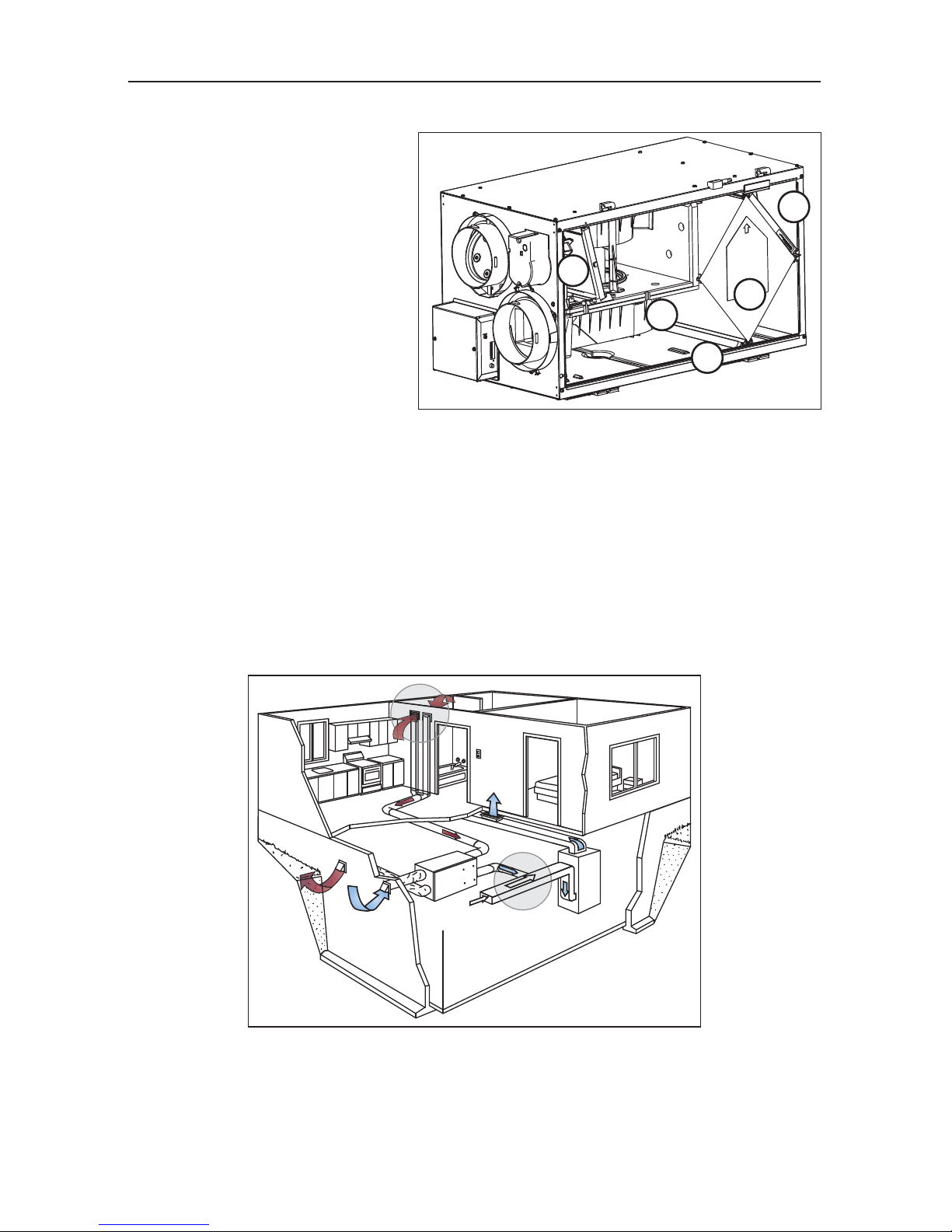
4
1. YOUR UNIT AND ITS PURPOSE
1. Filters
2. Blower
3. Recovery core
4. Condensation tray
1.1 UNIT DESCRIPTION
VL0052
Your ventilation system is designed to provide fresh air, warmed outdoor air to your home while
exhausting stale, humid air from your home. By eliminating accumulated pollutants and humidity, it
maintains an optimum air quality and an ideal relative humidity.
1.2 PURPOSE OF THE VENTILATION SYSTEM
VH0078
NOTES: 1. Shown with a forced air system. Can also operate on its own.
2. Installation may vary according to the model number.
1
1
2
3
4
Page 5
5
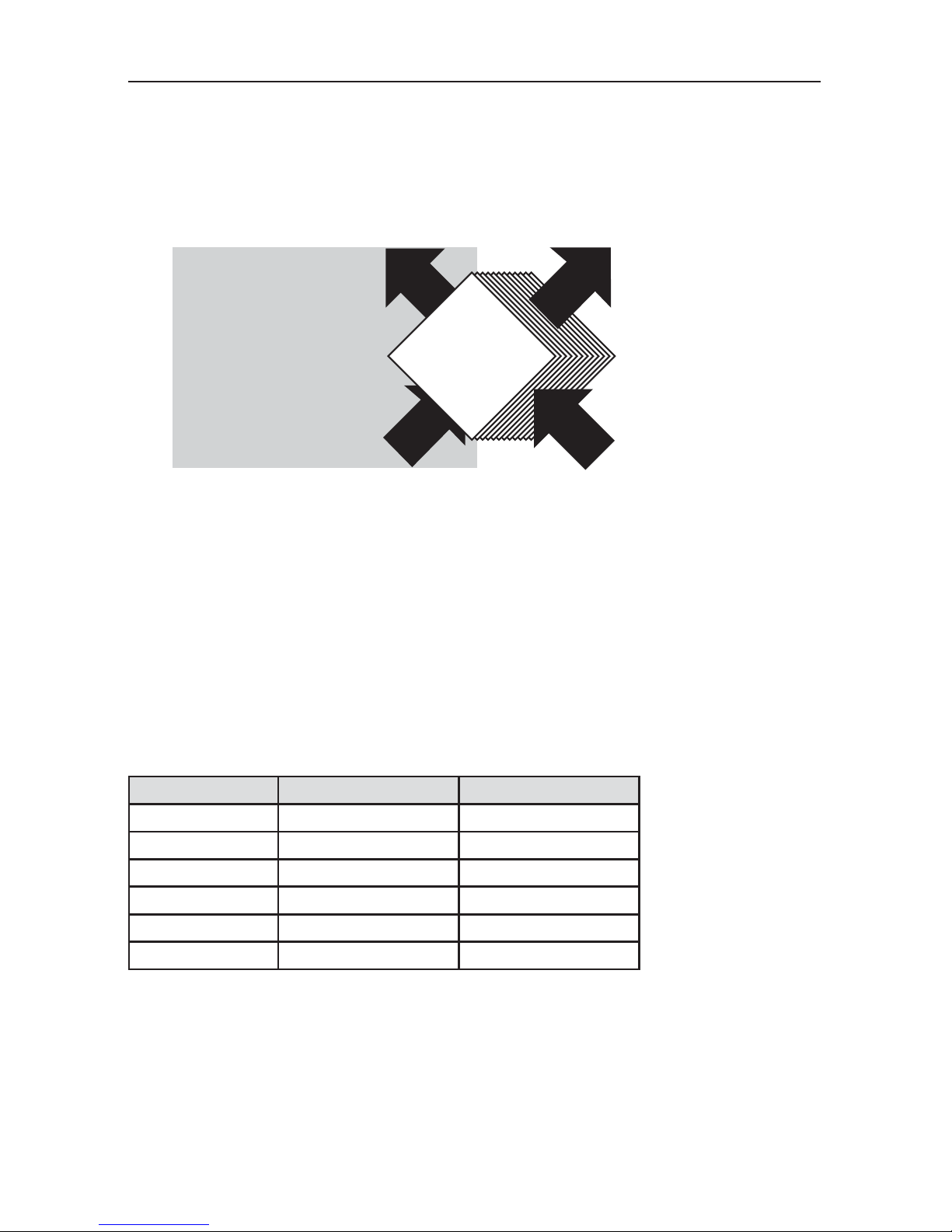
Your ventilation system is equipped with a heat recovery core specifically designed to control excess
humidity and reduce ventilation costs by recovering the heat energy from the exhausted air, and
using that same heat energy to warm the fresh air being supplied. This heat recovery process is
accomplished in such a way that the stale air is never mixed with the fresh air.
1.3 RECOVERY
EXAMPLE (IN WINTER)
VF0026
OUTDOORS
INDOOR
Stale air to outdoors
6°C/42°F
Fresh air from outdoors
0°C/32°F
Fresh air to building
16°C/61°F
Stale air from building
22°C/72°F
When the outdoor temperature is below -5°C (23°F), heat recovery creates frost in the module. To
maintain its proper operation, the unit is programmed to defrost the recovery module. The defrost
frequency varies according to the outdoor temperature. Defrost lasts 7 minutes for 100H model and
6 minutes for 200H model (or 10 minutes for both models if set on “Extented Defrost”). During the
defrost cycle, the unit shifts to maximum speed and the dampers close.
After defrosting, the unit returns to the operating mode selected by the user.
1.4 DEFROST MODE
1. YOUR UNIT AND ITS PURPOSE (CONT’D)
MODEL 100H 200H
WIDTH 30¼" 30¼"
HEIGHT 16½" 16½"
DEPTH 178" 178"
WEIGHT 65 LB. (29.5 KG) 65 LB. (29.5 KG)
E
LECTRICAL SUPPLY 120 V, 60 HZ 120 V, 60 HZ
POWER CONSUMPTION 160 WATTS 195 WATTS
1.5 SPECIFICATIONS
Page 6
6
2. CONTROLS
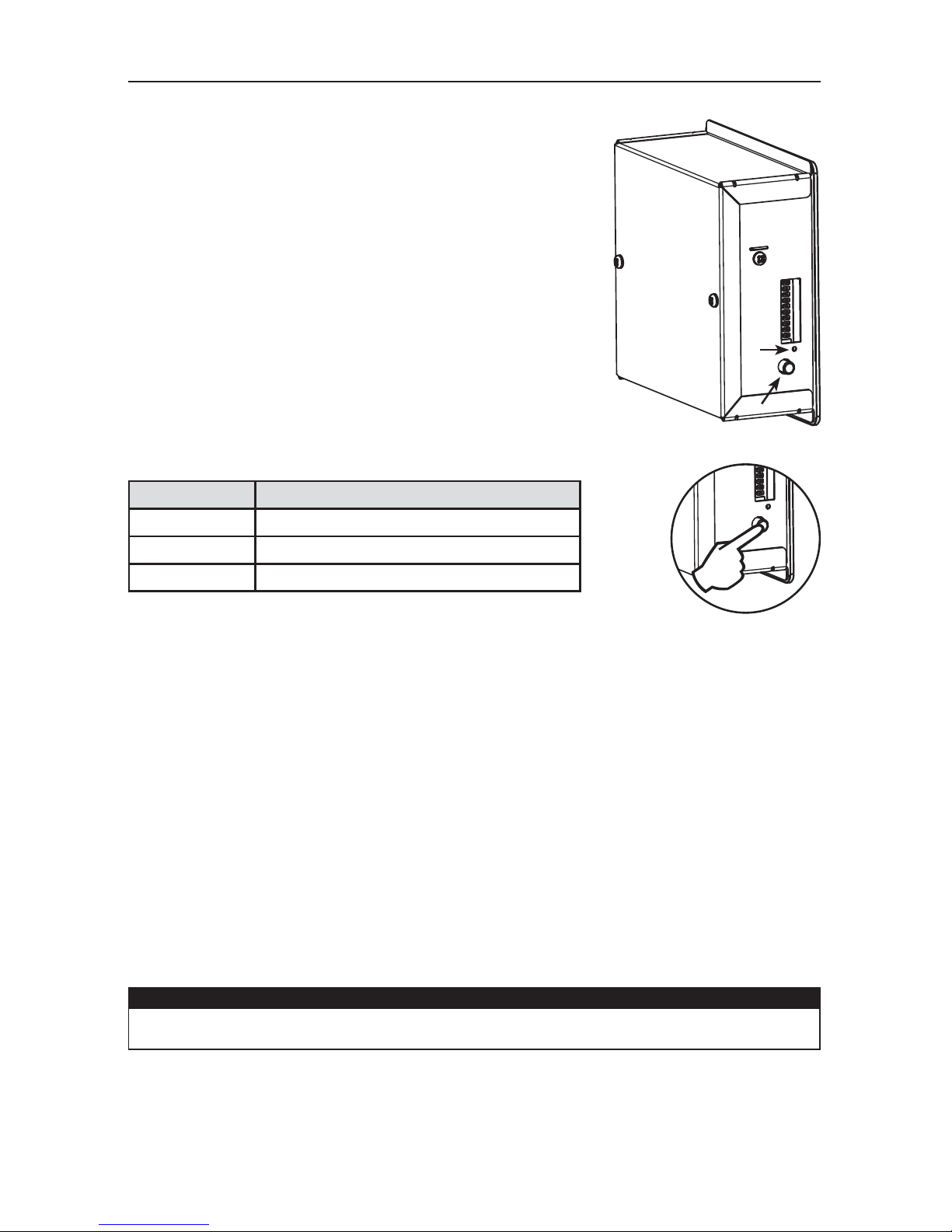
These units are equipped with an integrated control, located on the
electrical compartment. Use the push-button (1) to control the unit.
The LED (2) will then show on which mode the unit is in.
NOTES: 1. The integrated control must be turned OFF to use an
optional main control.
2. If an optional auxiliary control is used, if activated, the
auxiliary control operation will override the optional
main control operation.
2.1 INTEGRATED CONTROL
VD0278
1
2
VD0281
Refer to table below..
LED COLOR RESULTS
AMBER UNIT IS ON LOW SPEED
GREEN UNIT IS ON HIGH SPEED
NO LIGHT UNIT IS OFF OR CONTROLLED BY A MAIN CONTROL
The unit boot sequence is similar to a personnal computer boot sequence. Each time the unit is
plugged after being unplugged, or after a power failure, the unit will perform a 30-second booting
sequence before starting to operate. During the booting sequence, the integrated control LED will
light GREEN or AMBER for 5 seconds, and then will shut off for 2 seconds. After that, the LED will
light RED for the rest of the booting sequence. During this RED light phase, the unit is checking and
resetting the motorized damper position. Once the motorized damper position completely set, the
RED light turns off and the booting sequence is done.
NOTE: No command will be taken until the unit is fully booted.
2.2 BOOT SEQUENCE
2.3 OPTIONAL MAIN AND AUXILIARY CONTROLS
For more convenience, these units can also be controlled using an optional main control.
Only one main control can be connected per unit.
NOTE: If an optional auxiliary control is used, its activation will override the main control operation.
For more information about your unit controls, refer to the Main and auxiliary wall controls user
guide (included with your unit and also available at www.vanee.ca).
CAUTION
Turn off the integrated control and wait until its LED is turned off before using an
optional main wall control.
Page 7
7
3. MAINTENANCE
Dangerous voltage may be present. During maintenance and repairs, the unit
must always be turned off, then unplugged.
We take great care to minimize sharp edges; however, please proceed with
caution when handling all components.
When cleaning the unit, it is recommended to wear safety glasses and gloves.
3.1 EVERY THREE MONTHS
Regular maintenance should be performed every 3 months. Annual maintenance should take place
every fall season.
WARNING
!
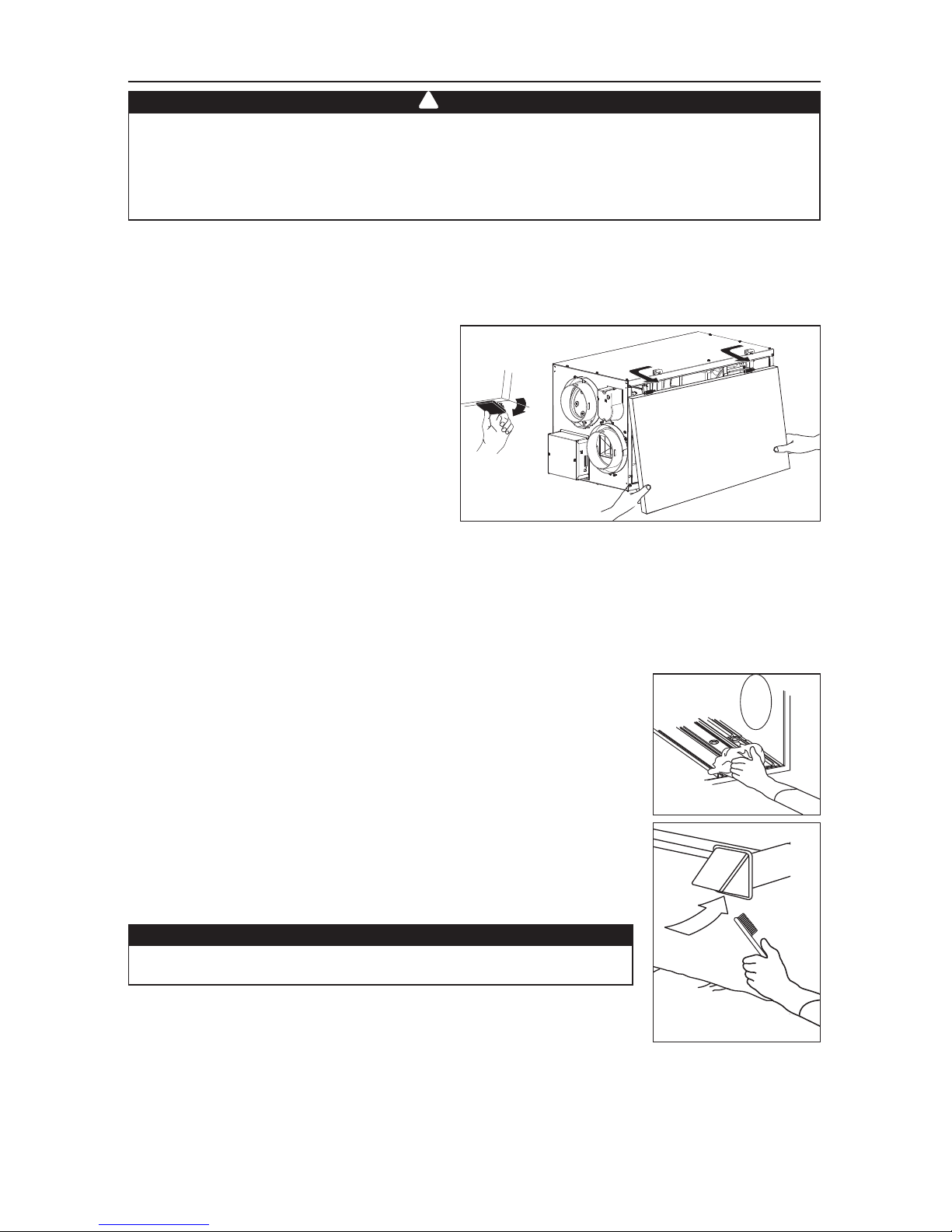
1. Disconnect power supply.
2. Unlatch the door. Lift the panel towards
you. Hold it firmly and hit on the right side
of the panel. The door will slide to the left.
3. Clean the inside of the door with a damp cloth.
4. Clean filters:
• Remove filters.
• Vacuum to remove most of the dust.
• Wash with a mixture of warm water and mild soap. You may add bleach if you wish to disinfect
(one tablespoon per gallon). Rinse thoroughly. Shake filters to remove excess water and let dry.
5. Clean the condensation tray with a damp cloth.
6. Check the exterior air intake hood:
• Make sure there are no leaves, twigs, ice or snow that could be
drawn into the vent.
• Clean if necessary.
7. Reassemble the components.
8. Reconnect power supply.
CAUTION
Even a partial blocking of this air vent could cause the unit
to malfunction.
VO0229
VD0035
VO0230
Page 8
8
3. MAINTENANCE (CONT’D)
3.2 ANNUAL MAINTENANCE (FALL)
Repeat steps 1 to 6 from Section 3.1 and continue with the following steps:
1. Clean the heat recovery core:
• Remove core.
• Let it soak in a mixture of cold or lukewarm water and mild soap (dishwashing liquid).
• Rinse thoroughly.
• Shake the core to remove excess water and let it dry.
2. Clean blower assembly.
• Remove dust using a vacuum cleaner with a soft brush attachment.
3. Reassemble the components.
4. Reconnect power supply.
CAUTION
Hot water and a strong detergent will damage the heat recovery core.
4. TROUBLESHOOTING
PROBLEM YOU SHOULD TRY THIS
1. Nothing works. • See if the unit is plugged in.
• See if the unit is receiving power from the house
circuit breaker or fuse.
2. Noisy unit. • Clean the unit (see Section 3). If the problem is not
solved, contact your installer.
3. Condensation on windows (air too
humid).
• Operate the unit at maximum speed (MAX.) during
activities generating excess humidity (family
gatherings, extra cooking, etc.).
• Leave curtains half-open to allow air circulation.
• Store all firewood in a closed room with a dehumidifier
or in a well ventilated room, or store the wood outdoors.
• Keep the temperature in your house above
18°C (64°F).
4. Air too dry. • Operate the unit at low speed (MIN.).
• Temporarily switch to the intermittent mode
(if available).
• Temporarily use a humidifier.
5. Air too cold at the air supply grille. • Make sure the outdoor hoods are not blocked.
• Operate the unit at low speed (MIN.).
• Have the system’s balancing checked.
• Have the unit’s defrost system checked.
• Install a duct heater.
If the problem is still not solved, call your installer or the nearest approved Service Center. You can
also reach the Customer Service Department at the following phone number:
1-800-567-3855.
For wall controls problems, refer to the Troubleshooting section in the Main and auxiliary wall
controls user guide (included with the ventilation unit and also available at www.vanee.ca).
 Loading...