

Page 1
INSTALLATION INSTRUCTIONS
DISPOSABLE CARTRIDGE SG-23
FOR IN-LINE DESICCANT DRYER MODEL ID15/SW
AND MINI DRYER MODEL MD4/SW
VAN AIR PART NUMBER: 26-0888
August 2008
432-00160-B
WHEN TO REPLACE CARTRIDGE:
Crystals in cartr idge as seen through sight window of
housing will change from blue to pink when silica gel in cartridge
is saturated with moisture. Install fresh cartridge when cr ystals
turn to pink.
WARNING
BEFORE INSTALLING NEW CARTRIDGE, READ THE
FOLLOWING INSTRUCTIONS CAREFULLY.
REPLACING OLD CARTRIDGE:
Close inlet and outlet shutoff valves (and open bypass if
1.
provided); or lock out all compressed air supply to dryer
housing.
Slowly open ball valve on bottom of housing and allow unit to
2.
depressurize completely.
WARNING
DO NOT REMOVE BOWL FROM DRYER HEAD UNTIL
VESSEL IS COMPLETELY DEPRESSURIZED.
3.
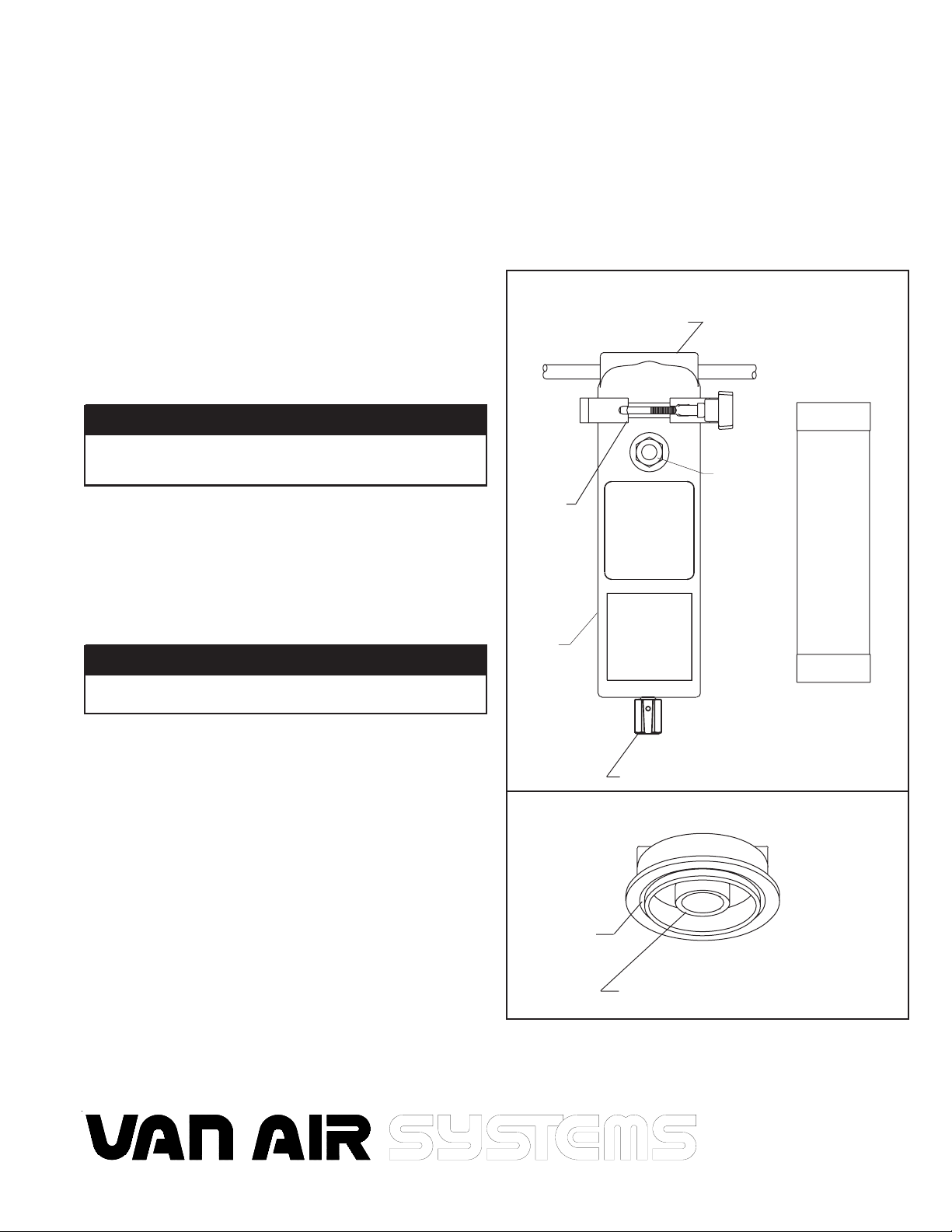
Grasp bottom portion of housing (Bowl) with one hand and
turn clamp knob with the other to loosen. Slide clamp down
and off vessel.
4.
Remove used cartridge from head and discard the cartridge.
5.
Remove new cartridge from packaging.
6.
Push new cartridge onto boss of dryer head.
7.
Reinstall bowl and clamp. Make sure that the bowl is tight
against the head and the o-ring is correctly seated in the
groove.
8.
Close the ball valve and slowly pressurize the vessel. If any
leaks occur, depressurize vessel completely and correct the
problem before repressurizing.
DRYER WITH CARTRIDGE
HEAD
INLET
1/2" NPT
CLAMP
BOWL
VIEW FROM BOTTOM OF DRYER HEAD
O-RING
GROOVE
A
1/4" BALL VALVE
B
OUTLET
1/2" NPT
SIGHT
WINDOW
SG-23 SILICA GEL
CARTRIDGE
BOSS (INSTALL CARTRIDGE
HERE)
2950 Mechanic Street
Lake City, PA 16423-2095
Phone: 814-774-2631
Fax: 814-774-3482
www.vanairsystems.com
Page 2
2950 Mechanic Street, Lake City, PA
consulted for specific requirements.
16423-2095
Phone: 814/774-2631
Or 800/840-9906
Order Fax: 814/774-3482
Corporate Fax: 814/774-0778
E-mail: [email protected]
www.vanairsystems.com
U.S. Department of Labor Occupational
Safety and Health Administration (non-
mandatory form)
May be used to comply with OSHA’s
Hazard Communication Standard, 29
CFR 1910.1200. Standard must be
Material Safety Data Sheet
Section 1 – Chemical Product Information Date Prepared: May 1, 2000
Product: Silica Gel (Indicator & Non-Indicator)
Indicator (Sorbead Blue); Non-Indicator (Sorbead R, H, WS & 22)
O
11
Part No.: 33-0105, 33-0243 thru 33-0247, 33-0248, 33-0249, 33-0315, 33-0316,
E
33-0317 & 38-0106
Section 2 – Hazardous Ingredients/Identity Information
Hazardous Components Other Limits
(Specific Chemical Identity/Common Name(s)) OSHA PEL ACGIH TLV Recommended % Optional
Silica, Amorphous, SiO
(CAS No. 7631-86-9) 6 Mg/mm
Alumina, AL
2O3
2
3
(No Hazard) 96.5
(CAS No. 1327-36-2) (No Hazard) 3.0
Cobalt Chloride, CoCL
(Indicator Only)
2
(CAS No. 7646-79-9) Harmful 0.5
The synthetic aluminosilicate in this product is amorphous and does not contain any crystalline forms. It
should not be confused with crystalline silica or any other naturally occurring forms that normally contain
crystalline silica.
Section 3 – Physical Chemical Characteristics
Boiling Point: Not applicable.
Specific Gravity (Water=1): Not applicable.
Vapor Pressure (mm Hg): Not applicable.
Melting Point: >1,000
o
C
Vapor Density (Air=1): Not applicable.
Solubility in Water: Insoluble.
Evaporation Rate (Butyl Acetate=1): Not applicable.
Appearance and Odor: Indicator = blue (dry) or pink (wet) odorless beads – 3.5 mm diameter.
Non-Indicator = brown or white odorless beads – 3.5 mm diameter.
Section 4 – Fire and Explosion Hazard Information
Flammable Properties
Flash Point: Not applicable.
Method Used: Not applicable.
Flammability Limits
LEL: Not applicable.
UEL: Not applicable.
Fire Fighting Instructions: Non-flammable.
Extinguishing Media: As necessary for surrounding fire.
Unusual Fire and Explosion Hazards: When handling near flammable gases or vapor take precautionary
measures against static discharges.
Page 3

Van Air Systems, Inc. Silica Gel (Indicating & Non-Indicating) Material Safety Data Sheet Page 2 of 2
Date Prepared: May 1, 2000
Section 5 – Reactivity Information
Stability (Conditions to avoid): Stable. (Handling near flammable gases or vapors.)
Incompatibility (Materials to avoid): None expected.
Hazardous decomposition/byproducts: None expected.
Hazardous Polymerization: Will not occur.
Section 6 – Health Hazard Information
Potential Health Effects: Inhalation, ingestion, skin and eye contact.
Health Hazards (acute and chronic): None known.
Carcinogenicity: No.
NTP: No.
IARC Monographs: No. (Yes for indicating material)
OSHA Regulated: No.
Signs and Symptoms of Exposure: Generally aggravated by exposure desiccant action may cause skin
dryness or eye irritation. NOTE: Indicator Only – LD50 (oral, rat):
766 Mg/Kg (for Cobalt Chloride Hexahydrate, RTECS 1985-86).
Emergency and First Aid Procedures
Eyes: Flush with water for at least 15 minutes.
Skin: Wash with soap and water.
Inhalation: Remove to fresh air. If unconscious seek immediate medical
attention.
Ingestion:
Physicians Note: Indicator Type Only: Beads impregnated with Cobalt Chloride,
therefore induce vomiting if victim has swallowed large quantities.
IF IRRITATION PERSISTS SEEK MEDICAL ATTENTION
Section 7 – Precautions for Safe Handling and Use
Small/Large Spills: Sweep or shovel up immediately due to slippery conditions (beads).
Dispose at appropriate waste disposal facility.
Waste Disposal Method: Comply with local regulations for non-hazardous chemical disposal.
Handling & Storage: Keep containers tightly closed and store in a cool, dry place.
Other precautions: Take precautionary measures against static discharge when handling
near flammable gases or vapors. Information given herein is offered
in good faith as accurate, but without guarantee. Conditions of use
and suitability of the product for particular uses are beyond our
control; all risks of u se of the product a re therefore assumed by the
user and we expressly disclaim all warranties of every kind and
nature, including warranties of merchantability and fitness for a
particular purpose in respect to the use or suitability of the product.
Section 8 – Control Measures
Respiratory Protection (specific type): Use a NIOSH approved dust mask if excessive dust is present.
Ventilation: Natural ventilation or local exhaust.
Mechanical, Special and other Exhaust – Not applicable.
Protective Gloves: None required however follow good personal hygiene practices.
Eye Protection: Safety glasses or goggles for dust and dirt.
Other Protective Clothing & Equipment: Work clothes and work gloves.
Work/Hygienic Practices: Wash thoroughly after handling.
 Loading...