

Page 1
Valve Amplification Company
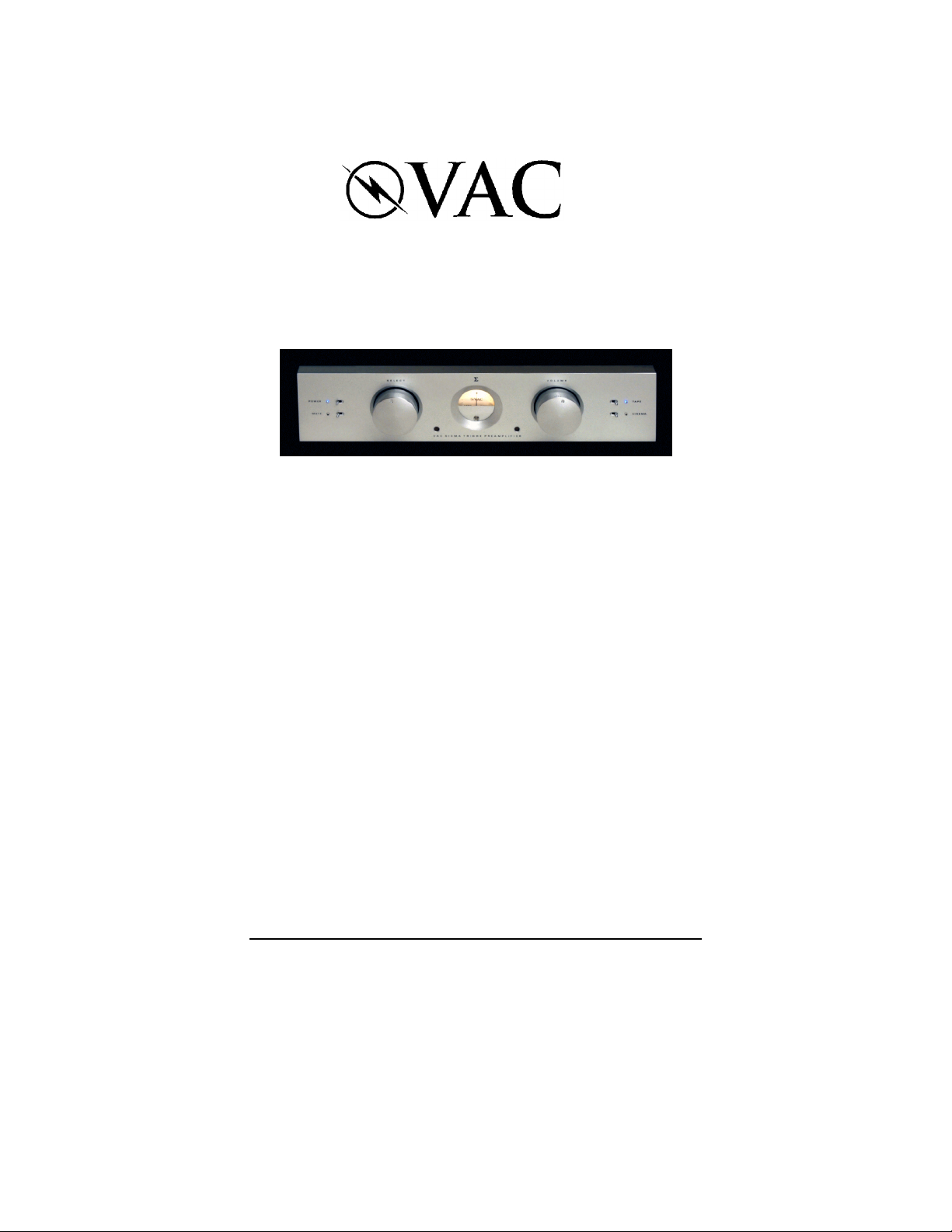
VAC Sigma Preamplifier
Instructions
Manual issued - 3 March 2008
Revised 2 April 2008
Please read carefully before installing
Copyright 2008 by Valve Amplification Company. All rights reserved.
Page 2

WELCOME
Congratulations on your purchase of the VAC Sigma Preamplifier, and welcome to the
family of VAC owners!
Your VAC is designed not to the latest fad but to substance, providing the highest quality
of sound. Time spent familiarizing yourself with this manual will be well rewarded.
It is our goal to provide instruments of the highest quality, be informative to all of our
customers, and to provide responsive, effective customer service.
Please feel free to contact us if we can be of assistance. We can be reached:
Telephone941 952 9695
Fax941 952 9691
E-mail info@vac-amps.com
Website www.vac-amps.com
We look forward to being of service, even as you have many years of enjoyment from your
VAC Sigma Preamplifier.
Kevin M. Hayes
President, VAC
INTRODUCTION
The VAC Sigma Preamplifier is an all new design derived from the VAC Phi Beta, and
employs four twin triode vacuum tubes operating in Class A. This unique design provides
great speed, detail, punch, and musicality, all without global feedback. Its moderate gain
structure and low output impedance provides an excellent match with a wide range of
popular power amplifiers.
The new highly shielded power transformer keeps significant e.m.f. fields away from the
audio circuit, yet allows the source of power to be located close to the audio circuit’s
demands, resulting is fast, clear response to audio transients and high resolution of inner
detail. Low noise rectifiers further improve the purity of the DC supplies, thus preserving
both the power and delicacy of the music. Heater voltage is precisely regulated to improve
tube life.
The chassis is rigid and non-magnetic.
A triode MM phono stage or triode MC/MM phono stage are optional.
Page 2
Page 3

GENERAL PRECAUTIONS & SAFETY NOTES
1. DANGEROUS VOLTAGES EXIST WITHIN THE CHASSIS. DO NOT REMOVE
CHASSIS COVER UNTIL UNIT HAS BEEN SWITCHED OFF AND
UNPLUGGED FROM THE WALL OUTLET (POWER) AND ALL
COMPONENTS FOR 15 MINUTES. TUBES BECOME HOT IN USE, AND CAN
CAUSE INJURY. DO NOT EXPOSE CHASSIS TO MOISTURE. DO NOT PLUG
INTO AN AC SOURCE UNTIL ALL CONNECTIONS ARE COMPLETED AND
ALL COVERS ARE INSTALLED.
2.Complete all signal connections before connecting the AC cord to the wall outlet and
turning the unit on. Similarly, always turn the amplifier off and remove the AC power
cord before detaching cabling. Failure to observe this sequence can result in damage
to the amplifier, speakers or associated components.
3.At turn on, all volume controls should be full counter-clockwise. Allow one (1)
minute for warm up before disengaging mute and commencing playback. Note: Mute
is automatically engaged when switching on units equipped with the remote control
option.
4.For protection of your speakers and power amplifier, always engage “Mute” before
switching the power off or on. Note: Mute is automatically engaged when switching
on.
5. DO NOT OPERATE THE UNIT IF IT IS WET.
6. THE CHASSIS CONTAINS VACUUM TUBES. DANGEROUS VOLTAGES
EXIST WITHIN THIS CHASSIS. NEVER REMOVE THE COVER UNLESS THE
UNIT HAS BEEN SWITCHED OFF AND COMPLETELY DISCONNECTED
FOR AT LEAST 15 MINUTES. THE TOP COVER MUST ALWAYS BE LEFT
SECURELY IN PLACE.
7. Take care to install your preamplifier securely in a sturdy, well designed stand so that
it will not fall or tip over (this could cause serious, possibly fatal injury).
Page 3
Page 4

INSTALLING THE SIGMA PREAMPLIFIER
Physical requirements:
1)Provide Adequate Ventilation.
2)The chassis cover will become warm during normal use.
3) This component must be installed in a secure, properly built (and ventilated) stand,
cabinet or enclosure. It could inflict serious injury or property damage if it falls, or
if the stand upon which it is placed tips over. This concern is particularly important
in households with small children who might try to climb furniture.
Basic Hookup:
1)Connect line level inputs (CD, Tape, etc.) to the appropriate RCA input jacks on the
rear panel. With the exception of Phono (when fitted), all inputs are “line level”.
2)Connect phono cables to the rear panel RCA input labeled “Phono.” Connect the
ground wire from the turntable or phono cable to the “Ground” terminal provided on
the rear panel. (See “Phono Section” for cartridge types appropriate for use.)
Connect output interconnects to your power amplifier.
3)Connect the AC power cord to the IEC connector. For best performance, route the
power cord away from signal cables.
4)Before turning the power switch to the “on” position, set output level to zero by
rotating the “Volume” control fully counterclockwise. Note: Mute is automatically
engaged when switching on.
5)Allow the preamplifier to warm up for a minute before you unmute the unit; failure
to wait can cause a transient to be sent through your power amplifier that might cause
damage to your loudspeakers and amplifiers.
6)Always mute the preamplifier before switching it off. The best practice is to also turn
off your power amplifier(s) before turning off the preamplifier.
As with all high performance audio products, the sonic characteristics of all VAC products
will continue to improve during the first several hundred hours of use.
Page 4
Page 5

OPERATING THE SIGMA PREAMPLIFIER
Front Panel Controls:
Although most of the front panel controls (Volume, Power, Mute) are self explanatory, VAC
has outfitted this unit with several advanced features which bear further description:
Phono Section MM (option): When fitted, input “L6" will be connected to a discrete, pure
tube phono preamplifier, providing 40 dB of gain, suitable for use with MM (moving
magnet) and many high-output MC (moving coil) cartridges. Your VAC dealer can
recommend the proper phono cartridge(s).
Phono Section MC (option): As above, this will be fitted to “L6", and provides
approximately 60 dB of gain. It should not be used with high output pickups, which may
generate excessive distortion. Your VAC dealers can recommend the proper phono
cartridge(s). A switch on the back panel selects between MC (60 dB) and MM (40 dB)
mode.
Monitor: This switches between “Source” and “Tape”. In the “Source” position, input
selection is determined by the Source Selector Switch. In the “Tape” position, the Source
Selector is overridden, and the Tape inputs are activated. [Important: The Sigma
Preamplifier is outfitted with a full “tape loop”, including a line level tape input and a fixed
level recording output. In addition to driving the recording inputs of a tape deck, this output
can supply signal to any typical line level input, enabling it to control a second zone in multi
room installations.]
Cinema: This switches between “Source” and “Cinema”, a fixed volume pass-through. In
the “Source” position, input selection is determined by the Source Selector Switch. The
“Cinema” position provides access to one of the Sigma Preamplifier’s most unusual feature.
When set in the “Source” position, input choice is governed by the Input Selector switch.
This is the normal setting, and enables the unit to be used as a typical preamplifier. Selecting
the “Cinema” position bypasses all preamplifier controls (including volume) and passes the
output from your surround sound processor (i.e., the front left- and right-channel outputs of
a multichannel processor) directly to your power amplifier. In this case, the users’ analogue
stereo sources would be connected, as usual, to the line, phono and tape inputs. A/V inputs
(DVD, Laserdisc, DSS, etc.) would be connected to the home theater processor, and the
processor’s main outputs would be connected to the pair of rear panel RCA jacks labeled
“Home Theater Direct”. When the control is set to the “Cinema” position, the Sigma
functions as a pass-through ONLY, and is controlled by the external processor, preamplifier,
or other component connected to the “Home Theater Direct” (a/k/a “Cine”) inputs.
Mute: This knob is spring loaded; moving the control clockwise will toggle between the
Page 5
Page 6

“Mute” and “Operate” condition. When muted, a red glow will be observed in the LED. On
occasion the preamplifier may seem not to have responded to a turn of the “Mute” knob; this
is due to “contact bounce” in the switch. Simply turn the knob again until the desired
condition is attained.
REMOTE CONTROL
The remote control allows for wireless adjustment of “Mute” and “Volume”.
The remote wand is powered by two “AAA” batteries. These should be of the alkaline type.
You will need to install them in the wand before using the remote. Since batteries can leak,
they should be removed from the wand if it is not going to be used for an extended period
of time.
Volume Up/Down: These buttons cause a motor to turn the volume control. Motorized
controls offer superior sound, as well as direct visual indication of volume setting. The front
panel control may also be used directly in the conventional way.
Mute: Pressing either side of the “Mute” button will toggle between the “Mute” and
“Operate” condition. When muted, a red glow will be observed in the LED indicator. Mute
is automatically engaged when switching on units equipped with the remote control option.
NOTE ON ABSOLUTE PHASE
Through the main RCA outputs Sigma Preamplifier inverts absolute phase. There is some
debate about the audibility of absolute phase, and it generally is not controlled for by the
recording industry (i.e., about half of your recordings may have inverted absolute phase).
If you wish to correct your playback system for absolute phase, this is easily accomplished
in the connections to your loudspeakers. Assuming that your source component(s), power
amplifier, and loudspeakers do not invert phase, you can correct for the inversion of the
Sigma Preamplifier by connecting the positive output terminals of your amplifier(s) to the
negative terminals of your loudspeakers, and the negative terminals of your amplifier(s) to
the positive terminals of your loudspeakers. Sonically, this is absolutely transparent.
Through the XLR main outputs, pin 2 is positive polarity (“pin 2 hot”) and pin 3 is negative
polarity. Note: Do not connect either pin to ground, as some XLR-to-RCA adapters might
do.
Page 6
Page 7

MAINTENANCE
Chassis Care:
Although your VAC chassis and faceplate are extremely durable, their finish can be
scratched, chipped or damaged if improperly treated. Cleaning with a soft, damp cloth while
the amplifier is switched off and unplugged should restore the finish to its original lustre.
Never clean this component with harsh or caustic cleansing agents.
When shipping your unit, be certain to wrap the amplifier in the cloth, tissue or plastic wrap
in which it was originally packaged. Given the high gloss of the lacquered finish, make sure
there are no ridges or sharp surfaces in those parts of the cloth which contact the faceplate.
Use of a coarser cloth or failure to otherwise protect the faceplate may result in damage to
the finish. VAC is not responsible for cosmetic damage resulting from improper care or
packing.
Installing New Tubes:
Original Equipment Replacement tubes are available from VAC. These tubes ensure your
Sigma Preamplifier will meet or exceed all factory performance specifications.
DANGEROUS VOLTAGES EXIST WITH THIS COMPONENT. YOU MUST FOLLOW
THESE STEPS TO PROTECT YOUR SAFETY. Before replacing tubes, all power must
be turned off. Unplug the power cord from the wall, and remove all audio interconnect
cables. Wait 15 minutes before removing the top cover. Install the new tubes fully firmly in
their sockets, taking care to make sure that pin pattern corresponds to holes in tube socket.
Reinstall the top cover before reconnecting the unit.
NEVER INSTALL OR OPERATE THIS UNIT WITHOUT ALL COVERS IN PLACE.
In the event that trouble is encountered, check all signal, speaker and power connections.
If the problem persists, follow all safety precautions stated earlier in this section, and check
that all tubes are correctly seated in their sockets. If possible, try another tube. If the problem
persists, please consult your VAC dealer or contact the factory directly.
Page 7
Page 8

GENERAL INFORMATION ABOUT TUBES
It is a truth that each brand of tube sounds different in a particular high resolution circuit.
This is because no two manufacturers make a tube type in quite the same way, and the
central tendencies of the performance parameters will differ slightly with each maker. This
sonic variability may at first seem a liability, but further thought will reveal that it is an
advantage. The owner of a tube amplifier can select those tubes which sound like the real
thing in his/her specific system. VAC can recommend the best tubes for your amplifier.
The tube types used in this component should last for 8,000 to 15,000 hours of use (two to
ten years for most users). There are always occasional exceptions, long or short. If you have
to replace a tube before, say, 3,000 hours, just replace the single tube. If you have to replace
a tube at 8,000 hours, replace them all and keep those still functioning well as spares
VAC will be happy to test tubes for concerned customers.
WARRANTY
Your equipment is warranted for a period of thirty (30) days from the date of purchase.
In addition, if the registration form is received by VAC along with a copy of your sales
receipt from an authorized VAC dealer within this thirty days, a service contract will be
extended to cover your equipment for two (2) years (tubes excepted).
This warranty applies only to units sold in the United States of America through authorized
VAC dealers, and operated within the U.S. by the original purchaser. It covers factory
service, and, in the continental U.S., standard return shipping. For warranty information
outside of the U.S. contact the importer of VAC equipment for your country. Units sold
outside of the U.S. should still be registered with VAC. It is the responsibility of the dealer
and/or customer to determine the suitability of this product for any particular application.
Your questions and comments are always welcome. Contact:
Valve Amplification Company, Inc.
1911 East Avenue North
Sarasota, FL 34234
Telephone941 952 9695
Facsimile941 952 9691
E-mail info@vac-amps.com
Page 8
Page 9

VAC SIGMA PREAMPLIFIER SPECIFICATIONS (typical)
Type:Vacuum tube line stage with home theater (direct power
amplifier) mode.
Options:Remote control for volume & mute
Dedicated MM phono input
Dedicated MC phono input
Line stage preamplifier:
Gain:24 dB
Maximum input signal:Essentially infinite (attenuation precedes line stage)
Main output:Inverting to RCA
Pin 2 positive “hot” on XLR, pin 3 negative
Tape output:Unity gain from selector, non-inverting (archival correct)
Phono stage preamplifier (optional):
Gain:40 dB MM, 60 dB MC (measured at tape output)
Residual noise:3 mV at output (S/N ratio approx. 69 dB MM)
Overload:117 mV @ 1 kHz = 8 volts RMS output, MM
460 mV @ 10 kHz, MM
Frequency response:RIAA +/- .25 dB
Notes:Does not invert absolute phase.
Tube compliment:
3 x 12AX7 (phono option) (located on circuit board at left side of chassis)
2 x 12AU7/6189A (line stage)
2 x 12AX7 (line stage)
Page 9
Page 10

SIGMA PREAMPLIFIER REGISTRATION
mail to VAC soon as possible.
Name______________________________________________________________
Address______________________________________________________________
______________________________________________________________
Telephone______/______-_____________E-Mail __________________________
Dealer name______________________________________________________________
" address______________________________________________________________
Purchase date ______________________Serial Number __________________________
Salesperson______________________________________________________________
How did you first learn of VAC products?
__________________________________________________________________________
What other brands and models did you consider?
__________________________________________________________________________
__________________________________________________________________________
What made you decide on the VAC?
__________________________________________________________________________
__________________________________________________________________________
Please provide any comments on VAC products or your dealer
__________________________________________________________________________
__________________________________________________________________________
What magazines do you read regularly?
________________________________________________________________________
________________________________________________________________________
What are your hobbies?
________________________________________________________________________
What are your favorite types of music?
________________________________________________________________________
________________________________________________________________________
 Loading...