

Page 1

UTO-NBL-52A
OEM/Integrators Installation Manual
Brief
Page 2

Bluetooth LE module (UTO-NBL-52A) User Manual
1. Product Information
UTO-NBL-52A is an antenna-embedded low-power Bluetooth module.
UTO-NBL-52A is a module that integrates wireless circuit, software stack and
antenna for Bluetooth operation.
It is a function that can operate independently without the need of a separate
external control device.
UTO-NBL-52A is applicable to Bluetooth wireless data communication for low power.
It has optimal RF performance with transmit power up to +4 dBm and receive
sensitivity of -93 dBm.
2. Description of operation
UTO-NBL-52A is a product using Bluetooth Low Energy Technology. The product is
operating 2.4GHZ ISM frequency band and it provides a fully compliant Bluetooth
specification system integrates all features of Bluetooth radio, software stack, GATT
based profiles, Antenna and host end user applications, which means no external
micro controller. It provides a Bluetooth Low Energy fully compliant system for a data
communication. The product integrates NordicnRF52832 Bluetooth chipset, 32 MHz
main clock oscillator, 32.768 KHz RTC clock oscillatorand Antenna. RF signal is sent
and received through Antenna.
The product is operated with 1.7 ~ 3.6V external voltage. The product has 30 PIOs.
The PIOs are functions with UART, ADC, I2C, SPI, I2Sand General purpose IO.
Main core is ARM Cortex-M4. The processor implements several features that
enable energy efficient arithmetic and high-performance signal processing including
“digital signal processing”, “Single-cycle multiple and accumulate instructions”,
“hardware divide”, “8 and 16 bit single instruction multiple data instructions”
3. Applications
- Commercial product
- Sports and fitness
- Healthcare
- Medical Sensors
- Home Automation
- Mobile Accessories
- clock
- User reaction device
4. Product Specification
- Bluetooth V4.2 Single Mode Satisfaction
- Built-in Bluetooth Smart Stack
. GAP, GATT, L2CAP and SMP
. Bluetooth Smart profiles
- RF performance
. Transmission output : +4 dBm
. Reception sensitivity : -96 dBm
Page 3
- Current consumption
. Transmit : 7.5 mA peak
. Receive : 12.9 mA peak
. waiting : 0.5 uA
- External interface
. UART/SPI(Master/Slave)/I2C
. GPIO
. 12-bit ADC
. I2S and PDM
. timer
. temperature Senser
. Power supply : 1.7 ~ 3.6 V
. Size : 5.9 x 8.9 x 1.9 mm (W x L x H)
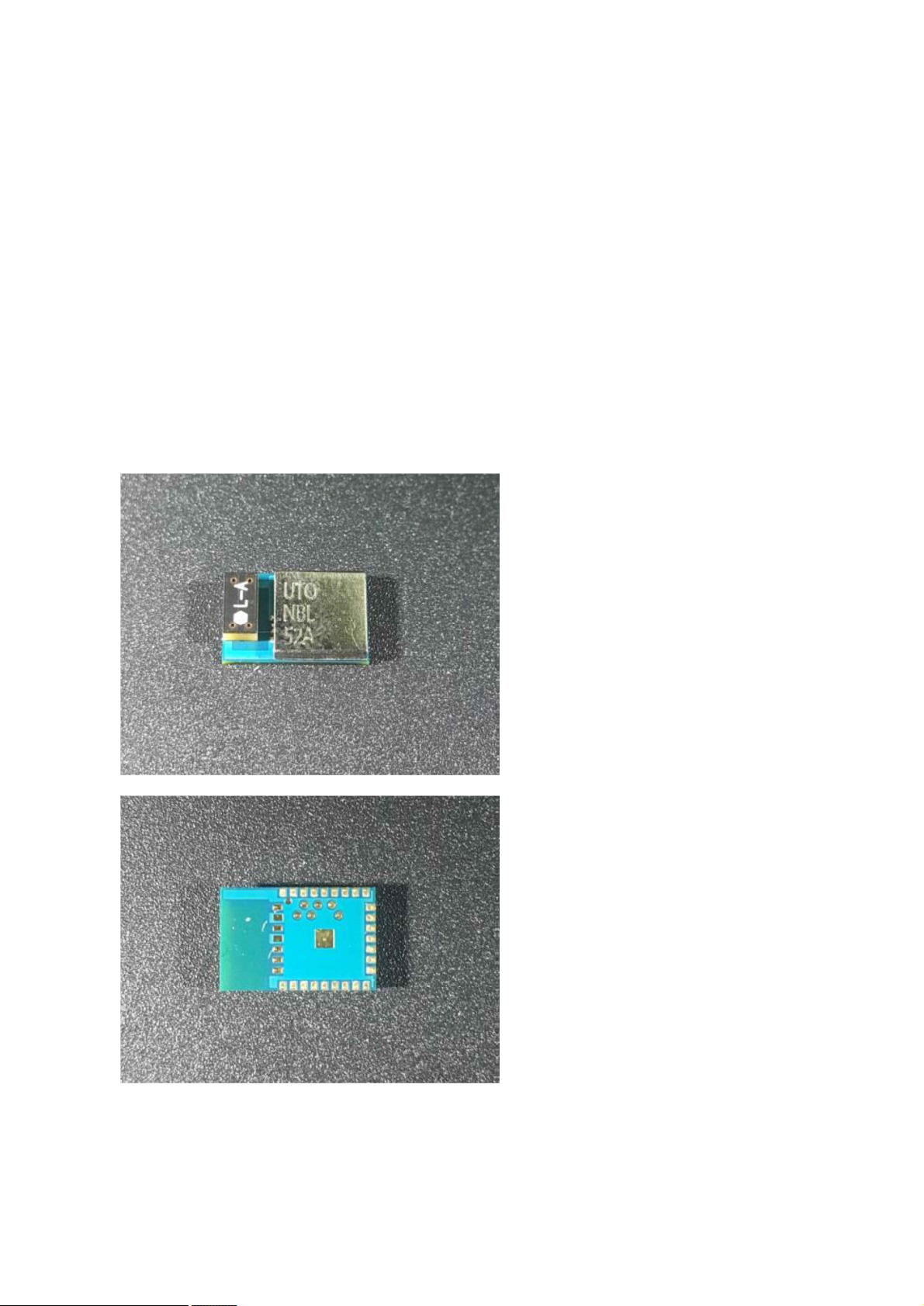
5. Product Photos
Page 4

6. Warranty and AS information
Warranty Year
If the product does not work, please ask for A/S on the contact below.
Brand Name: Utovertek
Address: Rm210,KETI Business Incubator,25 seanari-ro,Bundang-gu,Seongnamsi,Gyeonggi-do 463-816 Korea
Tel: 82-31-609-0703
Product name: BLE module
Model number: UTO-NBL-52A
Manufacturer / Country of Origin: Utovertek Co.,Ltd. / Korea
Bluetooth LE module (UTO-NBL-52A) User Manual
4. Warranty and AS information
FCC REQUIREMENTS PART 15
Caution: Any changes or modifications in construction of this device which are not expressly
approved by the responsible for compliance could void the user's authority to operate the
equipment.
NOTE: This device complies with Part 15 of the FCC Rules.
Operation is subject to the following two conditions;
1. This device may not cause harmful interface, and
2. This device must accept any interference received, including interference that may cause
undesired operation.
This equipment has been tested and found to comply with the limits for a Class B Digital
Device,
pursuant to Part 15 of the FCC Rules. These limits are designed to this equipment generates,
uses, and can radiate radio frequency energy and, if not installed and used in accordance with
the instructions, may cause harmful interference to radio communications.
However, there is no guarantee that interference will not occur in a particular installation. If
this equipment does cause harmful interference to radio or television reception, which can be
determined by turning the radio or television off and on, the user is encouraged to try to
correct interference by one or more of the following measures.
1. Reorient or relocate the receiving antenna.
2. Increase the separation between the equipment and receiver.
3. Connect the equipment into an outlet on another circuit.
4. Consult the dealer or an experienced radio/TV technician for help.
The module is limited to OEM installation ONLY.
OEM integrators are responsible for ensuring that the end-user has no manual instructions to
remove or install module.
This module is intended for OEM integrator. The OEM integrator is responsible for the
compliance to all the rules that apply to the product into which this certified RF module is
Page 5

integrated. Additional testing and certification may be necessary when multiple modules are
used.
In the users manual of the end product, the end user has to be informed to keep at least 20 cm
separation with the antenna while this end product is installed and operated. The end user has
to be informed that the FCC radio-frequency exposure guidelines for an uncontrolled
environment can be satisfied.
The end user has to also be informed that any changes or modifications not expressly
approved by manufacturer could void the user’s authority to operate this equipment.
If the labelling area is small than the palm of the hand, then additional FCC part 15.19
statement is required to be available in the users manual: This device complies wirh Part 15
of FCC rules.
Operation is subject to the following two conditions: (1) this device may not cause harmful
interference and (2) this device must accept any interference received, including interference
that may cause undesired operation.
The final end product must be labeled in a visible area with the following “contains
Transmitter Module FCC ID: 2AMD4UTO-NBL-52A
If the labelling area is larger than the palm of the hand, then the following FCC part 15.19
statement has to also be available on the label: This device complies with Part 15 of FCC
rules. Operation is subject to the following two conditions: (1) this device may not cause
harmful interference and (2) this device must accept any interference received, including
interference that may cause undesired operation.
The module is limited to installation in mobile or fixed applications, according to
Part 2.1091(b)
Separate approval is required for all other operating configurations, including portable
configuration with respect to Part 2.1093 and different antenna configuration.
 Loading...