

Page 1
Applications Engineering Notes
Document Title
Operating Instructions for the US Conec
Loose Fiber Ribbonizing Tool
Document Number AEN-1408
Revision Number 2.0
Effective Date August 2, 2017
Copyright 2018 US Conec, Ltd.
Page 2

Document Title: Operating Instructions for the US Conec
Loose Fiber Ribbonizing Tool
Document Number: AEN-1408 Rev 2.0
THE USE OF SAFETY GLASSES FOR EYE PROTECTION IS RECOMMENDED
1.0 Document Purpose
This document describes the procedure for ribbonizing loose fibers using the US Conec
loose fiber ribbonizing tool and ½” Scotch® 810 Magic™ Tape.
2.0 Required Equipment and Materials
US Conec loose fiber ribbonizing tool
100 millimeter ruler or other measuring device
Permanent marker
½” Scotch® 810 Magic™ Tape
New razor blade or Xacto® knife
Isopropyl alcohol, 99.8% pure
Lint-free wip es
Tweezers
Fiber optic side cutters
3.0 Ribbonizer Operating Instructions
3.1 Cable Preparation
3.1.1 Prepare the cable for ribbonization according to the manufacturer’s
instructions or for the termination type being used.
3.2 Fiber Preparation
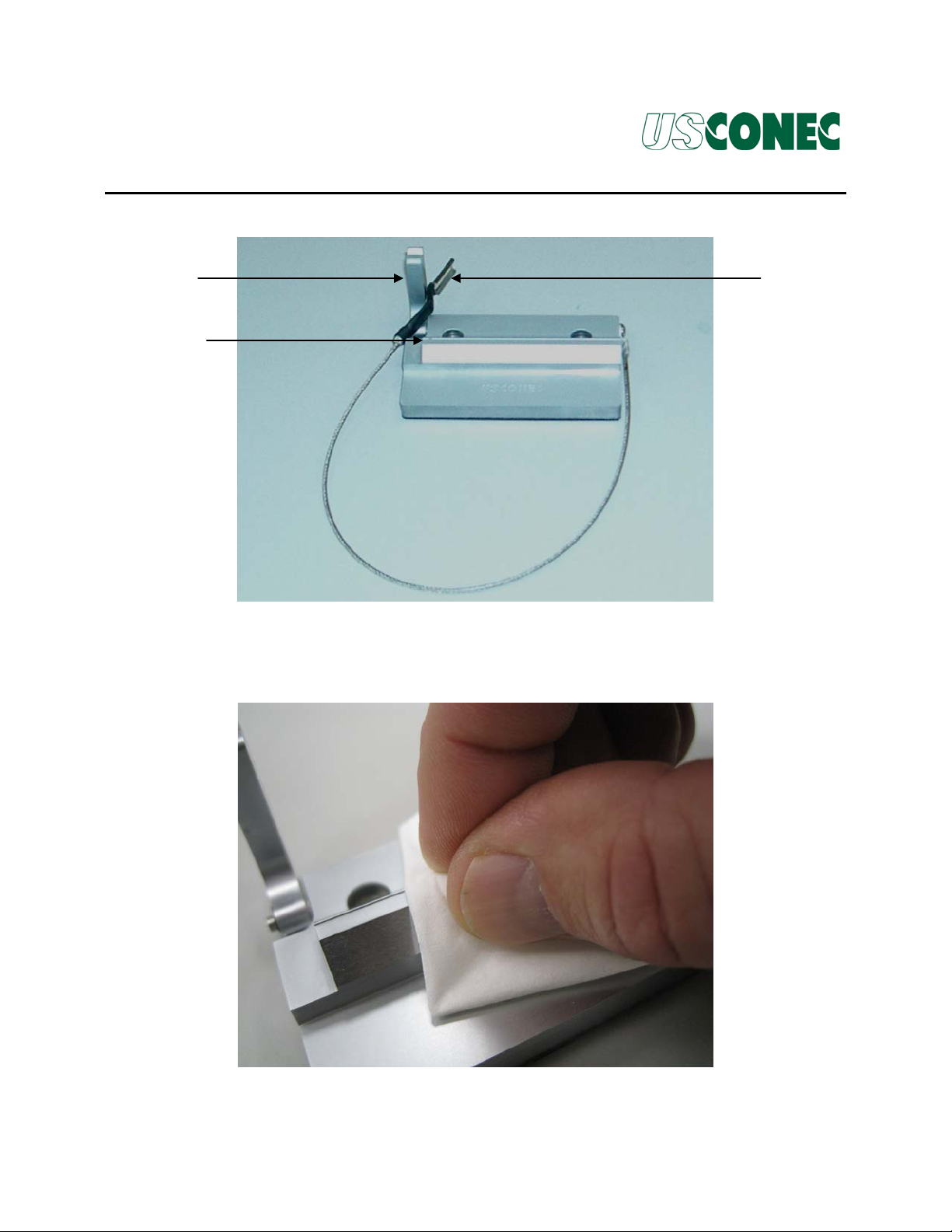
3.2.1 Raise the ribbonizing tool’s fiber stacker into the vertical position and
remove the fiber shim.
2 of 10
Page 3
Document Title: Operating Instructions for the US Conec
Loose Fiber Ribbonizing Tool
Fiber
Stacker
Fiber Shim
Fiber Tray
Document Number: AEN-1408 Rev 2.0
3.2.2 Clean all tool surfaces of contaminants with 99.8% pure isopropyl alcohol and lint free wipes. Pay particular attention to the fiber tray.
3.2.1
3.2.2
3 of 10
Page 4
Document Title: Operating Instructions for the US Conec
Loose Fiber Ribbonizing Tool
1
Blue
5
Slate
9
Yellow
Document Number: AEN-1408 Rev 2.0
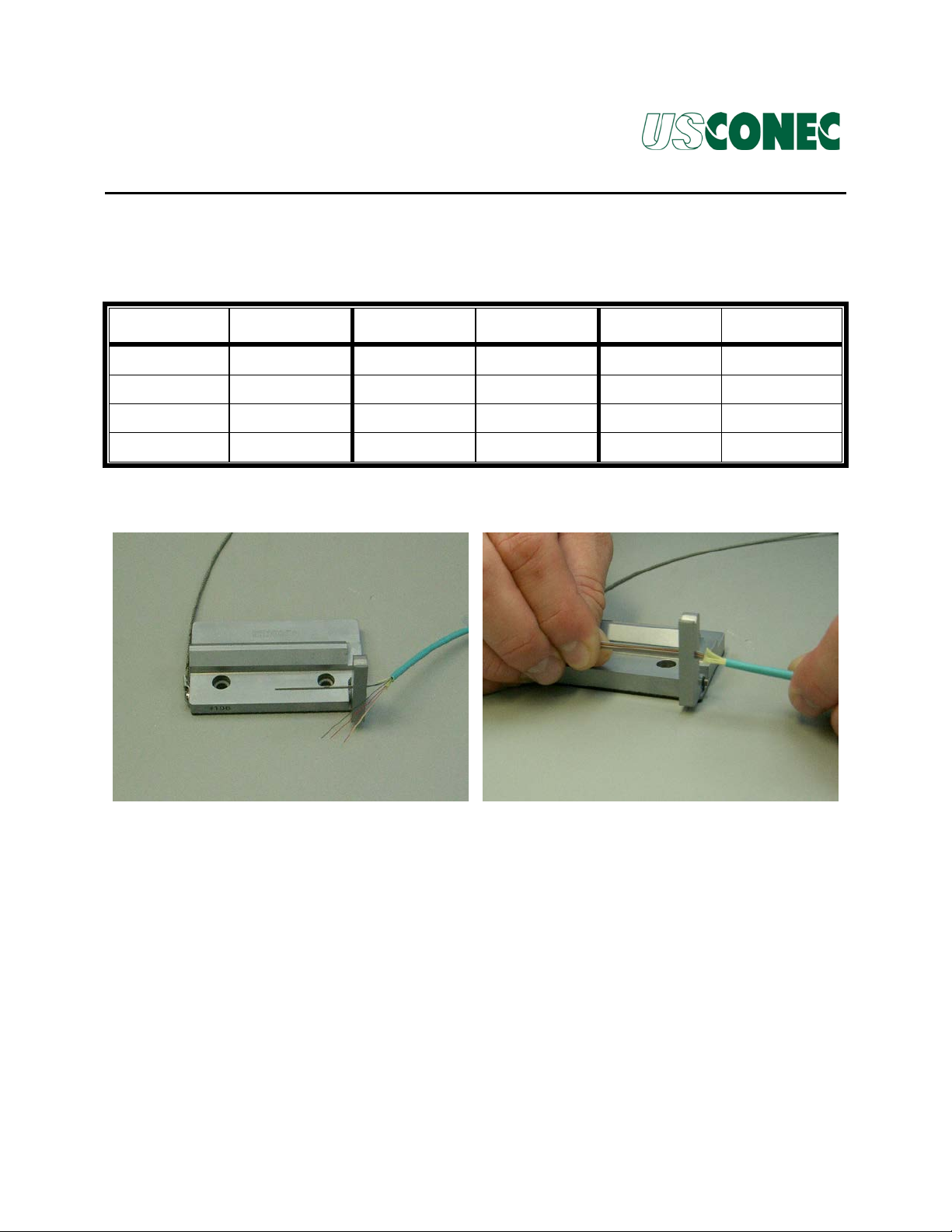
3.2.3 For standard polarity, place the loose fibers into the fiber stacker as shown
in Table 1 below.
Fiber No. Color Fiber No. Color Fiber No. Color
2 Orange 6 White 10 Violet
3 Green 7 Red 11 Rose
4 Brown 8 Black 12 Aqua
Table #1: Standard Ribbon Fiber Color Order Chart
3.2.3a 3.2.3b
3.2.4 Carefully slide the shim into the stacker, leaving a small gap between the
shim and the “top” fiber in the array.
4 of 10
Page 5
Document Title: Operating Instructions for the US Conec
Loose Fiber Ribbonizing Tool
Document Number: AEN-1408 Rev 2.0
3.2.4 3.2.5
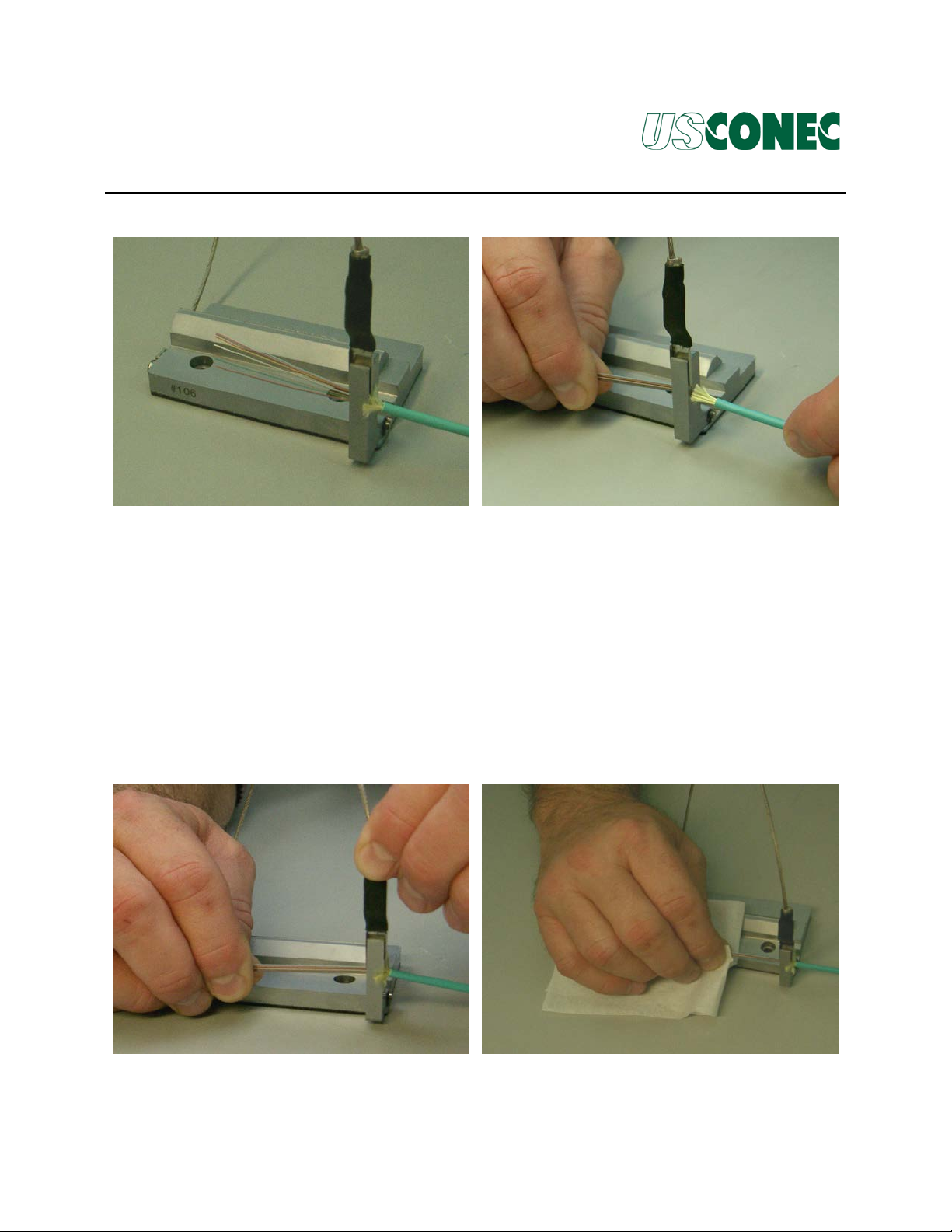
3.2.5 Gently slide the fibers from right to left and back several times to allow
the fibers to settle into position as they exit the jacket. Pull the fibers so
that the end of the jacket is snug against the opposite side of the stacker.
3.2.6 Push the shim down until it contacts the top fiber in the stacker and
compacts the fibers into a ribbon.
NOTE: Pushing the shim down too firmly will cause over-compacting of the
fibers resulting in fiber crossover and possible damage to individual
fibers.
3.2.6 3.2.7
5 of 10
Page 6
Document Title: Operating Instructions for the US Conec
Loose Fiber Ribbonizing Tool
Document Number: AEN-1408 Rev 2.0
3.2.7 Thoroughly clean the fibers with 99.8% pure isopropyl alcohol and lintfree wipes. Use caution to not break fibers.
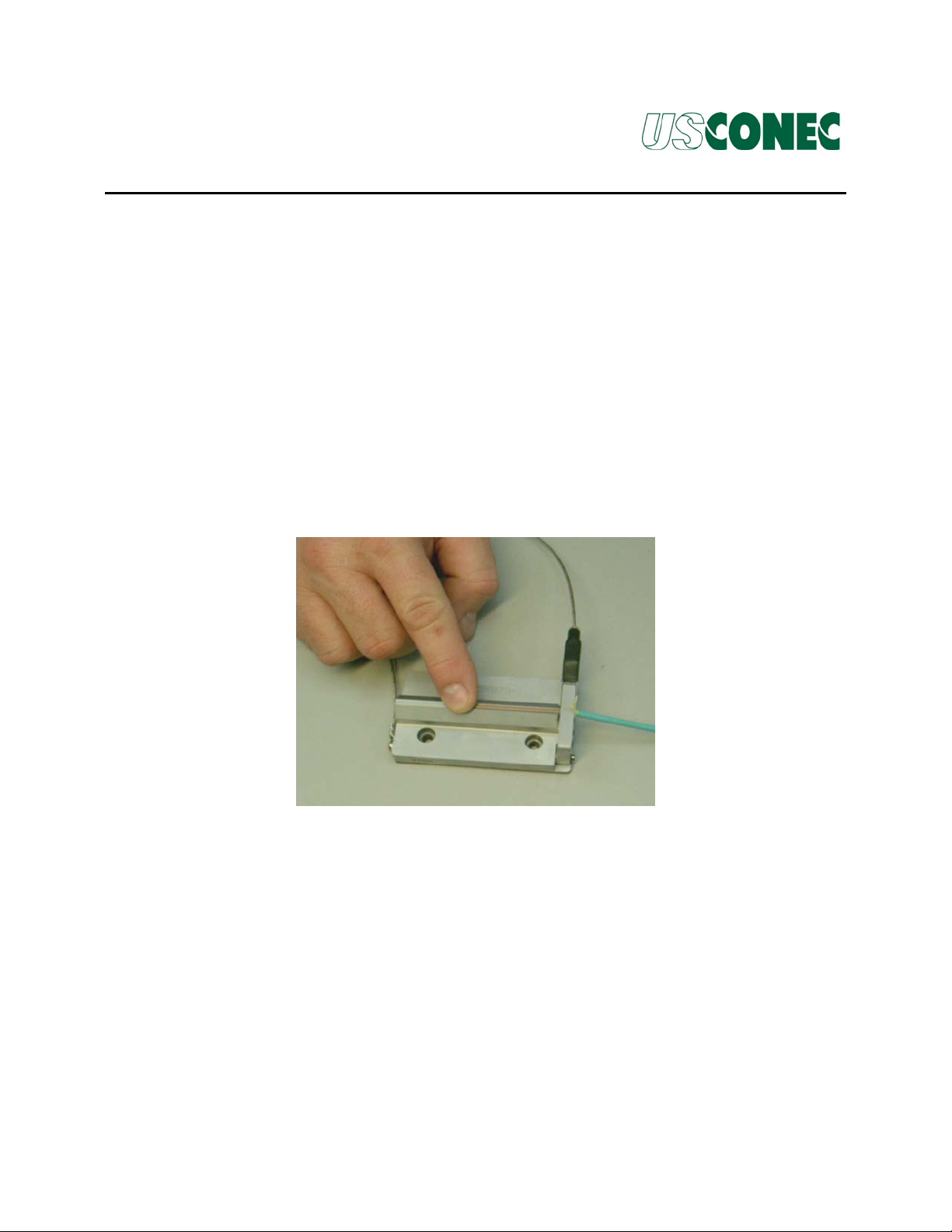
3.2.8 Position the fibers into the fiber tray.
3.2.8.1 Rotate the stacker down to the horizontal position.
3.2.8.2 Gently slide your finger along the fiber tray in the direction
of the opposite end of the tool, aligning the fibers in the
proper order in the tray.
NOTE: Repeat as necessary until the fibers are lying smoothly in
the tray.
3.2.8.2
4.0 Fiber Ribbonization
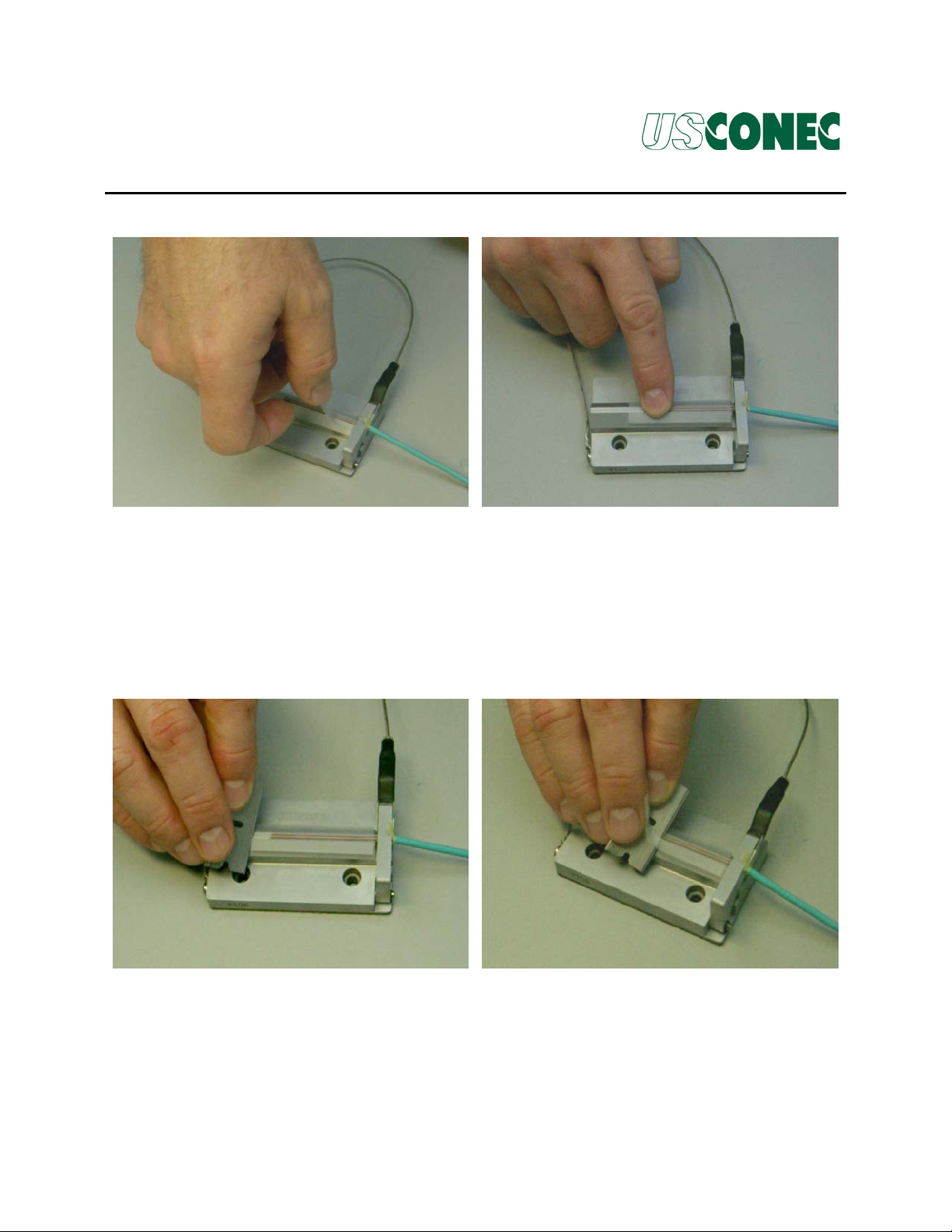
4.1 Cut a piece of Scotch® 810 Magic™ Tape approximately 60 mm long.
4.2 Apply the tape to the tray, covering the fibers and securing them into position.
Keep the tape approximately centered along the tray. Lightly slide your finger
along the tape as it covers the fibers aligned in the tray.
6 of 10
Page 7
Document Title: Operating Instructions for the US Conec
Loose Fiber Ribbonizing Tool
Document Number: AEN-1408 Rev 2.0
4.2a 4.2b
CAUTION: Make sure the fibers remain in the proper order during this step.
Attention is required to ensure fibers do not cross.
4.3 Place a new razor blade or Xacto® knife against the outside of the tray at the end
opposite the stacker. Hold the blade at an approximate 45° angle to the edge of
the tray.
4.3 4.4
4.4 Carefully slide the blade along the edge of the tray to remove the excess tape.
Pull the tape away from the tray with your other hand as the blade is moved.
Attention is required to ensure the tape is cut as closely as possible against the
edge without fiber damage.
7 of 10
Page 8
Document Title: Operating Instructions for the US Conec
Loose Fiber Ribbonizing Tool
Document Number: AEN-1408 Rev 2.0
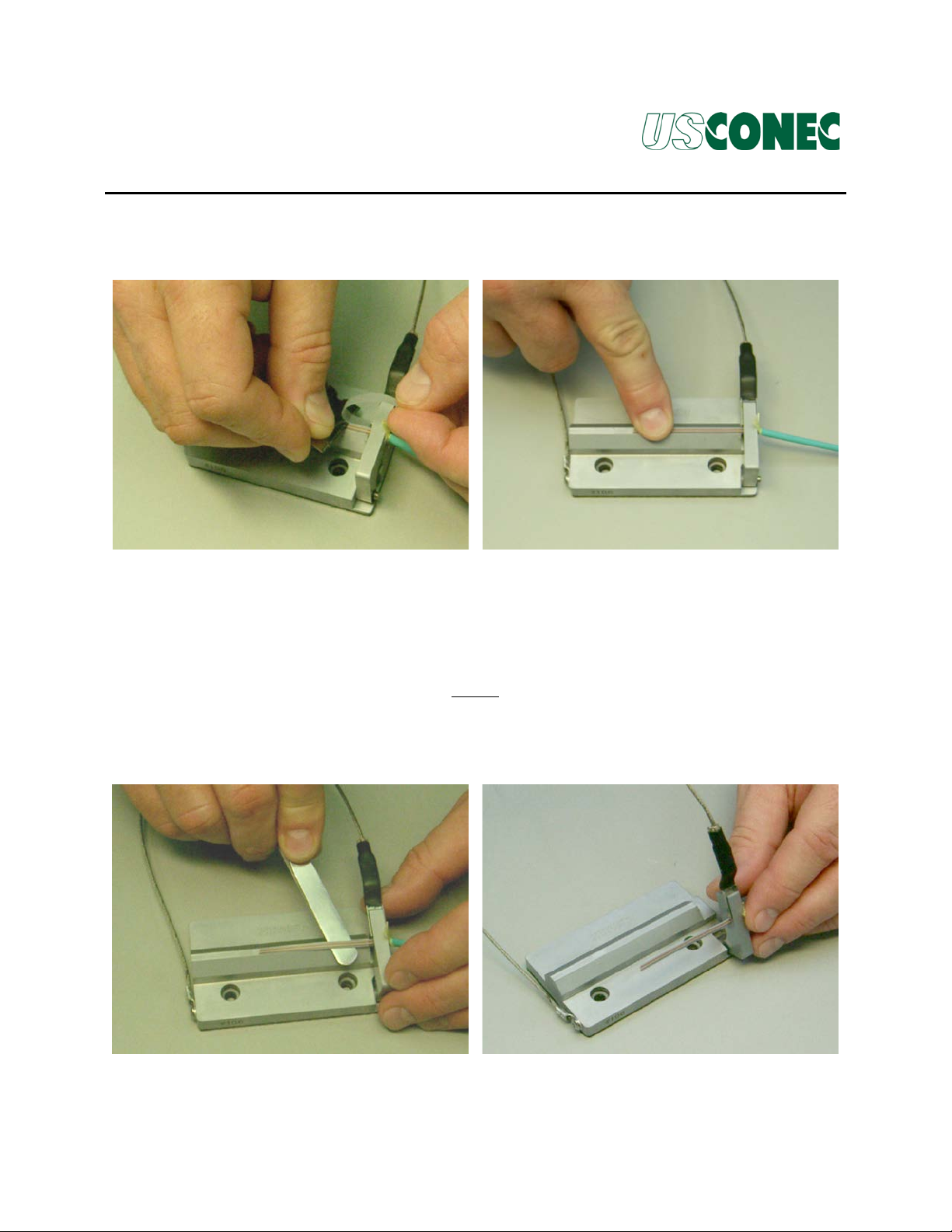
4.5 Repeat steps 4.3 and 4.4 for the other side of the ribbon.
4.5 4.6
4.6 Slide your finger across the ribbon lying in the tray. Repeat several times,
increasing pressure with each pass.
4.7 For multi-leg cables (24, 48, or 72 fiber units), number the ribbonized fiber ribbon
(1, 2, 3, 4, or A, B, C, D, etc.) before removing it from the fiber tray.
4.8 Slowly rotate the stacker to the vertical position while gently sliding the end of
the tweezers under the ribbon in order to remove it from the tray.
4.8a 4.8b
4.9 Remove the shim from the stacker and gently remove the fiber ribbon.
8 of 10
Page 9
Document Title: Operating Instructions for the US Conec
Loose Fiber Ribbonizing Tool
Document Number: AEN-1408 Rev 2.0
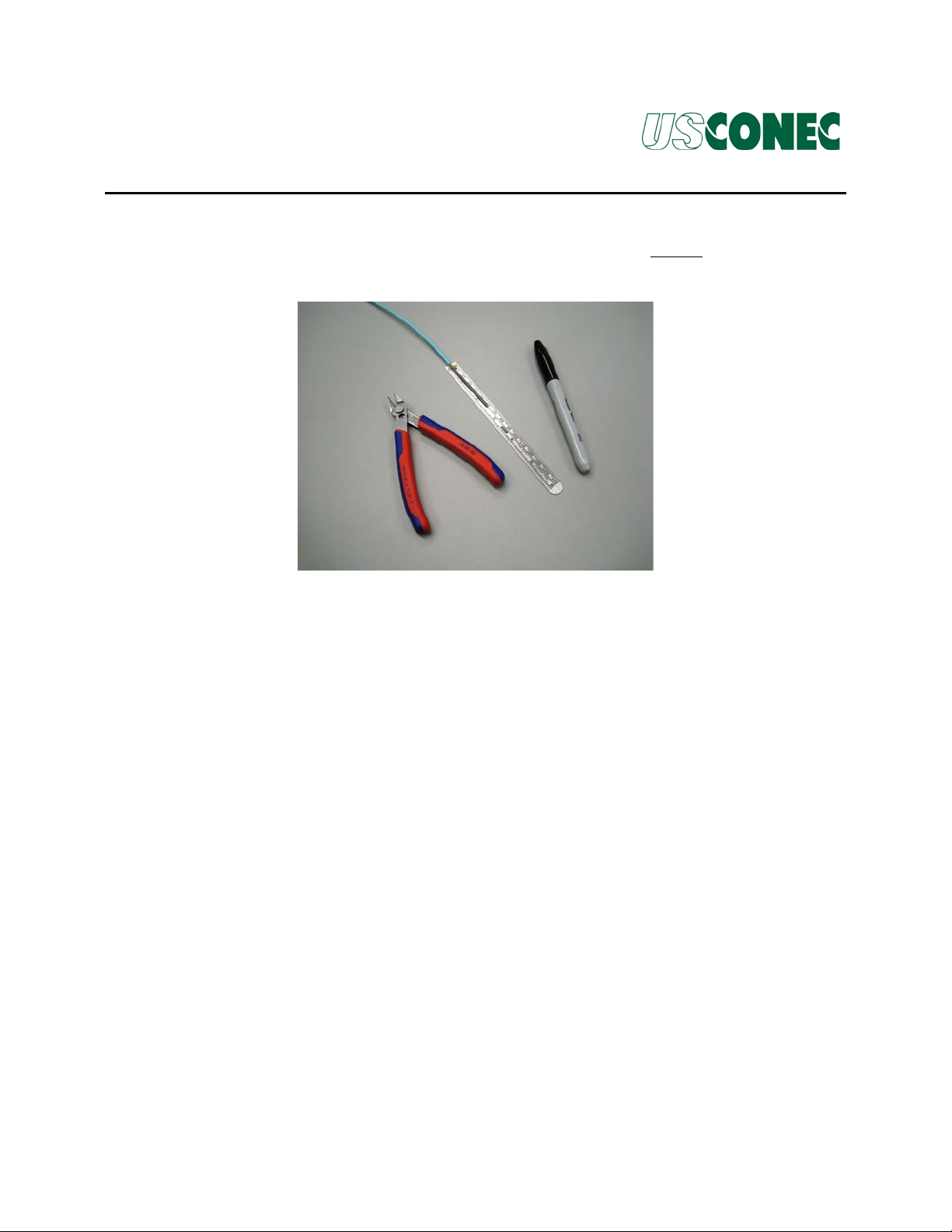
4.10 Measure and trim the ribbon to the required length using ONLY fiber optic side
cutters.
4.11 Follow the connector manufacturer’s recommended termination procedure for
complete connector installation.
4.10
9 of 10
Page 10

Document Title: Operating Instructions for the US Conec
Loose Fiber Ribbonizing Tool
Document Number: AEN-1408 Rev 2.0
• MTP®, MTP® PRO, MTP Elite®, MTP-16™, MXC®, MT Elite®, PRIZM®, LightTurn®, PRIZM® MT, ELiMENT™, and
IBC™ are trademarks or registered trademarks of US Conec, Ltd., Hickory, NC
• FiberChek2™ is a trademark of VIAVI Solutions, In c., San Jose, CA, formerly JDSU
• Corning® and SMF-28e® are registered trademarks of Corning, Inc., Corning, NY
• EPO-TEK® is a registered trademark of Epoxy Technology, Inc., Billerica, MA
• X-ACTO® is a registered trademark of Elmer's Produ cts, Inc., Atlanta, GA
• IDEAL® is a registered trad emar k of IDEAL Industries, Inc., Sycamore, IL
• 3M® and Scotch® Magic™ Tap e ar e trademarks or registered trademarks of 3M Company, St. Paul, MN
• Loctite®, Prism®, 4861™, 411™, 4851™, BIPAX®, TRA-BOND™, and F113SC™ are trademarks or registered trademar ks
of Henkel IP & Holding GmbH, Düsseldorf, Germany
• MicroCare® and Sticklers® ar e r egi s tered trademarks of MicroCare Corporation, New Britain, CT
• Chemtronics® and Techspray® are registered trademarks of Illinois Tool Works, Inc., Glenview IL
• SafetyLok™, Performus™, Nordson®, and EFD® are trademarks or registered trademarks of Nordson Corporation, Westlake,
OH
• Clauss® is a registered trademark of Acme United Corporation, Fairfield, CT
• Kimwipes® and Kimberly-Clark® are registered trade mar ks of Kimberly-Clark Worl dwide, Inc., Neenah, WI
• Cole-Parmer® is a registered trademark of Cole-Parmer Instrument Company, LLC, Vernon Hills, IL
• Kevlar® and DuPont™ are trademarks or registered trademarks of E. I. du Pont de Nemours and Company, Wilmington, DE
• Techni-Tool® is a registered trademark of Techni-Tool, Inc., Worcester, PA
• Excelta® is a registered trademark of Excelta Corporation, Buellton, CA
• McMaster-Carr® is a registered trademark of McMaster-Carr Supply Company, Elmhurst, IL
• OptiSaber™ and AbraSave® are trademarks or registered trademarks of Domaille Engineering, LLC, Clayton, MO
• NO-NIK® is a registered trademark of Ripley Tools, LLC, Cromwell, CT
• 1Cure™ is a trademark of Connected Fibers, LLC, Roswell, GA
• Fibersect.multi® is a registered trademark of Phenix Fiber Optics, LLC, Bozeman, MT
• Interprox® is a registered trademark of DENTAID, S.L., Barcelona, Spain
• Curaprox® is a registered trademark of Curaden AG, Kriens, Switzerland
• TePe® is a registered trademark of TePe Munhygienprodukter AB, Malmö, Sweden
• Jonard® is a registered trademark of Jonard Industries Corp., Tuckahoe, NY
• Ellsworth Adhesives® is a registered trademark of Ellsworth Corporation DBA Ellsworth Adhesives, LLC, Germantown, WI
• SEIKOH GIKEN® is a registered trademark of SEIKOH GIKEN Co., Ltd., Matsudo, Japan
• Mipox® is a registered trademark of Mipox Corporation, Tokyo, Japan
• NTT® is a registered trademark of Nippon Denshin Denwa Kabushiki Kaisha DBA Nippon Telegraph and Telephone Corp.,
Tokyo, Japan
• Data-Pixel® is a registered trademark of Data-Pixel Corp., Chavanod, France
• FastMT™ is a trademark of Fib erQA, Old Lyme, CT
• Norland® is a registered trademark of Norland Products Inc., Cranbury, NJ
• Teflon® and Chemours® are registered trademarks of The Chemours Company FC, LLC, Wilmington, DE
• OptiTap® is registered trademark of Corning Optical Communications, LLC, Hickory, NC
• ZAP-IT® is a registered trademark of Zap-It Corp., Andover, NH
• ÅngströmBond® is a regist er ed trademark of Fiber Optic Center, Inc., New Bedford, MA
• LaserCleave™ is a trademark of OpTek Systems, Abingdon, United Kingdom
• Promet® and FiBO® are regis tered trademarks of Pro met International, Inc., Shor evi ew, MN
• Sharpie® is a registered trademark of Sanford, L.P. N ewell O perating Company, Atlanta, GA
• NEOCLEAN® and CLETOP® are registered trademarks of NTT Advanced Technology Corp., Kawasaki, Japan
• Sumitomo® is a registered trademark of Sumitomo Heavy Industries, Ltd., Tokyo, Japan
10 of 10
 Loading...