

Page 1
______________________________________________________________________________
1
Owner’s Manual
and Service Booklet
Serial Number: __________________________________________________
Version 1.3
Effective: 03/2011
Updated: 07/2011
Page 2

______________________________________________________________________________
2
The data and statements contained within this manual may be changed without prior notice. No
part of these documents may be copied or transmitted for any purpose in any manner or by any
means, either electronic or mechanical, without explicit written permission from UP International.
© 1995-2011 UP International
Page 3

______________________________________________________________________________
3
Table of contents
WELCOME IN OUR TEAM ........................................................................................... 6
SAFETY INSTRUCTIONS ............................................................................................. 7
CORRECT BEHAVIOUR IN RELATION TO THE ENVIRONMENT ............................. 7
DEVELOPMENT OF PARAGLIDERS .......................................................................... 7
TECHNICAL DESCRIPTION ........................................................................................ 8
LTF AND EN CLASSIFICATION .................................................................................................. 9
Target group and recommended flying experience................................................ 9
Necessary skills for normal flights.......................................................................... 9
Necessary skills for dealing with disturbances ....................................................... 9
Necessary skills for dealing with rapid descent methods ....................................... 9
Suitability for training ............................................................................................. 9
Recommended Takeoff weight .............................................................................. 9
TECHNICAL DATA UP SUMMIT XC² ......................................................................... 11
CONSTRUCTION ...................................................................................................................... 12
Airfoil Stabilising System² .................................................................................... 13
CANOPY MATERIAL ................................................................................................................. 13
LINE MATERIAL ...................................................................................................................... 14
LINE SYSTEM .......................................................................................................................... 14
RISERS .................................................................................................................................... 14
UP BACKPACK........................................................................................................................ 17
Adjustment of the backpack ................................................................................. 18
Packing tips ......................................................................................................... 18
BEFORE THE FIRST FLIGHT .................................................................................... 19
ADJUSTMENTS ........................................................................................................................ 19
Position of the brakes ................................................................ .......................... 19
Speed system ...................................................................................................... 21
SUITABLE HARNESSES ................................................................ ................................ ............. 22
RESCUE SYSTEM ..................................................................................................................... 22
USE OF THE UP SUMMIT XC² .................................................................................................. 22
AEROBATICS ........................................................................................................................... 22
MOTORISED PARAGLIDING ...................................................................................................... 22
FLIGHT PRACTICE AND SAFETY............................................................................. 23
FLIGHT PRACTICE .................................................................................................... 23
Page 4

______________________________________________________________________________
4
PRE-FLIGHT CHECK ................................................................................................................. 23
THE START PHASES ................................................................................................................. 23
SPEED CONTROL ..................................................................................................................... 24
Using the brakes .................................................................................................. 24
Using the Speed System ..................................................................................... 24
TURNING ................................................................................................................................ 25
LANDING ................................................................................................................................ 25
WINCH TOWING ...................................................................................................................... 25
Attaching the towline release system ................................................................... 26
FLIGHT SAFETY ........................................................................................................ 27
THERMALS AND TURBULENCE................................................................................................. 27
GETTING DOWN FAST .............................................................................................................. 27
Steep Spiral Dive ................................................................................................. 28
B-Line Stalls ........................................................................................................ 28
Big Ears ............................................................................................................... 29
FLYING OUTSIDE THE NORMAL FLIGHT ENVELOPE ........................................... 30
BEHAVIOUR IN EXTREME SITUATIONS ...................................................................................... 30
COLLAPSING THE PARAGLIDER ................................................................................................ 30
Asymmetric collapse ............................................................................................ 30
Cravatte ............................................................................................................... 30
Full frontal collapse .............................................................................................. 31
THE STALLS ............................................................................................................................ 31
Deep Stall ............................................................................................................ 31
Fullstall ................................................................................................................ 31
Spin ..................................................................................................................... 32
WINGOVERS ........................................................................................................................... 32
EMERGENCY STEERING ........................................................................................................... 33
FURTHER REFERENCES ............................................................................................................ 33
Rain-induced deep stall ....................................................................................... 33
Adhesive logos .................................................................................................... 33
Overloading ......................................................................................................... 33
Salt water ............................................................................................................. 34
MAINTENANCE AND CLEANING .............................................................................. 35
TAKING CARE OF YOUR PARAGLIDER ....................................................................................... 35
Packing the wing.................................................................................................. 35
Paraglider fabric................................................................................................... 37
Paraglider lines .................................................................................................... 37
Storage and transport .......................................................................................... 38
CLEANING .............................................................................................................................. 38
CHANGING ASS BATTENS ...................................................................................................... 38
CHECKS AND REPAIRS ............................................................................................ 40
MAINTENANCE ....................................................................................................................... 40
Page 5
______________________________________________________________________________
5
Airworthiness Check ............................................................................................ 40
UP Craftsmanship................................................................................................ 40
UP WARRANTY ...................................................................................................................... 40
National warranty conditions ................................................................................ 40
International UP warranty .................................................................................... 41
CHECKING THE UP SUMMIT XC² ............................................................................................ 41
PACKING AND CHECKING OF THE RESCUE SYSTEM .................................................................... 41
SENDING THE UP GLIDER AND OTHER UP PRODUCTS ............................................................... 42
DISPOSAL .................................................................................................................. 42
UP HOMEPAGE .......................................................................................................... 42
SOME FINAL WORDS ................................................................................................ 43
Attachments ............................................................................................................... 44
Line Layout Plan .......................................................................................................... 45
Luftsportgeräte-Kennblatt UP Summit XC² S-L ........................................................... 46
Service Booklet
Used by the UP Service centre in connection with periodic service ............................ 54
Product registration card .............................................................................................. 58
Important
The following symbols are used to draw attention to particular sections:
WARNING!
Failing to comply with instructions given here may
lead to injury or death!
BEWARE!
Failing to comply with instructions given here may
cause undue wear to, or even damage your new
wing.
NOTICE
This pictogram indicates a tip or some helpful extra
knowledge.
Page 6

______________________________________________________________________________
6
Welcome in our team
Congratulations on the purchase of your new UP Summit XC². UP International is
renowned across the globe for designing and building the finest paragliders available
paragliders characterised by maximum safety, performance and quality in every
aspect.
Please take a little time to complete and send the reply card found in the back of this
manual. This way we can keep you informed of all new products and developments at
UP, as well as any technical information about the UP Summit XC².
We would also be delighted to hear any feedback you have concerning the glider. This
is only possible once we have received your product registration, either through
completing and sending the attached product registration card, or by doing the same
Online via www.up-paragliders.com>service>product registration. Your completed
product registration is also needed should any warranty issues arise.
If you have any questions regarding your paraglider or auxiliary equipment please ask
your local dealer or feel free to contact us here at UP directly.
Have fun with your new UP Summit XC²!
UP International Team
Page 7
______________________________________________________________________________
7
Safety instructions
Paragliding is an extremely demanding
sport requiring the highest levels
of attention, judgment, maturity,
and self-discipline. Due to the
inherent risks in flying this or
any paraglider, no warranty of
any kind can be made against
accidents, injury, equipment failure,
and/or death. This glider is not covered by
product liability insurance. Do not fly it
unless you are personally willing to
assume all risks inherent in the sport of
paragliding and all responsibility for any
property damage, injury, or death, which
may result from use of this paraglider.
Please read this owner's manual
thoroughly before your first flight with the
UP Summit XC² so that you are fully
acquainted with your new glider. This
manual gives you information on the entire
specific and general flying characteristics
of the UP Summit XC², but it does not
replace attending a paragliding school. It
is important to note the following points:
at the time of delivery the UP Summit
XC² conforms to German Hang
Gliding Association (DHV) and/or
AFNOR (SHV and ACPUL)
requirements (see certification
information later in this manual)
any changes being made outside the
permitted range of adjustment
invalidate any and all claims under
the warranty
using this paraglider is exclusively at
the risk of the user; the manufacturer
or distributor assumes no
responsibility for accidents occurring
while using it.
it is assumed that the pilot is in
possession of the necessary
qualifications and provisions of
any relevant laws are observed
when reselling the wing please
make sure you also give this
manual to the new owner. The
manual is an integrated part of
the paraglider and is required for
the wing to keep its certification.
Correct behaviour
in relation to the
environment
Paragliding is a particularly naturefriendly sport. This makes it all the
more important that we as paraglider
pilots behave in a responsible way
towards both the environment and the
people sharing it with us. We
encourage you to treat nature with
respect, to stay on marked hiking trails
when walking to takeoff or hiking out
from an XC landing, to avoid
unnecessary noise, to never litter and
to observe all local regulations.
Please also make sure to comply with
legislation regarding protected areas,
privately owned property or hunting
arenas this ensures the least
possible friction in relation to other
users of the great outdoors, to the
benefit of both yourself and the sport
as a whole.
Development of
paragliders
Admitted; we're proud of our history.
No other company in the free flying
Page 8

______________________________________________________________________________
8
world can look back on such an expansive
history as we can. The UP story started
back in 1970 when Pete Brock graduated
from the Art Center, a world famous
school for design and engineering in
Pasadena, California, and promptly
created some of the most legendary race
cars ever the Daytona Coupe from
General Motors was one and then went
on to become fascinated by the emerging
sport of hanggliding at that time
probably the maddest pastime of them all.
After founding Ultralite Products he
introduces his first wing, the Dragonfly,
and soon the new company becomes
known under the UP acronym..
Pete Brocks spirit survives to this day in
everything we do at UP International we
still have our very own way of seeing
things and designing things. This entails
building paragliders that are not only as
safe as they come, they must also meet
the very high standards we set ourselves.
Among these are the continued use of the
most advanced technology available both
in the designing and manufacturing
process, but also the feel, the handling
and the performance of the finished
product. All this because we're addicted to
building wings that will fascinate you. A
good paraglider is comprised of a number
of interacting factors of which looks, feel,
handling and performance are but a few.
Only when all these come together in the
final product can we claim to have built a
wing that is homogenous and pleasurable
to fly; and only then we're happy, and
ready to introduce our new UP baby to the
free flying world.
Our gliders are developed using state-ofthe-art CAD software. Our programs allow
us to do the initial flight testing in a virtual
environment where we can simulate a
great many things before even assembling
the first prototypes.
Once we're happy with the new
prototypes' behaviour in the virtual
environment the program generates
the templates after which the glider is
sewn. When a new prototype arrives
from our proto-building experts
everyone at UP is excited about the
prospects of trying it out in real life.
The practical tests may show that
further modifications are needed
these may be carried out on the
existing wing, or a new prototype is
built with the mods already
incorporated. In exceptional cases this
may continue through several
prototypes, for only when we're 100%
satisfied do we submit our new wing to
testing by the DHV. We owe it to our
customers, and to our own history, to
be particular about which products
earn the UP badge.
Technical
description
The UP Summit XC² was built to fulfil
the expectations to a modern, safe and
fast Performance Intermediate wing.
The launching is excellent and the
performance figures impressive.
As with all UP products, the materials
used have been carefully chosen for
their outstanding quality and strength,
to guarantee a long and trouble-free
service life.
Further construction details, including
line lengths, are included in the
certification specification sheets, which
form part of this manual. Any technical
changes will appear in the appendix.
Page 9

______________________________________________________________________________
9
LTF and EN
classification
The UP Summit XC² is certified to the
following classification(s): LTF09/EN C
Target group and
recommended flying
experience
Performance-oriented cross country pilots
with several years of regular flying behind
them. We recommend no less than 50
hours/year in combination with adequate
knowledge of extreme flying training.
Necessary skills for normal
flights
Wings in this class are characterised by
their demanding behaviour in case of inflight disturbances. Short brake travel,
dynamic reactions and little dampening
along all 3 axis require a great deal of
feeling and experience from the pilot.
Intensive training of the control techniques
as well as profound knowledge of the
appreciation and prevention of unintended
wing configurations.
Necessary skills for dealing
with disturbances
Paragliders in this class require correct,
timely and adequate pilot reactions to
canopy disturbances. Pilots flying these
wings should be current and should fly
often enough that their reactions don't
grow rusty. If the necessary skills are not
there we recommend a good SIV course
with the UP Summit XC² to get familiar
with it.
Necessary skills for
dealing with rapid descent
methods
The behaviour during manoeuvres like
spiral dives or b-line stalls in this class
can be demanding. The pilot should
possess adequate skills for the safe
execution of these rapid descent
manoeuvres. In case of insufficient
skills or experience in this department
we strongly recommend partaking in
an SIV clinic with the new wing.
Suitability for training
The UP Summit XC² is not suited for
training.
Recommended Takeoff
weight
The UP Summit XC² is manufactured
in four sizes. Each size is optimised for
the middle of the weight range, but can
be flown anywhere within the weight
range. In order to help you find the
ideal size for your weight we have
compiled the following practical tips:
If your total takeoff weight is within the
middle 1/3 of a size's weight range
then this is the size for you.In this
range you will have the ideal
compromise between dynamic
handling and docile behaviour. We
recommend this wing loading
especially for pilots mainly flying in
flatland regions, or pilots coming from
EN B class wings.
Pilots finding themsleves in the middle,
between two sizes need to approach
the process somewhat differently.
Experienced pilots will generally know
how they prefer to fly, i.e. If they like to
be heavy on their wing or rather would
Page 10

______________________________________________________________________________
10
have a little buffer upwards, and will
choose their size accordingly.
Pilots with less experience are likely to
prefer the somewhat damped reactions
obtained from flying at lower wing loadings
this speaks for choosing the larger of the
relevant sizes.
And finally, pilots preferring more dynamic
rides will want to load their wings up well,
and will be choosing a smaller size.
Page 11
______________________________________________________________________________
11
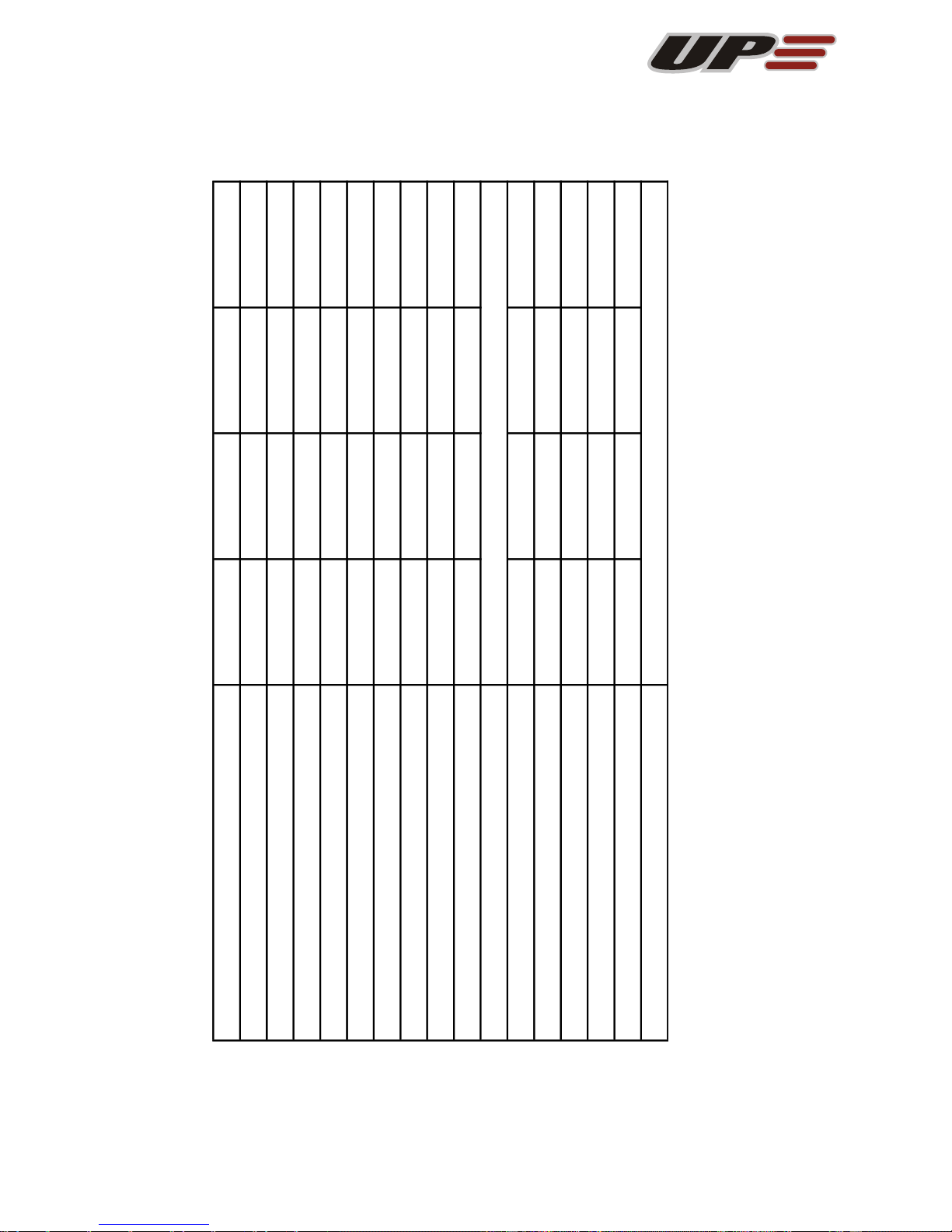
Technical Data UP Summit XC²
Größe S SM M L
Fläche ausgelegt [m²] 22,5 24,3 26,4 29,1
Fläche projiziert [m²] 19,3 20,8 22,6 24,9
Spannweite ausgelegt [m] 11,6 12,0 12,5 13,2
Spannweite projiziert [m] 9,3 9,7 10,1 10,6
Streckung ausgelegt 6,0 6,0 6,0 6,0
Streckung projiziert 4,5 4,5 4,5 4,5
Anzahl Kammern 61 61 61 61
Gesamtleinenlänge incl. Bremse [m] 286 297 309 324
Anzahl Leinen incl. Bremse 166 166 166 166
Leinendurchmesser [mm]
Schirmgewicht [kg] 5,7 6 6,4 6,8
Trimmgeschwindigkeit [km/h] 38 38 38 38
Maximalgeschwindigkeit [km/h] 55 55 55 55
Startgewicht [kg] 60-80 72-94 85-110 100-130
LTF/EN Kategorie C C C C
Beschreibung
0,65/0,75/0,95/1,1/1,3/1,6
Performance Intermdediate
Page 12
______________________________________________________________________________
12
Construction
The Summit XC²
is the perfect example of a wing combining
great passive safety with total flying
pleasure. Thanks to the new Hybrid
Synergy Profile the Summit XC² has
superior performance but also the safety
of a true intermediate wing. This makes
the Summit XC² the right choice for an
unusually large pilot group in fact, pilots
coming from almost all glider classes will
have fun on a Summit XC².
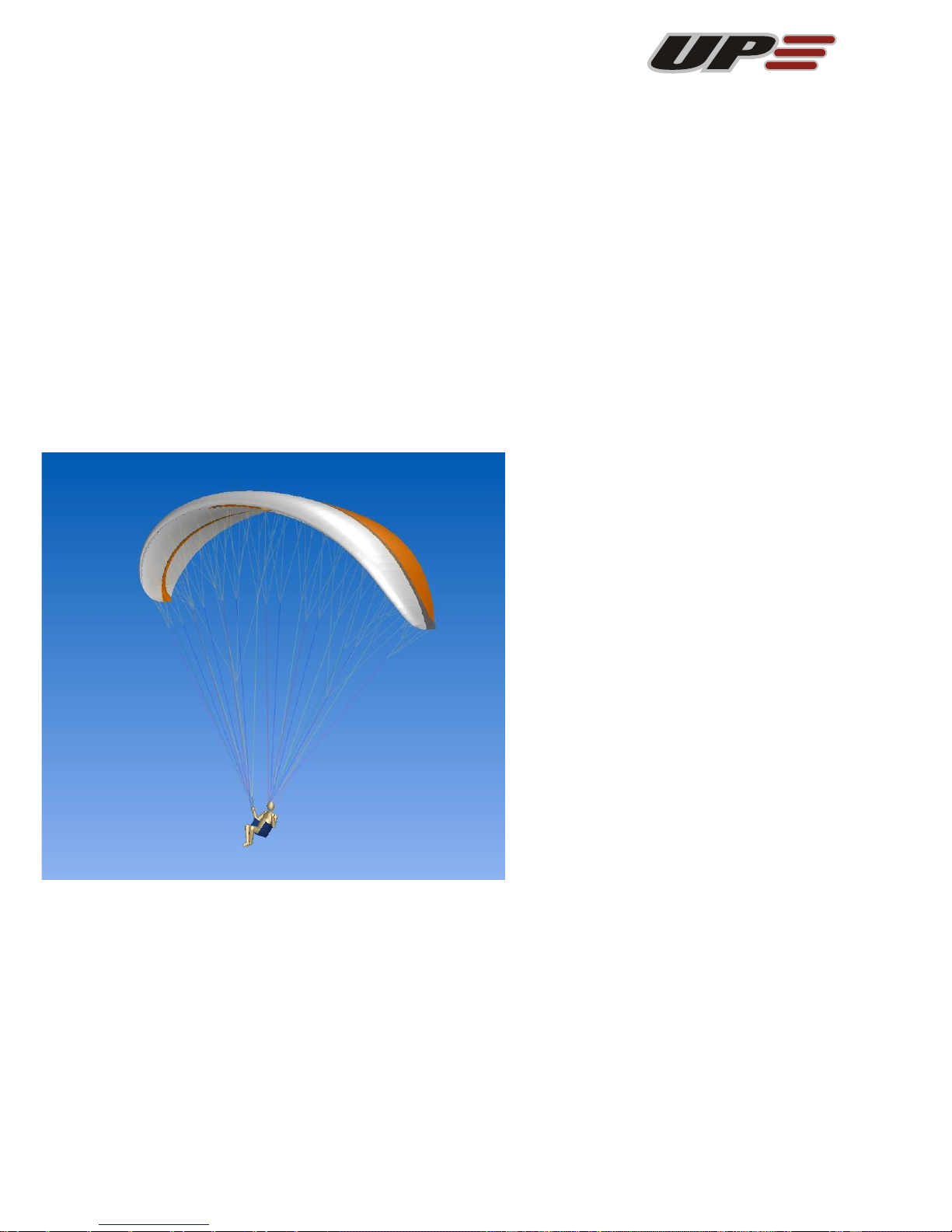
Illustration 2: CAD-drawing
UP Summit XC²
The UP Summit XC², the predecessor to
the new model, was well-loved by pilots
for its high performance in combination
with very a high passive safety level,
which made flying it a genuine pleasure.
With the Summit XC² we wanted to
remain true to that general description
while improving all parameters of the wing,
and we also wanted to increase the
dynamics a little. In order to reach this
ambitious goal we had to design a
completely new wing. Right from the
moment you inflate the new Summit
XC² you will notice a very high degree
of canopy solidity the wing transmits
a very reassuring feel through the
risers but also a playfulness that will
inspire the beanie crowd!
Reactions to collapses are
reassuringly unspectacular, and the
Summit XC² fulfils the LTF09/EN C
test criteria with flying colours. And lets
not forget that this is a wing with a
performance that matches even wings
in the EN D class.
These cahracterisitics make the
Summit XC² the perfekct allround
flying machine, apealing to pilots of
quasi all levels; the up-and-coming
performance pilot, the Weekend
Warrior, the XC ace, even pilots
stepping down from the higher
classes.
Due to the high inherent safety this is
also the perfect wing to for pilots
stepping up from a 1-2 wing.
Hybrid Synergy Profile
Whenever we build a new wing we
obviously strive to improve everything
about it compared to the predecessor;
not only performance, but also safety
and general feel-good factor. This
means that all new UP wings always
remain true to the basic values of UP
(more performance, but safely!) but at
the same time they are each
completely new developments in their
own right.
While the predecessor was based on
the aerofoil inherited from the UP
competition wings, the new design
Page 13
______________________________________________________________________________
13
gets to enjoy the benefits of an entirely
new aerofoil.
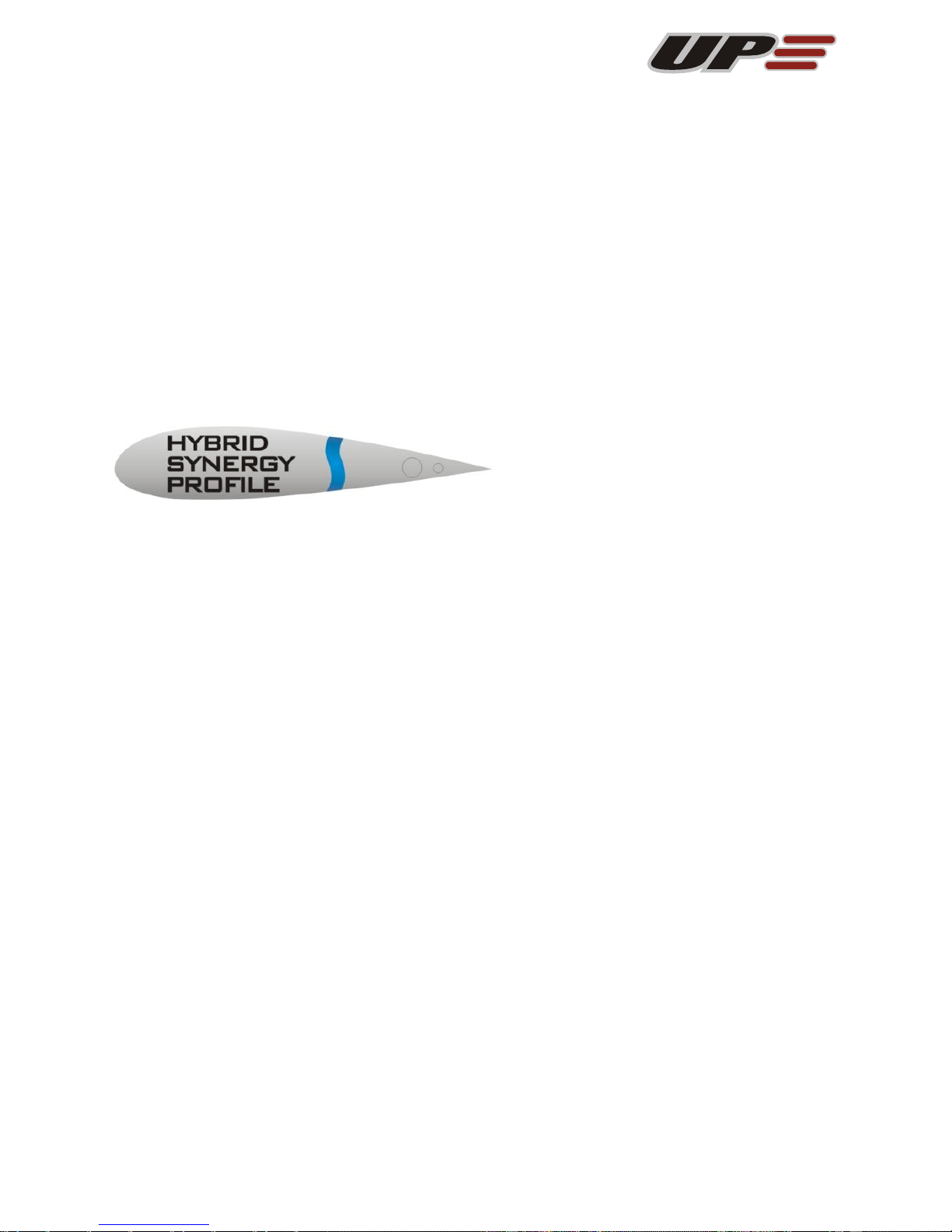
The aerofoil is nothing less than the next
generation of the Hybrid Synergy Aerofoil.
The basic premise for this design concept
is to combine the characteristics of a
competition wing aerofoil with that of an
intermediate wing and the child of this
union is a unique new Aerofoil with the
best of both worlds. The Summit XC² has
the performance of a competition wing and
the safety of an intermediate glider!
The best of both worlds basic gliders
and comp glider a new design with the
following advantages:
perfect performance
optimal safety
high-performance feel
accurate handling
Airfoil Stabilising System²
UP was first with the Aerofoil Stabilising
System, an idea that has since been
widely accepted in the industry. The
Summit XC² uses a modified version of
the same, and we have chosen to call this
the ASS². Instead of Mylar® the ASS²
comprises a Nylon® batten that defines
the leading edge curvature and helps
keeping the cell opening open at all times.
This Nylon® batten is insusceptible to
bending damage and has no ageing
properties it will normally outlast the rest
of the canopy by a good margin. This
means that the UP Summir XC² will retain
its perfect launching characteristics all
through its service life. In the unlikely
event that a batten should break it can
be replaced in a few easy steps
ines.
Performance data
Main focus area during the
development phase of the Summit XC²
was the improvement of the key
performance figures in comparison to
the predecessor. We wanted a wing
with higher trim speed and better L/D
at all speeds, and through the use of
advanced software we could begin to
compare on the virtual 3D models right
from the outset of the drawing process.
Combining different software allowed
us to draw a wing that at least in the
virtual world was significantly better,
and the real-life refinement and testing
showed that the computer models
were right.
Canopy material
The UP Summit XC² is constructed
from polyamide cloth, which is
particularly stretch-resistant and
durable, and is specially treated for
maximum UV resistance.
After At UP we are always testing new
materials to see if our wings can
benefit from new developments in the
textile industry. After comprehensive
tests we have settled on the following
Porcher Marine material mix for the
Summit XC²:
Leading edge top: 9092 E17
"Evolution Plus" (45 g/m²)
Bottom sail and trailing edge:
9017 E38, (40 g/m²)
Page 14

______________________________________________________________________________
14
Cell walls and V-Tapes: 9017
E29 (40 g/m²)
This mix comprises the best compromise
between weight/bulk and longevity.
Line material
The Summit XC² uses a mix of sheathed
Dyneema® and unsheathed Aramide®
lines from Edelrid, in the diameters
0,65/0,75/1,1/1,3/1,6 millimetres. The
unsheathed lines are applied at the
canopy end of the line structure and
contribute to the excellent performance
data of the wing through their low drag.
Line system
The entire line system is formed from
individual lines, which are sewn and
looped at both ends. The single line levels
are connected over a special hoop
technology ("handshake") to prevent a
weakening of the core and a loss of
strength. The lines and stitching are
subject to rigorous production controls, to
ensure high and consistent manufacturing
quality.
The lines of each wing section consist of
four groups and the brake lines:
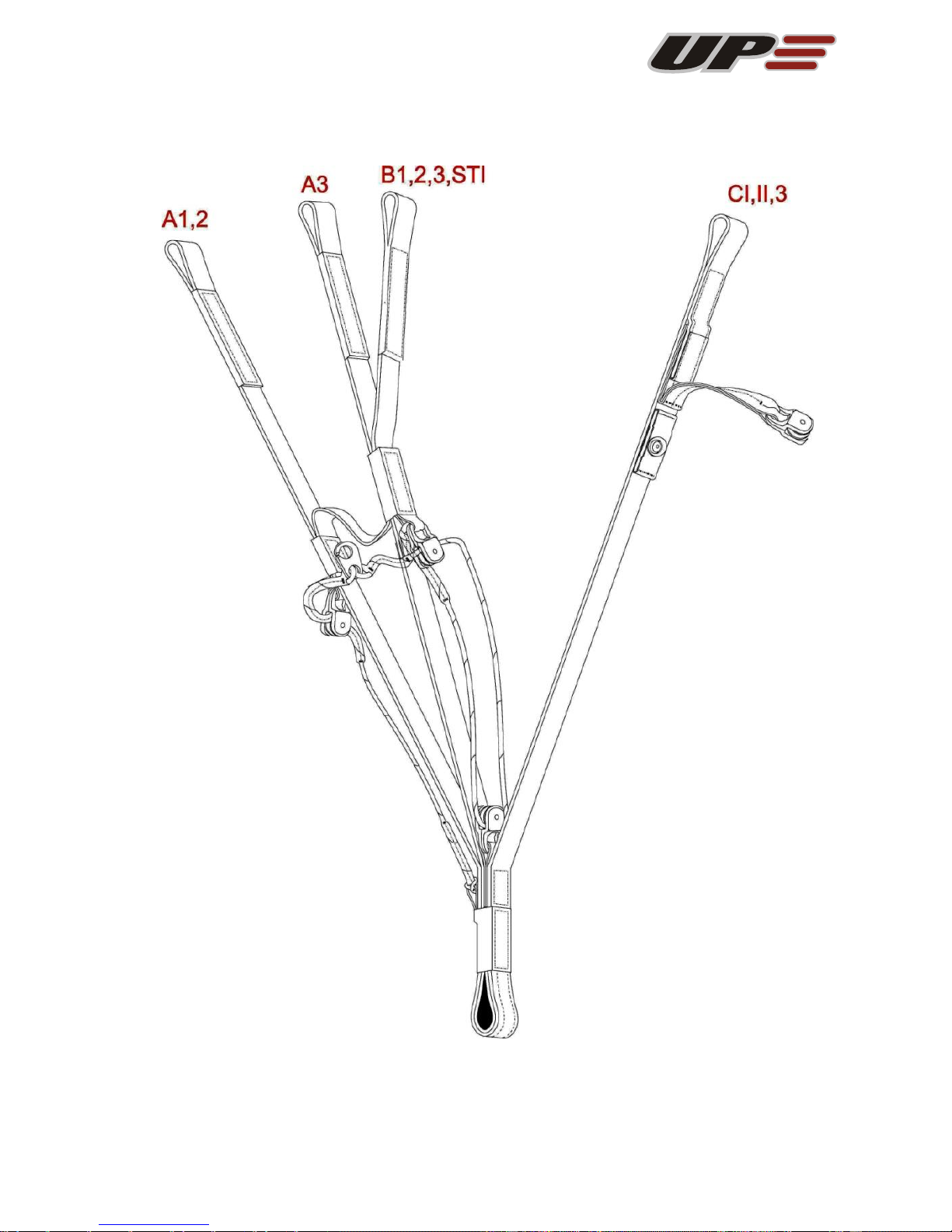
A-Level: A1-A2
Split A-Level : A3
B-Level: B1-B3,STI
C-Level: C1-C3
Brake lines : BRK1
The brake lines are collected at one main
control line per side. This control line runs
through a pulley attached to the D-Riser
and is marked with a black dot at the point
where it should loop around the D-ring.
The brake is pre-set so that the glider is at
0 degree brake when the toggle is free.
without checking the new length
carefully at a suitable training hill
before flying!
The line bundles (A, B, C and D) are
colour coded for easy identification
and handling. All main lines of each
level are looped together and attached
to delta quick links, which are
connected to the risers. The quick links
have special line collectors to prevent
lines slipping, and are secured using a
strong thread-locking compound
(Loctite©), to prevent unintentional
opening. After maintenance work the
delta quick links should be re-glued
with thread locking Loctite©!
Risers
The split A risers and B risers are
colour marked to improve ground
handling and B-lining/Big Ears.
A Risers: Red
A3 Risers (for BigEars): Green
B Risers: Blue
C Risers: Black/no marking
In order to accommodate different pilot
sizes the Summit XC² risers are
lenght-adapted to the canopy size S
and SM have shorter risers than M and
L. This little detail improves the
ergonomics of the wing and makes all
the different manoeuvres (b-line,
BigEars) more accessible to the pilots.
The speed system is optimised along
the same lines.
We use a very similar riser design for
our competition wings. They allow for
very high top speeds with low sink
values and give impressive stability at
high speeds.
Page 15

______________________________________________________________________________
15
Once activated the speed system pulls
simultaneously on the A's and B's. This
maintains the angle of incidence around
the leading edge and causes only minimal
influence to the collapse resistance
properties of the wing.
Top speed is reached when the top pulley
touches the bottom extremity of the speed
system, down near the karabiner.
Page 16
______________________________________________________________________________
16
Illustration 2: UP Summit XC²
riser
Page 17
______________________________________________________________________________
17
UP Backpack
The UP Summit XC² is delivered with a
special paraglider backpack, which fulfils
the demands of very high luggage volume
and ergonomically optimised comfort.
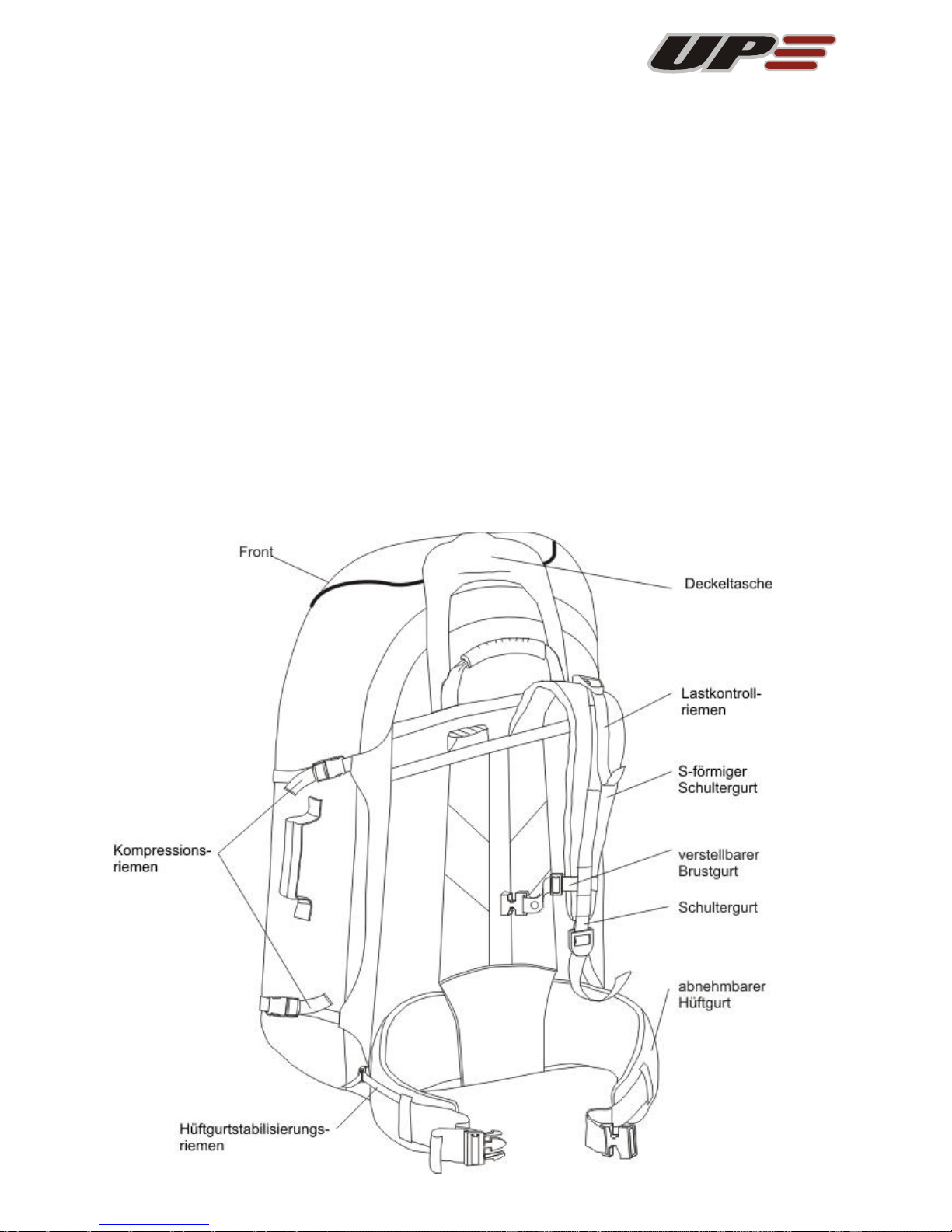
We have built in an anatomical carrying
system that allows an optimised load
distribution for maximum comfort. The S
shaped shoulder straps allow full
adjustment and the detachable chest strap
prevents the shoulder straps from slipping
off the shoulders.
The load control straps attached to the
shoulder straps can be set either loose, to
aid ventilation, or tight, for extra stability.
They should rise from your collarbone at
about a 45° angle.
A hip belt is also incorporated to assist
overall comfort. If the hip belt is
tightened then the shoulder straps can
be released slightly to transfer the load
away from the shoulders. The hip belt
is fitted with stabilisation straps, which
can be tightened to help stability, or
loosened for extra freedom of
movement. The hip belt is removable
for when packing size is critical, or the
pack is being transported by air.
It is important, especially when there is
a long trek involved, that the backpack
is adjusted for maximum comfort. The
following advice should be considered
when packing.
Illustration 3:
UP Backpack
Page 18
______________________________________________________________________________
18
Adjustment of the backpack
When fully loaded, all compression straps
should be tightened to secure the load in
the pack. All carrying straps should be set
fully loose and the pack then put on your
back. The hip belt should be fastened and
tightened to rest approximately in the
middle of the hip. Any slack should be
taken out of the shoulder straps, and the
chest strap should be done up. The load
control straps at the shoulders and hips
can now be tightened to achieve the
desired stability.
Packing tips
Packing the UP paraglider rucksack
correctly will make it a pleasure to carry. A
couple of easy tips can help you get it
right. Failing to follow these tips will
adversely affect you carrying comfort.
The centre of gravity of the load should be
as close to the vertical centre axis of the
carrier, while also being situated as high
on the back as possible. This allows for a
vertical posture and minimises the
leverage of the load against the natural
posture of the carrier. It also helps by
reducing the oscillations of the load while
walking.
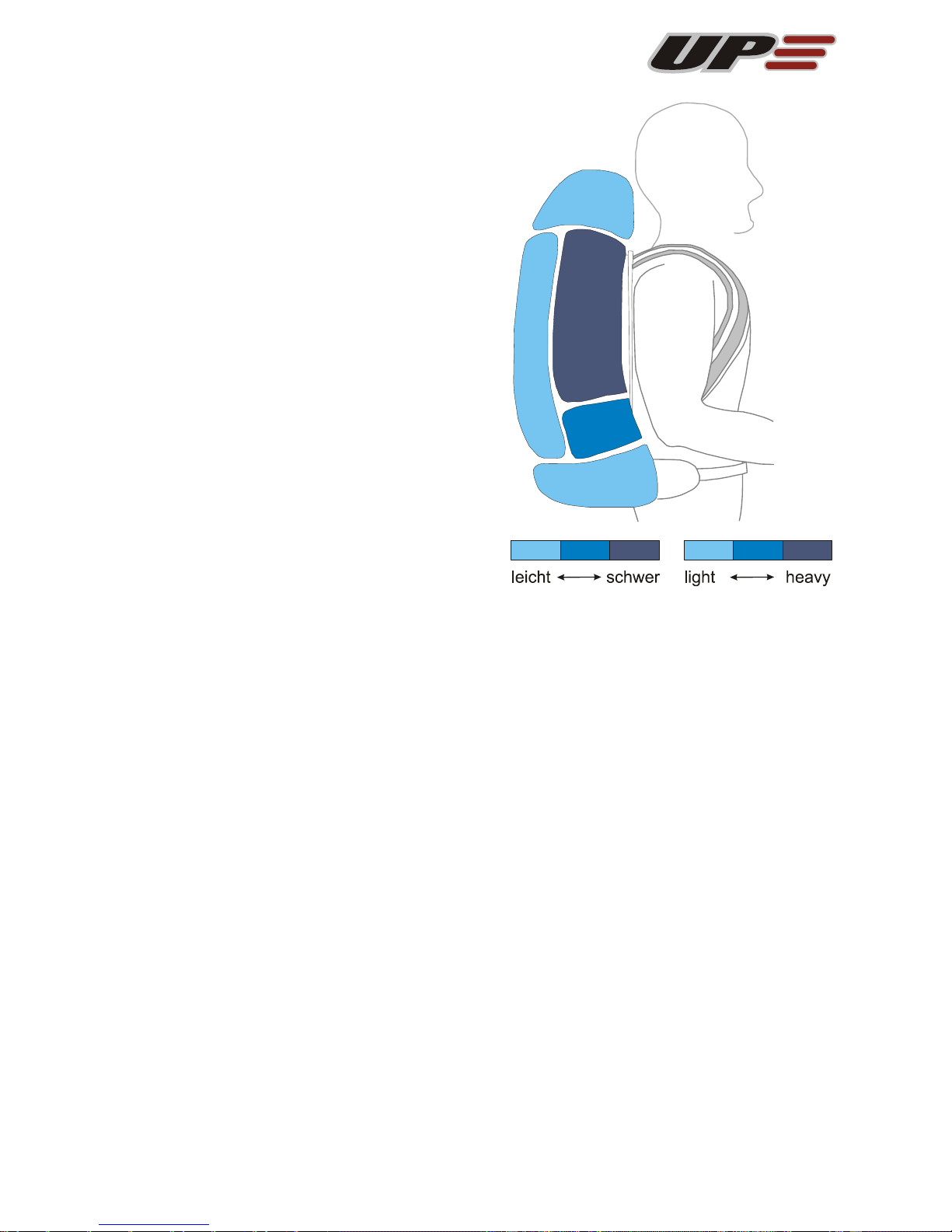
The drawing shows the ideal load
distribution in the UP rucksack. Loaded
like this the carrying comfort will be
optimal. Start by placing the heaviest
items close to the shoulder blades, with
lighter items over and under this region.
The lightest items should be placed the
furthest from your back.
Do not fasten any objects to the exterior of
the rucksack, as these are unprotected
against theft and can also get caught on
protruding points when entering or exiting
lifts, cars or buses.
Illustration 4: Ideal load distribution
in the UP rucksack
Page 19
______________________________________________________________________________
19
Before the first flight
The UP Summit XC² is delivered with a
speed system, rucksack Protec Bag and
strap, repair materials and this manual.
The manual may also be downloaded from
the UP website. Every Summit XC²
delivered has been minutely checked at
the factory, and corresponds exactly to the
wing certified by the DHV.
ATTENTION! The Summit XC²
must be test-inflated on flat
ground, and the first flight
must be carried out by a
professional, before the wing is
delivered to end customers
Adjustments
The UP Summit XC² has undergone an
extensive development program and
series of flight tests to ensure that the
production model exhibits the optimum
characteristics with regard to safety,
handling and flight performance.
As with all products from UP International,
the UP Summit XC² is manufactured to the
highest quality and precision. The line
lengths of each glider are individually
checked and recorded before dispatch.
Under no circumstances should the
lengths of the lines or risers of the UP
Summit XC² be altered in any way.
WARNING! Any change to the
configuration of the wing will
invalidate certification!
The only change allowed is to
the length of the lower brake
line. This should only be done by
an experienced person.
Position of the brakes
The UP Summit XC² is delivered from
the factory with what we feel is the
best brake position for most pilots. But
tall or short pilots, or those with a
harness with non-standard attachment
points might feel it necessary to
change the position of the brake
handles.
If the brakes are to be shortened, it is
extremely important to avoid the
adjustment affecting the glider's trim
speed. There must always be some
slack in the brakes when they are fully
released. This can be checked with the
glider inflated above the pilot's head.
There should be a noticeable bow in
the brake lines, and the brakes should
be having no effect on the shape of the
trailing edge.
If the brake lines are to be lengthened,
it is important to ensure that the pilot
can still stall the canopy (i.e. during
extreme manoeuvres or landing)
without the need to take wraps.
If you do feel the need to change the
brake line lengths, do so a little (34cm) at a time, and preferably whilst at
an easy training slope. Check
especially that both lines are the same
length, as any asymmetry will lead to
tiring and possible dangerous flying
characteristics.
If you have any questions or concerns
with reference to the brake line lengths
then seek advice from either your UP
dealer or directly from UP
International.
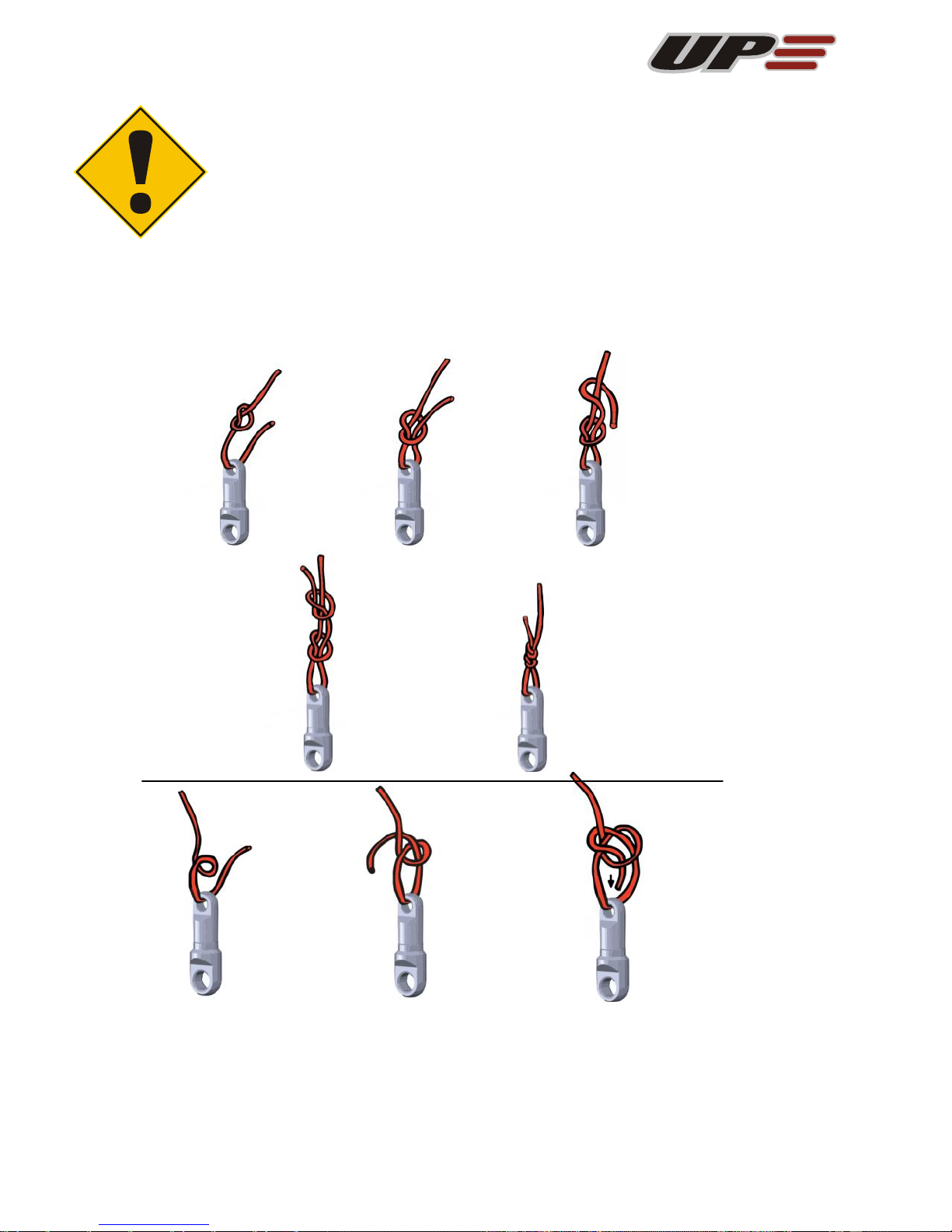
To tie the brake line onto the brake
handle use one of the following knots:
The simple fisherman's knot or the
Bowline as shown in illustration 5 and
6. These knots guarantee the least
amount of line weakening.
Page 20
______________________________________________________________________________
20
BEWARE! Loose or incorrect
brake knots can cause serious
accidents through loss of the
steering of the glider!
Illustration 5 and 6:
Fishermans- and
Bowmans-Knot
Page 21
______________________________________________________________________________
21
Speed system
It is important that the speed system is
connected correctly, and the length
checked, to ensure smooth operation in
flight.
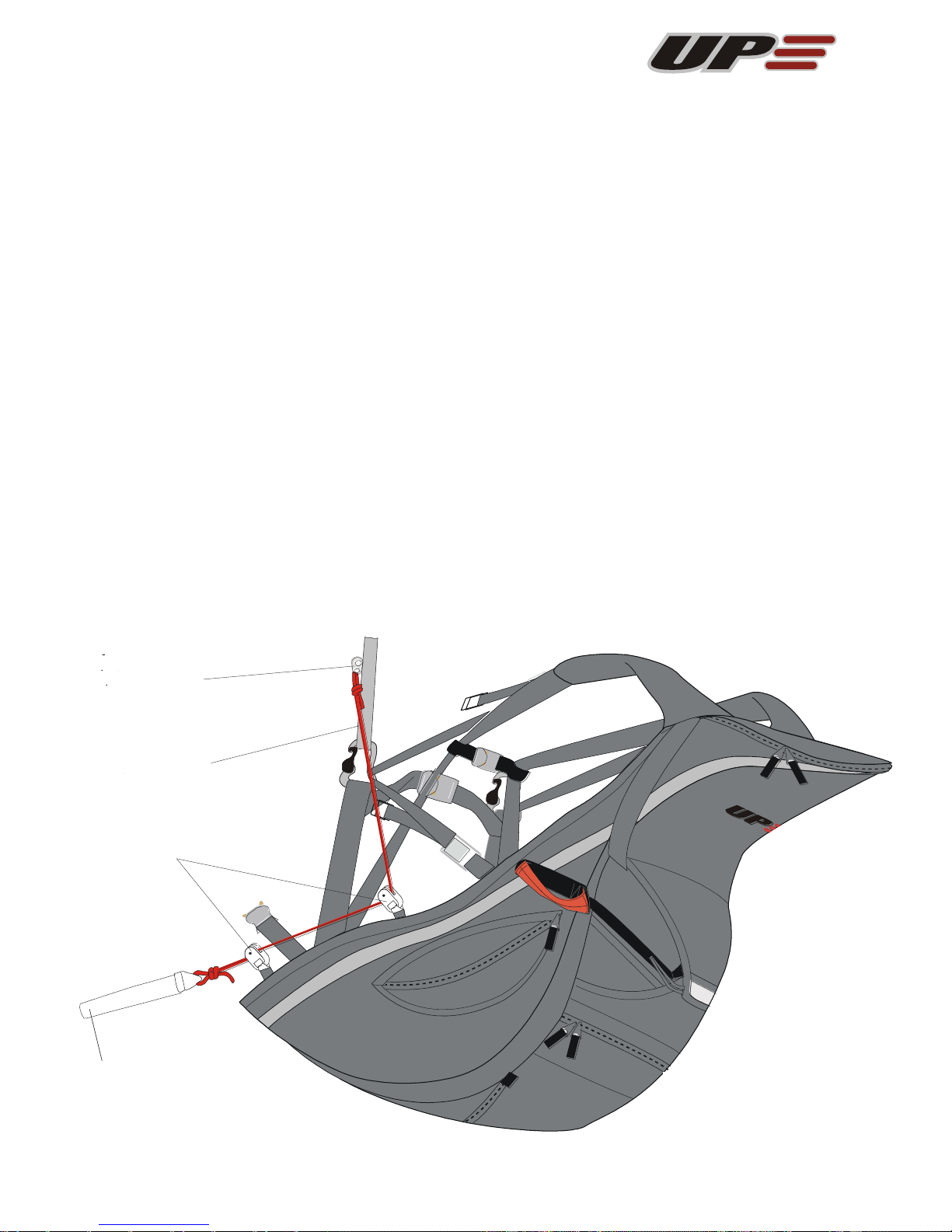
The link between the foot stirrup and the
risers consists of two cords and two
brummel hooks. The speed stirrup itself is
composed of a foot bar and webbing with
loops sewn on either end to attach the
cords. These cords should be run up
through the eyelets and pulleys on the
harness to connect with the pulley system
on the front of the risers (see Illustration).
This illustration refers to the UP harness,
but many harnesses are similar. If in any
doubt, please ask the harness
dealer/manufacturer.
The length of the cords should be set so
that, at full leg extension, the pulleys on
the risers are just touching each other.
Any shorter and the stirrup will be difficult
to reach; longer and the top of the speed
range will be unavailable.
During take off it is advisable to fix the
accelerator stirrup underneath the
harness to avoid any danger of tripping
over it.
Rope of speed
Brummel hook
combination
foot bar and
Pulley roller
Foot bar with
2 steps
Illustration 7:
Components of the
foot accelerator
Page 22
______________________________________________________________________________
22
Suitable harnesses
The Summit XC² can be flown with any
harness with the main suspension point at
around chest height. The lower the
suspension points the more the harness
will respond to weight shift.
The recommended distance between the
karabiners depends on the pilot weight:
<50kg: 38cm
50-80kg: 42cm
>80kg: 46cm
The harness design should also
the UP Summit XC² up to the maximum
speed.
Please note that different harnesses can
cause very different wing characteristics in
extreme situations (like increased risk of
twists with cocoon harnesses).
Note that the height of the hang point also
affects the brake line length. If you have a
question about your UP harness, contact
your dealer or UP International.
Rescue system
It is strongly recommended that you have
a rescue system (reserve parachute) fitted
at all times. In some countries it is
mandatory, so check if you plan to travel.
Make sure that the reserve system you
have is the correct size, and that you are
fully conver
For fitting the reserve system, follow the
instructions of the harness manufacturer.
Use of the UP Summit
XC²
The UP Summit XC² has been developed
and tested solely for foot launched and
winch launched paragliding flights. It is not
allowed and potentially dangerous to
use the glider for any other purpose.
Aerobatics
The UP Summit XC² has not been
developed, constructed and/or tested
for aerobatics use.
WARNING! The glider has not
been certified for aerobatics.
Performing aerobatics with
the UP Summit XC² or any
other paraglider can be very
dangerous. Doing aerobatics
can induce flying configurations
well beyond the tested flight envelope,
and can lead to total loss of control.
Aerobatics can also overload your
glider and break it in flight.
Motorised Paragliding
The UP Summit XC² has not been
tested for use with any kind of engine.
If you wish to fly your UP Summit XC²
with a motor please get in touch with
the manufacturer of the engine unit,
with UP International GmbH and with
the governing body for ultralight flying
in your area, to check on certification
of this configuration.
Page 23
______________________________________________________________________________
23
Flight practice and
safety
Both of the following chapters (Flight
practise and Flight safety) describe
fundamental aspects of flying paragliders.
In no way do they substitute proper
training, nor should any of the content
therein be unknown to any pilot who has
chosen to fly a performance paraglider like
the UP Summit XC².
Flight practice
Pre-flight check
Make sure whenever you get your UP
Summit XC² back from somebody else to
check the glider very carefully if you are
not the only pilot flying it. Ask if there was
anything that could have damaged any
part of the glider, if the pilot has found any
part that needs to be replaced or if they
noticed any strange flight behaviour. Make
sure you do the same when you lend your
glider to somebody else.
A thorough pre-flight inspection
should be performed prior to each
flight. A careful pre-flight check
is a must for any and all
airplanes also the UP Summit
XC². Please apply the same care
and attention before EVERY flight!
Before every launch you should carry out
the standard 5-point checking procedure.
It is a good idea to do the checks following
the same sequence every time to
minimize the risk of omitting something.
1. Unpack and arrange your glider in a
semi-circular manner. This shape
ensures that the centre cells inflate
before the tips. When unfolding your
glider, observe the wind direction
and arrange your glider so that it
is pointed directly into the wind.
2. The lines must be arranged so
that there are no tangles and the
A-lines are uppermost. Once the
lines are free and untangled,
check to make sure that they all
go directly from the riser to the
glider without going over the top
of the wing. Launching with a line
over the wing is extremely
dangerous! It is also important
that the brake lines are free and
not tangled.
3. Next check that you have put the
harness on correctly, and ensure
that both leg straps and the chest
strap are closed and adjusted.
Also check the rescue system
pins and deployment handle.
4. Right before the launch you
should check the air space (also
behind you).
5. Once again check the wind
direction before take-off.
The start phases
The take-off characteristics of the
UP Summit XC² are extremely
straightforward. Only a gentle forward
pressure on the A risers is necessary
and the glider will inflate evenly and
climb above your head. The glider has
no tendency to hang back behind you
or to overshoot over your head.
With the A risers and the brakes in
your hands, have another look at your
unfolded glider. By stronger wind the
start can be facilitated if the
UP Summit XC² is inflated solely with
both the internal A-risers (front Ariser). Make sure that you are centrally
positioned in the middle of the wing,
and that the wing is facing into wind.
Page 24
______________________________________________________________________________
24
The middle of the canopy is marked by the
UP logo at the leading edge.
Inflate the glider with a steady run and
remember to position your arms so that
they are a continuation of the A risers. As
the glider comes above your head, you
should glance up to see that the entire
canopy is inflated and flying. The
UP Summit XC² has a low surge
tendency, so there is usually no necessity
to brake to stop the glider from overflying you.
Directional control should only be
attempted when the glider is above your
head. Excessive braking will cause the
wing to drop back.
Only after checking that the wing is
properly inflated do you apply slight brake
pressure and accelerate rapidly down the
hill. After a few steps you will reach flying
speed and become airborne.
NOTE: The decision to actually
take off or not is only really
taken towards the end of the
control phase. The pilot
accellerates their start run and
is airborne. Depending on the
inclination of the launch paddock it may
make sense to brake a bit in this phase.
Once airborne and at a safe altitude the
pilot slips into the seated position in the
harness WITHOUT RELEASING THE
BRAKE HANDLES. If this is not possible
then the pilot may hold both handles in
one hand whilst assisting the seating with
the other.
Speed control
Using the brakes
The UP Summit XC² has a wide useable
speed range, coupled with excellent
stability at all speeds. The speed can be
set with the brakes to optimise
performance in any situation.
Maximum glide speed is achieved with
the brakes released completely,
whereas minimum sink speed is with
approximately 10-15cm of brake
applied. Further braking will not
improve the sink rate, but the brake
pressure increases noticeably as the
glider reaches minimum speed.
BEWARE! Flying close to the
stall point is very dangerous
and should be avoided. At
speeds below minimum
sink the danger of entering
an unintentional stall or spin is
increased dramatically.
Using the Speed System
The UP Summit XC² is equipped with
a very efficient speed system, working
over a foot stirrup as usual. By
engaging the speed system the true air
speed may be increased by around
17km/h. Being familiar with the use of
the speed system is an important skill
to have in paragliding.
The speed system should be used
when you are flying through sinking
air, when trying to achieve best glide in
a headwind, or trying to cover the
ground as quickly as possible. But it is
important to remember that the glider
will be more susceptible to collapses at
high speeds, so the speed system
should not be used in extreme
turbulence. If, with the speed system
applied, a collapse occurs then it
should be released immediately. Some
warning of an imminent collapse is
afforded by the tension felt in the
speed system; should the tension
suddenly reduce then the stirrup
should be released and the glider
returned to normal trim speed.
BEWARE! All extreme
flight situations, such as
Page 25

______________________________________________________________________________
25
collapses, happen more
dramatically at increased speed.
Therefore the speed system
should not be operated near the
ground or in noticeable
turbulence.
Turning
The UP Summit XC² is an agile glider and
reacts immediately to pilot input.
Brake input and amount of weight shift
induced will define the radius and bank
angle on the UP Summit XC², and will
allow it to be controlled with ease. Using
weight shift in combination with brake
input will result in flat turns with minimum
height loss and is in fact always the most
efficient control method. The radius of the
turn is then controlled with the brake line
whereas the bank is controlled through
weight shift.
If needed the UP Summit XC² will turn
very tight. To do this, apply some brake
input on both sides, then release the
outside brake whilst applying further brake
on the inside this will reduce turning
radius to a minimum.
When brake input is increased beyond
approximately 50% on one side, the UP
Summit XC² begins a fast and steep turn,
which can be made into a steep spiral
(refer to chapter heading "steep spiral").
Landing
The UP Summit XC² is easy to land. While
pointing into the wind, the pilot should fly
the wing fast until approximately one
meter above the ground, and then apply
both brakes completely. When landing in
stronger wind, less brake is required.
Landing from steep turns should be
avoided due to the risk of an uncontrolled
pendulum reaction.
Winch towing
The UP Summit XC² tows easily.
There are no special techniques that
need to be employed, but
consideration should be given to the
following points:
Especially when you are towing at
an unknown field, make sure that
you are fully aware of any local
conditions and peculiarities. Ask
the local pilots if you are at all
unsure.
During the launch, ensure that the
glider is completely inflated and
over your head before giving the
'start towing' signal. If the glider is
not central over your head do not
continue with the tow. Any
corrections attempted through the
brakes during this critical phase
may result in the canopy deflating
again, or in the tow progressing
with a non-flying wing; if tow
tension is applied when the glider
is not correctly positioned then a
'lock out' or a stall could occur.
Try to avoid large brake inputs
until you are reasonably high.
Emphasize weight shift if any
course correction is necessary
close to the ground.
Do not try to climb steeply during
the first part of the tow. Good
airspeed is essential.
Do not use a towline tension
greater than 90 daN at any time
during the tow.
All persons involved with the
towing operation should be
suitably qualified and
experienced. All equipment used
should, where necessary, be
certified, and a tow permit should
be valid for the field being used.
Page 26
______________________________________________________________________________
26
Attaching the towline release
system
The optimal attachment point for the
centre of gravity. On a paraglider that
means the connection point between the
risers and the harness, preferably right
onto the lower end of the risers. UP
International has developed special towrelease connectors for the UP Summit XC²
to ensure the optimal connection between
the pilot and the towline. For safety
reasons we suggest that you always use
these connectors when towing the
UP Summit XC².
When using towline release systems
incorporating distance-tubes between the
risers it is important to ensure that the
risers are not pulled together by the
system (use webbing loops designed for
climbing to increase the length of your
release system). It is also very important
to fit a bungee to the system that will keep
it from hitting you in the face in the event
of a towline failure
BEWARE! If you are using a front-
mounted reserve system it is very
important to verify the
unhindered deployment before
every flight. In case of doubt
please only tow using a textile
release system.
Page 27
______________________________________________________________________________
27
Flight safety
The development of high performance
paragliders from square parachutes has
meant vast improvements in speed, sink
rate and handling. But, at the same time, it
has also led to a requirement on behalf of
the pilot for accurate, sensitive control and
an acute anticipation of possible flying
conditions. Any glider, whether beginner
or competition class, may collapse in
turbulent conditions and you must be able
to react accordingly.
Today you have a wide choice between
different gliders in the UP range. The main
difference between the gliders is in the
stability that each class offers. Beginner
wings react to turbulence less dramatically
and are more forgiving when compared to
top performance gliders, which have more
sensitive, but less forgiving handling.
Making the correct decision when
choosing a new glider is most important;
you should critically examine your flying
and your level of knowledge.
A safe and efficient way to get used to
your new paraglider is by practicing your
ground handling skills. We suggest
finding a suitable area, like a playing field,
and with light to medium wind it is quite
easy to practice inflating the glider and
feel the reaction to brake input, b-line stall,
collapses etc.
Before takeoff and whilst flying it is very
important to anticipate any likely
turbulence and fly accordingly. Look well
ahead, and as well as looking for areas
of likely lift, try and predict, and avoid,
areas of sink and rough air. If you do
find yourself in turbulence then look for
the cause, and adjust your flight plan to
avoid other similar places.
Thermals and
Turbulence
In turbulent air, the UP Summit XC²
should be flown with a little brake to
increase the angle of attack and
provide greater stability. While flying in
strong or broken thermals, it is
important that you concentrate on
keeping the wing centrally above your
head. Do this by allowing the glider to
fly faster while entering a thermal, and
by dampening the surge of the canopy
while exiting the thermal by braking
gently.
Flying fast is useful for getting through
sink or when flying into a headwind.
The UP Summit XC² possesses a high
inherent stability due to its construction
and design, however an active flying
style in turbulence will help increase
safety by preventing unnecessary
collapses and deformation of the
canopy.
Getting down fast
All rapid descent manoeuvres should
be practiced initially in smooth
conditions with plenty of altitude before
you need to use them 'for real'. It is
important to distinguish between the
three techniques, and to know the
merits of each.
WARNING! All other
manoeuvres, such as full
stalls and spins, should be
avoided as fast descent
techniques. They are not
very efficient, and incorrect
recovery can have dangerous
consequences (as with any
paraglider)!
Page 28
______________________________________________________________________________
28
Steep Spiral Dive
A maximum sink rate of over 15 meters
per second can be achieved in a steep
spiral dive, but it is advisable to build up
gradually to these sink rates when you first
practice spiralling.
Getting the UP Summit XC² into a spiral
dive is very simple and has already been
described in the chapter regarding turning.
When entering the spiral it is essential to
induce the turn gradually; if you apply the
brake too quickly you may enter a spin. If
this happens, release the brake
immediately and let the glider recover
before trying again. Keep a steady tension
on the inside brake and observe the
increased angle of bank and sink rate. A
little brake on the outer wing will help
stabilize the glider at a high sink rate.
As the sink rates increase the inner
(lower) wing tip will begin to deform; this is
a design feature that improves the passive
safety during the manoeuvre.
To recover from a spiral, simply release
the inside brake. Do this gradually to
prevent an uncontrolled steep climb
caused by the excess energy built up
during the dive. Be prepared for the glider
to climb a little and to damp out the
subsequent dive. Be warned that steep
spiral dives are equal to high G loading on
both you and your glider!
WARNING! Spiral dives with
high sink rates expose the
pilot and material to very
high centrifugal forces
incidents caused by pilots
falling unconscious during spiral
dives are not unheard of. Approach this
manoeuvre with caution. NEVER fly a
spiral dive with BigEars engaged this
could lead to a catastrophic material
failure!
B-Line Stalls
To induce a B-line stall, start from
normal, un-accelerated flight. Reach
up and take hold of both B risers, still
with your hands in the brake loops,
and pull down simultaneously by
approximately 15 centimetre. The first
few centimetres of travel will be quite
hard, but as the glider settles into the
stall so the effort becomes less.
The glider will drop back a little as it
stalls, and then centralize over your
head. With 15 centimetre or so of pull
a sink rate of up to 9 meters per
second can be achieved. With less pull
you will get a decrease in sink rate.
The B-risers should not be pulled
beyond this point, as it may result in
the canopy entering an unstable phase
or going into a frontal rosette. Should
you inadvertently have pulled too far
down on the B-risers, simply release
them a little again until the wing is
again stable above you, showing the
characteristic deep crease along the
B-level and being fully stretched out
spanwise.
To recover from a B-line stall, the
risers should be released abruptly and
simultaneously. Doing so will allow the
wing to re-inflate completely and
resume normal flight. It is not unusual
for the canopy to dive in front of the
pilot as the wing regains speed, angles
of up to 30-45° are not perfectly
normal. In this phase the pilot should
NOT engage the brakes!
WARNING! Releasing the
B-stall too slowly, or
asymmetrically, can
lead to dangerous
situations. Always practise
manoeuvres under
professional guidance and over water!
Page 29

______________________________________________________________________________
29
Big Ears
To pull the ears in, reach up and get hold
of the outermost A line on both front risers
and pull them down, simultaneously, by
about 30cm until the tips collapse. Keep
these two lines in your hands, to prevent
the wing re-inflating.
Once the wing is flying in the Big Ears
configuration we recommend engaging
the speed system to about 50% of the
maximum travel (more if higher sink rates
are desired). This reduces the angle of
incidence and improves the safety of the
manoeuvre.
We suggest keeping the brake toggles in
your hands while inducing Big Ears. The
glider will remain fully steer-able through
weight shifting during the manoeuvre. The
sink rates will be around 3 to 5 metres per
Second, depending on the number of
centre cells still open and on the amount
of speed bar employed) straight ahead. To
end the BigEars configuration, simply
release the A risers and disengage the
speed system, and the wing will return to
level flight. Small collapses may be
cleared with directional changes and/or
little pumps through the brake lines. Note
that we advice against performing extreme
manoeuvres while flying in the BigEars
configuration.
Inducing large Big Ears on the UP Summit
XC² when flying near its lower weight limit
requires great caution on the amount of
brake input used, as it may deep stall in
extreme cases. Should this happen use
the recovery technique described in the
Page 30
______________________________________________________________________________
30
Flying outside the
normal flight
envelope
Behaviour in extreme
situations
The UP Summit XC² is designed to be
very aerodynamically stable. However as
with all paragliders extreme turbulence or
piloting error may induce unwanted
behaviour from the canopy. To ensure that
you are able to handle these situations
correctly we strongly recommend that you
attend a safety-training (SIV) clinic, where
you can learn to master your wing outside
the normal flying envelope under
professional guidance.
Safety training manoeuvres should only
be practiced in calm air with sufficient
altitude, and under the instruction of
qualified instructors. We would like to use
this occasion to once again remind you to
never fly without a reserve parachute!
The manoeuvres and possible flight
configurations described in the following
may occur following a conscious effort on
the part of the pilot, through turbulence or
through pilot input error. Any pilot flying in
turbulent air or making piloting mistakes
may end up experiencing these flight
configurations and therefore find
themselves in danger, particularly if they
are not adequately trained to master them.
WARNING! Mistakes during the
execution of the following
manoeuvres may seriously
compromise the safety of
pilot.
Collapsing the
paraglider
Asymmetric collapse
The UP Summit XC² belongs to the
new generation of paragliders that, as
well as having very good performance,
also exhibit a high degree of stability.
Wing tip collapses can almost always
be prevented through active flying.
Once an asymmetric collapse has
occurred the pilot aims to maintain
flying direction through weightshift and
careful application of brake input on
the open side.
If the open side is braked too much it
may stall, and the wing will enter a
spin this is the classical recipe for
cascading events (see the Spin
chapter).
In rare instances a wingtip may catch
in the lines during asymmetric
collapses (see Cravattes here below).
Cravatte
Our test pilots have found absolutely
NO tendency towards cravatting in all
the test flights the Summit XC² has
been subjected to. But under
extraordinary circumstances any
paraglider may cravatte, and if this
happens the pilot should know how to
deal with the situation.
The first step is to STOP any rotation,
or, if this is not possible, to slow down
the rotation as much as possible a
cravatted wing that is left to its own
devices may very quickly enter into a
spiral dive of such vehemence that the
pilot cannot stop the rotation any more.
Once the rotation is under control the
pilot attempts to free the cravatte by
pulling on the (purple) stabilo line,
Page 31
______________________________________________________________________________
31
perhaps in combination with pumping
action through the brake lines.
If neither of these approaches work then
the experts may decide to try either a full
stall or a brief spin on the cravatted side
please note that these measures should
ONLY be practised during an SIV training
over water.
WARNING! Should the pilot be
unable to control the rotation it
is normally best to deploy
the reserve parachute
immediately. Uncontrolled and
cravatted spiral dives are among
the most dangerous canopy configurations
in paragliding
Full frontal collapse
A negative angle of attack occurring
through turbulence or from simultaneously
pulling down both A-risers results in a full
frontal collapse of the leading edge of the
canopy. The UP Summit XC² will normally
reinflate quickly on its own, but can be
assisted through the application of a light
double-sided symmetrical brake input.
The stalls
When a paraglider flies through the air a
laminar and a turbulent airflow forms
around the surface of the wing. When the
laminar airflow along the top surface is
interrupted, dangerous flight
configurations follow we say that the
wing stalls. This is most often the
consequence of attempting to fly with too
high angle of attack.
In more detail we differ between three
different forms of stall.
BEWARE! Spin and full
stall are both dangerous
and somewhat
unpredictable
manoeuvres. Do not stall
or spin your paraglider on
purpose. However it is very important
to learn how to recognize the
symptoms of a glider about to stall or
spin so that you can take correct
action to avoid it happening.
Deep Stall
The UP Summit XC² has no inherent
tendency towards deep stall. It will
recover from a deep stall brought
about by over braking, by pulling on
the rear risers, or by releasing the Brisers too slowly after a B-stall, on its
own without any pilot input as soon as
the brakes or the risers are released.
Should you however find yourself in a
deep stall (as described above this
could happen through flying too light
on the wing and pulling big ears) the
situation can be rectified by
simultaneously pushing both A-risers
forward until the glider resumes normal
flight. Avoid applying brake to one side
if you think that you are in a deep stall
as this could lead to a spin.
Always remember that practicing
manoeuvres where you fly close to
minimum airspeed must only be
carried out under professional
supervision and with plenty of altitude.
Fullstall
Wilfully induced full stalls remains the
realm of the true experts of our sport.
The full stall is when there is no more
laminar airflow along the surface of the
canopy, and the wing has gone from
being a wing to being just a bunch of
material at the end of some lines.
Page 32
______________________________________________________________________________
32
Once the airspeed has been reduced to
below the minimum speed for the canopy
the wing will stall. To the pilot it feels like
dropping backwards, not unlike the
sensation felt when a jester removes your
chair from under you when you sit down.
In this phase it is important to avoid
releasing the brakes again, as this may
lead to uncontrollable shooting forward of
the canopy. In extreme cases pilots have
fallen into the canopy through poor timed
full stall releases.
In the next phase the canopy stabilises
somewhat above the pilot again. The wing
tips will often tend to try to reinflate quite
violently, and it requires considerable
force to maintain the wing in the stalled
configuration.
It is important to stabilise the wing above
the pilots' head before releasing the brake
lines. The pilot accomplishes this by
slowly releasing the brakes until the wing
is all but reinflated across the entire span.
In this phase the wing will be moving
somewhat along the cross axis. The pilot
attempts to release the last bit of brake
input as the wing is surged forward this
will cause the wing to resume flight with
the least possible diving tendency. Pilots
should note that timing the release
wrongly may cause the wing to dive quite
aggressively and be prepared to catch the
dive.
Test pilots have also tested the
asymmetric release of full stalls on the
Summit XC². This manoeuvre is ONLY
for reference and should not be
emulated by owners.
CAREFUL! The approach of
the minimum speed is
recognised through the
notable lack of forward
speed and thereby wind noise
and the extreme increase in
brake line tension. Up until the wing
starts to fall back the pilot may resume
normal flight by simply releasing the
brakes.
Spin
The negative spin occurs when one
side of the wing is stalled whilst the
other is still flying. This can happen
when, if flying very slowly, one brake is
pulled quickly to below the seat. When
the glider starts to spin, it will turn
quickly around the vertical axis, with
the stalled side flying backwards. To
recover from a spin, simply release the
brake on the stalled side. The glider
will immediately speed up and, most
likely, suffer an asymmetric collapse.
Recover as described above.
If you suspect that a spin is imminent
then immediately release the inside
brake. The glider will accelerate
smoothly and resume normal flight
with little altitude loss.
Wingovers
Wingovers are induced by flying
alternating turns; each time letting the
pendulum effect increase the bank
angle.
BEWARE! The UP Summit
XC² is a agile glider, and it is
quite easy to get to an
excessively high angle of
bank in just a few turns.
Practice wingovers gently at
first, as there is a chance of quite
large collapses at high bank angles.
Also notice that a wingover flown with
more than 90 degrees bank angle is
classified as illegal aerobatics in some
countries!
Page 33
______________________________________________________________________________
33
Emergency Steering
If for some reason the UP Summit XC²
cannot be controlled with the brakes, for
example if the brake handle has come off
the main brake line, it can be steered and
landed with the rear risers. Be aware that,
when rear riser steering, the glider is a
great deal more responsive to pilot input,
and the stall happens very suddenly.
Further references
Rain-induced deep stall
There are two reasons why flying with a
wet wing increases the risk of deep
stalling:
First reason: A paraglider flying in
heavy rain will soon grow significantly
heavier and thereby undergo changes
in the centre of gravity and the angle of
incidence. This may lead to deep stalls.
Note that older wings will absorb more
water than newer ones due to the coating
on older wings being more permeable
this means that the critical mass may be
reached sooner on older wings.
Second reason has to do with the actual
rain drops on the top surface if enough
large rain drops form that the entire top
together to either flow off or become a
homogenous mass, the surface will
become so rugged that the airflow
separates and the wing stalls.
This phenomenon has been observed on
hang gliders and gliders for years but
only recently have we discovered that
paragliders may also be affected. It is
more likely to happen with new wings
where the cloth is still highly hydrophobic
and the drops thus do not penetrate but
remain on the surface.
We know from computer simulations and
practical tests that this is physically
possible but we also suspect that it
occurs very seldom in real life flying.
In both cases the brakeline travel
becomes very short and even small
input may suddenly induce an airflow
separation; in some cases even a gust
or a sudden thermal may change the
angle of incidence enough to cause
the deep stall.
If you find yourself flying in
unavoidable rain we strongly
recommend that you avoid any sudden
movements or radical brakeline input,
that you do not pull BigEars or B-stall,
and that you steer clear of turbulence
and avoid a deep flare on landing.
WARNING! Avoid flying in
very humid air or in rain. A
wet canopy may have very
unpredictable flying
characteristics, one of which is
a radically increased risk of deep
stall!
Adhesive logos
Always make sure that your intended
logo will not in any way influence the
glider behaviour. If in doubt we
suggest avoiding the attachment of
advertising logos on the wing. UP
cannot be held responsible for any
mishaps caused by intentional aftersales changes done to the wing.
NOTE! The use of heavy and/or
unsuitable sticky material for
logo work on the canopy
may compromise the
certification and lead to the
aircraft becoming unsafe to fly
Overloading
The UP Summit XC² is a very strong
paraglider, and flying all the usual SIV
Page 34

______________________________________________________________________________
34
and acro manoeuvres will not normally
pose a structural problem. However,
frequent acro training does accelerate the
ageing process dramatically, and UP
recommends having wings that are often
used for acro or SIV-type manoeuvres
subjected to checkups at shorter intervals
than normally stipulated.
Salt water
If you do most of your flying near the sea,
where the air is humid and salty, the wing
may age faster. In this case we suggest
you have it checked more often than
prescribed in this manual.
Page 35
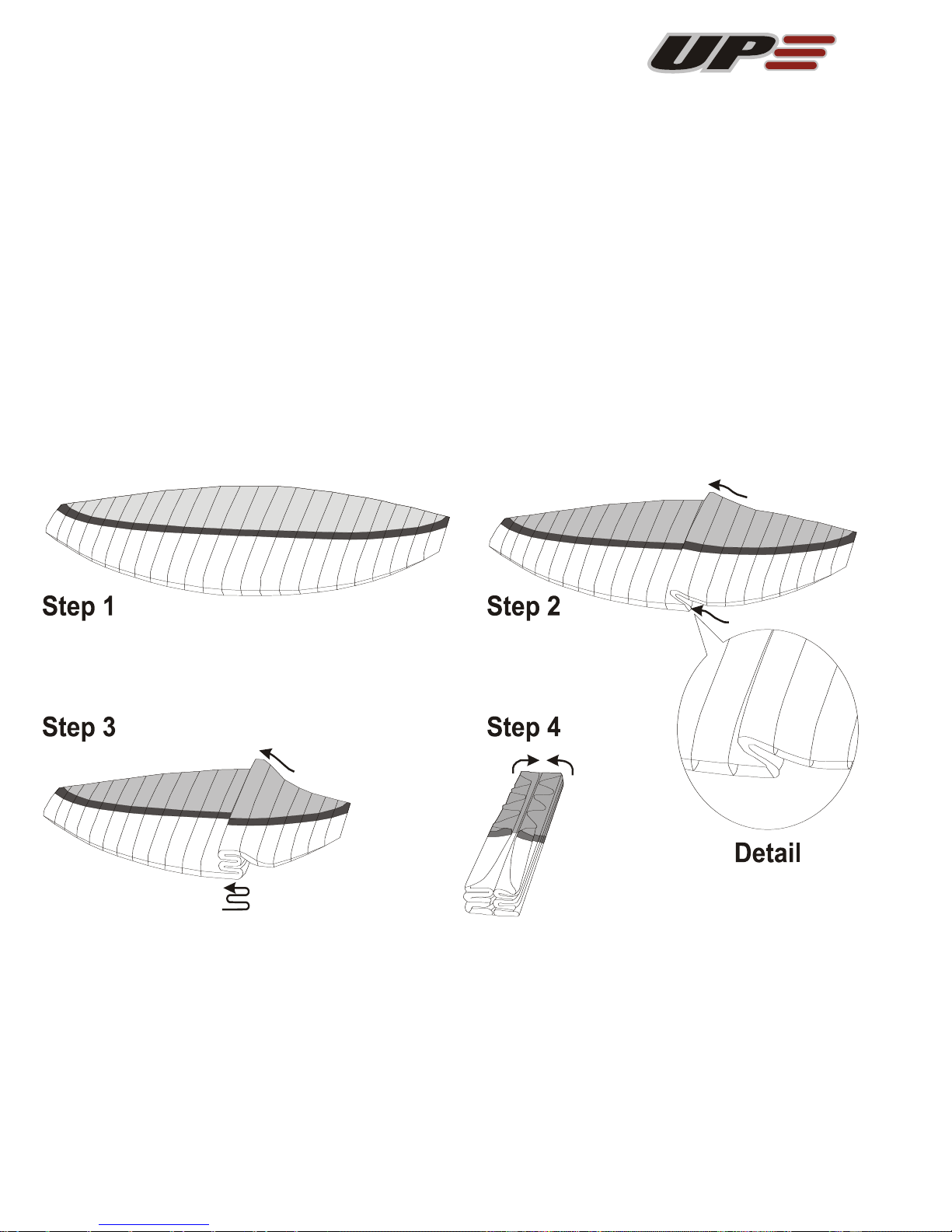
______________________________________________________________________________
35
Maintenance and
cleaning
Taking care of your
paraglider
The wear and tear that your paraglider
suffers depends on a number of factors;
the world you fly it, how much UV it gets
and how well you look after it. Bear in
mind the following maintenance points.
Packing the wing
Abbildung 8: Packschritte für den UP
Summit XC²2
The ASS battens are insusceptible to
bending damage. This means the Summit
XC²2 may be folded as per pilot
preference in the spanwise direction. The
pilot may opt to fold the wingtips towards
the centre, to fold along each cell wall, or
to use the now ubiquitous accordion
method (see illustrations above).
Regardless of pilot preference we
recommend alternating the packing
methods a little every time, especially
around the middle of the canopy, as
this area is particularly exposed to
mechanical abrasion in the folding
process. We also recommend to
always place the canopy on the
compression bag before folding along
the chord this will protect against soil
abrasion.
In order to prolong the life of the ASS
battens we recommend the following
procedure when folding the canopy in
the chord-wise direction:
Page 36
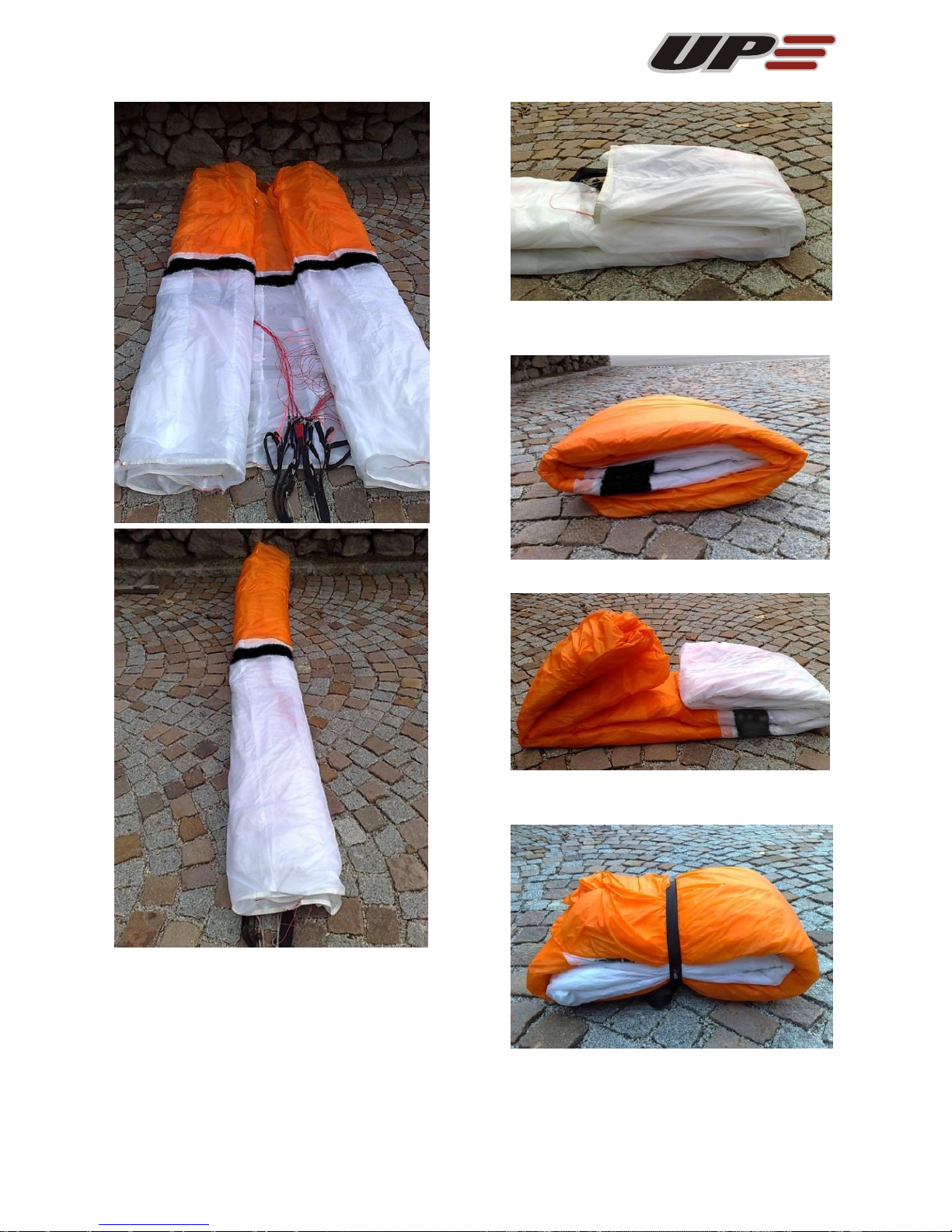
______________________________________________________________________________
36
Start by gathering the two sides into a
Then proceed to fold from the trailing
edge..,
Do NOT fold the leading edge inside
the bundle
Instead, keep the entire leading edge
on the outside of the bundle, and
secure with the UP compression strap.
Page 37

______________________________________________________________________________
37
Paraglider fabric
We use a top grade polyamide cloth to
build our paragliders, which has a special
protective coating against UV radiation
and air permeability. The cloth will suffer
UV (i.e. bright sunlight). Do not leave your
glider lying in the sun for any longer than
is absolutely necessary, only unpack and
rig right before launching and do yourself
the favour of repacking right after landing.
Modern paraglider textiles have improved
much in terms of UV durability but UV
exposure remains the deciding factor of a
paragliders' life expectancy. First the
colours start to fade, then the coating and
the structural integrity of the synthetic
fibres begins to deteriorate.
On UP gliders the coated side of the cloth
is facing inwards. This means that the
coating is subjected to less mechanical
abrasion while the porosity-limiting
capabilities remain the same
When choosing an area to lay out the
glider before launching, try to find
somewhere that is relatively free of stones
and sharp rocks. Pay particular attention
to the top surface, where it lies on the
ground.
Never step on your glider stepping on it
will weaken the cloth, especially if the
surface beneath it is hard or contains
sharp objects. We recommend keeping an
eye on spectators on launch. Many,
especially children, do not fully appreciate
the fragility of the lines and cloth. It is
usually easy to explain this to spectators
and parents.
When folding your wing please make sure
that there are no insects caught inside.
Many insect species contain acids that
could damage the cloth. Grasshoppers
may use their sharp mandibles to attempt
to gnaw their way out of a folded canopy,
making it full of holes in the process.
Beside they exude a dark and strong
colorant that will stain the cloth if
grasshoppers are packed inside. Shoo
them off before packing. Note that,
contrary to popular belief these
particular insects are not attracted to
any particular colours.
If the glider gets wet, then dry it as
soon as possible, but not in direct
sunlight! If you pack you wing away
wet it may grow mildewy and, if also
subjected to heat, the fabric fibres may
begin to decompose.
A new wing straight off the shelves is
often compressed hard. The
compression serves to reduce
shipping costs but should note be
repeated once the wing has been
unpacked and flown for the first time.
Also note that, in spite of it being a
comfortable seat, the glider bag should
not be used as such.
Should you accidentally put your UP
Summit XC² into seawater rinse it out
thoroughly with fresh water and dry it
slowly in the shade (see Chapter
Cleaning).
Paraglider lines
The lines used on the UP Summit XC²
are high grade Dyneema® and Aramid
lines from Cousin Trestec and Edelrid.
Keep the following points in mind:
The lines should be checked
regularly for damage.
Please take care to avoid
abrasion and damage to the lines'
protective sheeting
The lines should not be knotted or
bent unnecessarily.
The main brake line at the handle
should not have too many knots.
Each knot weakens the line.
After any line over-stressing (tree
landings, water landings and other
Page 38
______________________________________________________________________________
38
extreme situations) all lines must be
checked for condition and length and
should be replaced where necessary.
If any change in flying characteristics
is noticed then the lines should be
checked possibly exchanged.
Immediately send your wing to
UP International or to a UP certified
checking facility if you feel that
something is wrong!
Storage and transport
A paraglider should always be dry when
packed, but this is particularly important
after the last flight of the season. But even
a completely dry wing should still be
stored open in a dry, clean and dark
place. If you do not have room for such
winter storage we recommend you open
all compression straps on the bag as
much as possible and leave the bag lid off
so that air can circulate around the packed
canopy. Make sure no mice or cats make
their sleeping quarters in you wing, and
keep it well distant from solvents and
acids. Petrol and other petrochemicals is
especially abrasive for nylon and will
dissolve the cloth if allowed near.
The long-term storage temperature should
remain approximately constant between
10 and 25 degrees Celsius, and the
relative humidity between 50 and 75%.
Do not expose your UP Summit XC² to
extreme heat (storing it the boot of a car
parked in the sun). The heat may cause
moisture to be pressed through the fabric,
thereby damaging the coating. High
temperatures in combination with moisture
are a particularly volatile mix that will
accelerate the hydrolysis process where
the fibres and the coating are
decomposed. The chemical composition
of the canopy material may begin to
change from temperatures as low as 60°
Celsius !
Cleaning
If you feel it necessary to clean your
UP Summit XC² at any time then use
lots of lukewarm water and a soft
sponge. More stubborn stains can be
cleaned with a weak soap solution,
and rinsed thoroughly. Then leave it to
dry in a shady but well-ventilated area.
BEWARE! Never use
chemical cleaning agents,
brushes or hard sponges
on the material, as these
destroy the coating and
affect the strength of the
cloth.
The canopy will become porous and
will loose structural strength. Never
attempt to clean your paraglider in a
washing machine. Even without using
detergents the simple mechanical
abrasion will quickly finish the canopy
and render it useless. Also avoid
dipping it in a swimming pool; the
chlorine will damage the cloth. If you
MUST rinse the parachute, f.ex.
following a sea water landing, do so
with a gentle spray with fresh water.
Frequent spraying will accelerate the
ageing process.
Changing ASS Battens
The UP Summit XC² uses flexible
Nylon® battens to maintain the shape
of the leading edge. They are
insusceptible to bending damage and
very robust, but may in extreme cases
become bent or broken fear not, for
they are easily replaced on-site! A
small pocket at the top end of the
batten allows it to be released from the
confines of the little tunnel it resides in.
Page 39
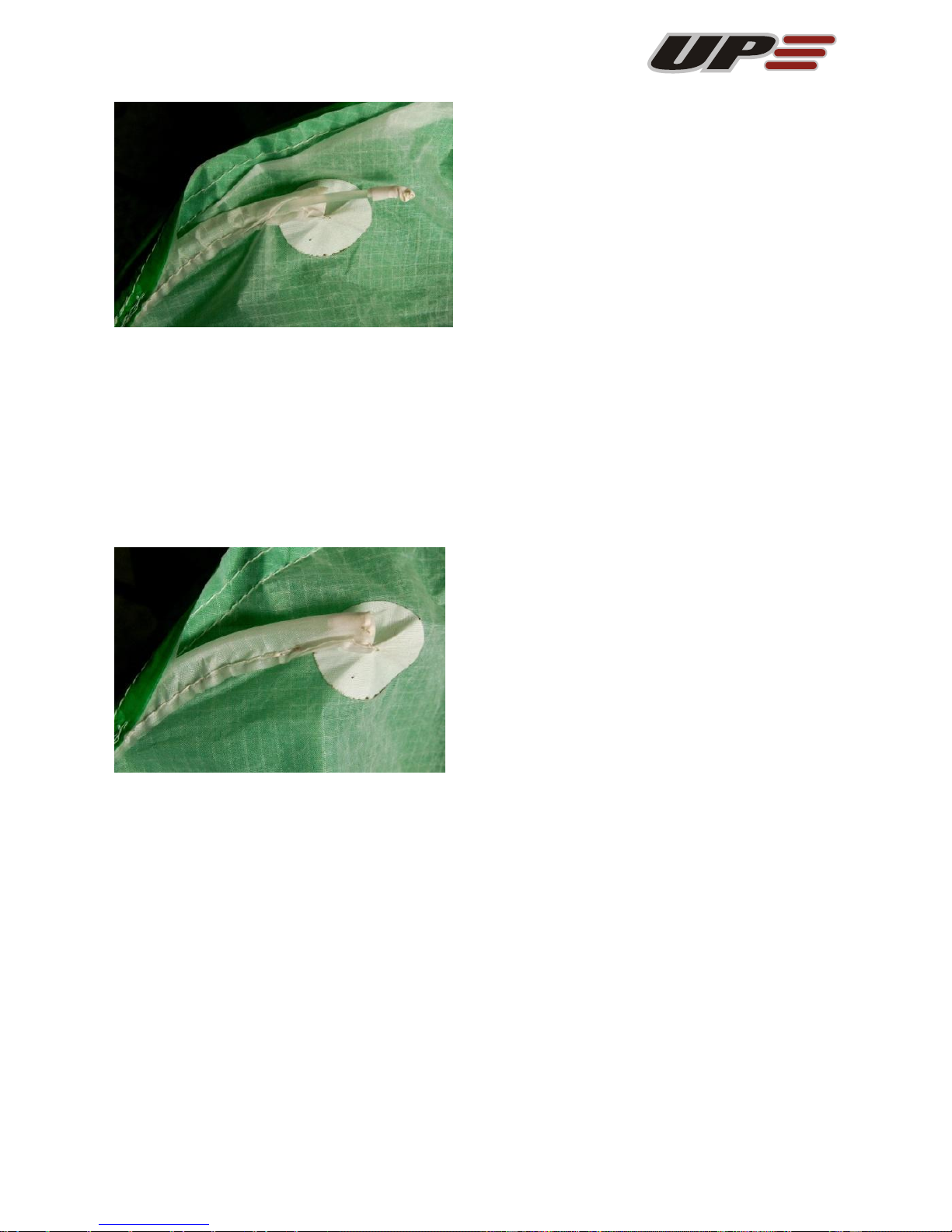
______________________________________________________________________________
39
Push the batten back somewhat and
release the end from the pocket, then
remove it entirely. Transfer the total length
precisely to the replacement material
(supplied) and cut a new length. File the
ends of the new batten and cover them
with tape. Push the new batten into place
and secure.
(ASS similar to Summit XC²)
Page 40
______________________________________________________________________________
40
Checks and repairs
Repairs and periodic checks
should ONLY be carried out by
UP, or by UP approved
checking centres. Failure to
comply with this will forfeit
the certification. Consult:
www.up-paragliders.com under
Service to find a check centre near you.
At UP we invest our entire knowhow in
paragliding into making the sport safer for
you. We offer a variety of services all
centred around safety to our customers.
Maintenance
All care and maintenance must be carried
out in accordance with UP
recommendations. To ensure that this
happens we strongly advise you to only let
UP recognised service centres touch your
wing this is also a prerequisite for the
speaking for letting UP, or a UP affiliate,
look after your Summit XC²!
Airworthiness Check
In Germany and Austria all paragliders
must be checked according to the
following time schedule:
2 years after the first flight
Every two years after that, or sooner if
prescribed by the UP checking facility
during the last check
After 150 hours of flying
After 100 flights
These limits have been set by the German
Free Flight Federation (DHV) and make
no less sense for wings flown outside of
Germany/Austria. Contact your local
dealer for information about the
nearest UP approved checking facility.
We will happily service the glider more
often, if you feel that it is necessary.
CAREFUL! If you notice new
or unusual behaviour from
your wing please hand it
in for immediate
inspection at a UP Service
centre.
UP Craftsmanship
In order to ensure that your UP
Summit XC² maintains its very high
inherent performance and safety we
highly recommend that you employ
UP, or a UP affiliate, with any repairs
or maintenance. Our service staff is
trained and skilled, and knows the UP
wings better than anyone.
UP Warranty
Conditions and extent of the UP
International Warranty can be found in
the following pages. For further
information please ask UP
International directly, or you local
representative. The UP importer in
your country is always delighted to
clear any questions with you.
National warranty
conditions
In some countries the local laws
stipulate different warranty rules than
those outlined here. Please note that
these local rules only apply in the
country where you have purchased
your wing. Information about local
rules and conditions are available from
your local dealer.
Page 41

______________________________________________________________________________
41
International UP warranty
Warranty conditions:
The international UP warranty covers
material- and workmanship faults and is
valid for 24 months from the delivery date.
The UP warranty covers the cost of
materials and workmanship on gliders
accepted by UP to fall under the warranty.
The UP warranty does not cover damage
caused by accidents, or by changes made
to the glider. Likewise, parts that are
damaged due to normal wear and tear are
exempt from warranty coverage. Fabric
colour changes that do not influence the
behaviour or safety of the wing are not
covered by the warranty, and neither are
faults caused by the exposure to solvents
or salt water, or plain incorrect handling of
the wing.
For any warranty claim to be accepted
the following conditions must be
adhered to:
The paraglider was used under
normal circumstances and was
maintained according to the
instructions given by UP International.
Note that these include instruction for
the correct packing, storing and
cleaning
The paraglider was only used in
accordance with its DHV certification
A complete logbook showing all
flights, with duration and location,
must be presented upon request
Only original UP spares have been
used, and only UP, or a UP affiliate
service centre, has performed repairs
or service jobs on the paraglider
A complete, correct registration card
has been filled in and sent to UP within
14 days of the purchase. Note that you
may also register your paraglider with
UP via the UP homepage
www.up-paragliders.com
>service >UP Product registration
UP reserves the right to refuse any
claims not honouring one or several of
these conditions. However, in some
offered.
Checking the
UP Summit XC²
According to German and Austrian
aeronautical legislation (§ 14 Abs. 5
LuftGerP) the owner of a glider can
check the airworthiness by his own, or
authorise a third person (for example
manufacturer/importer) to do this.
To perform your own airworthiness
check, UP International must give you
a briefing. This briefing could be done
after an agreement with UP
International and is only valid for the
UP Summit XC². The owner gets the
so-called "Nachprüfanweisung" after
completing a successful checking at
UP International.
Should the owner decide to check the
wing by himself, or employ a 3rd party
to do so they must make sure that
to do so will void the certification.
DHV and UP International highly
recommend that you let the
manufacturer/importer or a DHV
accepted service company do the
check of airworthiness.
Packing and checking
of the rescue system
Only by regularly having your rescue
parachute repacked can you
guarantee its flawless operation! As
with the glider, the rescue parachute
Page 42

______________________________________________________________________________
42
should be examined every 2 years by
either the manufacturer or an Authorised
Service Centre. We offer a certified
service for re-packing, checking and
installing the parachute into your harness.
We will also carry out any repairs
necessary, all fully guaranteed.
Sending the UP glider
and other UP products
The best way to send your paraglider,
rescue parachute, harness etc. to our
service team is in a stable box via post or
UPS. Enclose a note of what requires
doing (2 Year Check, repair, repack etc.)
and also your daytime contact details. We
will return your equipment either by post or
UPS. Please indicate preferred method of
payment (either bank cheque or C o d)/
Should you require any further information
about the services we offer, please
contact us at the address and phone
number below. We are also able to give
you information about your nearest
Authorised Service Centre, as well as
other manufacturers who are authorised to
check and repair UP gliders and
equipment.
UP International GmbH
-Abteilung ServiceKreuzeckbahnstraße 7
D-82467 Garmisch-Partenkirchen
Email: [email protected]
Telefon: +49 (0) 88 21-7 30 99-0
Fax: +49 (0) 88 51-92 92 60-16
Disposal
Even the best products have a limited
service life, and once the end is at hand
they must be disposed of properly.
Please make sure you follow your
finished paraglider all the way to a
correct disposal, or send it back to Up
International for correct disposal.
UP Homepage
The UP Homepage gives you
information about the latest news and
products from UP. You will find any
technical information and accessories
for your UP Summit XC², as well as
many useful things that are necessary
for flying.
Beside paragliders, harnesses and
flying equipment you will also find the
latest flying garments and the
section, which will keep you updated
with all activities around UP.
www.up-paragliders.com
Page 43

______________________________________________________________________________
43
Some final words
With paragliding a fundamental new air
sport has emerged; one that makes
independent flight possible for almost
everybody. The technical simplicity, the
mobility of the wing and the ease of
learning the basic flight techniques have
all combined to make paragliding appear
simple and straightforward.
As long as you fly with the necessary
respect for the demands and dangers,
then these ideals of paragliding will be
fulfilled. You should decide for yourself
whether conditions are suitable before you
proceed with the flight. You should always
be aware that any kind of air sport is
potentially dangerous if you overstep the
natural and physical laws, whether from
ignorance or unreasonableness.
where success requires, besides
physical fitness, understanding the
processes in nature to such a high
degree - a fact which distinguishes
par
have to try again and again to fathom
the logic and fly with regard to the
decisions you make.
If you want to realise the dream of
flying, the dream of free movement in
the air, fly not to impress others - fly for
the sheer joy of it.
We at UP wish you delightful, beautiful
and accident free flying with your UP
Summit XC².
SEE YOU UP IN THE SKY
UP International
* from Helmut Reichmann from the book
"Streckensegelflug"
Page 44

Attachments
Line Layout Plan ................................................................................ 45
-Summit XC² S-L ....................... 46
Pre-flight check sheet ........................................................................ 51
Service Booklet
Used by the UP Service centre in connection with periodic service ... 54
Product registration card .................................................................... 59
Page 45
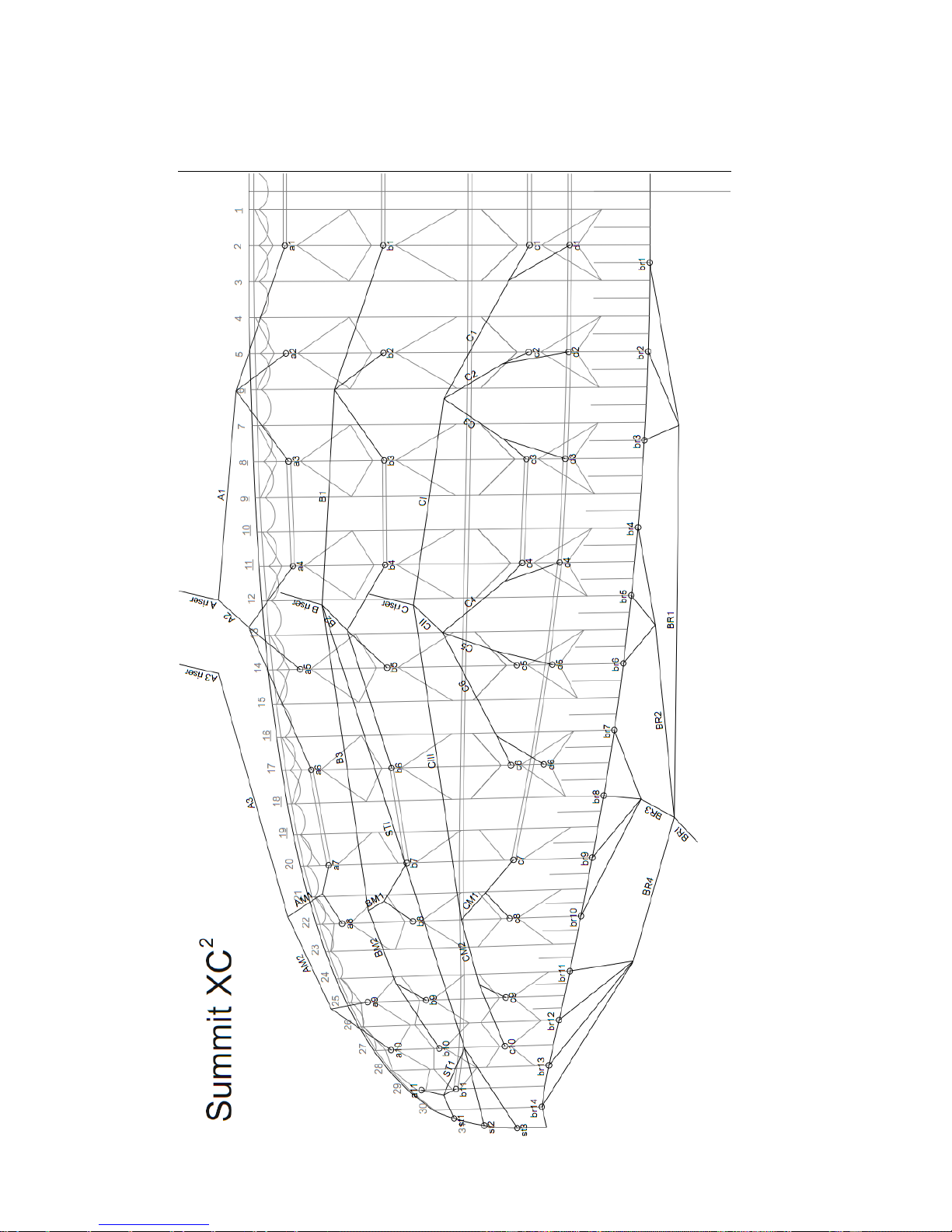
Line plan
Page 46

Deutscher Hängegleiterverband e.V. im DAeC
DHV/OeAeC-Technikreferat
LBA-anerkannte Prüfstelle für Hängegleiter und Gleitsegel
Beauftragter der österreichischen Luftfahrtbehörde
Herstellerangaben zum Luftsportgeräte-Kennblatt
Gleitsegel
I. Musterprüfung
1. Gerätemuster: UP Summit XC² S
2. Hersteller: UP International GmbH
II. Merkmale und Betriebsgrenzen
1. Gerätemasse(kg): 5,7
2. Zulässiges Startmasse minimal (kg): 60 maximal (kg): 80
3. Anzahl der Sitze: 1
4. Klasse: C
5. Gurtzeugbeschränkung: GH
6. Fußbeschleuniger: ja
7. Trimmer: nein
8. Projizierte Fläche (m²): 19,3
9. Windenschlepp: ja
10. Tragegurtlängen (mm):
Tragegurt A: Tragegurt B/A3: Tragegurt C:
normal:480 normal: 480 normal: 480
beschleunigt: 340 beschleunigt: 365 beschleunigt: 480
Page 47
11. Leinenlängen (mm), von der Kappenmitte beginnend:
Rib# A B C D
Bremse
Rib# 2 7025
6950
7020
7090
7990
2-3 5 6935
6850
6930
7005
7755
5 8 6990
6910
6980
7050
7650
7-8
11
6950
6870
6940
7010
7490
10
14
6860
6790
6860
6930
7365
12
17
6880
6820
6880
6935
7330
14
20
6745
6700
6785
7295
16
22
6640
6605
6680
7180
18
25
6505
6485
6550
7145
20
27
6485
6460
6515
7185
22
29
6275
6260
7045
24
31
6195
6970
26
31
6200
6940
28
31
6265
6950
30
12. Sonstige Besonderheiten:
III. Betriebsanweisung in der Fassung vom: 01.01.2008
Bearbeitungsvermerk DHV:
Kennblatt geprüft
am:
von:
Ort, Datum, Stempel und Unterschrift des Herstellers:
Garmisch-Partenkirchen, 29.06.2011
Page 48

Deutscher Hängegleiterverband e.V. im DAeC
DHV/OeAeC-Technikreferat
LBA-anerkannte Prüfstelle für Hängegleiter und Gleitsegel
Beauftragter der österreichischen Luftfahrtbehörde
Herstellerangaben zum Luftsportgeräte-Kennblatt
Gleitsegel
I. Musterprüfung
1. Gerätemuster: UP Summit XC² SM
2. Hersteller: UP International GmbH
II. Merkmale und Betriebsgrenzen
1. Gerätemasse(kg): 6,0
2. Zulässiges Startmasse minimal (kg): 72 maximal (kg): 94
3. Anzahl der Sitze: 1
4. Klasse: C
5. Gurtzeugbeschränkung: GH
6. Fußbeschleuniger: ja
7. Trimmer: nein
8. Projizierte Fläche (m²): 20,8
9. Windenschlepp: ja
10. Tragegurtlängen (mm):
Tragegurt A: Tragegurt B/A3: Tragegurt C:
normal: 480 normal: 480 normal: 480
beschleunigt: 340 beschleunigt: 365 beschleunigt: 480
Page 49
11. Leinenlängen (mm), von der Kappenmitte beginnend:
Rib# A B C D
Bremse
Rib# 2 7305
7235
7315
7390
8315
2-3
5
7220
7140
7225
7300
8080
5 8 7270
7195
7275
7345
7960
7-8
11
7235
7160
7245
7315
7795
10
14
7145
7075
7160
7225
7665
12
17
7165
7105
7185
7240
7630
14
20
7035
6990
7080
7600
16
22
6920
6885
6970
7475
18
25
6785
6765
6845
7440
20
27
6760
6740
6805
7480
22
29
6545
6535
7335
24
31
6470
7260
26
31
6475
7235
28
31
6540
7240
30
12. Sonstige Besonderheiten:
III. Betriebsanweisung in der Fassung vom: 01.01.2008
Bearbeitungsvermerk DHV:
Kennblatt geprüft
am:
von:
Ort, Datum, Stempel und Unterschrift des Herstellers:
Garmisch-Partenkirchen, 29.06.2011
Page 50

Deutscher Hängegleiterverband e.V. im DAeC
DHV/OeAeC-Technikreferat
LBA-anerkannte Prüfstelle für Hängegleiter und Gleitsegel
Beauftragter der österreichischen Luftfahrtbehörde
Herstellerangaben zum Luftsportgeräte-Kennblatt
Gleitsegel
I. Musterprüfung
1. Gerätemuster: UP Summit XC² M
2. Hersteller: UP International GmbH
II. Merkmale und Betriebsgrenzen
1. Gerätemasse(kg): 6,4
2. Zulässiges Startmasse minimal (kg): 85 maximal (kg): 110
3. Anzahl der Sitze: 1
4. Klasse: C
5. Gurtzeugbeschränkung: GH
6. Fußbeschleuniger: ja
7. Trimmer: nein
8. Projizierte Fläche (m²): 22,6
9. Windenschlepp: ja
10. Tragegurtlängen (mm):
Tragegurt A: Tragegurt B/A3: Tragegurt C:
normal: 530 normal: 530 normal: 530
beschleunigt: 365 beschleunigt: 395 beschleunigt: 530
Page 51
11. Leinenlängen (mm), von der Kappenmitte beginnend:
Rib# A B C D
Bremse
Rib# 2 7600
7515
7595
7670
8655
2-3
5
7500
7420
7500
7570
8400
5 8 7560
7480
7550
7620
8295
7-8
11
7520
7440
7520
7590
8125
10
14
7430
7355
7435
7500
7990
12
17
7445
7390
7460
7515
7960
14
20
7305
7255
7335
7915
16
22
7190
7150
7230
7795
18
25
7045
7020
7095
7755
20
27
7020
6995
7055
7790
22
29
6790
6775
7655
24
31
6710
7565
26
31
6710
7540
28
31
6780
7545
30
12. Sonstige Besonderheiten:
III. Betriebsanweisung in der Fassung vom: 01.01.2008
Bearbeitungsvermerk DHV:
Kennblatt geprüft
am:
von:
Ort, Datum, Stempel und Unterschrift des Herstellers:
Garmisch-Partenkirchen, 29.06.2011
Page 52

Deutscher Hängegleiterverband e.V. im DAeC
DHV/OeAeC-Technikreferat
LBA-anerkannte Prüfstelle für Hängegleiter und Gleitsegel
Beauftragter der österreichischen Luftfahrtbehörde
Herstellerangaben zum Luftsportgeräte-Kennblatt
Gleitsegel
I. Musterprüfung
1. Gerätemuster: UP Summit XC² L
2. Hersteller: UP International GmbH
II. Merkmale und Betriebsgrenzen
1. Gerätemasse(kg): 6,8
2. Zulässiges Startmasse minimal (kg): 100 maximal (kg): 130
3. Anzahl der Sitze: 1
4. Klasse: C
5. Gurtzeugbeschränkung: GH
6. Fußbeschleuniger: ja
7. Trimmer: nein
8. Projizierte Fläche (m²): 22,6
9. Windenschlepp: ja
10. Tragegurtlängen (mm):
Tragegurt A: Tragegurt B/A3: Tragegurt C:
normal: 530 normal: 530 normal: 530
beschleunigt: 365 beschleunigt: 395 beschleunigt: 530
Page 53
11. Leinenlängen (mm), von der Kappenmitte beginnend:
Rib# A B C D
Bremse
Rib# 2 7995
7900
7995
8080
9065
2-3
5
7895
7800
7895
7980
8805
5 8 7955
7860
7955
8030
8685
7-8
11
7915
7825
7920
7995
8520
10
14
7820
7735
7830
7900
8380
12
17
7840
7770
7865
7920
8350
14
20
7705
7655
7750
8305
16
22
7585
7550
7640
8180
18
25
7435
7410
7495
8135
20
27
7400
7380
7455
8180
22
29
7180
7165
8030
24
31
7090
7945
26
31
7080
7910
28
31
7140
7920
30
12. Sonstige Besonderheiten:
III. Betriebsanweisung in der Fassung vom: 01.01.2008
Bearbeitungsvermerk DHV:
Kennblatt geprüft
am:
von:
Ort, Datum, Stempel und Unterschrift des Herstellers:
Garmisch-Partenkirchen, 29.06.2011
Page 54

Service booklet
Page 55
Glider- and pilot data
Model: Summit XC²
Size: S SM M L
Serial number: ___________________________________________
Colour: _________________________________________________
Date of purchase: _________________________________________
First flight date: __________________________________________
Pilot (1. owner)
Name: _________________________________________________
Family name: ____________________________________________
Street: _________________________________________________
Town: __________________________________________________
Postal code: _____________________________________________
Country: ________________________________________________
Telephone: ______________________________________________
Fax: ___________________________________________________
Email: __________________________________________________
Dealer stamp and signature
Page 56

Pilot (2. owner)
Name: _________________________________________________
Family name: ____________________________________________
Street: _________________________________________________
Town: __________________________________________________
Postal code: _____________________________________________
Country: ________________________________________________
Telephone: ______________________________________________
Fax: ___________________________________________________
Email: __________________________________________________
Pilot (3. owner)
Name: _________________________________________________
Family name: ____________________________________________
Street: _________________________________________________
Town: __________________________________________________
Postal code: _____________________________________________
Country: ________________________________________________
Telephone: ______________________________________________
Fax: ___________________________________________________
Email: __________________________________________________
Please verify that your UP Service Centre has correctly filled in the form!
Page 57
1st Service
Performed date: _______________________________
Service jobs undertaken:
2nd Service
Performed date: _______________________________
Service jobs undertaken:
3rd Service
Performed date: _______________________________
Service jobs undertaken:
Please verify that your UP Service Centre has correctly filled in the form!
Assignment Nr.
Stamp
Assignment Nr.
Stamp
Assignment Nr.
Stamp
Page 58
4th Service
Performed date: _______________________________
Service jobs undertaken:
5th Service
Performed date: _______________________________
Service jobs undertaken:
6th Service
Performed date: _______________________________
Service jobs undertaken:
Assignment Nr.
Stamp
Assignment Nr.
Stamp
Assignment Nr.
Stamp
Page 59
Product registration card
Model: Summit XC²
Size: S SM M L
Serial number: ____________________________________
Date of purchase: _________________________________
First flight: _______________________________________
Preflown by: _____________________________________
Owner
Name: __________________________________________
Family name: ____________________________________
Address: ________________________________________
_______________________________________________
_______________________________________________
Telephone: ______________________________________
Fax: ________________________________ ____________
Email: __________________________________________
Cut out this card and mail it to UP within 14 days of purchase, or register
your new UP Summit XC² via www.up-paragliders.com>Service>UP>Product
Registration
Dealer stamp and signature
Page 60
UP International GmbH
Kreuzeckbahnstrasse 7
82467 Garmisch-Partenkirchen
GERMANY
 Loading...