

Page 1

DATASHEET
5 GHz PtMP LTU™ Client Radio
Proprietary Ubiqui® LTU Processor
13 dBi Integrated Antenna
10/20/30/40/50 MHz Channel Width Flexibility
Model: LTU-Lite
Page 2
Overview
Featuring an integrated antenna, the LTU Lite is a compact,
cost-eective subscriber station utilizing the 5GHz radio band.
It functions as a CPE (Customer Premises Equipment) in a
Point-to-MultiPoint (PtMP) environment with the LTU Rocket® as
the basestation.
Proprietary LTU Technology
Based on Ubiquiti’s LTU technology, the LTU Lite is not impeded
by the limitations of standard 802.11 Wi-Fi technology. Its custom
LTU silicon and radio architecture provide up to 600+Mbps of real
TCP/IP throughput and modulation rates of up to 4096QAM.
CPE Modes
The LTU Lite supports both bridged and built-in hardware NAT
router modes to suit your specic deployment.
Frequency Split
DATASHEET
The LTU Lite can use dierent frequencies for TX and RX to avoid
interference.
1+ Gbps with future rmware upgrade.
Available with future rmware upgrade.
Deployment Example
M/N: LTU-LITE
24V 0.5A GigE PoE
FCC ID: SWX-LTUL
IC: 6545A-LTUL
M/N: LTU-LITE
24V 0.5A GigE PoE
FCC ID: SWX-LTUL
IC: 6545A-LTUL
Convenient Mount Options
The LTU Lite is designed for quick yet reliable mounting on a pole
or on a wall. All necessary mounting hardware is included.
M/N: LTU-LITE
24V 0.5A GigE PoE
FCC ID: SWX-LTUL
M/N: LTU-LITE
24V 0.5A GigE PoE
FCC ID: SWX-LTUL
IC: 6545A-LTUL
IC: 6545A-LTUL
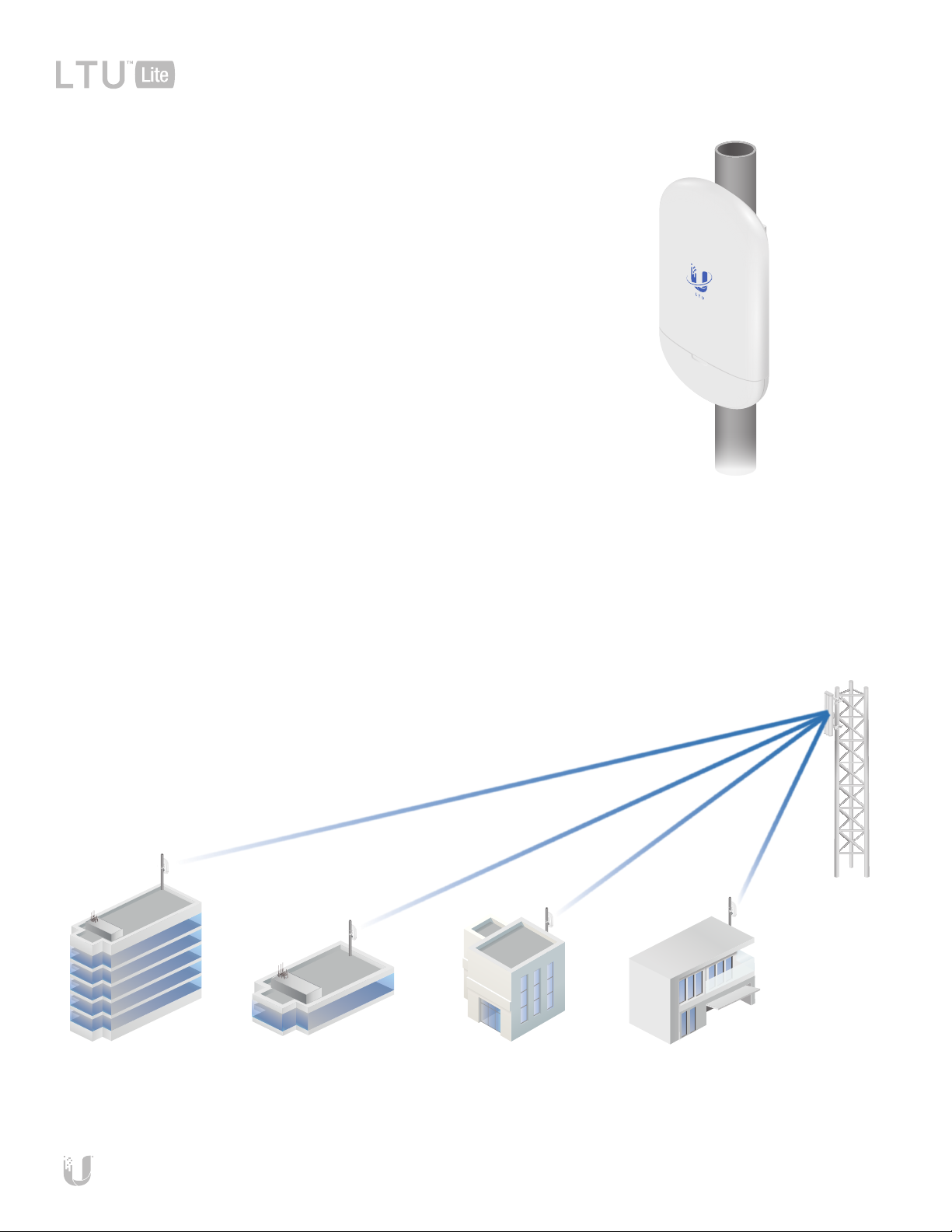
In a PtMP link, the LTU Lite functions as CPEs to the LTU Rocket, which is paired with an airMAX® sector antenna.
2
Page 3
Channel Width Flexibility
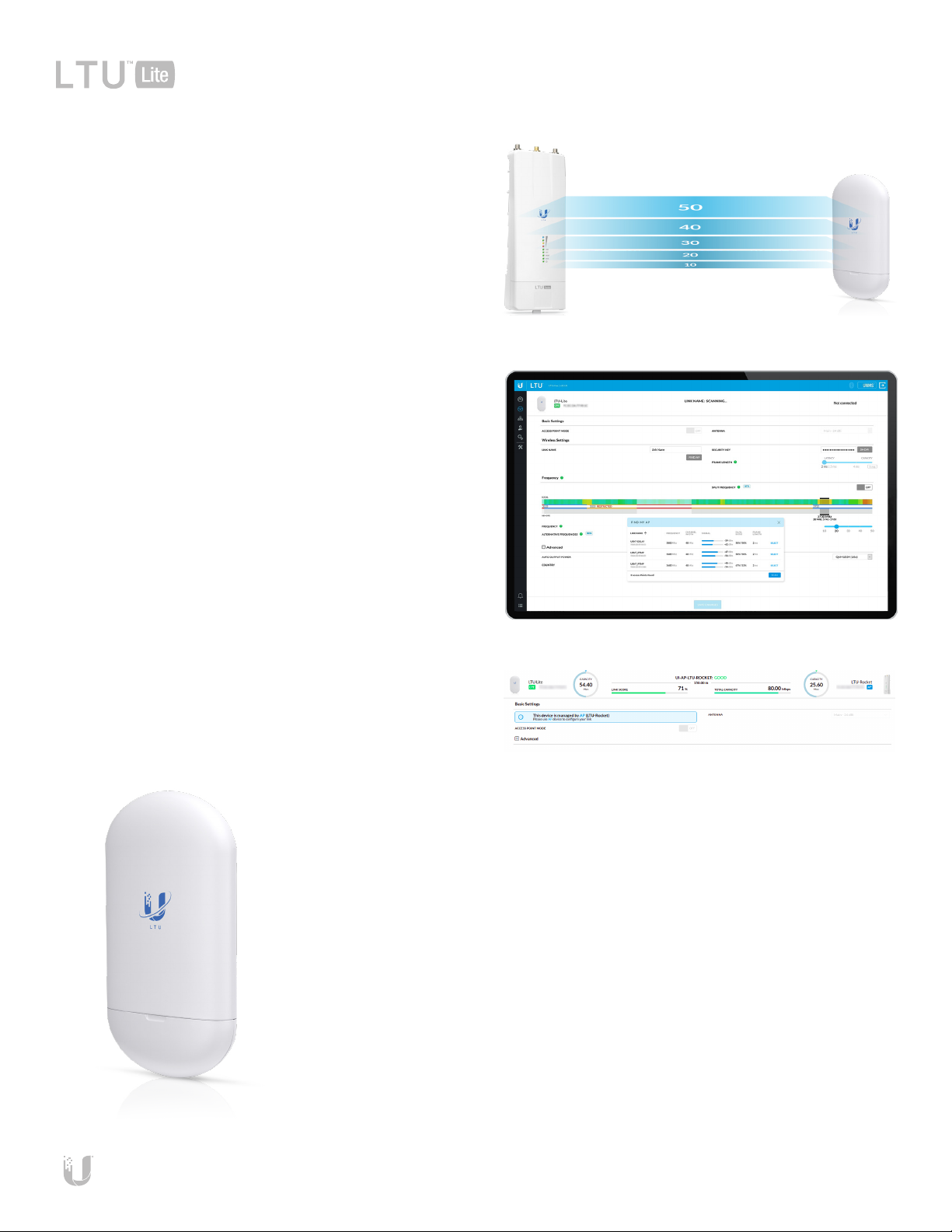
Channel width exibility allows independent TX and RX channel
frequency congurations anywhere within the radio band to avoid
local interference. Channel width options include:
• 10 MHz
• 20 MHz
• 30 Mhz
• 40 MHz
• 50 MHz
• Up to 100 MHz*
Auto Power Adjustments
By default, the Auto Output Power option allows the LTU Lite to set
the output power (EIRP) to the appropriate level.
Signal Control
The LTU Lite's TX output power is controlled by the AP's target
TX output power. A PtMP network can manage signal levels
to enhance network stability and achieve optimal wireless
performance with the highest possible modulation.
DATASHEET
Convenient Conguration
To manage the LTU Lite, you have two options: the LTU
Conguration Interface and Ubiquiti Network Management System
(UNMS™). Either option lets you manually congure the LTU Lite.
Within the LTU Conguration Interface, you can manually congure
the LTU Lite or manage it from the AP side using the Find My AP
feature. The LTU Lite will automatically scan for APs using the same
channel bandwidth. Select the appropriate AP and then use it to
congure the LTU Lite.
* Available with future rmware upgrade.
3
Page 4
LTU Conguration Interface
DATASHEET
PtMP Dashboard
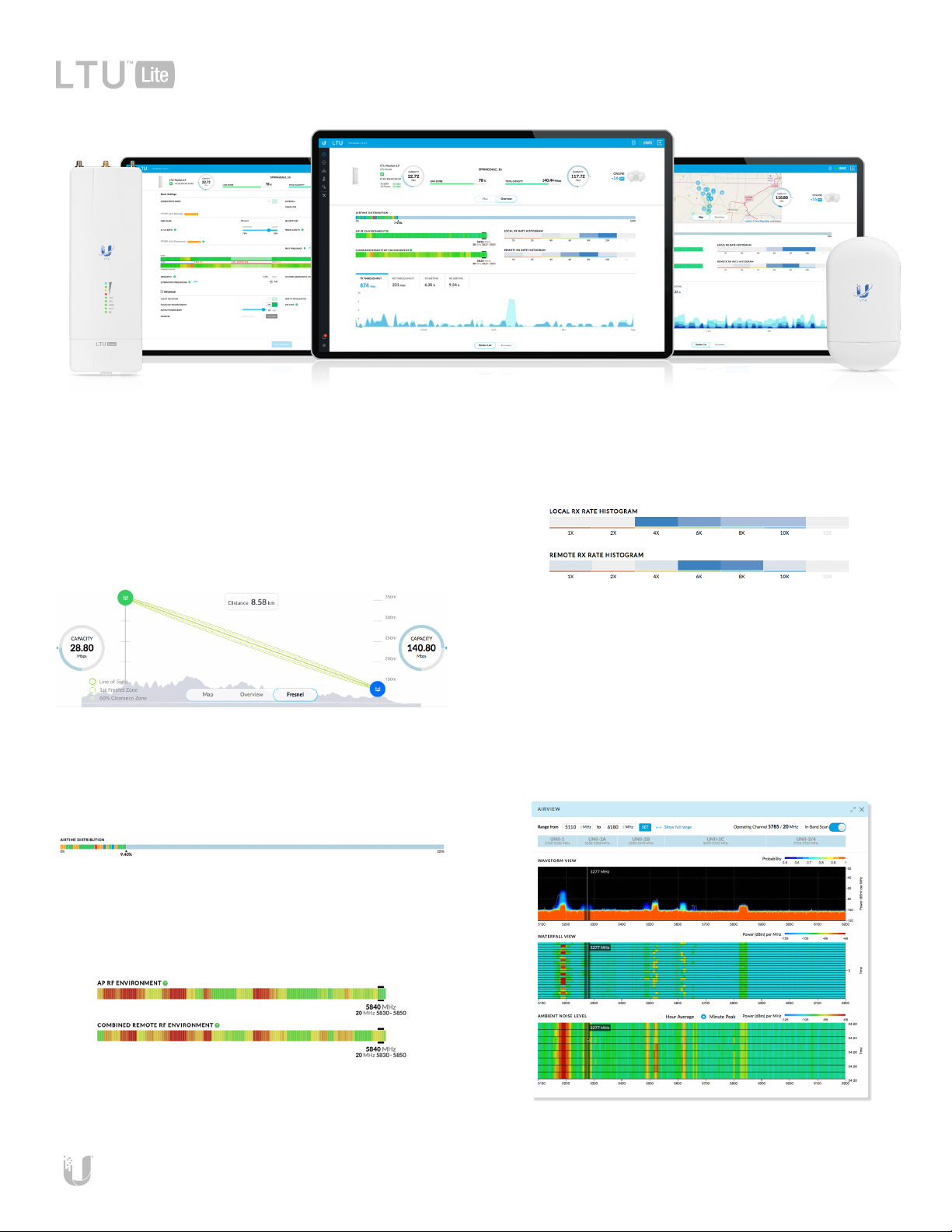
The Dashboard oers map and Fresnel views* so you can visualize
the network. The map view shows your PtMP links overlaid on a
geographic map, while the Fresnel view shows the link calculated
for your selected CPE, including line of sight, rst Fresnel zone, and
60% clearance zone.
New graphs provide instant status updates and help you to detect
connectivity issues and their eects on PtMP performance:
• The airtime distribution bar graph displays in real time how
much airtime each CPE is using. Click any point to view the
airtime and link score for a specic CPE.
• The AP RF environment bar graph shows ambient RF noise levels
across the frequency spectrum.
• The combined remote RF environment bar graph also shows
ambient RF noise levels but for the combined environment of all
of the remote CPEs.
• The local and remote RX rate histograms show the receive
modulation rates of the various CPEs.
Real-Time Spectral Analysis
airView® spectral analysis runs on a dedicated and independent
receiver, which has excellent EVM (Error Vector Magnitude)
performance.
The receiver can also perform other tasks, such as a search for
channel occupancy, DFS detection, and automatic channel/
frequency assignment. Calibration (signal level measurement
accuracy) and resolution bandwidth options are enhanced.
Spectral zoom (user-dened scan limits) is also available.
* Available for models equipped with GPS.
4
Page 5
LTU-Lite
Dimensions 153 x 84 x 39.5 mm
(6.02 x 3.31 x 1.56")
Weight 250 g (8.82 oz)
Networking Interface (1) 10/100/1000 Ethernet Port
Enclosure Outdoor UV Stabilized Plastic
SPECIFICATIONS
Max. Power Consumption
Power Supply 24V, 0.5A Gigabit PoE Adapter (Included)
Power Method 24V Passive PoE (Pairs 4, 5+; 7, 8-)
Voltage Range 22 - 26V
Max. Conducted TX
Power
Gain 13 dBi
Cross-pol Isolation 20 dB Minimum
Max. VSWR 1.8:1
Beamwidth 45° (H-pol) / 45° (V-pol) / 45° (Elevation)
Polarization Dual Linear
Mounting
Wind Loading 20 N @ 200 km/h (4.5 lbf @ 125 mph)
Wind Survivability 200 km/h (125 mph)
ESD/EMP Protection ± 24kV Contact/Air
Operating Temperature -40 to 55° C (-40 to 131° F)
Operating Humidity 5 to 95% Noncondensing
22 dBm per Chain
Wall Mount (Kit Included)
8.5W
Pole-Mount
Certications CE, FCC, IC
Operating Frequency (MHz)
Worldwide 4800 - 6200*
US/CA
U-NII-1
U-NII-2A
U-NII-2C
U-NII-3
* Depends on regulatory region.
Bluetooth LE Management Radio (MHz)
Worldwide 2400 - 2483.5
5150 - 5250
5250 - 5350
5470 - 5725
5725 - 5850
5
Page 6
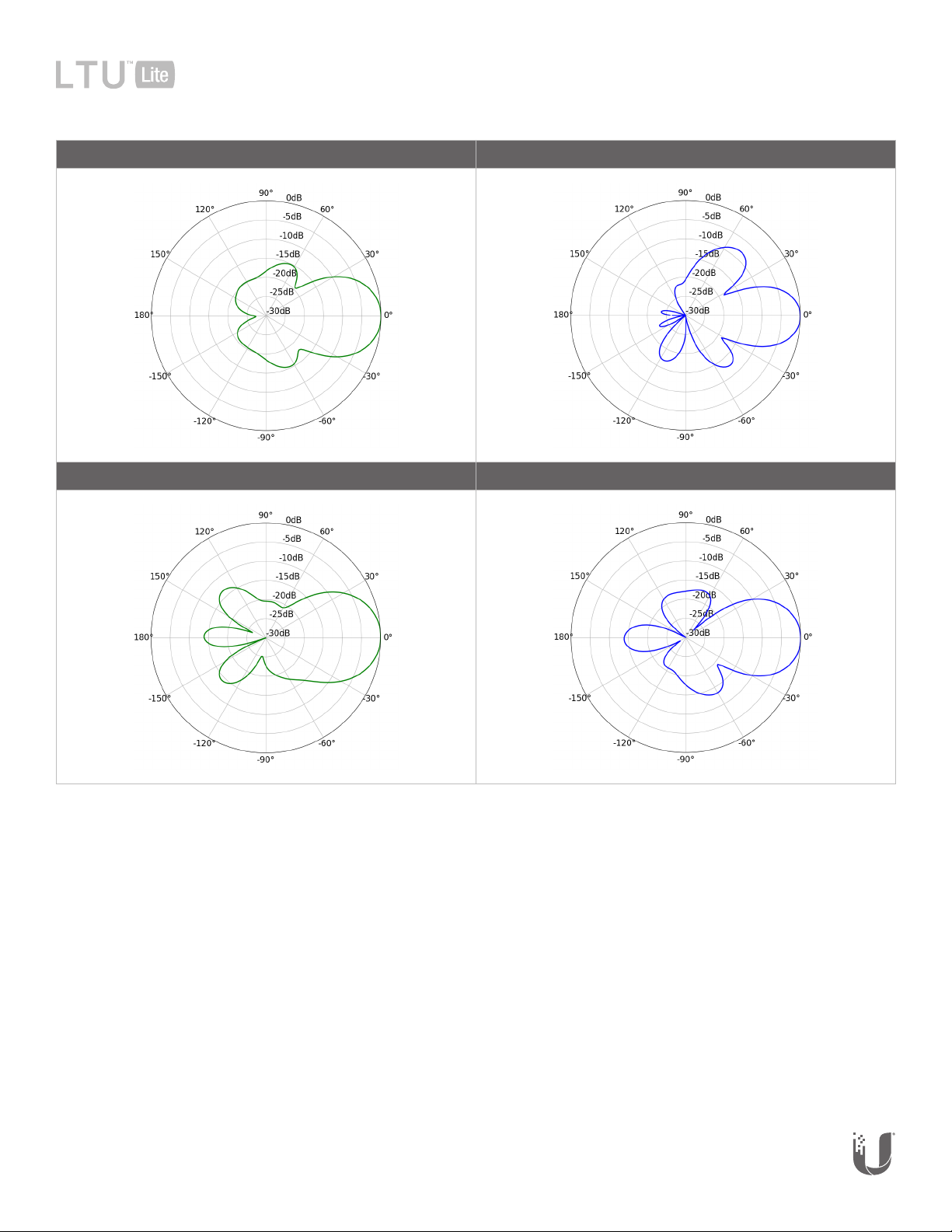
SPECIFICATIONS
Vertical Azimuth Vertical Elevation
Horizontal Azimuth Horizontal Elevation
Specications are subject to change. Ubiquiti products are sold with a limited warranty described at: ui.com/support/warranty
The limited warranty requires the use of arbitration to resolve disputes on an individual basis, and, where applicable, specify arbitration instead of jury trials or class actions.
©2019-2020 Ubiquiti Inc. All rights reserved. Ubiquiti, UbiquitiNetworks, the Ubiquiti U logo, the Ubiquiti beam logo, airMAX, airOS, airView, LTU, Rocket, and UNMS are trademarks or registered trademarks of Ubiquiti Inc. in the
United States and in other countries. Apple and the Apple logo are trademarks of Apple Inc., registered in the U.S. and other countries. App Store is a service mark of Apple Inc., registered in the U.S. and other countries. Android,
Google, Google Play, the Google Play logo and other marks are trademarks of Google LLC. All other trademarks are the property of their respective owners.
JLAI020320
 Loading...