

Page 1
®
rev. 12.12.15
USER’S GUIDE 5.3
AntakaMatics, Inc.
Pittsburgh, PA
Standard Version
electric harmonica
Harmonicas of the Future™
www.turboharp.com
Page 2
pg. 2
Congratulations and THANKS for your
purchase of the TurboHarp/ELX, the
world’s first and only truly electronic
harmonica. It is the result of over 25
years of blood, sweat and tears. I hope
you enjoy it. Please tell your friends!.
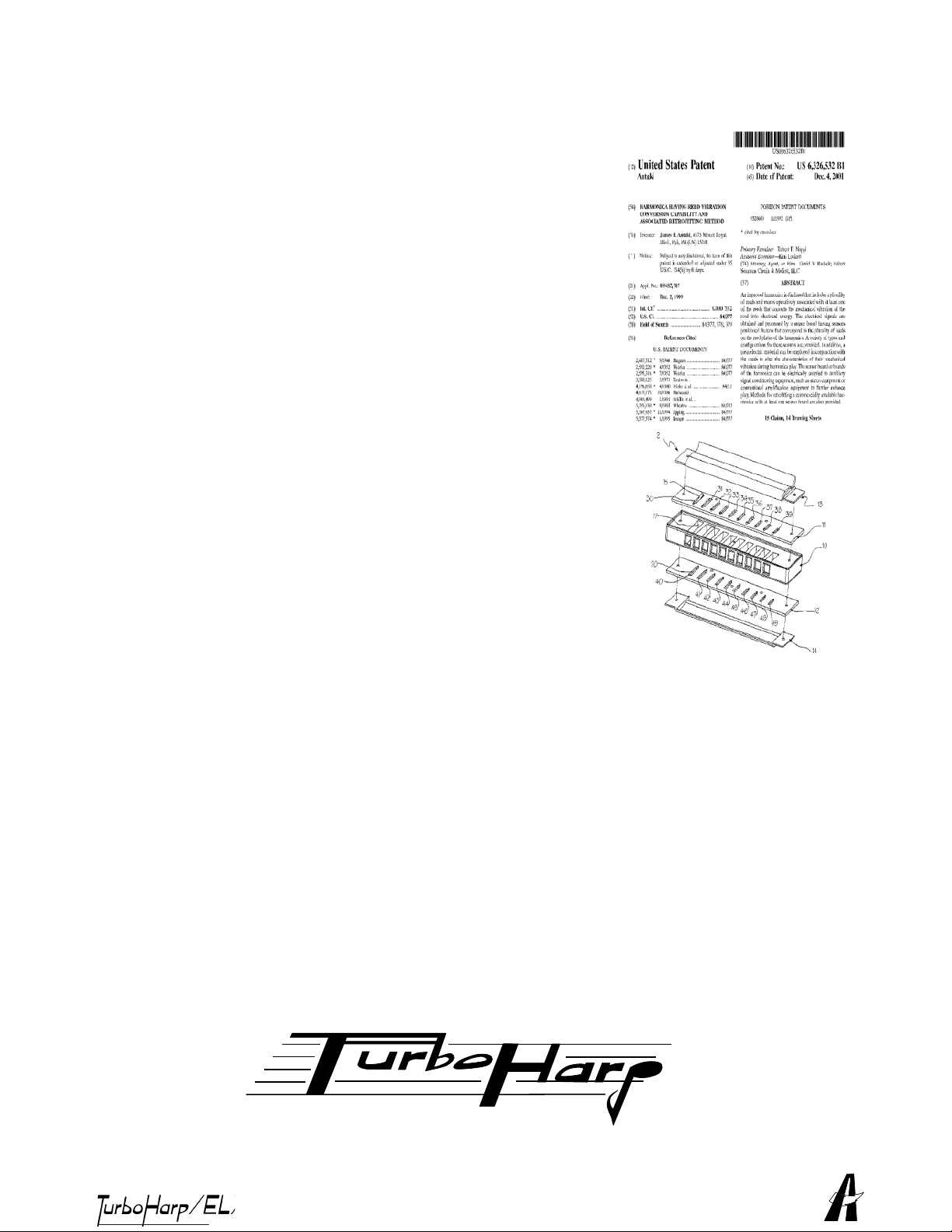
US Patent 6,326,532
Prof. Turbodog
dra
w
blow
DRAW
REED
BLOW
REED
BLOW
REEDPLATE
SENSOR
DRAW
REEDPLATE
COMB
SENSOR
HARMONICA BODY
(STANDARD)
UPPER
SENSOR BOARD
(BLOW NOTES)
UPPER
HOUSING
LOWER
HOUSING
LOWER
SENSOR BOARD
(DRAW NOTES)
draw blow
SENSOR
UPPER
(BLOW)
SENSOR
BOARD
HARMONICA
BODY
SENSOR
LOWER
(DRAW)
SENSOR
BOARD
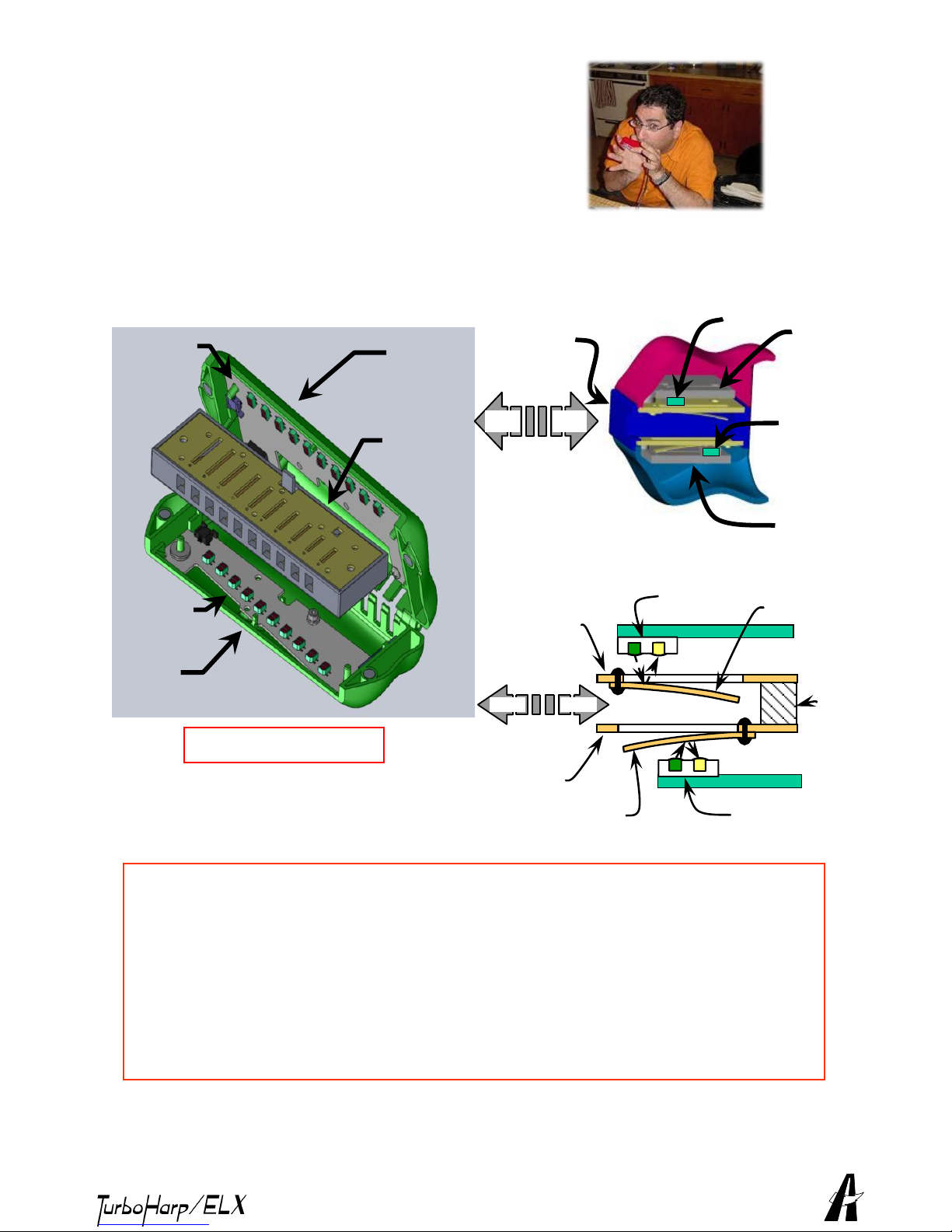
The operation of the TurboHarp/ELX is similar to an electric
guitar. It transforms the vibration of the reeds of the harmonica
to electrical signals that are transmitted to the amplifier, mixer,
or effects box. Unlike a guitar, however, which uses
electromagnetic pickups, the ELX relies on optical sensors
which detect motion by reflection off the reed surface. Each
reed has its own sensor, for a total of twenty.
Page 3

pg. 3
Disclaimers
1. Remember our famous no-questions-asked satisfaction
guarantee. If you are not completely satisfied, you are welcome
to return it within 30-days without any obligations.
2. The unadulterated output of the ELX is kind of boring... like an
electric guitar without an amplifier. We strongly urge you to use
some sort of electronics effects (stomp box, guitar pedal, etc.) to
get the most out of it.
3. When connected directly to an amplifier, there may be some
noticeable “idling noise” or hiss. This is an intrinsic, unavoidable
feature of the optical sensors. It is not detectable while playing,
and can be mitigated by any electronic noise gate, or multieffects box, or our own dynamic-noise-reduction belt pack.
4. The loudness (volume) of the reeds might not be perfectly
balanced from low to high end. This is partly a result of the key
of the harp body, and partly due to our own perception of
loudness, which varies with pitch. It is however easy to adjust
by incorporating a bit of equalization (EQ) in the chain.
5. These harmonicas may show minor flaws of hand assembly.
Because they are assembled by hand. But the good news is
that, like you, no two are exactly alike!
6. We greatly value your feedback and constructive criticism. In
particular we encourage your suggestions regarding the choice
of effects that might work best with the ELX.
7. We would be even more grateful if you could send us a
recording, or upload a video that we can post on our website.
8. If we introduce any improvements within 6 months of your
purchase of the harp, we will provide them to you free of
charge.
Sincere thanks for your interest and encouragement!
Although the ELX has gone through many MANY revisions and improvements
over the past 15 years, we admit that it is still not perfect. We ask that you please
keep the following points in mind:
Page 4
“before you begin”
(if that’s even possible)
make sure you have everything
DNR – dynamic noise reduction circuitry
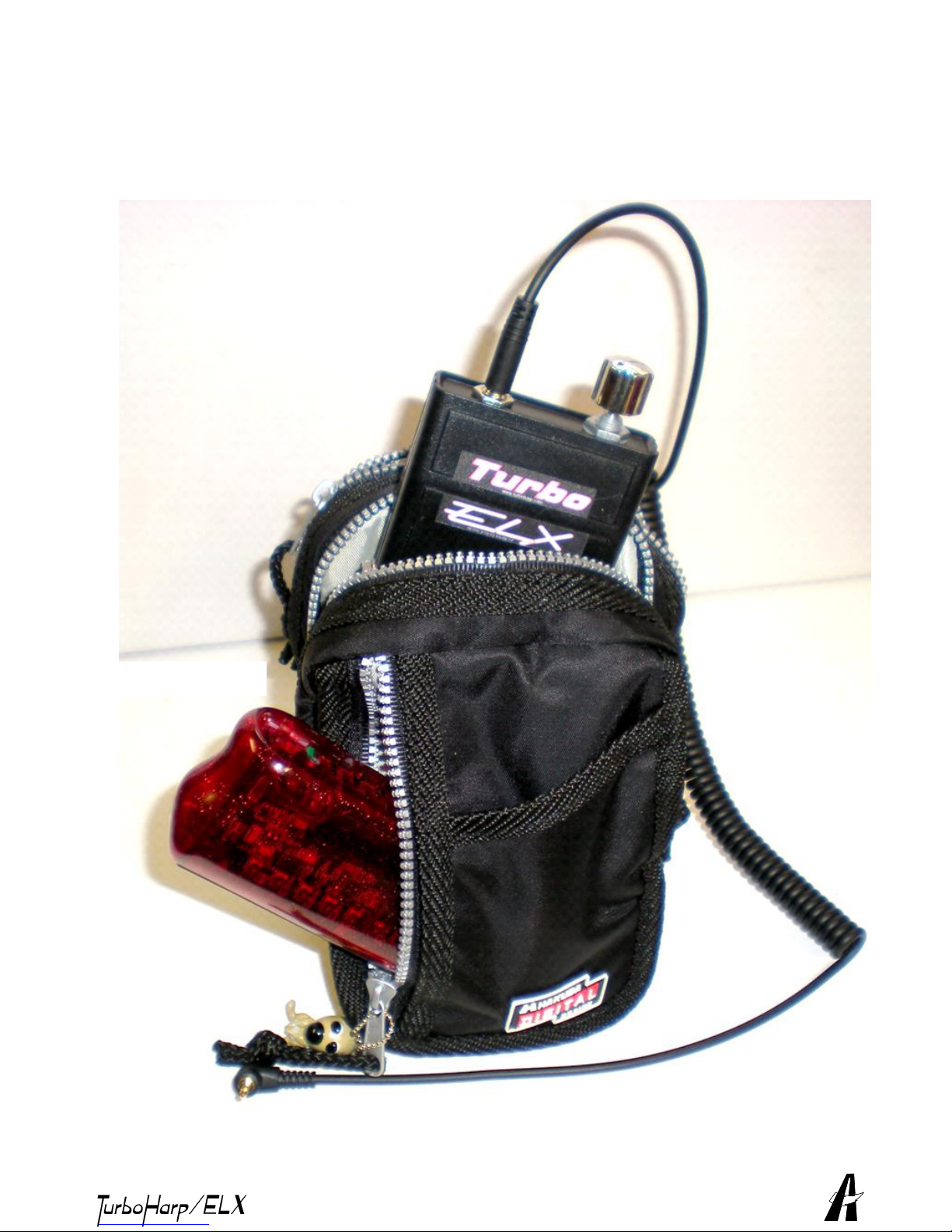
There are several configurations of the ELX. Yours should include some
combination of the following components:
BELT PACK
(9V BATT. INCL.)
24” CABLE
COMPACT
GIG CASE
ELX MODULE
Page 5
ELX Belt Pack
pg. 5
Dynamic Noise
Reduction
in: bright; out: Filtered
ELX INPUT
(1/8” (3.5mm )
on/off
volume
control
HEADPHONE JACK
(optional)
LINE OUT
(1/4” PHONE)
9-12V input
(center negative*)
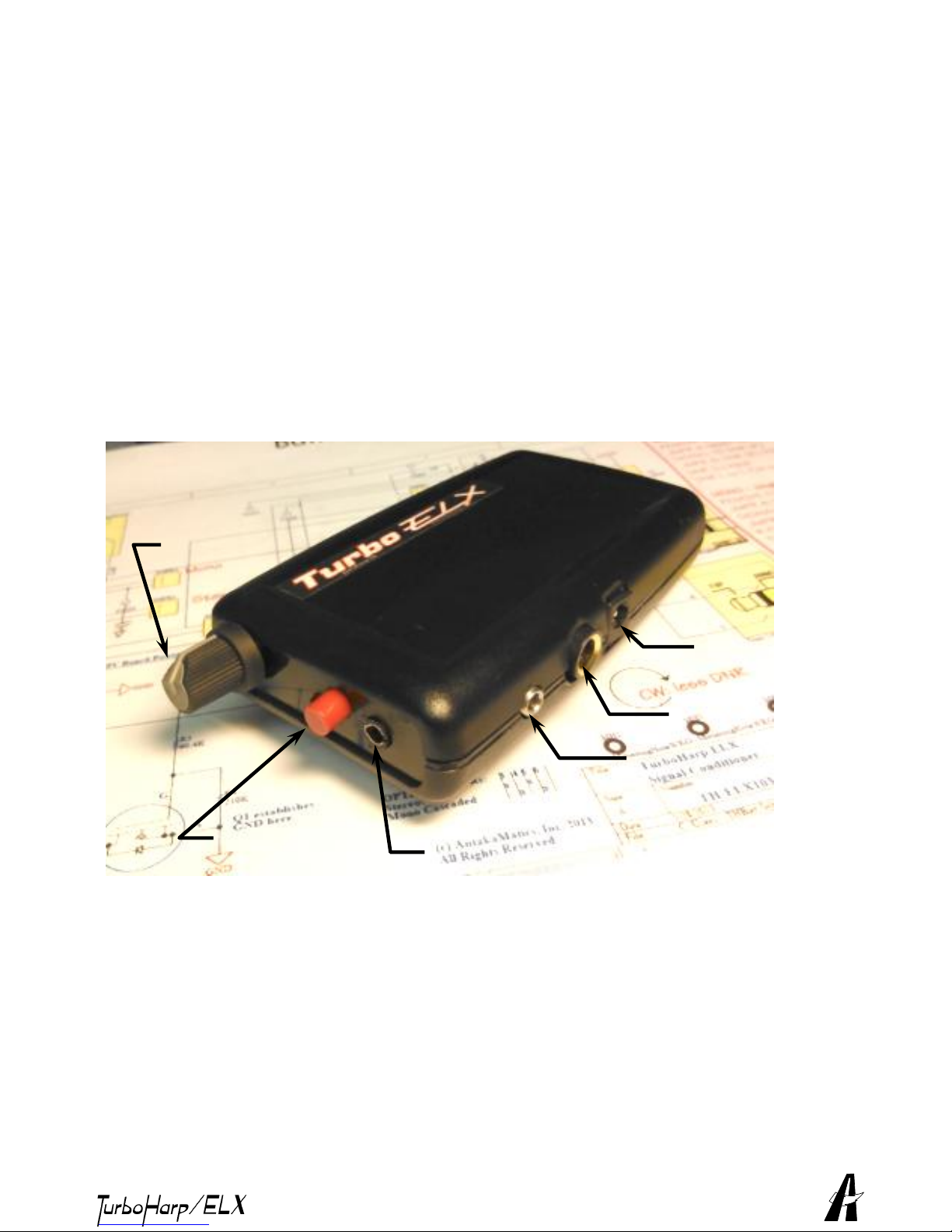
The belt pack provides power (including an AC adapter option), volume
control, and dynamic noise reduction.
It is included standard equipment with the economy version. So we
are offering it as an optional item. They are still made one at a time by
hand so there will be additional lead time if you place and order.
These are still made one at a time by hand so there may be additional
lead time if you place and order.
In the Super Awesome bundle, this is replaced by the Pandora
effects box, which already has noise reduction built-in.
However, it is available separately if you would like more battery
life, a volume control and extra noise reduction, or if you prefer to
play your ELX without the Pandora effects unit.
Page 6
pg. 6
Getting to Know your ELX
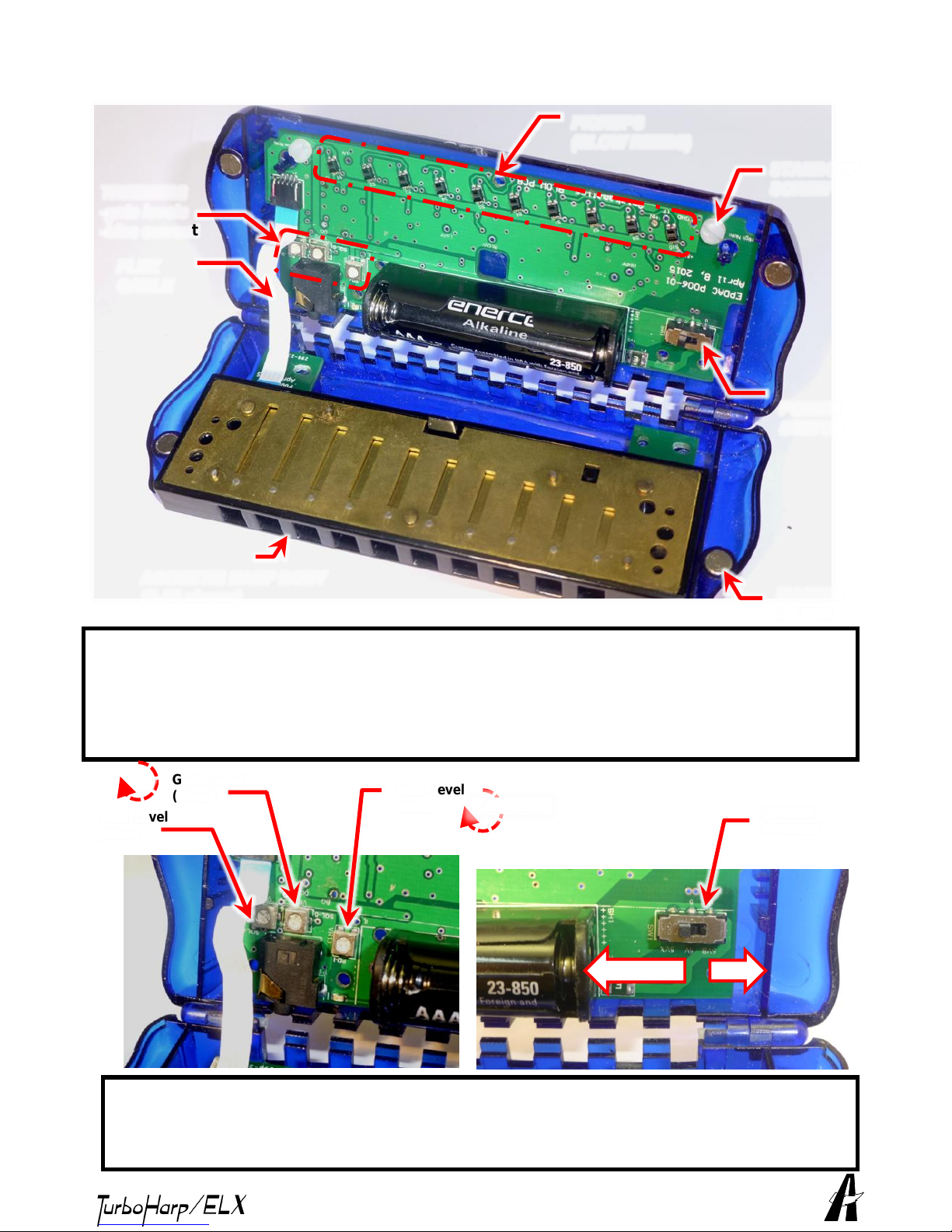
•Acoustic Harp Body – an ordinary Special-20 sized harp, with cover plates removed.
•Light Sensors – convert reed vibration to electrical signal, one per reed
•Magnetic Latch - holds the case closed, allows harp body to be changed quickly.
•Flex Cable – connects the draw board to the blow board.
•Standoff Screw – adjusts distance between sensor and reeds. Should not require adjustment.
•Trimmers – adjust the gain and gate cutoff, see below.
FLEX
CABLE
STANDOFF
SCREW
PICKUPS
(BLOW REEDS)
TRIMMERS
-gate levels
-bias current
ACOUSTIC HARP BODY
(S-20 shown)
MAGNET
LATCH
POWER
SWITCH
Take a moment to familiarize yourself with some of the main components of the ELX harp.
Gate Level
(Blow)
Bias Level
(Blow)
Gate Level
(Draw)
increase
off
POWER
SOURCE
BATT
phantom 9V
•Gate Level – adjustment for built-in noise gate. Rotate completely clockwise disables the gate.
•Bias Level – adjustment for gain of each sensor board. Draw sensor adjustment on other board.
•Power Source – switch left (towards battery) for remote phantom power; switch right for battery
power. (Note: there is no auto-shutoff, so don’t forget to turn it off when you’re done!)
Page 7
pg. 7
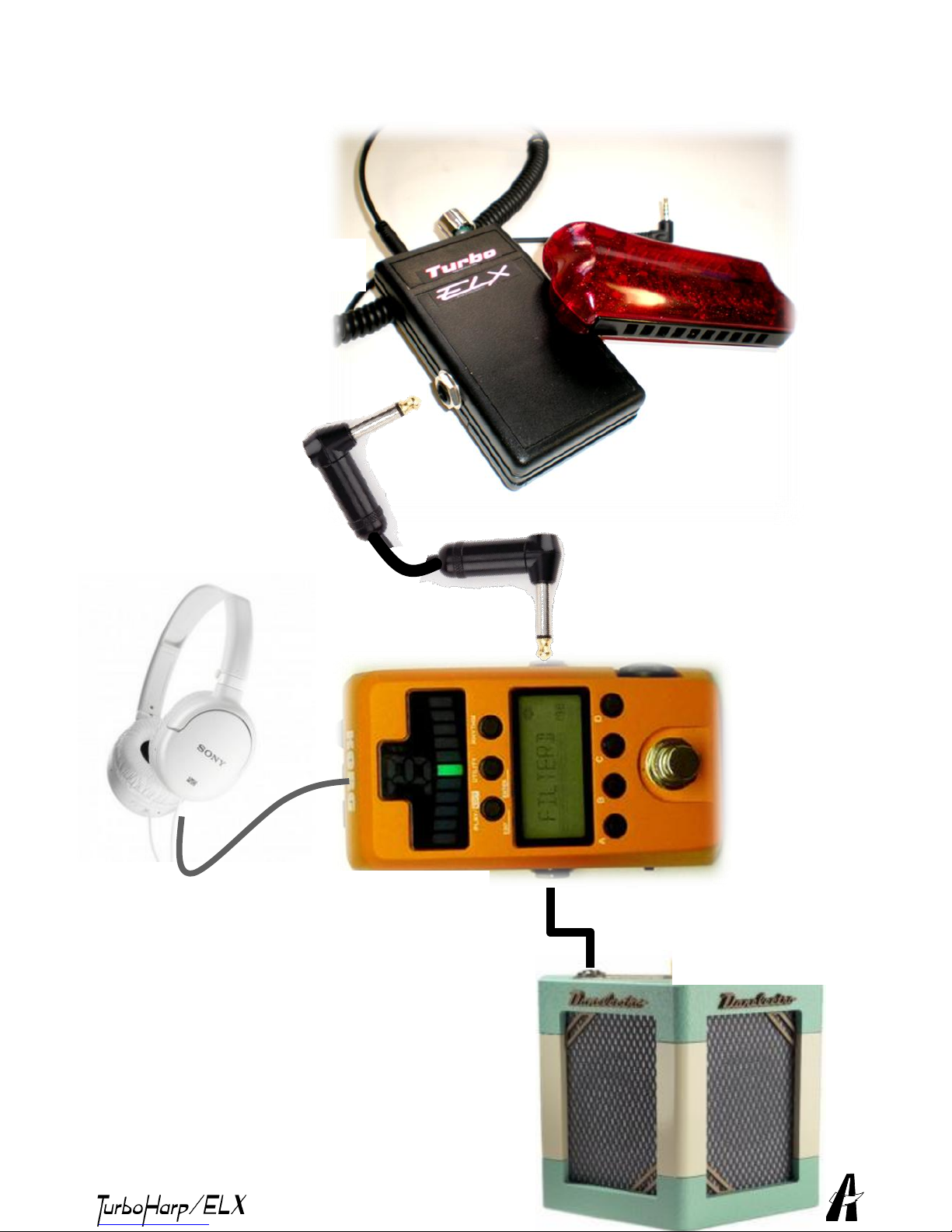
WIRING DIAGRAM
=Options=
*appearance may vary
if yours is a stereo system,
then you need to add a stereomono adapter on this cable
(should be included in your
package)
effects box
amplifier
(optional)
headphones
(optional)
¼” patch cord
(any length)
belt pack
for extended battery life and
dynamic noise reduction
Extremely highly recommended.
Our favorite is the Pandora Stomp Box –
which we ship pre-programmed with
some of the best effects we’ve found for
the ELX
Page 8
pg. 8
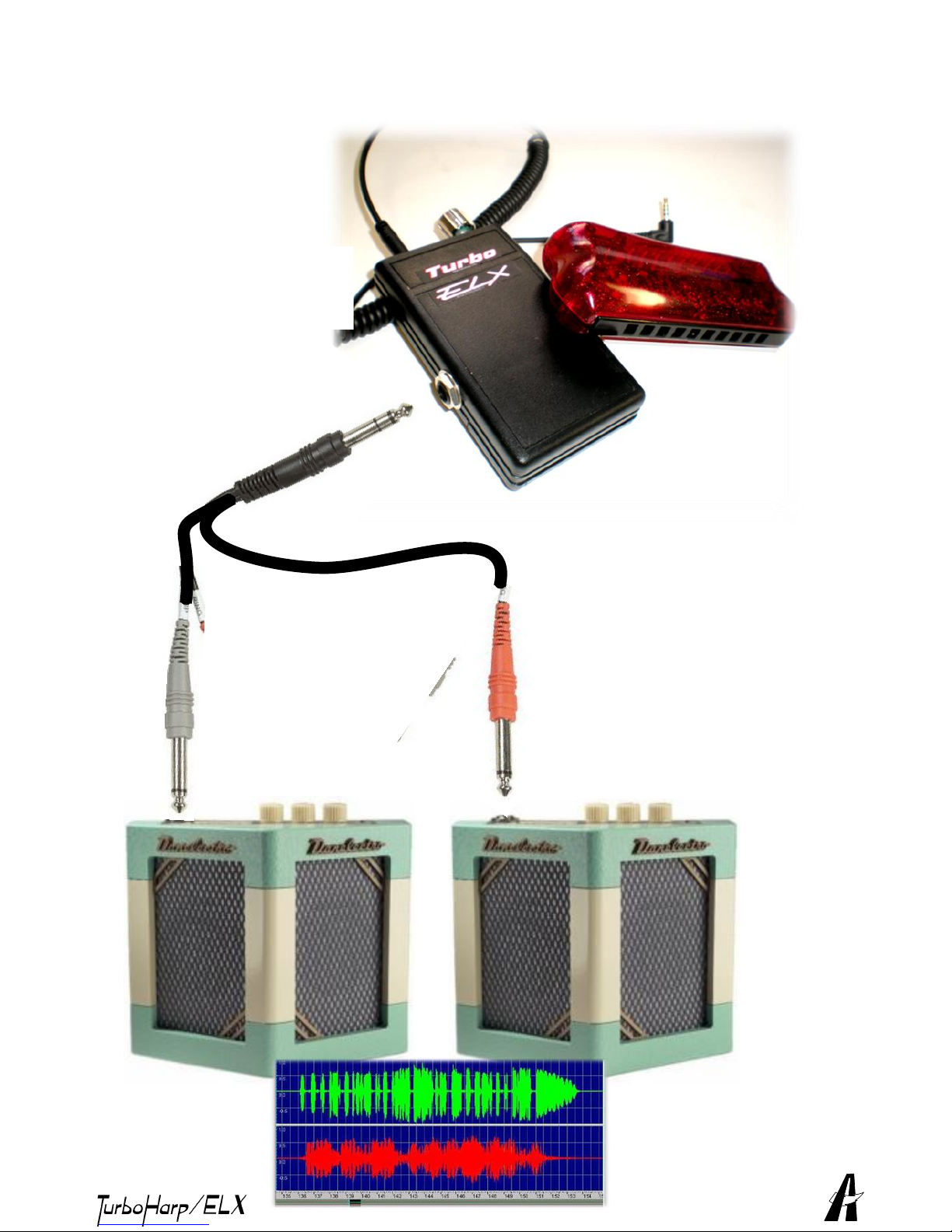
WIRING DIAGRAM
=Stereo=
*appearance may vary
draw notes
Stereo patch cord
(comes in different
varieties, see next page)
belt pack
(optional)
The Stereo option allows you
to split the blow and draw
notes into separate (right and
left) channels.
blow notes
Page 9
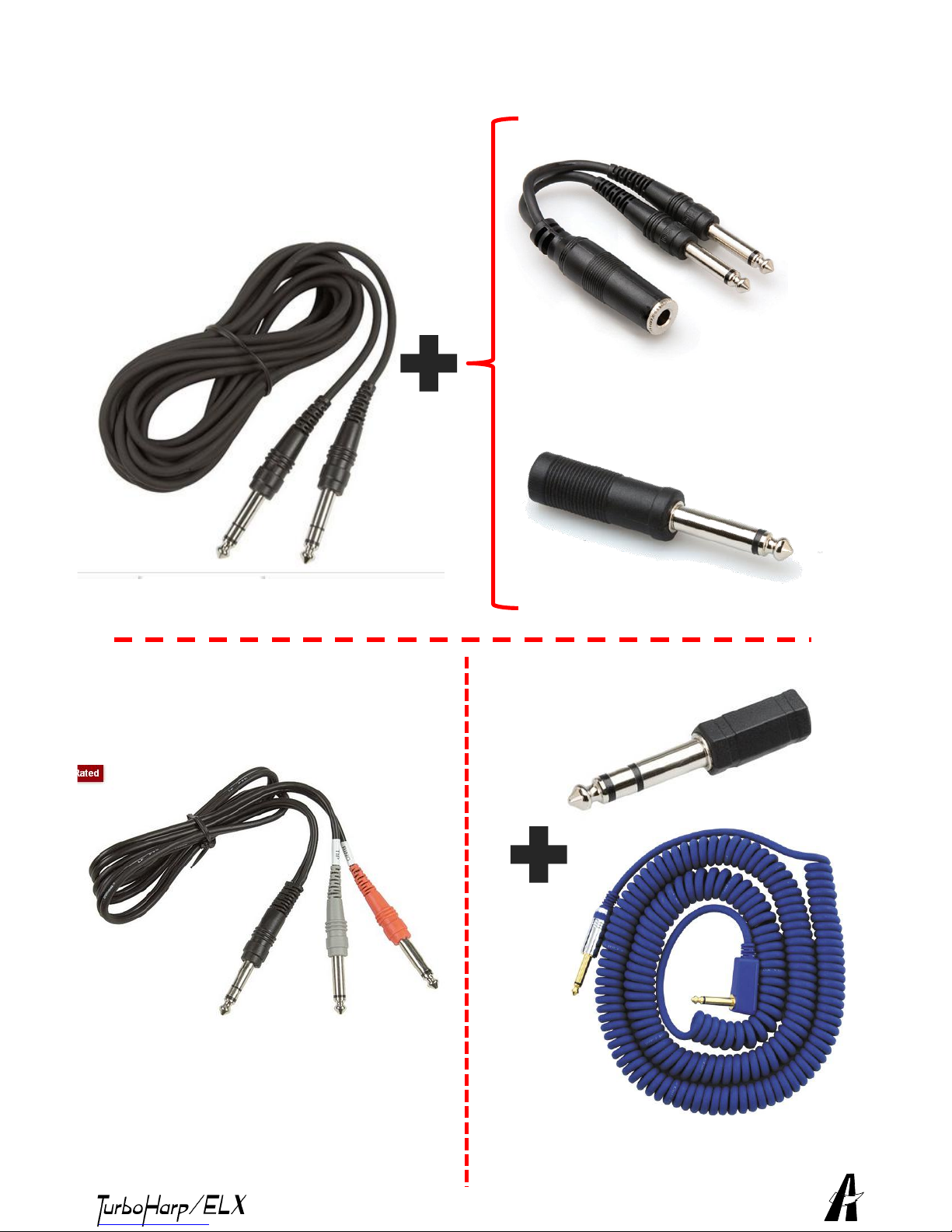
Stereo Patch Cables
(two options)
p/n: FS-MM2
1/4" Male (Stereo)
to 1/4"Male (Mono) x2, 6ft
1/4“F(stereo)
to 1/4“M(mono)X2
p/n: 4MS-4MM2x6
STEREO OUTPUT MONO OUTPUT
p/n: MS-FM
1/4“ F(stereo)
to 1/4” F(mono)
p/n: FS-MM2
p/n: FS-MM
1/4“F(stereo) to 1/4“M(mono)
1/4" Male (Stereo)
to 1/4"Male (Stereo), 6ft
1/4“F(stereo)
to 1/4“M(mono)X2
p/n: 4MS-4MSx6
STEREO OUTPUT
MONO OUTPUT
=OR =
Page 10
pg. 10
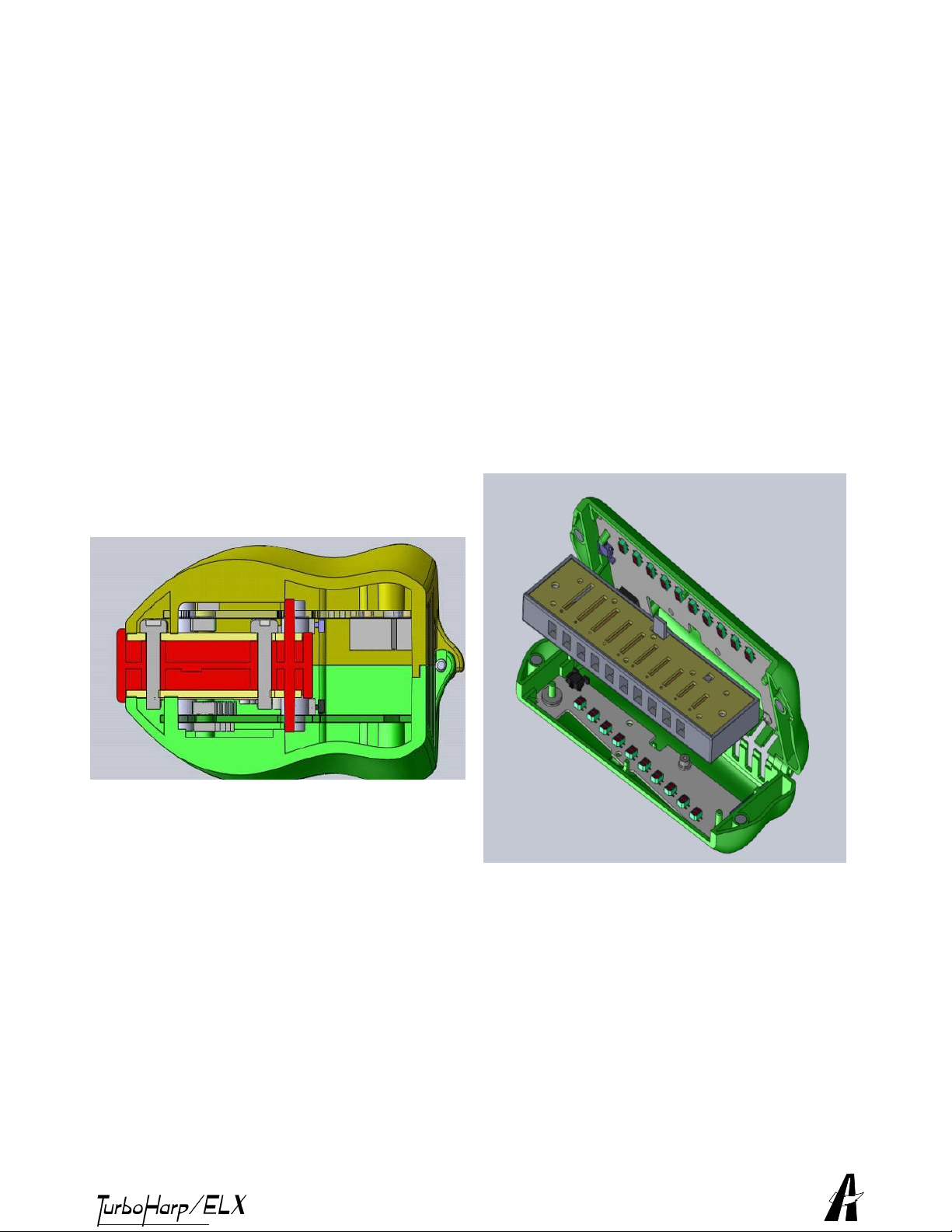
Replacing the Harmonica Body
Step 1: Place the assembly in your left hand (for right handed players). Holding
the lower lid between thumb and index finger, flip open the upper lid.
Step 2: Remove the harmonica body, noting the orientation: blow reeds on top.)
Step 3: Replace the harmonica body, close lid, and you’re good to go!
•The ELX is designed to accept any Special-20 harmonica body. It
can also be used with similarly sized harmonicas, including Marine
Band, etc, but may require extra shims to assure a proper fit.
•You can also purchase replacement harmonica bodies from
TurboHarp at a discount.
•Technical Note: the spacing between the sensor and the reeds is critical to the proper
operation of the ELX. This gap has been adjusted at the factory using a “standard” harp
body. If, after replacing harp bodies you detect a change in the loudness of any of the
reeds, it might indicate incorrect gapping. And if this happens, please contact us for
instructions.
Page 11

pg. 12
Troubleshooting Guide
No sound
Weak battery Not meant to insult your intelligence!
Sometimes a weak battery is just strong enough
to light the little red LED, but too weak to power
the sensors.
If not... then something
else is the culprit.
Check for something disconnected or switched
off between ELX and speaker: power strip, amp,
effects box, mixer. “Divide and conquer.”
Loudness
uneven
amongst
reeds
If all blow reeds or all
draw reeds affected.
This most commonly occurs with the Stereo
setup. If you forget the stereo-mono adapter,
you will only get one channel .
Otherwise… contact us for instructions.
If only one or two
reeds affected.
If too weak: Check for corrosion or tarnish on
respective reed. If too loud: adjust trim pot for
that particular read
Volume
seems to
drop out
when
bending low
notes
This is not supposed to
happen, but if it does,
its due to improper
offset.
First test by playing the harp with one of the lids
slightly pried open (about one fingernail
thickness.) If this solves the problem, then one
of the boards is too close to the reedplate and
the respective standoff screw needs loosened.
If it does not solve the problem – call TurboHarp
Hiss when
idling
There is normally a
small amount of
unavoidable hiss due
to the “idling” of the
optical pickups.
Make sure that dynamic noise reduction button
(DNR) is depressed.
And/or: introduce a noise gate or an effects unit
with built-in gate, such as the RP-55.
whoosh
when
playing
Typically on high blow
notes only. Usually
due to moisture on the
reed or sensor.
Open harp, and blow away moisture.
Hum/buzz 60 Hz noise could be
due to several factors:
both electrical AND
optical.
If there are fluorescent lights nearby, try
switching them off. If the ELX lid is open, it will
pick up 60Hz from any light source plugged in
the wall; but this will go away once you close the
lid. Else: look for bad connection, or cable.
Crackle, pop This is not a good
sign... please contact
us.
Contact TurboHarp for a replacement.
Page 12
pg. 13
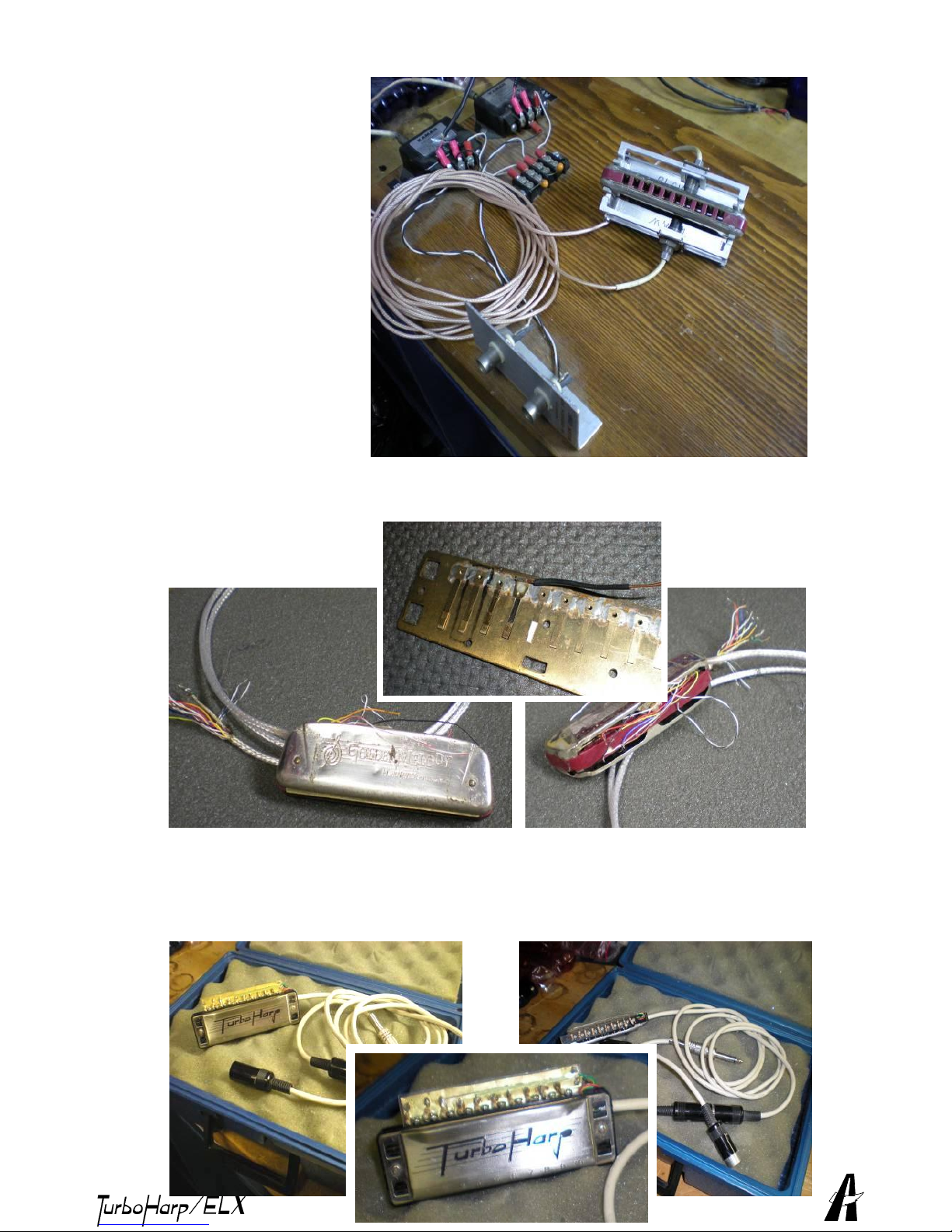
circa 1991 – original
“breadboard”
version – originally
intended for
experimentation on
physics of reed
dynamics. Two eddy
current proximity
sensors used.
circa 1996: Piezo version: flexible plastic sensors painstakingly
bonded to each reed. Wire attachment was a big problem.
circa 2001: Improved piezo version: wire attachment problem
“solved” kind-of. But still painstaking, and resulted in unacceptable
damping. Note brief venture into using Lee Oskar bodies.
Origins of the ELX
Page 13
pg. 14
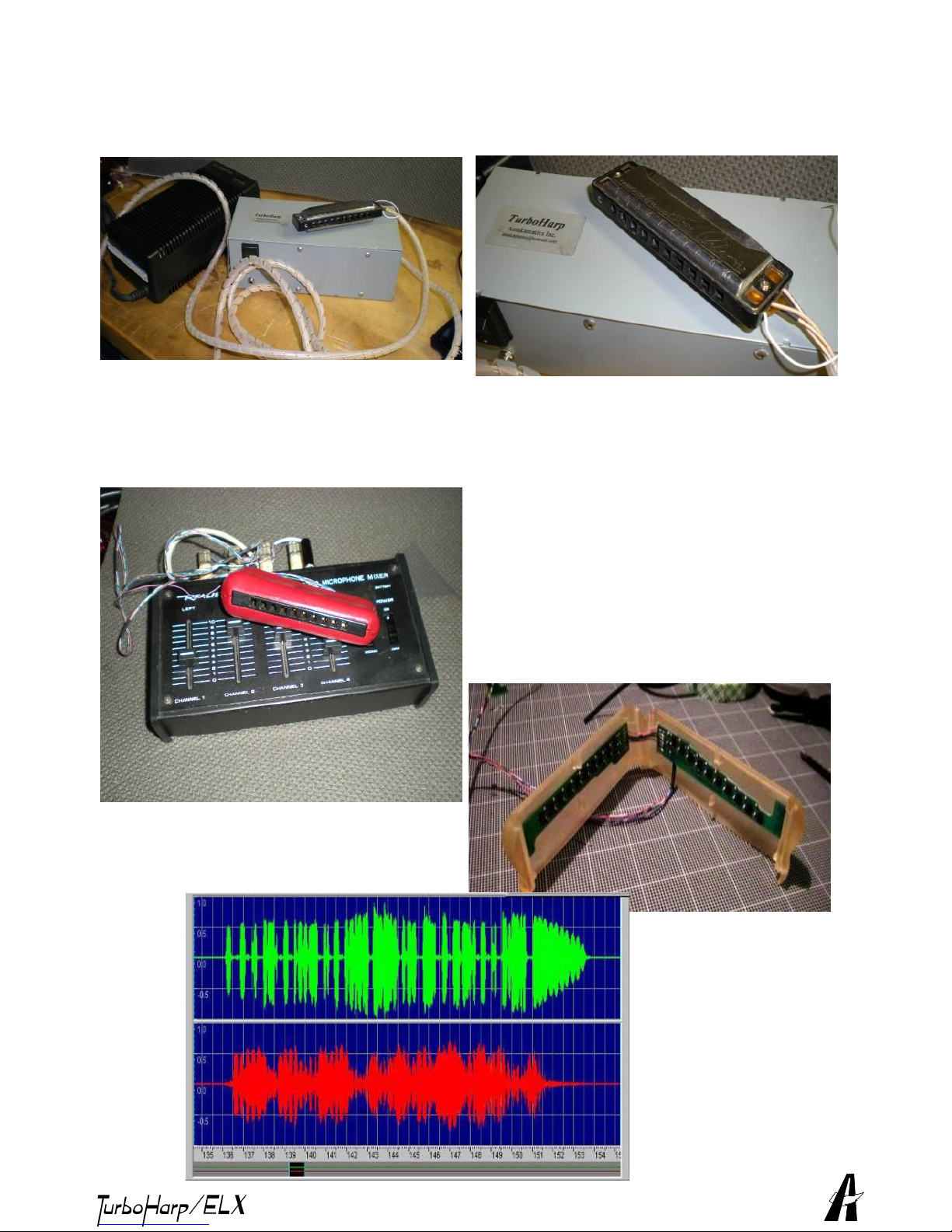
circa 2003: Attempt at proximity sensors integrated into the comb.
circa 2004: First optical pickup version. 4 channels: low notes blow, low
draw, high blow, high draw
Origins of the ELX
• Optical sensors (pickups)
convert reed vibration to
electrical signal.
• Used standard harmonica
body
• Required disassembly of lids
(by 2 allen screws) to swap
harmonica bodies.
RIGHT
LEFT
4 channels
from harp:
•Low blow
•Low draw
•High blow
•High draw
•Quad output: blow-draw; low-high registers
Page 14
pg. 15
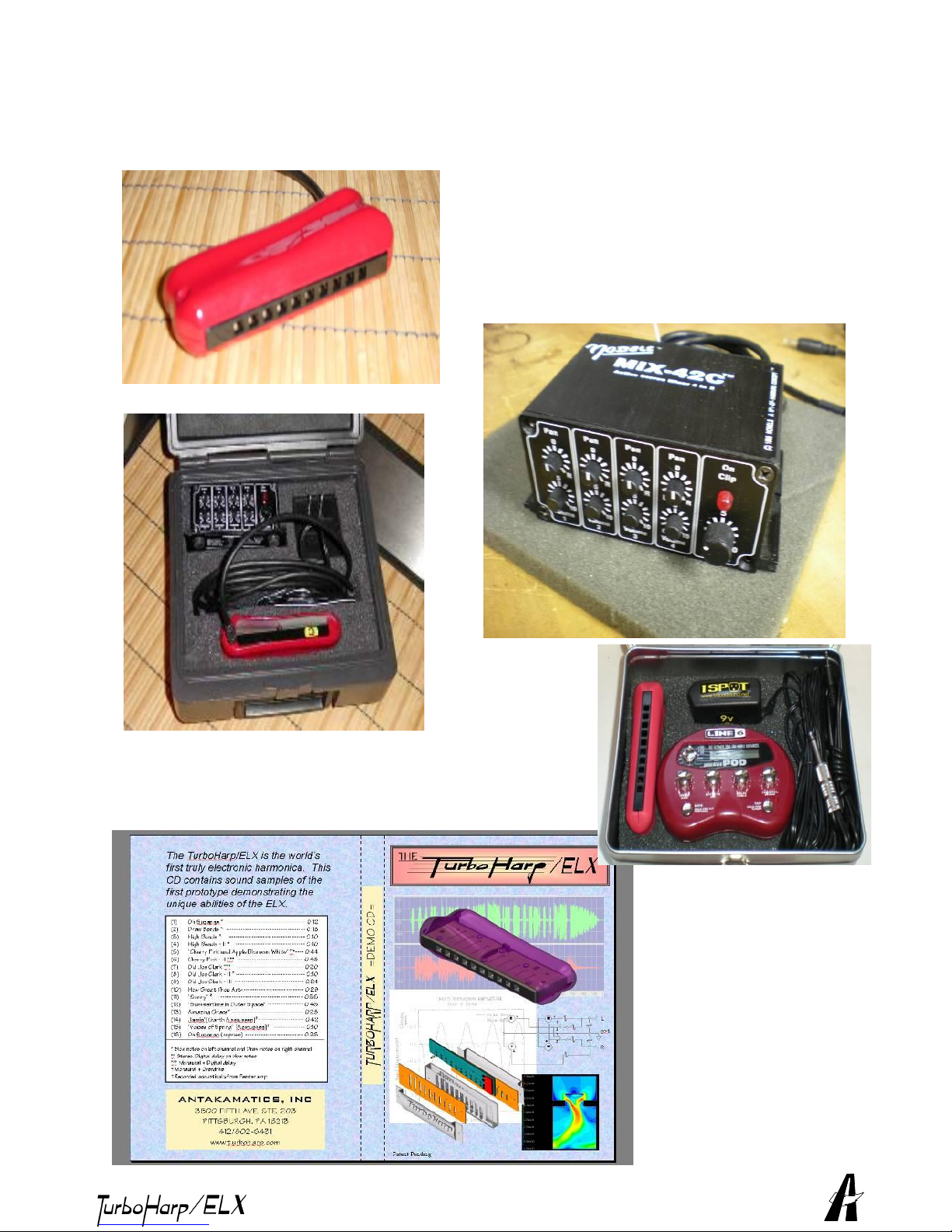
Origins of the ELX:
Generation-2 Optical
circa 2004
circa 2003: Demo CD
circa 2004:
refined 4-channel mixer.
•Experimented with various
effects boxes, including Line6, POD, Pandora Box,
Digitech RP50, and RP70,
and others.
Page 15
pg. 16
History of the ELX
• circa 1990 – experimental studies on harmonica reed
dynamics accidentally results in realization that reed motion
when converted to voltage, can then be translated to sound.
• circa 1996 – first piezo electric prototype
• circa 1999 – piezo model is “perfected” however has
significant drawbacks. Presented to Hohner, who expressed
no interest.
• circa 2002 – eddy current sensor
• circa 2002 – capacitive sensor
• 2003 – patent filed
• 2004 – first prototype using optical sensor using simple
passive summer circuit. Worked “ok” but gain was uneven
across reeds (very weak for the high reeds) and there was
unacceptable hiss.
• 2005 – second optical prototype designed by Tom Dragness
including on-board preamplifiers. Sensors changed from
Optek to Omron to save cost. This harp was configured as
quadraphonic: high register separated from low, draw from
blow, patched to mini quad mixer (Nobels.) Drawbacks
included complexity, difficulty to replace harp bodies
(requiring disassembly of lids), and ongoing problem of hiss.
• 2008 – retained Daedalus to re-design ELX to deal with
manufacturability issue and hiss. They redesigned the circuit,
and produced 5 prototypes, but not much was changed,
except convert from four channel to one (for sake of
simplicity, obviating 4-channel mixer.) The manufacturability
issue was never addressed.
• 2009-at wits end, Prof Turbodog decides to take matters into
his own hands, and redesigns the covers to permit easy
exchange of harp bodies. Returns to Daedalus for minor
revisions to circuit, particularly replacing sensors which had
been discontinued by Omron by Fairchild sensors. Added
pot’s to each of the reeds to balance gain; Also inverted
summation of blow and draw (based on suggestion of
Harmonica John) to prevent cancellation when bending
notes. Also added on-board connector along with other
improvements to improve manufacture, assembly, and
adjustment.
• 2011 – retained Novodyne (Burbank, CA) to produce circuit boards.
• 2011, November 7 – first 5 boards arrived. Assembled to 5-sets of rapid-prototype lids
to produce the first five “production” ELX’s.
• April 2012 – Novodyne loses lease, goes out of business; runs off with our down
payment.
• ca June 2012 – we find another supplier of circuit boards, and conduct another round of
debugging, and minor revisions.
• August 17, 2012: first set of 100 circuit boards received, full production initiated.
• January 2014: design of the Generation-5 ELX begun.
• ...and the beat goes on...
www.turboharp.com
®
Harmonicas of the Future
Page 16

www.turboharp.com
®
Harmonicas of the Future
 Loading...