

Page 1

www.ttfone.com
Thank you for choosing our mobile phone!
Please read this manual before use.
Check out our website for video
guides of how to use your phone
www.ttfone.com
We reserve the right to upgrade the software
and product and/or to make changes to this
user manual without prior notice. The icons
in this user manual may slightly dier from
your phone, depending on the phone you
purchased. All rights reserved.
Page 2

www.ttfone.com
Contents
1.Safety Instructions .................................................... 6
2. Getting Started ......................................................... 9
Install the SIM card and battery ........................ 9
Charging the Battery ............................................11
Battery Level Indication ......................................11
3. Your Phone ................................................................12
Key Functions ..........................................................13
4. Making and Receiving Phone Calls ...............15
To Make Calls:...........................................................15
To Answer Calls: ......................................................15
To End a Call: ............................................................15
To Redial a Number: ..............................................15
Making International Calls: ................................16
Volume Adjustment .............................................16
Main Menu ................................................................16
5. Phonebook ...............................................................17
Phonebook settings .............................................18
Messaging .................................................................18
6. Call Center .................................................................20
7. Organiser ...................................................................22
8. Multimedia ...............................................................23
9. Settings.......................................................................26
User Proles ..............................................................26
Phone Settings ........................................................27
Page 3

www.ttfone.com
This user manual includes important safety
information. Please read below instructions
carefully. It may be dangerous or illegal if you do not
follow these instructions. Remember to follow any
special regulations in force in any area and always
switch o your device when its use is prohibited or
when it may cause interference or danger.
Attention!
The factory default password: 1122
This password can be used to change the
settings, however it is advised that you change
this to your own personal password.
Network settings
................................................28
Security settings .................................................28
Connectivity ..........................................................29
Restore factory settings ..................................29
10. SOS .............................................................................29
11. Torch ..........................................................................31
12. Troubleshooting ..................................................31
13. Radio Frequency (RF) Exposure and SAR .34
Page 4

www.ttfone.com
1.Safety Instructions
Pay attention to Trac Safety
Obey local trac laws and do not use the
phone while driving. Using a cell phone
while driving is dangerous and it is illegal in
some areas. Radio frequency (RF) signals may
aect improperly installed or inadequately
shielded electronic systems in motor vehicles
such as electronic fuel injection systems,
electronic antiskid (antilock) braking systems,
electronic speed control systems, air bag
systems. For more information, check with
the manufacturer of your vehicle for any
equipment that has been added. Do not
place objects, including installed or portable
wireless equipment in the area over the air
bag or in the air bag deployment area.
Pacemaker Interference
Pacemaker manufacturers recommend that
a minimum separation of 15.3 centimeters
(6 inches) be maintained between a wireless
phone and a pacemaker in order to avoid
potential interference with the pacemaker.
Page 5

www.ttfone.com
Turn O Your Cell Phone in Medical and
Health Care Facilities.
Switch o your device in health care facilities
when any regulations posted in these areas
instruct you to do so. Hospitals or health care
facilities may be using equipment that could
be sensitive to external RF energy.
Switch O on Airplanes
Using your device while ying in aircraft is
prohibited. Switch o your device before
boarding an aircraft. The use of wireless
devices in an aircraft may be dangerous to the
operation of the aircraft, disrupt the wireless
telephone network, and may be illegal.
Accessories and Batteries
Use only the approved accessories and
batteries. Please do not try to use with any
product that was not manufactured for use
with this phone. Please be sure the phone has
been switched o before taking out battery.
Please dispose of scrap batteries properly
according to the local regulations.
Page 6

www.ttfone.com
Cell Phone Should Be Turned O Near
Sites of Explosion.
Potentially explosive atmospheres include
areas where you would normally be advised
to turn o your vehicle engine. Sparks in such
areas could cause an explosion or re resulting
in bodily injury or even death. Switch o the
device at refueling points such as near gas
pumps at service stations and in any area with
a potentially explosive atmosphere and obey
all signs and instructions. Observe restrictions
on the use of radio equipment in fuel depots,
storage, chemical plants or where blasting
operations are in progress.
Using the Phone Correctly
Please use this phone in its normal intended
position. Do not let children use the phone
without supervision.Your phone contains
small parts such as SIM card, which can be
accidentally swallowed by a child.
Your Phone is Not Waterproof
This phone is not waterproof. Please do not
expose your phone to wet weather or environment (such as rain, snow, seawater, etc.).
Page 7
www.ttfone.com
2. Getting Started
Install the SIM card and battery
Always switch the device o and disconnect
the charger before removing the battery.
Keep all SIM cards out of the reach of small
children. For availability and information
about using SIM card services, contact your
SIM card vendor. This may be
the service provider, network
operator, or other vendor. The
SIM card and its contacts are
easily damaged by scratches or
bending, so please be careful
when handling, inserting, or
removing the card.
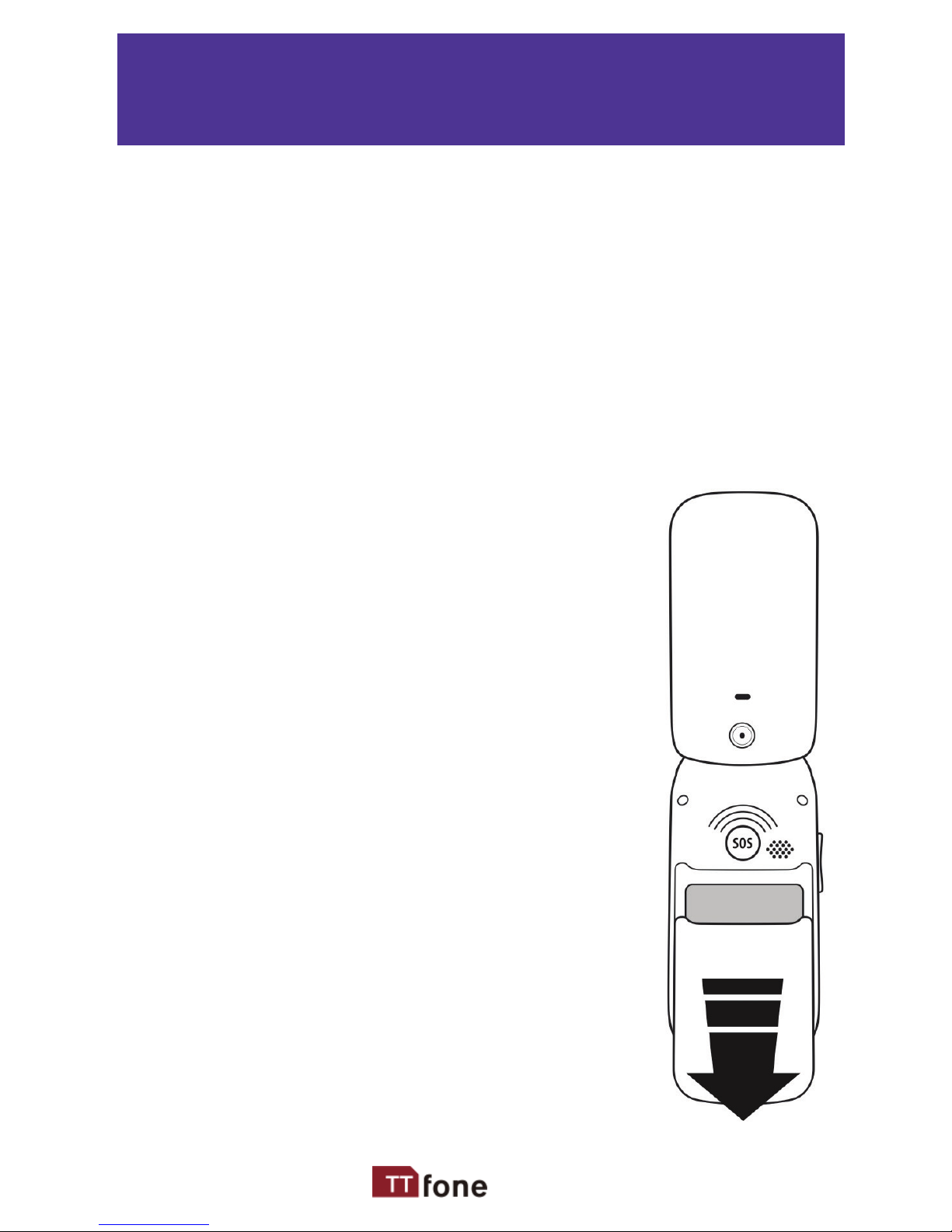
1. Open the battery cover by
lightly pressing on the back of
the phone and sliding the cover
panel down.
Page 8
www.ttfone.com
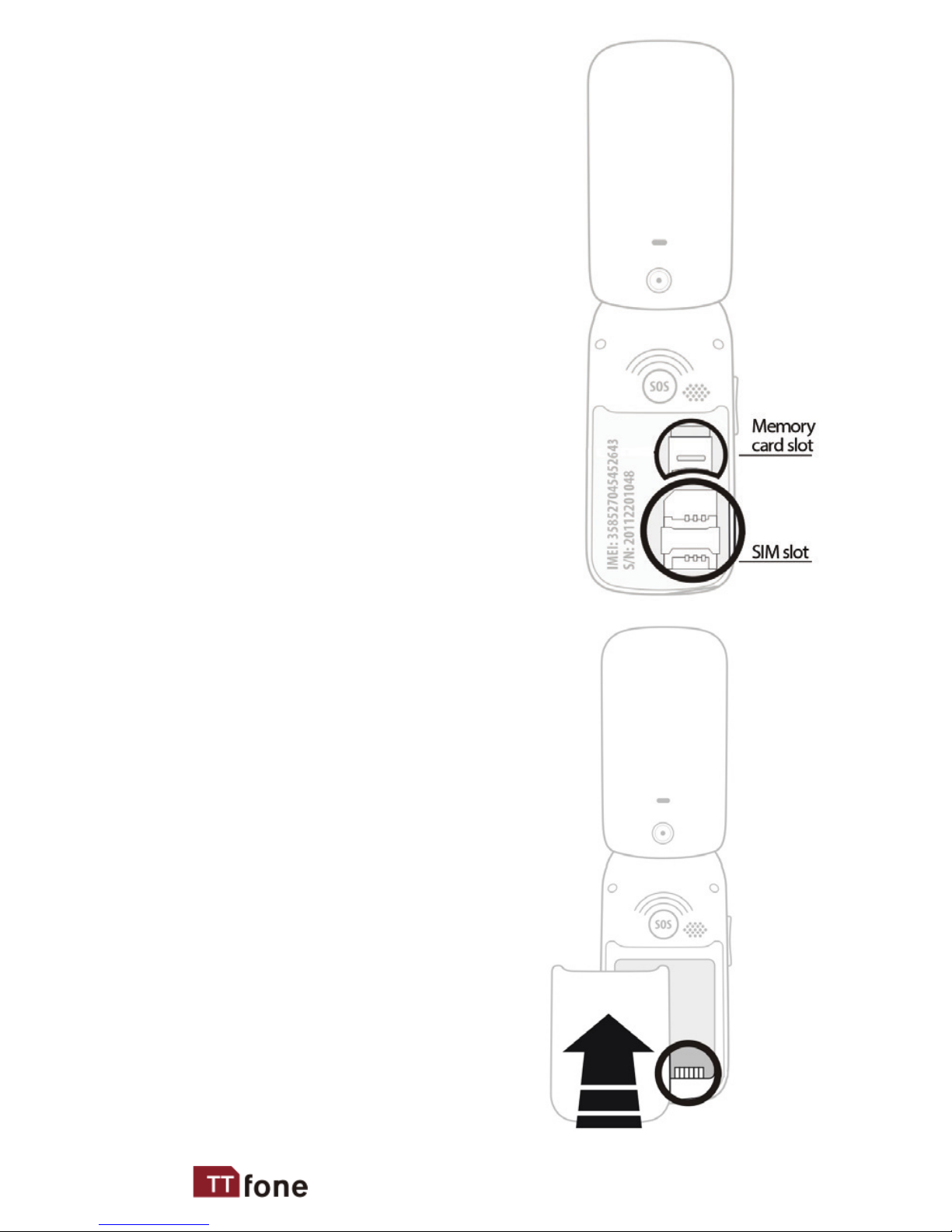
2. Install SIM card by
sliding it into its nest and
under the metal holding
plate. (To remove the SIM
card, gently press on it and
slide it out of its nest.)
3. Install the battery into
the battery slot, making
sure that the three metallic
stripes on the battery align
with the three metallic
prongs in the battery slot.
4. Put on the battery cover.
Make sure the cover is
completely matched and
a click sound can be heard.
5. To turn the phone on
press and hold the red
key until the screen lights
up. To turn it o press and
hold the same key until
the phone powers o.
Page 9
www.ttfone.com
Charging the Battery
Battery can be charged when the phone is
either on or o. Please make sure that the
battery is inserted into the phone before
charging.
Connect the charger to its port on the bottom
panel of the phone, and then plug it into the
240V electrical outlet. To disconnect, rst
unplug the charger from the electrical outlet
and then disconnect it from the phone.
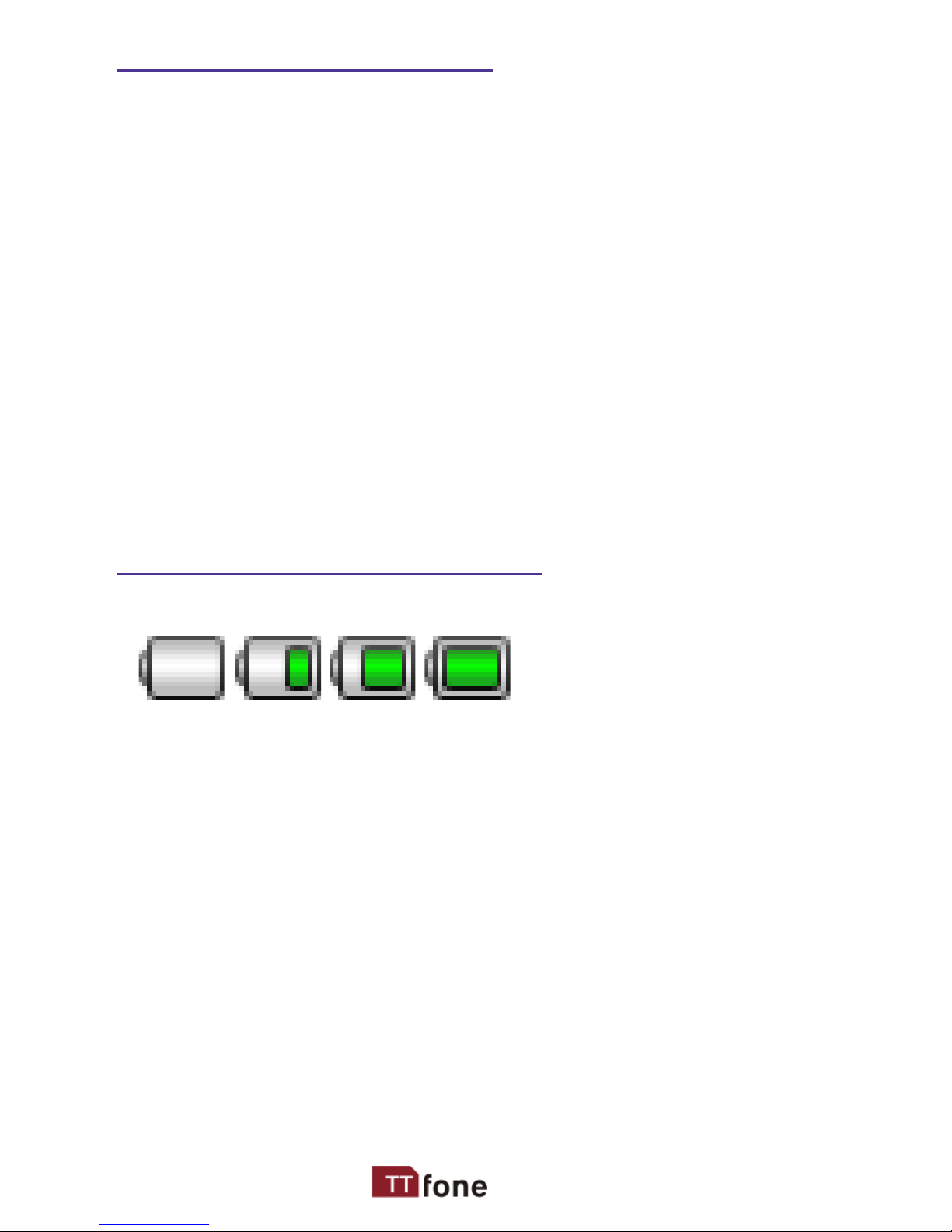
Battery Level Indication
Charging Charged
The phone will sound an alert when the battery is
low and display a message of low battery on the
screen.
Page 10

www.ttfone.com
3. Your Phone
Your phone is in Stand By mode when it is on
but no operation is chosen.
Page 11
www.ttfone.com
Key Functions
Green Key - When in home
screen use this key to
enter your call logs, use
it to make calls once a
number is highlighted
also use this button to
answer calls when the
phone is ringing and to
take a picture when in
camera mode.
Red Key - Hold down this
button to turn on and
o the phone, use this
button to end your call
and reject calls that
are incoming. Press
this key to return to
the home screen at
anytime.
Navigation Up Key - When in home screen use this key as
a shortcut to SMS messaging, use it to scroll up in the
menu
Navigation Down Key - When in home screen use this key
as a shortcut to Alarm, use it to scroll down in the menu
Menu Left Key - This key will do what is written above it
on the bottom left of the screen, when in home screen
press to access the menu
Menu Right Key - This key will do what is written above
it on the bottom right of the screen, when in home
Page 12
www.ttfone.com
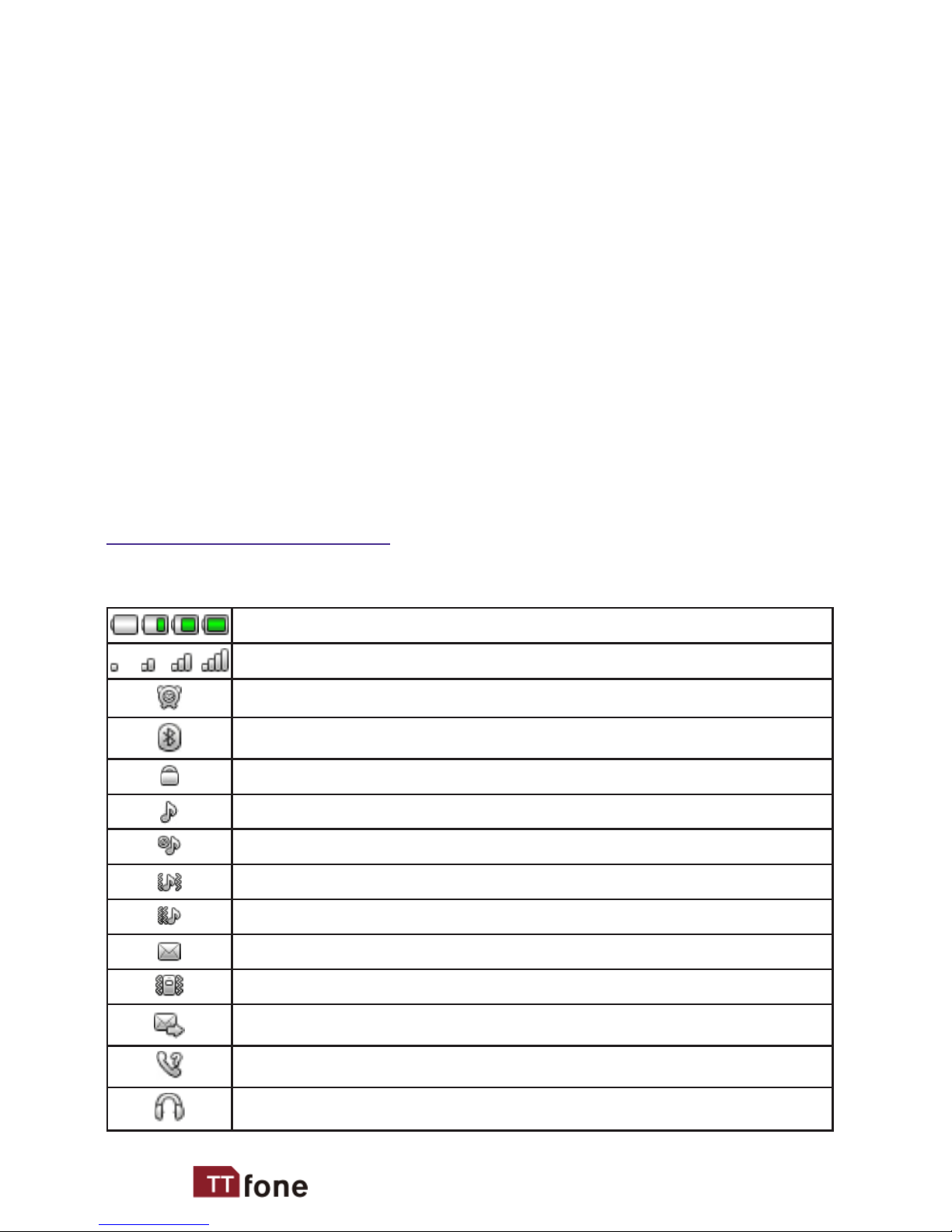
Icons on Screen
Following icons may be displayed on the screen:
Battery Status
Network Signal Status
Alarm
Bluetooth
Keypad locked
The phone in ring-down status
Silent mode is activated
The phone in Vib and ring status
The phone in vib rst and then ring status
New message
The phone in Vib status
Sending message
Missed call
Headset is Connected
screen press to access the phonebook
# Key - Press and hold this key to activate silent mode press
and hold again to go back to General mode
* Key - Press and hold to access the international calling
symbol + and the pause P
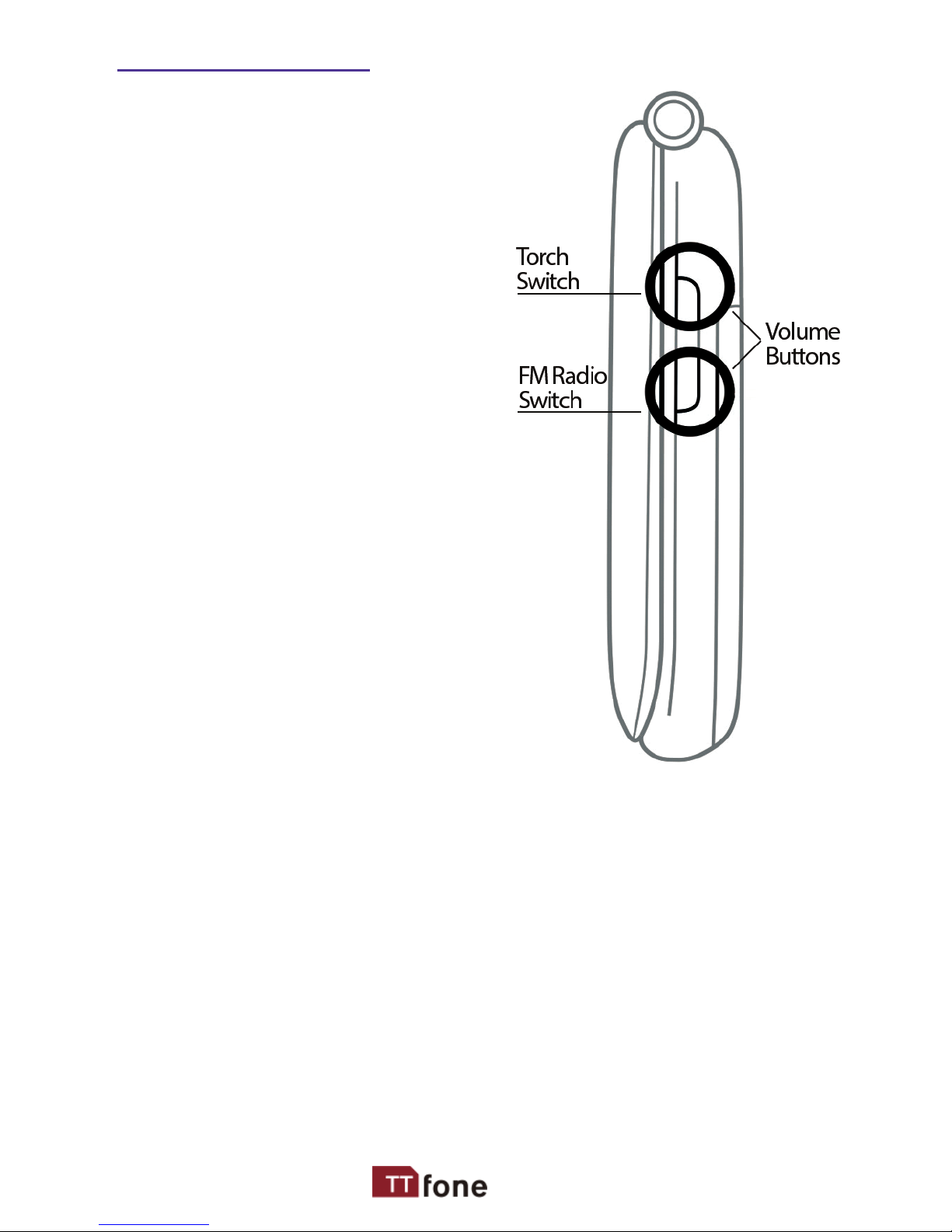
Volume Button - + for up and - for down
FM Radio Switch - Slide this up to switch on the radio
Torch Switch - Slide up to switch on the torch
Lock Switch - Up to unlock and down to lock the keypad
SOS Button - Press and hold to activate the Emergency
feature, press and hold again to cancel
Page 13

www.ttfone.com
To Make Calls:
When the phone is in a standby, the number
pad can be used to insert the desired
telephone number. To modify the number
you can use the up/down navigation keys,
the right menu key can be used to delete
numbers. Press the green key to dial the
inputted telephone number; the green key is
also used to answer incoming phone calls.
To Answer Calls:
When your phone rings or vibrates, press the
green key.
To End a Call:
The red end key is used to hang-up after a
phone call, it can also be used to reject an
incoming phone call.
To Redial a Number:
From the home screen, press the green key
to see a list of call logs, scroll down to desired
number by using the up and down keys and
once you nd the entry you want to call press
the green key.
4. Making and Receiving Phone Calls
Page 14

www.ttfone.com
Making International Calls:
- Hold down the Star “ * ” key a “+” character
will appear on the screen. Enter country code,
area code and phone number as instructed
by your long distance network service carrier.
Press the green key.
- To display “P” or "W" symbols press and hold
the “ * ” key then when the + sign appears
press “ * ” again
Volume Adjustment
During a normal or hands-free call connection,
press and hold Volume Control key to increase
the volume. Whilst in a phone call to reach
max volume you can press and hold the ‘0’ key,
this is an aid for users with a hearing aid.
Main Menu
To enter the main menu, press the left menu
key. The up/down navigation keys can then be
used to scroll through the menu use the left
menu key to select.
Page 15

www.ttfone.com
Here you can view all your phonebook entries,
use the up/down navigation keys to scroll
through or you can use the search box.
To add a new contact press the left menu
key when the words add new contact is
highlighted on screen, this will take you to the
add contact options menu, choose select then
choose to save to sim card or phone then add
the name and number press the right menu
key when done to save it.
When a number is highlighted press the left
menu key to see the options menu for this
number, here you can choose:
View
Send Text Message
Send MMS Message
Call
Edit
Delete
Copy
Move
Send Business Card
Phonebook Settings
5. Phonebook
Page 16

www.ttfone.com
Phonebook settings
Preferred Storage - You can choose the
storage path for the current number.
Memory Status - You can view the current
use status of the phonebook, including
SIM card and phone memory. The display
format is “Used/Total”.
Copy contacts - you can choose to copy the
contacts from mobile phone to SIM card or
from SIM card to mobile phone.
Move contacts - you can choose to move the
contacts from mobile phone to SIM card or
from SIM card to mobile phone.
Delete all contacts - You have two modes
regarding deletion: from the sim card or
from the phone
Caller Groups - You can set call tone, photo
and members for ve callers’ groups. Callers’
group member can only come from the
number saved on phone.
Messaging
Write message - Here you can choose to
write a Text or Multimedia message,
use the number keypad to enter the
corresponding letters, the phone has a
predictive message option that will help
Page 17

www.ttfone.com
you to write message faster. Use the Hash
# button to toggle this feature on or o.
When you have written your message
press the left menu key to go to the
options
- Send to - Enter the number or choose a
contact from your phonebook
- Insert Symbol - insert a symbol into your text
message
- Input Method - choose here the preferred
default input method
- Insert Template - pre-written messages
consisting of commonly used phases
- Advanced - you can insert the number and
name from phonebook during editing the
text message.
- Save to Drafts - save your message to send at
another
time
Inbox - where you can view, forward, delete
your received messages. Messages
can also be moved/ copied to dierent
memory stores using the advanced menu
Drafts - this is where your draft messages can
be viewed.
Outbox - this is where not yet sent messages
can be viewed
Page 18

www.ttfone.com
Sent messages - this is where your sent
messages can be viewed
Templates - pre-written messages consisting
of commonly used phases
SMS settings - change the network settings
of messaging options
Voicemail Server - change voicemail settings
Acts as a history for all the phone calls you
have missed, received or dialled out. You can
also check the duration of your incoming and
outgoing calls.
Call History
Missed Calls - shows the recent calls that you
have missed or failed to answer. From here
you can view the time/date of the phone
call and redial the number.
Dialled Calls - allows access to the recent
outgoing phone calls history. From here
you can view the call duration, time/date of
the phone call and redial the number.
Received Calls - shows the incoming call
history. From here you can view the call
6. Call Center
Page 19

www.ttfone.com
duration, time/date of the phone call and
redial the number.
Delete call logs - allows you to delete the call
history, either separately or all the call logs
at once.
Call Settings
Call waiting - from here you can activate/
deactivate call waiting, this service allows
for people to be put on hold when you
receive a call while you are already using
the phone in a call
Call divert - set your call divert status from this
menu. Calls that you receive while your line
is busy will be diverted, you can also set
when a phone call should be diverted.
Call Barring - outgoing/incoming calls can be
barred. A password is required to activate
this option. This you will need to get from
your network provider.
Advanced Settings - here you can access the
blacklist menu, auto redial, set call time
reminders, reject by SMS and change the
answer mode.
Page 20

www.ttfone.com
Emergency setting
SOS message - Here you can change the SOS
text message
SOS Number - H
ere you can set /update the 5
emergency numbers
Attention!
Emergency SOS button will only make calls
if a SIM card has been inserted into the
mobile.
Speed Dial
This menu will allow you set the speed dial
numbers into your phone, simply press and
hold the number on the home screen and it
will directly call the saved number.
Status
- switch on/o the speed dial feature
Set Numbers
- Here you can set the numbers
for 2-9 on the keypad
Alarm
The time format for the alarm clock is identical to
that of clock. You can set up to 6 separate alarms
Calendar
View your calendar and add/edit events
7. Organiser
Page 21

www.ttfone.com
Services
Sim card menu options, these vary according
to the network provider
File Manager
From here you can manage your multimedia
and other les that you may have stored
within your memory card or in the phone. The
le manager also shows the total space within
your memory card and also the amount of
free space available for use.
Calculator
enter the numbers and use the up/down
navigation keys to select an equation, press
the left menu key for the answer
Tasks
Set your tasks here, you can even set up an
alarm to remind you.
Please Note
A Micro SD memory card will need to be
inserted in order to use some of these
functions, this is not included and can be
8. Multimedia
Page 22

www.ttfone.com
purchased separately. We recommend no
larger than 8MB card should be used for
optimum performance.
Camera - Use the green key to take pictures, the
left menu key will take you to the camera
options and the right menu key to exit.
With this function, you can use the inbuilt
camera to take photos. The lens of the camera
is located on the back of the phone and the
screen is used as the viewing window. All
photos taken are in JPG form.
After downloading the photos onto PC, you
need some software to view them. If the storage
space of the mobile phone is insucient to store
the taken photos, it is necessary to delete some
old photos or other les in “File Management” to
release more space.
Image viewer
- View all the photos taken and
stored on your handset and on the Micro
SD card.
Video recorder
- press the green key to start/
stop recording use the navigation up/
down keys for zoom option and press the
right menu key to exit. The duration of
recording depends on the time limit set
and le management capacity.
Page 23

www.ttfone.com
Video player
- View all the videos taken and
stored on your handset and on the Micro
SD card.
Audio Player - Here you can play you can
play your music les, use the left menu
key to list your music. To download music,
you must insert the Micro SD memory
card into the mobile phone, switch o
the mobile phone, connect the mobile
phone and PC with USB cable, then the PC
will detect the new hardware and create
a new mobile hard drive. Download the
chosen MP3 le under “My Music” of the
mobile disk rather than in such folders as
Audio, Images and Photos; otherwise, the
le cannot be played. (Only music in MP3,
AMR and MIDI are supportable).
FM Radio
- You can also access the FM Radio
by holding down the FM switch on the
side of the phone. Use the up/down
navigation keys to scan through stations,
listen to the radio on the speaker phone or
connect the headset into the headset jack.
* The quality of radio sound depends on
signal quality at your particular location. The
Page 24

www.ttfone.com
headphones act as an aerial so you will get
better reception when they are plugged in.
The individual phone settings can be changed
from within this menu.
User Proles
You can use proles to set and customise the
ringing tones, message alert tones and other
tones for dierent situations. To change a
prole press the left menu key to enter the
menu then scroll to “Settings” and select “User
Proles” here you can activate or customise
each prole
Customise Menu
Once you have selected the prole you will
have the option to customise it with these
options
Alert type
- choose ring and vibrate options
Ring type
- repeat, ascending or beep once
Incoming call
- choose your ring tone for an
incoming call
Ringtone volume
- the volume level for
incoming calls
9. Settings
Page 25

www.ttfone.com
Message
- choose your tone for an incoming
message
Message volume
- the volume level for
incoming message
Keypad
- choose between tone, click, silent or
human voice tone (speaking numbers)
Keypad volume
- the volume level for the
keypad
Power on
- change the power on tone
Power o
- change the power o tone
Cover open
- change the sound made when
ip is opened
Cover close
- change the sound made when
ip is closed
System alert
- set the warning sounds to on
or o
Phone Settings
Time and date
- from this menu you can
change/set the time and date also the
format (12hour/24hour clock) of the time
display.
Schedule power on/o
- schedule the phone
to switch on/o
Page 26

www.ttfone.com
Language
- change the language the phone
displays
Pref input method
- change the input
method for text messages
Display
- here you can change the wallpaper
display, set the screen saver and choose
how to display the time and date on the
home screen
Flight mode
- use this to switch o GSM
signals
Misc settings
- LCD backlight - choose the
brightness and the time it stays lit without
pressing any buttons - note the brighter
and longer you set this the more battery
power it will consume
Network settings
Select a network or change your preferred
network from this option.
Security settings
Sim Security
- activate/change your sim card
pin code
Security lock
- activate/change your phone
secuirty code (default password is 1122).
Page 27

www.ttfone.com
Auto Keypad lock
- choose to lock the keypad
automatically
Connectivity
Data account details
Restore factory settings
This option allows you to restore all the
settings on the phone back to the original
manufacturer’s settings. The phone will
change the settings back to those which the
phone came with. A password is required to
activate this option. (default password is 1122).
Important Notice: Wireless phones, including
this device, operate using radio signals,
wireless networks, landline networks, and
user-programmed functions.
Because of this, connections in all conditions
and/or locations cannot be guaranteed.
You should never rely solely on any
wireless device for medical emergency
communication.
You can set the emergency numbers in the
10. SOS
Page 28

www.ttfone.com
phone according to your requirement, you
can set a total of up to 5 emergency numbers.
In case of an emergency, when the SOS button
is pushed down the phone will automatically
send a text message to the emergency
numbers set up on the phone.
The mobile phone will then make the
emergency call .
If the rst call fails, the phone will proceed to
dialling the second emergency number. In this
manner the phone will circulate the emergency
contact numbers 3 times in order to receive an
answer.
The phone will also sound an alarm when an
emergency call or message is sent.
To cancel the SOS emergency press the right
menu key
To set the emergency numbers press select
option “Organiser” then “Emergency Settings”
Press up or down keys until “SOS Number” is
displayed.
Select this option and insert up to 5 numbers.
The order in which they are entered is the order
in which they are dialed.
Page 29
www.ttfone.com
Hold down the button on the side of the
phone to activate the Torch function.
11. Torch
12. Troubleshooting
Problems Solutions
Phone
does not
turn on
1. Ensure you have held the power button
down for more than 5 seconds.
2. Re-insert the battery and retry phone
boot.
3. Plug charger into the phone and make
sure the battery is charged.
Cannot
connect
to a
network
1. Signal strength may be weak, try move
location and try again.
2. It may be possible that you are using
the phone beyond the network service
coverage area.
3. Check to make sure your SIM card is
inserted correctly and is valid. (contact
network provider)
No information
displayed
when
phone is
on
1. Check SIM card is correctly installed.
2. You may need to unlock your key-pad
using the button on the side of the phone
or your keypad (password maybe required).
3. You may have permanently locked your
phone by entering the pin code incorrectly
3 times, obtain your PUK code from your
network provider.
Page 30
www.ttfone.com
4. Increase the screen brightness in settings.
Phone call
quality
poor
1. Increase the call volume use (+ -) key on
the side of the phone.
2. It may be that the network reception is
poor in your location. Try moving to anoth-
er area to achieve a better connection.
Shorter
Standby
Time
1. Standby time is related to system set-
tings, in poor areas of reception the phone
will use more battery to try and nd a base
station, in this event the standby time will
be reduced to save battery power.
2. It could also be the case that the battery
of the phone has become exhausted, you
may need to consider changing the battery.
SIM card
Error
1. Reinstall the SIM card into the phone,
ensure the metal contact is clean, wipe
gently with a clean cloth before inserting
into the phone.
2. SIM card may not be correctly installed.
3. If the SIM card is damaged contact your
service provider.
Some
feature
do not
operate or
cannot be
set
1. This could be due to an operation error
on the phone, switch mobile phone o and
restart after 30 seconds.
2. The network provider may not support
the feature you are trying to use and this
may prevent its use.
Page 31
www.ttfone.com
Cannot
receive
incoming
calls
1. Ensure your mobile phone is switched on
and connected to a network.
2. Make sure your SIM card is correctly
installed.
3. Call restrictions may be prohibiting incoming phone calls, so these settings must
be checked.
4. Poor areas of network coverage can prevent incoming calls so check the network
status of your phone
Phone not
charging
1. Bad connections can hinder the phone
charging; make sure all contacts are correct-
ly connected.
2. Check to see whether the phone charg-
ing slot or the charge itself is damaged. If so
discontinue use. Replace battery or charger.
3. The phone cannot be charged in temper-
ature below 10˚C or above 55˚C.
Does
not dial
numbers
1. Conrm that once the number is
inputted using the keypad the green call
button must be pressed to dial the phone
number.
2. Check the phone number entered is
correct.
3. Check reception coverage status of your
mobile phone.
4. Make sure the call restriction settings are
correct in order for you to dial outgoing
calls.
Page 32

www.ttfone.com
This device meets international guidelines for exposure to
radio waves your mobile device is a radio transmitter and
receiver. It is designed and manufactured not to exceed the
limits for exposure to radio frequency (rf ) recommended
by international guidelines (icnirp). These limits are part of
comprehensive guidelines and establish permitted levels
of rf energy for the general population. The guidelines were
developed by independent scientic organizations through
periodic and thorough evaluation of scientic studies. The
exposure standard for mobile devices employs a unit of
measurement known as the specic absorption rate, or
sar. Although the sar is determined at the highest certied
power level, the actual sar of the device while operating
can be well below the maximum value. This is because the
device is designed to operate at multiple power levels so
as to use only the power required to reach the network.
In general, the closer you are to a base station, the lower
is the power output of the device. Sar values may vary
depending on national reporting and testing requirements
and the network band. Use of device accessories and
enhancements may result in dierent sar values.
The sar limit for mobile devices used by the public is 2.0 W/
kg (watts per kilogram) averaged over 10 grams of body
tissue. The guidelines incorporate a substantial margin of
safety to give additional protection for the public and to
account for any variations in measurements. The highest sar
value this model phone tested for while in use is:
Gsm 900:0.622W/kg(10g) / Dcs 1800: 0.42W/kg(10g)
Check out our other fantastic range
of products at www.
ttfone.com
13. Radio Frequency (RF) Exposure and SAR
 Loading...