

Page 1
Newton Multi Fuel
8kW Space Heating Stove With Boiler
OPERATION, INSTALLATION,
COMMISSIONING & SERVICING
INSTRUCTIONS
Please read these instructions carefully before installing,
Commissioning and using this appliance.
TO BE RETAINED BY THE HOUSEHOLDER
Page 2

2
HEALTH AND SAFETY
INFORMATION FOR THE USER, INSTALLER AND SERVICE ENGINEER
Under the Consumer Protection Act 1987 and the Health and Safety at Work Act 1974, it is a requirement to provide
information on substances hazardous to health (COSHH Regulations 1998).
TR Engineering takes every reasonable care to ensure that its products are designed and constructed to meet these safety
requirements when the products are properly installed and used. To fulfil the requirements, products are comprehensively
tested and examined before despatch.
When working on the appliance, it is the responsibility of the user or engineer to ensure that personal protective clothing o r
equipment appropriate to parts that could be considered hazardous or harmful is worn.
This appliance may contain some of the items below:
Insulation and Seals
Glass rope, mineral wool, insulation pads, ceramic fibre, glass insulation.
When handling, avoid inhalation and contact with eyes. These may be harmful and cause irritation to the skin, eyes, nose or
throat. Use disposable gloves, facemasks and eye protection.
After handling, wash hands and other exposed areas. When disposing of materials, limit dust and the risk of inhalation by
using a water spray. Ensure materials are securely wrapped.
Seek urgent medical attention if inhaled or ingested. Exposure to eyes and skin should be followed by immediate cleansing of
the affected areas and medical attention if necessary.
Glues, Sealants and Paints
The glues, sealants and paints used present no known hazards when the appliance is used in the manner for which it is
intended.
Handling
Adequate facilities must be available for loading, unloading and site handling.
Fire Cement
Some types of fire cement are caustic and should not be allowed to come into contact with the skin. In case of contact wash
immediately with plenty of water.
Asbestos
This stove contains no asbestos. If there is a possibility of disturbing any asbestos in the course of installation then pl ease
seek specialist guidance and use appropriate protective equipment.
Page 3

3
CONTENTS
Page no.
Important Notes
4
Operation 5
Using the stove
5 - 6
Recommended fuels
7 - 8
Troubleshooting and maintenance
8
After-sales advice
9
Installation 10
Regulations / Health & safety /
Preparation
10
Siting
11
Technical details
11
Chimneys / flues
12 - 13
Air supply
14
Fuel conversion
14
Commissioning
14
Servicing 15
Procedure
15
Spares
15
Page 4

4
IMPORTANT USER NOTES
CO Alarms:-
Building regulations require that whenever a new or replacement fixed solid fuel or wood/biomass
appliance is installed in a dwelling a carbon monoxide alarm must be fitted in the same room as the
appliance. Further guidance on the installation of the carbon monoxide alarm is available in
BS EN 50292:2002 and from the alarm manufacturer’s instructions. Provision of an alarm must not be
considered a substitute for either installing the appliance correctly or ensuring regular servicing and
maintenance of the appliance and chimney system.
Warning Note
Properly installed, operated and maintained this stove will not emit fumes into the dwelling. Occasional
fumes from de-ashing and re-fuelling may occur. However, persistent fume emission is potentially
dangerous and must not be tolerated. If the fume emission does persist, then the following immediate
action should be taken:-
a) Open doors and windows to ventilate the room and then leave the premises.
b) Let the fire go out.
c) Check for flue or chimney blockage and clean if required.
d) Do not attempt to relight the fire until the cause of the fume emission has been identified and
corrected. If necessary seek expert advice.
The most common cause of fume emission is flue way or chimney blockage. For your own safety these
must be kept clean at all times.
Your installer should have fitted a CO alarm in the same room as the appliance. If the alarm sounds
unexpectedly, follow the instructions given under “Warning Note” above.
Do not use aerosol sprays near the stove when it is alight.
Frozen System
If there is a possibility that a part of the heating system may be frozen you should not light the stove
until you are confident that the system is free of ice, has no leaks and water is able to fully circulate.
Extractor Fans:-
Do not fit an extractor fan in the same room as this stove as this may cause the stove to emit fumes into
the room.
Where the chimney is believed to have served an open fire installation it is possible that the higher flue gas
temperature from a closed appliance may loosen deposits that were previously firmly adhered, with the
consequent risk of flue blockage. It is therefore recommended that the chimney be swept a second time within
a month of regular use after installation.
Page 5
5
INTRODUCTION
The Newton Multi-fuel stove has been designed and
constructed to give years of trouble-free domestic space
heating. These instructions are provided to assist you in
obtaining the best performance with the least trouble and
cost.
To help us provide the highest levels of customer service,
it is important that the registration card is completed in
full and returned. To ensure you have a clear
understanding of the appliance, please take the time to
read these instructions.
The stove must be installed by a qualified engineer.
Routine cleaning can be carried out by the end user, but
the stove should be fully serviced, and the chimney
swept, on an annual basis by an approved engineer. Keep
all ventilation installed for use with the stove open and
clear of obstructions.
Do not put combustible materials close to the stove. Its
surface will become very hot during burning, so a suitable
fireguard should be used. Some household items, such as
photographs, paintings or television screens, may be
susceptible to damage from rapidly-fluctuating air
temperatures; as such, do not place them above the stove
area, where high-temperature air will circulate.
Do not use third-party spares with the appliance, or make
unauthorised modifications to its design. The stove must
not share a chimney with another appliance.
OPERATION
Before using the stove, check that the chimney is clear
and has been confirmed for soundness. Operate the stove
at low outputs for the first few days for glue and paint
curing; some odours may be given off during this time, so
keep the building well ventilated.
Solid fuels
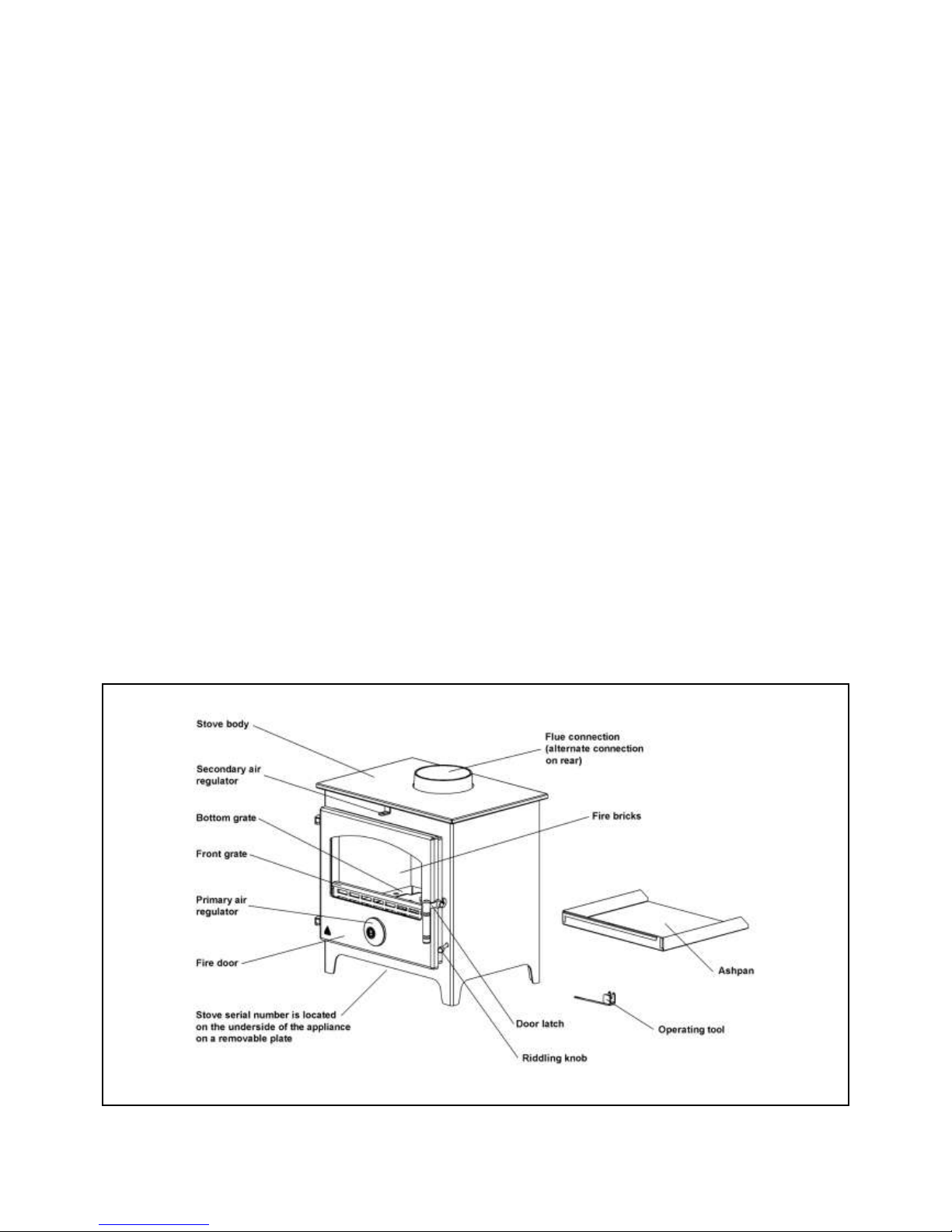
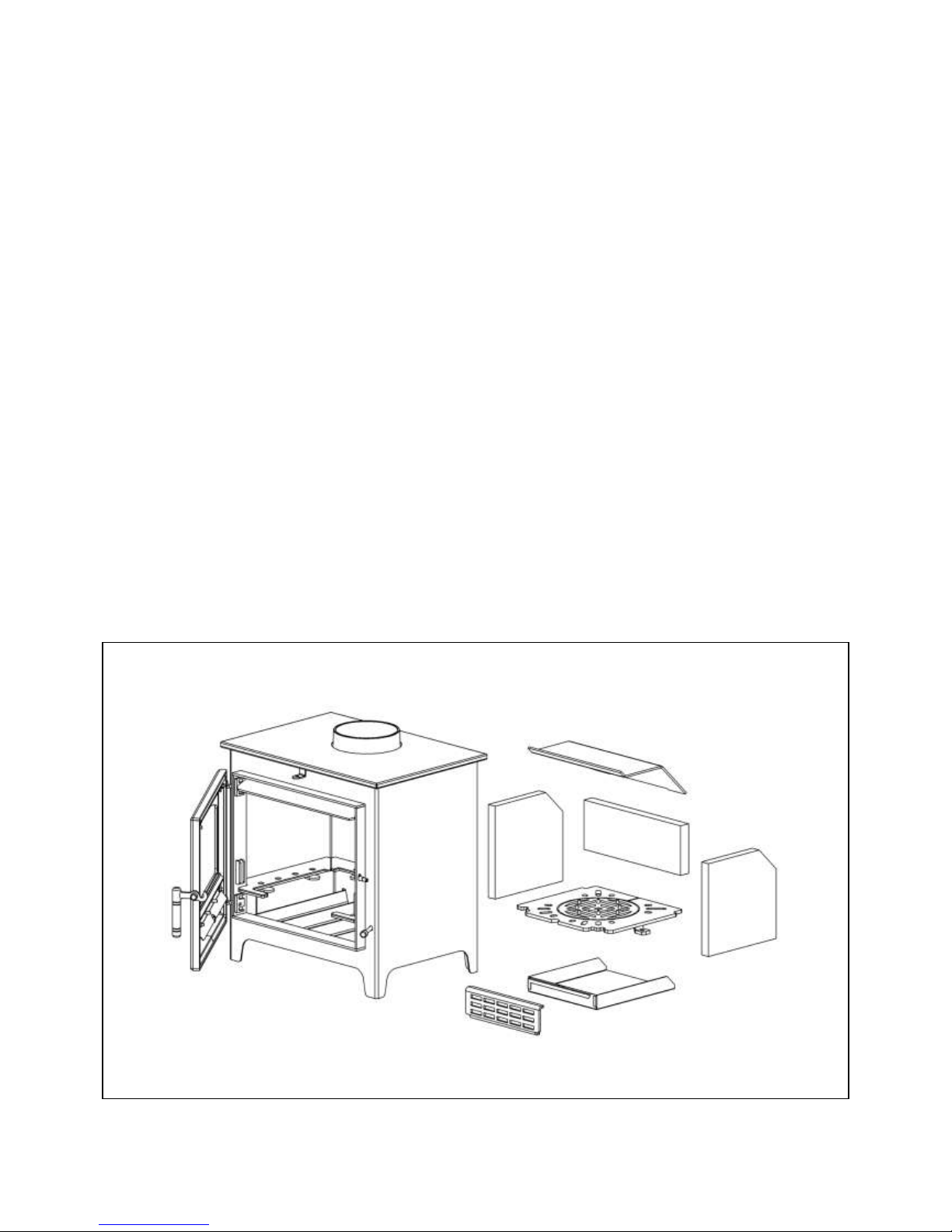
Ensure the stove is set to burn solid fuel. The bottom
grate assembly, fire bricks, throat plate, front grate and
ash pan must all be present (see fig 6 for assembly).
Note: on cold days it may be necessary to warm the flue
using two firelighters. Procedure:
Place firelighters, or a liberal coating of kindling
material (wood/paper, light paper) among a small
quantity of fuel in the combustion chamber.
After lighting, set the air regulator wheel to
maximum and the air wash to about 50%. To prevent
condensation build-up, leave the door partially open
until the glass has warmed.
With the fire established, open the fire door and fill
the combustion chamber to the top of the front
grate, sloping upwards to the rear of the chamber.
Close the fire door and ensure it is locked. For best
efficiency, set the air wash to about 25% and control
burning using the air regulator wheel.
Fig 1
Page 6

6
The highest burning rate is achieved by opening the air
regulator wheel to maximum. Excess ash formation may
indicate over firing.
For overnight or daytime slow burning, set the air
regulator wheel to be open by one full turn.
Experience will determine the settings that produce
best results.
Overnight burning can also be obtained by:
a) Using smaller fuel
b) De-ashing prior to refueling
c) Position of damper if fitted
d) condition of fire-bed before refuelling
When refueling, first de-ash the fire bed:
Riddle the bottom grate by engaging the operating
tool on the riddling knob. Pull and push sharply for
about 10 strokes, after which the fire should be free
of ash.
Open the locked fire door with the operating tool and
use the tool to remove the ash pan.
Empty the ash-pan at regular intervals; do not allow
ash to accumulate to the level of the bottom grate, as
it may cause damage over time.
The presence of shale, stone or clinker in the fire bed
will reduce burning rates; to remove, rake the fire
upwards with a poker to bring the material to the
top, where it can be removed with tongs.
To add fuel:
Turn the air regulator wheel to fully open; this will
establish a bed of hot fuel, onto which new fuel can
be placed.
Allow the stove to burn at maximum output for a few
minutes before setting the air regulator wheel to the
desired position.
The stove should be allowed to burn at maximum output
for around 30 minutes per day.
Bituminous fuel
Follow the procedure set out for lighting sold fuels, plus:
Always refuel to the maximum limit (i.e. to the top of
the front grate, sloping upwards to the rear).
The fire door must be left slightly ajar until the bed of
fuel has flames passing through it.
If the door is closed too early, small explosions can
force smoke through the door seals or air inlet into
the room being heated.
Do not operate the stove for long periods, or leave it
unattended, with the door open; doing so can
damage the stove.
When bituminous fuel is used, the fire door glass will
have to be cleaned more frequently.
Wood
Ensure the stove is set to burn wood. The bottom grate
assembly, fire bricks, throat plate, front grate and ash pan
must all be present (see fig 6 for assembly).
Add a liberal amount of paper and small pieces of
wood kindling. Place two smaller logs on top and light
the paper/kindling. Chemicals or fluids should not be
used to start the fire.
After lighting, set the air regulator wheel to
maximum, and the air wash to about 25%. To prevent
condensation build-up, leave the door partially open
until the glass has warmed.
With the fire established, open the fire door and fill
the combustion chamber to the top of the front
grate, sloping upwards to the rear of the chamber.
Close the fire door fully and ensure it is locked. Allow
the stove to burn at maximum output for a few
minutes before setting the air.
The highest burning rate is achieved by opening the
air regulator wheel to maximum. For best efficiency,
close the air regulator wheel and control the burning
rate with the air wash.
For daytime slow burning, set the air regulator wheel
to be open by one full turn. Experience will
determine the settings that produce best results.
Firing the stove at very low outputs for long periods
will increase creosote build-up and reduce the
effectiveness of the air wash.
To add fuel:
Open the locked fire door with the operating tool and
rake the embers over the fire bed.
Turn the air wash too fully open; this will establish a
bed of hot fuel, onto which new logs can be placed.
Allow the fire to burn for a few minutes before
setting the air wash to the desired position.
Page 7

7
The stove should be allowed to burn at maximum output
for around 30 minutes per day; this will help prevent
creosote build-up.
Disposal of ashes
The periodic removal of ashes will be required; the time
between de-ashings will be determined by the type of
fuel used and how much the stove is used. Solid fuel ash
will need to be removed more frequently than wood ash.
When burning solid fuel, allow the fire to burn low or go
out before removing the ash pan using the tool provided.
When burning wood, allow the fire to go out and cool.
Remove the front grate and remove the ash with a metal
shovel. It is usually advisable to leave a 12.5 mm (½")
layer of ash in the bottom of the combustion chamber for
future lighting.
Ashes should be placed in a non-combustible container.
Before the ashes are disposed of, ensure they have
thoroughly cooled. Ashes may contain dormant coals,
which can burn for several hours after a recognisable
flame has disappeared. No other waste should be placed
in the container. Use extreme caution when handling and
disposing of ashes.
Safety advice
Always use an approved fireguard in the presence of
children, and old and/or infirm people. The fireguard
should be manufactured in accordance with BS EN
8423:2002, Fireguards for use with solid fuel appliances.
Occasionally, fumes may be detected during refueling and
de-ashing, but during normal running the stove should
not emit fumes into the room being heated. See page 7
for troubleshooting.
FUELS
Manufactured and natural smokeless fuels are
recommended for use with the stove. Outside smoke
control areas, bituminous coal briquettes, wood logs and
peat blocks may be used.
For a full list of suitable fuels, check with the official solid
fuel approvals body, HETAS, or the Solid Fuel Association.
Only use fuels approved for use with closed heating
stoves. Refer problems about fuel quality or suitability to
the fuel supplier.
Do not burn liquid fuels, driftwood, manufactured logs
(e.g. compressed wood), varnished or plastic-coated
wood, wood treated with preservatives, or household
waste.
Smokeless fuel
The stove is suitable for use with manufactured and
natural smokeless fuels that have been approved for use
with closed heating stoves. Bituminous coal briquettes
may be used, but petroleum coke must not.
Wood burning – types of wood
Wood logs and peat blocks may be used, but only outside
smoke control areas. The stove will burn most wellseasoned softwoods and hard woods. Softwoods are
usually easier to light than hard woods, but the latter will
produce less ash, soot and creosote residue, and will burn
for longer. Types of hard wood include beech, ash and
oak.
Ensure wood has been seasoned correctly. Seasoning can
take up to 18 months, depending on the tree species,
when it was felled, and the drying conditions. Logs can
have their seasoning accelerated by being forced dried in
a kiln.
The thermal value of wood depends on its moisture
content. As the moisture content increases, the useful
energy derived from its burning decreases. This is because
energy is used to drive off the excess moisture. Ensure the
wood has a moisture content of less than 20%. Assuming
20% moisture content, 1 kg of wood will have a thermal
value of about 4 kWh.
Wood that has not been split and left for a period will
contain more moisture. This will reduce the efficiency of
the appliance and result in higher fuel consumption.
Wood that contains too much moisture also produces
more steam and may contribute to incomplete
combustion. This can lead to an excess of creosote buildup.
Wood burning storage
When wood has been cut to an appropriate length and
split, it should be stored in a dry area. Stack the logs to
expose both ends to the air, as more drying occurs from
the ends than the sides. This holds even for wood that has
been split. The woodpile should be under cover to
prevent its absorbing moisture from rain or snow, but
should still be open on the sides to be subject to the
drying effect of sun and wind.
Do not store the wood within the installation clearances
of the appliance, or within the space required for loading
or ash removal.
To reduce the impact on the environment, select a local
supplier as this reduces the energy required to transport
the fuel. Where possible, ensure wood comes from a
sustainable source. Buy logs by volume rather than
weight, as the influence of moisture content is removed
from the calculation.
Page 8

8
Wood burning creosote build-up
Wood combustion is never 100% complete, wood smoke
always contains some unburned material. A little of this
will condense on a cool surface, leaving a dark brown or
black substance that has an acrid odour. This substance is
commonly called creosote. If the exhaust gases condense
on cool surfaces such as a cold chimney, they will retain
large amounts of water. At higher temperatures, the
condensed creosote will resemble tar.
Creosote generation is highest during low heat outputs
common with long, smouldering burns. Creosote
generation is lowest during high heat outputs common
with intense fires. For best results against creosote buildup, it is recommended that a small, intense fire be used,
even though refuelling may need to take place more
often.
Creosote generation is also higher when burning wood
with a high moisture content, such as green wood. The
moisture in the wood absorbs heat from the fire, cooling
it below the point at which the creosote can be
consumed. The low-temperature smoke is then cooled
further in the chimney.
To reduce the likelihood of creosote build-up during
periods of low heat demand, it is recommended to fuel
the boiler with lower quantities of smaller diameter logs.
Matching fuel loads and heat requirements will result in
cleaner combustion and higher efficiency.
TROUBLESHOOTING
If a fire occurs in the chimney, immediately close the air
regulator wheel and air wash to cut off the fire's oxygen
supply. Evacuate the building and call the fire services; do
not use the stove until it has been certified safe by a
qualified HETAS engineer, any necessary repairs have
been made, and the chimney has been swept.
If smoke collects inside the building, close the air
regulator wheel and air wash. Open windows and doors
to allow the smoke to escape. Do not use the stove until
the source of the problem has been repaired.
Fuel quality
Poor quality fuel can lead problems lighting the stove or
maintaining a steady burning rate, poor flame with excess
smoke, excess dirt build-up, or staining, on the glass and
inside the combustion chamber, and reduced life spans
for the internal components, such as fire bricks and
bottom grate.
When burning wood, in addition to the above, wet fuel
may cause excess creosote build-up in the flue and
discoloured chimney smoke.
Flue draught
The flue must operate under pressure that is, there
should be a constant "pull" up the chimney to allow the
hot flue gases to escape safely. The flue draught can be
affected by structures that are too close to the flue
termination, extreme winds extreme temperatures,
incorrect combustion air, a blocked flue or incorrectlysized flue. Ensure the required ventilation openings are
kept permanently free of obstructions.
If fuel consumption is too high or overheating occurs,
these may be caused by excessive flue draught. If the fire
will not light or maintain a steady burning rate, if the heat
output is too low, or smoke remains in the combustion
chamber, these may be caused by inadequate flue
draught.
Blow-back
Blow-back small explosions that force air through the fire
door seals or air controls is caused by inadequate
combustion air; for example, if the door is closed too
early or the air regulator wheel and air wash are not open
wide enough after adding new fuel.
MAINTENANCE
Before cleaning the stove, ensure it has fully cooled.
Routine maintenance can be carried out by the end user.
The throat plate should be removed and cleaned monthly.
The flue pipe can be cleaned by using a flexible brush.
Only use a damp sponge for external surfaces. Over time,
the fire door glass may become dirty; to clean, wipe with
a damp cloth and polish with a dry one.
The stove should be fully serviced and the chimney swept
on an annual basis by qualified engineers.
It may eventually become necessary to re-coat the matt
black external surfaces of the stove; always use a paint or
spray specifically designed to withstand high
temperatures.
The ideal time for servicing is just after the end of the
heating season, as the stove will not be in use. While
dormant, the stove should be emptied of ash and fuel,
and left with the air regulator wheel and air wash open;
this will help prevent condensation build up, which can
reduce the stove's life expectancy.
After a prolonged shutdown, the flue should be checked
for blockages before use.
Do not modify the appliance; only use spares authorised
by the manufacturer.
Page 9

9
AFTER-SALES SERVICE INFORMATION
A qualified field service engineer is available to attend a
breakdown occurring during the stove's guarantee period.
The stove must be made available for attendance during
normal working hours, Monday to Friday.
How to report a fault
Step 1
Contact your installation or service engineer, who should
assess the unit and works carried out on the appliance
prior to requesting the attendance of an engineer from TR
Engineering.
Step 2
Please note that upon attendance by an engineer, a
charge will be made where:
The engineer finds no fault with the stove.
The cause of the breakdown is due to parts of the
system not supplied by the manufacturer.
The cause of the breakdown is due to incorrectly
fitted spare parts, or third-party spares not designed
for use with the stove.
The appliance has not been installed and
commissioned by a qualified engineer as described in
these instructions.
The stove has not been serviced annually since
installation.
The breakdown occurs outside the guarantee period.
The appliance has not been maintained correctly.
The breakdown occurs due to use of the appliance
not sanctioned by these instructions.
The breakdown occurs as a result of work on the
appliance by an unauthorised third party.
Important:
Invoices for attendance and repair work by any third
party will not be accepted unless authorised in advance
by TR Engineering Ltd.
Technical Assistance
A team of trained technical advisors is available to discuss
any problem with the appliance. In many cases, the
problem may be solved over the telephone, eliminating
the need for an engineer's visit.
Before making contact, please have the following
information ready:
The appliance serial number or your unique customer
identification number (issued upon registration of the
appliance). The serial number is located on the
underside of the stove, at the front.
A description of the fault and any unusual behaviour
by the appliance before the failure occurred.
The installation and commissioning dates, and the
details of any annual services.
Important note:
Over 50% of all service calls are found to have no
appliance fault.
Appliance Serial No.: ___________________
Cust. ID No.: ______________________
Installation Date: ____/____/____
Service Centre and Technical Support
Tel: 0114 257 2300 Fax: 0114 257 1419
Hours of Business
Monday–Thursday: 8:30am – 17:00pm
Friday: 8:30am – 14:30pm
Page 10
10
INSTALLATION
Regulations
The Newton Multi fuel must be installed by a competent
person, preferably HETAS registered. Follow the
requirements of all relevant Building Regulations. The
installation must comply with all other local, national and
European regulations and standards that may apply.
Where the regulations conflict with information in this
manual, follow the advice of the former.
The installation engineer should be aware of his or her
responsibilities under the Health and Safety at Work Act
and provide where necessary appropriate protection for
all persons carrying out the installation.
Preparation
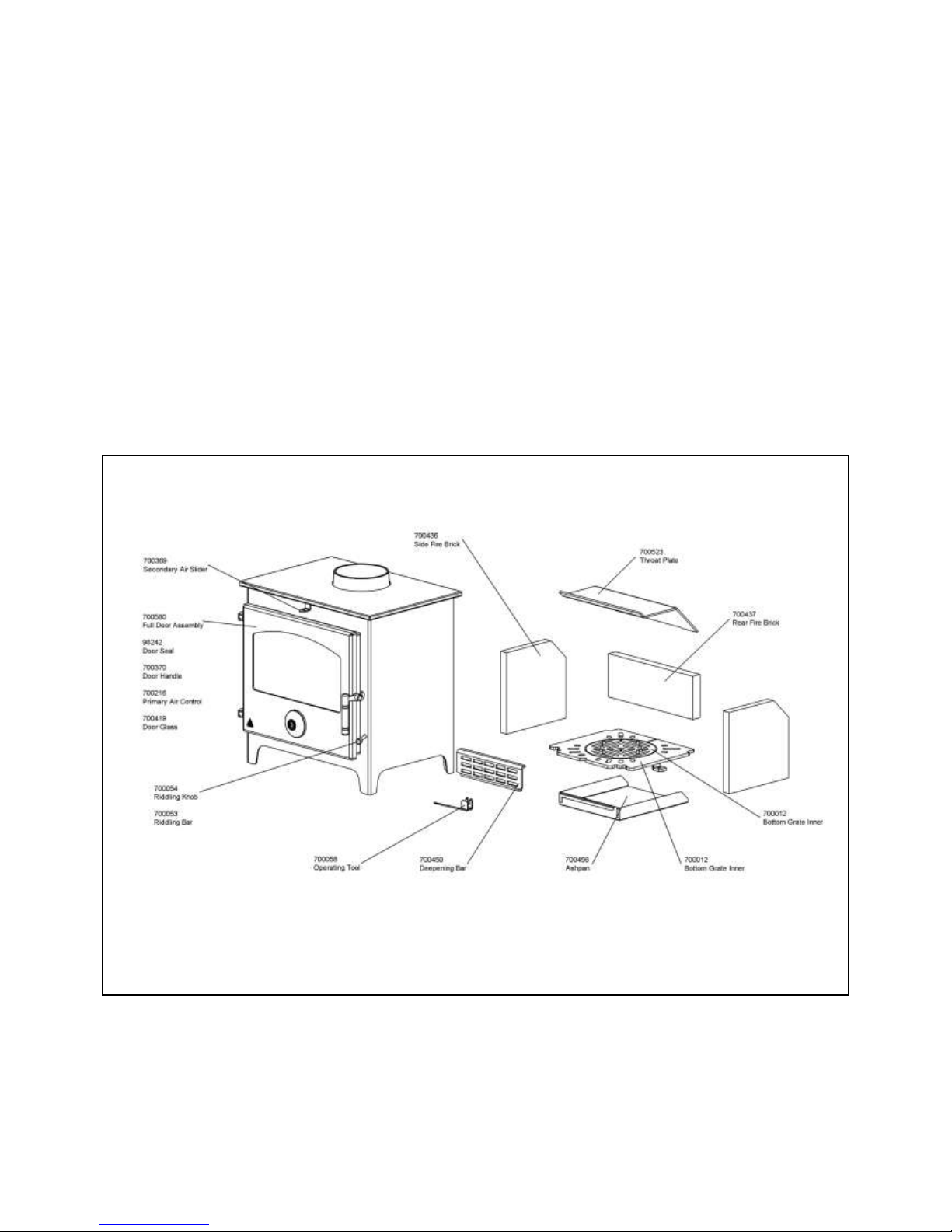
Before assembling the stove, ensure all packaged parts
have been removed from inside. Inspect the stove to
ensure no damage has occurred during transit. Ensure all
parts have been provided (see fig 7, page 13).
Siting
Before installation, ensure the building has a load bearing
rating sufficient for the stove's weight. Suitable measures
(e.g. a load distributing plate) should be taken if
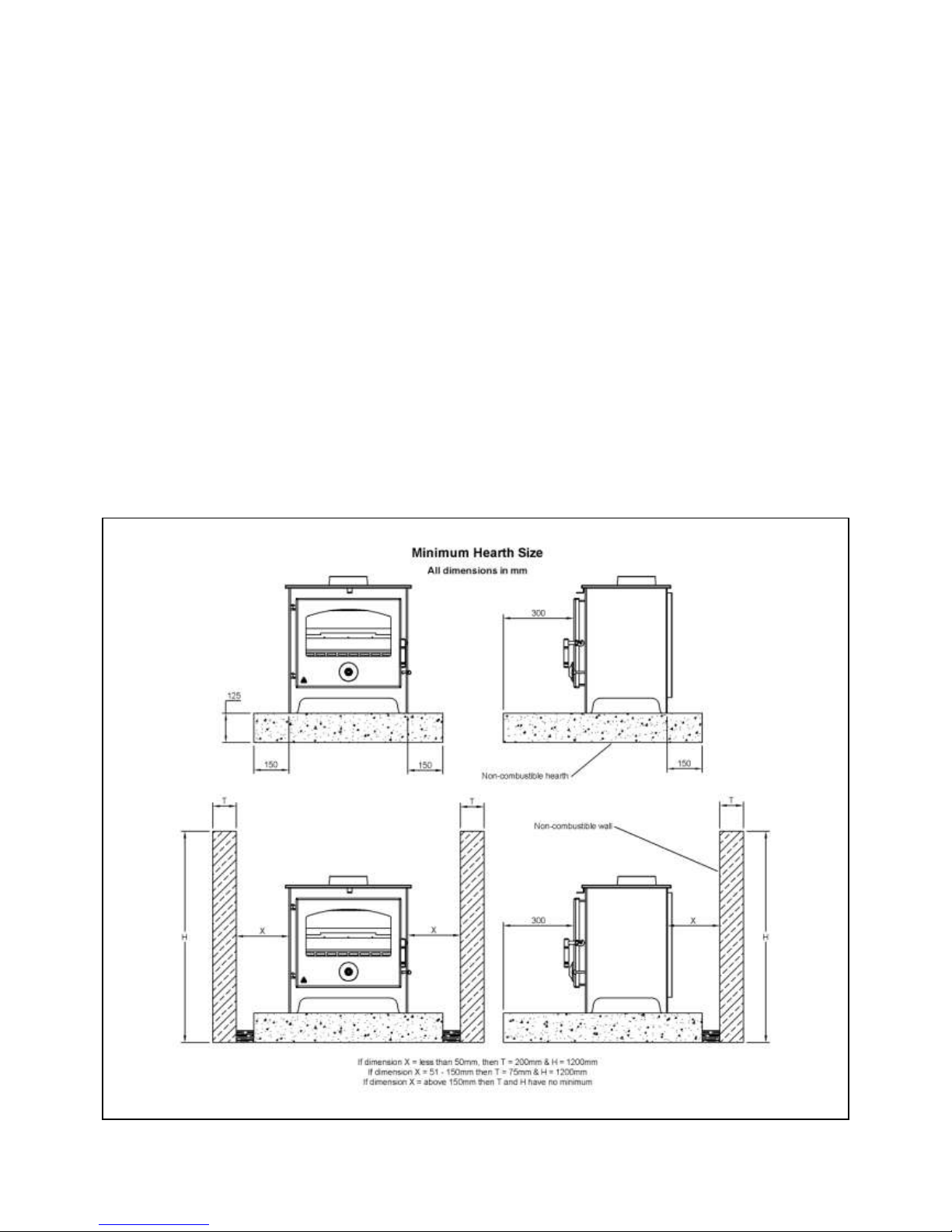
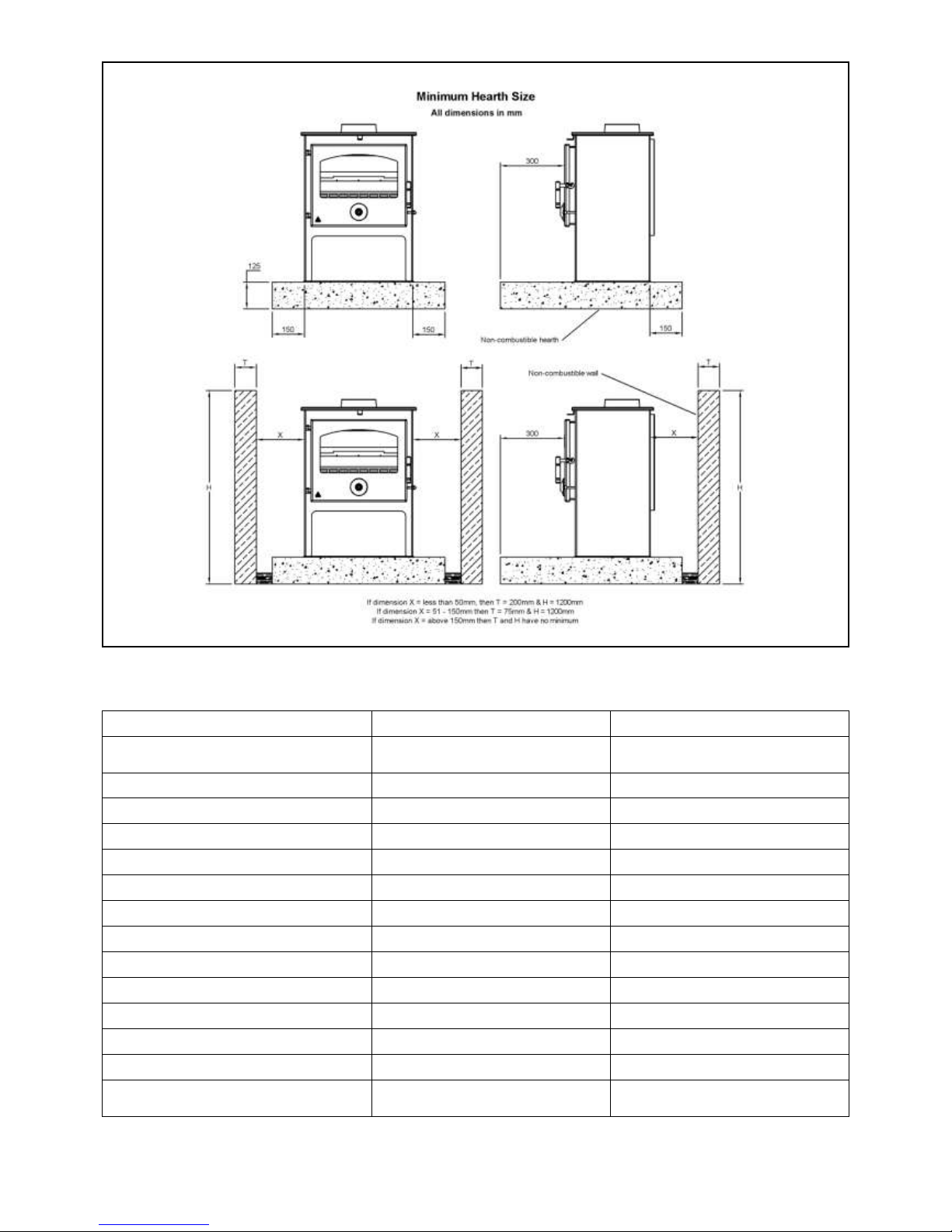
inadequate. The stove should be placed on a noncombustible hearth that adheres to the clearances in
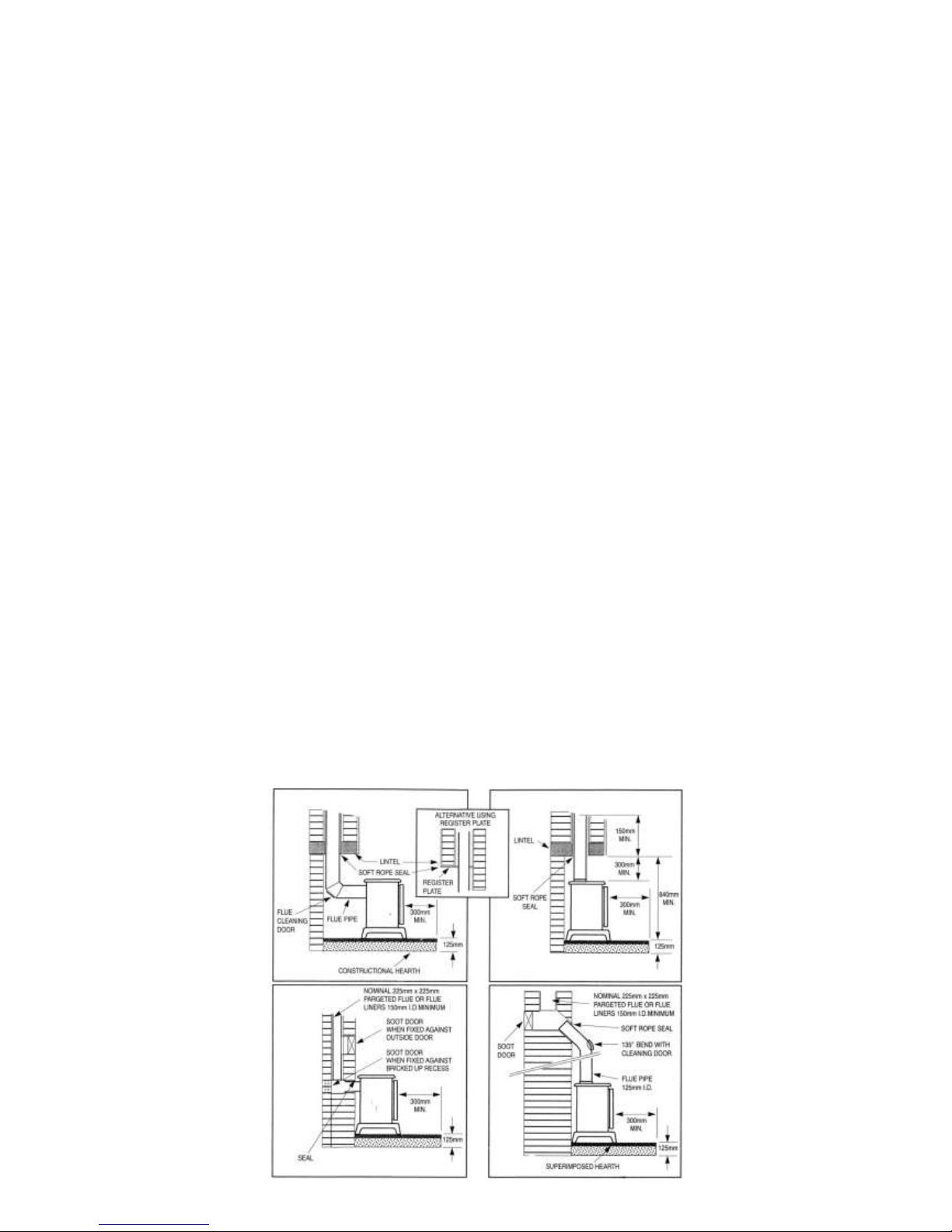
fig 2 & 3.
The stove can be installed in a recess if the hearth is level
and, with the adjacent walls, conforms to current Building
Regulations. The size of the recess is determined by the
types of material used.
Always leave access for future cleaning and servicing of
the stove, flue socket and flue.
The stove, recess hearth and chimney installation should
conform to relevant British Codes of Practice, BS 8303,
BS EN 15287-1.
Fig 2
Page 11
11
TECHNICAL SPECIFICATION
Smokeless Fuel
Wood
Recommended Fuels
Smokeless solid fuel for closed
appliances
Seasoned wood with <20%
Moisture content
Recommended Refueling Interval
4 hours
1 hour
Nominal Output
7.7 kW
8.3 kW
Efficiency
67.0%
67.2%
Weight (empty)
93 kg
93 kg
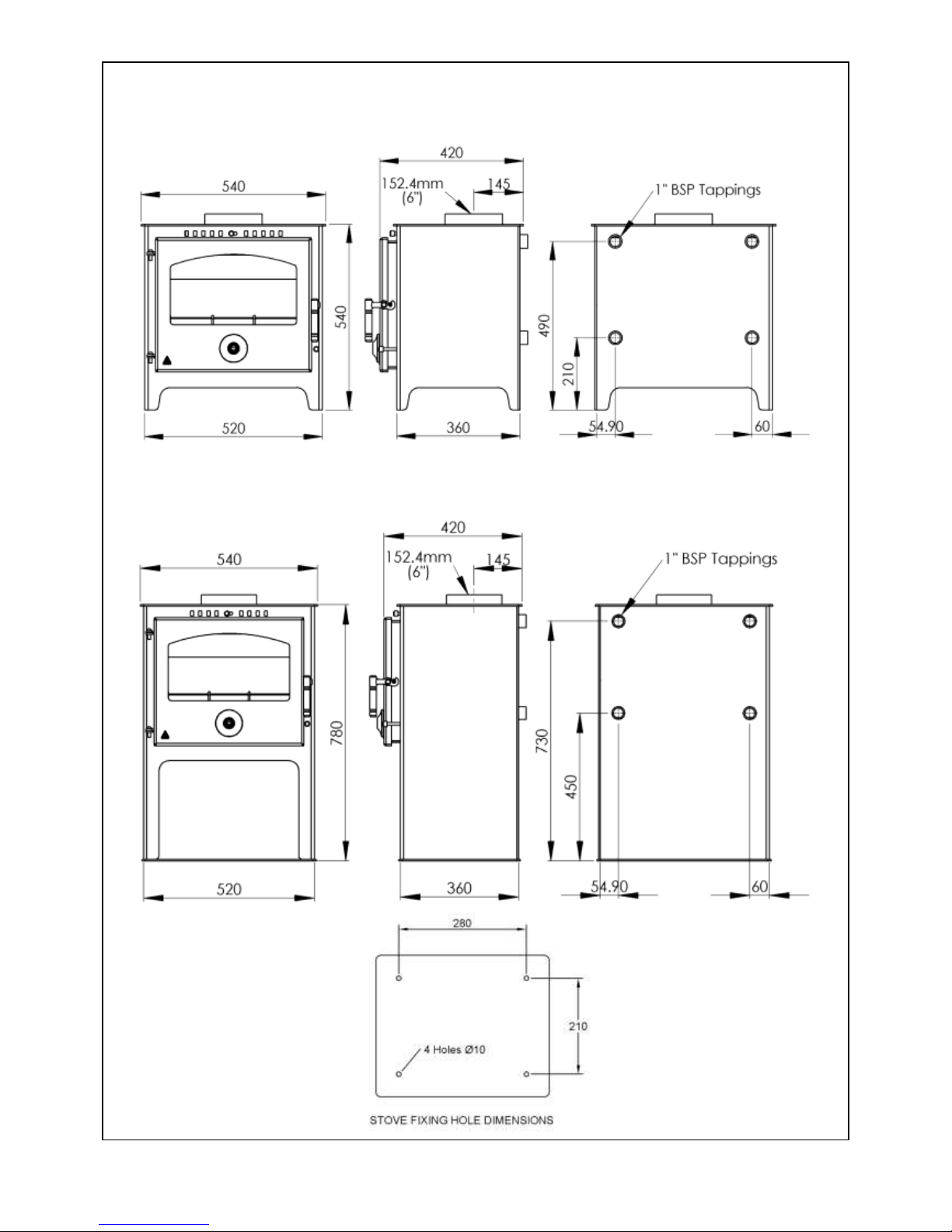
Dimensions – Standard (H x W x D)
540 x 540 x 420
540 x 540 x 420
Dimensions – Pedestal (H x W x D)
780 x 540 x 420
780 x 540 x 420
Flue Socket
152.5mm (6”)
152.5mm (6”)
Flue Gas Temperature (at outlet)
382°C
309°C
Flue Draught Requirement
0.04-0.06 in WG
0.04-0.06 in WG
Flue draught (nominal output)
0.048 in WG
0.048 in WG
Flue gas mass flow
9.0 g/s
6.4 g/s
Hearth (W x D x T)
820 x 865 x 125
820 x 865 x 125
Minimum Distance To Combustibles
Rear 1000mm
Sides 800mm
Rear 1000mm
Sides 800mm
Fig 3
Page 12
12
All dimensions in mm
Fig 4
Page 13
13
Chimney
For correct operation of the stove, the height of the
chimney from its base should not be less than 4.5m and it
should terminate above the roof in accordance with
current Building Regulations. All requirements as outlined
in BS EN 15287-1:2007 design, installation and
commissioning of chimneys should be observed. Failure
to observe the recommended minimum sizes or methods
of flue connection may lead to fume emission and reduce
burning rates.
When fitting the stove to an existing chimney, its internal
and external condition should be checked before the
appliance is installed. The chimney must be swept before
installation. The flue must be stable and free from all
jointing compounds.
If the stove is fitted in place of an open fire then the
chimney should be swept one month after installation to
clear any soot falls which may have occurred due to the
difference in combustion between the stove and the open
fire.
Where the chimney is believed to have served an open
fire installation it is possible that the higher flue gas
temperature from the closed appliance may loosen
deposits that were previously firmly adhered, with the
consequent risk of flue blockage. It is therefore
recommended that the chimney be swept a second time
within a month of regular use after installation.
Ensure a new chimney is free of internal projections, such
as jointing compounds, before installing the appliance.
The stove must not share a chimney with another
appliance.
When using a factory-made insulated chimney, it must
comply with BS 1856-1. The chimney and connecting flue
pipe must have a minimum diameter of
150mm and its dimension should not narrow to less than
the size of the outlet socket of the stove at any point.
After deciding whether to use the top or rear exit on the
stove, fit the flue socket plate and blanking plates in the
required positions, ensuring a good seal is made with fire
cement or similar. When using the rear exit, always use an
appropriate tee; a 90° elbow should not be used.
Advise the end user to have the chimney thoroughly
swept at least every twelve months. If bituminous coal or
wood is used, the chimney may require more frequent
sweeping.
Flue layout
If the stove is installed in an existing recess directly below
a chimney flue, the exhaust end of the flue pipe must
extend into the throat of the chimney, at least 150mm
into the overhanging brickwork. Any cavities or pockets
above the throat plate should be filled.
If the stove is connected via flue pipe to an existing brick
chimney, square bends and horizontal runs must not be
used. A cleaning door must be included at every bend.
See fig 5 below for details.
Avoid extended horizontal flue runs. Whichever method
of installation is used, air must not be allowed to enter
the chimney, save through the stove; all joints must be
airtight. If the chimney is unlined and there is doubt as to
its condition, it should be lined in accordance with current
Building Regulations.
Provision must always be made for sweeping the
chimney. Cement pipes and fittings must not be used
within 2m of the stove outlet. Plain pipe chimneys are not
recommended, but propriety makes of insulated
chimneys may be suitable; refer to manufacturers'
guidance.
Fig 5
Page 14
14
Air supply
A permanent, unobstructed air vent is required. It must
communicate directly with the outside or an adjacent
room which itself has a permanent air vent. The vent
must have a minimum effective area of 550mm2 per kW
of rated output above 5kW. Position the vent in a place
not liable to accidental blockage.
Extractor fans
If an extractor fan is located close by, it could affect the
stove's performance. The supply of air should be such
that the operation of the stove and chimney are
unaffected when the extractor fan is running. A separate
air supply may be required.
A flue draught interference test will determine whether
the extractor fan is having an effect. Where the fan is in
the same room as the appliance, close all windows and
doors. Where the fan is in an adjacent room, close all
external doors and windows, but leave the internal doors
open. Set the extractor fan to full capacity; after the fan
has established its normal airflow pattern, perform
combustion analyses of the stove at minimum and
maximum outputs. Perform similar tests while the fan is
switched off.
Interference tests should also be carried out if there are
other appliances close by that move air to the outside,
such as tumble dryers.
COMMISSIONING
Ensure all parts are correctly fitted, and that the
stove is set for the correct fuel.
Check the operation of: the door catch (ensuring it
holds the fire door tight); the bottom grate riddling
mechanism (using the tool supplied); the air regulator
wheel; and the air wash control.
Test the flue draught. The minimum draught required
is 0.04 in WG; the maximum allowed is 0.06 in WG.
Light the stove and allow to reach a steady burn
before checking for fume leakage into the room;
open the door and carry out a spillage test.
Demonstrate the methods of operation to the end
user. Explain the need for an annual service and
regular maintenance schedule. Record your details in
the space provided at the rear of this manual.
Ensure these instructions are left in the end user's
possession.
Fig 6
Internal Component Assembly
Page 15
15
SERVICING
Every year, the stove should be serviced and the chimney
swept. Always use a qualified engineer. The best time is
just after the end of the heating season, when the stove is
not likely to be in use. Allow the stove to cool before the
engineer attends. Procedure:
Remove the front grate, fire bricks, throat plate,
bottom grate and ash pan.
Sweep the chimney thoroughly from an accessible
position (see fig 5, page 12).
Clear out any large deposits from inside the
combustion chamber and vacuum that which
remains. If necessary, scrape off deposits that have
attached to the walls of the chamber.
Clean the throat plate, bottom grate and front plate
with a wire brush. Use a soft brush for the firebricks.
Replace any damaged items and re-fit in the reverse
order.
Remove the door glass and clean with a damp cloth;
wipe with a dry cloth. Inspect and replace the door
seal if necessary.
Check operation of the door catch, ensuring a tight seal is
made.
Fig 7
Page 16
16
PLUMBING
Please read these notes prior to installing your stove:
A boiler stove will have a lower combustion temperature
than a dry stove and will not reach the clean burn state as
readily.
A circulation pump MUST be fitted on the return to the
boiler, and must be controlled by pipe thermostats.
Do not fit the stove to a fully pumped system, or sealed
system. Always use open vent.
Ensure the system is fitted with a heat leak radiator,
which should be 30% of the total boiler output.
Do not plumb under-floor heating directly into the circuit;
a buffer tank or thermal store should be used.
A buffer tank or thermal store is a very efficient method
of providing heat from the store. The stove is fired flat out
to heat the buffer tank and then can be allowed to go out.
The buffer tank in conjunction with the electric controls
will provide mains pressure hot water and circulation
water as and when required.
The buffer tank can be plumbed directly to the stove with
the relevant safety devices to BS 1566, and must be sited
a minimum of 1800mm above the boiler.
PIPE THERMOSTATS
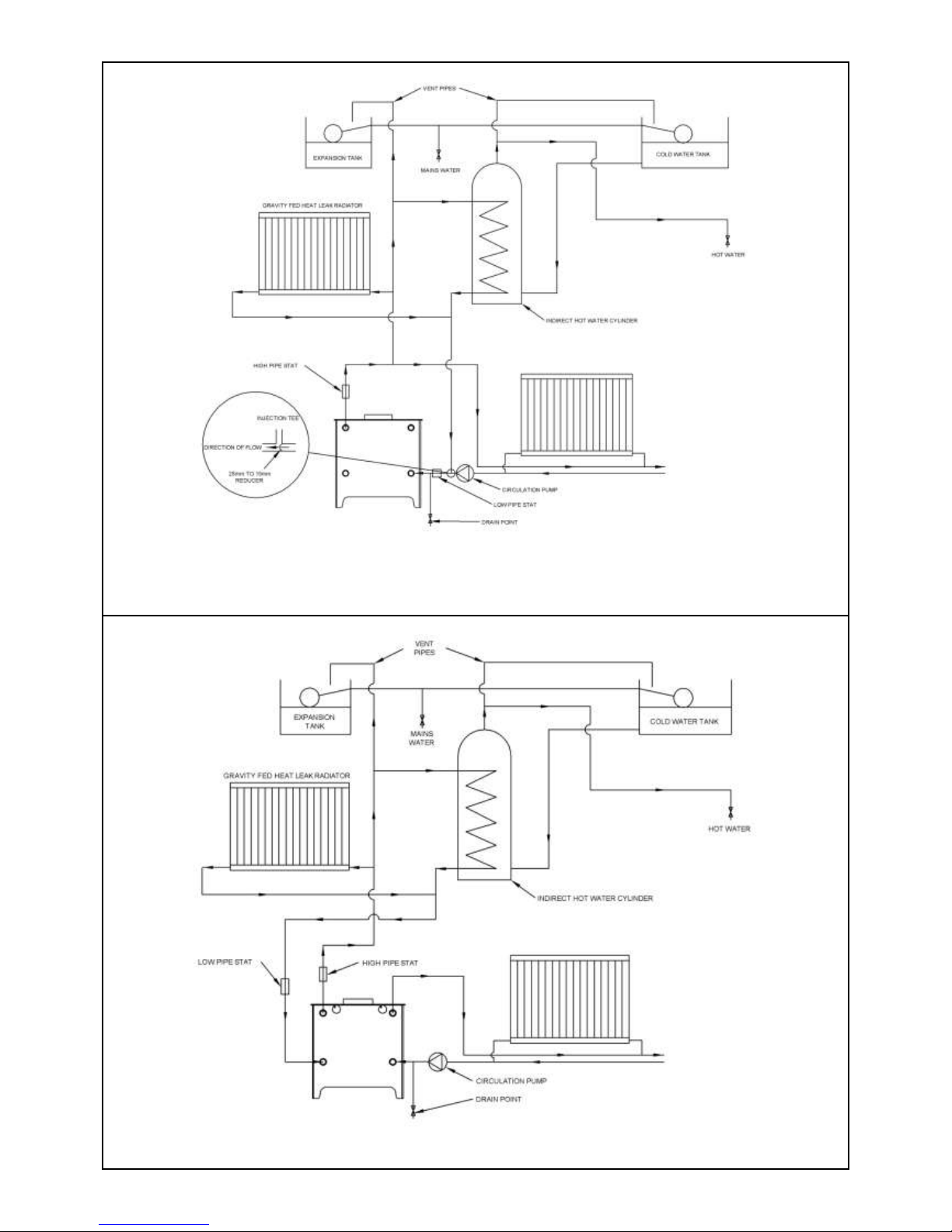
If the stove is intended for use on both domestic hot
water and central heating should have an indirect hot
water cylinder to the current issue of BS 1566 Copper
indirect cylinders for domestic purposes Part 1, a
circulating pump and a heat leak radiator see fig’s 8 and 9.
The heat leak radiator will protect the system in the event
of an electrical power or circulating pump failure. To
maintain safety and prolong the life of the boiler, the
following three devices should be fitted to the system.
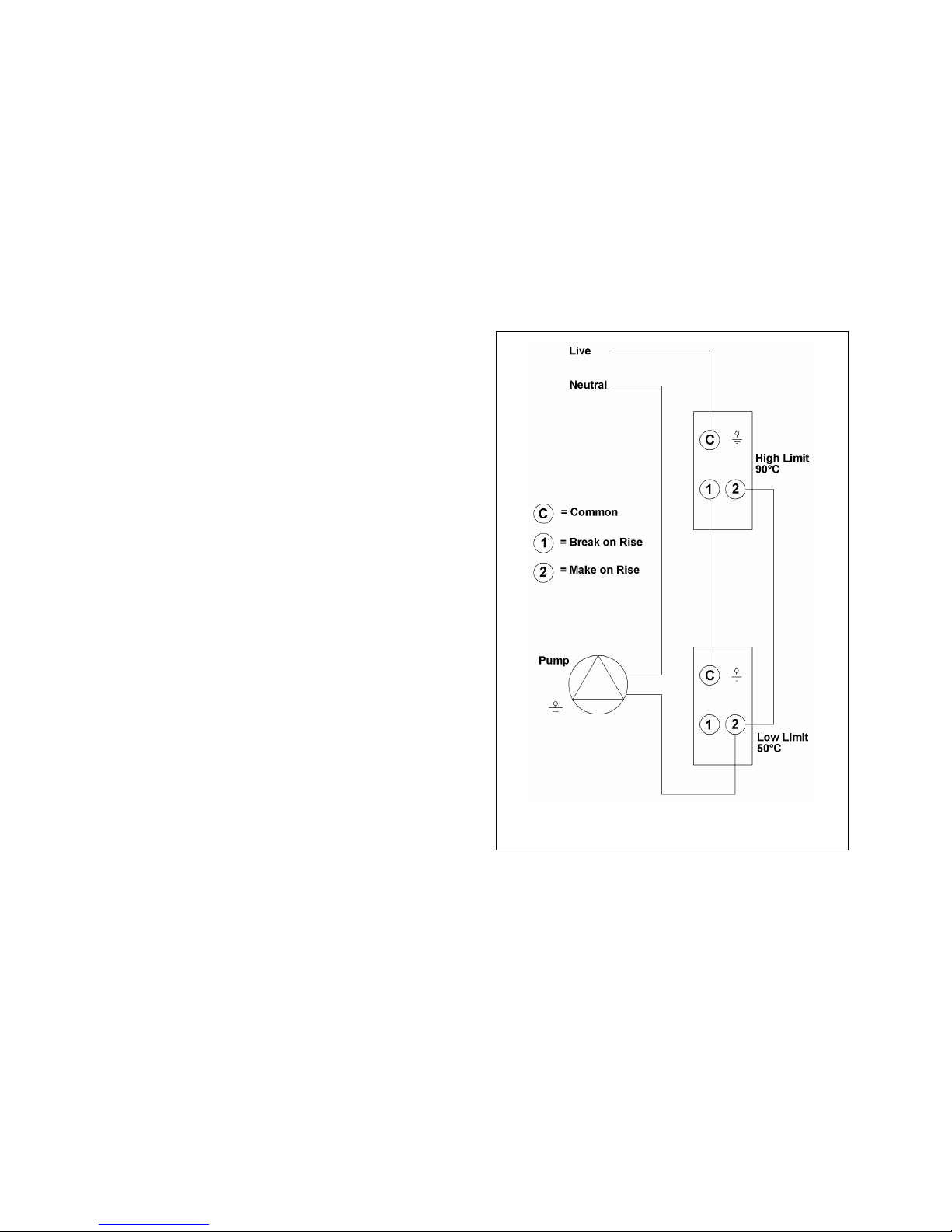
1 High Temperature Pipe Thermostat
This is clamped on to main gravity flow water pipe, and
switches the pump on when the boilers/pipe temperature
rises. The thermostat should be set between 85°C and
95°C to ensure that the cylinder hot water does not boil,
but is dissipated around the central heating circuit.
2 Low Temperature Pipe Thermostat
This is clamped on to the main return pipe and should be
set between 45°C and 55°C and switches the pump off
when the temperature of the water returning the system
or hot water cylinder begins to fall. It ensures that cold
water does not circulate through the stove as this would:
A) Allow the heating circuit to take heat from the hot
water cylinder.
B) Cause condensation to form on the inside of the stove
boiler and cause premature failure of the stove.
C) Create a cold flue/chimney and the associated
condensation/tar problems.
The stove must have a continuous supply of warm/hot
water circulating from the boiler to the hot water
cylinder, and when the pump is on circulating around the
radiators. The stove must be run at a sufficiently high
temperature to maintain this. It is important that the
boiler’s output is sufficient to achieve this. When
calculating the kilowatt room output of where the stove is
fitted should also be taken into account.
3 Injection Tee (see fig 9)
To prevent the 70% of the central heating load from
gravitating around the radiator circuit and creating cold
water problems when the circulation pump is off.
Fig 8: Pipe Thermostats – Wiring Diagram
Page 17
17
Typical 2 pipe central heating circuit
Fig 9
Typical 4 pipe central heating circuit
Fig 10
Page 18
18
The following information should be provided upon installation of the
appliance for householder reference:
Installation Engineer:
Company:
Company Address:
Company Tel. No:
Page 19

19
Page 20

20
TR ENGINEERING LTD
Thorncliffe, Chapeltown,
Sheffield, S35 2PH.
Tel: (0114) 2572300
Fax: (0114) 2571419
www.trianco.co.uk
Copyright in this brochure and the drawings and illustrations contained within are vested in TR Engineering Ltd
and neither the brochure or any part thereof may be reproduced without prior written consent.
TR Engineering’s policy is one of continuous research and development. This may necessitate alterations to this specification.
Instructions correct at time of going to print.
January 2013
Item No. 700484 Iss. 4
 Loading...