

Page 1
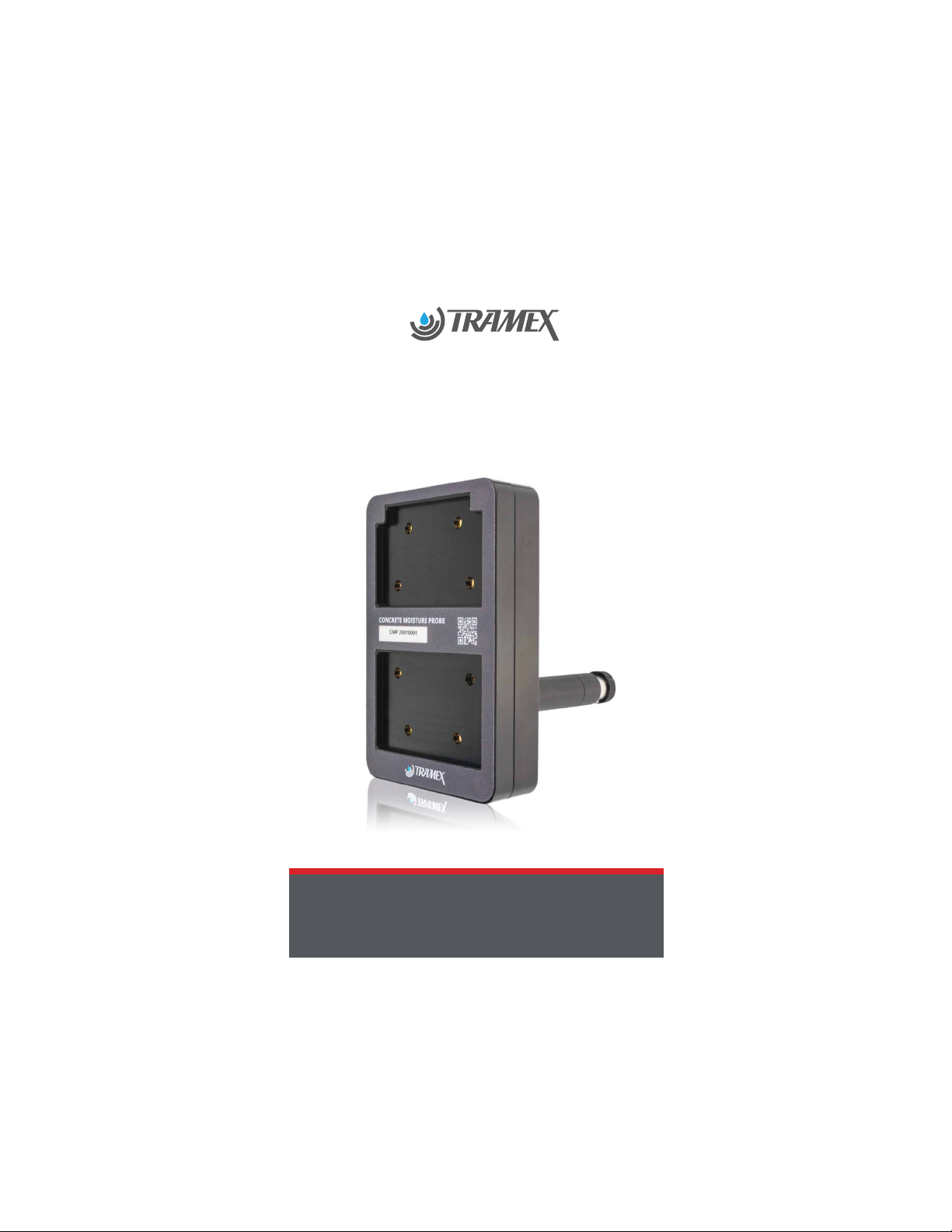
CONCRETE
MOISTURE PROBE
‘THE DETERMINATOR’
- CMP -
USER GUIDE
Find Quality Products Online at: [email protected]
www.GlobalTestSupply.com
Page 2

CONCRETE MOISTURE PROBE ‘THE DETERMINATOR’ USER GUIDE
INTRODUCTION
Thank you for selecting the Concrete Moisture
Probe, a.k.a. The Determinator, from Tramex.
This Concrete Moisture Probe functions in conjunction with the Tramex CME Concrete Moisture
Encounter range to provide the Tramex Unified
Moisture Content Test Method for quantitative
moisture content measurements in both the
top ¾ inch (20mm) layer and within the body of
concrete floors and slabs.
This instant and precise quantitative measurement of moisture content is based on the
gravimetric oven testing method. The use of %MC
readings for both the in-situ and the nondestructive top ¾” (20mm) layer tests eliminate
confusion between different testing method data.
3
Find Quality Products Online at: [email protected]
www.GlobalTestSupply.com
Page 3
CONCRETE MOISTURE PROBE ‘THE DETERMINATOR’ USER GUIDE
HOW IT WORKS
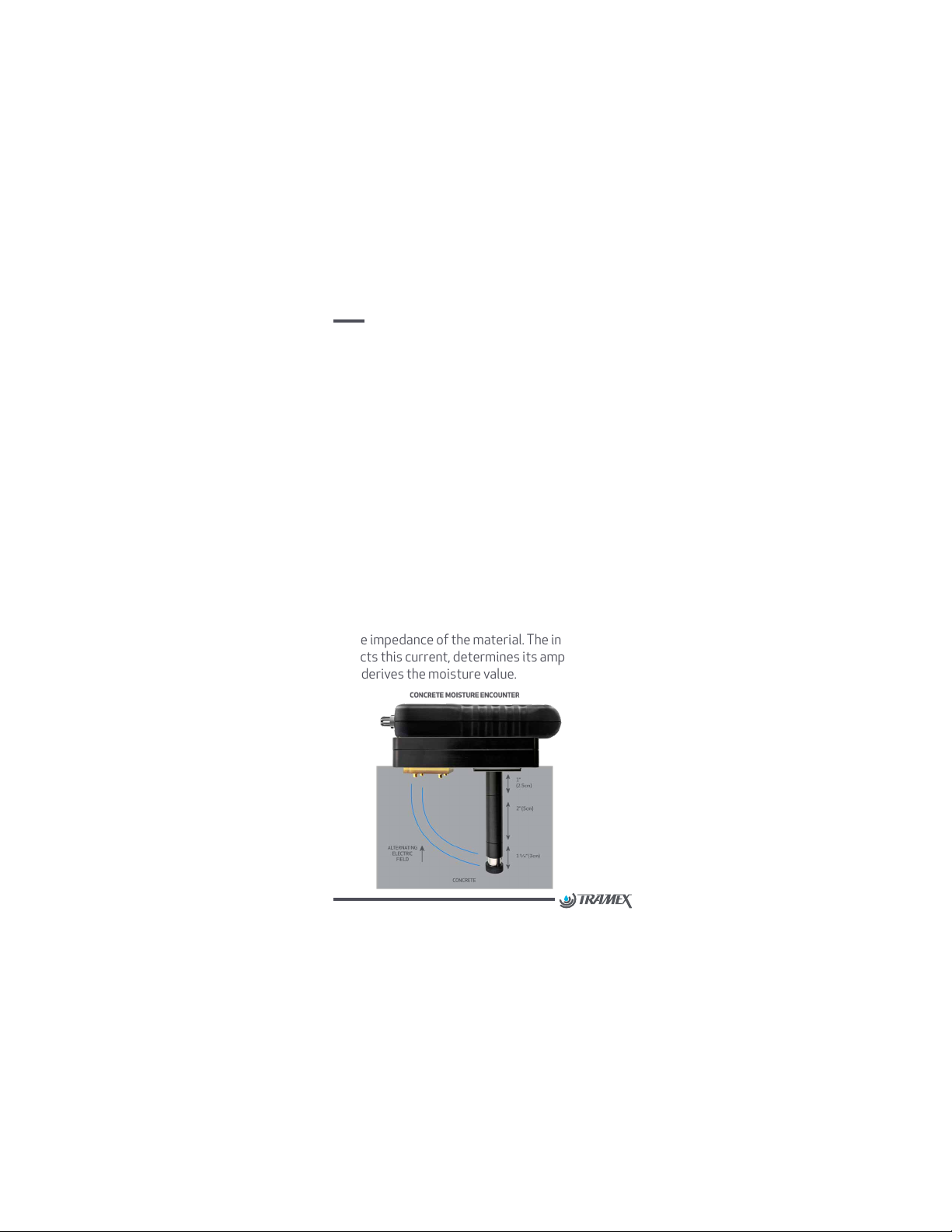
The Concrete Moisture Probe when used with
Tramex CME instruments operates on the
principle that the electrical impedance of a
material varies with its moisture content. The
CME instrument is pressed onto the CMP cradle
which is pressed onto the material surface with
the pins fully compressed and the probe inserted
into the pre-drilled hole (using 3/4 inch / 19mm
drill-bit) to measure the moisture content. The
electrical impedance is measured by creating a
low frequency alternating electric field between
the electrodes and the probe, to a depth of up to
4” (100mm). This field penetrates the material
under test. The very small alternating current
flowing through the field is inversely proportional
to the impedance of the material. The instrument
detects this current, determines its amplitude and
thus derives the moisture value.
4
Find Quality Products Online at: [email protected]
www.GlobalTestSupply.com
Page 4

CONCRETE MOISTURE PROBE ‘THE DETERMINATOR’ USER GUIDE
The Concrete Moisture Probe functions with
the Tramex CME Concrete Moisture Encounter
meters. The CMP does not require batteries. The
CMP does not require calibration. The probes are
reusable, extendable and replaceable. No holeliners are necessary. The hole diameter required is
the same for the Hygro-i2 RH test as per F2170.
5
Find Quality Products Online at: [email protected]
www.GlobalTestSupply.com
Page 5

CONCRETE MOISTURE PROBE ‘THE DETERMINATOR’ USER GUIDE
OPERATING INSTRUCTIONS
The Tramex Unified Test Method for concrete
comprises both non-destructive moisture content
testing of the top ¾”(20mm) layer and in-situ
moisture content testing. We also recommend
performing parallel tests of the ambient conditions and dew-point, as well as in-situ RH tests as
per ASTM F2170. All of these tests can be performed using the CMP with the Tramex CMEX5
and accessories.
The Concrete Moisture Probe is designed for
%MC measurement of concrete using the
concrete scale on your Tramex CME meter, but
can also be used with the Reference scale and
other scales where the depth of the cementitious
materials permits.
Drying time for concrete floors and screeds
Concrete floors and screeds must be allowed to
dry to an adequate level before the installation of
sheet material, tile, wood or coating. Manufacturers of such systems generally require moisture
testing to be performed before installation on a
floor slab. Moisture content measurement is one
such method. Excessive moisture in or permeating
from a floor covering or coating can cause failures
such as condensation, blistering, delaminating,
movement and general deterioration of the finished flooring/coating.
6
Find Quality Products Online at: [email protected]
www.GlobalTestSupply.com
Page 6

CONCRETE MOISTURE PROBE ‘THE DETERMINATOR’ USER GUIDE
There is also a risk of promoting microbial growth.
No exact period can be specified for the drying
of such floors to reach acceptable moisture
content, as this is affected by temperature and
humidity within the building as well as concrete
curing times and other factors. Typically a period
of 1 month per inch (25mm) depth of concrete
or sand/cement screed is often quoted. Longer
periods may be required in areas of high humidity
or low temperature.
During the drying period and prior to applying
the floor covering, the floor should be regularly
checked to monitor moisture content.
Testing for moisture content in a floor slab.
Pre-test conditioning and preparation
For best and most accurate results, final tests
should be carried out after the internal conditions
of the building in which the slab is located have
been at normal service temperature and humidity for at least 48 hours. All artificial heating or
drying equipment should be turned off at least
96 hours before final readings are attempted,
otherwise results may not accurately reflect the
amount of moisture present or moisture movement in the slab during normal operating conditions. If being used for the final test while artificial
heating or drying equipment is on, the readings
should only be considered as an indicative guideline for monitoring purposes, and not as the final
7
Find Quality Products Online at: [email protected]
www.GlobalTestSupply.com
Page 7

CONCRETE MOISTURE PROBE ‘THE DETERMINATOR’ USER GUIDE
test. Prior to testing, the actual test area should
be clean and free of foreign substances.
Pre-testing guidelines
Where covered floor slabs are being tested,
all covering materials, adhesive residue, curing
compounds, sealers, paints, etc., shall be removed
to expose a test area of clean bare concrete. For
removal of any existing flooring or adhesives,
strictly observe all the appropriate safety and
health practices relevant to cleaning and removal
of these types of materials. Removal of covering
materials and cleaning, if required, should take
place a minimum of 48 hours prior to testing. Use
of water based cleaning methods that could lead
to elevated surface and/or subsurface moisture
levels in the floor slab are not recommended, and
the testing after such treatment could result in
elevated readings. No visible water in liquid form
should be present on the concrete at the time
of testing. Avoid testing in locations subject to
direct sunlight or sources of heat.
Use of artificial aids for accelerated drying of
concrete is not recommended. If they are being
used it is recommended they should be turned off
at least four days before taking final readings.
8
Find Quality Products Online at: [email protected]
www.GlobalTestSupply.com
Page 8

CONCRETE MOISTURE PROBE ‘THE DETERMINATOR’ USER GUIDE
Guideline Non-Destructive test (NDT) procedures
as per International Standards
1. Remove any dust or foreign matter from the
Concrete Moisture Encounter electrodes
before commencing tests. Make sure that the
floor slab being tested is clean and bare and
free from dust, dirt or standing water.
2. Push the button and press the instrument
directly onto the surface of the material
being tested ensuring that all of the electrode
spring loaded pins are fully compressed. Read
the moisture measurement from the appropriate scale of the display.
3. On a rough surface, take a number of readings
in close proximity to one another such as 3 to
5 readings within an area of 1 ft² (929cm² )
at each location. If the readings vary, always
use the one with the highest value.
4. Perform at least eight tests for the first
1000ft² (100m² ) and at least five additional
tests for each additional 1000ft ² (100m²).
Include test locations in the centre of the
floor and within 3ft (1m) of each exterior wall.
9
Find Quality Products Online at: [email protected]
www.GlobalTestSupply.com
Page 9

CONCRETE MOISTURE PROBE ‘THE DETERMINATOR’ USER GUIDE
Guideline In-Situ Moisture Content Probe test
Procedure
1. Perform 3 per 100m ² (1000ft² ) and 1 per
next 100m², similar to ASTM F2170 recommendations for frequency of use. Holes must
be drilled dry and perpendicular (90˚), do not
use water for cooling or lubrication.
2. Determine the approximate depth of the
concrete slab. Connect the probe and extensions if required to the appropriate depth,
depending on the thickness of the slab. Use
the following as guidelines for probe extensions required:
• 1 1/4” (3cm) probe depth for concrete
between 2” to 4” (5 to 10cm)
• 2 1/4” (5.7cm) probe depth for concrete
between 4” to 6” (10 to 15cm)
• 3 1/4” (8.3cm) probe depth for concrete
between 6” to 9” (15 to 22cm)
• 4 1/4” (10.8cm) probe depth for concrete between 9” to 11” (22 to 28cm)
• For slabs drying from both sides (top
and bottom), the probe should be placed
into the middle of the slab.
10
Find Quality Products Online at: [email protected]
www.GlobalTestSupply.com
Page 10

CONCRETE MOISTURE PROBE ‘THE DETERMINATOR’ USER GUIDE
3. Remove any dust or foreign matter from the
Concrete Moisture Probe and electrodes
as well as from the CME concrete meter
electrodes before commencing tests. Make
sure that the floor slab being tested is clean
and bare and free from dust, dirt or standing
water.
4. Place the Concrete Moisture Probe in the
hole and the surface electrodes onto the surface of the material being tested. Place your
Tramex meter into the cradle of the CMP and
ensure that all of the electrode spring loaded
pins are fully compressed, both on the CMP
and the CME.
5. Take 4 readings by turning the Concrete
Moisture Probe and CME meter from ‘12
o’clock’ to 3, 6 and 9 o’clock positions.
Record the highest reading, discarding any
obvious anomalies.
6. Record the readings using the Tramex Meters App (when using the CME5 or CMEX5).
Interpretation of Concrete Moisture Probe
In-situ & NDT Readings in Concrete:
In newly poured concrete, the in-situ % Moisture
Content is expected to be approximately 0.5 –
1% higher than the top ¾” (20mm) surface layer
% Moisture Content value.
When readings outside these expected values are
taken, potential issues can be identified.
11
Find Quality Products Online at: [email protected]
www.GlobalTestSupply.com
Page 11

CONCRETE MOISTURE PROBE ‘THE DETERMINATOR’ USER GUIDE
Example Situation 1:
Readings are higher at the surface than the in-situ
readings in new concrete:
This may be a result of dew point issues, where
condensation has formed at the surface.
Check the ambient conditions and surface temperature of the concrete.
A solution would be to adjust the ambient conditions until concrete corrects itself.
Example Situation 2:
Readings are higher at the surface than the in-situ
readings in older concrete:
If this situation is found, when replacing a floor
covering, it may be the result of an old vapor or
moisture barrier at the surface causing moisture
to collect in the top 3/4 inch (20mm) layer below
the surface.
A solution would be to remove the surface layer
so as to allow the surface to dry out effectively.
Example Situation 3:
Readings more than 1%MC higher from the insitu readings than the surface NDT readings:
This may be due to moisture coming up from the
concrete due to a lack of subfloor barrier.
A solution would be to consider sealing the concrete before installing the floor covering.
12
Find Quality Products Online at: [email protected]
www.GlobalTestSupply.com
Page 12

CONCRETE MOISTURE PROBE ‘THE DETERMINATOR’ USER GUIDE
LIMITATIONS
The Concrete Moisture Probe and Concrete
Moisture Encounter will not detect or measure
moisture through any electrically conductive materials including metal sheeting or cladding, many
types of black EPDM rubber or wet surfaces. The
Concrete Moisture Probe and Concrete Moisture
Encounter are not suited for taking comparative
readings in the concrete substrate through thick
floor coverings such as wood.
WARRANTY
Tramex warrants that this instrument will be free
from defects and faulty workmanship for a period
of one year from date of first purchase. If a fault
develops during the warranty period, Tramex will,
at its absolute discretion, either repair the defective product without charge for the parts and
labour, or will provide a replacement in exchange
for the defective product returned to Tramex Ltd.
This warranty shall not apply to any defect, failure
or damage caused by improper use or improper or
inadequate maintenance and care.
In no event shall Tramex, its agents or distributors
be liable to the customer or any other person,
company or organisation for any special, indirect,
or consequential loss or damage of any type
whatsoever (including, without limitation, loss of
business, revenue, profits, data, savings or goodwill), whether occasioned by the act, breach,
13
Find Quality Products Online at: [email protected]
www.GlobalTestSupply.com
Page 13

CONCRETE MOISTURE PROBE ‘THE DETERMINATOR’ USER GUIDE
omission, default, or negligence of Tramex Ltd.,
whether or not foreseeable, arising howsoever
out of or in connection with the sale of this product including arising out of breach of contract,
tort, misrepresentation or arising from statute
or indemnity. Without prejudice to the above, all
other warranties, representations and conditions
whether made orally or implied by circumstances,
custom, contract, equity, statute or common law
are hereby excluded, including all terms implied
by Section 13, 14 and 15 of the Sale of Goods Act
1893 and Sale of Goods and Supply of Services
Act 1980.
WARRANTY CLAIMS
A defective product should be returned shipping
prepaid, with full description of defect to your
supplier or to Tramex at address shown on the
back of this guide.
PRODUCT DEVELOPMENT
It is the policy of Tramex to continually improve
and update all its products. We therefore reserve
the right to alter the specification or design of
this instrument without prior notice.
14
Find Quality Products Online at: [email protected]
www.GlobalTestSupply.com
Page 14

CONCRETE MOISTURE PROBE ‘THE DETERMINATOR’ USER GUIDE
SAFETY
This Users Guide does not purport to address
the safety concerns, if any, associated with this
instrument or its use. It is the responsibility of the
user of this instrument to establish appropriate
safety and health practices and determine the
applicability of regulatory limitations prior to use.
15
Find Quality Products Online at: [email protected]
www.GlobalTestSupply.com
 Loading...