

Page 1
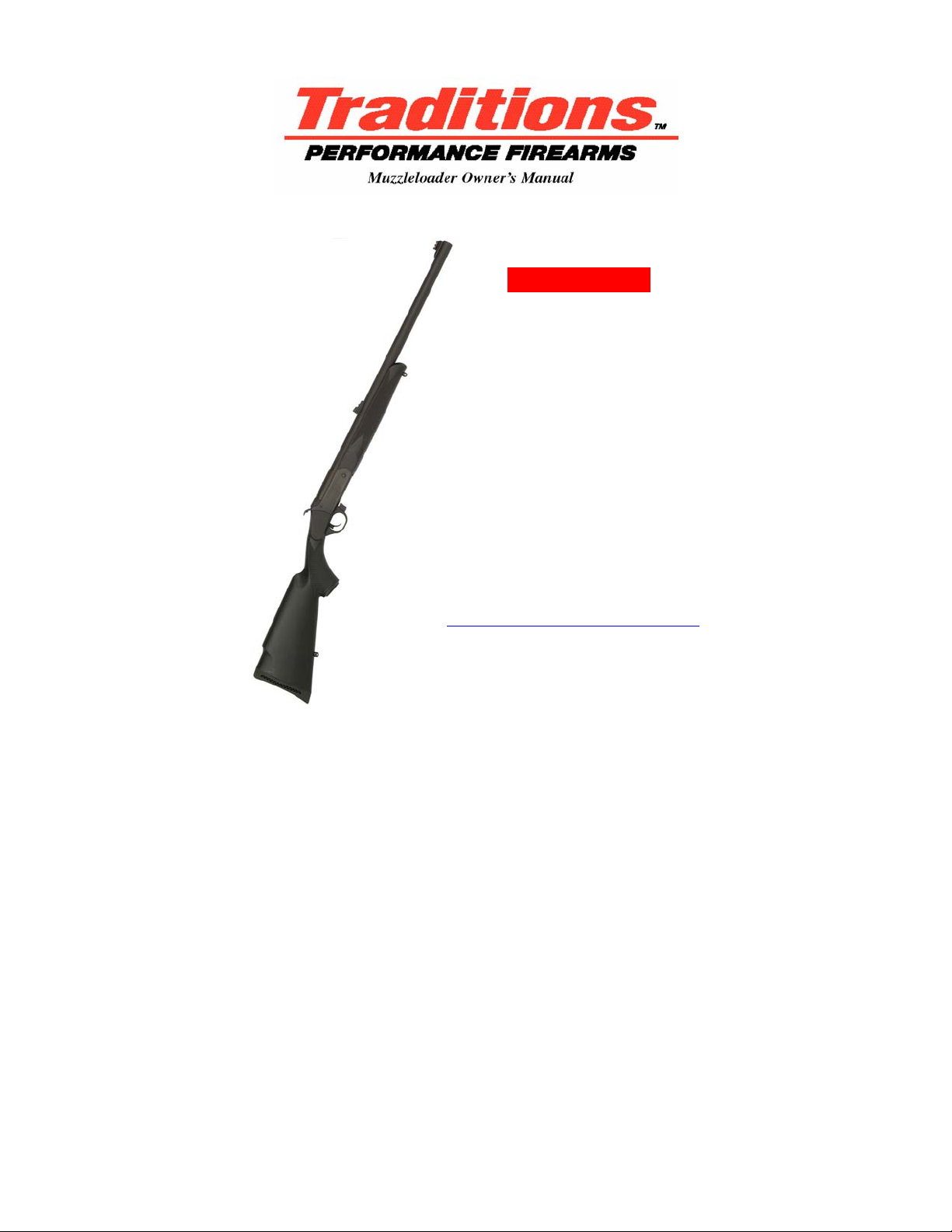
TIP UP OWNERS MANUAL
IMPORTANT!
Thoroughly read and
understand all of the
instructions and warnings in this
manual before using your
Traditions firearm.
Traditions Performance
Firearms
1375 Boston Post Road
P.O. Box 776
Old Saybrook, CT 06475
www.traditionsfirearms.com
email: [email protected]
Traditions Corporate Office
860-388-4656
1
Page 2

I:TRADITIONS’ WARRANTY PROTECTION
INCLUDED WITH YOUR NEW GUN
Thank you for purchasing the Traditions
muzzleloader. Quality, pride and old world
craftsmanship has gone into your new Traditions
muzzleloader. We work hard to provide the best value
and performance possible, we back it up with a limited
lifetime warranty. Should you ever experience
mechanical difficulty with your new Traditions firearm,
be assured that we are staffed and equipped to
correct it quickly. Your satisfaction with your firearm is
very important to Traditions.
PLEASE HELP US SERVE YOU BETTER
In the unlikely event you need warranty service on
your new firearm, we need
your help to get the work done right and without
delay. It’s as easy as dropping us a note or picking up
the telephone. Traditions conveniently engraves the
caliber, serial number and model name on each
barrel. Take note of this information, record it on the
warranty page in this manual and be prepared to state
it when contacting the Traditions Customer Service
Department with your questions. Contact Traditions at
860-388-4656, tell us what problem you are
experiencing and we’ll get busy to remedy your
situation.
2
Page 3

Help is just a phone call away should you experience
a problem. Simply follow these four simple steps and
we’ll get your firearm back in perfect working order in
the shortest possible time.
1. Do not return your firearm to the dealer. You
can save time by following the steps outlined
below.
2. Do call us and describe the problem. Chances are
we can either guide you to a solution right over the
phone or when possible send you the parts you need
to correct the problem.
3. Should your gun need factory service, we will give
you instructions about where to ship it and issue you
a Return Merchandise Authorization number.
4. We will inspect your firearm and make necessary
repairs that are covered under warranty.
Often we can help you by phone, call before you
return your Traditions firearm for service. Good
Shooting! 860-388-4656
Important: All firearms must have a factory issued
Return Merchandise Authorization number
(RMA#) before returning to Traditions for warranty
service.
3
Page 4

TABLE OF CONTENTS
I. Warranty Protection.......................... 2
II. Break Action overview ...................... 5
III. Your Centerfire Rifle ......................... 5
IV. Tip Up Schematics............................ 8
V. Rules of Firearms Safety ............... 10
VI. Safety.............................................. 14
VII. Use of Correct Ammunition............. 15
VIII. Loading & Firing your centerfire rifle16
IX. Failure to Fire.................................. 19
X. Sighting In....................................... 19
XI. Scope Mounting.............................. 19
XII. Cleaning & Disassembly.................20
XIII. Re-assembly................................... 24
XIV. Barrel Obstructions......................... 25
XV. Statement by Sporting Arms & Ammunition
Manufacturers................................. 27
XVI. Superior Accuracy........................... 28
XVII. Helpful Accessories .....................…29
XVIII. Limited Lifetime Warranty............... 29
XIX. Warranty Card................................. 32
4
Page 5

II:BREAK ACTION RIFLE OVERVIEW
Break-Action design firearms are so described due to the
fact that the barrel and receiver are joined by a pivoting
hinge. When the action release is depressed in a rearward
motion, the receiver and barrel open in a breaking motion.
A variety of finishes & stock configurations are available.
Your Tip Up rifle is based off of the Wesson Tip Up. This
is a pre-1900 designed single shot rifle and meets the
requirements of those states that require such a firearm for
use in their primitive seasons. It is important to note though
that safety features have been added to this firearm that
were not part of its original design, but still make the rifle
compliant as a pre 1900 design. Be sure to check your state
for rules and regulations regarding which weapons are legal
for use during prescribed season(s).
III:YOUR CENTERFIRE RIFLE
Congratulations on your purchase of the new Traditions Tip
Up Rifle. You have selected a firearm designed and
engineered to give today’s shooters the highest
performance and optimum accuracy. When given the
respect and care that any firearm demands, you can expect
many years of reliable service and enjoyable hunting from
your Traditions Tip Up firearm. The Tip Up break-open is
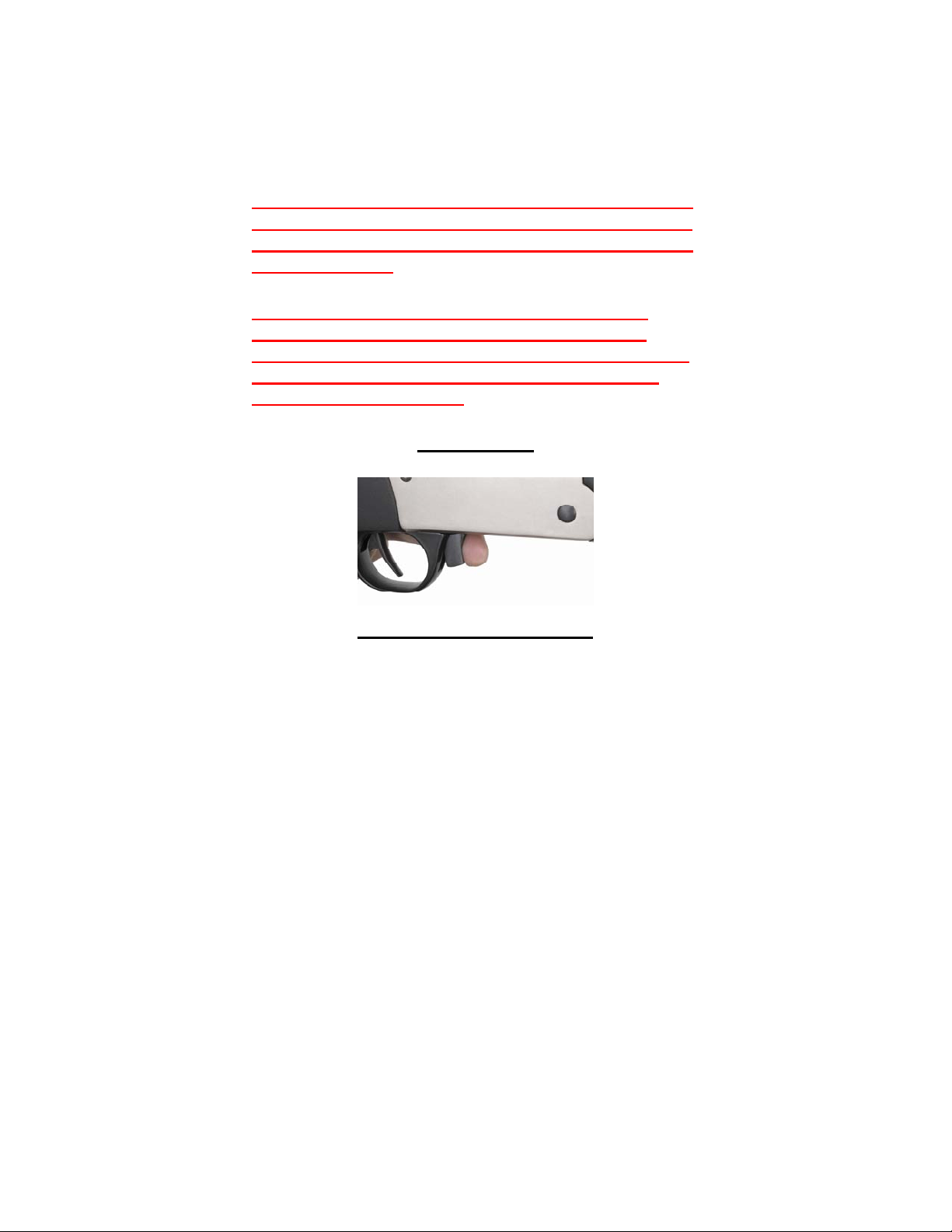
easy to load, shoot and clean. The action release button is
on the front of the trigger guard for ease in opening. The
extended hammer has an ambidextrous spur for left or right
5
Page 6

hand shooting. Built into the trigger guard is a trigger block
safety mechanism, in addition to a hammer block safety.
A person using any firearm has elected to take on an
enormous responsibility. This manual contains instructions,
cautions and dangers for the safe enjoyable use of your
Traditions firearm. Shooting a firearm is a serious
endeavor. These instructions and precautions must be
followed during each shooting session. Safe firearms
handling, loading and shooting are your responsibility and
requires that you understand and respect the design and
function of your firearm. All firearms can be very
dangerous if misused, handled improperly or not properly
maintained. All firearms can be dangerous. Your purchase
of this firearm implies that you accept all the
responsibilities associated with its proper handling, use and
care. Also, if in the hands of another, realize that you have
the duty to insure that that person handles your firearm in
the correct and proper manner.
! CAUTION :If you sell, trade or give this firearm to
another person, be sure to give the new owner a copy of
this manual. Copies of this manual are available free
of charge from Traditions Performance Firearms or
can be downloaded from our website.
Call 860-388-4656, email [email protected]
or go to www.traditionsfirearms.com
6
Page 7

! WARNING: The Tip Up is a centerfire rifle. Its barrel
cannot be interchanged. Traditions does manufacture
“platform” rifles in which the barrels can be
interchanged, but the Tip Up is not one of those
firearms. The Tip Up is strictly a .45-70 single shot rifle.
Traditions Tip Up Rifle(s)
.45-70 Cal only Perc. 1:20” twist
7
Page 8
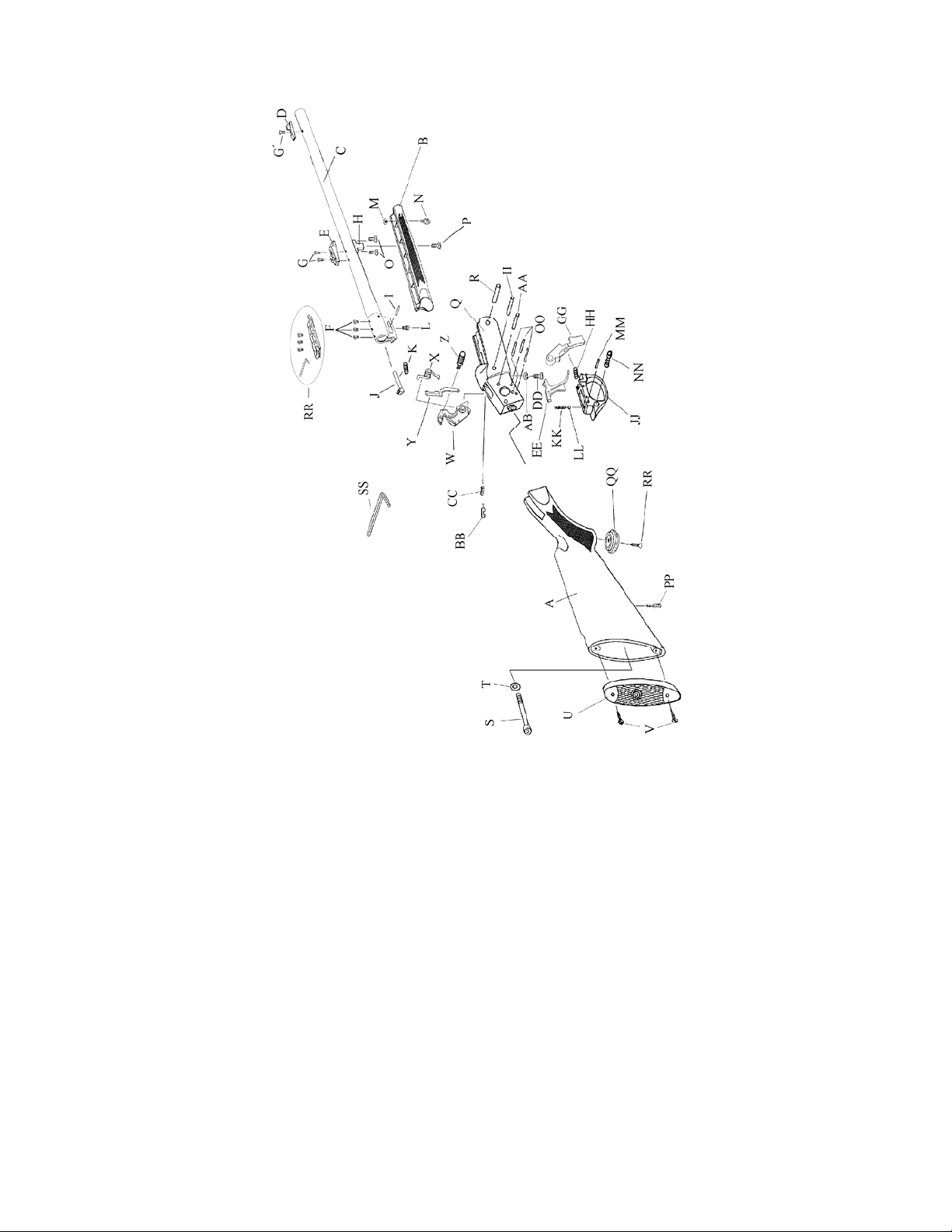
IV.
8
Page 9

Description
A Rear Stock (AW Treestand ST) (Finished)….... FCS71009-2 ST
B Fore Stock (AW Treestand ST) (Finished)…… FCS74009-1ST
C Barrel Assembly (Kit) (Length 24”)
.45-70 cal. perc. (twist 1-20”)............................. C-100450-9
Barrel Assembly (Finished) (Length 24”)
.45-70 cal. perc. Treestand (twist 1- 20”)... .......... FB100459
D Front Sight…………………………………... 70220
E Rear Sight…………..............................…........ 60193
G Rear Sight Screw (2)…………………………... M73620
G’ Front Sight Screw……………………………… M73621
F Plug Screw (3)..................................…............... 26029
H Tennon…………………………………………. M720023
I Extractor Pin…………………………………… 720025
J Extractor………………………………………. 72411
K Extractor Sring………………………………… M72015
L Extractor Screw……………………………….. 720021
M Sling Swivel Stud – Front nut............................. 60122
N Sling Swivel Stud – Front…............................... 37122
O Tennon Screw (2)…………………………….. 400016
P Forend Stock Screw..…………………………. 10035
Q Frame (Alloy/Blued)…………………….…….. 72004
R Frame Pivot Pin………………………………... 710024
S Tang Screw…………………………………….. 71016
T Tang Screw Washer…………………………… 71019
U Buttpad………………………………………… 74026
V Buttpad Mounting Screw (2)………………... 20634
W Hammer……………………………………... 10302
X Hammer Spring........………………………... M71018
Y Transfer Bar……….……………………... 71006
Z Hammer Handle…...………………………... 710004
AA Hammer Pin……….………………………... M710031
BB Firing Pin……………………………………. 72007
CC Firing Pin Spring....…………………………. M71011
DD Firing Pin Retaining Screw…………………. M710021
FF Trigger………………………………………. 71003
GG Barrel Catch………………………………… 72005
HH Barrel Catch Spring…………………………. M72017
II Barrel Catch Pin……………………………. M720024
JJ Trigger Guard……………………………….. M710027
KK Trigger Guard Spring……………………….. M71015
LL Pin…………………………………………. 71000
MM Safety Pin………………………….……….. M710029
(*) Exploded view at the reverse
Reference
9
Page 10

Description
NN Safety………………………………………... 710032
OO Trigger Guard and Trigger Pin (3)………… 710025
PP Sling Swivel Stud-Rear……………………... 37013
QQ Pistol Grip Cap……………………………… 50104
RR Pistol grip Cap Screw……………………….. 50105
SS Allen Wrench……………………………… M1005
RR Weaver Style Scope Assembly……………..
AB Firing Pin Screw Washer……………………. 71020
Reference
V: RULES OF FIREARMS SAFETY
1. Read completely, fully understand and be willing to
follow all instructions and warranty limitations in this
booklet before attempting to shoot your firearm.
2. Point the muzzle in a safe direction at all times. A "safe
direction" is one in which, if the firearm were to discharge,
there would be no injury to anyone. Never point a gun
(Whether you think it is loaded or unloaded) directly at
another person or at yourself. A bullet can penetrate walls,
ceilings, floors, doors, windows, and many other materials
and kill or injure someone on the opposite side.
3. Always check to make sure your firearm is in good
working order before use. Test the hammer, trigger, and
breeching lever carefully prior to loading. Check the barrel
for any obstructions, as any obstruction can cause the barrel
to burst causing severe injury or death. Keep your finger
off the trigger and outside the trigger guard until you are
aimed at a proper target and have decided to fire. If your
finger is inside the trigger guard, you could fire your gun
without intending to - for instance, if you were startled, or
if you slipped or lost your balance.
4. Always treat any firearm as if it is loaded.
10
Page 11

5. Always wear proper eye and ear protection when loading
or firing any firearm.
6. Be sure of your target, and what is around and beyond it.
The projectile fired from your firearm can travel several
hundred yards, and has the potential to kill or seriously
injure someone at that distance! Once you pull the trigger,
you cannot call the projectiles back, so you must positively
identify your target before you fire. Fire only with a safe
backstop behind your target - something that will stop and
contain the projectiles you fire, even if you miss the target
or your projectile passes through it.
7. Do not point your firearms at anything you do not intend
to shoot. Be sure that all bystanders are safely positioned
behind you and that they are aware that you are about to
shoot. Be mindful that this firearm has a range in excess of
a half a mile.
8. Whenever you handle a firearm that, even momentarily,
has been out of your direct control, start by checking its
condition to determine whether or not it is loaded. A
firearm in your hands is a lethal weapon which is YOUR
responsibility, so YOU must check it yourself, NOW, not
later. Do not rely on someone else to check it.
9. Never take drugs and/or drink alcoholic beverages before
and during shooting.
10. Never use any firearm unless you completely
understand how it operates and how its safety features
work. If you are not already an experienced firearms user,
you should obtain training in the safe and proper use of
firearms by attending one of the many firearms safety and
shooting courses offered in all parts of the country by the
National Rifle Association (telephone 703-267-1000), gun
11
Page 12

clubs and ranges, gun shops, shooting schools and other
qualified sources of instruction.
11. No projectiles other than those specifically
recommended by Traditions may be used in your firearm.
Traditions recommends the use of Remington 300 grain
SJHP for optimum performance in this firearm.
12. Before firing any firearm, be sure it is in good working
order and that the barrel is clear of dirt, grease, water,
excess oil, rust, corrosion or any other obstruction.
13. Always be mindful of where the safety is set and
routinely verify its setting. Never solely rely on any rifle’s
safety. It is prudent to always treat every gun as if it were
loaded and ready to fire. A firearm’s safety is a mechanical
device which can fail.
14. Never give a firearm to anyone, or take a firearm from
anyone, unless it is unloaded and the action is open. If
someone tries to hand you a firearm with the action closed,
politely ask them to open it before you take it from them.
15. Always unload your firearm when immediate shooting
is not planned.
16. Never leave a loaded firearm unattended.
17. Never climb, jump or move abruptly while carrying any
loaded firearm.
18. Never transport a loaded firearm nor shoot one from
within a vehicle.
19. Always store the ammunition and rifle in separate
locked places. Always keep all firearms and ammunition
components secured and separate away from children.
Never store a loaded gun.
12
Page 13

20. In the event of a misfire, assume the gun could fire at
any moment. Keep gun pointed down range with the action
closed. Wait at least one minute before unloading.
21. Never load a firearm indoors. Only load your firearm in
a location where it is safe to shoot.
22. Be certain that anyone firing this firearm understands
and is willing to follow the instructions and precautions in
this manual and the fundamentals of safe firearm handling.
23. Never shoot at a hard, flat surface or the surface of
water.
24. When shooting, be alert to be sure no one comes into
the line of fire. Check the backstop and target area carefully
to be sure it is free of people each time before you begin to
fire. When firing with a group of people, put a responsible
person in charge to maintain safety, discipline and control
to reduce the chance of accidents. On a firing range, be
alert to the commands of the range officer, and follow them
precisely and immediately. Never fire your gun near an
animal, unless it is trained to accept the noise of gunfire.
An animal's startled reaction to the sound of gunfire could
injure it or could cause an accident.
25. If the firearm is dropped or struck a hard blow, open
action and unload the firearm. Check the bore for
obstructions. Verify that the hammer and trigger function
properly and that there are no broken or damaged parts.
Take the firearm to a qualified gunsmith for inspection and
repair if any problems are found.
26. Refer to “CLEANING & MAINTENANCE for
cleaning and maintenance instructions.
13
Page 14
Take time now to acquaint yourself with your Traditions
Firearm. If you have any questions regarding your firearm
after reviewing this information, please contact the
Traditions Customer Service Department for assistance.
MAKE SURE THAT THE FIREARM IS UNLOADED
BEFORE PROCEEDING. Make sure fiream is pointed
in a safe direction at all times and your finger is outside
the trigger guard.
Verify firearm is unloaded by using action release
button in a rearward direction to open action and
visually verify that there are no live or spent cartridges
in the chamber. If there are spent or live cartridges
remove them immediately.
VI:SAFETY
Your Traditions rifle is equipped with a trigger block
safety & a hammer block safety. The hammer block
safety is designed to prevent a misfire if the hammer
14
Page 15

were to fall without being engaged by the trigger
mechanism.
! WARNING: With the safety set in the “Fire” (F)
position, the gun is now ready to fire. Never rely totally
on the rifle’s mechanical “safety” device. The word
“Safety” describes a gun’s trigger block mechanism.
This mechanical device is designed to place your gun in
a safer status. No guarantee can be made that the gun
absolutely will not fire even if the safety is set on the
“Safe” (S) position. Like any mechanical device, a
“Safety” can sometimes fail. It can be jarred or
inadvertently manipulated into an unsafe condition.
Never test the safety while your rifle is loaded or at any
time while it is pointed in an unsafe position.
VII: USE CORRECT AMMUNITION
Standard Factory Loaded Cartridges
The proper caliber cartridge for the barrel is marked on the
top left side of each barrel.
15
Page 16

Barrels for standard cartridges must use high quality
commercially manufactured ammunition that corresponds
exactly to the barrel marking. If you have any questions
concerning the proper ammunition for your firearm, call or
write Traditions. Do not fire the firearm if there is any
question regarding the proper ammunition!
! WARNING: The discharge of firearms can result in
the exposure to lead. In addition, cleaning firearms and
handling ammunition can result in exposure to lead
and other substances known to cause birth defects,
reproductive harm and other serious physical injury.
Have adequate ventilation at all times. Avoid eating,
handling food and touching your face and eyes while
handling or cleaning firearms. Wash hands thoroughly
after exposure.
VIII: LOADING AND FIRING THE
CENTERFIRE RIFLE
To load, push action release button rearward and allow
barrel to pivot downward.
The cartridge is pushed forward until its head contacts the
extractor. Close the action,If the action does not close
smoothly, do not force it closed on a live round. Remove
the live round from the chamber and inspect the cartridge
and chamber. Never continue to use your firearm if it is not
functioning properly. Never force a jammed action, as the
jammed cartridge may explode if the primer is crushed or
pressed against any metal part of the firearm. If you are
16
Page 17

unable to recognize and correct the problem, have the rifle
examined by a qualified gunsmith.
! WARNING: Never mix ammunition. Never use
ammunition not specifically designed for your firearm.
! WARNING: Forcing the action closed on a live round
may cause accidental discharge. An accidental ischarge
may cause injury or death.
1. Verify that the firearm is unloaded and that the bore is
clean and unobstructed.
2. Verify that your ammunition is the correct caliber for
your firearm.
3. Point the barrel in a downward slightly and insert the
cartridge into the chamber.
4. Push the cartridge in until the head contacts the extractor.
5. Close the action. The action must close smoothly, do not
force the action closed.
6. Push safety into “safe” position until ready to fire
! WARNING: Keep your finger off the trigger and
outside the trigger guard until you are aimed at a
proper target and have decided to fire. Failure to do so
could cause serious injury or death.
7. Keep you finger away from the trigger and with the
firearm pointed in a safe direction, aim at a safe target with
a safe backstop.
8. Push safety into fire position, which will disengage
safety
17
Page 18

9. Pull hammer rearward into cocked position, keep your
finger away from the trigger. Your firearm is now ready to
fire.
10. Carefully aim at target & gently pull the trigger with
your index finger to fire.
11. After firing, engage safety, open the rifle and remove
the empty casing.
! WARNING: Keep the safety engaged in the "Safe"
position until you are aimed at a proper target and have
decided to fire. Failure to do so could cause serious
injury or death.
12. If the sound from your firearm does not sound normal,
a low powered (“squib”) load may have left an obstruction
in the barrel. If this occurs, do not fire another cartridge!
Instead unload the firearm and check for a barrel
obstruction. Firing a cartridge with a bore obstruction can
result in destruction of your firearm and potential injury or
death to you or someone nearby.
! WARNING: IF YOU’RE FIREARM FAILS TO
FIRE:
Do not attempt to disassemble receiver. This includes
any pins holding the receiver together.
18
Page 19

IX: FAILURE TO FIRE
A misfire could be a very hazardous situation.
If your gun fails to fire for any reason, keep the barrel
pointed at your target for at least one minute with the action
closed. By doing so, you make sure you are prepared for
the chance of a delayed ignition Engage the safety and open
the rifle by pressing the action release button. Remove the
cartridge or shell. Verify that the bore is clean and
unobstructed. If the primer is indented, the cartridge should
be disposed of in accordance with the ammunition
manufacturer’s instructions for faulty ammunition, or, in
any safe manner. If the primer is not indented, or only
lightly indented, you should immediately return the Tip Up
to Traditions for service.
X: SIGHTING IN:
Start your sighting in at approximately 25 yards with a
large target. You want to achieve a grouping of shots no
matter where on the target first. After you are able to shoot
at least 3 shots in the same 2” area, then adjust your sight to
the center bull’s-eye.
To adjust: Move the rear sight in the direction you want
the bullet to go.
XI: SCOPE MOUNTING:
All Traditions firearms are drilled and tapped for mounting
a scope. To sight in your scope, please follow the scope
manufacturer’s directions.
19
Page 20

XII: CLEANING AND DISASSMEBLY
INSTRUCTIONS
! WARNING: Before proceeding with disassembly and
maintenance of your rifle, make certain the gun is
unloaded. In a safe position with the action closed &
safety engaged BEFORE YOU USE YOUR FIREARM
CLEAN & LUBRICATE IT!
These are brief instructions on what to do before you use
your firearm for the first time.
Please review the Disassembly instructions before
attempting to disassemble your firearm.. When you first
take the firearm out of the box there will be some
manufacturing oils and grease for shipping purposes. These
residues need to be removed so that the firearm will
function properly.
Proper maintenance and cleaning of your Tip Up will
require you to remove the barreled action from the stock.
You must clean the firearm each time it is used. Please see
the Disassembly and Cleaning sections for more
information. Take time before such cleaning to study the
Disassembly/Assembly procedures and the accompanying
photographs to thoroughly acquaint yourself with your
rifle’s subassemblies.
20
Page 21
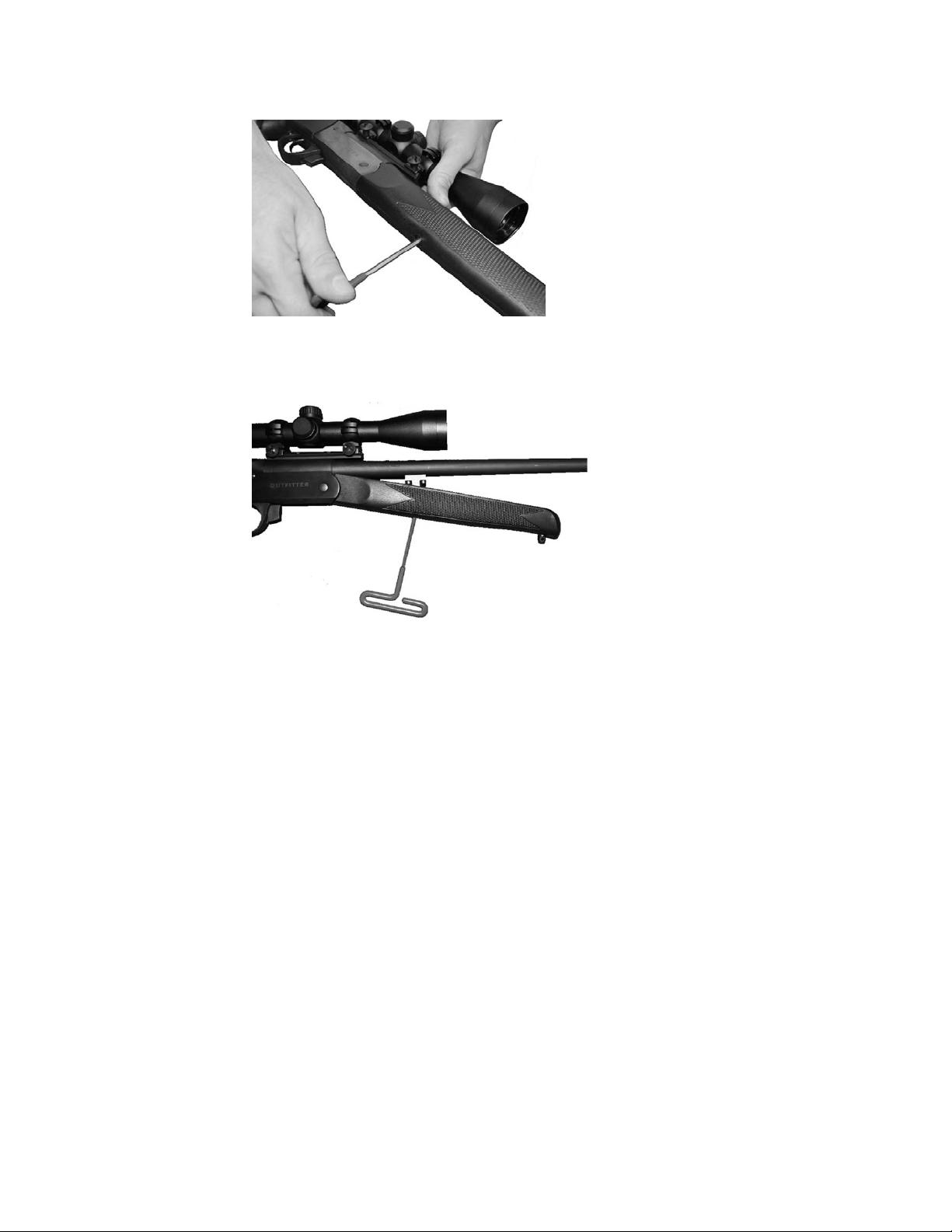
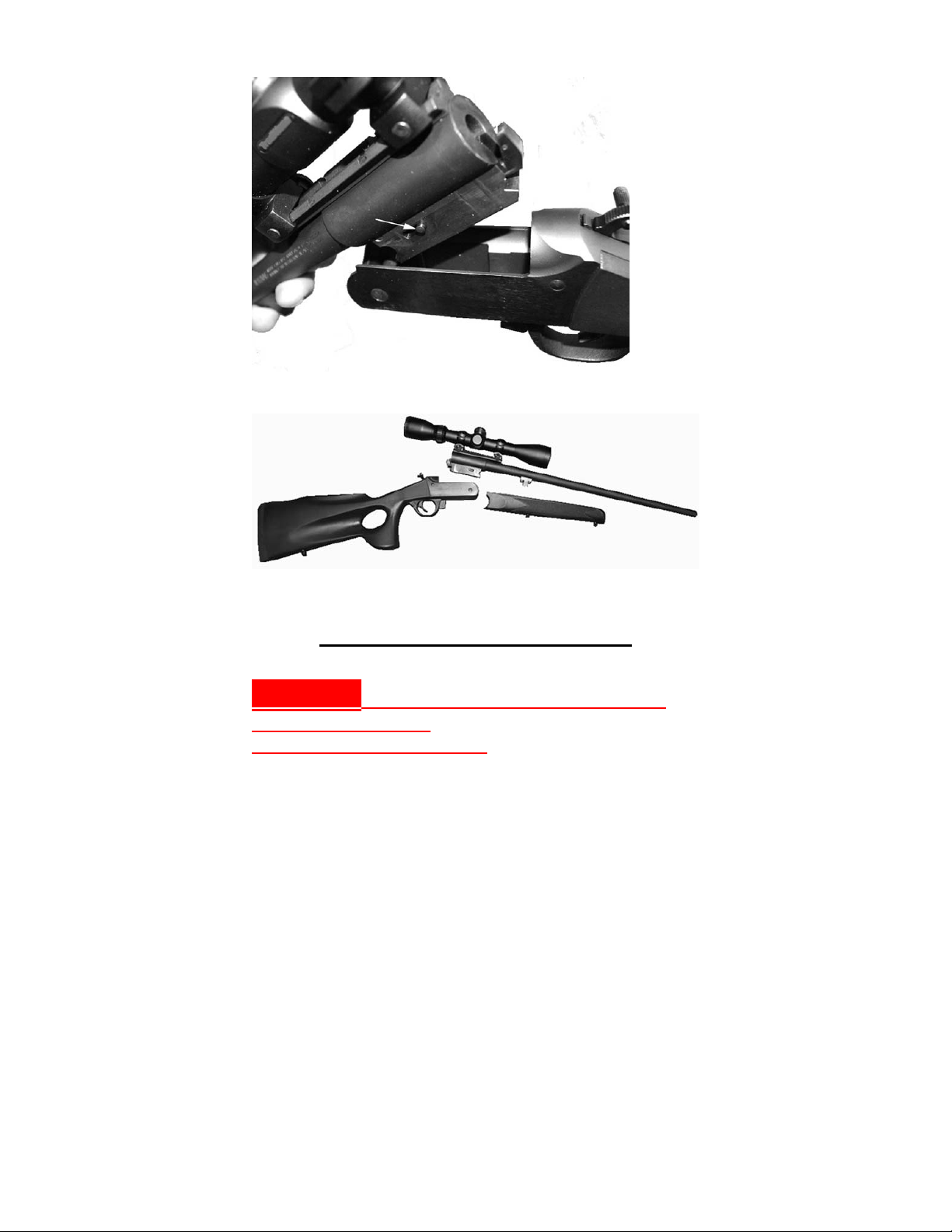
1. Use a 4mm. hex wrench draw out the screw in the
forend.
2. Once the screw is free, pull down on the forend to
remove.
3. Carefully open the action release button by pushing it in
a rearward mortion. Be sure to use one hand to support the
barrel as it pivots downward
4. Slide the barrel rearward and upwards away from the
frame.
21
Page 22
CLEANING & MAINTENANCE
! WARNING: Verify the chamber is empty prior to
cleaning your firearm.
Never clean a loaded firearm.
22
Page 23

Clean your gun as soon as possible after your shooting
session. Take care when cleaning not to get water or
solvent into the trigger assembly. If the trigger assembly is
affected, it will be necessary to remove the barreled-action,
dry the trigger assembly and treat it with gun oil. At regular
intervals, or whenever your firearm has been exposed to
sand, dust, extreme humidity, water or other adverse
conditions, it must be cleaned and lubricated.
Regular maintenance is essential to the proper functioning
of your firearm.
1. Unload the gun and disassemble it.
2. Using a cleaning rod and bore brush, run powder
solvent through the barrel.
3. Using a swab or patch on the cleaning rod, dry all
solvent from the barrel.
4. Using a clean swab or patch on the cleaning rod,
apply a thin coat of lubricant to the bore of the
barrel.
5. Before re-assembling the firearm, make sure that
nothing from the cleaning process is left in the bore.
Discharging the gun with anything in the bore can
result in destruction of the firearm and injury or
death to you or bystanders.
6. Wipe the exterior of the firearm with a rag lightly
coated in approved cleaning oil. Dry the exterior of
the gun and then apply a thin coat of lubricant to the
exterior of the firearm. Use of excess lubricant or
grease on your gun can attract dust or dirt which can
23
Page 24

interfere with the safe and reliable function of the
firearm.
7. Before firing remove all excess lubricant from the
bore.
!WARNING: DO NOT ATTEMPT TO
DISSASSEMBLE RECEIVER. THIS INCLUDES ANY
PINS HOLDING THE RECEIVER TOGETHER.
CLEAN AS A UNIT. Any attempt to do so will void the
factory warranty & may cause the firearm to be unsafe
& may result in injury and/or death.
XIII: RE-ASSEMBLY
1. Insert the barrel by sliding downward and
forward until the monoblock meets the pin.
2. Using one hand to support the barrel and the
other to support the frame/stock, pivot the barrel
in an upward motion to close the action.
3. With the barrel attached and the action closed
re-insert the forearm. With the nose of the
forend pointing down insert the rear part of the
forend against the frame and pivot up until it
meets the screw post.
4. Use Hex wrench to draw screw into screw post
and tighten.
5. With the firearm reassembled, make sure to do a
thorough function check of the rifle. At this time
24
Page 25

the barrel and action should work smoothly. The
hammer should not bind and all safeties should
be in good working order. If the firearm does not
function properly, consult a qualified gunsmith
immediately or call Traditions for immediate
assistance.
NOTE: Store your rifle in a cool, dry, secured area.
Storage in a gun case is discouraged, as it may hasten
condensation and corrosion. During long periods of
storage, periodically check for signs of pitting or rusting on
the surface and in the barrel bore.
NOTE: The myth that stainless steel & nickel doesn’t have
to be cleaned as much as blued steel is false. You need to
clean and lubricate your stainless barrel just as you would a
blued steel barrel. The stainless and nickel barrels are more
rust resistant than blued steel, but over time can rust.
XIV: BARREL OBSTRUCTIONS
!WARNING: Firing a firearm with an obstructed
barrel could cause a burst barrel and injury and/or
death to the shooter and/or bystanders and damage to
property.
Before loading, verify that the bore it is free of obstructions
(cleaning patches, excess oil, mud, snow or other foreign
materials). If the firearm is dropped it must be unloaded
and inspected to ensure that the bore has not become
clogged with foreign material. If, when firing, (particularly
25
Page 26

reloads) the report is weak or peculiar, stop immediately.
Inspect the barrel for a stuck bullet. If the bore is
obstructed return the barrel to a qualified gunsmith. Do not
continue to fire the firearm.
Failure to Fire
If the firearm fails to fire, keep the barrel pointed in a safe
direction for at least 1 minute If the firearm does not fire
after 1 minute, carefully open the action and remove the
cartridge. If the primer is indented, the cartridge must be
disposed of in a safe manner. If the primer is not indented,
or only lightly indented you must take the firearm to a
qualified gunsmith for service or return to Traditions.
! WARNING: Keep the barrel of your firearm pointed
in a safe direction for at least 1 minute if the cartridge
does not immediately fire after pulling the trigger.
The possibility of a “Hang Fire” (delayed ignition)
could exist and may result in the bullet or pellets being
directed in a dangerous direction, causing injury and/or
death to the shooter or bystanders and damage to
property.
26
Page 27

XV: STATEMENT ISSUED BY SPORTING
ARMS & AMMUNITION
MANUFACTURERS INSTITUTE (SAAMI)
UNSAFE ARMS AND AMMUNITION
COMBINATIONS
Ammunition used in a firearm must be the same caliber as
that marked on the firearm by its manufacturer. If the
firearm is not marked as to caliber or gauge, or if it appears
that the original marking has been overprinted or changed,
it is the responsibility of the gun user to have a qualified
person determine what cartridge can safely be used in the
firearm.
The firing of a cartridge or shell other than that for which
the firearm is chambered can result in the cartridge or shell
rupturing and releasing high pressure gas that can damage
or destroy the firearm and kill or seriously injure the
shooter and persons nearby.
There are countless combinations of specific cartridges and
firearm chambers which are unsafe. Many of these unsafe
combinations are recognizable because of significant
dimension differences between the cartridge and the
firearm chamber.
Dangerous combinations may also have similar chamber
and cartridge dimensions. It is not possible to list every
unsafe combination; therefore, in the interest of safety, use
only the cartridge designated by the firearm or ammunition
manufacturer for use in a specific firearm. The cartridge
27
Page 28

caliber must be marked on the firearm frame, receiver or
barrel by its manufacturer.
The practice of re-chambering firearms is not guided by
industry standards. It is possible that a firearm which has
been re-chambered may not be re-chambered properly or
the re-chambered caliber may not be marked on the
firearm. The firearm user is responsible to find out from a
qualified person the cartridge caliber or shell gauge for
which the firearm has been re-chambered.
XVI: SUPERIOR ACCURACY
Your Traditions Tip Up has been engineered and
manufactured to precise tolerances on modern
computerized machinery. With proper care and cleaning,
your Traditions firearm will retain its superior appearance
and accuracy for many years to come. There are many
environmental factors that influence accuracy such as
humidity, temperature etc. Accuracy can be affected by the
simple take-down and reassembly of the rifle components.
Although the sights or scope may not have moved, pressure
from the way the stock touches the barrel this is more
common with wood stocks that can be affected by moisture
in the environment.
28
Page 29

XVII: HELPFUL ACCESSORIES
In order to participate fully in the sport, you will probably
want to consider the purchase of the various Traditions
accessories. Your firearms retailer should stock a complete
line of accessories from Traditions. If not, ask them to
order them for you. Visit them soon to discover all the
ways to make your shooting experience even more
enjoyable and convenient
XVIII: LIMITED LIFETIME WARRANTY
Traditions warrants all factory-finished firearms to be free
of defects in workmanship or materials for the lifetime of
the firearm. This Limited Lifetime Warranty applies to the
original consumer owner. This warranty is put into effect
by the return of the authorized warranty card within 30
days of purchase and is not transferable.
Any covered Traditions firearm or part thereof that is
returned postage paid to the Repair Center or Customer
Service Department will be repaired or replaced to our
commercial standard, free of charge, and returned to the
consumer postage prepaid.
This warranty does not cover any damage caused by
custom alteration of the firearm! This warranty does not
cover any damage resulting from careless handling,
improper loading, rust or corrosion, neglect, or customer
alterations. Nor does it cover normal wear of any part,
29
Page 30

metal or stock finish, cost of inconvenience due to product
failure, or transportation to the Repair Center. Traditions
reserves the right to refuse to repair or replace any firearm
or parts thereof damaged by any of the above.
Should your Traditions centerfire firearm require repair, we
recommend that it be returned to our Warranty Repair
Center. This will assure that a competent staff of trained
technicians performs all work. Your Traditions Tip Up can
be shipped by you directly to our warranty repair center,
and we can return it directly to you, as per current US Law.
If you use a dealer or gunsmith to ship the rifle, we must
return it to the same dealer or gunsmith. NO
EXCEPTIONS WILL BE MADE. (Section 178.147
Federal Firearms Regulations) Any firearm returned to the
repair center should be marked to the attention of Warranty
& Repair- Attn: Tip Up Firearm Enclosed. A detailed letter
of instructions should be enclosed to facilitate handling and
an RMA # with it. Please be sure to include your name,
shipping address, and a daytime phone number
Our Repair Center will inspect and evaluate the problem.
Should any work not be covered by warranty, you will be
advised of the cost. No work will be done without your
approval.
30
Page 31

Firearms packaged and shipped improperly are not
covered under warranty if
damage occurs.
Shipping Address:
Traditions
1375 Boston Post Rd. • P.O. Box 776
Old Saybrook, CT 06475-0776
Tel. 860-388-4656
Website: www.traditionsfirearms.com
E-mail: [email protected]
31
Page 32

XIX: PREFFERED CUSTOMER WARRANTY
REGISTRATION CARD
Model # ________________________________________
Serial # (from barrel or frame)_______________________
Name __________________________________________
Age _______________
Street__________________________________________
City____________________________________________
State ___________
Zip ____________
Day Time Phone # _______________
Date of Purchase __________________
Purchase Price ___________________
Store Name _____________________
1. What is your age? 1 Under 18 2 18-24 3 25-34 4 35-
44 5 45-54 6 55-64 7 over 65
2. Reason for your purchase 1 Hunting 2 Target Shooting 3
Personal use 4 Gift 5 Raffle Prize 6 Other
3. Do you own? 1 Other muzzleloaders 2 Over/Under
Shotgun 3 Side by Side Shotgun 4 Semi-Auto Shotgun 5
Pump Shotgun 6 Cartridge Rifle 7 Handgun 8 Bow
4. Where purchased? 1 Gun Shop
Store 3 Hardware Store 4 Chain Store 5 Mail Order
Catalog 6 Internet Store
5. Is this your first Traditions Product? 1 Yes 2 No
6. Which factors influenced your purchase? 1 Previously owned
a Traditions product 2 Magazine Ad/Article
3 Internet/Website 4 Traditions Catalog
5 Recommendation of Salesperson
6 Recommendation of a Friend 7 Price 8 Features
9 Other
7. What type of game do you hunt? 1 Whitetail Deer 2 Mule
Deer 3 Elk 4 Bear 5 Antelope 6 Turkey 7 Small
Game 8
Other
2 General Sporting Goods
32
Page 33

8. What do you think is the best way to get information about
Hunting & Hunting products?
1 Magazine Ads 2 Internet/Website 3 Television
Programs 4 Radio
9a. Which magazine do you read?
____________________________________
b. Which TV hunting show do you watch?
_______________________________
Check here to receive a free Traditions catalog showing
muzzleloadings’ largest selection of firearms
and accessories or visit our website at
www.traditionsfirearms.com
To receive a Traditions Firearms Logo cap and catalog, send
$11.95 along
with your warranty registration card.
NOTE: Return this card within 15 days of purchase
in order to validate your limited lifetime warranty
33
Page 34

34
 Loading...