

Page 1

1
2005 ECHO from Aug. ’04 Prod. (OM52636U)
OPERATION OF INSTRUMENTS AND
CONTROLS
Overview of instruments and controls
Instrument panel overview 2. . . . . . . . . . . . . . . . . . . . . . . . . . . . . . . . . . . . .
Instrument cluster overvi ew 4. . . . . . . . . . . . . . . . . . . . . . . . . . . . . . . . . . . .
Indicator symbols on the instrument panel 7. . . . . . . . . . . . . . . . . . . . . . .
SECTION 1-
1
Page 2
2
2005 ECHO from Aug. ’04 Prod. (OM52636U)
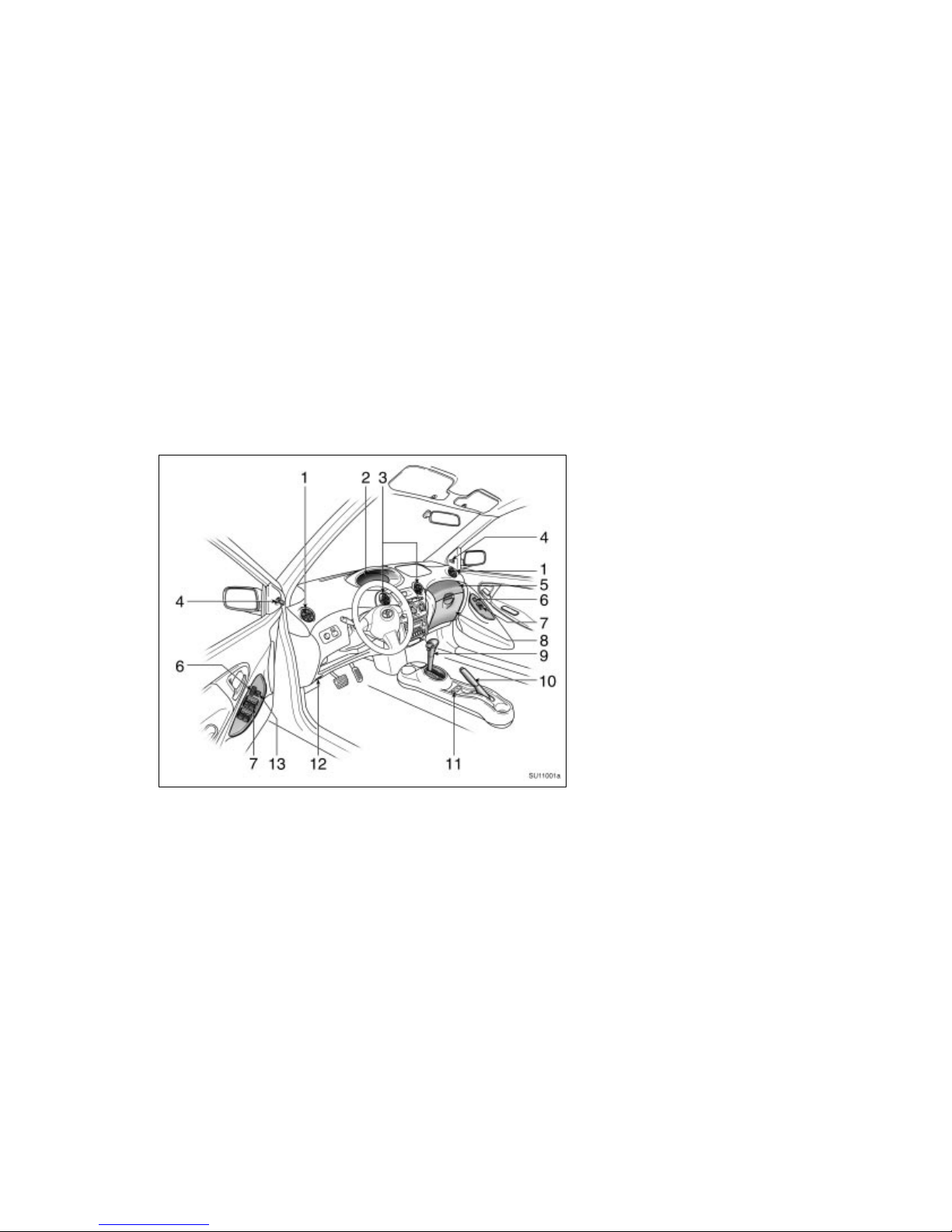
Instrument panel overview
1. Side vents
2. Instrument cluster
3. Center vents
4. Rear view mirror remote control levers
5. Auxiliary box
6. Power door lock switches
(with power windows)
7. Power window switches
8. Glove box
9. Automatic transmission selector lever or
manual transmission gear shift lever
10. Parking brake lever
11. Power door lock switch
(without power windows)
12. Hood lock release lever
13. Window lock switch
SU11001a
Page 3
3
2005 ECHO from Aug. ’04 Prod. (OM52636U)
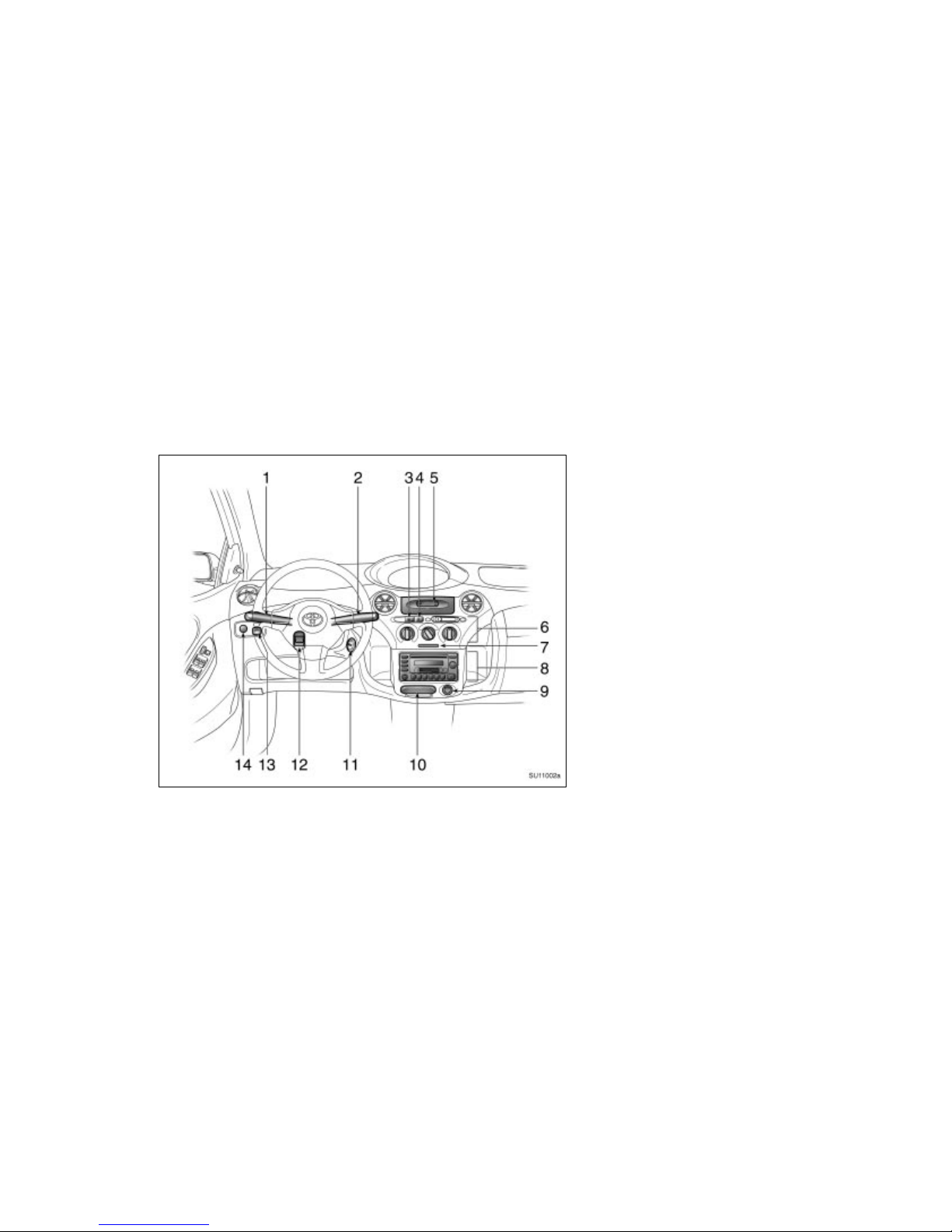
1. Headlight and turn signal switches
2. Wiper and washer switches
3. Rear window defogger switch
4. Emergency flasher switch
5. Clock
6. Air conditioning controls
7. Security indicator light/Front passenger’s seat belt reminder light
8. Audio system
9. Cigarette lighter/Power outlet
10. Ashtray/Coin box
11. Ignition switch
12. Tilt steering lock release lever
13. Power rear view mirror control switches
14. Instrument panel light control knob
SU11002a
Page 4
4
2005 ECHO from Aug. ’04 Prod. (OM52636U)
SU11015
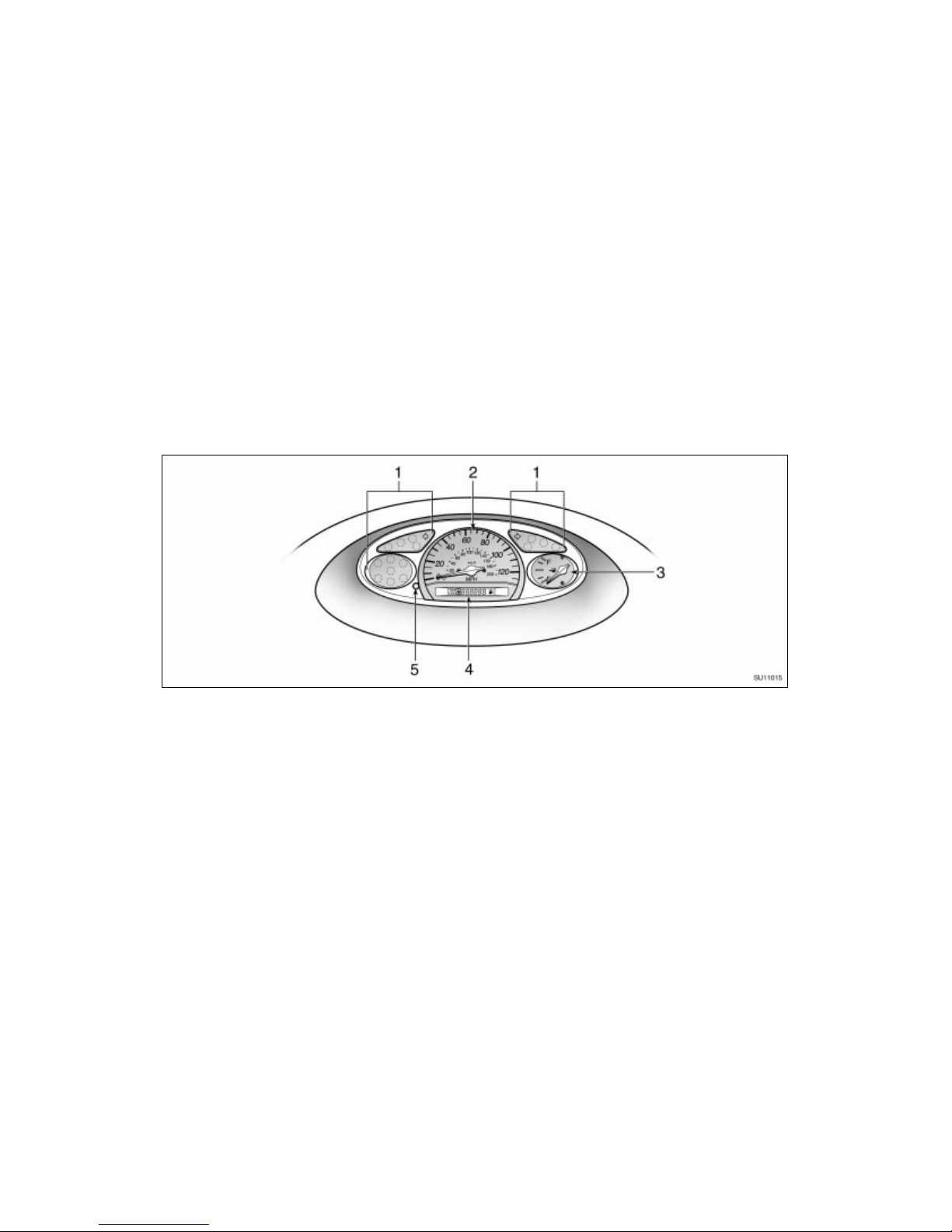
1. Servic e reminder indicators and
indicator l ights
2. Speedometer
3. Fuel gauge
4. Odometer and two tr ip meters
5. Trip m eter res et knob
Instrument cluster overview
Ty pe A
Page 5
5
2005 ECHO from Aug. ’04 Prod. (OM52636U)
SU11014
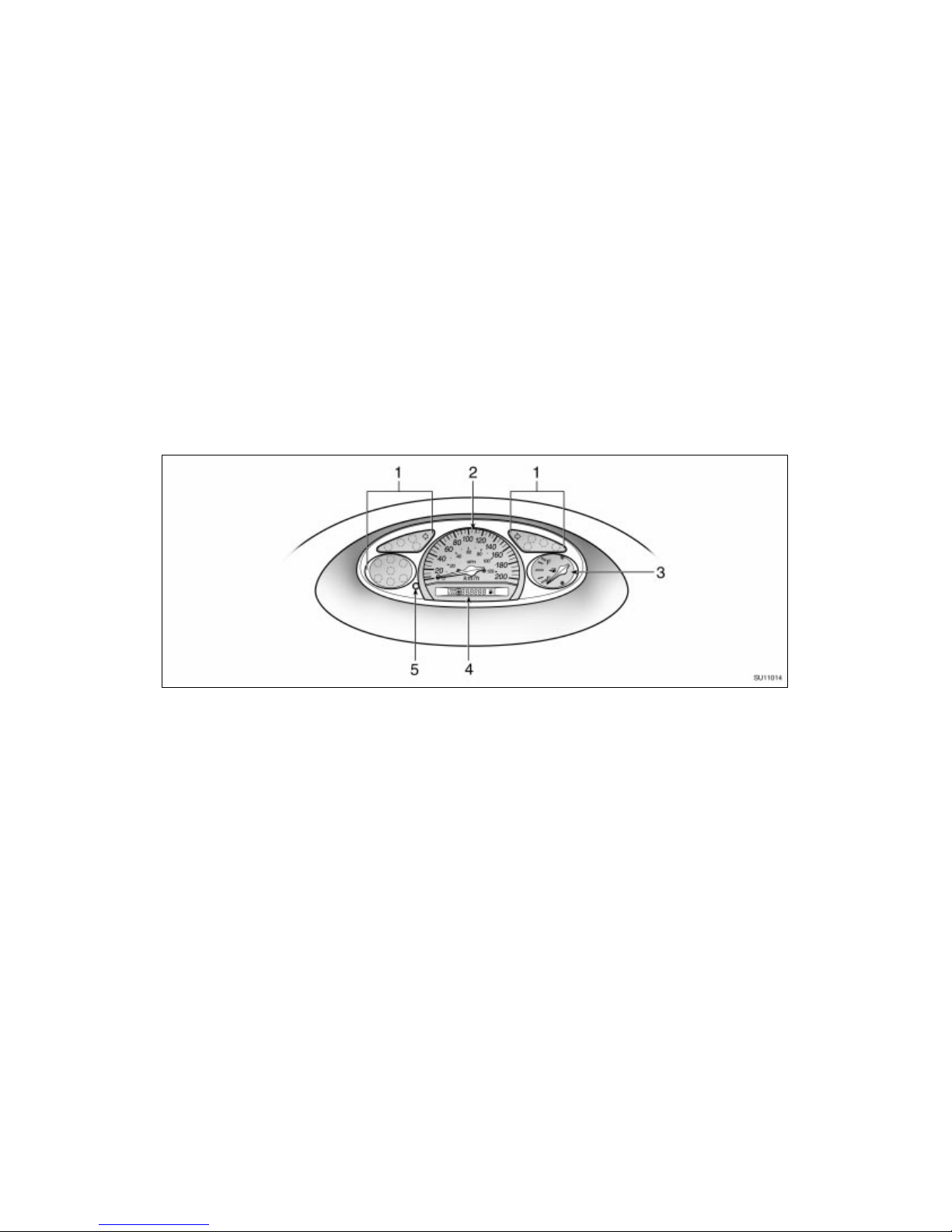
1. Servic e reminder indicators and
indicator l ights
2. Speedometer
3. Fuel gauge
4. Odometer and two tr ip meters
5. Trip m eter res et knob
Ty pe B
Page 6
6
2005 ECHO from Aug. ’04 Prod. (OM52636U)
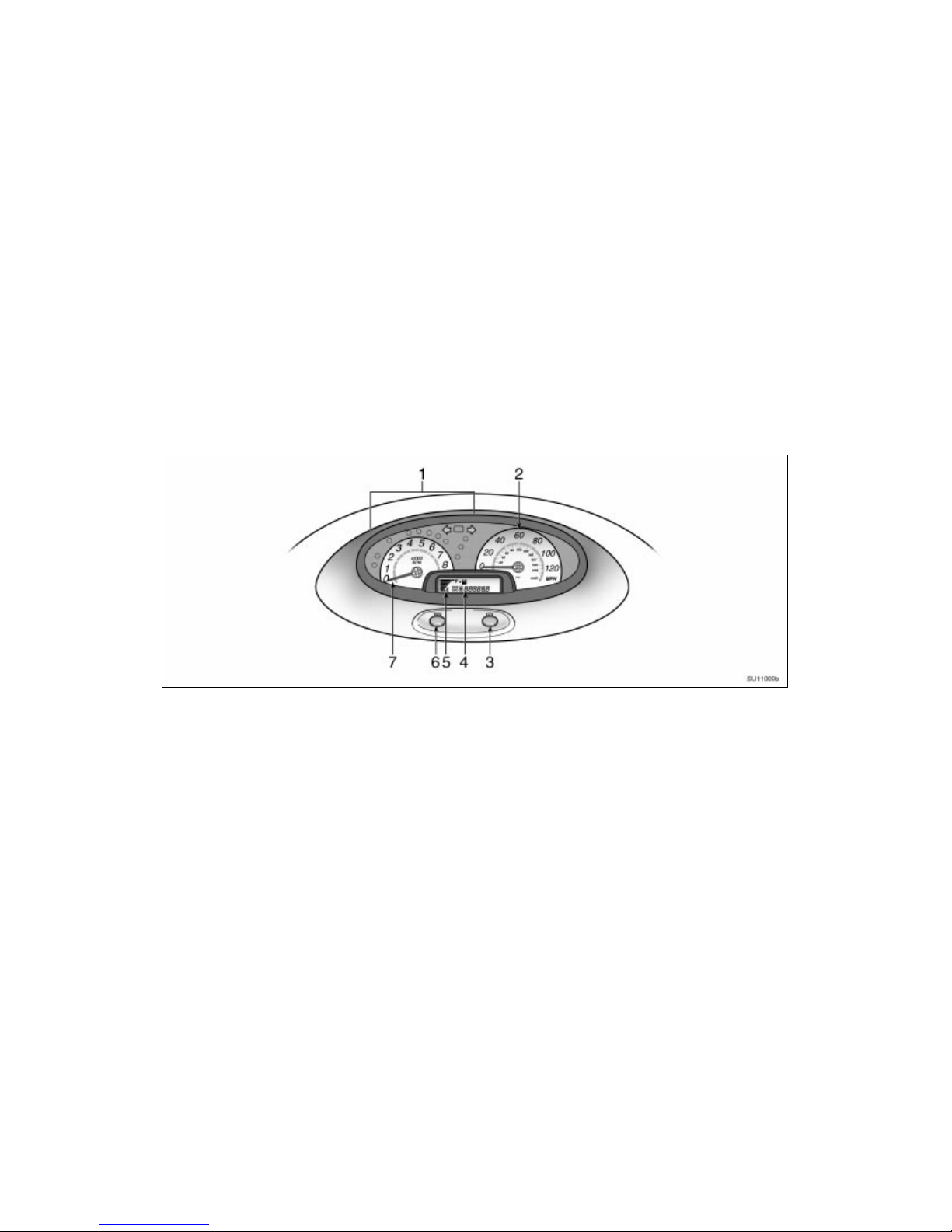
SU11009b
1. Servic e reminder indicators and
indicator l ights
2. Speedometer
3. Extinc tion canceling button
4. Odometer and two tr ip meters
5. Fuel gauge
6. Trip m eter res et button
7. Tachometer
Ty pe C
Page 7
7
2005 ECHO from Aug. ’04 Prod. (OM52636U)
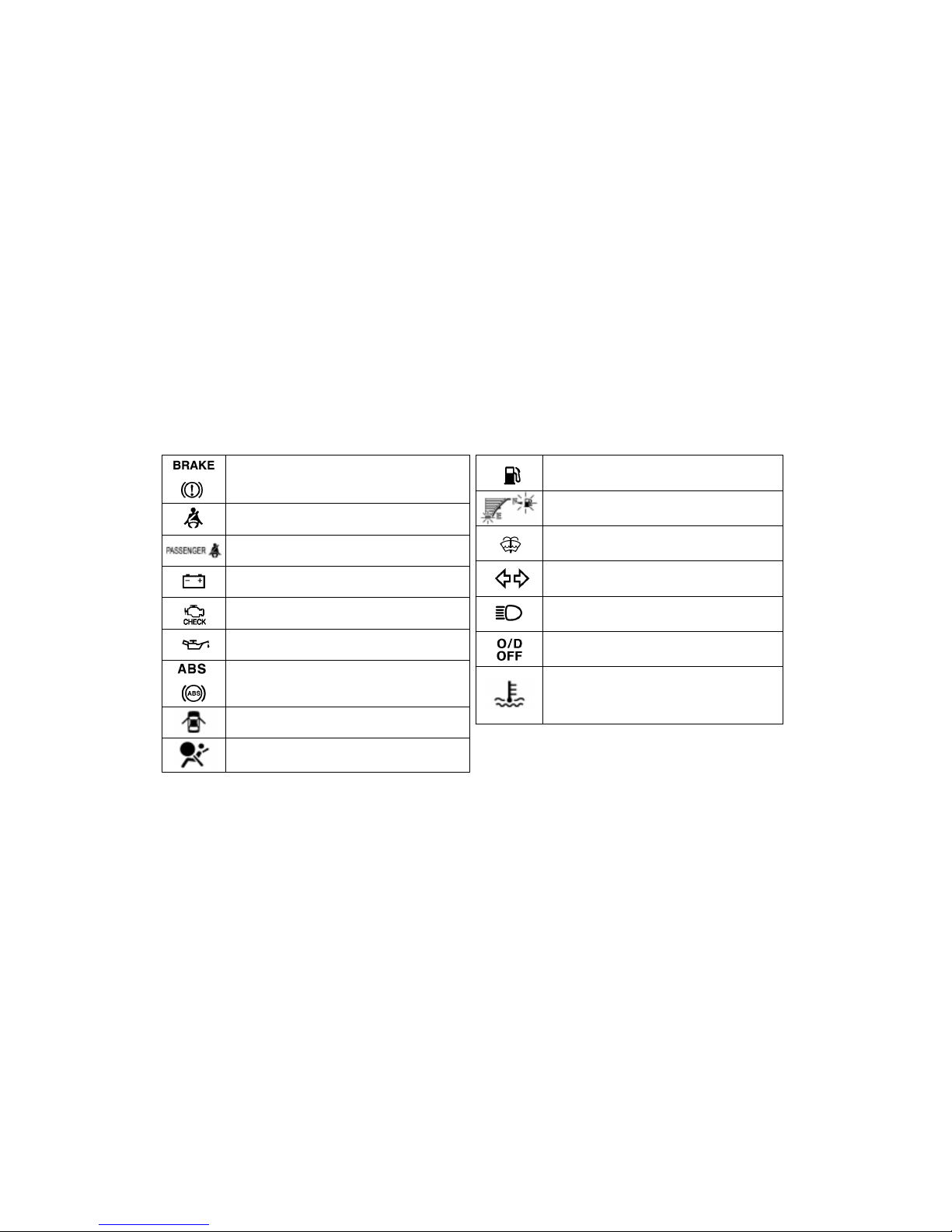
Indicator symbols on the instrument panel
or
Brake system warning light
∗
1
Driver’s seat belt reminder light
∗
1
Discharge warning light
∗
1
Malfunction indicator lamp
∗
1
Low engine oil pressure warning light
∗
1
Anti-lock brake system warning light
∗
1
SRS warning light
∗
1
Low windshield washer fluid level warning light
∗
1
Low fuel level warning light
∗
1
(type A)
Turn signal indicator lights
Headlight high beam indicator light
Overdrive- off indicator light
Low engine coolant temperature indicator light
(in blue)
∗
2
High engine coolant temperature warning light
(in red)
∗
1
Front passenger’s seat belt reminder light
∗
1
Open door warning light
∗
1
or
Low fuel level indicator light
∗
1
(type B)
∗
1
: For details , see “Service remi nder indicators and warni ng
buzzers” on page 90 in Section 1-6.
∗
2
: For details , see “Engine coolant temperat ure indicator and
warning light” on page 87 in Section 1- 6.
Page 8

8
2005 ECHO from Aug. ’04 Prod. (OM52636U)
Page 9

7
2005 ECHO HATCHBACK from Jul. ’04Prod. (OM52624U)
OPERATION OF INSTRUMENTS AND
CONTROLS
Keys and Doors
Keys 8. . . . . . . . . . . . . . . . . . . . . . . . . . . . . . . . . . . . . . . . . . . . . . . . . . . . . . . .
Side doors 8. . . . . . . . . . . . . . . . . . . . . . . . . . . . . . . . . . . . . . . . . . . . . . . . . . .
Back door 10. . . . . . . . . . . . . . . . . . . . . . . . . . . . . . . . . . . . . . . . . . . . . . . . . . .
Hood 11. . . . . . . . . . . . . . . . . . . . . . . . . . . . . . . . . . . . . . . . . . . . . . . . . . . . . . .
Fuel tank cap 12. . . . . . . . . . . . . . . . . . . . . . . . . . . . . . . . . . . . . . . . . . . . . . .
04 06.07
SECTION 1-
2
Page 10
8
2005 ECHO HATCHBACK from Jul. ’04Prod. (OM52624U)
Keys
SN12015
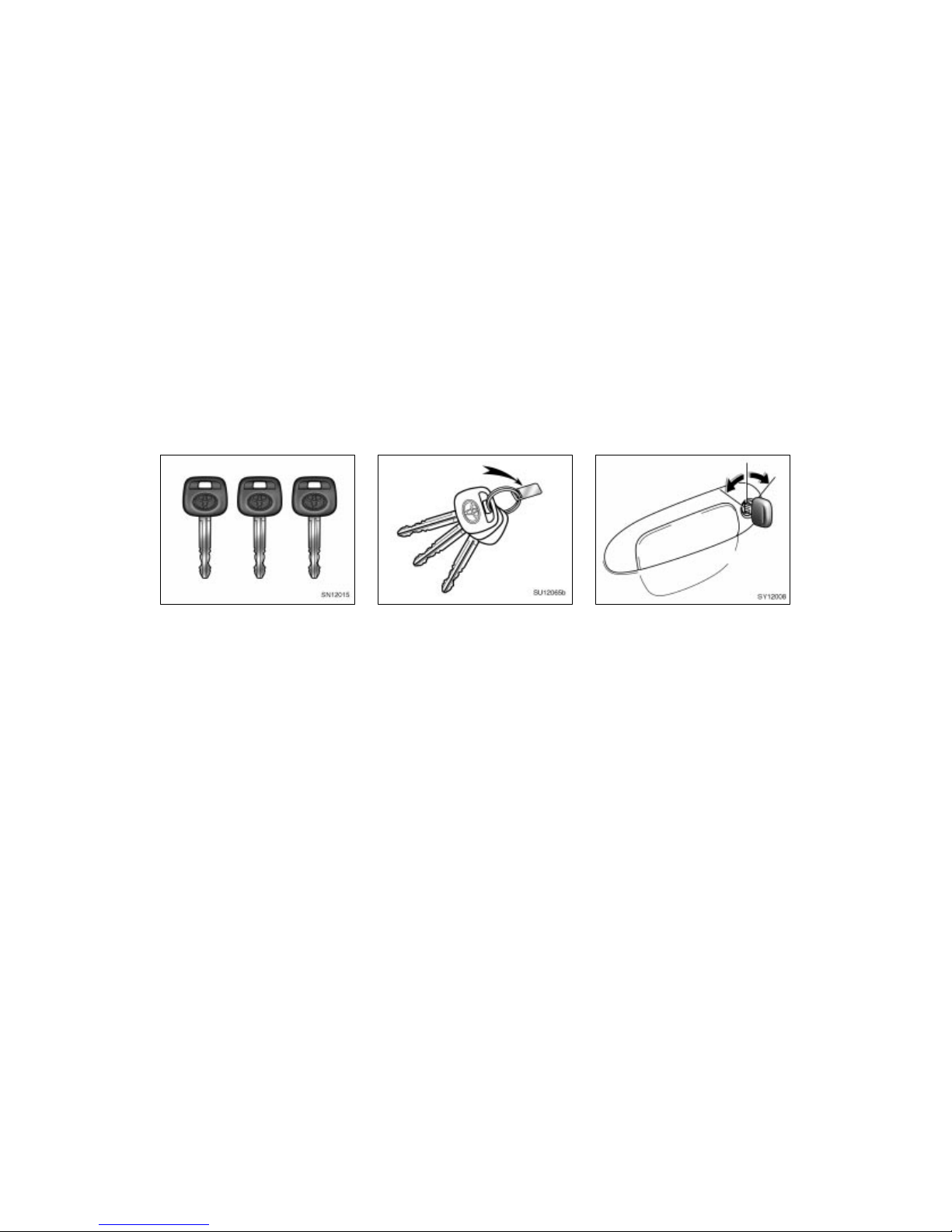
These keys work in every lock.
Since the side doors and back door can
be locked without a key, you should always carry a spare key in case you accidentally lock your keys inside the vehicle.
SU12065b
KEY NUMBER PLATE
Your key number is shown on the plate.
Keep the plate in a safe place such as
your wallet, not in the vehicle.
If you should lose your keys or if you
need additional keys, duplicates can be
made by a Toyota dealer using the key
number.
We recommend writing down the key number and storing it in a safe place.
Side doors—
SY12008
LOCKING AND UNLOCKING WITH KEY
Insert the key into the keyhole and turn
it.
To lock: Turn the key forward.
To unlock: Turn the key backward.
5- door models—All the side doors and
back door lock and unlock simultaneously
with either front door. In the driver’s door
lock, turning the key once will unlock the
driver’s door and twice in succession will
unlock all the side doors and back door
simultaneously.
04 06.07
Page 11
9
2005 ECHO HATCHBACK from Jul. ’04Prod. (OM52624U)
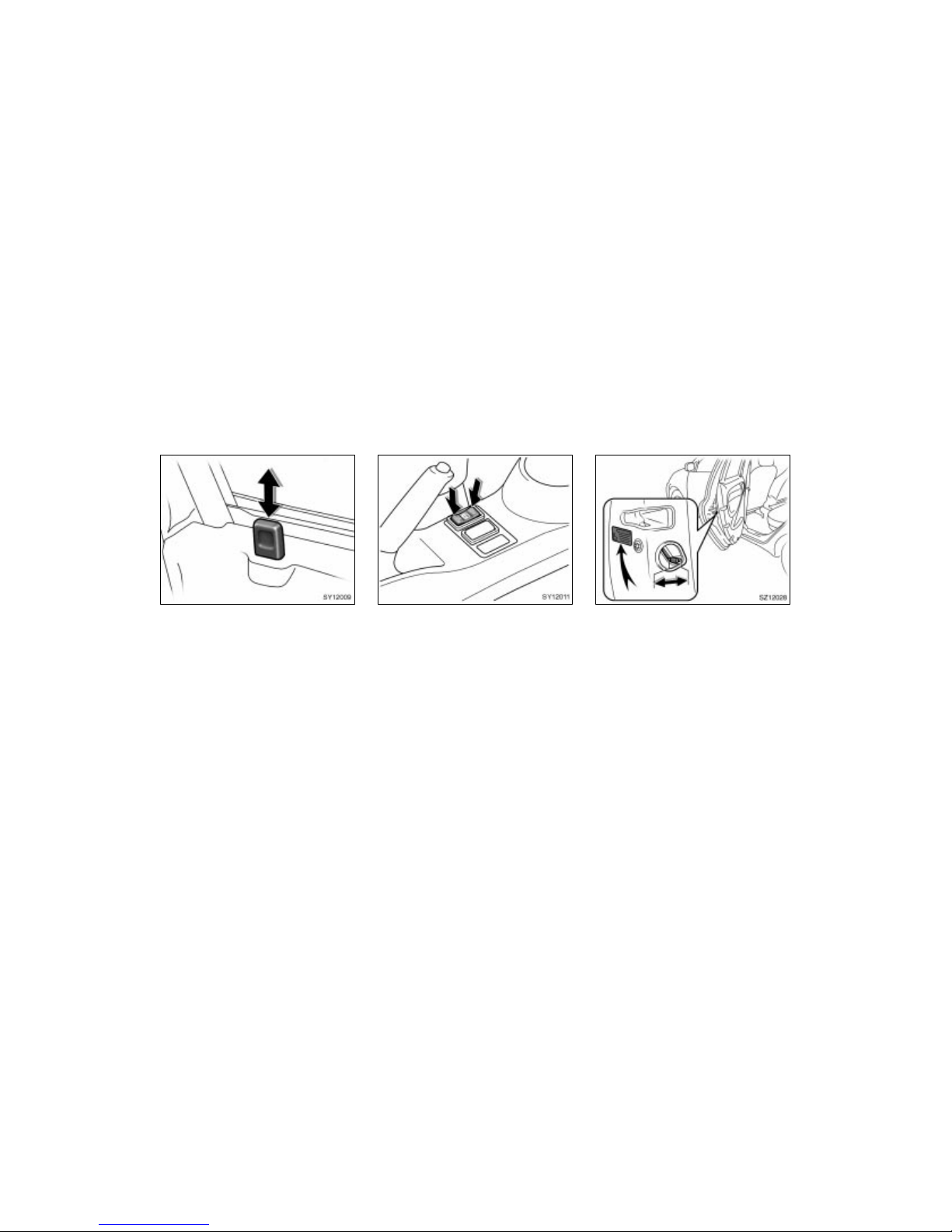
SY12009
LOCKING AND UNLOCKING WITH
INSIDE LOCK BUTTON
Move the lock button.
To lock: Push the knob down.
To unlock: Pull the knob up.
Closing the door with the lock knob in the
lock position will also lock the door. Be
careful not to lock your keys in the vehicle.
SY12011
LOCKING AND UNLOCKING WITH
POWER DOOR LOCK SWITCH
(5- door models only)
Push the switch.
To lock: Push the switch down on the
“LOCK” side.
To unlock: Push the switch down on the
“UNLOCK” side.
All the side doors and back door lock or
unlock simultaneously.
However, once you lock the back door by
a key, you can unlock the back door only
by the key.
SZ12028
REAR DOOR CHILD-PROTECTORS
(5- door models only)
Move the lock lever to the “LOCK”
position as shown on the label.
When the child-protector is locked, you
cannot open the rear door by the inside
door handle. We recommend using this
feature whenever small children are in the
vehicle.
04 06.07
Page 12
10
2005 ECHO HATCHBACK from Jul. ’04Prod. (OM52624U)
CAUTION
Before driving, be sure that the doors
are closed and locked, especially
when small children are in the vehicle. Along with the proper use of
seat belts, locking the doors helps
prevent the driver and passengers
from being thrown out from the vehicle during an accident. It also helps
prevent the doors from being opened
unintentionally.
Back door
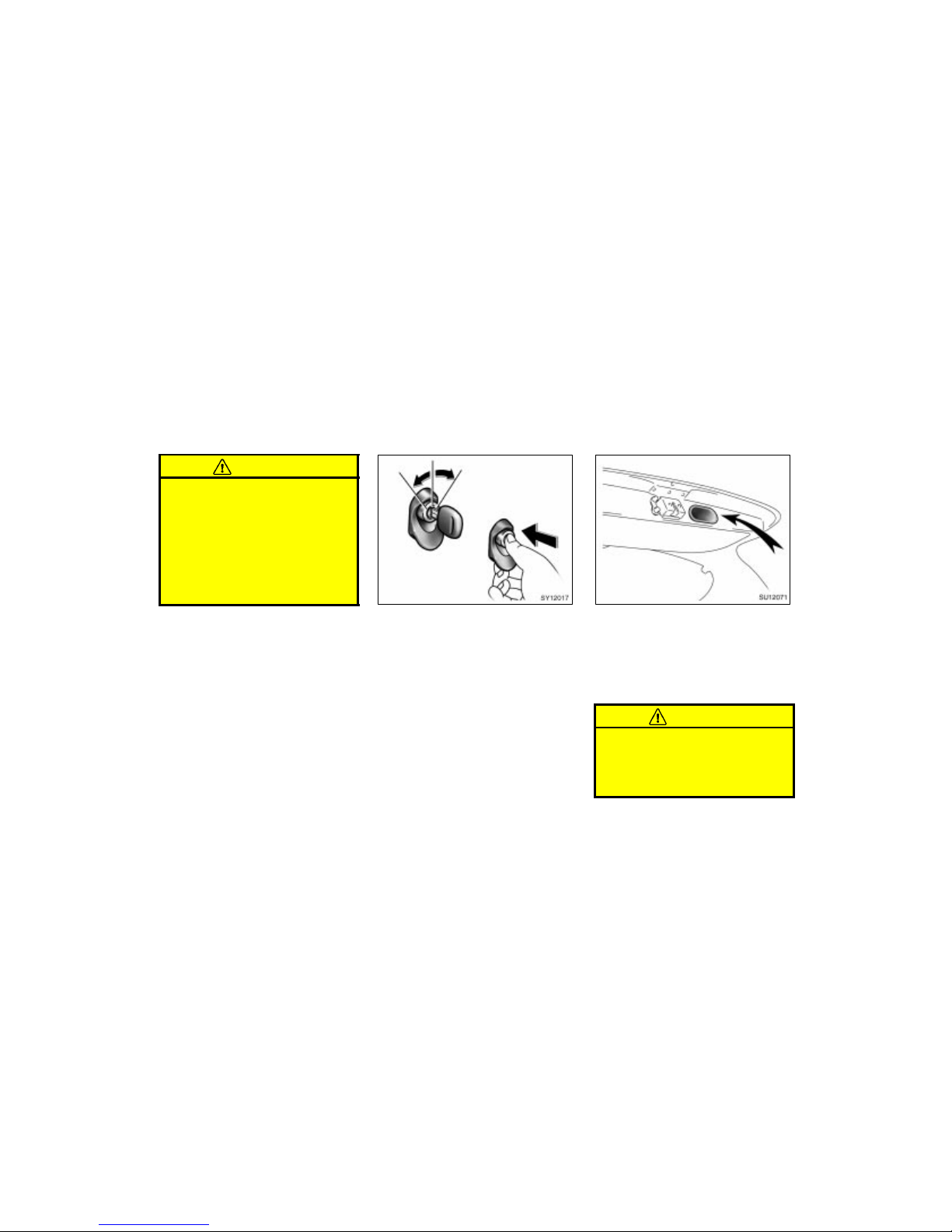
SY12017
LOCKING AND UNLOCKING WITH KEY
Insert the key into the keyhole and turn
it.
To lock: Turn the key clockwise.
To unlock: Turn the key counterclockwise.
5- door models—
Operating the power door lock switch simultaneously locks or unlocks the back
door (see “Side doors” on page 8).
However, once you lock it by a key, you
can unlock it only by the key.
See “Cargo and luggage” on page 120 in
Section 2 for precautions to observe when
loading luggage.
SU12071
When closing the back door, the inside
handle can be used to make the reach
easier.
To close the back door, lower it and press
down on it. After closing the back door,
try pulling it up to make sure it is securely closed.
CAUTION
Keep the back door closed while driving. This not only keeps the luggage
from being thrown out but also prevents exhaust gases from entering
the vehicle.
04 06.07
Page 13
11
2005 ECHO HATCHBACK from Jul. ’04Prod. (OM52624U)
Hood
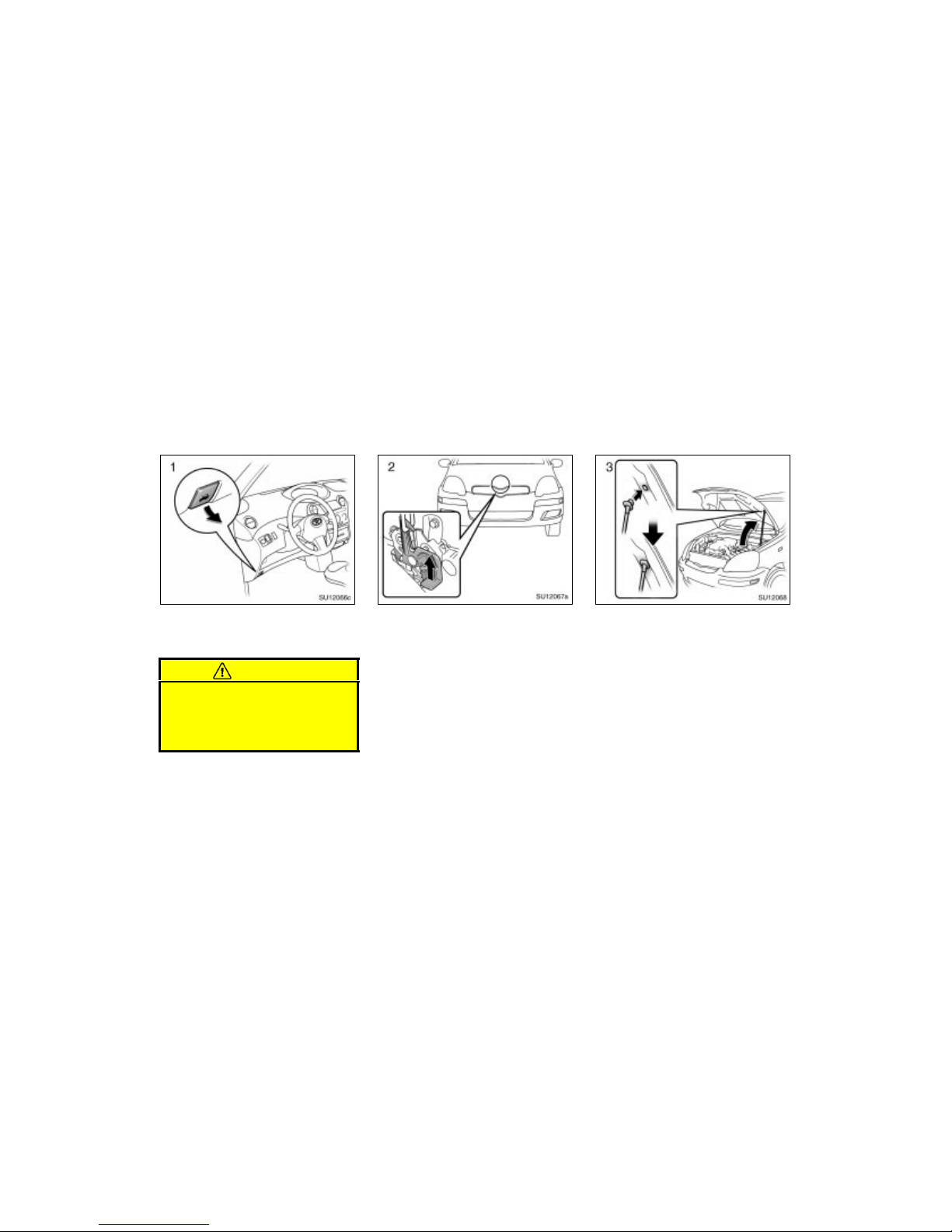
SU12066c
To open the hood:
1. Pull the hood lock release lever. The
hood will spring up slightly.
CAUTION
Before driving, be sure that the hood
is closed and securely locked. Otherwise, the hood may open unexpectedly while driving and an accident may
occur.
SU12067a
2. In front of the vehicle, pull up the
auxiliary catch lever and lift the
hood.
SU12068
3. Hold the hood open by inserting the
support rod into the slot.
To insert the support rod into the slot,
move it straight up. If it is moved to the
side or toward the inside of the vehicle,
it may become detached.
Before closing the hood, check to see that
you have not forgotten any tools, rags,
etc. and return the support rod to its clipthis prevents rattles. Then lower the hood
and make sure it locks into place. If necessary, press down gently on the front
edge to lock it.
04 06.07
Page 14
12
2005 ECHO HATCHBACK from Jul. ’04Prod. (OM52624U)
CAUTION
After inserting the support rod into
the slot, make sure the rod supports
the hood security from falling down
on to your head or body.
NOTICE
Be sure to return the support rod to
its clip before closing the hood. Closing the hood with the support rod up
could cause the hood to bend.
Fuel tank cap
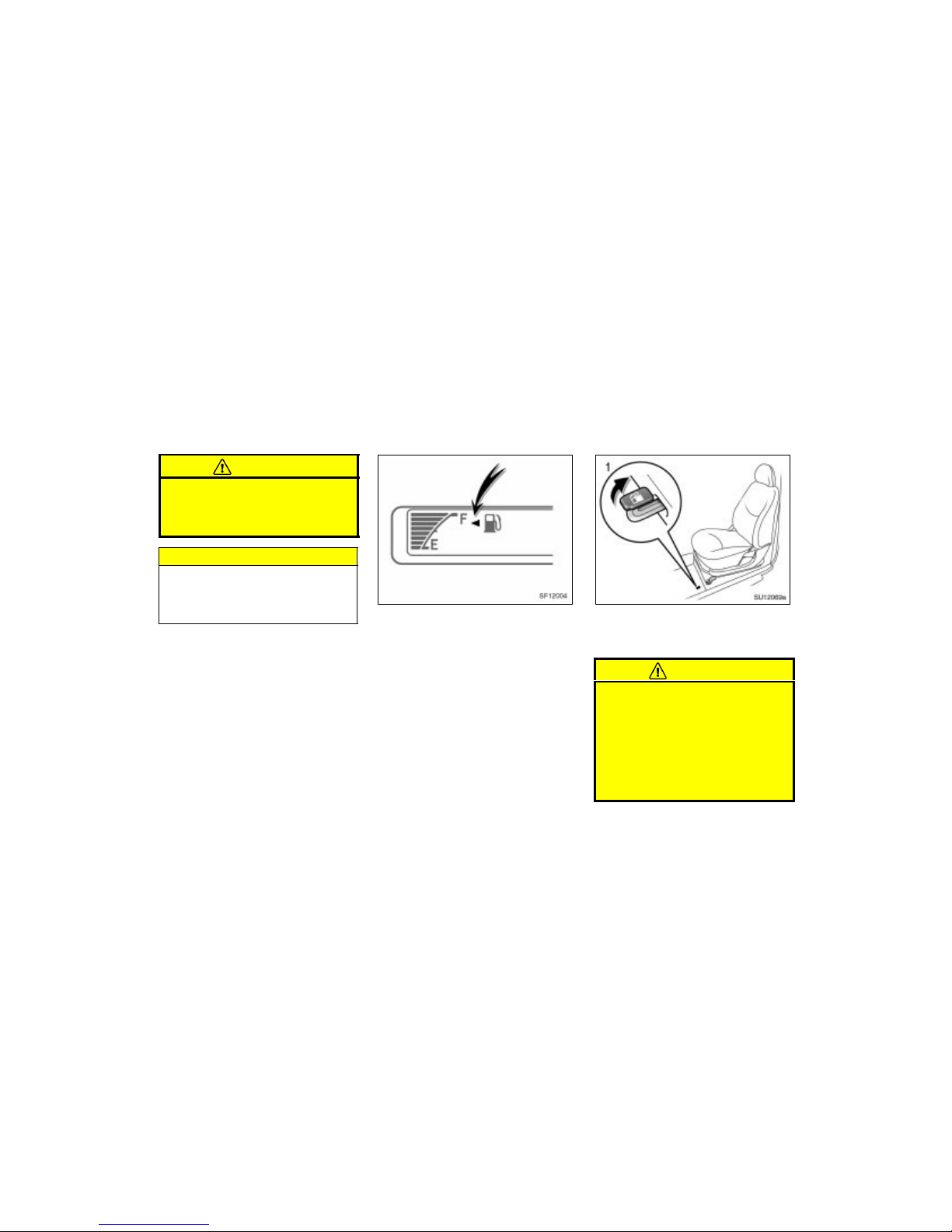
SF12004
This indicates that the fuel filler door
is on the left side of your vehicle.
SU12069a
1. To open the fuel filler door, pull the
lever up.
When refueling, turn off the engine.
CAUTION
Do not smoke, cause sparks or al-
low open flames when refueling.
The fumes are flammable.
When opening the cap, do not re-
move the cap quickly. In hot weather, fuel under pressure could cause
injury by spraying out of the filler
neck if the cap is suddenly removed.
04 06.07
Page 15
13
2005 ECHO HATCHBACK from Jul. ’04Prod. (OM52624U)
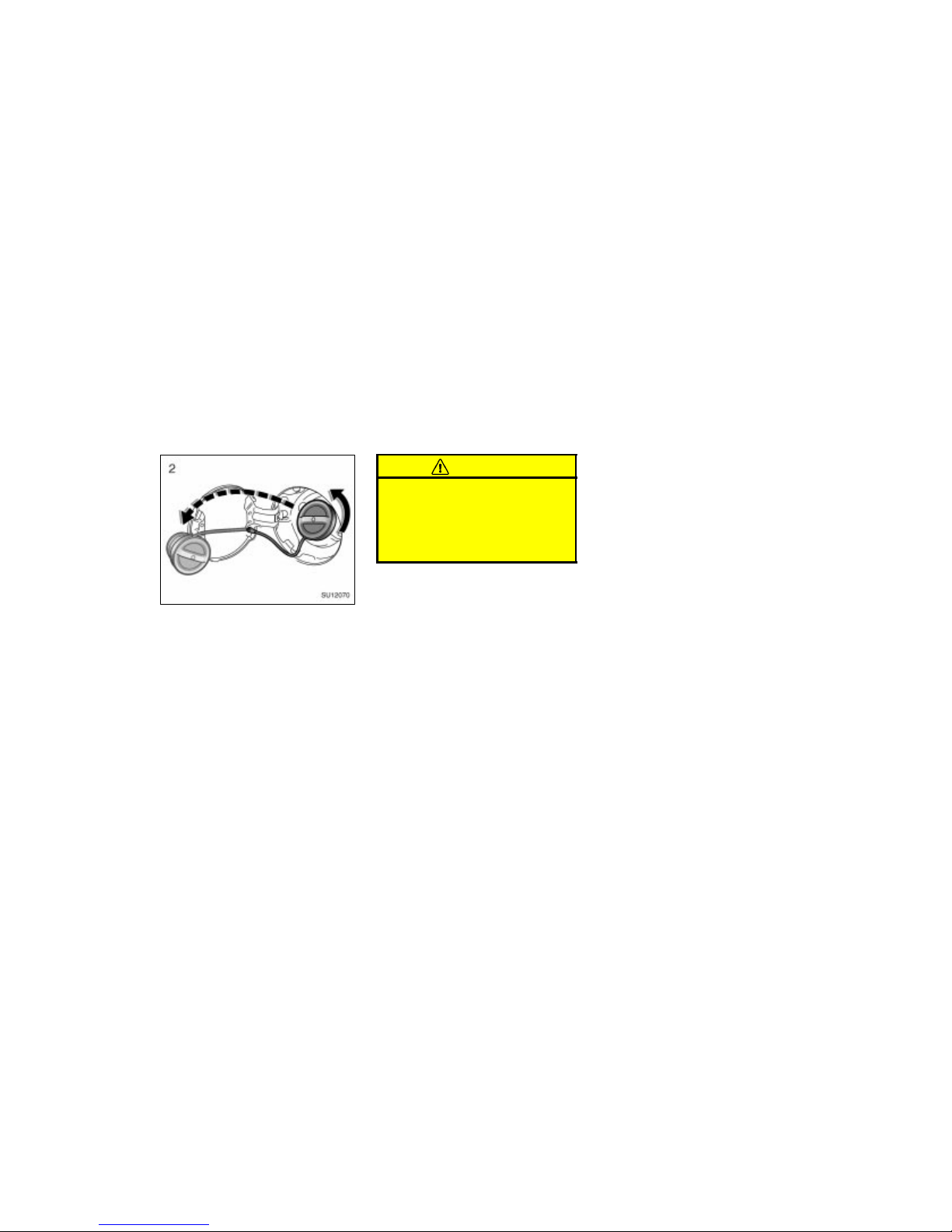
SU12070
2. To remove the fuel tank cap, turn
the cap slowly counterclockwise,
then pause slightly before removing
it. After removing the cap, hang the
tether as shown in the illustration.
It is not unusual to hear a slight swoosh
when the cap is opened. When installing,
turn the cap clockwise till you hear a
click.
If the cap is not tightened securely, the
malfunction indicator lamp comes on.
Make sure the cap is tightened securely.
The indicator lamp goes off after driving
several times. If the indicator lamp does
not go off, contact your Toyota dealer as
soon as possible.
CAUTION
Make sure the cap is installed se-
curely to prevent fuel spillage in
the event of an accident.
Use only a genuine Toyota fuel tank
cap for replacement. It is designed
to regulate fuel tank pressure.
04 06.07
Page 16

14
2005 ECHO HATCHBACK from Jul. ’04Prod. (OM52624U)
04 06.07
Page 17

9
2005 ECHO from Aug. ’04 Prod. (OM52636U)
OPERATION OF INSTRUMENTS AND
CONTROLS
Keys and Doors
Keys 10. . . . . . . . . . . . . . . . . . . . . . . . . . . . . . . . . . . . . . . . . . . . . . . . . . . . . . .
Wireless remote control 11. . . . . . . . . . . . . . . . . . . . . . . . . . . . . . . . . . . . . .
Side doors 15. . . . . . . . . . . . . . . . . . . . . . . . . . . . . . . . . . . . . . . . . . . . . . . . . .
Power windows 17. . . . . . . . . . . . . . . . . . . . . . . . . . . . . . . . . . . . . . . . . . . . . .
Trunk lid 19. . . . . . . . . . . . . . . . . . . . . . . . . . . . . . . . . . . . . . . . . . . . . . . . . . . .
Hood 21. . . . . . . . . . . . . . . . . . . . . . . . . . . . . . . . . . . . . . . . . . . . . . . . . . . . . . .
Theft deterrent system 23. . . . . . . . . . . . . . . . . . . . . . . . . . . . . . . . . . . . . . .
Fuel tank cap 24. . . . . . . . . . . . . . . . . . . . . . . . . . . . . . . . . . . . . . . . . . . . . . .
04 07.14
SECTION 1-
2
Page 18
10
2005 ECHO from Aug. ’04 Prod. (OM52636U)
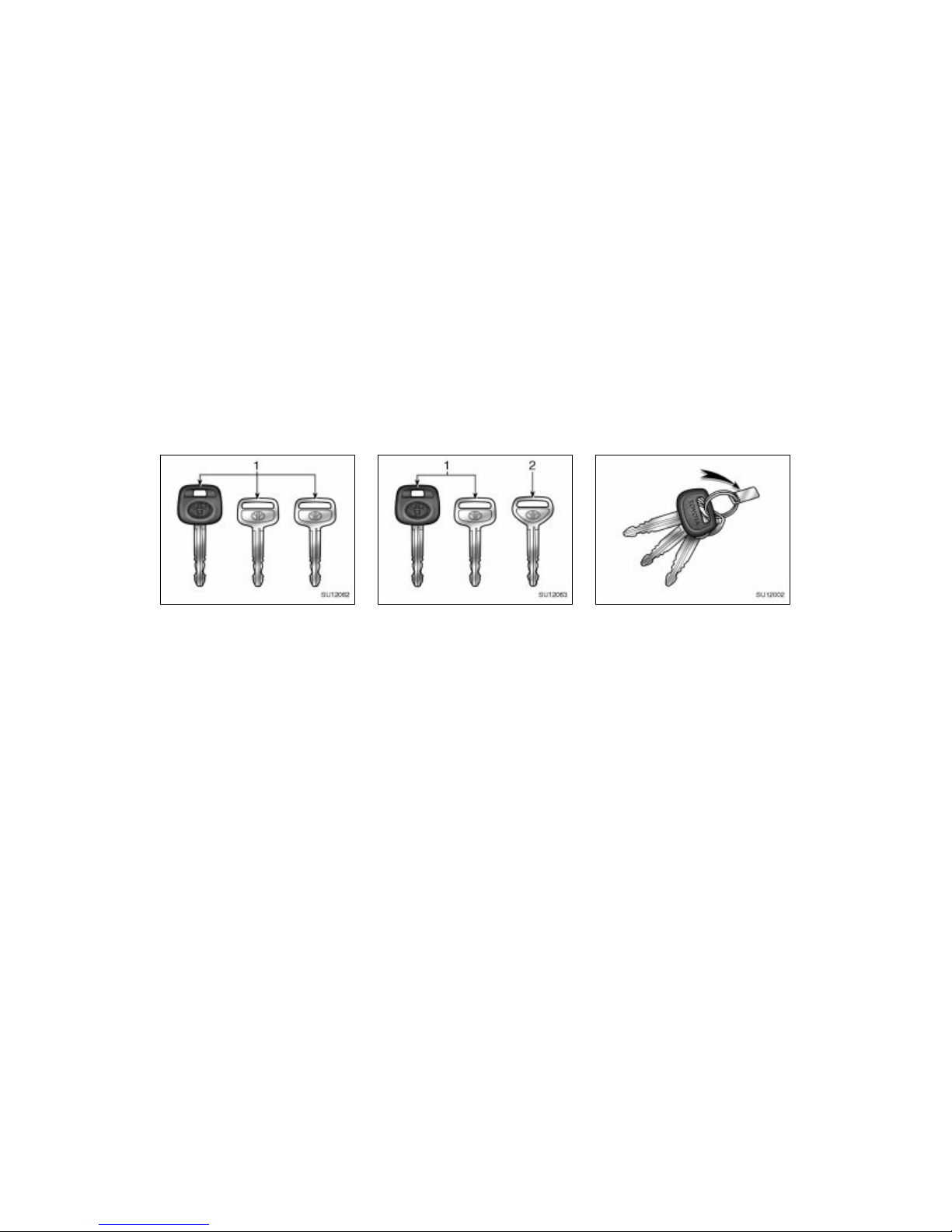
Keys (type A)
SU12062
These keys work in every lock.
1. Master keys—These keys work in every lock.
Since the doors and trunk lid can be
locked without a key, you should always
carry a spar e key in case you accidentally
lock your keys inside the vehicle.
Keys (type B)
SU12063
Your vehicle is supplied with two kinds
of key.
1. Master keys—These keys work in every lock.
2. Sub key—This key will not work in the
trunk.
To protect items locked in the trunk when
using valet parking, leave the sub key
with the attendant.
Since the doors and trunk lid can be
locked without a key, you should always
carry a spare master key in case you
accidentally lock your keys inside the vehicle.
SU12002
KEY NUMBER PLATE
Your key number is shown on the plate.
Keep the plate in a safe place such as
your wallet, not in the vehicle.
If you should lose your keys or if you
need additional keys, duplicates can be
made by a Toyota dealer using the key
number.
We recommend writing down the key number and storing it in a safe place.
04 07.14
Page 19
11
2005 ECHO from Aug. ’04 Prod. (OM52636U)
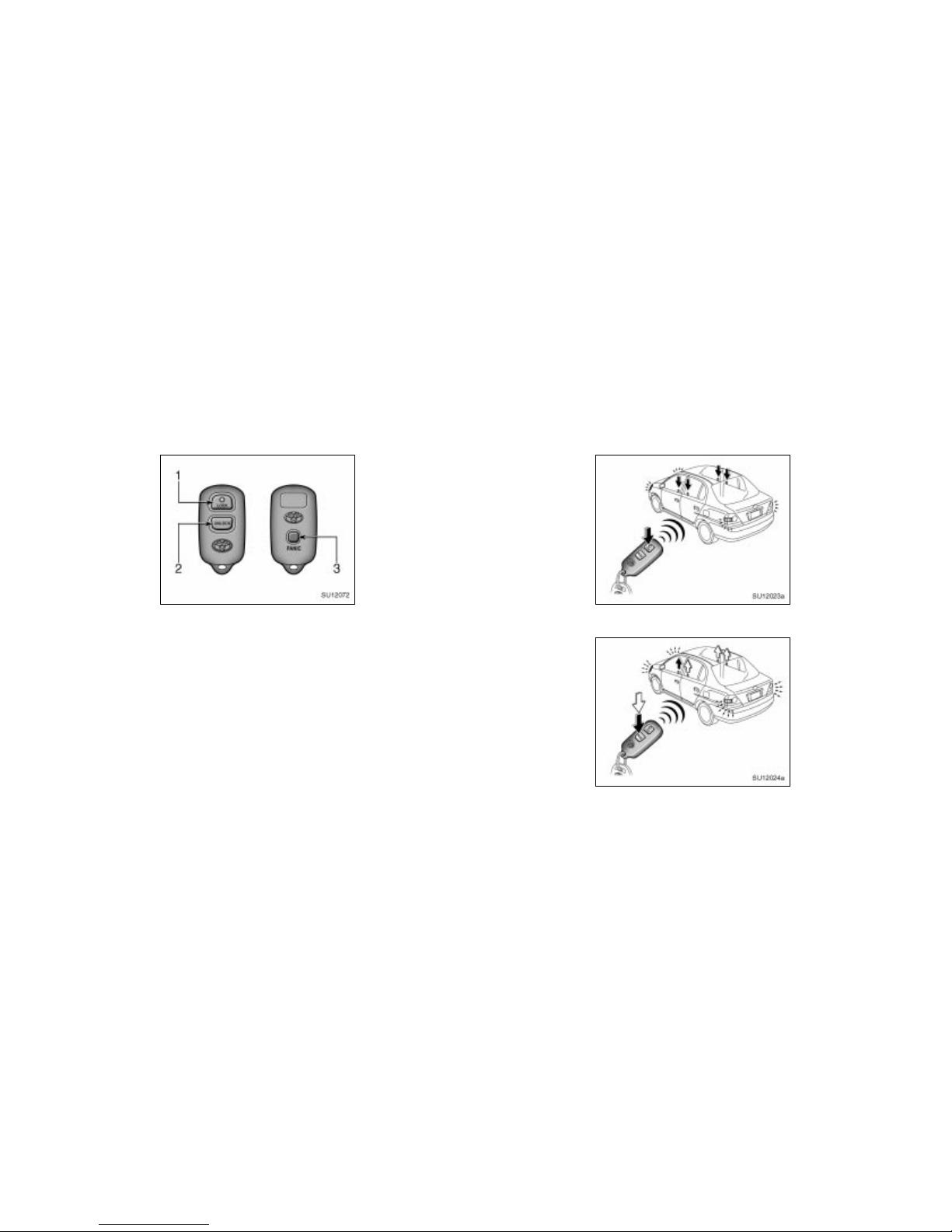
Wireless remote control—
SU12072
1. “LOCK” switch
2. “UNLOCK” switch
3. “PANIC” switch
The wireless remote control system is
designed to lock or unlock all the
doors, or activate the “PANIC” mode
from a distance within approximately 1
m (3 ft.) of the vehicle.
When you operate any switch, push it
slowly and securely.
The wireless remote control transmitter is
an electronic component. Observe the following instructions in order not to cause
damage to the transmitter.
Do not leave the transmitter in places
where the temperature becomes high
such as on the dashboard.
Do not disassemble it.
Avoid knocking it hard against other
objects or dropping it.
Avoid putting it in water.
You can use up to 2 wireless remote control transmitters for the same vehicle.
Contact your Toyota dealer for detailed
information.
If the wireless remote control transmitter
does not actuate the doors or alarm, or
operate from a normal distance:
Check for closeness to a radio trans-
mitter such as a radio station or an
airport which can interfere with normal
operation of the transmitter.
The battery may have been consumed.
Check the battery in the transmitter. To
replace the battery, see “—Replacing
transmitter battery” on page 13.
If you lose your wireless remote control
transmitter, contact your Toyota dealer as
soon as possible to avoid the possibility
of theft, or an accident. (See “If you lose
your wireless remote control transmitter”
on page 200 in Section 4.)
—Locking and unlocking doors
SU12023a
Locking operation
SU12024a
Unlocking operation
04 07.14
Page 20
12
2005 ECHO from Aug. ’04 Prod. (OM52636U)
To lock and unlock all the doors, push
the switches of the transmitter slowly
and securely.
To lock: Push the “LOCK” switch. All the
doors are locked simultaneously. At this
time, parking lights, side marker lights and
tail lights flash.
Check to see that the doors are securely
locked.
If any of the doors is not securely closed,
or if the key is in the ignition switch,
locking cannot be performed by the
“LOCK” switch.
To unlock: Push the “UNLOCK” switch
once to unlock the driver’s door alone.
Pushing the switch twice within 3 seconds
unlocks all the doors simultaneously. At
this time, parking lights, side marker lights
and tail lights flash twice.
You have 30 seconds to open a door a fter
using the wireless remote unlock feature.
If a door is not opened by then, all the
doors will be automatically locked again.
If the “LOCK” or “UNLOCK” switch is kept
pressed in, the locking or unlocking operation is not repeated. Release the switch
and then push again.
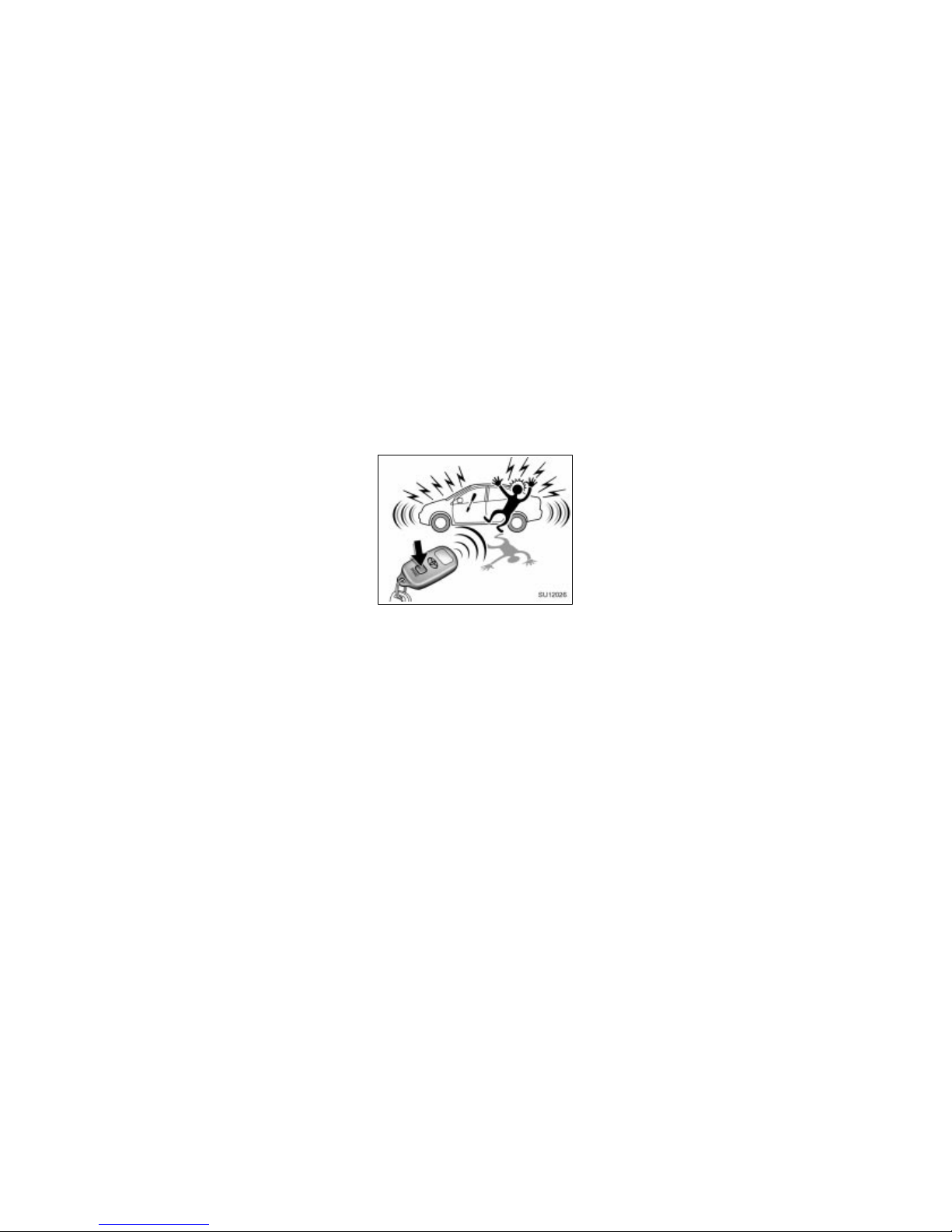
—Activating panic mode
SU12026
Pushing the “PANIC” switch blows the
horn intermittently and flashes the
headlights and tail lights.
The “PANIC” switch is used to deter vehicle theft when you witness anyone attempting to break into or damage your
vehicle.
The alarm will last for one minute. To stop
this midway, push the “PANIC” switch
once again, unlock any door with the key
or transmitter, open the trunk with the key
or turn the ignition key from the “LOCK”
to “ON” position.
To cancel the “PANIC” mode, unlock any
door with the key or wireless remote control transmitter, or open the trunk with the
key from the “LOCK” to “ON” position.
The “PANIC” mode does not work when
the key is inserted in the ignition switch.
04 07.14
Page 21
13
2005 ECHO from Aug. ’04 Prod. (OM52636U)
—Replacing transmitter battery
For replacement, use a CR2016 lithium
battery or equivalent.
CAUTION
Special care should be taken to prevent small children from swallowing
the removed transmitter battery or
components.
NOTICE
When replacing the transmitter battery, be careful not to lose the components.
Replace only with the same or
equivalent type recommended by a
Toyota dealer.
Dispose of used battery according
to the local laws.
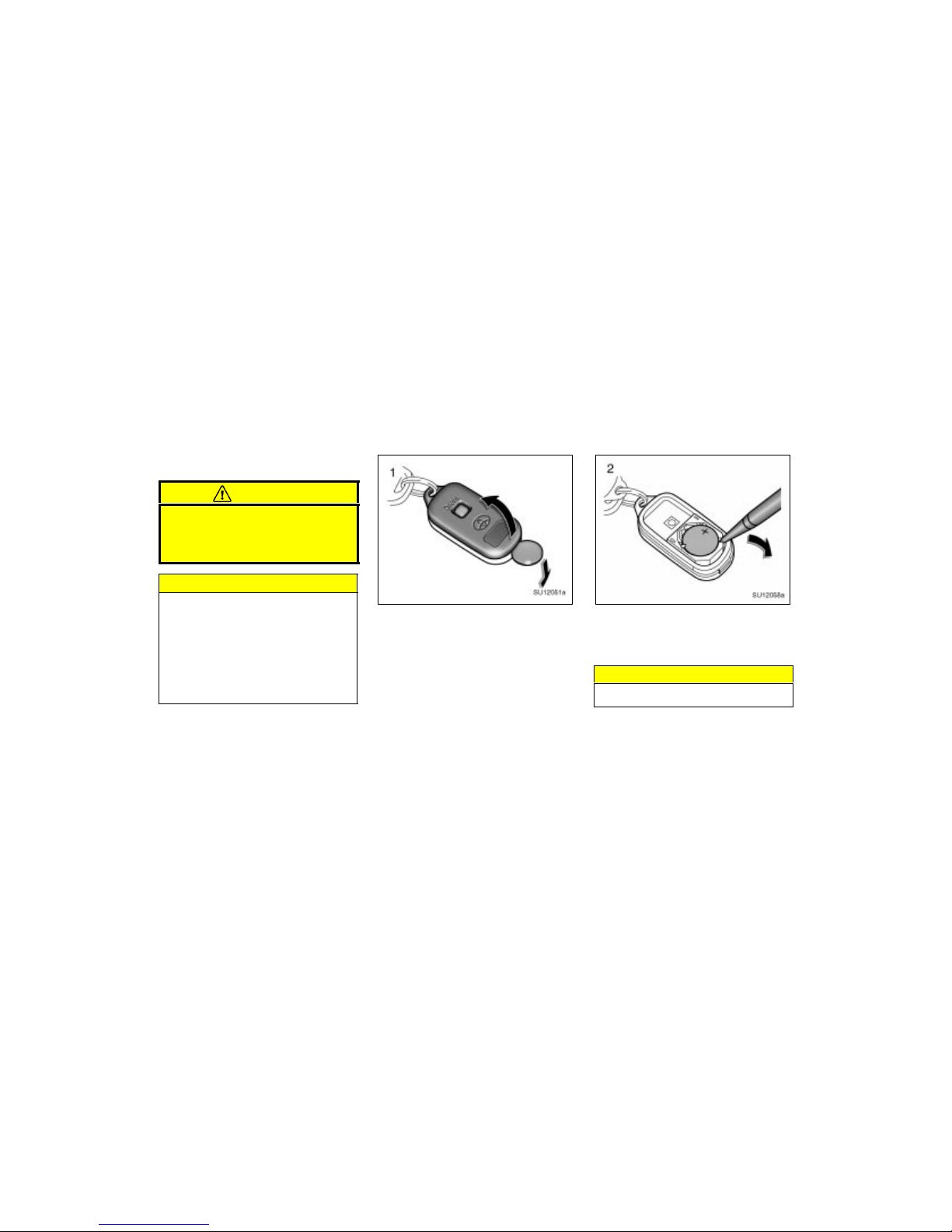
Replace the transmitter battery by following these procedures:
SU12051a
1. Using a coin or equivalent, open the
transmitter case.
SU12058a
2. Remove the discharged transmitter battery by ballpoint pen. Insert the tip of
ballpoint pen at the guide groove and
lift as shown in the above illustration.
NOTICE
Do not bend the terminals.
04 07.14
Page 22
14
2005 ECHO from Aug. ’04 Prod. (OM52636U)
SU12059a
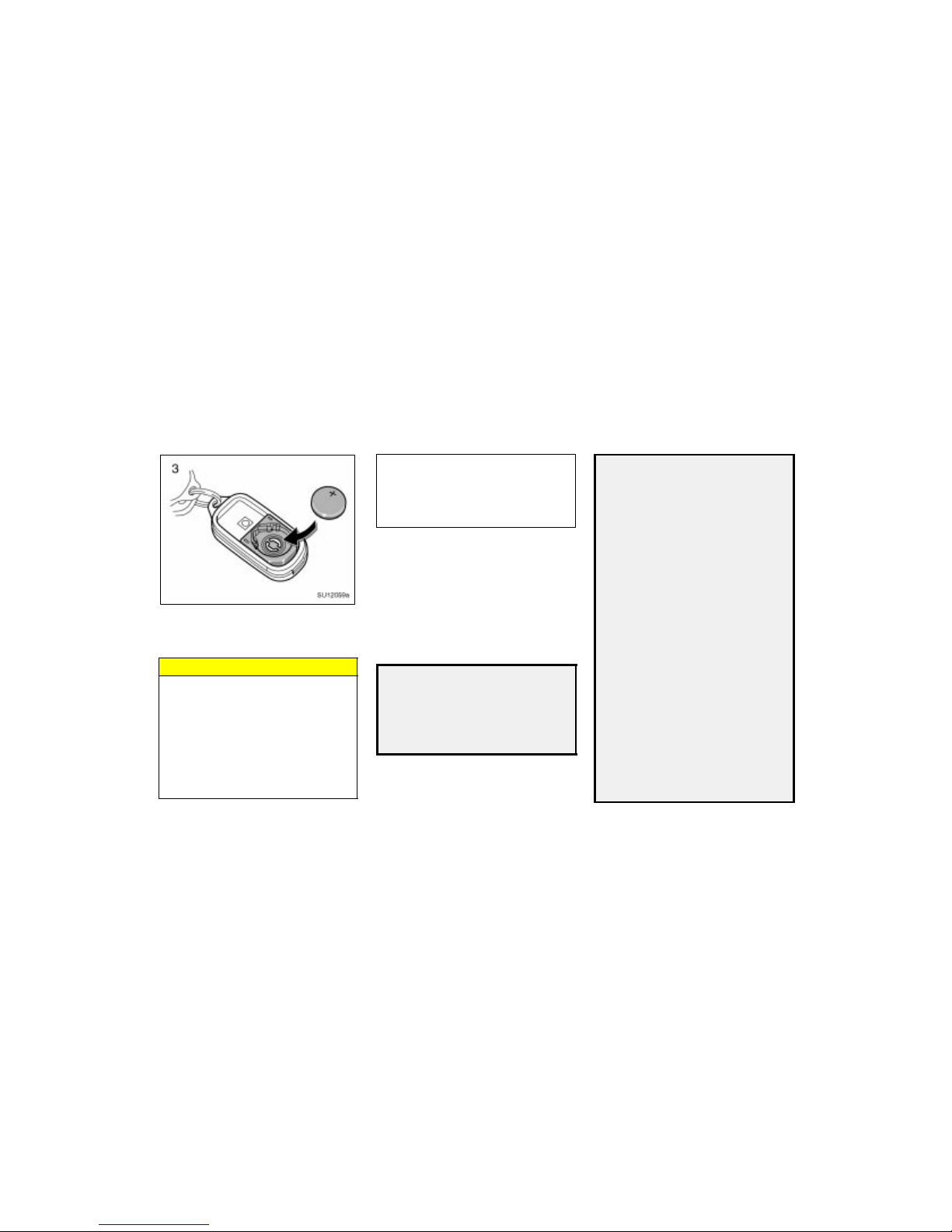
3. Put in a new transmitter battery with
positive (+) side up.
Close the transmitter case securely.
NOTICE
Make sure the positive side and
negative side of the transmitter battery are faced correctly.
Do not replace the battery with wet
hands. Water may cause unexpected
rust.
Do not touch or move any components inside the transmitter, or it
may interfere with proper operation.
Be careful not to bend the electrode
when inserting the transmitter battery and that dust or oils do not
adhere to the transmitter case.
Close the transmitter case securely.
After replacing the battery, check that the
transmitter operates properly. if the transmitter still does not operate properly, contact your Toyota dealer.
If you lose your transmitter, contact your
Toyota dealer as soon as possible to
avoid the possibility of theft, or an accident. (See “If you lose your wireless remote control transmitter” in Section 4.)
For vehicles sold in U.S.A.
This device complies with Part 15 of the
FCC Rules. Operation is subject to the
following two conditions: (1) This device
may not c ause harmful int erference, and
(2) this device must accept any interference received, including interference
that may cause undesired operation.
NOTICE:
This equipment has been tested and
found to comply with the limits for a
Class B digital device, pursuant to Part
15 of the FCC Rules. These limits are
designed to provide reasonable protection against harmful interference in a
residential installation. This equipment
generates, uses and can radiate radio
frequency energy and, if not installed
and used in accordanc e with the instr uctions, may cause harmful interference to
radio communications. However, there is
no guarantee that interference will not
occur in a particular installation. If this
equipment does cause harmful interference to radio or television reception,
which can be determined by turning the
equipment off and on, the user is encouraged to try to correct the interference by one or more of the following
measures:
Reorient or relocate the receiving an-
tenna.
Increase the separation between the
equipment and receiver.
Connect the equipment into an outlet
on a circuit different from that to
which the receiver is connected.
04 07.14
Page 23
15
2005 ECHO from Aug. ’04 Prod. (OM52636U)
Consult the dealer or an experienced
radio / TV technician for help.
FCC WARNING:
Changes or modifications not ex-
pressly approved by the par ty responsible for compliance could void the
user’s authority to operate the equipment.
For vehicles sold in Canada
Operation is subject to the following two
conditions: (1) this device may not
cause interference, and (2) this device
must accept any interference, including
interference that may cause undesired
operation of the device.
Side doors
SY12008
LOCKING AND UNLOCKING WITH KEY
Insert the key into the keyhole and turn
it.
To lock: Turn the key forward.
To unlock: Turn the key backward.
Vehicles with power door lock system—All
the doors lock and unlock simultaneously
with either front door. In the driver’s door
lock, turning the key once will unlock the
driver’s door and twice in succession will
unlock all the doors simultaneously.
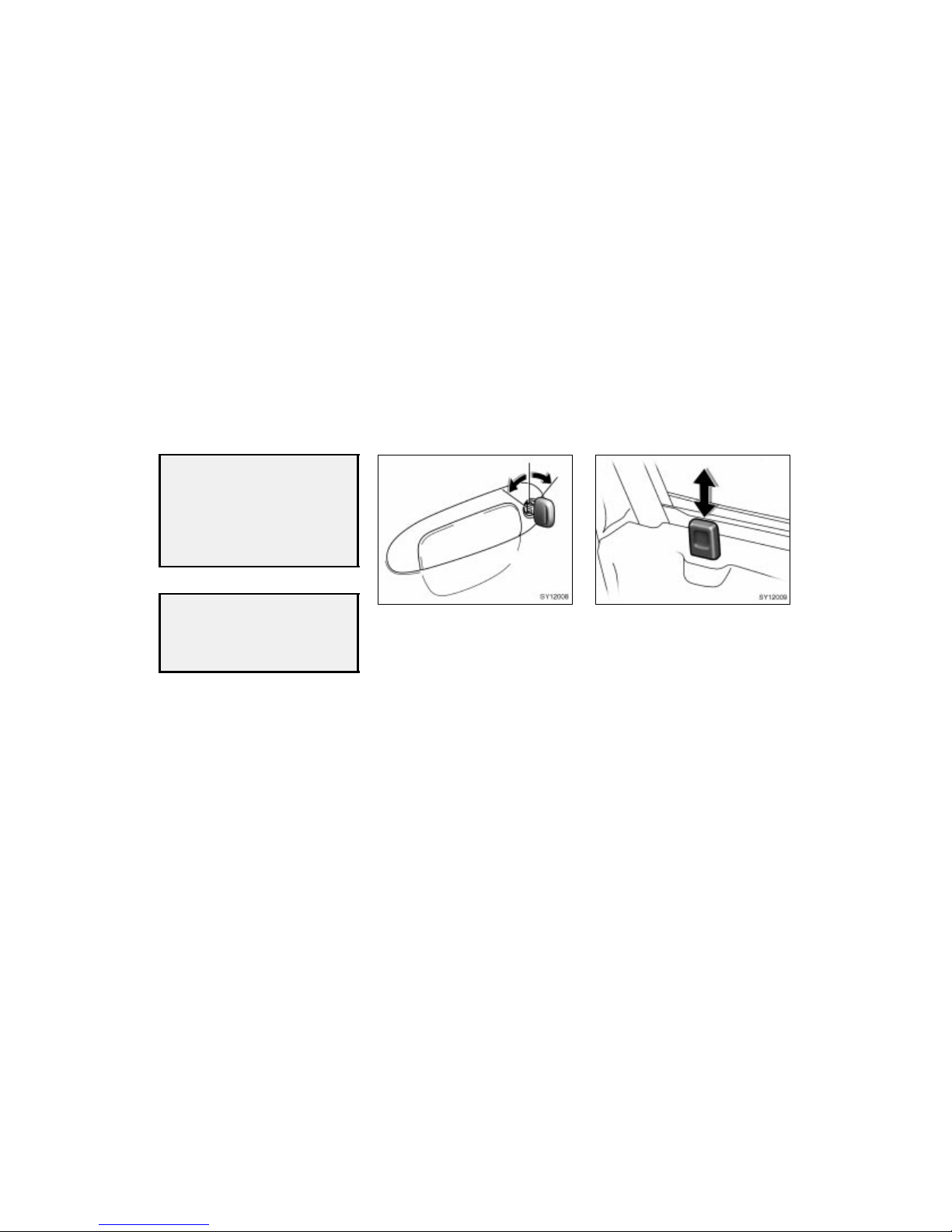
SY12009
LOCKING AND UNLOCKING WITH
INSIDE LOCK BUTTON
Move the lock button.
To lock: Push the knob down.
To unlock: Pull the knob up.
Closing the door with the lock knob in the
lock position will also lock the door. Be
careful not to lock your keys in the vehicle.
Vehicles with power door lock system—Doors cannot be locked when either
front door is open and the key is in the
ignition.
04 07.14
Page 24
16
2005 ECHO from Aug. ’04 Prod. (OM52636U)
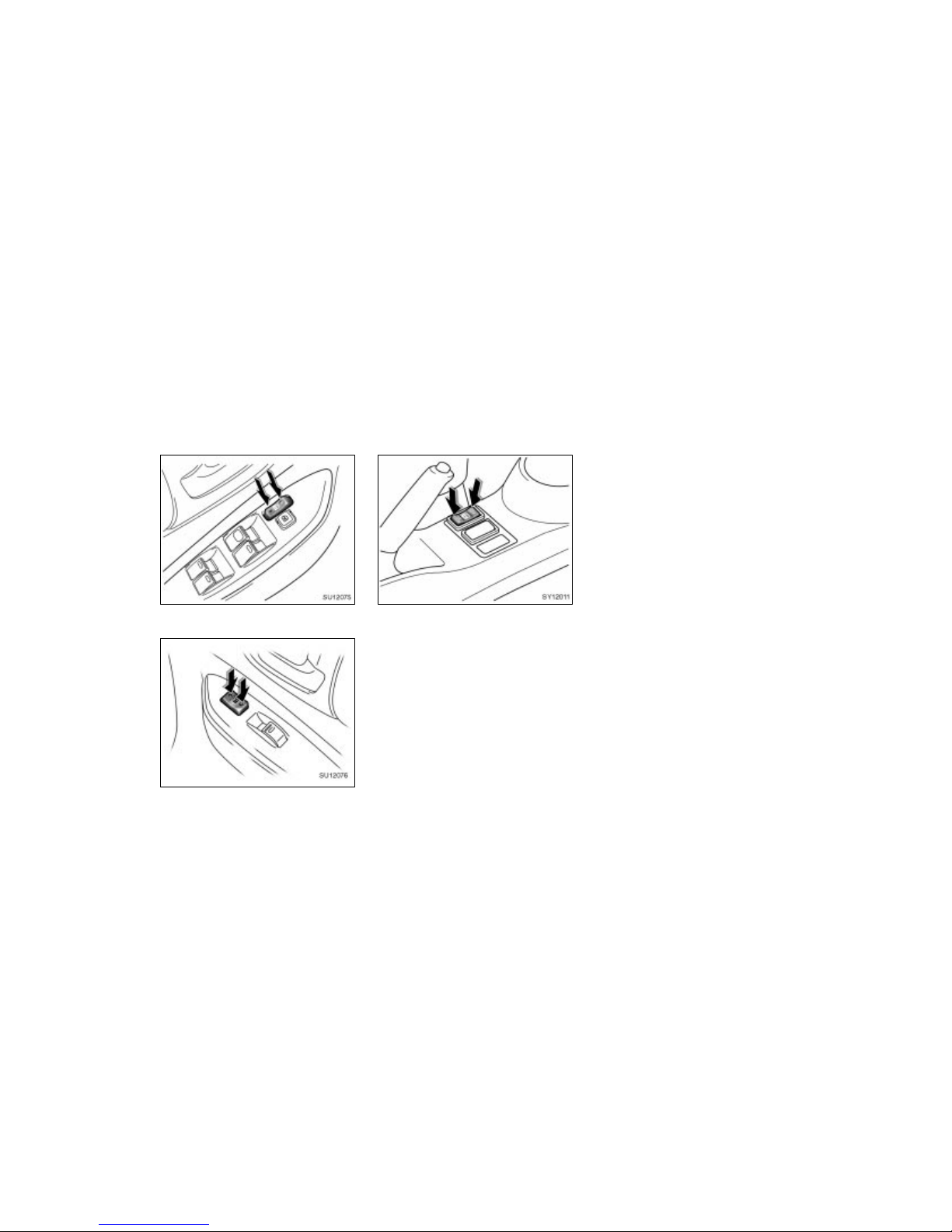
SU12075
Vehicles with power windows (driver’s
side)
SU12076
Vehicles with power windows (passenger’s side)
SY12011
Vehicles without power windows
LOCKING AND UNLOCKING WITH
POWER DOOR LOCK SWITCH
Push the switch.
Vehicles with power windows—
To lock: Push the switch down on the
front side.
To unlock: Push the switch down on the
rear side.
Vehicles without power windows—
To lock: Push the switch down on the
“LOCK” side.
To unlock: Push the switch down on the
“UNLOCK” side.
All the doors lock or unlock simultaneously.
04 07.14
Page 25
17
2005 ECHO from Aug. ’04 Prod. (OM52636U)
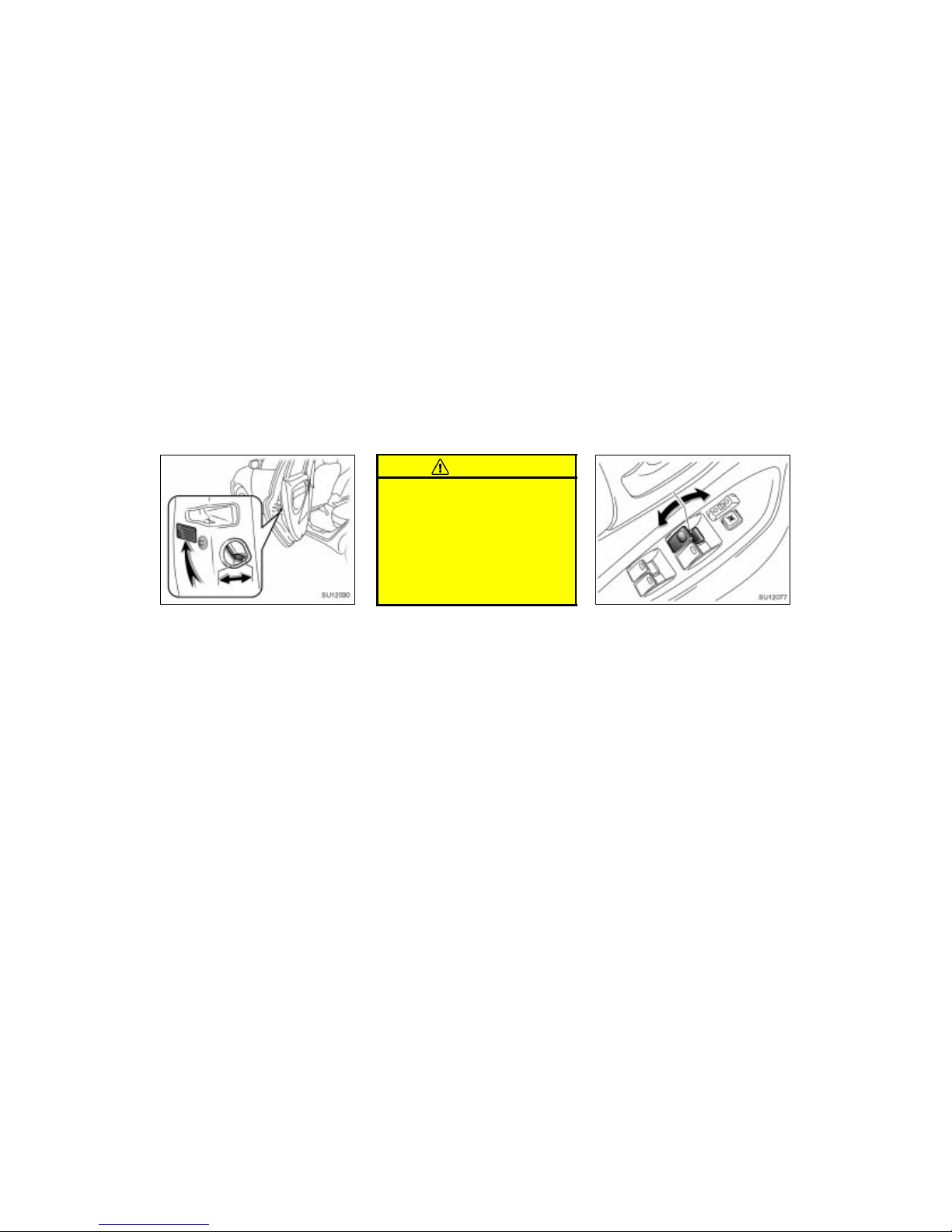
SU12030
REAR DOOR CHILD-PROTECTORS
(4- door models only)
Move the lock lever to the “LOCK”
position as shown on the label.
When the child-protector is locked, you
cannot open the rear door by the inside
door handle. We recommend using this
feature whenever small children are in the
vehicle.
CAUTION
Before driving, be sure that the doors
are closed and locked, especially
when small children are in the vehicle. Along with the proper use of
seat belts, locking the doors helps
prevent the driver and passengers
from being thrown out from the vehicle during an accident. It also helps
prevent the doors from being opened
unintentionally.
Power windows
SU12077
The windows can be operated with the
switch on each door.
The power windows work when the igniti on
switch is in the “ON” position.
OPERATING THE DRIVER’S WINDOW
Use the switch on the driver’s door.
Normal operation: The window moves as
long as you hold the switch.
To open: Lightly push down the switch.
To close: Pull up the switch.
04 07.14
Page 26
18
2005 ECHO from Aug. ’04 Prod. (OM52636U)
SU12078
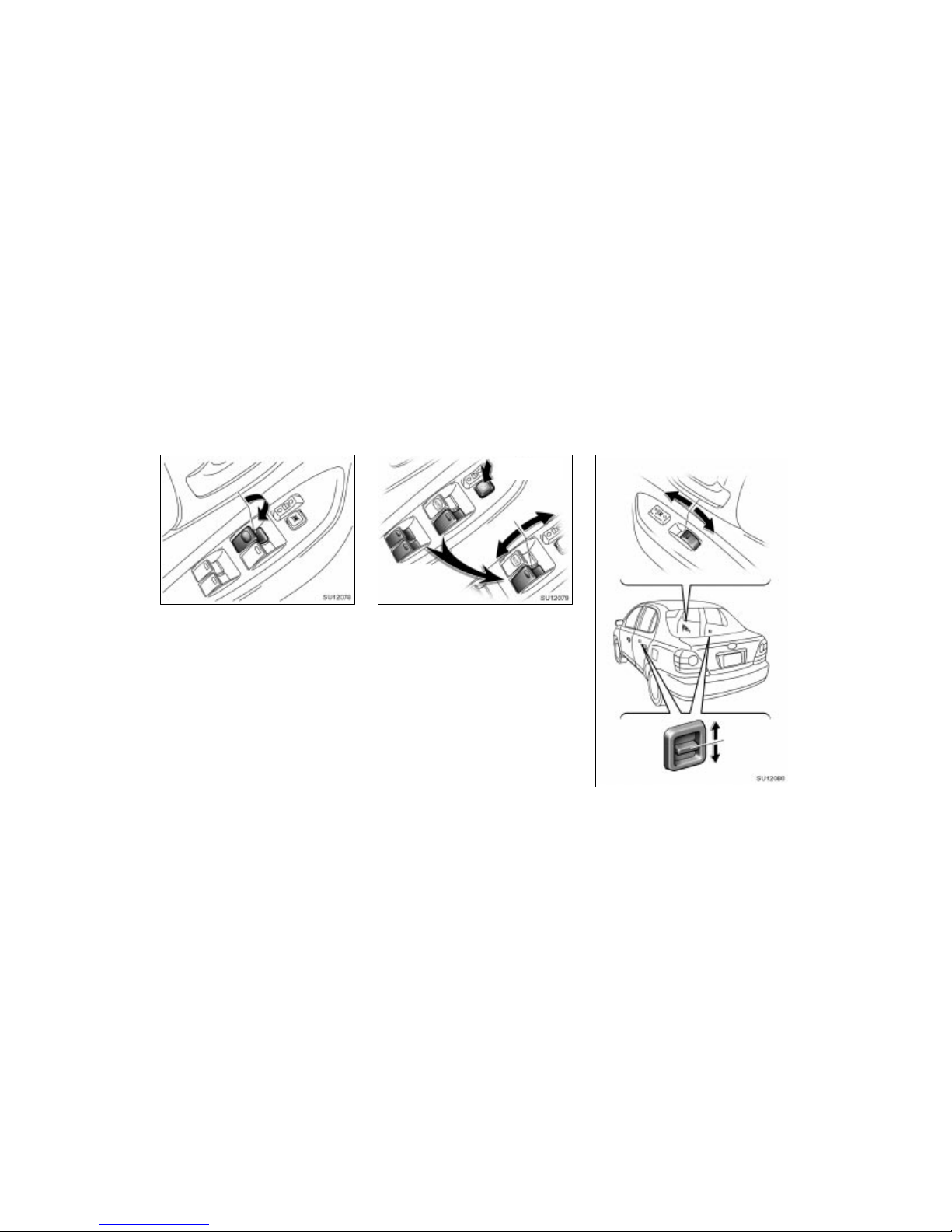
Automatic operation (to open only):
Push the switch completely down and then
release it. The window will fully open. To
stop the window partway, lightly pull the
switch up and then release it.
SU12079
Window lock
switch
OPERATING THE PASSENGERS’
WINDOWS
Use the switches on the passengers’
doors. The driver’s door also has
switches that control the passengers’
windows.
The window moves as long as you hold
the switch.
To open: Push down the switch.
To close: Pull up the switch.
If you push in the window lock switch on
the driver ’s door, the passengers’ windows
cannot be operated.
SU12080
04 07.14
Page 27
19
2005 ECHO from Aug. ’04 Prod. (OM52636U)
CAUTION
To avoid serious personal injury, you
must do the following.
Before you close the power win-
dows, always make sure there is
nobody around the power windows.
You must also make sure the
heads, hands and other parts of the
bodies of all occupants are kept
completely inside the vehicle. If
someone’s neck, head or hands get
caught in a closing window, it
could result in a serious injury.
When anyone closes the power windows, make sure he or she operates the windows safely.
When small children are in the ve-
hicle, never let them use the power
window switches without supervision. Use the window lock switch to
prevent them from making unexpected use of the switches.
Be sure to remove the ignition key
or turn the ignition switch to the
“LOCK” position when you leave
your vehicle.
Never leave anyone (particularly a
small child) alone in your vehicle,
especially with the ignition key still
inserted. Otherwise, he/she could
use the power window switches and
get trapped in a window. Unattended person (particularly a small
child) can be involved in a serious
accident.
Trunk lid—
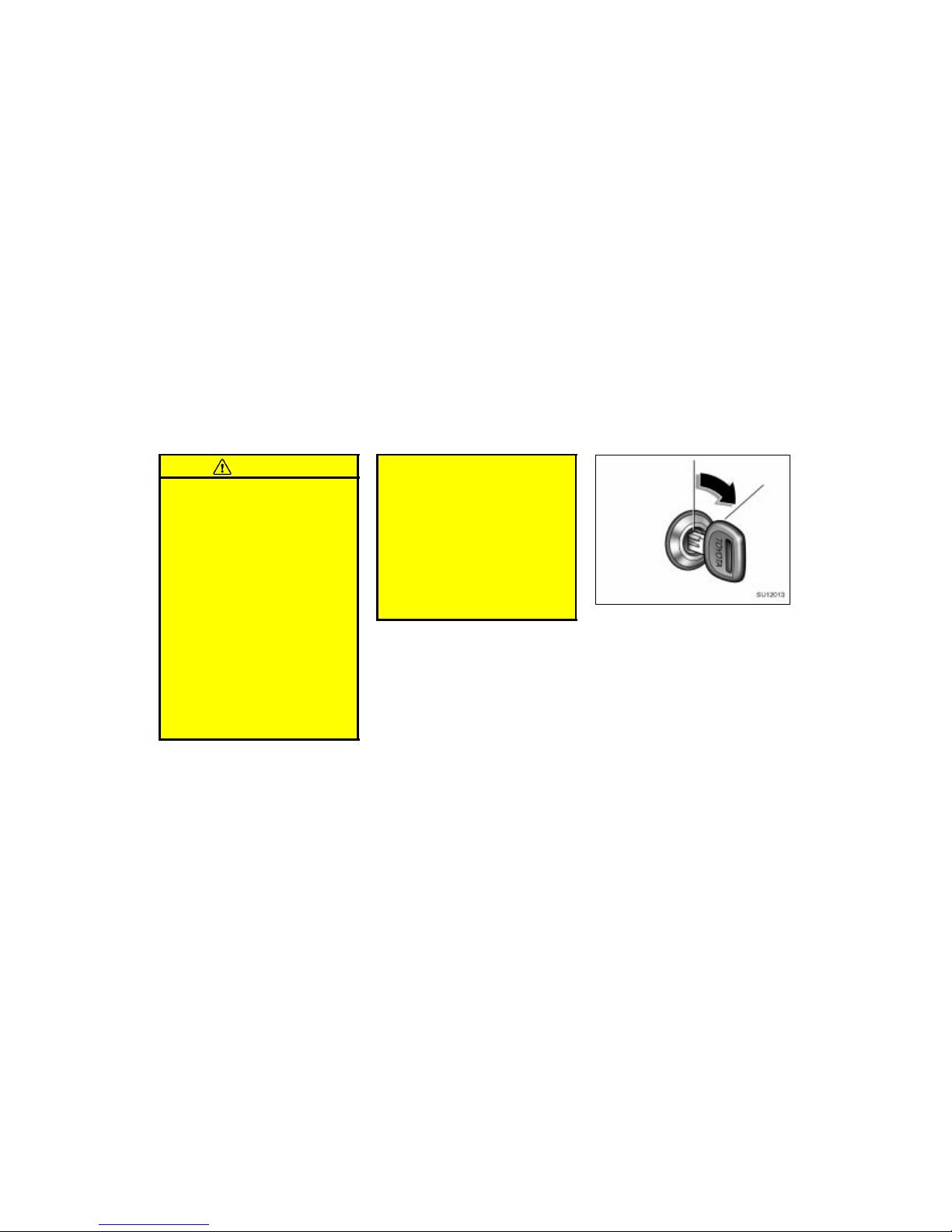
SU12013
To open the trunk lid from the outside,
insert the master key and turn it clockwise.
See “Cargo and luggage” on page 167 in
Section 2 for precautions to observe when
loading luggage.
To close the trunk lid, lower it and press
down on it. After closing the trunk lid, try
pulling it up to make sure it is securely
closed.
04 07.14
Page 28
20
2005 ECHO from Aug. ’04 Prod. (OM52636U)
CAUTION
Keep the trunk lid closed while
driving. This not only keeps the
luggage from being thrown out but
also prevents exhaust gases from
entering the vehicle.
Always lock the trunk lid and all
doors, and keep away the vehicle
keys out of children’s reach.
Never leave children unattended in
the vehicle. Unsupervised children
may lock themselves in the vehicle
or trunk and suffer serious injuries
or death.
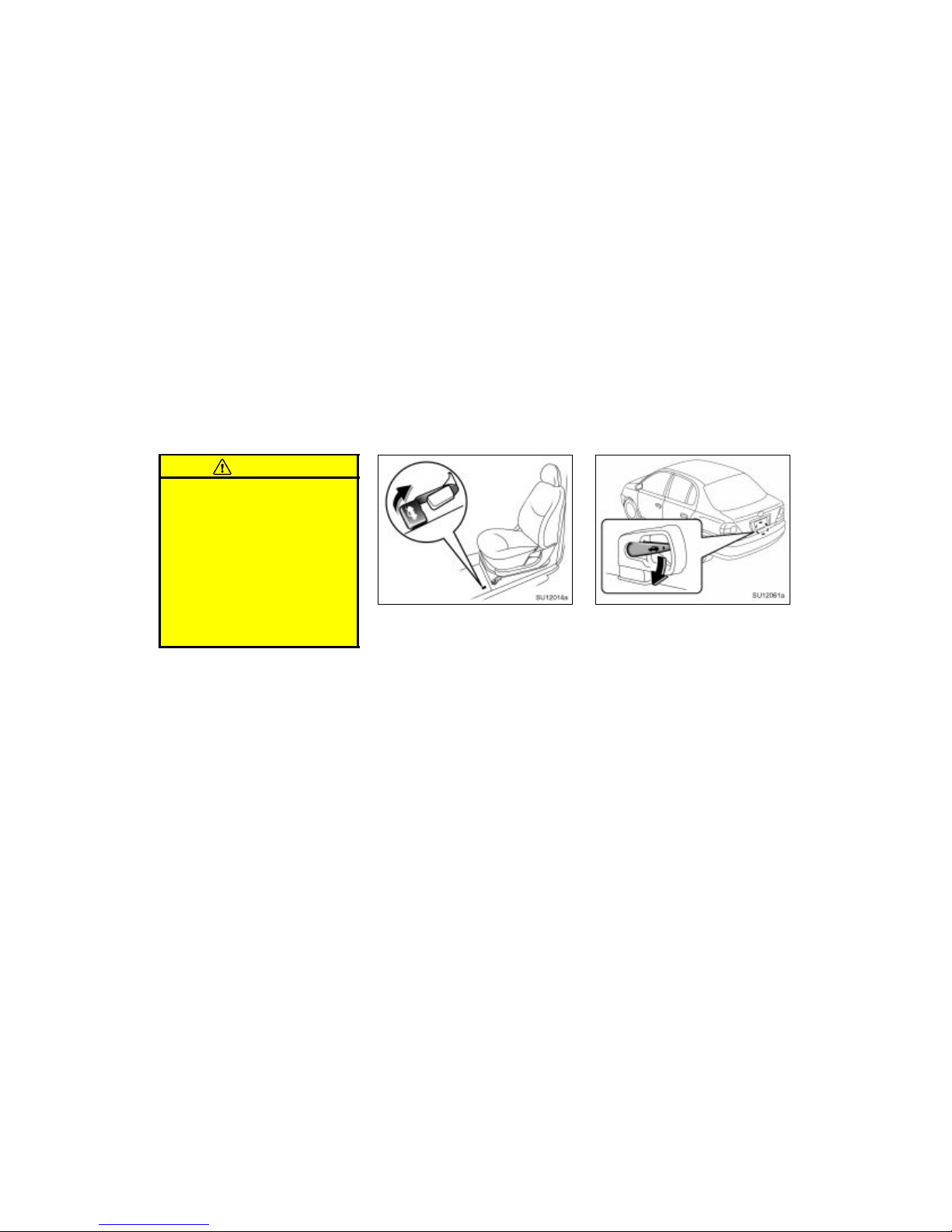
—Lock release lever
SU12014a
To open the trunk lid from the driver’s
seat, pull up on the lock release lever.
—Internal trunk release handle
SU12061a
If a person is locked in the trunk, he/
she can pull down the phosphorescent
handle on the inside of trunk lid to
open the trunk lid.
The phosphorescent (glow- in- the- dark)
handle will continue to glow for a time
after the trunk lid is closed. Exposing the
handle to stronger light will cause it to
glow longer.
04 07.14
Page 29
21
2005 ECHO from Aug. ’04 Prod. (OM52636U)
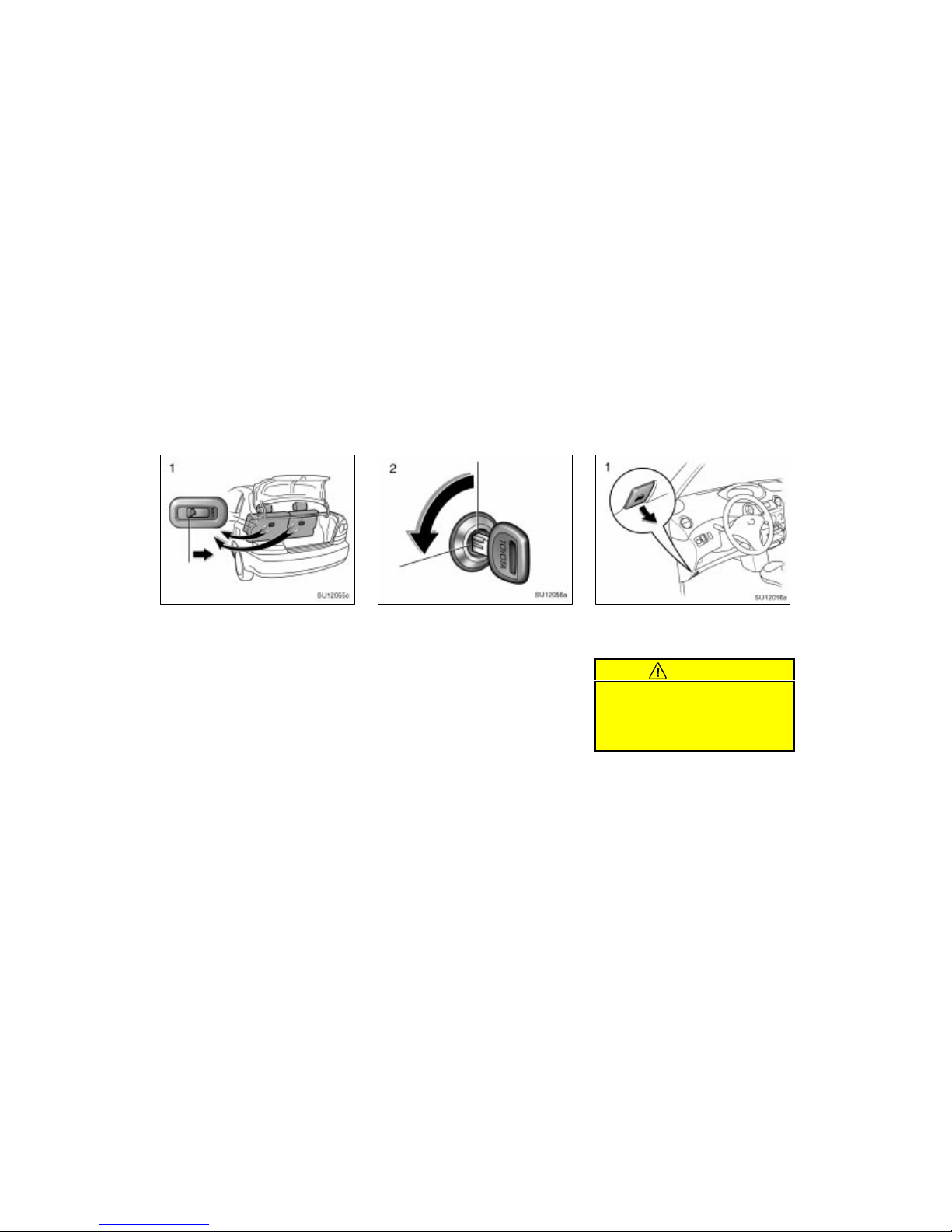
—Luggage security system
SU12055c
This system deactivates the lock release lever so that things locked in the
trunk can be protected.
1. Push down the security lock levers
to lock the rear seatbacks.
On vehicles with built-in child restraint,
only the left seatback has a lock lever
and can be lowered. The right seatback
cannot be folded down.
After locking the rear seatbacks, try folding them down to make sure they are
securely locked, otherwise someone could
get into the trunk by folding down a rear
seat.
SU12056a
2. After closing the trunk lid, insert the
master key and turn it counterclockwise to deactivate the lock release
lever.
After closing the trunk lid, try pulling it up
to make sure it is securely locked.
Hood
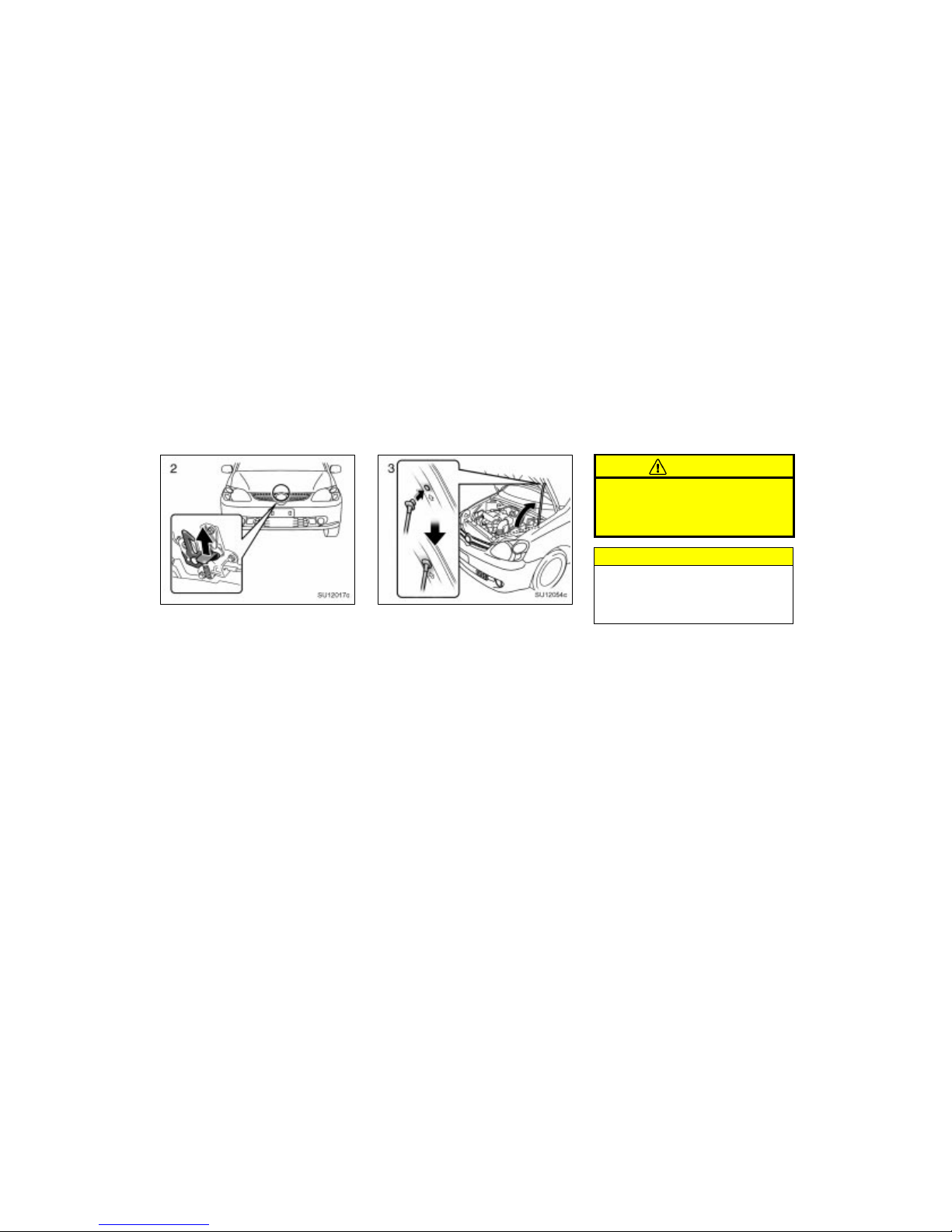
SU12016a
To open the hood:
1. Pull the hood lock release lever. The
hood will spring up slightly.
CAUTION
Before driving, be sure that the hood
is closed and securely locked. Otherwise, the hood may open unexpectedly while driving and an accident may
occur.
04 07.14
Page 30
22
2005 ECHO from Aug. ’04 Prod. (OM52636U)
SU12017c
2. In front of the vehicle, pull up the
auxiliary catch lever and lift the
hood.
SU12054c
3. Hold the hood open by inserting the
support rod into the slot.
To insert the support rod into the slot,
move it straight up. If it is moved to the
side or toward the inside of the vehicle,
it may become detached.
Before closing the hood, check to see that
you have not forgotten any tools, rags,
etc. and return the support rod to its clipthis prevents rattles. Then lower the hood
and make sure it locks into place. If necessary, press down gently on the front
edge to lock it.
CAUTION
After inserting the support rod into
the slot, make sure the rod supports
the hood security from falling down
on to your head or body.
NOTICE
Be sure to return the support rod to
its clip before closing the hood. Closing the hood with the support rod up
could cause the hood to bend.
04 07.14
Page 31
23
2005 ECHO from Aug. ’04 Prod. (OM52636U)
Theft deterrent system
SU12028
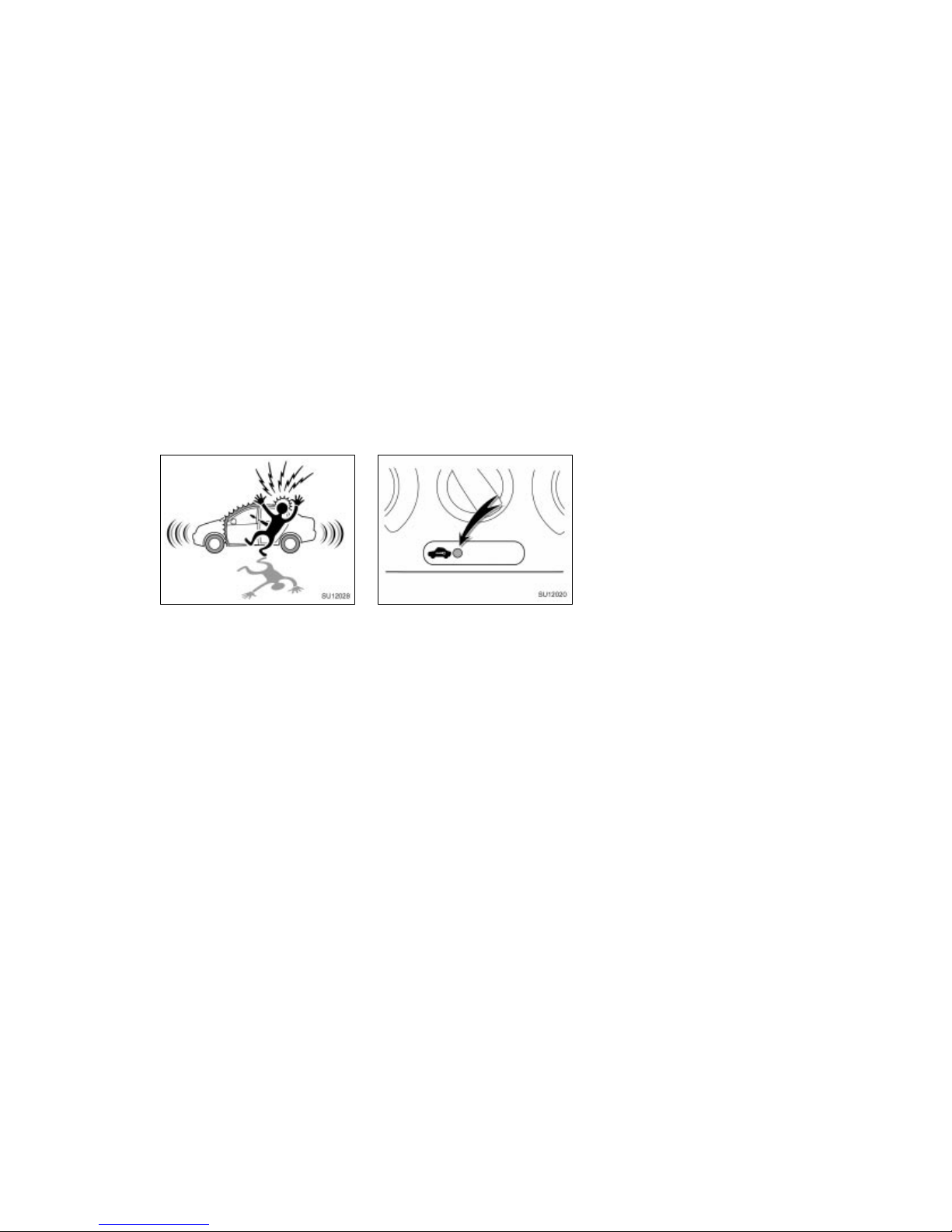
To deter vehicle theft, the system is
designed to sound an alarm if any of
the doors, trunk or hood is forcibly unlocked or the battery ter minal is disconnected and then reconnected when the
vehicle is locked.
The alarm blows the horn intermittently
and flashes the headlights and tail lights.
SU12020
SETTING THE SYSTEM
1. Turn the ignition key to the “LOCK”
position and remove it.
The indicator light will start flashing when
the key is removed from the ignition
switch.
2. Have all passengers get out of the
vehicle.
3. Close and lock all the doors, trunk and
hood.
The indicator light will come on when all
the doors, trunk and hood are closed and
locked.
The system will automatically be set after
30 seconds. When the system is set, the
indicator light will start flashing again.
4. After making sure the indicator light
starts flashing, you may leave the vehicle.
Never leave anyone in the vehicle when
you set the system, because unlocking
from the inside will activate the system.
WHEN THE SYSTEM IS SET
Activating the system
The system will sound the alarm under
the following conditions:
If any of the doors is unlocked or if
the trunk or hood is forcibly opened
without the key
If the battery terminal is disconnected
and then reconnected
The indicator light will come on when the
system is activated.
04 07.14
Page 32
24
2005 ECHO from Aug. ’04 Prod. (OM52636U)
If any of the doors are unlocked without
the key and the key is not in the ignition
switch, all the doors will be automatically
locked again.
After one minute, the alarm will automatically stop and the indicator light will starts
flashing again.
Reactivating the alarm
Once set, the system automatically resets
the alarm after the alarm stops.
The alarm will activate again under the
same circumstances described in
“Activating the system”.
Stopping the alarm
The alarm will b e stopped by the following
three ways:
Turn the ignition key from the “LOCK”
to “ON” position.
Unlock any of the doors with the key.
Open the trunk with the key.
CANCELLING THE SYSTEM
The system will be cancelled by the
above mentioned 3 ways.
If the tail lights come on for 2 seconds,
the theft deterrent system has been
alarmed. Check to see if there is any
abnormality with your vehicle.
TESTING THE SYSTEM
1. Open all the windows.
2. Set the system as described above.
The doors should be locked with the
key. Be sure to wait until the indicator
light goes off or starts flashing.
3. Unlock any door from the inside. The
system should activate the alarm.
4. Stop the alarm as described above.
5. Repeat this operation for the other
doors, trunk and hood. When testing
the hood, also check that the system
is activated when the battery terminal
is disconnected and then reconnected.
If the system does not work properly,
have it checked by your Toyota dealer.
Fuel tank cap
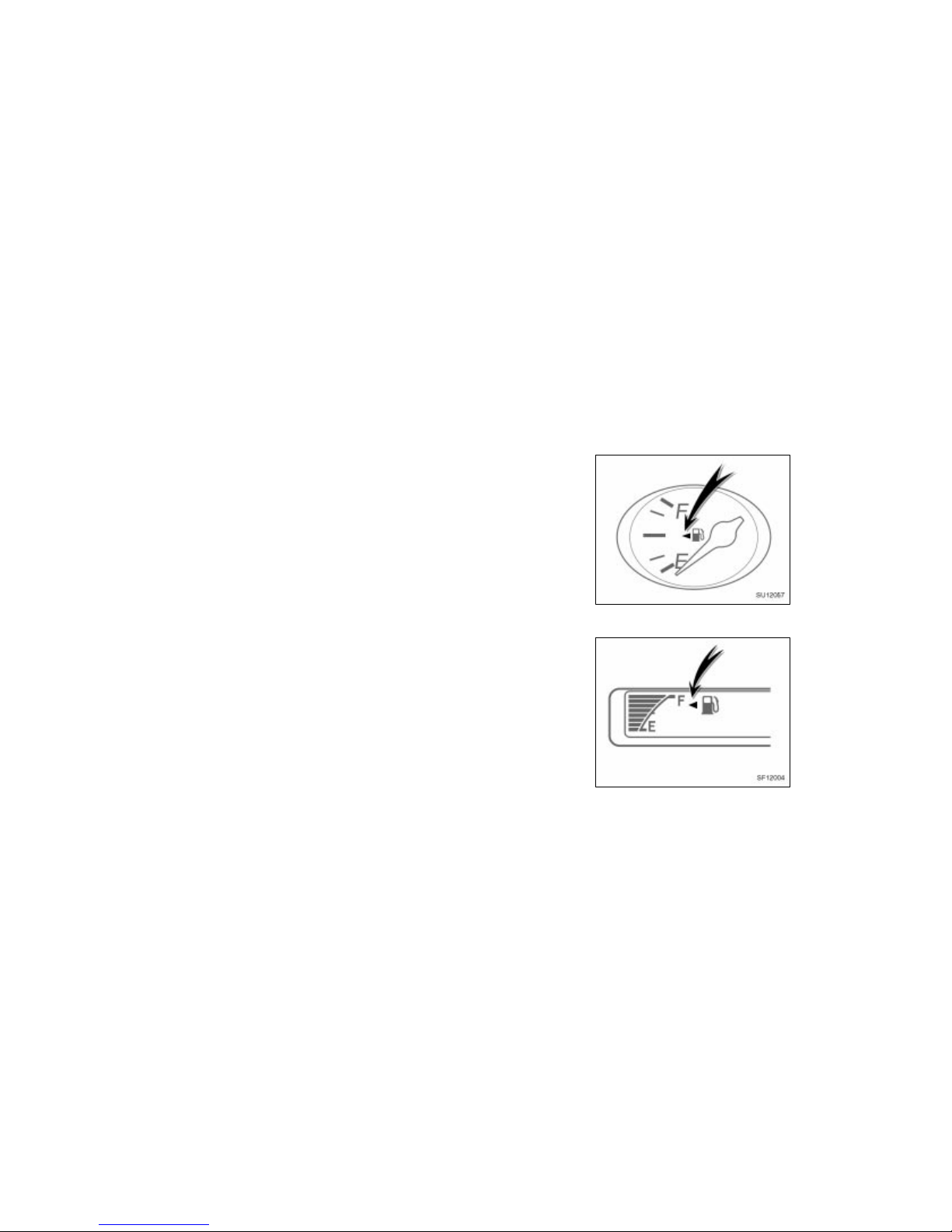
SU12057
Type A
SF12004
Type B
04 07.14
Page 33
25
2005 ECHO from Aug. ’04 Prod. (OM52636U)
This indicates that the fuel filler door
is on the left side of your vehicle.
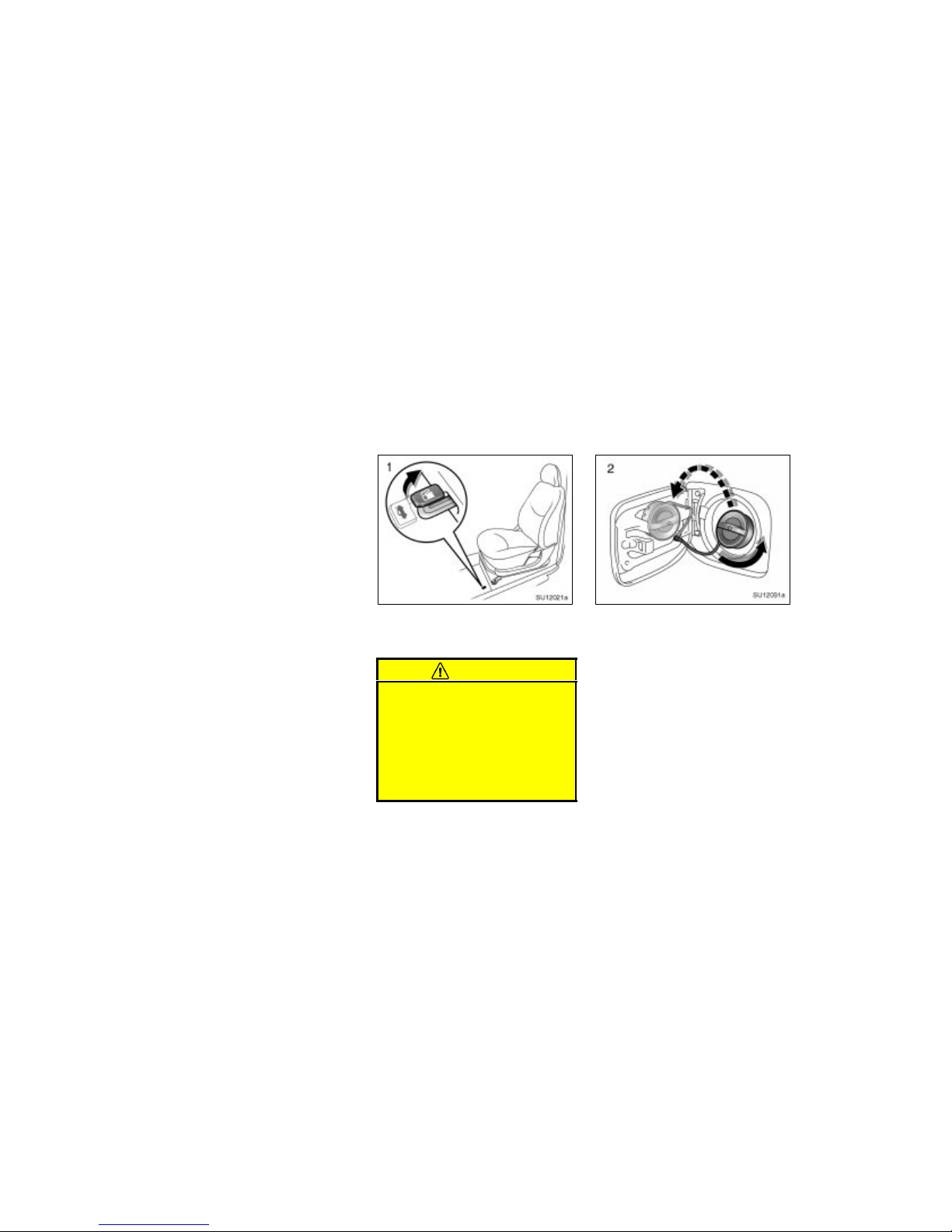
SU12021a
1. To open the fuel filler door, pull the
lever up.
When refueling, turn off the engine.
CAUTION
Do not smoke, cause sparks or al-
low open flames when refueling.
The fumes are flammable.
When opening the cap, do not re-
move the cap quickly. In hot weather, fuel under pressure could cause
injury by spraying out of the filler
neck if the cap is suddenly removed.
SU12031a
2. To remove the fuel tank cap, turn
the cap slowly counterclockwise,
then pause slightly before removing
it. After removing the cap, hang it
on the cap hanger.
It is not unusual to hear a slight swoosh
when the cap is opened. When installing,
turn the cap clockwise till you hear a
click.
If the cap is not tightened securely, the
malfunction indicator lamp comes on.
Make sure the cap is tightened securely.
04 07.14
Page 34
26
2005 ECHO from Aug. ’04 Prod. (OM52636U)
The indicator lamp goes off after driving
several times. If the indicator lamp does
not go off, contact your Toyota dealer as
soon as possible.
CAUTION
Make sure the cap is installed se-
curely to prevent fuel spillage in
the event of an accident.
Use only a genuine Toyota fuel tank
cap for replacement. It is designed
to regulate fuel tank pressure.
04 07.14
Page 35

15
2005 ECHO HATCHBACK from Jul. ’04Prod. (OM52624U)
OPERATION OF INSTRUMENTS AND
CONTROLS
Occupant restraint systems
Seats 16. . . . . . . . . . . . . . . . . . . . . . . . . . . . . . . . . . . . . . . . . . . . . . . . . . . . . .
Front seats 16. . . . . . . . . . . . . . . . . . . . . . . . . . . . . . . . . . . . . . . . . . . . . . . . .
Fold-down rear seat 19. . . . . . . . . . . . . . . . . . . . . . . . . . . . . . . . . . . . . . . . .
Head restrai nts 20. . . . . . . . . . . . . . . . . . . . . . . . . . . . . . . . . . . . . . . . . . . . . .
Seat belts 21. . . . . . . . . . . . . . . . . . . . . . . . . . . . . . . . . . . . . . . . . . . . . . . . . . .
SRS driver and front passenger airbags 28. . . . . . . . . . . . . . . . . . . . . . . .
Child restraint 35. . . . . . . . . . . . . . . . . . . . . . . . . . . . . . . . . . . . . . . . . . . . . . .
04 06.07
SECTION 1-
3
Page 36
16
2005 ECHO HATCHBACK from Jul. ’04Prod. (OM52624U)
Seats
While the vehicle is being driven, all vehicle occupants should have the seatback
upright, sit well back in the seat and properly wear the seat belts provided.
Seating capacit y:
Total 4 (Front 2, Rear 2)
CAUTION
Do not drive the vehicle unless the
occupants are properly seated. Do
not allow any passengers to sit on
top of a folded- down seatback, or
in the luggage compartment or cargo area. Persons not properly
seated and/or not properly restrained by seat belts can be severely injured in the event of emergency braking or a collision.
During driving, do not allow any
passengers to stand up or move
around between seats. Otherwise,
severe injuries can occur in the
event of emergency braking or a
collision.
Driver seat
CAUTION
The SRS driver airbag deploys with
considerable force, and can cause
death or serious injury especially if
the driver is very close to the airbag.
The National Highway Traffic Safety
Administration (“NHTSA”) advises:
Since the risk zone for driver airbag
is the first 50-75 mm (2-3 in.) of
inflation, placing yourself 250 mm (10
in.) from your driver airbag provides
you with a clear margin of safety.
This distance is measured from the
center of the steering wheel to your
breastbone. If you sit less than 250
mm (10 in.) away now, you can
change your driving posit ion in several ways:
Move your seat to the rear as far
as you can while still reaching the
pedals comfortably.
Slightly recline the back of the
seat. Although vehicle designs vary,
many drivers can achieve the 250
mm (10 in.) distance, even with the
driver seat all the way forward, simply by reclining the back of the
seat somewhat. If reclining the back
of your seat makes it hard to see
the road, raise yourself by using a
firm, non- slippery cushion, or raise
the seat if your vehicle has that
feature.
If your steering wheel is adjustable,
tilt it downward. This points the airbag toward your chest instead of
your head and neck.
The seat should be adjusted as recommended by NHTSA above, while
still maintaining control of the foot
pedals, steering wheel, and your view
of the instrument panel controls.
04 06.07
Front seats—
—Front seat precautions
Page 37
17
2005 ECHO HATCHBACK from Jul. ’04Prod. (OM52624U)
Front passenger seat
CAUTION
The SRS front passenger airbag also
deploys with considerable force, and
can cause death or serious injury especially if the front passenger is very
close to the airbag. The front passenger seat should be as far from the
airbag as possible with the seatback
adjusted, so the front passenger sits
upright.
—Seat adjustment precautions
CAUTION
Do not adjust the seat while the
vehicle is moving as the seat may
unexpectedly move and cause the
driver to lose control of the vehicle.
Be careful that the seat does not
hit a passenger or luggage.
After adjusting the seat position, re-
lease the lever and try sliding the
seat forward and backward to make
sure it is locked in position.
After adjusting the seatback, push
your body back against the seat to
make sure the seat is locked in
position.
Do not put objects under the seats
except for putti ng them in the auxiliary box. Otherwise, the objects
may interfere with the seat-lock
mechanism or unexpectedly push
up the seat position adjusting lever
and the seat may suddenly move,
causing the driver to lose control of
the vehicle.
While adjusting the seat, do not put
your hands under the seat or near
the moving parts. Otherwise, your
hands or fingers may be caught and
injured.
04 06.07
Page 38
18
2005 ECHO HATCHBACK from Jul. ’04Prod. (OM52624U)
—Adjusting front seats
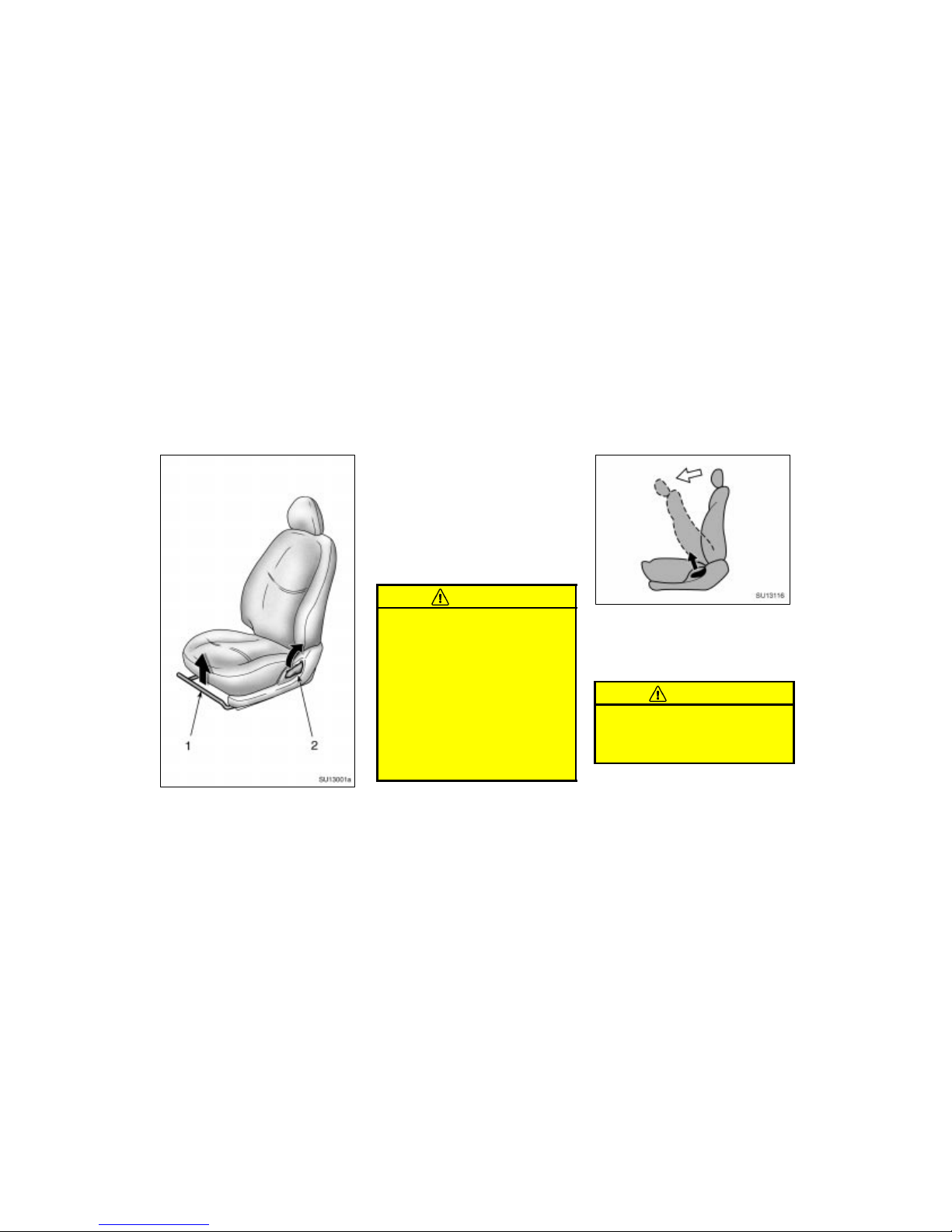
SU13001a
1. SEAT POSITION ADJUSTING LEVER
Hold the center of the lever and pull it
up. Then slide the seat to the desired
position with slight body pressure and
release the lever.
2. SEATBACK ANGLE ADJUSTING
LEVER
Lean forward and pull the lever up.
Then lean back to the desired angle
and release the lever.
CAUTION
To reduce the risk of sliding under
the lap belt during a collision, avoid
reclining the seatback any more than
needed. The seat belts provide maximum protection in a frontal or rear
collision when the driver and the
front passenger are si tting up straight
and well back in the seats. If he/she
is reclined, the lap belt may slide
past his/her hips and apply restraint
forces directly to the abdomen. In the
event of a frontal collision, the more
the seat is reclined, the greater the
risk of personal injury.
SU13116
Lift the seatback release lever—the
seatback will tilt forward.
This allows passengers to get into or out
of the rear seat easily. After passengers
are in, lift up on the seatback.
CAUTION
After putting back the seatback, try
pushing the seatback forward and
rearward to make sure it is secured
in place.
04 06.07
—Tilting driver’s seatback for
rear seat entry
(3- door models)
Page 39
19
2005 ECHO HATCHBACK from Jul. ’04Prod. (OM52624U)
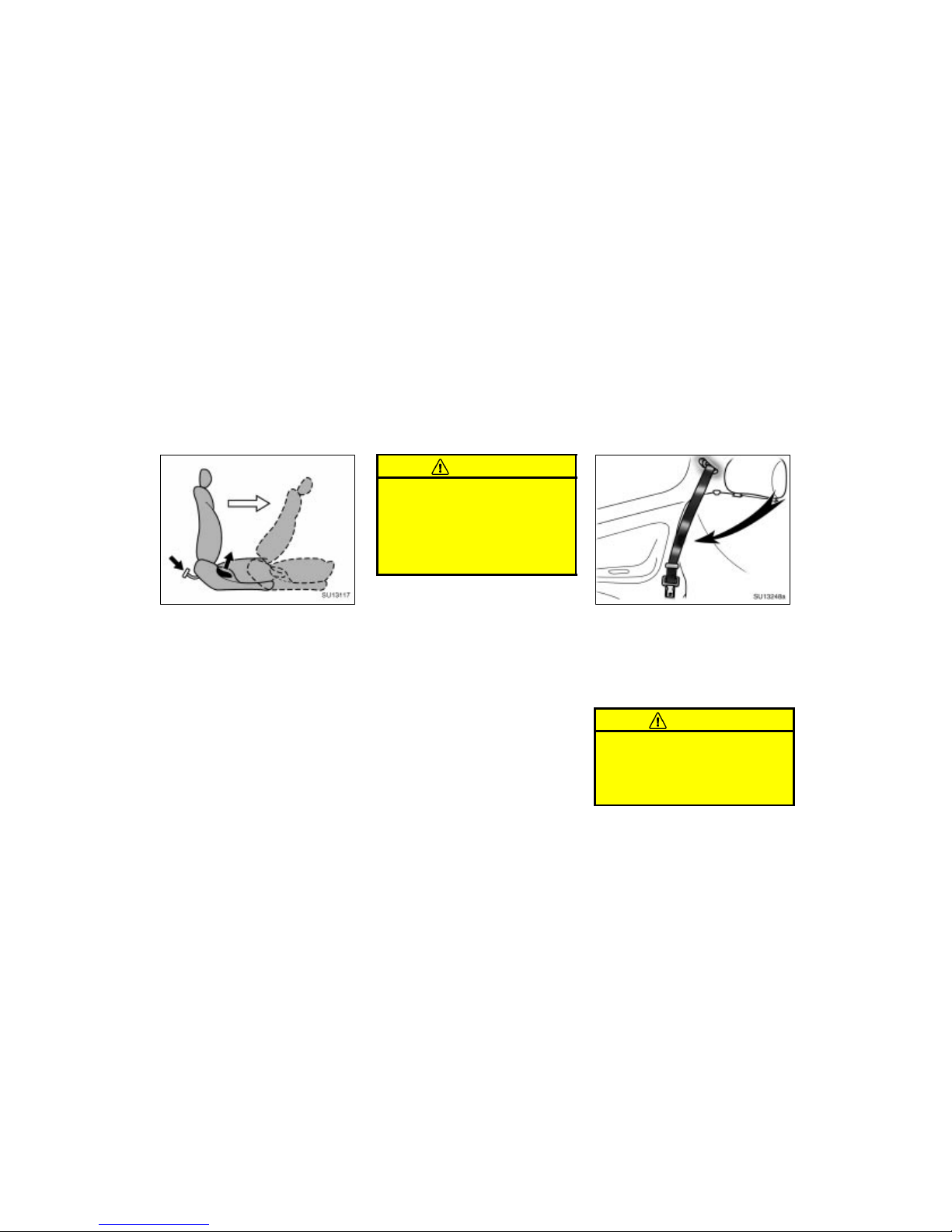
SU13117
For easy access to the rear seat:
1. Lift the seatback angle adjusting lever
or press the pedal behind the seatback.
The seat will slide forward.
2. Move the seat to the front- most position.
After passengers are in, lift up the seatback and return the seat until it locks.
CAUTION
After putting back the seat, try
pushing the seat forward and rearward to make sure it is secured in
place.
Never allow anyone to rest their
foot on the release pedal while the
vehicle is moving.
Fold- down rear seat
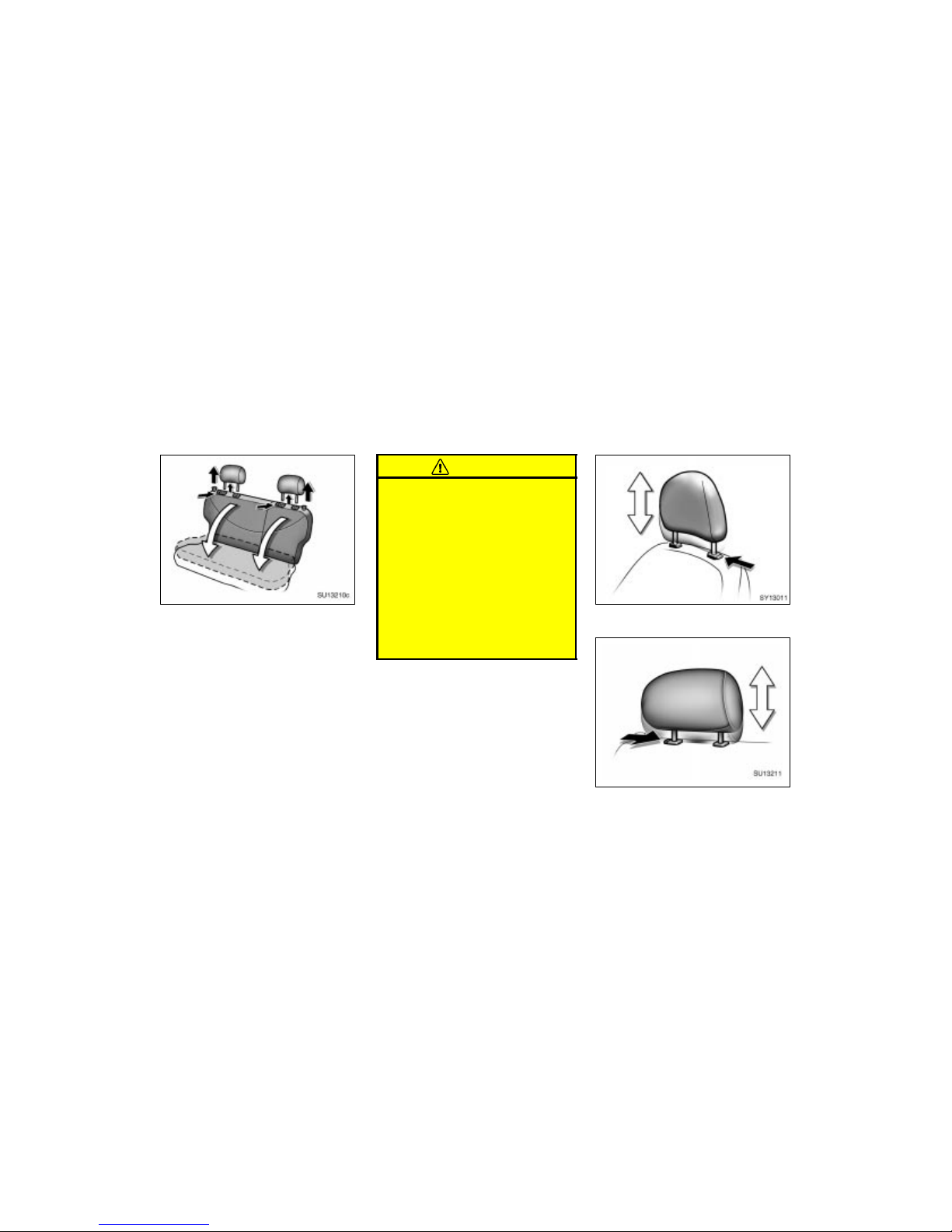
SU13248a
(A) BEFORE FOLDING REAR SEAT
Make sure the shoulder belt passes
through the hanger when folding the
seatback down (or returning the seatback to the upright position).
This prevents the shoulder belt from being
damaged.
CAUTION
Do not operate the seat while the
vehicle is moving.
The seat belt must be removed
from the hanger when the seat belt
is in use.
04 06.07
—Moving passenger’s seat for
rear seat entry
(3- door models)
Page 40
20
2005 ECHO HATCHBACK from Jul. ’04Prod. (OM52624U)
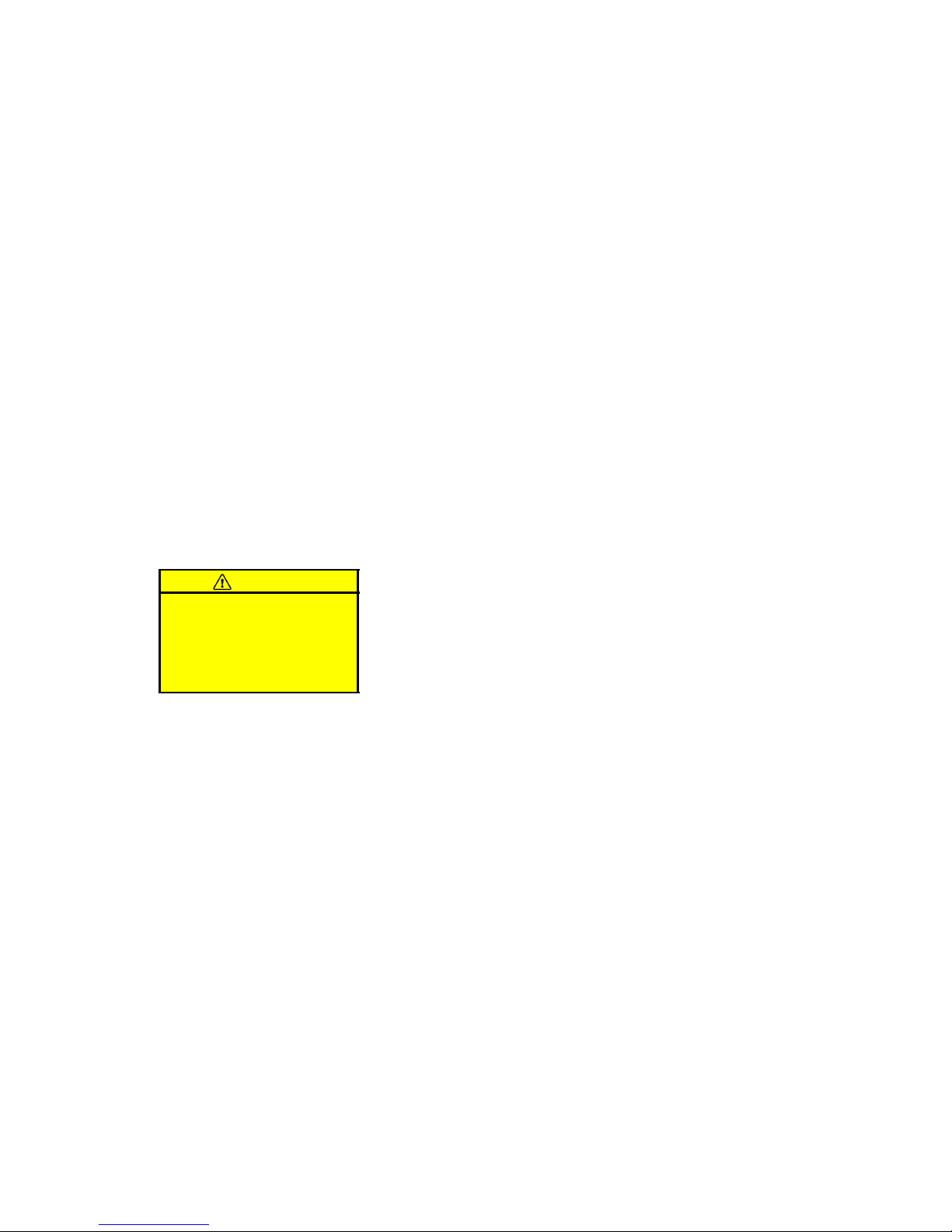
SU13210c
(B) FOLDING REAR SEAT
1. Remove the head restraints.
2. Unlock the seatback, and fold it
down.
This will enlarge the luggage compartment
as far as the front seatback. See “Cargo
and luggage” on page 120 in Section 2 for
precautions to observe in loading luggage.
CAUTION
When returning the seatback to the
upright position, observe the following precautions in order to prevent
personal injury in a collision or sudden stop:
Make sure the seatback is securely
locked by pushing for ward and rearward on the top of the seatback. If
you removed head restraints, be
certain to replace them.
Make sure the seat belts are not
twisted or caught in the seatback
and are arranged in their proper
position and are ready to use.
Head restraints
SY13011
Front seat
SU13211
Rear seat
04 06.07
Page 41
21
2005 ECHO HATCHBACK from Jul. ’04Prod. (OM52624U)
For your safety and comfort, adjust the
head restraint before driving.
To raise: Pull it up.
To lower: Push it down while pressing the
lock release button.
The head restraint is most effective when
it is close to your head. Therefore, using
a cushion on the seatback is not recommended.
CAUTION
Adjust the center of the head re-
straint so that it is closest to the
top of your ears.
After adjusting the head restraint,
make sure it is locked in position.
Do not drive with the head re-
straints removed.
Toyota strongly urges that the driver and
passengers in the vehicle be properly restrained at all times with the seat belts
provided. Failure to do so could increase
the chance of injury and/or the severity of
injury in accidents.
The seat belts provided for your vehicle
are designed for people of adult size,
large enough to properly wear them.
Child. Use a child restraint system appropriate for the child until the child becomes large enough to properly wear the
vehicle’s seat belts. See “Child restraint”
on page 35 for details.
If a child is too large for a child restraint
system, the child should sit in the rear
seat and must be restrained using the
vehicle’s seat belt. According to accident
statistics, the child is safer when properly
restrained in the rear seat than in the
front seat.
If a child must sit in the front seat, the
seat belts should be worn properly. If an
accident oc curs and the seat belts are not
worn properly, the force of the rapid inflation of the airbag may cause death or
serious injury to the child.
Do not allow any children to stand up or
kneel on either rear or front seats. An
unrestrained child could suffer serious injury o r death during emergenc y br aking or
a collision. Also, do not let the child sit
on your lap. Holding a child in your arms
does not provide sufficient restraint.
Pregnant woman. Toyota recommends the
use of a seat belt. Ask your doctor for
specific recommendations. The lap belt
should be worn securely and as low as
possible over the hips and not on the
waist.
Injured person. Toyota recommends the
use of a seat belt. Depending on the injury, first check with your doctor for specific
recommendations.
04 06.07
Seat belts—
—Seat belt precautions
Page 42
22
2005 ECHO HATCHBACK from Jul. ’04Prod. (OM52624U)
CAUTION
Persons should ride in their seats
properly wearing their seat belts
whenever the vehicle is moving.
Otherwise, they are much more likely
to suffer serious bodily injury or
death in the event of sudden braking
or a collision.
When using the seat belts, observe
the following:
Use the belt for only one person at
a time. Do not use a single belt for
two or more people—even children.
To reduce the risk of sliding under
the lap belt during a collision,
avoid reclining the seatback any
more than needed. The seat belts
provide maximum protection in a
frontal or rear collision when the
driver and the front passenger are
sitting up straight and well back in
the seats. If you are reclined, the
lap belt may slide past your hips
and apply restraint forces directly
to the abdomen. In the event of a
frontal collision, the more the seat
is reclined, the greater the risk of
personal injury.
Be careful not to damage the belt
webbing or hardware. Take care that
they do not get caught or pinched
in the seat or doors.
Inspect the belt system periodically.
Check for cuts, fraying, and loose
parts. Damaged parts should be replaced. Do not disassemble or
modify the system.
Keep the belts clean and dry. If
they need cleaning, u se a mild soap
solution or lukewarm water. Never
use bleach, dye, or abrasive cleaners, or allow them to come into
contact with the belt—they may severely weaken the belts. (See
“Cleaning the interior” on page 167
in Section 5.)
Replace the belt assembly (includ-
ing bolts) if it has been used in a
severe impact. The entire assembly
should be replaced even if damage
is not obvious.
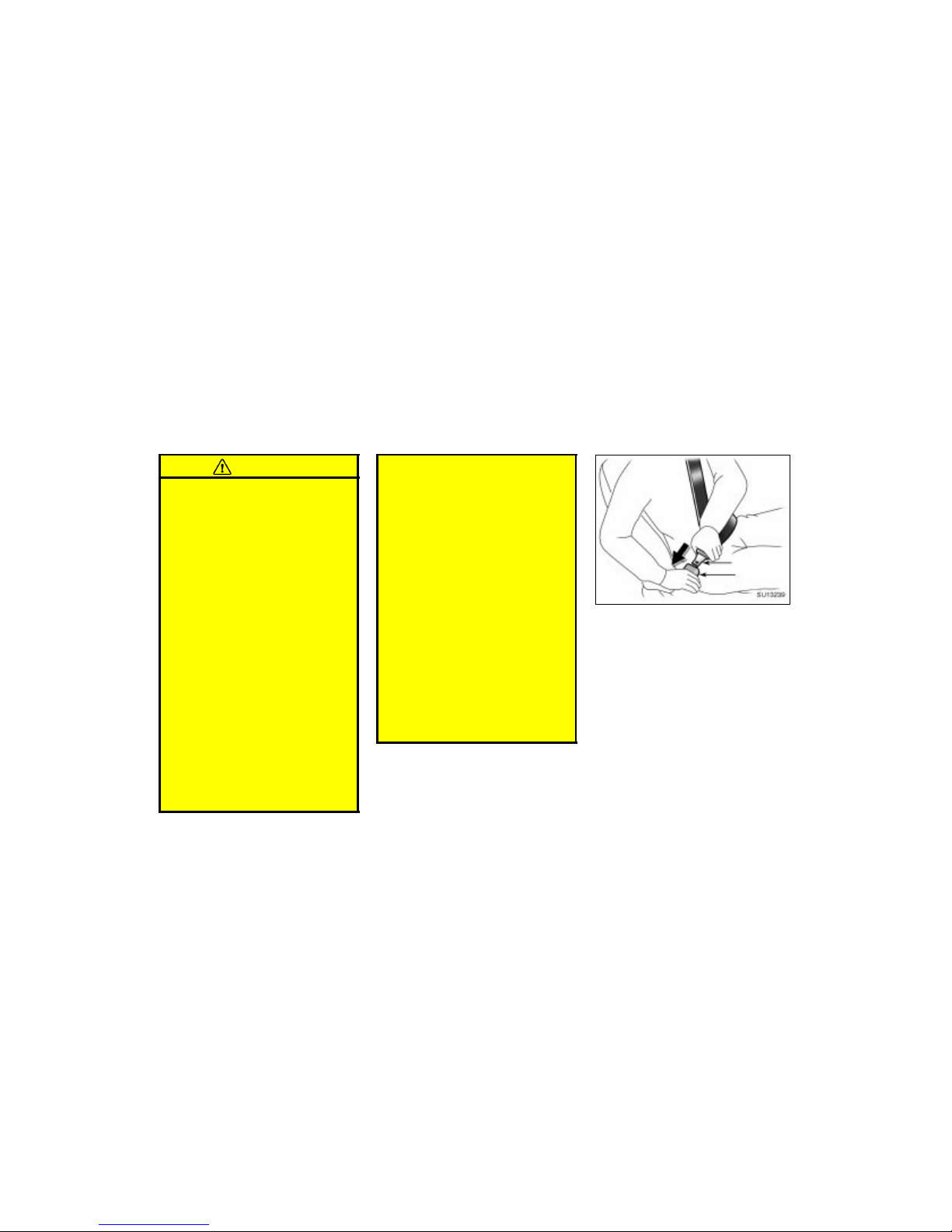
SU13239
Ta b
Buckle
Adjust the seat as needed and sit up
straight and well back in the seat. To
fasten your belt, pull it out of the retractor and insert the tab into the
buckle.
You will hear a click when the tab locks
into the buckle.
The seat belt length automatically adjusts
to your size and the seat position.
The retractor will lock the belt during a
sudden stop or on impact. It also may
lock if you lean forward too quickly. A
slow, easy motion will allow the belt to
extend, and you can move around freely.
04 06.07
—Fastening front and rear
seat belts
Page 43
23
2005 ECHO HATCHBACK from Jul. ’04Prod. (OM52624U)
When a passenger’s shoulder belt is completely extended and is then retracted
even slightly, the belt is locked in that
position and c annot be extended. Thi s feature is used to hold the child restraint
system securely. (For details, see “Child
restraint” on page 35 in this Section.) To
free the belt again, fully retract the belt
and then pull the belt out once more.
If the seat belt cannot be pulled out of the
retractor, firmly pull the belt and release
it. You will then be able to smoothly pull
the belt out of the retractor.
CAUTION
After inserting the tab, make sure
the tab and buckle are locked and
that the belt is not twisted.
Do not insert coins, clips, etc. in
the buckle as this may prevent you
from properly latching the tab and
buckle.
If the seat belt does not function
normally, immediately contact your
Toyota dealer. Do not use the seat
until the seat belt is fixed, because
it cannot protect an adult occupant
or your child from injury.
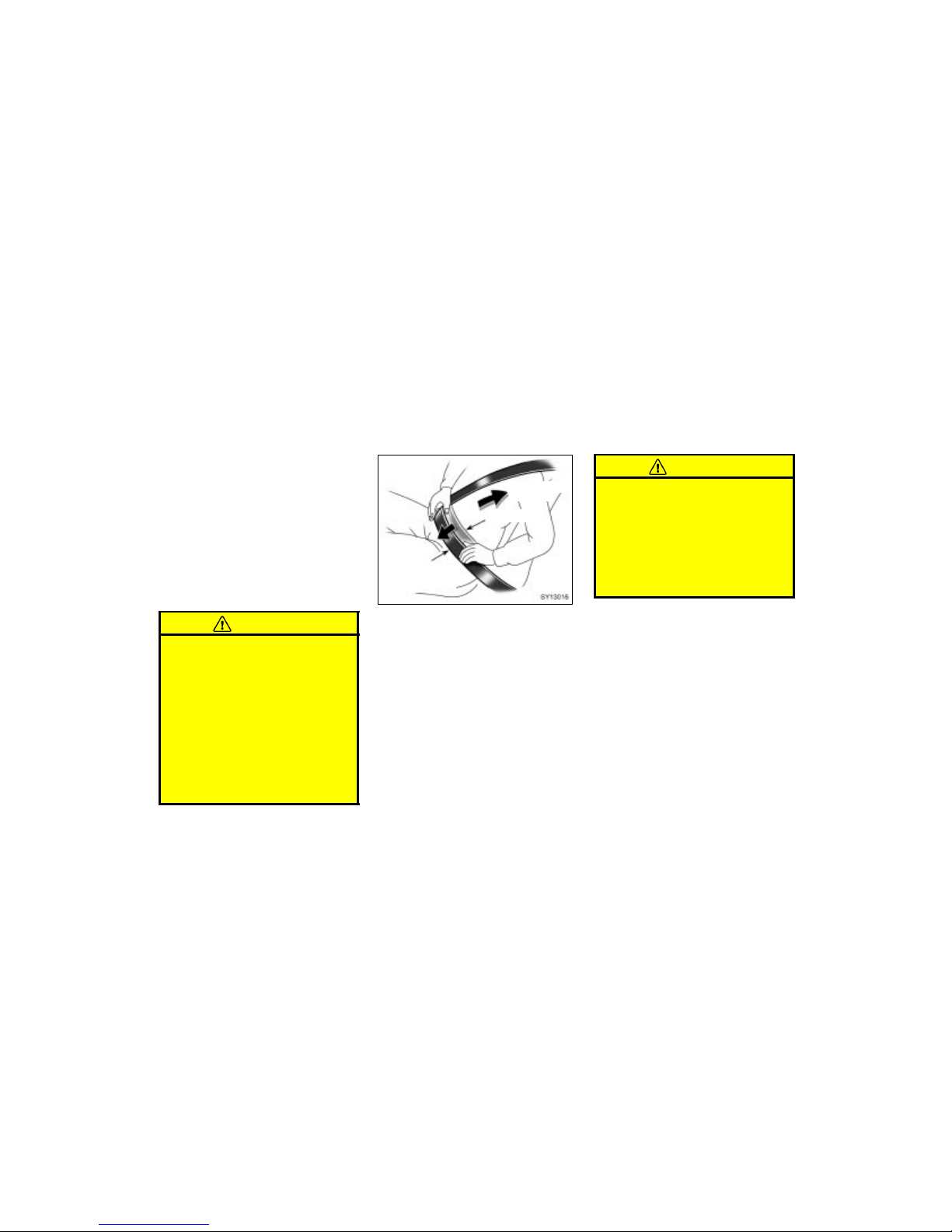
SY13016
Ta ke u p
slack
To o h i g h
Keep as low on
hips as possible
Ta k e u p
slack
Adjust the position of the lap and
shoulder belts.
Position the lap belt as low as possible
on your hips—not on your waist, then adjust it to a snug fit by pulling the shoulder
portion upward through the latch plate.
CAUTION
Both high- positioned lap belts and
loose- fitting belts could increase
the chance of injury due to sliding
under the lap belt during an accident or other unintended event.
Keep the lap belt as low on your
hips as possible.
Do not place the shoulder belt un-
der your arm.
04 06.07
Page 44
24
2005 ECHO HATCHBACK from Jul. ’04Prod. (OM52624U)
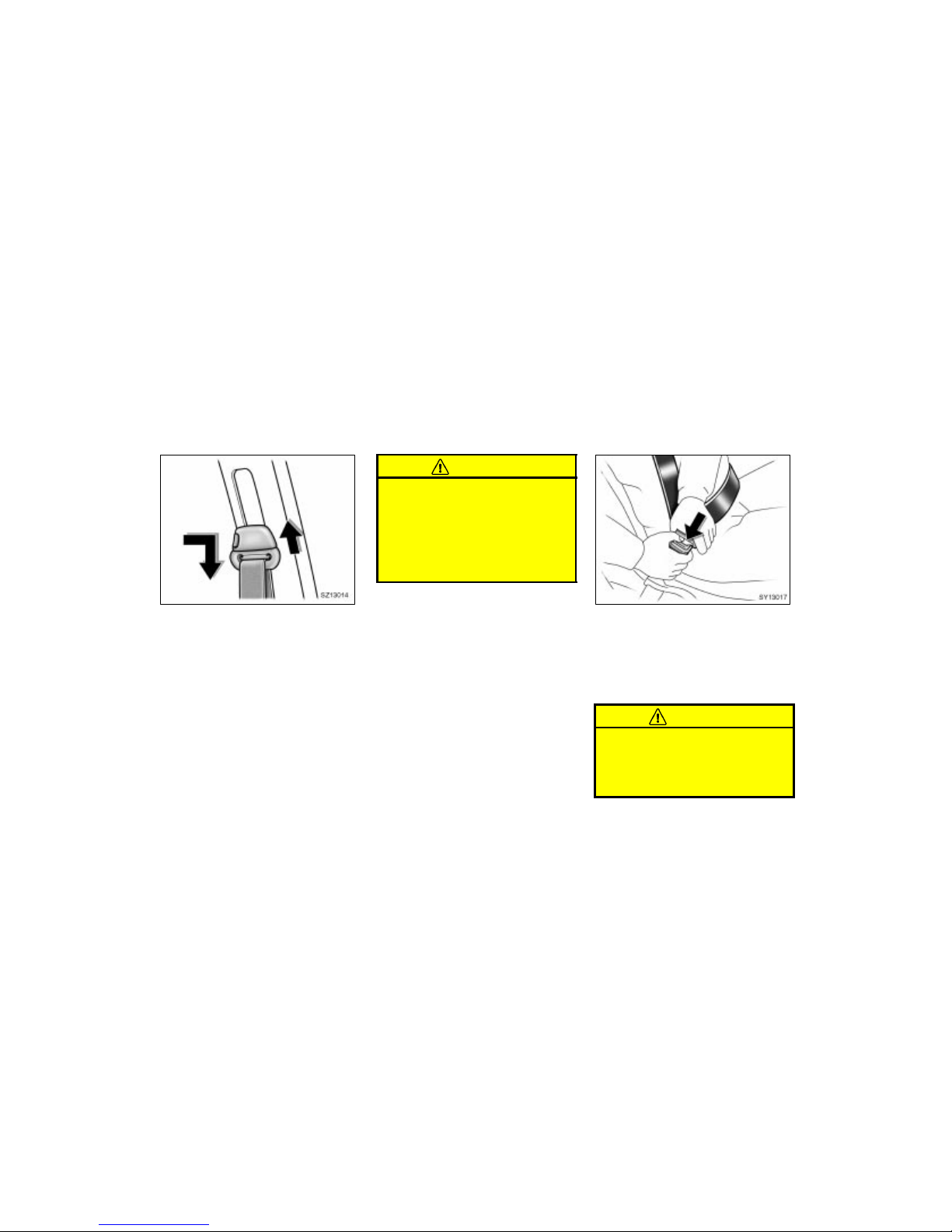
SZ13014
Seat belts with an adjustable shoulder
anchor (5- door models)—
Adjust the shoulder anchor position to
your size.
To raise: Slide the anchor up.
To lower: Push in the lock release button
and slide the anchor down.
After adjustment make sure the anchor is
locked in position.
CAUTION
Always make sure the shoulder belt
is positioned across the center of
your shoulder. The belt should be
kept away from your neck, but not
falling off your shoulder. Failure to
do so could reduce the amount of
protection in an accident and cause
serious injures in a collision.
SY13017
To release the belt, press the buckle
release button and allow the belt to
retract.
If the belt does not retract smoothly, pull
it out and check for kinks or twists. Then
make sure it remains untwisted as it retracts.
CAUTION
Do not separate the buckle with light
gray buckle release button. Ot herwise,
the seat belt may not work properly.
See the information in the following
columns.
04 06.07
Page 45
25
2005 ECHO HATCHBACK from Jul. ’04Prod. (OM52624U)
—Seat belt extender
If your seat belts cannot be fastened securely because they are not long enough,
a personalized seat belt extender is available from your Toyota dealer free of
charge.
Please contact your local Toyota dealer so
that the dealer can order the proper required length for the extender. Bring the
heaviest coat you expect to wear for proper measurement and selection of length.
Additional ordering information is available
at your Toyota dealer.
CAUTION
When using the seat belt extender,
observe the following precautions.
Failure to follow these instructions
could reduce the effectiveness of the
seat belt restraint system in case of
an accident, increasing the chance of
personal injury.
Remember that the extender pro-
vided for you may not be safe when
used on a different vehicle, for
another person, or at a different
seating position than the one originally intended.
Be sure to wear the seat belt with-
out the seat belt extender if you
can fasten the seat belt without the
extender.
Do not use the seat belt extender
when installing a child restraint
system on the front or rear passenger seat. If installing a child restraint system with the seat belt
extender connected to the seat belt,
the seat belt will not securely hold
the child restraint system, which
could cause death or serious injury
to the child or other passengers in
the event of collision.
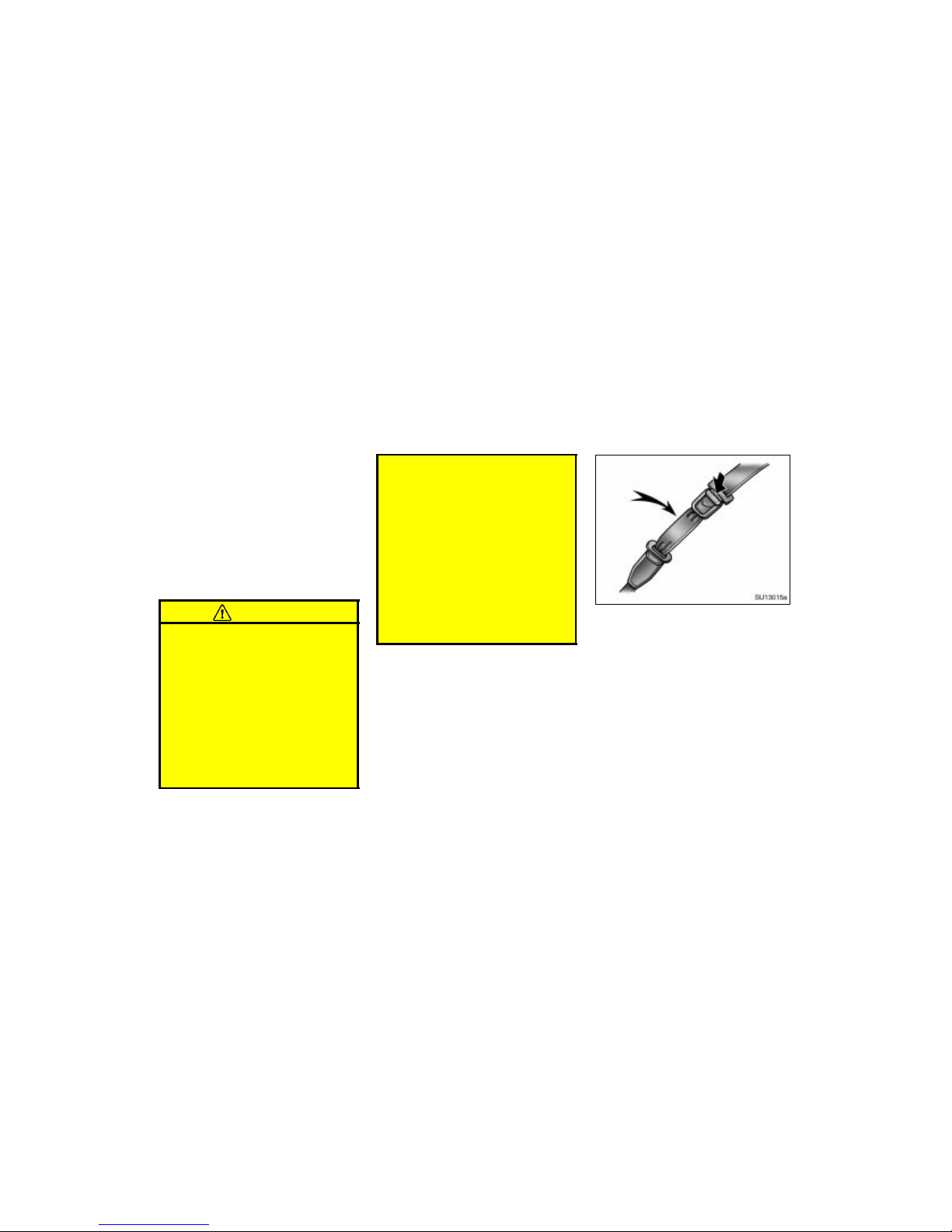
SU13015a
To connect the extender to the seat
belt, insert the tab into the seat belt
buckle so that the “PRESS” signs on
the buckle release buttons of the extender and the seat belt are both facing
outward as shown.
You will hear a click when the tab locks
into the buckle.
When releasing the seat belt, press on
the buckl e release b utton on the extender,
not on the seat belt. This helps prevent
damage to the vehicle interior and extender itself.
When not in use, remove the extender
and store in the vehicle for future use.
04 06.07
Page 46
26
2005 ECHO HATCHBACK from Jul. ’04Prod. (OM52624U)
CAUTION
After inserting the tab, make sure
the tab and buckle are locked and
that the lap and shoulder portions
of the belt and the seat belt extender are not twisted.
Do not insert coins, clips, etc. in
the buckle as this may prevent you
from properly latching the tab and
buckle.
If the seat belt does not function
normally, immediately contact your
Toyota dealer. Do not use the seat
until the seat belt is fixed, because
it cannot protect an adult occupant
or your child from injury.
—Seat belt pretensioners
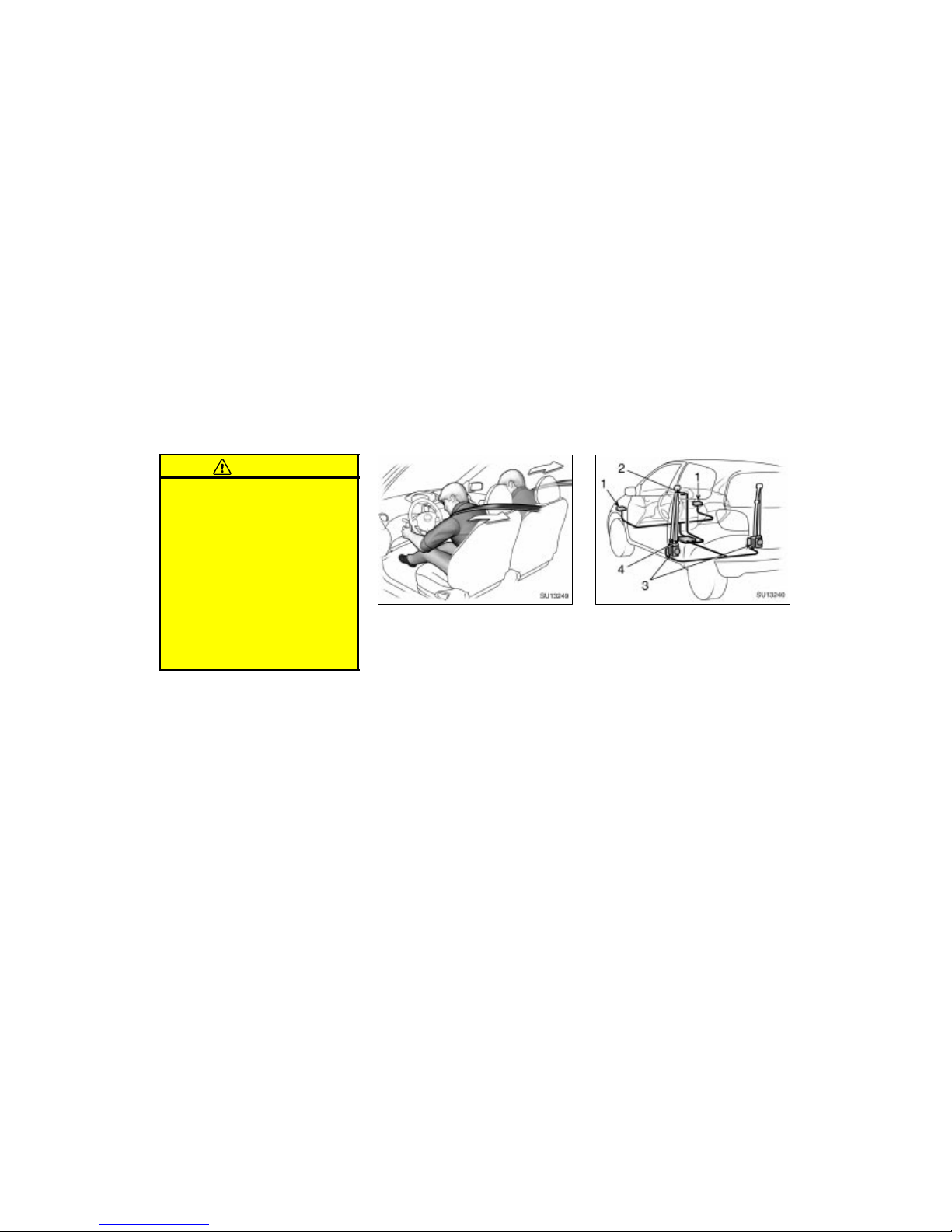
SU13249
The driver and front passenger seat
belt pretensioners are designed to be
activated in response to a severe frontal impact.
When the sensor detects a severe frontal
impact, the front seat belts are quickly
drawn back by the retractors so that the
belts snugly restrain the occupants.
The seat belt pretensioners are activated
even with no passenger in the front seat.
The seat belt pretensioners and SRS airbags may not operate together in all collisions.
SU13240
The seat belt pretensioner system consists mainly of the following components
and their locations are shown in the illustration.
1. Front airbag sensors
2. SRS warning light
3. Seat belt pretensioner assemblies
4. Airbag sensor assembly
The seat belt pretensioners are controlled
by the airbag sensor assembly. The airbag
sensor assembly consists of a safing sensor and airbag sensor.
04 06.07
Page 47
27
2005 ECHO HATCHBACK from Jul. ’04Prod. (OM52624U)
When the seat belt pretensioners are activated, an operating noise may be heard
and a small amount of non- toxic gas may
be released. This does not indicate that
a fire is occurring. This gas is normally
harmless.
Once the seat belt pretensioners have
been activated, the seat belt retractors
remain locked.
CAUTION
Do not modify, remove, strike or open
the seat belt pretensioner assemblies,
airbag sensor or surrounding area or
wiring. Failure to follow these instruction may prevent the seat belt pretensioners from activating correctly,
cause sudden operation of the system
or disable the system, which could
result in death or serious injury. Consult your Toyota dealer about any repair and modification.
NOTICE
Do not perform any of the following
changes without consulting your
Toyota dealer. Such changes can
interfere with proper operation of the
seat belt pretensioners in some
cases.
Installation of electronic devices
such as a mobile two- way radio,
cassette tape player or compact
disc player
Repairs on or near the front seat
belt retractor assemblies
Modification of the suspension system
Modification of the front end structure
Attachment of a grille guard (bull
bar, kangaroo bar, etc.), snowplow,
winches or any other equipment to
the front end
Repairs made on or near the front
fenders, front end structure or console
SP13504
This indicator comes on when the ignition key is turned to the “ON” position.
It goes off after about 6 seconds. This
means the seat belt pretensioners are
operating properly.
This warning light system monitors the
airbag sensor assembly, front airbag sensors, seat belt pretensioner assemblies,
inflators, warning light, interconnecting wiring and power sources. (For details, see
“Service reminder indicators and warning
buzzers” on page 69 in Section 1-6.)
If any of the following conditions occurs,
this indicates a malfunction of the airbags
or seat belt pretensioners. Contact your
Toyota dealer as soon as possible.
04 06.07
Page 48
28
2005 ECHO HATCHBACK from Jul. ’04Prod. (OM52624U)
The light does not come on when the
ignition key is turned to the “ON” position or remains on for more than 6
seconds or flashes.
The light comes on or flashes while
driving.
If any seat belt does not retract or can
not be pulled out due to a malfunction
or activation of the relevant seat belt
pretensioner.
The seat belt pretensioner assembly or
surrounding area has been damaged.
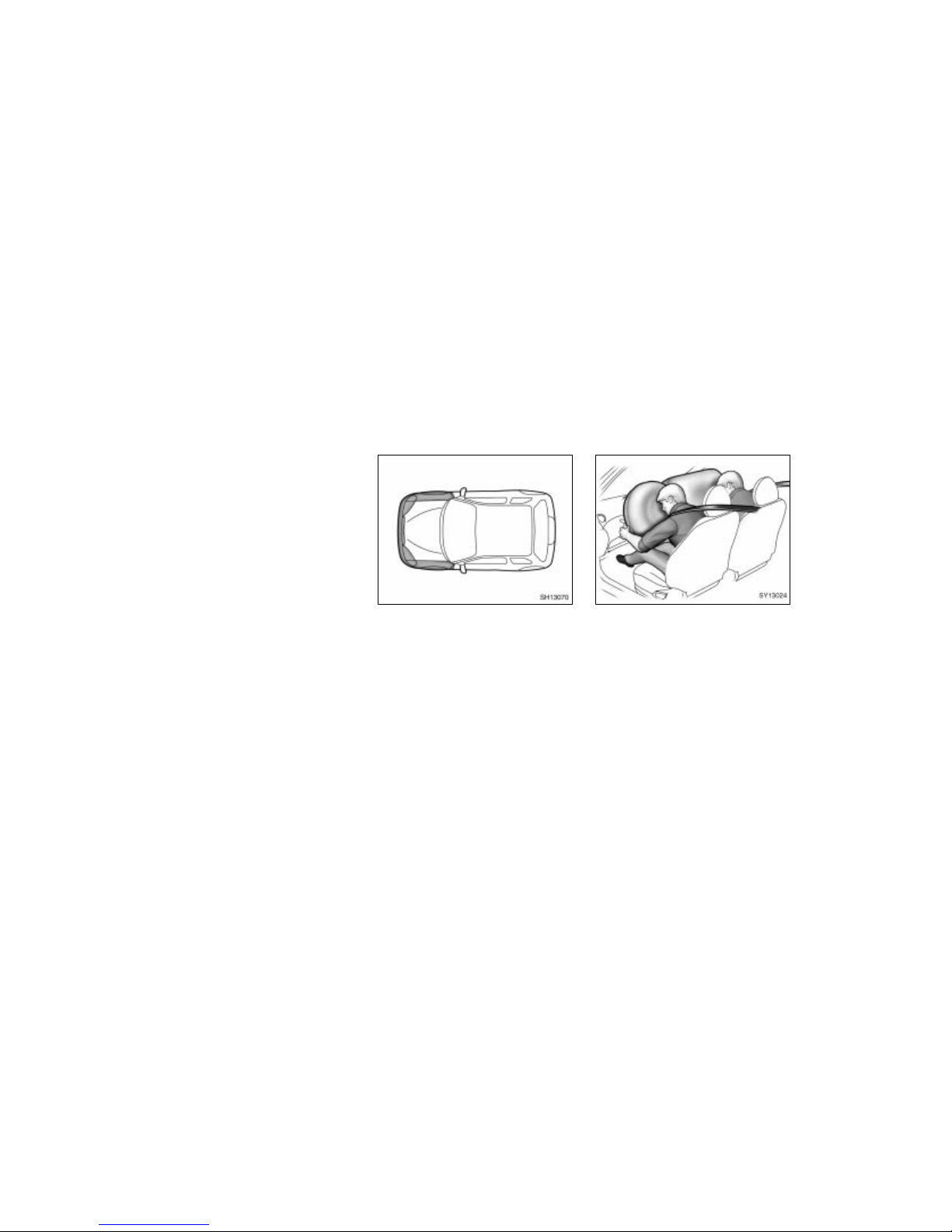
SH13070
In the following cases, contac t your Toyota
dealer as soon as possible:
The front part of the vehicle (shaded
in the illustration) was involved in an
accident that was not severe enough to
cause the seat belt pretensioners to
operate.
Either seat belt pretensioner assembly
or surrounding area is scratched,
cracked, or otherwise damaged.
SY13024
The SRS (Supplemental Restraint System) airbags are designed to provide
further protection for the driver and
front passenger in addition to the primary safety protection provided by the
seat belts.
In response to a severe frontal impact,
the SRS airbags work together with the
seat belts to help reduce injury by inflating. The SRS airbags help reduce injuries
mainly to the driver’s or front passenger’s
head or chest caused by hitting the vehicle interior. The SRS front passenger
airbag is activated even with no passenger in the front seat.
Always wear your seat belt properly.
04 06.07
SRS driver and front
passenger airbags
Page 49
29
2005 ECHO HATCHBACK from Jul. ’04Prod. (OM52624U)
Your vehicle is equipped with a crash
sensing and diagnostic module, which will
record the use of the seat belt restraint
system by the driver and front passenger
when the SRS airbags are inflated.
CAUTION
The SRS airbag system is designed
only as a supplement to the primary protection of the driver and front
passenger seat belt systems. The
driver and front passenger can be
killed or seriously injured by the
inflating airbags if they do not wear
the available seat belts properly.
During sudden braking just before
a collision, an unrestrained driver
or front passenger can move forward into direct contact with or
close proximity to the airbag which
may then deploy during the collision. To ensure maximum protection
in an accident, the driver and all
passengers in the vehicle must
wear their seat belts properly. Wearing a seat belt properly during an
accident reduces the chances of
death or serious injury or being
thrown out of the vehicle. For instructions and precautions concerning the seat belt system, see “Seat
belts” on page 21 in this Section.
Improperly seated and/or restrained
infants and children can be killed
or seriously injured by the deploying airbags. An infant or child who
is too small to use a seat belt
should be properly secured using a
child restraint system. Toyota
strongly recommends that all infants and children be placed in the
rear seat of the vehicle and properly restrained. The rear seat is the
safest for infants and children. For
instructions concerning the installation of a child restraint system, see
“Child restraint” on page 35 in this
Section.
04 06.07
Page 50
30
2005 ECHO HATCHBACK from Jul. ’04Prod. (OM52624U)
The SRS airbags are designed to deploy
in severe (usually frontal) collisions
where the magnitude and duration of
the forward deceleration of the vehicle
exceeds the designed threshold level.
The SRS airbags will deploy if the severity of the impact is above the designed
threshold level, comparable to an approximate 30 km/h (18 mph) collision when the
vehicle has the impact straight into a fixed
barrier that does not move or deform.
However, this threshold velocity will be
considerably higher if the vehicle strikes
an object, such as a parked vehicle or
sign pole, which can move or deform on
impact, or if the vehicle is involved in an
underride collision (e.g. a collision in
which the front of the vehicle “underrides”,
or goes under, the bed of a truck, etc.).
It is possible that in some collisions
where the forward deceleration of the vehicle is very close to the designed threshold level, the SRS airbags and the seat
belt pretensioners may not activate together.
Always wear your seat belts properly.
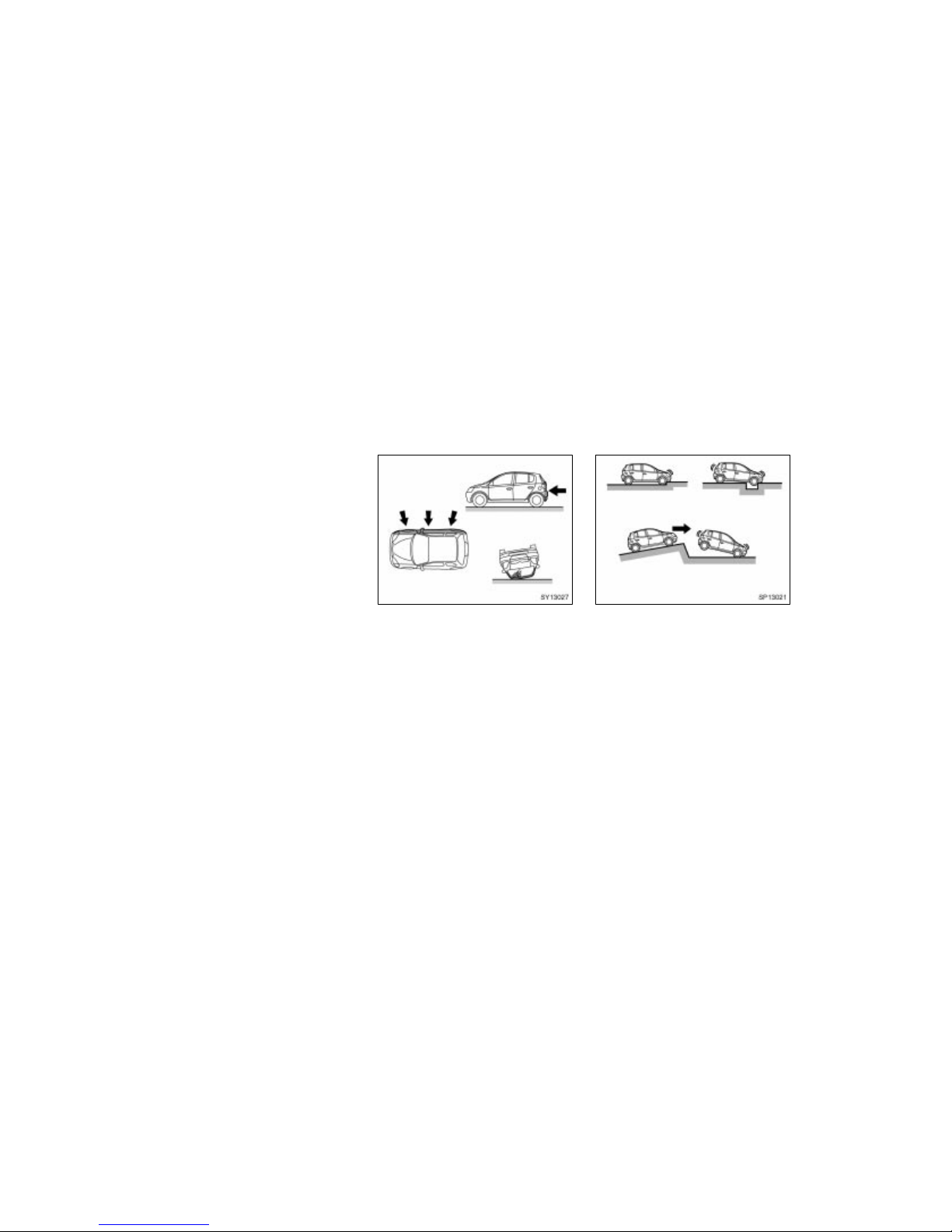
SY13027
Collision from the side
Vehicle rollover
Collision from the rear
The SRS airbags are generally not designed to inflate if the vehicle is involved in a side or rear collision, if it
rolls over, or if it is involved in a lowspeed frontal collision. But, whenever a
collision of any type causes sufficient
forward deceleration of the vehicle, deployment of the SRS airbags may occur.
SP13021
Hitting a curb,
edge of pavement
or hard surface
Falling into or
jumping over a
deep hole
Landing hard or vehicle falling
The SRS airbags may also deploy if a
serious impact occurs to the underside
of your vehicle. Some examples are
shown in the illustration.
04 06.07
Page 51
31
2005 ECHO HATCHBACK from Jul. ’04Prod. (OM52624U)
SU13123b
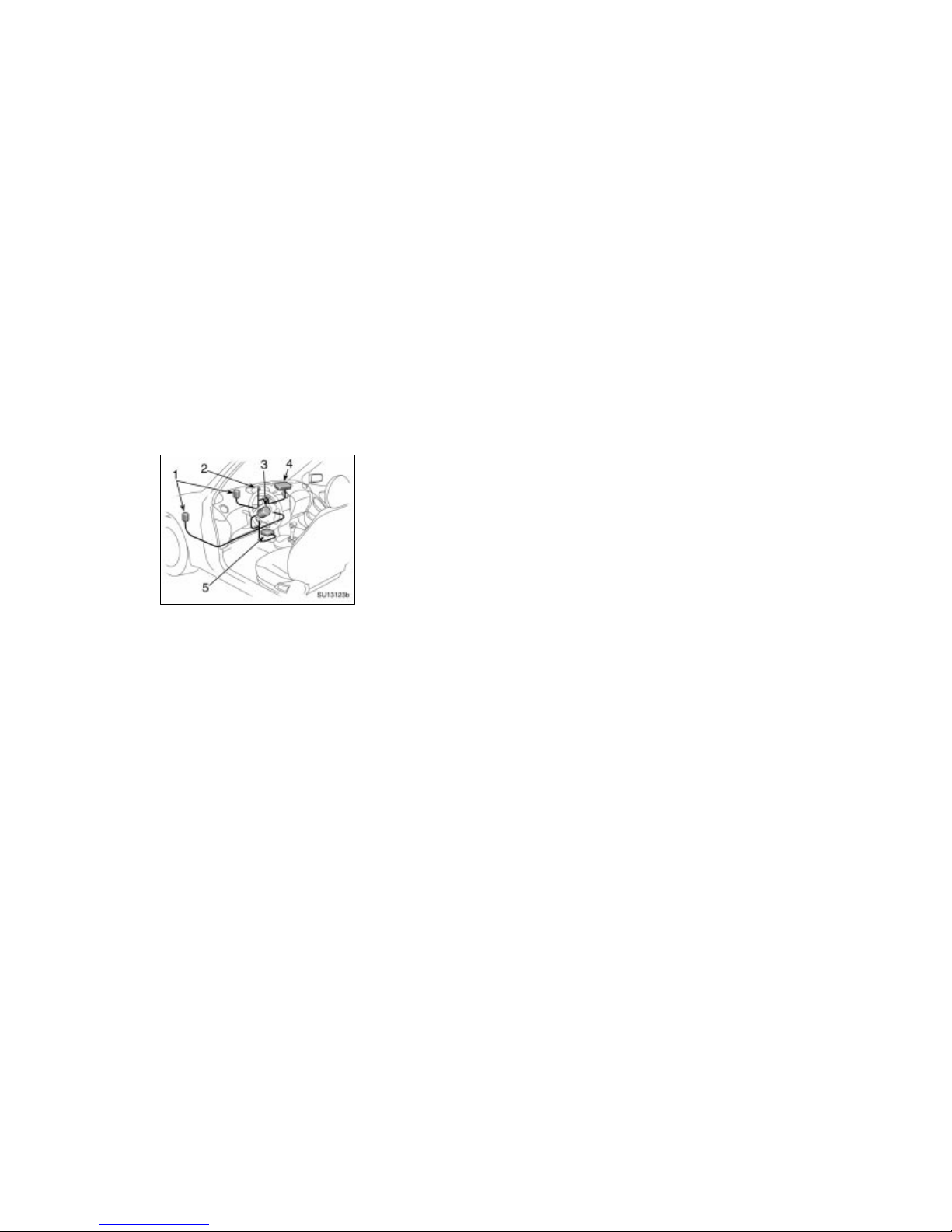
The SRS airbag system consists mainly of
the following components, and their locations are shown in the illustration.
1. Front airbag sensors
2. SRS warning light
3. Airbag module for driver (airbag and
inflator)
4. Airbag module for front passenger (airbag and inflator)
5. Airbag sensor assembly
The airbag sensor assembly consists of a
safing sensor and airbag sensor.
The front airbag sensors constantly monitor the forward deceleration of the vehicle.
If an impact results in a forward deceleration beyond the designed threshold level,
the system triggers the airbag inflators. At
this time a chemical reaction in the inflators very quickly fills the airbags with nontoxic gas to help restrain the forward motion of the occupants. The airbags then
quickly deflate, so that there is no obstruction of the driver ’s vision should it be
necessary to continue driving.
When the airbags inflate, they produce a
loud noise and release some smoke and
residue along with non- toxic gas. This
does not indicate a fire. This smoke may
remain inside the vehicle for some time,
and may cause some minor irritation to
the eyes, skin or breathing. Be sure to
wash off any residue as soon as possible
to prevent any potential skin irritation with
soap and water. If you can safely exit
from the vehicle, you should do so immediately.
Deployment of the airbags happens in a
fraction of a second, so the airbags must
inflate with considerable force. While the
system is designed to reduce serious injuries, primarily to the head and chest, it
may also cause other, less severe injuries
to the face, c hest, arms and hands. These
are usually in the nature of minor burns
or abrasions and swelling, but the force of
a deploying airbag can cause more serious injuries, especially if an occupant’s
hands, arms, chest or head is in close
proximit y to the airbag m odule at the time
of deployment. This is why it is important
for the occupant to: avoid placing any
object or part of the body between the
occupant and the airbag module; sit
straight and well back into the seat; wear
the available seat belt properly; and sit as
far as possible from the airbag module,
while still maintaining control of the vehicle.
Parts of the ai rbag module (steering wheel
hub, airbag cover and inflator) may be hot
for several minutes after deployment, so
do not touch! The airbags inflate only
once. The windshield may be damaged by
absorbing some of the force of the inflating airbag.
04 06.07
Page 52
32
2005 ECHO HATCHBACK from Jul. ’04Prod. (OM52624U)
CAUTION
The driver or front passenger who is
too close to the steering wheel or
dashboard during airbag deployment
can be killed or seriously injured.
Toyota strongly recommends that:
The driver sit as far back as pos-
sible from the steering wheel while
still maintaining control of the vehicle.
The front passenger sit as far back
as possible from the dashboard.
All vehicle occupants be properly
restrained using the available seat
belts.
For instructions and precautions concerning the seating position, see
“—Front seat precautions” on page
16 in this Section.
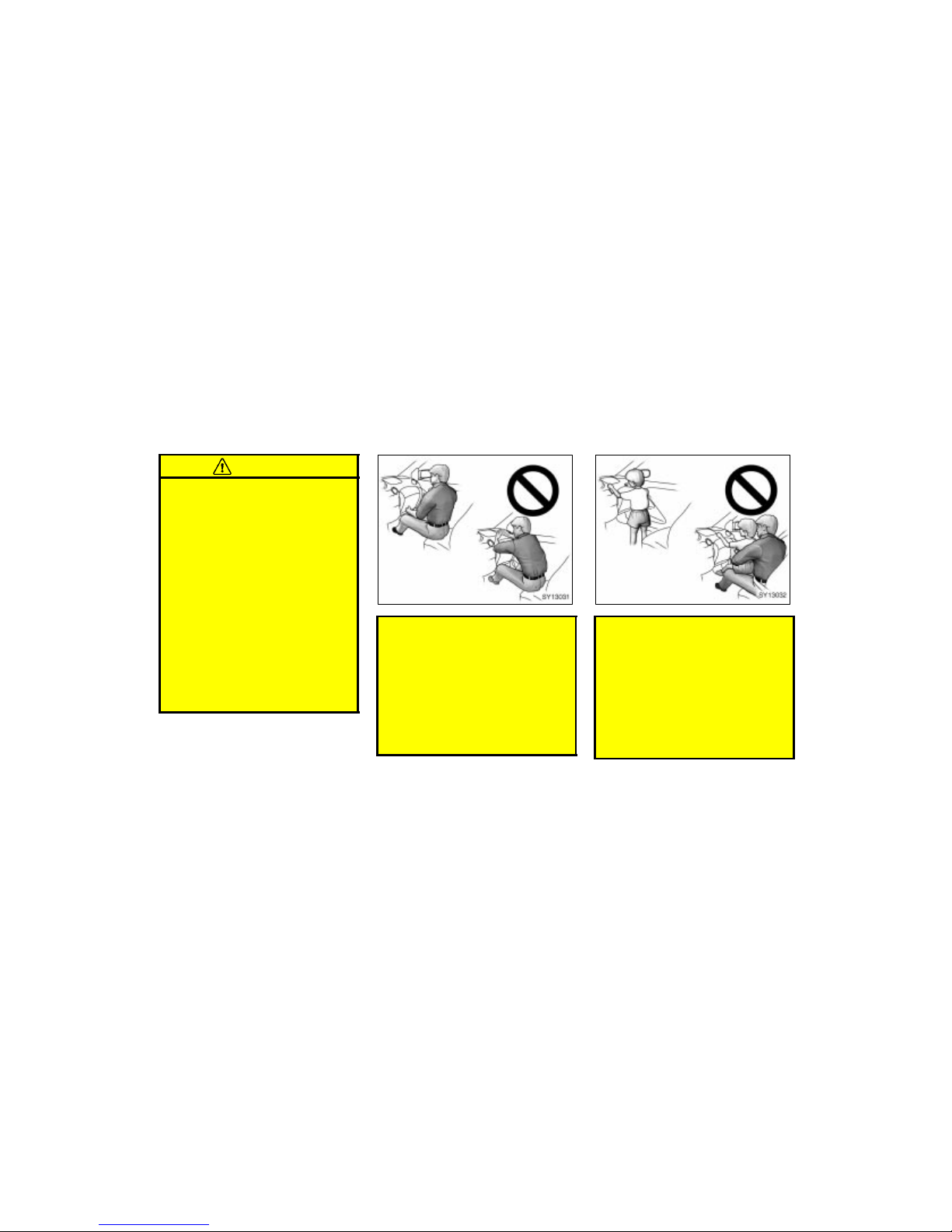
SY13031
Do not sit on the edge of the seat
or lean against the dashboard when
the vehicle is in use, since the
front passenger airbag could inflate
with considerable speed and force.
Anyone who is up against, or very
close to, an airbag when it inflates,
can be killed or seriously injured.
Sit up straight and well back in the
seat, and always use your seat belt
properly.
SY13032
Toyota strongly recommends that all
infants and children be placed in
the rear seat of the vehicle and be
properly restrained.
Do not allow a child to stand up or
kneel on the front passenger seat,
since the front passenger airbag
could inflate with considerable
speed and force. Otherwise, the
child may be killed or seriously injured.
04 06.07
Page 53
33
2005 ECHO HATCHBACK from Jul. ’04Prod. (OM52624U)
Do not hold a child on your lap or
in your arms. Use a child restraint
system in the rear seat. F or instructions concerning the installation of
a child restraint system, see “Child
restraint” on page 35 in this Section.
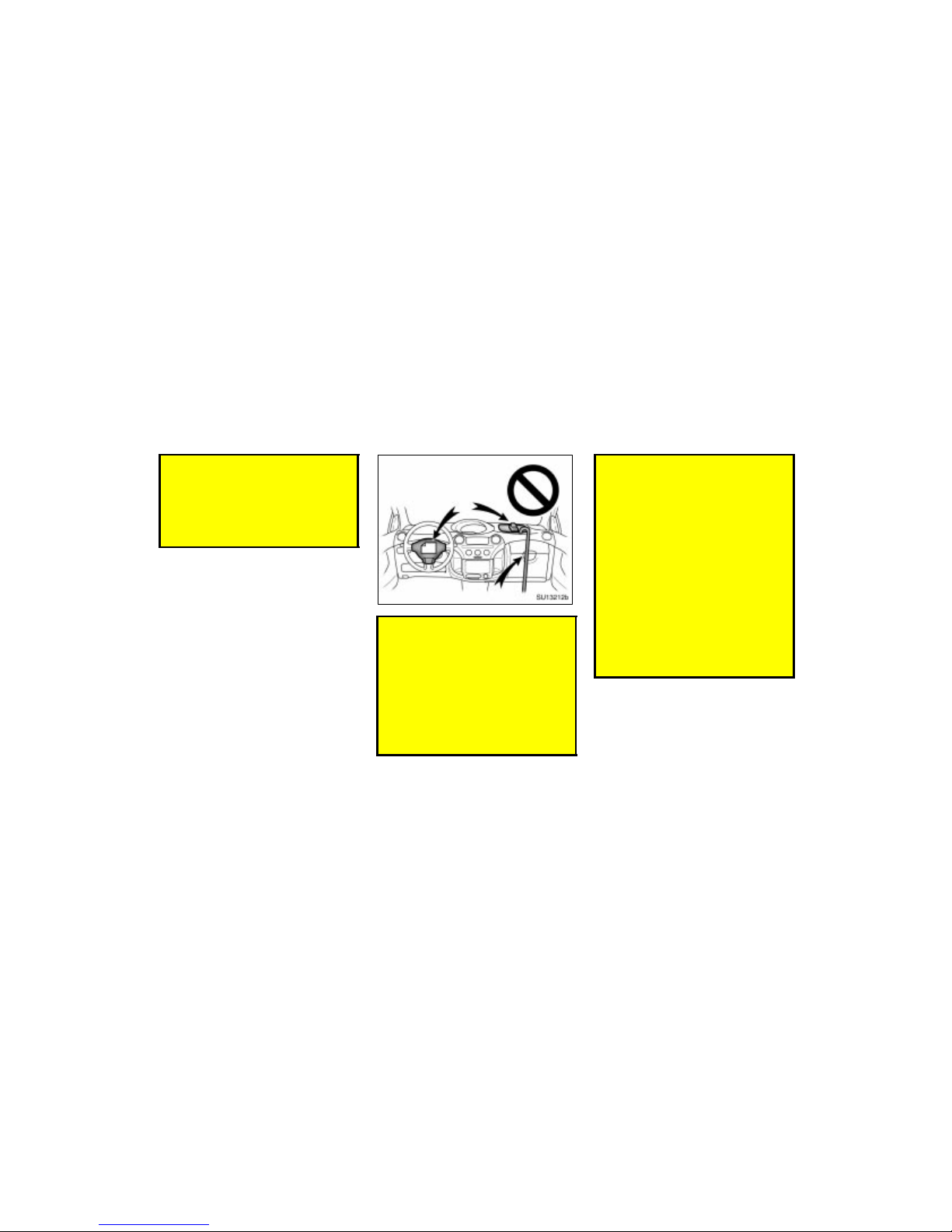
SU13212b
Do not put anything or any part of
your body on or in front of the
dashboard or steering wheel pad
that houses the airbag system. They
might restrict inflation or cause
death or serious injury as they are
projected rearward by the force of
deploying airbags. Likewise, the
driver and front passenger should
not hold objects in their arms or on
their knees.
Do not modify or remove any wir-
ing. Do not modify, remove, strike
or open any components such as
the steering wheel pad, steering
wheel, column cover, dashboard
near the front passenger airbag,
front passenger airbag cover, front
passenger airbag or airbag sensor
assembly. Doing so may prevent t he
airbag system from activating correctly, cause sudden activation of
the system or disable the system,
which could result in death or serious injury.
Failure to follow these instructions
can result in death or serious injury.
Consult your Toyota dealer about any
repair and modification.
04 06.07
Page 54
34
2005 ECHO HATCHBACK from Jul. ’04Prod. (OM52624U)
NOTICE
Do not perform any of the following
changes without consulting your
Toyota dealer. Such changes can
interfere with proper operation of the
SRS airbag system in some cases.
Installation of electronic devices
such as a mobile two- way radio,
cassette tape player or compact
disc player
Modification of the suspension system
Modification of the front end structure
Attachment of a grille guard (bull
bar, kangaroo bar, etc.), snowplow,
winches or any other equipment to
the front end
Repairs made on or near the front
fenders, front end structure, console, steering column, steering
wheel or dashboard near the front
passenger airbag
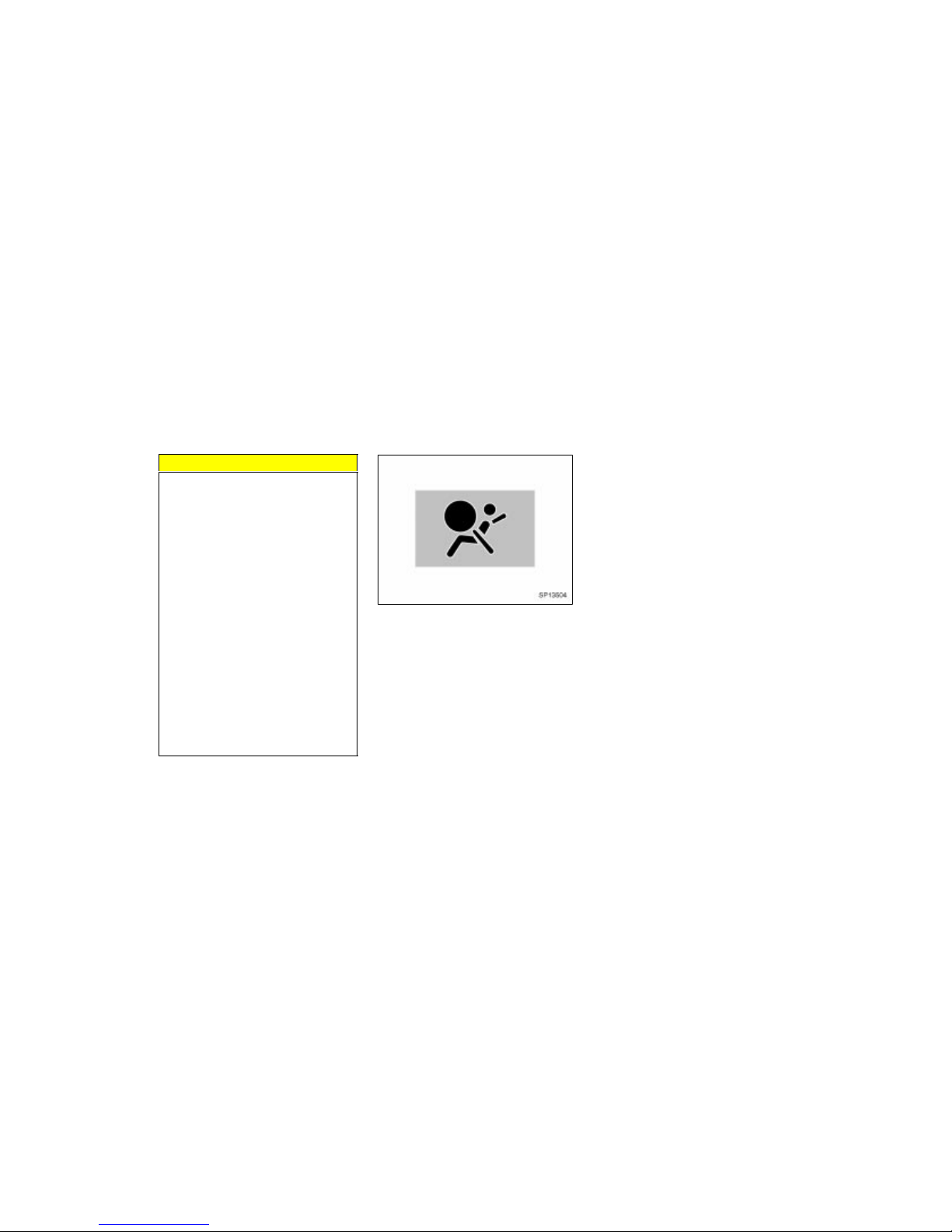
SP13504
This indicator comes on when the ignition key is turned to the “ON” position.
It goes off after about 6 seconds. This
means the SRS airbags are operating
properly.
This warning light system monitors the
airbag sensor assembly, front airbag sensors, seat belt pretensioner assemblies,
inflators, warning light, interconnecting wiring and power sources. (For details, see
“Service reminder indicators and warning
buzzers” on page 69 in Section 1-6.)
If any of the following conditions occurs,
this indicates a malfunction of the airbags
or seat belt pretensioners. Contact your
Toyota dealer as soon as possible.
The light does not come on when the
ignition key is turned to the “ON” position or remains on for more than 6
seconds or flashes.
The light comes on or flashes while
driving.
04 06.07
Page 55
35
2005 ECHO HATCHBACK from Jul. ’04Prod. (OM52624U)
SU13213a
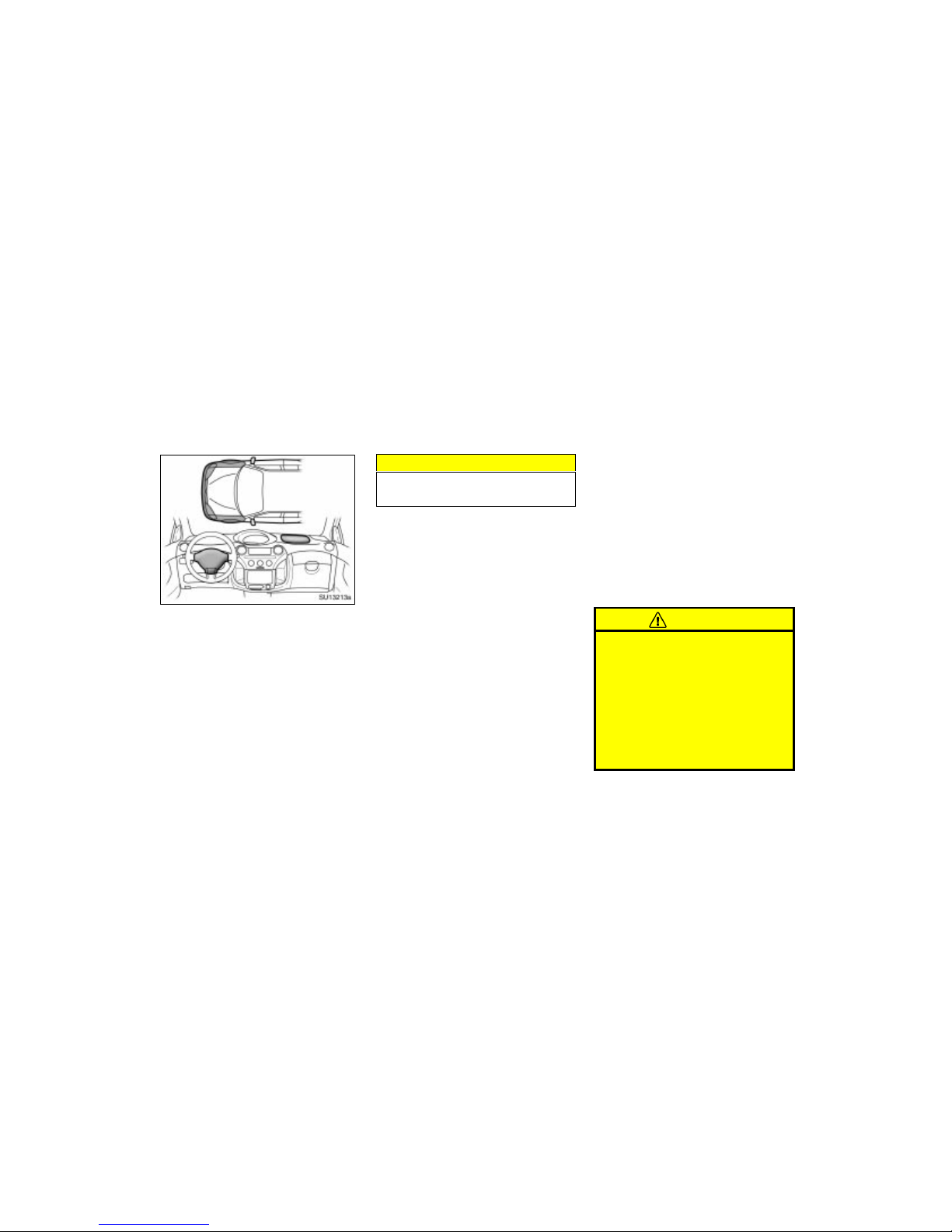
In the following cases, contac t your Toyota
dealer as soon as possible:
The SRS airbags have been inflated.
The front part of the vehicle (shaded
in the illustration) was involved in an
accident that was not severe enough to
cause the SRS airbags to inflate.
The pad part of the steering wheel or
front passenger airbag cover (shaded
in the illustration) is scratched,
cracked, or otherwise damaged.
NOTICE
Do not disconnect the battery cables
before contacting your Toyota dealer.
Toyota strongly urges the use of appropriate child restraint systems for
children.
The laws of all 50 states in the U.S.A.
and Canada now require the use of a
child restraint system.
Your vehicle conforms to SAE J1819.
If a child is too large for a child restraint
system, the child should sit in the rear
seat and must be restrained using the
vehicle’s seat belt. See “Seat belts” for
details.
CAUTION
For effective protection in automo-
bile accidents and sudden stops, a
child must be properly restrained,
using a seat belt or child restraint
system depending on the age and
size of the child. Holding a child in
your arms is not a substitute for a
child restraint system. In an accident, the child can be crushed
against the windshield, or between
you and the vehicle’s interior.
04 06.07
Child restraint—
—Child restraint precautions
Page 56
36
2005 ECHO HATCHBACK from Jul. ’04Prod. (OM52624U)
Toyota strongly urges use of a
proper child restraint system which
conforms to the size of the child,
installed on the rear seat. According to accident statistics, the child
is safer when properly restrained in
the rear seat than in the front seat.
Never put a rear- facing child re-
straint system on the front passenger seat. In the event of an accident, the force of the rapid inflation
of the front passenger airbag can
cause death or serious injury to the
child if the rear-facing child restraint system is put on the front
passenger seat.
A for ward- facing child restraint sys-
tem should be allowed to be put on
the front seat only when it is unavoidable. Always move the seat as
far back as possible, because the
front passenger airbag could inflate
with considerable speed and force.
Otherwise, the child may be killed
or seriously injured.
Do not use the seat belt extender
when installing a child restraint
system on the front or rear passenger seat. If installing a child restraint system with the seat belt
extender connected to the seat belt,
the seat belt will not securely hold
the child restraint system, which
could cause death or serious injury
to the child or other passengers in
the event of collision.
Make sure you have complied with
all installation instructions provided
by the child restraint manufacturer
and that the system is properly secured. If it is not secured properly,
it may cause death or serious injury
to the child in the event of a sudden stop or accident.
—Child restraint system
A child restraint system for a small
child or baby must itself be properly
restrained on the seat with the lap portion of the lap/shoulder belt. You must
carefully consult the manufacturer’s
instructions which accompany your
child restraint system.
To provide proper restraint, use a child
restraint system following the manufacturer’s instructions about the appropriate age
and size of the child for the child restraint
system.
Install the child restraint system correctly
following the instructions provided by its
manufacturer. General directions are also
provided under the following illustrations.
The child restraint system should be
installed on the rear seat. According to
accident statistics, the child is safer when
properly restrained in the rear seat than
in the front seat.
When not using the child restraint system,
keep it secured with the seat belt or place
it in the trunk or somewhere other than
the passenger compartment. This will prevent it from injuring passengers in the
event of a sudden stop or accident.
04 06.07
Page 57
37
2005 ECHO HATCHBACK from Jul. ’04Prod. (OM52624U)
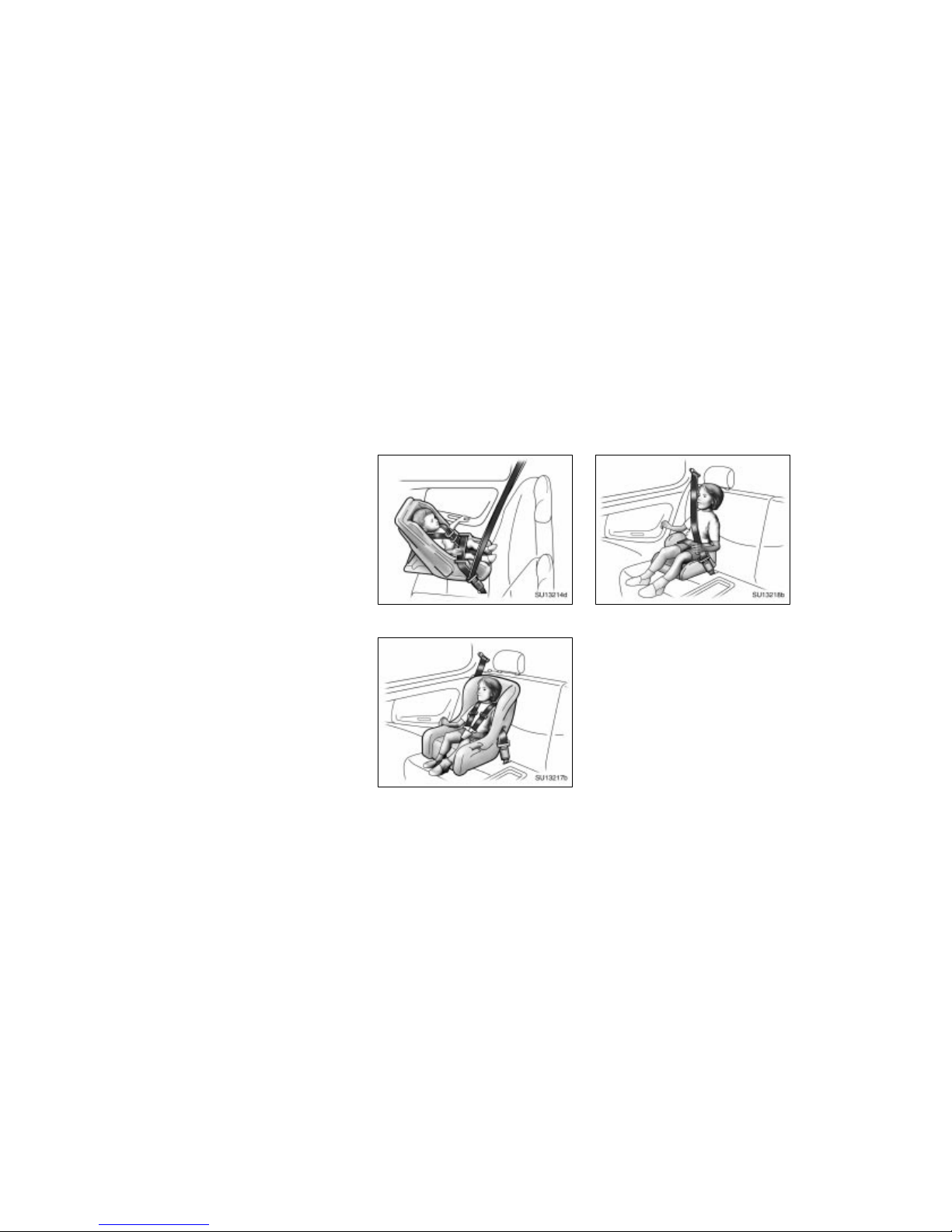
Child restraint systems are classified into
the following 3 types depending on the
child’s age and size.
(A) Infant seat
(B) Convert ible seat
(C) Boos ter seat
Install the child restraint system following
the instructions provided by its manufacturer.
Your vehicle has anchor brackets for securing the top strap of a child restraint
system.
For instructions about how to use the anchor bracket, see “—Using a top strap” on
page 46 in this Section.
The child restraint lower anchorages
approved for your vehicle may also be
used. See “—Installation with child
restraint lower anchorages” on page 48 in
this Section.
SU13214d
(A) Infant seat
SU13217b
(B) Convertible seat
SU13218b
(C) Booster seat
04 06.07
—Types of child restraint
system
Page 58
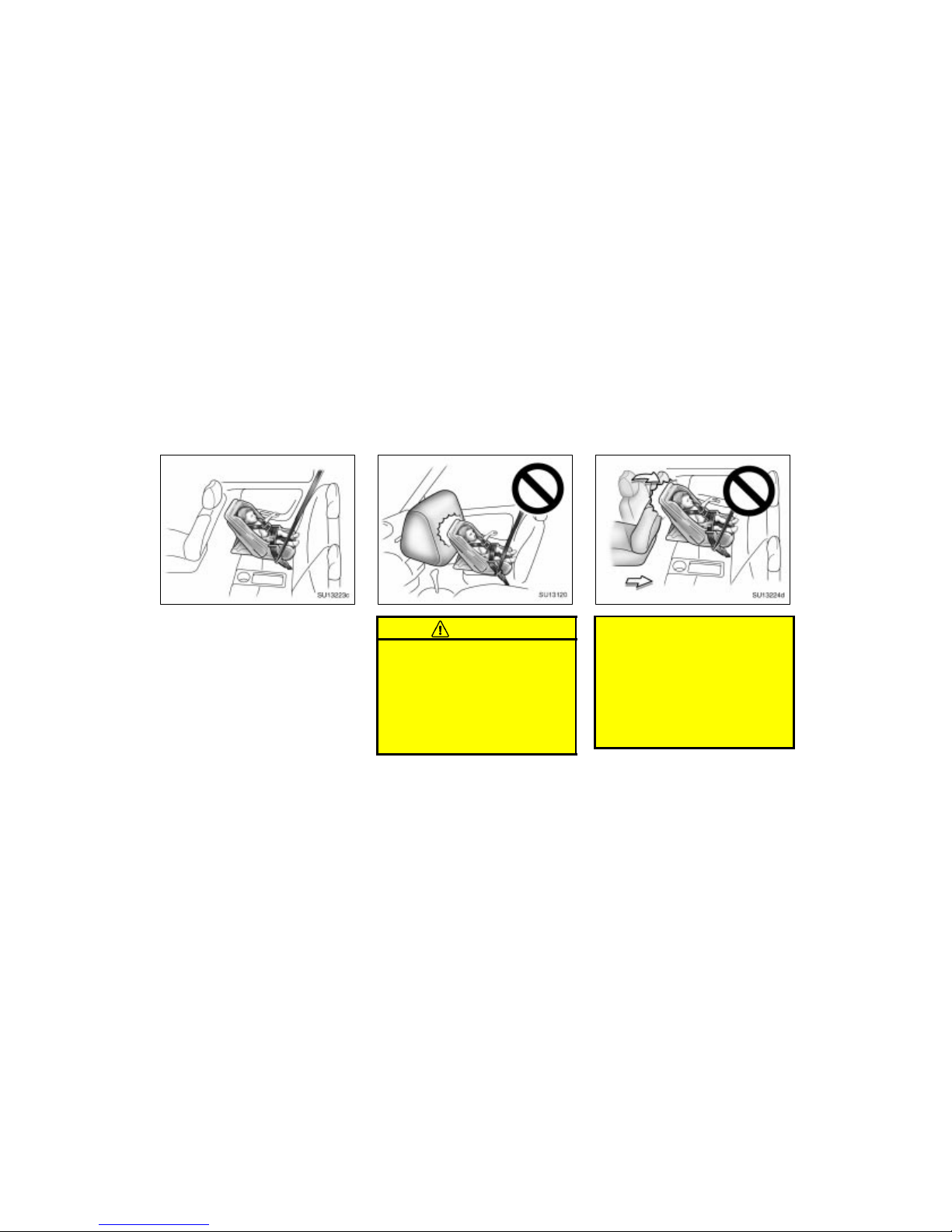
38
2005 ECHO HATCHBACK from Jul. ’04Prod. (OM52624U)
SU13223c
(A) INFANT SEAT INSTALLATION
An infant seat must be used in rear-
facing position only.
SU13120
CAUTION
Never put a rear- facing child re-
straint system on the front passenger seat. In the event of an accident, the force of the rapid inflation
of the front passenger airbag can
cause death or serious injury to the
child if the rear-facing child restraint system is installed on the
front passenger seat.
SU13224d
Do not put a child restraint system
on the rear seat if it interferes with
the lock mechanism of the front
seats. Otherwise, the child or front
seat occupant(s) may be killed or
seriously injured in case of sudden
braking or a collision.
If your driving position is not satis-
factory, install the child restraint
system on the rear right seat.
04 06.07
—Installation with 3- point
type seat belt
Page 59
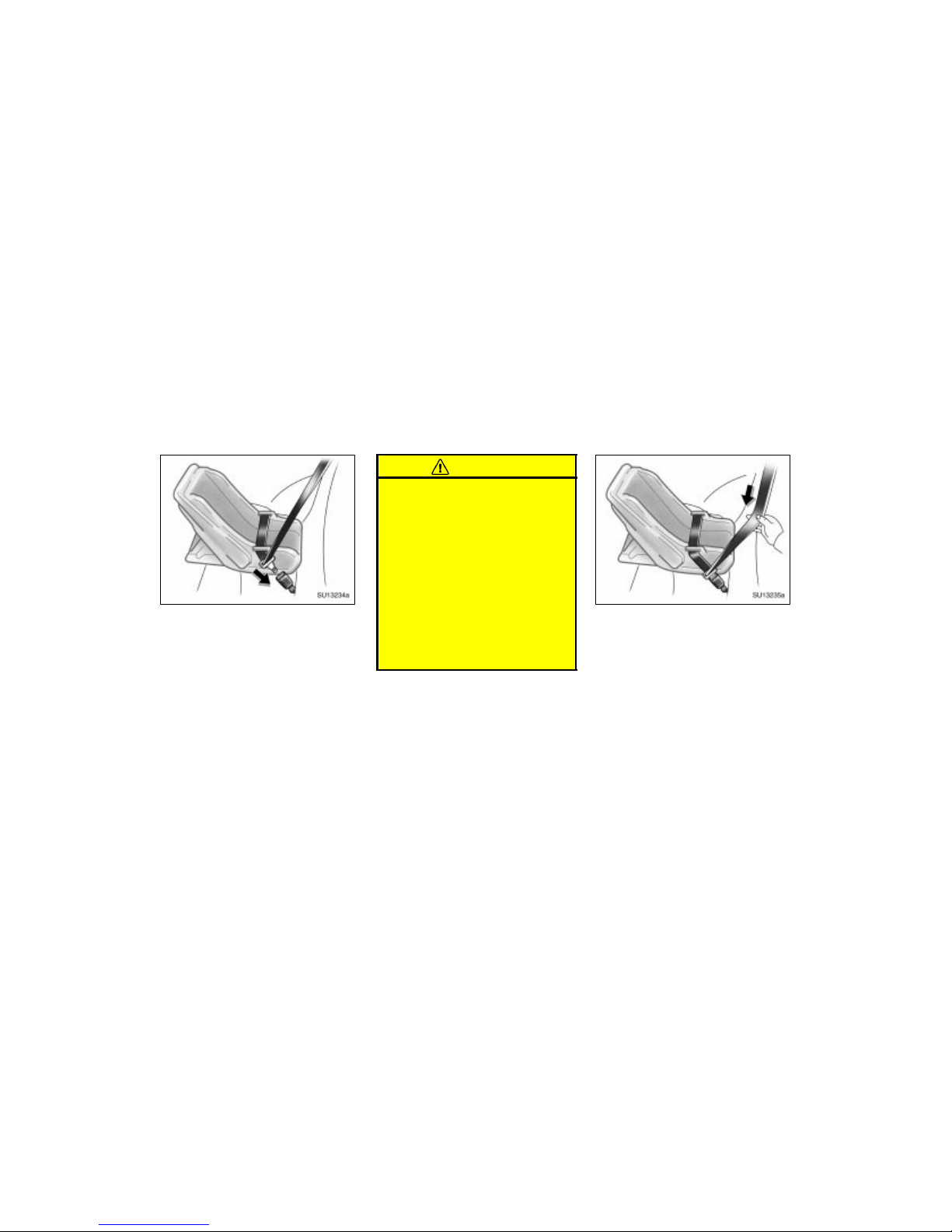
39
2005 ECHO HATCHBACK from Jul. ’04Prod. (OM52624U)
SU13234a
1. Run the lap and shoulder belt through
or around the infant seat following the
instructions provided by its manufacturer and insert the tab into the buckle
taking care not to twist the belt. Keep
the lap portion of the belt tight.
CAUTION
After inserting the tab, make sure
the tab and buckle are locked and
that the lap and shoulder portions
of the belt are not twisted.
Do not insert coins, clips, etc. in
the buckle as this may prevent your
child from properly latching the tab
and buckle.
If the seat belt does not function
normally, it cannot protect your
child from death or serious injury.
Contact your Toyota dealer immediately. Do not install the child restraint system on the seat until the
seat belt is fixed.
SU13235a
2. Fully extend the shoulder belt to put it
in the lock mode. When the belt is
then retracted even slightly, it cannot
be extended.
To hold the infant seat securely, make
sure the belt is in the lock mode before
letting the belt retract.
04 06.07
Page 60
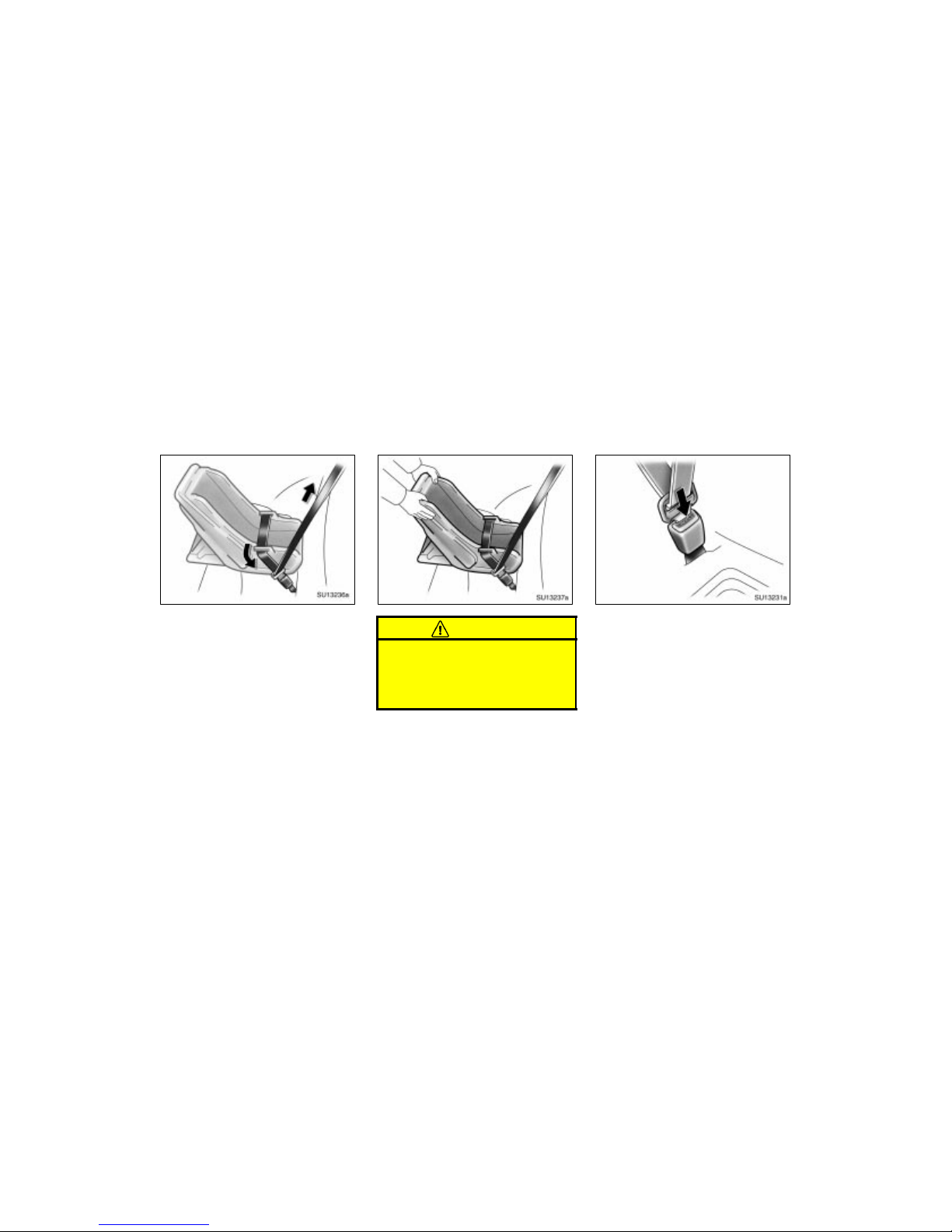
40
2005 ECHO HATCHBACK from Jul. ’04Prod. (OM52624U)
SU13236a
3. While pressing the infant seat firmly
against the seat cushion and seatback,
let the shoulder belt retract as far as
it will go to hold the infant seat securely.
SU13237a
CAUTION
Push and pull the child restraint system in different directions to be sure
it is secure. Follow all the installation
instructions provided by its manufacturer.
SU13231a
4. To remove the infant seat, press the
buckle release button and allow the
belt to retract completely. The belt will
move freely again and be ready to
work for an adult or older child passenger.
04 06.07
Page 61
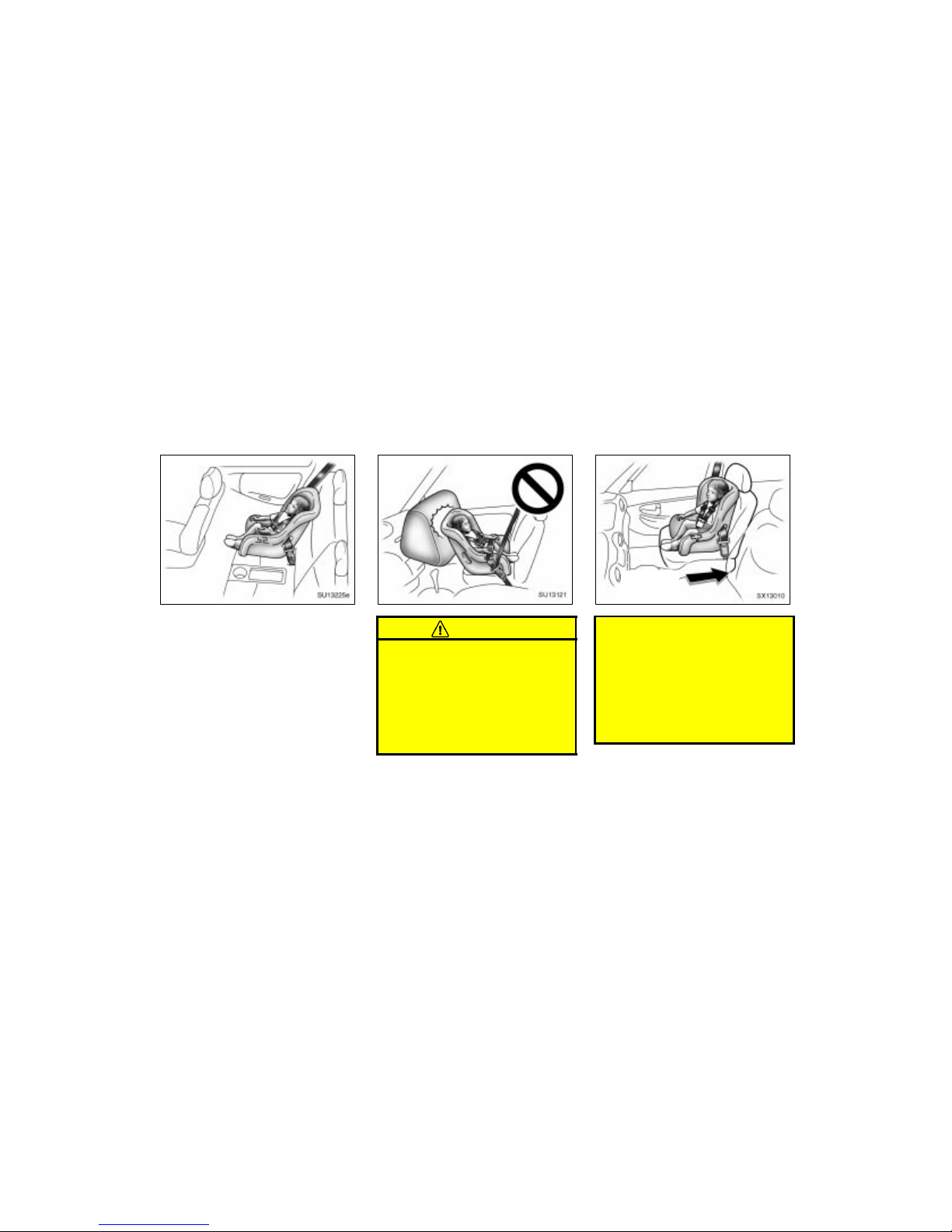
41
2005 ECHO HATCHBACK from Jul. ’04Prod. (OM52624U)
SU13225e
(B) CONVERTIBLE SEAT INSTALLATION
A convertible seat must be used in for-
ward- facing or rear- facing position depending on the age and size of the
child. When installing, follow the
manufacturer’s instructions about the
applicable age and size of the child as
well as directions for installing the
child restraint system.
SU12121
CAUTION
Never put a rear- facing child re-
straint system on the front passenger seat. In the event of an accident, the force of the rapid inflation
of the front passenger airbag can
cause death or serious injury to the
child if the rear-facing child restraint system is installed on the
front passenger seat.
SX13010
Move seat
fully back
A for ward- facing child restraint sys-
tem should be allowed to be
installed on the front passenger
seat only when it is unavoidable.
Always move the seat as far back
as possible, because the front passenger airbag could inflate with
considerable speed and force.
Otherwise, the child may be killed
or seriously injured.
04 06.07
Page 62
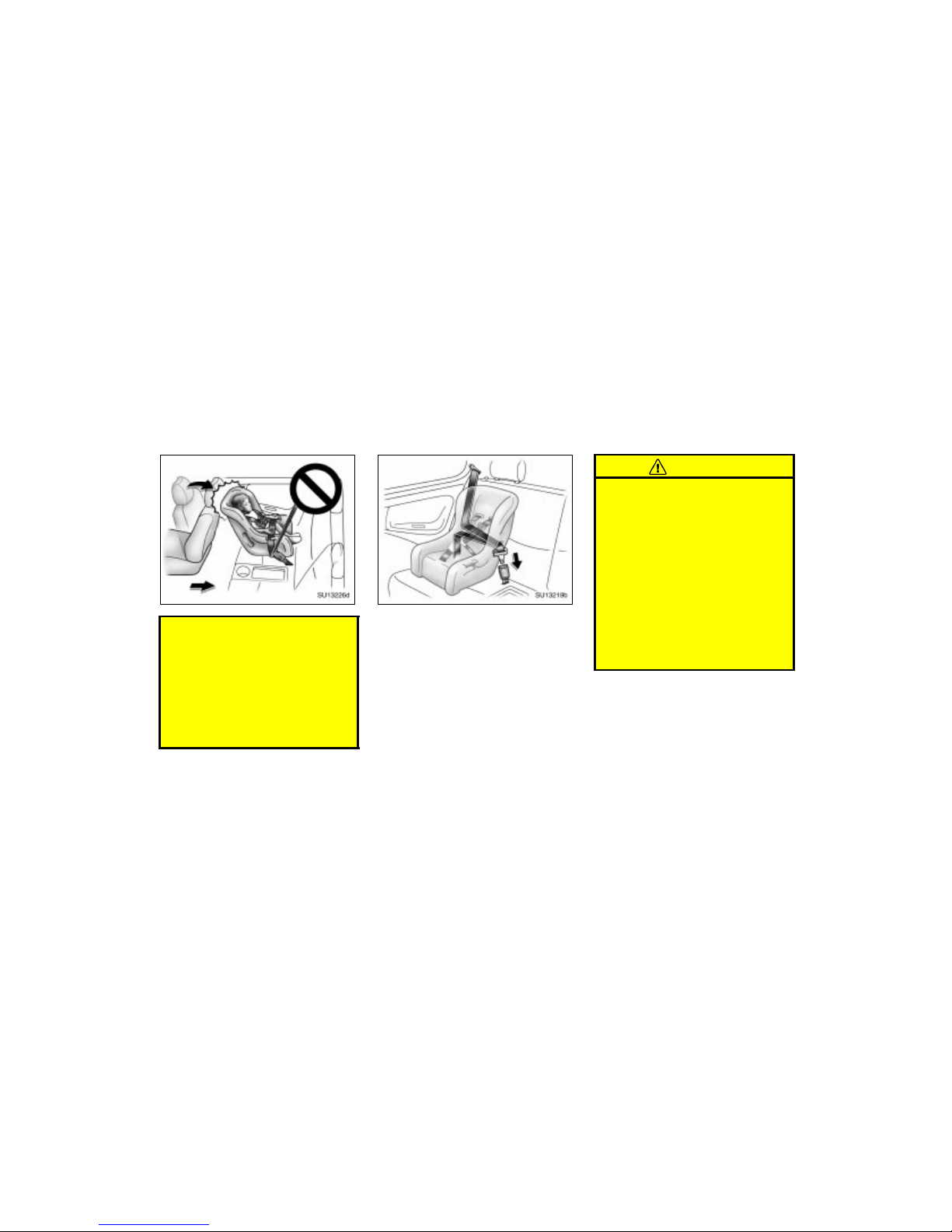
42
2005 ECHO HATCHBACK from Jul. ’04Prod. (OM52624U)
SU13226d
Do not put a child restraint system
on the rear seat if it interferes with
the lock mechanism of the front
seats. Otherwise, the child or front
seat occupant(s) may be killed or
seriously injured in case of sudden
braking or a collision.
If your driving position is not satis-
factory, install the child restraint
system on the rear right seat.
SU13219b
1. Run the lap and shoulder belt through
or around the convertible seat following
the instructions provided by its
manufacturer and insert the tab into
the buckle taking care not to twist the
belt. Keep the lap portion of the belt
tight.
CAUTION
After inserting the tab, make sure
the tab and buckle are locked and
that the lap and shoulder portions
of the belt are not twisted.
Do not insert coins, clips, etc. in
the buckle as this may prevent your
child from properly latching the tab
and buckle.
If the seat belt does not function
normally, it cannot protect your
child from death or serious injury.
Contact your Toyota dealer immediately. Do not install the child restraint system on the seat until the
seat belt is fixed.
04 06.07
Page 63
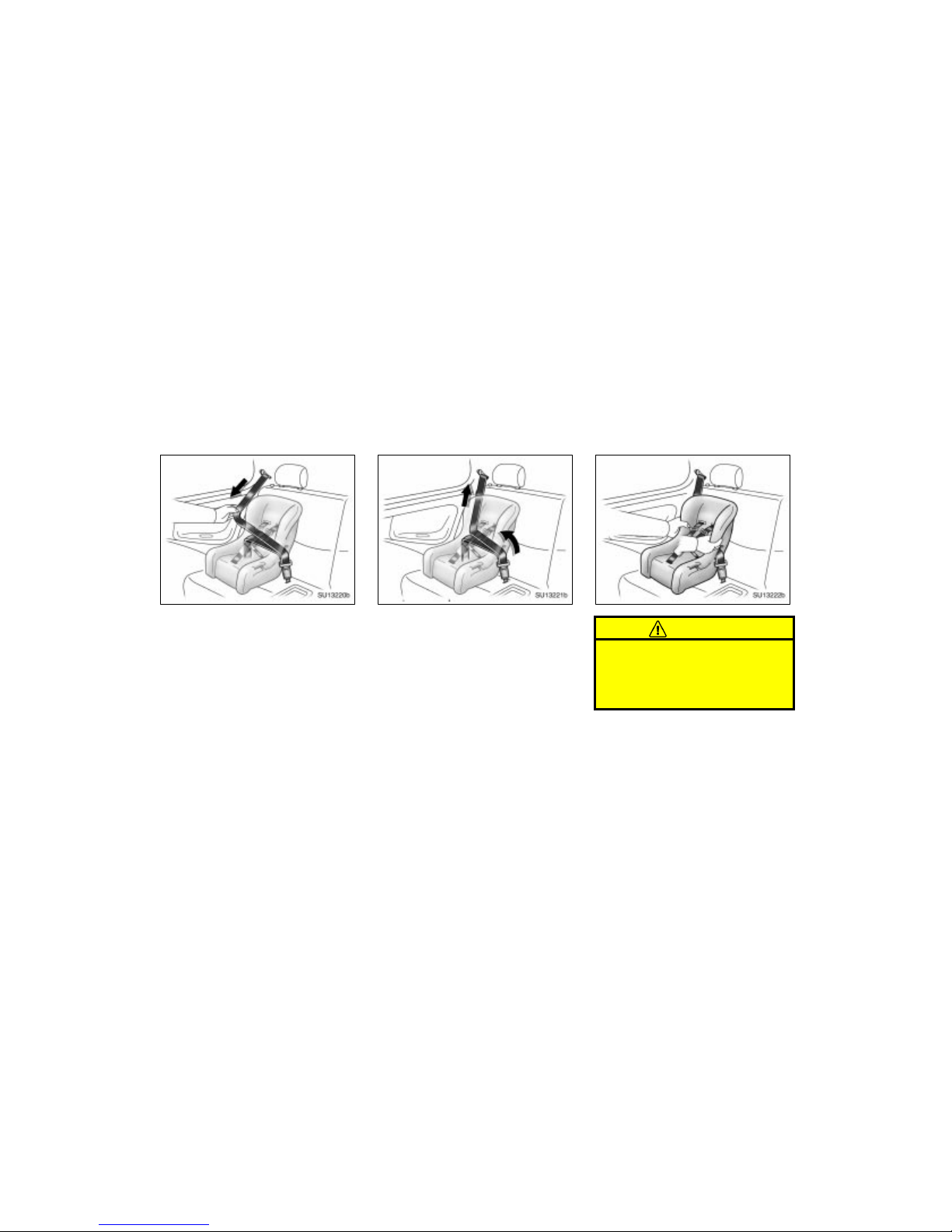
43
2005 ECHO HATCHBACK from Jul. ’04Prod. (OM52624U)
SU13220b
2. Fully extend the shoulder belt to put it
in the lock mode. When the belt is
then retracted even slightly, it cannot
be extended.
To hold the convertible seat securely,
make sure the belt is in the lock mode
before letting the belt retract.
SU13221b
3. While pressing the convertible seat
firmly against the seat cushion and
seatback, let the shoulder belt retract
as far as it will go to hold the convertible seat securely.
SU13222b
CAUTION
Push and pull the child restraint system in different directions to be sure
it is secure. Follow all the installation
instructions provided by its manufacturer.
04 06.07
Page 64
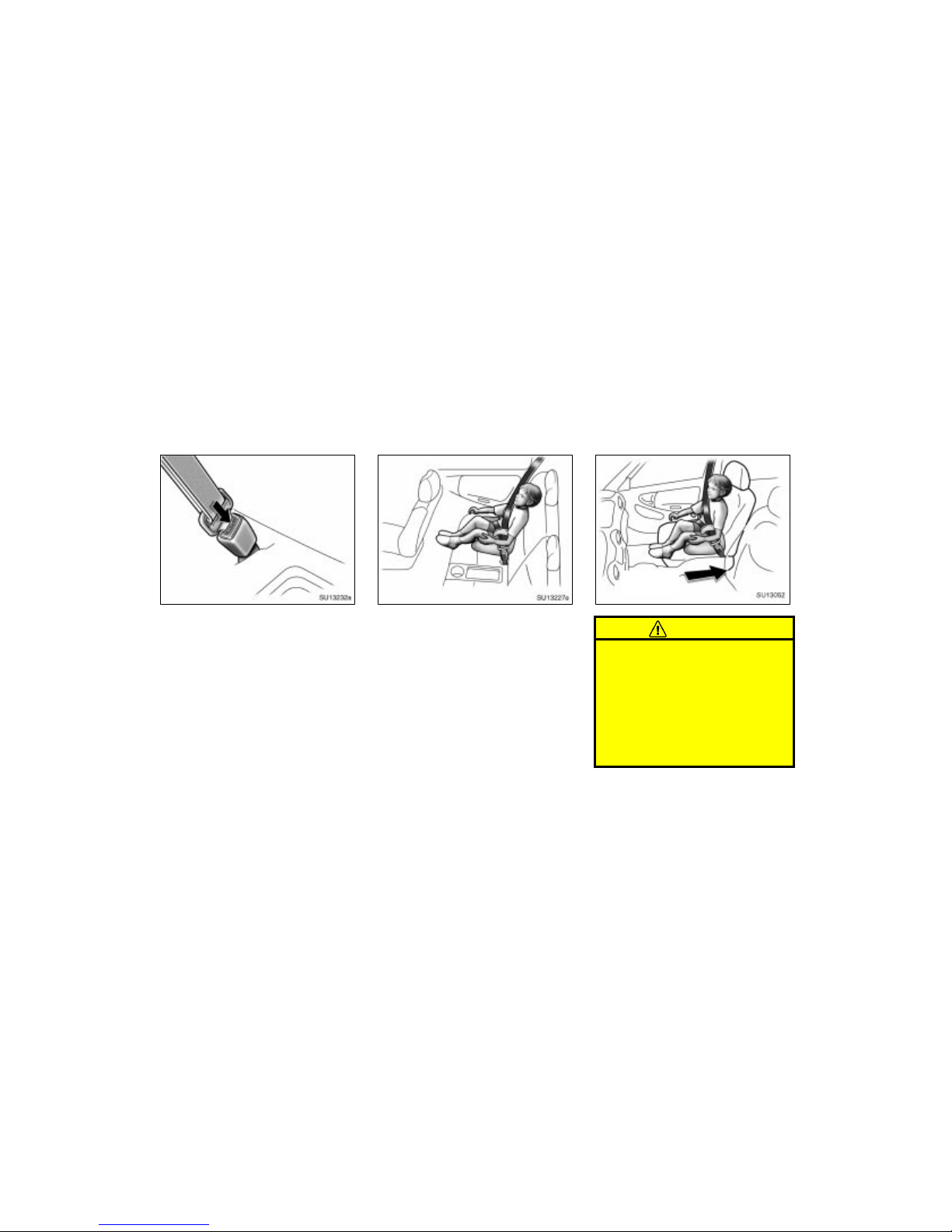
44
2005 ECHO HATCHBACK from Jul. ’04Prod. (OM52624U)
SU13232a
4. To remove the convertible seat, press
the buckle release button and allow the
belt to retract completely. The belt will
move freely again and be ready to
work for an adult or older child passenger.
SU13227e
(C) BOOSTER SEAT INSTALLATION
A booster seat must be used in for-
ward- facing position only.
SU13052
Move seat
fully back
CAUTION
A for ward- facing child restraint sys-
tem should be allowed to be
installed on the front passenger
seat only when it is unavoidable.
Always move the seat as far back
as possible, because the front passenger airbag could inflate with
considerable speed and force.
Otherwise, the child may be killed
or seriously injured.
04 06.07
Page 65
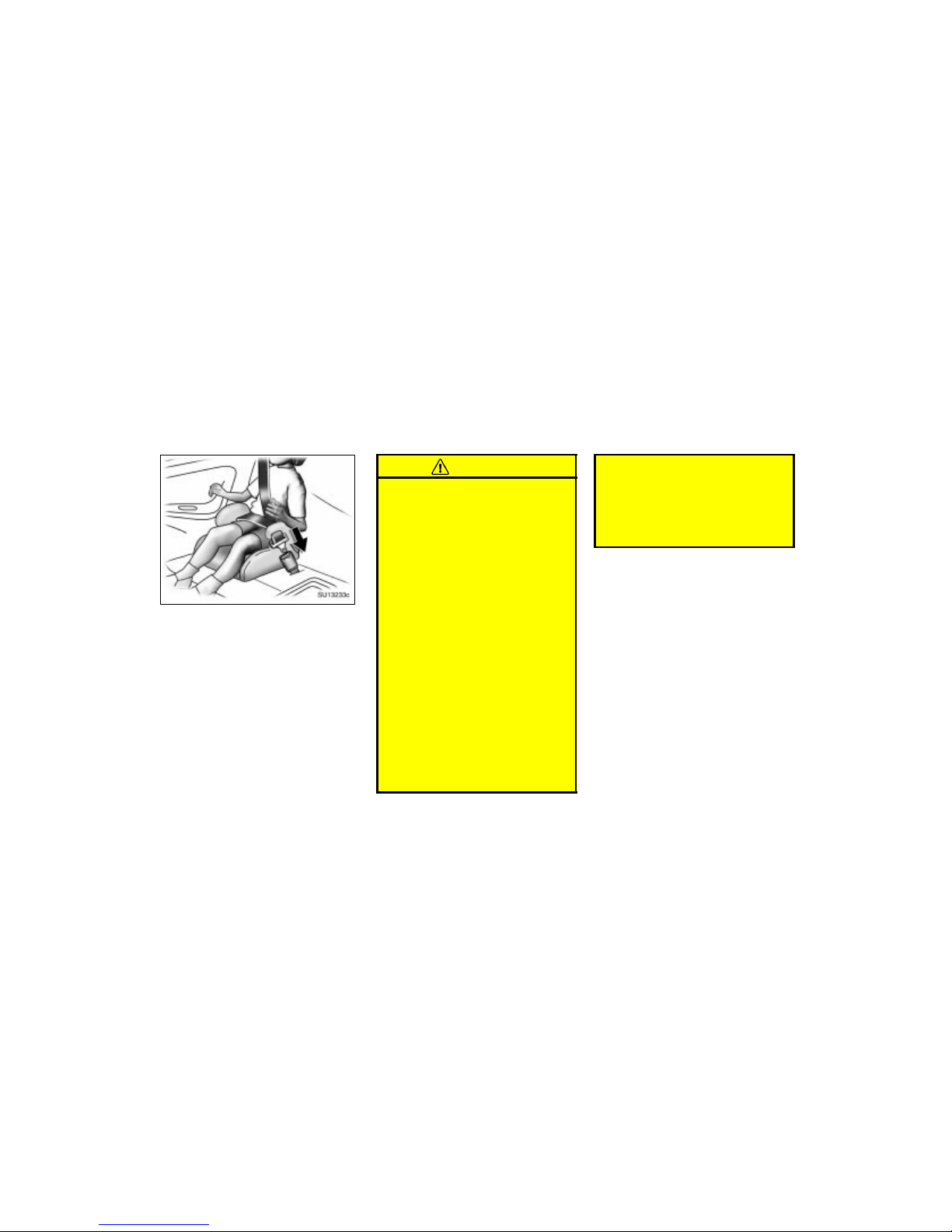
45
2005 ECHO HATCHBACK from Jul. ’04Prod. (OM52624U)
SU13233c
1. Sit the child on a booster seat. Run
the lap and shoulder belt through or
around the booster seat and across the
child following the instructions provided
by its manufacturer and insert the tab
into the buckle taking care not to twist
the belt.
Make sure the shoulder belt is correctly
across the child’s shoulder and that the
lap belt is positioned as low as possible
on the child’s hips. See “Seat belts” for
details.
CAUTION
Always make sure the shoulder belt
is positioned across the center of
child’s shoulder. The belt should be
kept away from child’s neck, but
not falling off child’s shoulder.
Otherwise, the child may be killed
or seriously injured in case of sudden braking or a collision.
Both high- positioned lap belts and
loose- fitting belts could cause
death or serious injuries due to
sliding under the lap belt during a
collision or other unintended event.
Keep the lap belt positioned as low
on a child’s hips as possible.
For child’s safety, do not place the
shoulder belt under child’s arm.
After inserting the tab, make sure
the tab and buckle are locked and
that the lap and shoulder portions
of the belt are not twisted.
Do not insert coins, clips, etc. in
the buckle as this may prevent your
child from properly latching the tab
and buckle.
If the seat belt does not function
normally, it cannot protect your
child from death or serious injury.
Contact your Toyota dealer immediately. Do not install the child restraint system on the seat until the
seat belt is fixed.
04 06.07
Page 66
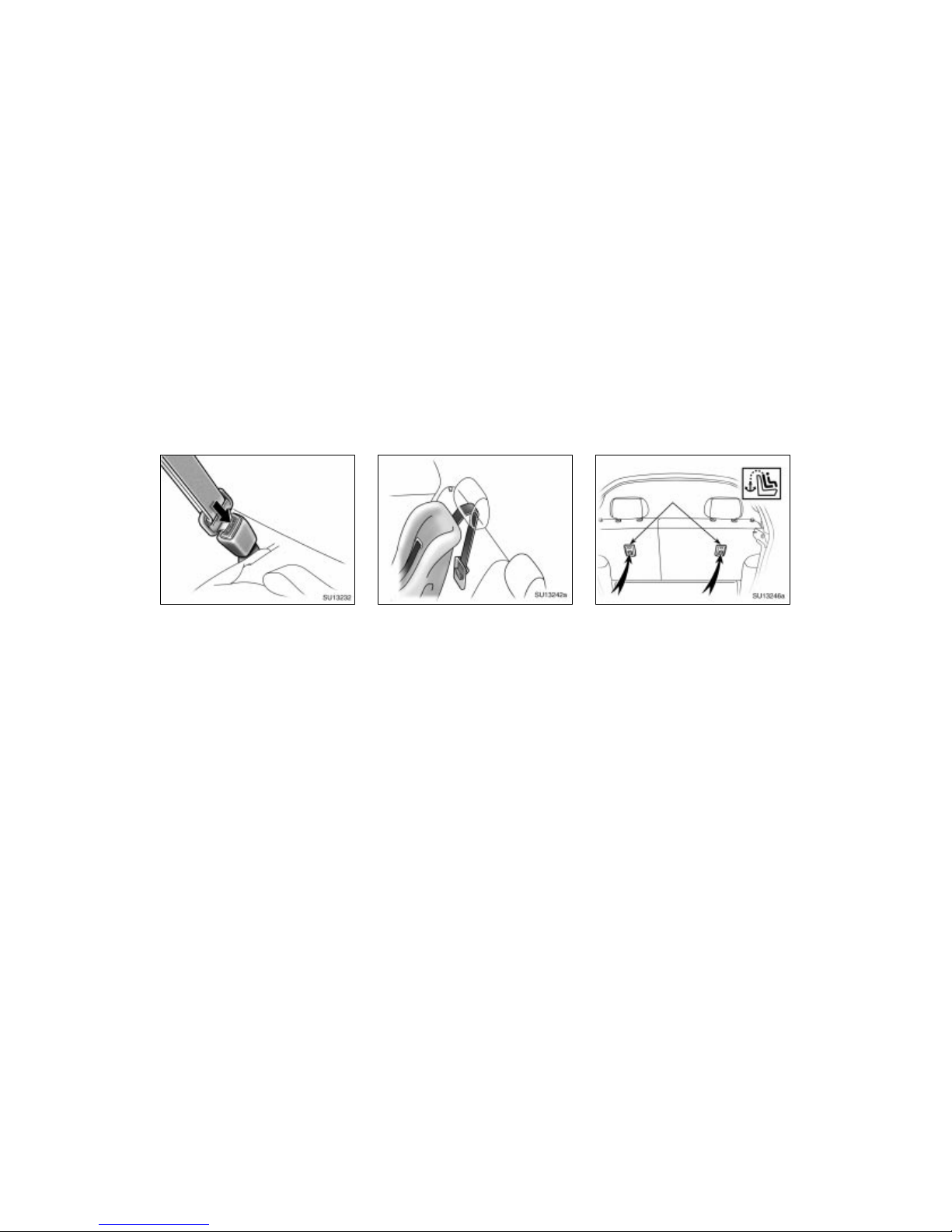
46
2005 ECHO HATCHBACK from Jul. ’04Prod. (OM52624U)
SU13232
2. To remove the child restraint system,
press the buckle release button and
allow the belt to retract.
—Using a top strap
SU13242a
Follow the procedure below for a child
restraint system that use of a top strap
to secure the system. Follow all the
installation instructions provided by its
manufacturer.
SU13246a
Anchor brackets
Symbol
Use the anchor bracket behind the rear
seat to attach the top strap.
Anchor brackets are installed for outside
rear seating position.
This symbol indicates the location of user
ready anchor brackets.
04 06.07
Page 67
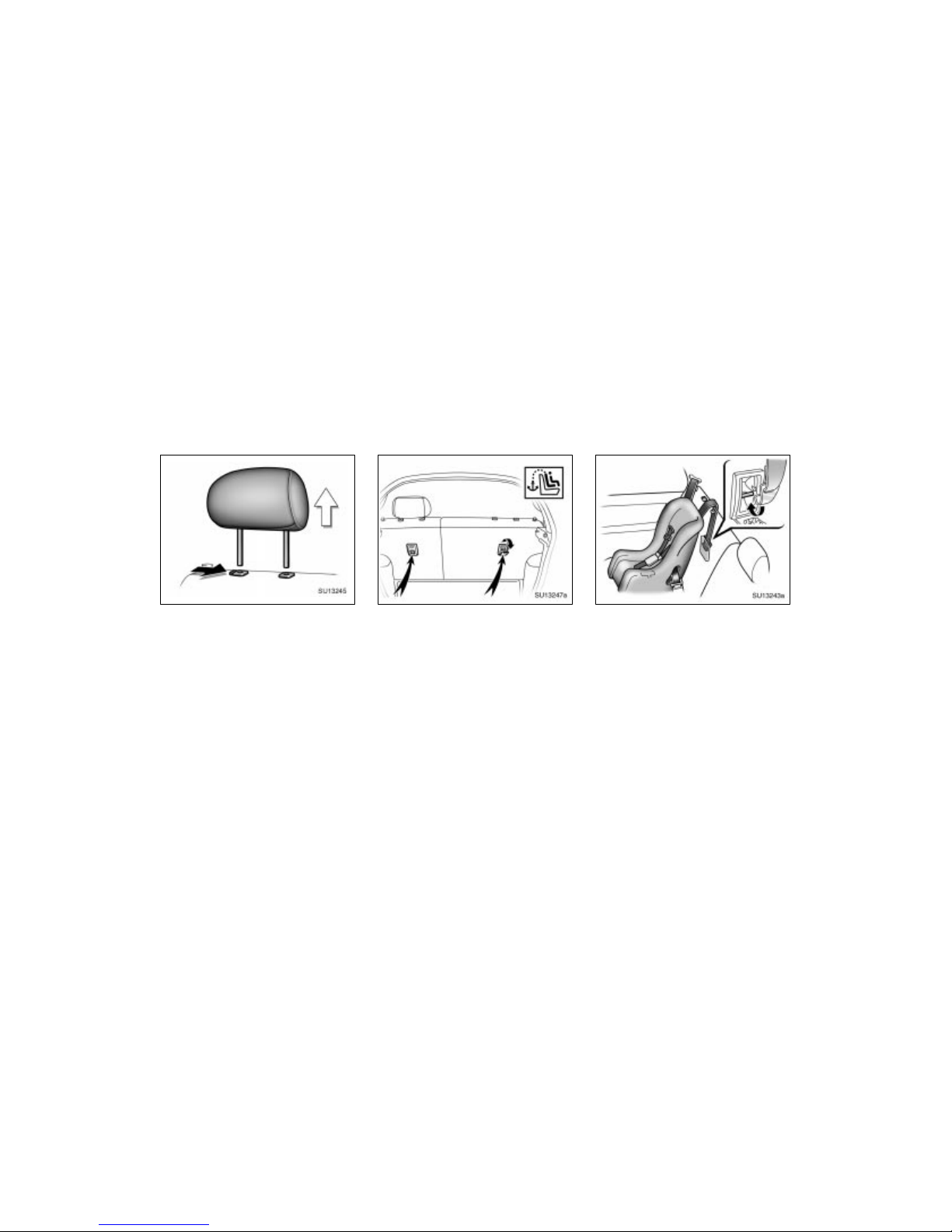
47
2005 ECHO HATCHBACK from Jul. ’04Prod. (OM52624U)
SU13245
TO USE THE ANCHOR BRACKET:
1. Remove the head restraint.
SU13247a
2. Open the anchor bracket cover with
the symbol mark shown in the illustration.
SU13243a
3. Securely fasten the child restraint
system with the seat belt.
Latch the hook onto the anchor
bracket and tighten the top strap.
For instructions to install the child restraint system, see “Child restraint” on
page 35 in this Section.
04 06.07
Page 68
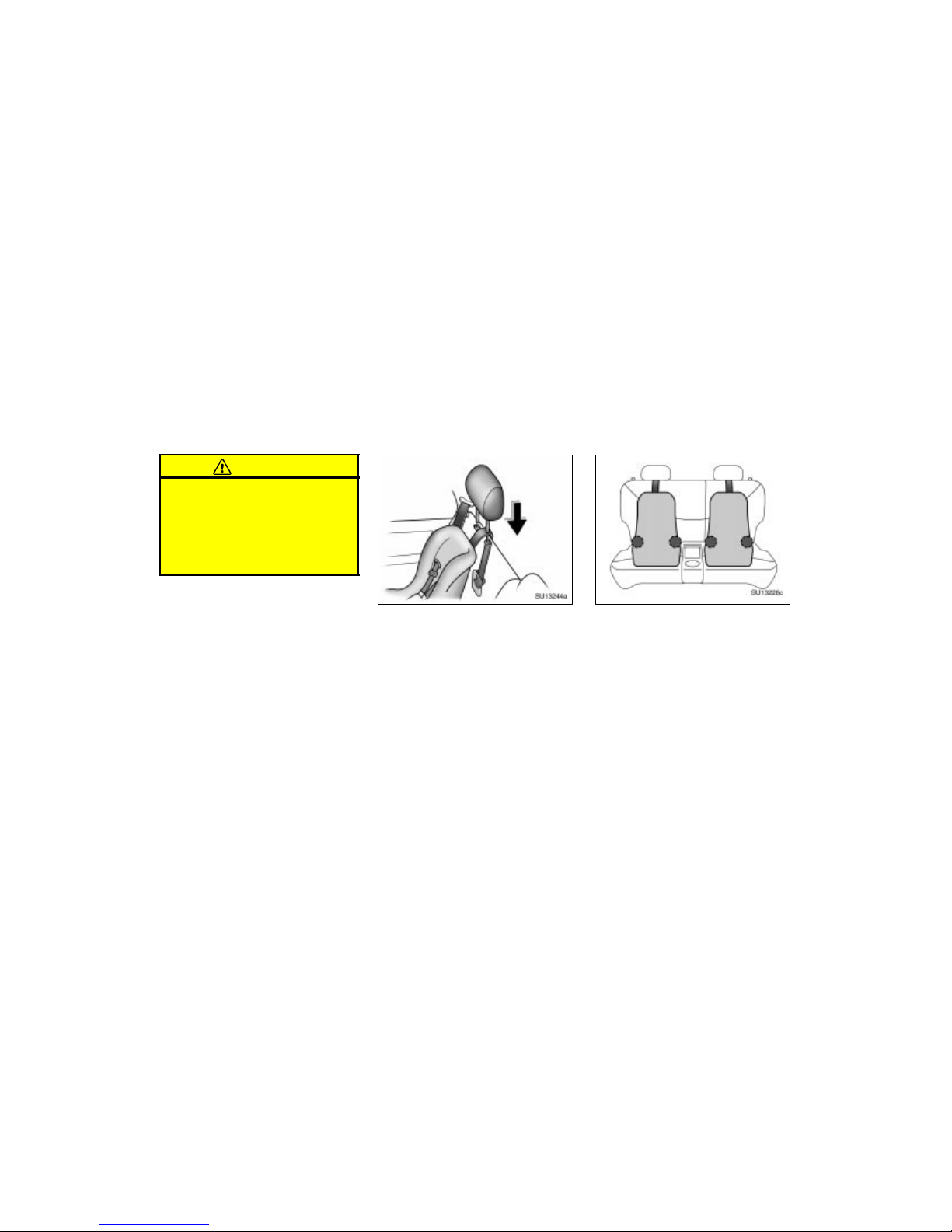
48
2005 ECHO HATCHBACK from Jul. ’04Prod. (OM52624U)
CAUTION
Make sure the top strap is securely
latched, and check that the child
restraint system is secure by pushing and pulling it in different directions.
Follow all the installation instructions
provided by its manufacturer.
SU13244a
4. Replace the head restraint.
Be sure to close the cover when the anchor bracket is not in use.
SU13228c
The lower anchorages for the child restraint system interfaced with the
FMVSS225 or CMVSS210.2 specification
are installed in the rear seat.
The anchorages are installed in the gap
between the seat cushion and seatback of
both outside rear seats.
Child restraint system interfaced with the
FMVSS213 or CMVSS213 specification
can be fixed with these anchorages. In
this case, it is not necessary to fix the
child restraint system with a seat belt on
the vehicle.
04 06.07
—Installation with child
restraint lower anchorages
Page 69
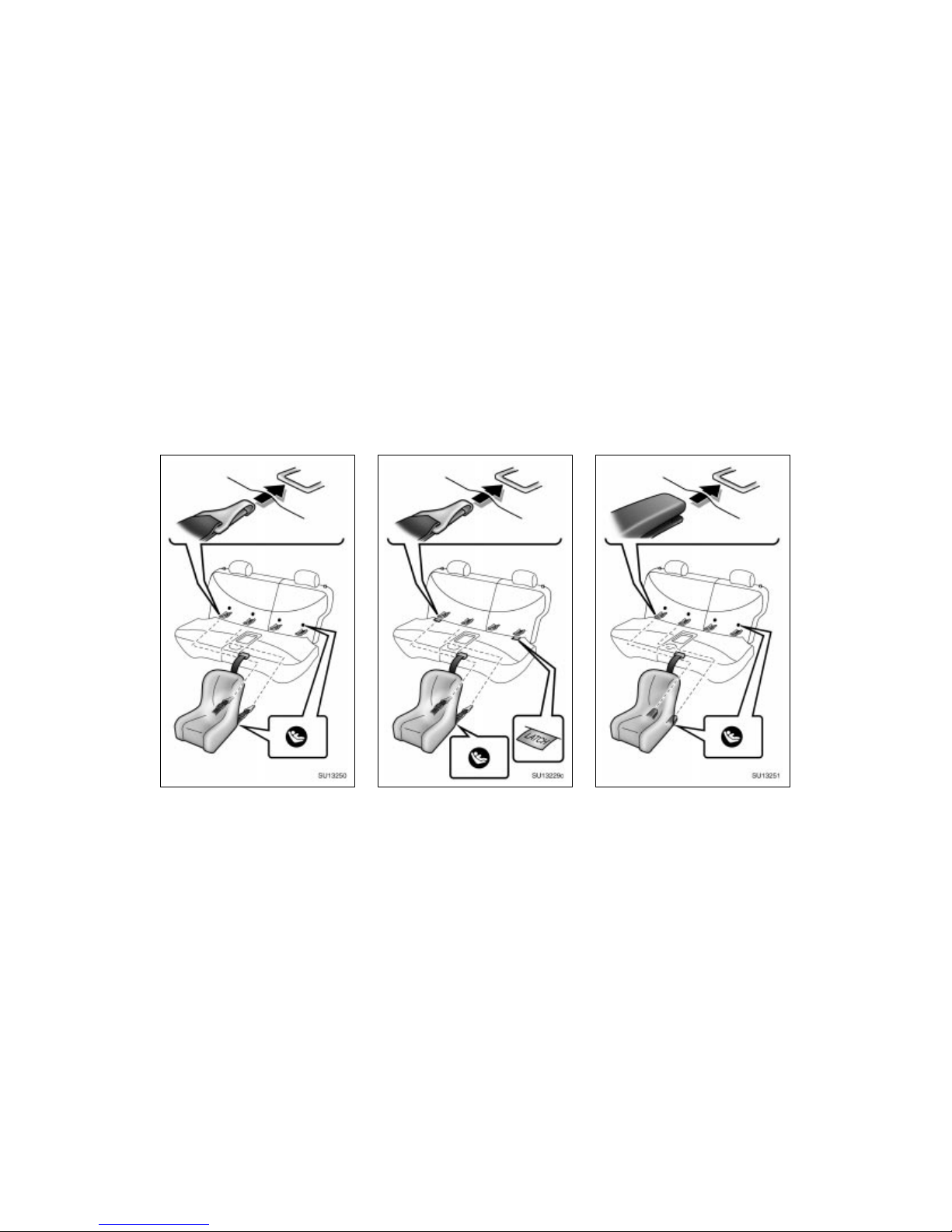
49
2005 ECHO HATCHBACK from Jul. ’04Prod. (OM52624U)
SU13250
Type A (anchor position indicated by
buttons)
SU13229c
Type A (anchor position indicated by
tags)
SU13251
Type B (anchor position indicated by
buttons)
04 06.07
Page 70
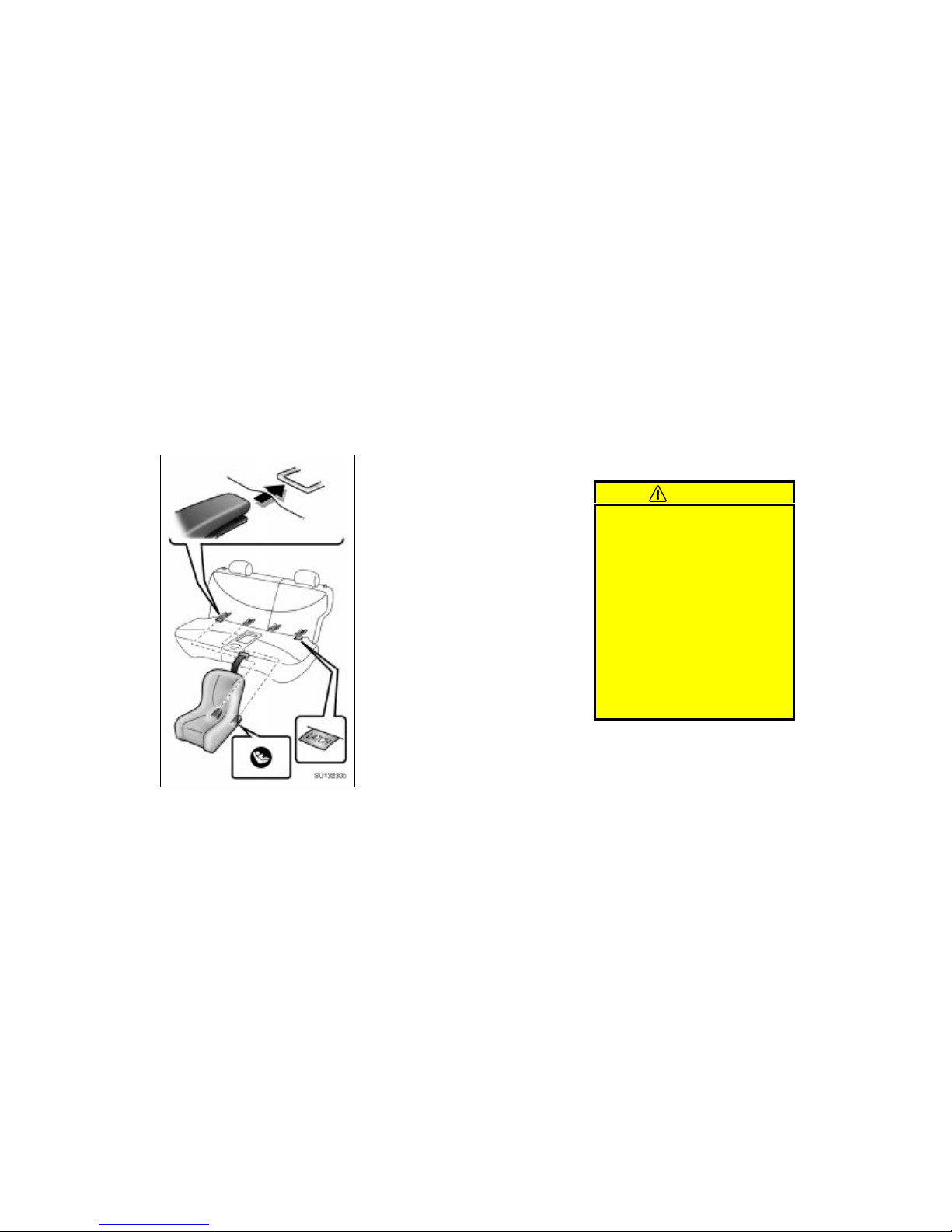
50
2005 ECHO HATCHBACK from Jul. ’04Prod. (OM52624U)
SU13230c
Type B (anchor position indicated by
tags)
The symbol on a child restraint system
indicates the presence of a lower connector system.
CHILD RESTRAINT SYSTEM
INSTALLATION
Type A —
1. Widen the gap between the seat
cushion and seatback slightly and
confirm the position of the lower anchorages below the button or tag in
the seatback.
2. Latch the hooks of lower straps onto
the anchorages and tighten the lower
straps.
Type B —
1. Widen the gap between the seat
cushion and seatback slightly and
confirm the position on the lower
anchorages below the button or tag
in the seatback.
2. Latch the buckles onto the anchorages.
If your child restraint system has a top
strap, it should be anchored. (For the
installation of the top strap, see “—Using
a top strap” on page 46 in this Section.)
For installation details, refer to the instruction manual equipped with each product.
CAUTION
When using the lower anchorages
for the child restraint system, be
sure that there are no irregular objects around the anchorages or that
the seat belt is not caught.
Push and pull the child restraint
system in different directions to be
sure it is secure. Follow all the
installation instructions provided by
its manufacturer.
Do not put a child restraint system
on the rear seat if it interferes with
the lock mechanism of the front
seats. Otherwise, the child or front
seat occupant(s) may be killed or
seriously injured in case of sudden
braking or a collision.
04 06.07
Page 71

27
2005 ECHO from Aug. ’04 Prod. (OM52636U)
OPERATION OF INSTRUMENTS AND
CONTROLS
Occupant restraint systems
Seats 28. . . . . . . . . . . . . . . . . . . . . . . . . . . . . . . . . . . . . . . . . . . . . . . . . . . . . .
Front seats 28. . . . . . . . . . . . . . . . . . . . . . . . . . . . . . . . . . . . . . . . . . . . . . . . .
Fold-down rear seat 32. . . . . . . . . . . . . . . . . . . . . . . . . . . . . . . . . . . . . . . . .
Head restrai nts 34. . . . . . . . . . . . . . . . . . . . . . . . . . . . . . . . . . . . . . . . . . . . . .
Seat belts 35. . . . . . . . . . . . . . . . . . . . . . . . . . . . . . . . . . . . . . . . . . . . . . . . . . .
SRS driver and front passenger airbags 43. . . . . . . . . . . . . . . . . . . . . . . .
SRS side airbags 50. . . . . . . . . . . . . . . . . . . . . . . . . . . . . . . . . . . . . . . . . . . .
Child restraint 56. . . . . . . . . . . . . . . . . . . . . . . . . . . . . . . . . . . . . . . . . . . . . . .
SECTION 1-
3
Page 72
28
2005 ECHO from Aug. ’04 Prod. (OM52636U)
Seats
While the vehicle is being driven, all vehicle occupants should have the seatback
upright, sit well back in the seat and properly wear the seat belts provided.
CAUTION
Do not drive the vehicle unless the
occupants are properly seated. Do
not allow any passengers to sit on
top of a folded- down seatback, or
in the luggage compartment or cargo area. Persons not properly
seated and/or not properly restrained by seat belts can be severely injured in the event of emergency braking or a collision.
During driving, do not allow any
passengers to stand up or move
around between seats. Otherwise,
severe injuries can occur in the
event of emergency braking or a
collision.
Driver seat
CAUTION
The SRS driver airbag deploys with
considerable force, and can cause
death or serious injury especially if
the driver is very close to the airbag.
The National Highway Traffic Safety
Administration (“NHTSA”) advises:
Since the risk zone for driver airbag
is the first 50—75 mm (2—3 in.) of
inflation, placing yourself 250 mm (10
in.) from your driver airbag provides
you with a clear margin of safety.
This distance is measured from the
center of the steering wheel to your
breastbone. If you sit less than 250
mm (10 in.) away now, you can
change your driving posit ion in several ways:
Move your seat to the rear as far
as you can while still reaching the
pedals comfortably.
Slightly recline the back of the
seat. Although vehicle designs vary,
many drivers can achieve the 250
mm (10 in.) distance, even with the
driver seat all the way forward, simply by reclining the back of the
seat somewhat. If reclining the back
of your seat makes it hard to see
the road, raise yourself by using a
firm, non- slippery cushion, or raise
the seat if your vehicle has that
feature.
If your steering wheel is adjustable,
tilt it downward. This points the airbag toward your chest instead of
your head and neck.
The seat should be adjusted as recommended by NHTSA above, while
still maintaining control of the foot
pedals, steering wheel, and your view
of the instrument panel controls.
Front seats—
—Front seat precautions
Page 73
29
2005 ECHO from Aug. ’04 Prod. (OM52636U)
Front passenger seat
CAUTION
The SRS front passenger airbag also
deploys with considerable force, and
can cause death or serious injury especially if the front passenger is very
close to the airbag. The front passenger seat should be as far from the
airbag as possible with the seatback
adjusted, so the front passenger sits
upright.
Front seats (with SRS side airbags)
CAUTION
The SRS side airbags are installed in
the driver and front passenger seats.
Observe the following precautions.
Do not lean against the front door
when the vehicle is in use, since
the side airbag inflates with considerable speed and force. Otherwise,
you may be killed or seriously injured.
Do not use seat accessories which
cover the area where the side airbags inflate. Such accessories may
prevent the side airbags from activating correctly causing death or
serious injury.
Do not modify or replace the seats
or upholstery of the seats equipped
with side airbags. Such change may
prevent the si de airbag system from
activating correctly, disable the system or cause the side airbags to
inflate accidentally, resulting in
death or serious injury.
—Seat adjustment precautions
CAUTION
Do not adjust the seat while the ve-
hicle is moving as the seat may unexpectedly move and cause the
driver to lose control of the vehicle.
Be careful that the seat does not
hit a passenger, luggage or the rear
seat.
After adjusting the seat position, re-
lease the lever and try sliding the
seat forward and backward to make
sure it is locked in position.
After adjusting the seatback, push
your body back against the seat to
make sure the seat is locked in
position.
Do not put objects under the seats
except for putti ng them in the auxiliary box. Otherwise, the objects
may interfere with the seat-lock
mechanism or unexpectedly push
up the seat position adjusting lever
and the seat may suddenly move,
causing the driver to lose control of
the vehicle.
Page 74
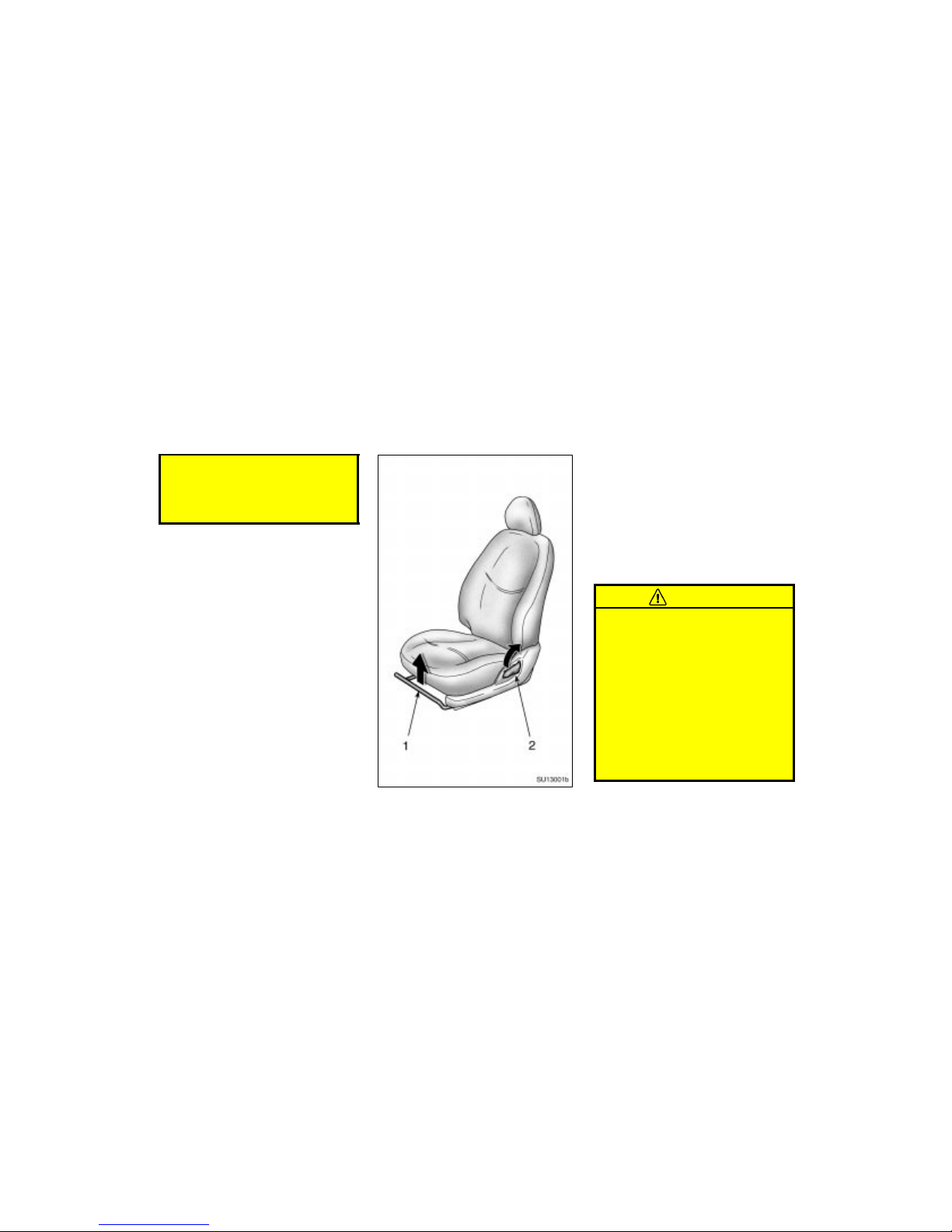
30
2005 ECHO from Aug. ’04 Prod. (OM52636U)
While adjusting the seat, do not put
your hands under the seat or near
the moving parts. Otherwise, your
hands or fingers may be caught and
injured.
—Adjusting front seats
SU13001b
1. SEAT POSITION ADJUSTING LEVER
Hold the center of the lever and pull it
up. Then slide the seat to the desired
position with slight body pressure and
release the lever.
2. SEATBACK ANGLE ADJUSTING
LEVER
Lean forward and pull the lever up.
Then lean back to the desired angle
and release the lever.
CAUTION
To reduce the risk of sliding under
the lap belt during a collision, avoid
reclining the seatback any more than
needed. The seat belts provide maximum protection in a frontal or rear
collision when the driver and the
front passenger are si tting up straight
and well back in the seats. If he/she
is reclined, the lap belt may slide
past his/her hips and apply restraint
forces directly to the abdomen. In the
event of a frontal collision, the more
the seat is reclined, the greater the
risk of personal injury.
Page 75
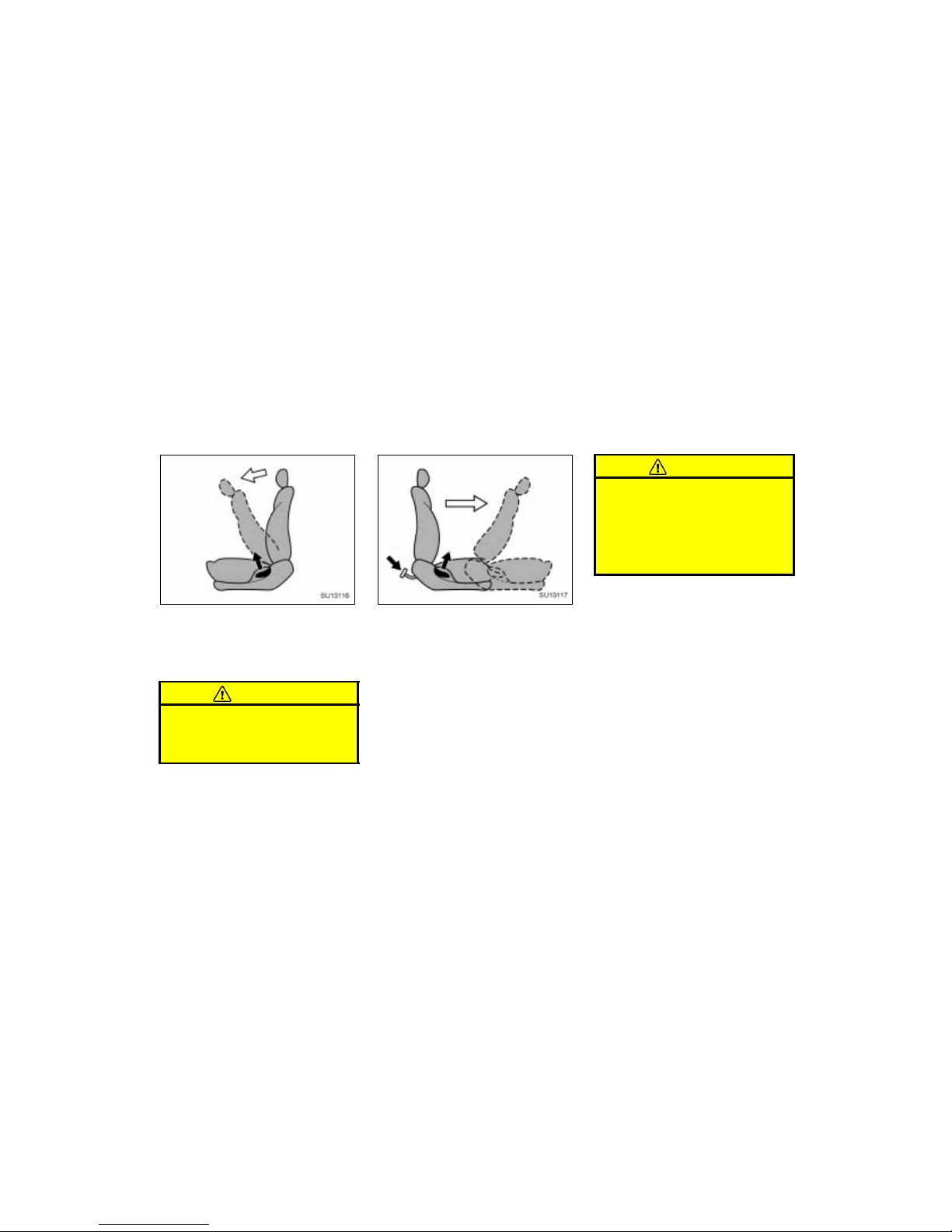
31
2005 ECHO from Aug. ’04 Prod. (OM52636U)
SU13116
Lift the seatback release lever—the
seatback will tilt forward.
This allows passengers to get into or out
of the rear seat easily. After passengers
are in, lift up on the seatback.
CAUTION
After putting back the seatback, try
pushing the seatback forward and
rearward to make sure it is secured
in place.
SU13117
For easy access to the rear seat:
1. Lift the seatback angle adjusting lever
or press the pedal behind the seatback.
The seat will slide forward.
2. Move the seat to the front- most position.
After passengers are in, lift up the seatback and return the seat until it locks.
CAUTION
After putting back the seat, try
pushing the seat forward and rearward to make sure it is secured in
place.
Never allow anyone to rest their
foot on the release pedal while the
vehicle is moving.
—Tilting driver’s seatback for
rear seat entry
(2- door models)
—Moving passenger’s seat for
rear seat entry
(2- door models)
Page 76
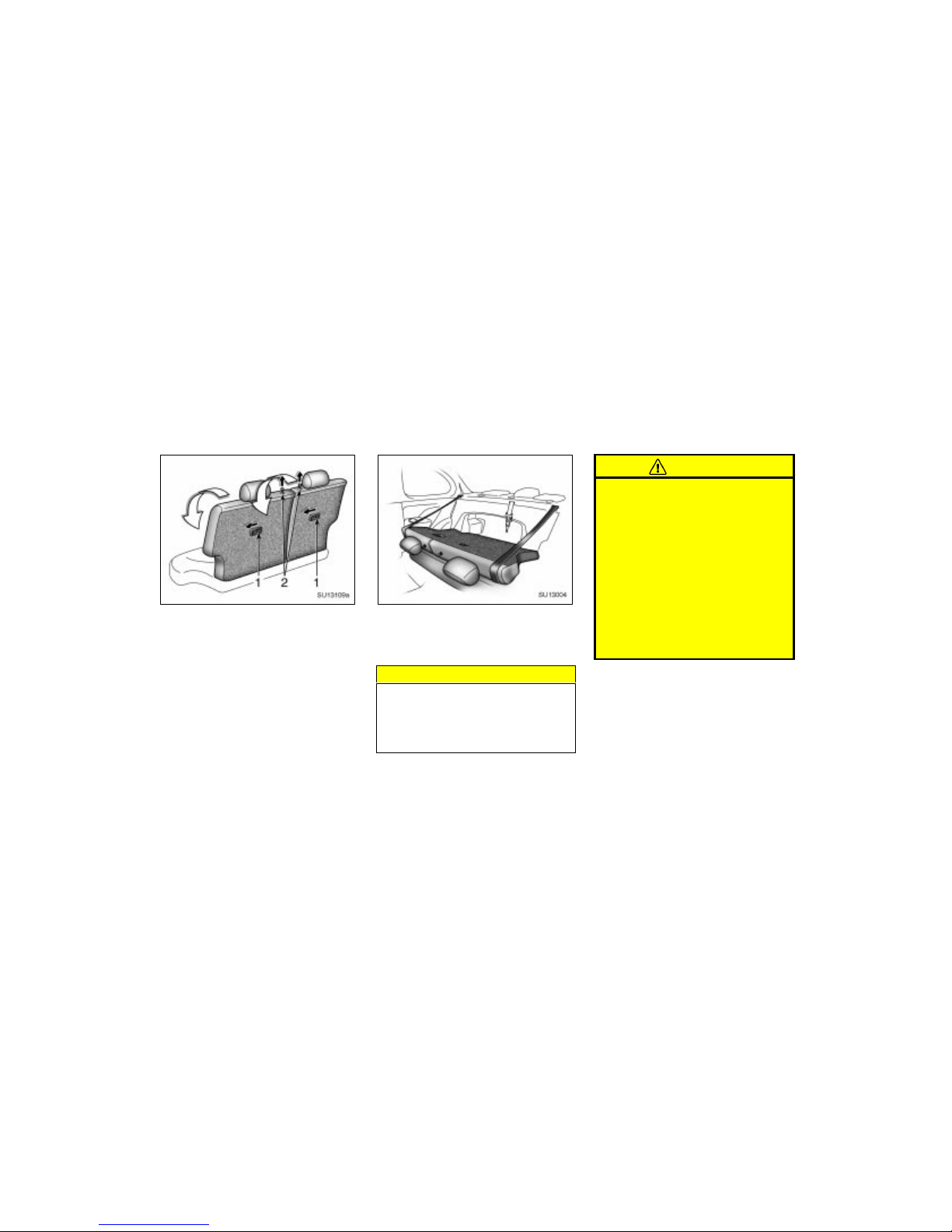
32
2005 ECHO from Aug. ’04 Prod. (OM52636U)
Fold- down rear seat
SU13109a
(A) FOLDING DOWN REAR SEAT
1. Pull up the seatback security lock
lever 1 to the unlock position.
2. Pull up the lock release button 2.
3. Fold down the seatback.
Each seatback may be folded separately.
SU13004
This will enlarge the trunk as far as the
seatbacks. See “Cargo and luggage” on
page 167 for precautions to observe for
loading luggage.
NOTICE
Make sure the luggage loaded in the
enlarged trunk will not damage the
webbing of the rear center seat belt
when the left seatback is folded
down.
CAUTION
When returning the seatback to the
upright position, observe the following in precautions order to prevent
personal injury in a collision or sudden stop:
Make sure the seatback is securely
locked by pushing for ward and rearward on the top of the seatback.
Failure to do so will prevent the
seat belt from operating properly.
Make sure the seat belts are not
twisted or caught in the seatback
and are arranged in the proper
position and are ready to use.
Page 77
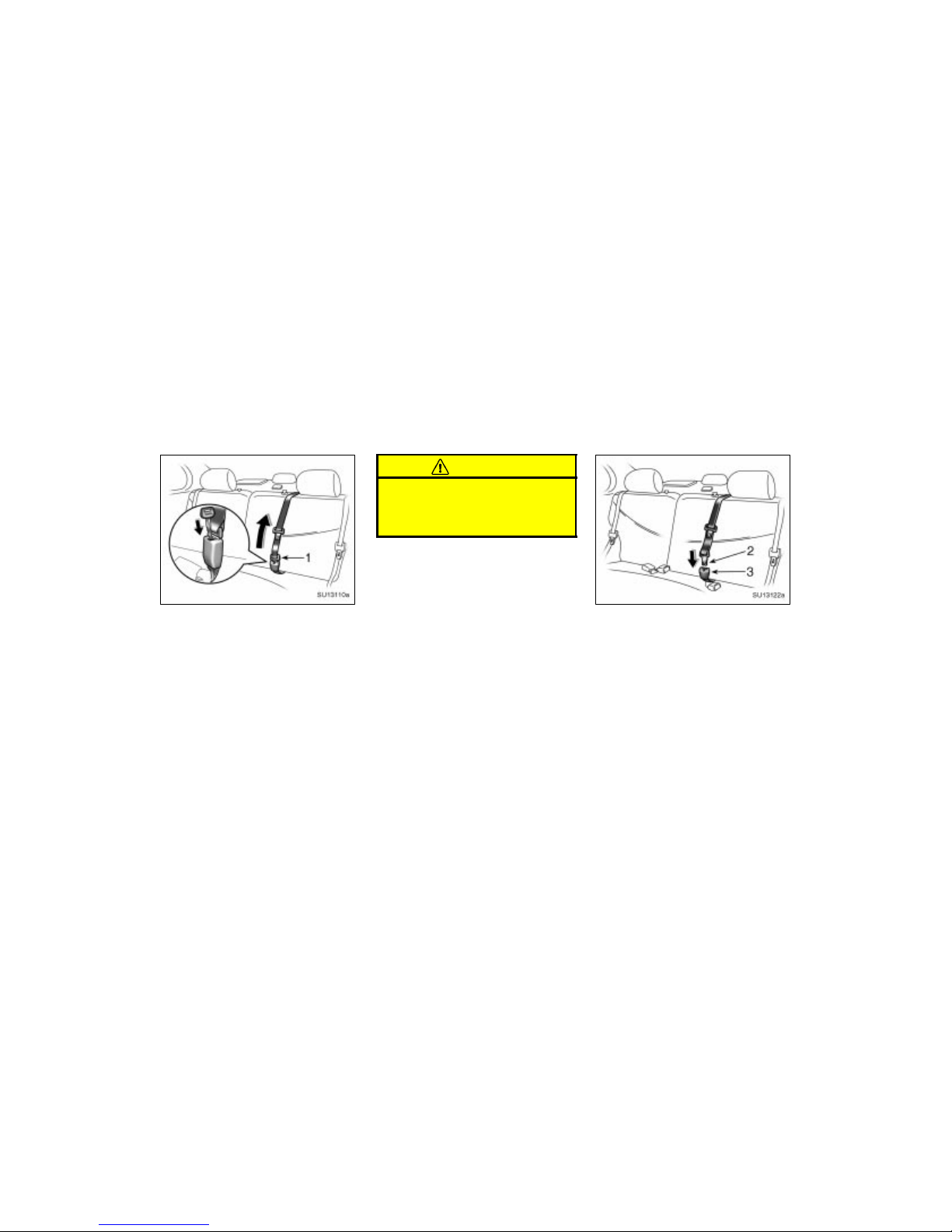
33
2005 ECHO from Aug. ’04 Prod. (OM52636U)
SU13110a
(B) PREVENTING DAMAGE TO REAR
CENTER SEAT BELT WEBBING
When folding down the left seatback,
the luggage loaded in the enlarged
trunk will damage the webbing of the
rear center seat belt. Disconnect the
rear center seat bel t to prevent damage.
Insert the key into the hole (light gray)
on the buckle to release tab 1 (light
gray), and allow the belt to retract.
CAUTION
Disconnect the rear center seat belt
only under the above mentioned circumstances; do not disconnect it in
other circumstances.
SU13122a
(C) BEFORE RETURNING REAR SEAT
Before returning the seatback to the
upright position, make sure to correctly
connect the center seat belt for ready
use.
Insert tab 2 into the buckle 3.
You will hear a click when the tab locks
into the buckle.
Page 78
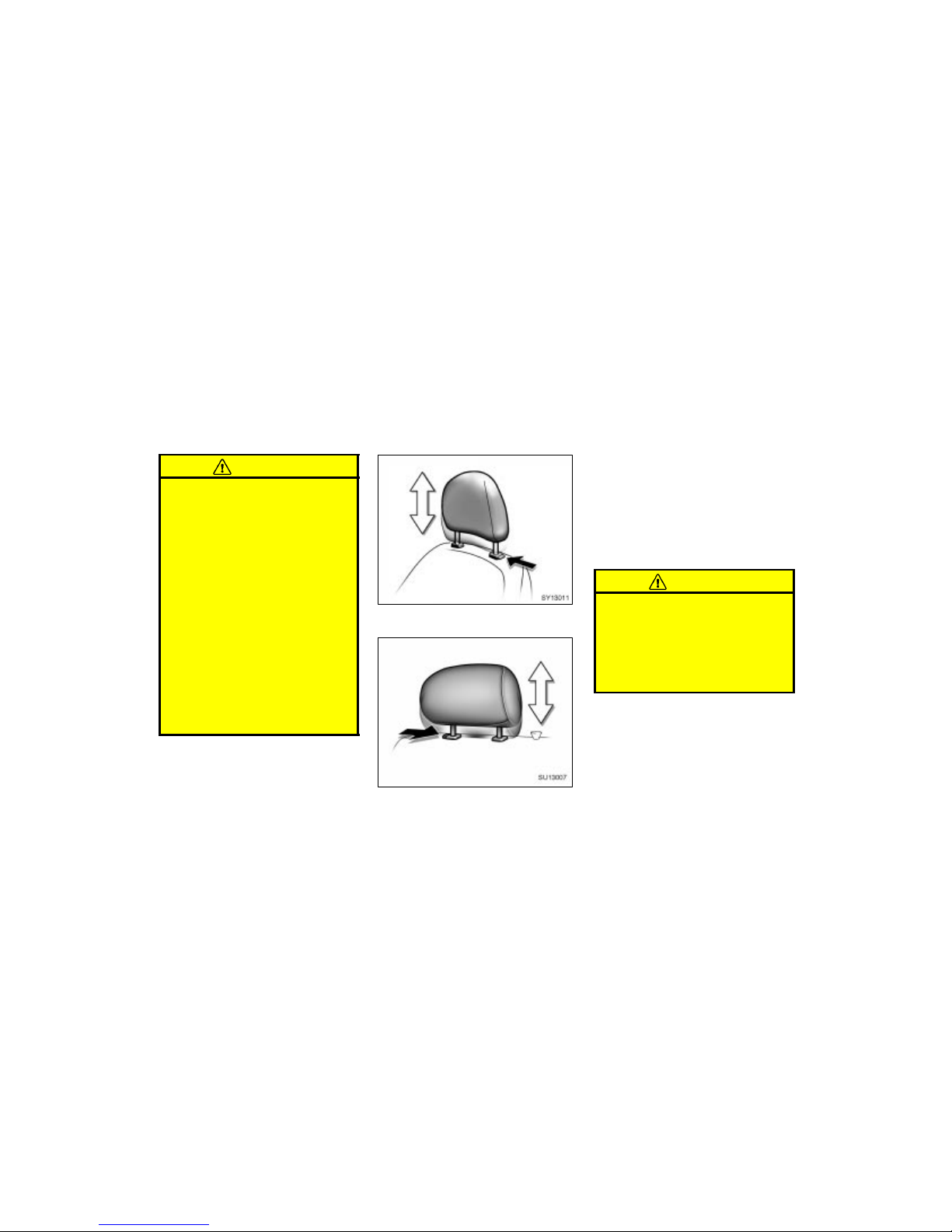
34
2005 ECHO from Aug. ’04 Prod. (OM52636U)
CAUTION
Be careful not to mix up the proper
match of tab and buckle. Do not
insert tab 1 (light gray) into other
buckle than the one with light gray
buckle release button. (See “Seat
belts” in this Section for proper
matching of the buckles and tabs.)
After inserting the tab, make sure
the tab and buckle are locked.
Do not insert coins, clips, etc. in
the buckle as this may prevent you
from properly latching the tab and
buckle.
Make sure the belt is not twisted or
caught in the seatback and that it
is arranged in the proper position
for ready use.
If the seat belt does not function
normally, immediately contact your
Toyota dealer.
Head restraints
SY13011
Front seat
SU13007
Rear seat
For your safety and comfort, adjust the
head restraint before driving.
To raise: Pull it up.
To lower: Push it down while pressing the
lock release button.
The head restraint is most effective when
it is close to your head. Therefore, using
a cushion on the seatback is not recommended.
CAUTION
Adjust the center of the head re-
straint so that it is closest to the
top of your ears.
After adjusting the head restraint,
make sure it is locked in position.
Do not drive with the head re-
straints removed.
Page 79
35
2005 ECHO from Aug. ’04 Prod. (OM52636U)
Toyota strongly urges that the driver and
passengers in the vehicle be properly restrained at all times with the seat belts
provided. Failure to do so could increase
the chance of injury and/or the severity of
injury in accidents.
The seat belts provided for your vehicle
are designed for people of adult size,
large enough to properly wear them.
Child. Use a child restraint system appropriate for the child until the child becomes large enough to properly wear the
vehicle’s seat belts. See “Child restraint”
on page 56 for details.
If a child is too large for a child restraint
system, the child should sit in the rear
seat and must be restrained using the
vehicle’s seat belt. According to accident
statistics, the child is safer when properly
restrained in the rear seat than in the
front seat.
If a child must sit in the front seat, the
seat belts should be worn properly. If an
accident oc curs and the seat belts are not
worn properly, the force of the rapid inflation of the airbag may cause death or
serious injury to the child.
Do not allow any children to stand up or
kneel on either rear or front seats. An
unrestrained child could suffer serious injury o r death during emergenc y br aking or
a collision. Also, do not let the child sit
on your lap. Holding a child in your arms
does not provide sufficient restraint.
Pregnant woman. Toyota recommends the
use of a seat belt. Ask your doctor for
specific recommendations. The lap belt
should be worn securely and as low as
possible over the hips and not on the
waist.
Injured person. Toyota recommends the
use of a seat belt. Depending on the injury, first check with your doctor for specific
recommendations.
CAUTION
Persons should ride in their seats
properly wearing their seat belts
whenever the vehicle is moving.
Otherwise, they are much more likely
to suffer serious bodily injury or
death in the event of sudden braking
or a collision.
When using the seat belts, observe
the following:
Use the belt for only one person at
a time. Do not use a single belt for
two or more people—even children.
To reduce the risk of sliding under
the lap belt during a collision,
avoid reclining the seatback any
more than needed. The seat belts
provide maximum protection in a
frontal or rear collision when the
driver and the front passenger are
sitting up straight and well back in
the seats. If you are reclined, the
lap belt may slide past your hips
and apply restraint forces directly
to the abdomen. In the event of a
frontal collision, the more the seat
is reclined, the greater the risk of
personal injury.
Seat belts—
—Seat belt precautions
Page 80
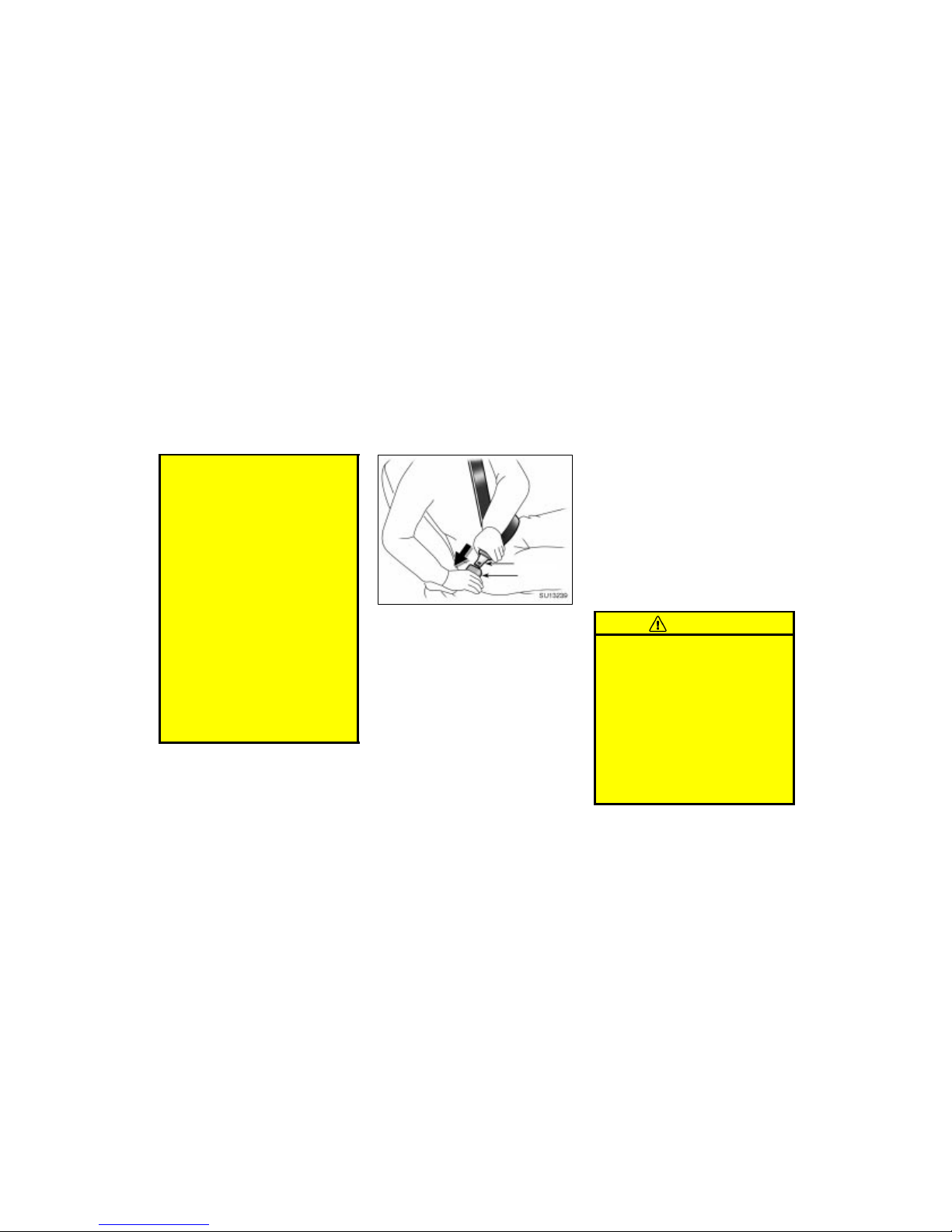
36
2005 ECHO from Aug. ’04 Prod. (OM52636U)
Be careful not to damage the belt
webbing or hardware. Take care that
they do not get caught or pinched
in the seat or doors.
Inspect the belt system periodically.
Check for cuts, fraying, and loose
parts. Damaged parts should be replaced. Do not disassemble or
modify the system.
Keep the belts clean and dry. If
they need cleaning, u se a mild soap
solution or lukewarm water. Never
use bleach, dye, or abrasive cleaners, or allow them to come into
contact with the belt—they may severely weaken the belts. (See
“Cleaning the interior” on page
205.)
Replace the belt assembly (includ-
ing bolts) if it has been used in a
severe impact. The entire assembly
should be replaced even if damage
is not obvious.
SU13239
Ta b
Buckle
Adjust the seat as needed and sit up
straight and well back in the seat. To
fasten your belt, pull it out of the retractor and insert the tab into the
buckle.
You will hear a click when the tab locks
into the buckle.
The seat belt length automatically adjusts
to your size and the seat position.
The retractor will lock the belt during a
sudden stop or on impact. It also may
lock if you lean forward too quickly. A
slow, easy motion will allow the belt to
extend, and you can move around freely.
When a passenger’s shoulder belt is completely extended and is then retracted
even slightly, the belt is locked in that
position and c annot be extended. Thi s feature is used to hold the child restraint
system securely. (For details, see “Child
restraint” on page 56.) To free the belt
again, fully retract the belt and then pull
the belt out once more.
If the seat belt cannot be pulled out of the
retractor, firmly pull the belt and release
it. You will then be able to smoothly pull
the belt out of the retractor.
CAUTION
After inserting the tab, make sure
the tab and buckle are locked and
that the belt is not twisted.
Do not insert coins, clips, etc. in
the buckle as this may prevent you
from properly latching the tab and
buckle.
If the seat belt does not function
normally, immediately contact your
Toyota dealer. Do not use the seat
until the seat belt is fixed, because
it cannot protect an adult occupant
or your child from injury.
—Fastening front and rear
seat belts
Page 81
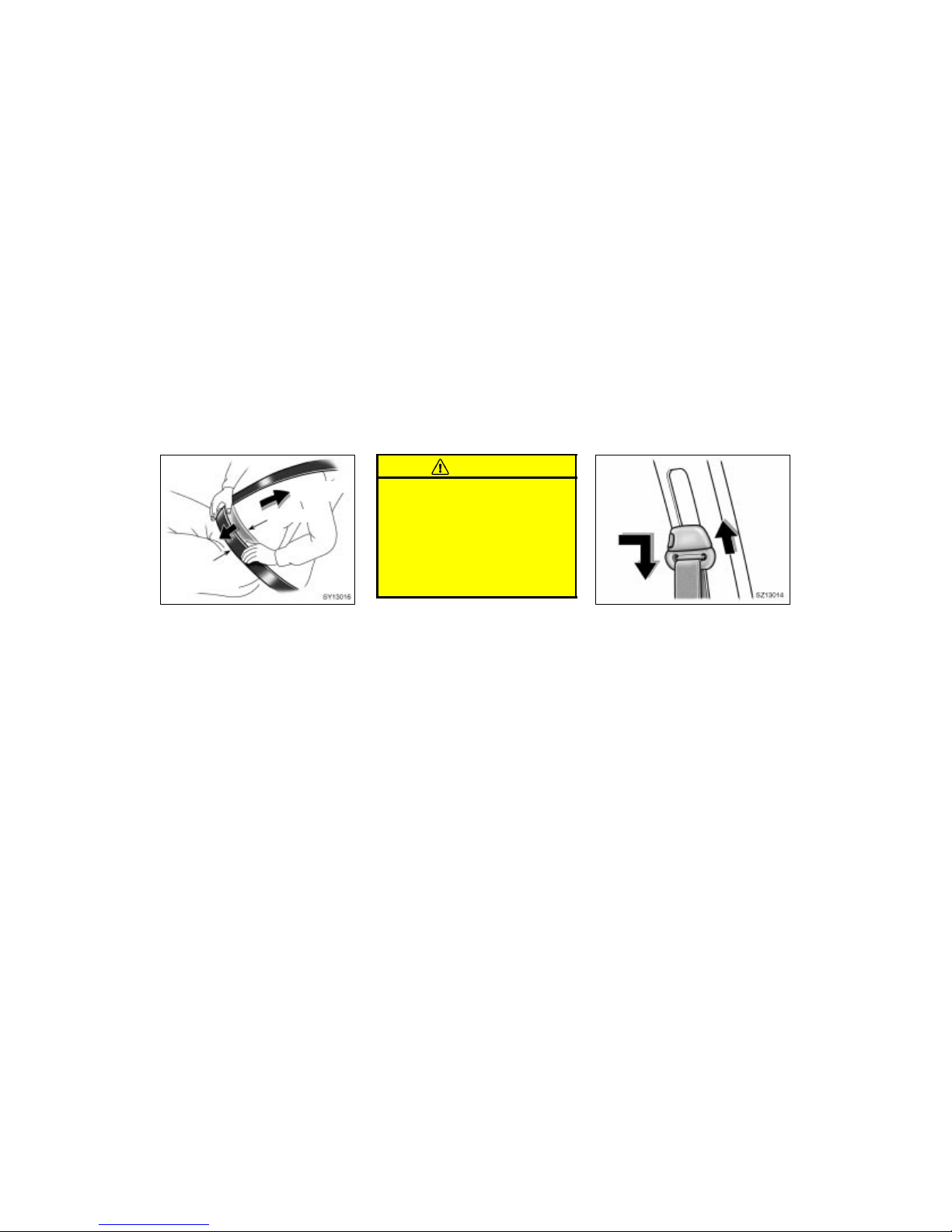
37
2005 ECHO from Aug. ’04 Prod. (OM52636U)
SY13016
Ta ke u p
slack
To o h i g h
Keep as low on
hips as possible
Ta k e u p
slack
Adjust the position of the lap and
shoulder belts.
Position the lap belt as low as possible
on your hips—not on your waist, then adjust it to a snug fit by pulling the shoulder
portion upward through the latch plate.
CAUTION
Both high- positioned lap belts and
loose- fitting belts could cause serious injuries due to sliding under
the lap belt during a collision or
other unintended event. Keep the
lap belt positioned as low on hips
as possible.
Do not place the shoulder belt un-
der your arm.
SZ13014
Seat belts with an adjustable shoulder
anchor (4- door models)—
Adjust the shoulder anchor position to
your size.
To raise: Slide the anchor up.
To lower: Push in the lock release button
and slide the anchor down.
After adjustment make sure the anchor is
locked in position.
Page 82
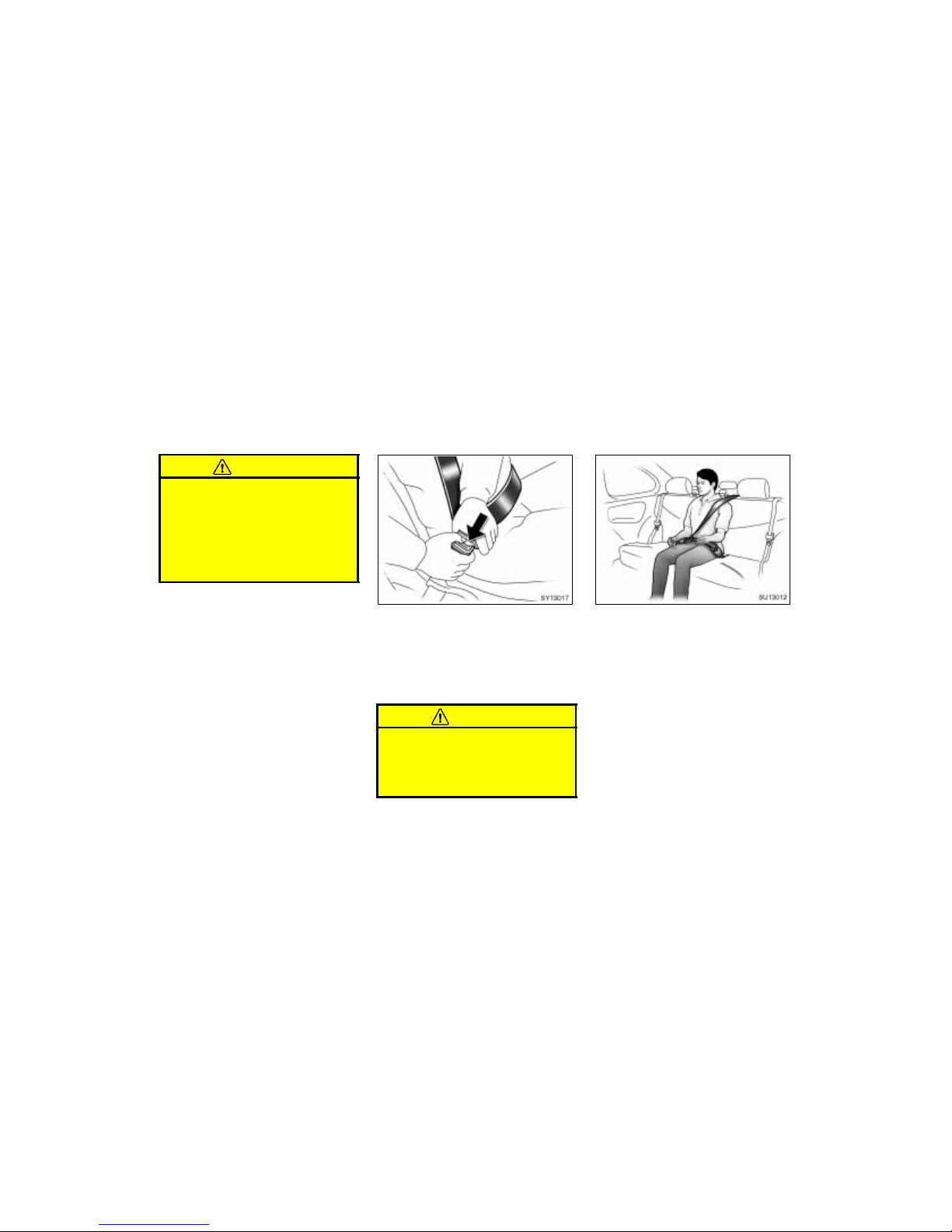
38
2005 ECHO from Aug. ’04 Prod. (OM52636U)
CAUTION
Always make sure the shoulder belt
is positioned across the center of
your shoulder. The belt should be
kept away from your neck, but not
falling off your shoulder. Failure to
do so could reduce the amount of
protection in an accident and cause
serious injuries in a collision.
SY13017
To release the belt, press the buckle
release button and allow the belt to
retract.
If the belt does not retract smoothly, pull
it out and check for kinks or twists. Then
make sure it remains untwisted as it retracts.
CAUTION
Do not separate the buckle with light
gray buckle release button. Ot herwise,
the seat belt may not work properly.
See the information in the following
columns.
SU13012
REAR CENTER SEAT BELT (WITH
FOLD- DOWN SEAT)
The rear center seat belt is a 3- point type
restraint with 2 buckles. Both seat belt
buckles must be correctly located and securely latched for proper operation
Make sure buckle 1 (with light gray
buckle- release button) is securely latched
for ready use of the center seat belt.
Buckle 1 should be separated when the
rear left seatback is folded down. Otherwise, the luggage loaded in the enlarged
trunk will damage the webbing of the rear
center seat belt. (See “Fold- down rear
seat” in this Section for the instruction of
how to correctly connect the seat belt.)
Page 83
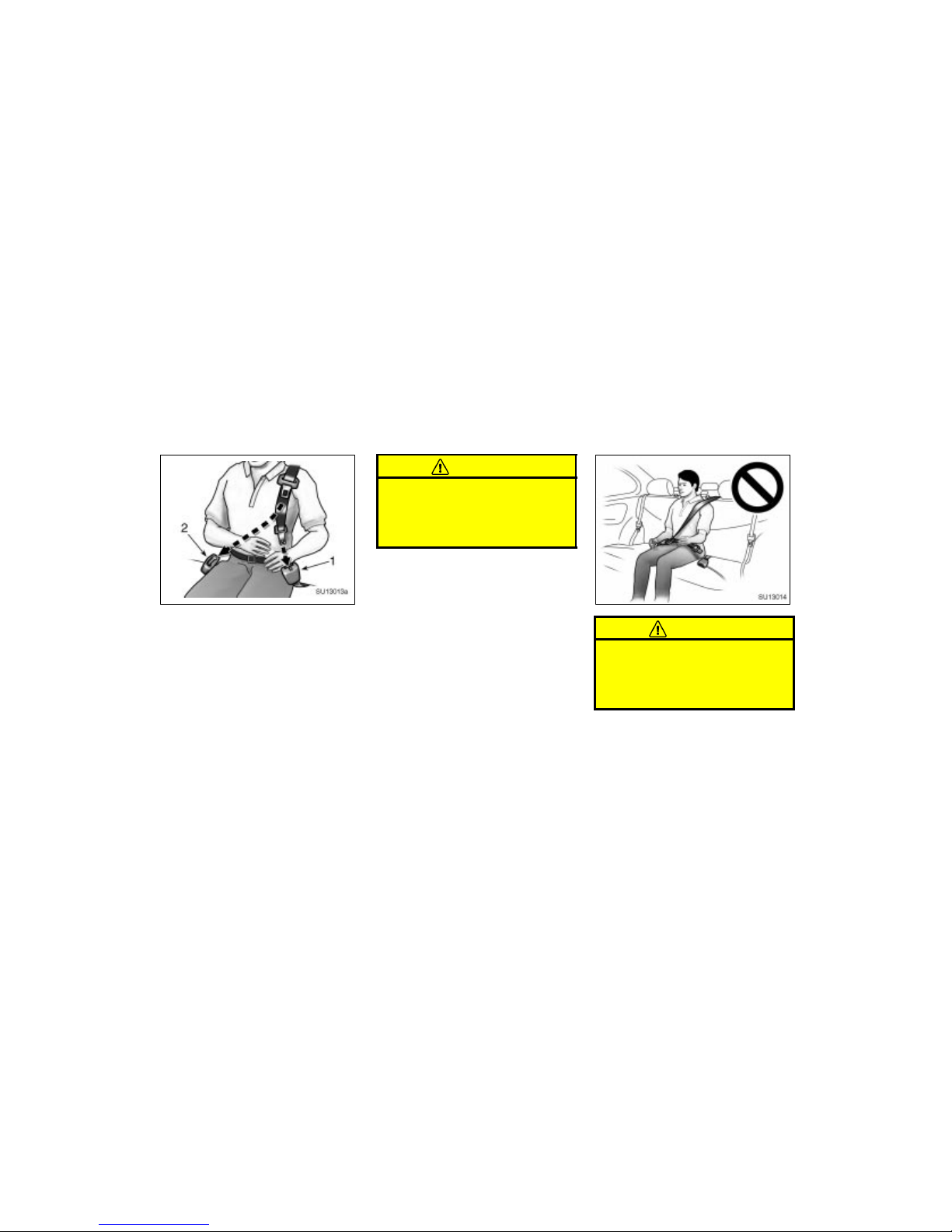
39
2005 ECHO from Aug. ’04 Prod. (OM52636U)
SU13013a
Two buckles and tabs for rear center
seat belt
The two buckles for the rear center seat
belt are distinguished with colors of the
buckle release button. Also the two tabs
have different shape for its end so that
the belt is not buckled in the wrong place.
Buckle 1—Properly matches with light
gray tab
Buckle 2—Properly matches with interior color tab
CAUTION
Make sure the both buckles are correctly located and securely latched.
Failure to properly match the buckle
and tab may cause severe injury in
case of an accident or a collision.
SU13014
CAUTION
Do not use the rear center seat belt
with either buckle released. Fastening
only the shoulder belt or lap belt may
cause severe personal injury in case
of sudden braking or a collision.
Page 84
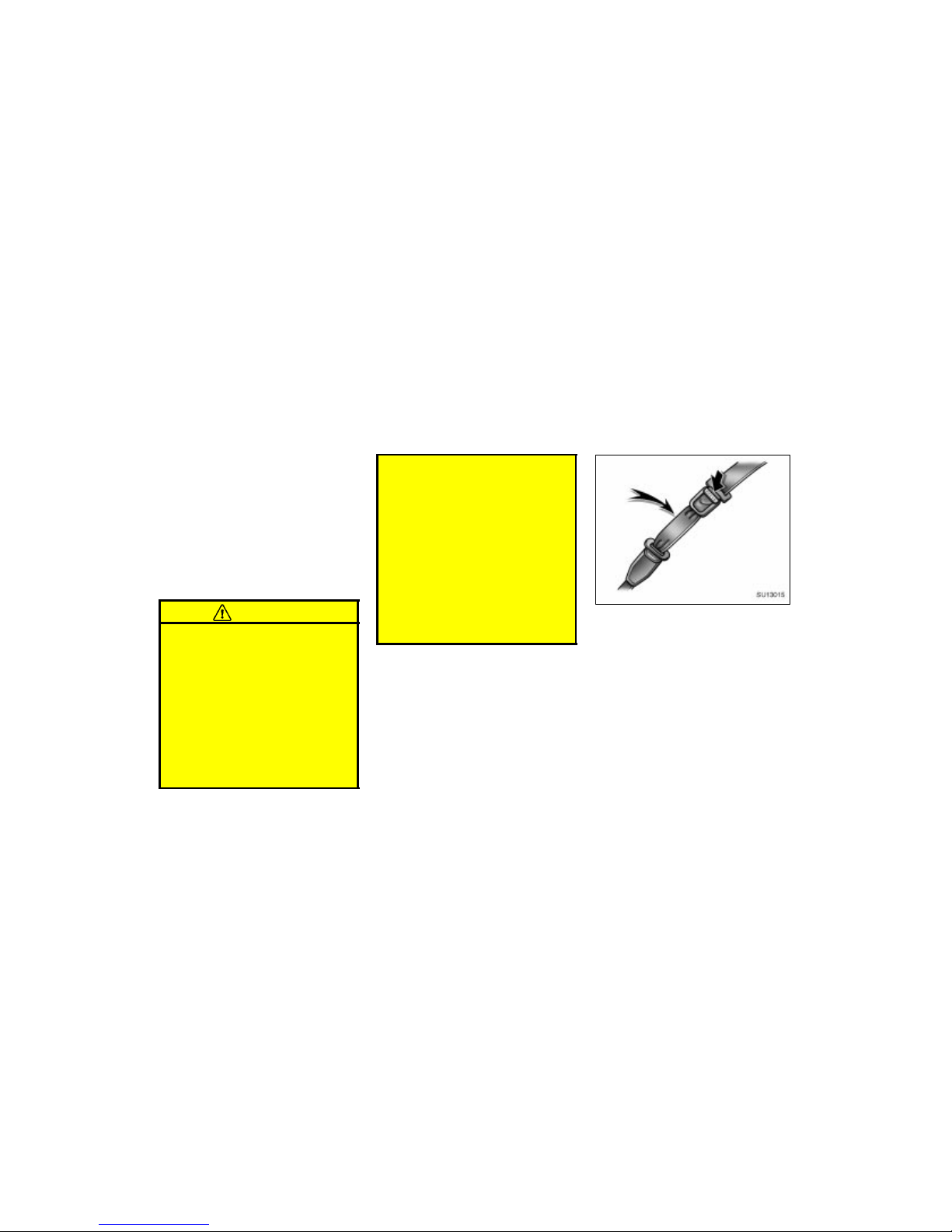
40
2005 ECHO from Aug. ’04 Prod. (OM52636U)
—Seat belt extender
If your seat belts cannot be fastened securely because they are not long enough,
a personalized seat belt extender is available from your Toyota dealer free of
charge.
Please contact your local Toyota dealer so
that the dealer can order the proper required length for the extender. Bring the
heaviest coat you expect to wear for proper measurement and selection of length.
Additional ordering information is available
at your Toyota dealer.
CAUTION
When using the seat belt extender,
observe the following precautions.
Failure to follow these instructions
could reduce the effectiveness of the
seat belt restraint system in case of
an accident, increasing the chance of
personal injury.
Remember that the extender pro-
vided for you may not be safe when
used on a different vehicle, for
another person, or at a different
seating position than the one originally intended.
Be sure to wear the seat belt with-
out the seat belt extender if you
can fasten the seat belt without the
extender.
Do not use the seat belt extender
when installing a child restraint
system on the front or rear passenger seat. If installing a child restraint system with the seat belt
extender connected to the seat belt,
the seat belt will not securely hold
the child restraint system, which
could cause death or serious injury
to the child or other passengers in
the event of collision.
SU13015
To connect the extender to the seat
belt, insert the tab into the seat belt
buckle so that the “PRESS” signs on
the buckle release buttons of the extender and the seat belt are both facing
outward as shown.
You will hear a click when the tab locks
into the buckle.
When releasing the seat belt, press on
the buckl e release b utton on the extender,
not on the seat belt. This helps prevent
damage to the vehicle interior and extender itself.
When not in use, remove the extender
and store in the vehicle for future use.
Page 85
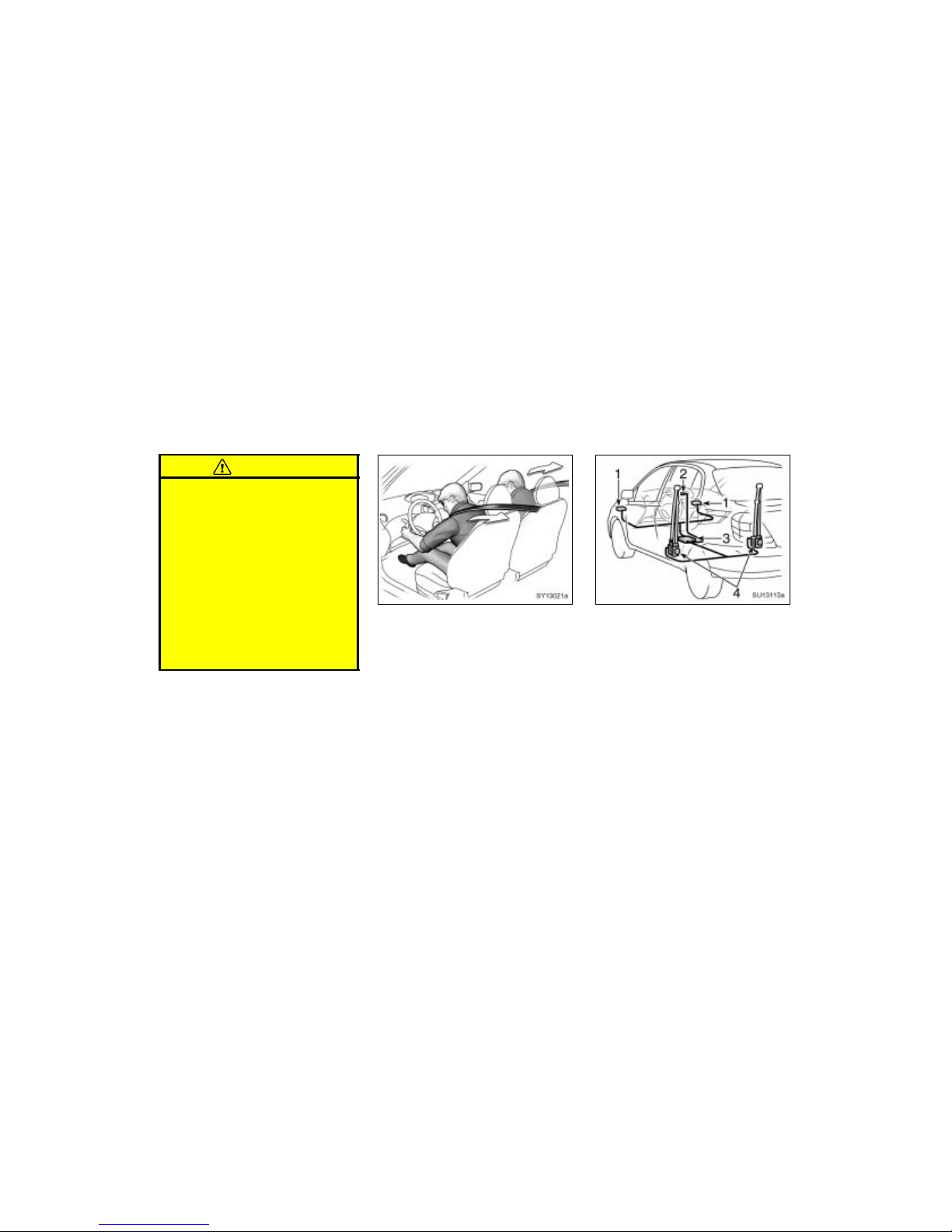
41
2005 ECHO from Aug. ’04 Prod. (OM52636U)
CAUTION
After inserting the tab, make sure
the tab and buckle are locked and
that the lap and shoulder portions
of the belt and the seat belt extender are not twisted.
Do not insert coins, clips, etc. in
the buckle as this may prevent you
from properly latching the tab and
buckle.
If the seat belt does not function
normally, immediately contact your
Toyota dealer. Do not use the seat
until the seat belt is fixed, because
it cannot protect an adult occupant
or your child from injury.
—Seat belt pretensioners
SY13021a
The driver and front passenger seat
belt pretensioners are designed to be
activated in response to a severe frontal impact.
When the sensor detects a severe frontal
impact, the front seat belts are quickly
drawn back by the retractors so that the
belts snugly restrain the occupants.
The seat belt pretensioners are activated
even with no passenger in the front seat.
The seat belt pretensioners and SRS airbags may not operate together in all collisions.
SU13113a
The seat belt pretensioner system consists mainly of the following components
and their locations are shown in the illustration.
1. Front airbag sensors
2. SRS warning light
3. Airbag sensor assembly
4. Seat belt pretensioner assemblies
The seat belt pretensioners are controlled
by the airbag sensor assembly. The airbag
sensor assembly consists of a safing sensor and airbag sensor.
Page 86
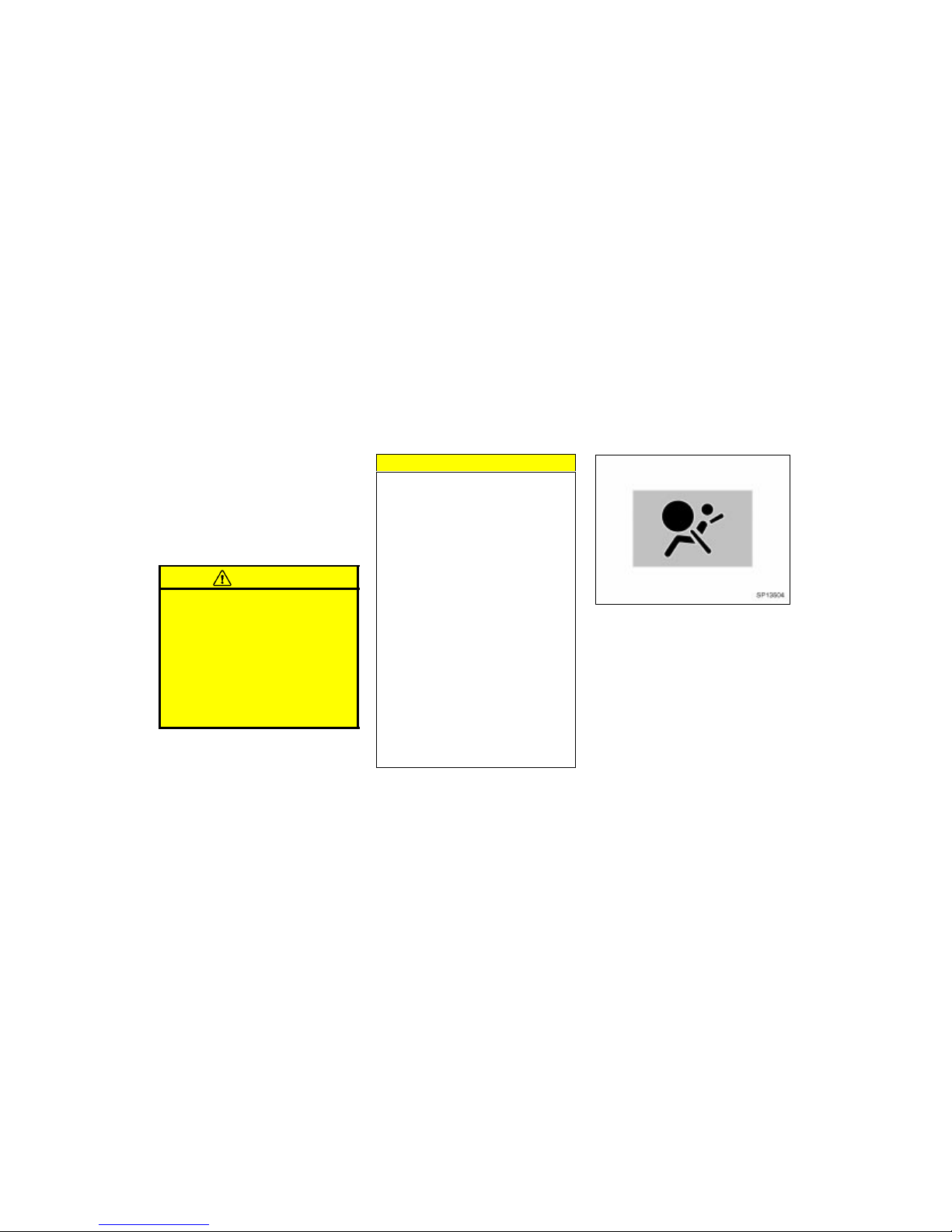
42
2005 ECHO from Aug. ’04 Prod. (OM52636U)
When the seat belt pretensioners are activated, an operating noise may be heard
and a small amount of non- toxic gas may
be released. This does not indicate that
a fire is occurring. This gas is normally
harmless.
Once the seat belt pretensioners have
been activated, the seat belt retractors
remain locked.
CAUTION
Do not modify, remove, strike or open
the seat belt pretensioner assemblies,
airbag sensor or surrounding area or
wiring. Failure to follow these instructions may prevent the seat belt pretensioners from activating correctly,
cause sudden operation of the system
or disable the system, which could
result in death or serious injury. Consult your Toyota dealer about any repair and modification.
NOTICE
Do not perform any of the following
changes without consulting your
Toyota dealer. Such changes can
interfere with proper operation of the
seat belt pretensioners in some
cases.
Installation of electronic devices
such as a mobile two- way radio,
cassette tape player or compact
disc player
Repairs on or near the front seat
belt retractor assemblies
Modification of the suspension system
Modification of the front end structure
Attachment of a grille guard (bull
bar, kangaroo bar, etc.), snowplow,
winches or any other equipment to
the front end
Repairs made on or near the front
fenders, front end structure or console
SP13504
This indicator comes on when the ignition key is turned to the “ON” position.
It goes off after about 6 seconds. This
means the seat belt pretensioners are
operating properly.
This warning light system monitors the
airbag sensor assembly, front airbag sensors, side airbag sensors, door side airbag sensors, seat belt pretensioner assemblies, inflators, warning light,
interconnecting wiring and power sources.
(For details, see “Service reminder indicators and warning buzzers” on page 90.)
If any of the following conditions occurs,
this indicates a malfunction of the airbags
or seat belt pretensioners. Contact your
Toyota dealer as soon as possible.
Page 87
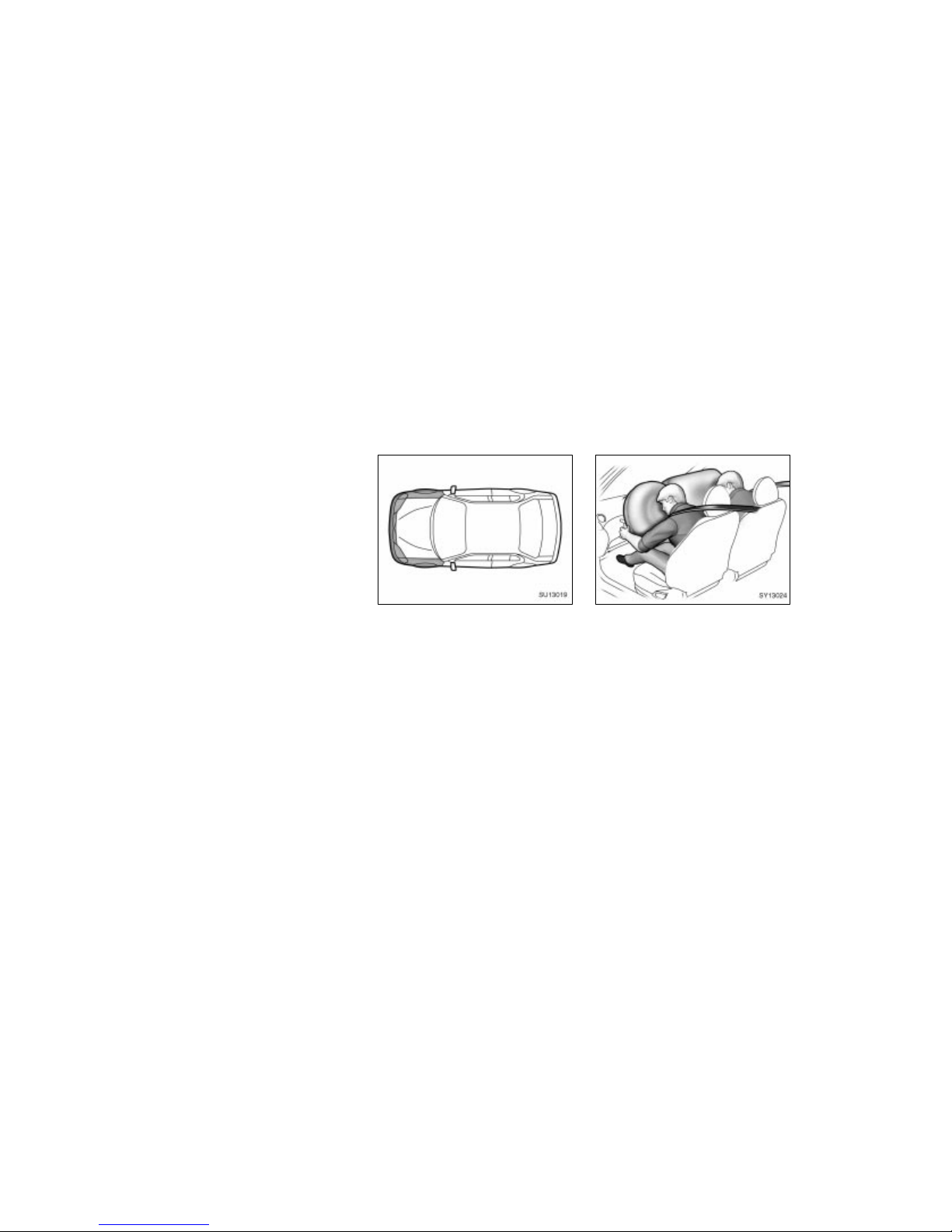
43
2005 ECHO from Aug. ’04 Prod. (OM52636U)
The light does not come on when the
ignition key is turned to the “ON” position or remains on for more than 6
seconds or flashes.
The light comes on or flashes while
driving.
If any seat belt does not retract or
cannot be pulled out due to a malfunction or activation of the relevant seat
belt pretensioner.
The seat belt pretensioner assembly or
surrounding area has been damaged.
SU13019
In the following cases, contac t your Toyota
dealer as soon as possible:
The front part of the vehicle (shaded
in the illustration) was involved in an
accident that was not severe enough to
cause the seat belt pretensioners to
operate.
Either seat belt pretensioner assembly
or surrounding area is scratched,
cracked, or otherwise damaged.
SY13024
The SRS (Supplemental Restraint System) front airbags are designed to provide further protection for the driver
and front passenger in addition to the
primary safety protection provided by
the seat belts.
In response to a severe frontal impact,
the SRS front airbags work together with
the seat belts to help reduce injury by
inflating. The SRS front airbags help reduce injuries mainly to the driver’s or front
passenger’s head or chest caused by hitting the vehicle interior. The SRS front
passenger airbag is activated even with
no passenger in the front seat.
Always wear your seat belt properly.
SRS driver and front
passenger airbags
Page 88
44
2005 ECHO from Aug. ’04 Prod. (OM52636U)
Your vehicle is equipped with a crash
sensing and diagnostic module, which will
record the use of the seat belt restraint
system by the driver and front passenger
when the SRS front airbags are inflated.
CAUTION
The SRS front airbag system is de-
signed only as a supplement to the
primary protection of the driver and
front passenger seat belt systems.
The driver and front passenger can
be killed or seriously injured by the
inflating airbags if they do not wear
the available seat belts properly.
During sudden braking just before
a collision, an unrestrained driver
or front passenger can move forward into direct contact with or
close proximity to the airbag which
may then deploy during the collision. To ensure maximum protection
in an accident, the driver and all
passengers in the vehicle must
wear their seat belts properly. Wearing a seat belt properly during an
accident reduces the chances of
death or serious injury or being
thrown out of the vehicle. For
instructions and precautions concerning the seat belt system, see
“Seat belts” on page 35.
Improperly seated and/or restrained
infants and children can be killed
or seriously injured by the deploying airbags. An infant or child who
is too small to use a seat belt
should be properly secured using a
child restraint system. Toyota
strongly recommends that all infants and children be placed in the
rear seat of the vehicle and properly restrained. The rear seat is the
safest for infants and children. For
instructions concerning the installation of a child restraint system, see
“Child restraint” on page 56.
Page 89
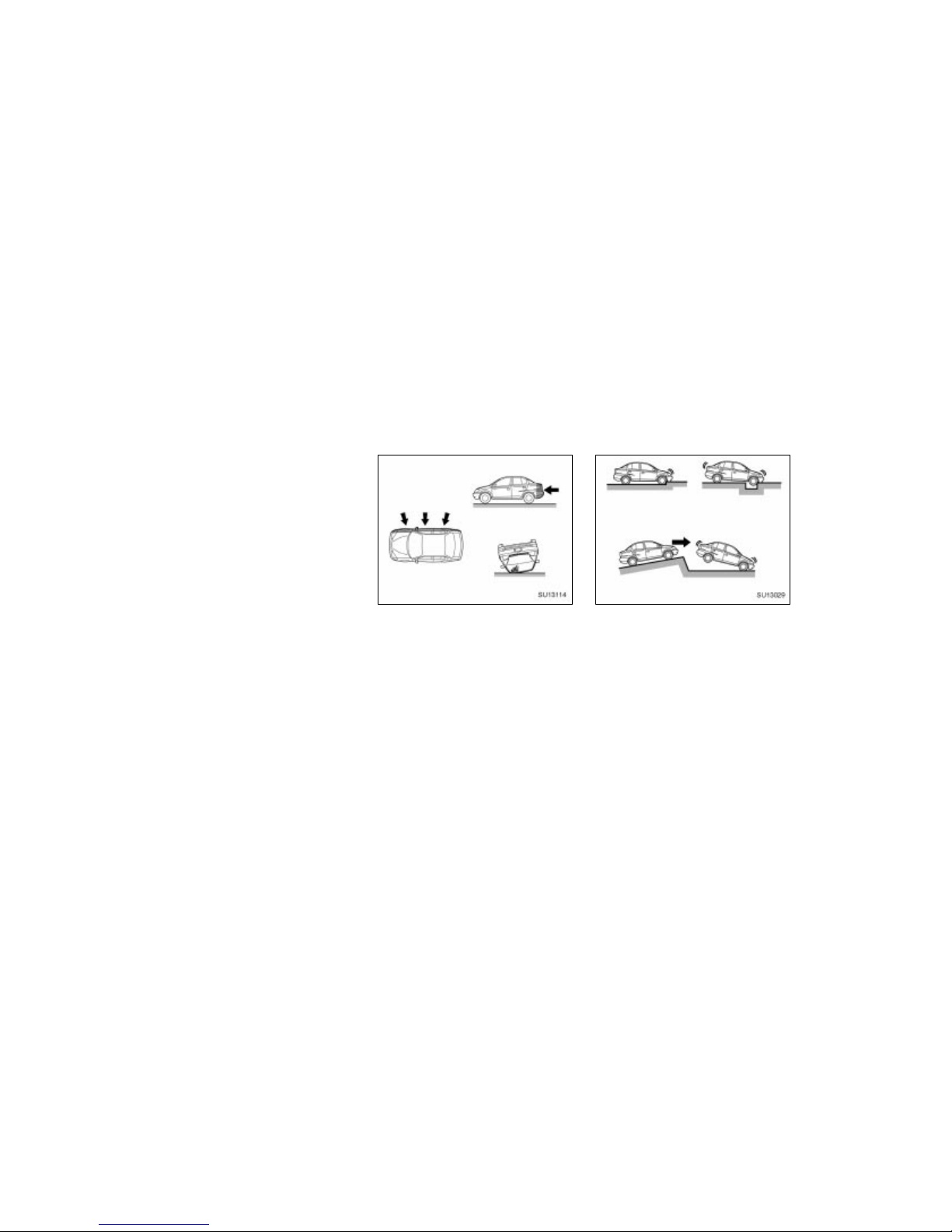
45
2005 ECHO from Aug. ’04 Prod. (OM52636U)
The SRS front airbags are designed to
deploy in severe (usually frontal) collisions where the magnitude and duration
of the forward deceleration of the vehicle exceeds the designed threshold
level.
The SRS front airbags will deploy if the
severity of the impact is above the designed threshold level, comparable to an
approximate 25 km/h (15 mph) collision in
the U.S.A. and 30 km/h (18 mph) collision
in Canada when the vehicle has the impact straight into a fixed barrier that does
not move or deform.
However, this threshold velocity will be
considerably higher if the vehicle strikes
an object, such as a parked vehicle or
sign pole, which can move or deform on
impact, or if the vehicle is involved in an
underride collision (e.g. a collision in
which the front of the vehicle “underrides”,
or goes under, the bed of a truck, etc.).
It is possible that in some collisions
where the forward deceleration of the vehicle is very close to the designed threshold level, the SRS front airbags and the
seat belt pretensioners may not activate
together.
Always wear your seat belts properly.
SU13114
Collision from the side
Vehicle rollover
Collision from the rear
The SRS front airbags are generally not
designed to inflate if the vehicle is involved in a side or rear collision, if it
rolls over, or if it is involved in a lowspeed frontal collision. But, whenever a
collision of any type causes sufficient
forward deceleration of the vehicle, deployment of the SRS front airbags may
occur.
SU13029
Hitting a curb,
edge of pavement
or hard surface
Falling into or
jumping over a
deep hole
Landing hard or vehicle falling
The SRS front airbags may also deploy
if a serious impact occurs to the underside of your vehicle. Some examples
are shown in the illustration.
Page 90
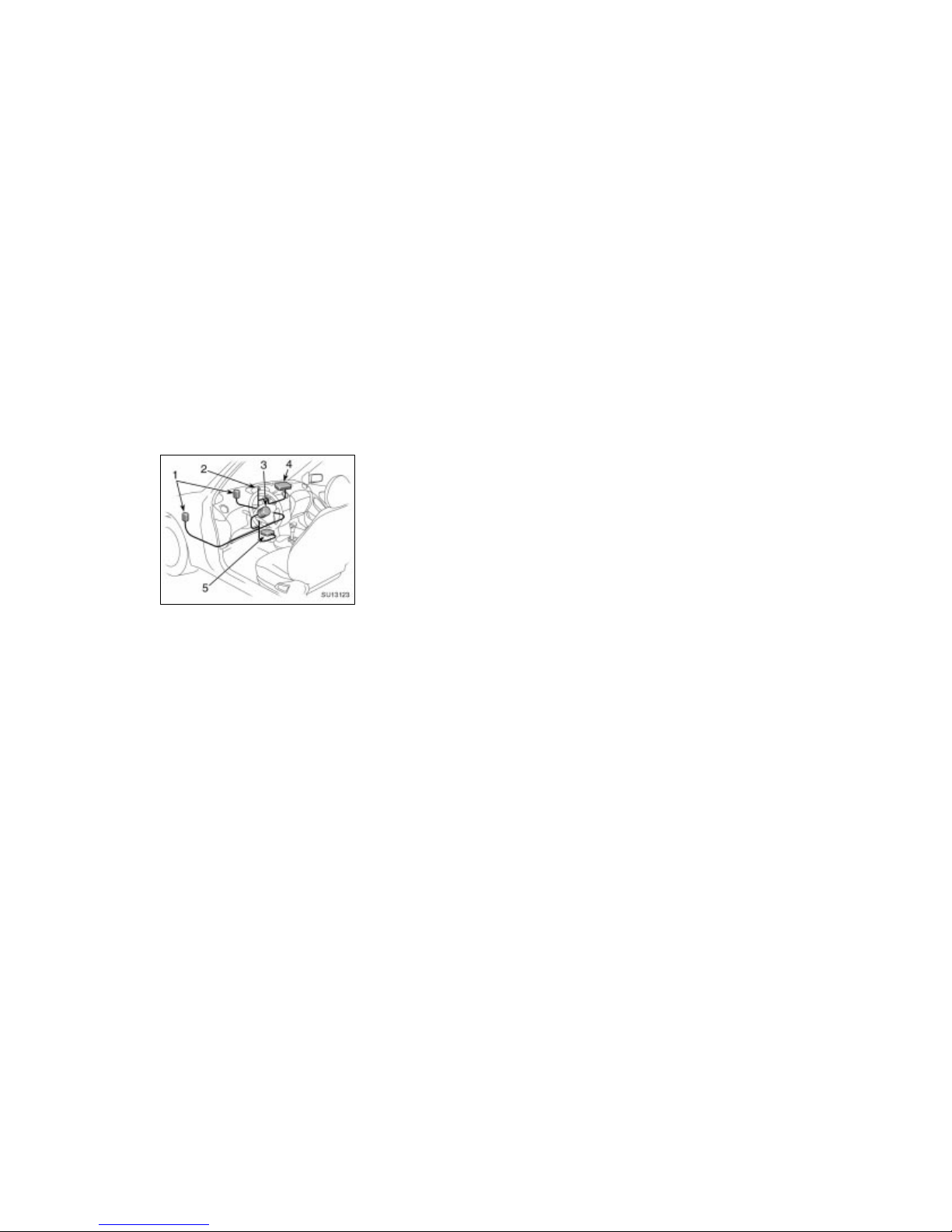
46
2005 ECHO from Aug. ’04 Prod. (OM52636U)
SU13123
The SRS front airbag system consists
mainly of the following components, and
their locations are shown in the illustration.
1. Front airbag sensors
2. SRS warning light
3. Airbag module for driver (airbag and
inflator)
4. Airbag module for front passenger (airbag and inflator)
5. Airbag sensor assembly
The airbag sensor assembly consists of a
safing sensor and airbag sensor.
The front airbag sensors constantly monitor the forward deceleration of the vehicle.
If an impact results in a forward deceleration beyond the designed threshold level,
the system triggers the airbag inflators. At
this time a chemical reaction in the inflators very quickly fills the airbags with nontoxic gas to help restrain the forward motion of the occupants. The front airbags
then quickly deflate, so that there is no
obstruction of the driver’s vision should it
be necessary to continue driving.
When the airbags inflate, they produce a
loud noise and release some smoke and
residue along with non- toxic gas. This
does not indicate a fire. This smoke may
remain inside the vehicle for some time,
and may cause some minor irritation to
the eyes, skin or breathing. Be sure to
wash off any residue as soon as possible
to prevent any potential skin irritation with
soap and water. If you can safely exit
from the vehicle, you should do so immediately.
Deployment of the airbags happens in a
fraction of a second, so the airbags must
inflate with considerable force. While the
system is designed to reduce serious injuries, primarily to the head and chest, it
may also cause other, less severe injuries
to the face, c hest, arms and hands. These
are usually in the nature of minor burns
or abrasions and swelling, but the force of
a deploying airbag can cause more serious injuries, especially if an occupant’s
hands, arms, chest or head is in close
proximit y to the airbag m odule at the time
of deployment. This is why it is important
for the occupant to: avoid placing any
object or part of the body between the
occupant and the airbag module; sit
straight and well back into the seat; wear
the available seat belt properly; and sit as
far as possible from the airbag module,
while still maintaining control of the vehicle.
Parts of the ai rbag module (steering wheel
hub, airbag cover and inflator) may be hot
for several minutes after deployment, so
do not touch! The airbags inflate only
once. The windshield may be damaged by
absorbing some of the force of the inflating airbag.
Page 91
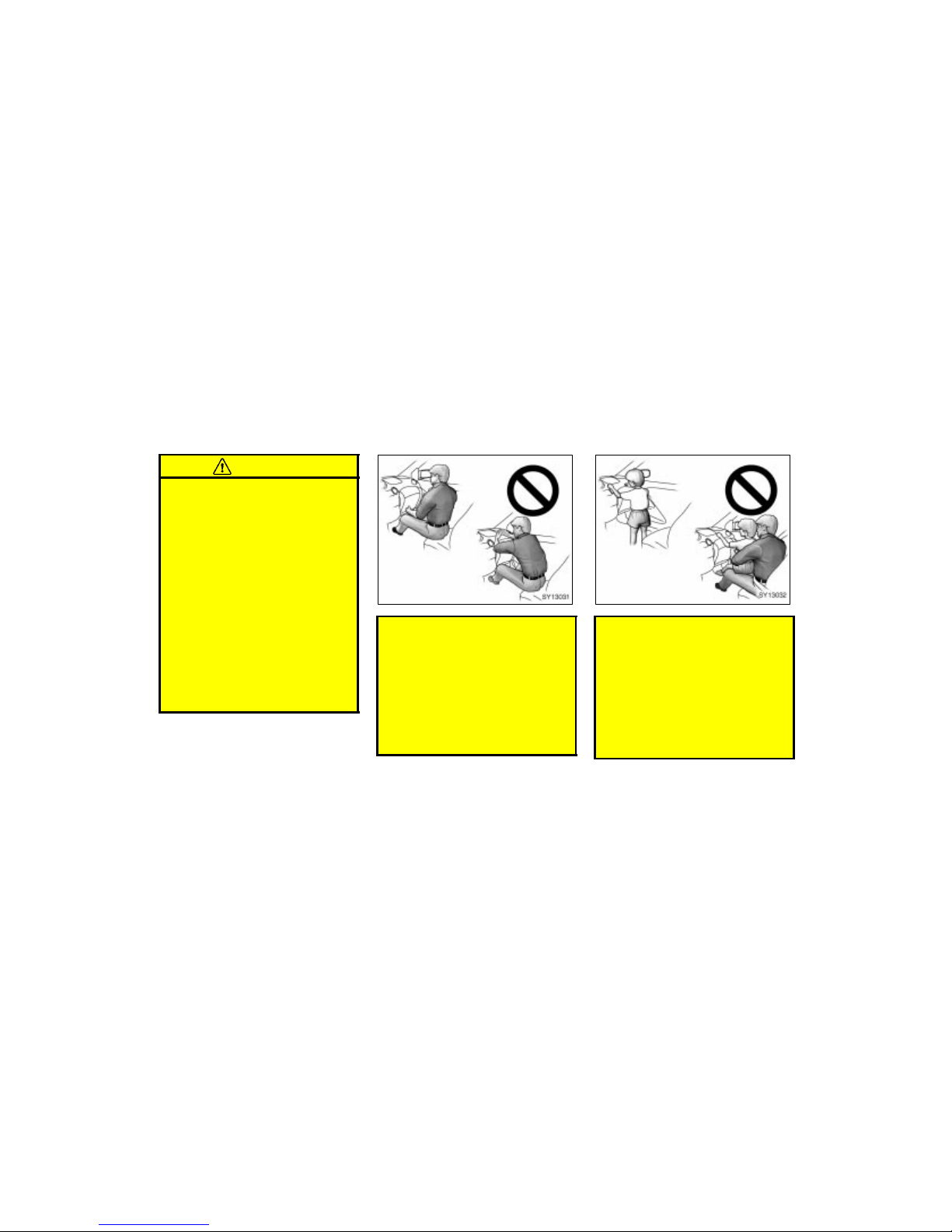
47
2005 ECHO from Aug. ’04 Prod. (OM52636U)
CAUTION
The driver or front passenger who is
too close to the steering wheel or
dashboard during airbag deployment
can be killed or seriously injured.
Toyota strongly recommends that:
The driver sit as far back as pos-
sible from the steering wheel while
still maintaining control of the vehicle.
The front passenger sit as far back
as possible from the dashboard.
All vehicle occupants be properly
restrained using the available seat
belts.
For instructions and precautions concerning the seating position, see
“—Front seat precautions” on page
28.
SY13031
Do not sit on the edge of the seat
or lean against the dashboard when
the vehicle is in use, since the
front passenger airbag could inflate
with considerable speed and force.
Anyone who is up against, or very
close to, an airbag when it inflates,
can be killed or seriously injured.
Sit up straight and well back in the
seat, and always use your seat belt
properly.
SY13032
Toyota strongly recommends that all
infants and children be placed in
the rear seat of the vehicle and be
properly restrained.
Do not allow a child to stand up or
kneel on the front passenger seat,
since the front passenger airbag
could inflate with considerable
speed and force. Otherwise, the
child may be killed or seriously injured.
Page 92
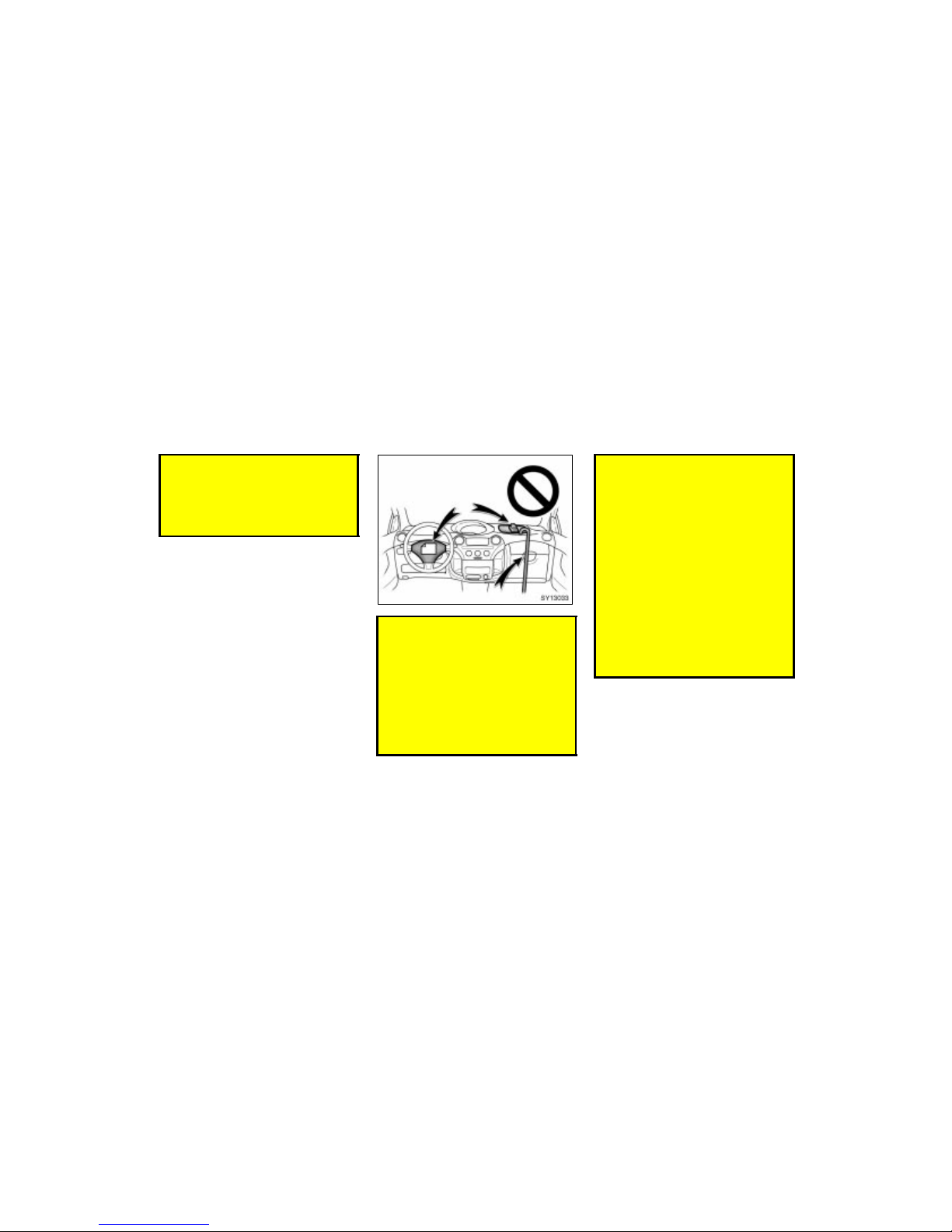
48
2005 ECHO from Aug. ’04 Prod. (OM52636U)
Do not hold a child on your lap or
in your arms. Use a child restraint
system in the rear seat. F or instructions concerning the installation of
a child restraint system, see “Child
restraint” on page 56.
SY13033
Do not put anything or any part of
your body on or in front of the
dashboard or steering wheel pad
that houses the front airbag system. They might restrict inflation or
cause death or serious injury as
they are projected rearward by the
force of deploying airbags. Likewise, the driver and front passenger
should not hold objects in their
arms or on their knees.
Do not modify or remove any wir-
ing. Do not modify, remove, strike
or open any components such as
the steering wheel pad, steering
wheel, column cover, dashboard
near the front passenger airbag,
front passenger airbag cover, front
passenger airbag or airbag sensor
assembly. Doing so may prevent t he
front airbag system from activating
correctly, cause sudden activation
of the system or disable the system, which could result in death or
serious injury.
Failure to follow these instructions
can result in death or serious injury.
Consult your Toyota dealer about any
repair and modification.
Page 93
49
2005 ECHO from Aug. ’04 Prod. (OM52636U)
NOTICE
Do not perform any of the following
changes without consulting your
Toyota dealer. Such changes can
interfere with proper operation of the
SRS front airbag system in some
cases.
Installation of electronic devices
such as a mobile two- way radio,
cassette tape player or compact
disc player
Modification of the suspension system
Modification of the front end structure
Attachment of a grille guard (bull
bar, kangaroo bar, etc.), snowplow,
winches or any other equipment to
the front end
Repairs made on or near the front
fenders, front end structure, console, steering column, steering
wheel or dashboard near the front
passenger airbag
SP13504
This indicator comes on when the ignition key is turned to the “ON” position.
It goes off after about 6 seconds. This
means the SRS front airbags are operating properly.
This warning light system monitors the
airbag sensor assembly, front airbag
sensors, side airbag sensors, door side
airbag sensors, seat belt pretensioner
assemblies, inflators, warning light,
interconnecting wiring and power sources.
(For details, see “Service reminder
indicators and warning buzzers” on page
90.)
If any of the following conditions occurs,
this indicates a malfunction of the airbags
or seat belt pretensioners. Contact your
Toyota dealer as soon as possible.
The light does not come on when the
ignition key is turned to the “ON” position or remains on for more than 6
seconds or flashes.
The light comes on or flashes while
driving.
Page 94
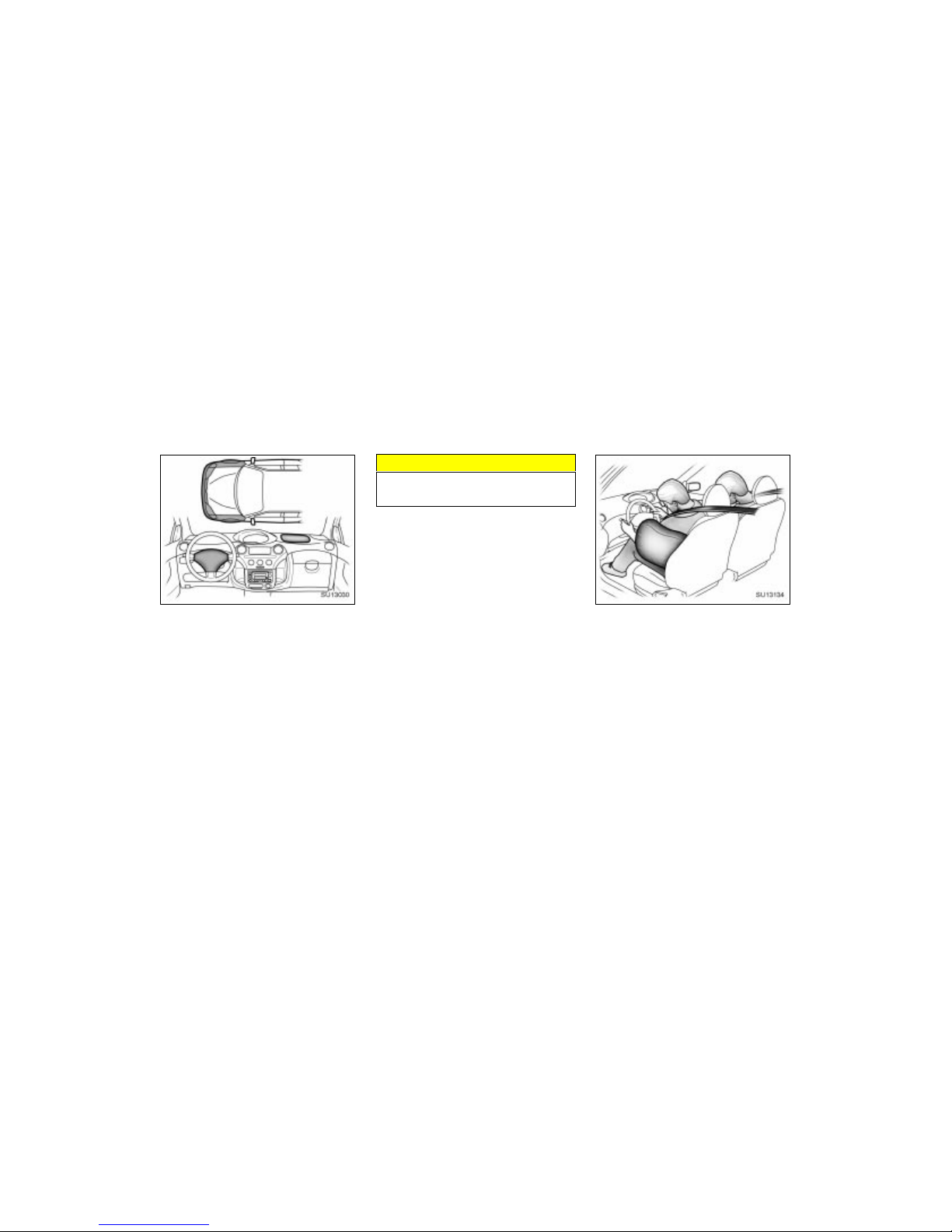
50
2005 ECHO from Aug. ’04 Prod. (OM52636U)
SU13030
In the following cases, contac t your Toyota
dealer as soon as possible:
The SRS front airbags have been in-
flated.
The front of the vehicle (shaded in the
illustration) was involved in an accident
that was not severe enough to cause
the SRS front airbags to inflate.
The pad part of the steering wheel or
front passenger airbag cover (shaded
in the illustration) is scratched,
cracked, or otherwise damaged.
NOTICE
Do not disconnect the battery cables
before contacting your Toyota dealer.
SRS side airbags
SU13134
The SRS (Supplemental Restraint System) side airbags are designed to provide further protection for the driver
and front passenger in addition to the
primary safety protection provided by
the seat belts.
In response to a severe side impact, the
SRS side airbags work together with the
seat belts to help reduce injury by inflating. The SRS side airbags help reduce
injuries mainly to the driver’s or front passenger’s chest.
The SRS side airbag on the passenger
seat is activated even with no passenger
in the front seat.
Always wear your seat belt properly.
Page 95
51
2005 ECHO from Aug. ’04 Prod. (OM52636U)
Your vehicle is equipped with a crash
sensing and diagnostic module, which will
record the use of the seat belt restraint
system by the driver and front passenger
when the SRS side airbags are inflated.
CAUTION
The SRS side airbag system is de-
signed only as a supplement to the
primary protection of the driver and
front passenger seat belt systems.
To ensure maximum protection in
an accident, the driver and all passengers in the vehicle must wear
their seat belts properly. Wearing a
seat belt properly during an accident reduces the chances of death
or serious injury or being thrown
out of the vehicle. For instructions
and precautions concerning t he seat
belt system, see “Seat belts—” on
page 35.
Do not allow anyone to lean his/her
head or any part of his/her body
against the door or the area of the
seat from which the SRS side airbag deploys even if he/she is a
child seated in the child restraint
system. It is dangerous if the SRS
side airbag inflates, and the impact
of the deploying airbag could
cause death or serious injury to the
occupant.
Improperly seated and/or restrained
infants and children can be killed
or seriously injured by the deploying airbags. An infant or child who
is too small to use a seat belt
should be properly secured using a
child restraint system. Toyota
strongly recommends that all infants and children be placed in the
rear seats of the vehicle and properly restrained. The rear seats are
the safest for infants and children.
For instructions concerning the
installation of a child restraint system, see “Child restraint—” on page
56.
Page 96
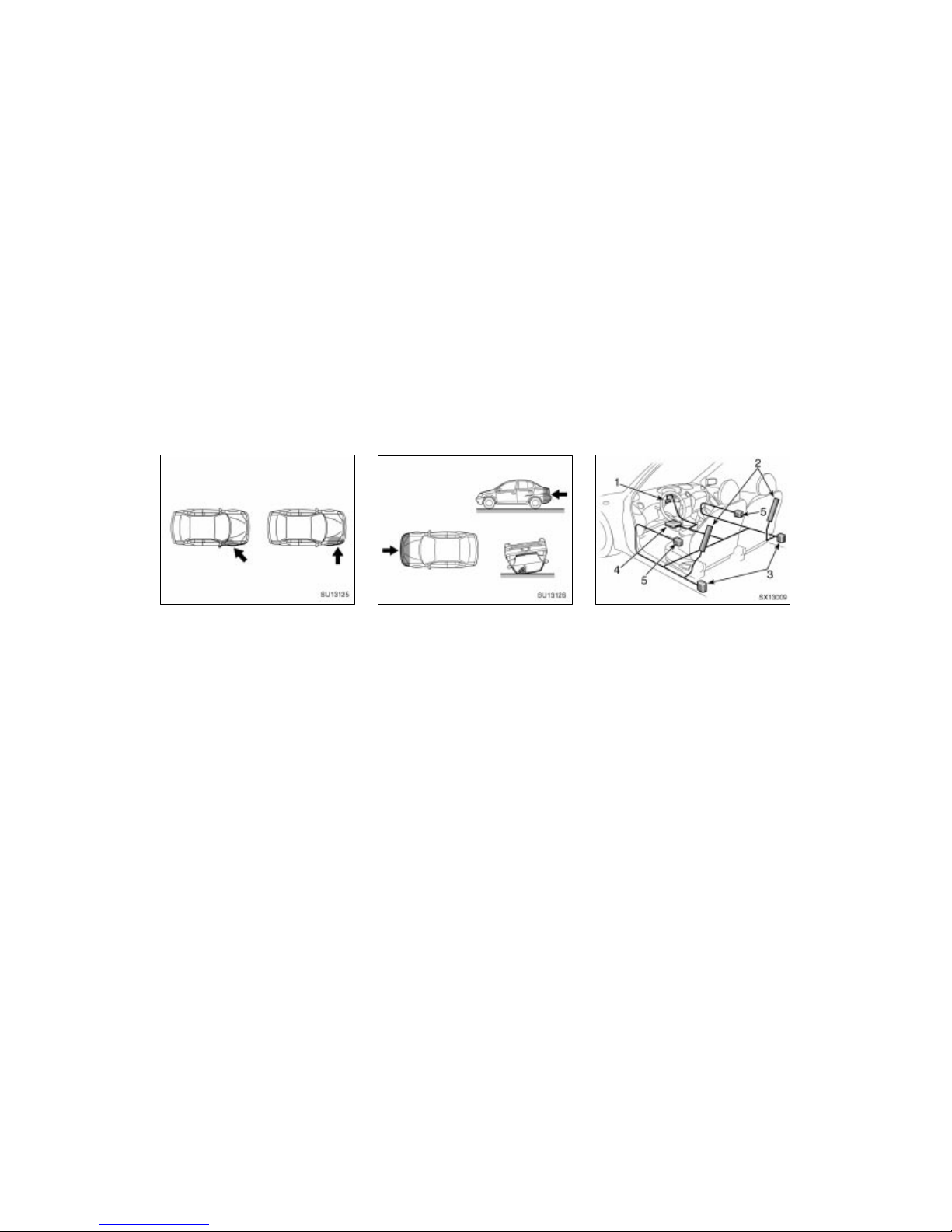
52
2005 ECHO from Aug. ’04 Prod. (OM52636U)
SU13125
The SRS side airbag system may not
activate if the vehicle is subjected to a
collision from the side at certain
angles, or a collision to the side of the
vehicle body other than the passenger
compartment as shown in the illustration.
The SRS side airbags are designed to
inflate when the passenger compartment
area suffers a severe impact from the
side.
Always wear your seat belts properly.
SU13126
Collision from the rear
Collision from the front
Vehicle rollover
The SRS side airbags are not generally
designed to inflate if the vehicle is involved in a front or rear collision, if it
rolls over, or if it is involved in a lowspeed side collision.
SX13009
The SRS side airbag system consists
mainly of the following components, and
their locations are shown in the illustration.
1. SRS warning light
2. Side airbag modules
(airbag and inflator)
3. Side airbag sensors
4. Airbag sensor assembly
5. Door side airbag sensor (only for
2- door models)
The SRS side airbag system is controlled
by the airbag sensor assembly. The side
airbag sensors consist of a safing sensor
and airbag sensor.
Page 97
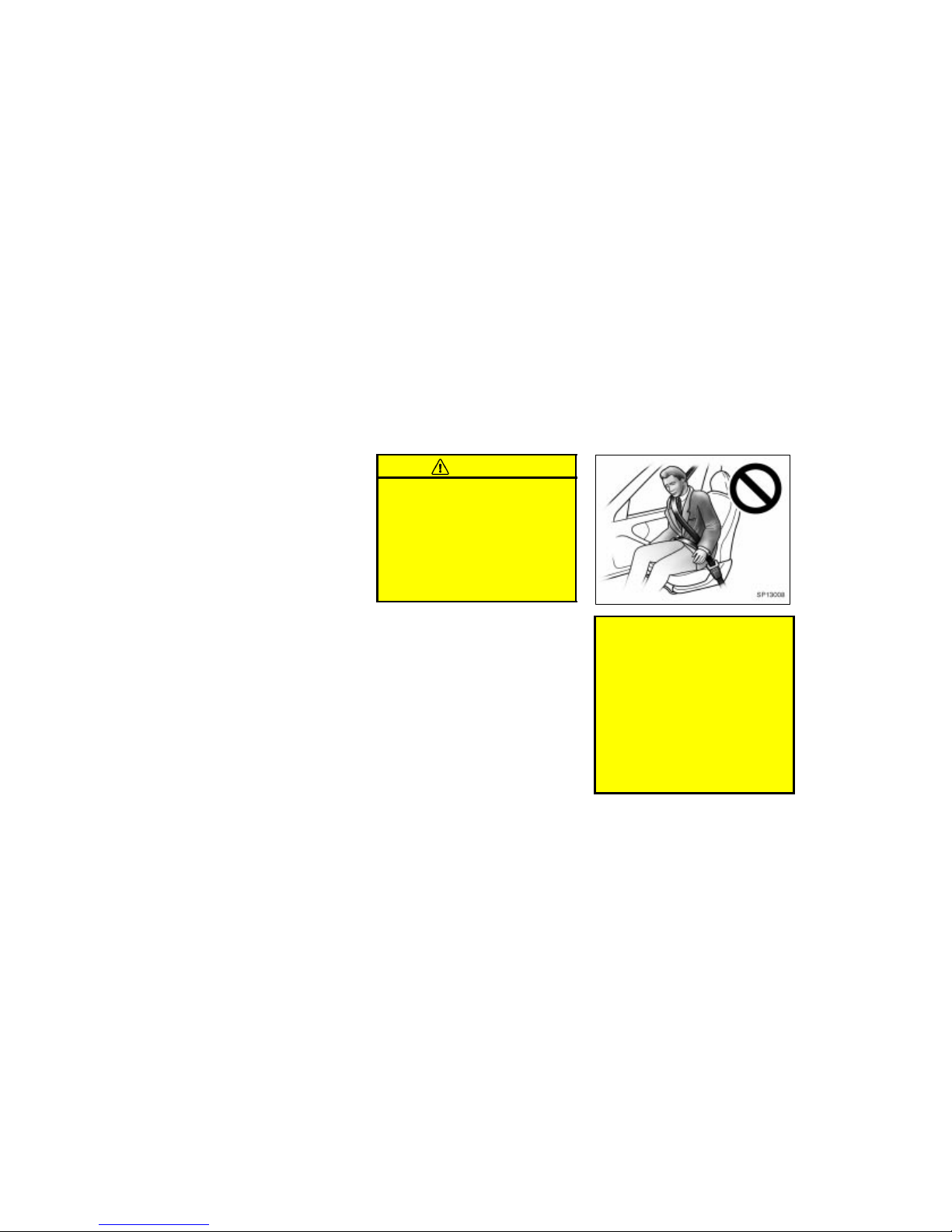
53
2005 ECHO from Aug. ’04 Prod. (OM52636U)
In a severe side impact, the side airbag
sensor triggers the side airbag inflators.
At this time a chemical reaction in the
inflators quickly fills the airbags with nontoxic gas to help restrain the lateral motion of the occupants.
When the airbags inflate, they produce a
fairly loud noise and release some smoke
and residue along with non- toxic gas. This
does not indicate a fire. This smoke may
remain inside the vehicle for some time,
and may cause some minor irritation to
the eyes, skin or breathing. Be sure to
wash off any residue as soon as possible
to prevent any potential skin irritation with
soap and water. If you can safely exit
from the vehicle, you should do so immediately.
Deployment of the airbags happens in a
fraction of a second, so the airbags must
inflate with considerable force. While the
system is designed to reduce serious injuries, it may also cause minor burns or
abrasions and swelling.
Front seats may be hot for several minutes, but the airbags themselves will not
be hot. The airbags are designed to inf late
only once.
CAUTION
SRS side airbags inflate with considerable force. To reduce the possibility
of death or serious injury when they
inflate, the driver and front passenger
must:
Wear their seat belts properly.
Remain properly seated with their
backs upright and against the seats
at all times.
SP13008
Do not allow anyone to lean against
the front door when the vehicle is
in use, since the side airbag could
inflate with considerable speed and
force. Otherwise, he/she may be
killed or seriously injured. Special
care should be taken especially
when you have a small child in the
vehicle.
Sit up straight and well back in the
seat, distr ibuting your weight evenly
in the seat. Do not apply excessive
weight to the outer side of the
seats on vehicles with side airbags.
Page 98
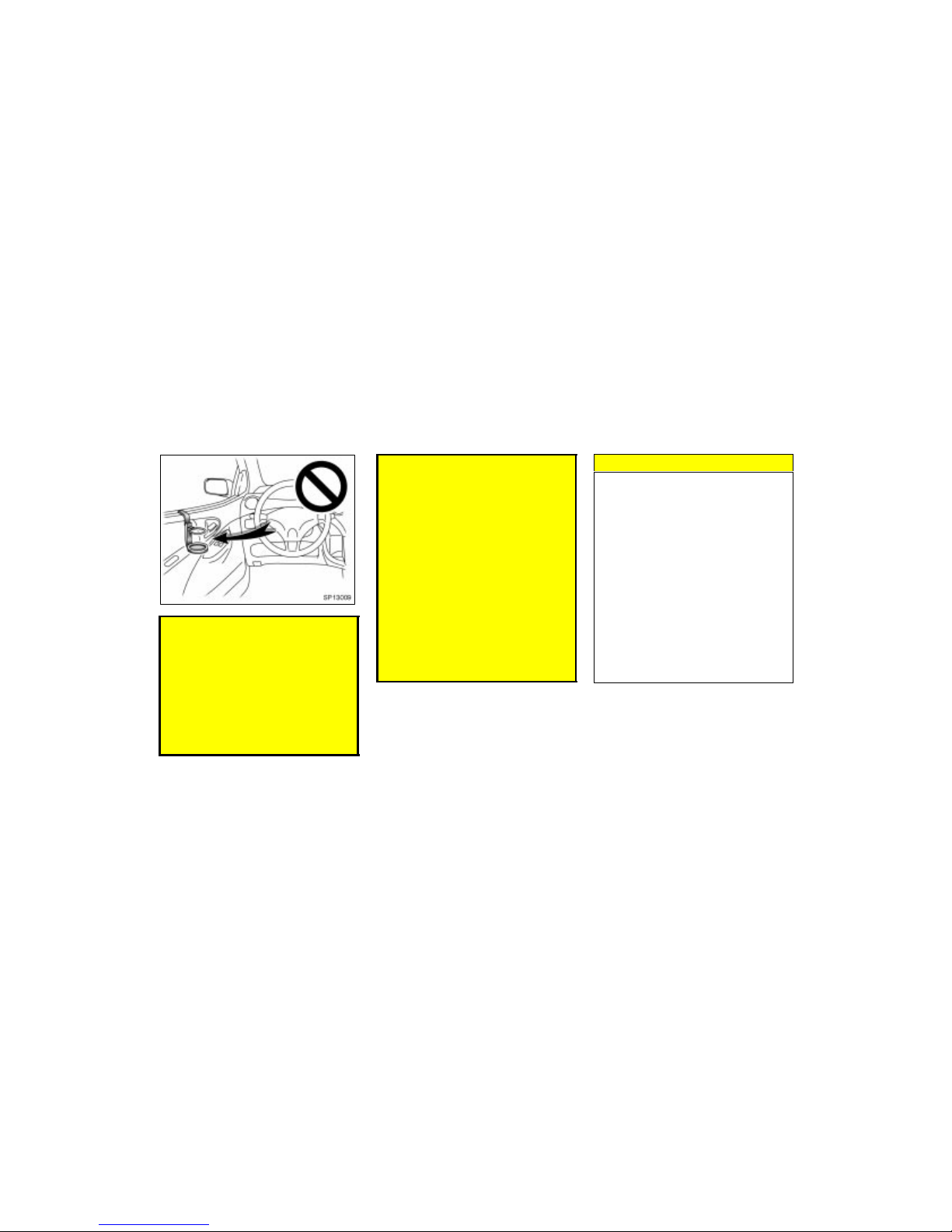
54
2005 ECHO from Aug. ’04 Prod. (OM52636U)
SP13009
Do not attach a cup holder or any
other device or object on or around
the door. When the side airbag inflates, the cup holder or any other
device or object will be thrown with
great force or the side airbag may
not activate correctly, resulting in
death or serious injury. Likewise,
the driver and front passenger
should not hold objects in their
arms or on their knees.
Do not use accessories for the
seats which cover the parts where
the side airbags infl ate. Such accessories may prevent the side airbags
from activating correctly, causing
death or serious injury.
Do not modify or replace the seats
or upholstery of the seats with side
airbags. Such changes may prevent
the side air bag system from act ivating correctly, disable the system or
cause the side airbags to inflate accidentally, result ing in death or serious injury.
Failure to follow these instructions
can result in death or serious injury.
Consult your Toyota dealer about any
repair and modification.
NOTICE
Do not perform any of the following
changes without consulting your
Toyota dealer. Such changes can
interfere with proper operation of the
SRS side airbag system in some
cases.
Installation of electronic devices
such as a mobile two- way radio,
cassette tape player or compact
disc player
Modification of the suspension system
Modification of the side structure of
the passenger compartment
Repairs made on or near the console or front seat
Page 99
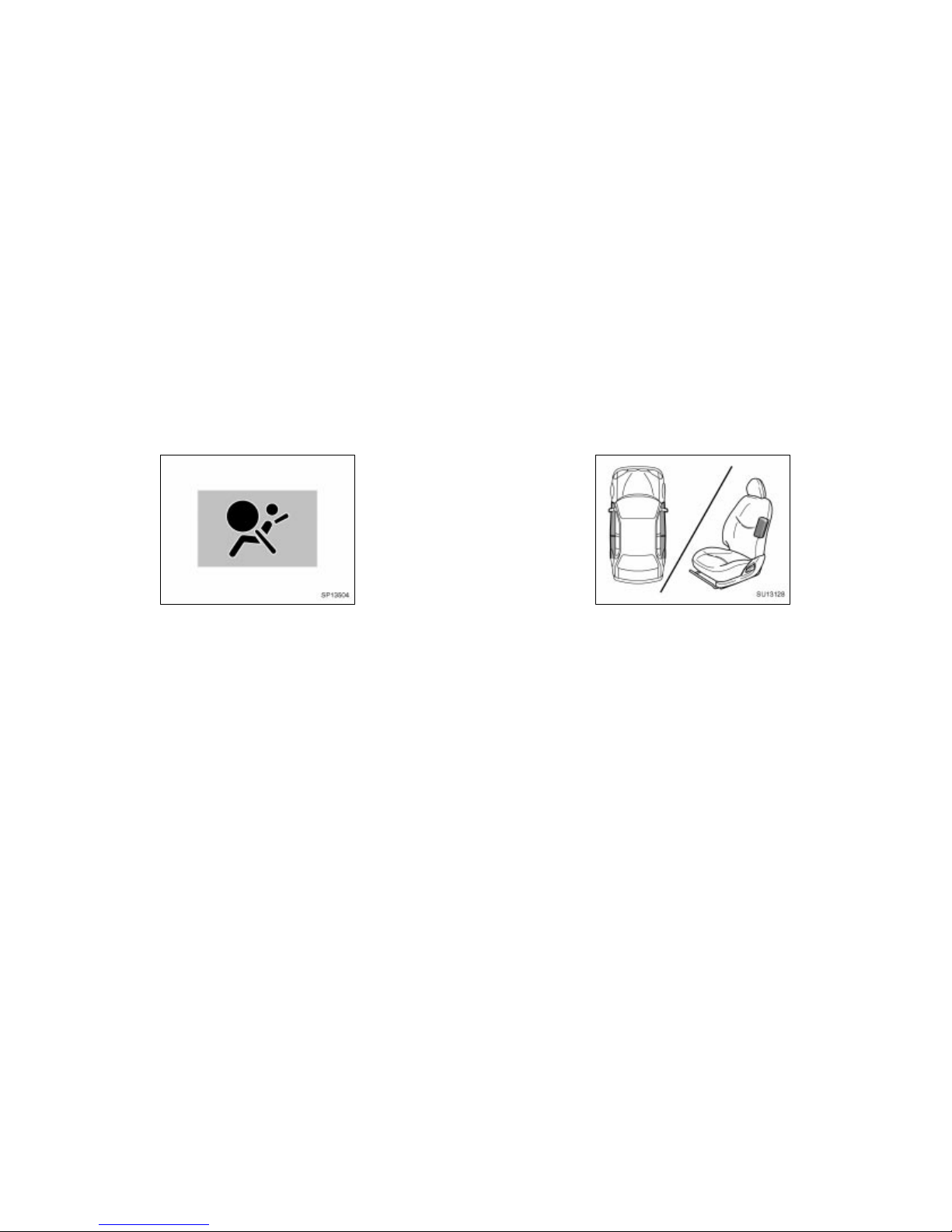
55
2005 ECHO from Aug. ’04 Prod. (OM52636U)
SP13504
This indicator comes on when the ignition key is turned to the “ON” position.
It goes off after about 6 seconds. This
means the SRS side airbags are operating properly.
This warning light system monitors the
airbag sensor assembly, front airbag
sensors, side airbag sensors, door side
airbag sensors, seat belt pretensioner
assemblies, inflators, warning light,
interconnecting wiring and power sources.
(For details, see “Service reminder
indicators and warning buzzers” on page
90.)
If any of the following conditions occurs,
this indicates a malfunction of the airbags
or seat belt pretensioners. Contact your
Toyota dealer as soon as possible.
The light does not come on when the
ignition key is turned to the “ON” position or remains on for more than 6
seconds or flashes.
The light comes on or flashes while
driving.
SU13128
In the following cases, contac t your Toyota
dealer as soon as possible:
Any of the SRS side airbags have
been inflated.
The portion of the doors (shaded in the
illustration) was involved in an accident
that was not severe enough to cause
the SRS side airbags to inflate.
The surface of the seats with the side
airbag (shaded in the illustration) is
scratched, cracked, or otherwise damaged.
Page 100
56
2005 ECHO from Aug. ’04 Prod. (OM52636U)
NOTICE
Do not disconnect the battery cables
before contacting your Toyota dealer.
Toyota strongly urges the use of appropriate child restraint systems for
children.
The laws of all 50 states in the U.S.A.
and Canada now require the use of a
child restraint system.
Your vehicle conforms to SAE J1819.
If a child is too large for a child restraint
system, the child should sit in the rear
seat and must be restrained using the
vehicle’s seat belt. See “Seat belts” on
page 35 for details.
CAUTION
For effective protection in automo-
bile accidents and sudden stops, a
child must be properly restrained,
using a seat belt or child restraint
system depending on the age and
size of the child. Holding a child in
your arms is not a substitute for a
child restraint system. In an accident, the child can be crushed
against the windshield, or between
you and the vehicle’s interior.
Toyota strongly urges use of a
proper child restraint system which
conforms to the size of the child,
installed on the rear seat. According to accident statistics, the child
is safer when properly restrained in
the rear seat than in the front seat.
Never install a rear- facing child re-
straint system on the front passenger seat. In the event of an accident, the force of the rapid inflation
of the front passenger airbag can
cause death or serious injury to the
child if the rear-facing child restraint system is installed on the
front passenger seat.
A for ward- facing child restraint sys-
tem should be allowed to be
installed on the front passenger
seat only when it is unavoidable.
Always move the seat as far back
as possible, because the front passenger airbag could inflate with
considerable speed and force.
Otherwise, the child may be killed
or seriously injured.
Child restraint—
—Child restraint precautions
 Loading...