

Page 1
Hand Sanitizing Wipes
Safety Data Sheet
Date of issue: 8/28/2017
Revision date: 08/17/2017
Version: 1.3
P GHS SDS
Page 1 of 6
SECTION 1: Product and company identification
Product name
:
Hand Sanitizing Wipes
Use of the substance/mixture
:
Premoistened wipe
Product code
:
1448
Company
:
Total Solutions
P.O. Box 240014
Milwaukee, WI 53224 - USA
T (414) 354-6417
Emergency number
:
Chemtec: (800) 424-9300
SECTION 2: Hazards identification
2.1. Classification of the substance or mixture
GHS-US classification
Flam. Sol. 2
H228
Eye Irrit. 2
H319
STOT SE 3
H336
2.2. Label elements
GHS-US labeling
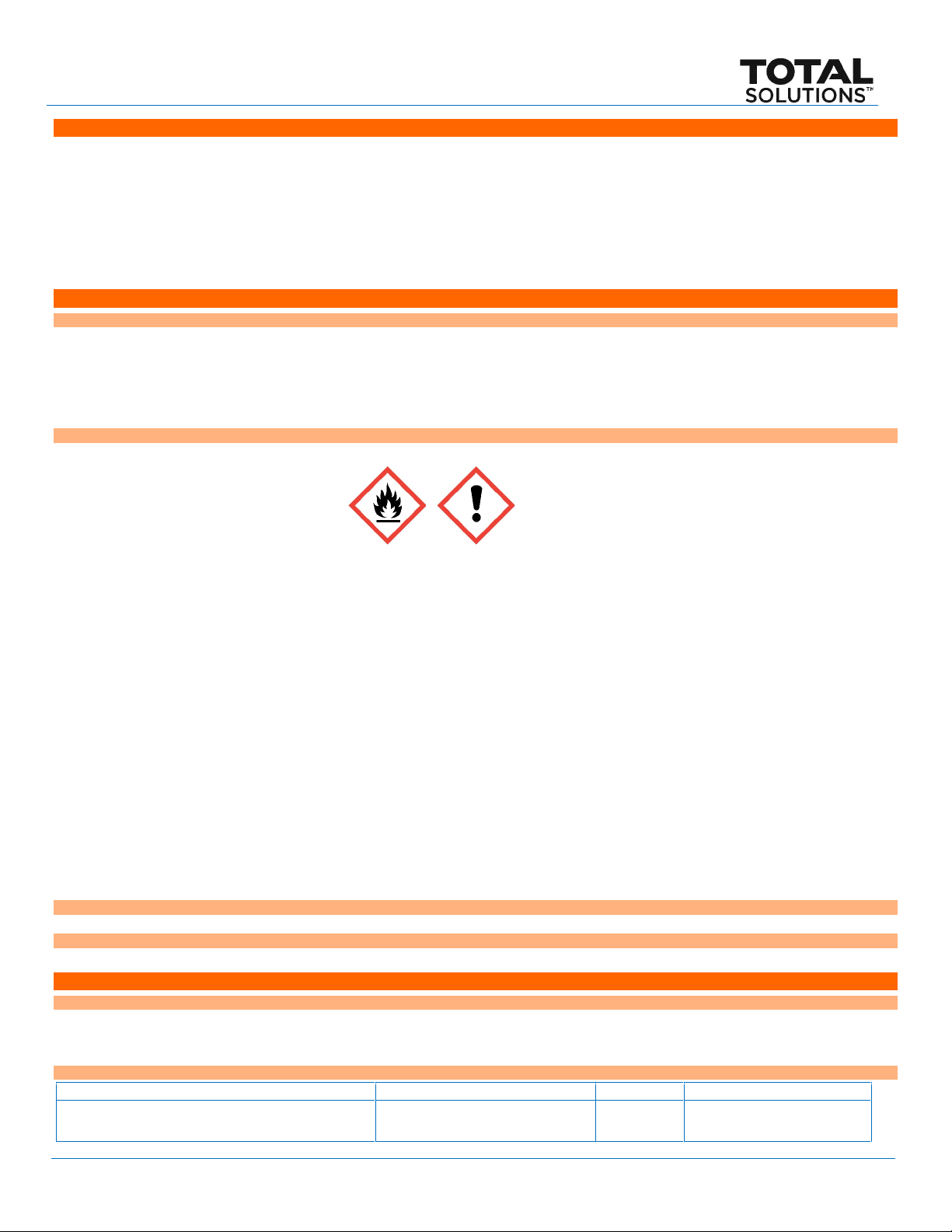
Hazard pictograms (GHS-US)
:
GHS02
GHS07
Signal word (GHS-US)
:
Warning
Hazard statements (GHS-US)
:
Flammable solid
Causes serious eye irritation
May cause drowsiness or dizziness
Precautionary statements (GHS-US)
:
Keep away from heat, open flames, sparks. - No smoking
Ground/Bond container and receiving equipment
Use explosion-proof electrical, lighting, ventilating equipment
Avoid breathing mist, vapors
Wash thoroughly after handling
Use only outdoors or in a well-ventilated area
Wear eye protection, protective clothing, protective gloves
If inhaled: Remove person to fresh air and keep comfortable for breathing
If in eyes: Rinse cautiously with water for several minutes. Remove contact lenses, if present
and easy to do. Continue rinsing
Call a doctor, a POISON CENTER if you feel unwell
If eye irritation persists: Get medical advice/attention
In case of fire: Use water to extinguish
Store in a well-ventilated place. Keep container tightly closed
Store locked up
Dispose of contents/container to comply with local/regional/national/international regulations
2.3. Other hazards
No additional information available
2.4. Unknown acute toxicity (GHS US)
Not applicable
SECTION 3: Composition/Information on ingredients
3.1. Substances
Not applicable
Full text of H-phrases: see section 16
3.2. Mixtures
Name
Product identifier
%
GHS-US classification
ethanol
(CAS No) 64-17-5
60 - 100
Flam. Liq. 2, H225
Eye Irrit. 2A, H319
STOT SE 3, H336
Page 2

Hand Sanitizing Wipes
Safety Data Sheet
Date of issue: 8/28/2017
Revision date: 08/17/2017
Version: 1.3
P GHS SDS
Page 2 of 6
Name
Product identifier
%
GHS-US classification
Linear Alcohol Ethoxylate
(CAS No) 34398-01-1
0.5 - 1.5
Acute Tox. 4 (Oral), H302
Eye Dam. 1, H318
A specific chemical identity and/or percentage of composition has been withheld as a trade secret. Any concentration shown as a range is to protect confidentiality or is due to
batch variation.
SECTION 4: First aid measures
4.1. Description of first aid measures
First-aid measures general
:
If you feel unwell, seek medical advice (show the label where possible).
First-aid measures after inhalation
:
Remove the victim into fresh air.
First-aid measures after skin contact
:
Take off immediately all contaminated clothing and wash it before reuse. Rinse skin with
water/shower.
First-aid measures after eye contact
:
Remove contact lenses, if present and easy to do. Continue rinsing. Rinse cautiously with water for
several minutes. If eye irritation persists: Get medical advice/attention.
First-aid measures after ingestion
:
Rinse mouth with water. Do NOT induce vomiting.
4.2. Most important symptoms and effects, both acute and delayed
Symptoms/effects
:
Not expected to present a significant hazard under anticipated conditions of normal use.
Symptoms/effects after inhalation
:
None under normal use.
Symptoms/effects after skin contact
:
Contact during a long period may cause slight irritation.
Symptoms/effects after eye contact
:
Causes serious eye irritation.
Symptoms/effects after ingestion
:
Gastrointestinal complaints.
4.3. Indication of any immediate medical attention and special treatment needed
Treat symptomatically.
SECTION 5: Firefighting measures
5.1. Extinguishing media
Suitable extinguishing media
:
All extinguishing media allowed.
5.2. Special hazards arising from the substance or mixture
Fire hazard
:
Highly flammable liquid and vapor.
Reactivity
:
Upon combustion: CO and CO2 are formed.
5.3. Advice for firefighters
Firefighting instructions
:
Exercise caution when fighting any chemical fire. Use water spray or fog for cooling exposed
containers. Take account of environmentally hazardous firefighting water.
Protection during firefighting
:
Do not enter fire area without proper protective equipment, including respiratory protection.
SECTION 6: Accidental release measures
6.1. Personal precautions, protective equipment and emergency procedures
General measures
:
Isolate from fire, if possible, without unnecessary risk.
6.1.1. For non-emergency personnel
Protective equipment
:
Protective goggles. Gloves. Protective clothing.
Emergency procedures
:
Evacuate unnecessary personnel. Avoid contact with skin, eyes and clothing. Ventilate spillage area.
6.1.2. For emergency responders
Protective equipment
:
Equip cleanup crew with proper protection.
Emergency procedures
:
Stop leak if safe to do so. Stop release. Ventilate area.
6.2. Environmental precautions
Avoid release to the environment. Prevent entry to sewers and public waters.
6.3. Methods and material for containment and cleaning up
For containment
:
Contain released substance, pump into suitable containers.
Methods for cleaning up
:
This material and its container must be disposed of in a safe way, and as per local legislation.
6.4. Reference to other sections
No additional information available
SECTION 7: Handling and storage
7.1. Precautions for safe handling
Precautions for safe handling
:
Keep away from heat, hot surfaces, sparks, open flames and other ignition sources. No
smoking. Keep container tightly closed.
Hygiene measures
:
Wash thoroughly after handling. Wash contaminated clothing before reuse.
Page 3
Hand Sanitizing Wipes
Safety Data Sheet
Date of issue: 8/28/2017
Revision date: 08/17/2017
Version: 1.3
P GHS SDS
Page 3 of 6
7.2. Conditions for safe storage, including any incompatibilities
Technical measures
:
Comply with applicable regulations.
Storage conditions
:
Keep container closed when not in use.
Incompatible products
:
Oxidizing agent.
Information on mixed storage
:
KEEP SUBSTANCE AWAY FROM: oxidizing agents.
Storage area
:
Meet the legal requirements. Store in a cool area. Store in a well-ventilated place.
Special rules on packaging
:
meet the legal requirements.
SECTION 8: Exposure controls/personal protection
8.1. Control parameters
ethanol (64-17-5)
ACGIH
ACGIH STEL (ppm)
1000 ppm
ACGIH
Remark (ACGIH)
URT irr
OSHA
OSHA PEL (TWA) (mg/m³)
1900 mg/m³
OSHA
OSHA PEL (TWA) (ppm)
1000 ppm
8.2. Exposure controls
Personal protective equipment
:
Use appropriate personal protective equipment when risk assessment indicates this is necessary.
SECTION 9: Physical and chemical properties
9.1. Information on basic physical and chemical properties
Physical state
:
Solid
Appearance
:
Premoistened wipe.
Odor
:
Pleasant scent
Odor threshold
:
No data available
pH:No data available
Melting point
:
No data available
Freezing point
:
No data available
Boiling point
:
> 95 °F
Flash point
:
70 °F Closed Cup - Tested using the liquid component of the towelette
Relative evaporation rate (butyl acetate=1)
:
No data available
Flammability (solid, gas)
:
No data available
Explosion limits
:
No data available
Explosive properties
:
No data available
Oxidizing properties
:
No data available
Vapor pressure
:
No data available
Relative density
:
No data available
Relative vapor density at 20 °C
:
No data available
Specific gravity / density
:
0.88 g/ml
Solubility
:
Liquid component is soluble in water.
Log Pow
:
No data available
Log Kow
:
No data available
Auto-ignition temperature
:
No data available
Decomposition temperature
:
No data available
Viscosity
:
No data available
Viscosity, kinematic
:
No data available
Viscosity, dynamic
:
No data available
VOC content
:
< 75 % - Tested using the liquid component of the towelette
SECTION 10: Stability and reactivity
10.1. Reactivity
Upon combustion: CO and CO2 are formed.
Page 4
Hand Sanitizing Wipes
Safety Data Sheet
Date of issue: 8/28/2017
Revision date: 08/17/2017
Version: 1.3
P GHS SDS
Page 4 of 6
10.2. Chemical stability
No additional information available
10.3. Possibility of hazardous reactions
Refer to section 10.1 on Reactivity.
10.4. Conditions to avoid
No additional information available
10.5. Incompatible materials
No additional information available
10.6. Hazardous decomposition products
Under normal conditions of storage and use, hazardous decomposition products should not be produced.
SECTION 11: Toxicological information
11.1. Information on toxicological effects
Acute toxicity
:
Not classified
Linear Alcohol Ethoxylate (34398-01-1)
LD50 oral rat
> 1400 mg/kg
ethanol (64-17-5)
LD50 oral rat
10740 mg/kg body weight (Rat; OECD 401: Acute Oral Toxicity; Experimental value)
LD50 dermal rabbit
> 16000 mg/kg (Rabbit; Literature study)
ATE CLP (oral)
10740 mg/kg body weight
Skin corrosion/irritation
:
Not classified
Serious eye damage/irritation
:
Causes serious eye irritation.
Respiratory or skin sensitization
:
Not classified
Germ cell mutagenicity
:
Not classified
Carcinogenicity
:
Not classified
Reproductive toxicity
:
Not classified
Specific target organ toxicity – single exposure
:
May cause drowsiness or dizziness.
Specific target organ toxicity – repeated
exposure
:
Not classified
Aspiration hazard
:
Not classified
Symptoms/effects after inhalation
:
None under normal use.
Symptoms/effects after skin contact
:
Contact during a long period may cause slight irritation.
Symptoms/effects after eye contact
:
Causes serious eye irritation.
Symptoms/effects after ingestion
:
Gastrointestinal complaints.
SECTION 12: Ecological information
12.1. Toxicity
Linear Alcohol Ethoxylate (34398-01-1)
LC50 fish 1
< 10 mg/l
EC50 Daphnia 1
< 10 mg/l
ErC50 (algae)
< 10 mg/l
ethanol (64-17-5)
LC50 fish 1
14200 mg/l (LC50; US EPA; 96 h; Pimephales promelas; Flow-through system; Fresh water;
Experimental value)
12.2. Persistence and degradability
ethanol (64-17-5)
Persistence and degradability
Readily biodegradable in water. Biodegradable in the soil. Highly mobile in soil.
Biochemical oxygen demand (BOD)
0.8 - 0.967 g O₂/g substance
Chemical oxygen demand (COD)
1.7 g O₂/g substance
ThOD
2.1 g O₂/g substance
BOD (% of ThOD)
0.43
Page 5
Hand Sanitizing Wipes
Safety Data Sheet
Date of issue: 8/28/2017
Revision date: 08/17/2017
Version: 1.3
P GHS SDS
Page 5 of 6
12.3. Bioaccumulative potential
ethanol (64-17-5)
BCF fish 1
1 (BCF; Other; 72 h; Cyprinus carpio; Static system; Fresh water; Read-across)
Log Pow
-0.31 (Experimental value)
Bioaccumulative potential
Low potential for bioaccumulation (Log Kow < 4).
SECTION 13: Disposal considerations
13.1. Waste treatment methods
Waste treatment methods
:
Do not flush wipes. Dispose of contents/container to comply with
local/regional/national/international regulations.
Product/Packaging disposal
recommendations
:
Dispose in a safe manner in accordance with local/national regulations.
SECTION 14: Transport information
Department of Transportation (DOT)
Transport document description
:
UN3175 Solids containing flammable liquid, n.o.s. (Ethanol), 4.1, II
UN-No.(DOT)
:
UN3175
Proper Shipping Name (DOT)
:
Solids containing flammable liquid, n.o.s.
Class (DOT)
:
4.1 - Class 4.1 - Flammable Solid 49 CFR 173.124
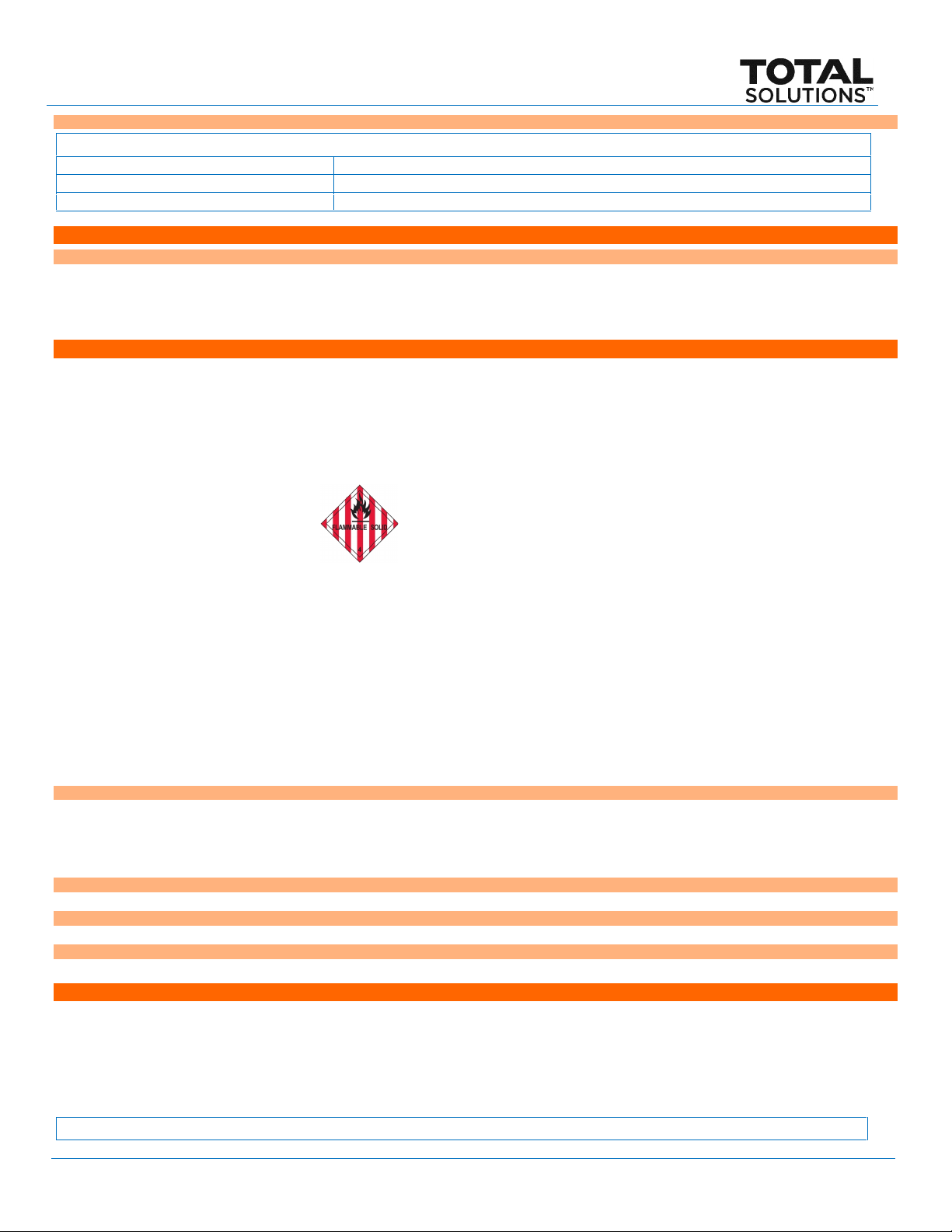
Hazard labels (DOT)
:
4.1 - Flammable solid
Packing group (DOT)
:
II - Medium Danger
DOT Packaging Non Bulk (49 CFR 173.xxx)
:
212
DOT Packaging Bulk (49 CFR 173.xxx)
:
240
DOT Symbols
:
G - Identifies PSN requiring a technical name
DOT Special Provisions (49 CFR 172.102)
:
47,IB6,IP2,T3,TP33
DOT Packaging Exceptions (49 CFR
173.xxx)
:
151
DOT Quantity Limitations Passenger
aircraft/rail (49 CFR 173.27)
:
15 kg
DOT Quantity Limitations Cargo aircraft
only (49 CFR 175.75)
:
50 kg
DOT Vessel Stowage Location
:
B
Additional information
Emergency Response Guide (ERG)
Number
:
133
Other information
:
This product may be eligible to be shipped as a Limited Quantity or Consumer Commodity ORM-D
utilizing the exception found at 49 CFR 173.151.
ADR
No additional information available
Transport by sea
No additional information available
Air transport
No additional information available
SECTION 15: Regulatory information
All components of this product are listed, or excluded from listing, on the United States Environmental Protection Agency Toxic Substances
Control Act (TSCA) inventory.
This product or mixture does not contain a toxic chemical or chemicals in excess of the applicable de minimis concentration as specified in 40
CFR §372.38(a) subject to the reporting requirements of section 313 of Title III of the Superfund Amendments and Reauthorization Act of 1986
and 40 CFR Part 372.
Linear Alcohol Ethoxylate (34398-01-1)
Page 6
Hand Sanitizing Wipes
Safety Data Sheet
Date of issue: 8/28/2017
Revision date: 08/17/2017
Version: 1.3
P GHS SDS
Page 6 of 6
Linear Alcohol Ethoxylate (34398-01-1)
SARA Section 311/312 Hazard Classes
Immediate (acute) health hazard
California Proposition 65 - This product does not contain substances known to the state of California to cause cancer and/or reproductive toxicity.
SECTION 16: Other information
Training advice
:
Normal use of this product shall imply use in accordance with the instructions on the packaging.
Full text of H-phrases:
------
H225
Highly flammable liquid and vapor
------
H228
Flammable solid
------
H302
Harmful if swallowed
------
H318
Causes serious eye damage
------
H319
Causes serious eye irritation
------
H336
May cause drowsiness or dizziness
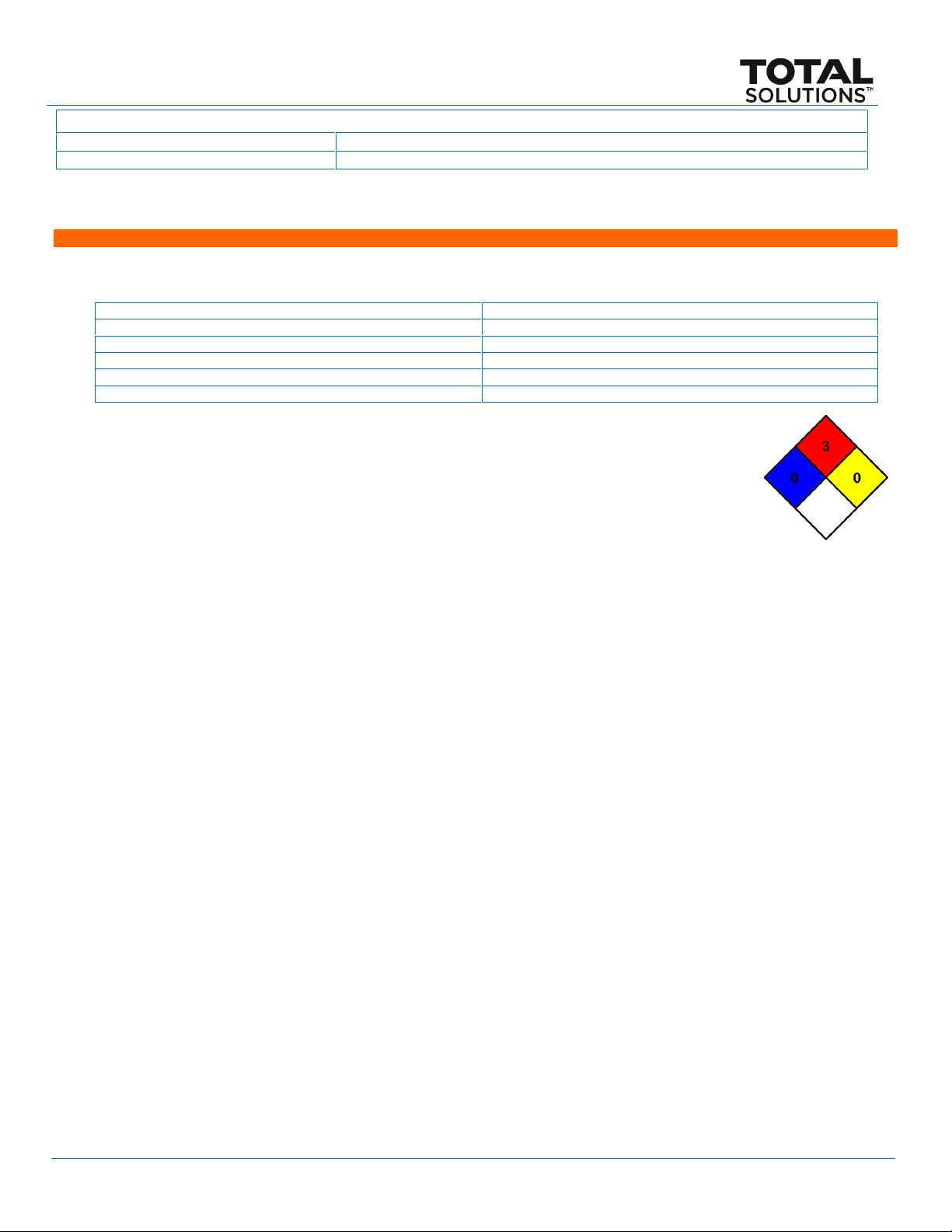
NFPA health hazard
:
0 - Materials that, under emergency conditions, would offer no hazard beyond that of ordinary
combustible materials.
NFPA fire hazard
:
3 - Liquids and solids (including finely divided suspended solids) that can be ignited under almost all
ambient temperature conditions.
NFPA reactivity
:
0 - Material that in themselves are normally stable, even under fire conditions.
Prepared by: Technical Department
This information is based on our current knowledge and is intended to describe the product for the purposes of health, safety and environmental requirements only. It should not therefore be construed as
guaranteeing any specific property of the product. No warranty is expressed or implied regarding the accuracy of this data or the results obtained from the use thereof. Our co mpany assumes no
responsibility for personal injury or property damage to the vendee, users or third parties caused by the materi al. Such vendees or users assume all risks associated with the use of this material.
 Loading...