

Page 1
5246421909
SOF-TS DE
Silicone-based soft denture liner
REF SR02
Instructions for Use
Manufacturer
Tokuyama Dental Corporation
38-9, Taitou 1-chome, Taitou-ku, Tokyo 110-0016, Japan
Tel: +81-3-3835-7201
URL: http://www.tokuyama-dental.com/
EC Rep.
Tokuyama Dental Italy S.r.l.
Via Chizzalunga, 1
36066 Sandrigo, Vicenza, Italy
Tel: +39 0444 659650
Fax: +39 0444 750345
Importer
Tokuyama Dental Deutschland GmbH
Am Landwehrbach 5
48341 Altenberge Germany
Tel: +49 2505 938513
Fax: +49 2505 938515
Last updated 2019-10-31 Rev.A
ENGLISH
EESTI KEEL
LIETUVIŲ K.
POLSKI
ČESKY
FRANÇAIS
MAGYAR
SLOVENČINA
DANSK
ITALIANO
NEDERLANDS
SUOMI
DEUTSCH
LATVISKI
NORSK
SVENSKA
Page 2
ENGLISH
Carefully read all of these instructions before using SOFRELINER TOUGH S.
PRODUCT DESCRIPTION AND GENERAL INFORMATION
■
1. SOFRELINER TOUGH S is an addition-cured silicone chairside soft lining material for
removable dentures. SOFRELINER TOUGH S conforms to both ISO 10139-2 “Soft lining
materials for removable dentures Part 2: Materials for long-term use” and ISO 10139-1 “Soft
lining materials for removable dentures Part 1: Materials for short-term use”.
2. SOFRELINER TOUGH S Kit contains PASTE, PRIMER and other accessories such as mixing
tips, drip nozzle, drip cup, brushes, COARSE POINT (Black), FINISHING WHEEL (Brown).
3. PRIMER is used solely for bonding to the acrylic surfaces. It cannot be used to bond nylon,
metal and silicone surfaces. PASTE is dispensed in automix cartridge delivery system. The
material sets in 5 minute intraorally or 20 minutes at room temperature (23℃ / 73.4℉) and has
no odor or taste.
INDICATIONS
■
1. For pain caused by sharp ridges of alveolar bone and mucous atrophy.
2. Poor retention caused by extreme ridge atrophy.
3. Major undercuts or maxillary / mandibular tori.
4. Retention of overdentures before the final attachment is placed.
5. Temporary lining or tissue conditioning.
CONTRAINDICATIONS
■
SOFRELINER TOUGH S is contraindicated in patients allergic to or hypersensitive to silicone
and platinum compounds and should NOT be used on such patients.
PRECAUTIONS
■
1. SOFRELINER TOUGH S is designed for sale and use by licensed dental care professionals
only. It is not designed for sale nor is it suitable for use by non-dental care professionals.
2. Use SOFRELINER TOUGH S only as instructed herein. DO NOT use SOFRELINER
TOUGH S for any application other than those noted in these instructions.
3. DO NOT use SOFRELINER TOUGH S if the safety seal is broken or if it appears the contents
have been tampered with.
4. PRIMER contains ethylacetate, which is a highly flammable and volatile solvent. Do not
Page 3

expose the PRIMER to open flame. Use in a ventilated room during use and close the cap
tightly after use.
5. If patient experiences an allergic reaction or sensitivity to SOFRELINER TOUGH S, such as a
dermatitis outbreak, remove the prosthesis and discontinue its use immediately.
6. Wear non-latex examination gloves at all times while using SOFRELINER TOUGH S to avoid
the possibility of allergic reactions. Latex gloves may also inhibit the setting of SOFRELINER
TOUGH S. If SOFRELINER TOUGH S PRIMER comes in contact with the examination
gloves, immediately dispose of the examination gloves and wash hands thoroughly with water.
7. Avoid contact with eyes. In case of contact with eyes, thoroughly flush eyes with water, and
immediately contact a physician.
8. Avoid contact of unset chemical with skin. In case of contact with skin, clean affected area
with rubbing alcohol, then thoroughly flush with water.
9. Avoid contact of unset materials with clothing. In case of contact with clothing, do not wipe
the material. Allow it to set and then peel it off.
10. DO NOT allow excess materials to flow down the patient’s trachea or esophagus. Aspirated or
ingested SOFRELINER TOUGH S PASTE can cause asphyxiation or other injury.
Immediately remove any excess lining material from the palatal area to avoid material flowing
down the patient’s throat. SOFRELINER TOUGH S is not radiopaque, and radiographs will
not detect aspirated or ingested material. In case of an elderly patient whose reflex ability is
compromised, set the chair in an upright position and instruct the patient to breathe through the
nose in order to prevent the material from entering the airway.
11. DO NOT mix SOFRELINER TOUGH S with any materials not noted in these instructions.
12. After using SOFRELINER TOUGH S cartridge, the mixing tip must be replaced with the
cartridge cap that comes with the cartridge at the time of purchase. Wipe off the excess paste
on the tip of cartridge with a clean cloth or tissue each time before using a new mixing tip or
replacing the cartridge cap.
13. Always clean the spatula, brushes and cups with alcohol after each use to avoid cross
contamination.
14. Instruct patients in accordance with the PATIENT PRECAUTIONS contained in the last
section of these instructions.
15. To avoid inhaling dust while finishing, always wear a mask recommended by federal and/or
local regulations.
16. Read and follow the manufacturers’ instructions for all products mentioned in this instruction
manual that are not included in this kit.
Page 4

17. As much as possible, avoid contact SOFRELINER TOUGH S with oral mucous membrane
other than the region to be lined. Instruct patients to rinse their mouth with adequate amount
of water after the treatment.
18. Do not place the PRIMER in direct contact with plastic materials, contact may dissolve some
types of plastic.
NOTES FOR USE
■
1. In the case of a poor fitting denture, first line the denture with an acrylic material, such as
TOKUYAMA REBASE II, chairside hard denture lining material, or any other laboratory/
indirect procedures to improve the fit.
2. In the case of an old worn denture, the surface to be lined should be first lined with new acrylic
material since the materials absorbed in the old worn resin such as oil or water lowers the
adhesion of SOFRELINER TOUGH S.
3. If the SOFRELINER TOUGH S PRIMER becomes thick due to volatilization, do not use it as
the adhesive strength may be reduced.
4. Regarding the brush for the primer, wipe off the tip with alcohol-soaked cotton swab or gauze
after each use. Contaminated brush can lower the adhesion of SOFRELINER TOUGH S.
5. Do not mix pastes by hand, doing so may cause air bubbles to be incorporated into the paste,
which could result in deterioration, staining and unpleasant odors.
6. Avoid contact SOFRELINER TOUGH S with the materials below, as they may inhibit the
setting of SOFRELINER TOUGH S:
Silicone-based impression materials, eugenol containing materials, polysulfide rubber
impression materials, natural rubber gloves, other manufacturer’s soft lining materials and
uncured acrylic resins.
7. The material sets in 5 minutes intraorally or 20 minutes at room temperature (23℃ / 73.4℉).
After 24 hours the liner turns slightly firmer. The finishing procedure can be performed
immediately after the removal of the newly lined denture from the mouth or a gypsum model.
8. Soaking the denture in solutions containing heavy bleach may alter the color of SOFRELINER
TOUGH S; however, it will not affect its performance.
9. Instruct patient to clean the denture as described in PATIENT PRECAUTIONS.
10. Since silicone-based fit checking material sticks to SOFRELINER TOUGH S, apply Vaseline
on the surface prior to use.
11. If there is a fracture in the finished liner, compeletly remove the liner and repeat the procedure.
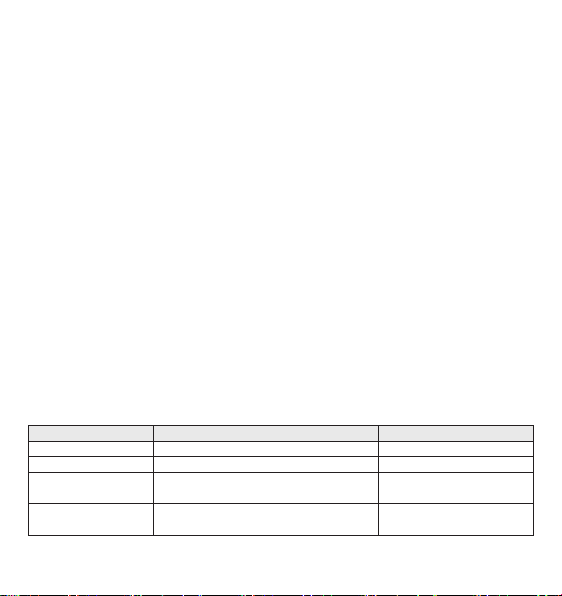
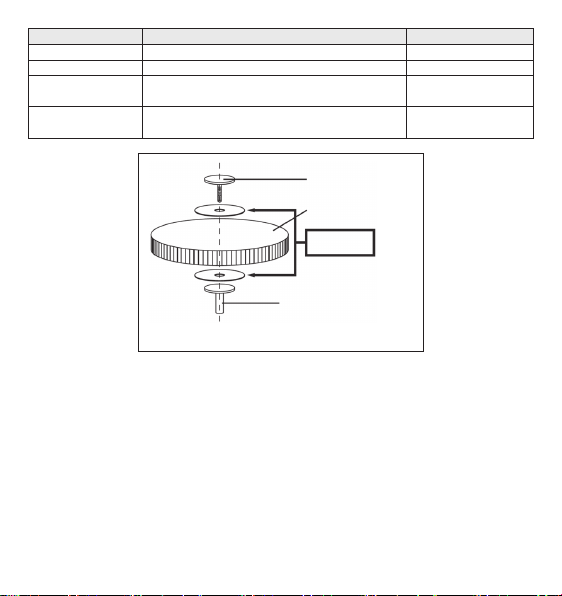
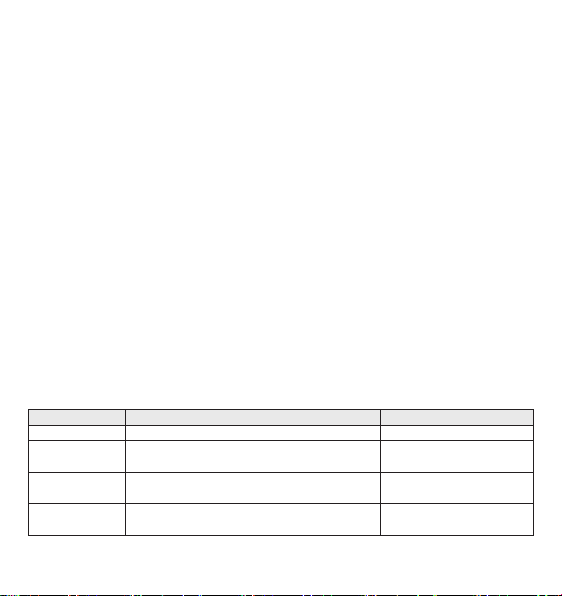
12. Refer to following tools for shape adjustment and finishing.
Page 5
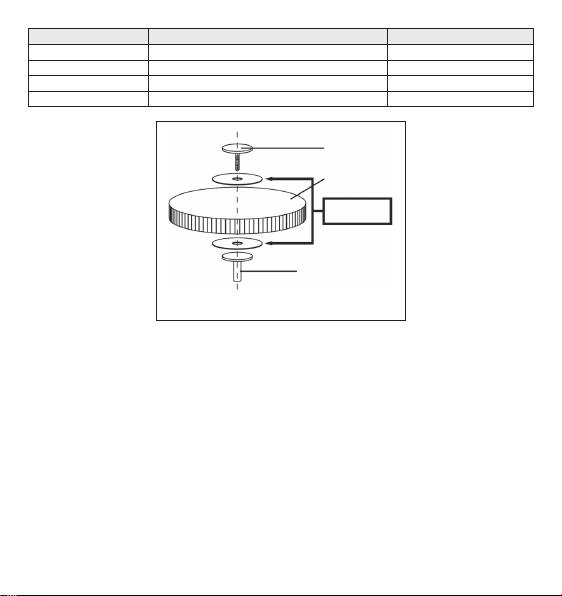
Stages Tools Shapes
Trimming Sharp scalpel Slightly rounded blade
Shape Adjustment COARSE POINT (Black) Round tapered end
Finishing FINISHING WHEEL (Brown) Wheel
Relief DIAMOND ROUND BUR (sold separately) Round
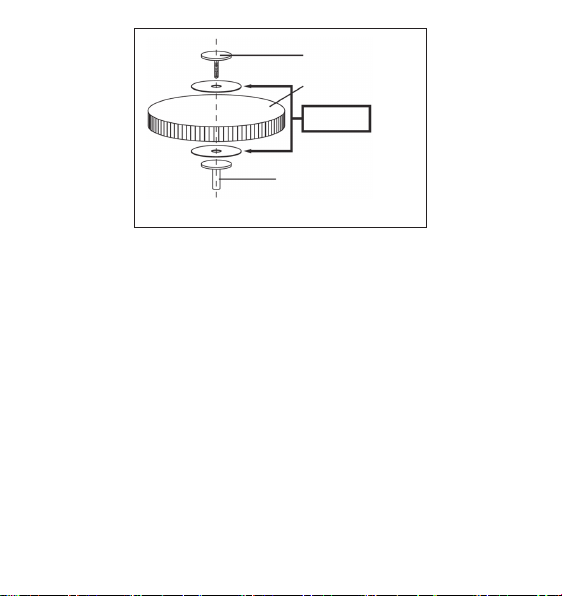
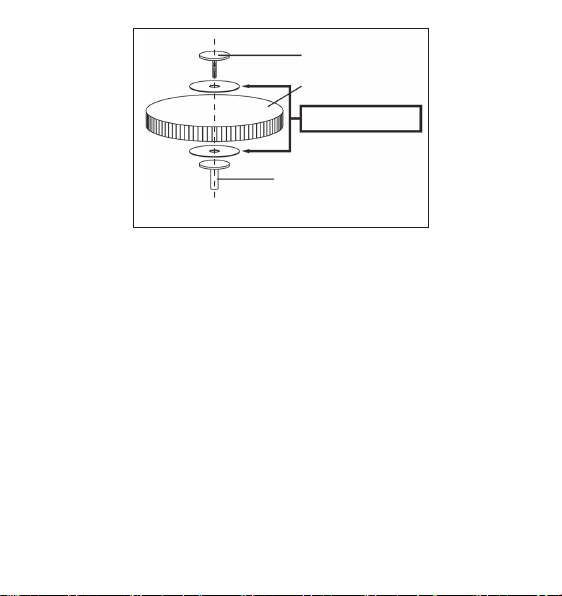
Screw
Finishing
Wheel
Washer
Mandrel
Finishing Wheel
STORAGE
■
1. Store SOFRELINER TOUGH S at a temperature between 0 - 25℃ (32 - 77℉).
2. Avoid direct exposure of SOFRELINER TOUGH S to heat, open flame, humidity and sunlight.
3. Do not use SOFRELINER TOUGH S after the indicated date of expiration.
4. DO NOT leave SOFRELINER TOUGH S unnecessarily within the reach of patients and
children to avoid being swallowed by mistake.
DISPOSAL
■
1. To dispose of the PASTE, dispense unused paste from the cartridge and allow it to set prior to
disposal.
2. The remaining PRIMER liquid should be absorbed in an inert absorbent material such as gauze
or cotton, and disposed of in accordance with local regulations.
Page 6
CLINICAL APPLICATION OF SOFRELINER TOUGH S INTRAORAL
■
LINING METHOD
In most cases the optimum thickness of SOFRELINER TOUGH S should be 1-2 millimeter. If a
thickness of over 2 millimeters is required, the area should first be lined with TOKUYAMA
REBASE II, chairside hard denture liner, to obtain sufficient denture base. Excessive removal of
denture resin could cause denture to fracture and weaken.
1. Preparation
Check intraoral condition by inspection and palpation. Remove denture from patient’s mouth and
clean the area to be lined with soap and water. Rinse thoroughly and air-dry the denture surface
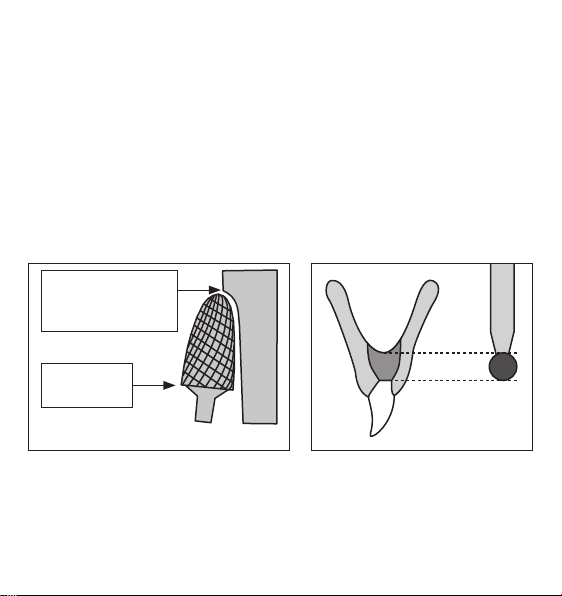
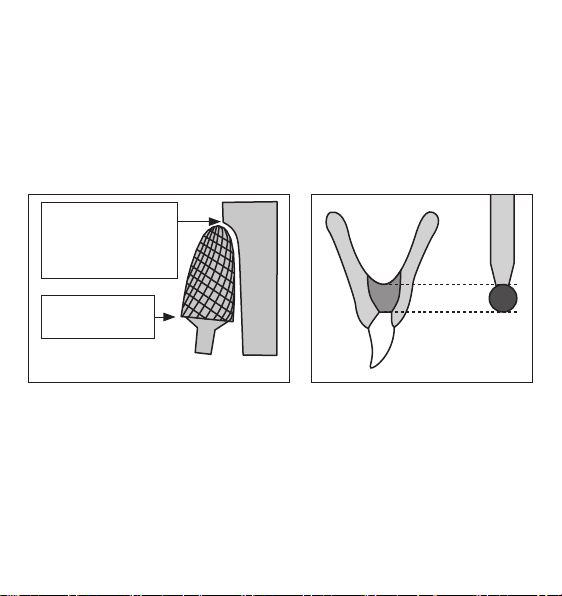
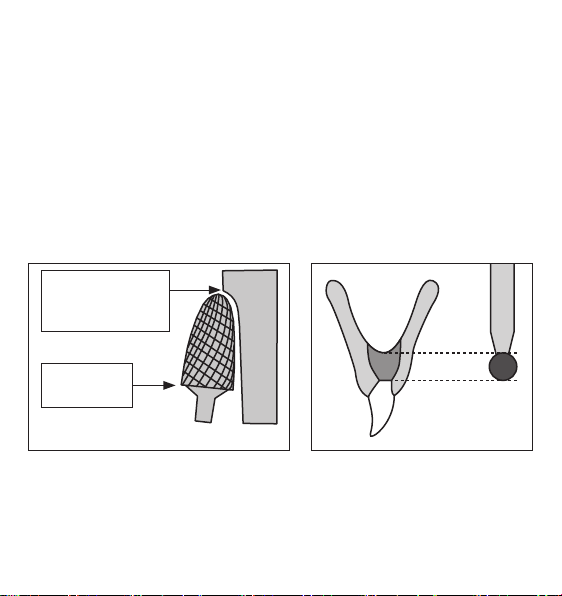
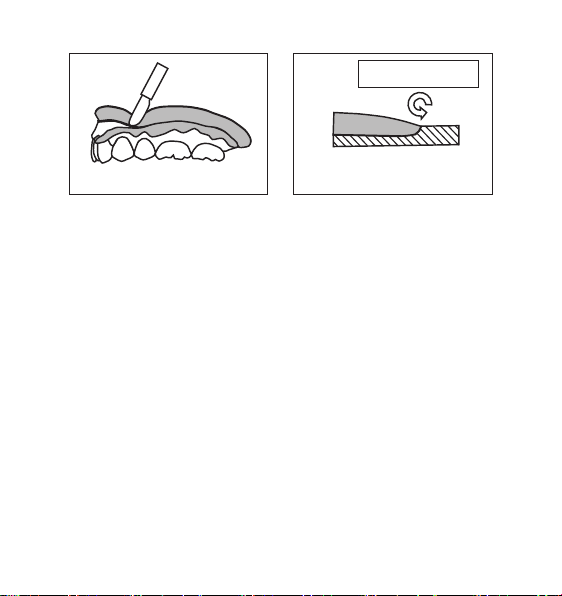
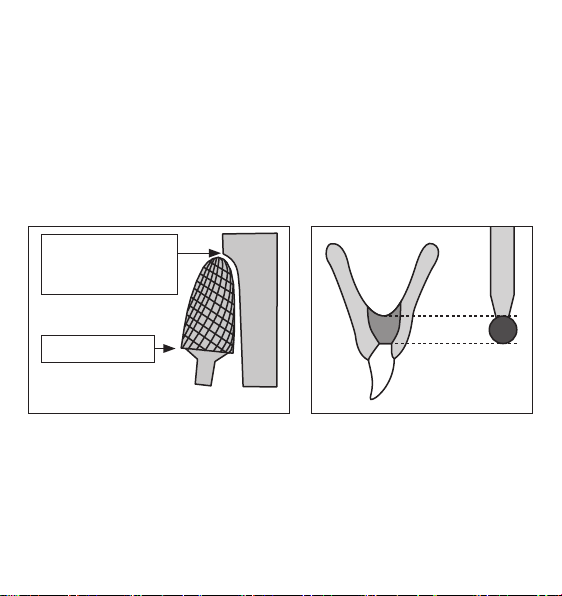
completely. Grind the tissue side of the denture with a cross cut carbide bur to the proper depth.
Bevel the borders of the denture to allow 1 millimeter of material to roll over the borders (See
Figure 1). Remove the grinding dust with a dry brush or dry oil-free air.
Note: When the border is placed within the flange of denture base, grind the tissue side of the
denture with round bur (for acrylic resin) to the proper depth (See Figure 2).
Margin between
lining material and
denture base
Cross cut
carbide bur
Figure 1
2. Dispensing the PRIMER
Open the bottle of PRIMER. Attach the drip nozzle to the bottle. Dispense an adequate amount of
PRIMER into the drip-cup. Replace the cap, closing the bottle tight immediately after dispensing.
3. Applying the PRIMER
Using the brush for the PRIMER, apply a thin, even coat of PRIMER on the denture surface where
SOFRELINER TOUGH S is to be lined. Do not miss any areas where the PRIMER should be
Figure 2
Page 7

applied since this may cause poor adhesion. Then air-dry the surface thoroughly until no visible
liquid remains.
4. Dispensing the PASTE
Load the SOFRELINER TOUGH S PASTE cartridge into a dispenser (sold separately). Open the
cartridge cap of PASTE. Attach the mixing tip to the cartridge by aligning the notches, push it
onto the cartridge, rotating the mixing tip clockwise 90 degrees.
5. Applying the PASTE
Extrude the mixed paste evenly on the tissue side of the denture. Using a spatula spread the paste
evenly across all surfaces where the PRIMER was applied.
Note: If any part of the primed surface is not covered with paste in this stage, the area may be
contaminated by saliva when it is inserted into the mouth, thus causing low adhesion.
6. Intraoral insertion
Suction any excess saliva from patient’s mouth. Within 1.5 - 2 minutes after mixing
SOFRELINER TOUGH S the material will turn to an adequate viscosity. Placing the denture in
the patient’s mouth, have the patient occlude very gently into centric occlusion with the proper
vertical dimension. Check for any excess SOFRELINER TOUGH S in the patient’s mouth, and
remove immediately if present. Advise patients to alert the dentist immediately if he/she feels
SOFRELINER TOUGH S material or any substance flowing toward the throat.
Note: To line upper dentures with SOFRELINER TOUGH S, insert the denture from the
posterior palatal region to avoid flow of SOFRELINER TOUGH S material down the
patient’s throat.
When lining the palatal region, avoid applying too much Paste on the surface to be
lined and insert the denture in the mouth as quickly as possible to avoid making the
liner too thick.
7. Border molding
Pull the cheeks very gently to mold the border of vestibule area while the patient is gently
occluding. If patient salivates, suction the saliva and instruct the patient to resume occluding
gently. SOFRELINER TOUGH S should be allowed to set intraorally for at least 5 minutes.
Note: Removal prior to 5 minutes may distort the liner.
8. Trimming
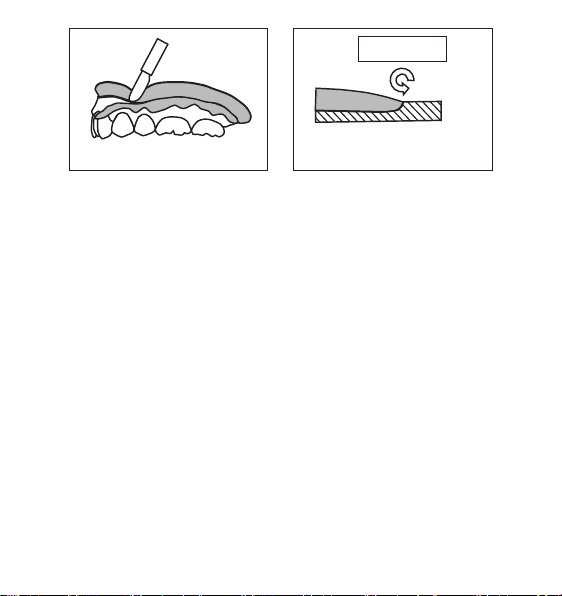
Remove the denture from patient’s mouth, rinse with water and air-dry. Carefully trim all excess
SOFRELINER TOUGH S material from the border areas with a sharp scalpel (See Figure 3).
Page 8
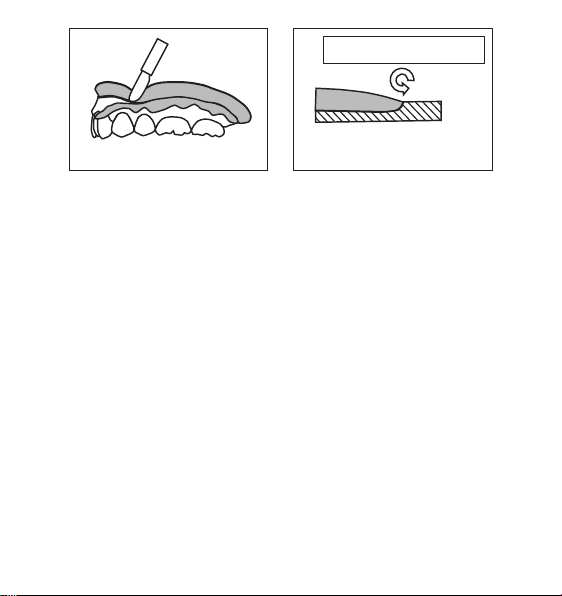
Direction for a rotation
Lining
Denture
Figure 3
9. Finishing
For shaping, use the COARSE POINT (Black), by applying light pressure not to exceed 15,000
rpm allowing the point to move in a small circle. For finishing, use the FINISHING WHEEL
(Brown), by applying light pressure not to exceed 8,000 rpm.
Note: Rotate the COARSE POINT and the FINISHING WHEEL from the lined area to the
denture area so as not to break the margin region (See Figure 4).
Use DIAMOND ROUND BUR (sold separately) or any suitable bur for relief.
10. Readjustment
In case of tissue conditioning, revisits should be made a few days after the initial treatment.
Readjust the denture according to the procedure of section 9. If new material is to be added to the
lined surface, remove the existing liner from the denture base and replace with a new liner.
11. Removal
Remove a large portion of SOFRELINER TOUGH S material by cutting it off with a sharp
instrument. Remove the remaining material by grinding.
Note: SILICONE REMOVER (sold separately) easily removes old silicone denture liner
from the acrylic denture base.
CLINICAL APPLICATION OF SOFRELINER TOUGH S
■
Figure 4
LABORATORY LINING METHOD
1. Examination of mouth
Check intraoral condition by inspection and palpation. Examine the area where needs relief.
2. Examination of the denture
If the denture is worn or old, line the denture first using TOKUYAMA REBASE II, chairside hard
denture lining material. The hard lining material should be applied in the appropriate thickness so
Page 9

that when the new material is ground down according to the procedure in step 4, a newly lined
layer of hard lining material is left on the denture bearing area, allowing SOFRELINER TOUGH
S to adhere to it.
3. Fabrication of a gypsum model
Take an impression with the patient biting on the denture, then pour a stone slurry onto the
impression. Make a stone index of the teeth and mount the denture on the index of a lining jig.
Relieve the stone model with wax in the region where may cause pain in the mouth. Apply a
separating medium on the ridge area of the gypsum model so the lining material will not adhere to
it.
4. Preparation
Grind the tissue side of the denture with a cross cut carbide bur to the proper depth. Bevel the
borders of the denture to allow 1 millimeter of material to roll over the borders (See Figure 1).
Remove the grinding dust with a dry brush or dry oil-free air.
Note: Use of a round bur makes it easy to remove a uniform depth of resin. The diameter of
the bur can be used as a guide for depth.
5. Dispensing the PRIMER
Open the bottle of PRIMER. Attach the drip nozzle to the bottle. Dispense an adequate amount of
PRIMER into the drip-cup. Replace the cap, closing the bottle tight immediately after dispensing.
6. Applying the PRIMER
Using the brush for the PRIMER, apply a thin, even coat of PRIMER on the denture surface where
SOFRELINER TOUGH S is to be lined. Do not miss any areas where the PRIMER should be
applied since this may cause poor adhesion. Then air-dry the surface thoroughly until no visible
liquid remains.
7. Dispensing the PASTE
Load the SOFRELINER TOUGH S PASTE cartridge into a dispenser (sold separately). Open the
cartridge cap of PASTE. Attach the mixing tip to the cartridge by aligning the notches, push it
onto the cartridge rotating the mixing tip clockwise 90 degrees.
8. Applying the PASTE
Extrude the mixed paste onto the surface where the PRIMER has been applied. Position the paste
both on the mucosal side of denture and stone model.
9. Reattachment
Reattach the denture onto its gypsum stone model and press it with the lining jig. Leave
undisturbed for 20 minutes or more at room temperature (23℃ / 73.4℉).
Note: If the set material is sticky, soak the denture in warm water at 40℃ to 50℃ (104℉ to
Page 10

122℉) for 5 minutes with the lining jig.
10. Trimming
Remove the denture from the gypsum model. Carefully trim all excess SOFRELINER TOUGH S
material from the border areas with a sharp scalpel (See Figure 3).
11. Finishing
For shaping, use the COARSE POINT (Black), by applying light pressure not to exceed 15,000
rpm allowing the point to move in a small circle. For finishing, use the FINISHING WHEEL
(Brown), by applying light pressure not to exceed 8,000 rpm.
Note: Rotate both the COARSE POINT and the FINISHING WHEEL from lined area to the
denture area so as not to break the margin region (See Figure 4).
Use DIAMOND ROUND BUR (sold separately) or any suitable tool for relief.
PATIENT PRECAUTIONS
■
Patients should be informed of the following instructions to enhance the longevity, durability and
safety of a denture lined with SOFRELINER TOUGH S:
1. SOFRELINER TOUGH S lining material should not be scrubbed with a denture brush or
toothbrush. The best way to clean SOFRELINER TOUGH S is with a sponge or a soft piece
of gauze. While running cold water on the SOFRELINER TOUGH S surface, wipe the surface
with sponge or gauze saturated with soap. Use a gentle wiping motion to remove all debris
and food deposits from the SOFRELINER TOUGH S lining material. The tooth surface and
hard acrylic denture base may be cleaned with a regular denture brush by scrubbing with soap,
denture toothpaste or regular denture cleaners at the dentist’s discretion.
2. Soak the denture at least once a day, preferably at bedtime, in an oxygenating denture cleaner
(i.e. Polident, Efferdent, etc.). The denture should not be cleaned with an oxygenating cleaner
within the patient’s mouth. Color fading may occur with long term use, depending upon the
patient’s denture maintenance. Use a denture cleaner according to its manufacturer
instructions.
3. Soaking the denture in heavy bleach cleaning solutions may alter the color of the
SOFRELINER TOUGH S, but it will not affect its performance.
4. The denture should be stored in water when not being worn.
5. The lined denture should be inspected and ultrasonically cleaned by a dentist every three
months, or whenever plaque deposit is noted.
6. The SOFRELINER TOUGH S must be inspected frequently for any damage. A denture with
disturbed, broken, cracked, loose or damaged liner should not be worn. Use of a damaged or
Page 11
broken denture could result in choking, aspiration, asphyxiation or other injury.
7. In the event of any sign of sensitivity to silicone, use of the denture should be discontinued,
and the patient should contact his/her dentist immediately.
The user and/or patient should report any serious incident that has occurred in relation to the
device to the manufacturer and the competent authority of the Member State in which the user
and/or patient is established.
IMPORTANT NOTE: The manufacturer of SOFRELINER TOUGH S is not responsible for
damage or injury caused by improper use of this product. It is the personal responsibility of the
user to ensure that this product is suitable for an appropriate application before use.
Product specifications of SOFRELINER TOUGH S are subjected to change without notification.
When the product specifications change, the instruction and precaution may change also.
ČESKY
Před použitím výstelky SOFRELINER TOUGH S si pečlivě přečtěte všechny tyto pokyny.
POPIS VÝROBKU A VŠEOBECNÉ INFORMACE
■
1. SOFRELINER TOUGH S je silikonový měkký výstelkový materiál pro použití přímo v
ordinaci polymerovaný přídavkem pro vyjímatelné zubní protézy. Výstelka SOFRELINER
TOUGH S splňuje požadavky jak normy ISO 10139-2 „Měkké výstelkové materiály pro
vyjímatelné zubní protézy, 2. část: Materiály pro dlouhodobé použití“, tak ISO 10139-1
„Měkké výstelkové materiály pro vyjímatelné zubní protézy, 1. část: Materiály pro krátkodobé
použití“.
2. Sada SOFRELINER TOUGH S obsahuje PASTE, PRIMER a další příslušenství, jako jsou
míchací kanyly, kapací tryska, kapací kalíšek, kartáčky, COARSE POINT (černý), FINISHING
WHEEL (hnědý).
3. PRIMER se používá výlučně pro bondování a akrylátové povrchy. Nelze jej použít pro
bondování na nylonové, kovové a silikonové povrchy. PASTE se dávkuje v automatickém
mísicím kazetovém dávkovacím systému. Materiál tuhne 5 minut v ústní dutině nebo 20 minut
při pokojové teplotě (23°C/73,4°F) a je bez chuti a bez zápachu.
INDIKACE
■
1. Proti bolesti způsobené ostrými výčnělky alveolární kosti a atrofií sliznice.
Page 12

2. Špatná retence způsobené extrémní atrofií výčnělku.
3. Velké podsekřiviny nebo maxilární/mandibulární vyklenutí.
4. Retence hybridních protéz před umístěním ke konečnému připevnění.
5. Dočasné výstelky nebo kondiciování tkáně.
KONTRAINDIKACE
■
Systém SOFRELINER TOUGH S je kontraindikován u pacientů alergických nebo přecitlivělých
na silikon a sloučeniny platiny a NEMĚL by se u takových pacientů používat.
BEZPEČNOSTNÍ OPATŘENÍ
■
1. Systém SOFRELINER TOUGH S je určen k prodeji a použití výhradně odborníky na dentální
péči s příslušnou licencí. Není určen k prodeji a není vhodný pro použití osobami, které nejsou
odborníky na dentální péči s příslušnou licencí.
2. Používejte výstelku SOFRELINER TOUGH S pouze podle zde uvedených pokynů. Systém
SOFRELINER TOUGH S NEPOUŽÍVEJTE k žádnému jinému účelu, než je popsáno v těchto
pokynech.
3. NEPOUŽÍVEJTE systém SOFRELINER TOUGH S v případě, že je porušen bezpečnostní
uzávěr nebo bude-li se zdát, že byl obsah narušen.
4. PRIMER obsahuje ethylacetát, který je vysoce hořlavým a volatilním rozpouštědlem. PRIMER
nelikvidujte otevřeným ohněm. Během používání pracujte ve ventilované místnosti a uzávěr
pevně uzavřete po použití.
5. Pokud se u pacienta projeví alergická reakce nebo přecitlivělost na systém SOFRELINER
TOUGH S, jako je rozpraskání dermatitidy, vyjměte protézu a jeho používání okamžitě
přerušte.
6. Během používání systému SOFRELINER TOUGH S používejte po celou dobu nelatexové
vyšetřovací rukavice, aby se zabránilo případným alergickým reakcím. Latexové rukavice
mohou rovněž znemožňovat tuhnutí systému SOFRELINER TOUGH S. Pokud SOFRELINER
TOUGH S PRIMER přijde do styku s vyšetřovacími rukavicemi, okamžitě je zlikvidujte a ruce
důkladně omyjte vodou.
7. Chraňte před vniknutím do očí. Pokud dojde k vniknutí do očí, důkladně oči propláchněte
vodou a neprodleně vyhledejte lékaře.
8. Chraňte kůži před stykem s neztuhlou chemikálií. V případě kontaktu s kůží vyčistěte
postiženou plochu vtíráním alkoholu, pak důkladně opláchněte vodou.
9. Chraňte oděv před stykem s neztuhlými materiály. V případě kontaktu s oděvem materiál
Page 13

neotírejte. Nechte jej ztuhnout a pak jej odloupněte.
10. Přebytečné materiály NESMÍ stékat do dýchací trubice či jícnu pacienta. Vdechnutí či požití
SOFRELINER TOUGH S PASTE může způsobit dušení nebo jiné poranění. Jakýkoliv
přebytečný výstelkový materiál okamžitě odeberte z palatální oblasti, aby nedošlo ke stékání
materiálu dolů do hrdla pacienta. Materiál SOFRELINER TOUGH S není neprostupný pro
záření a rentgenové snímky nebudou detekovat vdechnutý či spolknutý materiál. V případě
staršího pacienta, jehož reflexní schopnost je narušená, nastavte křeslo do svislé polohy a
vydejte pacientovi pokyn, aby dýchal nosem, aby nedošlo ke vniknutí materiálu do dýchacích
cest.
11. Systém SOFRELINER TOUGH S NEMÍCHEJTE s žádnými materiály, které nejsou uvedeny
v těchto pokynech.
12. Po použití kazety SOFRELINER TOUGH S se musí míchací kanyla nahradit uzávěrem kazety,
který se dodává s kazetou v době nákupu. Odstraňte přebytečnou pastu na kanyle kazety čistou
látkou nebo tampónem pokaždé před použitím nové míchací kanyly nebo vrácením uzávěru
kazety na původní místo.
13. Stěrku, kartáčky a kalíšky vždy čistěte alkoholem po každém použití, aby nedošlo ke křížové
kontaminaci.
14. Poučte pacienty v souladu s BEZPEČNOSTNÍMI OPATŘENÍMI PRO PACIENTA uvedenými
v poslední části těchto pokynů.
15. Během dokončování vždy používejte masku doporučenou federálními a/nebo místními
předpisy, aby nedošlo ke vdechování prachu.
16. U všech výrobků uvedených v tomto návodu k použití, které nejsou v této sadě uvedeny, si
přečtěte a dodržujte pokyny výrobců.
17. Pokud to bude možné, nedotýkejte se materiálem SOFRELINER TOUGH S jiné sliznice v
ústech než v oblasti, která se má vyložit výstelkou. Vydejte pacientovi pokyn, aby si
bezprostředně po léčbě vypláchl ústa odpovídajícím množstvím vody.
18. PRIMER chraňte před přímým kontaktem s plastovými materiály, protože při styku s nimi by
mohlo dojít k rozpuštění některých typů plastů.
POZNÁMKY OHLEDNĚ POUŽITÍ
■
1. Pokud protéza špatně padne, vyložte nejprve zubní protézu akrylátovým materiálem, jako je
například TOKUYAMA REBASE II, což je tvrdý výstelkový materiál zubní protézy pro
použití přímo v ordinaci, nebo použijte jiné laboratorní/nepřímé postupy ke zlepšení usazení.
2. U staré opotřebované zubní protézy je nutné vystýlaný povrch nejprve vyložit novým
Page 14
akrylovým materiálem, protože materiály absorbované ve staré opotřebované pryskyřici, jako
je například olej nebo voda, snižují adhezi SOFRELINER TOUGH S.
3. Pokud SOFRELINER TOUGH S zhoustne kvůli volatilizaci, nepoužívejte jej, protože jeho
adhezivní pevnost se může snížit.
4. Pokud jde o kartáč na primer, po každém použití otřete kanylu vatovým tampónem nebo gázou
namočenou v alkoholu. Kontaminovaný kartáček může snížit adhezi SOFRELINER TOUGH
S.
5. Pasty nemíchejte rukou, tímto způsobem se mohou do pasty dostat vzduchové bubliny, které
by mohly způsobit zhoršení, vznik skvrn a nepříjemné zápachy.
6. SOFRELINER TOUGH S nesmí přijít do styku s následujícími materiály, protože mohou
znemožnit ztuhnutí SOFRELINER TOUGH S:
materiály otisků obsahující silikon, materiály obsahující eugenol, materiály otisků z
polysulfidové gumy, rukavice z přírodního kaučuku, měkké výstelkové materiály jiných
výrobců a nepolymerované akrylové pryskyřice.
7. Materiál tuhne 5 minut v ústní dutině nebo 20 minut při pokojové teplotě (23°C/73,4°F). Po 24
hodinách se výstelka stane o něco pevnější. Dokončovací postup lze provádět bezprostředně
po odstranění nově vyložené zubní protézy z úst nebo sádrového modelu.
8. Namáčení zubní protézy v roztocích obsahujících silné bělicí činidlo může změnit barvu
SOFRELINER TOUGH S, ovšem neovlivní to jeho vlastnosti.
9. Vydejte pacientovi pokyn, aby zubní protézu čistil způsobem popsaným v
BEZPEČNOSTNÍCH OPATŘENÍCH PRO PACIENTA.
10. Protože materiál pro kontrolu zasazení obsahující silikon ulpívá na SOFRELINER TOUGH S,
naneste před použitím na povrch vazelínu.
11. Pokud je v dokončené výstelce trhlina, výstelku úplně odstraňte a postup opakujte.
12. Pro úpravu tvaru a dokončení viz následující nástroje.
Stupně Nástroje Tvary
Seříznutí Ostrý skalpel Mírně zakulacená čepel
Úprava tvaru COARSE POINT (černý) Zakulacený kuželový konec
Konečné vypracování
před leštěním
Odlehčení
FINISHING WHEEL (hnědý) Kotouč
DIAMOND ROUND BUR (prodává se
samostatně)
Kulatý
Page 15
Šroub
Kotouč pro konečné
vypracování
Podložka
Trn
Kotouč pro konečné vypracování
SKLADOVÁNÍ
■
1. Uchovávejte SOFRELINER TOUGH S při teplotě 0–25°C (32–77°F).
2. SOFRELINER TOUGH S chraňte před přímým působením tepla, otevřeného plamene,
vlhkosti a slunečního světla.
3. Nepoužívejte SOFRELINER TOUGH S po vyznačené době použitelnosti.
4. Aby nedošlo k pozření SOFRELINER TOUGH S omylem, NENECHÁVEJTE jej bez dozoru
v dosahu pacientů a dětí.
LIKVIDACE
■
1. Při likvidaci pasty PASTE vytlačte nepoužitou pastu z kazety a nechte ji před likvidací
ztuhnout.
2. Zbylý kapalný PRIMER by se měl absorbovat do inertního absorpčního materiálu, jako je gáza
nebo vata, a zlikvidovat v souladu s místními předpisy.
KLINICKÉ POUŽITÍ INTRAORÁLNÍ VÝSTELKOVÉ METODY SE
■
SOFRELINER TOUGH S
Ve většině případů by měla být optimální tloušťka SOFRELINER TOUGH S 1–2 milimetrů.
Pokud bude požadována tloušťka nad 2 milimetry, plochu je nejprve nutno vyložit materiálem
TOKUYAMA REBASE II, což je tvrdá výstelka zubní protézy pro použití přímo v ordinaci, aby
byla získána dostatečná základna zubní protézy. Nadměrné odstranění pryskyřice zubní protézy by
mohlo způsobit frakturu a oslabení zubní protézy.
Page 16
1. Preparace
Zkontrolujte prohlídkou a pohmatem stav uvnitř ústní dutiny. Vyjměte zubní protézu z úst pacienta
a místo, které se má vyložit, vyčistěte mýdlem a vodou. Důkladně opláchněte a dokonale osušte
povrch zubní protézy vzduchem. Obruste tkáňovou stranu zubní protézy křížovým karbidovým
vrtáčkem na správnou hloubku. Seřízněte hrany zubní protézy, aby se přes okraje mohl překlopit 1
milimetr materiálu (viz obr. 1). Odstraňte prach po broušení suchým kartáčkem nebo suchým
vzduchem bez oleje.
Poznámka: Když se okraj umístí v rámci příruby základny zubní protézy, obruste tkáňovou
stranu zubní protézy kulatým vrtáčkem (pro akrylátovou pryskyřici) do správné
hloubky (viz obr. 2).
Okraj mezi
materiálem výstelky
a základnou zubní
protézy
Křížový karbidový
vrtáček
Obrázek 1
2. Dávkování PRIMER
Otevřete lahvičku PRIMER. Na lahev upevněte odkapávací trysku. Do odkapávacího kalíšku
dávkujte adekvátní množství PRIMER. Nasaďte zpět uzávěr, ihned po dávkování uzavřete pevně
lahev.
3. Nanesení PRIMER
Pomocí kartáčku pro PRIMER naneste tenký, rovnoměrný povlak PRIMER na povrch zubní
protézy, kde se má nanést výstelka z SOFRELINER TOUGH S. Nevynechávejte žádné plochy,
kde by se měl PRIMER použít, protože to může způsobit špatnou adhezi. Důkladně osušte povrch
suchým vzduchem, až nebudou viditelné žádné zbytky kapaliny.
4. Dávkování PASTE
Vložte kazetu SOFRELINER TOUGH S PASTE do dávkovače (prodává se samostatně). Otevřete
Obrázek 2
Page 17

uzávěr kazety PASTE. Připevněte míchací kanylu ke kazetě vyrovnáním zářezů, zatlačte ji na
kazetu, otočte míchací kanylu ve směru hodinových ručiček o 90 stupňů.
5. Nanášení PASTE
Vytlačujte namíchanou pastu rovnoměrně na tkáňovou stranu zubní protézy. Stěrkou rovnoměrně
rozetřete pastu přes všechny povrchy, kde byl nanesen PRIMER.
Poznámka: Pokud nebude zakryta pastou jakákoliv část povrchu ošetřeného primerem v
6. Vložení do ústní dutiny
Odsajte veškeré přebytečné sliny z úst pacienta. Do 1,5–2 minut po míchání SOFRELINER
TOUGH S materiál získá adekvátní viskozitu. Vložte zubní protézu do úst pacienta, nechte
pacienta velmi jemně skousnout do středního skusu s vhodnými svislým rozměrem. Zkontrolujte,
zda v ústech pacienta není jakýkoliv přebytek SOFRELINER TOUGH S a pokud se objeví, ihned
jej odstraňte. Poučte pacienty, aby okamžitě upozornili zubního lékaře, pokud budou cítit, že
materiál SOFRELINER TOUGH S nebo jakákoliv jiná látka teče směrem do krku.
7. Formování okraje
Velmi jemně povytáhněte tváře, aby se zformoval okraj vestibulární oblasti a pacient současně
jemně skousl. Pokud bude pacient slinit, odsávejte sliny a vyzvěte pacienta, aby obnovil jemný
skus. Materiál SOFRELINER TOUGH S by se měl nechat tuhnout intraorálně nejméně 5 minut.
8. Seříznutí
Vyjměte zubní protézu z úst pacienta, opláchněte vodou a vysušte vzduchem. Opatrně odřízněte
veškerý přebytečný materiál SOFRELINER TOUGH S z hraničních ploch ostrým skalpelem (viz
obr. 3).
tomto stádiu, plocha může být kontaminována slinami při zasunutí do úst, což
způsobí nízkou adhezi.
Poznámka: Pro vyložení horních zubních protéze materiálem SOFRELINER TOUGH S
vložte zubní protézu do zadní palatální oblasti, aby nedošlo k odtoku materiálu
SOFRELINER TOUGH S dolů do krku pacienta.
Když vyložíte palatální oblast, nenanášejte příliš mnoho pasty na povrch, který se
má vyložit a vložte zubní protézu do úst co nejrychleji, aby nedošlo k tomu, že
výstelka bude příliš silná.
Poznámka: Vyjmutí před uplynutím 5 minut může výstelku zdeformovat.
Page 18
Směr otáčení
Výstelka
Zubní protéza
Obrázek 3
9. Konečné vypracování před leštěním
K tvarování použijte COARSE POINT (černý) a za slabého tlaku a při nejvýše 15 000 ot/min.
nechte brousek, aby se pohyboval v malém kruhu. Pro konečnou úpravu použijte FINISHING
WHEEL (hnědý) a lehce přitlačte, zatímco nepřekročíte 8 000 ot/min.
Poznámka: Otáčejte COARSE POINT a FINISHING WHEEL směrem z vyložené plochy do
Použijte DIAMOND ROUND BUR (prodává se samostatně) nebo jakýkoliv vhodný vrtáček k
uvolnění.
10. Opakovaná úprava
V případě kondiciování tkáně je nutné provést opakované návštěvy několik dnů po počáteční
léčbě. Znovu upravte zubní protézu podle postupu v odstavci 9. Pokud se má na vyložený povrch
přidat nový materiál, odstraňte stávající výstelku ze základny zubní protézy a nahraďte ji výstelkou
novou.
11. Odstranění
Velkou část materiálu SOFRELINER TOUGH S odstraňte jeho odříznutím ostrým nástrojem.
Zbývající materiál odstraňte broušením.
KLINICKÉ POUŽITÍ LABORATORNÍ VÝSTELKOVÉ METODY SE
■
plochy zubní protézy, aby se neporušila okrajová oblast (viz obr. 4).
Poznámka: SILICONE REMOVER (prodává se samostatně) snadno odstraní starou
silikonovou výstelku zubní protézy z akrylátové základny zubní protézy.
Obrázek 4
SOFRELINER TOUGH S
1. Vyšetření úst
Zkontrolujte prohlídkou a pohmatem stav uvnitř ústní dutiny. Vyšetřete plochu, kde je zapotřebí
úlevy.
Page 19

2. Vyšetření zubní protézy
Pokud bude zubní protéza opotřebená nebo stará, vyložte nejprve zubní protézu TOKUYAMA
REBASE II, což je tvrdý výstelkový materiál zubní protézy pro použití přímo v ordinaci. Tvrdý
výstelkový materiál je nutné používat ve vhodné tloušťce, proto když se nový materiál zbrousí
podle postupu uvedeného v kroku 4, nově vyložená vrstva tvrdého výstelkového materiálu se
ponechá za nosné ploše zubní protézy, což umožní SOFRELINER TOUGH S, aby k ní přilnul.
3. Výroba sádrového modelu
Odeberte otisk, když pacient kouše do zubní protézy, pak vylijte sádrovou kaši na otisk. Vyrobte
sádrový předlitek zubů a namontujte zubní protézu na předlitek výstelkového přípravku. Uvolněte
sádrový model voskem v oblasti, kde může v ústech způsobovat bolest. Na oblast předělu
sádrového modelu naneste oddělovací médium, aby se materiál výstelky k němu nepřilepil.
4. Preparace
Obruste tkáňovou stranu zubní protézy křížovým karbidovým vrtáčkem na správnou hloubku.
Seřízněte hrany zubní protézy, aby se přes okraje mohl překlopit 1 milimetr materiálu (viz obr. 1).
Odstraňte prach po broušení suchým kartáčkem nebo suchým vzduchem bez oleje.
Poznámka: Používání kulatého vrtáčku usnadňuje odstranění pryskyřice v jednotné hloubce.
5. Dávkování PRIMER
Otevřete lahvičku PRIMER. Na lahev upevněte odkapávací trysku. Do odkapávacího kalíšku
dávkujte adekvátní množství PRIMER. Nasaďte zpět uzávěr, ihned po dávkování uzavřete pevně
lahev.
6. Nanesení PRIMER
Pomocí kartáčku pro PRIMER naneste tenký, rovnoměrný povlak PRIMER na povrch zubní
protézy, kde se má nanést výstelka z SOFRELINER TOUGH S. Nevynechávejte žádné plochy,
kde by se měl PRIMER použít, protože to může způsobit špatnou adhezi. Důkladně osušte povrch
suchým vzduchem, až nebudou viditelné žádné zbytky kapaliny.
7. Dávkování PASTE
Vložte kazetu SOFRELINER TOUGH S PASTE do dávkovače (prodává se samostatně).
Otevřete uzávěr kazety PASTE. Připevněte míchací kanylu ke kazetě vyrovnáním zářezů, zatlačte
ji na kazetu, otočte míchací kanylu ve směru hodinových ručiček o 90 stupňů.
8. Nanášení PASTE
Vytlačte namíchanou pastu na povrch, kde byl nanesen PRIMER. Umístěte pastu jak na stranu
zubní protézy, která bude v kontaktu se sliznicí, tak na sádrový model.
Průměr vrtáčku lze použít jako vodítko pro hloubku.
Page 20

9. Opakované upevnění
Znovu upevněte zubní protézu na její sádrový model a stlačte ji na výstelkový přípravek. Nechte v
klidu 20 minut nebo déle při pokojové teplotě (23°C/73,4°F).
Poznámka: Pokud bude ztuhlý materiál lepkavý, namočte zubní protézu do vody teplé 40°C
10. Seříznutí
Sejměte zubní protézu ze sádrového modelu. Opatrně odřízněte veškerý přebytečný materiál
SOFRELINER TOUGH S z hraničních ploch ostrým skalpelem (viz obr. 3).
11. Konečné vypracování před leštěním
K tvarování použijte COARSE POINT (černý) a za slabého tlaku a při nejvýše 15 000 ot/min.
nechte brousek, aby se pohyboval v malém kruhu. Pro konečnou úpravu použijte FINISHING
WHEEL (hnědý) a lehce přitlačte, zatímco nepřekročíte 8 000 ot/min.
Použijte DIAMOND ROUND BUR (prodává se samostatně) nebo jakýkoliv vhodný nástroj k
uvolnění.
BEZPEČNOSTNÍ OPATŘENÍ PRO PACIENTA
■
1. Pacienty je nutné informovat o následujících pokynech ke zlepšení životnosti, trvanlivosti a
bezpečnosti zubní protézy vyložené SOFRELINER TOUGH S:
Výstelkový materiál SOFRELINER TOUGH S by neměl být kartáčován kartáčky na zubní
protézu nebo zubním kartáčkem. Nejlepší způsob čištění SOFRELINER TOUGH S je houbou
nebo měkkým kusem gázy. Dejte povrch s SOFRELINER TOUGH S pod tekoucí studenou
vodu, povrch otřete houbou nebo gázou nasycenou mýdlem. Jemně otírejte, abyste odstranili z
výstelkového materiálu SOFRELINER TOUGH S všechny usazeniny tkání a potravin. Povrch
zubu a tvrdá akrylátová podložka zubní protézy se mohou čistit běžným kartáčkem na zubní
protézu kartáčováním mýdlem, pastou na zubní protézy nebo běžnými čističi zubních protéz
podle uvážení zubního lékaře.
2. Namočte zubní protézu nejméně jednou denně, nejlépe před usnutím, do oxidačního čističe
zubních protéz (tj. Polident, Efferdent atd.). Zubní protéza by se neměla čistit oxidačním
čističem v ústech pacienta. Při dlouhodobém používání může dojít ke ztrátě barevnosti podle
toho, jak pacient zubní protézu udržuje. Použijte čistič zubních protéze podle pokynů výrobce.
3. Namáčení zubní protézy v čisticích roztocích obsahujících silné bělicí činidlo může změnit
barvu SOFRELINER TOUGH S, ale neovlivní to jeho vlastnosti.
až 50°C (104°F až 122°F) po dobu 5 minut s výstelkovým přípravkem.
Poznámka: Otáčejte jak COARSE POINT, tak FINISHING WHEEL směrem z vyložené
plochy do plochy zubní protézy, aby se neporušila okrajová oblast (viz obr. 4).
Page 21

4. Zubní protézu je nutno v době, kdy není nasazena, uchovávat ve vodě.
5. Zubní protézu s výstelkou by měl zubní lékař zkontrolovat a čistit ultrazvukem každé tři
měsíce nebo kdykoliv bude zaznamenán výskyt zubního plaku.
6. SOFRELINER TOUGH S se musí často kontrolovat, zda není poškozený. Zubní protéza s
narušenou, rozbitou, nalomenou, uvolněnou nebo poškozenou výstelkou by se neměla nosit.
Použití poškozené nebo rozbité zubní protézy by mohlo vést k dušení, vdechnutí cizího tělesa,
asfyxií nebo jiném poranění.
7. V případě jakékoliv známky citlivosti na silikon je zapotřebí používání zubní protézy přerušit
a pacient by měl okamžitě kontaktovat zubního lékaře.
Je nutné, aby uživatel a/nebo pacient hlásil jakýkoliv závažný incident, který nastal v souvislosti
se zařízením výrobci a kompetentnímu úřadu členskému státu, v němž uživatel a/nebo pacient
sídlí.
DŮLEŽITÁ POZNÁMKA: Výrobce SOFRELINER TOUGH S není odpovědný za škodu či újmu
způsobenou nesprávným použitím tohoto výrobku. Uživatel osobně odpovídá za to, že před
použitím je tento výrobek vhodný pro příslušnou aplikaci.
Technické parametry SOFRELINER TOUGH S se mohou změnit bez ohlášení. Když se změní
technické parametry výrobku, mohou se rovněž změnit pokyny a bezpečnostní opatření.
DANSK
Læs omhyggeligt alle anvisningerne inden brug af SOFRELINER TOUGH S.
PRODUKTBESKRIVELSE OG GENEREL INFORMATION
■
1. SOFRELINER TOUGH S er et additionshærdende silikonebaseret blødt direkte
underforingsmateriale til aftagelige proteser. SOFRELINER TOUGH S opfylder både ISO
10139-2 “Elastiske rebaseringsmaterialer til aftagelige proteser 2. del: Materialer til langvarig
anvendelse” og ISO 10139-1 “Elastiske rebaseringsmaterialer til aftagelige proteser 1. del:
Materialer til kortvarig anvendelse”.
2. SOFRELINER TOUGH S-sættet indeholder PASTA (PASTE), PRIMEREN (PRIMER) og
andet tilbehør, såsom blandespidser, dryppestuds, skål, børster, GROVFRÆSER (sort,
COARSE POINT), FINISHERINGSHJUL (brun, FINISHING WHEEL).
3. PRIMEREN (PRIMER) er kun beregnet til at binde til akryloverflader. Den kan ikke bruges
Page 22

til at binde til overflader af nylon, metal eller silikone. PASTAEN (PASTE) leveres i
magasiner til et automix-dispensersystem. Materialet hærder på 5 minutter intraoralt eller på
20 minutter ved stuetemperatur (23°C / 73,4°F), og det har hverken lugt eller smag.
INDIKATIONER
■
1. Smerter forårsaget af skarpe gummerande knoglekanter og slimhindeatrofi.
2. Dårlig fæstneevne retention på grund af ekstremt svind atrofi af gummeranden processus/pars
alveolaris.
3. Omfattende underskæringer eller tori i over- eller underkæben.
4. Fastholdelse af overmunds hybridproteser, indtil attachment er fixeret den endelig fastgørelse
er på plads.
5. Midlertidig underforing eller blødtvævstilpasning (tissue conditioning) behandling.
KONTRAINDIKATIONER
■
SOFRELINER TOUGH S er kontraindiceret hos patienter, der er allergiske eller overfølsomme
over for silikone- eller platinforbindelser og må IKKE anvendes hos sådanne patienter.
FORHOLDSREGLER
■
1. SOFRELINER TOUGH S er alene beregnet til at sælges til og bruges af autoriserede tandlæger
og professionelle tandplejere. Det er ikke beregnet til at sælges til eller bruges af personer,
som ikke er professionelle tandplejere.
2. Brug kun SOFRELINER TOUGH S som anført i denne brugsanvisning. SOFRELINER
TOUGH S må IKKE bruges til andre anvendelser end de, der er anført i denne brugsanvisning.
3. SOFRELINER TOUGH S må IKKE bruges, hvis sikkerhedsforseglingen er brudt, eller hvis
det kan ses, der har været pillet ved indholdet.
4. PRIMEREN (PRIMER) indeholder ethylacetat, som er et letantændeligt og flygtigt
opløsningsmiddel. PRIMEREN (PRIMER) skal beskyttes mod åben ild. Brug produktet i et
veludluftet lokale og stram låget godt efter brug.
5. Hvis patienten udvikler en allergisk reaktion eller overfølsomhed over for SOFRELINER
TOUGH S, såsom et udbrud af dermatitis, fjernes protesen, og brugen heraf afbrydes straks.
6. Bær latexfri undersøgelseshandsker hele tiden under anvendelsen af SOFRELINER TOUGH S
for at undgå risikoen for allergiske reaktioner. Handsker af latex kan desuden hæmme
hærdningen af SOFRELINER TOUGH S. Hvis SOFRELINER TOUGH S PRIMEREN
(PRIMER) kommer i kontakt med undersøgelseshandskerne, skal disse straks kasseres, og
hænderne vaskes omhyggeligt med vand.
Page 23

7. Undgå kontakt med øjnene. Ved kontakt med øjnene, skyl øjnene omhyggeligt med vand og
søg straks lægehjælp.
8. Undgå kontakt af det uhærdede kemikalie med huden. Ved kontakt med huden, rens det
berørte område med sprit og skyl omhyggeligt efter med vand.
9. Undgå kontakt af det uhærdede materiale med tøjet. Ved kontakt med tøjet, forsøg ikke at
tørre materialet af. Lad det i stedet hærde og pil det af.
10. Lad IKKE overskydende materiale løbe ned i patientens luft- eller spiserør. Indåndet eller
indtaget SOFRELINER TOUGH S PASTA (PASTE) kan medføre kvælning eller anden skade.
Fjern straks overskydende underforingsmateriale fra ganeområdet for at undgå, at det løber ned
i patientens svælg. SOFRELINER TOUGH S er ikke radioopakt, og indåndet eller indtaget
materiale kan ikke ses ved røntgenfotografi. I tilfælde af ældre patienter med forringede
reflekser indstilles stolen i oprejst stilling, og patienten instrueres om at trække vejret gennem
næsen for at undgå at få materiale i luftvejene.
11. SOFRELINER TOUGH S må IKKE blandes med andre materialer de, der er anført i denne
brugsanvisning.
12. Efter brug af et SOFRELINER TOUGH S-magasin skal blandespidsen erstattes af den hætte,
der følger med magasinet. Tør overskydende pasta af spidsen af magasinet vha. en ren klud
eller serviet før hver brug af en ny blandespids eller påsætning af magasinets hætte.
13. Rengør altid spatler, børster og skåle med sprit efter hver anvendelse for at undgå
krydskontaminering.
14. Instruér patienterne i henhold til FORHOLDSREGLER FOR PATIENTER i sidste afsnit af
denne brugsanvisning.
15. For at undgå at indånde støv under poleringen skal der altid bæres en maske, som opfylder de
nationale og/eller lokale bestemmelser.
16. Læs og følg anvisningerne fra fabrikanterne af alle de produkter, der omtales i denne
brugsanvisning, men som ikke hører til sættet.
17. Undgå så vidt muligt, at SOFRELINER TOUGH S kommer i kontakt med mundens slimhinder
andre steder end i det område, der skal underfores. Instruer patienterne i at skylle munden med
tilstrækkelige mængder vand efter behandlingen.
18. Undgå, at PRIMEREN kommer i direkte kontakt med plastmaterialer, idet visse typer plast
herved kan opløses.
BEMÆRKNINGER VEDR. BRUGEN
■
1. I tilfælde af en protese med dårlig pasform rebaseres protesen først med et akrylmateriale,
Page 24

såsom TOKUYAMA REBASE II, et hårdt rebaseringsmateriale til direkte rebasering
(chairside), eller ved enhver anden laboratorie- eller indirekte procedure til forbedring af
pasformen.
2. I tilfælde af en ældre, slidt protese skal overfladen, som skal underfores, først rebaseres med
nyt akrylmateriale, eftersom visse stoffer, såsom olie eller vand, der er absorberet i det ældre,
slidte plastacrylmateriale, hæmmer vedhæftningen af SOFRELINER TOUGH S.
3. Hvis SOFRELINER TOUGH S PRIMEREN (PRIMER) tykner som følge af afdampning, bør
den ikke anvendes, da dens vedhæftningsstyrke kan være forringet.
4. Hvad angår børsten til primeren, skal spidsen tørres af med en spritvædet vatpind eller gaze
efter hver brug. En kontamineret børste kan forringe vedhæftningen af SOFRELINER
TOUGH S.
5. Undgå at blande pastaerne med hånden, da det kan medføre indarbejdningen af luftbobler, som
kan føre til nedbrydning, dannelse af pletter eller ubehagelige lugte.
6. Undgå, at SOFRELINER TOUGH S kommer i kontakt med følgende materialer, da de kan
hæmme hærdningen af SOFRELINER TOUGH S:
Silikonebaserede aftryksmaterialer, eugenolholdige materialer, aftryksmaterialer af
polysulfidgummi, handsker af naturgummi, andre fabrikanters bløde underforingsmaterialer og
uhærdet akryl.
7. Materialet hærder på 5 minutter intraoralt eller på 20 minutter ved stuetemperatur (23°C /
73,4°F). Efter 24 timer bliver underforingsmaterialet kun en smule stivere. Finisheringen kan
udføres umiddelbart efter fjernelsen af den underforede protese fra munden eller gipsmodellen.
8. Hvis protesen lægges i stærke chloropløsninger, kan farven af SOFRELINER TOUGH S
ændres, men det påvirker ikke materialets egenskaber.
9. Instruér patienten i at rengøre protesen som beskrevet i FORHOLDSREGLER FOR
PATIENTER.
10. Da silikonebaserede materialer til kontrol af pasformen klæber til SOFRELINER TOUGH S,
bør der påføres vaseline på protesens overflade inden brug af sådanne materialer.
11. Hvis der opstår brud på den færdige underforing, skal den fjernes fuldstændigt og proceduren
gentages.
12. Brug følgende instrumenter til justering af formen og finishering.
Page 25
Trin Instrument Shapes
Trimming Skarp skalpel Let afrundet blad
Formning GROVFRÆSER (sort, COARSE POINT) Afrundet, konisk spids
Finishing
Aflastining(Relief)
OPBEVARING
■
1. SOFRELINER TOUGH S skal opbevares ved en temperatur på mellem 0 og 25°C (32 - 77°F).
2. Undgå at udsætte SOFRELINER TOUGH S direkte for varme, åben ild, fugt eller sollys.
3. SOFRELINER TOUGH S må ikke anvendes efter den anførte udløbsdato.
4. SOFRELINER TOUGH S bør ikke unødigt efterlades inden for patienters eller børns
rækkevidde for at undgå, at det sluges ved en fejltagelse.
BORTSKAFFELSE
■
1. For at bortskaffe PASTAEN (PASTE) trykkes den ubrugte pasta ud af magasinet og får lov at
hærde, inden den bortskaffes.
2. Ubrugt PRIMER-væske skal absorberes i et inert, absorberende materiale, såsom gaze eller
vat, og bortskaffes i henhold til de lokale bestemmelser.
FINISHERINGSHJUL (brun, FINISHING
WHEEL)
RUNDT DIAMANTBOR (sælges separat,
DIAMOND ROUND BUR)
Skrev
Finisheringshjul
Skive
Skrev
Finisheringshjul
Hjul
Rund
Page 26
KLINISK APPLICERING AF SOFRELINER TOUGH S, INTRAORAL
■
UNDERFORINGSMETODE
I de fleste tilfælde ligger den optimale tykkelse af SOFRELINER TOUGH S på 1 - 2 millimeter.
Hvis der kræves en tykkelse på over 2 millimeter, skal området først rebaseres med TOKUYAMA
REBASE II, et hård rebaseringsmateriale, for at opnå en tilstrækkelig protesebase. Overdreven
fjernelse af plastprotesemateriale fra protesen kan føre til brud eller svækkelse af protesen.
1. Forberedelse
Tjek de intraorale forhold visuelt og ved palpation palpering. Tag protesen ud af patientens mund
og rengør området, der skal underfores, med vand og sæbe. Skyl grundigt og lufttør protesens
overflade fuldstændigt. Slib vævssiden af protesen til en passende dybde med et krydsskåret
carbidbor. Skær kanterne af protesen skråt, så materialet kan overskride kanterne med 1 millimeter
(se figur 1). Fjern slibestøvet med en tør børste eller tør, oliefri luft.
Bemærk: Når kanten laves inden i protesebasens, indenfor proteseflangen, slibes vævssiden
af protesen til en passende dybde med et rundt bor (til akryl) (se figur 2).
Margen mellem
underforingsmaterialet og
protesebasen.
Krydsskåret
carbidbor
Figur 1
2. Dosering af PRIMEREN (PRIMER)
Åbn flasken med PRIMEREN. Sæt dryppestudsen på flasken. Doser en passende mængde
PRIMEREN i skålen. Sæt låget tilbage på plads og luk flasken stramt straks efter doseringen.
3. Applicering af PRIMEREN (PRIMER)
Ved hjælp af børsten, der er beregnet til PRIMEREN, appliceres et tyndt, jævnt lag PRIMEREN
på den del af proteseoverfladen, der skal underfores med SOFRELINER TOUGH S. Pas på ikke
Figur 2
Page 27

at glemme noget område, hvor PRIMEREN skal appliceres, da dette kan betyde en dårlig
vedhæftning. Lufttør dernæst overfladen grundigt, indtil der ikke er nogen synlig væske tilbage.
4. Dosering af PASTA (PASTE)
Sæt magasinet med SOFRELINER TOUGH S PASTA i dispenseren (sælges separat). Åbn låget
på PASTA-magasinet. Sæt blandespidsen på magasinet ved at sætte hakkene ud for hinanden,
skubbe spidsen ind på magasinet og dreje den 90 grader med uret.
5. Applicering af PASTA (PASTE)
Tryk den blandede pasta jævnt ud på vævssiden af protesen. Brug en spatel til at sprede
PASTAEN jævnt over hele den overflade, hvor PRIMEREN er appliceret.
Bemærk: Hvis en del af den primede overflade ikke dækkes med pasta på dette trin, kan
6. Indsætning i munden
Sug overskydende spyt op fra patientens mund. Inden for 1,5 - 2 minutter efter, at det materialet
er blandet, vil SOFRELINER TOUGH S have opnået en passende viskositet. Anbring protesen i
patientens mund og bed patienten bide meget blidt sammen for at opnå central okklusion med den
korrekte bidhøjde. Tjek for overskydende SOFRELINER TOUGH S i patientens mund og fjern
det straks. Bed patienten straks underrette tandlægen, hvis han/hun føler SOFRELINER TOUGH
S-materiale eller noget andet stof løbe ned i svælget.
7. Formning af kanterne
Træk meget blidt i kinderne, mens patienten forsigtigt bider sammen, for at forme kanterne i det
vestibulære område. Hvis patienten danner meget spyt, opsuges dette, og patienten instrueres om
at fortsætte med at bide forsigtigt sammen. Lad SOFRELINER TOUGH S hærde intraoralt i
mindst 5 minutter.
8. Trimning
Tag protesen ud af patientens mund, skyl den med vand og lufttør den. Skær forsigtigt alt
overskydende SOFRELINER TOUGH S-materiale af kanterne ved hjælp af en skarp skalpel (se
området blive kontamineret med spyt, når protesen sættes ind i munden, hvilket kan
betyde en dårlig vedhæftning.
Bemærk: Ved underforing af overmundsproteser med SOFRELINER TOUGH S indsættes
protesen fra den posteriore del af ganen for at undgå, at SOFRELINER TOUGH
S-materiale løber ned i patientens svælg.
Ved underforing i ganeområdet skal det undgås at applicere for megen pasta på
overfladen, og protesen skal indføres i munden så hurtigt som muligt for at undgå,
at underforingen bliver for tyk.
Bemærk: Hvis protesen fjernes efter mindre end 5 minutter, kan underforingen forvrides.
Page 28
figur 3).
Rotationsretning
Underforing
Protese
Figur 3
9. Finishering
Til formning anvendes benyttes GROVFRÆSER (sort, COARSE POINT) med påføring under
anvendelse af et let tyk og uden at overskride 15.000 omdr./min, idet fræseren bevæges i små
cirkler. Til finishering anvendes benyttes FINISHERINGSHJULET (brun, FINISHING WHEEL)
med påføring under anvendelse af et let tryk og uden at overskride 8.000 omdr./min.
Bemærk: Drej Rotationen af GROVFRÆSEREN og FINISHERINGSHJULET skal være fra
Brug et RUNDT DIAMANTBOR (sælges separat, DIAMOND ROUND BUR) eller ethvert andet
egnet bor for aflastning(Relief).
10. Justering
I tilfælde af blødtvævstilpasning (tissue conditioning), behandling skal patienten til fornyet
undersøgelse et par dage efter den første behandling. Juster protesen ifølge proceduren i afsnit 9.
Hvis der skal tilføjes nyt materiale på den underforede overflade, fjernes den eksisterende
underforing fra protesebasen og erstattes med en ny underforing.
11. Fjernelse
Fjern en stor del af SOFRELINER TOUGH S-materialet ved at skære det med et skarpt
instrument. Fjern det tilbageværende materiale ved slibning.
det underforede område mod proteseområdet for at undgå at beskadige kantområdet
(se figur 4).
Bemærk: Gammel silikoneunderforing fjernes let fra den akryliske protesebase ved hjælp af
SILIKONEFJERNER (sælges separat, SILICONE REMOVER).
Figur 4
Page 29

KLINISK APPLICERING AF SOFRELINER TOUGH S, METODE TIL
■
UNDERFORING I LABORATORIET
1. Undersøgelse af munden
Tjek de intraorale forhold visuelt og ved palpation palpering. Undersøg det område, der har brug
for aflastning (Relief).
2. Undersøgelse af protesen
Hvis protesen er slidt eller gammel, rebaseres den først med TOKUYAMA REBASE II, et hårdt
rebaseringsmateriale. Dette skal påføres i passende tykkelse, således at der er et lag nyt hårdt
rebaseringsmateriale tilbage på det understøttende område af protesen, efter at det nye materiale er
slebet ned ifølge proceduren i trin 4, således at SOFRELINER TOUGH S kan binde til det.
3. Fremstilling af en gipsmodel
Tag et aftryk med protesen mens patienten bider med protesen, og hæld en gipsopslæmning i
aftrykket. Støb en gipsmodel af tænderne Fremstil en antagonistmodel og monter protesen på
modellen i en okkludator. Aflast gipsmodellen med voks i det område, der giver smerter i munden.
Påfør et separationsmiddel på gipsmodellens gummerandsområde, så underforingsmaterialet ikke
binder til det.
4. Forberedelse
Slib vævssiden af protesen til en passende dybde med et krydsskåret carbidbor. Skær kanterne af
protesen skråt, så materialet kan overlappe overskride kanterne med 1 millimeter (se figur 1).
Fjern slibestøvet med en tør børste eller tør, oliefri luft.
Bemærk: Brugen af et rundt bor gør det let at fjerne en regelmæssig dybde af
5. Dosering af PRIMEREN (PRIMER)
Åbn flasken med PRIMEREN. Sæt dryppestudsen på flasken. Doser en passende mængde
PRIMEREN i skålen. Sæt låget tilbage på plads og luk flasken stramt straks efter doseringen.
6. Applicering af PRIMEREN (PRIMER)
Ved hjælp af børsten, der er beregnet til PRIMEREN, appliceres et tyndt, jævnt lag PRIMEREN
på den del af proteseoverfladen, der skal underfores med SOFRELINER TOUGH S. Pas på ikke
at glemme noget område, hvor PRIMEREN skal appliceres, da dette kan betyde en dårlig
vedhæftning. Lufttør dernæst overfladen grundigt, indtil der ikke er nogen synlig væske tilbage.
7. Dosering af PASTA (PASTE)
Sæt magasinet med SOFRELINER TOUGH S PASTA i dispenseren (sælges separat). Åbn låget
plastprotesemateriale. Borets diameter kan bruges som hjælp til at bedømme
dybden.
Page 30

på PASTA-magasinet. Sæt blandespidsen på magasinet ved at sætte hakkene ud for hinanden,
skubbe spidsen ind på magasinet og dreje den 90 grader med uret.
8. Applicering af PASTA (PASTE)
Tryk PASTAEN ud på den overflade, hvor PRIMEREN er appliceret. Påfør PASTAEN både på
slimhindesiden af både protesen og gipsmodellen.
9. Fastgørelse
Fastgør protesen på gipsmodellen igen og sæt den i pres i okkludator. Lad den stå i mindst 20
minutter ved stuetemperatur (23°C / 73,4°F).
Bemærk: Hvis det hærdede materiale er klæbrigt, dyppes protesen i 40°C - 50°C varmt vand
10. Trimning
Tag protesen af gipsmodellen. Skær forsigtigt alt overskydende SOFRELINER TOUGH
S-materiale af kanterne ved hjælp af en skarp skalpel (se figur 3).
11. Finishering
Til formning anvendes benyttes GROVFRÆSER (sort, COARSE POINT) med påføring under
anvendelse af et let tryk og uden at overskride 15.000 omdr./min, idet fræseren bevæges i små
cirkler. Til finishering anvendes benyttes FINISHERINGSHJULET (brun, FINISHING WHEEL)
med påføring under anvendelse af et let tryk og uden at overskride 8.000 omdr./min.
Brug et RUNDT DIAMANTBOR (sælges separat, DIAMOND ROUND BUR) eller ethvert andet
egnet bor for aflastning (Relief).
FORHOLDSREGLER FOR PATIENTER
■
Patienterne skal informeres om følgende anvisninger med det formål at forbedre levetiden,
holdbarheden og sikkerheden af en protese, der er underforet med SOFRELINER TOUGH S:
1. SOFRELINER TOUGH S underforingsmateriale må ikke skrubbes med en protesebørste eller
(104°F - 122°F) i 5 minutter sammen med okkludatoren.
Bemærk: Drej både Rotationen af både GROVFRÆSEREN og FINISHERINGSHJULET
skal være fra det underforede område mod proteseområdet for at undgå at beskadige
kantområdet (se figur 4).
en tandbørste. Den bedste måde at rengøre SOFRELINER TOUGH S på er med en svamp
eller et blødt stykke gaze. Lad koldt vand løbe ned over SOFRELINER TOUGH S og tør
overfladen af med en svamp eller et stykke gaze, der er mættet med sæbe. Brug en blid,
aftørrende bevægelse til at fjerne snavs og madrester fra SOFRELINER TOUGH S
underforingsmaterialet. Tandoverfladen og den hårde protesebase af akryl kan rengøres med
en normal protesebørste ved at skrubbe med sæbe, protesetandpasta eller normale
Page 31

proteserensemidler som anvist af tandlægen.
2. Mindst en gang om dagen, fortrinsvis ved sengetid, skal lægges protesen stilles til rensning i et
oxygenudviklende proteserensemiddel (f. eks. Polident, Efferdent mv.). Protesen må ikke
rengøres med et oxygenudviklende rensemiddel i patientens mund. Efter længere tids brug
kan farverne blegne, afhængigt af patientens pleje af protesen. Brug proteserensemidlet i
henhold til producentens anvisninger.
3. Hvis protesen lægges i stærke blegende rensemidler chloropløsninger, kan farven af
SOFRELINER TOUGH S ændres, men det påvirker ikke materialets egenskaber.
4. Protesen skal opbevares i vand, når den ikke bæres.
5. Den underforede protese skal kontrolleres og ultralydrenses hos tandlægen hver tredje måned,
eller når der iagttages afsætning af plak på protesen.
6. SOFRELINER TOUGH S skal hyppigt kontrolleres for skader. En protese med modificeret
ødelagt, brækket, revnet, løsnet eller beskadiget underforing bør ikke bæres. Brug af en
beskadiget eller brækket protese kan føre til kvælning, aspiration, asfyxi eller andre skader.
7. Såfremt der opstår tegn på overfølsomhed over for silikone, skal brugen af protesen afbrydes,
og patienten skal straks kontakte sin tandlæge.
Brugeren og/eller patienten skal indberette eventuelle alvorlige hændelser, der har fundet sted med
udstyret, til producenten og den kompetente myndighed i medlemslandet, hvor brugeren og/eller
patienten er etableret.
VIGTIG BEMÆRKNING: Fabrikanten af SOFRELINER TOUGH S er ikke ansvarlig for skader,
der skyldes forkert brug af dette produkt. Det er brugerens personlige ansvar at sikre sig før brug,
at dette produkt er egnet til en given anvendelse.
Produktspecifikationerne for SOFRELINER TOUGH S kan ændres uden forudgående varsel. Når
produktspecifikationerne ændres, kan anvisningerne og forholdsreglerne også ændres.
Page 32
DEUTSCH
Bitte lesen Sie diese Anweisung vor der Verwendung von SOFRELINER TOUGH S
sorgfältig durch.
PRODUKTBESCHREIBUNG UND ALLGEMEINE
■
INFORMATIONEN
1. SOFRELINER TOUGH S ist ein additionsvernetztes weiches Silikonunterfütterungsmaterial
für die direkte Unterfütterung herausnehmbarer Prothesen. SOFRELINER TOUGH S
entspricht sowohl der Norm ISO 10139-2 „Zahnheilkunde - Weichbleibende
Unterfütterungswerkstoffe für Prothesen - Teil 2: Werkstoffe für die Langzeitanwendung” als
auch der ISO 10139-1 „Weichbleibende Unterfütterungswerkstoffe für Prothesen - Teil 1:
Werkstoffe für kurzzeitige Anwendungen“.
2. Ein Set SOFRELINER TOUGH S enthält PASTE, PRIMER und weiteres Zubehör wie
Mischspitzen, Tropfdüse, Kunststoffbecher für entnehmen, Pinsel, Formkorrekturspitze
(schwarz, COARSE POINT) und Finishing-Scheibe(braun, FINISHING WHEEL).
3. Der PRIMER wird ausschließlich für das Haften an Acryloberflächen verwendet. Er kann
nicht für die Haftung an Nylon-, Metall- oder Silikonoberflächen verwendet werden. Die
PASTE ist in einer selbstmischenden Spenderkartusche erhältlich. Der Werkstoff härtet
intraoral innerhalb von 5 Minuten oder bei Raumtemperatur (23℃ / 73,4℉) innerhalb von 20
Minuten aus. Er ist geruchs- und geschmacksneutral.
INDIKATIONEN
■
1. Bei Schmerzen, die durch scharfe Kanten des Alveolarfortsatzes sowie durch
Schleimhautatrophie hervorgerufen werden.
2. Bei schlechtem Prothesenhalt aufgrund extremer Kieferkammathrophie.
3. Bei größeren unter sich gehenden Stellen oder bei maxillären / mandibulären Tori.
4. Zur Retention von Deckprothesen vor der endgültigen Verankerung.
5. Kurzzeitige Unterfütterung oder Weichteildeckung.
GEGENANZEIGEN
■
SOFRELINER TOUGH S ist bei Patienten mit Allergie oder Überempfindlichkeiten gegenüber
Silikon- oder Platinverbindungen kontraindiziert und sollte daher in diesen Fällen NICHT
angewendet werden.
Page 33

VORSICHTSMASSNAHMEN
■
1. SOFRELINER TOUGH S ist ausschließlich zum Verkauf und Gebrauch durch
zahnmedizinisches Fachpersonal vorgesehen. Es darf weder an Laien verkauft noch von
diesen verwendet werden.
2. Verwenden Sie SOFRELINER TOUGH S nur nach den hier aufgeführten
Anwendungshinweisen. BENUTZEN SIE SOFRELINER TOUGH S NICHT für einen
anderen als den hier vorgesehenen Zweck.
3. SOFRELINER TOUGH S NICHT VERWENDEN, wenn die Versiegelung beschädigt oder mit
dem Inhalt unsachgemäß umgegangen wurde.
4. Der PRIMER enthält Äthylazetat, ein leicht entflammbares und flüchtiges Lösungsmittel. Der
PRIMER darf nicht in Kontakt mit offenen Flammen kommen. Benutzen Sie ihn in gut
gelüfteten Räumen und drehen Sie den Verschluss nach Benutzung wieder fest zu.
5. Wenn bei einem Patienten eine allergische oder eine Überempfindlichkeitsreaktion auf
SOFRELINER TOUGH S auftritt, wie z.B. ein Hautexanthem, sollte die Prothese entfernt und
nicht mehr getragen werden.
6. Tragen Sie beim Gebrauch von SOFRELINER TOUGH S stets latexfreie
Untersuchungshandschuhe, um mögliche allergische Reaktionen zu vermeiden.
Latexhandschuhe können ebenfalls das Aushärten von SOFRELINER TOUGH S behindern.
Wenn SOFRELINER TOUGH S PRIMER mit den Untersuchungshandschuhen in Berührung
kommt, so entsorgen Sie diese sofort und waschen Sie die Hände gründlich mit Wasser.
7. Vermeiden Sie Kontakt mit den Augen. Im Fall eines solchen Kontakts, die Augen gründlich
mit Wasser ausspülen und sofort einen Arzt aufsuchen.
8. Vermeiden Sie den Hautkontakt mit ungehärteten Chemikalien. Im Fall eines solchen
Kontakts den betroffenen Bereich mit Reinigungsalkohol säubern und daraufhin gründlich mit
Wasser spülen.
9. Vermeiden Sie den Kontakt von ungehärteter Substanz mit der Kleidung. Im Fall eines
solchen Kontakts nicht an der Kleidung reiben. Das Material aushärten lassen und dann
ablösen.
10. LASSEN SIE KEIN überschüssiges Material in die Luft- oder die Speiseröhre des Patienten
laufen. Aspirierte oder verschluckte SOFRELINER TOUGH S PASTE kann zur Asphyxie
oder anderen Schäden führen. Überschüssiges Unterfütterungsmaterial sofort aus dem
Gaumenbereich entfernen, um ein Herabfließen in den Rachen des Patienten zu verhindern.
SOFRELINER TOUGH S ist strahlendurchlässig, weshalb auf Röntgenaufnahmen weder
Page 34

aspiriertes noch verschlucktes Material erkennbar ist. Stellen Sie bei einem älteren Patienten,
dessen Reaktionsvermögen vermindert ist, den Stuhl aufrecht und weisen Sie diesen an, durch
die Nase zu atmen, um ein Eindringen des Materials in die Atemwege zu vermeiden.
11. Mischen Sie SOFRELINER TOUGH S NICHT mit anderen als den in diesen Anweisungen
angegebenen Materialien.
12. Nach dem Gebrauch von SOFRELINER TOUGH S muss die Mischspitze wieder durch den
mitgelieferten Kartuschenverschluss ersetzt werden. Jedes Mal, wenn eine neue Mischspritze
benutzt oder der Kartuschenverschluss wieder aufgesetzt werden soll, die überschüssige Paste
mit einem sauberen Tuch oder Papiertuch von der Kartuschenspitze entfernen.
13. Um Kreuzkontaminationen zu vermeiden, nach jedem Gebrauch Spatel, Pinsel und
Kunststoffbecher für entnehmen mit Alkohol reinigen.
14. Unterweisen Sie die Patienten entsprechend den HINWEISEN FÜR PATIENTEN, die sich im
letzten Abschnitt dieser Anleitung befinden.
15. Um beim Polieren das Einatmen von Staub zu vermeiden, sollten Sie immer einen Mundschutz
gemäß den Empfehlungen der zuständigen Behörden tragen.
16. Lesen und befolgen Sie die Herstellerhinweise für alle in dieser Anleitung erwähnten Produkte,
die nicht Teil dieses Sets sind.
17. Vermeiden Sie soweit wie möglich den Kontakt von SOFRELINER TOUGH S mit der
Mundschleimhaut, bis auf die zu unterfütternden Stellen. Weisen Sie die Patienten an, ihren
Mund nach der Behandlung mit reichlich Wasser auszuspülen.
18. Bringen Sie den PRIMER nicht in direkten Kontakt mit anderen Kunststoffmaterialien, da sich
diese sonst auflösen können.
ANWENDUNGSHINWEISE
■
1. Im Fall einer schlecht sitzenden Prothese unterfüttern Sie diese zunächst mit einem
Acrylwerkstoff, wie beispielsweise TOKUYAMA REBASE II, einem harten direkten
Unterfütterungsmaterial, oder verwenden Sie ein anderes Labor- bzw. indirektes Verfahren zur
Verbesserung des Sitzes.
2. Im Fall einer alten, abgenutzten Prothese sollte die zu unterfütternde Oberfläche zunächst mit
einem neuen Acrylmaterial unterfüttert werden, da die in das alte, abgenutzte Harz
eingedrungenen Materialien, wie Öl oder Wasser, die Haftung von SOFRELINER TOUGH S
verringern.
3. Falls sich der SOFRELINER TOUGH S PRIMER aufgrund von Verflüchtigung verdickt haben
sollte, sollte er nicht mehr verwendet werden, da seine Haftfähigkeit verringert sein kann.
Page 35
4. Nach jedem Gebrauch muss die Spitze des Primerpinsels mit einem alkoholgetränkten
Wattetupfer oder einer ebenfalls getränkten Mullkompresse gereinigt werden. Ein
verunreinigter Pinsel kann die Haftfähigkeit von SOFRELINER TOUGH S beeinträchtigen.
5. Die Pasten sollten nicht per Hand vermischt werden, um die Entstehung von Luftblasen in der
Paste zu vermeiden. Diese könnten zu Abnutzung, Verschmutzung und unangenehmen
Gerüchen führen.
6. Den Kontakt von SOFRELINER TOUGH S mit den unten genannten Werkstoffen vermeiden,
da diese das Aushärten von SOFRELINER TOUGH S verhindern können:
Abdruckmaterialien auf Silikonbasis, eugenolhaltige Materialien, Abdruckmaterialien aus
Polysulfidkautschuk, Handschuhe aus Naturlatex, weiche Unterfütterungsmaterialien anderer
Hersteller und ungehärtete Acrylharze.
7. Der Werkstoff härtet intraoral innerhalb von 5 Minuten oder bei Raumtemperatur (23℃ /
73,4℉) innerhalb von 20 Minuten aus. Das Unterfütterungsmaterial ist nach 24 Stunden
vollständig ausgehärtet. Die Endbearbeitung kann sofort, nachdem die neu unterfütterte
Prothese aus dem Mund oder vom Gipsmodell genommen wurde, durchgeführt werden.
8. Das Eintauchen der Prothese in stark bleichende Lösungen kann die Farbe von SOFRELINER
TOUGH S verändern, beeinträchtigt aber nicht dessen Funktion.
9. Weisen Sie den Patienten an, die Prothesen nach den HINWEISEN FÜR PATIENTEN zu
reinigen.
10. Da Anpassungstestmaterial auf Silikonbasis an SOFRELINER TOUGH S klebt, sollten Sie vor
deren Gebrauch Vaseline auf die Oberfläche aufbringen.
11. Falls es zu einem Riss in der fertigen Unterfütterung kommen sollte, entfernen Sie das
Unterfütterungsmaterial vollständig und wiederholen Sie den Vorgang.
12. Halten Sie sich für die Formkorrektur und das Polieren an die folgenden Werkzeuge.
Phase Werkzeuge Formen
Ausarbeitung Scharfes Skalpell Leicht abgerundete Klinge
Formkorrektur
Endbearbeitung
Korrektur der
Innenfläche
Formkorrekturspitze (schwarz, COARSE
POINT)
Finishing-Scheibe (braun, FINISHING
WHEEL)
RUNDER DIAMANTBOHRER (gesondert
verkauft)
Konisch mit abgerundetem
Ende
Scheibenförmig
Kugelförmig
Page 36
Schraube
Finishing-
Scheibe
Unterlegscheibe
Mandrell
Finishing-Scheibe
LAGERUNG
■
1. Lagern Sie SOFRELINER TOUGH S bei einer Temperatur zwischen 0 und 25℃(32 - 77℉).
2. Vermeiden Sie, SOFRELINER TOUGH S Hitze, offenen Flammen, Feuchtigkeit oder
Sonnenlicht direkt auszusetzen.
3. Benutzen Sie SOFRELINER TOUGH S nicht nach Ablauf des angegebenen Verfallsdatums.
4. SOFRELINER TOUGH S NICHT unnötig in der Reichweite von Patienten und Kindern
lassen, um ein versehentliches Verschlucken zu vermeiden.
ENTSORGUNG
■
1. Zur Entsorgung der PASTE, die nicht benutzte, überschüssige Paste aus der Kartusche
entleeren und vor dem Entsorgen aushärten lassen.
2. Restliche PRIMER Flüssigkeit muss mit einem inerten absorbierenden Material wie etwa
Mullkompressen oder Baumwolltupfer aufgesaugt und nach den örtlichen Vorschriften entsorgt
werden.
KLINISCHE ANWENDUNG DER INTRAORALEN
■
UNTERFÜTTERUNGSMETHODE MIT SOFRELINER TOUGH S
In den meisten Fällen liegt die optimale Dicke von SOFRELINER TOUGH S bei 1-2 Millimetern.
Falls eine Dicke von mehr als 2 Millimetern erforderlich ist, sollte der entsprechende Bereich
zunächst mit TOKUYAMA REBASE II, einem harten Unterfütterungsmaterial, unterlegt werden,
um die notwendige Prothesendicke zu erhalten. Da übermäßiges Entfernen von Prothesenharz zu
Page 37
einer Fraktur oder Schwächung der Prothese führen kann.
1. Vorbereitung
Prüfen Sie den intraoralen Zustand zuerst durch Untersuchung und Palpation. Entnehmen Sie die
Prothese anschließend aus dem Mund des Patienten und säubern Sie die zu unterfütternde Stelle
mit Wasser und Seife. Danach spülen Sie die Prothesenoberfläche gründlich ab und trocknen Sie
mit dem Luftbläser. Den gewebeseitigen Teil der Prothese mit einem Querhiebbohrer aus Karbid
auf die richtige Tiefe fräsen. Die Prothesenränder so abschrägen, dass 1 Millimeter des Materials
an den Kanten abgerundet hochragt (siehe Abb. 1). Den Frässtaub mit einem trockenen Pinsel
oder einem ölfreien Luftbläser entfernen.
Hinweis: Wenn der Rand innerhalb des Umrisses des künstlichen Zahnfleisches der
Prothesenbasis liegt, die Prothese auf der Unterfütterungsseite mit einem runden
Bohrer (für Acrylharz) auf die richtige Tiefe fräsen (siehe Abb. 2).
Rand zwischen
Unterfütterung und
Prothesenuntergrund
Querhiebbohrer
Abbildung 1
2. Den PRIMER entnehmen
Die PRIMER-Flasche öffnen. Die Tropfdüse auf der Flasche befestigen. Eine angemessene
Menge des PRIMERS in den Kunststoffbecher geben. Die Flasche sofort nach der Entnahme
wieder mit dem Deckel fest verschließen.
3. Den PRIMER auftragen
Mit dem PRIMER-Pinsel eine dünne, gleichmäßige Schicht PRIMER dort auf die
Prothesenoberfläche aufbringen, an der diese unterfüttert werden soll. Lassen Sie keine der
vorbereiteten Stellen aus, auf die der PRIMER aufgetragen werden sollte, da dies zu einer
verringerten Haftung führen kann. Trocknen Sie daraufhin die Oberfläche gründlich mit dem
Abbildung 2
Page 38

Luftbläser bis keine Flüssigkeit mehr zu sehen ist.
4. Die PASTE entnehmen
Die Kartusche mit SOFRELINER TOUGH S PASTE in einen Spender stecken (gesondert
verkauft). Den Kartuschenverschluss der PASTE öffnen. Die Mischspitze auf der Kartusche
befestigen, indem Sie die Einkerbungen in Übereinstimmung bringen, die Mischspitze auf die
Kartusche drücken und diese 90° im Uhrzeigersinn drehen.
5. Die PASTE aufbringen
Die selbstmischende Paste herausdrücken und gleichmäßig auf den gewebeseitigen Teil der
Prothese auftragen. Mit Hilfe eines Spatels wird die Paste gleichmäßig auf alle Flächen verteilt,
auf die der PRIMER zuvor aufgebracht wurde.
Hinweis: Falls ein Bereich der zuvor mit Primer benetzten Fläche in dieser Phase nicht mit
6. Einsetzen in den Mund
Saugen Sie überschüssigen Speichel aus dem Mund des Patienten ab. Innerhalb von 1,5 – 2
Minuten nach dem Mischen von SOFRELINER TOUGH S bekommt das Material eine
angemessene Zähigkeit. Setzen Sie die Prothese in den Mund des Patienten ein und lassen Sie ihn
sehr sanft in zentrischer Okklusion und korrekter vertikaler Dimension zubeißen. Prüfen Sie, ob
sich überschüssiges SOFRELINER TOUGH S im Mund des Patienten befindet und entfernen Sie
es sofort. Weisen Sie die Patienten darauf hin, dass sie Ihnen sofort mitteilen müssen, falls sie den
Eindruck haben, dass SOFRELINER TOUGH S Material in ihren Rachen läuft.
7. Formen des Randbereichs
Ziehen Sie leicht an den Wangen, um den vestibulären Bereich zu formen, während der Patient
vorsichtig zubeißt. Falls sich Speichel bildet, diesen absaugen und den Patienten wieder vorsichtig
zubeißen lassen. SOFRELINER TOUGH S sollte intraoral mindestens 5 Minuten lang aushärten.
Paste bedeckt wird, kann die betreffende Stelle beim Einsetzen in den Mund durch
Speichel kontaminiert werden. Dadurch kann die die Haftung verringert werden.
Hinweis: Um Oberkieferprothesen mit SOFRELINER TOUGH S zu unterfüttern, setzen Sie
die Prothese von der hinteren Gaumenregion her ein, um das Herabfließen von
SOFRELINER TOUGH S Material in den Rachen des Patienten zu vermeiden.
Vermeiden Sie bei der Unterfütterung der Gaumenregion, zuviel Paste auf die zu
unterfütternde Oberfläche aufzutragen, und setzen Sie die Prothese so schnell wie
möglich in den Mund ein, damit das Material nicht zu zäh wird.
Hinweis: Falls die Prothese vor Ablauf der 5 Minuten herausgenommen wird, kann dies die
Unterfütterung beeinträchtigen.
Page 39
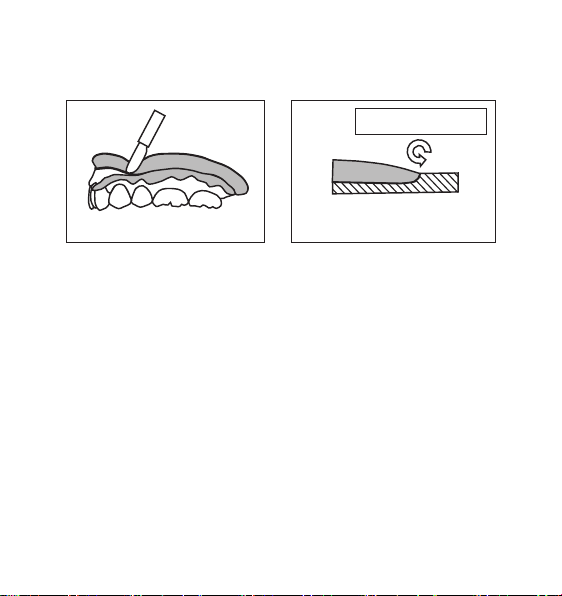
8. Ausarbeitung
Die Prothese aus dem Mund des Patienten nehmen, mit Wasser spülen und mit dem Luftbläser
trocknen. Vorsichtig alles überschüssige SOFRELINER TOUGH S Material mit einem scharfen
Skalpell vom Prothesenrand entfernen (siehe Abb. 3).
Rotationsrichtung
Unterfütterung
Prothese
Abbildung 3
9. Endbearbeitung
Verwenden Sie für die Formgebung die Formkorrekturspitze (schwarz, COARSE POINT).
Wenden Sie dabei leichten Druck an, Sie sollten jedoch nicht 15.000 rpm überschreiten und
erlauben Sie der Spitze kleine Kreisbewegungen. Zum Polieren wird die Finishing-Scheibe
(braun, FINISHING WHEEL) unter Anwendung eines leichten Drucks unterhalb von 8.000 rpm
verwendet.
Hinweis: Rotieren Sie die Formkorrekturspitze und die Finishing-Scheibe von der
Den RUNDEN DIAMANTBOHRER (gesondert verkauft) oder weiteren geeigneten Bohrer für
die Korrektur der Innenfläche verwenden.
10. Erneute Anpassung
Im Fall einer Weichteildeckung sollte eine paar Tage nach der ursprünglichen Behandlung ein
erneuter Zahnarztbesuch erfolgen. Die Prothese nach dem im Abschnitt 9 beschriebenen Verfahren
erneut anpassen. Falls weiteres Material auf die unterfütterte Oberfläche aufgebracht werden
muss, muss die vorhandene Unterfütterung entfernt und durch eine neue ersetzt werden.
11. Entfernung
Schneiden Sie einen großen Teil des SOFRELINER TOUGH S Materials mit einem scharfen
Instrument ab. Das verbleibende Material wird durch Fräsen entfernt.
Unterfütterung zur Prothese, um nicht den Übergangsbereich aufzubrechen (siehe
Abb. 4).
Abbildung 4
Page 40

Hinweis: SILICONE REMOVER (gesondert verkauft) entfernt ganz leicht altes
■
Silikonunterfütterungsmaterial von der Prothesenunterlage aus Acryl.
KLINISCHE ANWENDUNG DER LABOR-
UNTERFÜTTERUNGSMETHODE MIT SOFRELINER TOUGH S
1. Untersuchung des Mundes
Prüfen Sie den intraoralen Zustand durch Untersuchung und Palpation. Untersuchen Sie den
Bereich, in dem eine Korrektur der Innenfläche erforderlich ist.
2. Untersuchung der Prothese
Falls die Prothese abgenutzt oder alt ist, muss sie zuerst mit TOKUYAMA REBASE II, einem
harten Unterfütterungsmaterial, unterfüttert werden. Das harte Unterfütterungsmaterial sollte in
einer angemessenen Schichtdicke aufgetragen werden, damit (wie in Schritt 4 beschrieben)
ausreichend Substanz geschaffen wurde. Somit kann SOFRELINER TOUGH S darauf haften.
3. Herstellung eines Gipsmodells
Nehmen Sie einen Abdruck, bei dem der Patient auf die Prothese beißt. Gießen Sie dann den
Abdruck mit Hartgips aus. Fertigen Sie einen Gipsschlüssel der Zähne an und montieren Sie die
Prothese auf die Unterfütterungsvorrichtung. Blocken Sie das Gipsmodell in dem Bereich mit
Wachs aus, in dem evtl. Schmerzen im Mund entstehen könnten. Bringen Sie ein Trennmittel auf
den Kieferkamm des Gipsmodells auf, damit das Unterfütterungsmaterial nicht daran haftet.
4. Vorbereitung
Den gewebeseitigen Teil der Prothese mit einem Querhiebbohrer aus Karbid auf die richtige Tiefe
fräsen. Die Prothesenränder so abschrägen, dass 1 Millimeter des Materials an den Kanten
abgerundet hochragt (siehe Abb. 1). Den Frässtaub mit einem trockenen Pinsel oder einem
ölfreien Luftbläser entfernen.
Hinweis: Durch die Verwendung eines runden Bohrers kann auf einfache Weise eine
5. Den PRIMER entnehmen
Die PRIMER-Flasche öffnen. Die Tropfdüse auf der Flasche befestigen. Eine angemessene
Menge des PRIMERS in den Kunststoffbecher geben. Die Flasche sofort nach der Entnahme
wieder mit dem Deckel fest verschließen.
6. Den PRIMER auftragen
Mit dem PRIMER-Pinsel eine dünne, gleichmäßige Schicht PRIMER dort auf die Prothesenfläche
aufbringen, an der diese unterfüttert werden soll. Lassen Sie keine der Stellen aus, auf die der
einheitliche Tiefe des Harzes entfernt werden. Der Bohrerdurchmesser kann als
Hinweis auf die Tiefe der Bohrung dienen.
Page 41

PRIMER aufgetragen werden sollte, da dies zu einer verringerten Haftung führen kann. Trocknen
Sie daraufhin die Oberfläche gründlich mit dem Luftbläser bis keine Flüssigkeit mehr zu sehen ist.
7. Die PASTE entnehmen
Die Kartusche mit SOFRELINER TOUGH S PASTE in einen Spender stecken (gesondert
verkauft). Den Kartuschenverschluss der PASTE öffnen. Die Mischspitze auf der Kartusche
befestigen, indem Sie die Einkerbungen in Übereinstimmung bringen, die Mischspitze auf die
Kartusche drücken und diese 90° im Uhrzeigersinn drehen.
8. Die PASTE aufbringen
Die selbstmischende Paste herausdrücken und auf die Stellen auftragen, auf die zuvor der
PRIMER aufgebracht wurde. Geben Sie die Paste sowohl auf die zu unterfütternde Seite der
Prothese als auch auf das Gipsmodell.
9. Erneute Befestigung
Befestigen Sie die Prothese erneut auf dem entsprechenden Gipsmodell und drücken Sie sie mit
der Unterfütterungsvorrichtung an. Lassen Sie dies mindestens 20 Minuten lang bei
Raumtemperatur (23℃ / 73,4℉) ruhen.
Hinweis: Falls das ausgehärtete Material klebrig sein sollte, tauchen Sie die Prothese 5
10. Ausarbeitung
Nehmen Sie die Prothese vom Gipsmodell. Vorsichtig alles überschüssige SOFRELINER
TOUGH S Material mit einem scharfen Skalpell vom Prothesenrand entfernen (siehe Abb. 3).
11. Endbearbeitung
Verwenden Sie für die Formgebung die Formkorrekturspitze (schwarz, COARSE POINT).
Wenden Sie dabei leichten Druck an, Sie sollten jedoch nicht 15.000 rpm überschreiten und
erlauben Sie der Spitze kleine Kreisbewegungen. Zum Polieren wird die Finishing-Scheibe
(braun, FINISHING WHEEL) unter Anwendung eines leichten Drucks unterhalb von 8.000 rpm
verwendet.
Den RUNDEN DIAMANTBOHRER (gesondert verkauft) oder jegliches angemessenes Werkzeug
für die Korrektur der Innenfläche verwenden.
Minuten lang mit der Unterfütterungsvorrichtung in 40℃ bis 50℃ (104℉ to
122℉) warmes Wasser.
Hinweis: Rotieren Sie sowohl die Formkorrekturspitze als auch die Finishing-Scheibe von
der Unterfütterung zur Prothese, um nicht den Übergangsbereich aufzubrechen
(siehe Abb. 4).
Page 42

HINWEISE FÜR DEN PATIENTEN
■
Die Patienten sollten die folgenden Anweisungen erhalten, um die Langlebigkeit, Haltbarkeit und
Sicherheit einer mit SOFRELINER TOUGH S unterfütterten Prothese zu erhöhen:
1. SOFRELINER TOUGH S Unterfütterungsmaterial sollte nicht mit einer Prothesen- oder
Zahnbürste bearbeitet werden. Am besten wird SOFRELINER TOUGH S mit einem
Schwamm oder einer weichen Mullkompresse gereinigt. Die Oberfläche von SOFRELINER
TOUGH S unter fließendem kaltem Wasser mit einem eingeseiften Schwamm oder einer
eingeseiften Mullkompresse abreiben. Entfernen Sie alle Verschmutzungen und Speisereste
mit sanften Wischbewegungen vom SOFRELINER TOUGH S Unterfütterungsmaterial. Die
Zahnflächen und die harte Acrylprothesenbasis sollten durch Bürsten mit einer normalen
Prothesenbürste mit Seife, Prothesen-Zahnpasta oder einem üblichen Prothesenreiniger je nach
Ermessen des Zahnarztes gereinigt werden.
2. Die Prothese muss mindestens einmal täglich, vorzugsweise beim Schlafengehen, in einen
Prothesenreiniger mit Aktivsauerstoff gelegt werden (z.B. Polident, Efferdent usw.). Die
Prothese darf nicht mit einem derartigen Reiniger im Mund des Patienten gesäubert werden.
Bei Langzeitanwendung kann, je nachdem, wie gut der Patient seine Prothese pflegt, die Farbe
verblassen. Verwenden Sie den Prothesenreiniger im Einklang mit den Anweisungen des
Herstellers.
3. Das Eintauchen der Prothese in stark bleichende Lösungen kann die Farbe von SOFRELINER
TOUGH S verändern, beeinträchtigt aber nicht dessen Funktion.
4. Wenn die Prothese nicht getragen wird, sollte sie in Wasser aufbewahrt werden.
5. Die unterfütterte Prothese muss alle drei Monate oder wann immer Plaqueablagerungen
bemerkt werden vom Zahnarzt untersucht und mit Ultraschall gereinigt werden.
6. SOFRELINER TOUGH S muss regelmäßig auf Beschädigungen hin untersucht werden. Eine
Prothese mit verändertem, zerbrochenem, rissigem, losem oder beschädigtem
Unterfütterungsmaterial sollte nicht getragen werden. Wird eine beschädigte oder zerbrochene
Prothese getragen, kann dies zu Würgereiz, Aspiration, Erstickung oder anderen Beschwerden
führen.
7. Bei allen Anzeichen einer Überempfindlichkeit gegen Silikon sollte die Prothese nicht mehr
getragen werden und der Patient sollte sofort den Zahnarzt informieren.
Der Anwender und/oder Patient sollte dem Hersteller und der zuständigen Behörde des
Mitgliedstaats, in dem der Anwender und/oder Patient ansässig ist, jeden schwerwiegenden
Zwischenfall melden, der im Zusammenhang mit dem Produkt aufgetreten ist.
Page 43
WICHTIGER HINWEIS: Der Hersteller von SOFRELINER TOUGH S ist nicht verantwortlich
für Schäden oder Verletzungen, die durch unsachgemäße Anwendung dieses Produkts verursacht
werden. Es obliegt der persönlichen Verantwortung des Anwenders, die Eignung dieses Produkts
für eine entsprechende Anwendung vor dem Gebrauch sicherzustellen.
Die Produktspezifikationen von SOFRELINER TOUGH S können ohne Vorankündigung geändert
werden. Bei Änderungen der Produktspezifikationen können sich die Anweisungen und
Vorsichtsmaßnahmen ebenfalls ändern.
EESTI KEEL
Lugege enne SOFRELINER TOUGH S-i kasutamist kogu see juhend läbi.
TOOTE KIRJELDUS JA ÜLDINE TEAVE
■
1. SOFRELINER TOUGH S on hambaravikabinettides kasutatav lisaainete abil kõvastuvast
silikoonist pehme voodrimaterjal eemaldatavatele hambaproteesidele. SOFRELINER TOUGH
S vastab standarditele ISO 10139-2 „Eemaldatavate hambaproteeside pehmed
voodrimaterjalid. Osa 2: materjalid pikaajaliseks kasutamiseks” ja ISO10139-1 „Eemaldatavate
hambaproteeside pehmed voodrimaterjalid. Osa 1: materjalid lühiajaliseks kasutamiseks”.
2. SOFRELINER TOUGH S-i komplekt sisaldab PASTE’I, PRIMERIT ja muid tarvikuid, nt
segamisotsi, tilgutusotsakut, tilgutustopsi, harju, COARSE POINTI (must), FINISHING
WHEELI (pruun).
3. PRIMERIT kasutatakse ainult akrüülpindade kinnituseks. Seda ei saa kasutada nailon-, metallja silikoonpindade kinnitamiseks. PASTE väljutatakse automaatsegamisega padrunisüsteemi
kaudu. Materjal tardub suus 5 minutiga või toatemperatuuril (23°C / 73,4°F) 20 minutiga ning
on lõhnatu ja maitsetu.
NÄIDUSTUSED
■
1. Alveolaarluu teravate servade ja limaskesta atroofia poolt põhjustatud valu.
2. Serva raske atroofia põhjustatud halb püsivus.
3. Üla-/alalõua pindade suured õõnsused.
4. Hambaproteeside paigalhoidmine lõpliku kinnituse paikapanekuni.
5. Ajutine voodri või koe parandamine.
VASTUNÄIDUSTUSED
■
SOFRELINER TOUGH S on vastunäidustatud patsientidel, kes on silikooni- ja plaatinaainete
Page 44

suhtes allergilised või ülitundlikud, ning seda EI tohiks neil patsientidel kasutada.
ETTEVAATUSABINÕUD
■
1. SOFRELINER TOUGH S on välja töötatud müügiks ja kasutamiseks ainult litsentsitud
hambaravispetsialistide poolt. See ei ole mõeldud müügiks ega sobi kasutamiseks isikutele,
kes ei ole hambaravispetsialistid.
2. Kasutage SOFRELINER TOUGH S-i ainult nii, nagu siin kirjeldatud. ÄRGE kasutage
SOFRELINER TOUGH S-i muudel eesmärkidel kui selles juhendis kirjeldatud.
3. ÄRGE kasutage SOFRELINER TOUGH S-i, kui kaitsetihend on katki või paistab, et sisu on
muudetud.
4. PRIMER sisaldab etüülatsetaati, mis on kergesti süttiv ja lenduv lahusti. Ärge laske
PRIMERIL lahtise tulega kokku puutuda. Kasutage hästi õhutatud ruumis ja sulgege pärast
kasutamist kork tihedalt.
5. Kui patsiendil tekib SOFRELINER TOUGH S-i suhtes allergiline reaktsioon või tundlikkus, nt
dermatiidi ägenemine, eemaldage protees ja lõpetage kohe selle kasutamine.
6. Kasutage SOFRELINER TOUGH S-iga kokkupuutel alati lateksivabu kaitsekindaid, et vältida
võimalikke allergilisi reaktsioone. Latekskindad võivad takistada SOFRELINER TOUGH S-i
tardumist. Kui SOFRELINER TOUGH S PRIMER puutub kaitsekinnastega kokku, visake
kindad kohe ära ja peske käsi põhjalikult veega.
7. Vältige kokkupuudet silmadega. Kokkupuutel silmadega loputage silmi põhjalikult veega ja
pöörduge kohe arsti poole.
8. Vältige tardumata kemikaali kokkupuudet nahaga. Kokkupuutel nahaga puhastage
kokkupuutepiirkond piiritusega ning loputage siis põhjalikult veega.
9. Vältige tardumata materjalide kokkupuudet riietega. Kokkupuutel riietega ärge pühkige
materjali ära. Laske sellel tarduda ja koorige see siis riietelt ära.
10. ÄRGE laske liigsel materjalil voolata patsiendi hingetorusse ega söögitorusse. Aspireerimisel
või allaneelamisel võib SOFRELINER TOUGH S PASTE põhjustada lämbumise või muid
vigastusi. Eemaldage liigne voodrimaterjal kohe suulae piirkonnast, et vältida materjali
voolamist patsiendi kurku. SOFRELINER TOUGH S ei ole röntgenkiirgust läbilaskmatu ning
radioloogilised uuringud ei tuvasta aspireeritud ega allaneelatud materjali. Eaka patsiendi
jaoks, kelle refleksid on piiratud, seadke tool püstiasendisse ning suunake patsient hingama
läbi nina, et vältida materjali sattumist hingamisteedesse.
11. ÄRGE segage SOFRELINER TOUGH S-i materjalidega, mida ei ole selles juhendis
kirjeldatud.
Page 45

12. Pärast SOFRELINER TOUGH S-i padruni kasutamist tuleb segamisots vahetada padruni korgi
vastu, mis on padruniga ostmisel kaasas. Pühkige liigne pasta padruni otsalt puhta lapi või
salvrätikuga ära iga kord enne uue segamisotsa kasutamist või padrunikorgi vahetamist.
13. Puhastage ristsaastumise vältimiseks spaatel, harjad ja topsid pärast iga kasutuskorda
alkoholiga.
14. Juhendage patsiente selle juhendi viimases osas toodud PATSIENDI
ETTEVAATUSABINÕUDE järgi.
15. Kandke viimistluse ajal tolmu sissehingamise vältimiseks alati föderaal- ja/või kohalikes
eeskirjades soovitatud maski.
16. Lugege kõigi selles juhendis mainitud toodete, mida ei ole selles komplektis, tootjate juhiseid
ja järgige neid.
17. Vältige nii palju kui võimalik SOFRELINER TOUGH S-i kokkupuudet suu limaskestaga
piirkondades, kuhu voodrit ei panda. Käskige patsientidel kohe pärast ravi suud piisava koguse
veega loputada.
18. Ärge laske PRIMERIL plastikmaterjalidega otseselt kokku puutuda; kokkupuutel võivad
mõned plastikutüübid lahustuda.
MÄRKUSED KASUTAMISEKS
■
1. Halvasti istuvate hambaproteeside korral vooderdage protees kõigepealt akrüülmaterjaliga, nt
TOKUYAMA REBASE II-ga, hambaravikabinetis kasutatava kõva hambaproteeside
vooderdusmaterjaliga või tehke sobivuse parandamiseks muid labori-/kaudseid protseduure.
2. Vana kulunud proteesi puhul tuleks vooderdatav pind kõigepealt vooderdada uue
akrüülmaterjaliga, kuna vanasse kulunud polümeeri imendunud ained nagu rasu või vesi
vähendavad SOFRELINER TOUGH S-i kinnituvust.
3. Kui SOFRELINER TOUGH S PRIMER muutub lenduvuse tõttu paksuks, ärge kasutage seda,
kuna kinnituvuse tugevus võib olla vähenenud.
4. Pühkige alussegu harja otsa pärast iga kasutuskorda alkoholis leotatud vatitupsu või marliga.
Saastunud hari võib vähendada SOFRELINER TOUGH S-i kinnituvust.
5. Ärge segage pastasid käsitsi; see võib põhjustada õhumullide segunemise pastasse, millega
võib kaasneda riknemine, plekid ja ebameeldiv lõhn.
6. Vältige SOFRELINER TOUGH S-i kokkupuudet alltoodud materjalidega, kuna need võivad
takistada SOFRELINER TOUGH S-i tardumist.
Silikoonipõhised jäljendimaterjalid, eugenooli sisaldavad materjalid, polüsulfiidkummist
jäljendimaterjalid, naturaalsest kummist kindad, teiste tootjate pehmed voodrimaterjalid ja
Page 46
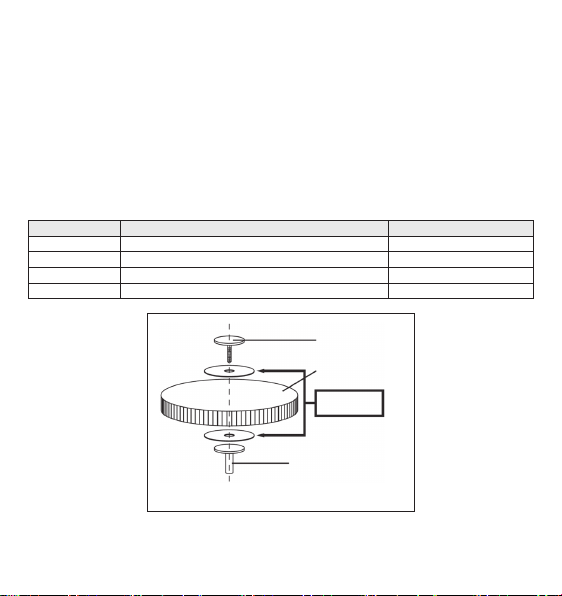
kõvastumata akrüülipolümeerid.
7. Materjal tardub suus 5 minutiga või toatemperatuuril (23°C / 73,4°F) 20 minutiga. 24 tunni
pärast muutub vooder veidi tugevamaks. Viimistlusprotseduuri saab teha kohe pärast uue
voodriga proteesi eemaldamist suust või kipsmudelilt.
8. Proteesi leotamine tugevat valgendit sisaldavates lahustes võib muuta SOFRELINER TOUGH
S-i värvi, kuid ei mõjuta selle toimimist.
9. Suunake patsient proteesi puhastama, nagu PATSIENDI ETTEVAATUSABINÕUDES
kirjeldatud.
10. Kuna silikoonipõhine sobivuse kontrollimise materjal jääb SOFRELINER TOUGH S-i külge
kinni, pange enne kasutamist pinnale vaseliini.
11. Kui valmis voodris on pragu, eemaldage see täielikult ja korrake protseduuri.
12. Kasutage kuju muutmiseks ja viimistluseks järgmisi tööriistu.
Etapid Tööriistad Kujud
Kärpimine Terav skalpell Kergelt ümara kujuga tera
Kuju muutmine COARSE POINT (must) Ümar koonusjas ots
Viimistlus FINISHING WHEEL (pruun) Ratas
Vabastus DIAMOND ROUND BUR (müüakse eraldi) Ümar
Kruvi
Viimistlusratas
Seib
Spindel
Viimistlusratas
HOIUSTAMINE
■
1. Hoiustage SOFRELINER TOUGH S-i temperatuuril vahemikus 0–25°C (32–77°F).
Page 47

2. Vältige SOFRELINER TOUGH S-i otsest kokkupuudet valguse, lahtise tule, niiskuse ja
päikesevalgusega.
3. ÄRGE kasutage SOFRELINER TOUGH S-i pärast selle realiseerimiskuupäeva.
4. Eksliku allaneelamise vältimiseks ÄRGE jätke SOFRELINER TOUGH S-i põhjuseta
patsientide ega laste käeulatusse.
KÕRVALDAMINE
■
1. PASTE’I kõrvaldamiseks väljutage kasutamata pasta padrunist ja laske sellel enne äraviskamist
tarduda.
2. PRIMERI vedeliku jäägid tuleks imada inertsesse imavasse materjali, nt marlisse või vatti,
ning kõrvaldada viisil, mis on kooskõlas kohalike eeskirjadega.
SOFRELINER TOUGH S-I SUUSISESE VOODERDUSMEETODI
■
KLIINILINE RAKENDUS
Enamikul juhtudest peaks SOFRELINER TOUGH S-i optimaalne paksus olema 1–2 millimeetrit.
Kui vajalik on paksus üle 2 millimeetri, tuleks vastav piirkond kõigepealt vooderdada
hambaravikabinetis kasutatava kõva hambaproteesivoodriga TOKUYAMA REBASE II, et tagada
piisavalt tugev proteesipõhi. Liigne proteesipolümeeri eemaldamine võib põhjustada
hambaproteesi mõranemist ja nõrgenemist.
1. Ettevalmistus
Kontrollige suu seisukorda seestpoolt vaatluse ja palpeerimise teel. Eemaldage hambaprotees
patsiendi suust ja puhastage vooderdatav piirkond seebi ja veega. Loputage põhjalikult ja
kuivatage hambaproteesi pind täielikult õhuga. Lihvige hambaproteesi koepoolset osa ristlõike
karbiidpuuriga õige sügavuse saavutamiseni. Kallutage proteesi servi, et materjal saaks 1
millimeetri ulatuses üle servade rulluda (vt joonist 1). Eemaldage lihvimistolm kuiva harja või
kuiva õlivaba õhuga.
Märkus: kui serv asub proteesipõhja ääriku sees, lihvige õige sügavuse saavutamiseks
hambaproteesi koepoolset külge ümara puuriga (akrüülpolümeeri puhul) (vt joonist
2).
Page 48
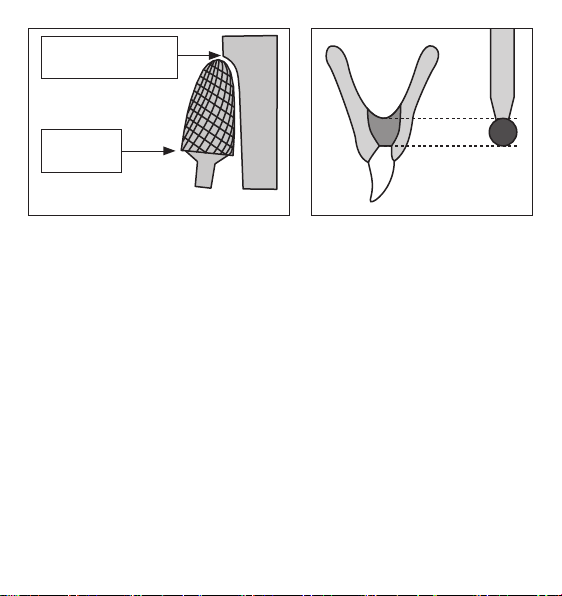
Piir voodrimaterjali ja
proteesipõhja vahel
Ristlõike
karbiidpuur
Joonis 1
2. PRIMERI väljutamine
Avage PRIMERI pudel. Kinnitage tilgutusotsak pudelile. Väljastage vajalik kogus PRIMERIT
tilgutustopsi. Pange kork uuesti peale ja sulgege pudel kindlalt kohe pärast segu väljastamist.
3. PRIMERI pealekandmine
Kandke õhuke ühtlane kiht PRIMERI selleks ettenähtud pintsliga hambaproteesi pinnale, mida
SOFRELINER TOUGH S-iga vooderdatakse. Ärge jätke vahele ühtegi kohta, kuhu PRIMER
tuleks peale kanda, kuna see võib põhjustada nõrka kinnitumist. Seejärel kuivatage pind
põhjalikult õhuga, kuni vedelikujääke ei ole enam näha.
4. PASTE’I väljastamine
Pange SOFRELINER TOUGH S PASTE’I padrun jaoturisse (müüakse eraldi). Avage PASTE’I
padruni kork. Kinnitage segamisots padrunile, joondades sälgud; lükake see padrunile, pöörates
segamisotsa 90 kraadi päripäeva.
5. PASTE’I pealekandmine
Pressige segatud pasta ühtlaselt hambaproteesi koepoolsele küljele. Jaotage pasta spaatli abil
ühtlaselt kõigile pindadele, mis on kaetud PRIMERIGA.
Märkus: kui mõnda alusseguga kaetud pinna osa ei kaeta selles etapis pastaga, võib see
6. Suhupanek
Imege liigne sülg patsiendi suust välja. 1,5–2 minutit pärast SOFRELINER TOUGH S-i segamist
saavutab materjal piisava viskoossuse. Hambaproteesi patsiendile suhu pannes laske patsiendil
hambad väga õrnalt keskel õige vertikaalse mõõtmega kokku suruda. Kontrollige, et patsiendi suus
piirkond suhupanemisel saastuda süljega, põhjustades nõrka kinnitumist.
Joonis 2
Page 49
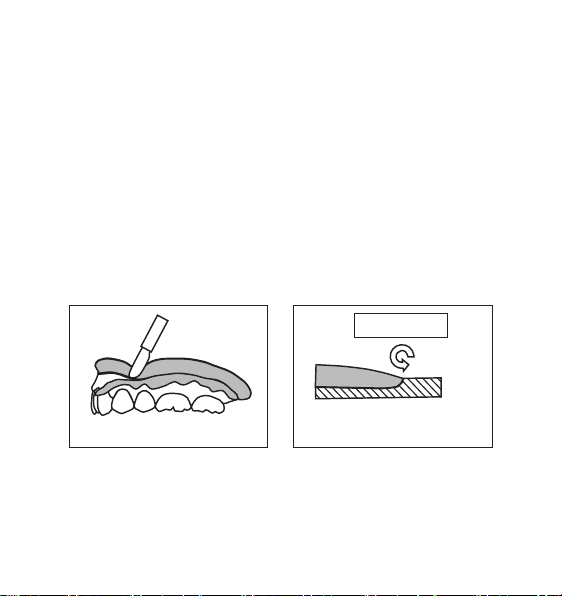
ei oleks liigset SOFRELINER TOUGH S-i ja eemaldage see kohe. Soovitage patsientidel
hambaarstile kohe teada anda, kui nad tunnevad, et SOFRELINER TOUGH S või muu materjal
voolab kurgu poole.
Märkus: ülemiste hambaproteeside vooderdamiseks SOFRELINER TOUGH S-iga sisestage
7. Äärte vormimine
Esiosa serva vormimiseks tõmmake põski väga õrnalt, samal ajal kui patsient hambaid õrnalt
kokku surub. Süljeerituse korral imege sülg välja ja laske patsiendil hammaste õrna kokkusurumist
jätkata. SOFRELINER TOUGH S peaks saama vähemalt 5 minutit suus tarduda.
8. Kärpimine
Eemaldage hambaprotees patsiendi suust, loputage veega ja kuivatage õhuga. Kärpige kogu
üleliigne materjal SOFRELINER TOUGH S servade piirkonnast terava skalpelliga (vt joonist 3).
protees posterioorse suulaepiirkonna kaudu, et vältida materjali SOFRELINER
TOUGH S voolamist patsiendi kurku.
Suulaepiirkonna vooderdamisel vältige liigse pasta kandmist vooderdatavale
piirkonnale ning pange protees võimalikult kiiresti suhu, et vältida liiga paksu voodri
tegemist.
Märkus: väljavõtmine enne 5 minuti möödumist võib voodri kuju moonutada.
Pöörde suund
Vooder
Hambaprotees
Joonis 3
9. Viimistlus
Vormimiseks kasutage COARSE POINTI (must), rakendades kerget survet, ületamata 15 000
pööret minutis, lastes otsal liikuda väikeses ringis. Viimistluseks kasutage FINISHING WHEELI
(pruun), rakendades kerget survet, ületamata 8000 pööret minutis.
Märkus: pöörake COARSE POINTI ja FINISHING WHEELI vooderdatud alalt proteesiala
suunas, et mitte murda piiriala (vt joonist 4).
Joonis 4
Page 50

Kasutage DIAMOND ROUND BURI (müügil eraldi) või muud vabastuseks sobivat puuri.
10. Ümberkujundamine
Koe parandamise korral tuleks uus ülevaatus teha mõned päevad pärast esialgset ravi. Kujundage
hambaprotees ümber jaotises 9 kirjeldatud protseduuri järgi. Kui vooderdatud pinnale lisatakse uut
materjali, eemaldage olemasolev vooder proteesipõhjalt ja asendage uuega.
11. Eemaldus
Eemaldage suur kogus SOFRELINER TOUGH S-i materjali, lõigates seda terava instrumendiga.
Eemaldage ülejäänud materjal lihvides.
Märkus: SILICONE REMOVER (müügil eraldi) eemaldab kergesti hambaproteesi vana
■
silikoonvoodri akrüülist proteesipõhjalt.
SOFRELINER TOUGH S-I LABORATOORSE
VOODERDUSMEETODI KLIINILINE RAKENDUS
1. Suu läbivaatus
Kontrollige suu seisukorda seestpoolt vaatluse ja palpeerimise teel. Vaadake üle, milline piirkond
vajaks vabastust.
2. Proteesi ülevaatus
Vana või kulunud hambaproteesi korral vooderdage protees kõigepealt TOKUYAMA REBASE IIga, hambaravikabinetis kasutatava kõva hambaproteeside vooderdusmaterjaliga. Kõva
voodrimaterjali peaks peale kandma sobiva paksusega, et uue materjali paikapanekul etapis 4
kirjeldatud protseduuri järgi jääks uus kõva voodrimaterjali kiht proteesi kandealale, võimaldades
SOFRELINER TOUGH S-il sellele kinnituda.
3. Kipsmudeli kokkupanek
Võtke jäljend, kui patsient hammustab hambaproteesiga kokku, ning valage siis jäljendisse
kivimörti. Tehke hammastest kivinäidis ja pange hambaprotees vooderduse gabariidi näidisele.
Lõdvendage kivimudelit vahaga piirkonnas, kus see võib suus valu põhjustada. Pange kipsmudeli
serva piirkonda eraldusbarjäär, et voodrimaterjal selle külge ei kinnituks.
4. Ettevalmistus
Lihvige hambaproteesi koepoolset osa ristlõike karbiidpuuriga õige sügavuse saavutamiseni.
Kallutage proteesi servi, et materjal saaks 1 millimeetri ulatuses üle servade rulluda (vt joonist 1).
Eemaldage lihvimistolm kuiva harja või kuiva õlivaba õhuga.
Märkus: ümara puuri kasutamine muudab polümeeri eemaldamise ühtlaselt sügavuselt
lihtsaks. Puuri diameetrit saab kasutada sügavuse suunisena.
Page 51

5. PRIMERI väljutamine
Avage PRIMERI pudel. Kinnitage tilgutusotsak pudelile. Väljastage vajalik kogus PRIMERIT
tilgutustopsi. Pange kork uuesti peale ja sulgege pudel kindlalt kohe pärast segu väljastamist.
6. PRIMERI pealekandmine
Kandke õhuke ühtlane kiht PRIMERI selleks ettenähtud pintsliga hambaproteesi pinnale, mida
SOFRELINER TOUGH S-iga vooderdatakse. Ärge jätke vahele ühtegi kohta, kuhu PRIMER
tuleks peale kanda, kuna see võib põhjustada nõrka kinnitumist. Seejärel kuivatage pind
põhjalikult õhuga, kuni vedelikujääke ei ole enam näha.
7. PASTE’I väljastamine
Pange SOFRELINER TOUGH S PASTE’I padrun jaoturisse (müüakse eraldi).
Avage PASTE’I padruni kork. Kinnitage segamisots padrunile, joondades sälgud; lükake see
padrunile, pöörates segamisotsa 90 kraadi päripäeva.
8. PASTE’I pealekandmine
Suruge segatud pasta pinnale, kuhu PRIMER on peale kantud. Pange pastat nii hambaproteesi kui
kivimudeli limaskestapoolsele küljele.
9. Uuesti kinnitamine
Kinnitage hambaprotees uuesti kipskivimudelile ja vajutage seda voodri gabariidiga. Jätke see 20
minutiks või kauemaks toatemperatuurile (23°C/73,4°F) seisma.
Märkus: kui tardunud materjal on kleepuv, leotage hambaproteesi soojas vees 5 minutit
10. Kärpimine
Eemaldage hambaprotees kipsmudelilt. Kärpige kogu üleliigne materjal SOFRELINER TOUGH S
servade piirkonnast terava skalpelliga (vt joonist 3).
11. Viimistlus
Vormimiseks kasutage COARSE POINTI (must), rakendades kerget survet, ületamata 15 000
pööret minutis, lastes otsal liikuda väikeses ringis. Viimistluseks kasutage FINISHING WHEELI
(pruun), rakendades kerget survet, ületamata 8000 pööret minutis.
Kasutage DIAMOND ROUND BURI (müügil eraldi) või muud vabastuseks sobivat puuri.
■
1. Patsiente tuleks teavitada järgmistest juhtnööridest, et parandada SOFRELINER TOUGH
temperatuuril 40°C kuni 50°C (104°F kuni 122°F) koos voodri gabariidiga.
Märkus: pöörake nii COARSE POINTI kui FINISHING WHEELI vooderdatud alalt
proteesiala suunas, et mitte murda piiriala (vt joonist 4).
PATSIENDI ETTEVAATUSABINÕUD
S-iga vooderdatud proteeside tööiga, vastupidavust ja ohutust.
Page 52

SOFRELINER TOUGH S-i voodrimaterjali ei tohiks hõõruda proteesi- ega hambaharjaga.
Parim viis SOFRELINER TOUGH S-i puhastamiseks on käsnaga või pehme marlitükiga.
Pühkige SOFRELINER TOUGH S-i pinda seebise käsna või marliga, lastes sellele samal ajal
külma vett voolata. Eemaldage õrnalt pühkides SOFRELINER TOUGH S-i voodrimaterjalilt
kogu mustus ja toidujäägid. Hammaste pinda ja kõva akrüülist proteesipõhja võib puhastada
tavalise proteesiharjaga hõõrudes, kasutades hambaarsti soovituse järgi proteesidele mõeldud
hambapastat või tavalisi proteesipuhastusvahendeid.
2. Leotage hambaproteese vähemalt kord päevas, soovitavalt uneajal, hapnikuga küllastavas
proteesipuhastusvahendis (nt Polident, Efferdent jne). Hambaproteese ei tohiks hapnikuga
küllastava puhastusvahendiga puhastada patsiendi suus. Pikaajalisel kasutamisel võib olenevalt
patsiendi proteesihooldusest tekkida värvi tuhmumine. Kasutage proteesipuhastusvahendit
selle tootja juhiste järgi.
3. Proteesi leotamine tugevat valgendit sisaldavates lahustes võib muuta SOFRELINER TOUGH
S-i värvi, kuid ei mõjuta selle toimimist.
4. Kui hambaproteese ei kanta, tuleks neid hoida vees.
5. Katu kogunemise märkamisel või iga kolme kuu järel tuleks vooderdatud hambaproteese
hambaarsti juures kontrollida ja ultrahelimeetodil puhastada.
6. SOFRELINER TOUGH S-i tuleb sageli kahjustuste suhtes kontrollida. Vigase, katkise,
pragunenud, lahtise või kahjustatud voodriga hambaproteese ei tohiks kanda.
Kahjustatud või katkise hambaproteesi kasutamine võib põhjustada lämbumise, aspiratsiooni,
hingamistakistuse või muu vigastuse.
7. Silikoonitundlikkuse tunnuste ilmnemisel tuleks hambaproteesi kasutamine lõpetada ja patsient
peaks kohe pöörduma oma hambaarsti poole.
Kasutaja ja/või patsient peavad tootjat ning kasutaja ja/või patsiendi elukohariigi pädevat asutust
teavitama seadmega seoses tekkinud mis tahes rasketest juhtumitest.
OLULINE MÄRKUS: SOFRELINER TOUGH S-i tootja ei vastuta selle toote valest kasutamisest
põhjustatud kahjustuste ega vigastuste eest. Toote kasutuskõlblikkuses veendumine enne selle
sihtotstarbelist kasutamist on kasutaja isiklik kohustus.
SOFRELINER TOUGH S-i tehnilised andmed võivad muutuda ette teatamata. Kui toote tehnilised
andmed muutuvad, võivad muutuda ka juhendid ja ettevaatusabinõud.
Page 53
FRANÇAIS
Lire soigneusement toutes les instructions avant d’utiliser SOFRELINER TOUGH S.
DESCRIPTION DU PRODUIT ET INFORMATION GÉNÉRALE
■
1. SOFRELINER TOUGH S est un silicone souple par addition destiné au rebasage des prothèses
dentaires au fauteuil. SOFRELINER TOUGH S est conforme à la norme ISO 10139-2
« Matériaux de revêtement souple pour prothèses dentaires Partie 2 : Matériaux pour usage à
long terme » et à la norme ISO 10139-1 « Matériaux de revêtement souple pour prothèses
dentaires Partie 1 : Matériaux pour usage à court terme ».
2. Le kit SOFRELINER TOUGH S contient de la pâte [PASTE], du primaire [PRIMER] et d’autres
accessoires tels que canules de mélange, compte-gouttes, coupelle, brosses, pointe de modelage
(noire, COARSE POINT), roue de finition (marron, FINISHING WHEEL).
3. Le primaire [PRIMER] n’est utilisé que pour le collage sur des surfaces acryliques. Il ne doit
pas être utilisé pour le collage sur des surfaces en nylon, en métal et en silicone. La pâte
[PASTE] est conditionnée dans une cartouche auto-mélangeuse. Le matériau durcit en 5
minutes en bouche ou en 20 minutes à température ambiante (23℃ / 73,4℉) et n’a ni odeur ni
goût.
INDICATIONS
■
1. Douleurs causées par des crêtes saillantes de l’os alvéolaire et une atrophie des muqueuses.
2. Mauvaise rétention provoquée par une atrophie extrême de la crête alvéolaire.
3. Contre-dépouilles majeures ou tori maxillaire/mandibulaire.
4. Rétention des prothèses avant la mise en place de l’attachement définitif.
5. Rebasage temporaire ou conditionnement des tissus.
CONTRE-INDICATIONS
■
SOFRELINER TOUGH S est contre-indiqué chez les patients allergiques (hypersensibilité) aux
composants du silicone et du platine. Il NE faut PAS l’utiliser sur ces patients.
PRÉCAUTIONS
■
1. SOFRELINER TOUGH S est prévu pour être vendu et utilisé exclusivement par des
professionnels des soins dentaires. Il n’est pas prévu pour être vendu ni utilisé par d’autres
personnes.
2. N’utiliser SOFRELINER TOUGH S que selon les instructions contenues dans cette notice.
Page 54

NE PAS utiliser SOFRELINER TOUGH S pour une application qui n’est pas citée dans ces
instructions.
3. NE PAS utiliser SOFRELINER TOUGH S si le sceau de sécurité est rompu ou si le produit n’est
pas intact.
4. Le primaire [PRIMER] contient de l’éthylacétate, qui est un solvant très inflammable et
volatile. Ne pas exposer le primaire à une flamme nue. Utiliser le produit dans une pièce
ventilée et bien fermer le capuchon après utilisation.
5. Si le patient a une réaction allergique au SOFRELINER TOUGH S, telle qu’une dermatite de
contact, enlever la prothèse et en interrompre immédiatement l’utilisation.
6. Porter des gants d’examen sans latex pendant toute la durée d’utilisation de SOFRELINER
TOUGH S afin de prévenir les réactions allergiques. Les gants en latex peuvent aussi
empêcher le durcissement de SOFRELINER TOUGH S. Si le primaire SOFRELINER
TOUGH S entre en contact avec les gants d’examen, jeter immédiatement les gants et se laver
soigneusement les mains à l’eau.
7. Éviter tout contact avec les yeux. En cas de contact avec les yeux, bien les rincer à l’eau et
contacter immédiatement un médecin.
8. Éviter de mettre en contact avec la peau le produit chimique non polymérisé. En cas de
contact avec la peau, nettoyer la zone touchée en la frottant légèrement à l’alcool puis bien
rincer à l’eau.
9. Éviter de mettre en contact avec les vêtements les matériaux non polymérisés. En cas de
contact avec les vêtements, ne pas essuyer le matériau. Attendre qu’il durcit avant de l’enlever.
10. NE PAS laisser du matériau excédentaire couler dans la trachée ou l’œsophage du patient. La
pâte SOFRELINER TOUGH S aspirée ou ingérée peut causer une asphyxie ou blesser le
patient. Enlever immédiatement de la région palatine tout matériau de rebasage excédentaire
afin d’éviter que le matériau ne coule dans la gorge du patient. SOFRELINER TOUGH S n’est
pas opaque aux rayons X : si du materiau est aspiré ou ingéré, une radiographie ne permettra
pas de le déceler. En cas de patient âgé dont les réflexes sont amoindris, mettre le fauteuil en
position relevée et demander au patient de respirer par le nez pour éviter toute pénétration dans
les voies aériennes.
11. NE PAS mélanger SOFRELINER TOUGH S avec des matériaux qui ne sont pas cités dans ces
instructions.
12. Après avoir utilisé la cartouche SOFRELINER TOUGH S, il faut remplacer la canule de
mélange par le capuchon qui est fourni avec la cartouche. Nettoyer la pointe de la cartouche
avec un tissu propre avant chaque utilisation d’une canule de mélange neuve et chaque mise en
Page 55

place du bouchon.
13. Toujours nettoyer la spatule, les brosses et les coupelles à l’alcool après chaque utilisation pour
prévenir une contamination croisée.
14. Informer le patient des PRÉCAUTIONS à prendre indiquées dans la dernière section de cette
notice.
15. Pour éviter d’inhaler de la poussière pendant le polissage, toujours porter un masque
conformément aux règlementations nationales et/ou locales.
16. Lire et suivre les instructions des fabricants de tous les produits qui sont cités dans cette notice
mais ne font pas partie du kit.
17. Autant que possible, éviter tout contact avec les muqueuses buccales qui sont extérieures à la
zone de rebasage. Dire aux patients de bien se rincer la bouche à l’eau après la procédure.
18. Ne pas mettre le primaire [PRIMER] en contact avec du plastique car il peut dissoudre certains
types de plastique.
REMARQUES CONCERNANT L’UTILISATION
■
1. En cas de prothèse mal fixée, rebaser d’abord l’ancienne prothèse dentaire avec un matériau
acrylique, par exemple TOKUYAMA REBASE II, matériau à consistance dure pour le
rebasage des prothèses dentaires au fauteuil ou toute autre procédure indirecte/de laboratoire
pour améliorer la fixation.
2. En cas d’ancienne prothèse usée, rebaser d’abord l’ancienne prothèse dentaire avec un nouveau
matériau acrylique car les éléments absorbés par l’ancienne résine usée tels que la graisse et
l’eau réduisent l’adhérence de SOFRELINER TOUGH S.
3. Si la consistance du primaire SOFRELINER TOUGH S devient épaisse par volatilisation, ne
pas l’utiliser, cela pourrait réduire sa force d’adhésion.
4. Concernant la brosse pour le primaire, essuyer l’extrémité avec un coton tige ou de la gaze
imbibée d’alcool après chaque utilisation. Une brosse souillée peut réduire l’adhérence de
SOFRELINER TOUGH S.
5. Ne pas mélanger les pâtes à la main car cela pourrait enfermer des bulles d’air dans la pâte,
entraînant une détérioration, des taches et une odeur désagréable.
6. Éviter tout contact de SOFRELINER TOUGH S avec les matériaux ci-dessous, car ils peuvent
empêcher le durcissement de SOFRELINER TOUGH S :
matériaux à empreinte à base de silicone, matériaux contenant de l’eugénol, matériaux à
empreinte au polysulfure, gants en caoutchouc naturel, matériaux souples de rebasage d’autres
fabricants et résines acryliques non durcies.
Page 56
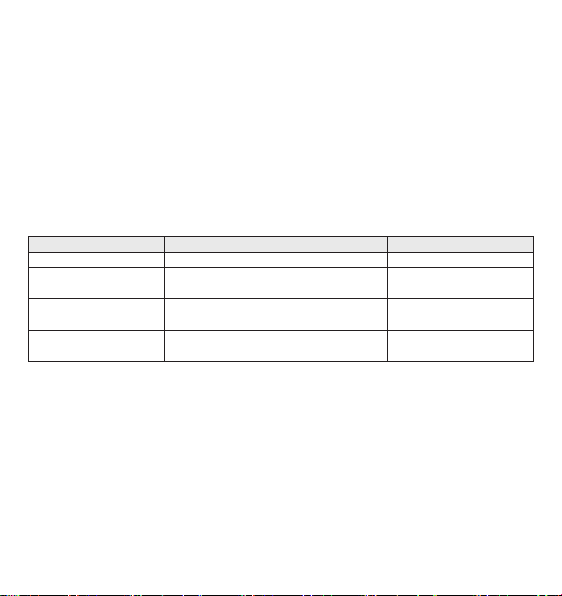
7. Le matériau durcit en 5 minutes en bouche ou en 20 minutes à température ambiante (23℃ /
73,4℉). Le durcissement est achevé 24 heures après le rebasage. La procédure de finition
peut être réalisée immédiatement après retrait de la prothèse de la bouche du patient ou du
modèle en plâtre.
8. L’immersion de la prothèse dans des solutions de nettoyage fortement chlorées peut modifier
la teinte de SOFRELINER TOUGH S mais elle est sans effet sur l’utilisation de la prothèse.
9. Donner au patient des consignes de nettoyage de la prothèse conformément à la section
MESURES DE PRÉCAUTION A L’ATTENTION DES PATIENTS.
10. Le matériau de test à base de silicone (fit check) adhère à SOFRELINER TOUGH S ; il
convient donc d’appliquer de la vaseline sur la surface avant utilisation.
11. En présence d’une fracture dans le rebasage fini, enlever l’intégralité du rebasage et
recommencer la procédure.
12. Se reporter aux outils suivants pour le modelage et la finition.
Étapes Matériaux Formes
Ébarbage Scalpel aiguisé Lame légèrement arrondie
Modelage
Finition
Ajustement de la surface
interne (relief)
Pointe de modelage (noire, COARSE
POINTE)
Roue de finition (marron, FINISHING
WHEEL)
Fraise ronde en diamant (vendue
séparément, DIAMOND ROUND BUR)
Extrémité conique
Roue
Arrondie
Page 57
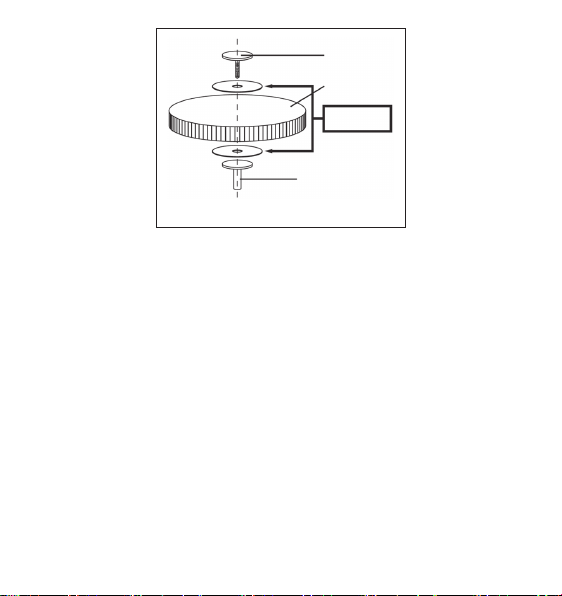
Vis
Roue de
finition
Rondelle
Mandrin
Roue de finition
STOCKAGE
■
1. Stocker SOFRELINER TOUGH S à une température comprise entre 0 et 25℃ (32 et 77℉).
2. Éviter d’exposer directement SOFRELINER TOUGH S à la chaleur, à une flamme nue, à
l’humidité ou aux rayons du soleil.
3. Ne pas utiliser SOFRELINER TOUGH S après la date de péremption indiquée.
4. NE PAS laisser SOFRELINER TOUGH S à portée des patients, en particulier des enfants,
pour éviter qu’ils ne l’avalent par erreur.
ÉLIMINATION
■
1. Pour éliminer la pâte [PASTE], faire sortir de la cartouche la pâte inutilisée et la faire durcir
avant de la jeter.
2. Absorber le primaire [PRIMER] résiduel (liquide) avec un matériau absorbant et inerte tel que
de la gaze ou du coton et jeter conformément aux règlementations locales et en vigueur.
APPLICATION CLINIQUE DE SOFRELINER TOUGH S – PROCÉDÉ
■
DE REBASAGE AU FAUTEUIL
Pour obtenir une efficacité maximale, l’épaisseur optimale de SOFRELINER TOUGH S doit être
de 1 à 2 millimètres. Les zones exigeant une épaisseur de rebasage supérieure à 2 millimètres
doivent d’abord être rebasées avec TOKUYAMA REBASE II, matériau à consistance dure pour le
rebasage des prothèses dentaires au fauteuil, afin d’obtenir l’épaisseur approprie. Un retrait
excessif de résine dentaire peut entraîner la fracture de la prothèse et la fragiliser.
Page 58
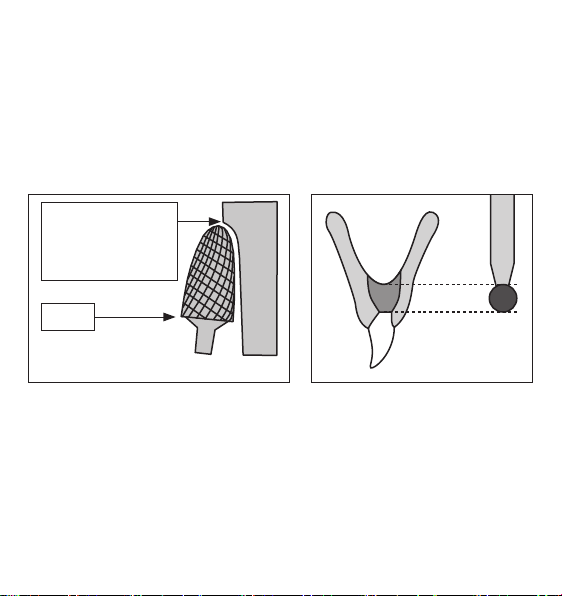
1. Préparation
Vérifier l’intérieur de la bouche du patient par inspection et palpation. Enlever la prothèse de la
bouche du patient et nettoyer la zone à rebaser à l’eau et au savon. Bien rincer et bien sécher à
l’air la surface de la prothèse. Meuler l’intrados de la prothèse à la profondeur voulue en utilisant
une fraise. Biseauter les bords de la prothèse de façon à laisser 1 millimètre de matériau dépasser
du bord (Voir la figure 1). Ôter la poussière de meulage avec une brosse sèche ou sécher à la
soufflette sans graisse.
Remarque : quand le bord est fait dans le bourrelet de la base de la prothèse, enlever la résine
Marge entre le
matériau de rebasage
et la base de la
prothèse
de la zone de rebasage au moyen de la fraise ronde (pour résine acrylique) afin de
garantir que la résine sera à la profondeur voulue (Voir la figure 2).
Fraise
Figure 1
2. Distribution du primaire [PRIMER]
Ouvrir le flacon de primaire. Fixer le compte-gouttes sur le rebord du flacon. Verser la bonne
quantité de primaire dans la coupelle en plastique. Remettre le capuchon en place et bien refermer
le flacon immédiatement après distribution.
3. Application du primaire [PRIMER]
Au moyen de la brosse pour primaire, appliquer une couche fine et régulière de primaire sur
l’intrados de la prothèse à rebaser avec SOFRELINER TOUGH S. Veiller à appliquer le primaire
sur toutes les zones concernées afin de prévenir un manque d’adhésion. Utiliser la soufflette pour
sécher la surface jusqu’à ce qu’il n’y ait plus aucune trace de liquide visible.
4. Distribution de la pâte [PASTE]
Charger la cartouche de pâte de SOFRELINER TOUGH S dans un pistolet distributeur (vendu
Figure 2
Page 59

séparément). Ouvrez le capuchon de la cartouche de pâte. Fixer la canule de mélange à la
cartouche en alignant les encoches. Pousser ensuite la cartouche et faire tourner la canule de
mélange de 90 degrés en sens horaire.
5. Application de la pâte [PASTE]
Appliquer la pâte mélangée de façon régulière sur l’intrados de la prothèse. Avec une spatule,
répartir la pâte uniformément sur toutes les surfaces où le primaire [PRIMER] a été appliqué.
Remarque : si une partie de la surface recouverte de primaire n’est pas ensuite recouverte de
6. Insertion en bouche
Aspirer l’excès de salive de la bouche du patient. 1,5 à 2 minutes après avoir mélangé
SOFRELINER TOUGH S, le matériau parviendra à la viscosité adéquate. Placer la prothèse dans
la bouche du patient et faire mettre le patient en occlusion centrée, à la dimension verticale voulue.
Contrôler l’absence d’excès de SOFRELINER TOUGH S en bouche ; le cas échéant, l’éliminer
immédiatement. Le patient doit être prévenu que s’il sent le SOFRELINER TOUGH S ou une
autre substance sur le point de passer dans sa gorge, il doit en avertir immédiatement le dentiste.
Remarque : pour rebaser les prothèses maxillaires avec SOFRELINER TOUGH S,
7. Moulage des bords
Tirer légèrement les joues du patient pour mouler les bords de la zone vestibulaire (le patient
devant légèrement fermer la bouche). Si le patient salive, aspirer la salive et dire au patient de
refermer délicatement la bouche. SOFRELINER TOUGH S doit durcir en bouche pendant au
moins 5 minutes.
Remarque : ne pas procéder à l’ébarbage avant 5 minutes sous peine d’une déformation.
8. Ébarbage
Retirer la prothèse de la bouche du patient, rincer à l’eau et sécher à la soufflette. Ébarber
soigneusement tout excédent de SOFRELINER TOUGH S sur les bords avec un scalpel tranchant
(Voir la figure 3).
pâte à cette étape, une contamination par la salive lors de l’insertion en bouche
peut se produire, entraînant une altération de l’adhésion.
commencer par la région palatine postérieure afin d’éviter un écoulement du
SOFRELINER TOUGH S dans la gorge du patient.
En cas de rebasage de la région palatine, veiller à ne pas mettre trop de pâte
SOFRELINER TOUGH S sur la prothèse, ni trop tôt, car la pâte durcie tend à
s’épaissir.
Page 60
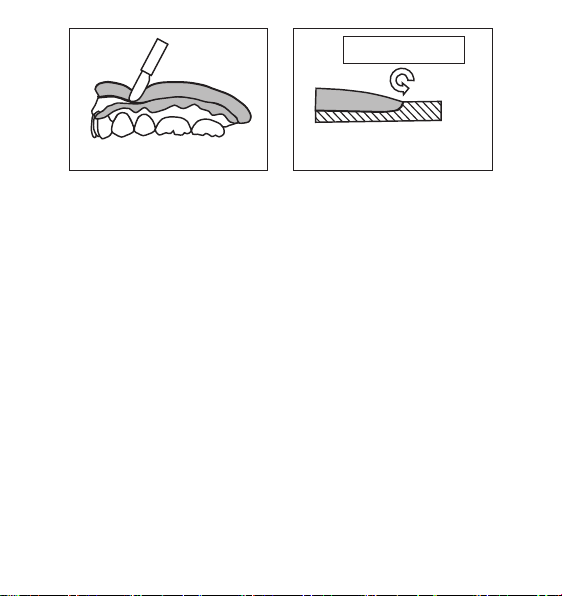
Sens de rotation
Rebasage
Prothèse
Figure 3
9. Finition
Pour le modelage, utiliser la pointe de modelage (noire, COARSE POINT), en appliquant une
légère pression ne dépassant pas 15 000 tr/min permettant à la pointe de se déplacer dans un petit
cercle. Pour la finition, utiliser la roue de finition (marron, FINISHING WHEEL), en appliquant
une légère pression en ne dépassant pas 8 000 tr/min.
Remarque : tourner la pointe de modelage et la roue de finition de la zone de rebasage à la
Utiliser la fraise ronde en diamant (vendue séparément, DIAMOND ROUND BUR) ou un
matériau de polissage adéquat pour traiter le relief.
10. Réajustement
En cas de mise en condition tissulaire, des visites ultérieures chez le dentiste sont nécessaires après
le traitement initial. Réajuster la prothèse selon la procédure de la section 9. Si du nouveau
matériau doit être ajouté à la surface rebasée, retirer le rebasage existant de la base de la prothèse
et remplacer par un nouveau rebasage.
11. Retrait
Ébarber une large portion de SOFRELINER TOUGH S avec un instrument tranchant. Retirer le
matériau restant par meulage.
Remarque : Un décapant de silicone (vendu séparément, SILICONE REMOVER) enlève
zone de la prothèse afin de ne pas casser le bord (Voir la figure 4).
facilement l’ancien rebasage au silicone de la prothèse de la base acrylique de la
prothèse.
Figure 4
Page 61

APPLICATION CLINIQUE DE SOFRELINER TOUGH S – PROCÉDÉ
■
DE REBASAGE EN LABORATOIRE
1. Examen de la bouche
Vérifier l’intérieur de la bouche du patient par inspection et palpation. Examiner la zone qui a
besoin d’être traitée (relief).
2. Examen de la prothèse
Si la prothèse est usée ou ancienne, rebaser d’abord la prothèse avec TOKUYAMA REBASE II,
matériau à consistance dure pour le rebasage des prothèses dentaires au fauteuil. Le matériau de
rebasage à consistance dure doit être appliqué selon l’épaisseur appropriée afin que lors du
meulage du nouveau matériau selon la procédure de l’étape 4, il en reste une couche suffisante à la
base de la prothèse pour permettre l’adhérence de SOFRELINER TOUGH S.
3. Fabrication d’un modèle en plâtre
Prendre une empreinte d’occlusion puis couler l’empreinte en plâtre. Réaliser un calibre en plâtre
et monter la prothèse sur ce calibre. Mettre de la cire dans l’empreinte en plâtre aux endroits qui
pourraient gêner le patient et lui donner des sensations douloureuses. Appliquer un isolant sur la
zone des crêtes du modèle en plâtre afin que le matériau de rebasage n’y adhère pas.
4. Préparation
En utilisant une fraise, meuler l’intrados de la prothèse à la profondeur voulue. Biseauter les bords
de la prothèse de façon à laisser 1 millimètre de matériau dépasser du bord (Voir la figure 1). Ôter
la poussière de meulage avec une brosse sèche ou sécher á la soufflette sans graisse.
Remarque : la fraise ronde permet de meuler une couche de résine uniforme en prenant le
5. Distribution du primaire [PRIMER]
Ouvrir le flacon de primaire. Fixer le compte-gouttes sur le rebord du flacon. Verser la bonne
quantité de primaire dans la coupelle du compte-gouttes. Remettre le capuchon en place et bien
refermer le flacon immédiatement après distribution.
6. Application du primaire [PRIMER]
Au moyen de la brosse pour le primaire, appliquer une couche fine et régulière de primaire sur
l’intrados de la prothèse à rebaser avec SOFRELINER TOUGH S. Veiller à appliquer le primaire
sur toutes les zones concernées afin de prévenir un manque d’adhésion. Utiliser la soufflette pour
sécher la surface jusqu’à ce qu’il n’y ait plus aucune trace de liquide visible.
7. Distribution de la pâte [PASTE]
Charger la cartouche de pâte de SOFRELINER TOUGH S dans un pistolet distributeur (vendu
diamètre de la fraise pour guide de la profondeur du meulage.
Page 62

séparément). Ouvrez le capuchon de la cartouche de pâte. Fixer la canule de mélange à la
cartouche en alignant les encoches. Pousser ensuite la cartouche et faire tourner la canule de
mélange de 90 degrés en sens horaire.
8. Application de la pâte [PASTE]
Appliquer la pâte mélangée sur la surface où le primaire [PRIMER] a été appliqué. Placer la pâte
sur le côté de la prothèse et du modèle en plâtre qui fait face à la muqueuse buccale.
9. Refixation
Remettre la prothèse sur son modèle en plâtre puis comprimer avec le calibre de rebasage pendant
au moins 20 minutes à température ambiante (23℃ / 73,4℉).
Remarque : immerger la prothèse et le calibre de rebasage pendant 5 minutes dans de l’eau
10. Ébarbage
Enlever la prothèse du modèle en plâtre. Ébarber soigneusement le SOFRELINER TOUGH S en
excès sur les bords au moyen d’un scalpel tranchant (Voir la figure 3).
11. Finition
Pour le modelage, utiliser la pointe de modelage (noire, COARSE POINT), en appliquant une
pression légère en ne dépassant pas 15 000 tr/min permettant à la pointe de se déplacer dans un
petit cercle. Pour la finition, utiliser la roue de finition (marron, FINISHING WHEEL), en
appliquant une légère pression ne dépassant pas 8 000 tr/min.
Remarque : tourner la pointe de modelage et la roue de finition de la zone de rebasage à la
Utiliser la fraise ronde en diamant (vendue séparément, DIAMOND ROUND BUR) ou un
matériau de polissage adéquat pour traiter le relief.
MESURES DE PRÉCAUTION À L’ATTENTION DES PATIENTS
■
Ces instructions doivent être communiquées aux patients afin d’améliorer la longévité, la durabilité
et la fiabilité de leur prothèse rebasée avec SOFRELINER TOUGH S :
1. Le matériau de rebasage SOFRELINER TOUGH S ne doit pas être brossé avec une brosse
pour prothèses ou une brosse à dents. La meilleure façon de nettoyer SOFRELINER TOUGH
S consiste à utiliser une éponge ou un tampon de gaze doux. En laissant couler de l’eau froide
sur la surface du SOFRELINER TOUGH S, essuyer la surface avec l’éponge ou la gaze
imprégnée de savon. Essuyer délicatement pour éliminer tous les débris et dépôts d’aliments
présents à la surface du matériau de rebasage SOFRELINER TOUGH S. Les dents et la base
dont la température est comprise entre 40℃ et 50℃ (104℉ à 122℉), afin
d’accélérer le durcissement.
zone de la prothèse pour ne pas casser le bord (Voir la figure 4).
Page 63

de la prothèse en résine dure peuvent être nettoyées avec une brosse pour prothèses ordinaire
en frottant avec du savon, du dentifrice pour prothèses ou un nettoyant pour prothèses
ordinaire, selon les instructions du dentiste.
2. Faire tremper la prothèse au moins une fois par jour, de préférence le soir, dans un nettoyant
pour prothèses oxygéné (par exemple, Polident, Efferdent, etc.). Les prothèses ne doivent pas
être nettoyées avec un nettoyant oxygéné lorsqu’elles se trouvent dans la bouche du patient.
Un ternissement de la couleur peut survenir à la longue, en fonction des soins apportés par le
patient à sa prothèse. Utiliser le nettoyant pour prothèses conformément aux instructions du
fabricant.
3. L’immersion de la prothèse dans des solutions de nettoyage fortement chlorées peut modifier
la teinte de SOFRELINER TOUGH S, mais elle est sans effet sur les performances.
4. La prothèse doit être immergée dans de l’eau lorsqu’elle n’est pas portée.
5. La prothèse rebasée doit être contrôlée et nettoyée aux ultrasons par un dentiste tous les trois
mois ou chaque fois qu’un dépôt de plaque dentaire est visible.
6. SOFRELINER TOUGH S doit être contrôlé fréquemment pour détecter une quelconque
détérioration. Lorsque la couche de rebasage est irrégulière, cassée, fissurée, décolletée ou
endommagée, la prothèse ne doit pas être portée. L’utilisation d’une prothèse endommagée ou
cassée peut entraîner une suffocation, une aspiration, une asphyxie ou d’autres troubles.
7. En présence d’un signe d’intolérance clinique à la silicone, le patient doit immédiatement ôter
la prothèse et contacter son dentiste.
L’utilisateur et/ou le patient doivent signaler tout incident grave survenant en lien avec le dispositif
au fabricant et aux autorités compétentes de l’État membre dans lequel l’utilisateur et/ou le patient
sont établis.
REMARQUE IMPORTANTE : Le fabricant de SOFRELINER TOUGH S n’est nullement
responsable d’un dommage ou d’une blessure résultant d’une utilisation incorrecte du produit.
Avant d’utiliser le produit, il incombe à l’utilisateur de s’assurer que le produit convient pour
l’application envisagée.
Les spécifications du produit SOFRELINER TOUGH S sont sujettes à modification sans avis
préalable. Lorsque les spécifications du produit changent, les instructions et les précautions à
prendre peuvent aussi changer.
Page 64
ITALIANO
Prima di utilizzare SOFRELINER TOUGH S leggere attentamente tutte le istruzioni di
seguito riportate.
DESCRIZIONE DEL PRODOTTO E INFORMAZIONI GENERALI
■
1. SOFRELINER TOUGH S è un materiale di rivestimento morbido a base siliconica per protesi.
SOFRELINER TOUGH S è conforme alle norme ISO 10139-2 “Materiali di rivestimento
morbido per protesi Parte 2: Materiali per utilizzo a lungo termine” e ISO 10139-1 “Materiali
di rivestimento morbido per protesi Parte 1: Materiali per uso a breve termine”.
2. Il Kit SOFRELINER TOUGH S contiene pasta [PASTE], primer [PRIMER] e altri accessori
come punte di miscelazione, beccuccio di erogazione, coppetta plastici per erogazione,
spazzole, punta grossa (Nera, COARSE POINT), punta di finitura (Marrone, FINISHING
WHEEL).
3. Il primer [PRIMER] viene utilizzato esclusivamente per l’adesione su superfici acriliche. Non
può essere utilizzato per l’adesione su superfici di nylon, metallo e silicone. La pasta [PASTE]
viene fornita in un sistema di distribuzione a cartucce automix. Il materiale si indurisce
nell’arco di 5 minuti nella cavità orale o di 20 minuti a temperatura ambiente (23℃ / 73,4℉)
ed è inodore e insapore.
INDICAZIONI
■
1. Dolori causati da sporgenze acute dell’osso alveolare e da atrofia della mucosa.
2. Scarsa ritenzione provocata da estrema atrofia dell’arcata.
3. Formazione di grosse cavità o rigonfiamenti alla mascella superiore/inferiore.
4. Ritenzione di protesi prima del fissaggio definitivo.
5. Condizionamento del tessuto o rivestimento temporaneo.
CONTROINDICAZIONI
■
SOFRELINER TOUGH S è controindicato nei pazienti con reazione allergica o ipersensibile ai
composti di silicone e platino, pertanto si raccomanda di NON utilizzarlo su questi pazienti.
PRECAUZIONI
■
1. SOFRELINER TOUGH S è destinato alla vendita e all’uso esclusivo da parte di utilizzatori
professionali abilitati alle cure dentali. Non può essere venduto, né è indicato all’uso da parte
di professionisti estranei al settore.
Page 65

2. Utilizzare SOFRELINER TOUGH S solo come descritto qui di seguito. NON utilizzare
SOFRELINER TOUGH S per scopi diversi da quelli specificati nelle presenti istruzioni.
3. NON utilizzare SOFRELINER TOUGH S se i sigilli di garanzia sono rotti o se il contenuto
sembra manomesso.
4. Il primer [PRIMER] contiene etilacetato, un solvente estremamente volatile e infiammabile.
Non esporre il primer a fiamme libere. Utilizzare il prodotto in un ambiente ventilato e
richiudere bene il tappo dopo l’uso.
5. Se il paziente presenta una reazione allergica o sintomi di sensibilità a SOFRELINER TOUGH
S, come ad esempio dermatite, rimuovere la protesi ed interromperne immediatamente l’uso.
6. Quanto si utilizza SOFRELINER TOUGH S indossare sempre guanti professionali senza
lattice per evitare possibili reazioni allergiche. I guanti in lattice possono inoltre inibire
l’indurimento di SOFRELINER TOUGH S. In caso di contatto dei guanti con il primer
SOFRELINER TOUGH S, gettare immediatamente i guanti e lavarsi le mani con abbondante
acqua.
7. Evitare il contatto con gli occhi. In caso di contatto con gli occhi, sciacquare gli occhi con
abbondante acqua e consultare immediatamente un medico.
8. Evitare il contatto della sostanza chimica non indurita con la pelle. In caso di contatto con la
pelle, strofinare la zona interessata con un panno imbevuto di alcol, quindi sciacquare con
abbondante acqua.
9. Evitare il contatto del materiale non polimerizzato con gli indumenti. In caso di contatto con
gli indumenti, non strofinare il materiale. Lasciarlo indurire e poi staccarlo.
10. NON lasciar penetrare materiale in eccesso nella trachea o nell’esofago del paziente.
L’aspirazione o l’ingestione della pasta SOFRELINER TOUGH S può provocare asfissia o
altre lesioni. Rimuovere immediatamente il materiale di rivestimento in eccesso dal palato per
evitare che il materiale penetri nella gola del paziente. SOFRELINER TOUGH S non è
radiopaco, pertanto i raggi X non sono in grado di rilevare materiale aspirato o ingerito. Se si
utilizza il prodotto su pazienti anziani con scarsa capacità di riflessi, posizionare la poltrona in
posizione eretta e chiedere al paziente di respirare con il naso per evitare che il materiale
penetri nelle vie aeree.
11. NON miscelare SOFRELINER TOUGH S con altri materiali non menzionati nelle presenti
istruzioni.
12. Dopo aver utilizzato la cartuccia SOFRELINER TOUGH S, la punta di miscelazione deve
essere sostituita con il tappo fornito in dotazione insieme alla cartuccia al momento
dell’acquisto. Pulire sempre la punta della cartuccia con un panno o un fazzoletto di carta
Page 66

prima di utilizzare una nuova punta di miscelazione o prima di sostituire il tappo della
cartuccia.
13. Pulire sempre la spatola, la spazzola e le coppette con alcol dopo ogni utilizzo per evitare
fenomeni di contaminazione incrociata.
14. Informare i pazienti in conformità con le PRECAUZIONI PER I PAZIENTI riportate
nell’ultimo paragrafo delle presenti istruzioni.
15. Per evitare l’inalazione di polvere durante la finitura, indossare sempre una mascherina
consigliata dalle disposizioni federali e/o locali.
16. Leggere e rispettare le istruzioni del produttore relative a tutti i prodotti menzionati nelle
presenti istruzioni, ma non inclusi nel kit.
17. Evitare, nel limite del possibile, il contatto con la membrana mucosa orale diversa dalla zona
da rivestire. Terminata l’operazione chiedere ai pazienti di sciacquarsi la bocca con
un’adeguata quantità d’acqua.
18. Non esporre il primer [PRIMER] a contatto con materiali plastici, perché può sciogliere alcuni
tipi di plastica.
NOTE PER L’USO
■
1. In caso di protesi difettosa, rivestire in primo luogo la protesi con materiale acrilico, come
TOKUYAMA REBASE II, materiale ribasante duro per protesi, o con qualsiasi altra procedura
di laboratorio/indiretta per migliorare l’adesione della protesi.
2. In caso di protesi logora o vecchia, rivestire innanzitutto la superficie con un nuovo materiale
acrilico, poiché i materiali assorbiti nella vecchia resina logora, come olio o acqua, riducono
l’adesione di SOFRELINER TOUGH S.
3. Se il primer SOFRELINER TOUGH S risulta addensato per effetto della volatilizzazione, non
utilizzarlo perché potrebbe aver perso forza adesiva.
4. Per quanto riguarda la spazzola per il primer, pulire la punta con un tampone di cotone o una
garza imbevuti di alcol dopo ciascun utilizzo. Una spazzola contaminata può ridurre
l’adesione di SOFRELINER TOUGH S.
5. Non miscelare la pasta manualmente per la possibile formazione di bolle d’aria che possono
provocare fenomeni di deterioramento, macchie e cattivo odore.
6. Evitare il contatto di SOFRELINER TOUGH S con i materiali di seguito elencati perché questi
inibiscono l’indurimento di SOFRELINER TOUGH S:
materiali per impronta a base di silicone, materiali contenenti eugenolo, materiali per impronta
a base di tioplasti, guanti in gomma naturale, altri materiali di rivestimento morbidi del
Page 67
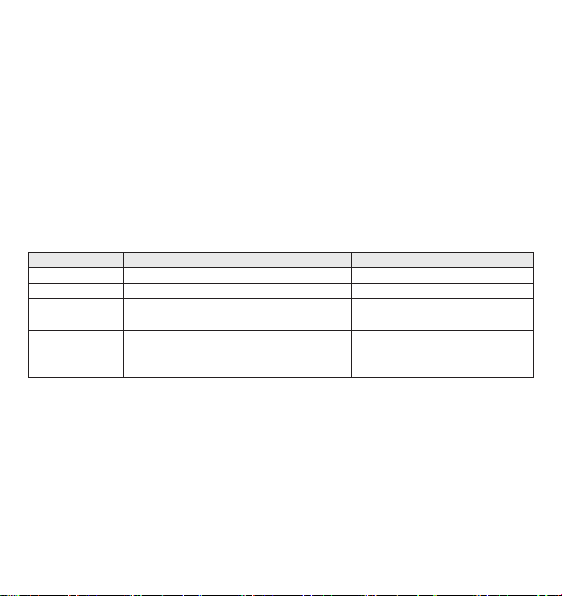
produttore e resine acriliche non indurite.
7. Il materiale si indurisce nell’arco di 5 minuti nella cavità orale o di 20 minuti a temperatura
ambiente (23℃ / 73,4℉). Il prodotto raggiunge il massimo grado di indurimento dopo 24 ore.
L’operazione di finitura può essere eseguita non appena la protesi rivestita viene rimossa dalla
cavità orale o dal modello di gesso.
8. L’immersione della protesi in soluzioni detergenti molto sbiancanti può modificare il colore di
SOFRELINER TOUGH S, ma non influisce sull’utilizzo della protesi.
9. Invitare il paziente a pulire la protesi come descritto nelle PRECAUZIONI PER IL
PAZIENTE.
10. Dato che il materiale a base di silicone per il test d’inserimento (fit checking) aderisce a
SOFRELINER TOUGH S, prima dell’uso applicare della vaselina sulla superficie.
11. In caso di frattura lungo la linea di finitura, rimuovere completamente il rivestimento ed
eseguire di nuovo l’operazione.
12. Utilizzare i materiali e i metodi di seguito indicati per la modellazione o la finitura.
Fasi Strumenti Forme
Taglio Bisturi affilato Lama leggermente arrotondata
Modellazione Punta grossa (Nera, COARSE POINT) Estremità arrotondata conica
Finitura
Distensione
Punta di finitura (Marrone, FINISHING
WHEEL)
Fresa diamantata arrotondata (venduta
separatamente, DIAMOND ROUND
BUR)
Disco
Arrotondata
Page 68
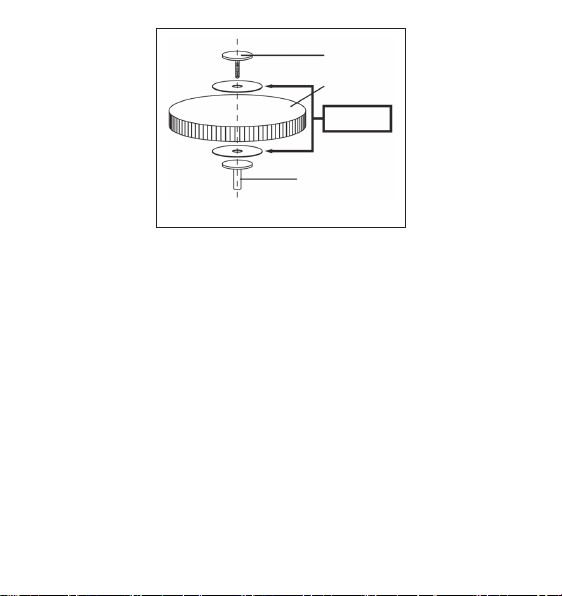
Vite
Punta di
finitura
Rondella
Mandrino
Punta di finitura
CONSERVAZIONE
■
1. Conservare SOFRELINER TOUGH S a temperature comprese fra 0 e 25℃ (32 - 77℉).
2. Evitare di esporre SOFRELINER TOUGH S a fonti di calore, fiamme libere, umidità e ai raggi
del sole.
3. NON usare SOFRELINER TOUGH S dopo la data di scadenza indicata.
4. NON lasciare SOFRELINER TOUGH S incustodito a portata di pazienti e bambini: potrebbe
essere ingerito accidentalmente.
SMALTIMENTO
■
1. Per smaltire la pasta [PASTE], vuotare quella non utilizzata dalla cartuccia e lasciarla indurire
prima di procedere allo smaltimento.
2. I residui del primer [PRIMER] devono essere assorbiti in materiale assorbente inerte come
garza o cotone e smaltiti in conformità con le normative locali.
APPLICAZIONE CLINICA DI SOFRELINER TOUGH S: METODO
■
DI RIVESTIMENTO INTRAORALE
SOFRELINER TOUGH S offre il massimo rendimento quando il materiale di rivestimento
raggiunge lo spessore ottimale di 1-2 millimetri. Eventuali aree che richiedono uno spessore di
rivestimento superiore a 2 millimetri devono essere rivestite preventivamente con TOKUYAMA
REBASE II, materiale duro per ribasatura alla poltrona, allo scopo di ottenere uno spessore
sufficiente alla base della protesi. Una rimozione eccessiva della resina della protesi può
Page 69
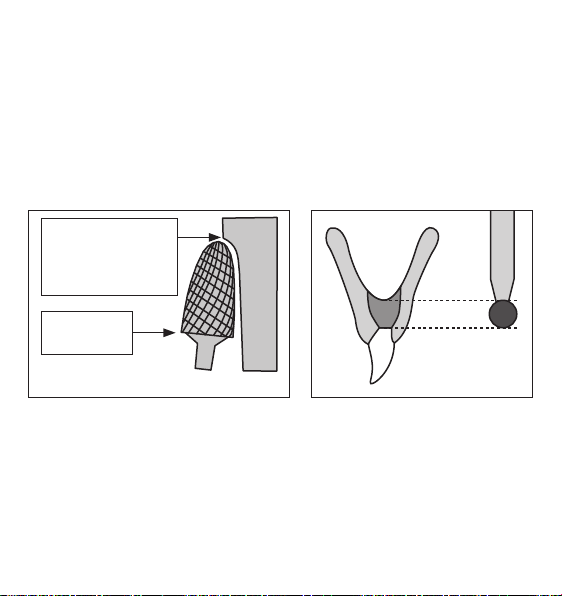
provocare una frattura e un indebolimento della protesi.
1. Preparazione
Verificare le condizioni della cavità orale mediante ispezione e palpazione. Rimuovere la protesi
dalla bocca del paziente e lavare la parte da rivestire con acqua e sapone. Sciacquare
accuratamente, quindi asciugare bene con aria la superficie della protesi. Irruvidire con una fresa
il lato interno della protesi fino a raggiungere la profondità adeguata. Smussare i bordi della
protesi in modo da potervi stendere sopra 1 millimetro di materiale (figura 1). Rimuovere la
polvere da levigatura con una spazzola asciutta o con aria asciutta senza olio.
Nota: Se il bordo viene eseguito all’interno della flangia della base della protesi, irruvidire
con una fresa a palla (per resina acrilica) il lato interno della protesi in modo da
garantire un’adeguata profondità (figura 2).
Margine fra il
materiale di
rivestimento e la
base della protesi
Taglio della
fresa
Figura 1
2. Erogazione del primer [PRIMER]
Aprire il flacone di primer. Applicare il beccuccio di erogazione al flacone. Erogare una quantità
adeguata di primer nel coppetta plastici. Riposizionare il tappo, chiudere bene il flacone
immediatamente dopo l’erogazione.
3. Applicazione del primer [PRIMER]
Utilizzando il pennello per il primer, applicare uno strato sottile ed uniforme di primer sulla
superficie della protesi da rivestire con SOFRELINER TOUGH S. Durante l’applicazione del
primer non trascurare alcuna zona poiché una copertura non accurata potrebbe determinare
un’adesione imperfetta. Asciugare il primer con un getto d’aria asciutta su tutta la superficie fino
a quando non rimane più alcun liquido visibile.
Figura 2
Page 70

4. Erogazione della pasta [PASTE]
Posizionare la cartuccia per la pasta SOFRELINER TOUGH S in un dispenser (acquistabile
separatamente). Aprire il tappo della cartuccia della pasta. Applicare la punta di miscelazione
sulla cartuccia allineando le apposite tacche, quindi premerla sulla cartuccia e ruotarla di 90° in
senso orario.
5. Applicazione della pasta [PASTE]
Applicare uniformemente la pasta miscelata sul lato interno della protesi. Distribuire
uniformemente la pasta con una spatola su tutte le zone in cui è stato applicato il primer.
Nota: Se in questa fase rimangono scoperte alcune zone della superficie trattate
precedentemente con primer, queste zone possono essere contaminate dalla saliva
durante l’inserimento della protesi nella bocca, quindi può prodursi una scarsa adesione
della pasta in queste zone.
6. Inserimento intraorale
Aspirare la saliva in eccesso dalla bocca del paziente. Entro 1,5 – 2 minuti dalla miscelazione di
SOFRELINER TOUGH S il materiale acquisterà una viscosità adeguata. Collocare la protesi
nella bocca del paziente, chiedere al paziente di chiudere lievemente la bocca fino all’occlusione
centrica con la dimensione verticale adeguata. Assicurarsi che non siano presenti residui di
SOFRELINER TOUGH S nella bocca del paziente e, in caso contrario, rimuoverli
immediatamente. Chiedere ai pazienti di segnalare immediatamente al dentista se avvertono la
sensazione di avere ingoiato del materiale SOFRELINER TOUGH S o qualsiasi altra sostanza.
Nota: Per rivestire con SOFRELINER TOUGH S la protesi dell’arcata superiore, inserire la
protesi dalla regione palatale posteriore per evitare che il materiale SOFRELINER
TOUGH S scorra lungo la gola del paziente. Avere cura di non applicare troppa pasta
sulla superficie da rivestire e inserire la protesi nella bocca il più rapidamente possibile
per evitare che il rivestimento si inspessisca troppo.
7. Regolazione del bordo
Tirare leggermente le guance del paziente per formare il bordo dell’area vestibolare mentre il
paziente occlude lievemente la bocca. Aspirare l’eventuale saliva formatasi e chiedere al paziente
di chiudere lievemente la bocca. Lasciare indurire SOFRELINER TOUGH S nella cavità orale
per almeno 5 minuti.
Nota: Una rimozione effettuata prima che siano trascorsi 5 minuti può determinare una
distorsione del rivestimento.
8. Taglio
Estrarre la protesi dalla bocca del paziente e sciacquare il materiale con acqua e un getto di aria
Page 71
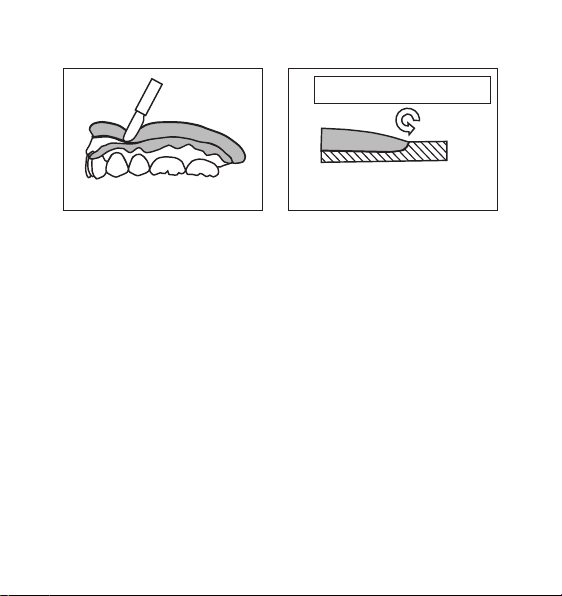
asciutta. Asportare il materiale SOFRELINER TOUGH S in eccesso dai bordi con un bisturi
affilato (vedere figura 3).
Direzione della rotazione
Rivestimento
Protesi
Figura 3
9. Finitura
Per la modellazione, utilizzare la punta grossa (Nera, COARSE POINT), esercitando una leggera
pressione senza superare 15.000 giri al minuto, consentendo alla punta di effettuare piccoli
movimenti circolari. Per la finitura, utilizzare la punta di finitura (Marrone, FINISHING
WHEEL), esercitando una leggera pressione senza superare 8.000 giri al minuto.
Nota: Utilizzare la punta grossa e la punta di finitura con un movimento rotatorio a partire
dall’area di rivestimento fino all’area della protesi in modo da non danneggiare l’area
marginale (vedi figura 4).
Utilizzare la fresa diamantata arrotondata (acquistabile separatamente, DIAMOND ROUND BUR)
o qualsiasi altra fresa adatta per la distensione.
10. Modellazione
Nel caso di condizionamento del tessuto, è necessario effettuare visite aggiuntive alcuni giorni
dopo il trattamento iniziale. Rimodellare la protesi in base alla procedura della sezione 9. Se è
necessario aggiungere nuovo materiale alla superficie rivestita, rimuovere il rivestimento esistente
dalla protesi e sostituirlo con un nuovo rivestimento.
11. Rimozione
Rimuovere un’ampia porzione di materiale SOFRELINER TOUGH S, tagliandola via con l’aiuto
di uno strumento affilato. Rimuovere il materiale restante tramite frese.
Nota: Il SILICONE REMOVER (acquistabile separatamente) rimuove con facilità il vecchio
rivestimento in silicone della protesi dalla base acrilica della protesi.
Figura 4
Page 72

APPLICAZIONE CLINICA DI SOFRELINER TOUGH S: METODO
■
DI RIVESTIMENTO IN LABORATORIO
1. Controllo della cavità orale
Verificare le condizioni della cavità orale mediante ispezione e palpazione. Esaminare la zona che
richiede la distensione.
2. Controllo della protesi
Se la protesi è vecchia o logora per l’uso, rivestirla preventivamente con TOKUYAMA REBASE
II, un materiale di rivestimento compatto. Occorre applicare il giusto spessore di questo materiale
in modo che, quando il nuovo materiale viene levigato in base alla procedura della fase 4, il nuovo
strato di rivestimento rimanga nel settore portante della protesi, permettendo una perfetta aderenza
di SOFRELINER TOUGH S.
3. Realizzazione di un modello in gesso
Prendere un’impronta e invitare il paziente ad esercitare una pressione sulla protesi, quindi
ricavare per colata un modello in gesso dell’impronta. Realizzare un negativo in gesso dei denti e
montare la protesi su una sagoma di rivestimento. Applicare sul modello in gesso della cera nel
punto in corrispondenza del quale si avverte dolore nella bocca. Applicare un prodotto di
separazione sul modello in gesso per evitare che vi aderisca il materiale di rivestimento.
4. Preparazione
Irruvidire con una fresa il lato interno della protesi fino a raggiungere la profondità adeguata.
Smussare i bordi della protesi in modo da potervi stendere sopra 1 millimetro di materiale (figura
1). Rimuovere la polvere da levigatura con una spazzola asciutta o con aria asciutta senza olio.
Nota: L’impiego della fresa arrotondata facilita la rimozione uniforme della resina. Il
diametro della fresa può essere utilizzato come guida per la profondità.
5. Erogazione del primer [PRIMER]
Aprire il flacone di primer. Applicare il beccuccio di erogazione al flacone. Erogare una quantità
adeguata di primer nel coppetta plastici. Riposizionare il tappo, chiudere bene il flacone
immediatamente dopo l’erogazione.
6. Applicazione del primer [PRIMER]
Utilizzando il pennello per il primer, applicare uno strato sottile ed uniforme di primer sulla
superficie della protesi da rivestire con SOFRELINER TOUGH S. Durante l’applicazione del
primer non trascurare alcuna zona poiché una copertura non accurata potrebbe determinare
un’adesione imperfetta. Asciugare il primer con un getto d’aria asciutta su tutta la superficie fino
a quando non rimane più alcun liquido visibile.
Page 73

7. Erogazione della pasta [PASTE]
Posizionare la cartuccia per la pasta SOFRELINER TOUGH S in un dispenser (acquistabile
separatamente). Aprire il tappo della cartuccia della pasta. Applicare la punta di miscelazione
sulla cartuccia allineando le apposite tacche, quindi premerla sulla cartuccia e ruotarla di 90° in
senso orario.
8. Applicazione della pasta [PASTE]
Applicare la pasta miscelata sulla superficie su cui è stato applicato il primer. Applicare la pasta
sia sul lato mucoso della protesi, sia sul modello in gesso.
9. Riposizionamento
Riposizionare la protesi sul suo modello in gesso e premere con la sagoma di rivestimento.
Lasciare assestare la protesi sulla sagoma di rivestimento per 20 minuti a temperatura ambiente
(23℃ / 73,4℉).
Nota: Se il materiale non risulta ancora indurito, immergere la protesi in acqua calda a 40℃ -
50℃ (104℉ - 122℉) per 5 minuti con la sagoma di rivestimento.
10. Taglio
Rimuovere la protesi dal modello in gesso. Asportare il materiale SOFRELINER TOUGH S in
eccesso dai bordi con un bisturi affilato (vedere figura 3).
11. Finitura
Per la modellazione, utilizzare la punta grossa (Nera, COARSE POINT), esercitando una leggera
pressione senza superare 15.000 giri al minute, consentendo alla punta di effettuare piccoli
movimenti circolari. Per la finitura, utilizzare la punta di finitura (Marrone, FINISHING
WHEEL), esercitando una leggera pressione e senza superare 8.000 giri al minuto.
Nota: Utilizzare la punta grossa e la punta di finitura con un movimento rotatorio a partire
dall’area di rivestimento fino all’area della protesi in modo da non danneggiare l’area
marginale (vedi figura 4).
Utilizzare la fresa diamantata arrotondata (acquistabile separatamente, DIAMOND ROUND BUR)
o qualsiasi altra fresa adatta per la distensione.
PRECAUZIONI PER IL PAZIENTE
■
Per migliorare la stabilità, la durata e la sicurezza di una protesi rivestita con SOFRELINER
TOUGH S fornire ai pazienti le istruzioni di seguito riportate:
1. Il materiale di rivestimento SOFRELINER TOUGH S non deve essere sfregato con spazzolini
da denti o da protesi. Per pulire al meglio SOFRELINER TOUGH S utilizzare una spugnetta
o una garza. Strofinare la superficie di SOFRELINER TOUGH S sotto acqua corrente con una
Page 74

spugnetta o una garza imbevute di sapone. Eliminare impurità e resti di alimenti dal materiale
di rivestimento SOFRELINER TOUGH S strofinando delicatamente. La superficie dei denti e
la dura base acrilica della protesi possono essere pulite, a discrezione del dentista, con un
normale spazzolino per protesi, strofinando con sapone, dentifricio o un comune detergente per
protesi.
2. Almeno una volta al giorno, preferibilmente prima di coricarsi, immergere la protesi in un
detergente per protesi saturo di ossigeno (ad es. Polident, Efferdent, ecc.). Non pulire la
protesi con detergenti saturi di ossigeno direttamente nella bocca del paziente. In caso di
impiego prolungato, il colore può sbiadire a seconda del tipo di cura che il paziente presta alla
protesi. Utilizzare i detergenti per protesi secondo le istruzioni fornite dal produttore.
3. L’immersione della protesi in soluzioni detergenti molto sbiancanti può modificare il colore di
SOFRELINER TOUGH S, ma non influisce sull’utilizzo della protesi.
4. La protesi deve essere conservata in acqua quando non viene utilizzata.
5. La protesi rivestita deve essere controllata e pulita con ultrasuoni da un dentista ogni tre mesi,
oppure ogniqualvolta si sia formata della placca.
6. Controllare regolarmente che SOFRELINER TOUGH S non sia danneggiato. Non utilizzare
la protesi se il rivestimento risulta difettoso, spezzato, incrinato, staccato o danneggiato. L’uso
di una protesi danneggiata o spezzata può provocare soffocamento, inspirazione di particelle,
asfissia o altre lesioni.
7. All’insorgere di sintomi di allergia al silicone, il paziente deve interrompere l’uso della protesi
e consultare immediatamente il proprio dentista.
L’utente e/o il paziente sono tenuti a segnalare qualsiasi evento avverso grave occorso in relazione
al dispositivo al fabbricante e all’autorità competente dello Stato Membro in cui l’utente e/o il
paziente risiedono.
NOTA IMPORTANTE: Il produttore di SOFRELINER TOUGH S non è responsabile di danni o
lesioni causate dall’uso improprio di questo prodotto. Rientra nella personale responsabilità
dell’utilizzatore assicurarsi, prima dell’uso, che il prodotto sia idoneo per il tipo di applicazione
prevista.
Le specifiche di SOFRELINER TOUGH S sono soggette a modifiche senza preavviso. La
variazione delle specifiche del prodotto può comportare anche la modifica delle istruzioni e delle
precauzioni d’uso.
Page 75
LATVISKI
Pirms oderējuma materiāla SOFRELINER TOUGH S lietošanas uzmanīgi izlasiet visus šajā
dokumentā sniegtos norādījumus.
PRODUKTA APRAKSTS UN VISPĀRĪGA INFORMĀCIJA
■
1. SOFRELINER TOUGH S ir silikona mīkstais oderējuma materiāls noņemamām protēzēm, ko
paredzēts lietot zobārstniecībā. Oderējuma materiāls SOFRELINER TOUGH S atbilst
Standarta ISO 10139-2 “Mīkstie oderējuma materiāli noņemamām zobu protēzēm — 2. daļa:
Materiāli ilgtermiņa lietošanai” un ISO 10139-1 “Mīkstie oderējuma materiāli noņemamām
zobu protēzēm — 1. daļa: Īslaicīgi lietojami materiāli” prasībām.
2. Oderējuma materiāla SOFRELINER TOUGH S komplektā ir ietverta PASTE, PRIMER un citi
piederumi, piemēram, uzgaļi sajaukšanai, pilienu uzgalis, pilienu trauks, otas, COARSE
POINT (melna), FINISHING WHEEL (brūna).
3. PRIMER paredzēts izmantot tikai līmēšanai pie akrila virsmām. To nevar izmantot līmēšanai
pie neilona, metāla un silikona virsmām. PASTE tiek izvadīta, izmantojot kārtridžu ar
automātisko sajaušanas funkciju. Materiāla sacietēšanas ilgums: mutes dobumā — 5 minūtes;
istabas temperatūrā — 20 minūtes (23°C/73,4°F). Materiālam nav nekādas smaržas vai garšas.
INDIKĀCIJAS
■
1. Paredzēts lietot sāpju gadījumā, kas rodas alveolārā kaula un muskuļu atrofijas dēļ.
2. Nepietiekama aizture, ko izraisa pārmērīga alveolārās daļas atrofija.
3. Vairums konkavitāšu vai augšžokļa/zemžokļa izaugumi.
4. Noņemamo protēžu noturēšana pirms galīgās piestiprināšanas.
5. Pagaidu oderējums vai audu reģenerācija.
KONTRINDIKĀCIJAS
■
Oderējuma materiālu SOFRELINER TOUGH S NEDRĪKST lietot pacientiem, kam ir alerģija vai
paaugstināta jutība pret silikonu un platīna savienojumiem.
PIESARDZĪBAS PASĀKUMI
■
1. Oderējuma materiālu SOFRELINER TOUGH S drīkst pārdot un izmantot tikai licencēti
stomatoloģijas speciālisti. To nedrīkst pārdot un izmantot personas, kas nav stomatoloģijas
speciālisti.
2. Oderējuma materiālu SOFRELINER TOUGH S atļauts izmantot tikai šajos norādījumos
Page 76

minētajos nolūkos. NEIZMANTOJIET oderējuma materiālu SOFRELINER TOUGH S
jebkādā citā nolūkā, kas nav minēts šajos norādījumos.
3. NEIZMANTOJIET oderējuma materiālu SOFRELINER TOUGH S, ja ir bojāta tā iepakojuma
drošības aizdare vai ir bojāts iepakojuma saturs.
4. PRIMER satur etilacetātu, kas ir viegli uzliesmojošs un gaistošs šķīdinātājs. Nepakļaujiet
PRIMER atklātas liesmas ietekmei. Lietot vēdināmā telpā. Pēc lietošanas stingri noslēdziet
vāciņu.
5. Ja pacientam ir alerģija vai paaugstināta jutība pret oderējuma materiālu SOFRELINER
TOUGH S, piemēram, dermatīta uzliesmojums, nekavējoties izņemiet protēzes un pārtrauciet
to lietošanu.
6. Strādājot ar oderējuma materiālu SOFRELINER TOUGH S, lai izvairītos no alerģiskām
reakcijām, vienmēr lietojiet lateksu nesaturošus cimdus. Ja lietosiet lateksu saturošus cimdus,
var tikt kavēta oderējuma materiāla SOFRELINER TOUGH S iestrāde. Ja SOFRELINER
TOUGH S PRIMER nokļūst uz izmeklējumā izmantotiem cimdiem, nekavējoties izmetiet
cimdus un rūpīgi nomazgājiet rokas ar ūdeni.
7. Uzmanieties, lai izstrādājums neiekļūst acīs. Ja izstrādājums iekļūst acīs, rūpīgi skalojiet tās ar
ūdeni un nekavējoties sazinieties ar ārstu.
8. Uzmanieties, lai ķimikālijas neiekļūst acīs. Ja nokļūst uz ādas, tīriet skarto vietu ar spirta
salveti un pēc tam rūpīgi noskalojiet ar ūdeni.
9. Uzmanieties, lai materiāls nenokļūst uz apģērba. Ja materiāls nokļūst uz apģērba, nemēģināt to
noslaucīt. Uzgaidiet, līdz tas sacietē, un pēc tam noņemiet no apģērba.
10. UZRAUGIET, lai materiāla pārpalikums neiekļūst pacienta trahejā vai barības vadā. Ja
SOFRELINER TOUGH S PASTE tiek ieelpota vai norīta, var tikt izraisīta nosmakšana vai
citas traumas. Lai materiāls neietecētu pacienta rīklē, nekavējoties notīriet visu oderējuma
materiāla pārpalikumu no mutes. Oderējuma materiāls SOFRELINER TOUGH S nav
rentgenkontrastains, tādēļ ieelpota vai norīta materiāla atrašanās vietu nevarēs noteikt,
izmantojot rentgenoloģijas iekārtas. Gados vecākiem pacientiem, kam ir palēnināta refleksu
darbība, lai materiāls neiekļūtu elpceļos, krēslu iestatiet vertikālā stāvoklī, kā arī lūdziet
pacientam elpot ar degumu.
11. NEJAUCIET oderējuma materiālu SOFRELINER TOUGH S ar jebkādu citu materiālu, kas
nav minēts šajos norādījumos.
12. Pēc oderējuma materiāla SOFRELINER TOUGH S kārtridža izmantošanas jaukšanas uzgalis
ir jānomaina pret kārtridža komplektā ietverto vāciņu. Katru reizi pirms jauna jaukšanas uzgaļa
lietošanas vai kārtridža vāciņa noņemšanas notīriet no kārtridža uzgaļa pastas pārpalikumu,
Page 77

izmantojot tīru drānu vai salveti.
13. Pēc lāpstiņu, otu un kausiņu lietošanas vienmēr notīriet tos ar spirtu, lai izvairītos no
piesārņojuma.
14. Instruējiet pacientus saskaņā ar šo norādījumu pēdējās sadaļas apakšsadaļā “PIESARDZĪBAS
PASĀKUMI PACIENTIEM” minēto informāciju.
15. Lai slīpēšanas laikā neieelpotu putekļus, vienmēr lietojiet šo norādījumu pēdējā sadaļa ieteikto
aizsargmasku.
16. Izlasiet un ievērojiet visu šajos norādījumos minēto izstrādājumu, kas nav ietverti šī
izstrādājuma komplektā, ražotāja norādījumus.
17. Cik vien iespējams, uzraugiet, lai oderējuma materiāls SOFRELINER TOUGH S nenokļūst
mutes dobuma gļotādām ārpus oderējamā apgabala. Pēc procedūras lūdziet pacientus izskalot
muti ar pietiekamu daudzumu ūdens.
18. PRIMER nedrīkst nokļūt tiešā saskarē ar plastmasas materiāliem, jo tādējādi noteikta veida
plastmasa var tikt izkausēta.
PIEZĪMES PAR LIETOŠANU
■
1. Ja zobu protēžu izmēri nedaudz nav atbilstoši, vispirms pārklājiet tās ar akrila materiālu,
piemēram, cieto zobu protēžu oderējuma materiālu TOKUYAMA REBASE II, vai arī veiciet
jebkādu citu laboratorijas/netiešo procedūru, lai pielāgotu zobu protēzes.
2. Ja zobu protēzes ir pārmērīgi nolietotas, oderējamā virsma vispirms ir jāpārklāj ar jaunu akrila
materiālu, jo zobu protēzes absorbē dažādas vielas, piemēram, eļļu vai ūdeni, un tādējādi
pasliktinās oderējuma materiāla SOFRELINER TOUGH S pielipšanas spēja.
3. Ja iztvaikošanas procesa ietekmē SOFRELINER TOUGH S PRIMER sabiezē, neizmantojiet
to, jo var būt negatīvi ietekmēta tā pielipšanas spēja.
4. Attiecībā uz praimera otu: pēc katras lietošanas reizes noslaukiet uzgali ar spirtā samērcētu
vates tamponu vai marli. Lietojot piesārņotu otu, var tikt pazemināta oderējuma materiāla
SOFRELINER TOUGH S pielipšanas spēja.
5. Nejauciet pastas ar rokām, citādi var veidoties gaisa burbuļi, kas var bojāt pastu, piemēram,
izraisīt krāsas maiņu vai nepatīkamu smaku.
6. Uzraugiet, lai oderējuma materiāls SOFRELINER TOUGH S nesaskaras ar šādiem
materiāliem, jo tie var kavēt SOFRELINER TOUGH S sacietēšanu:
silikona nospiedumu veidošanas materiāli, eigenolu saturoši materiāli, polisulfīda gumijas
nospiedumu veidošanas materiāli, cimdi no dabīgās gumijas, citu ražotāju mīkstie oderējuma
materiāli un nesacietējuši akrila sveķi.
Page 78
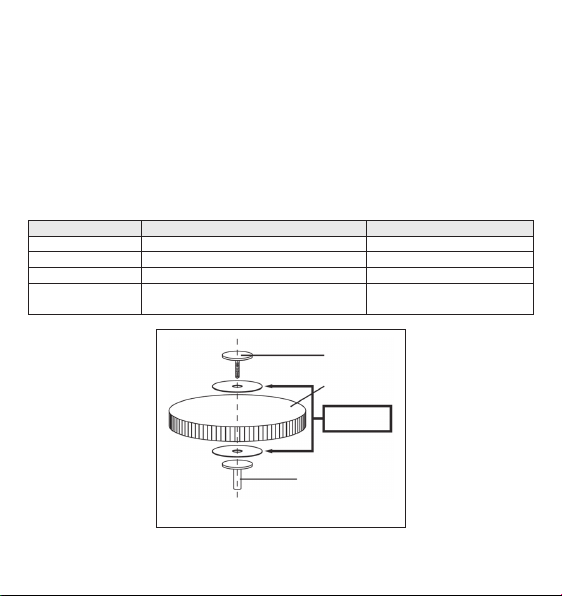
7. Materiāla sacietēšanas ilgums: mutes dobumā — 5 minūtes; istabas temperatūrā — 20 minūtes
(23°C/73,4°F). Pēc 24 stundām oderējuma materiāls kļūst nedaudz cietāks. Slīpēšanas
procedūru var veikt nekavējoties pēc tam, kad zobu protēzes ar no jauna ieklāto oderējuma
materiālu tiek izņemtas no mutes vai ģipša modeļa.
8. Iegremdējot zobu protēzes tādos šķīdumos, kas satur balinātāju, var mainīties oderējuma
materiāla SOFRELINER TOUGH S krāsa, tomēr zobu protēžu kvalitāte netiek ietekmēta.
9. Lūdziet pacientu notīrīt zobu protēzes, ievērojot apakšsadaļā “PIESARDZĪBAS PASĀKUMI
PACIENTIEM” minētos norādījumus.
10. Silikona sēžas pārbaudes materiāls var pielipt pie oderējuma materiāla SOFRELINER TOUGH
S, tādēļ pirms tā lietošanas uz virsmas uzklājiet vazelīnu.
11. Ja slīpētajā oderējumā ir radies lūzums, pilnībā noņemiet oderējumu un atkārtojiet procedūru.
12. Tālāk tabulā ir minēti formas izveides un slīpēšanas instrumenti.
Posms Instrumenti Forma
Apgriešana Ass skalpelis Nedaudz noapaļots asmens
Formas pielāgošana COARSE POINT (melna) Noapaļota un patievināta mala
Slīpēšana FINISHING WHEEL (brūna) Ripa
Reljefa izveide
DIAMOND ROUND BUR (jāiegādājas
atsevišķi)
Apaļš
Skrūve
Slīpēšanas
ripa
Paplāksne
Tapnis
Slīpēšanas ripa
Page 79

UZGLABĀŠANA
■
1. Glabājiet oderējuma materiālu SOFRELINER TOUGH S 0–25 °C (32–77 °F) temperatūrā.
2. Nepakļaujiet oderējuma materiālu SOFRELINER TOUGH S karstuma, atklātas liesmas,
mitruma un saules gaismas iedarbībai.
3. Nelietojiet oderējuma materiālu SOFRELINER TOUGH S, ja ir beidzies tā derīguma termiņš.
4. NENOVIETOJIET oderējuma materiālu SOFRELINER TOUGH S pacientiem un bērniem
sasniedzamā vietā, lai tas netiktu nejauši norīts.
ATBRĪVOŠANĀS
■
1. Lai izmestu PASTE, izspiediet neizmantoto pastu no kārtridža un uzgaidiet, līdz tā sacietē.
2. PRIMER šķidrums ir jāuzsūc inertā absorbējošā materiālā, piemēram, marlē vai vatē, un pēc
tam jāizmet saskaņā ar vietējo tiesību aktu prasībām.
ODERĒJUMA MATERIĀLA SOFRELINER TOUGH S IEKLĀŠANA
■
MUTĒ, PROCEDŪRU VEICOT ZOBĀRSTNIECĪBAS IESTĀDĒ
Vairākumā gadījumu optimālais oderējuma materiāla SOFRELINER TOUGH S biezums ir 1–2
milimetri. Ja ir jānodrošina biezāks slānis, kas pārsniedz 2 milimetrus, attiecīgajā vietā vispirms
jāieklāj cietais zobu protēžu oderējuma materiāls TOKUYAMA REBASE II, lai nodrošinātu
atbilstošu pamatni zobu protēzēs. Noņemot pārmērīgi daudz zobu protēžu sveķu, var tikt
pasliktināta protēžu kvalitāte vai tās var salūzt.
1. Sagatavošana
Vizuāli un ar palpācijas metodi pārbaudiet mutes veselības stāvokli. Izņemiet zobu protēzes no
pacienta mutes un ar ziepēm un ūdeni notīriet vietu, kur tiks ieklāts oderējuma materiāls. Rūpīgi
noskalojiet un pilnībā nožāvējiet ar gaisu zobu protēžu virsmu. Slīpējiet to zobu protēžu daļu, kas
pieskaras audiem, izmantojot karbīda urbi ar šķērseniskiem iegriezumiem, līdz tiek nodrošināts
atbilstošs dziļums. Slīpējiet zobu protēžu robežvietu, lai gar to varētu ieklāt 1 milimetru materiāla
(skatīt 1. attēlu). Notīriet slīpēšanas laikā sakrājušos putekļus, izmantojot otu vai sausu gaisu, kam
nav eļļas piemaisījuma.
Piezīme. Ja robežvieta tiek ievietota zobu protēžu pamatnes atlokā, slīpējiet to zobu protēžu
daļu, kas pieskaras audiem, izmantojot apaļo urbi (piemērots akrila sveķiem), līdz
tiek nodrošināts atbilstošs dziļums (skatīt 2. attēlu).
Page 80
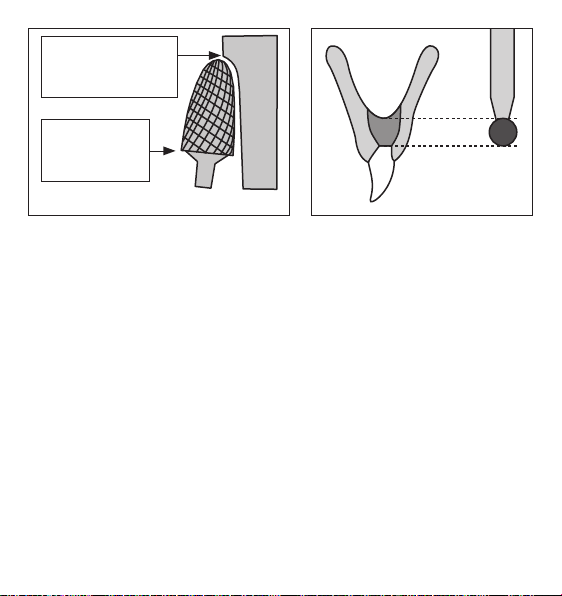
Oderējuma materiāla
un zobu protēžu
pamatnes robežvieta
Karbīda urbis ar
šķērseniskiem
iegriezumiem
1. attēls
2. PRIMER lietošana
Atveriet PRIMER flakonu. Pievienojiet flakonam pilienu uzgali. Iepildiet pilienu traukā atbilstošu
daudzumu PRIMER. Noņemiet uzgali un nekavējoties cieši noslēdziet flakonu.
3. PRIMER uzklāšana
Izmantojot PRIMER paredzētu otu, uzklājiet plānu, vienmērīgu kārtu PRIMER uz zobu protēžu
virsmas vietā, kur paredzēts ieklāt oderējuma materiālu SOFRELINER TOUGH S. PRIMER
jāuzklāj pilnībā uz visām vietām, citādi var tikt pasliktināta pielipšanas spēja. Pēc tam rūpīgi ar
gaisu nožāvējiet, līdz šķidrums vairs nav redzams.
4. PASTE lietošana
Ievietojiet SOFRELINER TOUGH S PASTE kārtridžu dispenserī (jāiegādājas atsevišķi). Atveriet
PASTE kārtridža vāciņu. Pievienojiet kārtridžam jaukšanas uzgali: salāgojiet rievas, uzspiediet uz
kārtridža un pagrieziet jaukšanas uzgali pa 90 grādiem pulksteņa rādītāju kustības virzienā.
5. PASTE uzklāšana
Vienmērīgi izspiediet sajaukto pastu uz tās zobu protēžu daļas, kas pieskaras audiem. Izmantojot
lāpstiņu, vienmērīgi izlīdziniet pastu pa visu virsmu, kur tika uzklāts PRIMER.
Piezīme. Ja šajā posmā daļa no virsmas, kur tika uzklāts praimeris, netiks pārklāta ar pastu,
6. Ievietošana mutē
Atsūciet siekalas no pacienta mutes. 1,5–2 minūtes pēc oderējuma materiāla SOFRELINER
TOUGH S samaisīšanas tas iegūst atbilstošu viskozitāti. Ievietojot zobu protēzes pacienta mutē,
ievietojot zobu protēzes mutē, attiecīgā daļa var tikt piesārņota ar siekalām, un
tādējādi var tikt pasliktināta pielipšanas spēja.
2. attēls
Page 81
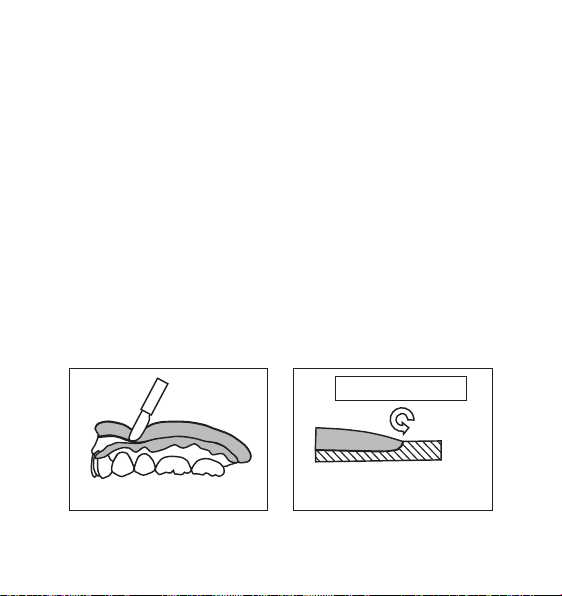
lūdziet pacientu ļoti viegli sakost zobus sakodiena vidusdaļā, nodrošinot atbilstošu vertikālo
virzienu. Pārbaudiet, vai pacienta mutē nav oderējuma materiāla SOFRELINER TOUGH S
pārpalikumu, un, ja tos konstatējat, nekavējoties likvidējiet. Iesakiet pacientam nekavējoties
brīdināt zobārstu, ja viņš/viņa jūt, ka rīklē iekļūst oderējuma materiāls SOFRELINER TOUGH S
vai jebkura cita viela.
Piezīme. Lai salāgotu augšējās zobu protēzes ar oderējuma materiālu SOFRELINER TOUGH
7. Formas izveide robežvietā
Uzmanīgi paveriet vaigus, lai izveidotu formu priekšējās daļas robežvietā. Šajā brīdī pacienta
zobiem jābūt viegli sakostiem. Ja pacienta mutē sakrājas siekalas, atsūciet tās un lūdziet pacientu
no jauna viegli sakost zobus. Vismaz 5 minūtes uzgaidiet, līdz oderējuma materiāls SOFRELINER
TOUGH S sacietē.
8. Apgriešana
Izņemiet zobu protēzes no pacienta mutes, noskalojiet tās ar ūdeni un nožāvējiet ar gaisu.
Uzmanīgi apgrieziet visus oderējuma materiāla SOFRELINER TOUGH S pārpalikumus no
robežvietām, izmantojot asu skalpeli (skatīt 3. attēlu).
S, protēzes ievietojiet no aizmugurējās aukslējas puses. Tādējādi oderējuma
materiāls SOFRELINER TOUGH S neiekļūs pacienta rīklē.
Ieklājot oderējuma materiālu aukslējas daļā, uzmanieties, lai pasta netiktu uzklāta
pārmērīgi daudz. Lai oderējuma materiāls nekļūst pārmērīgi biezs, zobu protēzes
mutē ievietojiet cik vien iespējams ātrāk.
Piezīme. Ja izņemsiet ātrāk par 5 minūtēm, oderējums var tikt bojāts.
Pagriešanas virziens
Oderējums
Zobu protēzes
3. attēls
9. Slīpēšana
Formas izveidei izmantojiet COARSE POINT (melna), nedaudz uz tās uzspiežot. Maksimālais
4. attēls
Page 82

slīpēšanas ātrums ir 15 000 apgr./min, tādējādi ar ripu var veikt nelielu apļveida kustību. Slīpēšanai
izmantojiet FINISHING WHEEL (brūna), nedaudz uzspiežot uz tās. Maksimālais slīpēšanas
ātrums ir 8000 apgr./min.
Piezīme. Grieziet COARSE POINT un FINISHING WHEEL virzienā no oderētās vietas uz
Reljefa veidošanai izmantojiet DIAMOND ROUND BUR (jāiegādājas atsevišķi) vai jebkādu citu
piemērotu urbi.
10. Atkārtota pielāgošana
Ja tiek veikta audu reģenerācija, dažas dienas pēc sākotnējās procedūras pacientam jānāk uz
atkārtotu vizīti. Atkārtoti pielāgojiet zobu protēzes, veicot 9. sadaļā aprakstīto procedūru. Ja
oderētajai virsmai ir jāpievieno jauna oderējuma materiāla kārta, noņemiet no zobu protēžu
pamatnes esošo kārtu un ieklājiet jaunu oderējumu.
11. Noņemšana
Izmantojot asu instrumentu, nogrieziet lielu daļu oderējuma materiāla SOFRELINER TOUGH S.
Atlikušo materiālu noslīpējiet.
■
zobu protēžu daļu tā, lai nebojātu robežvietu (skatīt 4. attēlu).
Piezīme. Veco akrila zobu protēžu oderējumu no akrila protēžu pamatnes var viegli noņemt,
izmantojot SILICONE REMOVER (jāiegādājas atsevišķi).
ODERĒJUMA MATERIĀLA SOFRELINER TOUGH S KLĪNISKAIS
PIELIETOJUMS ODERĒJUMA VEIDOŠANAI LABORATORIJĀ
1. Mutes pārbaude
Vizuāli un ar palpācijas metodi pārbaudiet mutes veselības stāvokli. Pārbaudiet vietu, kur jāveido
reljefs.
2. Zobu protēžu pārbaude
Ja zobu protēzes ir nodilušas vai vecas, vispirms pārklājiet tās ar cieto zobu protēžu oderējuma
materiālu TOKUYAMA REBASE II. Cietais oderējuma materiāls jāieklāj atbilstošā biezumā tā,
lai, kad tiek ieklāts jaunais materiāls, veicot 4. darbībā aprakstīto procedūru, jaunais cietā
oderējuma slānis paliktu zobu protēžu atbalsta daļā, tādējādi oderējuma materiāls SOFRELINER
TOUGH S pielīmēsies pie tā.
3. Ģipša modeļa izveide
Veidojiet nospiedumu. Šajā brīdī zobu protēzēm jābūt ievietotām pacienta mutē un pacientam ir
jāsakož zobi. Iepildiet ģipša masu nospiedumā. Atzīmējiet zobus un novietojiet zobu protēzes uz
oderējuma materiāla iespīlēšanas ierīces. Izņemiet ģipša modeli. Vietās, kur var tikt izraisītas
sāpes, izmantojiet vasku. Ģipša modeļa alveolārajā daļā ieklājiet atdalošo materiālu tā, lai tajā
Page 83

nepielīp oderējuma materiāls.
4. Sagatavošana
Slīpējiet to zobu protēžu daļu, kas pieskaras audiem, izmantojot karbīda urbi ar šķērseniskiem
iegriezumiem, līdz tiek nodrošināts atbilstošs dziļums.
Slīpējiet zobu protēžu robežvietu, lai gar to varētu ieklāt 1 milimetru materiāla (skatīt 1. attēlu).
Notīriet slīpēšanas laikā sakrājušos putekļus, izmantojot otu vai sausu gaisu, kam nav eļļas
piemaisījuma.
Piezīme. Izmantojot apaļo dimanta urbi, var vieglāk un vienmērīgi dziļi noslīpēt sveķus.
5. PRIMER lietošana
Atveriet PRIMER flakonu. Pievienojiet flakonam pilienu uzgali. Iepildiet pilienu traukā atbilstošu
daudzumu PRIMER. Noņemiet uzgali un nekavējoties cieši noslēdziet flakonu.
6. PRIMER uzklāšana
Izmantojot PRIMER paredzētu otu, uzklājiet plānu, vienmērīgu kārtu PRIMER uz zobu protēžu
virsmas vietā, kur paredzēts ieklāt oderējuma materiālu SOFRELINER TOUGH S. PRIMER
jāuzklāj pilnībā uz visām vietām, citādi var tikt pasliktināta pielipšanas spēja. Pēc tam rūpīgi ar
gaisu nožāvējiet, līdz šķidrums vairs nav redzams.
7. PASTE lietošana
Ievietojiet SOFRELINER TOUGH S PASTE kārtridžu dispenserī (jāiegādājas atsevišķi).
Atveriet PASTE kārtridža vāciņu. Pievienojiet kārtridžam jaukšanas uzgali: salāgojiet rievas,
uzspiediet uz kārtridža un pagrieziet jaukšanas uzgali pa 90 grādiem pulksteņa rādītāju kustības
virzienā.
8. PASTE uzklāšana
Izspiediet sajaukto pastu uz virsmas tur, kur tika ieklāts PRIMER. Uzklājiet pastu gan uz zobu
protēžu mukozālās virsmas, gan uz ģipša modeļa.
9. Atkārtota ievietošana
Atkārtoti ievietojiet zobu protēzes ģipša modelī un iespiediet, izmantojot oderējuma iespīlēšanas
ierīci. Vismaz 20 minūtes novietojiet istabas temperatūrā (23°C/73,4°F).
10. Apgriešana
Izņemiet zobu protēzes no ģipša modeļa. Uzmanīgi apgrieziet visus oderējuma materiāla
SOFRELINER TOUGH S pārpalikumus no robežvietām, izmantojot asu skalpeli (skatīt 3. attēlu).
Urbja diametru var izmantot kā dziļuma mērītāju.
Piezīme. Ja sacietējušais materiāls ir lipīgs, 5 minūtes skalojiet zobu protēzes 40–50°C (104–
122°F) siltā ūdenī, nenoņemot iespīlēšanas ierīci.
Page 84

11. Slīpēšana
Formas izveidei izmantojiet COARSE POINT (melna), nedaudz uz tās uzspiežot. Maksimālais
slīpēšanas ātrums ir 15 000 apgr./min, tādējādi ar ripu var veikt nelielu apļveida kustību. Slīpēšanai
izmantojiet FINISHING WHEEL (brūna), nedaudz uzspiežot uz tās. Maksimālais slīpēšanas
ātrums ir 8000 apgr./min.
Piezīme. COARSE POINT un FINISHING WHEEL virzienā no oderētās vietas uz zobu
Reljefa veidošanai izmantojiet DIAMOND ROUND BUR (jāiegādājas atsevišķi) vai jebkādu citu
piemērotu instrumentu.
■
1. Lai uzlabotu zobu protēžu, kam izmantots oderējuma materiāls SOFRELINER TOUGH S,
2. Vismaz vienu reizi dienā (ieteicams pirms gulētiešanas) zobu protēzes jāiegremdē tīrīšanas
3. Iegremdējot zobu protēzes tīrīšanas šķīdumos, kas satur balinātāju, var mainīties oderējuma
4. Ja zobu protēzes netiek lietotas, tās jāglabā ūdenī.
5. Ik pēc trīs mēnešiem vai vienmēr, kad tiek pamanīti pārmērīgi nosēdumi, zobu protēzes ar
6. Regulāri jāpārbauda, vai oderējuma materiāls SOFRELINER TOUGH S nav bojāts. Zobu
Lietojot salauztas vai bojātas zobu protēzes, pacientam var tikt izraisīts aizrīšanās,
protēžu daļu tā, lai nebojātu robežvietu (skatīt 4. attēlu).
PIESARDZĪBAS PASĀKUMI PACIENTIEM
ilgmūžību, izturību un drošību, informējiet pacientus par tālāk minētajiem norādījumiem.
Oderējuma materiālu SOFRELINER TOUGH S nedrīkst berzt ar birsti vai zobu suku.
Oderējuma materiāla SOFRELINER TOUGH S tīrīšanai vispiemērotākais ir sūklis vai marle.
Skalojot oderējuma materiāla SOFRELINER TOUGH S virsmu ar aukstu ūdeni, tas ir jāslauka
ar ziepjūdenī samitrinātu sūkli vai marli. Lai no oderējuma materiāla SOFRELINER TOUGH
S notīrītu netīrumus un ēdiena atlikumus, jāveic tīrīšanas kustības. Zobu virsmu un zobu
protēžu cieto akrila pamatni var tīrīt, izmantojot parasto zobu protēzēm paredzēto suku un
ziepes, zobu protēzēm paredzēto zobu pastu vai parastos zobu tīrīšanas līdzekļus (pēc zobārsta
ieskatiem).
līdzeklī, kas izdala aktīvo skābekli (piemēram, Polident, Efferdent u. c.). Zobu protēžu tīrīšanas
līdzekli, kas izdala aktīvo skābekli, nedrīkst lietot tad, ja zobu protēzes ir ievietotas pacienta
mutē. Ilgstoši lietojot zobu protēzes, atkarībā no to kopšanas paradumiem var mainīties protēžu
krāsa. Zobu protēzēm jāizmanto piemērots tīrīšanas līdzeklis, ievērojot tā ražotāja ieteikumus.
materiāla SOFRELINER TOUGH S krāsa, tomēr zobu protēžu kvalitāte netiek ietekmēta.
oderējumu ir jāpārbauda un jātīra, izmantojot ultraskaņas metodi, pie zobārsta.
protēzes nedrīkst lietot, ja tās ir bojātas, ieplīsušas, salauztas vai ir bojāts to oderējums.
Page 85
nosmakšanas vai citu traumu apdraudējums.
7. Ja tiek novērots jutīgums pret silikonu, zobu protēzes jāpārtrauc lietot un pacientam ir
nekavējoties jāsazinās ar savu zobārstu.
Par jebkādu nopietnu negadījumu, kas radies saistībā ar ierīci, lietotājam un/vai pacientam ir
jāziņo ražotājam un kompetentajai iestādei dalībvalstī, kurā lietotājs un/vai pacients atrodas.
SVARĪGA PIEZĪME. Oderējuma materiāla SOFRELINER TOUGH S ražotājs neuzņemas nekādu
atbildību par bojājumiem vai traumām, kas rodas, nepareizi lietojot materiālu. Pirms produkta
lietošanas lietotājam ir jāpārliecinās, ka šis produkts ir piemērots attiecīgajam pielietojumam.
Oderējuma materiāla SOFRELINER TOUGH S specifikācijas var tikt mainītas bez iepriekšēja
brīdinājuma. Ja izstrādājuma specifikācijas tiks mainītas, var tikt mainīta arī ar norādījumiem un
piesardzības pasākumiem saistītā informācija.
LIETUVIŲ K.
Prieš naudodami SOFRELINER TOUGH S, atidžiai perskaitykite visas šias instrukcijas.
GAMINIO APRAŠAS IR BENDROJI INFORMACIJA
■
1. SOFRELINER TOUGH S yra jungimosi būdu kietėjanti silikoninė minkšta perbazavimo
medžiaga, skirta išimamiems protezams perbazuoti gydytojo kabinete. SOFRELINER TOUGH
S atitinka ir ISO 10139-2 „Išimamųjų dantų plokštelių minkštosios medžiagos pagrindui
restauruoti. 2 dalis. Ilgalaikio naudojimo medžiagos“, ir ISO 10139-1 „Minkštosios medžiagos
išimamųjų dantų plokštelių pagrindui restauruoti. 1 dalis. Trumpalaikio naudojimo
medžiagos“.
2. SOFRELINER TOUGH S rinkinį sudaro PASTE (pasta), PRIMER (gruntas) ir kiti priedai,
pavyzdžiui, maišymo antgaliai, lašintuvas, indelis, šepetėliai, COARSE POINT (juoda),
FINISHING WHEEL (rudas).
3. PRIMER naudojamas tik klijuoti prie akrilinių paviršių. Juo negalima klijuoti prie nailono,
metalo ar silikono paviršių. PASTE išspaudžiama automatinio maišymo kasečių sistema.
Medžiaga sukietėja per 5 minutes burnoje arba per 20 minučių kambario temperatūroje (23°C /
73,4°F), ji yra bekvapė ir beskonė.
INDIKACIJOS
■
1. Skausmas dėl aštrių alveolės kaulo keterų ir gleivinės atrofijos.
Page 86

2. Prastas laikymasis dėl sunkios keteros atrofijos.
3. Didelės neigiamosios nišos arba viršutinio / apatinio žandikaulio kaulo išaugos.
4. Dengiamųjų protezų laikymasis prieš įstatant galutinius fiksatorius.
5. Laikinas perbazavimas arba minkštųjų audinių formavimas.
KONTRAINDIKACIJOS
■
SOFRELINER TOUGH S kontraindikuotinas pacientams, alergiškiems ar smarkiai jautriems
silikonui ir platinos junginiams, jo tokiems pacientams naudoti NEGALIMA.
ATSARGUMO PRIEMONĖS
■
1. SOFRELINER TOUGH S skirtas parduoti ir naudoti tik licencijuotiems odontologijos
specialistams. Jo negalima parduoti ir jis netinkamas naudoti ne odontologijos specialistams.
2. Naudokite SOFRELINER TOUGH S tik kaip nurodyta šiame dokumente. NENAUDOKITE
SOFRELINER TOUGH S jokiu kitu būdu, išskyrus nurodytą šiose instrukcijose.
3. NENAUDOKITE SOFRELINER TOUGH S, jei apsauginė plomba pažeista arba jei atrodo,
kad prie turinio buvo liestasi.
4. PRIMER yra etilacetato, tai labai degus ir lakus tirpiklis. Nelaikykite PRIMER netoli atviros
ugnies. Naudokite ventiliuojamoje patalpoje ir panaudoję stipriai užsukite dangtelį.
5. Jei pacientui pasireiškia alerginė reakcija ar padidėjęs jautrumas SOFRELINER TOUGH S,
pavyzdžiui, paūmėja dermatitas, išimkite protezą ir jo neleiskite nešioti.
6. Naudodami SOFRELINER TOUGH S visą laiką dėvėkite vienkartines pirštines be latekso,
kad išvengtumėte alerginių reakcijų tikimybės. Latekso pirštinės taip pat slopina
SOFRELINER TOUGH S kietėjimą. Jei SOFRELINER TOUGH S PRIMER patenka ant
vienkartinių pirštinių, iškart išmeskite pirštines ir kruopščiai nusiplaukite rankas vandeniu.
7. Venkite patekimo į akis. Patekus į akis, gausiai plaukite akis vandeniu ir iškart kreipkitės į
gydytoją.
8. Venkite nesukietėjusios medžiagos patekimo ant odos. Patekus ant odos, valykite paveiktą sritį
alkoholiniu dezinfekantu, tada gausiai plaukite vandeniu.
9. Venkite nesukietėjusios medžiagos patekimo ant drabužių. Patekus ant drabužių, medžiagos
nevalykite. Leiskite jai sukietėti ir tada ją nulupkite.
10. NELEISKITE medžiagos pertekliui tekėti į paciento trachėją ar stemplę. Dėl įkvėptos ar
nurytos SOFRELINER TOUGH S PASTE galima užspringti ar kitaip susižaloti. Iškart
pašalinkite perbazavimo medžiagos perteklių nuo gomurio, kad jis nenubėgtų pacientų į ryklę.
SOFRELINER TOUGH S nėra rentgenokontrastinis, įkvėptos ar prarytos medžiagos rentgeno
Page 87

nuotraukose nesimatys. Jei gydomas vyresnis pacientas, kurio refleksų geba suprastėjusi, kėdę
nustatykite sėdimoje padėtyje ir nurodykite pacientui kvėpuoti per nosį, kad medžiaga
nepatektų į kvėpavimo takus.
11. NEMAIŠYKITE SOFRELINER TOUGH S su jokiomis medžiagomis, nenurodytomis šiose
instrukcijose.
12. Panaudojus SOFRELINER TOUGH S kasetę, maišymo antgalį reikia pakeisti kasetės
dangteliu, kuris būna uždėtas ant kasetės įsigijus. Kaskart prieš naudodami naują maišymo
antgalį ar uždėdami kasetės dangtelį nuvalykite pastos perteklių nuo kasetės galiuko švaria
servetėle.
13. Kaskart panaudoję nuvalykite mentelę, šepetėlius ir indelius alkoholiu, kad išvengtumėte
kryžminės taršos.
14. Išmokykite pacientus pagal PACIENTO ATSARGUMO PRIEMONES, nurodytas
paskutiniame šių instrukcijų skyriuje.
15. Kad apdorodami neįkvėptumėte dulkių, visada dėvėkite kaukę, rekomenduojamą federalinių ir
(arba) vietinių įstatymų.
16. Perskaitykite ir laikykitės visų į šį rinkinį neįeinančių gaminių, minimų šiose instrukcijose,
gamintojų instrukcijų.
17. Kiek įmanoma venkite SOFRELINER TOUGH S kontakto su burnos gleivine, išskyrus
perbazuojamą sritį. Po gydymo nurodykite pacientams skalauti burną pakankamu kiekiu
vandens.
18. Netepkite PRIMER tiesiai ant plastikinių medžiagų, nes jiems susilietus tam tikri plastiko tipai
gali ištirpti.
NAUDOJIMO PASTABOS
■
1. Jei išimamasis protezas netinkamas, pirma perbazuokite jį akriline medžiaga, pavyzdžiui,
TOKUYAMA REBASE II kieta perbazavimo medžiaga, skirta išimamiems protezams
perbazuoti gydytojo kabinete, arba bet kokiomis laboratorinėmis / netiesioginėmis
procedūromis, kad protezas tiktų geriau.
2. Seno nusidėvėjusio protezo atveju pirma reikia perbazuoti nauja akriline medžiaga, nes į seną
nusidėvėjusią dervą įsigėrusios medžiagos, pavyzdžiui, aliejus ar vanduo, prastina
SOFRELINER TOUGH S adheziją.
3. Jei SOFRELINER TOUGH S PRIMER dėl išgaravimo sutirštėja, jų nenaudokite, nes gali
susilpnėti jungties stiprumas.
4. Grunto teptuko galiuką po kiekvieno naudojimo nuvalykite alkoholiu sudrėkintu vatos
Page 88
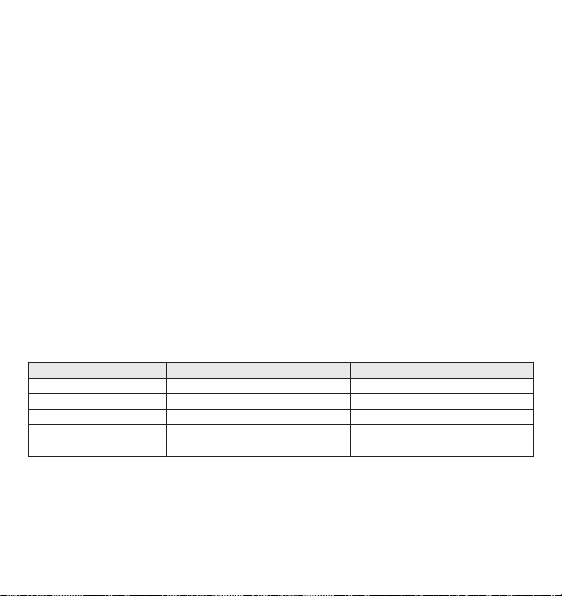
gumulėliu ar marle. Užterštas teptukas gali suprastinti SOFRELINER TOUGH S adheziją.
5. Nemaišykite pastų ranka, nes taip į pastą gali patekti oro burbuliukų, dėl jų medžiaga gali irti,
nusidažyti ir įgauti nemalonų kvapą.
6. Venkite SOFRELINER TOUGH S kontakto su toliau nurodytomis medžiagomis, nes jos gali
slopinti SOFRELINER TOUGH S kietėjimą.
Silikono pagrindo atspaudų medžiagos, medžiagos su eugenoliu, polisulfido gumos atspaudų
medžiagos, natūralios gumos pirštinės, kitų gamintojų minkštosios perbazavimo medžiagos ir
nesukietėjusios akrilo dervos.
7. Medžiaga sukietėja per 5 minutes burnoje arba per 20 minučių kambario temperatūroje (23°C /
73,4°F), ji yra bekvapė ir beskonė. Po 24 valandų perbazavimo medžiaga tampa šiek tiek
standesnė. Apdoroti galima iškart išėmus perbazuotą protezą iš burnos ar nuėmus nuo gipso
modelio.
8. Merkiant protezą į stiprių baliklių tirpalus gali pakisti SOFRELINER TOUGH S spalva, tačiau
jo savybės nepasikeis.
9. Nurodykite pacientui valyti protezą, kaip aprašyta skyriuje PACIENTO ATSARGUMO
PRIEMONĖS.
10. Kadangi silikono pagrindo tikimo tikrinimo medžiagos limpa prie SOFRELINER TOUGH S,
prieš naudodami paviršių patepkite vazelinu.
11. Jei apdorota perbazavimo medžiaga įskilusi, pašalinkite visą medžiagą ir procedūrą
pakartokite.
12. Formai koreguoti ir apdoroti naudokite toliau nurodytus instrumentus.
Etapai Instrumentai Formos
Apipjaustymas Aštrus skalpelis Šiek tiek užapvalinti ašmenys
Formos koregavimas COARSE POINT (juoda) Užapvalintas galiukas
Apdorojimas FINISHING WHEEL (rudas) Ratukas
Vietos sukūrimas
DIAMOND ROUND BUR
(parduodamas atskirai)
Rutulys
Page 89
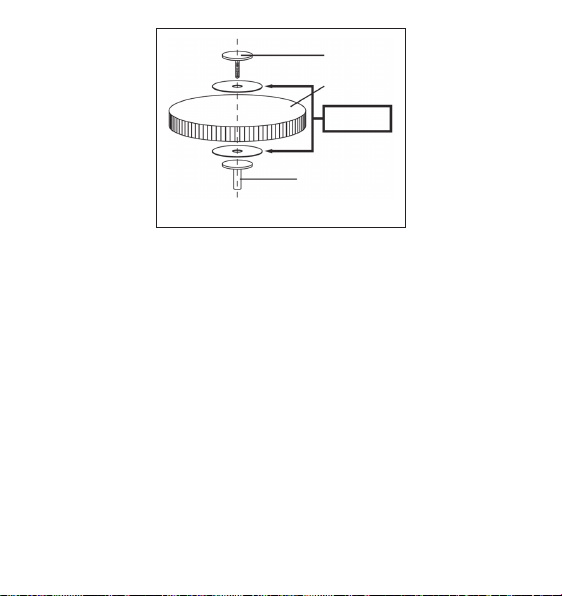
Varžtas
Apdorojimo
ratukas
Tarpiklis
Laikiklis
Apdorojimo ratukas
LAIKYMAS
■
1. Laikykite SOFRELINER TOUGH S 0–25 °C (32–77 °F) temperatūroje.
2. Venkite tiesioginio SOFRELINER TOUGH S kontakto su karščiu, atvira liepsna, drėgme ir
saulės šviesa.
3. Nenaudokite SOFRELINER TOUGH S pasibaigus nurodytam galiojimo laikui.
4. Be reikalo NEPALIKITE SOFRELINER TOUGH S pacientams ir vaikams pasiekiamoje
vietoje, kad jo netyčia nenurytų.
UTILIZAVIMAS
■
1. Norėdami išmesti PASTE, išspauskite likusią pastą iš kasetės ir prieš išmesdami leiskite jai
sukietėti.
2. Likusį PRIMER skystį reikia sugerti sugeriamąja medžiaga, pavyzdžiui, marle ar vata, ir
išmesti pagal vietines taisykles.
SOFRELINER TOUGH S KLINIKINIS NAUDOJIMAS
■
PERBAZAVIMO BURNOJE METODAS
Dauguma atveju optimalus SOFRELINER TOUGH S storis turi būti 1–2 milimetrai. Jei reikia
didesnio nei 2 mm storio, sritį pirma reikia perbazuoti TOKUYAMA REBASE II kieta
perbazavimo medžiaga, skirta išimamiems protezams perbazuoti gydytojo kabinete, kad būtų
gauta tinkamas protezo pagrindas. Pašalinus per daug protezo dervos jis gali susilpnėti ir lūžti.
Page 90
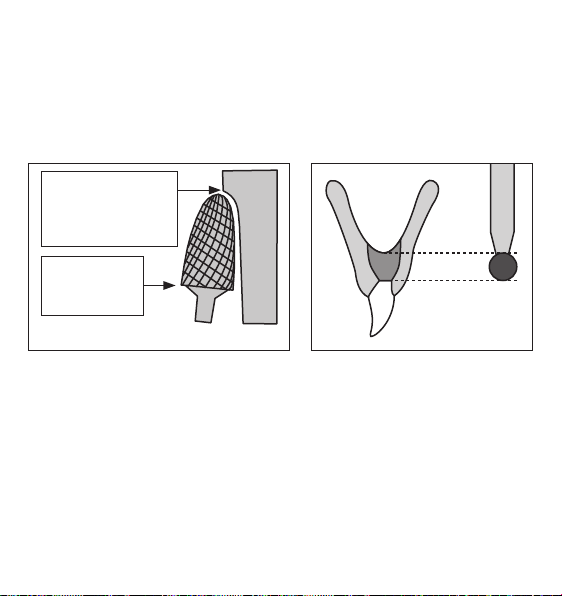
1. Paruošimas
Patikrinkite burnos būklę apžiūrėdami ir palpuodami. Išimkite protezą iš paciento burnos,
nuvalykite perbazuojamą sritį muilu ir vandeniu. Kruopščiai nuskalaukite ir visiškai išdžiovinkite
protezo paviršių. Nugręžkite protezo audinių pusę kryžminio pjovimo karbido freza iki tinkamo
gylio. Nusklembkite protezo kraštus, kad 1 milimetras medžiagos gaubtų kraštus (žr. 1 pav.).
Pašalinkite dulkes sausu šepetėliu ar oro srove be alyvos.
Pastaba. Kai kraštas yra protezo pagrindo dugne, išgręžkite protezo audinių pusę rožiniu
grąžtu (skirtu akrilinei dervai) iki tinkamo gylio (žr. 2 pav.).
Riba tarp
perbazavimo
medžiagos ir protezo
pagrindo
Kryžminio
pjovimo karbido
freza
1 pav.
2. PRIMER dozavimas
Atidarykite PRIMER buteliuką. Prie buteliuko pritvirtinkite lašintuvą. Įlašinkite į indelį
pakankamą kiekį PRIMER. Įlašinę uždenkite buteliuką ir iškart jį sandariai uždarykite.
3. PRIMER tepimas
Naudodami PRIMER teptuką ant protezo paviršių užtepkite ploną tolygų PRIMER sluoksnį ten,
kur turės būti SOFRELINER TOUGH S. Nepraleiskite vietų, kurias reikia patepti PRIMER, nes
dėl to gali suprastėti adhezija. Tada kruopščiai nusausinkite paviršių oru, kol neliks matomo
skysčio.
4. PASTE dozavimas
Įdėkite SOFRELINER TOUGH S PASTE kasetę į pistoletą (parduodamas atskirai). Nuimkite
PASTE kasetės dangtelį. Pritvirtinkite maišymo antgalį prie kasetės sulygiuodami įrantas,
įspauskite jį į kasetę sukdami antgalį palei laikrodžio rodyklę 90 laipsnių.
2 pav.
Page 91

5. PASTE tepimas
Tolygiai išspauskite pastos ant protezo audinių pusės. Mentele tolygiai paskleiskite pastą po visus
paviršius, pateptus PRIMER.
Pastaba. Jei per šį etapą dalis gruntuoto paviršiaus nebus padengta pasta, įdėjus į burną jis
6. Įdėjimas į burną
Išsiurbkite iš paciento burnos seilių perteklių. Per 1,5–2 minutes nuo sumaišymo SOFRELINER
TOUGH S medžiaga taps tinkamo klampumo. Įdėję protezą pacientui į burną, liepkite jam labai
švelniai sukąsti esant centriniam žandikaulių santykiui ir tinkamam vertikaliajam matmeniui.
Patikrinkite, ar paciento burnoje nėra SOFRELINER TOUGH S pertekliaus, ir jei jo yra, iškart
perteklių pašalinkite. Nurodykite pacientams iškart įspėti odontologą, jei jie jaučia, kad
SOFRELINER TOUGH S medžiaga ar kažkas kito teka link gerklės.
7. Kraštų formavimas
Labai švelnia patempkite paciento žandus, kad suformuotumėte prieangio srities kraštą, kol
pacientas švelniai sukandęs. Jei pacientas seilėjasi, išsiurbkite seiles ir nurodykite pacientui toliau
būti sukandus. SOFRELINER TOUGH S reikia palikti kietėti burnoje bent 5 minutes.
8. Apipjaustymas
Išimkite protezą iš paciento burnos, nuskalaukite vandeniu ir išdžiovinkite oru. Kruopščiai
pašalinkite visą SOFRELINER TOUGH S medžiagos perteklių nuo kraštų aštriu skalpeliu (žr. 3
pav.).
gali būti užterštas seilėmis ir lemti prastą adheziją.
Pastaba. Perbazuodami viršutinius protezus naudojant SOFRELINER TOUGH S, protezą
dėkite nuo galinės gomurio srities, kad SOFRELINER TOUGH S medžiaga nebėgtų
pacientui į gerklę.
Perbazuodami gomurio sritį neišspauskite per daug pastos ant perbazuojamo
paviršiaus ir kiek galėdami greičiau įdėkite protezą į burną, kad medžiaga
nesustandėtų.
Pastaba. Išimant anksčiau nei po 5 minučių medžiaga gali deformuotis.
Page 92
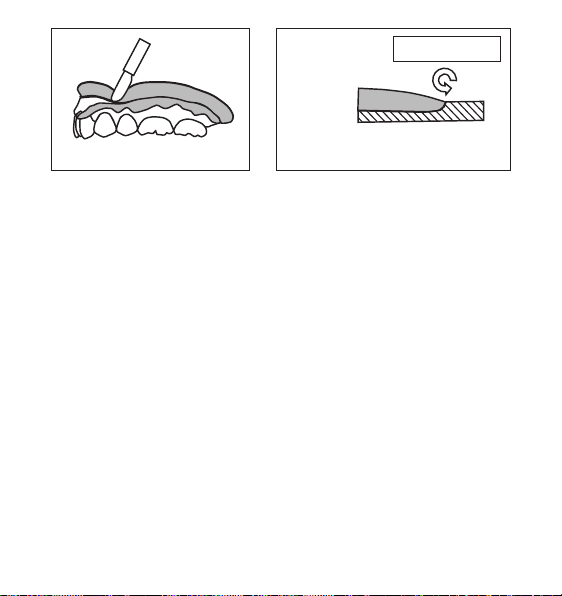
Sukimosi kryptis
Perbazavimo medžiaga
Protezas
3 pav.
9. Apdorojimas
Protezo formai koreguoti naudokite COARSE POINT (juodą) ir silpnai spausdami, neviršydami
15 000 aps./min. judinkite nedideliais apskritimais. Protezui apdoroti naudokite FINISHING
WHEEL (rudą) švelniai spausdami, neviršydami 8000 aps./min.
Pastaba. Sukite COARSE POINT ir FINISHING WHEEL nuo perbazuotos srities link
Pertekliui pašalinti naudokite DIAMOND ROUND BUR (parduodamą atskirai) arba bet kokį
tinkamą grąžtą.
10. Pakartotinis koregavimas
Jei formuojami audiniai, praėjus kelioms dienoms po pradinio gydymo reikia planuoti
pakartotinius vizitus. Pakartotinai koreguokite protezą pagal 9 skyriaus procedūrą. Jei prie
perbazuoto paviršiaus reikia pridėti daugiau medžiagos, pašalinkite esamą medžiagą nuo protezo
bazės ir perbazuokite iš naujo.
11. Pašalinimas
Pašalinkite didžiąją dalį SOFRELINER TOUGH S medžiagos nupjaudami aštriu instrumentu.
Likusią medžiagą nugręžkite.
■
protezo srities, kad nepažeistumėte ribos (žr. 4 pav.).
Pastaba. SILICONE REMOVER (silikono šalinimo medžiaga, parduodama atskirai) lengvai
pašalina seną silikoninę protezo perbazavimo medžiagą nuo akrilinio protezo
pagrindo.
SOFRELINER TOUGH S KLINIKINIS NAUDOJIMAS
4 pav.
PERBAZAVIMO LABORATORIJOJE METODAS
1. Burnos ištyrimas
Patikrinkite burnos būklę apžiūrėdami ir palpuodami. Patikrinkite, kuriose vietose reikia sukurti
Page 93

erdvės.
2. Protezo ištyrimas
Jei išimamasis protezas senas ar nusidėvėjęs, pirma perbazuokite jį TOKUYAMA REBASE II
kieta perbazavimo medžiaga, skirta išimamiems protezams perbazuoti gydytojo kabinete. Kietąją
perbazavimo medžiagą reikia tepti tinkamu storiu, kad pašalinus naująją medžiagą pagal 4
veiksmo procedūrą, liktų naujos kietos perbazavimo medžiagos sluoksnis, prie kurio galėtų prilipti
SOFRELINER TOUGH S.
3. Gipso modelio gaminimas
Nuimkite atspaudą pacientui sukandant protezą, tada į atspaudą pilkite gipso masę. Pagaminkite
gipsinį dantų šabloną ir uždėkite protezą ant perbazavimo laikiklio. Srityje, kurioje protezas gali
skausmingai spausti, uždėkite vaško. Ant gipsinio modelio keteros srities uždėkite atskiriamosios
medžiagos, kad perbazavimo medžiaga nepriliptų prie modelio.
4. Paruošimas
Nugręžkite protezo audinių pusę kryžminio pjovimo karbido freza iki tinkamo gylio.
Nusklembkite protezo kraštus, kad 1 milimetras medžiagos gaubtų kraštus (žr. 1 pav.). Pašalinkite
dulkes sausu šepetėliu ar oro srove be alyvos.
Pastaba. Rožiniu grąžtu lengva pašalinti vienodą dervos sluoksnį. Grąžto skersmuo gali būti
5. PRIMER dozavimas
Atidarykite PRIMER buteliuką. Prie buteliuko pritvirtinkite lašintuvą. Įlašinkite į indelį
pakankamą kiekį PRIMER. Įlašinę uždenkite buteliuką ir iškart jį sandariai uždarykite.
6. PRIMER tepimas
Naudodami PRIMER teptuką ant protezo paviršių užtepkite ploną tolygų PRIMER sluoksnį ten,
kur turės būti SOFRELINER TOUGH S. Nepraleiskite vietų, kurias reikia patepti PRIMER, nes
dėl to gali suprastėti adhezija. Tada kruopščiai nusausinkite paviršių oru, kol neliks matomo
skysčio.
7. PASTE dozavimas
Įdėkite SOFRELINER TOUGH S PASTE kasetę į pistoletą (parduodamas atskirai).
Nuimkite PASTE kasetės dangtelį. Pritvirtinkite maišymo antgalį prie kasetės sulygiuodami
įrantas, įspauskite jį į kasetę sukdami antgalį palei laikrodžio rodyklę 90 laipsnių.
8. PASTE tepimas
Išspauskite sumaišytos pastos ant PRIMER patepto paviršiaus. Pastos išspauskite tiek ant protezo
gleivinės pusės, tiek ant gipsinio modelio.
gylio rodmuo.
Page 94

9. Pakartotinis tvirtinimas
Vėl pritvirtinkite protezą prie jo gipsinio modelio ir suspauskite jį perbazavimo laikiklyje. Palikite
nejudindami 20 minučių ar ilgiau kambario temperatūroje (23°C / 73,4°F).
Pastaba, Jei sukietėjusi medžiaga lipni, pamerkite protezą į 40–50°C (104–122°F)
10. Apipjaustymas
Nuimkite protezą nuo gipsinio modelio. Kruopščiai pašalinkite visą SOFRELINER TOUGH S
medžiagos perteklių nuo kraštų aštriu skalpeliu (žr. 3 pav.).
11. Apdorojimas
Protezo formai koreguoti naudokite COARSE POINT (juodą) ir silpnai spausdami, neviršydami
15 000 aps./min. judinkite nedideliais apskritimais. Protezui apdoroti naudokite FINISHING
WHEEL (rudą) švelniai spausdami, neviršydami 8000 aps./min.
Pertekliui pašalinti naudokite DIAMOND ROUND BUR (parduodamą atskirai) arba bet kokį
tinkamą instrumentą.
■
1. Pacientus reikia informuoti apie toliau pateiktas instrukcijas, kaip pagerinti protezo, perbazuoto
SOFRELINER TOUGH S perbazavimo medžiagos negalima valyti protezų šepetėliu ar dantų
2. Bent kartą per dieną, geriausiai prieš naktį, pamerkite protezą į oksigenacinį protezų valiklį
3. Merkiant protezą į stiprių baliklių valomuosius tirpalus gali pakisti SOFRELINER TOUGH S
4. Nenešiojant protezą reikia laikyti vandenyje.
temperatūros vandenį 5 minutes su visu perbazavimo laikikliu.
Pastaba. Tiek COARSE POINT, tiek FINISHING WHEEL sukite nuo perbazuotos srities link
protezo srities, kad nepažeistumėte ribos (žr. 4 pav.).
PACIENTO ATSARGUMO PRIEMONĖS
naudojant SOFRELINER TOUGH S, ilgaamžiškumą, patvarumą ir saugą.
šepetėliu. Geriausia SOFRELINER TOUGH S valyti kempine arba minkšta marle.
SOFRELINER TOUGH S paviršių plaudami tekančiu šaltu vandeniu, valykite paviršių muilo
prisotinta kempine ar marle. Švelniai braukdami nuvalykite visus likučius ir susikaupusį maistą
nuo SOFRELINER TOUGH S perbazavimo medžiagos. Dantų paviršius ir kietą akrilinį
protezo pagrindą galima valyti įprastu protezų šepetėliu valant su muilu, protezų pasta arba
įprastais protezų valikliais odontologo nuožiūra.
(pvz., „Polident“, „Efferdent“ ir t. t.). Protezo negalima valyti oksigenaciniu valikliu paciento
burnoje. Ilgai naudojant gali išblukti spalva, atsižvelgiant į protezo priežiūrą. Naudokite
protezų valiklį pagal jo gamintojo instrukcijas.
spalva, tačiau jo savybės nepasikeis.
Page 95
5. Kas tris mėnesius ar pastebėjus kietų apnašų perbazuotą protezą odontologas turi patikrinti ir
nuvalyti ultragarsinėje vonelėje.
6. SOFRELINER TOUGH S reikia dažnai tikrinti, ar jis nepažeistas. Protezo su pažeista,
įskilusia, atsipalaidavusia ar atlipusia perbazavimo medžiaga nešioti negalima.
Nešiojant sugadintą ar sulūžusį protezą galima užspringti, jį įkvėpti, uždusti ar kitaip susižaloti.
7. Jei pasireiškia bet koks jautrumo silikonui požymis, protezo reikia nebenešioti ir iškart kreiptis
į savo odontologą.
Naudotojas ir (arba) pacientas apie bet kokį rimtą incidentą, įvykusį su prietaisu, turi pranešti
gamintojui ir valstybės narės, kurioje yra įsisteigęs naudotojas ir (arba) pacientas, kompetentingai
institucijai.
SVARBI PASTABA: SOFRELINER TOUGH S gamintojas neatsako už žalą ar sužalojimus,
sukeltus netinkamai naudojant šį gaminį. Užtikrinti, kad gaminys tinkamas naudoti pagal norimą
paskirtį, yra naudotojo asmeninė atsakomybė.
SOFRELINER TOUGH S gaminio specifikacijos gali keistis be įspėjimo. Pasikeitus gaminio
specifikacijoms taip pat gali keistis instrukcijos ir atsargumo priemonės.
MAGYAR
A SOFRELINER TOUGH S használata előtt figyelmesen olvasson el minden alábbi utasítást.
TERMÉKLEÍRÁS ÉS ÁLTALÁNOS INFORMÁCIÓK
■
1. A SOFRELINER TOUGH S addíciós szilikonból készült, puha alábélelő anyag kivehető
fogsorok közvetlen alábéleléséhez. A SOFRELINER TOUGH S megfelel mind az ISO 101392 „Puha alábélelő anyagok kivehető fogpótláshoz. 2. rész: Tartósan bent maradó anyagok”,
mind az ISO 10139-1 „Puha alábélelő anyagok kivehető fogpótláshoz. 1. rész: Rövid ideig
használt anyagok” követelményeinek.
2. A SOFRELINER TOUGH S készlet PASTE-et, PRIMER-t és más tartozékokat, például
keverőcsúcsokat, csepegtetőt, cseppfogó csészét, ecseteket, COARSE POINT formakorrekciós
hegyet (fekete), FINISHING WHEEL finírozókorongot (barna) tartalmaz.
3. A PRIMER-t kizárólag az akril felületekhez történő rögzítéshez használják. Nylon, fém és
szilikon felületek ragasztásához nem használható. A PASTE önkeverő adagolópatronos
rendszerben kapható. Az anyag a szájban 5 perc alatt, szobahőmérsékleten (23°C/73,4°F) 20
Page 96

perc alatt keményedik ki, és nincs illata és íze.
JAVALLATOK
■
1. Az alveoláris csont éles peremei, valamint a nyálkahártya-atrófia által okozott fájdalom
enyhítése.
2. A fogpótlásnak az alveoláris csontperem extrém atrófiája által okozott gyenge megtartása.
3. Nagyobb alámenős részek vagy torus maxillaris/mandibularis.
4. A teleszkópprotézisek megtartása a végső rögzítés felhelyezése előtt.
5. Ideiglenes alábélelés vagy szövetkondicionálás.
ELLENJAVALLATOK
■
A SOFRELINER TOUGH S ellenjavallt azoknál a pácienseknél, akik allergiásak vagy
túlérzékenyek a szilikon és platina összetevőkre, és ezért ilyen pácienseknél NEM használható.
ÓVINTÉZKEDÉSEK
■
1. A SOFRELINER TOUGH S-t kizárólag engedéllyel rendelkező fogászati szakemberek általi
értékesítésre és használatra tervezték. Nem tervezték nem fogászati szakemberek általi
értékesítésre, és nem is alkalmas az általuk történő használatra.
2. A SOFRELINER TOUGH S-et kizárólag az itt szereplő utasításoknak megfelelően használja.
NE használja a SOFRELINER TOUGH S-et a jelen útmutatóban megjelöltektől eltérő
alkalmazás céljára.
3. NE használja a SOFRELINER TOUGH S-et, ha a biztonsági zár sérült, vagy ha a csomagolás
tartalmát illetéktelenül módosították.
4. A PRIMER etil-acetátot tartalmaz, amely igen gyúlékony és illékony oldószer. Ne tegye ki a
PRIMER-t nyílt láng hatásának. Jól szellőző helyiségben használja, és a használatot követően
szorosan zárja le.
5. Ha a páciens a SOFRELINER TOUGH S használatakor allergiás reakciót vagy
túlérzékenységet, például dermatitisz fellépését tapasztalja, vegye ki a protézist, és azonnal
függessze fel a használatát.
6. Az esetleges allergiás reakciók elkerülésére a SOFRELINER TOUGH S használata során
mindig viseljen nem latexből készült kesztyűt. A latex kesztyű meggátolhatja a SOFRELINER
TOUGH S kikeményedését is. Ha a SOFRELINER TOUGH S PRIMER érintkezésbe kerül a
vizsgálati kesztyűkkel, azonnal dobja ki a kesztyűket, és mossa meg alaposan a kezét vízzel.
7. Kerülje az anyag szembe kerülését. Szembe kerülés esetén alaposan mossa ki a szemét vízzel,
és azonnal keressen fel egy orvost.
Page 97

8. Kerülje a még nem kikeményedett vegyszerek érintkezését a bőrrel. A bőrre kerülés esetén
tisztítsa meg az érintett felületet alkohollal, majd alaposan öblítse le vízzel.
9. Kerülje el a még nem kikeményedett anyagok érintkezését a ruházattal. A ruházatra kerülés
esetén ne törölje le az anyagot. Várja meg, hogy kikeményedjen, majd dörzsölje le.
10. NE hagyja, hogy a felesleges anyag lefolyjon a páciens légcsövén vagy nyelőcsövén. A
belélegzett vagy lenyelt SOFRELINER TOUGH S PASTE hatására fulladás, vagy más sérülés
léphet fel. Azonnal távolítson el a palatális területről minden felesleges alábélelő anyagot, hogy
elkerülje az anyag lefolyását a páciens torkán. A SOFRELINER TOUGH S átereszti a
röntgensugárzást, és a röntgenfelvételeken nem látszik a belélegzett vagy lenyelt anyag.
Idősebb páciensek esetében, akiknek a reagálóképessége csökkent, állítsa a széket függőleges
helyzetbe, és kérje meg a pácienst, hogy az orrán keresztül lélegezzen, és így elkerülje az
anyag bekerülését a légutakba.
11. NE keverje össze a SOFRELINER TOUGH S-et a jelen útmutatóban nem szereplő anyagokkal.
12. A SOFRELINER TOUGH S patron használatát követően a keverőcsúcs helyére a vásárláskor
a patronhoz kapott kupak kerül. Minden alkalommal, mielőtt új keverőcsúcsot használna, vagy
feltenné a patron kupakját, törölje le a felesleges anyagot a patron csúcsáról egy tiszta
törlőruhával vagy törlőkendővel.
13. A keresztszennyeződés elkerülésére mindig tisztítsa meg alkohollal a spatulát, az ecseteket és a
csészéket.
14. Lássa el a pácienseket a jelen útmutató utolsó részében található ÓVINTÉZKEDÉSEK A
PÁCIENSEK SZÁMÁRA című részben szereplő instrukciókkal.
15. Hogy elkerülje finírozás közben a por belégzését, mindig viseljen a szövetségi és/vagy helyi
hatóságok által előírt arcvédő maszkot.
16. Olvassa el és kövesse a gyártó jelen útmutatóban említett, ezen készlethez nem mellékelt
összes termékére vonatkozó utasításait.
17. Amennyire lehetséges, kerülje a SOFRELINER TOUGH S érintkezését a száj
nyálkahártyájának azzal a részével, ahol nem végez alábélelést. Kérje meg a betegeket, hogy a
kezelés után öblítsék ki a szájukat megfelelő mennyiségű vízzel.
18. Ne tegye ki a PRIMER-t a műanyagokkal való közvetlen érintkezésnek, mert ez feloldhatja a
műanyagok egyes típusait.
AZ ALKALMAZÁSRA VONATKOZÓ UTASÍTÁSOK
■
1. Rosszul illeszkedő fogsor esetén azt először akril anyaggal, például TOKUYAMA REBASE
II-vel, a fogsor közvetlen alábélelésére szolgáló kemény anyaggal, vagy más laboratóriumi/
Page 98

közvetlen eljárással alá kell bélelni az illeszkedés javításához.
2. Régi, elhasználódott fogsor esetén az alábélelendő felületet először új akril anyaggal alá kell
bélelni, mivel a régi, elhasználódott gyantába felszívódott anyagok, például az olaj vagy a víz
csökkenthetik a SOFRELINER TOUGH S tapadását.
3. Ha a SOFRELINER TOUGH S PRIMER párolgás következtében megvastagszik, ne használja,
mivel a tapadási szilárdság csökkenhet.
4. Az alapozószín ecsetének hegyét minden használat után törölje le alkoholba mártott vatta-
vagy gézdarabbal. A szennyezett ecset csökkentheti a SOFRELINER TOUGH S tapadását.
5. Ne keverje össze a pasztákat kézzel, met így buborékok kerülhetnek a pasztába, ami
elhasználódást, beszennyeződést és kellemetlen szagokat okozhat.
6. Kerülje a SOFRELINER TOUGH S érintkezését az alábbi anyagokkal, mivel ezek gátolhatják
a SOFRELINER TOUGH S kikeményedését:
szilikon bázisú lenyomatanyagok, eugenol-tartalmú anyagok, poliszulfid-gumi
lenyomatanyagok, természetes gumiból készült kesztyűk, más gyártótól származó puha
alábélelő anyagok, valamint nem kikeményedett akrilgyanta.
7. Az anyag a szájban 5 perc alatt, szobahőmérsékleten (23 °C/73,4 °F) 20 perc alatt keményedik
ki, és nincs illata és íze. 24 óra elteltével az alábélelés némileg megszilárdul. A finírozási
eljárás közvetlenül az újonnan alábélelt fogsor vagy a gipszmodell szájból történő eltávolítását
követően végrehajtható.
8. A fogsor erős fehérítőszert tartalmazó oldatba történő mártása megváltoztathatja a
SOFRELINER TOUGH S színét, a hatását azonban nem módosítja.
9. Lássa el a pácienseket a fogsor tisztítására vonatkozó utasításokkal az ÓVINTÉZKEDÉSEK A
PÁCIENSEK SZÁMÁRA című részben leírtaknak megfelelően.
10. Mivel a szilikon bázisú illeszkedés-ellenőrző anyag hozzátapad a SOFRELINER TOUGH
S-hez, használat előtt vigyen fel a felületre vazelint.
11. Ha a befejezett alábélelésben törés észlelhető, teljesen távolítsa el az alábélelést, és ismételje
meg az eljárást.
12. A forma kiigazításához és a finírozáshoz használja az alábbi eszközöket.
Page 99
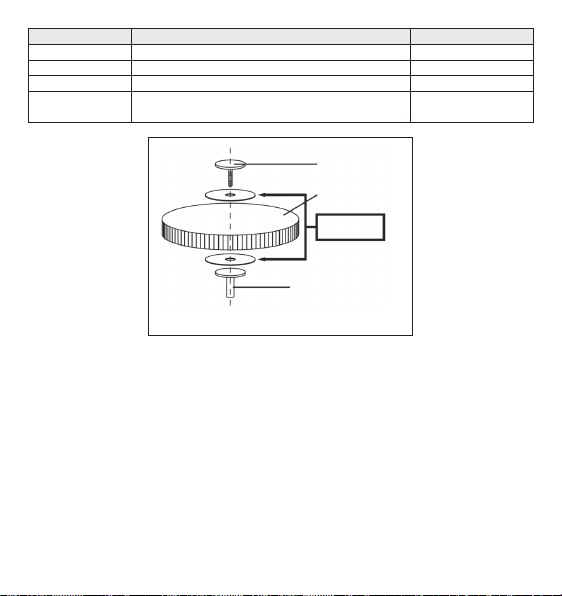
Fázisok Eszközök Formák
Kidolgozás Éles szike Enyhén lekerekített él
Forma kiigazítása COARSE POINT formakorrekciós hegy (fekete) Kerek, kúpos vég
Finírozás FINISHING WHEEL finírozókorong (barna) Korong forma
A belső felületek
korrekciója
TÁROLÁS
■
1. Tárolja a SOFRELINER TOUGH S-et 0–25 °C-os (32–77 °F-os) hőmérsékleten.
2. Kerülje a SOFRELINER TOUGH S hőnek, nyílt lángnak, nedvességnek és napfénynek való
kitételét.
3. Ne használja a SOFRELINER TOUGH S-et a lejárati dátum után.
4. A termék tévedésből történő lenyelésének elkerülésére NE hagyja a SOFRELINER TOUGH
S-et szükségtelenül a páciensek és gyermekek számára elérhető helyen.
HULLADÉKKEZELÉS
■
1. A PASTE ártalmatlanításához nyomja ki a felhasználatlan pasztát a patronból, és mielőtt
kidobja, hagyja, hogy kikeményedjen.
2. A megmaradt PRIMER folyadékot semleges nedvszívó anyaggal, például gézzel vagy pamuttal
fel kell itatni, és a helyi előírásoknak megfelelően kell ártalmatlanítani.
DIAMOND ROUND BUR kerek gyémántfúró
(külön beszerezhető)
Csavar
Finírozókorong
Csavaralátét
Tüske
Finírozókorong
Gömbölyű
Page 100
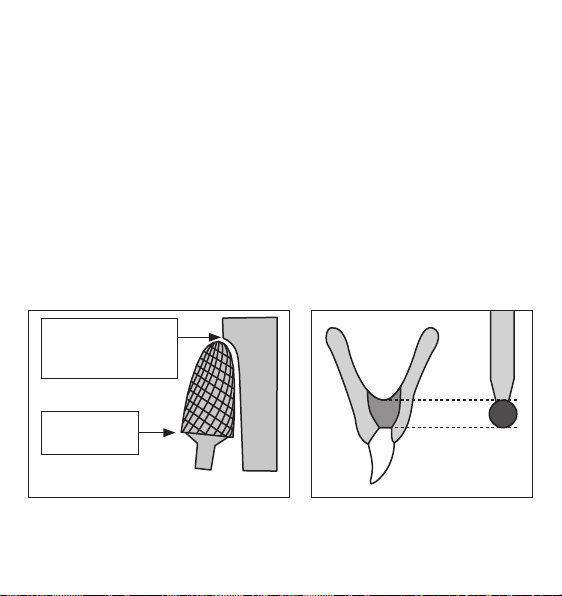
A SOFRELINER TOUGH S INTRAORÁLIS ALÁBÉLELÉSI
■
MÓDSZER KLINIKAI ALKALMAZÁSA
A legtöbb esetben a SOFRELINER TOUGH S optimális vastagságának 1–2 milliméternek kell
lennie. Ha 2 milliméternél nagyobb vastagságra van szükség, a megfelelő fogsoralap
létrehozásához a területet először alá kell bélelni TOKUYAMA REBASE II-vel, a fogsor
közvetlen alábélelésére szolgáló kemény alábélelő anyaggal. A fogsorgyanta túlzott eltávolítása a
fogsor töréséhez és meggyengüléséhez vezethet.
1. Előkészítés
Ellenőrizze az intraorális állapotot szemrevételezéssel és tapintással. Vegye ki a fogsort a páciens
szájából, és tisztítsa meg az alábélelendő területet szappannal és vízzel. Öblítse le alaposan a
fogsort, és légbefúvó segítségével szárítsa meg teljesen a felületét. Fúrja ki a fogsor szövet felőli
oldalát a megfelelő mélységig egy keresztvágású karbid fúróval. Alakítsa ki rézsútosan a fogsor
széleit úgy, hogy 1 milliméternyi anyag ráhajoljon a peremekre (lásd: 1. ábra). Távolítsa el a
fúrásból származó port egy száraz ecsettel, vagy szárítsa meg olajmentes levegővel.
Megjegyzés: Amikor a perem a fogsor-alaplemez karimáján belül helyezkedik el, fúrja ki a
Az alábélelő anyag és
a fogsor-alaplemez
közti rés
Keresztvágású
karbid fúró
fogsor szövet felőli oldalát a megfelelő mélységig kerek fúróval (akrilgyanta
esetén) (lásd: 2. ábra).
1. ábra
2. A PRIMER adagolása
Nyissa ki a PRIMER flakonját. Csatlakoztassa a csepegtetőt a flakonhoz. Adagoljon megfelelő
mennyiségű PRIMER-t a cseppfogó csészébe. Tegye vissza a kupakot, és az adagolás után zárja le
2. ábra
 Loading...