

Page 1

t Equipment Depot - 800.517.8431 - 5 Commonwealth Ave, MA 01801 -
Tes
TestEquipmentDepot.com
testo 316-2
Leakage detector for gas
Instruction manual
Page 2
Safety and environment2
Safety and environment
On this document
Read this document through carefully, and familiarize yourself with the product before
>
you put it to use. Keep this documentation close to hand in order to be able to
consult it if required. Pass this documentation on to later users of the product.
>
Pay particular attention to information which is marked with the following symbols:
· With the signal word Warning!:
Warns of dangers which can lead to serious injury if the prescribed safety measures
are not taken.
· With the signal word Attention!:
Warns of dangers which can lead to light injuries or material damage if the prescribed
safety measures are not taken.
· Important information
Avoiding personal injury/material damage
Use the measuring instrument only for the purpose for which it is intended, and within
>
the parameters stated in the technical data. Do not use force.
>
If damage, malfunction or incorrect display occur, have the instument checked. Do
not use faulty instruments.
>
Do not carry out measurements with the product on or near live parts.
> Never store the product together with solvents, acids or other corrosive substances.
> Carry out only repair and maintenance work described in the instruction manual.
Observe the prescribed handling steps. Use only original spare parts from Testo.
Protecting the environment
Dispose of faulty rechargeable batteries/empty batteries at the proper collection
>
points.
>
Send the product back to Testo at the end of its life. We will ensure that it is disposed
of in an environmentally friendly manner.
Page 3
Page 4

Specifications4
Technical data
Technical measuring data
Sensor: Gas-sensitive semi-conductor
· Reaction threshold: 10 ppm bei C3H8, CH4 und H2
· Reactions time: <2s
· Alarm thresholds
Further instrument data
Operating conditions: -5 to 50°C / 23 to 122°F / 20 to
80%RH, with limited functionality (only audible indication, reduced accuracy, reduced operating time)
can also be used in the range -20°C to -5°C / -4 to
23°F
· Storage/transp. conditions: -25...60°C / -13...140°F/
20...80%rF
· Minimum bend radius gooseneck: 40 mm
· Current supply: Rech. battery pack NiMh
Sensor data
Meas. parameter Measuring range Bar display Reaction time
CH4 10 ppm to 4.0 Vol. % 1 - 18 bars < 2 sec. with pump
C3H8 10 ppm to 1.9 Vol. % 1 - 18 bars < 2 sec. with pump
H2 10 ppm to 4.0 Vol. % 1 - 18 bars < 2 sec. with pump
Alarm thresholds
Meas. parameter 1. Alarm threshold 1. Alarm 2. Alarm threshold 2. Alarm
(12 bars) Accuracy (17 bars) Accuracy
CH4 200 ppm ±2 bars 10.000 ppm ±2 bars
C3H8 100 ppm ±2 bars 5.000 ppm ±2 bars
H2 200 ppm ±2 bars 10.000 ppm ±2 bars
· Battery life: appprox. 6h (at 22°C / 72°F)
· Charging time: approx. 8h
· Dimensions: 57 x 190 x 42mm
· Weight: 348g
Guidelines, norms and tests
· Instrument complies with worksheet DVGW G465-4
Page 5

Page 6

First steps6
Audible notification
The audible notification takes place with a signal tone whose interval frequency
increases with increasing gas concentrations. A continuous signal sounds when the
second alarm threshold is passed.
First steps
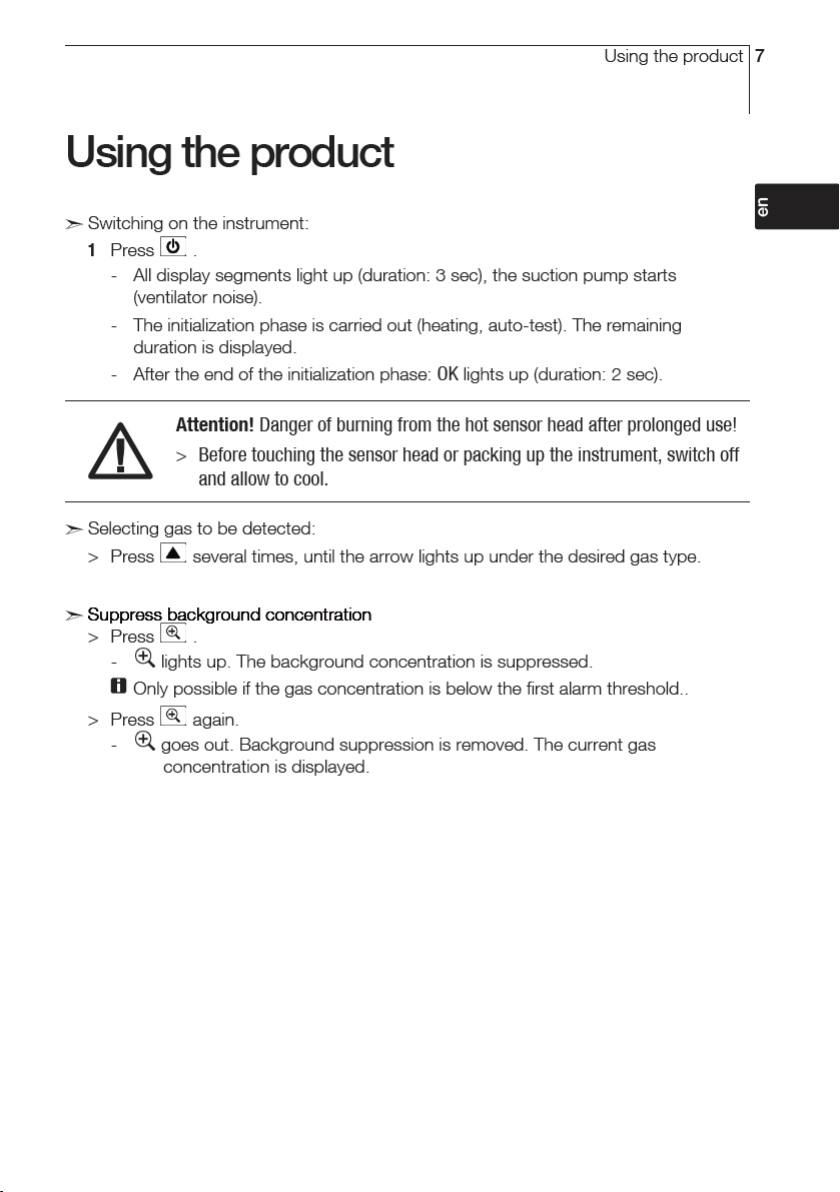
ã Charging battery:
Use only the original mains unit 0554 1093!
The rechargeable battery can only be charged at an ambient temperature
of 0 to 45°C ( 32 to 113°F).
If the rechargeable battery is completely discharged, charging takes approx. 8h.
In order to ensure as long a battery life as possible, the battery shoud always be
completely discharged and recharged.
The instrument can continue to be used during charging.
1
Plug the mains plug into the country-specific adapter and then plug into the mains
socket.
2
Plug the instrument plug into the mains unit socket of the instrument.
- Charging begins: , and light up alternately.
- Charging stops automatically when the rechargeable battery is full: lights up.
ã Using the earplug:
Use only the original earplug 0554 5001!
The instrument loudspeaker is deactivated when the earplug is plugged in!
Plug the connection plug of the earplug into the earplug socket of the instrument.
>
Page 7
Page 8
Using the product8
ã Carrying out gas detection:
Attention! Destruction of the sensor by non-desorbant substances (e.g. oils)!
> Do not use the instrument in dirty surroundings.
> Move the sensor head as close as possible, and slowly (3 to 5 cm per second)
over the parts which are to be examined for leaks.
Resetting maximum value display:
ã
> Press and simultaneously.
ã Switching instrument off:
> Press and hold until the display switches off.
Page 9

Maintaining the product
Maintaining the product 9
â Charging the rechargeable battery:
See chapter “First steps”
â
Cleaning the sensor:
Tobacco smoke, dirty air, oils, grease, silicones and evaporating liquids or gases can
lead to deposits on the surface of the sensor. This can result in reduced sensitivity
and falsified display of concentrations. If necessary clean the sensor.
>
Switch on the instrument, wait until the end of the initialization phase and switch
off again. Repeat this procedure several times.
Clean the sensor head from the outside
â
> If dirty, clean the sensor head with a soft dry cloth.
â Cleaning the housing:
> If dirty, clean the housing with a damp cloth (soap solution). Do not use aggressive
cleaning products or solvents!
Switching on regularly
â
If the instrument is used infrequently, deposits may build up on the sensor.
Switching the instrument on prevents deposits building up on the sensor. Testo
recommends switching the instrument on regularly to avoid deposits building up
on the sensor.
â
Storage & transportation
To avoid contamination of the sensor, the instrument should not be stored
or transported in an environment where there is tobacco smoke, foul air, oils,
greases, silicones or evaporating liquids or gases. Any sensor that is contaminated
as a result of storage or transportation must be cleaned before use, see Cleaning
the sensor.
â
Regular servicing:
Testo recommends yearly servicing of the gas detector by an authorized service
centre.
en
Page 10

Tips and assistance10
Tips and assistance
Questions and answers
Question Possible causes / solutions
“Error 01” · Instrument error: please contact your dealer or Testo customer service.
“Error 02” · Sensor defective (wire breakage): please contact your dealer or Testo customer
“Error 03” · Sensor connection faulty: Steckverbidnung des Sensorkopfes prüfen Please
“Sensor” blinkt · Sensor dirty: clean sensor, see chapter “Maintaining product”.
If we were not able to answer your question, please contact your dealer or Testo
customer service. For contact data, see back of this document or web page www.testo.
com/service-contact.
Accessories and spare parts
Description Part no.
Earplug 0554 5001
Mains unit 0554 1093
testo 316-2 0632 3162
service.
contact your dealer or Testo customer service
Tes
t Equipment Depot - 800.517.8431 - 5 Commonwealth Ave, MA 01801 -
TestEquipmentDepot.com
 Loading...