

Page 1

For RDKS
Users manual
For RDKS®Battery-less TPMS
Rev. 1.0.1
01. Apr, 2004
®
Battery-less TPMS 1.0.1
Users manual
IQ-mobil GmbH, Hans-Urmiller-Ring 46c, D-82515 Wolfratshausen, Germany
Page 2

Users manual
For RDKS
®
Battery-less TPMS 1.0.1
Table of Contents
1. Purpose and scope of this document ...................................................................................3
2. Installation ...............................................................................................................................3
2-1. Parts to be used for the installation ..........................................................................................................3
2-2. Installation procedure ................................................................................................................................. 3
3. Operation .................................................................................................................................4
4. Operation sequence of the measurement............................................................................. 4
4-1. Interference detection ................................................................................................................................. 4
4-2. Transmission................................................................................................................................................ 4
4-3 Reception ......................................................................................................................................................4
4-4. Calculation ...................................................................................................................................................4
5. Eligibility requirements for regulatory approval...................................................................5
5-1. Compliance statement to FCC ................................................................................................................... 5
5-2. RF exposure compliance............................................................................................................................ 5
5-3. Requirements to end product .................................................................................................................... 5
5-3-1. Wheel-arch Antenna............................................................................................................................. 5
5-3-2. Markings ................................................................................................................................................ 5
5-3-3. Caution to user for modification......................................................................................................... 5
5-3-4. Compliance statement to FCC ............................................................................................................5
6. Caution.....................................................................................................................................6
6-1. Life Support Applications........................................................................................................................... 6
7. Revision History...................................................................................................................... 7
IQ-mobil GmbH, Hans-Urmiller-Ring 46c, D-82515 Wolfratshausen, Germany
Page 3
Users manual
For RDKS
®
Battery-less TPMS 1.0.1
1. Purpose and scope of this document
This document describes the installation, operation and regulatory requirements for RDKS® Battery-less Tire
Pressure Monitoring System (TPMS) .
2. Installation
2-1. Installation requirements
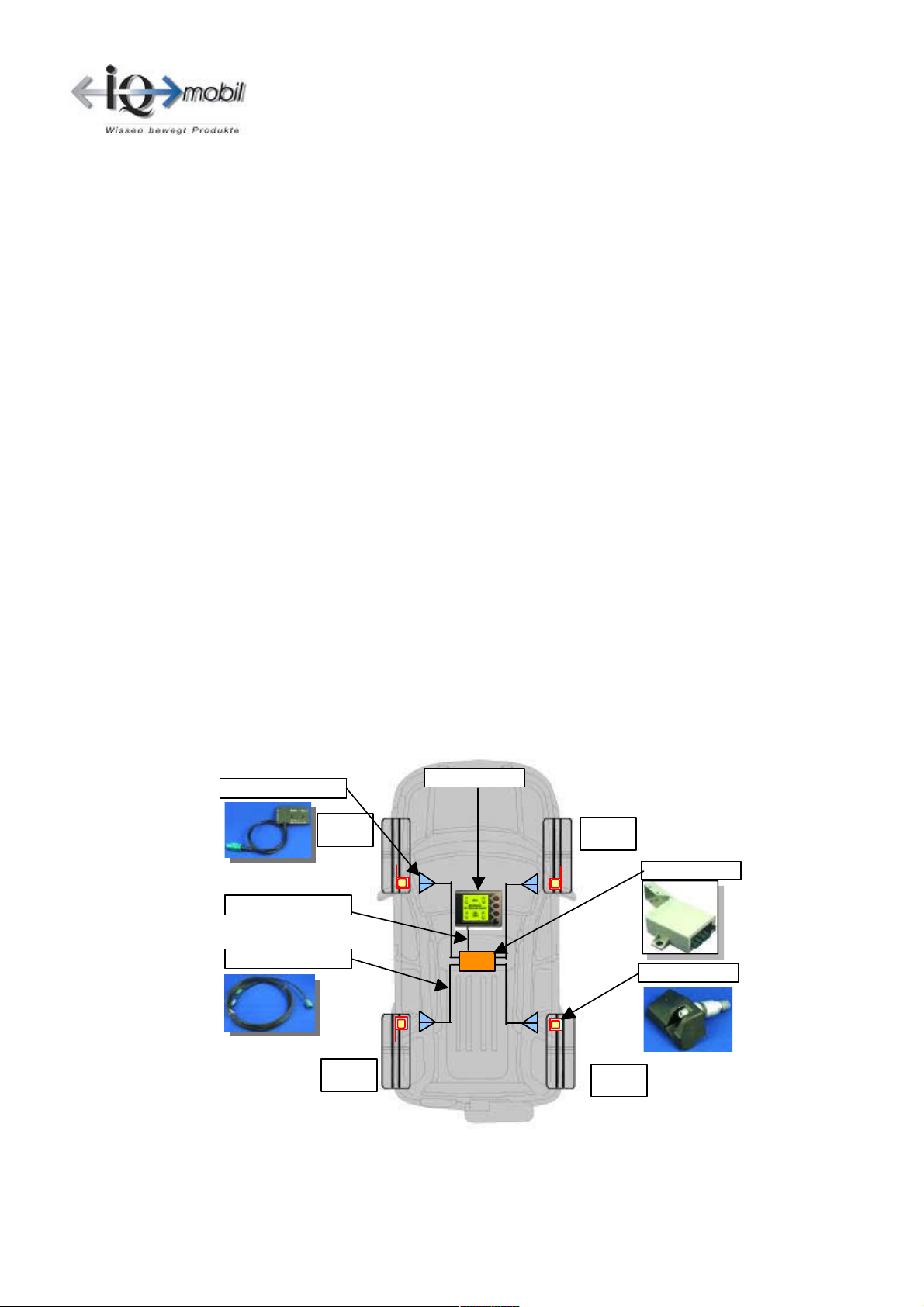
A TPMS system consists of the following components:
♦ Car terminal
♦ Display
♦ Cable harness (to connect Car terminal with the Display and Power supply from car battery (ex. via
cigarette socket))
♦ 4 Wheel-arch Antennas each with 350cm length coaxial cable plus connector(FAKRA)
♦ 4 Tires with installed wheel terminal.
Please refer to Fig.-1 for a pictorial view of the related TPMS components.
2-2. Installation procedure
a) Install the wheel-arch antennas in the front-left, front-right, rear-left and rear-right, tire-house of the car.
b) Put the Car terminal underneath the passenger seat, or in one of the Glove compartments(location may
vary depending on user preference), and connect the car terminal to the antennas by coaxial cables.
c) Place the Display in the center console panel and connect it to the car terminal by the Cable harness.
d) Connect the cable harness to the cigarette socket as a power supply.
The below picture Fig. -1 shows an image of installed TPMS in a vehicle.
RDKS®system architecture
Wheel-arch ANT
FL
Cable Harness
coaxial cable
Display
ECU
FR
ECU
Transponder
RL
Fig.-1 : TPMS system architecture
IQ-mobil GmbH, Hans-Urmiller-Ring 46c, D-82515 Wolfratshausen, Germany
RR
Page 4

Users manual
For RDKS
®
Battery-less TPMS 1.0.1
3. Operation
The following section explains the functional operation for the TPMS system in the car.
a) Turn on the car ignition which will supply power to the car terminal.
b) Check the status of 4 tires by looking at the Display, some tires may not display any information, because
they may be out of their respective Inquiry angle ranges.
(Check the status of the four tires by the display. Some tires may not display any information, because
they are out of the operate angle.)
After power on, but before a valid reading is sent from the tire, the “INAKTIV” icon will be
displayed.
After one revolution of all four wheels the “AKTIV” icon should be displayed.
c) After one full tire revolution, all states of air pressure, and temperature measurement data are displayed.
d) If after step c) there are still no readings on the display, the antenna, the transponder, and the tire are
checked to find the non-functional unit.
4. Operation sequence of the measurement
The TPMS measures the tire air pressure (and temperature) according to the following sequence of events:
4-1. Interference detection
Before the measurement, radio noise and interference from other equipment is checked. If this level is above a
predetermined level, a different frequency carrier channel is used.
4-2. Transmission
The electric wave which puts the AM modulation on the carrier frequency in the 2.4GHz carrier is transmitted.
4-3 Reception
The carrier frequency without the modulation is transmitted. The electric wave modulated from the transponder is
received. The frequency of the modulation by the transponder depends on the pressure/temperature sensing.
4-4. Calculation
The electric wave related the measurement is stopped and the micro controller of the system calculates from the
frequency of the modulation, pressure/temperature readings.
(The micro controller of ECU calculates tire air pressure and temperature using received modulation frequency.)
The method of measuring each tire is performed in a random fashion.
At high speeds this gives a better distribution of temperature/pressure readings for each tire.
IQ-mobil GmbH, Hans-Urmiller-Ring 46c, D-82515 Wolfratshausen, Germany
Page 5

Users manual
r
For RDKS
®
Battery-less TPMS 1.0.1
5. Eligibility requirements for regulatory approval
As a part of regulatory certification, IQ-mobil will provide an approval for certain countries in the form of modular
approval (MA).
The regulatory approval is required for each country throughout world where the end-user wishes to use TPMS
into entire end product, if no certification program for the modular approval exists in the country.
The countries that can accept MA include the USA, Canada, and certain European countries.
The conditions for approval of IQ-mobil's TPMS and related information for each country are described below.
5-1. Compliance statement to FCC
The TPMS complies with part 15 of the FCC rules. Operation is subject to the following conditions:
(1) This device may not cause harmful interference.
(2) This device must accept any interference received, including interference that may cause undesired operation.
5-2. RF exposure compliance
The TPMS is intended to be installed into a vehicle for Tire Pressure (and Temperature) monitoring applications.
Because the system only radiates very low power levels, it complies with RF exposure requirements.
According to Supplement C, Edition 01-01 to OET Bulletin 65, Edition 97-01 spread spectrum transmitters are
categorically excluded from routine environmental evaluation because of the low power level, where there is a high
likelihood of compliance with RF exposure standards.
5-3. Requirements to end product
The following provisions for end product will be required on the FCC regulation, part 15.
5-3-1. Wheel-arch Antenna
IQ-mobil wishes that customer(s) can use the TPMS without any modifications including antenna. If customer uses
a unique antenna, the FCC certification is required for the end product.
5-3-2. Markings
To satisfy FCC exterior labeling requirements, the following text must be placed on the exterior of the end product.
---------------------------------------FCC ID: RXB-RDKS
Any similar wording that expresses the same meaning may be used.
5-3-3. Caution to user for modification
The following caution shall be expressed on the user's instruction manual.
The changes or modifications not expressly approved by the party responsible fo
compliance could void the user’s authority to operate the device.
5-3-4. Compliance statement to FCC
The following statement shall be expressed on the user's instruction manual.
This product complies with part 15 of the FCC rules. Operation is subject to the
following conditions: (1) This device may not cause harmful interference, and (2)
this device must accept any interference received, including interference that may
cause undesired operation.
IQ-mobil GmbH, Hans-Urmiller-Ring 46c, D-82515 Wolfratshausen, Germany
Page 6

Users manual
For RDKS
®
Battery-less TPMS 1.0.1
6. Caution
6-1. Life Support Applications
The TPMS is not designed for use in life support appliances, devices or systems where malfunction of this product
can reasonably be expected to result in personal injury. IQ-mobil customers using or selling this product for use in
such applications do so at their own risk and agree to fully indemnify IQ-mobil for any damages resulting from such
improper use or sale.
IQ-mobil GmbH, Hans-Urmiller-Ring 46c, D-82515 Wolfratshausen, Germany
Page 7

Users manual
For RDKS
®
Battery-less TPMS 1.0.1
7. Revision History
Revision Date of issue Contents of change Author
Rev. 1.0.0 30.Mar, 2004 Initial issue IQ-mobil
Rev. 1.0.1 01.Apr, 2004 Text modifications IQ-mobil
IQ-mobil GmbH, Hans-Urmiller-Ring 46c, D-82515 Wolfratshausen, Germany
 Loading...