

Page 1
Temp-O-Matic Oil Furnace
TMP Multi-Position (Counterflow / Horizontal)
KEEP THESE INSTRUCTIONS
WITH FURNACE FOR FUTURE
REFERENCE.
Hazards that will cause severe personal injury,
death or substantial property damage.
Hazards that can cause severe personal injury,
death or substantial property damage.
INSTALLER – Read all instructions before
installing. Read page 2 first. Follow all instructions
in proper order to prevent personal injury or death.
• Consider ducting, fuel supply, venting and
installation when determining furnace location.
• Any claims for damage or shortage in shipment
must be filed immediately against the transportation
company by the consignee.
Do not store or use gasoline or other flammable
liquids or vapors near this furnace or any other
appliance.
Ventilate house while operating furnace for the first
time. Odors may be emitted for a brief period.
Do not alter this furnace in any way. The
manufacturer will not be liable for any damage
resulting from changes made in the field to the
furnace or its components or from improper
installation. Failure to comply could result in severe
personal injury, death or substantial property
damage.
Hazard definitions
Furnace Manual
Contents Page
Read this first!............................................................................ 2
1. Check furnace location..............................................................3
2. Prepare furnace and place in position.......................................6
3. Connect supply and return ducts............................................... 8
4. Venting..................................................................................... 11
5. Connect fuel oil piping ............................................................. 12
6. Wire furnace and burner.......................................................... 14
7. Start-up.................................................................................... 17
8. Checkout procedure ................................................................ 18
9. Troubleshooting....................................................................... 19
10. Service and maintenance ........................................................ 20
11. Components and replacement parts........................................ 23
12. Dimensions and ratings ........................................................... 25
13. Owner’s information .................................................................27
Hazards that will or can cause minor personal
injury or property damage.
Special instructions on installation, operation or
maintenance that are important but not related to
personal injury or property damage.
USER – Please read the following. Failure to
comply could result in severe personal injury, death
or substantial property damage.
• This manual is for use only by your qualified
heating installer / service technician.
• Please see the Owner’s information only, on back
page of this manual.
• Have the furnace serviced by a qualified service
technician, at least annually.
This manual must only be used by a qualified
heating installer / service technician. Furnace and
burner must be installed and serviced only by a
qualified heating installer / service technician.
Failure to comply could result in severe personal
injury, death or substantial property damage.
When calling or writing about the furnace – Please
indicate furnace model number and serial number
from rating label. You may list the serial number and
model number in the space provided on the
“Installation and service certificate” found on
page 18.
Printed on 100% recycled paper 670-000-004/1010
Page 2
READ THIS FIRST!
Service and maintenance –
1. To avoid electric shock, disconnect electrical supply before
performing maintenance.
2. To avoid severe burns, allow furnace to cool before performing
maintenance.
3. Perform service and maintenance as described in this manual
and the burner manual.
4. Do not attempt to make adjustments to the blower or motor while
the furnace is in operation. Disconnect power to the furnace and
be sure all parts have stopped moving before attempting
adjustments or maintenance.
5. The burner must be set up and adjusted using combustion test
instruments. Visual examination of the flame alone cannot
determine combustion performance.
Operation -
6. Do not use the furnace as a construction heater.
7. Do not operate any furnace if the heat exchanger is damaged,
corroded or pitted. Toxic flue products could enter the air
stream.
8. Do not jumper, attempt to by-pass or override any limit control.
9. Do not block flow of combustion or ventilation air to furnace. Do
not block or obstruct the air openings in the furnace casing.
10. Do not store or use combustible materials, gasoline, or other
flammable liquids or vapors in the furnace area.
11. Do not operate the furnace if the furnace area will be exposed to
air contaminants as described on page 5.
12. Should overheating occur, do not turn off or disconnect electrical
supply to furnace. Instead, shut off the oil supply at a location
external to the appliance, if possible.
13. Do not use this furnace if any part has been under water. Call a
qualified service technician immediately, to inspect the furnace
and to replace any part of the furnace, control system or burner
that was submerged in water.
14. Do not operate furnace if temperature rise through heat
exchanger exceeds 85
Installation –
1. Be sure to level the furnace, using a spirit level at the front and
one side. If the furnace is not level, oil can drip into the
combustion chamber after burner cycling, contaminating the
heat exchanger and the burner head.
2. Avoid locating return grills in rooms that may contain undesirable
odors.
3. Never locate a return air grill closer than approximately 20 feet
from the furnace.
Failure to adhere to the guidelines below can result in severe personal injury, death or substantial property damage.
o
F.
Apply the following suggestions to prevent unsatisfactory operation of the furnace.
15. Inspect, clean and replace (if necessary) return air filter
regularly.
16. Do not obstruct return air grills or supply air outlets.
17. Supply only #2 fuel oil to the burner. Never attempt to use
gasoline, a mixture of gasoline and oil, waste fuel, refuse or any
other substance in the burner of furnace.
Installation -
18. Do not block flow of combustion or ventilation air to furnace. Do
not block or obstruct the air openings in the furnace casing.
19. Connect furnace only to a functional vent system in good
condition. Place the furnace to allow proper venting, with the
shortest possible venting and minimum number or elbows.
20. Always connect and seal a return air duct to the furnace unless
the furnace is located in a large space, such as an unpartitioned
basement. Route the return air duct to an adjacent room if no
return air manifold is used.
21. Install furnace maintaining minimum clearances for service and
separation from combustible surfaces described in this manual.
If furnace is installed on a combustible floor, you must use the
combustible floor base or provide the minimum clearance from
the furnace to the floor as given in this manual.
22. Install, start-up, service and maintain burner per instructions in
this manual and the burner manual.
23. Verify burner is properly inserted through the combustion
chamber opening.
24. Furnace must be installed so that burner and control system
components are protected from dripping, spraying water or rain
during operation or service.
25. If installing an air conditioning evaporator coil, install the coil
downstream of, or in parallel with, the furnace to prevent
condensation on the furnace heat exchanger. If the coil is in
parallel, provide means to prevent flow of chilled air into the
furnace, including an interlock to prevent simultaneous operation
of heating and air conditioning.
4. Locate the furnac e near the center of the supply and return duct
systems.
5. Always check the size of the ducts on a replacement installation,
particularly if adding air conditioning.
2 670-000-004/1010
Page 3
TMP Oil Furnaces – Furnace Manual
1 Check furnace location
Pre-installation checklist
Verify code compliance
Local, state, provincial, and national codes, laws, regulations
and ordinances
NFPA-31, Installation of Oil-Burning Equipment
National Electrical Code
All local codes and/or regulations take precedence over the
instructions in this manual and should be followed accordingly.
TMP furnaces, their burners and controls met safe
lighting and other performance criteria when furnace
underwent tests specified in Underwriters Laboratories
Standard UL727.
Check location and furnace specifications
Use the table below to verify:
Furnace heating capacity
Space is large enough to provide required clearances
Verify the installation will meet the requirements of this manual:
Clearances (page 3)
Combustion/ventilation air openings (pages 4)
Supply air duct (page 8)
Vent system (page 11)
Fuel oil piping (page 12 plus burner manual)
Electrical connection (page 14)
Clearances
Minimum clearance to combustible materials
1. Install the furnace, ductwork and vent such that no combustible
surface is closer than listed in Table 1.
Flue pipe clearances must take precedence over
jacket clearances (listed below).
Service accessibility clearances
1. Provide no less than the minimum clearances given in Table 1 to
ensure the furnace can be properly operated, serviced and
maintained.
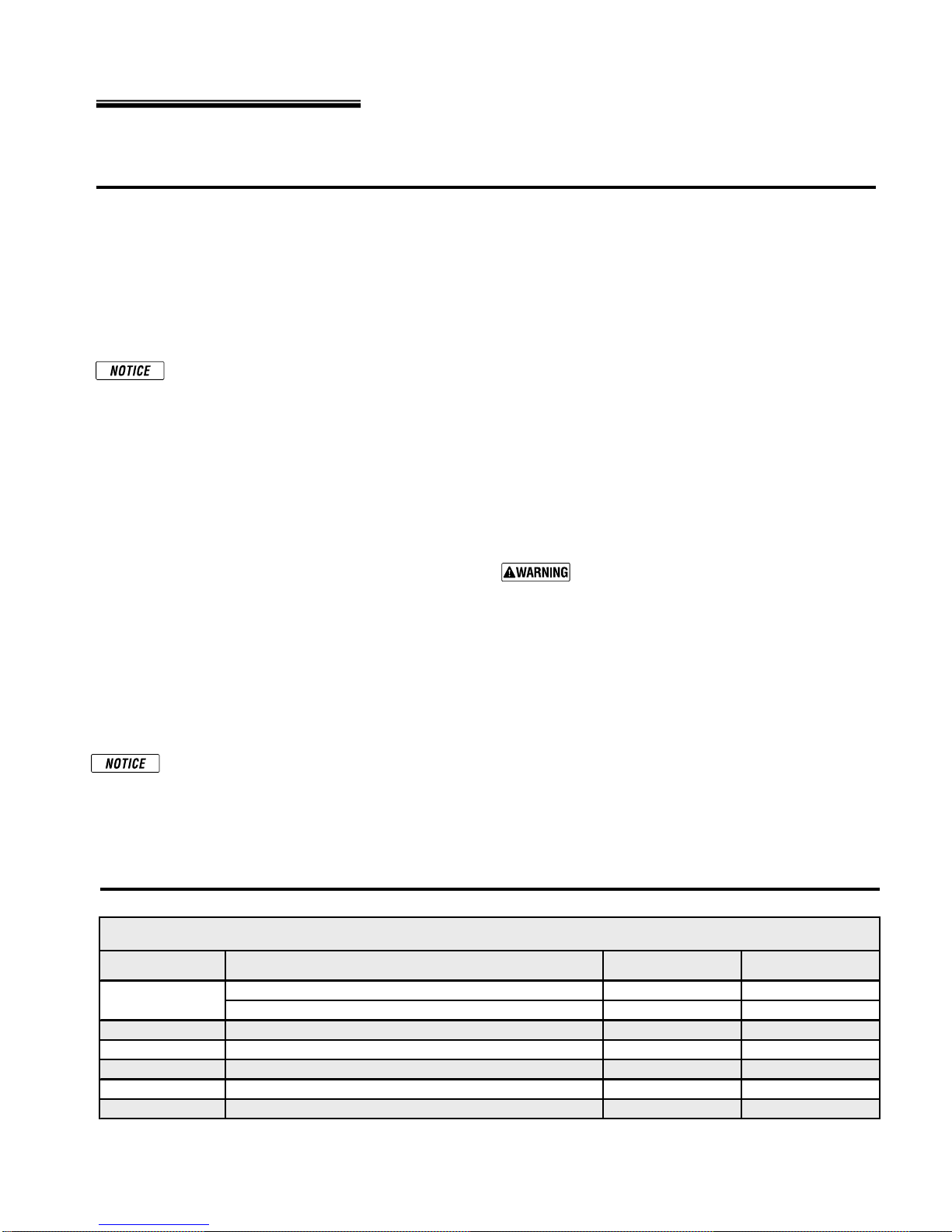
Table 1 Minimum clearances
2. Always apply whichever clearance is LARGER – combustible
construction or service accessibility.
Flooring and foundation
Flooring
TMP furnaces are approved for installation on non-combustible floor.
If a combustible floor is used, follow these instructions:
Horizontal installation on combustible floor
Always keep the minimum installation clearances of 1 inch between
the combustible floor and the furnace sides. Use appropriate leveling
legs or optional kit #HFB-1-W.
Counterflow installation on combustible floor
Always keep the minimum installation clearances of 1 inch between
the combustible floor and the furnace bottom or air supply plenum.
Use appropriate leveling base and spacers or optional kit #CFB1-W.
Do not install furnace on carpeting even if foundation
is used. Fire can result, causing severe personal
injury, death or substantial property damage.
Foundation
1. Provide a solid brick or minimum 2-inch thick concrete
foundation pad if any of the following is true:
• the floor can become flooded.
• the furnace mounting area is not level.
Residential garage installations
Take the following special precautions when installing the furnace in
a residential garage. If the furnace is located in a residential garage:
• Mount the furnace a minimum of 18 inches above the floor
of the garage.
• Locate or protect the furnace so it cannot be damaged by a
moving vehicle.
Minimum installation clearances from combustible materials ( Chimney installation)
Location Application Counterflow Horizontal
Sides
Back Furnace 1 " 1 "
Top Furnace casing or plenum 1 " 1 "
Bottom Furnace – combustible f l oor 1 " 1 "
Front Furnace 24 " 24 "
Flue pipe 18 " 18 "
* Use appropriate leveling legs or optional ki t #HFB-1-W; ** Use appropriat e l eveling base and spacers or optional kit #CFB -1 -W.
670-000-004/1010 3
Supply plenum, warm air duct wit hin 6ft of furnace 1 " 1 "
Furnace 1 " 1 "
***
Page 4

TMP Oil Furnaces – Furnace Manual
1 Check furnace location (continued)
Air for combustion and ventilation
Adequate combustion and ventilation air ensures
proper combustion and reduces risk of severe
personal injury or death from possible flue gas
leakage and carbon monoxide emissions.
Do not install exhaust fan in furnace room.
Consider building construction
Older buildings with single-pane windows, minimal weather-stripping
and no vapor barrier often provide enough natural infiltration and
ventilation without dedicated openings.
New construction or remodeled buildings are most often built tighter.
Windows and doors are weather-stripped, vapor barriers are used
and openings in walls are caulked. As a result, such tight
construction is unlikely to allow proper natural air infiltration and
ventilation.
For buildings with tight construction, provide openings directly to
outside or to a ventilated crawl space or attic. Size the openings to
the same specifications as for the furnace location per the following
paragraphs.
Follow state, provincial or local codes when sizing adequate
combustion and ventilation air openings. In absence of codes, use
the following guidelines when furnace is in a confined room (defined
by NFPA 31 as less than 7200 cubic feet per 1 GPH input of all
appliances in area. A room 8 ft. high x 30.0 ft. x 30.0 ft. is 7200 cu.
ft.).
Provide two permanent openings
Openings locations
One within 12 inches of ceiling, one within 12 inches of floor.
Minimum height or length dimension of each rectangular opening
should be at least 3 inches.
When inside air is used:
Each opening must freely connect with areas having adequate
infiltration from outside. Each opening should be at least 140 sq. in.
per 1 GPH input (1 sq. in. per 1000 BTU input) of all fuel-burning
appliances plus requirements for any equipment that can pull air
from room (including clothes dryer and fireplace).
When outside air is used:
Connect each opening directly, by ducts to the outdoors, or to crawl
or attic space that freely connects with outdoors. Size per below:
• Through outside wall or vertical ducts – at least 35 sq. in. per 1
GPH input (1 sq. in. per 4000 BTU input) of all fuel burning
appliances plus requirements for any equipment that can pull air
from room (including clothes dryer and fireplace).
• Through horizontal ducts – at least 70 sq. in. per 1 GPH furnace
input (1 sq. in. per 2000 BTU input) of all fuel-burning appliances
plus requirements for any equipment that can pull air from room
(including clothes dryer and fireplace).
• Where ducts are used, they should have the same crosssectional area as free area of openings to which they connect.
Compensate for louver, grille or screen blockage when
calculating free air openings. Refer to the manufacturers’
instructions for details. If unknown, use:
• Wood louvers, which provide 20-25% free air.
• Metal louvers or grilles, which provide 60-75% free air.
Lock louvers in open position or interlock with equipment to
prove open before furnace operation.
Basement installations
When the furnace is located in an unconfined space, such as an
unpartitioned basement, adequate air should normally be available
without additional openings. An unconfined space is defined as one
having no less than 50 cubic feet room volume per 1,000 BTU/h
input of all appliances in the space.
If the house is of tight construction, provide air openings to the
basement directly from outside or from a ventilated attic. Size the
openings as described above under “When outside air is used”.
Closet installations – special NOTICE
Openings in closet doors
Provide TWO openings – one within 6 inches of top of closet door,
the other within 6 inches of the bottom of closet door.
EACH opening must be at least 24 inches wide by 12 inches high.
Advise homeowner that the openings to the closet
must never be obstructed or blocked in any way.
Failure to provide adequate air for combustion and
ventilation could result in severe personal injury,
death or substantial property damage.
4 670-000-004/1010
Page 5
TMP Oil Furnaces – Furnace Manual
1 Check furnace location (continued)
Air contamination
Please review the following information on potential combustion air
contamination problems.
See Table 2 for products and areas which may cause contaminated
combustion air.
To prevent the potential of severe personal injury or
death, check for products or areas listed below
before installing the furnace. If any of these
contaminants are found:
• Remove contaminants permanently.
-OR-
• Isolate furnace and provide outside combustion air. See
national, provincial or local codes for further information.
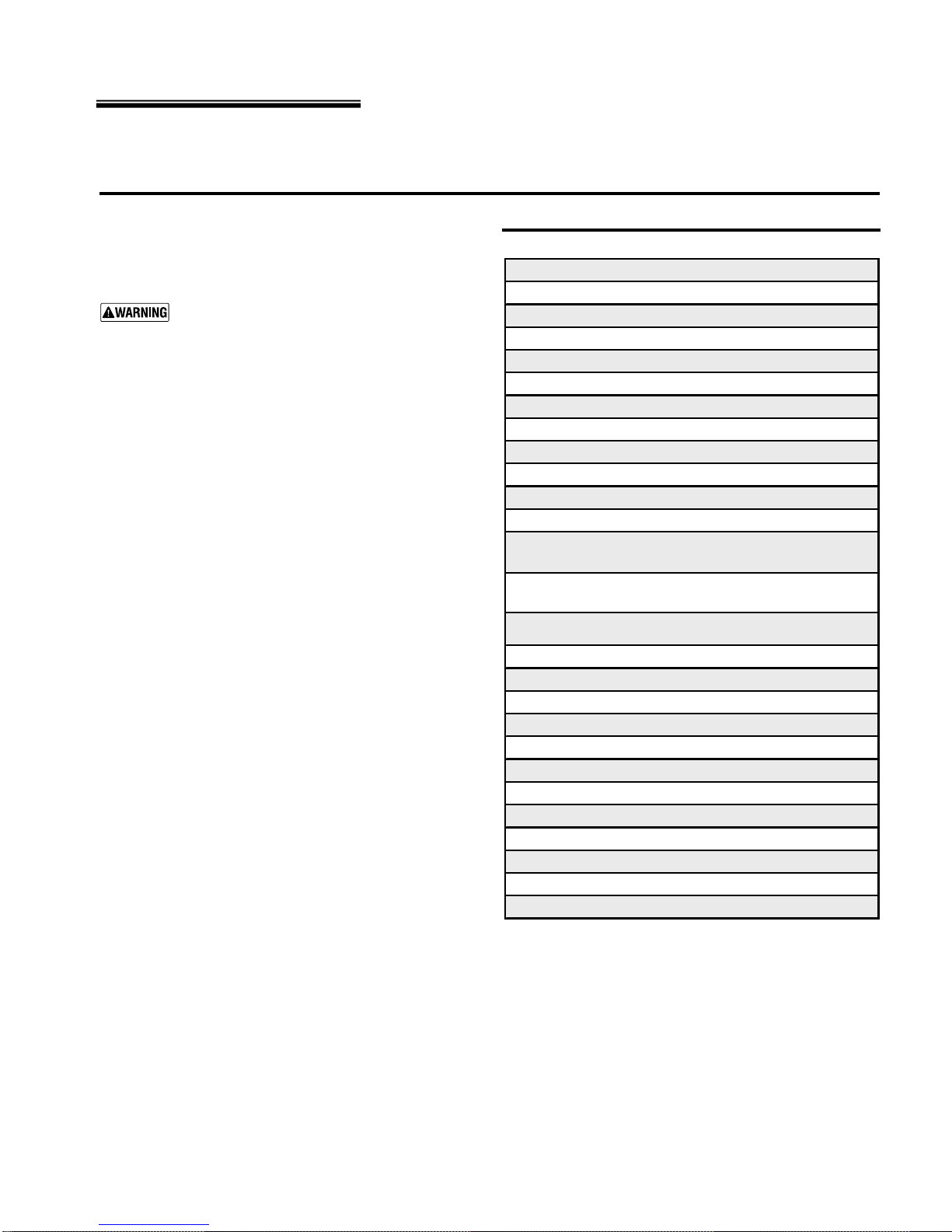
Table 2 Corrosive contaminants and likely locations
Products to avoid
Spray cans containing chloro/fluorocarbons
Permanent wave solutions
Chlorinated waxes/cleaners
Chlorine-based swimming pool chemicals
Calcium chloride used for thaw ing
Sodium chloride used for water softening
Refrigerant leaks
Paint varnish removers
Hydrochloric acid/muriatic acid
Cements and glues
Anti static fabric softeners used in clothes dryers
Chlorine-type bleaches, detergents, and cleaning solvents found in
household laundry rooms
Adhesives used to fasten building products and other similar
products
Areas likely to have contaminants
Dry cleaning/laundry areas and establishments
Swimming pools
Metal fabrication plants
Beauty shops
Refrigeration repair shops
Photo processing plants
Auto body sho ps
Plastic manufacturing plants
Furniture refinishing areas and esta blishme nts
New building construction
Remodeling areas
Garages with workshops
670-000-004/1010 5
Page 6
TMP Oil Furnaces – Furnace Manual
2 Prepare furnace and place in position
Inspect & prepare furnace
Remove furnace from carton
Remove the furnace from its shipping carton and inspect thoroughly.
Remove access panels to inspect the furnace interior.
Immediately file a claim with the transportation
company if you discover concealed damage.
Do not install or attempt to operate the furnace if the
heat exchanger, burner or controls have been
damaged. Immediately contact your furnace
supplier. Operating a damaged furnace could result
in severe personal injury, death or substantial
property damage.
Prepare burner
Remove the burner from its shipping carton and inspect thoroughly.
Read the burner manual and follow instructions for preparing and
installing the burner.
Install the correct nozzle for the required firing rate, using the burner
manual shipped with the burner. Follow the burner manual
instructions for nozzle installation. Verify the correct setting of
electrodes after nozzle and burner oil tube assembly are in place.
Openings in walls, floor & ceiling
General
Ensure that the finished door opening to the furnace room is large
enough to install and remove the furnace, water heater or any other
appliances in the room.
Before placing furnace in a closet or small room, cut all openings
required in floor, ceiling or walls for ducts and vent. This will simplify
the work and prevent construction dust from entering the furnace
heat exchanger.
Verify that all clearances to combustible construction
and for service accessibility will be met. The vent
must be no closer than 18 inches to any combustible
surface unless a type “L” double-wall vent pipe is
used or the vent is constructed per the requirements
of the NFPA 31. Provide a ventilated thimble per all
applicable codes where vent pipe passes through
wall or ceiling. Failure to comply could result in
severe personal injury, death or substantial property
Duct locations and sizing
Verify that the size of the supply and return duct system is sufficient
for the application. The pressure drop through the duct system must
not exceed 0.2” water column. The total drop through the duct
system and air conditioning condensing coil (if used) must not
exceed 0.5” water column.
See suggested duct sizing in this manual. For more detailed sizing
information, refer to ACCA Manual D.
damage.
Openings …
Supply and return ducts
You must install a return air duct, sealed to the furnace, even if no
return manifold is used. Cut the required opening for the supply air
duct in the floor of the room before placing the furnace.
(continued)
Verify that the filter will be easily accessible for
removal after the furnace is in place.
Install furnace and burner
Place furnace
Place the furnace in the desired location. Measure clearances and
verify per page 3 or table 1 of this manual.
Level the furnace using a spirit level on the front and one side.
Inspect combustion chamber
Inspect the combustion chamber. Verify that it is in good condition
and correctly positioned inside the heat exchanger. The burner
opening in the chamber must align with the burner heat exchanger
opening.
The combustion chamber is constructed of ceramic
fiber materials. See the WARNING information on
page 21 of this manual. Comply with these
instructions when handling any ceramic fiber or
fiberglass materials. Failure to adhere to these
guidelines could result in severe personal injury or
Insert burner
Following the burner manual instructions, install the burner and its
gasket in the burner opening. Make sure the burner passes through
the opening in the combustion chamber and does not protrude more
than ¼ inch into the chamber.
Secure the burner in place with the four nuts and washers provided.
Wire and pipe fuel to the burner as per the burner manual and this
manual.
Burner orientation
For a horizontal installation, you must turn the burner 90o, to the
normal orientation. Always keep the motor shaft in horizontal
position.
death.
6 670-000-004/1010
Page 7
TMP Oil Furnaces – Furnace Manual
2 Prepare furnace and place in position (continued)
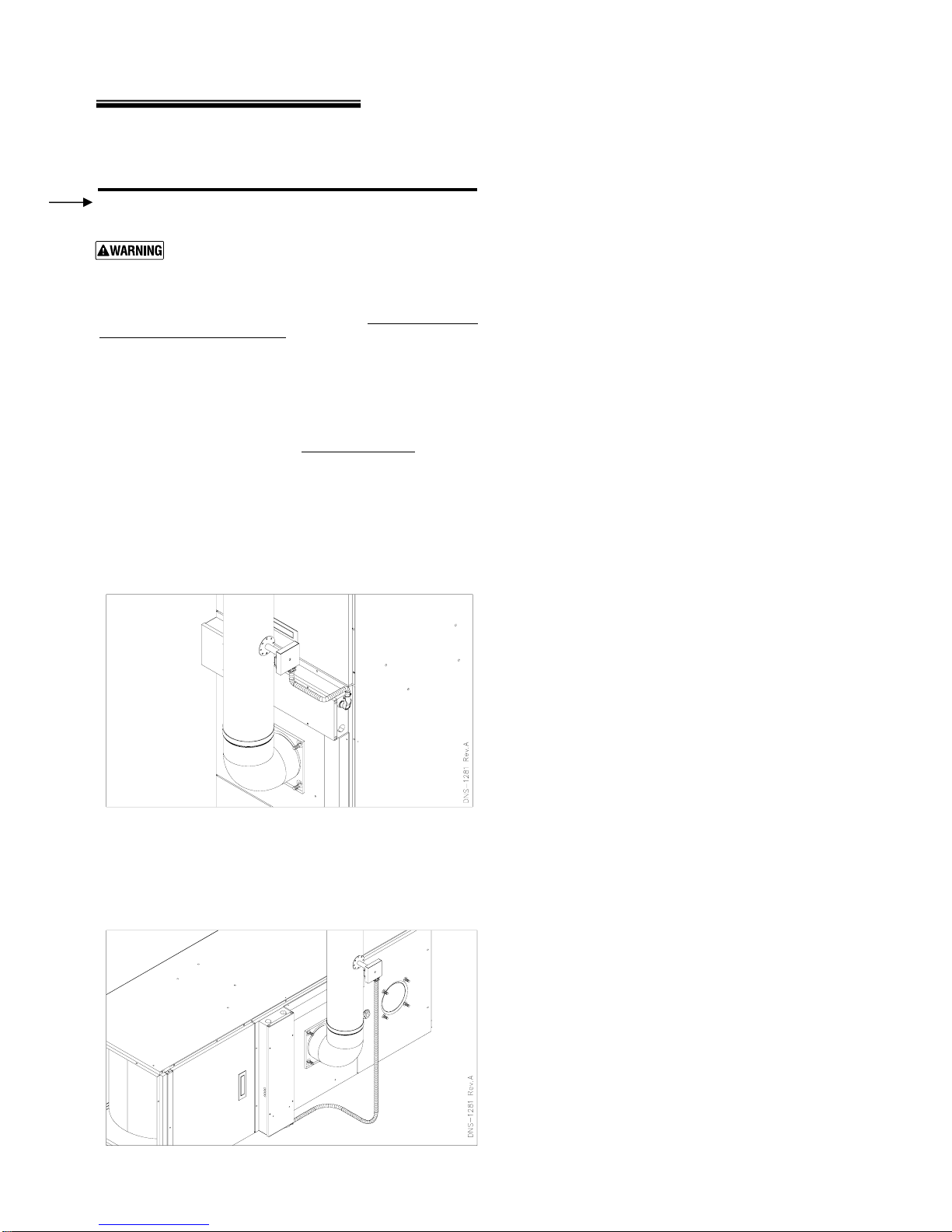
Blocked Vent Shut-Off (BVSO) for chimney venting
(OPTIONAL)
It is imperative that this device be installed by a
qualified agency.
This device is designed to detect the insufficient evacuation of
combustion gases in the event of a vent blockage. In such a case
the thermal switch will shut down the oil burner. The device will then
need to be re-armed MANUALLY.
In the event that the BVSO repetitively shuts down the oil burner, a
qualified technician needs to evaluate the cause of this shut down.
Refer to the figures 3 to 5 at section 6, Wiring Diagrams and detailed
instructions supplied with the BVSO for the installation and wiring
procedures.
It is also essential that the BVSO be maintained annually.
For more details refer to the instructions supplied with the device
itself, as well as the Maintenance Section.
Figure 1
Installation : Upflow with Vertical exhaust
Blocked Vent Shutt-Off device wiring
(Optional)
Figure 2
Blocked Vent Shutt-Off device wiring
Installation : Horizontal flow with vertical exhaust
(Optional)
670-000-004/1010 7
Page 8
TMP Oil Furnaces – Furnace Manual
3 Connect supply and return ducts
Duct sizing
Determine airflow CFM
The temperature rise through the furnace must not exceed 85oF and
should be at least 55
assume a temperature rise of 70
The noticeable temperature change for cooling would be
approximately 27-30
approximately 18-21
To calculate the noticeable heat temperature change (ΔT), you can
use the formula:
ΔT = BTU/h/(1.1 x CFM) Eq. 3-1
To calculate airflow when you know temperature change (ΔT), you
can use:
CFM = BTU/h/(1.1 x ΔT) Eq. 3-2
You can estimate airflow using the following rules of thumb:
Heating: 14 CFM per 1,000 BTU/h output Eq. 3-3
Cooling: 400 CFM per ton air conditioning Eq. 3-4
Determine the required airflow based on whichever is larger –
heating mode or air conditioning mode.
Examples:
1. What would the temperature rise be for a 100,000 BTU/h output
furnace with an airflow rate of 1200 CFM?
Use Equation 3-1 since you know CFM and BTU/h:
ΔT = 100,000/(1.1 x 1200) = 76
• The temperature rise would be 76
• If the air enters the furnace at 70
furnace at 70
2. What would the airflow be to obtain a 70
120,000 BTU/h output furnace?
Use equation 3-2 since you know ΔT and BTU/h:
CFM = 120,000/(1.1 x 70) = 1,558 CFM
• The airflow would have to be 1,558 CFM to obtain a
temperature rise of 70
3. Estimate the required airflow for a 75,000 BTU/h output furnace
installed with a 2-ton air conditioning evaporator coil.
Heating mode airflow (use Equation 3-3):
CFM = 75 x 14 = 1,050 CFM
Cooling mode airflow (use Equation 3-4):
CFM = 2 x 400 = 800 CFM
• The larger number is 1,050 CFM (heating), so the duct
system should be sized for 1,050 CFM.
• The supply duct would need to be 16” round or a rectangular
equivalent such as 8” x 25” or 12” x 16”, using Table 4,
page 8.
4. Estimate the required airflow for the same furnace installed with
a 4-ton air conditioning evaporator coil.
Heating mode airflow is still 1,050 CFM.
Cooling mode airflow (use Equation 3-4):
CFM = 4 x 400 = 1,600 CFM
• The larger number is 1,600 CFM (cooling), so the duct
system should be sized for 1,600 CFM.
• The supply duct would need to be 18” round or a rectangular
equivalent such as 8” x 36” or 12” x 21”, using Table 4,
page 9.
o
F for comfort. When calculating airflow,
o
F.
o
F. Actual temperature change will be
o
F due to humidity of the air.
o
F
o
F.
o
o
F + 76o F = 146o F.
o
F.
F, it would leave the
o
F rise through a
Always check the size of existing ducts, particularly
if you are adding air conditioning. The air pressure
loss through the cooling evaporator coil reduces
available airflow. If the ducts are too small as well,
the system may not work satisfactorily on either
heating or cooling.
Determine duct dimensions
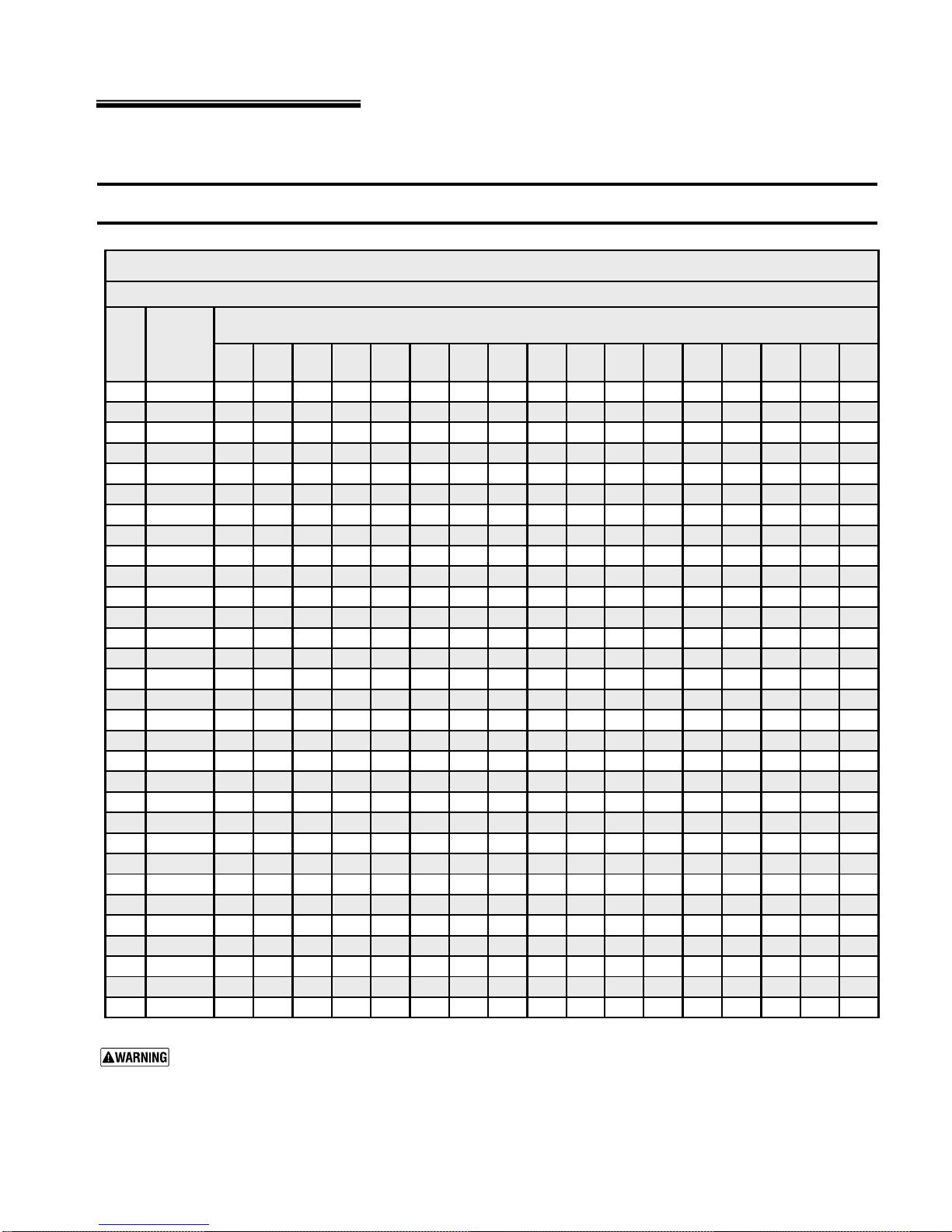
Table 4, page 9, and Table 5, page 10, provide typical round and
rectangular duct sizes for rectangular and flat oval galvanized ducts.
Do not apply these tables to size ductwork if the total equivalent
length of the duct exceeds approximately 100 feet. For longer
systems or for ductboard, fiberglass-lined or flexible duct sizing, use
the ACCA Manual D or the ACCA duct sizing slide rule. These
tables are based on pressure loss of approximately 0.10” water
column per 100 feet equivalent length of duct.
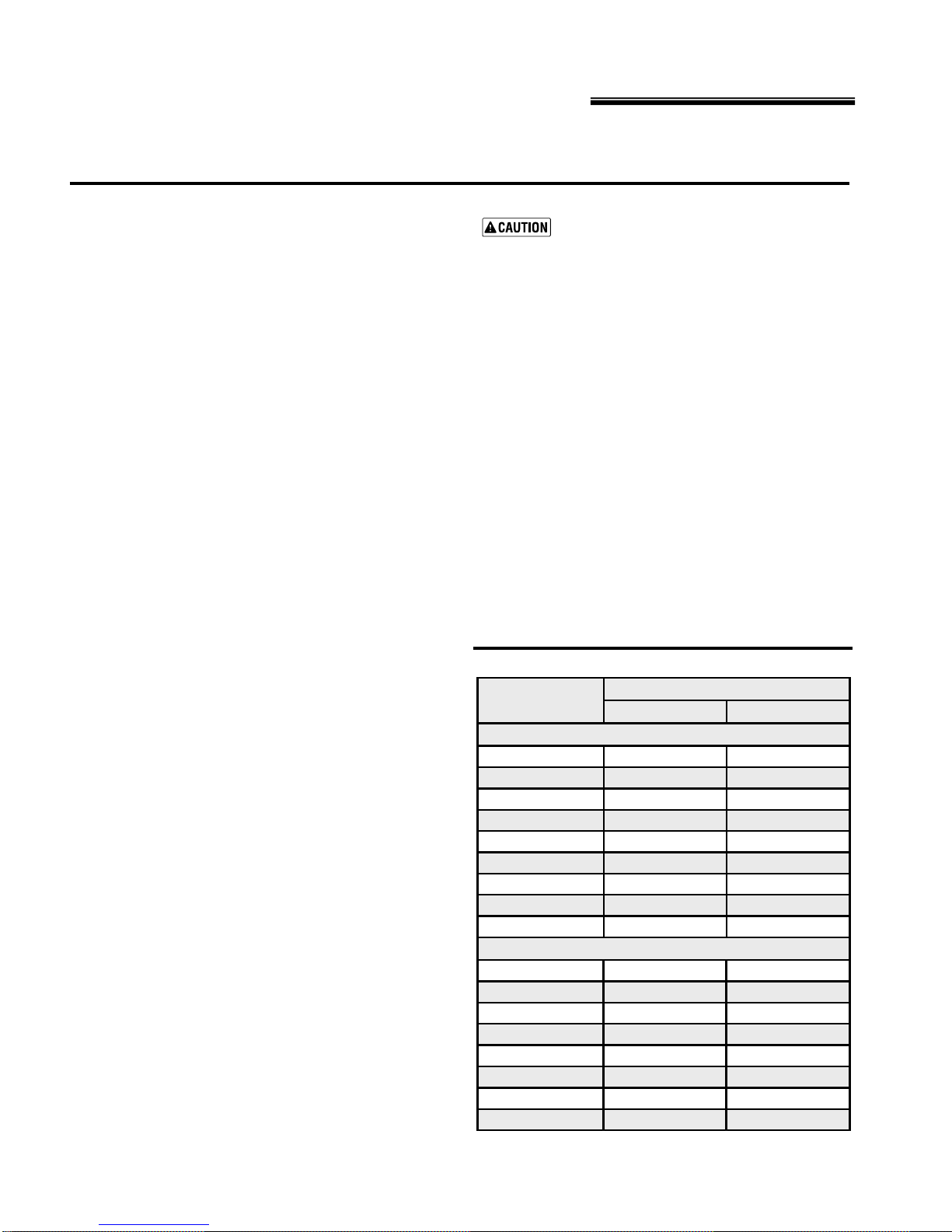
Use Table 3 below to size or check sizing of take-offs to supply
registers or return grills.
Verify the size and type of registers, diffusers and grills from the
manufacturer’s ratings. Do not exceed the recommended flow rate.
The pressure drop allowance for each should not exceed
approximately 0.05” water column.
Install a return air filter, sized per specifications in Section 12.
Use only a return air filter mounted to the furnace. Do not add
additional filters unless the duct system is carefully sized to allow for
the additional pressure drop.
Table 3 Suggested maximum flow to runouts
TAKE-OFF SIZE
(Inches)
Sheet metal or ductboard
5 Round 60 45
6 Round 100 75
7 Round 140 110
8 Round 210 160
3 ¼ x 8 Stack 70 55
3 ¼ x 10 Stack 100 75
3 ¼ x 14 Stack 140 110
2 ¼ x 12 Stack 70 55
2 ¼ x 14 Stack 90 70
Flexible duct (keep bends to minimum)
6 Round 55 40
8 Round 120 90
10 Round 200 160
12 Round 320 250
14 Round 480 375
16 Round 660 530
18 Round 880 680
20 Round 1200 900
SUPPLY RETURN
CFM
8 670-000-004/1010
Page 9
TMP Oil Furnaces – Furnace Manual
3 Connect supply and return ducts (continued)
Duct sizing (continued)
Table 4 Typical duct sizing for systems not over 100 feet equivalent length – round or rectangular galvanized
(For approx imately 0.10 i nc h w.c. in a typic al residential instal lation of galvaniz ed metal duc t)
Round
CFM
duct
diameter4567891012141618202224262830
(inches)xxxxxxxxxxxxxxxxx
45
65
100
150
200
250
300
400
500
600
700
800
900
1000
1100
1200
1300
1400
1500
1600
1700
1800
1900
2000
2200
2400
2600
2800
3000
3500
4000
Rectangular duct equival ent sizes
Mini mum widt h
4
5
6
7
8
9
9
10
12
12
12
14
14
16
16
16
16
18
18
18
18
18
20
20
20
22
22
22
22
24
26
444-------------6544- ------------
865544- - - -------1297655544- ------141198766544------181310987665544- - - - 20151210987665544- - - 2619151311109876655544322318151312119876665555
3828221815131210987766655
46322520171514111098777666
523628231917151311109887766
58 41 31 25 21 19 17 14 12 11 10 9 8 8 7 7 7
64 45 34 28 23 20 18 15 13 11 10 9 9 8 8 7 7
72 49 38 30 25 22 19 16 14 12 11 10 9 9 8 8 7
- 544133272421171513121110 9 9 8 8
- 58443529252218161412111010 9 9 8
- 6347383127241916141312111010 9 9
- 685140342925201715141212111010 9
- 725443363027211816141312111110 9
- - 58 45 38 32 28 23 19 17 15 14 13 12 11 10 10
- - 61 48 40 34 29 24 20 17 16 14 13 12 11 11 10
- - 64 51 42 35 31 25 21 18 16 15 14 13 12 11 11
- - 68 53 44 37 32 26 22 19 17 15 14 13 12 12 11
- - - 59 48 41 35 28 23 20 18 16 15 14 13 12 12
- - - 64 52 44 38 30 25 22 19 17 16 15 14 13 12
- - - 69 56 47 41 32 27 23 21 19 17 16 15 14 13
----61514434292522201817151514
----65544737302623211917161514
-----635442342926232119181716
-----726147393329262321201918
Do not apply this table for duct systems over approximately 100 equivalent feet in length. For longer systems or systems
using other duct materials, refer to ACCA Manual D. Incorrectly sizing duct systems can result in unsafe or uncomfortable
operation.
(inches)
Typical duct sizing
for duct heights
(inches)
of :
670-000-004/1010 9
Page 10

TMP Oil Furnaces – Furnace Manual
3 Connect supply and return ducts (continued)
Duct sizing
Table 5 Typical duct sizing for systems not over 100 feet equivalent length – round or flat oval galvanized
CFM
45
65
100
150
200
250
300
400
500
600
700
800
900
1000
1100
1200
1300
1400
1500
1600
1700
1800
1900
2000
2200
2400
2600
2800
3000
3500
4000
(continued)
Typical duct sizing
(For approximately 0.10 inch w.c. in a typical r esi dential installation of galv anized metal duct)
Round
duct
diameter3456789101214161820
(inches)xxxxxxxxxxxxx
10
12
12
12
14
14
16
16
16
16
18
18
18
18
18
20
20
20
22
22
22
22
24
26
Do not apply this table for duct systems over approximately 100 equivalent feet in length. For longer systems or systems
using other duct materials, refer to ACCA Manual D. Incorrectly sizing duct systems can result in unsafe or uncomfortable
operation.
Flat oval duct equi val ent sizes
Mini mum widt h
4
5
6
7
8
9
9
65-----------
86----------1187---------161198--------211511108-------26181411109------302016131110------40262016141211-----4932241916141312----5938282219161513----694432252118161513----
-5036292420181614----
-5641322622201815----
- 634535292422191715 - - -
- 694938312623211816 - - -
- 755341332825221917 - - -
- - 58 44 36 30 26 24 20 18 - - -
- - 62 47 38 32 28 25 21 18 17 - -
- - 66 50 41 34 30 26 22 19 18 - -
- - 71 54 43 36 31 28 23 20 18 - -
- - - 57 46 38 33 29 24 21 19 - -
- - - 60 48 40 35 31 25 22 20 - -
- - - 63 50 42 36 32 26 23 21 19 -
- - - 67 53 44 38 33 27 24 21 20 -
- - - 73 58 48 41 36 29 25 23 21 -
----635244393227242221
----685648423429252322
-----6051443630272423
-----6454473832282624
------63544336322826
------71614840353129
(inches)
for duct heights
(inches)
of :
10 670-000-004/1010
Page 11

TMP Oil Furnaces – Furnace Manual
4 Venting
General venting requirements
Failure to follow all instructions can result in flue gas
spillage and carbon monoxide emissions, causing
severe personal injury or death.
Inspect existing chimney before installing furnace.
Clean chimney thoroughly. Replace or repair
chimney if visual inspection indicates chimney may
be unsuitable for use. Insufficient draft can cause
flue gas leakage and carbon monoxide emissions.
Failure to clean or replace perforated pipe or tile
lining and/or patch mortar and joints can cause
severe personal injury or death.
• Proper draft for t hese oil furnaces may be achieved using either
a conventional chimney (natural draft) or a power vent (sidewall)
system that has been properly designed for use with oil-fired
equipment. Power vent manufacturer’s instructions must be
followed.
• Use vent material approved by local codes for oil-fired burners.
In their absence, refer to:
• NFPA 31, Installation of Oil-Burning Equipment.
• NFPA211, Standard for Chimneys, Fireplaces, Vents and
Solid Fuel Burning Appliances.
• In Canada, refer to CSA B139, Installation Code for Oil-
Burning Equipment.
• NFPA-211 re quires chimney to be lined before connected to
furnace.
• To prevent downdrafts, extend chimney at least 3 feet above
highest point where it passes through roof and 2 feet higher than
any portion of building within 10 feet. Increase chimney crosssectional area and height at least 4% per 1,000 feet above sea
level.
• Provide minimum clearances from vent (flue) pipe to
combustible material:
• Single-wall vent – 18 inches minimum
• Type “L” double-wall vent – 6 inches minimum
Oversized chimneys, outside masonry chimneys
and/or derated inputs can result in condensation in
chimney.
Connect venting
Long horizontal vent runs, excessive number of tees
and elbows, or other obstructions restricting
combustion gas flow can result in the possibility of
condensation, flue gas leakage and carbon
monoxide emissions, which can lead to severe
personal injury or death.
1. The horizontal vent must slope upwards, away fro m the furnace,
a minimum of ¼ inch per foot.
2. Connection must be made above bottom of chimney to avoid
blockage. Vent pipe must not enter chimney far enough to cause
obstruction. Use thimble or slip joint where vent pipe enters
chimney to allow removal for cleaning.
3. When burner and furnace are properly installed, draft overfire
will be approximately –0.01” to –0.02” w.c. Install barometric
Connect venting (continued)
control in vent, per control manufacturer’s instructions, when
excess draft needs to be relieved or to comply with applicable
codes and regulations. Use draft gauge to adjust proper
opening.
4. An induced draft fan for the chimney may be necessary if:
• Excessive resistance to flow of combustion gases can be
expected.
• Cross-sectional area of chimney is smaller than minimum
recommended.
• Chimney height is less than recommended.
• When using induced draft fan seal all vent joints and
interlock burner with fan operation.
Vent dampers
Do not install a thermal-type vent damper on this
furnace. Failure to comply could result in severe
personal injury, death or substantial property
damage.
If a vent damper is required, use only a motorized
one, installed and wired in the furnace according to
the vent damper manufacturer’s instructions.
Barometric draft control
Install a barometric control in the vent, per the manufacturer’s
instructions, when excess draft needs to be relieved or to comply
with applicable codes and regulations. Use draft gauge to adjust
proper opening.
1. Install a barometric draft control in the vent pipe at least one foot
from the furnace vent connection, preferably in the highest part
of the vent pipe before the vent enters the chimney. If headroom
does not provide enough clearance to locate the control at least
one foot from the vent connection, install an elbow at the furnace
and mount the control in an horizontal pipe at least one foot from
the elbow. Install an elbow after the control to turn vertically.
2. The barometric draft control must be located in the same room
as the furnace to operate correctly.
3. Ensure that the barometric draft control is accessible. Adjust the
damper to obtain the correct overfire draft, as described in this
manual and the burner manual.
670-000-004/1010 11
Page 12

TMP Oil Furnaces – Furnace Manual
5 Connect fuel oil piping
General oil piping requirements
• Location and installation of oil tanks, oil piping and burners must
follow:
• NFPA 31, Standard for the Installation of Oil-Burning
Equipment.
• In Canada, CSA B139, Installation of Oil-Burning
Equipment.
• Local codes and regulations.
• Information provided with burner and fuel pump.
• If any part of the fuel oil tank is above burner level, an anti-
siphon device must be used to prevent the flow of oil in case of
an oil line break.
• Support oil lines as required by codes.
• Make tank connections with swing joints or copper tubing to
prevent breakage in case the tank settles. Make swing joints so
they will tighten as tank settles. Non-hardening pipe joint
compounds should be used on all threads.
Do not use Teflon tape as an oil pipe sealant. It can
cause valves to fail, creating hazards. Use only flare
fittings. Do not use compression fittings. Failure to
comply could result in severe personal injury, death
or substantial property damage from oil leakage
and/or fire hazard.
• Underground pipe must be ru n in a casing to prevent oil leaking
into the ground or under the floor. Check local codes for
information.
Oil piping connection at burner
• Connect oil line to burner using a flare fitting.
Use of any connection other than a flare fitting at the
oil connection to the burner could result in a fuel oil
leak, with the potential for severe personal injury,
death or substantial property damage.
• See local codes for appropriate arrangement and piping of filter,
control valves, etc. connecting to oil tank.
• Refer to burner manual for oil system requirements. Verify that
suction lift does not exceed stated limit. Where lift exceeds limit
for a one-pipe system, use a two-pipe system as directed in
burner manual.
12 670-000-004/1010
Page 13

TMP Oil Furnaces – Furnace Manual
Notes:
670-000-004/1010 13
Page 14

5 3
TMP Oil Furnaces – Furnace Manual
6 Wire furnace & burner
Electric shock hazard. It can cause severe personal injury or death if power source, including the service switch on the
furnace, is not disconnected before installation or servicing.
Wire burner
The burner harness is factory-wired to the furnace. Plug the burner
harness into the matching burner connector. Refer to the wiring
diagrams on pages 15 and 16 for further information.
Install and wire thermostat
Locate the room thermostat on an interior wall in the natural
circulating path of room air. Do not locate thermostat so it is exposed
to cold air infiltration, drafts from windows or doors, air currents from
supply or return air registers, behind obstructions, on a shelf, in a
closet, or in a corner.
Ensure the thermostat won’t be exposed to heat from nearby
fireplace, radio, television, lamp or rays from the sun. Do not mount
thermostat on a wall over a supply or return duct, chimney or vent.
Wire thermostat to furnace and set thermostad anticipator as shown
on wiring diagram, pages 15 and 16.
Figure 3
Blocked Vent Shut-Off device wiring
(Optional)
1
2
4
Connect power wiring
All wiring must conform to:
• National Electrical Code, ANSI/NFPA 70, latest edition and any
additional national, state or local codes.
• In Canada, CSA C22.1 Canadian Electrical Code Part One and
any local codes.
• Wiring must be N.E.C. Class 1. If original wire, as supplied with
furnace, must be replaced, type 105
be used. Supply wiring to furnace and additional control wiring
must be 14 gauge or heavier.
• Provide electrical ground at furnace as required by codes.
Connect 120 VAC/60 Hertz, single phase separate electrical line
from the main house panel to the power leads in the external
junction box as shown on wiring diagrams on pages 15 and 16.
Provide a fused disconnect in the power wiring, following all local
codes.
Ensure the wire size and type are adequate for the electrical load
(see Section 12 and furnace nameplate for value).
Limit control
The furnace is equipped with a fan switch/limit control. This control
limits the air leaving the heat exchanger to 200
switch continues fan operation until the air drops to a preset
temperature. For most installations, set the blower ON setting at
o
F and blower OFF setting at 90oF. If a longer cool down period
130
is desired, lower the OFF setting.
Counterflow furnaces also contain an automatic reset auxiliary limit
control to prevent blower motor and filters from being overheated.
o
C wire or equivalent must
o
F or less. The fan
1. Blocked Vent Shutt-Off device (BVSO)
2. Electrical kit supplied.
3. Connect one red wire to limit switch.
4. Disconnect red wire from limit switch and connect to one re d
wire from BVSO.
5. Connect the green ground wire to a cabinet screw.
14 670-000-004/1010
Page 15

TMP Oil Furnaces – Furnace Manual
6 Wire furnace & burner (continued)
PLB Oil Furnaces – Furnace Manual
Figure 4 Wiring – TMP furnaces with direct-drive blowers.
DNS-0888 Rev.E
670-000-004/1010 15
Page 16

TMP Oil Furnaces – Furnace Manual
6 Wire furnace & burner (continued)
PLB
Oil Furnaces – Furnace Manual
Figure 5 Wiring – TMP furnaces with direct-drive blowers.
16 670-000-004/1010
DNS-0907 Rev. C
Page 17

TMP Oil Furnaces – Furnace Manual
7 Start up
Follow information below to prevent severe personal
injury, death or substantial property damage:
• Do not use gasoline, crankcase drainings or any oil
containing gasoline. See burner manual for proper
fuel oil.
• Do not attempt to start burner when excess oil has
accumulated, when unit is full of vapor or when
combustion chamber is very hot.
• Do not start burner unless collector box, venting and
burner mounting plate are secured in place.
• Never burn garbage or paper in the furnace.
To start furnace
1. Factory burner adjustment and settings may not be suitable for
2. Set room thermostat to call for heat.
3. Start burner as described in burner manual.
4. The furnace blower will delay for a short time after burner starts,
5. Set room thermostat to its lowest setting. Burner should turn off.
6. Furnace blower will continue to run until the Limit/Fan switch
7. Set the room thermostat to call for heat again. Allow furnace to
• Never leave combustible material around it.
specific job conditions. Refer to burner manual for burner start
up, adjustment and checkout procedures.
until the Limit/Fan switch senses air temperature above the fan
ON setting.
senses air temperature below the fan OFF setting.
heat to design temperature. Then adjust burner for correct
combustion, using combustion test equipment. Adjust burner for:
Draft: -0.00” to +0.035” water column draft in furnace
combustion chamber.
For pressure reading, replace the sight glass by the gasket
supply with the appliance.
After the verification, put back in place the sight glass.
See Figure 3.
CO
: between 10% and 11½ %, with 0 smoke.
2
To start furnace (continued)
Make final burner adjustments using combustion test
equipment to assure proper operation.
8. Check furnace and duct system for proper operation and
conditions.
9. Inspect vent system for proper operation.
10. To set Limit/Fan switch:
The blower operates until the air temperature drops below the
fan OFF setting. If the air at the supply registers is too warm at
blower start up or shutdown, lower the fan OFF and ON settings
on the Limit/Fan switch.
To check operation of the limit switch, slide a piece of cardboard
into the furnace filter slot. After a few minutes of operation (not
more than 5 minutes), the burner should shut off (limit switch
open). The blower will operate until the furnace cools down.
Remove cardboard when finished.
11. Perform complete test of the burner cad cell control as per the
burner manual instructions.
To shut down furnace
1. Set the room thermostat to its lowest setting.
2. Turn off the disconnect switch on the 120-VAC po wer line to the
furnace.
3. If the burner will be shut down for an extended time, tightly close
all oil valves.
4. Refer to burner manual for any additional instructions.
Gasket for overfire
pressure reading
Figure 6
670-000-004/1010 17
DNS-1092 Rev. A
Page 18

TMP Oil Furnaces – Furnace Manual
8 Checkout procedure
Furnace selection
..1. Heat loss ............................... BTU/h at ............ oF outdoor
design temperature.
..2. Furnace model.......................................................................
output .......................... BTU/h.
..3. Burner model ........................................................................
nozzle: ............. gph ................
..4. Burner pump pressure........................................ psig.
Furnace installation
..5. Is furnace level?
..6. Are return and supply ducts securely attached to furnace?
.. 7. Are fuel filter and fuel lines installed and inspected as per
the burner manual?
..8. Are furnace and burner wired as per the wiring diagram?
..9. 120 VAC wiring: type ................ size ................ AWG.
Vent and combustion air
.. 10. Was existing chimney/vent system inspected and found in
proper condition?
..11. Was new vent piping installed and sealed as required?
..12. Was vent sizing checked against furnace manual and
codes?
Ductwork
..13. Was duct sizing checked against furnace manual and/or
ACCA Manual D?
.. 14. Were supply and return re gisters checked for size based on
airflow?
..15. Were balancing dampers installed as needed?
..16. Was ductwork sealed and insulated as needed?
o
type............... .
Furnace operation
..17. Is a / Are clean air filter(s) in place?
..18. Was temperature rise through furnace checked (not to
exceed 85
..19. Was thermostat heat anticipator set per wiring diagram?
..20. Was burner started and tested per burner manual?
..21. Is there proper draft and burner flame? Were final
adjustments made with combustion test equipment?
..22. Was air purged from oil piping and piping checked for leaks?
..23. Was burner sealed to furnace and nuts tightened? Was
burner harness securely plugged in?
..24. Was Limit Control tested per “To start up” in this manual?
..25. Was furnace cycled with thermostat? Raise to highest
setting and verify furnace goes through normal start up
cycle. Lower to lowest setting and verify furnace goes off.
..26. Were several operating cycles observed for proper
operation?
..27. Were room thermostat(s) set to desired room temperature?
o
F) and blower speed adjusted if necessary?
Obtain gas-tight seals at burner flange, cleanout
plates and/or flue collector box to prevent possible
flue gas leakage and carbon monoxide emissions,
leading to severe personal injury or death.
After installation
..28. Was “Installation and service certificate” (below) filled out?
..29. Was Owner’s information in this manual reviewed with
owner or maintenance person and the person instructed to
keep the manual for future reference?
..30. Were all instruction manuals placed near the furnace for
future reference?
Installation and service certificate
Furnace model__________________________________________________ Series _______________________
Serial number_______________________________________Date installed_____________________________
Installation instructions have been followed.
Checkout sequence has been performed.
Above information is certified to be correct.
Information received and left with owner/maintenance person.
Installer ______________________ ________________________ _____________________
(company) (address) (phone)
________________________________________________
(installer’s signature)
18 670-000-004/1010
Page 19

r
TMP Oil Furnaces – Furnace Manual
9 Troubleshooting
Before beginning these troubleshooting procedures, ALWAYS :
Check 120 volt supply to furnace. If there is no supply To successfully service the oil furnace, yo u must
voltage, check fuses and service switch. CAUTION : have these instruments :
When testing electrical equipment, always follow smoke tester
standard electrical safety procedures.
Make sure thermostat is calling for burner operation.
Check oil supply and make sure all valves are open.
Sym ptom – B urn er
Bu rner mo tor does no t start.
Burner short cycles or locks out on
p rim ary re lay s a f e t y .
Un able to achieve clean co mb u stion
by setting air adjustments .
To check CAD cell operatio n, u se the
follow ing proc ed ure :
Symptom – Furnace blower
Furnace blower will not start.
Blower cycles on and off after the
burner has shut down.
Blower short cycles on limit control.
carbon-dioxide (CO
draft gauge (scale should read from -.01” w.c. to -.25” w.c.)
volt/OHM/milliamper multimeter
pressure gauge capa ble of reading 0-150 lb/sq. inch (for oil o nly)
Be familiar with these instruments as well as the burner
manufacturers recommended settings.
Possible corrections :
Check fuses and make sure service switch
is on.
Check for line voltage into furnace junction
box.
If the primary relay control is not popping
out the reset button, measure the
milliamperage at the thermostat and set the
heat-anticipator accordingly. Also check
wiring fr om the the rm os t at to the burner .
Chec k noz z le and electr ode po s it ion. Chec k ig nit ion transform er ou tpu t
(Ref e renc e burner manufa ctu rers
instructions).
Chec k tube ins ert i on and ali gnm ent . Chec k no zzle and elect rode po s it ion
Replace nozzle. Check pump pressure (varies with
Che ck o verfi re dra ft.
1. Remove CAD cell leadwires from the f-f
terminals on the primary safety control, then
start burner. Shortly after burner starts,
place a temporary jumper between
terminals f-f. Connect ohmeter across CAD
cell leadwires-resistance should be under
1,600 ohm s .
2. Stop burner and rem ov e temporary jumper.
Possible corrections :
Check for 120V to the blower motor. If
present, replace motor.
Check wiring from Fan and Limit control. See
if blower motor will run when it is switched on
manually at the thermostat sub-base (if subbase is installed).
o
Adjust fan "off" setting at 90
"on" setting setting at 130
and adjust fan
o
.
Return ducts may be undersized.
) or oxygen (O2) analyzer
2
Check for voltage from primary relay to
burner motor. Make sure the primary relay
has not locked out on safety.
Make sure the thermostat is calling for heat and
that the wiring to the thermo stat is correct and t ight .
Check the alignment of the cad cell to
assure it is aimed at the fire.
(Ref erenc e burner ma nuf acturers
instructions).
manufacturer and application; see burne
manual).
3. With burner off, check dark cell resistance
across CAD cell leadwires. Resistance
should be greater than 20,000 ohms. If cell
resistances are different from above,
recheck wiring and location of cell, etc. If
ne cess ary , replac e plug-in port ion of cell.
670-000-004/1010 19
Page 20

TMP Oil Furnaces – Furnace Manual
10 Service and maintenance
Follow the “Service and maintenance” procedures given throughout this manual and in component literature shipped with the
furnace. Failure to perform the service and maintenance could result in damage to the furnace or system. Failure to follow the
directions in this manual and component literature could result in severe personal injury, death or substantial property
damage.
The furnace should be inspected and started annually, at the beginning of the heating season, only by a qualified service
technician. In addition, the maintenance and care of the furnace designated in the table below, and explained on the following
pages must be performed to assure maximum furnace efficiency and reliability. Failure to service and maintain the furnace
and system could result in equipment failure.
This furnace contains fiberglass and ceramic fiber materials. These materials require special attention. Please refer to the
WARNING and guidelines given on page 21. Failure to comply could result in severe personal injury, death or substantial
property damage.
Service technici an annual maintenance/ st ar t up
(see following pages and burner manual for instructions)
Service and mai nt e nance
Annual start up
Furnace and air system
Consult with homeowner to see if there were any Check sequence of operation
problems with furnace or system during the prior Check flame characteristics
heating season (or cooling season) Perform combustion checks/tests per burner manual and
Clean, inspect, and lubricate blower motor and wheel furnace manual
Check condition of electrical wiring and tightness of
terminals and connectors Check thermostat heat anticipator setting
Clean and inspect heat exchanger and combustion Check safety controls (high-temperature limit switch, flame
chamber
Clean and inspect system accessories
Check temperature rise
cutoff time, etc.)
Check operation
Vent system
Clean and inspect flue pipe, chimney/vent, and dra ft regulator
Fuel oil system
Check oil tank and piping for leaks
Replace oil filter
Oil burner
Clean and inspect oil burner assembly
Bleed system of air (single-pipe system)
Check oil pump pressures
Check combustion air ducts, grilles, etc. (if applicable)
20 670-000-004/1010
Page 21

TMP Oil Furnaces – Furnace Manual
Handling ceramic fiber and fiberglass materials
HANDLING OR REMOVAL OR COMBUSTION CHAMBER
Avoid breathing dust and contact with skin and eyes.
• Use NIOSH certified dust respirator (N95). This type of respirator is based on the OSHA
requirements for cristobalite at the time this document was written. Other types of respirators
may be needed depending on the job site conditions. Current NIOSH recommendations can
be found on the NIOSH web site at http://www.cdc.gov/niosh/homepage.html
approved respirators, manufacturers, and phone numbers are also listed on this web site.
• Wear long-sleeved, loose fitting clothing, gloves, and eye protection.
Apply enough water to the combustion chamber lining to prevent airborne dust.
Remove combustion chamber lining from the furnace and place it in a plastic bag for disposal.
Wash potentially contaminated clothes separately from other clothing. Rinse clothes washer
thoroughly.
NIOSH stated First Aid.
Eye: Irrigate immediately
Breathing: Fresh air.
HANDLING OR REMOVAL OF FIBERGLASS WOOL – OR –
INSTALLATION OF FIBERGLASS WOOL OR COMBUSTION CHAMBER :
Avoid breathing dust and contact with skin and eyes.
• Use NIOSH certified dust respirator (N95). This type of respirator is based on the OSHA
requirements for fiberglass wool at the time this document was written. Other types of
respirators may be needed depending on the job site conditions. Current NIOSH
recommendations can be found on the NIOSH web site at
http://www.cdc.gov/niosh/homepage.html
phone numbers are also listed on this web site.
• Wear long-sleeved, loose fitting clothing, gloves, and eye protection.
Operations such as sawing, blowing, tear out, and spraying may generate airbone fiber
concentration requiring additional protection.
Wash potentially contaminated clothes separately from other clothing. Rinse clothes washer
thoroughly.
NIOSH stated First Aid.
Eye: Irrigate immediately
Breathing: Fresh air.
The combustion chamber in this product contains ceramic fiber materials.
Ceramic fiber can be converted to cristobalite in very high temperature
applications. The International Agency for Research on Cancer (IARC) has
concluded, “Crystalline silica inhaled in the form of quartz or cristobalite from
occupational sources is carcinogenic to humans (Group 1)”.
. NIOSH
This product contains fiberglass jacket insulation and ceramic fiber materials in
combustion chamber. Airbone fibers from these materials have been listed by
the State of California as a possible cause of cancer through inhalation.
. NIOSH approved respirators, manufacturers, and
670-000-004/1010 21
Page 22

TMP Oil Furnaces – Furnace Manual
10 Service and maintenance (continued)
To lubricate and inspect blower motor
DO NOT lubricated the oil burner motor or the direct
drive blower motor as they are permanently
lubricated.
Clean blower wheel – Vacuum dust from blower wheel blades and
surrounding area.
To clean heat exchanger
The heat exchanger must be cleaned and inspected
at least once each year. Operating the furnace with
a fouled or leaking heat exchanger could result in
severe personal injury, death or substantial property
damage.
The combustion chamber contains ceramic fiber
materials. Wear a NIOSH-approved respirator while
cleaning the furnace and follow WARNING on page
21 for proper handling.
1. Remove the burner and mounting plate.
2. Inspect the heat exchanger using a mirror inserted through the
burner opening.
3. Using a b rush on a flexible handle , loosen the soot on the inside
of the heat exchanger.
4. Remove the soot with a vacuum. Be careful not to damage the
combustion chamber while cleaning the heat exchanger.
5. Remove the heat exchanger cleanout covers of flue collector
box. Using a brush on a flexible handle, loosen the soot from the
heat exchanger surfaces. Remove as much soot as possible
using a vacuum.
6. Replace cleanout covers.
7. Inspect combustion chamber and replace with a new one if
chamber is damaged in any way.
8. Re-install burner and mounting plate.
Obtain gas-tight seal at burner flange and cleanout
plates to prevent possible flue gas leakage and
carbon monoxide emissions, leading to severe
personal injury or death.
Inspect vent system
Thoroughly inspect the entire vent system at least annually,
including horizontal vent pipe and chimney or vertical vent. Ensure
vent system is repaired or replaced if necessary before placing
furnace in operation.
Oiled-bearing burner motors
The burner may need to be lubricated if motor is equipped with oiling
cups. Refer to burner manual for specific instructions. If instructed,
apply a few drops only of S.A.E. 20 detergent oil (never use
household oils). Do not attempt to “fill up” the oil cup. Over-oiling can
damage the motor.
Optional Blocked vent shut off (BVSO) cleaning
For continued safe operation, the Blocked Vent Shut Off System
(BVSO) is required to be inspected and maintained annually by a
qualified agency.
1. Disconnect the power to the appliance;
2. Remove the two screws holding on the BVSO assembly
cover;
3. Remove the cover;
4. Remove the two screws holding the thermal switch to the
assembly base;
5. Without removin g the electrical wires, remove the thermal
switch and remove any build-up from the thermal switch
surface;
22 670-000-004/1010
6. Clear and remove any build-up or obstruction inside the
heat transfer tube;
7. Re-mount the thermal switch to the assembly base;
8. Re-attach the assembly cover with the screws removed in
step 2;
9. Re-establish power to the appliance.
Annual start up
To start furnace
1. Factory burner adjustment and settings may not be suitable for
specific job conditions. Refer to burner manual for burner start
up, adjustment and checkout procedures.
2. Set room thermostat to call for heat.
3. Refer to burner manual for start up.
4. The furnace blower will delay for a short period after burner
starts, until the Limit/Fan switch senses air temperature above
the fan ON setting.
5. Set room thermostat to its lowest setting. Burner should turn off.
6. Furnace blower will continue to run until the Limit/Fan switch
senses air temperature below the fan OFF setting.
7. Set the room thermostat to call for heat again. Allow furnace to
heat to design temperature. Then adjust burner for correct
combustion, using combustion test equipment. Adjust burner for:
Draft: -0.01” to –0.02” water column draft in furnace combustion
chamber.
: between 10% and 11 ½ %, with 0 smoke.
CO
2
8. Check furnace and duct system for proper operation and
conditions.
9. Inspect vent system for proper operation.
10. To set Limit/Fan switch:
The blower operates until the air temperature drops below the
fan OFF setting. If the air at the supply registers is too warm at
blower start up or shut down , lower the fan OFF and ON
settings on the Limit/Fan switch.
To check operation of the limit switch, slide a piece of cardboard
into the furnace filter slot. After a few minutes of operation (not
more than 5 minutes), the burner should shut off (limit switch
open). The blower will operate until the furnace cools down.
Remove cardboard when finished.
11. Complete testing of the burner cad cell control using the
instructions in the burner manual.
Do not dent or scratch the surface of the
thermal switch. If the thermal switch is
damaged, replacement is required.
Follow information below to prevent severe personal
injury, death or substantial property damage:
• Do not use gasoline, crankcase drainings or any oil
containing gasoline. See burner manual for proper
fuel oil.
• Do not attempt to start burner when excess oil has
accumulated, when unit is full or vapor or when
combustion chamber is very hot.
• Do not start burner unless collector box, vent and
burner mounting door are secured in place.
• Never burn garbage or paper in the furnace.
• Never leave combustible material around it.
Make final burner adjustments using combustion test
equipment to ensure proper operation.
D
Page 23

TMP Oil Furnaces – Furnace Manual
11 Components and replacement parts
Figure 7 Model TMP furnaces – Component locations
B50098 Rev.A
670-000-004/1010 23
Page 24

TMP Oil Furnaces – Furnace Manual
11 Components and replacement parts (continued)
Model TMP furnaces
ITEM DESCRIPTIO N PART #
1
2
3
4
5
6
7
8
9
10
11
12
13
14
15
16
17
18
19
20
21
22
23
24
25
26
27A
27B
28
29
30
31
32
33
34
35
36
37
38
39
40
41
42
43
44
45
46
47
48
49
50
51
52
B50098 Rev.B
Complete heat exchanger (item 2, 3, 4, 5 & 6 included)
Top heat exchanger
Gasket, heat exchanger
Hexagonal flange nut 3/8-16NC brass
Combustion chamber
Bottom heat exchanger
Washer 1 7/16 zinc
Front filter drawer
Gasket, burner
Left side panel assembly (item 11 & 12 included)
Left side panel insulation
Left filter support
Rear panel assembly (item 14 & 15 included)
Rear panel insulation
Rear filter support
Rear Baffle
Division panel (without item 18)
Blower slide support
Right side panel assembly (item 20 & 21 included)
Right side panel insulation
Right filter support
Upper front reinfor cer
Blower door assembly (item 24 included)
Door handle
Center front panel assembly (item 26 included)
Center front panel insulation
Front right baffle
Front left baffle
Bottom front panel assembly (item 29 included)
Bottom front panel insulation
Washer 3/8" AA zinc (for burner)
Hexagonal nut 3/8-16NC (for burner)
Sight glass
5" breech plate
Gasket, breech plate
Burner electrical kit
Corner conduit
Electrical box cover ( without logo )
Transformer 120/24 VAC / 40 VA
Thermoswitch 160-40F
Thermoswitch 110-10F
Relay S PDT 24VAC
Electrical box (without control)
Terminal strip, 4 positions
Blower assembly (45, 47, 50, 51 and 52 included)
Blower 100-10T (housing and wheel included)
Belly band assembly (band, legs, nut & bolts included)
Motor assembly 1/3 HP (motor, bell band & legs included)
Blower electrical kit
Blower s ide ra ils
Seal strip 1 1/2" x 13 1/8"
Capacitor 5 MF
Capacitor holder
B30776-01
B30542-01
B30517
F07O001
B30518
B30757
F06F015
B30507-01
B30534
B30550-04
B30571
B30566-01
B30549-01
B30572
B30555-01
B30564
B30567
B30513
B30550-03
B30571
B30566-01
B30556-01
B30709-04
Z99F050
B30703-01
B30570
B30569-01
B30569-02
B30774-01
B30773
F06F005
F07F024
Z99F061
B30459
B30415-02
B30575
B30557
B40098-01
L01F009
R02N012
R02N011
L01H009
B30797
L05F009
B01405-01
B03720-04
B01888
B01890-01
B02916
B30433
B01291-01
L01I001
B01024
Part number Description
CFB -1 -W Co m b u stib le flo o r b a se
HFB -1 -W Ho riz onta l flo or ba se
DFVEST-1-W Counterflow vestibule kit
Optional kit
24 670-000-004/1010
Page 25

TMP Oil Furnaces – Furnace Manual
12 Dimensions and ratings
Figure 5 Model TMP dimensional data – ALL DIMENSIONS IN INCHES
Model
TMP-105 21 21 57 19 3/4 19 3/4 19 3/4 19 3/4 5
Furnace casing
Wi dt h Depth Height Width Depth Width Depth diam.
ABCJKRS
Warm air supply
(top)
DNS-0908 Rev. A
Model
TMP-105
Input Output Firing rate
(BTU/h) (BTU/h) (GPH) @ 0.25" WC @ 0.50" WC (tons) @ 0.25" WC @ 0.50" WC
Installed
nozzle
AFUE
Blower
size
Blower
motor HP
Direct-drive units
70,000 58,000 0.50 81.5 GT10-10 1/3 Med. - Low Med. - Low 3 800 770
88,200 72,500 0.63 81.0 GT10-10 1/3 Med. - Hi Med. - Hi 3 1060 970
105,000 85,200 0.75
¨
80.2 GT10-10 1/3 High High 3 1350 1210
Model Volt - Hertz - Phase
TMP-105 55 - 70 (1) 20 X 20 115 - 60 - 1 12.2 13.7 15 202
Maximum heating Filter Electrical Minimum Maximum Ship
temperature rise quantity load am paci t y f or fuse size weight
(oF)
and size
(amps)
Return air
(side)
Blower speed
wiring sizing
Flue pipe
Maximum
cooling
capacity
(amps) (pounds)
Blower CFM
670-000-004/1010 25
Page 26

TMP Oil Furnaces – Furnace Manual
12 Dimensions and ratings
Model TMP-105, Burners data
Model
TMP-105
Input
BTU/h
70,000 0.50 0.50 - 70A 100 F0 Yes 2 3/4 #3383 0 / 4.5
88,200 0.63 0.50 - 70A 155 F0 Yes 2 3/4 #3383 0 / 8
105,000 0.75 0.60 - 70B 155 F0 No 2 3/4 #3383 0 / 7.5
RIE LLO B URNE R - Model 40-F3 - T ube insertion 5 3/16"
Model
TMP-105
Input Firing rate
BTU/h
88,200 0.63 0.50 - 60A 155
105,000 0.75 0.60 - 60A 155
Model
TMP-105
Input
BTU/h
70,000 0.50 0.50 - 60A 100
88,200 0.63 0.50 - 60A 155
105,000 0.75 0.60 - 60A 155
Airflow data (CFM)
Model Blower speed
TMP-105
Notes :
Airflow values in cubic ft per minute (CFM) rounded to nearest 5 CFM.
Data taken with filters in place.
BECK E TT B URNE R - Model AFG (3450 RP M) - Tube insertion 5 1/8"
Firing rate
USGPH
USGPH
CARLIN B URNE R - E Z-1 - Tube insertion 5 3/16"
Firing rate
USGPH
Med-Low 820 810 795 785 770 760 750
Med-High 1115 1080 1045 1010 970 935 900
High 1435 1380 1325 1270 1210 1155 1100
Nozzle
(Delavan)
Nozzle
(Delavan)
Nozzle
(Delavan)
0.1 0.2 0.3 0.4 0.5 0.6 0.7
Pump Combustion
pressure air adjustment
(PSIG)
Pump
pressure
(PSIG)
Pump
pressure
(PSIG)
Head
Combus tion
air adjustment
(Turbulator / Band)
Combus tion
air adjustment
Bar # 0.50 / 0.50
Bar # 0.60 - 0.65 / 0.60
Bar # 0.75 / 0.75
External static pressure
Low firing
rate baffle
0 / 3
0 / 4
(Bar / Band)
St atic disc
(band/shutter)
26 670-000-004/1010
Page 27

TMP Oil Furnaces – Furnace Manual
13 Owner’s information
The furnace must be inspected and started ANNUALLY, at the
beginning of the heating season, only by a qualified service technician.
The service technician must perform annual service and maintenance on the furnace to ensure reliable operation.
Failure to service and maintain the furnace and system could result in equipment failure, causing severe personal
W-T Manufacturing
8201 W. Calumet Rd. •Milwaukee, WI 53223
injury, death or substantial property damage.
As the owner, you nee to be aware of the following needs of your furnace. You must inspect and clean or replac e
the furnace filter monthly, as described below, and perform the other inspection procedures as well. Failure to
maintain a clean filter will result in unsatisfactory cycling of the furnace and could lead to a no-heat condition.
Failure to perform this maintenance could result in substantial property damage.
Follow all of the procedures below. Failure to comply could result in severe personal injury, death or substantial
property damage.
Operating the furnace
1. The furnace should operate automatically on call for heat from the room thermostat.
2. If the furnace oil burner should shut down on flame failure, the burner primary control will lock out. Ask your
service technician to show you the correct procedure to reset the primary control button. NEVER push the
button more than once in an attempt to start the burner after lockout. Continued lockout of the control means
something is wrong with the burner, controls or oil system. The condition must be corrected by a qualified
service technician.
Daily inspection
1. Verify there are no combustible materials in the furnace room or near the furnace.
2. Verify the air openings to the furnace room are not obstructed in any way.
3. Verify the furnace seems to be operating normally. Notify your service technician immediatel y if you notice any
abnormal behavior.
Monthly – inspect and clean/replace filter
1. Ask your service technician to show you the correct way to remove and clean your furnace filter. Replace the
filter if you are unable to thoroughly clean it.
To shut down furnace
1. Set the room thermostat to its lowest setting.
2. Turn off the disconnect switch in the 120-VAC power line to the furnace.
3. If the burner will be shut down for an extended time, tightly close all oil valves.
4. Refer to burner manual for any additional instructions.
670-000-004/1010 27
Page 28

TMP Oil Furnaces – Furnace Manual
X40105 Rev. K
 Loading...