

Page 1
#202 Itplex, YusungGu, JangDong 59-2, Daejeon City, Korea 305-343
TEL : +82-42-360-2020 FAX : +82-360-2010 email : [email protected]
www.teltron.com
1
Telecommunications &
Electronics
X-Band Motion Sensor
Model : TMS230
[ Features ]
TMS230 is X-band Doppler motion sensor to detect
motion.
It consists of DR(dielectric resonator) oscillator,
passive diode and patch antennas and provides most
reliable solution in motion detection.
[ Applications ]
§ Intrusion alarm
§ Automatic door
§ Obstruction alarm system
§ Non-contact measurement
§ Dual motion sensor with PIR
§ Velocity measurement
§ Automatic on and off lamps
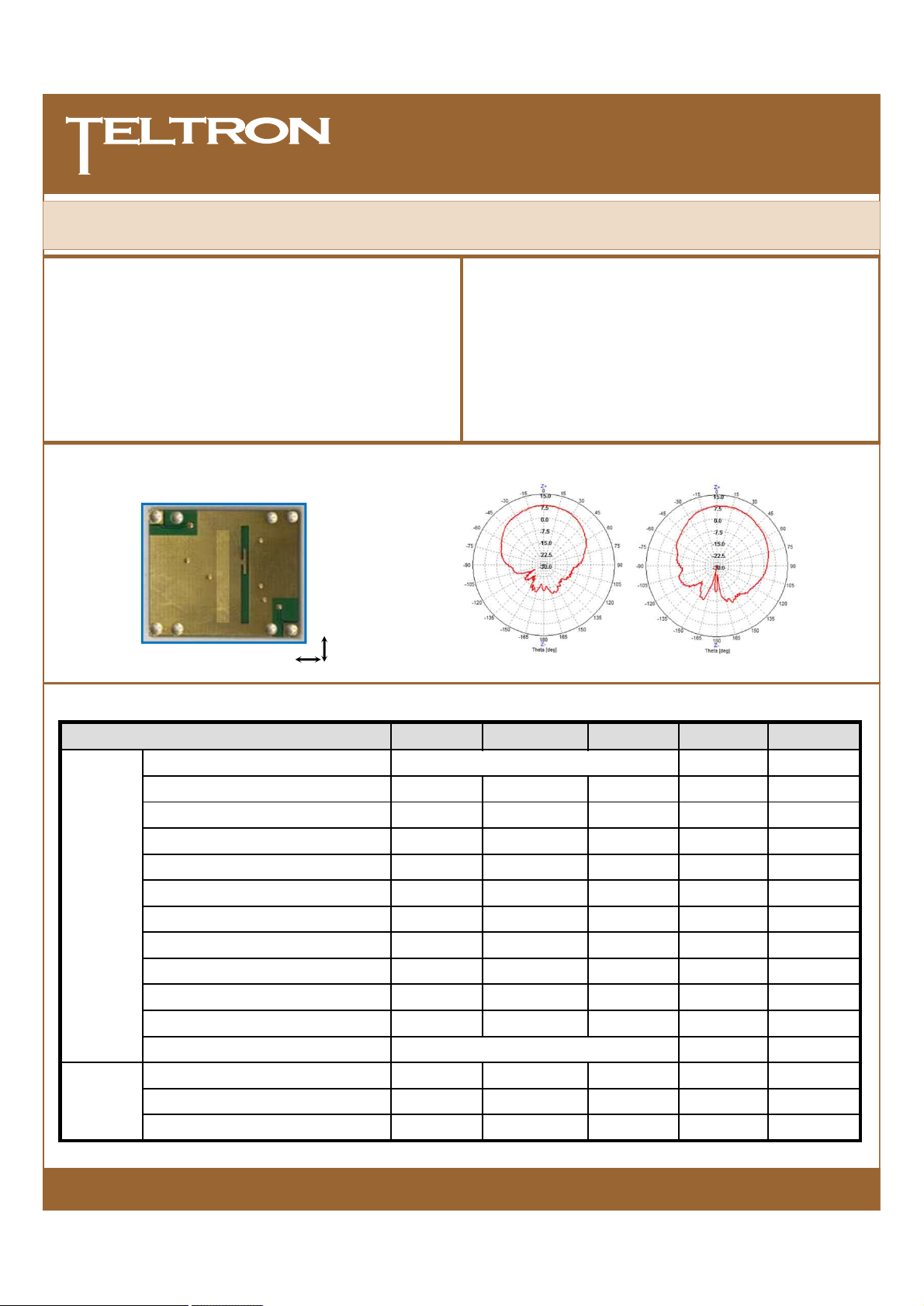
[ Antenna beam pattern ]
E-axis
H-axis
[ Picture ]
Parameters Min. Typ. Max. Unit Condition
CW
Frequency
10,525 ± 25
MHz Over Temp.
Output Power (EIRP) 8 dBm
Power Supply 3.0 3.3 3.6 V
Current Consumption 24 35 mA CW
Settling time 6
mS
Noise 10
mVrms
3~80 Hz
Received Signal 20 mVp-p max
3dB Antenna Beam Width – E-axis 84
o
3dB Antenna Beam Width – H-axis 85
o
Operating temp. -10 +50
o
C
Storage temp. -30 +70
Size 20.5*17.5*8.1 mm
Pulse
Operation
Pulse Width 5
mS
Duty Cycle 20 %
Average Current 5 mA @20% duty
[Electrical Specifications]
Warning : The specifications can be changed without any notice.
H-axis
E-axis
Page 2
www.teltron.com
2
Telecommunications &
Electronics
X-Band Motion Sensor
Model : TMS230
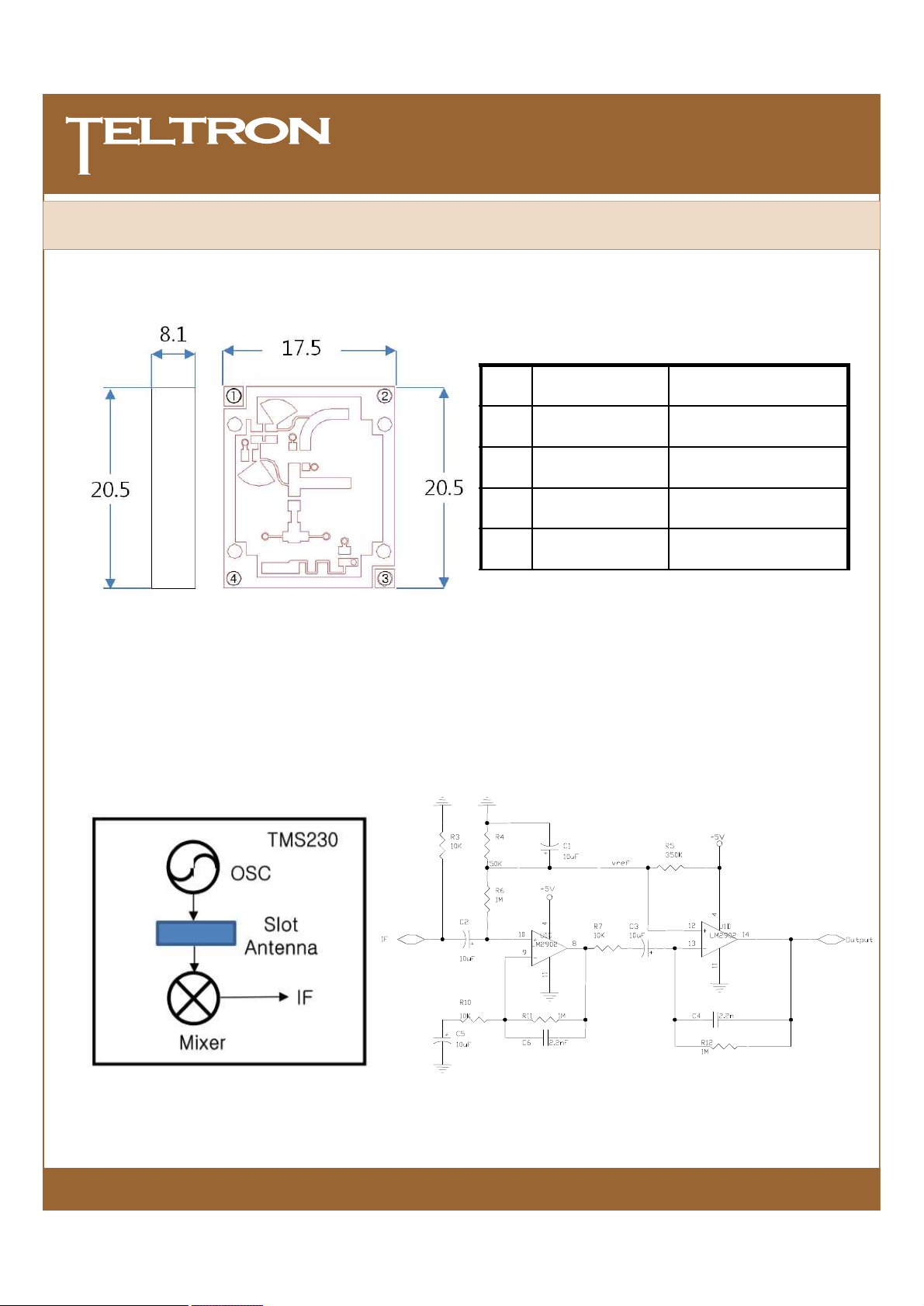
[Dimension ]
[ Pin Description ]
[ Application Circuit Example ]
[ Block Diagram ]
#202 Itplex, YusungGu, JangDong 59-2, Daejeon City, Korea 305-343
TEL : +82-42-360-2020 FAX : +82-42-360-2010 email : [email protected]
Warning : TMS230 is very sensitive to ESD, so you should be very careful in installation. Unless, there
would be an operational problem or it may be out of order.
# Pin Name Explanation
1 VDD Power, +3.3V
2 GND Ground
3 IF Output
4 GND Ground
Side view Front view (mm)
Page 3

Federal Communications Commission (FCC) Interference Statement
This equipment has been tested and found to comply with the limits for a Class B digital device,
pursuant to Part15 of the FCC Rules.
These limits are designed to provide reasonable protection against harmful interference in a
residential installation. This equipment generate, uses and can radiate radio frequency energy and, if
not installed and used in accordance with the instructions, may cause harmful interference to radio
communications.
However, there is no guarantee that interference will not occur in a particular installation. If this
equipment does cause harmful interference to radio or television reception, which can be determined
by turning the equipment off and on, the user is encouraged to try to correct the interference by one of
the following measures:
Reorient or relocate the receiving antenna.
Increase the separation between the equipment and receiver.
Connect the equipment into an outlet on a circuit different from that to which the receiver is
connected.
Consult the dealer or an experienced radio/TV technician for help.
This device complies with Part 15 of the FCC Rules. Operation is subject to the following two
conditions:
(1) This device may not cause harmful interference, and (2) this device must accept any interference
received, including interference that may cause undesired operation.
FCC Caution: Any changes or modifications not expressly approved by the party responsible for
compliance could void the user's authority to operate this equipment.
RF exposure warning
This equipment complies with FCC radiation exposure limits set forth for an uncontrolled
environment.
This equipment must be installed and operated in accordance with provided instructions and the
antenna(s) used for this transmitter must be installed to provide a separation distance of at least 20
cm from all persons and must not be collocated or operating in conjunction with any other antenna or
transmitter.
Page 4

OEM Integration Instructions:
This device is intended only for OEM integrators under the following conditions:
The module can be used to installation in other host. The antenna must be installed such that 20 cm is
maintained between the antenna and users, and the transmitter module may not be co-located with
any other transmit or antenna. The module shall be only used with the integral antenna(s) that has
been originally tested and certified with this module. As long as 3 conditions above are met, further
transmitter test will not be required. However, the OEM integrator is still responsible for testing their
end-product for any additional compliance requirement with this module installed (for example,
digital device emission, PC peripheral requirements, etc.)
IMPORTANT NOTE:
In the event that these conditions cannot be met (for example certain laptop configuration or
co-location with another transmitter), then the FCC authorization for this module in combination with
the host equipment is no longer considered valid and the FCC ID of the module cannot be used on the
final product. In these and circumstance, the OEM integrator will be responsible for re-evaluating. The
end product (including the transmitter) and obtaining a separate FCC authorization. The final end
product must be labeled in a visible area with the following: “Contains Transmitter Module FCC ID:
2AJWPTMS230 or Contains FCC ID: 2AJWPTMS230”.
 Loading...