

Page 1
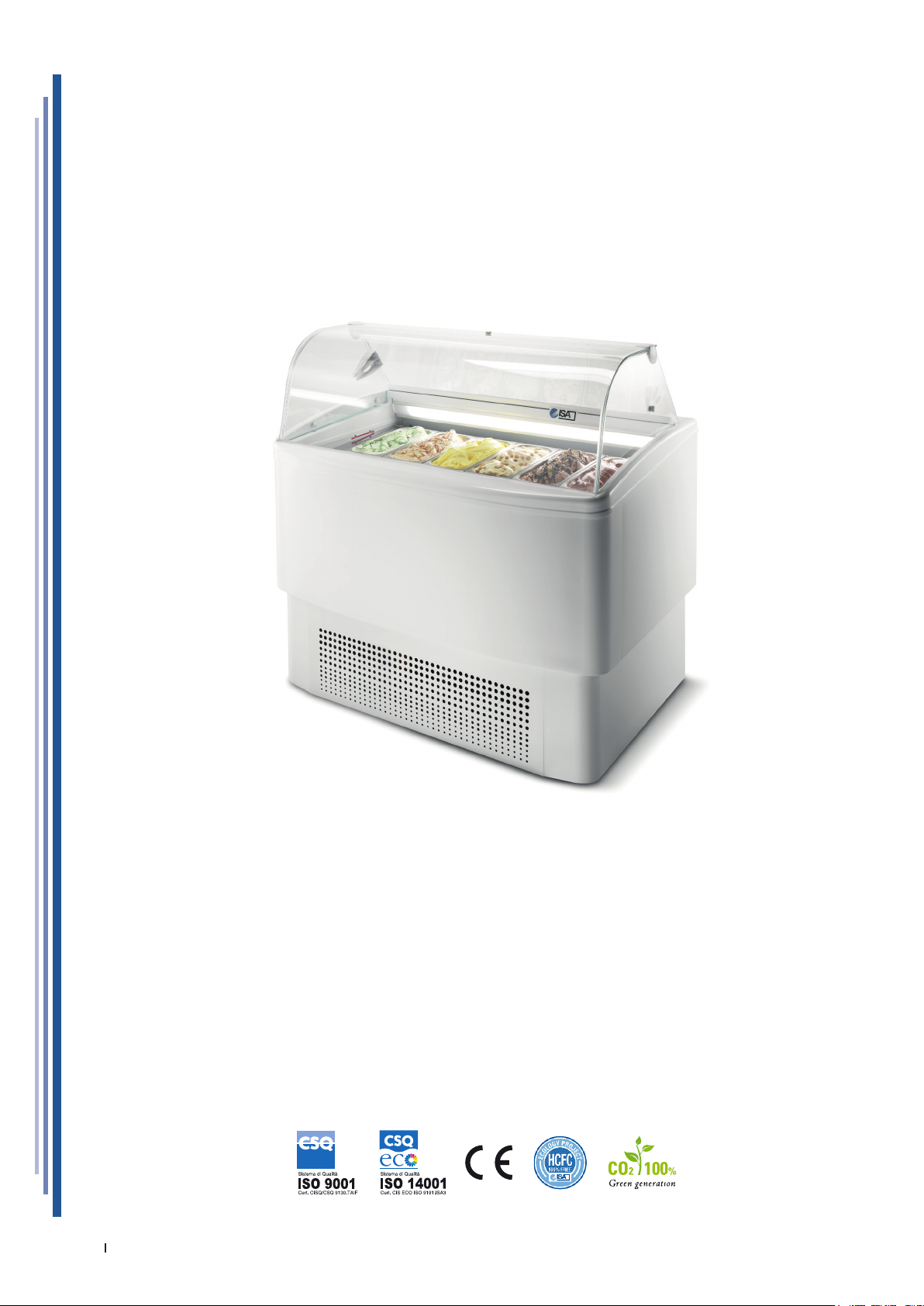
FIJI
EN
428000377137 FIJI
ISA S.p.A.
Via Madonna di Campagna 123 - 06083 Bastia Umbra PG - Italy
T. +39 075 801 71 - F. +39 075 800 09 00 - E. [email protected]
www.isaitaly.com
USE AND MAINTENANCE MANUAL
1
Page 2
1. NOTES / WARNINGS 4
2. MANUFACTURER 10
3. WARRANTY TERMS AND CONDITIONS 10
4. EQUIPMENT IDENTIFICATION 10
5. USE 11
5.1 COMPOSITION 11
6. SAFETY 12
6.1 SAFETY DEVICES PRESENT 12
6.2 FIXED GUARDS 12
6.3 ISOLATING THE ELECTRIC POWER SUPPLY 12
6.4 RESIDUAL RISKS 12
6.5 RISK OF CONTACT WITH LIVE PARTS 12
6.6 FIRE 12
6.7 EXPLOSIVE ATMOSPHERE 13
6.8 SLIPPING 13
6.9 TRIPPING 13
6.10 CIRCUIT FAULTS 13
6.11 WARNING SIGNS (IF ANY) 13
6.12 FALLING OBJECTS 13
6.13 COOLING 13
6.14 FOOD SAFETY (PACKAGED PRODUCTS) 13
7. DISPOSAL OF WASTE MATERIAL 14
8. INSTALLATION 15
8.1 STORAGE AND UNPACKING 15
8.2 ENVIRONMENTAL CONDITIONS 15
8.3 ELECTRICAL CONNECTION 15
8.4 WALL MOUNTING 16
8.5 POSITIONING / MOVING 16
9. MAINTENANCE 17
10. FAULTS - TECHNICAL AFTER-SALES ASSISTANCE 18
10.1 ALARMS LIST (WHERE PRESENT) 19
11. TECHNICAL SPECIFICATIONS 20
11.1 LIGHTING 21
11.2 WEIGHTS 21
11.3 OPENING / CLOSING (OPERATOR SIDE) 21
12. CONTROL PANEL 22
12.1 USER INTERFACE EW974 23
13. CLEANING 24
13.1 INTERNAL 24
13.2 CONDENSING UNIT 25
13.3 DEFROST WATER COLLECTION TRAY (IF PRESENT) 25
14. PROLONGED APPLIANCE SWITCH-OFF 26
EN
428000377137 FIJI
USE AND MAINTENANCE MANUAL
2
Page 3
ATTACHMENTS
1 WIRING DIAGRAM - 412100264000 27
2 WIRING DIAGRAM - 412100411000 28
3 WIRING DIAGRAM - 412100756000 29
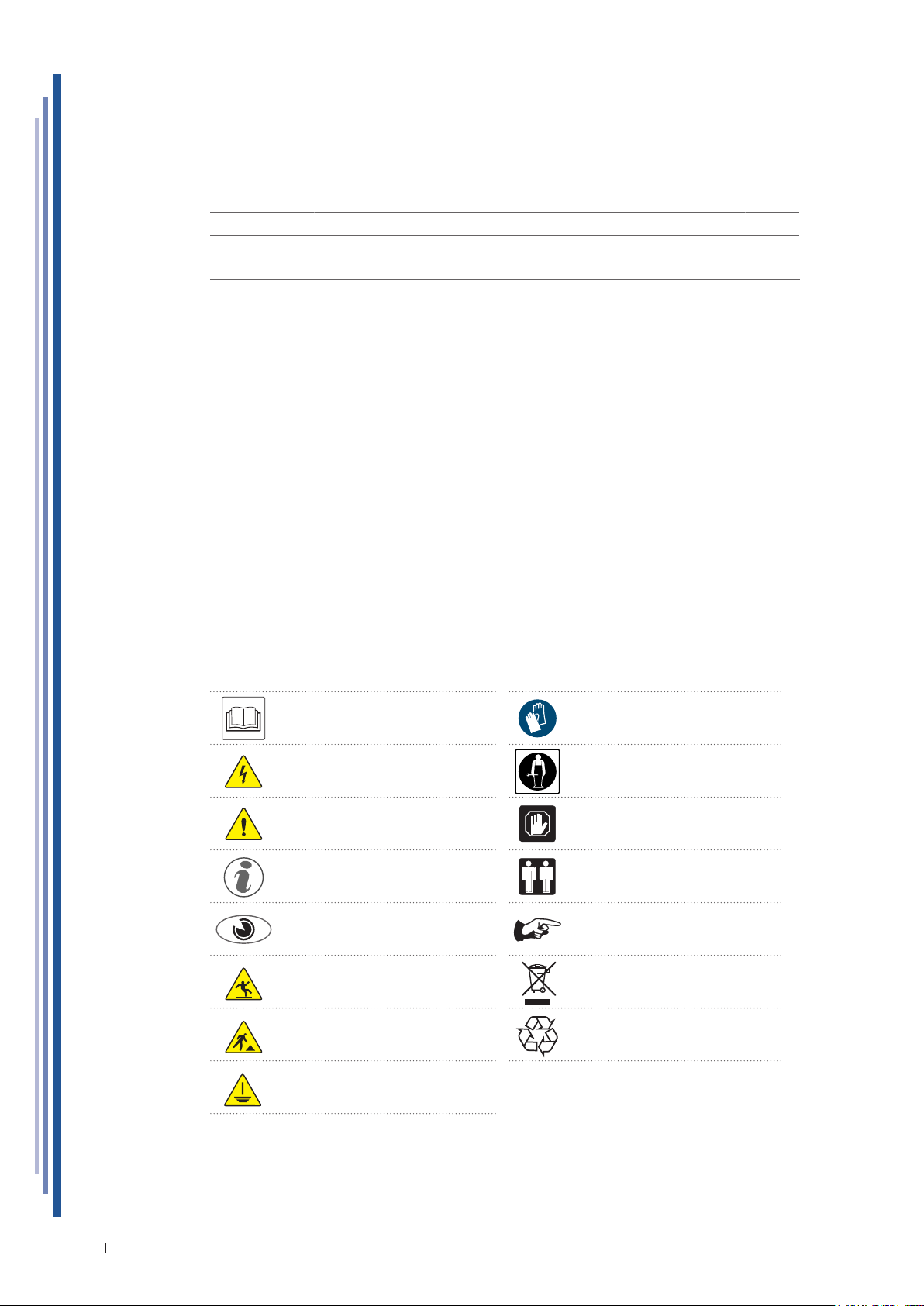
The manual contains symbols to attract the reader's attention and highlight particularly
important aspects. The table below illustrates the meaning of the various symbols used.
Read the manual Use of protective clothing
DANGER
Live electrical parts
ATTENTION / DANGER Important information
Information
Eye check Notes/Important Notes
DANGER
Slipping
DANGER
Tripping
Maintenance requirement or operations that
must be completed by qualied personnel or
technical assistance centre
Operations that must be performed by two
persons
Waste disposal
Recyclable Material
Earthing
EN
428000377137 FIJI
USE AND MAINTENANCE MANUAL
3
Page 4

1. NOTES / WARNINGS
NOTE
The content of this manual is of a technical nature and is owned by ISA.
It is forbidden to reproduce, circulate or modify all or part of its content
without written consent. Any infringement will be legally pursued.
The manual and the conformity certicate are an integral part of the equipment
and should always accompany the product in the event of a transfer to a new
location or to a new owner. The user is responsible for the integrity of these
documents, for their consultation and during the whole life cycle of the equipment
itself. Keep this manual in a safe place.It should be available for consultation
near the equipment at all times. If lost or destroyed, you can request a copy of
the manual from ISA by specifying the exact model, serial number and year of
manufacture. The manual reects the manufacturing technology at the time of
supply.The manufacturer reserves the right to modify its products in any way it
deems necessary, with no obligation to update manuals and machines relating to
previous manufacturing batches.
The equipment can be used by children no younger than 8 and by persons
with reduced physical, sensory or mental capabilities, or lacking experience or
necessary knowledge, as long as supervised or after having received training
regarding safe use of the equipment and have an understanding of the inherent
risks involved. Do not allow children to play with the device. The cleaning and
maintenance that the user will carry out must not be undertaken by children
without supervision.
Always refer to this manual before going ahead with any operation. Before doing
any type of work, disconnect the equipment from the power supply. Any work on
electric and electronic parts or cooling system components should only be carried
out by trained personnel in compliance with current laws.
The Manufacturer cannot be held liable for any damage to persons, animals or to
the product in the following cases:
• Improper use of the equipment or use of the appliance by unqualied or
unauthorised personnel.
• Failure to comply with current legislation.
• Incorrect installation and/or power supply faults.
• Failure to observe the instructions contained in this Manual.
• Failure to follow the maintenance programme.
• Unauthorised modications.
• Installation of non-original spare parts in the equipment.
• Installation and use of the equipment for purposes other than those for which
the appliance was designed and sold.
• Tampering with or damage to the power supply cable.
EN
428000377137 FIJI
USE AND MAINTENANCE MANUAL
4
Page 5
1. NOTES / WARNINGS
Liability for applying the safety instructions contained in this manual is held by
the technical personnel responsible for the intended use of the equipment, who
should ensure that authorised personnel:
• Are qualied to carry out the requested activity;
• is aware of and carefully complies with the instructions contained in this
document
• are aware of, and apply, the general safety standards applicable to the
equipment.
The buyer is responsible for training personnel using the appliance on the risks,
safety devices and general health and safety rules required by the laws of the
country where the appliance is installed.Users/operators should be aware of the
position of all the controls and how they work, as well as of the features of the
appliance.
They should also read this manual in its entirely. Maintenance work should be
conducted by qualied personnel after the appliance has been prepared adequately.
DANGER
Unauthorised tampering with or replacement of one or more parts
of the appliance, use of accessories that modify the use of the same
and use of spare parts different to those recommended, can become
the cause of injury.
DANGER
Any work conducted on the on the appliance must involve
disconnection from the power socket and in any case, none of the
protective elements (grid, casing) should be removed by non-qualied
staff.The appliance should not be operated when these protective
elements have been removed.
NOTE
In order not to compromise functionality and safety of the appliance,
the particularly complex installation and maintenance activities are
not documented in this manual and are performed by the undersigned
company.
Never use electric devices inside this appliance. Do not use mechanical
devices or other means to accelerate the defrosting process, other than those
recommended by the manufacturer. Keep the air vents in the casing of the
appliance or in the structure built into the wall free of obstructions. Do not
damage the refrigeration circuit.
EN
RISK OF EXPLOSION
Do not store products containing ammable propellants or explosives.
428000377137 FIJI
USE AND MAINTENANCE MANUAL
5
Page 6
1. NOTES / WARNINGS
STAFF TRAINING
The buyer is responsible for ensuring personnel who will use the appliance
and maintenance technical staff are instructed and trained adequately. The
manufacturer is available for advice, clarications, etc. so that the operator
and technical staff can use the appliance correctly. To ensure operator safety,
appliance devices should be kept in constant working order. This manual is
intended to illustrate the use and maintenance of the appliance.The operator has
a responsibility and duty to carefully observe the instructions contained within it.
Failure to comply with safety standards may result in injury to personnel and
damage to the equipment components and control unit.
The user can contact the dealer to request additional information not contained
in this document, or suggest improvements, at any time.
Before the product is delivered to the customer, it is essential that
a trained technical member of staff checks that the appliance is
operating correctly in order to achieve maximum performance.
INTRODUCTION
ISA employs materials of the best quality and as they enter the company,
we constantly monitor their storage and the use as part of the manufacturing
process to prevent damage, deterioration and failure. All manufacturing elements
has been designed and manufactured in order to guarantee reliability and high
safety standards. All appliances are subjected to a strict testing procedure before
delivery.However, please bear in mind that product performance over time depends
on correct use and adequate maintenance. This manual contains the necessary
instructions to maintain the appliance’s initial appearance and functions over
time.
The use and maintenance manual contains the information required to understand
the operating modes of the appliance and for its correct use, in particular: the
technical description of the various functional groups, accessories and safety
systems, operation, use of instrumentation and interpretation of any diagnostic
warnings, main procedures and information relating to the ordinary maintenance
operations. For correct use of the appliance, the working environment should
comply with current health and safety standards.
EN
The safety requirements, indications, standards and notes illustrated in the
various chapters of the manual are aimed at establishing a code of conduct and
a series of obligations to be observed when performing the various activities, in
order to create safe conditions for personnel, the equipment and the surrounding
environment.
428000377137 FIJI
USE AND MAINTENANCE MANUAL
6
Page 7
1. NOTES / WARNINGS
The safety standards reported in this document are intended for trained, authorised
personnel responsible for:
• Transport
• Installation
• Operation
• Management
• Maintenance
• Cleaning
• Putting out of order
• Disposal
ATTENTION
Reading this manual, albeit in full, is no substitute for adequate user
experience. therefore it should only be considered a useful reminder
of the technical features and the main operations to perform.
WARNING
Installers and users must read
and understand all instructions herein before
carrying out any operation on the equipment.
EN
428000377137 FIJI
USE AND MAINTENANCE MANUAL
7
Page 8
1. NOTES / WARNINGS
R744 - REFRIGERANT (WHERE APPLICABLE)
R744 The refrigerant R744 is a gas that is compatible with the environment.
Pay close attention during transport, installation and that the
destruction not to damage the refrigerant pipelines.
IN THE EVENT OF DAMAGE:
Keep ames or sources of ignition away from the appliance. Properly ventilate
the premises for a few minutes. Turn the unit off, pull the plug. Notify the
customer service department.
ATTENTION
The refrigerant system is High Pressure.
Do not tamper with the system, but call a specialised and qualied technician
before disassembly.
ATTENTION
Maintenance must be performed by qualied personnel that has been
to work with ammable refrigerants.
R290 - REFRIGERANT (WHERE APPLICABLE)
The refrigerant R290 is a gas that is compatible with the environment,
but is highly ammable. Pay close attention during transport,
installation and dismantling not to damage the refrigerant pipelines.
IN THE EVENT OF DAMAGE:
Keep ames or sources of ignition away from the appliance. Properly ventilate the
premises for a few minutes. Turn the unit off, pull the plug. Notify the customer
service department. The more refrigerant containing an appliance, the greater
must be the environment in which there is the unit. In areas too small, in the
event of leakage can form a ammable mixture of air and gas. The volume of
the room where the appliance is installed must be at least 19 m³ for each
cooling system present in the room.
ATTENTION
Maintenance must be performed by qualied technical personnel
with appropriate training and authorisation to work with inammable
refrigerants.
EN
428000377137 FIJI
USE AND MAINTENANCE MANUAL
8
Page 9
1. NOTES / WARNINGS
R600a - REFRIGERANT (WHERE APPLICABLE)
The refrigerant R600a is a gas that is compatible with the
environment, but highly ammable. Pay close attention during
transport, installation and dismantling not to damage the refrigerant
pipelines.
IN THE EVENT OF DAMAGE:
Keep ames or sources of ignition away from the appliance. Properly ventilate the
premises for a few minutes. Turn the unit off, pull the plug. Notify the customer
service department. The more refrigerant containing an appliance, the greater
must be the environment in which there is the unit. In areas too small, in the
event of leakage can form a ammable mixture of air and gas. The volume of
the room where the appliance is installed must be at least 17 m³ for each
cooling system present in the room.
ATTENTION
Maintenance must be performed by qualied technical personnel
with appropriate training and authorisation to work with inammable
refrigerants.
EN
428000377137 FIJI
USE AND MAINTENANCE MANUAL
9
Page 10
2. MANUFACTURER
ISA S.p.A.
Via Madonna di Campagna 123
06083 Bastia Umbra PG
Italy
T. +39 075 801 71
F. +39 075 800 09 00
E. [email protected]
www.isaitaly.com
3. WARRANTY TERMS AND CONDITIONS
The seller's warranty on the equipment is valid for 12 (TWELVE) months from the date of delivery.
The warranty includes repairs or replacements of any faulty parts due to manufacturing processes or installation after
written communication has been received, stating the appliance serial number and date of installation.
Not included in the warranty:
• Incorrect use of the appliance
• Incorrect connection to the power grid
• Normal component wear (e.g. compressor failure, neon/LED lights, etc.) where not caused by manufacturing defects.
• Installation, technical instruction, regulation and condenser cleaning call-outs.
If the seller's technical staff detect any tampering, unauthorised repairs or inappropriate use of appliance the warranty
will be invalidated.
Shipment of components covered by the warranty is freight collect only.
Any damage to the appliance detected at the time of delivery due to transport must be reported on the same shipping
note to claim compensation from the carrier.
The seller cannot be held liable in the event of damage to accepted products due to appliance faults.
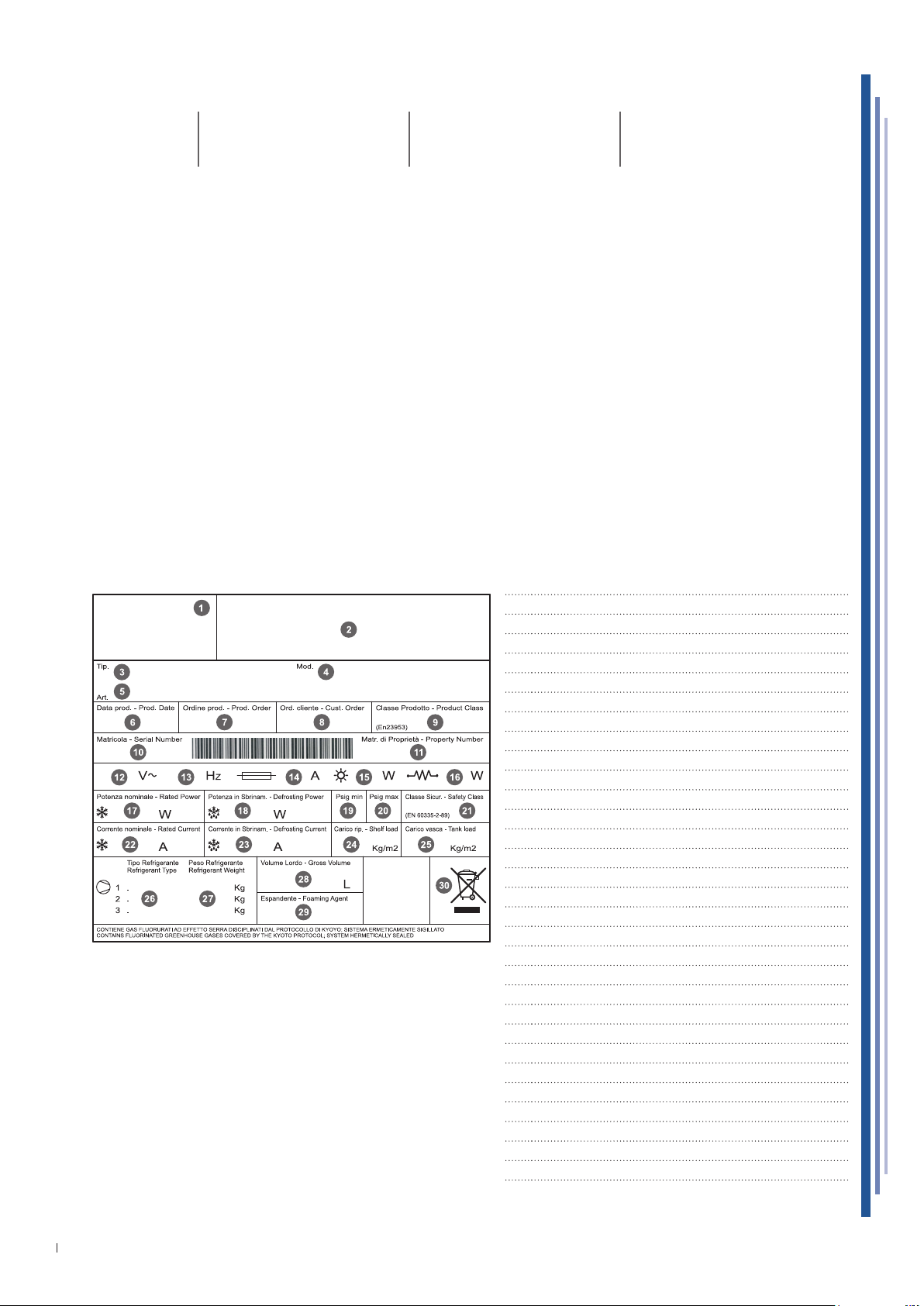
4. EQUIPMENT IDENTIFICATION
• Find the label afxed to the machine in order to read technical data.
• Check the machine model and the power supply voltage before you perform any operation.
• If you nd discrepancies, contact the manufacturer or the company that supplied the machine immediately.
1
IDENTIFICATION OF THE COMPANY RESPONSIBLE FOR THE PRODUCT
2 SYMBOLS OF COMPLIANCE
3 TYPE
4 MODEL NAME
5 ARTICLE
6 PRODUCTION DATE
7 PRODUCTION ORDER
8 CUSTOMER ORDER
9 PRODUCT CLASS
10 SERIAL NO.
11 OWNER REGISTRATION NUMBER
12 SUPPLY VOLTAGE
13 SUPPLY VOLTAGE
14 FUSE VALUE
15 LAMP POWER
16 ELECTRICAL RESISTANCE ABSORPTION
17 NOMINAL POWER (NORMAL OPERATION)
18 POWER (DEFROSTING)
19 MINIMUM PRESSURE
20
MAXIMUM PRESSURE
21 SAFETY CLASS
22 NOMINAL CURRENT
23 CURRENT DURING DEFROSTING
24 SHELF LOAD
25 TANK LOAD
26 TYPE OF COOLANT
27 WEIGHT OF COOLANT
28 GROSS VOLUME
29 EXPANDING ISOLATION AGENT
WEEE MARK
30
EN
428000377137 FIJI
USE AND MAINTENANCE MANUAL
10
Page 11
5. USE
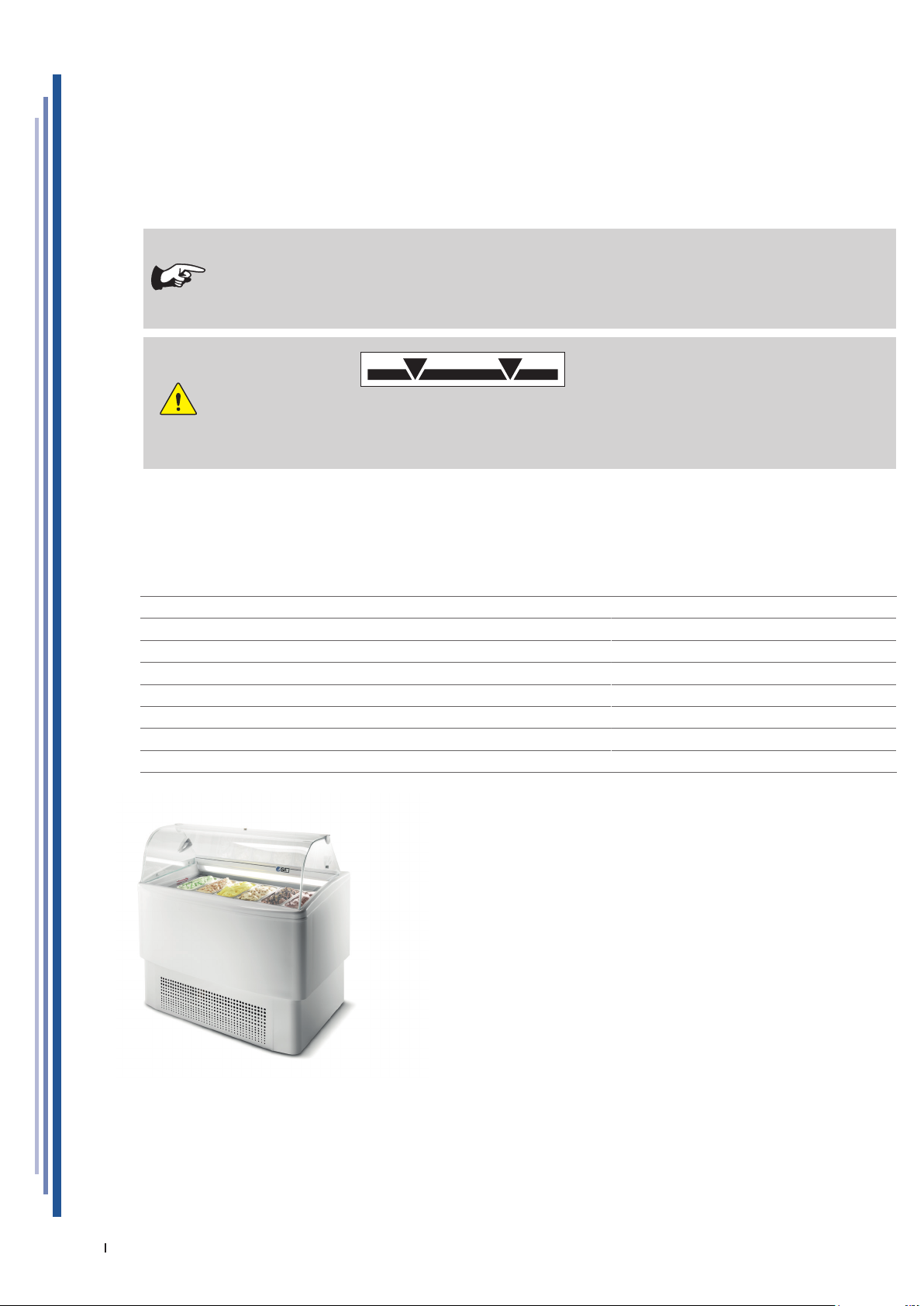
This appliance is exclusively intended to:
DISPLAYING AND SALE OF SPREADABLE ICE CREAM
The manufacturer is not liable for injury to persons or damage to property or the appliance itself caused by
the displaying of products other than those described above.
THE APPLIANCE IS INTENDED FOR PROFESSIONAL USE.
Not suitable for:
• Food preservation.
• Displaying and/or preserving of non-food products (chemicals, pharmaceuticals, etc.).
ATTENTION
LOAD LIMITS
It is fundamental not to exceed the load limits indicated in order not to alter the correct air circulation
and thus prevent a higher product temperature. The limits indicated refer to a static and evenly distributed
load. Therefore dynamic overloads due to violent loading operations are excluded, which must be
prevented for safety reasons.
5.1 COMPOSITION
The appliance is made up from a unique cabinet, onto which all devices necessary to make it a professional and efcient
product for its declared use, are installed.
The appliance is composed of:
Ventilated refrigeration unit
Condenser unit on board
Electrical system
Electronic command panel
Insulated monolithic structure in ecological polyurethane
Internal LED lighting
Operator side closure with ap
Swivel casters with brakes
EN
428000377137 FIJI
USE AND MAINTENANCE MANUAL
11
Page 12
6. SAFETY
The appliance is equipped with safety devices. The buyer is responsible for training personnel using the appliance on the
risks, safety devices and general health and safety rules required by the laws of the country where the appliance is installed. Users/operators should be aware of the position of all the controls and how they work, as well as of the features
of the appliance. They must also have read this manual in its entirety.
6.1 SAFETY DEVICES PRESENT
Devices whose operation prevents the occurrence of risk situations in operating conditions (e.g. fuses, pressure
switches, protections, magnet circuit breakers, etc.).
6.2 FIXED PROTECTIONS
Fixed protective devices consist of xed perimeter shields, which are used to prevent external parts from entering the
equipment.
DANGER
The appliance must not be restarted following maintenance until all protective panels have been replaced.
VISUAL OBSERVATION
You should check the integrity of xed panels and corresponding xings to the frame, focussing in
particular on the protective panels.
6.3 ISOLATING THE ELECTRIC POWER SUPPLY
Before conducting any maintenance work on the equipment or part of it, it is necessary to section the power supply that
powers it.
DANGER
In the event of maintenance operations in which the operator cannot prevent accidental closure of the
circuit by others, disconnect the appliance from the mains electricity entirely.
6.4 RESIDUAL RISKS
During design the manufacturer examined all the areas or parts at risk.Therefore, all necessary precautions have been
taken to prevent risks to persons and damage to the appliance.
ATTENTION
• Periodically check that all safety devices are operating correctly.
• Do not remove the xed guards.
• Do not introduce unauthorised objects or tools into the work area.
Although the appliance is tted with the safety devices prepared, there are still some risks that cannot be eliminated,
Below is a summary of the remaining risks associated with the appliance during:
• Normal operation
• Adjustments and ne tuning
• Maintenance
• Cleaning
but reduced via corrective action by the nal integrator and correct operational procedures.
6.5 RISKS OF CONTACT WITH LIVE PARTS
Risk of breaking or damaging the electrical components of the appliance, with a possible reduction in safety levels
Before connecting the electricity supply, make sure there is no ongoing maintenance work.
following a short circuit.
6.6 FIRE
428000377137 FIJI
EN
ATTENTION
Before making the connection, check that the d.c. current in the installation point does not exceed that
indicated on the protections switches present in the electric control board.If this is not the case, the user
must envision the relevant limiting devices. It is strictly forbidden to conduct any electrical modication, in
order to prevent additional unforeseen hazards and risks.
DANGER
In the event of a re, immediately disconnect the master switch from the main power supply line.
USE AND MAINTENANCE MANUAL
12
Page 13
6.7 EXPLOSIVE ATMOSPHERE
The equipment must not be located in an area classied as an explosion risk
as per 199/92/EC such as:
Zone 0
An area in which there is a permanent, long-lasting or frequently explosive atmosphere made up of a mixture of air and
ammable substances in the form of gases, fumes or steam.
Zone 1
An area in which the formation of an explosive atmosphere, made up of a mixture of air and ammable substances in
the form of gases, fumes or steam is occasionally probable during normal activities.
Zone 20
An area in which there is a permanent, long-lasting or frequently explosive atmosphere in the form of clouds of
combustible dust in the air.
Zone 21
An area in which the formation of an explosive atmosphere in the form of clouds of combustible dust is occasionally
probable during normal activities.
6.8 SLIPPING
DANGER
Any leaks in the areas surrounding the appliance may cause personnel to slip. Check that there are
no leaks and keep these areas clean at all times.
6.9 TRIPPING
DANGER
Generally untidy deposits of material may constitute a trip hazard and a total or partial obstruction
of emergency exit routes. You should ensure that operating and transit areas and escape routes are
free from obstacles in compliance with current law.
6.10 CIRCUIT FAULTS
Owing to potential faults, safety circuits may become less effective, which results in lower safety levels. You should
check the operational condition of the appliance devices regularly.
6.11 WARNING SIGNS (IF ANY)
The appliance is tted with warning danger, warning and obligation signs dened in agreement with the Standard relative to
the graphical signs to be used on equipment. These signs are located where they are clearly visible.
ATTENTION
Any warning plates on the appliance must not be removed.
The user is responsible for replacing warning signs that, owing to wear, become unreadable.
6.12 FALLING OBJECTS
The positioning of the cabinet display parts (where present) of the equipment (i.e. counters, rods and hooks, etc.),
as well as the arrangement of the products inside the cabinet can be the source of potential hazards if not properly
performed. Follow the positioning instructions described in this Manual before you place products inside the cabinet,
check that the counters are properly fastened, as also the hooks, etc. Do not exceed the maximum load limit. Do not
exceed the maximum load limit. Do not position tilted product on the counters if they are not held in place by their
stoppers.
6.13 COOLING
During different operations to perform on the counter, such as cleaning or loading goods, it is necessary to handle
products and/or counter parts at a low temperature with the risk of “cold injury” for the operators and/or accidental
slipping hazard. Follow the safety regulations in the place where the cabinet is installed; more specically, be sure to
always use correct PPE (especially gloves).
6.14 FOODSTUFFS SAFETY (PACKAGED PRODUCTS)
During displaying of packaged products there must be no direct contact between the food products and the display
surfaces, however in the event of accidental breakage of the packaging of a product for a sufciently prolonged period,
contamination of the product itself may occur; in this case, strictly follow the instructions for use of the appliance
(remove the packaging damaged by exposure and clean using specic products).
428000377137 FIJI
EN
USE AND MAINTENANCE MANUAL
13
Page 14
7. DISPOSAL OF WASTE MATERIAL
During normal operation, the appliance does not generate any environmental contamination. At the end of its life cycle,
or if it is necessary to carry out permanent decommissioning, we recommend the following procedures:
DISPOSAL (USER)
The symbol, applied to either the product or its packaging, indicates that the product should not be
considered as normal domestic waste, but should be taken to a waste collection point for the recycling
of electrical and electronic appliances. The correct disposal of this product contributes to preventing
potential negative consequences that might derive from an inadequate disposal of the product. For detailed
information about recycling this product, contact your council, your local waste collection service or the
store where you purchased the product.
PROCEDURE FOR DISPOSAL and RECYCLING AT THE END OF APPLIANCE LIFE SPAN
OF THE EQUIPMENT (AUTHORISED BODIES)
• Switch off the equipment and unplug the power supply cable.
• Remove the lamps (if installed).These should be disposed of separately.
• Remove the power units and the electronic cards.These should be disposed of separately.
• Remove all the independent parts (grids, casings, proles, etc.) and group them according to shared features in
order to access the heat exchangers, pipes, cables, etc. and be careful not to damage the cooling circuit.
• Remove all mobile parts (doors, sliding doors, glass parts, etc.) and group the various materials according to their
features.
• Check the type of refrigerant on the plate positioned inside the counter; extract the refrigerant and dispose of it
through authorised services.
• Disconnect the evaporator, condenser, compressor, pipes and fans. These are made of copper, aluminium, steel and
plastic and should therefore disposed of separately.
• On removal of all guards and the various components from the frame, separate the different types of material
making up the appliance (plastic, sheet steel, polyurethane, copper, etc.) and collect them separately.
All recyclable materials and waste should be processed and recycled by professionals, in compliance
with the laws in the country in question. The company responsible for recycling the materials should be
registered and certied as a waste disposal service in accordance with the country in question.
ATTENTION
Illegal disposal of the product by the owner will result in administrative sanctions
as required by current laws. Disposal of the product should comply with current laws on the disposal of coolant liquids and mineral oils.
IMPORTANT
If the crossed wheelie bin sign is not present on the appliance, it means that the disposal of the product is
not the manufacturer's responsibility. In these cases, current waste disposal regulations apply. Refer to the
local authorities, waste disposal services or the store from where the product was purchased.
ADDITIONAL INFORMATION
Further information on the disposal of liquid coolant, oils and other substances is available on the safety
data sheet corresponding to the substance itself. In order to dispose of foamed assemblies, remember that
the polyurethane foams used are CFC, HFC and HCFC free.
EN
428000377137 FIJI
USE AND MAINTENANCE MANUAL
14
Page 15
8. INSTALLATION
This manual supplies the information necessary for correct unpacking, procedures for
positioning and connection to mains electricity.
8.1 STORAGE and UNPACKING
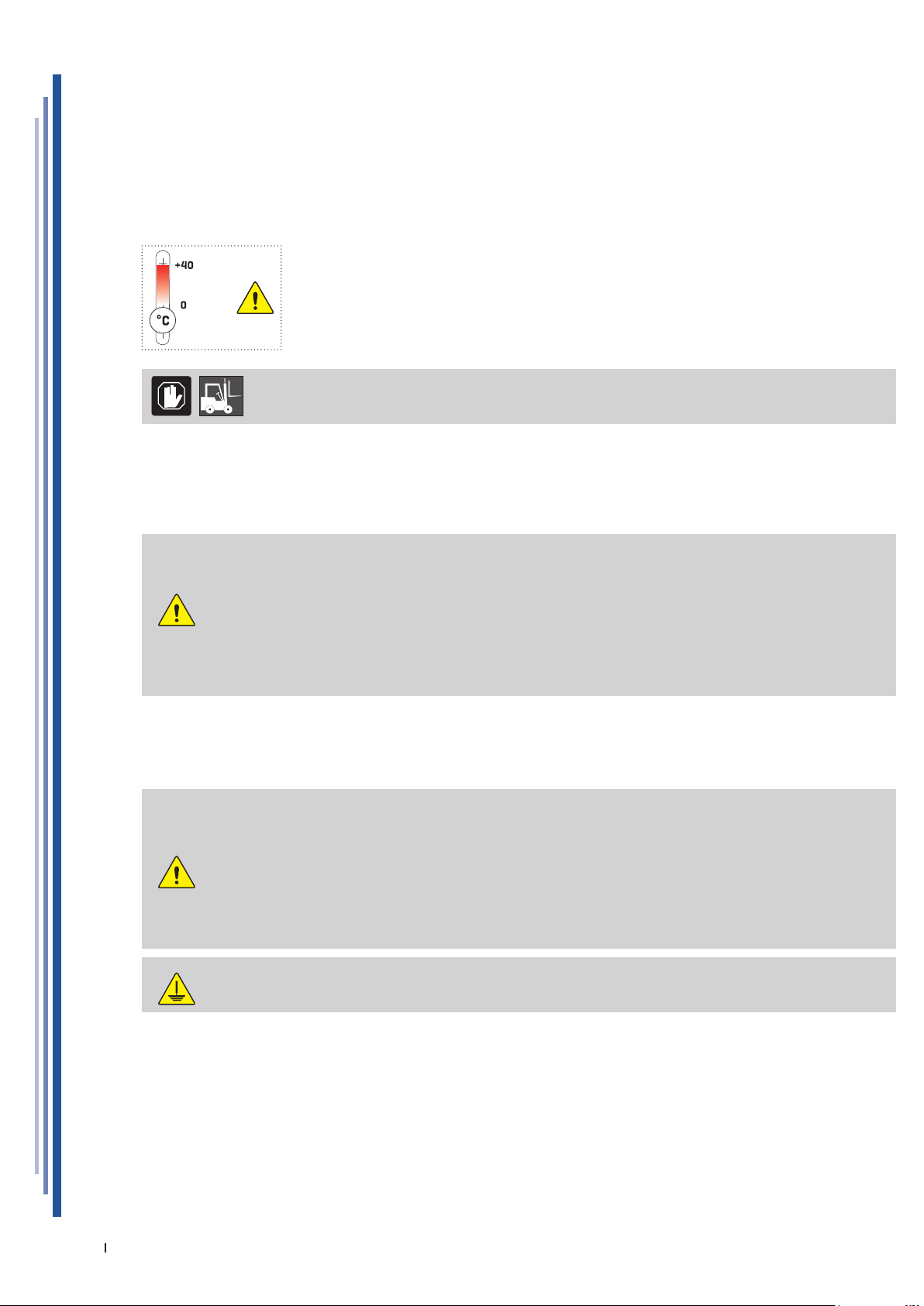
The appliance, with or without the packaging, should be carefully stored inside warehouses or in areas away from the
elements and direct sunlight, at a temperature between 0 and +40 °C.
MAX
MIN
The movement of the apparatus should only be carried out using a pump or forked truck
of a sufcient capacity for the weight, and moved by qualied personnel: during such operations,
the apparatus must be positioned on the pallet supplied.
8.2 ENVIRONMENTAL CONDITIONS
All packaging materials are recyclable and should be disposed of in accordance with local regulations. All packaging
materials are recyclable and should be disposed of in accordance with local regulations.Please destroy "plastic" bags to
prevent them from becoming hazardous to children (suffocation).
ATTENTION
A dry room that can be ventilated is the suitable location for the appliance's installation. There should be
a good air ow around the compressor/condensing unit.Therefore the area around the unit should not be
obstructed by boxes or other objects. Place the equipment away from sources of heat (radiators, heaters
of any kind, etc.) and far from the inuence of continuous air movement (caused by fans, air conditioning
units, etc.). If it is unavoidable to install near a heat source, use a suitable insulating plate. Also avoid
exposure to direct sunlight; all of this causes the temperature inside the refrigerated compartment to rise
with negative consequences on operation and energy consumption. The apparatus must not be used outside
nor be exposed to rain.
8.3 ELECTRICAL CONNECTION
ATTENTION
Check that the network voltage matches the one displayed on the identication
plate of the appliance, and that the power is adequate. Check on the socket that the power supply voltage
provides rated voltage (±10%) when you start up the compressor. The plug should be directly connected to
the electrical socket.It is forbidden to connect the plug to the socket by means of multiple socket extensions
or adaptors. The plant power supply socket must be tted with a disconnection device from the mains
electricity (dimensioned to the load and in compliance with Standards in force), which guarantees complete
disconnection in category III (3) over-voltage conditions and therefore protects the circuits against earth
faults, overloads and short circuits. Do not route the electricity cable in passageways.
ATTENTION
EN
428000377137 FIJI
Earthing is necessary and mandatory by law.
USE AND MAINTENANCE MANUAL
15
Page 16
8.4 WALL MOUNTING
ATTENTION
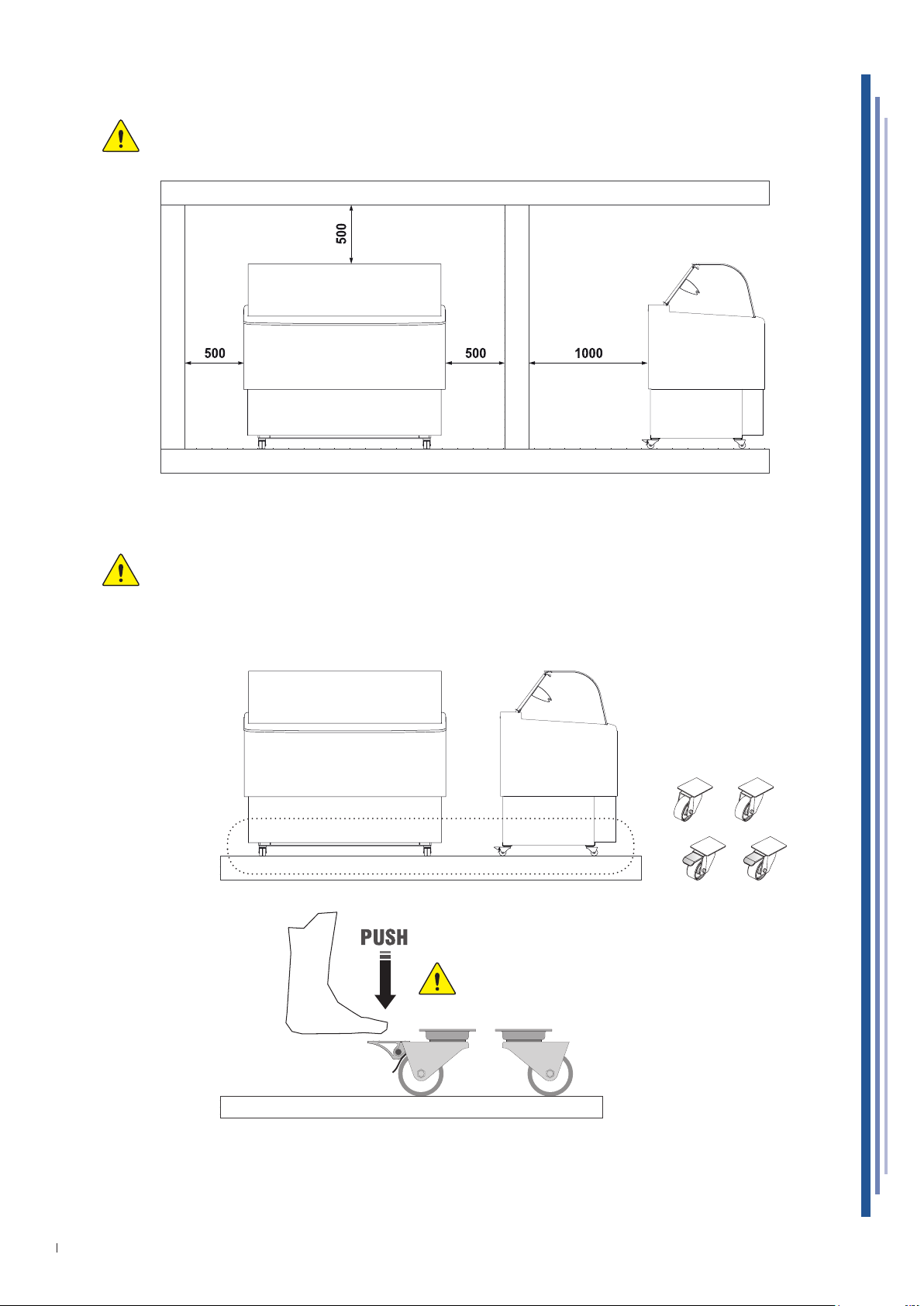
It is fundamental to respect the distances indicated (mm) for correct installation of the appliance.
8.5 POSITIONING / HANDLING
ATTENTION
SWIVEL CASTERS
The appliance has swivel drive wheels with brake to facilitate handling.
After positioning it, the appliance must be stabilised on the oor as indicated.
EN
428000377137 FIJI
USE AND MAINTENANCE MANUAL
16
Page 17
9. MAINTENANCE
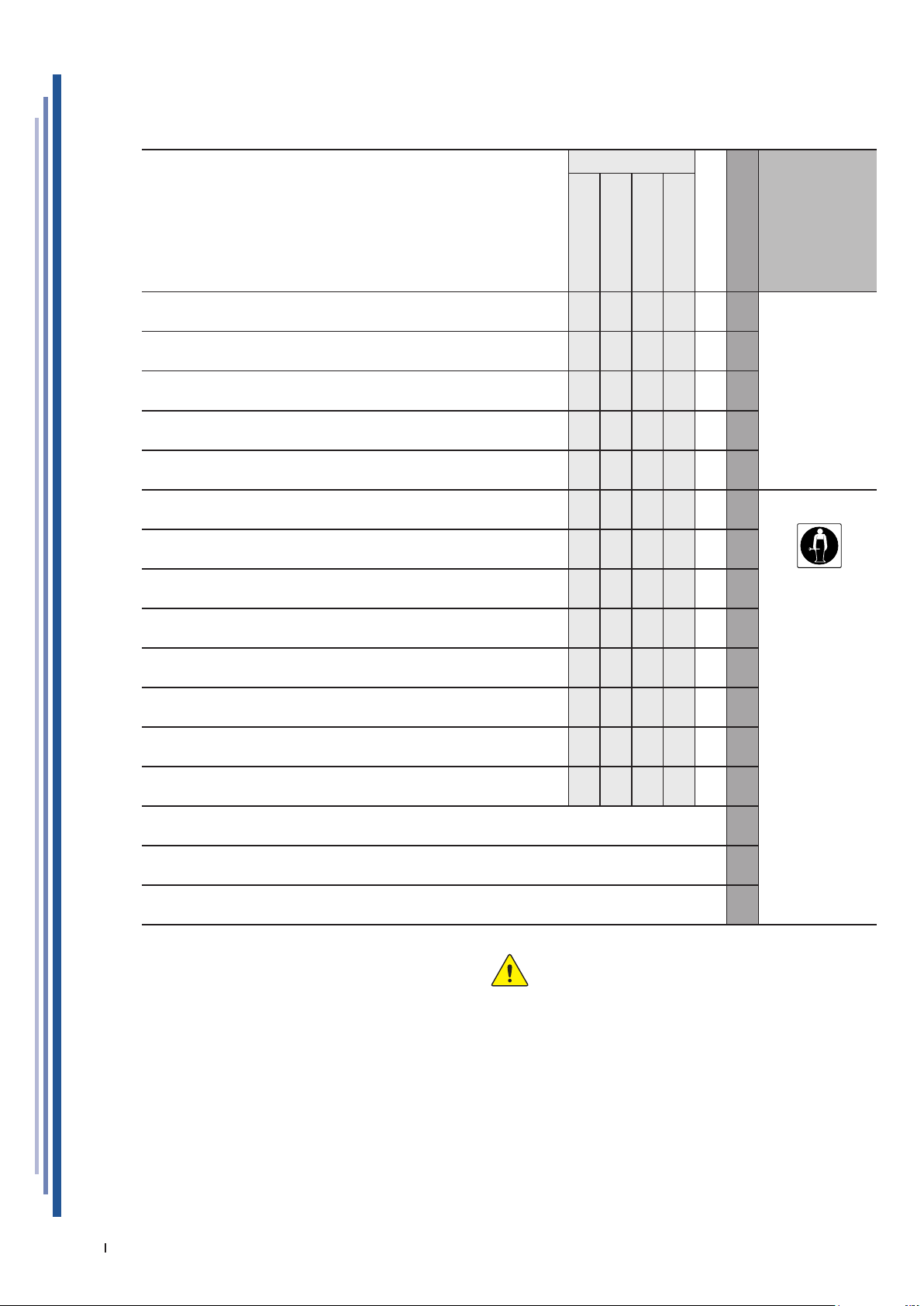
The Staff in charge of the appliance must control and respect the expiry dates for maintenance, given in the table
below, contacting the authorised Technical Assistance when indicated.
OPERATION FREQUENCY
Depending on the
Use and Necessity
Monthly
Every 6 months
CLEANING THE EXTERNAL SURFACES
CLEANING THE ACCESSIBLE INTERNAL PARTS
(without the use of tools)
CONTROL POWER SUPPLY CABLE,
PLUGS AND / OR ELECTRICAL SOCKETS
INTEGRITY CONTROL SEAL
FILTER CLEANING CONDENSING UNIT
(whenever present)
CLEANING THE DEFROSTING WATER COLLECTION TRAY
CONDENSER CLEANING
CHECK COMPRESSOR OIL LEVEL
(whenever present)
X X
X X
X X
X X
X X
X X
X X X
Annual
PERSONNEL
AUTHORISED
ORDINARY
EXTRAORDINARY
USER
TECHNICAL
ASSISTANCE
X
AIR TANK DRAINING
(whenever present)
CONTROL PNEUMATIC CONNECTIONS
(whenever present)
INTEGRITY CONTROL PIPE COOLING SYSTEM
INSPECTION OF CABLES
INTERNAL CONNECTIONS AND POWER
CLEANING CONDENSATE DRYING SPONGES
(whenever present)
LAMP / LED REPLACEMENT
(whenever present)
CONTROL PANEL REPLACING
(electronic control unit - thermostat - etc.)
REPLACEMENT POWER SUPPLY CABLE, PLUGS AND / OR ELECTRICAL SOCKETS
ATTENTION
After all maintenance it is mandatory to perform all electrical safety tests in accordance with
the IEC EN 50106 Standard.
X X
X X
X X
X X
X X
X
X
X
EN
428000377137 FIJI
USE AND MAINTENANCE MANUAL
17
Page 18
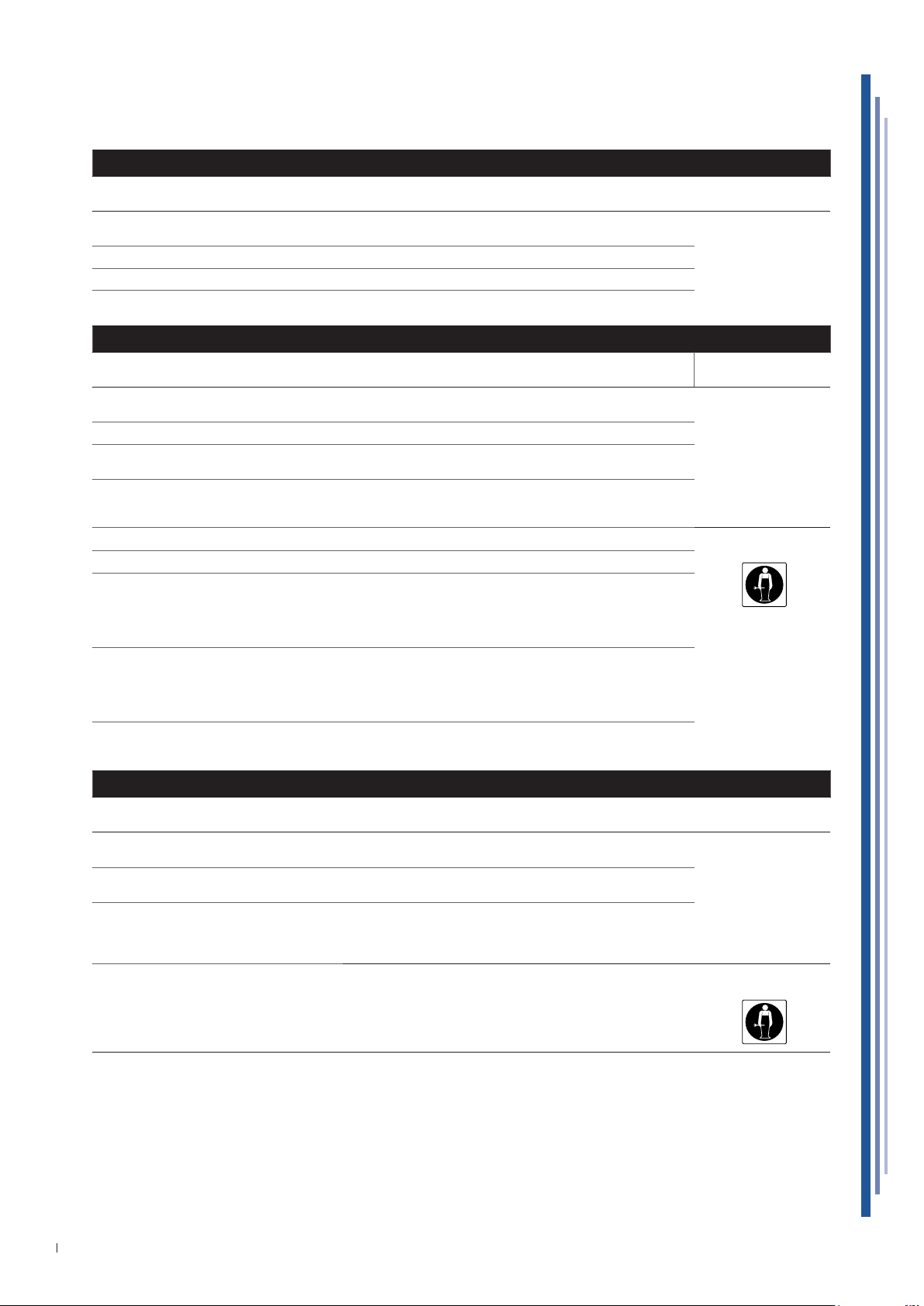
10. FAULTS - TECHNICAL AFTER-SALES ASSISTANCE
In the case of uncertain or non-operation, before requesting the intervention of the service of Technical Assistance
perform the following controls:
THE APPLIANCE IS NOT WORKING
CAUSE SOLUTION
Blown protective fuse First nd the cause of the trip
The master switch is open Close the master switch.
The plug is not inserted Insert the plug.
Electrical black-out If the black-out should be prolonged, transfer the product
THE INTERNAL TEMPERATURE IS NOT LOW ENOUGH
CAUSE SOLUTION
Evaporator/s obstructed completely
by ice
Wrong temperature setting Set the appropriate temperature.
The appliance is affected by draughts or is
exposed to direct or reected sunlight
Insufcient air ow for
cooling to the condenser
Internal fans at standstill or with fans damage TECHNICAL
Internal ventilation is too high
Thermostat / Electrical base unit
not efcient
Condenser unit blocked by dust
or dirt in general.
Insufcient refrigerant
load in the cooling system
THE COMPRESSOR DOES NOT START-UP OR OPERATES FOR A FEW MOMENTS
CAUSE SOLUTION
No electric power supply
to the appliance
Excessively low power voltage Check that the network voltage of the power supply cable is
Temperature set too high If the temperature is higher than the air temperature
Intervention of the maximum pressure
switch (where present)
of the switch, and then replace the new fuse.
into an appropriate cold storage container.
Carry out an additional defrosting cycle. USER
Remove any draughts and prevent any direct or reected
sunlight.
Remove anything which could obstruct the circulation of air
through the condenser (sheets of paper, cardboard, insufcient slots in grille, etc.).
Replace the electronic control board.
If the control unit is set up especially for must R290 refrigerant, it must only be replaced with an original replacement
from ISA. Replace the temperature probes only after check-
ing which of the two is not operating efciently.
Clean the condensing unit thoroughly.
The air condenser or MAINTENANCE FREE, in particular heavy
environments (e.g. presence of dust, the presence of excessive moisture, oiled vapours etc..) in order to avoid performance loss, needs accurate cleaning.
Find the cause behind the lower amounts of coolant and
eliminate it.Top up the coolant.If necessary, empty the system before topping up.
Check if there is a power cut.
Close the various switches on the power supply line.
of a nominal value of 220V +/- 10%.
in the display chamber, the compressor will not start.
Set the suited temperature if the current temperature
is not low enough.
Check the reasons why the pressure switch is operating at
maximum pressure levels, such as: air condenser obstructed,
condenser fan with air stopped, ambient temperature too
high, pressure switch defective.
PERSONNEL
AUTHORISED
USER
PERSONNEL
AUTHORISED
ASSISTANCE
PERSONNEL
AUTHORISED
USER
TECHNICAL
ASSISTANCE
EN
428000377137 FIJI
USE AND MAINTENANCE MANUAL
18
Page 19
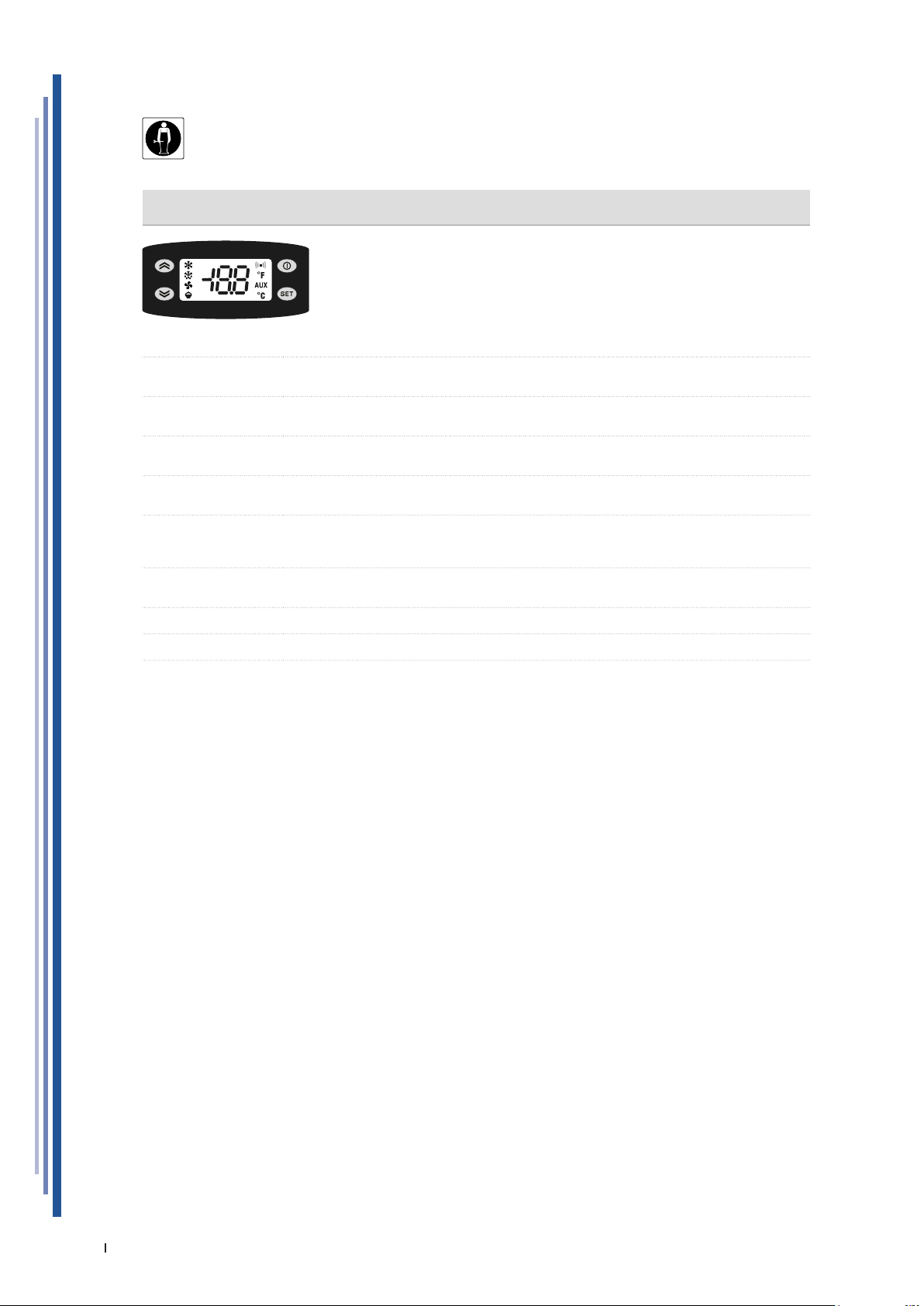
10.1 ALARM LIST (WHERE PRESENT)
ALARMS
ALARM MEANING
P1
E0
Broken thermostat probe.
Compressor output according to“COn” and “COF parameters
P2
E1
HA
HI
LA
LO
EA
IA
CB
ETc
RTF
EE Machine parameter error.
EF Operating parameters error
Broken evaporator probe.
Set time for defrosting.
High temperature alarm.
Low temperature alarm.
External alarm.
Real time clock is broken.
EN
428000377137 FIJI
USE AND MAINTENANCE MANUAL
19
Page 20
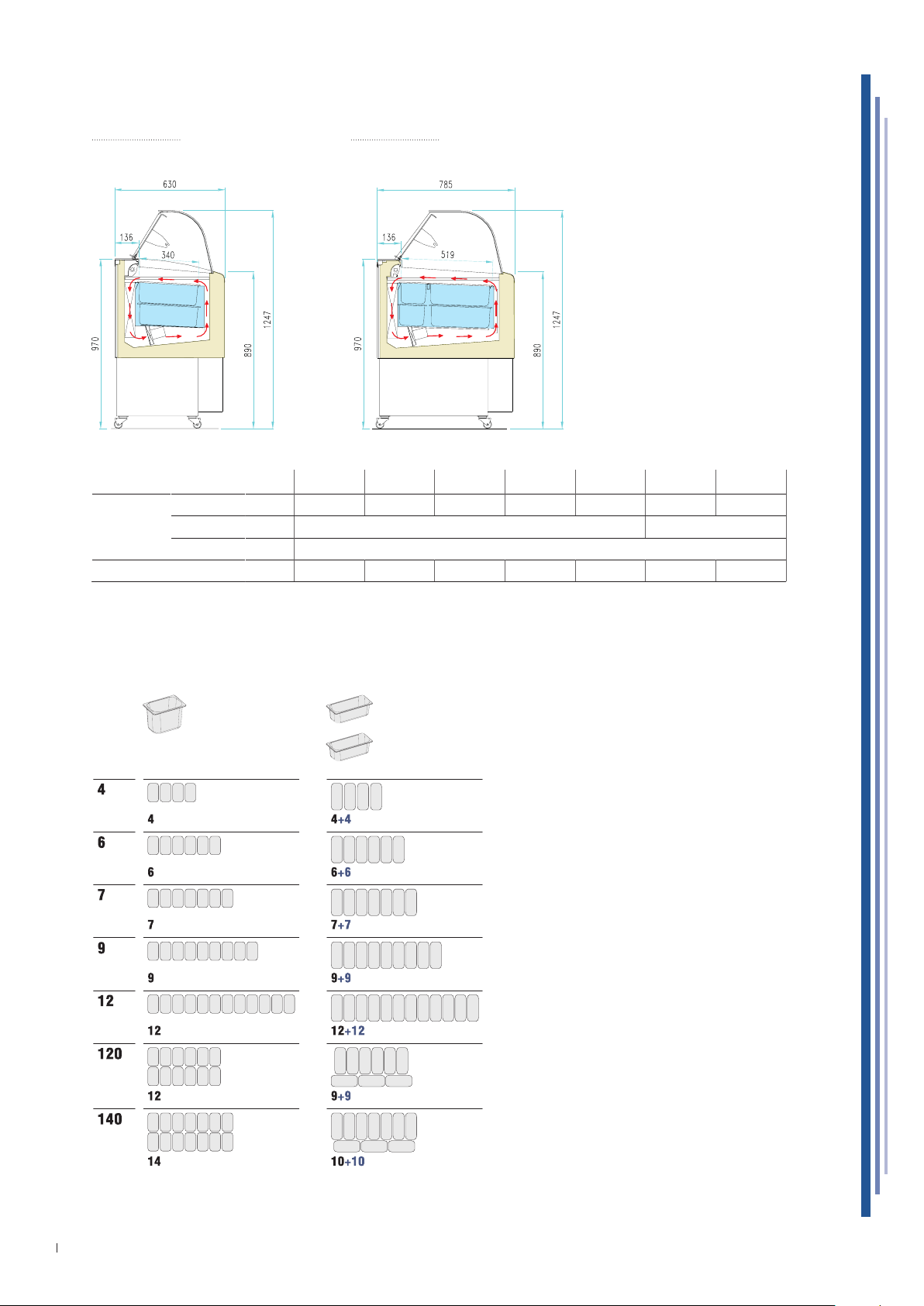
11. TECHNICAL SPECIFICATIONS
4-6-7-9-12 120-140
4 6 7 9 12 120 140
External
dimensions
Weight (net)
Length mm
Depth mm
Height mm
Kg
824 1214 1354 1659 2119 1214 1354
67 99 110 135 172 110 135
630 785
1247
ARRANGEMENT ICE CREAM CONTAINERS
5 litres
360x165x120H
Double reserve line
+
Model
4.75 litres
260x157x170H
EN
428000377137 FIJI
USE AND MAINTENANCE MANUAL
20
Page 21
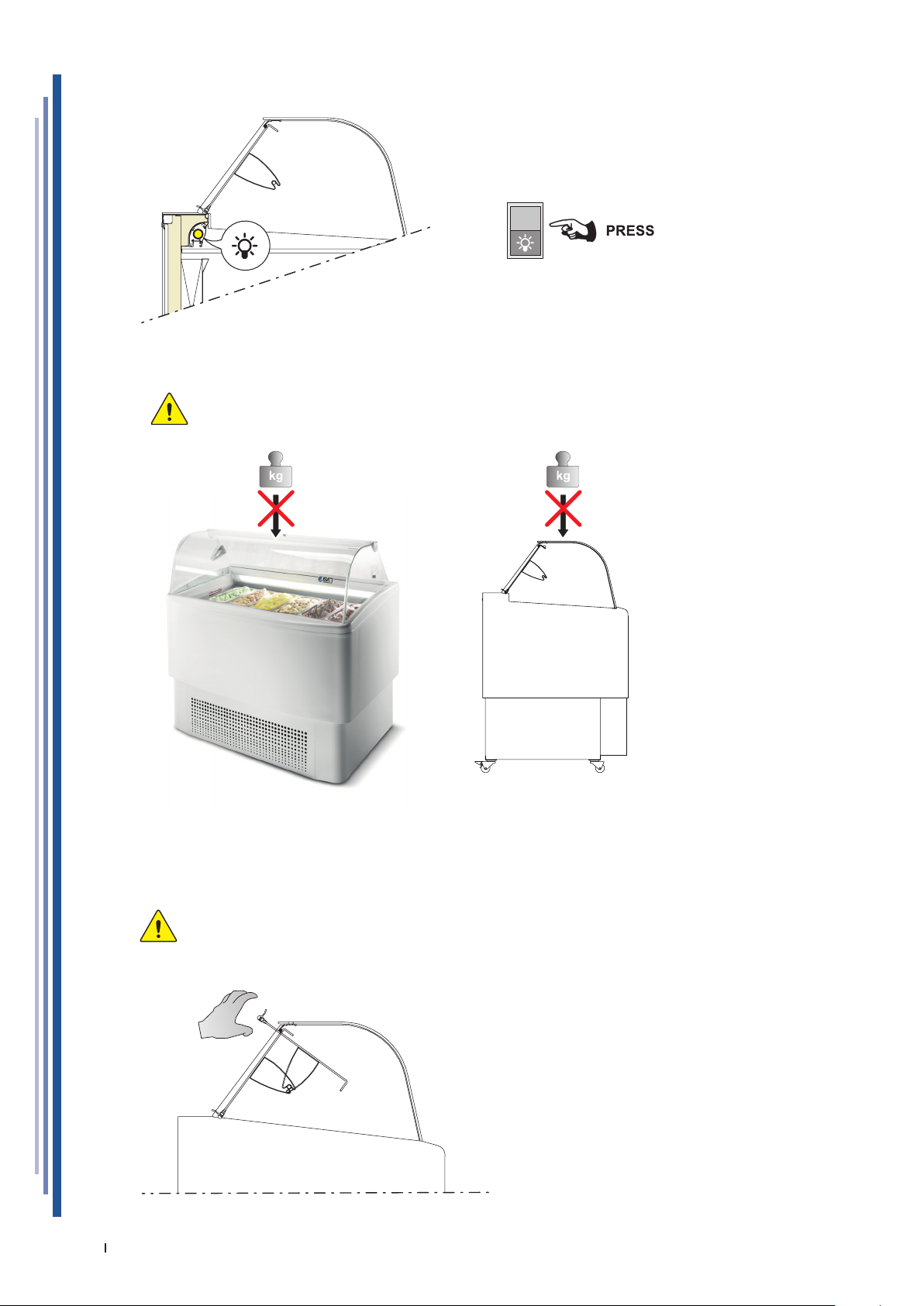
11.1 LIGHTING
11.2 WEIGHTS
ATTENTION
It is absolutely forbidden to position weights as indicated.
11.3 OPENING / CLOSING (OPERATOR SIDE)
TILT FLAP
ATTENTION
Ensure complete / correct closure; incomplete / incorrect closure negatively impacts on performance of the
appliance with possible excessive accumulation of ice on the internal walls.
428000377137 FIJI
EN
USE AND MAINTENANCE MANUAL
21
Page 22
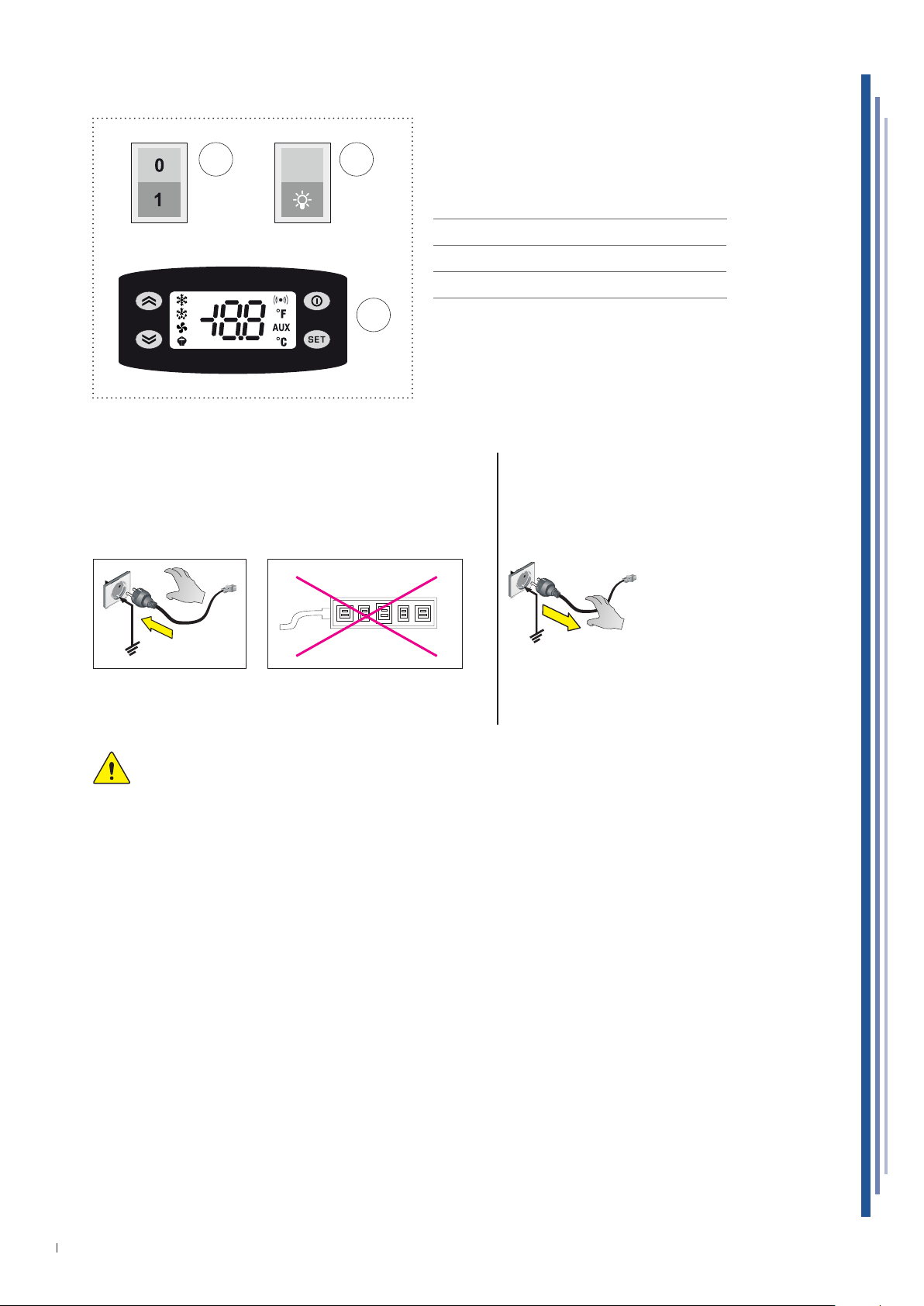
12. CONTROL PANEL
1
2
1 GENERAL SWITCH
2 LIGHTING SWITCH
3 ELECTRONIC CONTROL BOARD
3
START-UP (ON)
Activate the mains system master switch.
Plug the appliance in at the socket supplied by the customer,
ensuring that the plug is tted with an earth contact and that
there are no multiple sockets connected to it; the equipment
automatically starts.
NO
SWITCH OFF (OFF)
Press the main switch (1), otherwise manually
disconnect the power plug.
Press the main switch (1), the equipment starts working
automatically.
ATTENTION
The electronic control board is installed already programmed. Any changes to the control board
settings can be carried out exclusively by qualied technical personnel.
EN
428000377137 FIJI
USE AND MAINTENANCE MANUAL
22
Page 23
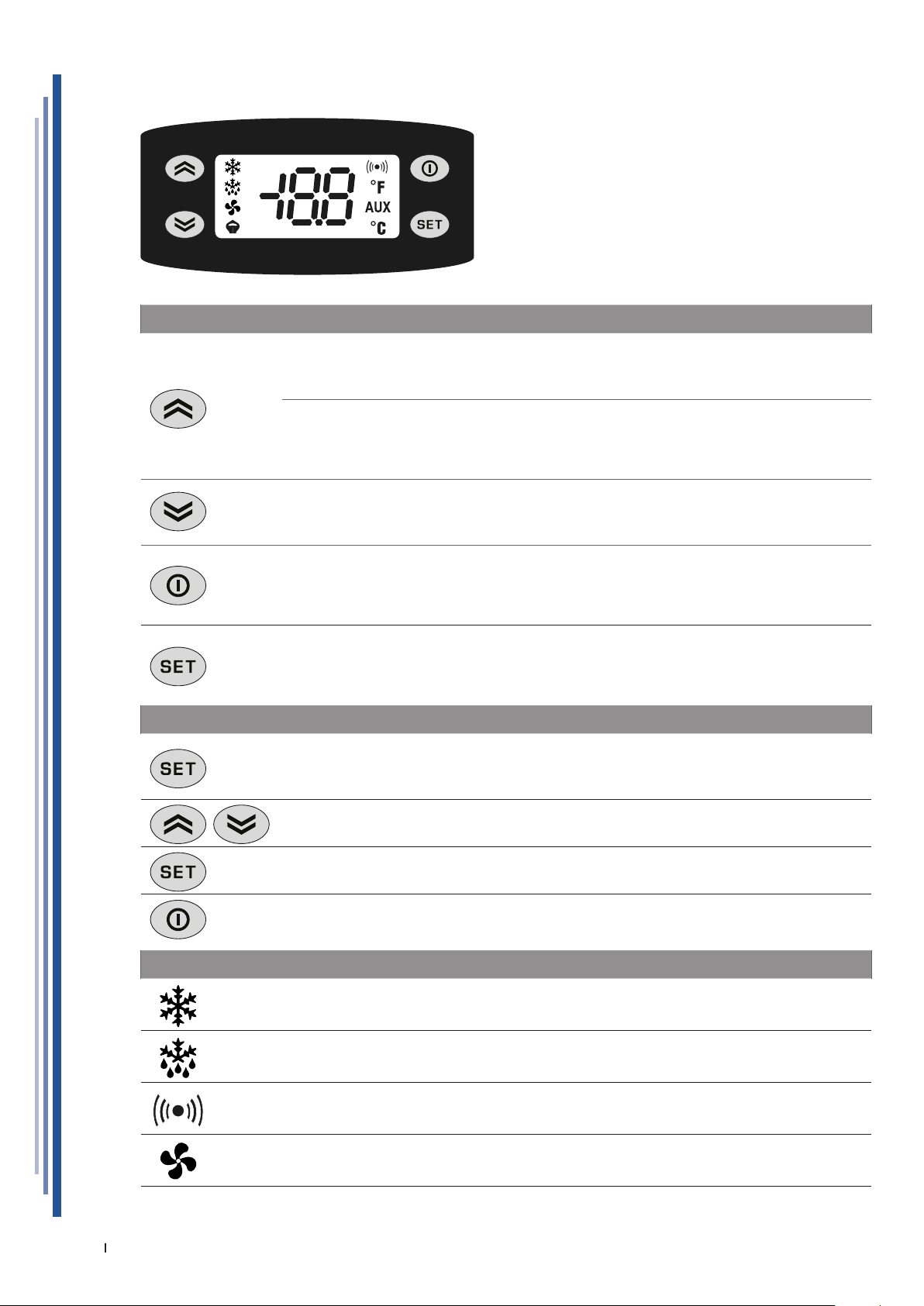
12.1 USER INTERFACE EW974
KEYS
UP
Scrolls menu options.
Increases the values.
Activates manual defrosting.
MANUAL ACTIVATION OF THE DEFROSTING CYCLE
To manually activate the defrosting cycle, press and hold the UP key for 5 seconds.
If the conditions for defrosting are not present (e.g. the temperature of the evaporator probe
is higher than the defrosting end temperature), the display will ash three (3) times to indicate
that the operation will not be carried out.
DOWN
Scrolls menu options.
Decreases the values.
SETTING SET POINT
LED
STAND-BY (ESC)
Goes back up one level with respect to current menu.
Conrms parameter value.
Activates the Stand-by function.
ON / OFF the equipment.
SET (ENTER)
Accesses the Set-point.
Accesses the programming menu.
Conrms the inputs.
Display alarms (if any).
Press the button and release immediately.
The “Set” label will appear.
To view the Set point value, press the SET (ENTER) button again.
The Set-point value will appear on the display.
To change the Set point value, press the UP and DOWN buttons within 15 seconds.
To conrm the new Set-point value set, press the SET (ENTER) key again.
By not operating on the keyboard for more than 15 seconds (time-out)or pressing the STANDBY (ESC) key once, the last value displayed is conrmed and you go back to the previous
display.
COMPRESSOR or RELAY 1
ON for compressor on.
Flashing for delay, protection or blocked activation.
DEFROSTING
ON for defrosting in progress.
Flashing for manual activation.
ALARM
ON for active alarm.
Flashing for silenced alarm.
EN
428000377137 FIJI
FANS
ON for operating fans.
USE AND MAINTENANCE MANUAL
23
Page 24
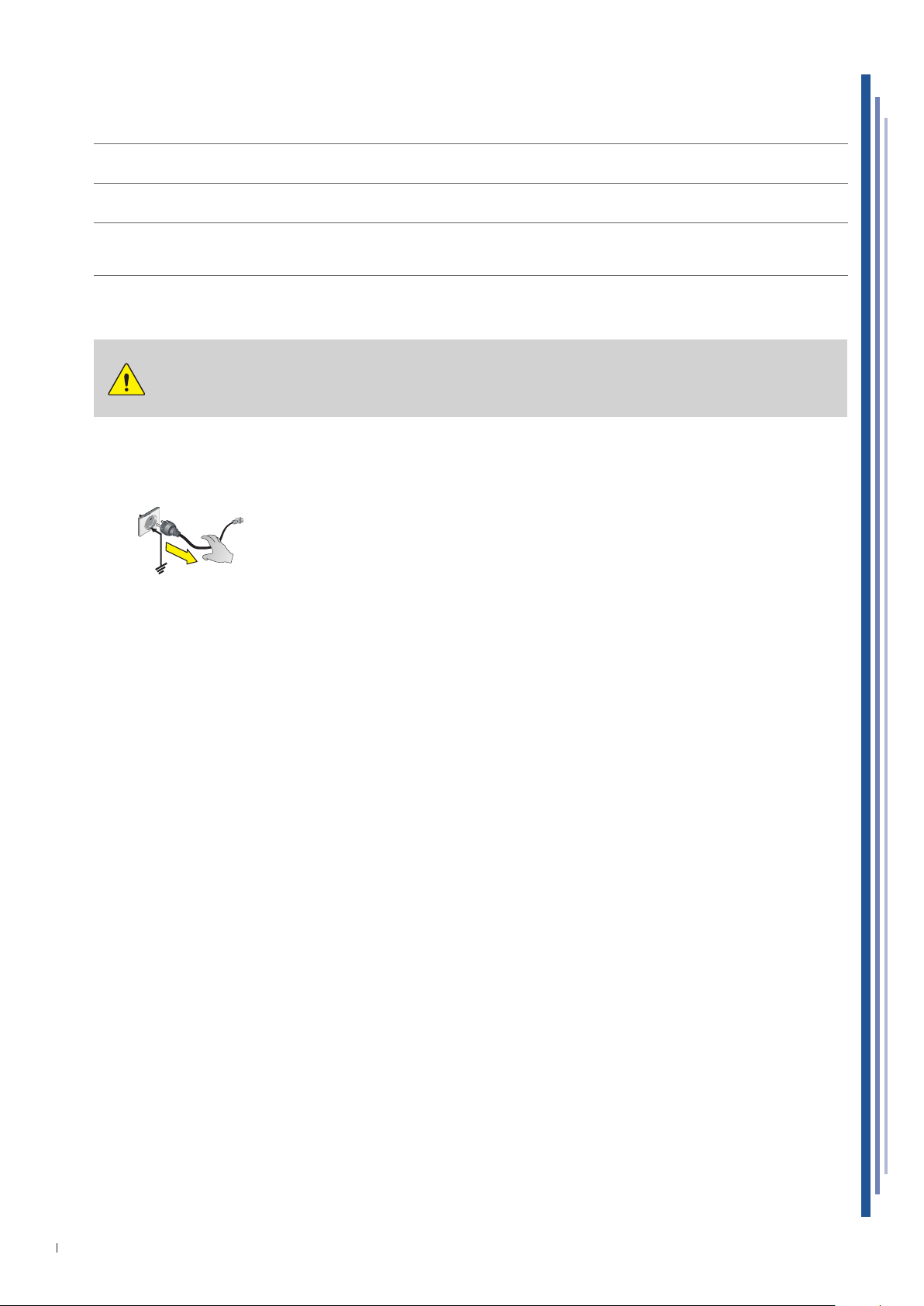
13. CLEANING
The materials listed below must be cleaned as follows:
STAINLESS STEEL Only use warm water and non-aggressive detergents and then rinse and dry
using a soft cloth.
ACRYLIC OR POLYCARBONATE Wash with lukewarm water, using a soft cloth or a chamois cloth.
Do not use abrasive cloths or sponges.
CURVED GLASS Only use products specically designed for cleaning glass.
We do not recommend using tap water, which may leave calcium deposits on the
surface of the glass.
13.1 INTERNAL
ATTENTION
Do not scrape ice from the walls with pointed tools, the surface could be damaged.
Do no use high pressure appliances (e.g. steam generators).
1. Remove the product contained in the refrigerated compartment and place it immediately in a suitable
refrigerated container to ensure proper storage.
2. Turn off the equipment.
3. Remove the manually removable accessories (e.g. Sliding, grills, ice cream containers, etc.).
4. Wait at least 4 to 6 hours, until the ice on the evaporator has melted completely, before proceeding with
cleaning operations. We suggest in this regard, you wait for the next day to make sure that the defrosting is
thoroughly completed. Do not use mechanical devices or other means to accelerate the defrosting process,
other than those recommended by the manufacturer.
5. Remove (if present) the drain plug at the bottom of the tank to drain the defrosted water. We recommend
attaching a rubber tube or other suitable material in order to aid water drainage.
6. Clean the side panels and the bottom of the tank using a mild detergent, warm water and a non-abrasive cloth
or sponge. Do not use sharp tools. Rinse thoroughly and dry with an absorbent cloth.
7. If the equipment was joined to a oor drain, slide lukewarm water containing a sanitising solution suited to
the specic application. In terms of quantity, the amount of solution used should be enough to remove any
product residues and disinfect the whole drainage channel.
8. If the equipment is not joined to a oor drain, follow the procedure referred to above. The rinse water collected
in the tank will be positioned inside the base of the apparatus. Proceed to also clean and disinfect the collection
t r ay.
9. Fit the accessories that were removed (step 3).
10. Turn on the equipment and allow to cool on the bench for at least 2 hours or until it reaches the desired
temperature before reintroducing foods.
EN
428000377137 FIJI
USE AND MAINTENANCE MANUAL
24
Page 25
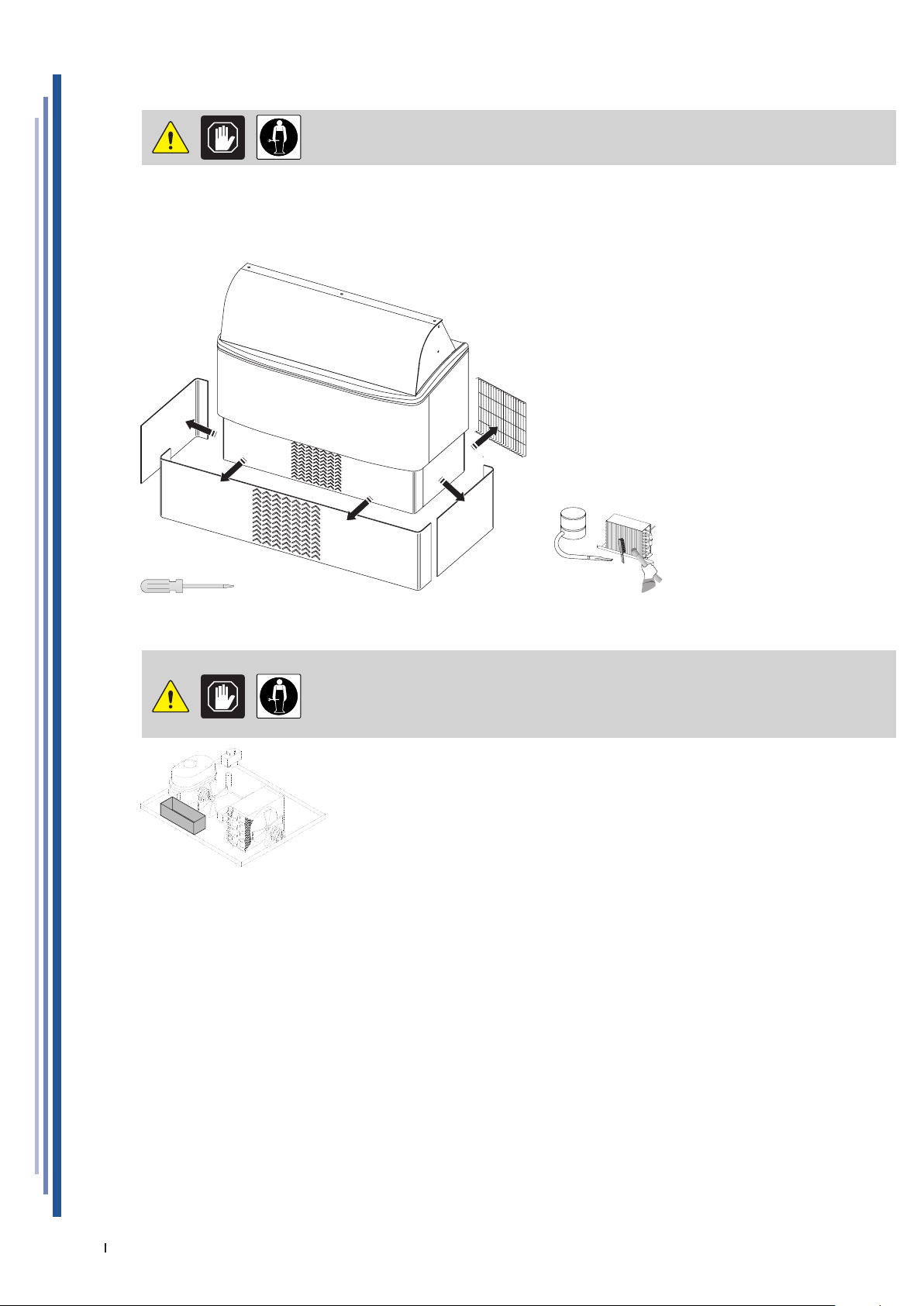
13.2 CONDENSING UNIT
Turn off the product, wait a few hours until the equipment of the condensing unit has
reached a temperature near to ambient temperature.
Remove the grilles as indicated.
Clean the condensing unit using a suction brush.Clean the condenser with a soft bristle brush; make sure you do not
bend the condensing unit springs whilst cleaning it.
13.2 DEFROST WATER COLLECTION TRAY (IF PRESENT)
Clean based on use and as needed and in certain environmental conditions (e.g., high
humidity, low environmental temperature, presence of dust, etc.) in order to avoid the
incorrect and complete evaporation of the water and/or the presence of unpleasant
odours.
Disinfect the tray with suitable products.
EN
428000377137 FIJI
USE AND MAINTENANCE MANUAL
25
Page 26
14. PROLONGED APPLIANCE SWITCH-OFF
• Remove the product contained in the refrigerated compartment and place it immediately in a suitable refrigerated
container to ensure proper storage.
• Open the equipment and wait for it to reach room temperature and then clean it.
• Leave the door/sliding panels open by 2-3 cm so as to guarantee circulation of the air and prevent the formation of
mould and bad smells inside the appliance.
• The equipment, whether equipped with its packaging or not, must be stored with care in the warehouse
or in an area protected from the elements, atmospheric agents and away from direct sunlight, at a temperature
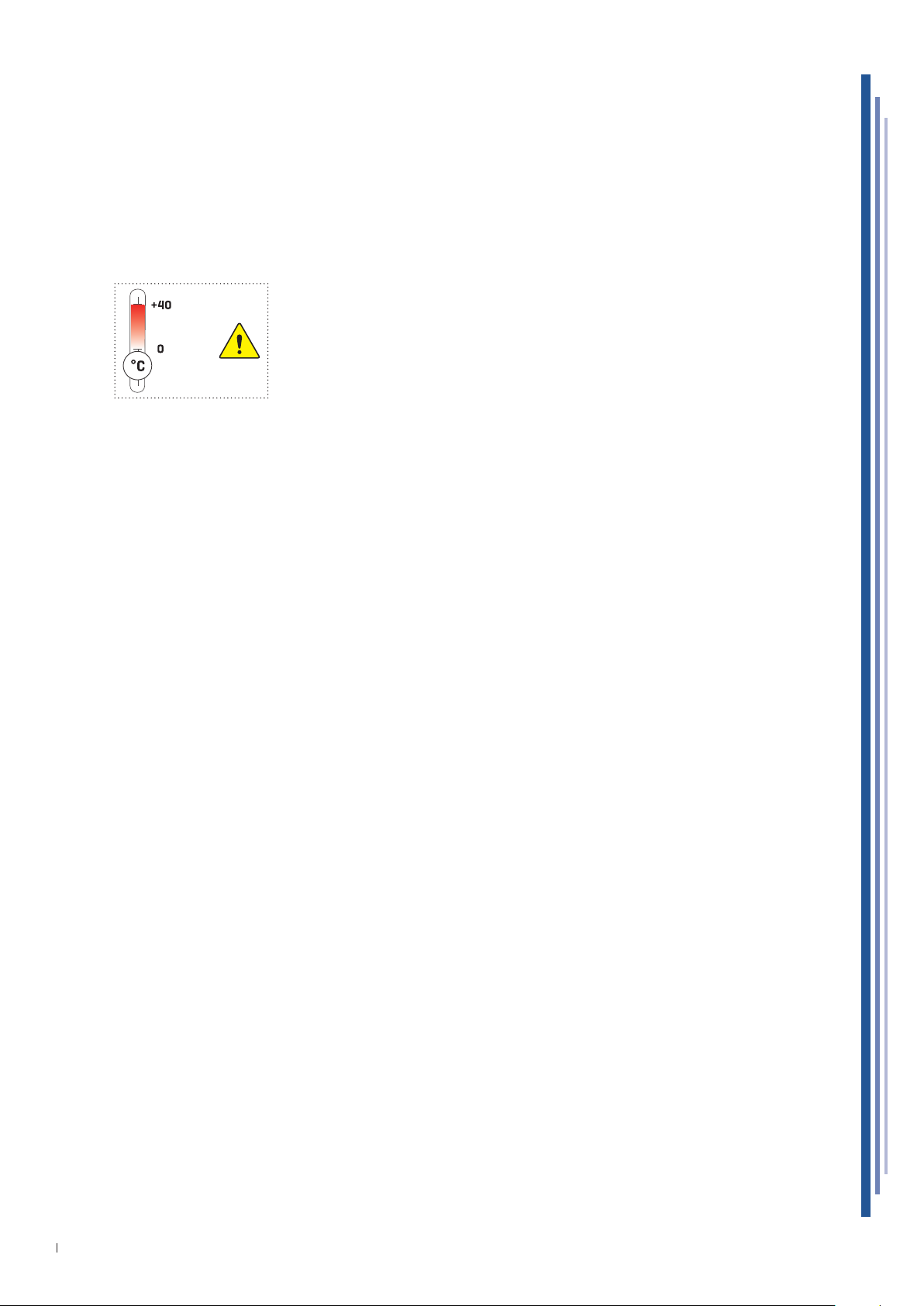
between 0 and +40 °C.
MAX
MIN
EN
428000377137 FIJI
USE AND MAINTENANCE MANUAL
26
Page 27
ATTACHMENT
1
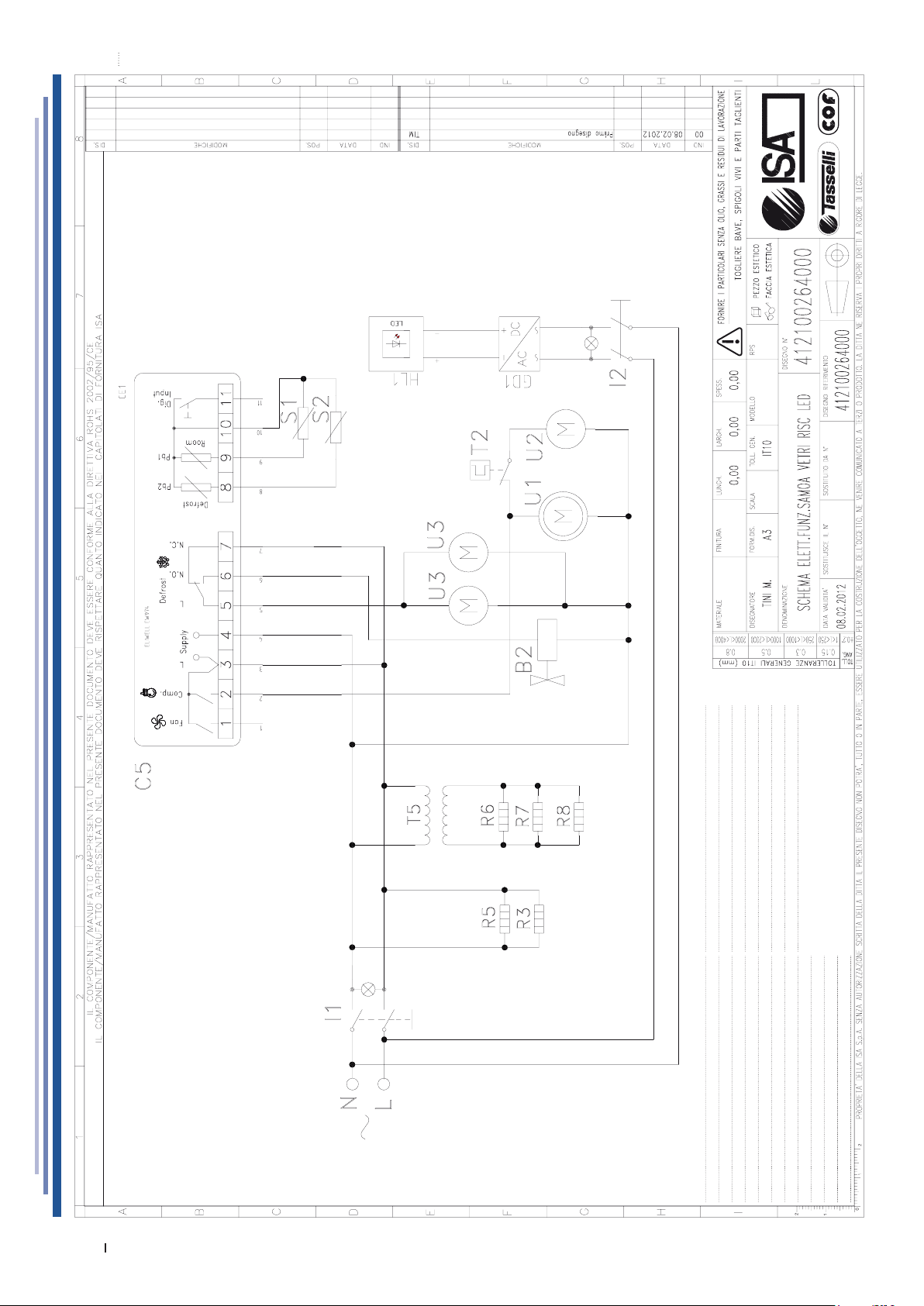
WIRING DIAGRAM - 412100264000
EN
428000377137 FIJI
USE AND MAINTENANCE MANUAL
27
S1 TEMPERATURE PROBE
S2 DEFROST PROBE
T2 THERMOSTAT
T5 TRANSFORMER
U1 COMPRESSOR
U2 CONDENSATION FAN
U3 EVAPORATOR FAN
DEFROST SOLENOID VALVE
B2
C5 ELECTRONIC CONTROL BOARD
I1 SHOWCASE SWITCH
I2 LIGHT SWITCH
GD1 FEEDER
HL1 LED
R3 PERIMETER TRIM HEATER
R5 FRONT TRIM HEATER
R6 RIGHT SIDE GLASS HEATING RESISTANCE
R7 FRONT SIDE HEATING RESISTANCE
R8 LEFT SIDE GLASS HEATING RESISTANCE
Page 28
ATTACHMENT
2
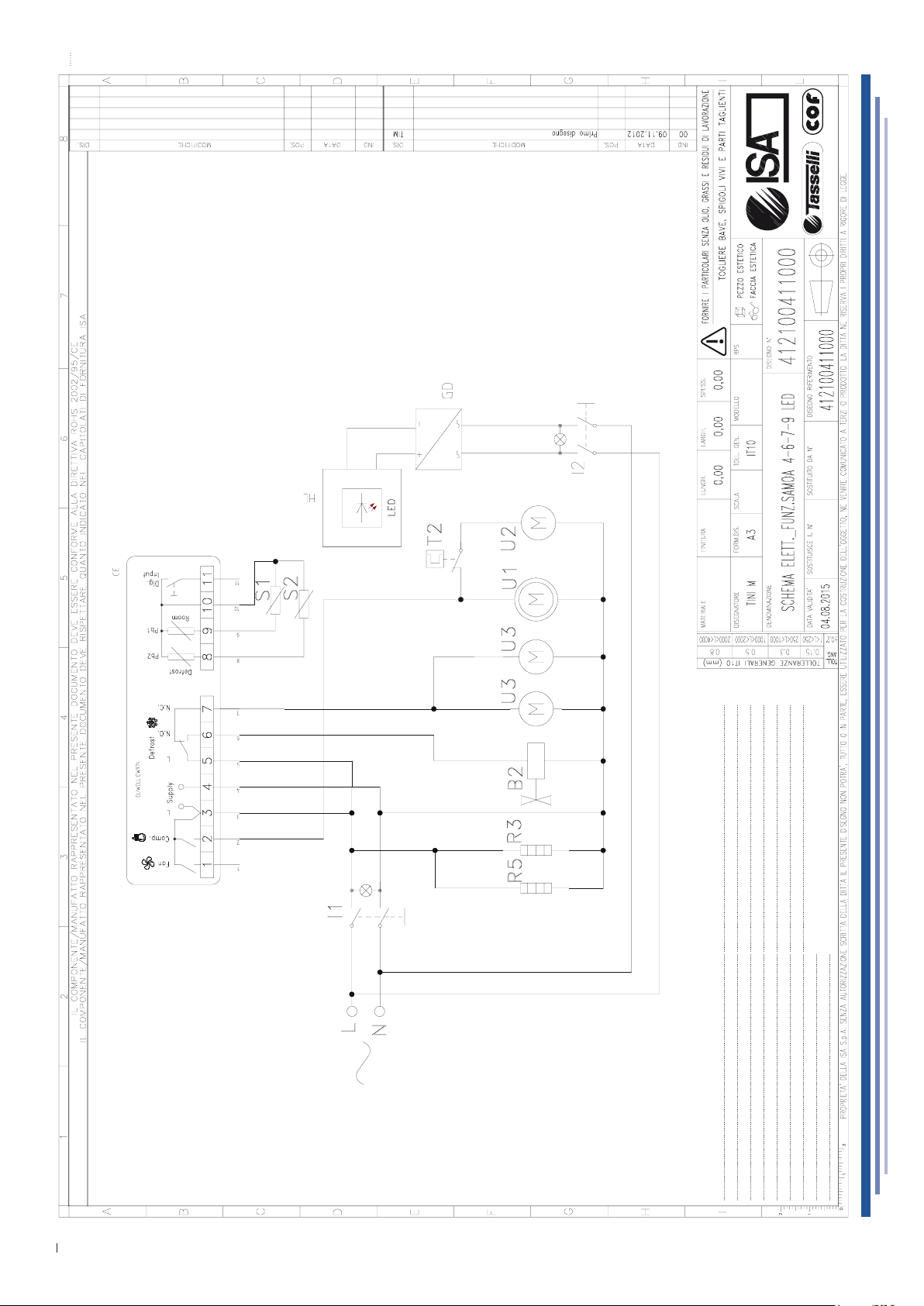
WIRING DIAGRAM - 412100411000
EN
428000377137 FIJI
USE AND MAINTENANCE MANUAL
28
S1 TEMPERATURE PROBE
S2 DEFROST PROBE
T2 THERMOSTAT
U1 COMPRESSOR
U2 CONDENSATION FAN
U3 EVAPORATOR FAN
DEFROST SOLENOID VALVE
B2
CE ELECTRONIC CONTROLLER
GD LED POWER SUPPLY
HL LED LIGHTING
I1 SHOWCASE SWITCH
I2 LIGHT SWITCH
R3 PERIMETER TRIM HEATER
R5 FRONT TRIM HEATER
Page 29
ATTACHMENT
3
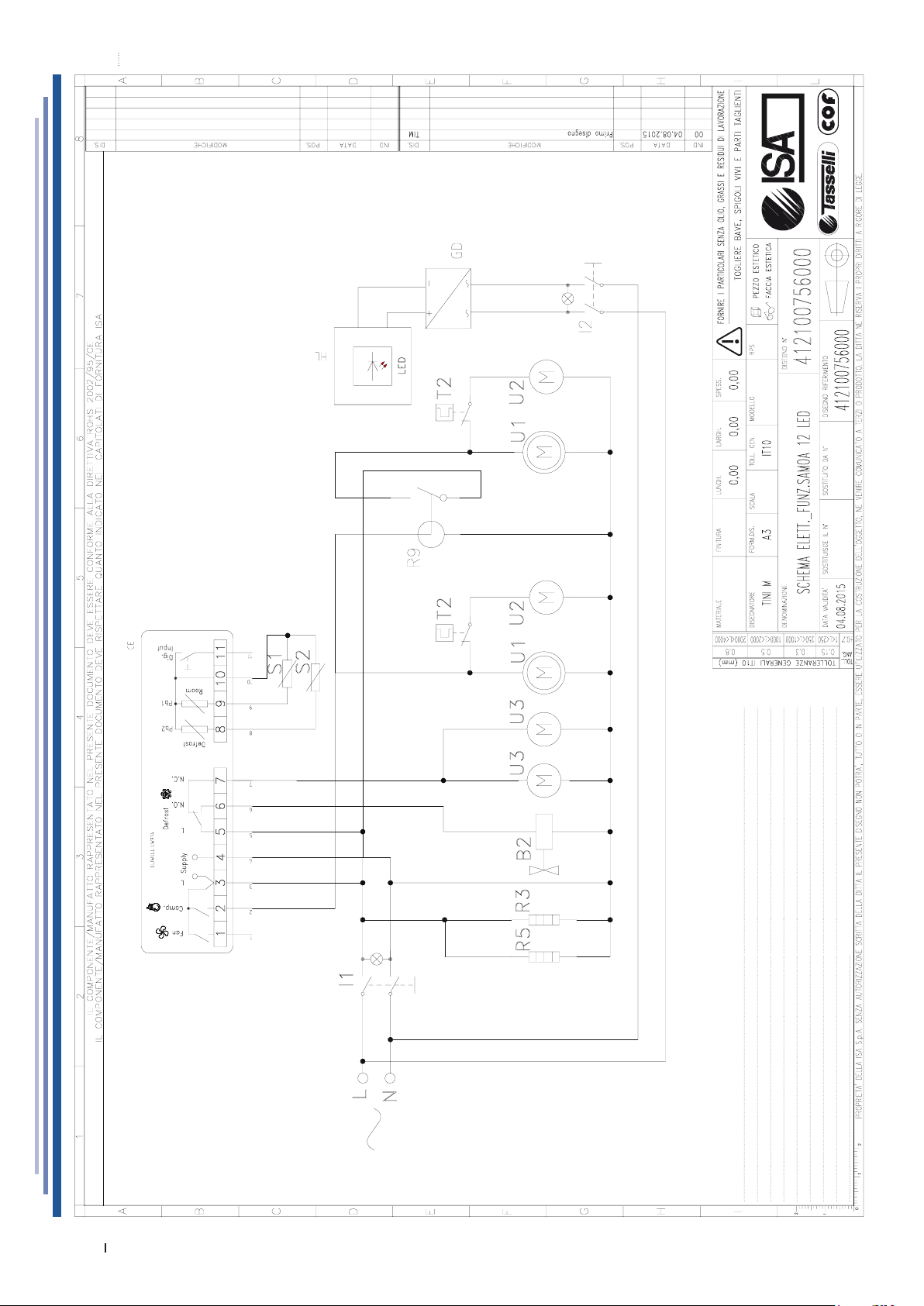
WIRING DIAGRAM - 412100756000
EN
428000377137 FIJI
USE AND MAINTENANCE MANUAL
29
R9 RETARDER
S1 TEMPERATURE PROBE
S2 DEFROST PROBE
T2 THERMOSTAT
U1 COMPRESSOR
U2 CONDENSATION FAN
U3 EVAPORATOR FAN
DEFROST SOLENOID VALVE
B2
CE ELECTRONIC CONTROLLER
GD LED POWER SUPPLY
HL LED LIGHTING
I1 SHOWCASE SWITCH
I2 LIGHT SWITCH
R3 PERIMETER TRIM HEATER
R5 FRONT TRIM HEATER
Page 30

 Loading...