

Page 1
F ridge-Freezer
MODEL:
TFP300W-U
TFP300BK-U
INSTRUCTION MANUAL
Page 2
1
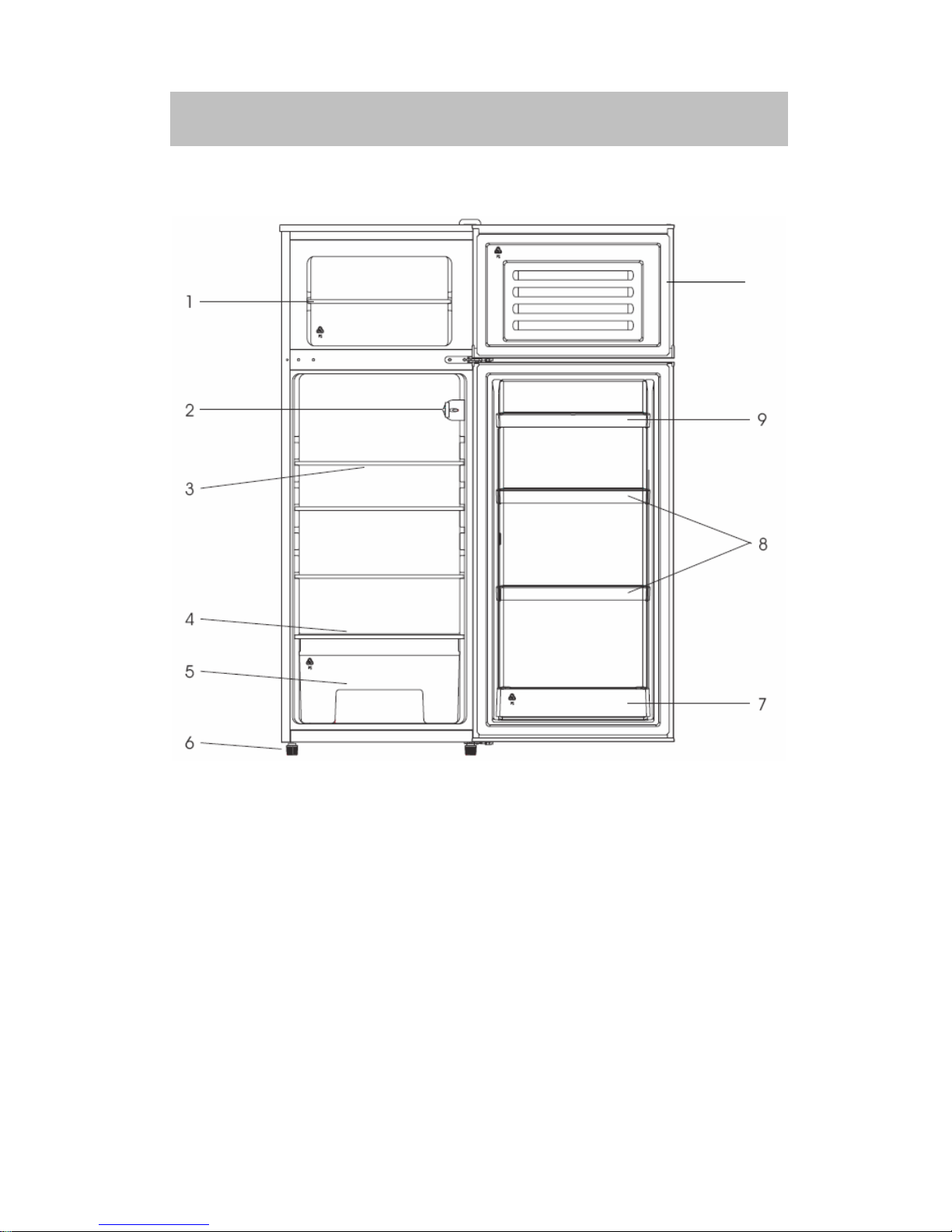
Structure Illustration
1. Glass Shelf(Freezer) 2. Thermostat and lamp assembly
3. Glass Shelf(Fridge) 4. Crisper Cover
5. Crisper 6. Leveling Foot
7. Lower Door Shelf 8. Middle Door Shelves
9. Upper Door Shelf 10. Freezer Door Gasket
10
Note: Compartment design may change due to product improvement, NO
prior notice will be given.
Page 3
THANK YOU FOR PURCHASING THIS TECNOLEC PRODUCT
This booklet contains the information you will require to install and operate your new
appliance.
It is important and worthwhile spending time to fully read this booklet so you will
understand how to operate the appliance safely and efficiently.
Please keep this booklet in a safe place so that you can refer to it when required.
ELECTRICAL CONNECTION (UK ONLY)
For your safety please read the following information.
Warning: This appliance must be earthed.
The appliance must be connected to a 240 volts 50 cycle AC supply by means of a three
pin socket, suitably earthed and should be protected by a 13 amp fuse in the plug.
The appliance is supplied with a standard 13 amp 3-pin plug fitted with a 13-amp fuse.
Should the fuse require replacement, it must be replaced with a fuse rated at 13 amp and
approved to BS1362.
If the mains plug is unsuitable for the socket outlet in your home or is removed for any
other reason, then the cut off plug should be disposed of safely, do not insert the cut off
plug into a mains outlet to prevent the hazard of electric shock. Remove the fuse before
disposal.
There is a danger of electric shock if the cut off plug is inserted into any 13-amp socket
outlet.
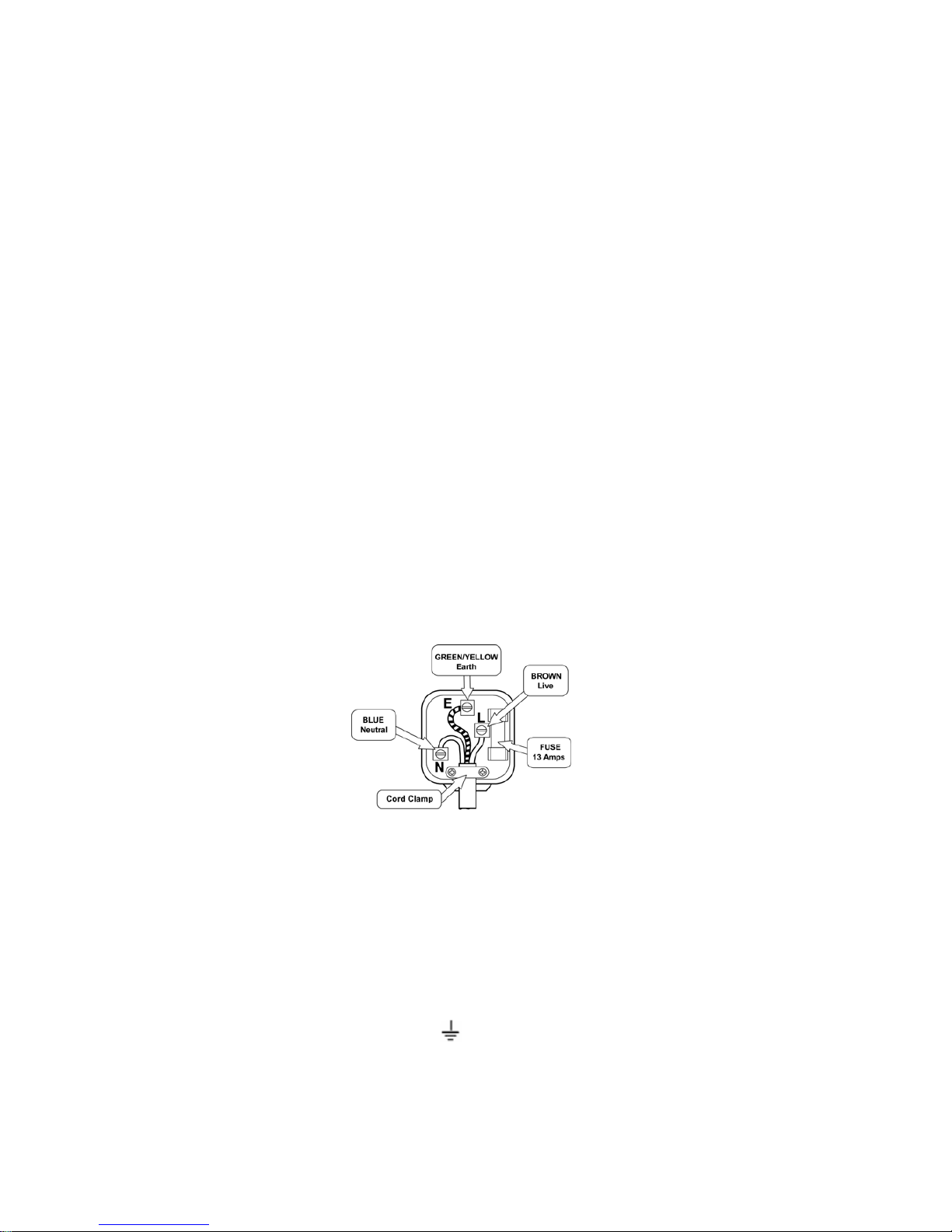
How to wire a 13 amp plug:
Important
The wires in the mains lead on this appliance are colored in accordance with the following
code:
Green and Yellow - Earth
Blue – Neutral
Brown – Live
As the colours may not correspond with the markings identifying the terminals in your plug
proceed as follows.
The green and yellow wire must be connected to the terminal in the plug which is marked
with the letter E or with the earth symbol or colored green and yellow.
The blue wire must be connected to the terminal marked N.
The brown wire must be connected to the terminal marked L.
You must make sure the mains cord is firmly secured under the cord clamp.
2
Page 4

3
REFRIGERATOR SAFETY INFORMATION
Check that the voltage marked on the rating plate matches that of your local supply.
Failure to use the correct voltage will render the guarantee VOID and may cause damage to
the appliance.
The manufacturer accepts NO responsibility for using any other voltage than that marked on
the rating plate.
This appliance is intended for domestic use only; any other use may invalidate the warranty
and might be dangerous.
This appliance is intended for indoor use only, do not use or store outdoors. This appliance
shall not be exposed to rain.
The mains plug shall be the main disconnect device and shall remain operable at all times.
A short power-supply cord is provided to reduce the risk of a tripping hazard.
To disconnect from the mains completely, turn the appliance OFF, then remove the plug from
wall outlet.
Do not immerse the appliance, its lead or plug in water or any other liquid.
Remove all food and unplug from the supply when not in use and before cleaning the
appliance.
If the mains lead becomes damaged, it must be replaced by the manufacturer, its service
agent or similarly qualified person with a specially prepared lead of the same type and rating
to avoid a hazard.
Do not operate the appliance with a damaged cord or plug or after the appliance malfunctions
or has been damaged in any way.
Do not let cord hang over edge of the surface, or touch hot surfaces.
Do not place the appliance on or near hot surfaces, or in direct sunlight.
Children must be supervised to make sure they do not swing on the door.
Accessible surfaces may get hot when in use, use handles and knobs at all times.
Always attach a plug to the appliance, and then plug it into the wall outlet and switch on.
If you are discarding an old appliance with a lock or catch fitted to the door , ensure that it is
left in a disabled condition to avoid the entrapment of young children when playing.
As old refrigeration ap pliances may contai n CFC’s whic h will dama ge the ozone layer, when
disposing of any refrigeration appliance please contact your local waste disposal department
for advice on the correct method of disposal.
This appliance is not intended for use by persons(including children) with reduced physical,
sensory or mental capabilities, or lack of experience and knowledge, unless they have been
given supervision or instruction concerning use of the appliance by a person responsible for
their safety.
Children should be supervised to ensure that they do not play with the appliance.
Page 5

4
This appliance is for refrigerating food and making ice cubes.
REFRIGERANT
The refrigerating gas contained in the circuit of this appliance is Isobutane (R600a); it causes
a low level of pollution but is inflammable.
CAUTION:
Extreme caution must be used when moving the appliance.
WARNINGS:
Do not damage the refrigerant circuit.
Do not use sharp or pointed objects such as knives to remove ice when defrosting.
Do not use mechanical devices or other means to accelerate the defrosting process,
other than those recommended by the manufacturer.
Do not use electrical appliances inside the food storage compartments of the
appliance, unless they are of the type recommended by the manufacturer.
If the appliance is installed in a carpeted area, do not let the carpet block the
ventilation holes in the base of the unit, adjust the levelling feet after a few hours to
compensate for carpet movement.
Keep ventilation openings, in the appliance enclosure or the built in structure clear of
obstructions.
Installation
Position the appliance and allow to stand for two to three hours before it is turned on
for the first time to allow the system to settle. Do not position next to any heat source
e.g. cooker, boiler or in direct sunlight etc.
A clearance of 10 cm must be left between the sides of the appliance and any adjacent
cabinets or walls to allow for adequate air circulation. The appliance is not designed for
recessed installation (“building in”).
Install on a good firm level surface, and any unevenness of the floor should be
corrected prior to installation, slight unevenness can be overcome by adjusting the
front feet.
Do not keep your appliance in a room where the temperature is likely to fall below 16
degrees C (61 degrees F) at night and/or especially in winter, as it is designed to
operate in ambient temperatures between +16 and +32 degrees C (61 and 90 degrees
F). At lower temperatures the appliance may not operate, resulting in a reduction in
the storage life of the food.
Do not place the appliance near cookers or radiators or in direct sunlight, as this will cause
extra strain on the appliance’s functions.
If installed next to a source of heat such as a fridge, maintain the following minimum
clearances.
Choose a well-ventilated location with no less than 10cm clearance around the refrigerator.
Place the refrigerator in a location with a firm base in order to prevent vibration and excessive
noise.
Level the refrigerator by adjusting the two front feet.
Page 6

Instructions for use
Remove all packing materials and wash the interior of the appliance using
lukewarm water containing a little bicarbonate of soda in the proportion of 1
teaspoon to 1.2 liters (2 pints) of water. Do not use detergents or soaps as they
may taint the food. After cleaning, dry all parts thoroughly.
Temperature Control
The refrigerator is designed to maintain an internal storage temperature in the
refrigerator compartment between 0℃ to +8℃.
To enable adjustment of the temperature in the appliance it is fitted with an
adjustable thermostat located in the fridge compartment, which can be adjusted
from setting 1 (warmest) to 7 (coldest). For normal working temperature it is
recommended to adjust the thermostat control to the position 5.0, after a few
hours readjust the thermostat to the desired temperature. There is also an off
position “0”, which turns OFF the refrigerator and freezer compartments. Please
Note this dose not disconnect the appliance from the mains supply. To do this
you must remove the mains plug from the socket.
To obtain a lower internal temperature turn the thermostat temperature control
to a higher number. To obtain a higher internal temperature turn the thermostat
control to a lower number. However, the internal temperature and temperature
control setting is dependent on a number of factors:
1. Varying ambient temperatures.
2. The number of times the appliance doors are opened and how long the doors
remain open.
3. The amount and temperature of the food and drink introduced into the
appliance.
4. The weather conditions and time of year e.g. summer / winter.
5. The positioning of the appliance and an adequate air circulation to the sides
and back of the cabinet.
Never place hot or warm foods into the cabinet or leave the doors open for
longer than necessary as this will raise the temperature and cause excessive
amount of moisture thus increasing the amount of ice in the refrigerator / freezer
compartments.
The Internal Light
The internal light will automatically switch ON and OFF whenever the
refrigerator door is opened or closed. To change the light bulb, please see the
chapter on changing the light bulb.
5
Page 7

6
Storage of fresh food in the refrigerator
Food should always be covered tightly with foil, plastic film, placed in bags or
stored in airtight containers. This will prevent food from dehydrating and prevent
the strong smell of some foods transferring to milder ones.
To store raw meat wrap in polythene bags or airtight containers and place on
the lowest shelf.
Do not allow raw meat to come into contact with cooked foods. For safety, only
store raw meat for two or three days. Fruit and vegetables should be thoroughly
cleaned and placed in the crisper drawer.
Milk and other liquids should be sealed with lids and placed in the bottle shelf
on the door.
Store frozen food
When using the freezer for the first time or after defrosting, turn the thermostat
temperature control to setting 7 for at least two hours before introducing the
food to be stored, then adjust to your preferred setting.
All frozen food products you purchase should be placed in the freezer as soon
as possible to avoid the frozen food from defrosting.
Storage recommendations printed on the packaging of frozen food by the
manufactures should always be followed.
Freezing fresh food (Freezer)
Ensure that your freezing operations are carried out under the most hygienic
conditions, as freezing alone does not sterilise the food. Never put hot or even
warm foodstuffs into the freezer. Prior to storing the food, pack it in plastic bags,
aluminum foil or freezer containers and place into the freezer without putting
them in contact with food that has already been frozen.
See the technical data sheet at the rear of this booklet for the maximum
permissible amount in kilograms of fresh food that can be frozen in any 24-hour
period with a room temperature of 25℃. Never freeze more than the maximum
permissible for a given 24 hours period(3.5kg in 24 hours).
Making ice cubes
Pour water into the ice cube tray until it is two thirds full and place into the
freezer. Ice cubes will form in approximately 2 to 3 hours. The ice cubes can be
easily removed by twisting the ice cube tray or running under cold water for a
short time.
Page 8

7
Refrigerator defrost process
The refrigerator defrosting process is carried out automatically every time the
compressor stops.
The defrost water drains from the cabinet into a tray placed on the top of the
compressor to the rear of the unit where it evaporates.
Freezer defrost process
Small amounts of frost will accumulate inside the freezer depending upon the
length of time during which the door is left open or the amount of moisture
introduced.
It is essential to ensure that no frost or ice is allowed to form at places where it
will affect the close fitting of the door seal. This might allow air to penetrate the
cabinet, thus encouraging continuous running of the compressor.
Thin frost formation is quite soft and can be removed with a brush or plastic
scraper. Do not use metal or sharp scrapers, mechanical devices or other
means to accelerate the defrosting process. Remove all dislodged frost from the
cabinet floor.
For the removal of thin frost it is not necessary to switch off the appliance.
For the removal of heavy ice deposits disconnect the appliance from the mains
supply and empty the contents into cardboard boxes and wrap in thick blankets
or layers of paper to keep them cold. Defrosting will be most effective if carried
out when the freezer is empty, and it should be carried out as quickly as
possible.
An increase in temperature of frozen food packages during defrosting will
shorten the storage life. Provided that the contents are well wrapped and placed
in a cool area, they should keep for several hours.
Examine the contents when replacing them in the freezer and if some of the
packages have thawed out it should be eaten within 24hours or be cooked and
refrozen.
After defrosting has finished clean the inside with a solution of warm water with
a little bicarbonate of soda and then dry thoroughly. Wash all removable parts in
the same way and reassemble.
Reconnect the appliance to the mains supply and leave for 2 to 3 hours on
setting number 7 before introducing the food back into the freezer and setting
the thermostat to your normal setting.
Page 9

8
Reversing The Doors
Before you reverse the refrigerator doors, you should ensure the refrigerator is unplugged
and empty. Certain sections of this process may require two people to complete it.
Remove the top
cover(1) and the
upper hinge (2).
1
2
1
Lift the door
upwards to
disengage it from
the middle hinge.
Put the door to one
side and lay it down
gently on a padded
surface.
Using a screwdriver,
dismantle the middle
hinge. Lift the lower
door upwards to
disengage it from
the lower hinge.
Put the door to one
side and lay it down
gently on a padded
surface.
Tilt the refrigerator
backwards and rest
it on a firm surface.
Remove the lower
hinge. Re-fit the
adjustable foot from
left side to right side.
Remove the lower
hinge pin. Turn the
hinge plate over and
replace the hinge pin
in the same
hole(reversed).
Replace the lower
hinge on the other
side and then stand
the refrigerator
upright
Remove the door
stopper assemblies
which are in the
bottom of the fridge
and freezer door. At
the other side of the
fridge and freezer
door, insert the
replaced door
stopper assemblies
which are supplied
with the appliance.
Place the fridge door
on the lower hinge,
making sure that the
hinge pin is inserted
in the hole at the
bottom of the fridge
door.
Put the middle hinge
back on the cabinet,
making sure that it is
on the opposite side
from its original
position.
2
4
5
6
1
3
5
Page 10

9
Place the freezer
door on the middle
hinge, making sure
that the hinge pin is
inserted in the hole
at the bottom of the
freezer door.
Remove the hinge
pin from upper
hinge. Turn the
hinge plate over and
replace it in the
same
hole(reversed).
Re-fit the upper
hinge. Do not fully
tighten the screws
Check that doors are
aligned horizontally
and vertically and
that all seals make
good contact with
the cavity all the way
around the cavity
opening before
finally tightening the
hinges. Re-fit the
plastic insert on the
top cover from left
side to right side
before re-fitting the
top cover. Re-adjust
the leveling feet, if
necessary.
8
2
1
7
Energy Saving Tips
1.The refrigerator should be placed as far as possible away from the heat source and it is
better to place it in shady and cool and ventilated environment.
2. Do not put the hot food into refrigerator directly until it reaches room temperature.
3. Do not put too much food in refrigerator. There should be some space between food
and the inner wall of refrigerator.
4. It is better to transfer the frozen food into fridge compartment in a planned way before
eating.
5. Do not open the door frequently.
6. Due to lower ambient temperatures at night, it is better to arrange to make ice or cool
drink at night.
7. Fruit and vegetables and other foods which are with high moisture content, should be
wrapped by plastic bags and then put them into the vegetable crisper.
8.Keep the appliance door gasket sealing well and the appliance ventilation openings(if
any) free.
9.If frost layer became too thick, it would affect the refrigeration effect. When the thickness
of the frost layer is more than 3mm, the appliance must be defrosted in time.
10. The pre-set combination of drawers, baskets and shelves has already been set in the
most efficient use of this product.
Page 11

10
Cleaning and maintenance
Before any cleaning or maintenance is carried out you must disconnect the
appliance from the mains supply by removing the plug, never remove the plug
by pulling on the mains cord. Remove the plug by pulling on the plug itself.
It is recommended that when cleaning the appliance, both the inside and
outside, can be cleaned using warm water and a little bicarbonate of soda. Use
1 teaspoon to 1.2 litres of water.
If the appliance is not to be used for a long period of time then it is
recommended to remove all the food stuff, clean the inside of the appliance and
leave the door open to allow the air to circulate thus avoiding unpleasant odors.
Changing the light bulb
Note. Light bulbs are not covered by the warranty
Disconnect the appliance from the mains supply.
Remove the screw for the lamp cover. Pull the lamp cover outside, to gain
accesses to the lamp. Unscrew the light bulb in an anti-clockwise direction from
the holder.
Replace the bulb with one of the correct type and size (10 Watt E14 base).
Replace the cover by Pushing the cover inside and the screw for the cover.
Reconnect the appliance to the mains supply.
Power Failure
If there is a power failure for a short time less than 12 hrs keep the door closed
Frozen food should not be affected if the failure lasts for less than 12 hrs.
Extra protection can be given by covering the appliance with two or three thick
blankets.
If a long power failure is anticipated, try to get the foodstuff into another
appliance or cold store, if possible.
If the power cut is longer than 12 hrs then check the content of the freezer.
If the food has defrosted, cook and refreeze the food or it should be eaten
immediately.
Never refreeze food that has been defrosted.
Page 12

11
If the appliance is not operating correctly:
Please check the following points.
Is there a power failure? (Check by turning on a house light)
Has the fuse blown or has the circuit breaker tripped?
Has the door been closed correctly?
Check the thermostat has been set correctly.
Check the mains plug is seated in the wall socket correctly and the socket switch is on.
Check the power outlet is working, Try another appliance.
Is the room temperature too cold or too hot? ( working temperature range 16℃ to 32℃ )
Prolonged off periods
If the refrigerator is not in use for a long period of time, proceed as follows:
Disconnect the refrigerator from the main supply by removing the plug from the socket.
Clean and dry the inside as instructed under the heading of cleaning and maintenance.
Leave the door open to prevent any unpleasant smells from building up while the
appliance is not in use.
If there is a power failure for a short time keep the door closed check the contents of
the refrigerator every so often.
Before calling for service
Please check the following points:
1. The refrigerator is not working
Check the plug is inserted correctly into the wall socket
Check there is power to the wall socket by plugging in another appliance, if the other
appliance works, check the fuse in the appliance plug.
2. The refrigerator is noisy when running
Check the appliance is level and is not in contact with another appliance or kitchen
furniture.
3. The refrigerator does not cool sufficiently.
If the door has been opened too often, or it has been left open for a while it will take
time for the appliance to reach its set temperature.
Check the air flow around the refrigerator has not been reduced due to insufficient
clearance.
NOTE: The following characteristics should not be looked upon as a problem.
A gentle trickling sound caused by refrigerant flowing through the pipe.
Compressor operating at high temperature.
Page 13

12
Do's and Don'ts
Do- keep raw meat and poultry below cooked food and dairy products.
Do- Leave lettuce, cabbage, parsley and cauliflower on the stem.
Do- Wrap cheese firstly in greaseproof paper and then in a polythene bag, excluding As
much air as possible. For best results, take out of the fridge compartment an hour before
eating.
Do- Wrap raw meat and poultry loosely in polythene or aluminium foil. This prevents
drying.
Do- Wrap fish and offal in polythene bags.
Do- Wrap food with a strong odour or which may dry out, in polythene bags, or aluminium
foil or place in airtight container.
Do- Wrap bread well to keep it fresh.
Do- Chill white wines, beer, larger and mineral water before serving.
Do- Check contents of the low temp compartment every so often.
Do- Keep food for as short a time as possible and adhere to "Best before" and "Use by"
etc. dates.
Do- Store commercially prepared food in accordance with the instructions given on the
packets.
Do- Always choose high quality fresh food and be sure it is thoroughly clean before
Storing it.
Do- Wrap all food in aluminium foil or food quality polythene bags and make sure any
air is excluded.
Do-Keep ventilation openings, in the appliance enclosure clear of obstruction.
Do-ensure that frozen food does not rise in temperature while defrosting, a rise in
temperature during defrosting may shorten the storage life of your food.
Don't- Cover the shelves with any protective materials which may obstruct air circulation.
Don't- Store poisonous or any dangerous substances in your fridge. It has been designed
for the storage of edible foodstuffs only.
Don't- Consume food which has been refrigerated for an excessive length of time.
Don't- Store cooked and fresh food together in the same container. They should be
packaged and stored separately.
Don't- Let defrosting food or food juices drip onto already stored food.
Don't- leave the door open for long periods, as this will make the appliance more costly
to run and cause excessive ice formation.
Don't- Use sharp edged objects such as knives or forks to remove the ice.
Don't- Use hairdryers, or electrical appliances for defrosting only use item recommended
by the manufacturer.
Don't- put hot food into the appliance. Let it cool down first.
Don't- put liquid-filled bottles or sealed cans containing carbonated liquids into the freezer
section, as they may burst.
Don't- Give children ice cream and water ices direct from the freezer section. The low
temperature may cause 'freezer burns' on the lips.
Don't- Try to keep frozen food which has thawed; it should be eaten within 24 hours or
cooked and refrozen.
Don't- Damage the refrigerant circuit at any time.
Page 14

Technical data
Brand Tecnolec
Appliance type Fridge-Freezer
Star rating
Total gross volume 308L
Total storage volume 298L
Freezer storage volume 75L
Freezing capacity 3.5kg/24h
Maximum rated wattage of lamp 10W
Rated power input 115W
Rated current 0.89A
Climate Class + Ambient Range
N (+16℃ to +32℃)
Energy class (1) A
Energy consumption (kWh/year) (2) 328
Supply voltage 220-240V~, 50Hz
Noise [dB(A) re 1pW] <42
Refrigerant/Amount R600a/102g
Product dimensions(W×D×H) 595×590×1745mm
Insulation blowing gas Cyclopentane
Net weight 57kg
(1) Energy class: A…..G (A=economical…G=less economical)
(2) The real energy consumption depends on using conditions and appliance
location.
13
mm
492mm
595mm
1135mm
515 m m
1130mm
Page 15

IMPORTANT DISPOSAL INSTRUCTIONS
As a responsible retailer we care about the environment.
As such we urge you to follow the correct disposal procedure for your
product and packaging materials. This will help conserve natural
recourses and ensure that it is recycled in a manner that protects
health and the environment.
You must dispose of this product and its packaging according to local
laws and regulations.
Because this product contains electronic components, the product and its accessories
must be disposed of separately from household waste when the product reaches its end of
life.
Contact your local authority to learn about disposal and recycling.
The product should be taken to your local collection point for recycling. Some collection
points accept products free of charge.
If something doesn't seem to work
If there is something about your appliance which you do not understand and you live in the
UK, you can phone our help line during normal office hours on: 0844 8009595
Calls are charged at standard rates.
We apologise for any inconvenience caused by minor inconsistencies in these instructions,
which may occur as a result of product improvement and development.
Kesa Electricals UK, HU1 3AU 14 /09/ 2010
14
 Loading...