

Page 1
ManuaManua
Manua
ManuaManua
Manuel de l'utilisateurManuel de l'utilisateur
Manuel de l'utilisateur
Manuel de l'utilisateurManuel de l'utilisateur
BB
B
BB
GebruikershandleidingGebruikershandleiding
Gebruikershandleiding
GebruikershandleidingGebruikershandleiding
Manual para el usuarioManual para el usuario
Manual para el usuario
Manual para el usuarioManual para el usuario
le pele pe
le pe
le pele pe
User's manualUser's manual
User's manual
User's manualUser's manual
enutzenutz
enutz
enutzenutz
Guia do usuárioGuia do usuário
Guia do usuário
Guia do usuárioGuia do usuário
ee
rr
handhand
e
r
hand
ee
rr
handhand
r l’r l’
r l’
r l’r l’
utut
ut
utut
entent
ent
entent
bucbuc
buc
bucbuc
hh
h
hh
ee
e
ee
Page 2
Technogym®, The Wellness Company™ and Multipla™ (figurative) are trademarks
owned by Technogym® s.p.a. in Italy and other countries.
Copyright © Technogym® s.p.a., March 2004
Technogym® reserves the right to modify the products and documentation without
prior notice.
Le denomi nazioni Technogym®, The Wellness Company™ e Multipla™ (figurativo)
sono marchi di proprietà Technogym® s.p.a. in Italia e altri Paesi.
Copyright © Technogym® s.p.a., marzo 2004
Technogym® si riserva il diritto di modifiche ai prodotti e alla documentazione
senza obbligo di preavviso.
Les appellations Technogym®, The Wellness Company™ et Multipla™ (figurative)
sont de s marque s appar tenant à Technogy m® s.p.a. en Italie et dans d’au tres pays.
Copyright © Technogym® s.p.a., mars 2004
Technogym® se réserve le droit de modifier ses produits et leur documentation
sans aucune obligation de préavis.
Die Bezeichnungen Technogym®, The Wellness Company™ und Multipla™
(bildmarke) sind eingetragene Warenzeichen von Technogym® s.p.a. in Italien
und anderen Ländern.
Copyright © Technogym® s.p.a., März 2004
Technogym® behält sich das Recht vor, ohne Vorankündigung Änderungen an den
Produkten und der Dokumentation vorzunehmen.
Las denominaciones Technogym®, The Wellness Company™ y Multipla™
(figurativa) son marcas de propiedad de Technogym® s.p.a. , tanto en Italia como
en otros Países.
Copyright © Technogym® s.p.a., marzo de 2004
Technogym® se reserva el derecho a modificar los productos y la documentación,
sin obligación de advertirlo previamente.
Page 3
User’s manual. ............................................... 5
Manuale per l’utente...................................... 63
Manuel de l’utilisateur. ................................. 121
Benutzerhandbuch. ....................................... 179
Manual para el usuario. ................................ 237
Page 4

Page 5
User’s manual
Contents
Introduction ...................................................................................................7
Important safety instruction ........................................................................8
Personal safety..............................................................................................9
1 Technical information ...................................................................... 10
1.1 Identification of manufacturer and equipment .................................. 10
1.2 Description of equipment ........................................................................11
1.2.1 Technical data ............................................................................................11
1.2.2 Principal components .............................................................................. 12
1.2.3 Accessories ................................................................................................14
1.3 Installation and packaging ......................................................................19
1.3.1 Description of packaging .........................................................................19
1.3.2 Lifting and handling the packed equipment ........................................19
1.3.3 Place of installation .................................................................................. 20
1.3.4 Unpacking ................................................................................................. 20
1.3.5 Assembly ................................................................................................... 21
1.4 Maintenance ............................................................................................. 22
1.4.1 Routine maintenance .............................................................................. 22
1.4.2 Technical support .....................................................................................23
1.5 Storage ........................................................................................................24
1.6 Disposal ...................................................................................................... 24
Contents
5
Page 6
2 Using the Multipla ........................................................................... 25
2.1 Exercises .................................................................................................... 25
Triceps extension ......................................................................................25
Chest press ............................................................................................... 26
Incline chest press ...................................................................................27
Shoulder press ......................................................................................... 28
Up/right row ...............................................................................................29
Rowing ....................................................................................................... 30
Lat pull down ............................................................................................. 31
Mid lat pull down ....................................................................................... 32
Lat pull down reverse...............................................................................33
Leg extensions ......................................................................................... 34
Standing leg curl........................................................................................35
Standing calf ............................................................................................. 36
Squat........................................................................................................... 37
Short dead lift ........................................................................................... 38
Pectoral fly ................................................................................................. 39
Incline bench fly ...................................................................................... 40
Pull over ......................................................................................................41
Lateral raise .............................................................................................. 42
Alternate frontal raises.............................................................................43
Lateral raise on bench ............................................................................ 44
Dumbell bent row...................................................................................... 45
Triceps extension ..................................................................................... 46
Triceps concentration ..............................................................................47
Biceps concentration, seated ................................................................ 48
Curl concentration .................................................................................... 49
Abdominal crunch ................................................................................... 50
Reverse crunch ......................................................................................... 51
Alternate leg raises ...................................................................................52
Side leg raise ..............................................................................................53
Rear leg pull ................................................................................................54
2.2 Stretching .................................................................................................. 55
Multipla - User’s manual
6
Page 7
Introduction
This manual, written in the manufacturer’s original language and then
translated into the language of the destination country, is an integral part of
the MULTIPLA, and must always be kept with the equipment; the manual must
also accompany the equipment in the event of its being relocated or sold.
The manual must be kept in a known, accessible place, protected against
dampness and heat.
The text describes the installation, transport and maintenance operations,
and contains important information and useful tips for training with the
equipment; it is therefore a useful guide for both beginners and advanced
users.
The following symbols are used in this manual:
Warning
Indicates important information which the reader must be aware of.
!
Danger
Indicates precautions which must be scrupulously observed to avoid
endangering persons or the equipment itself.
i
Information
Indicates an answer to a frequently asked question.
Please read the whole of this User’s manual carefully
before you start any operation
Introduction
7
Page 8
Important safety
instruction
Please read all instructions before using the Multipla. These instructions were
written to ensure your safety and to protect the equipment.
The Multipla is intended for household use.
WARNING
To reduce the risk of injury, take the following precautions:
- Close supervision is necessary when the Multipla is used by, on or near
children, invalids or disabled persons.
- Use the Multipla only for its intended use as described in this manual. Only
perform the exercises for which the equipment has been designed, following
the instructions given in this manual. Do not use attachments not
recommended by the manufacturer.
- Keep hands away from moving parts.
- Do not use outdoors. Do not leave the appliance outdoors, exposed to the
elements (rain, sun, wind, etc.). Do not expose the appliance to water jets.
SAVE THESE INSTRUCTIONS
Multipla - User’s manual
8
Page 9
Personal safety
Do not use the equipment in presence of small children or pets.
Completely assemble the Multipla before using it. Check the unit before each
use. Do not continue to operate the Multipla, when it is not working properly.
Assemble and operate the Multipla on a solid, level surface.
Do not use accessory attachments that are not recommended by the
manufacturer; such attachments might cause injury.
Maintain the Multipla in good working condition. Prior to every use make sure
that the cable is correctly positioned in the race of all the pulleys and check
the condition of wear of the cable and the spring hooks. If they show signs of
wear, contact Technogym Technical Support Service.
Do not attempt to service the Multipla yourself other than the maintenance
instructions found in this manual.
Before starting an exercise, make sure your position on the equipment is
correct, and be careful with any components that might constitute an
obstruction.
Wear proper exercise clothing and shoes during a workout, no loose clothing.
Tie long hair back. Keep garments or towels away from moving parts.
Choose suitable exercises for your physical characteristics and state of health,
starting out with light weight loads.
Do not overexert yourself or work to exhaustion. If you feel any pain or abnormal
symptoms, stop the workout immediately and consult your physician.
Personal safety
9
Page 10
1 Technical
information
1.1 Identification of manufacturer
and equipment
The equipment identity label, with the serial number and bar code, is behind
the frame, at the top.
A Manufacturer’s name and address
B CE conformity mark
C Serial number
D Warning
Multipla - User’s manual
10
Page 11
1.2 Description of equipment
1.2.1 Technical data
Width 850 mm (33 inch)
Length 1210 mm (48 inch)
Height 2050 mm (81 inch)
Weight of equipment 120 kg (265 lb)
i
Information
If the equipment and its accessories are to be used to their full potential,
the user must have enough space to perform the exercises.
1.2 Description of equipment
11
Page 12
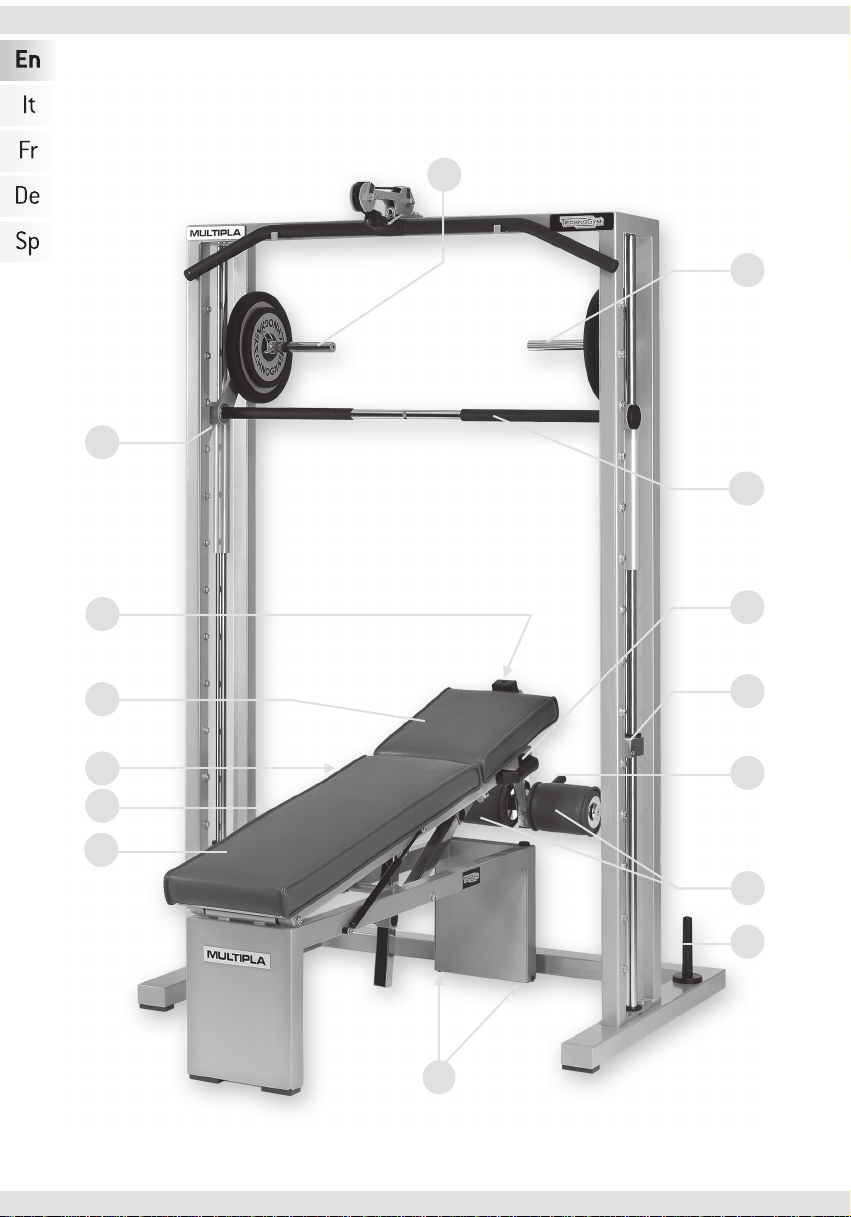
1.2.2 Principal components
8
9
9
7
12
2
14
13
1
Multipla - User’s manual
12
3
10
6
5
11
4
foto_componenti principali_grigio
Page 13
1 - bench, level adjustable with the release knob (13 )
2 - padded backrest, adjustable with the release knob (14)
3 - handles, to incline the bench and for the abdominal exercises
4 - wheels to move the bench
5 - padded rollers for the legs
6 - pin for fitting discs between the padded rollers, for exercises such as
standing leg curls and leg extensions
7 - barbell
8 - hooks to block and release the barbell on the supports; operated by
rotating the wrist
9 - pins for fitting discs on the barbell
10 - safety locks, to select the lowest position for the barbell
11 - disc stands
12 - lock to adjust the position of the rollers
1.2 Description of equipment
13
Page 14
1.2.3 Accessories
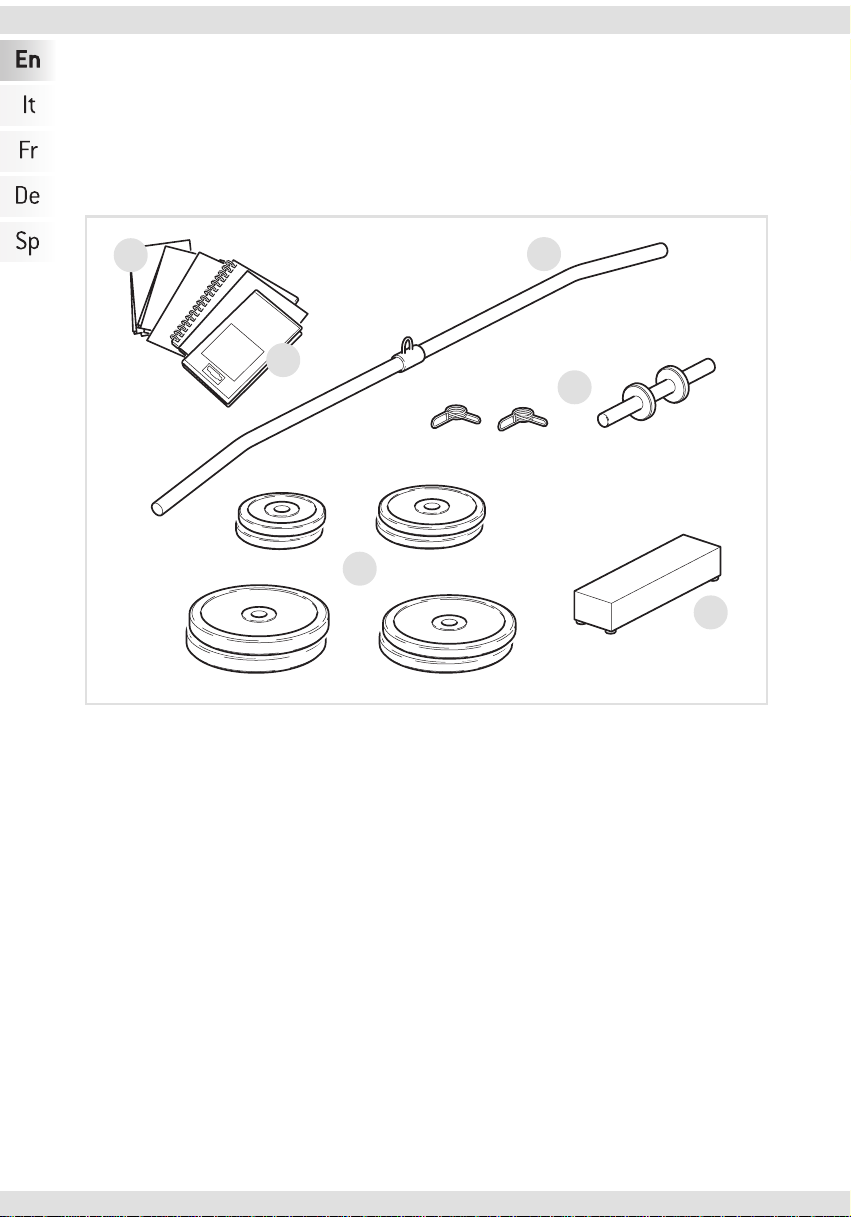
The equipment is supplied with the following accessories:
20
16
19
17
15
15 - rubber coated discs (10 kg , 5 kg, 2,5 kg, 1,25 kg)
16 -lat bar
17 - dumbells, with disc safety catches
18 - wedge, for squats and standing calf exercises
19 -user’s manual
20 - warranty certificate
18
03195001
14
Multipla - User’s manual
Page 15
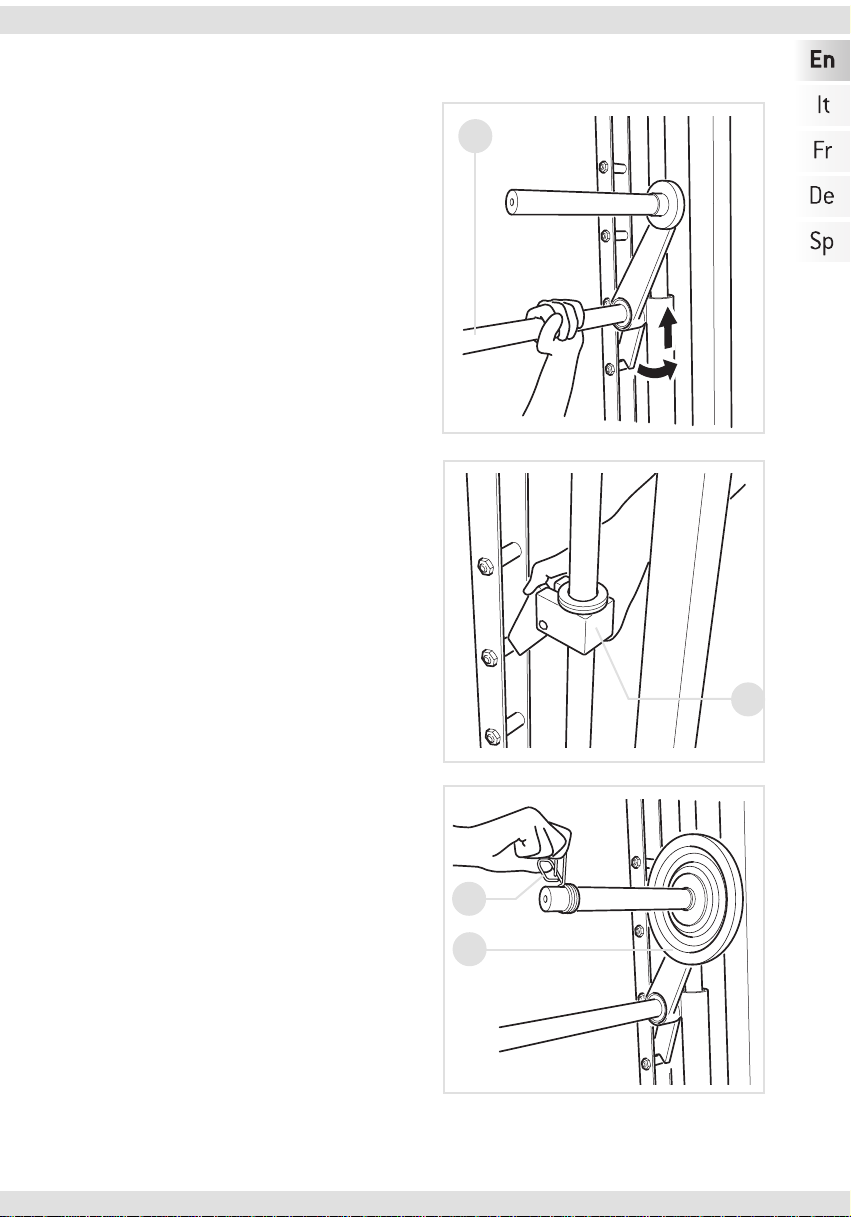
Hooking and unhooking the barbell (7)
Fitting the barbell safety clamps (10)
7
03195002
10
Fitting the discs (15) and the safety
catch (17 ) on the barbell
17
15
03195004
03195003
1.2 Description of equipment
15
Page 16
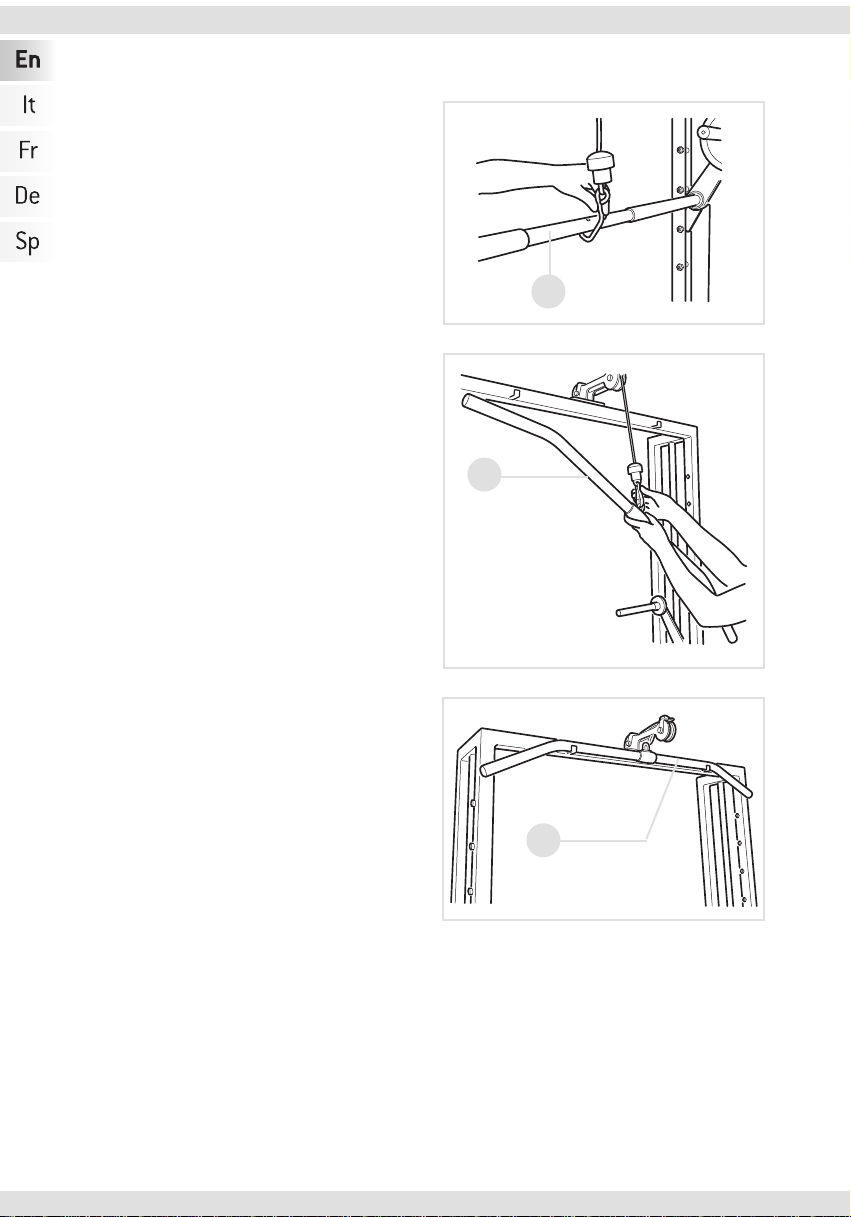
Hooking the cable to the barbell (1),
to use the lat bar (16)
Hooking the lat bar (16) to the high
cable
Fitting the lat bar (16) in the special
supports
03195005
16
03195006
1
03195007
16
Multipla - User’s manual
16
Page 17
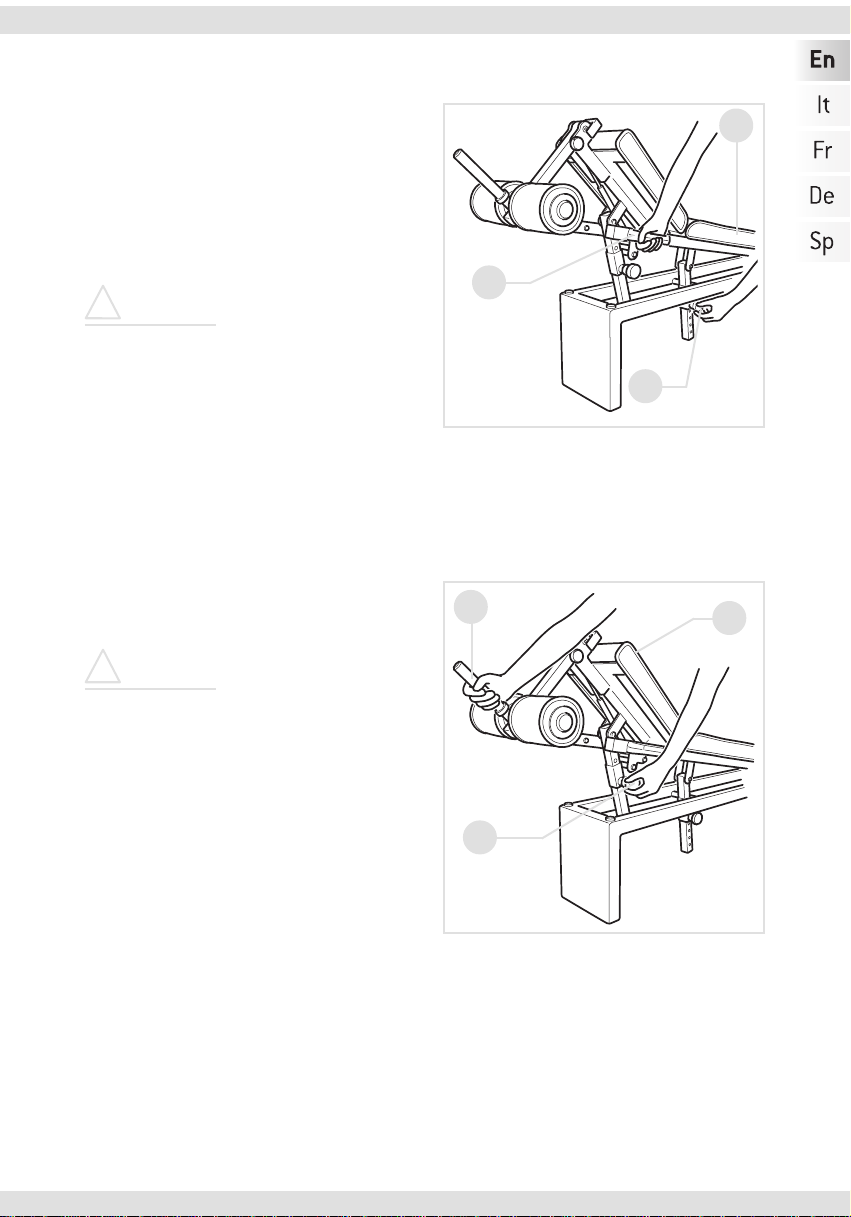
Bench (1) inclination: use the handles
to change the inclination of the bench;
the inclination can be increased with
the knob (13 ). Release the bench with
the knob (13) to return it to the
horizontal position
!
Danger
As soon as the knob (13) is
released, the bench falls
rapidly downwards.
Always move the bench by
holding it with the handles (3).
1
3
13
03195038
Backrest (2) inclination with the
knob (14)
!
Danger
As soon as the knob (14) is
released, the backrest rises
quickly upwards.
Always move the backrest by
holding it with the pin (6).
6
2
14
03195039
1.2 Description of equipment
17
Page 18
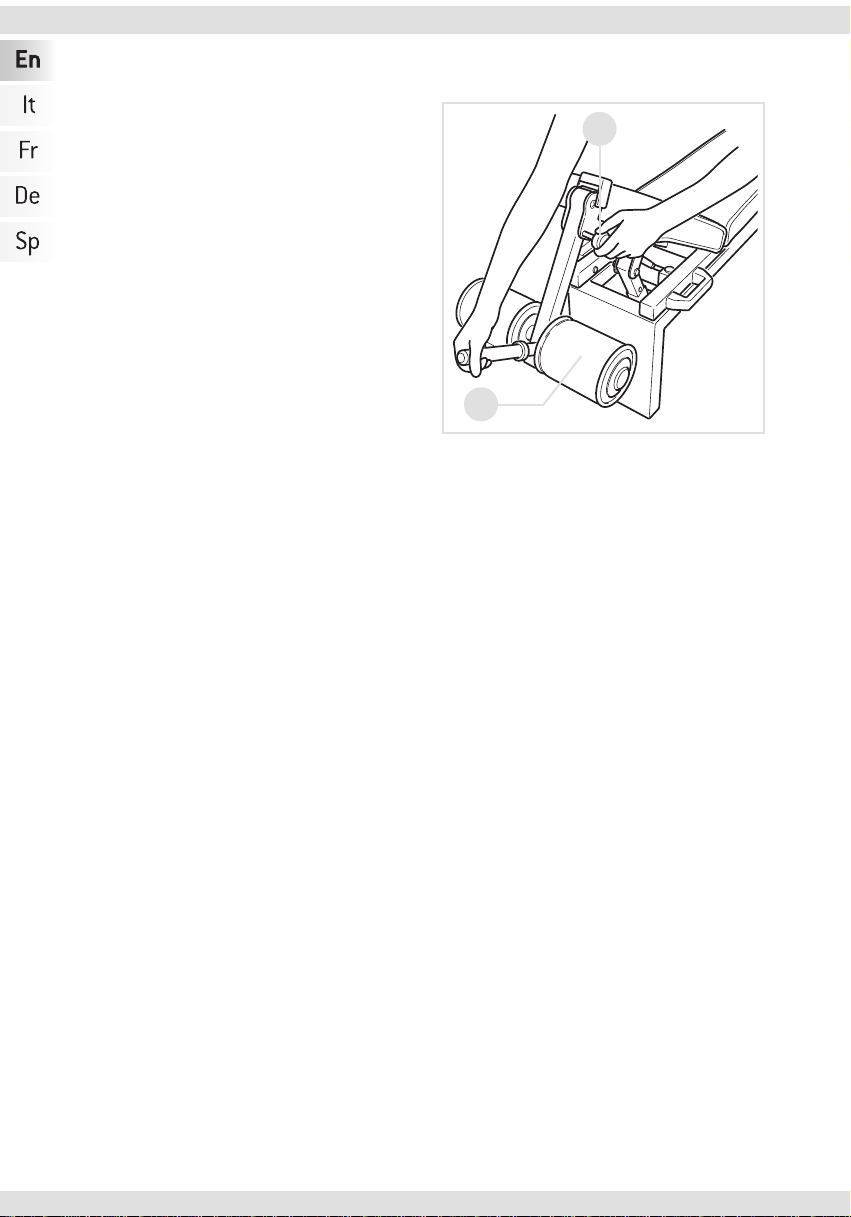
Fitting the lock (12 ) to adjust the
position of the padded rollers (5)
12
5
03195040
Multipla - User’s manual
18
Page 19
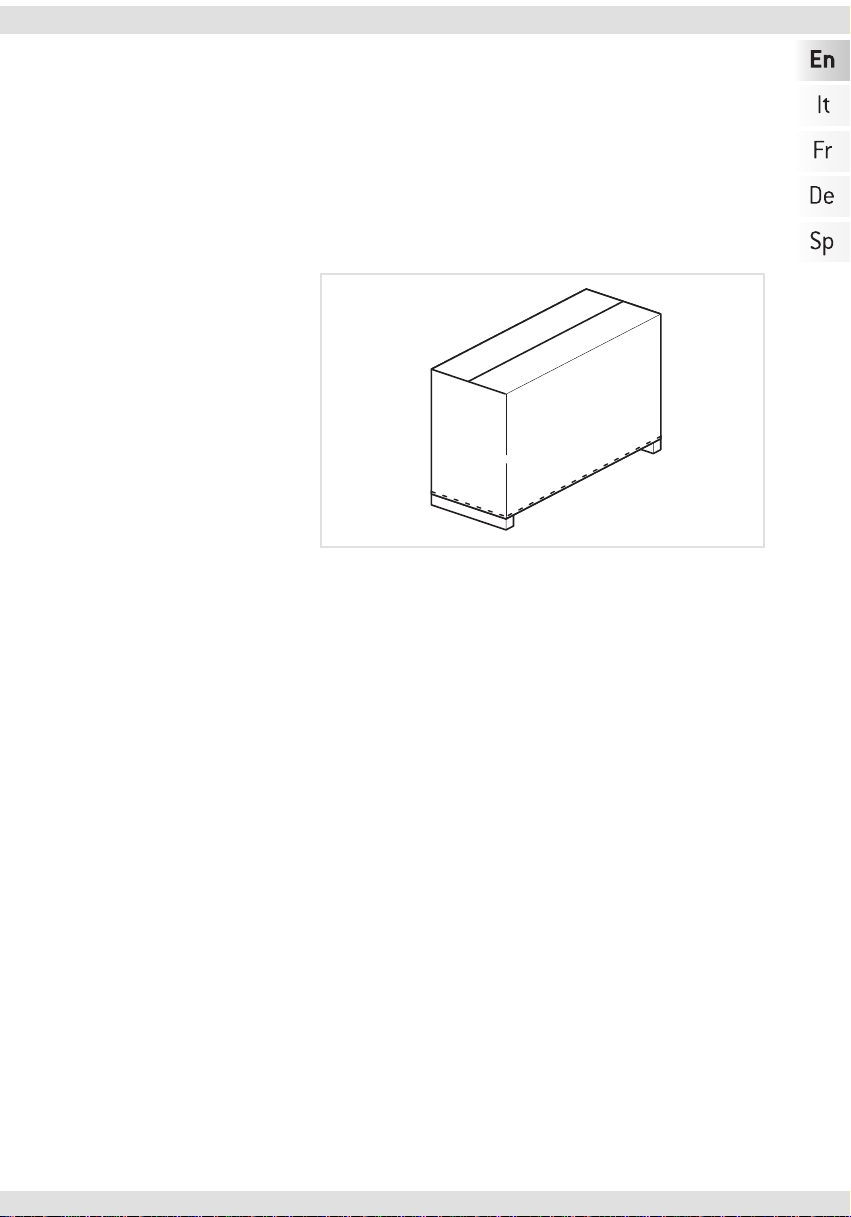
1.3 Installation and packaging
1.3.1 Description of packaging
The equipment comes
partially assembled in a
special pack, on a pallet.
All the supplied
accessories are in the
pack.
03180037
1.3.2 Lifting and handling the packed equipment
The equipment can be lifted and transported using normal lifting equipment.
To prevent injury to persons or damage to property, carefully choose the most
appropriate type of lifting and transport equipment for the place of installation.
The lifting and unpacking instructions are printed directly on the pack.
1.3 Installation and packaging
19
Page 20
1.3.3 Place of installation
The recommended ambient temperature is between 10° and 25°C, with air
humidity between 20% and 90%.
For safety reasons, leave a wide area of free space all around the equipment to
ensure there are no obstructions during the exercises.
If the equipment is installed in a public place of entertainment, its location
must comply with all the requirements of the currently binding legislation in
this area.
1.3.4 Unpacking
Cut the nylon straps holding the boxes to the pallet (see the instructions
directly on pack).
i
Information
You are advised to keep all packaging materials for re-use in case of a
move.
The packaging materials (boxes, bags, etc.) must not be left within reach of
children, as they constitute a potential hazard; nor should they be disposed
of in the environment.
Multipla - User’s manual
20
Page 21
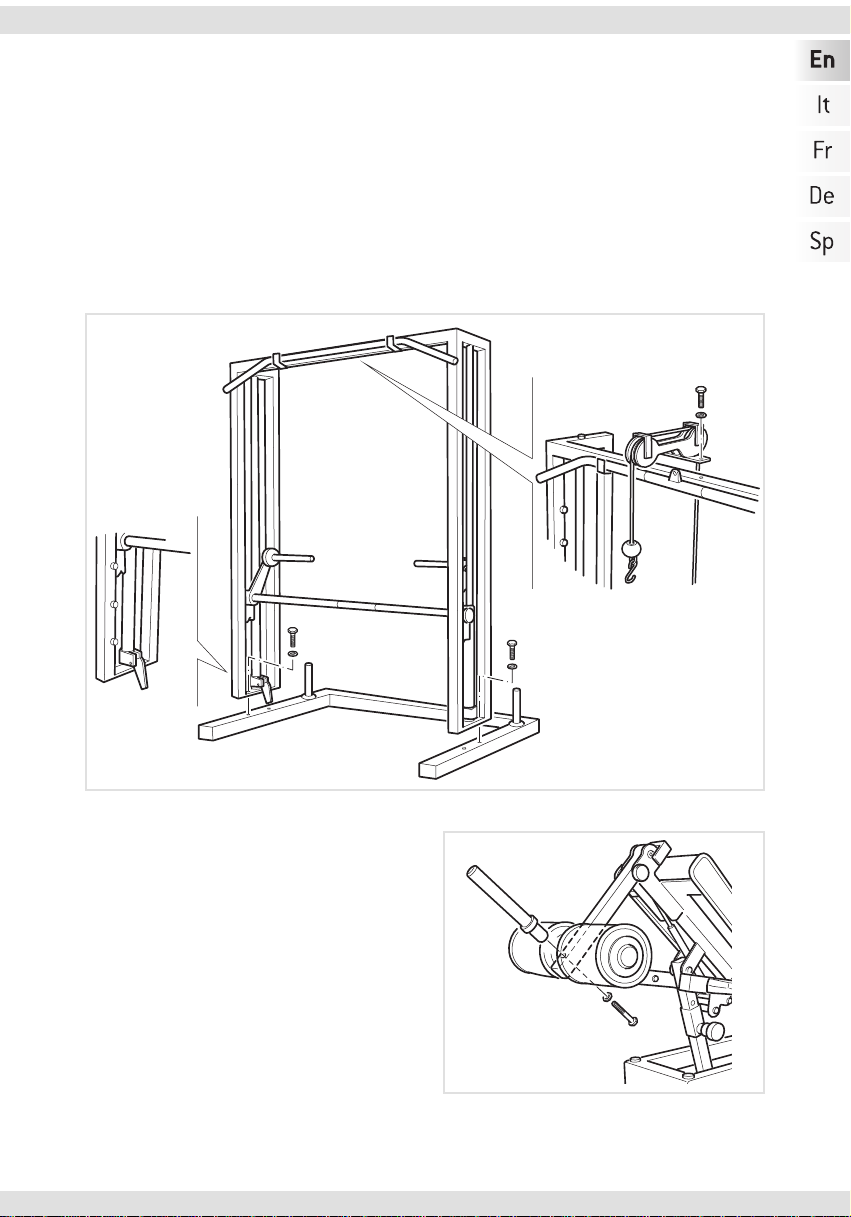
1.3.5 Assembly
Position the safety locks all the way to the bottom.
Lower the barbell to the bottom and rest it on the safety locks.
Fit the frame on the base and fix it with the washers and the special screws (TE 10x25).
Position the pulleys support and fix it with the washers and the two special
screws (TE 10x25).
03195043
03195042
Position the pin for the discs between
the padded rollers and fix it with the
washer and screw (TE 10x25).
03195 041
03195044
1.3 Installation and packaging
21
Page 22
1.4 Maintenance
1.4.1 Routine maintenance
The equipment should always be kept clean and free of dust, in accordance
with normal hygiene and sanitary rules, particularly if it is used in a sports
centre or by more than one person.
Clean the padded parts using a damp cloth or sponge and neutral soap.
For maintenance operations not described in this manual, consult the
Technogym Technical Support Service.
Multipla - User’s manual
22
Page 23
1.4.2 Technical support
The Technogym Technical Support Service provides:
- telephone assistance
- information about which services
are covered by the warranty and
Technogym International B.V.
Manno Branch
which must be paid for
- on-site support service
- sending of original spare parts.
Via Cantonale, Galleria 2
6928 Manno – Switzerland
tel:++41 91 6108600
Fax:++ 41 91 6001405
email:[email protected]
When contacting the Technogym Technical Support service, please specify
the following details:
- model
-date of purchase
- serial number
- precise description of problem.
Warning
Any operations on the equipment carried out by persons not
authorized by Technogym will invalidate the warranty.
1.4 Maintenance
23
Page 24
1.5 Storage
If a long period of disuse is expected, you are advised to store the equipment
in the following way:
- in a clean dry place, covered with a cloth to protect it from dust;
- at a room temperature between 10°C and 25°C and humidity between 20%
and 90%.
1.6 Disposal
It is always good practice to ensure that the equipment can never constitute
a hazard; therefore do not leave the equipment where children might use it as
a toy.
Disposing of the equipment on open ground, in public areas, or in private areas
used by the public is prohibited.
Multipla is made of recyclable materials, such as steel, aluminium and plastics,
which must be disposed of according to the method laid down in current
legislation relating to urban and similar waste.
Multipla - User’s manual
24
Page 25
2 Using the Multipla
2.1 Exercises
Warning
Carefully check the exercise illustrations and pay particular
attention to your position on the equipment.
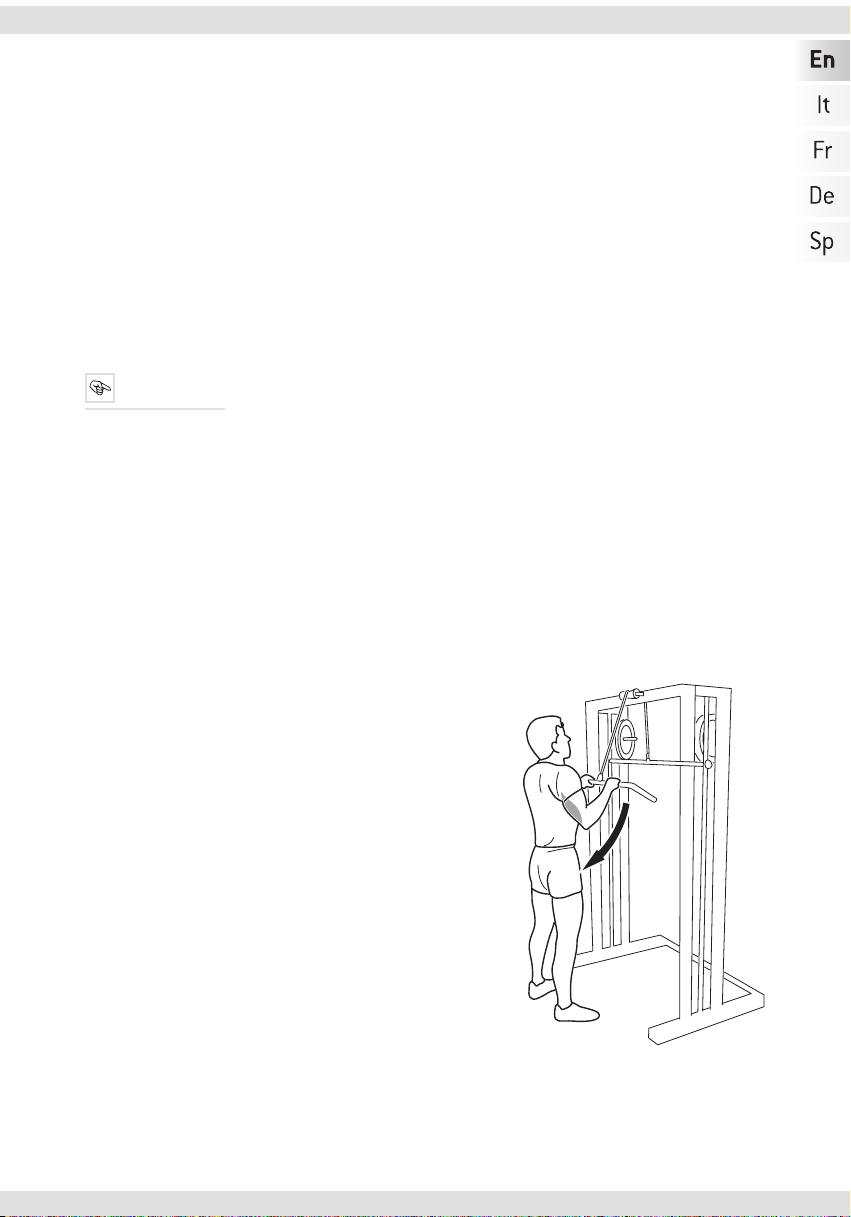
Triceps extension
This is an arms extension exercise,
indispensable for throwing sports, that require
strength in the upper limbs.
Muscles used: triceps
Movement:
- hook the cable to the barbell
- hook the lat bar to the high cable
- position the barbell at the bottom, the lowest
position
- fit the discs symmetrically on the barbell pin
and block them with safety catches
- grasp the lat bar with your palms facing the
floor and hands 15 cm apart
03195021
2.1 Exercises
25
Page 26
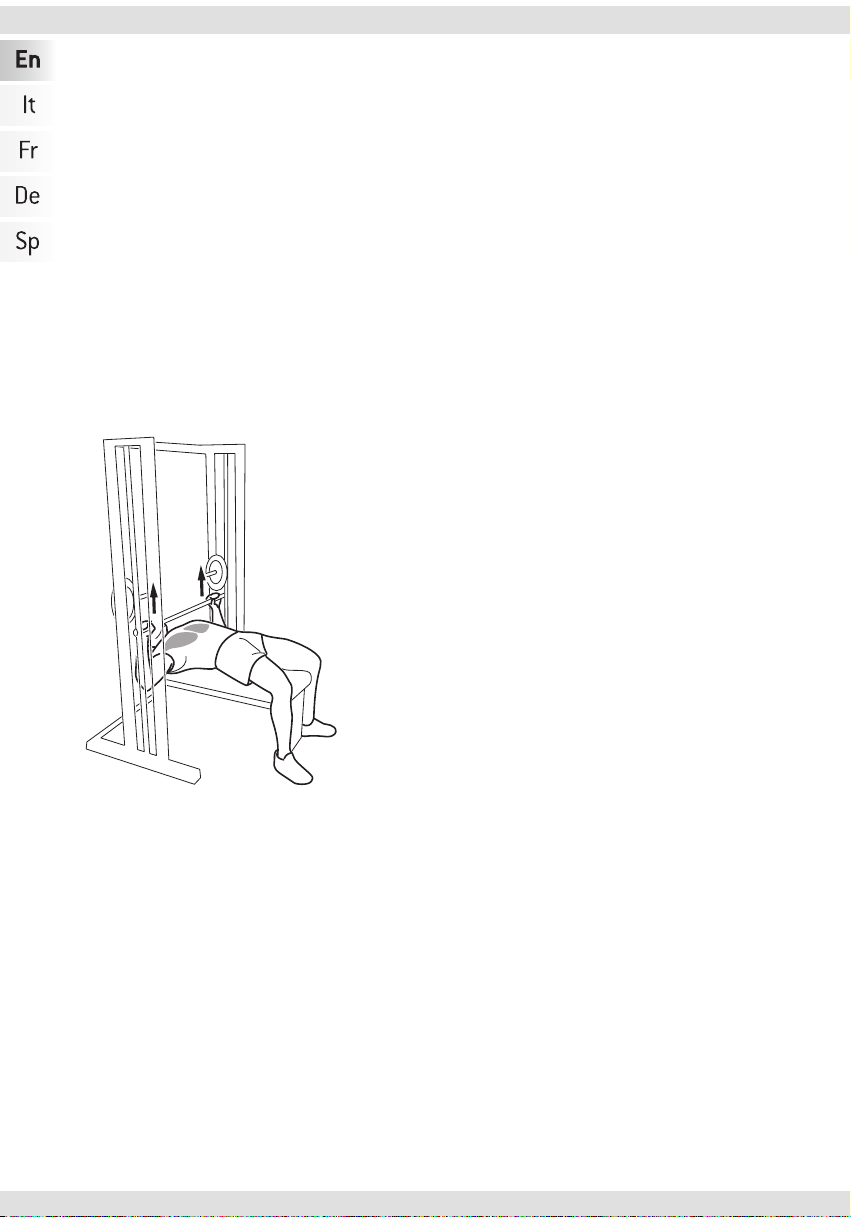
Chest press
03195008
- extend your arms completely, keeping your
elbows against your torso, then return to the
starting position; the return movement must
be slower than the outwards movement.
This is the basic exercise for strengthening the
chest.
Muscles used: pectorals, anterior deltoid, triceps
Movement:
- lie on the bench with the backrest in the
horizontal position
- position the barbell at a slightly lower height
than the length of your stretched arm
- fit the discs symmetrically on the barbell pin
and block them with safety catches
- lie on the bench and grasp the barbell with a
wide grip, at the outer limit of the textured
section
- unhook the barbell by rotating it counter
clockwise and bring it down to your chest,
so that it touches the top of your pectoral
muscle; keep your elbows wide apart, out
from the torso
- push the barbell up, keeping your elbows
wide apart, then go back to the starting
position.
Multipla - User’s manual
26
Page 27
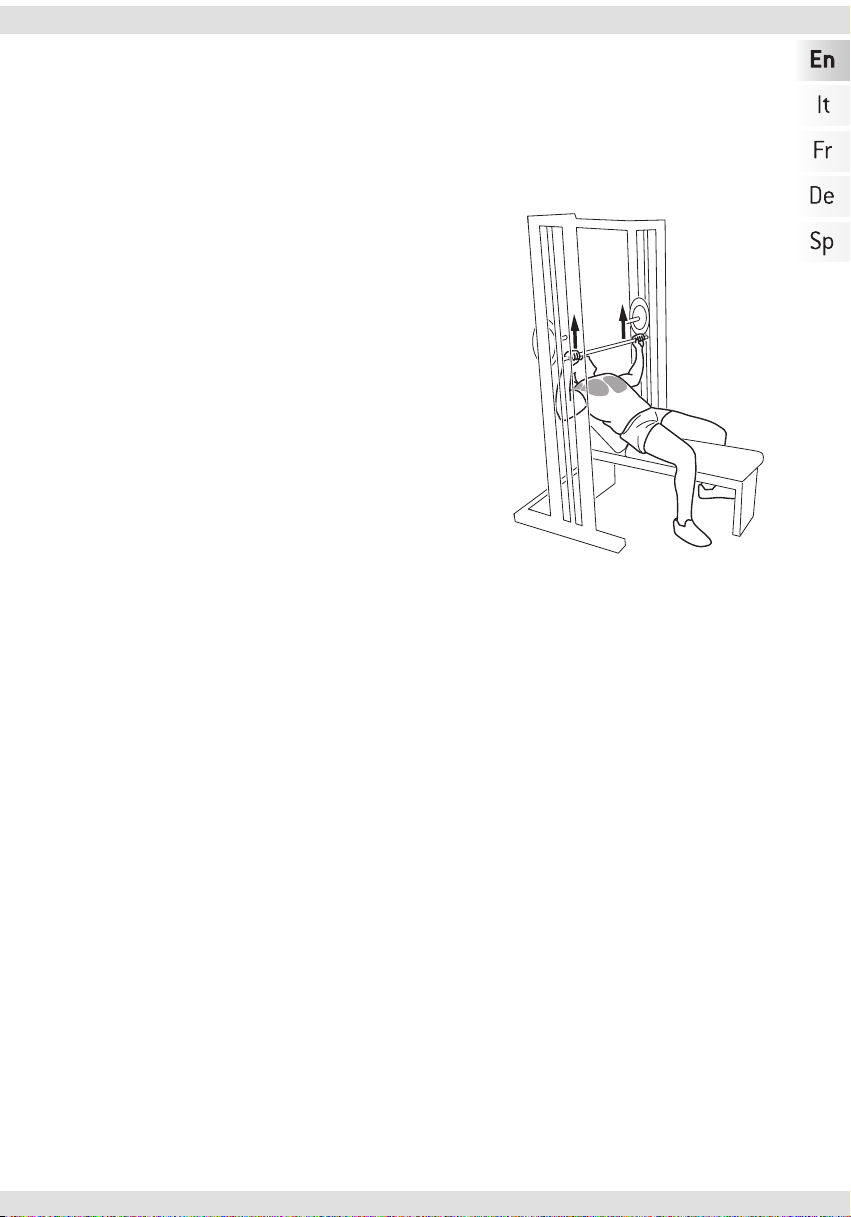
Incline chest press
This exercise is similar to the previous one (chest
press), but the inclined backrest angle
concentrates the work more on the upper part
of the chest.
Muscles used: pectorals, anterior deltoid, triceps
Movement:
- position the backrest in the second hole
- sit on the bench and position the barbell at a
slightly lower height than the length of your
stretched arm
- fit the discs symmetrically on the barbell pin
and block them with safety catches
- sit on the bench, keeping your back firmly
against the backrest and grasp the barbell
with a wide grip, at the outer limit of the
textured section
- unhook the barbell by rotating it counter
clockwise and bring it down to your chest,
so that it touches the top of your pectoral
muscle; keep your elbows wide apart, out
from the torso
- push the barbell up, keeping your elbows
wide apart, then go back to the starting
position; the barbell trajectory corresponds
with the top part of the chest.
03195009
2.1 Exercises
27
Page 28
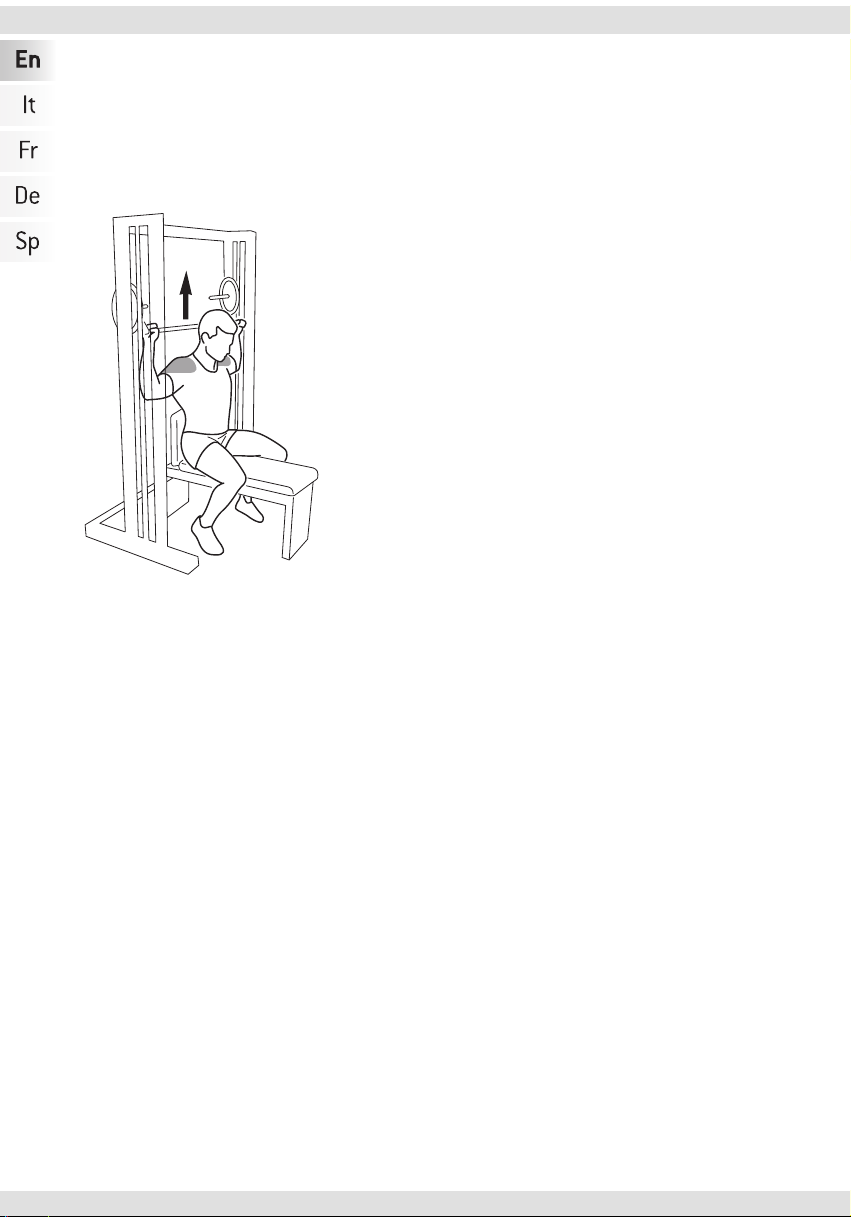
Shoulder press
03195010
This is an exercise that works the pushing chain
of the upper limbs. Strengthens the shoulder
joint.
Muscles used: deltoid, triceps, trapezius
Movement:
- position the backrest in the last hole
- move the bench so that the backrest is in
line with the barbell
- sit on the bench and position the barbell so
that your arms are completely stretched
- fit the discs symmetrically on the barbell pin
and block them with safety catches
- sit on the bench, keeping your back firmly
against the backrest and grasp the barbell
with a wide grip, at the outer limit of the
textured section
- unhook the barbell by rotating it counter
clockwise and bring it behind your head as
far as the base of your neck
- push the barbell up, keeping your elbows
wide apart, then go back to the starting
position.
Multipla - User’s manual
28
Page 29
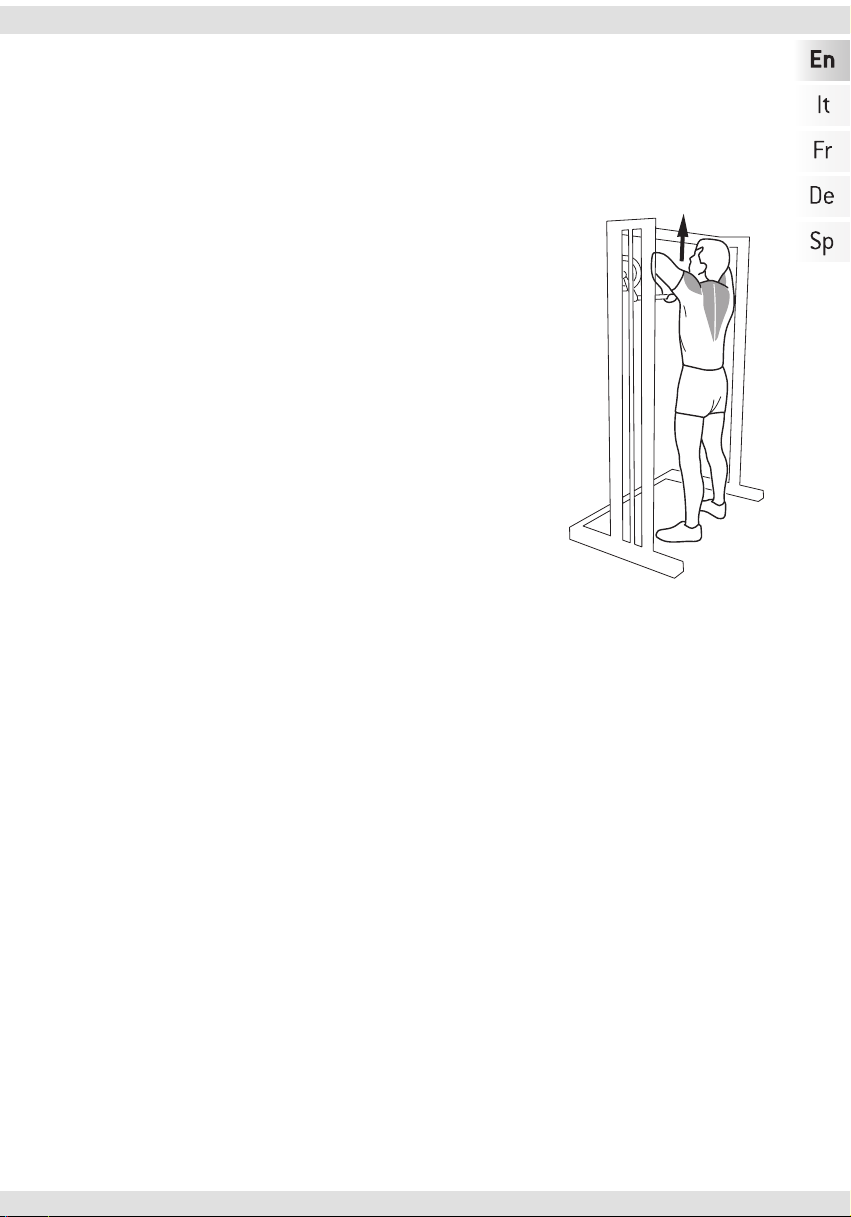
Up/right row
This is an exercise for training the shoulder
muscles and the top part of the back. It is
important for the prevention of shoulder pains.
Muscles used: deltoid, trapezius
Movement:
- stand facing the equipment, position the
barbell so that you grasp it with your arms
stretched
- fit the discs symmetrically on the barbell pin
and block them with safety catches
- grasp the barbell with your hands close
together and spread your legs slightly for
greater stability
- unhook the barbell by rotating it counter
clockwise
- curl your forearm and bring the barbell up to
your chin, keeping your elbows higher than
your shoulders; then return to the starting
position.
03195011
2.1 Exercises
29
Page 30
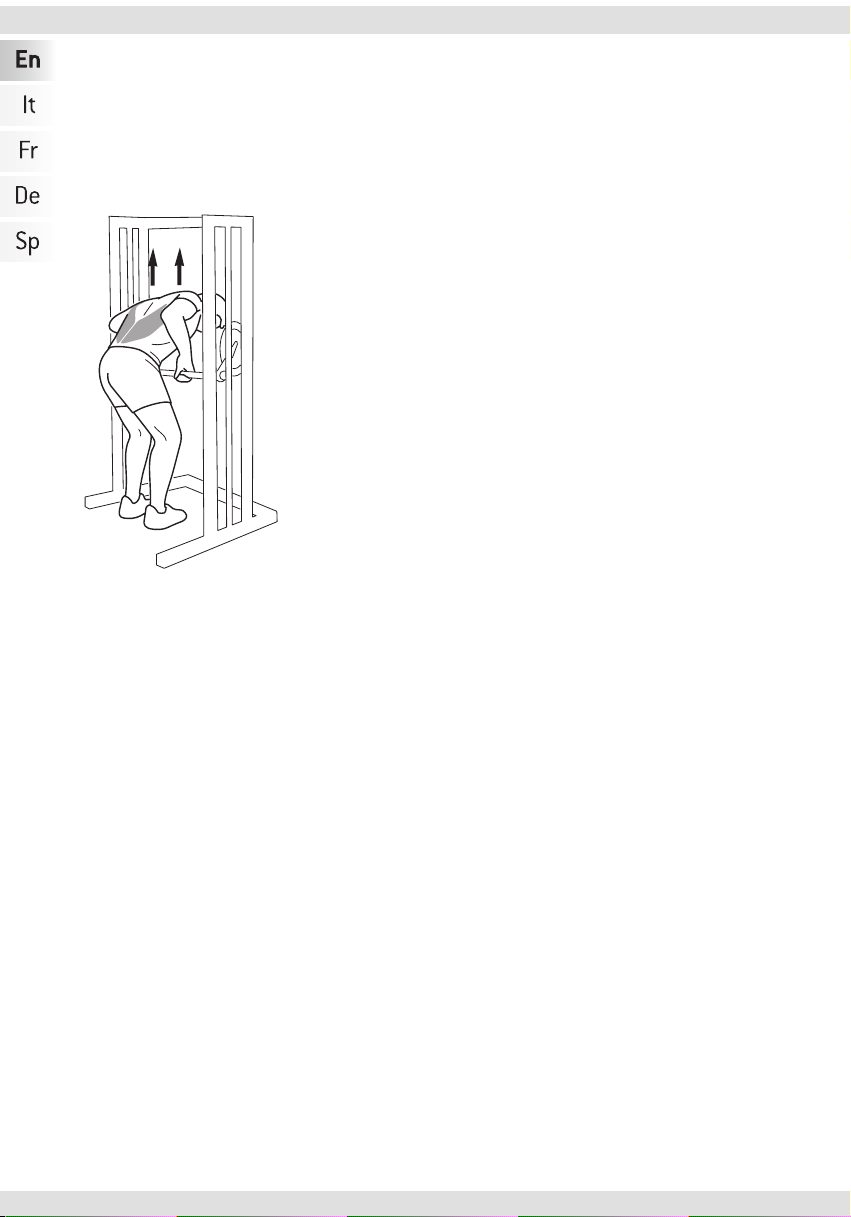
Rowing
03195 013
This is an exercise that tones and strengthens
the back muscles and is especially useful for all
water sports.
Muscles used: latissimus dorsi
Movement:
- stand facing the equipment, position the
barbell at the bottom, the lowest position
- fit the discs symmetrically on the barbell pin
and block them with safety catches
- grasp the barbell with your hands at
shoulder width
- spread your legs slightly for greater stability;
your body is bent forwards and your knees
are bent
- unhook the barbell by rotating it counter
clockwise
- lift the barbell as far as the sternum by
moving your arms and shoulders and
keeping your elbows close to your chest;
then return to the starting position.
Multipla - User’s manual
30
Page 31
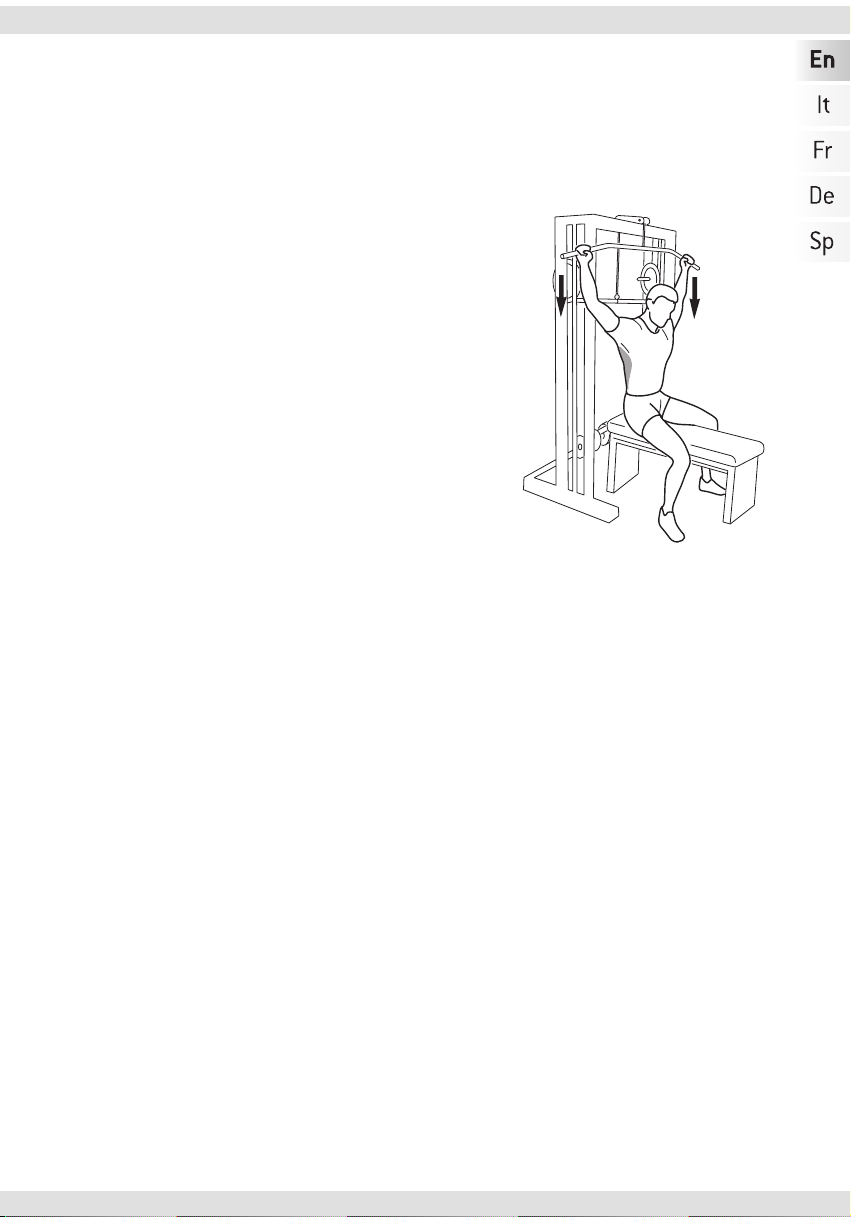
Lat pull down
This is the basic exercise to tone the upper back
muscles. It is recommended for all sports and
to treat certain posture problems.
Muscles used: latissimus dorsi and biceps
Movement:
- hook the cable to the barbell
- hook the lat bar to the high cable
- position the barbell at the bottom, the lowest
position
- fit the discs symmetrically on the barbell pin
and block them with safety catches
- grasp the lat bar with a wide grip and sit on
the bench with your back to the barbell; the
backrest is in the horizontal position
- pull down the lat bar as far as the base of
your neck, then return to the starting
position; your head must be slightly bent
forward to facilitate the movement.
03195 014
2.1 Exercises
31
Page 32
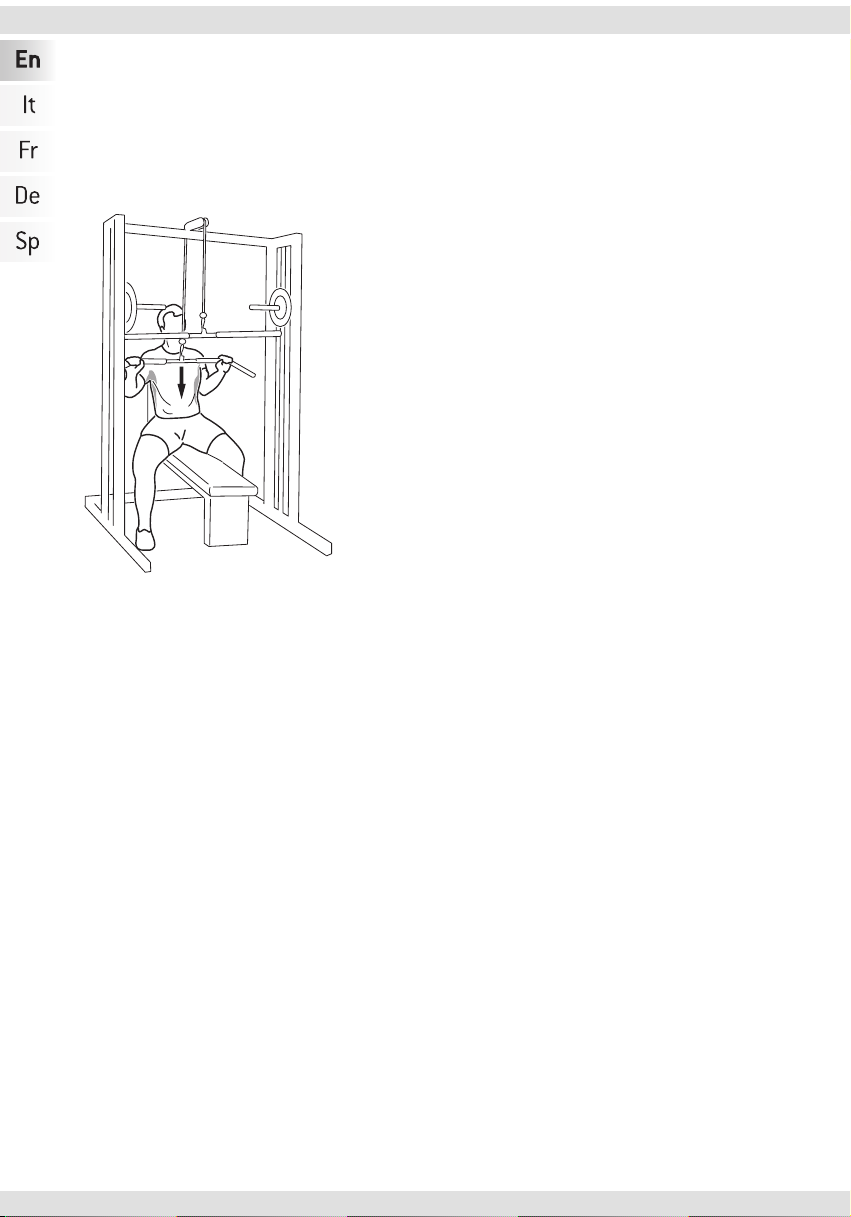
Mid lat pull down
03195 015
Like the previous exercise this one tones the
upper back muscles. It is recommended for all
sports and to treat certain posture problems.
Muscles used: latissimus dorsi and biceps
Movement:
- hook the cable to the barbell
- hook the lat bar to the high cable
- position the barbell at the bottom, the lowest
position
- fit the discs symmetrically on the barbell pin
and block them with safety catches
- position the backrest in the last hole
- grasp the lat bar with a medium grip and sit
on the bench facing the barbell
- pull down the lat bar as far as the sternum,
then return to the star ting position; your head
must be slightly back to facilitate the
movement.
Multipla - User’s manual
32
Page 33
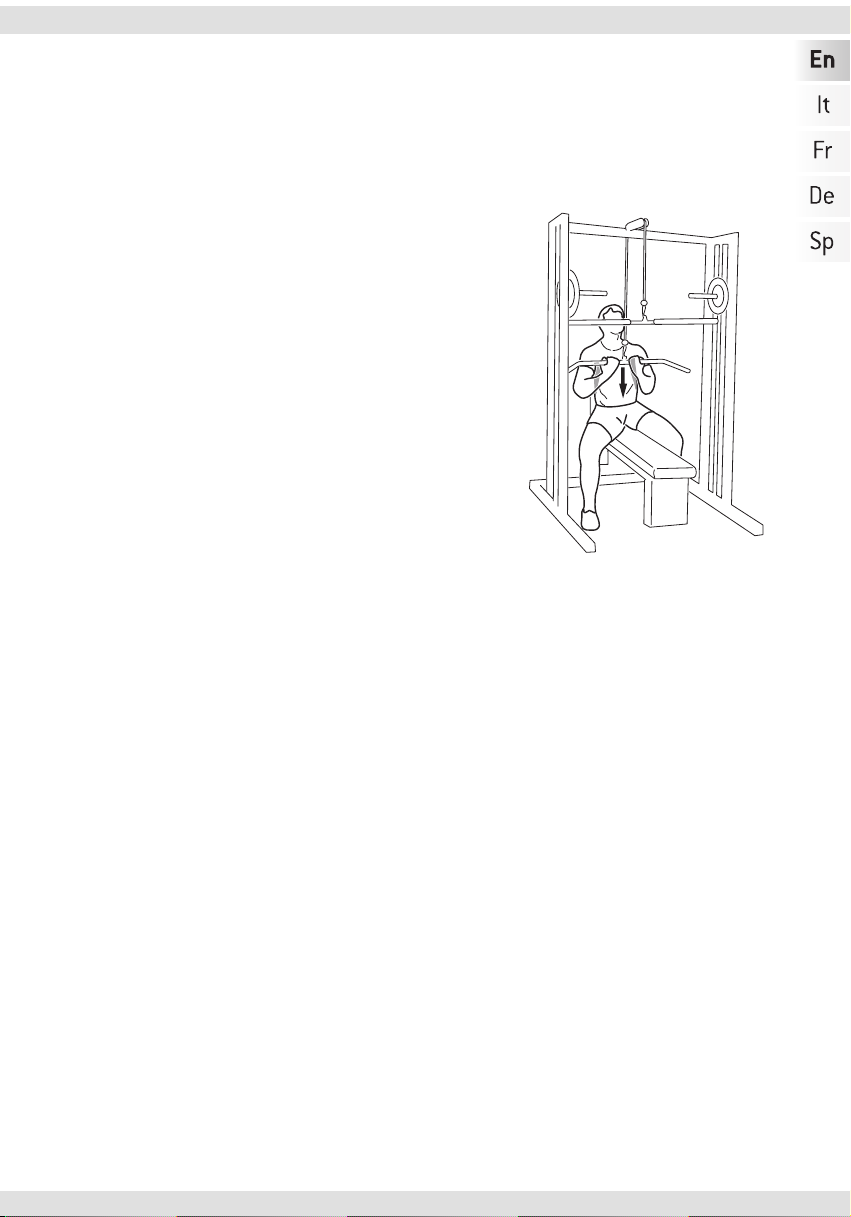
Lat pull down reverse
Like the previous exercise this one tones the
upper back muscles. It is recommended for all
sports and to treat certain posture problems.
Muscles used: latissimus dorsi and biceps
Movement:
- hook the cable to the barbell
- hook the lat bar to the high cable
- position the barbell at the bottom, the lowest
position
- fit the discs symmetrically on the barbell pin
and block them with safety catches
- position the backrest in the last hole
- grasp the lat bar with the palm of your hand
facing you and sit on the bench facing the
barbell
- pull down the lat bar as far as the sternum,
then return to the starting position; your head
must be slightly back to facilitate the
movement.
03195 016
2.1 Exercises
33
Page 34
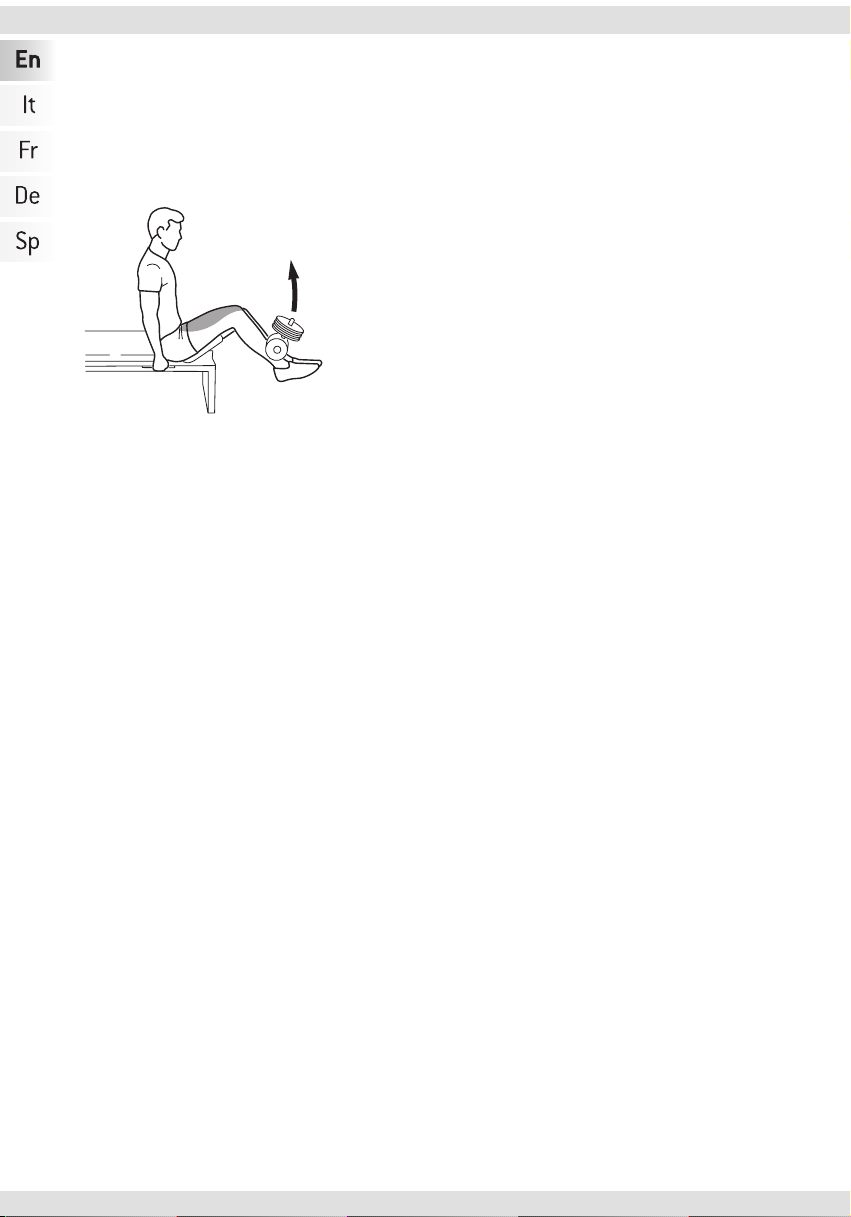
Leg extensions
03195018
This is the basic exercise for isolating the
quadriceps muscle and it is used both for
training and rehabilitation.
Muscles used: quadriceps
Movement:
- position the backrest in the first hole
- fit the discs on the pin between the padded
rollers
- remove the lock to adjust the position of the
rollers
- sit on the bench, put your feet behind the
rollers and grasp the handles
- push on the rollers with the tibia and extend
your leg s, then retu rn to the s tar ting position;
the return movement must be slower than
the outwards movement.
Multipla - User’s manual
34
Page 35
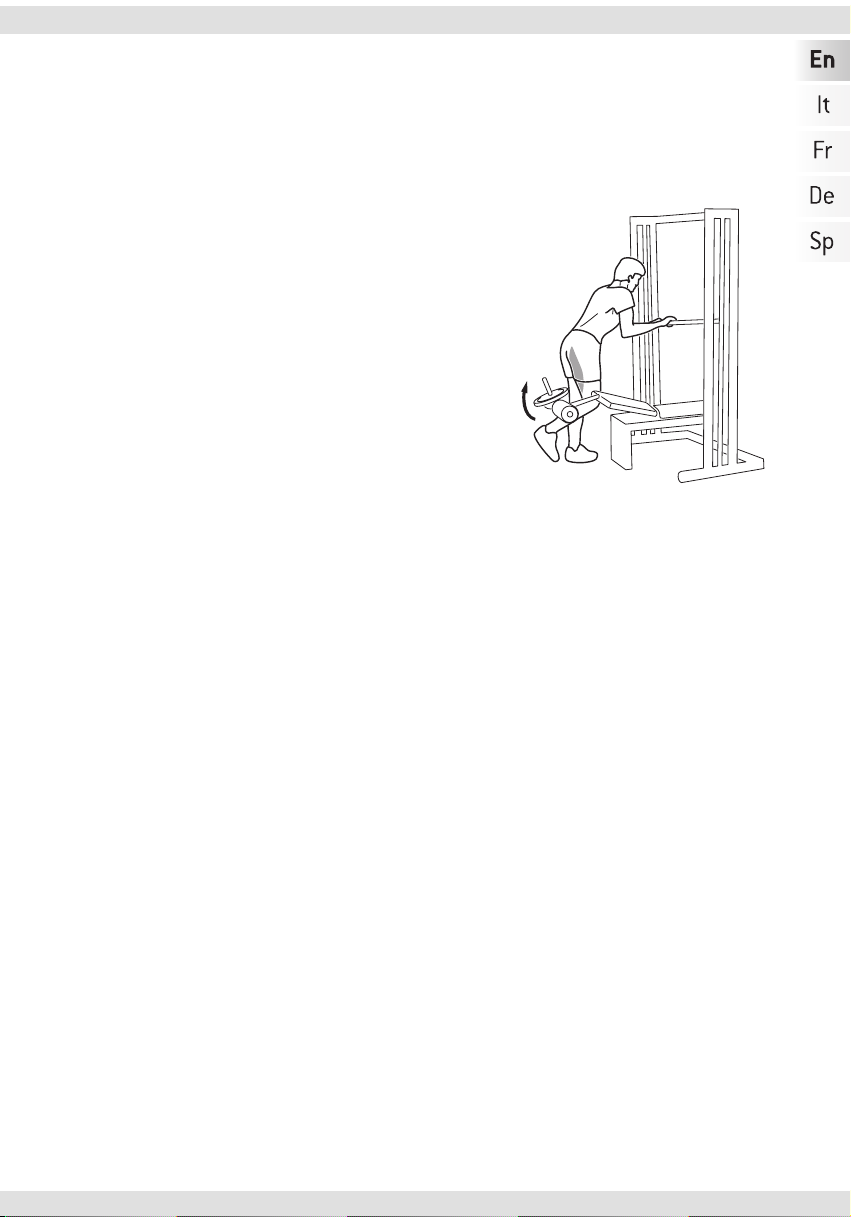
Standing leg curl
This is the basic exercise for toning the rear part
of the leg.
Muscles used: leg biceps
Movement:
- position the backrest in the first hole
- fit the discs on the pin between the padded
rollers
- remove the lock to adjust the position of the
rollers
- bring the bench closer in order to use the
barbell for support
- place the heel of the leg to be exercised
behind the padded roller and grasp the
barbell for greater stability
- curl the leg slowly, then return to the starting
position.
0319 5019
2.1 Exercises
35
Page 36
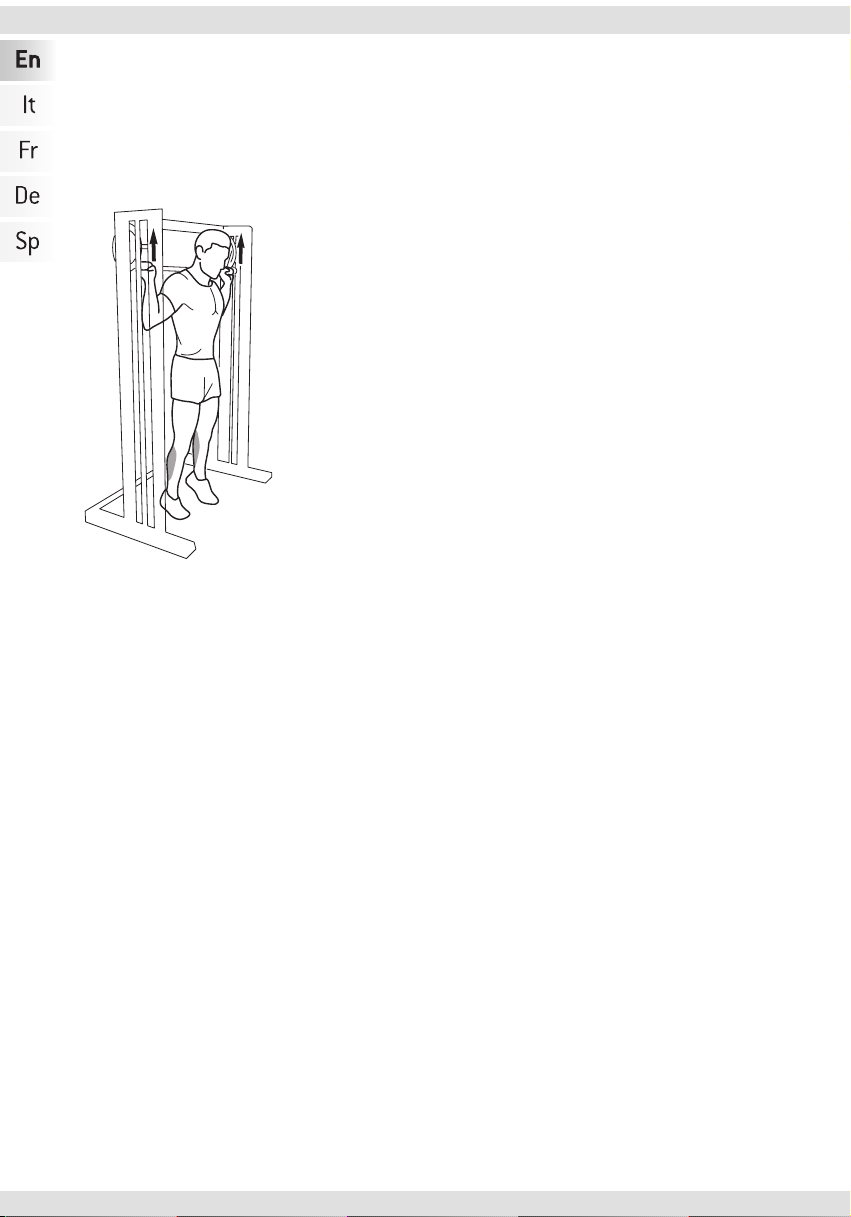
Standing calf
03195020
This is an exercise for strengthening the calf
muscles and it is used especially for sports that
require jumping and sprinting. Performed with
a low weight and with the wedge under the front
part of the foot, it improves the flexibility of the
ankle.
Muscles used: soleus, gastrocnemius
Movement:
- position the barbell slightly lower than your
shoulders
- fit the discs symmetrically on the barbell pin
and block them with safety catches
- stand under the barbell and position it on
your trapezius, in line with your shoulders
- spread your legs so that your feet are in line
with your hips and your calf muscles in line
with the barbell
- unhook the barbell by rotating it counter
clockwise
- lift yourself up onto your toes by moving only
the ankles and keeping your legs straight;
then return to the starting position
- to increase the travel of the movement place
the wedge under your toes.
Multipla - User’s manual
36
Page 37
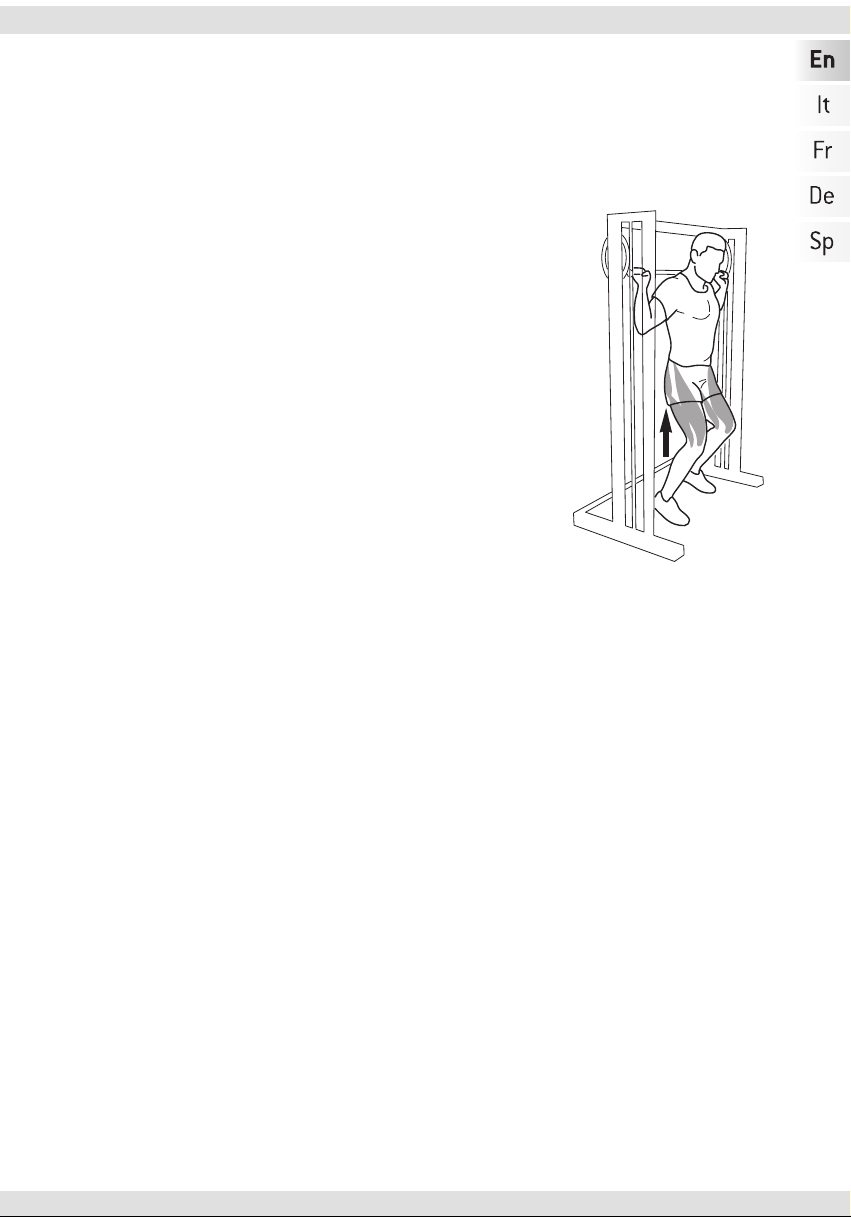
Squat
This is the basic exercise for strengthening the
legs. This is an essential exercise for all sports
requiring leg strength; it must be performed
properly to be effective.
Muscles used: quadriceps, gluteus, thigh
Movement:
- position the barbell slightly lower than your
shoulders
- fit the discs symmetrically on the barbell pin
and block them with safety catches
- stand under the barbell and position it on
your trapezius, in line with your shoulders;
your hands should be slightly wider apart
than your shoulders
- spread your legs so that your feet are in line
with your hips, pointing slightly outwards
- unhook the barbell by rotating it counter
clockwise and stretch your legs completely
- bend your legs until your thighs are parallel
with the ground, then return to the starting
position
- during the exercise the heels stay on the
ground; if you raise them you can place the
wedge underneath them
- during the exercise it is important not to arch
your back or bend too far forwards; to keep
as straight as possible try to focus on a point
overhead.
03195017
2.1 Exercises
37
Page 38
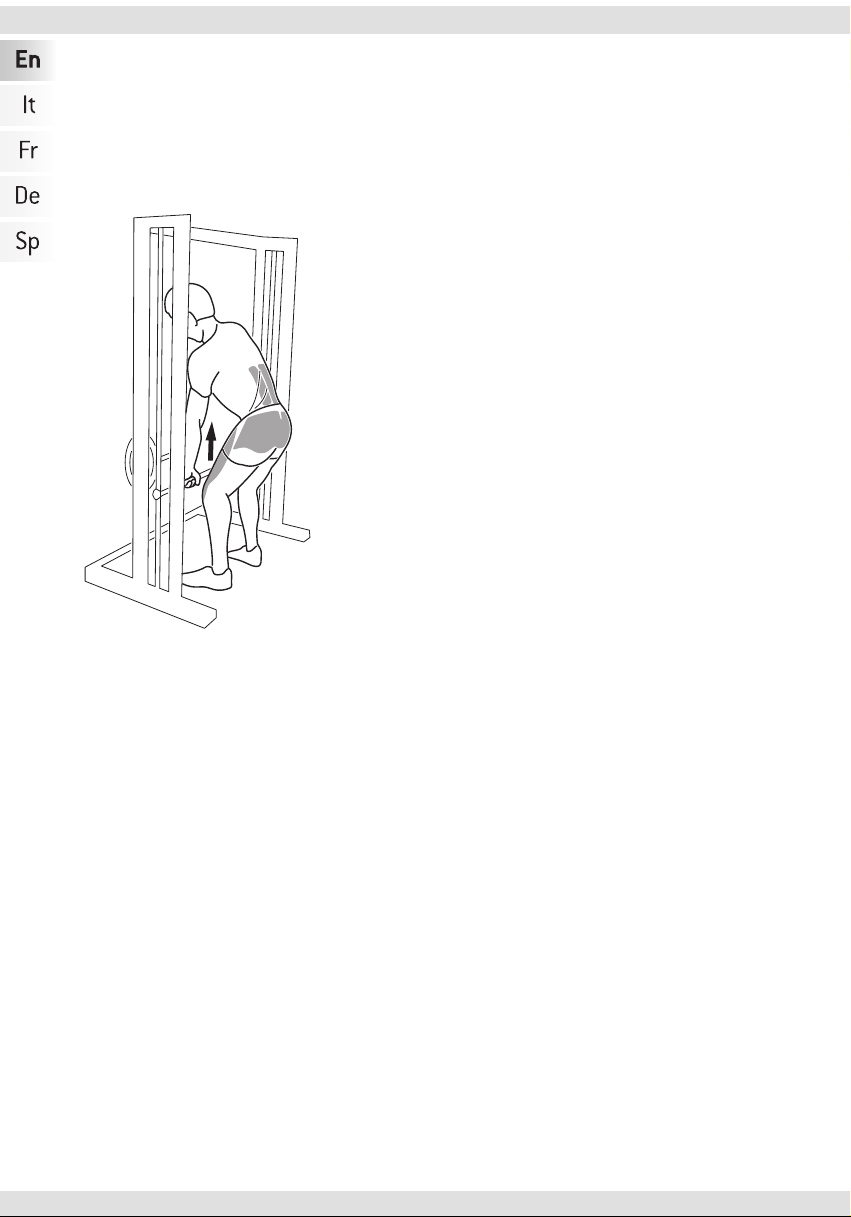
Short dead lift
03195012
This is a highly synergic exercise because it
involves various muscle groups. It is very good
for improving strength and resistance.
Muscles used: lumbar, quadriceps, gluteus
Movement:
- stand facing the equipment, position the
barbell at the bottom, the lowest position
- fit the discs symmetrically on the barbell pin
and block them with safety catches
- grasp the barbell with one hand facing
upwards and one hand facing downwards;
your hands are at shoulder width
- spread your legs slightly for greater stability;
your body is bent forward and your knees
are bent
- unhook the barbell by rotating it counter
clockwise
- stretch your legs completely and at the same
time straighten your torso and shoulders;
then return to the starting position.
Multipla - User’s manual
38
Page 39
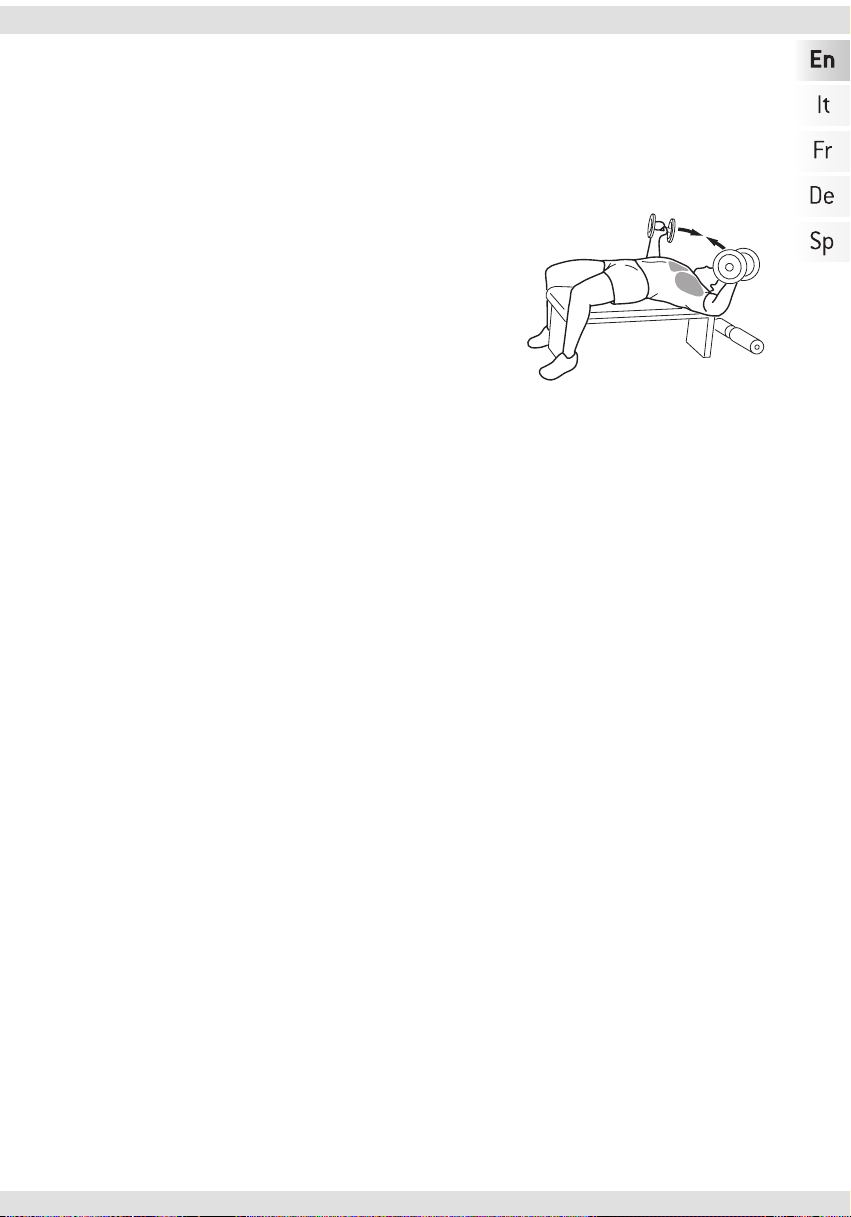
Pectoral fly
This exercise isolates the pectoral muscles.
Broadens the chest and tones up the pectoral
muscles.
Muscles used: pectorals and anterior deltoid
Movement:
- lie on the bench with the backrest in the
horizontal position; keep your arms
perpendicular to the ground, your elbows
slightly bent and your hands opposite each
other
- open your arms, moving the shoulder joints
- do not change the angle of your elbows or
the position of your hands during the
exercise.
03195022
2.1 Exercises
39
Page 40
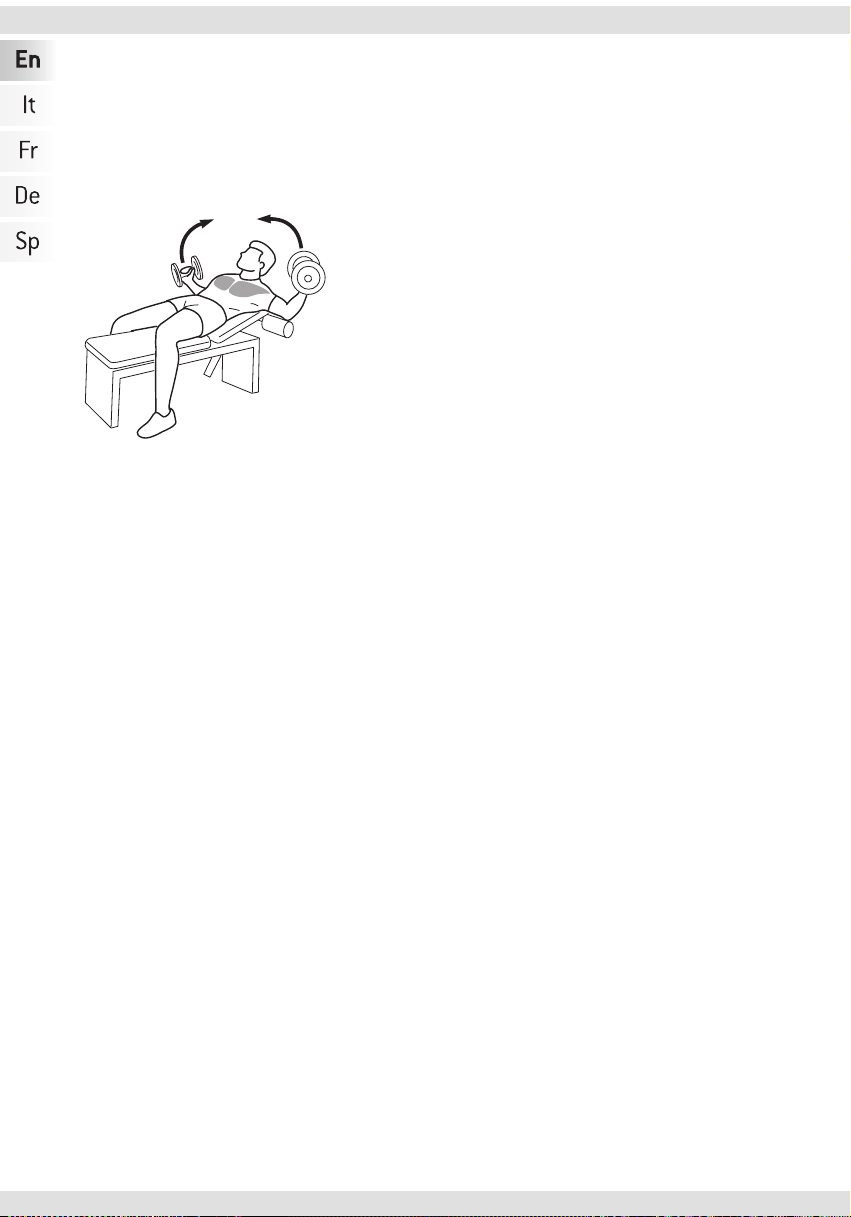
Incline bench fly
This exercise is similar to the previous one
(pectoral fly), but the inclined backrest angle
concentrates the work more on the upper part
of the chest.
Muscles used: pectorals and anterior deltoid
03195023
Movement:
- position the backrest in the second hole
- sit on the bench, keeping your back firmly
against the backrest; keep your arms
perpendicular to the ground, your elbows
slightly bent and your hands opposite each
other
- open your arms, moving the shoulder joints
- do not change the angle of your elbows or
the position of your hands during the
exercise.
Multipla - User’s manual
40
Page 41
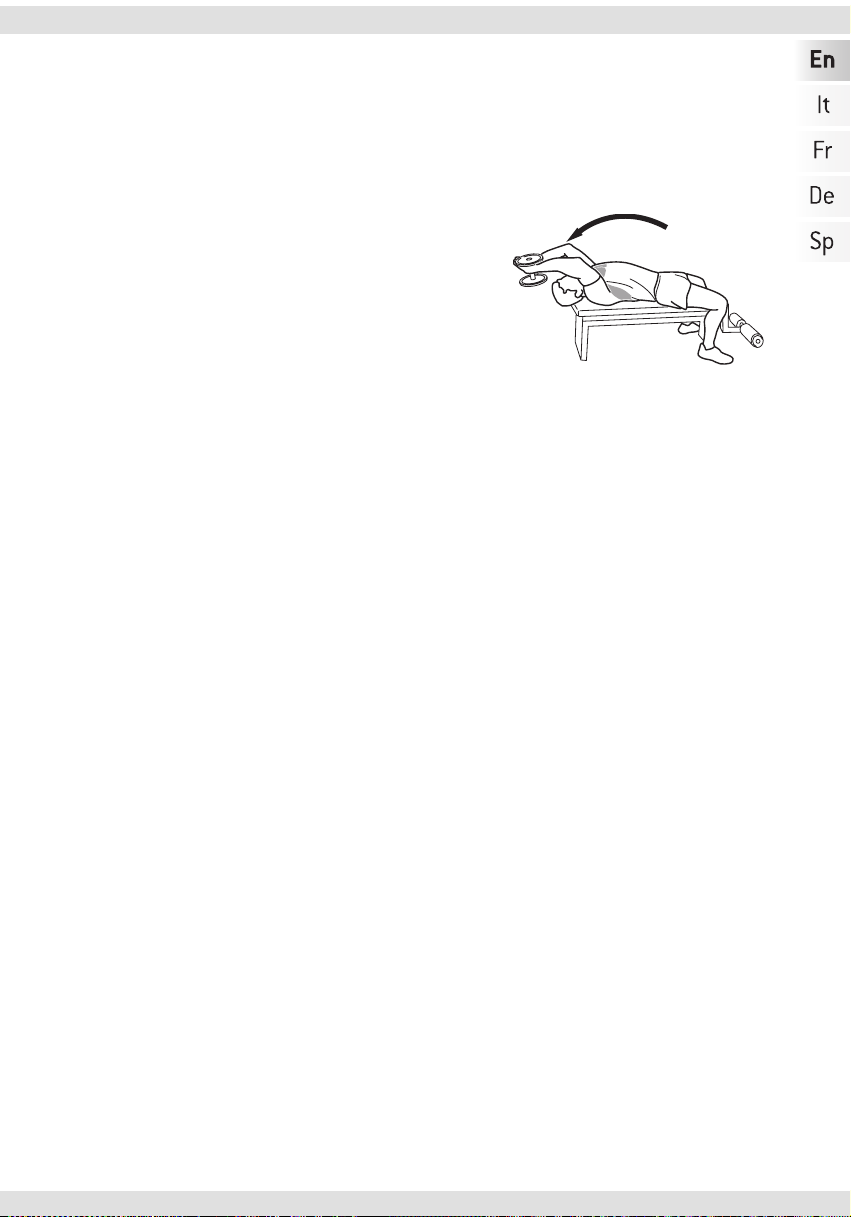
Pull over
This exercise trains all the chest muscles.
Muscles used: pectorals, latissimus dorsi,
serratus
Movement:
- lie on the bench with the backrest in the
horizontal position and your head at the end
of the backrest
- grasp the dumbell with a crossed grip,
keeping your arms perpendicular to the
ground and your elbows slightly bent and
close together
- moving your shoulder joints, take the dumbell
as far as you can behind your head without
spreading your elbows, then go back to the
starting position
- the elbows must be kept at the same angle
throughout the exercise.
03195024
2.1 Exercises
41
Page 42
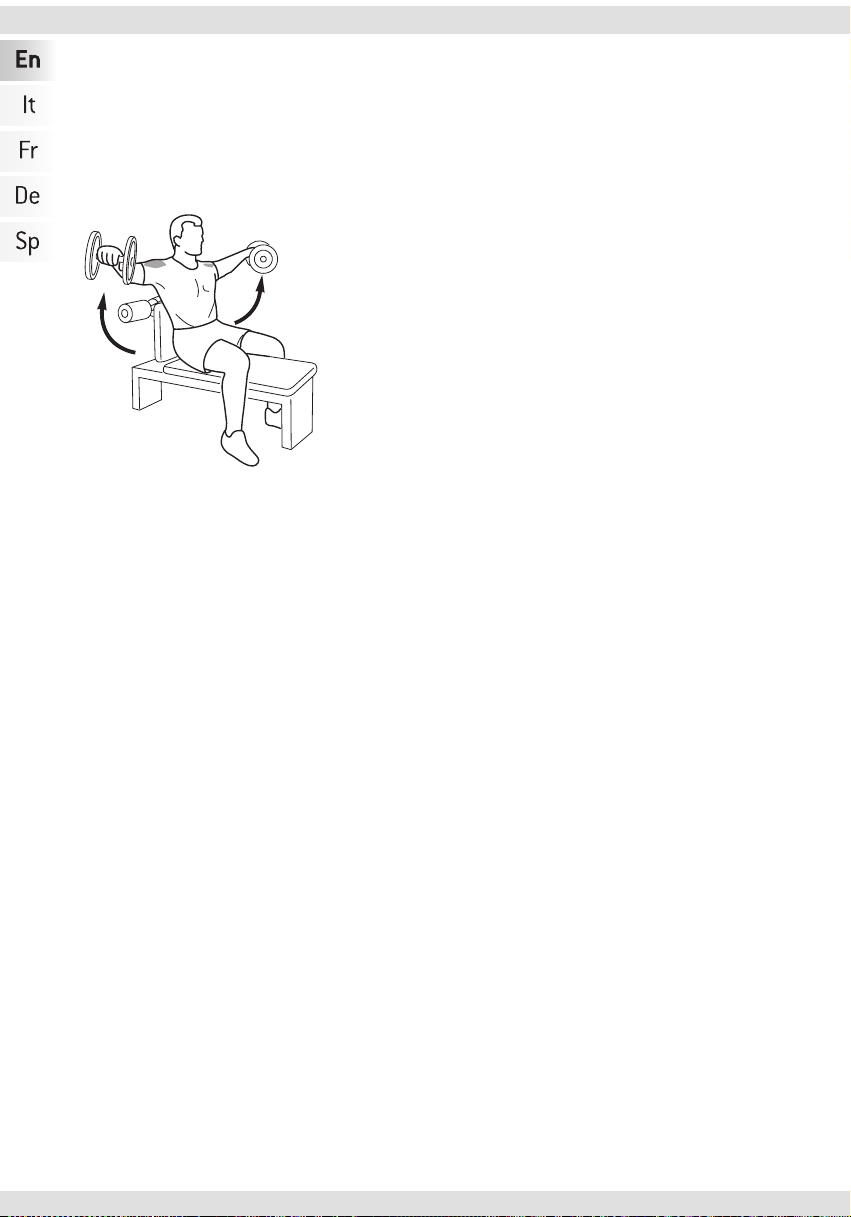
Lateral raise
03195025
This exercise isolates the central part of the
shoulders.
Muscles used: middle deltoid
Movement:
- position the backrest in the last hole
- sit on the bench, keeping your back firmly
against the backrest
- in the starting position, your arms should be
against your sides with your elbows slightly
bent
- raise your arms until your elbows reach
shoulder height, with the palms of your
hands turned towards the ground.
Multipla - User’s manual
42
Page 43
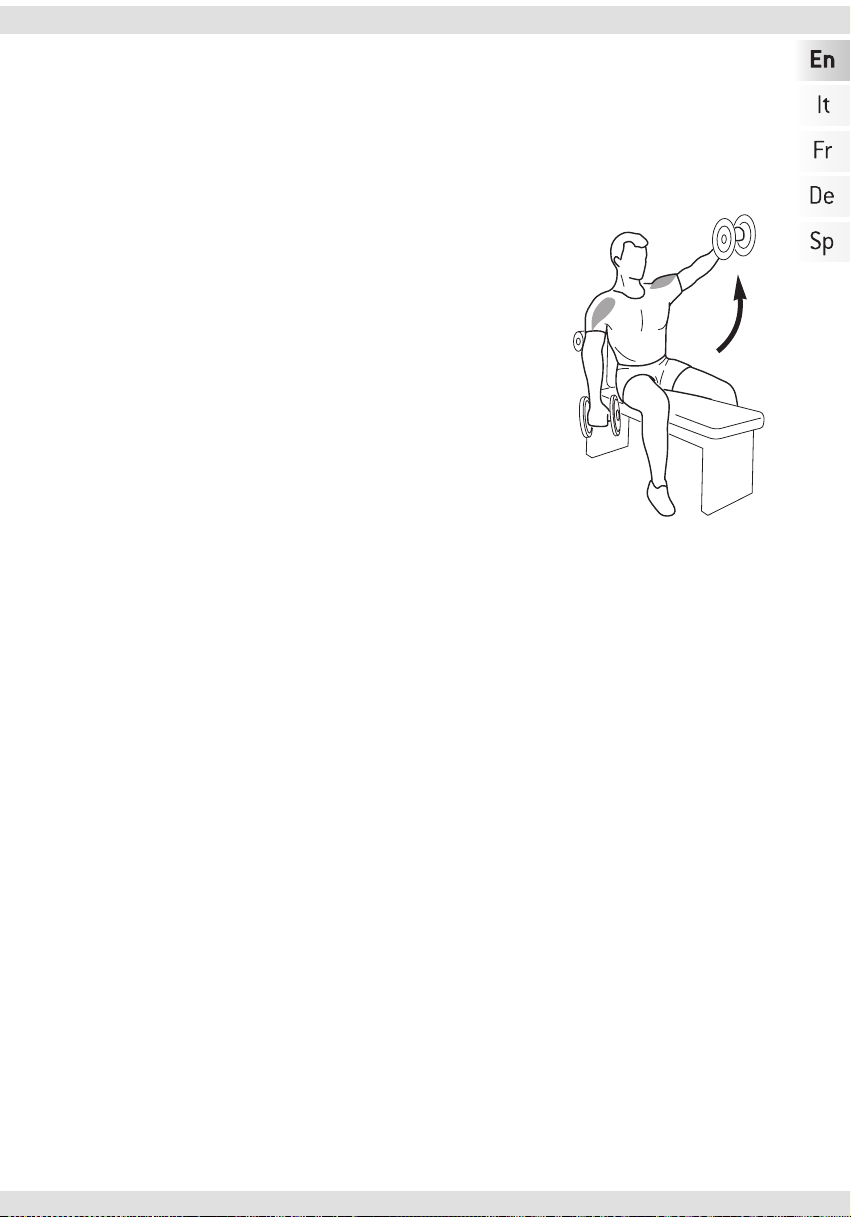
Alternate frontal raises
This exercise isolates the front part of the
shoulders.
Muscles used: front deltoid
Movement:
- position the backrest in the last hole
- sit on the bench, keeping your back firmly
against the backrest
- in the starting position your arms are close
to your torso, perpendicular to the ground;
the palm of your hand is facing backwards
- lift your arm up behind your head, then
return to the starting position; during the
return phase start the movement with your
other arm.
03195026
2.1 Exercises
43
Page 44
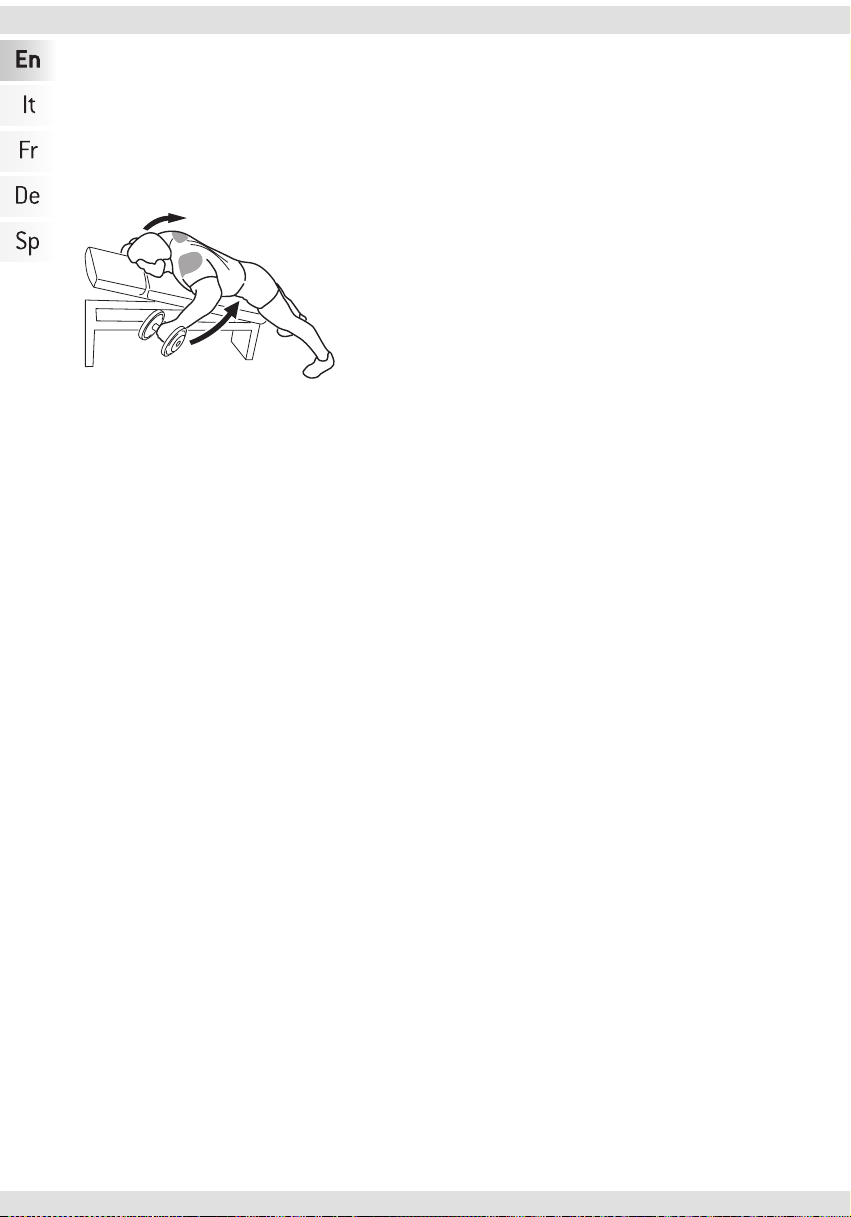
Lateral raise on bench
This exercise works on the rear part of the
shoulders and therefore greatly improves
posture.
Muscles used: rear deltoid
03195027
Movement:
- incline the bench with the handle
- lie down on the bench with your feet on the
ground
- in the starting position your arms are facing
the ground, with your elbows slightly bent
- raise your arms, keeping them in line with
your shoulders; when fully raised the palms
of your hands should be turned towards the
floor
- the elbows must be kept at the same angle
throughout the exercise.
Multipla - User’s manual
44
Page 45
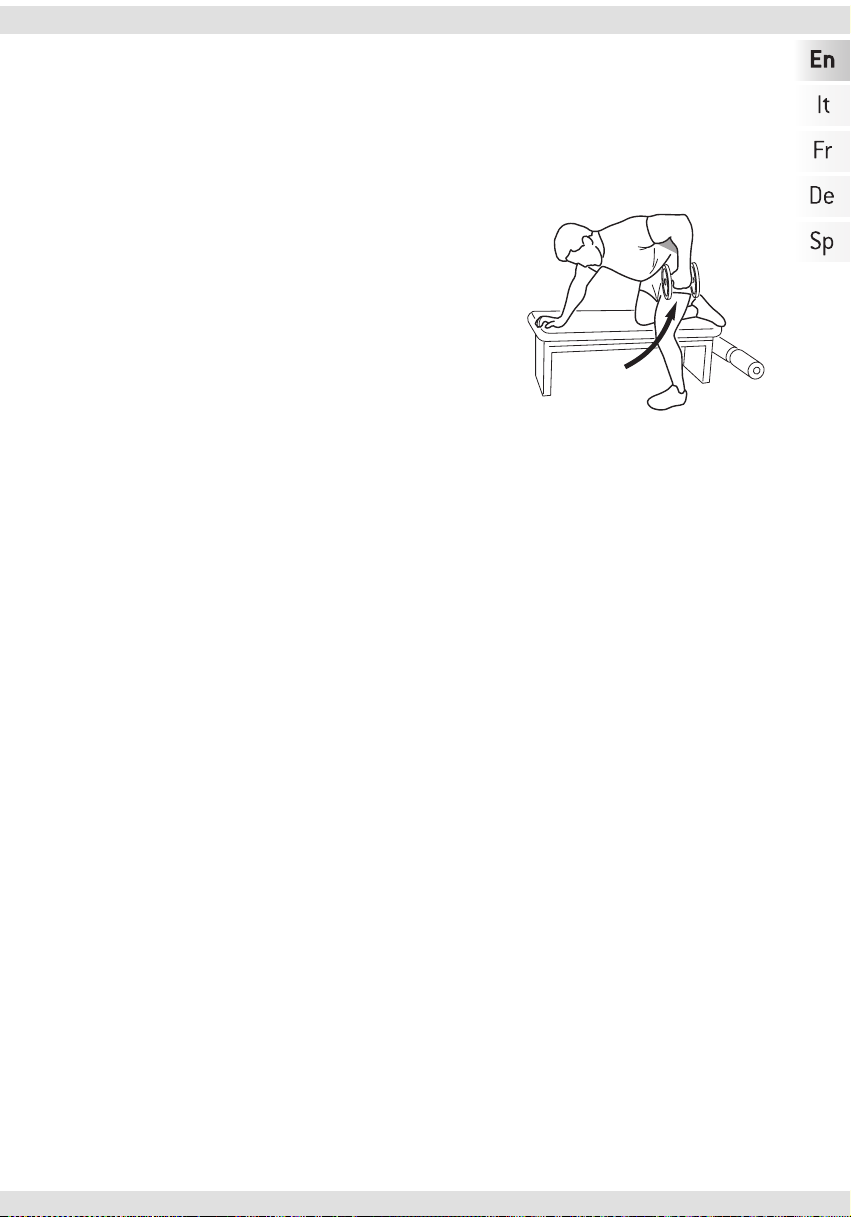
Dumbell bent row
This is an exercise for training the latissimus
dorsi and toning the shoulder blade muscles; it
is an important movement for the correct
alignment of the shoulder joint.
Muscles used: latissimus dorsi, rear deltoid,
rhomboid
Movement:
- bring the bench to the horizontal position
- rest the hand of the arm that is not being
exercised and the knee of the corresponding
leg on the bench, as shown in the figure
- grasp the dumbell with a hammer grip, i.e.
with the palm of your hand turned towards
your body; in the starting position the arm in
question should be perpendicular to the
ground
- pull your arm towards your torso, keeping
your elbow against your body and trying to
move your shoulder back as well; then go
back to the starting position
- repeat the exercise with the other arm.
03195028
2.1 Exercises
45
Page 46
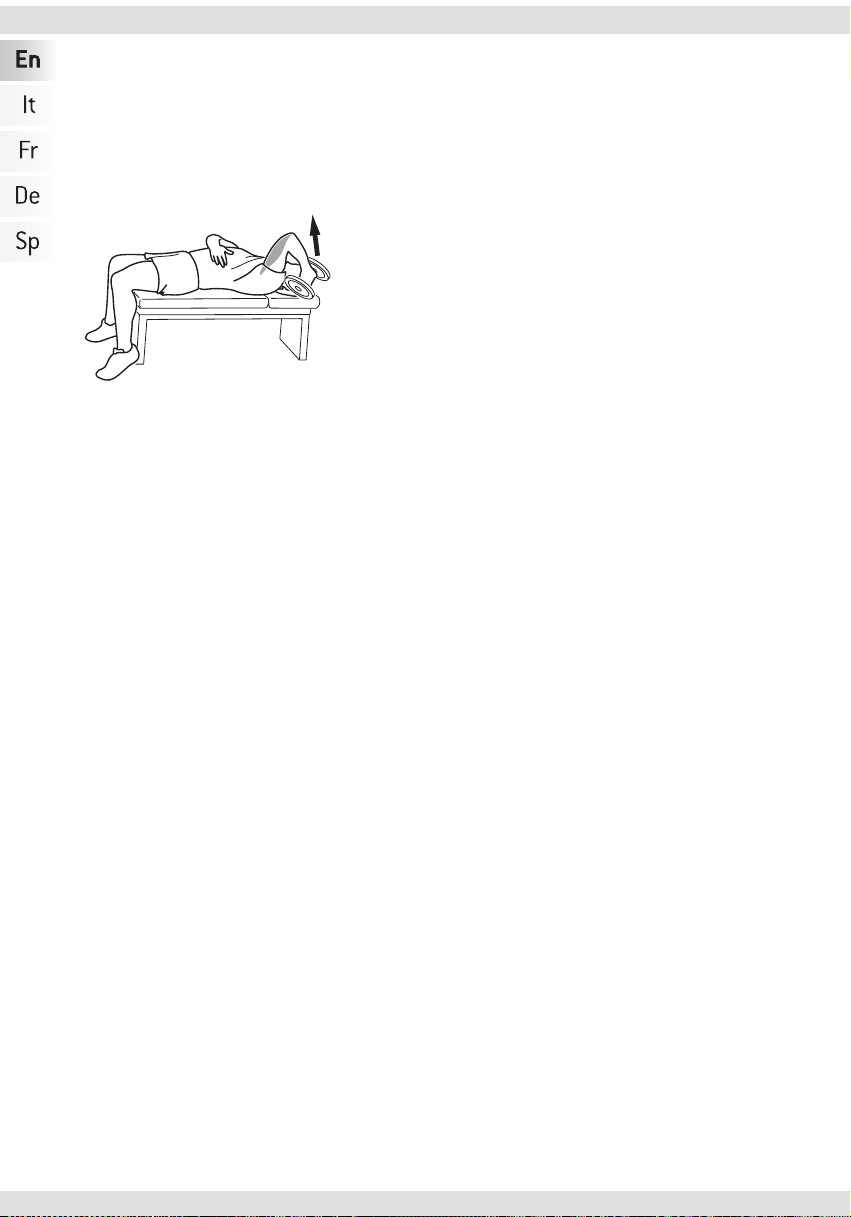
Triceps extension
This is the basic exercise for strengthening the
triceps.
Muscles used: triceps
03195029
Movement:
- grasp the dumbell with a hammer grip, i.e.
with the palm of your hand turned towards
your body and lie down on the bench that is
completely horizontal
- in the starting position your arm should be
fully stretched above your head,
perpendicular to the ground
- curl your forearm without moving the whole
arm, taking the dumbell to behind your neck;
then go back to the starting position
- repeat the exercise with the other arm.
Multipla - User’s manual
46
Page 47
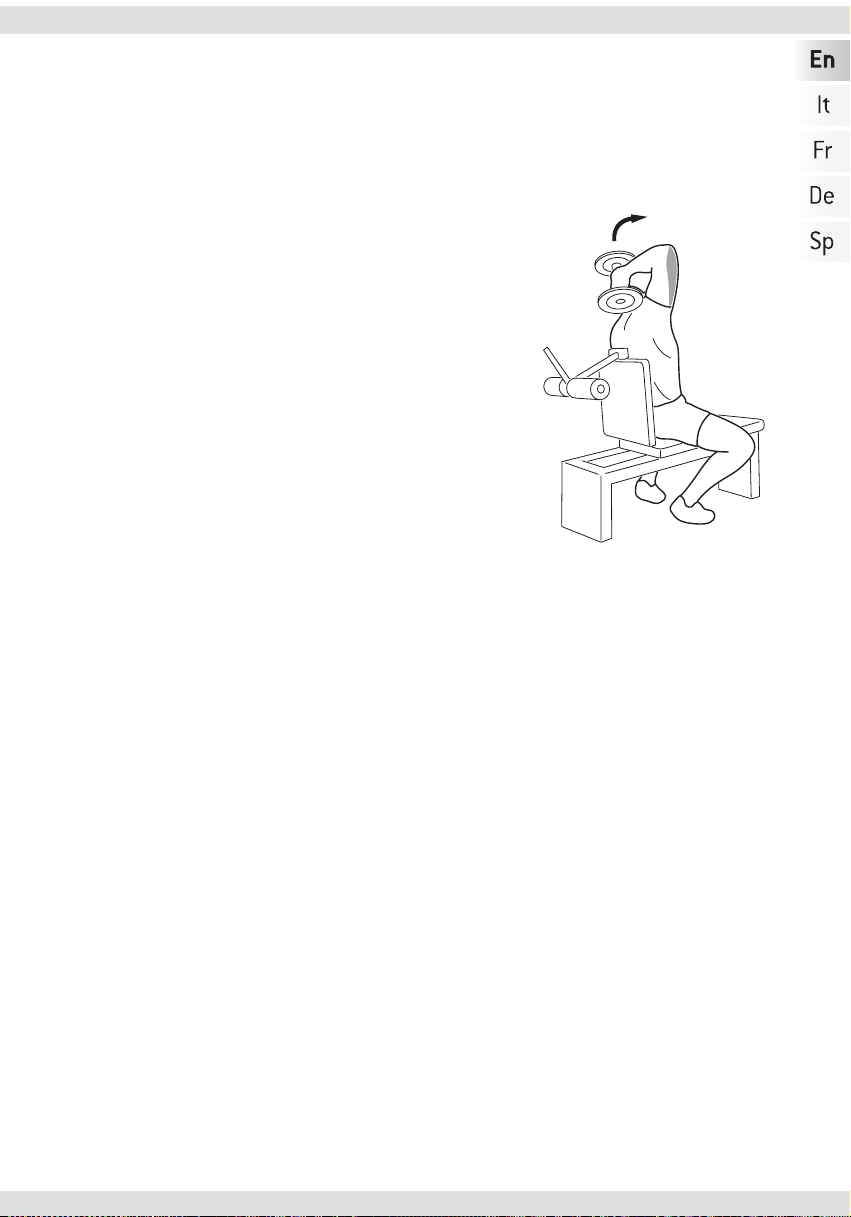
Triceps concentration
This exercise is specifically for the back of the
arm; in this position you can achieve the
maximum extension of the muscle.
Muscles used: triceps
Movement:
- position the backrest in the last hole
- sit on the bench, keeping your back firmly
against the backrest and grasp the dumbell
with one hand
- in the starting position your arm should be
fully stretched above your head,
perpendicular to the ground
- curl your forearm without moving the whole
arm, taking the dumbell to behind your neck;
then go back to the starting position
- repeat the exercise with the other arm.
03195030
2.1 Exercises
47
Page 48
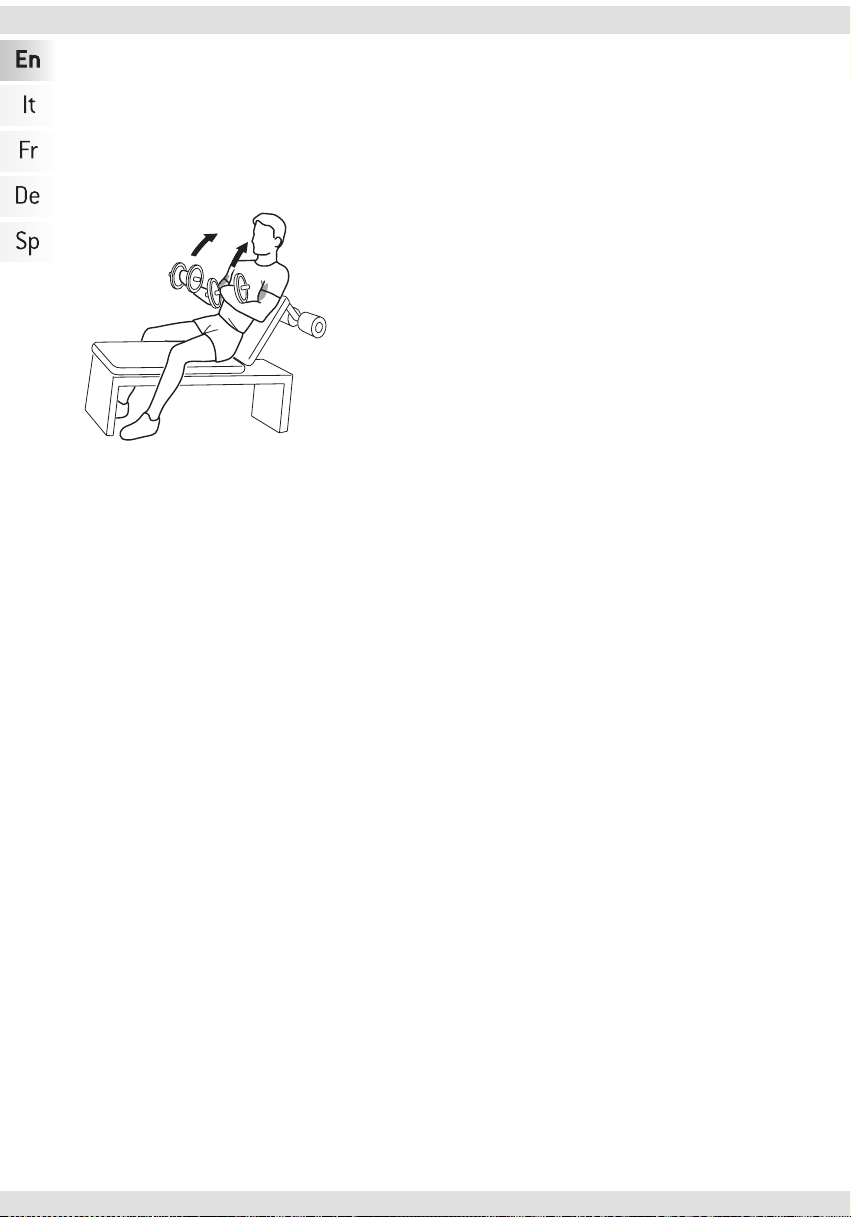
Biceps concentration, seated
This exercise isolates the biceps. Together with
the triceps exercises, it helps to build strong,
balanced arms. Working in a seated position
allows you to train your arm without straining
your back.
Muscles used: biceps
03195031
Movement:
- position the backrest in the third hole
- sit on the bench, keeping your back firmly
against the backrest
- in the starting position your arms should be
perpendicular to the ground, palms forward
- curl your forearm without moving the whole
arm, bringing the dumbell towards your
shoulder
- go back to the starting position with a
controlled movement.
Multipla - User’s manual
48
Page 49
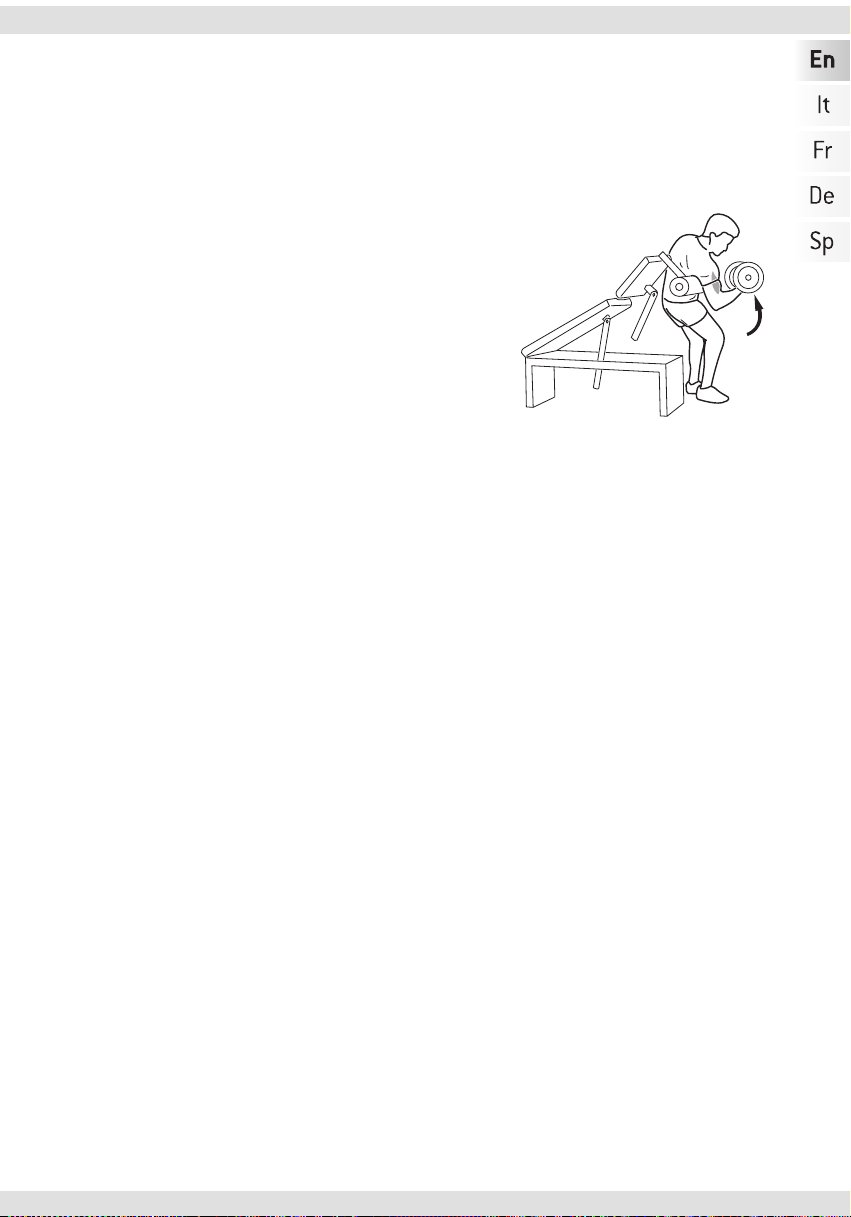
Curl concentration
This is a concentration exercise for the biceps,
that also trains the lowest part of the muscle.
Muscles used: biceps
Movement:
- incline the bench to the fifth hole and the
backrest to the second hole
- grasp the dumbell with the palm of your hand
facing your face
- rest the arm in question on one of the padded
rollers; your body is behind the roller
- curl your forearm without moving the whole
arm, bringing the dumbell towards your
shoulder
- go back to the starting position with a
controlled movement.
03195032
2.1 Exercises
49
Page 50
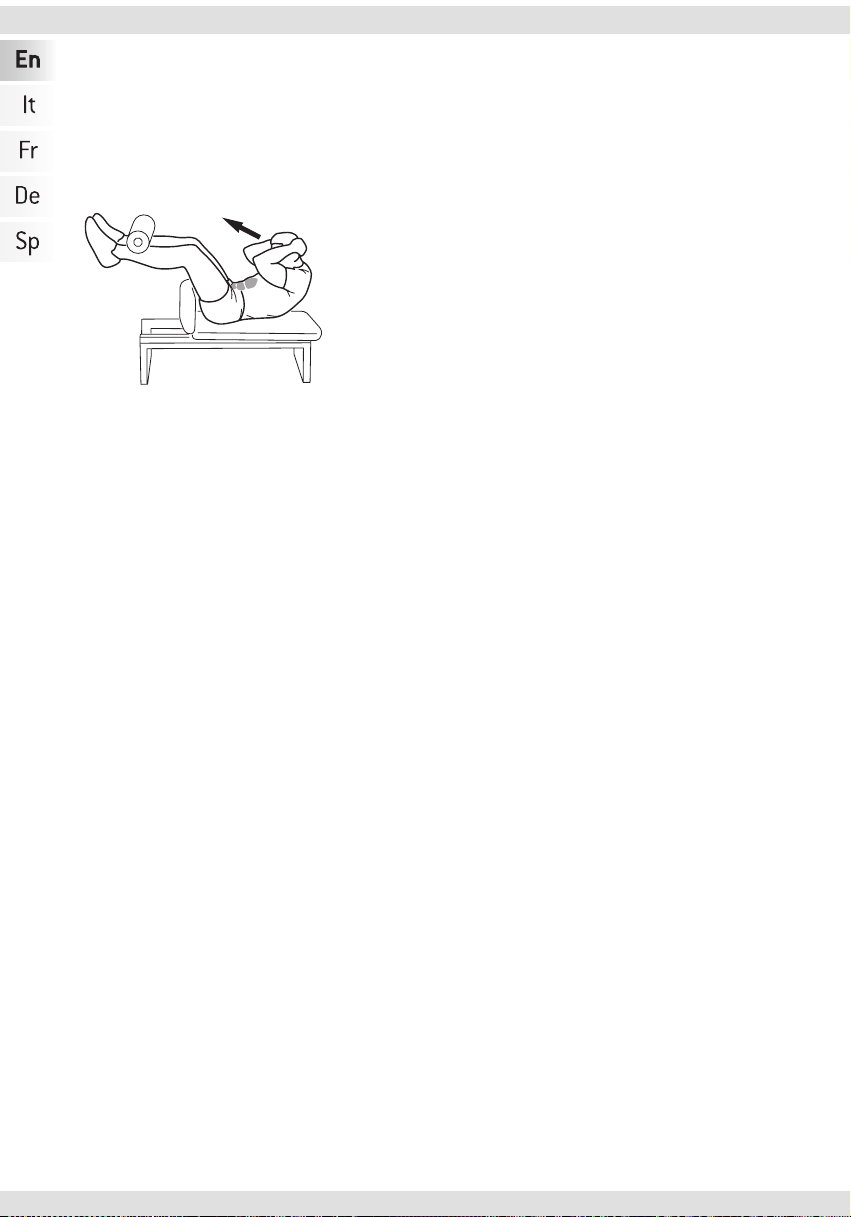
Abdominal crunch
03195033
This is the basic exercise for isolating the rectus
abdominis muscles.
Muscles used: abdominals
Movement:
- position the backrest in the third hole
- lie down on the bench and place your feet
behind the rollers
- curl your chest upwards, keeping your lower
back pressed against the bench
- you can either fold your arms across your
chest or, if the muscles are already trained,
behind your neck.
Multipla - User’s manual
50
Page 51
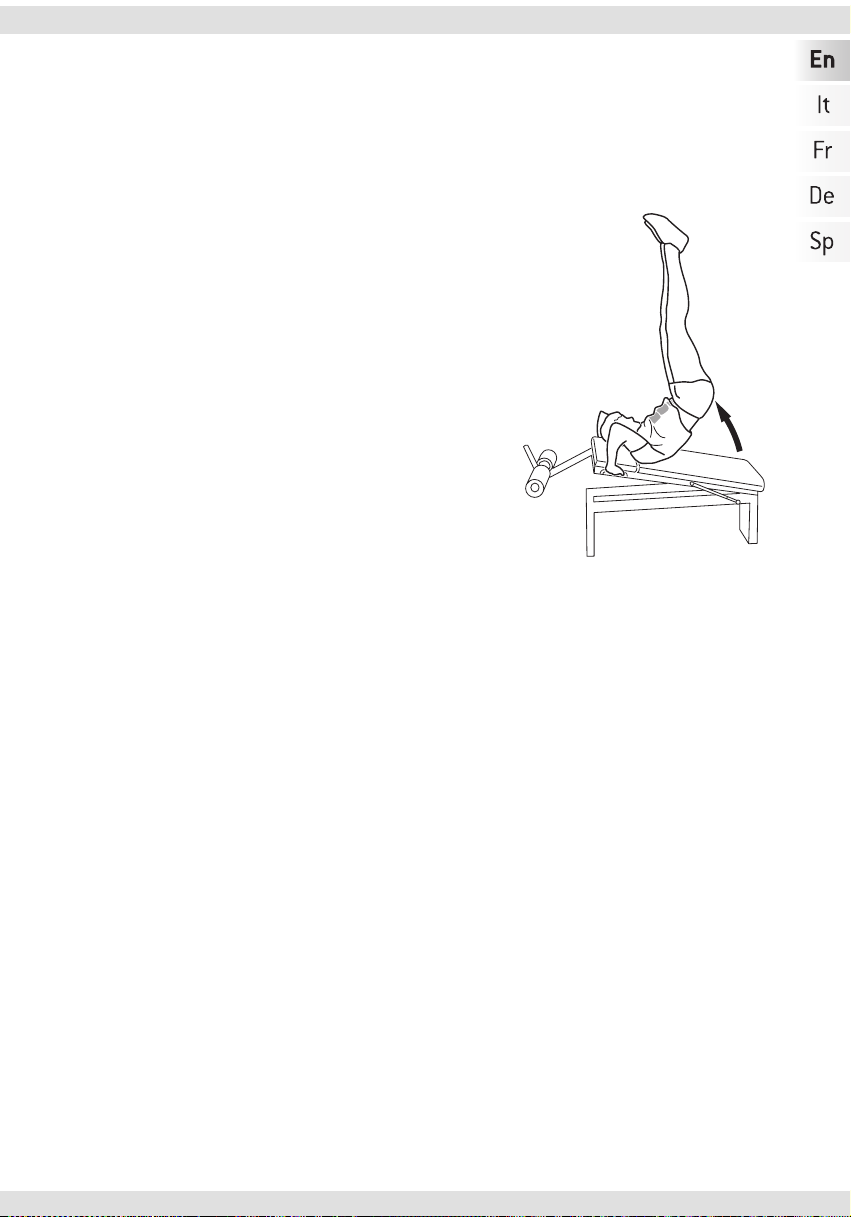
Reverse crunch
This is the basic exercise for isolating the lower
part of the abdomen. The exercise must be
performed by concentrating the maximum
amount of work on the abdomen in a few
repetitions.
Muscles used: abdominals
Movement:
- incline the bench to your liking: the greater
the inclination, the greater the difficulty of
the exercise
- lie down on the bench and grasp the handles,
behind your head
- in the starting position your legs are bent at
right angles in respect to your torso
- lift your pelvis from the bench, keeping your
legs perpendicular to the ground, then return
to the starting position
- to make the exercise easier, bend your knees
up to your chest instead of keeping your legs
straight.
03195034
2.1 Exercises
51
Page 52
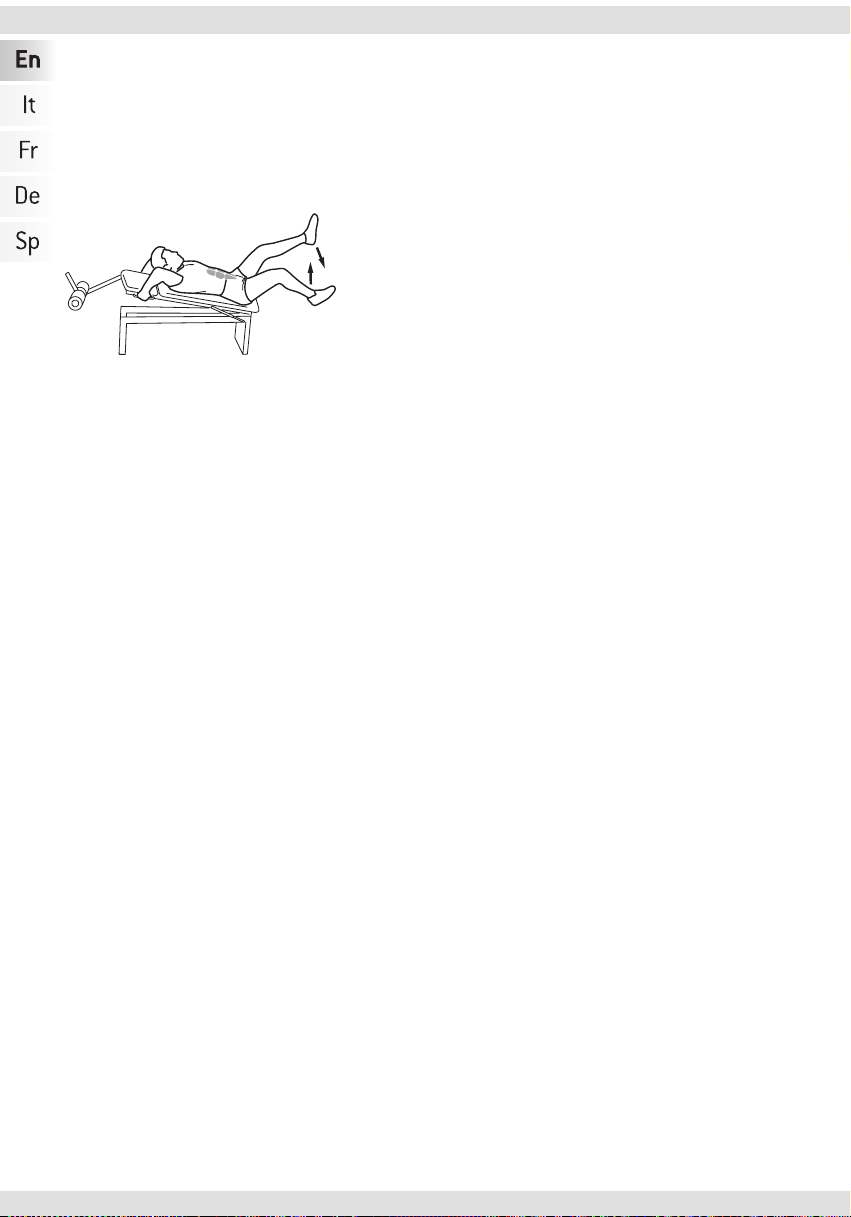
Alternate leg raises
This abdomen exercise involves also the leg
muscles and the hip flexors (ileopsoas).
Muscles used: abdominals
03195035
Movement:
- incline the bench to your liking: the greater
the inclination, the greater the difficulty of
the exercise
- lie down on the bench and grasp the handles
behind your head
- in the starting position your legs are slightly
raised from the bench
- swing your legs alternately to make an arc of
a circumference of around 20/30 cm.
Multipla - User’s manual
52
Page 53
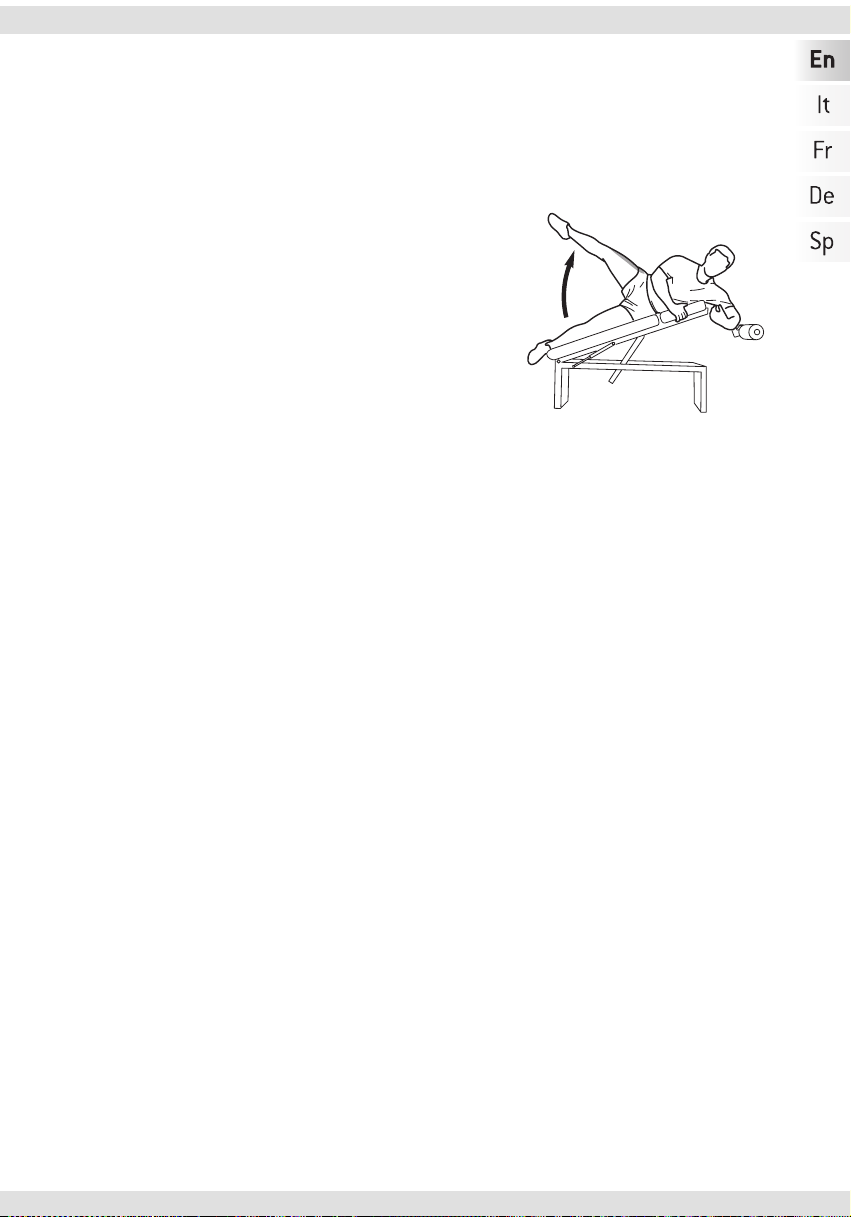
Side leg raise
This exercise isolates the external leg muscles
and is very good for loosening the coxofemoral
joint.
Muscles used: abductor
Movement:
- incline the bench with the handles
- lie down on your side and grasp the handle
in front of you, with the hand of the outside
arm in respect of the bench
- lift your leg upwards with a continuous
movement, without pausing during the
movement
- return to the starting position with a slow
and controlled movement.
03195036
2.1 Exercises
53
Page 54
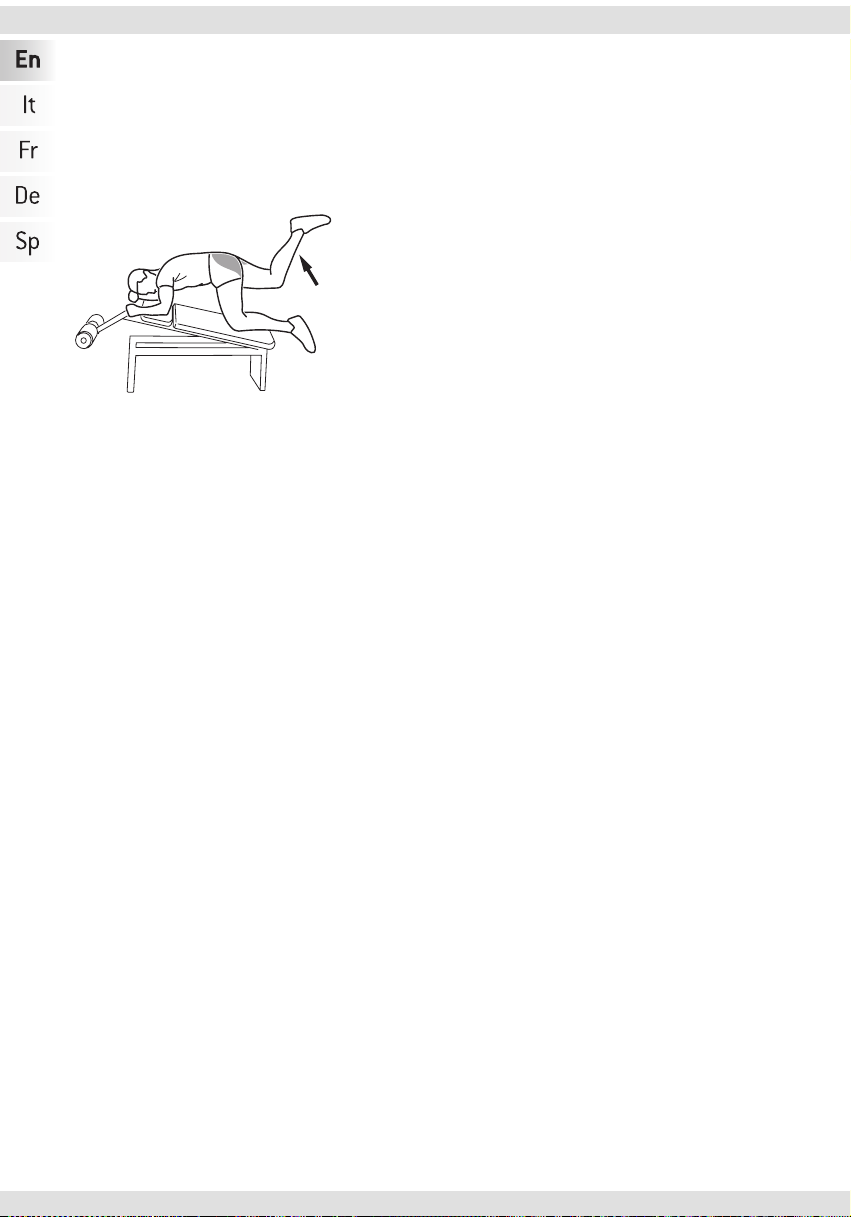
Rear leg pull
This is the basic exercise for training the gluteus
in isolation. The bent elbows position avoids
bending the back excessively.
Muscles used: gluteus and hamstring
03195037
Movement:
- incline the bench to your liking: the greater
the inclination, the greater the difficulty of
the exercise
- position yourself kneeling on the bench with
your elbows bent
- throw your leg back, upwards, keeping it
slightly bent, with a continuous and
controlled movement
- during the exercise make sure that you do
not bend your back in the lumbar area.
Multipla - User’s manual
54
Page 55
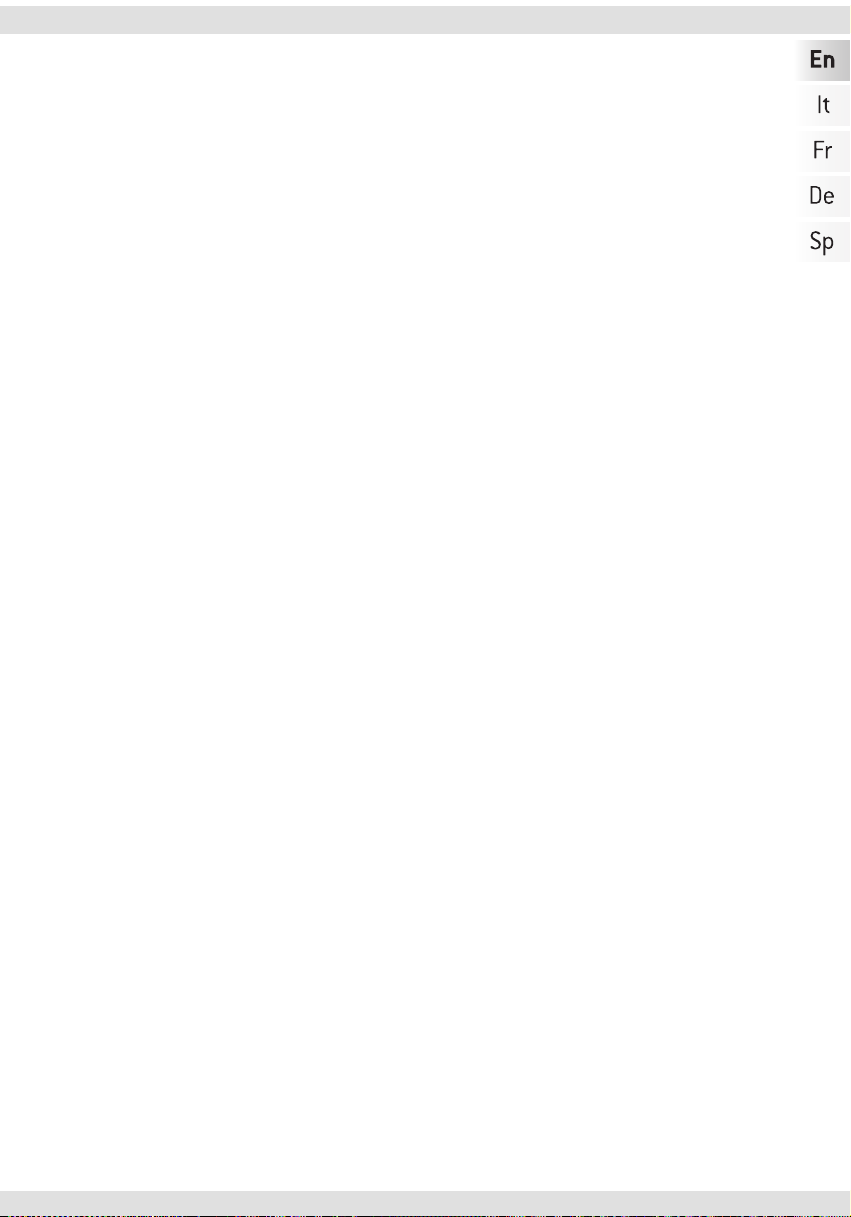
2.2 Stretching
Physical fitness is the result of a balance of three components: cardiovascular
efficiency, strength and flexibility. The type of training which improves muscle
flexibility is called stretching. Stretching reduces muscle tension, gives greater
mobility, helps prevent injury and improves sporting performance and posture.
There are two main methods of performing stretching exercises: isolation and
integration. Isolation exercises are those more commonly used and target a
single muscle at a time; integration exercises require the assistance of an
instructor and consist of special postures which stretch an entire “chain” of
muscles rather than a single muscle at a time.
To perform isolation exercises properly, study the illustration carefully and
make sure all the parts of your body are positioned correctly. Correct stretching
technique involves gradually reaching the point where you feel tension,
concentrating your attention on the muscles that are being stretched.
The main factors affecting muscle flexibility are the intensity and duration of
the stretching exercise. Low intensity stretching for longer periods gives more
lasting results (plastic deformations). You should also be careful about how
quickly you get into position: an overly abrupt movement may stimulate a
defense reflex, which can cause micro-tears in the muscle fibres, resulting in
the scarring of the muscle tissue and loss of flexibility.
Never “bounce” during a stretching exercise, or stretch to the point of extreme
pain.
For the first two weeks you are recommended to repeat each illustrated
movement twice, 15 seconds each time; then increase the stretching time by
5 seconds a week until you get to 45 seconds. Your breathing should be slow,
regular and controlled; do not hold your breath during stretching.
2.2 Stretching
55
Page 56
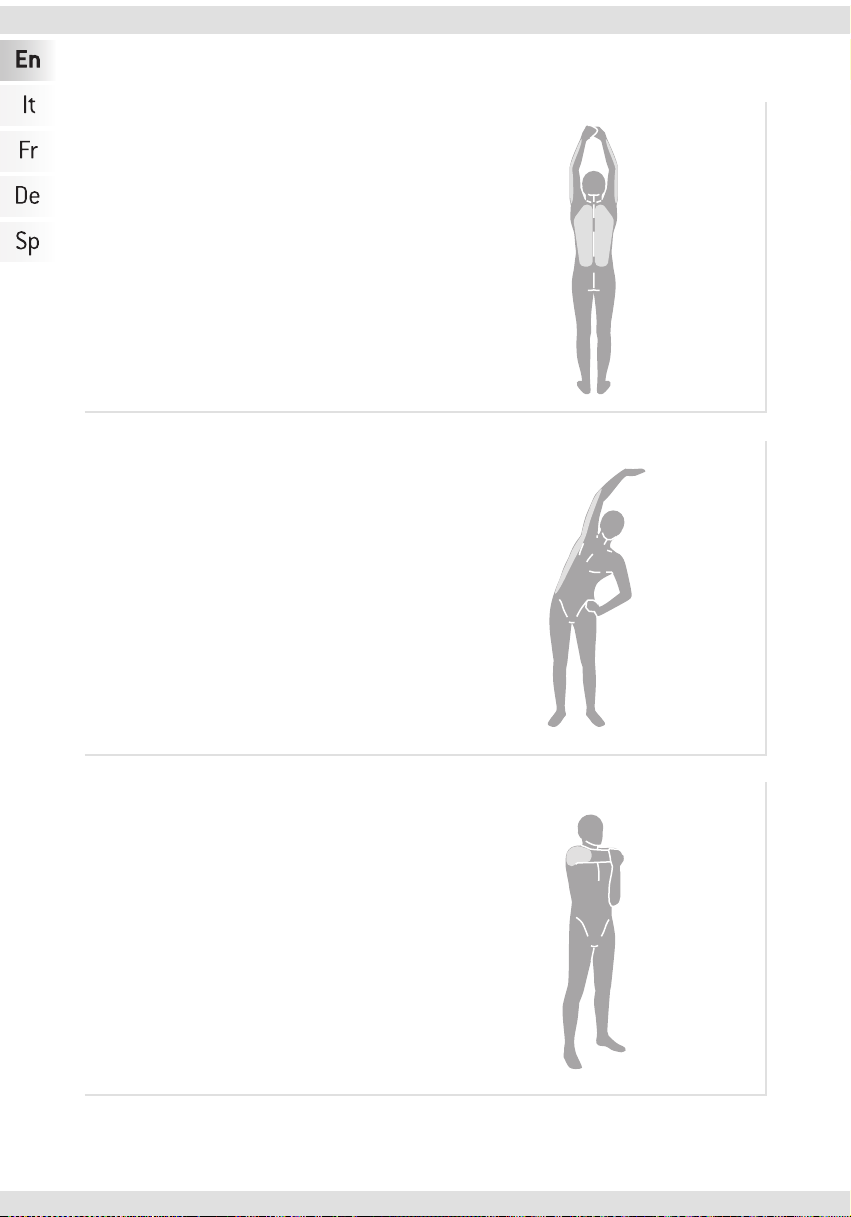
Latissimus dorsi
Musculus obliquus
00871051
Deltoids
Multipla - User’s manual
56
00871052
00871053
Page 57
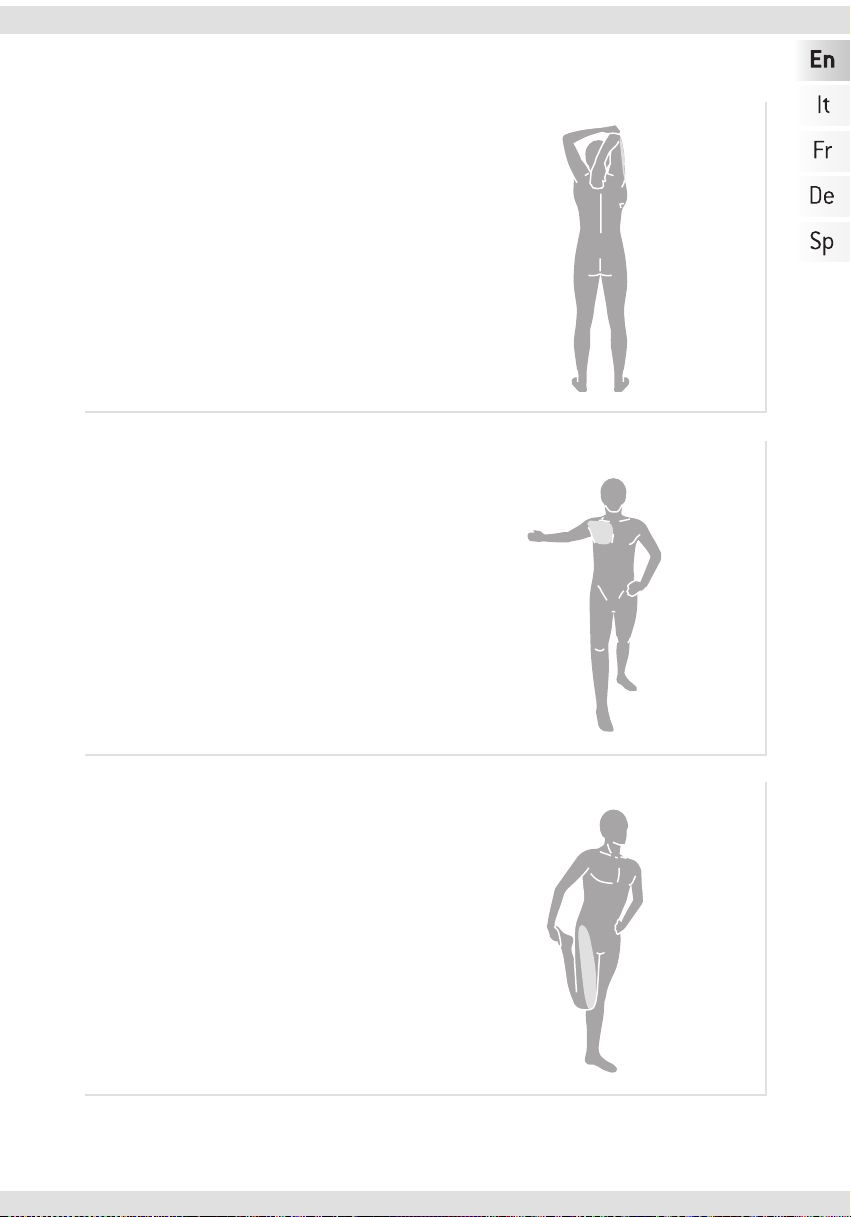
Triceps
Pectorals
00871054
Quadriceps
00871055
00871056
2.2 Stretching
57
Page 58
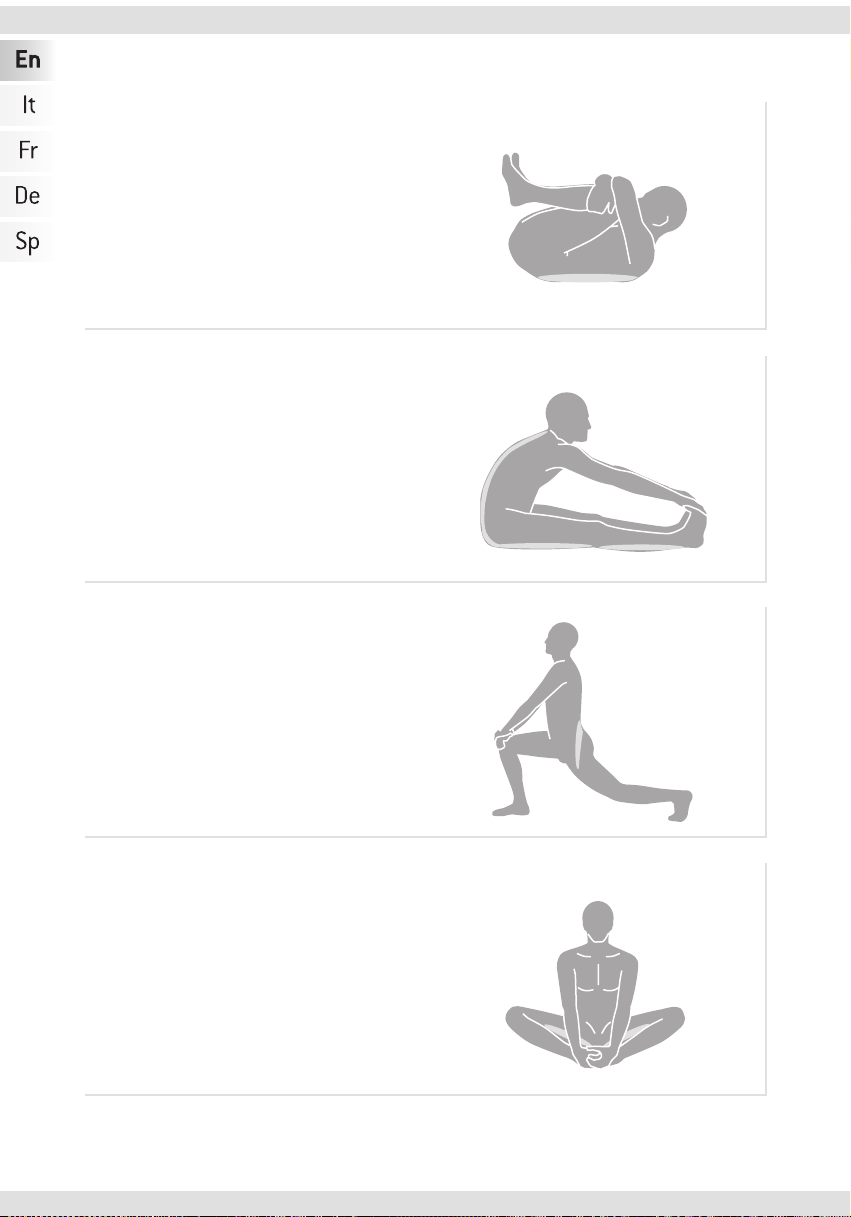
Lower back (erector spinae)
Posterior muscles
Hip flexors (iliopsoas)
00871057
00871058
Hip adductors
Multipla - User’s manual
58
00871059
00871060
Page 59
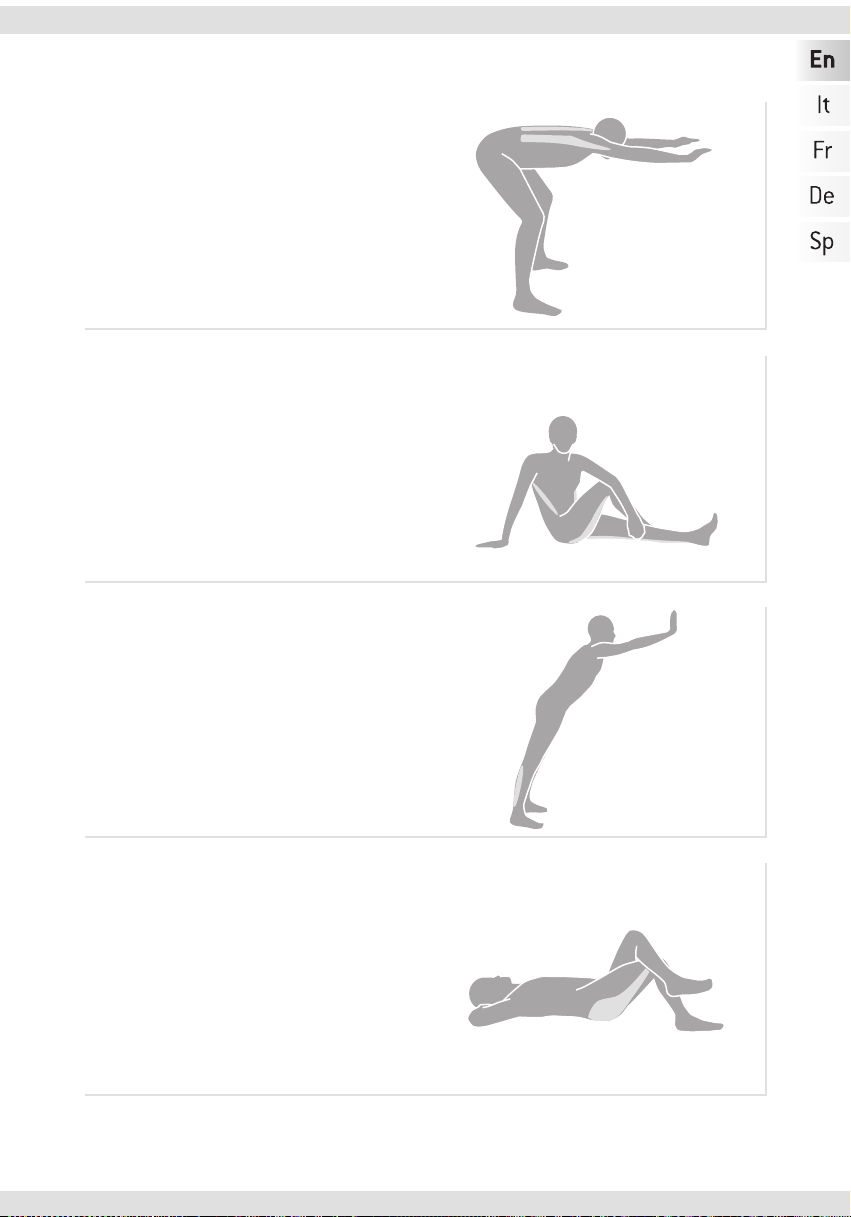
Latissimus dorsi
Hamstring and abductors
Calves
00871061
00871062
Thigh abductors
00871063
00871064
2.2 Stretching
59
Page 60
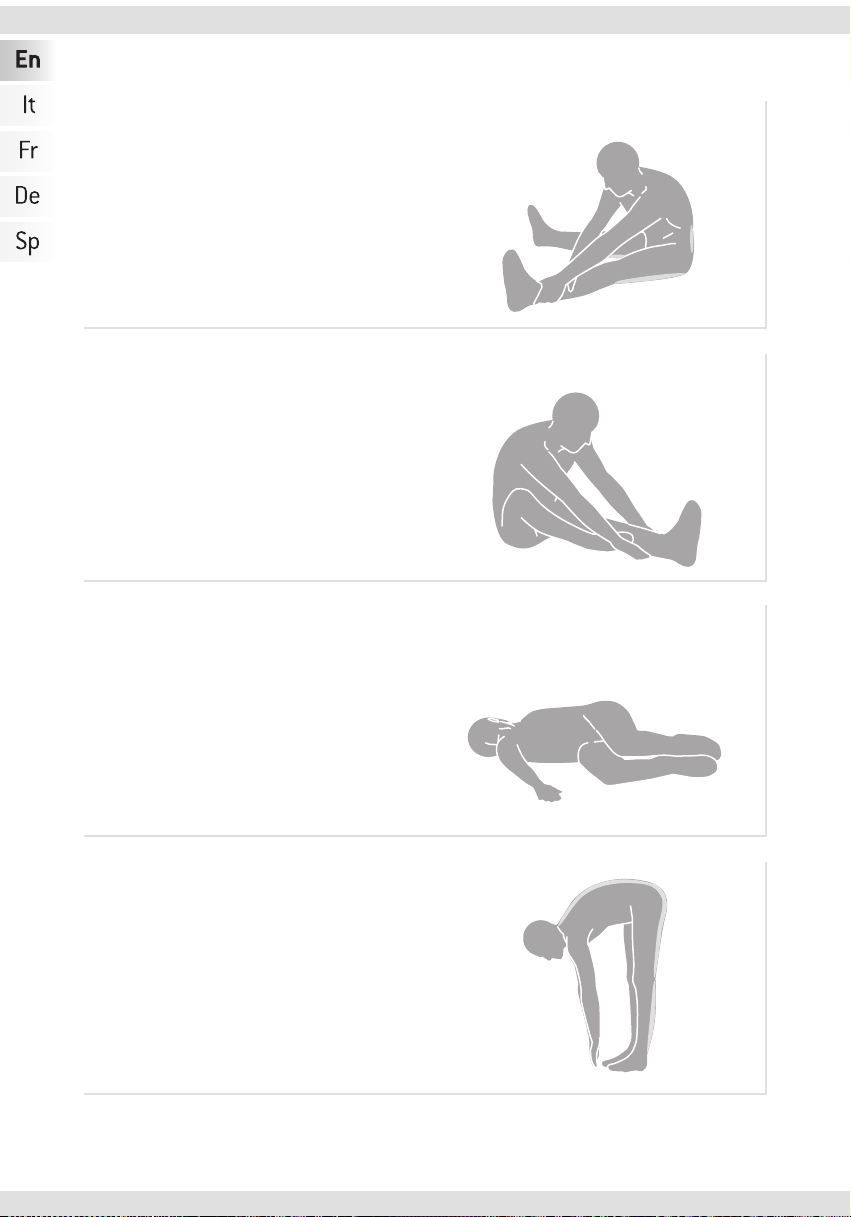
Adductors
Hamstring
Lumbar (spinal column)
01478012
01478013
Hamstring
Multipla - User’s manual
60
00871071
00871072
Page 61
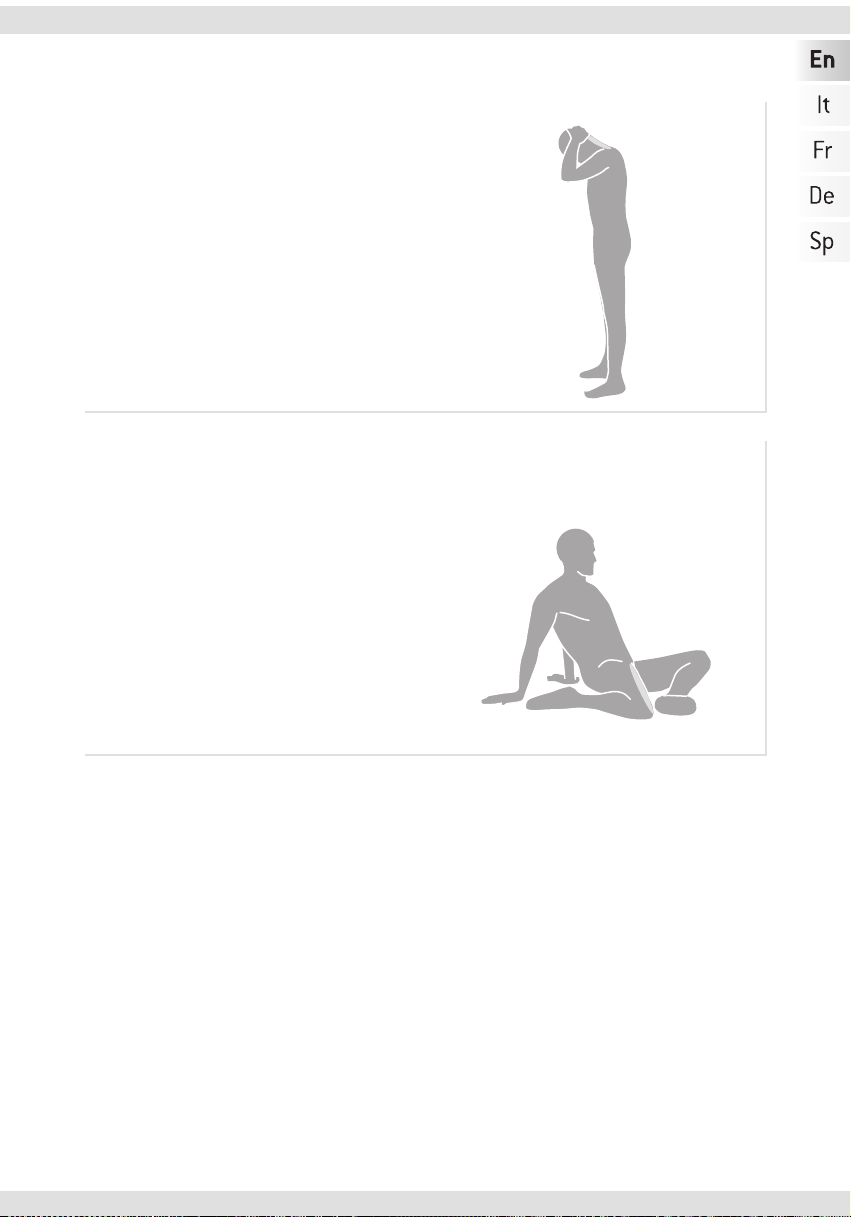
Paravertebrals
Quadriceps
00871073
00871074
2.2 Stretching
61
Page 62

Page 63
Manuale per l’utente
Indice
Introduzione ................................................................................................ 65
Importanti istruzioni di sicurezza ............................................................. 66
Sicurezza personale .................................................................................... 67
1 Informazioni tecniche ..................................................................... 68
1.1 Identificazione del costruttore e dell’attrezzo .................................... 68
1.2 Descrizione dell’attrezzo ......................................................................... 69
1.2.1 Dati tecnici ................................................................................................. 69
1.2.2 Componenti principali .............................................................................. 70
1.2.3 Accessori .................................................................................................... 72
1.3 Installazione e imballo .............................................................................. 77
1.3.1 Descrizione dell’imballo............................................................................77
1.3.2 Sollevamento e trasporto del materiale imballato................................77
1.3.3 Ambiente di installazione......................................................................... 78
1.3.4 Disimballo ................................................................................................... 78
1.3.5 Montaggio ...................................................................................................79
1.4 Manutenzione ........................................................................................... 80
1.4.1 Manutenzione ordinaria .......................................................................... 80
1.4.2 Assistenza tecnica ................................................................................... 81
1.5 Immagazzinamento ................................................................................. 82
1.6 Smaltimento .............................................................................................. 82
Indice
63
Page 64
2 Usare Multipla ................................................................................. 83
2.1 Esercizi ....................................................................................................... 83
Braccia: estensioni....................................................................................83
Petto: distensioni ..................................................................................... 84
Petto: distensioni su panca inclinata .....................................................85
Spalle: distensioni .................................................................................... 86
Spalle: trazioni al mento ........................................................................... 87
Dorso: rematore ........................................................................................ 88
Dorso: trazioni dietro ............................................................................... 89
Dorso: trazioni avanti ............................................................................... 90
Dorso: trazioni avanti con presa inversa ............................................... 91
Gambe: estensioni ................................................................................... 92
Gambe: flessioni ....................................................................................... 93
Polpacci: estensioni ................................................................................. 94
Squat.......................................................................................................... 95
Gambe: stacchi da terra .......................................................................... 96
Petto: adduzioni ........................................................................................97
Petto: adduzioni su panca inclinata ...................................................... 98
Petto: pull over .......................................................................................... 99
Deltoidi: alzate laterali ........................................................................... 100
Deltoidi: alzate frontali alternate...........................................................101
Deltoidi: alzate laterali a 90° ................................................................... 102
Dorso: rematore .......................................................................................103
Braccia: flessioni per i tricipiti, disteso ............................................... 104
Braccia: flessioni per i tricipiti, seduto ................................................ 105
Braccia: flessioni per i bicipiti, seduto................................................. 106
Braccia: flessioni per i bicipiti, in piedi .................................................107
Addominali: flessioni del busto ............................................................ 108
Addominali: crunch inverso ................................................................. 109
Gambe: flesso-estensioni alternate ..................................................... 110
Gamba: abduzioni ...................................................................................111
Gamba: slanci posteriori ........................................................................ 112
2.2 Stretching ................................................................................................ 113
Multipla - Manuale per l’utente
64
Page 65
Introduzione
Il presente manuale, scritto nella lingua originale del costruttore e poi tradotto
nella lingua del Paese di utilizzo, è parte integrante di MULTIPLA, a cui dovrà
sempre restare unito; anche in caso di trasloco o passaggio di proprietà il
manuale dovrà accompagnare l’attrezzo.
Il manuale deve essere conservato in un luogo noto e accessibile, protetto da
umidità e calore.
Il testo descrive le operazioni di installazione, trasporto e manutenzione e
contiene preziose informazioni e utili suggerimenti sui metodi di allenamento;
rappresenta quindi una guida sia per l’utente professionale sia per il principiante.
Alcuni simboli fungeranno da guida nella lettura del manuale:
Avvertenze
Evidenzia informazioni importanti, che non devono sfuggire.
!
Attenzione
Evidenzia le regole da seguire scrupolosamente per non creare situazioni di pericolo per l’uomo o l’attrezzo.
i
Informazioni
Evidenzia le soluzioni ai dubbi più comuni.
Prima di procedere a qualsiasi operazione si raccomanda
una lettura attenta del manuale in ogni sua parte
Introduzione
65
Page 66
Importanti istruzioni
di sicurezza
Leggere tutte le istruzioni prima di usare Multipla. Queste istruzioni sono state
compilate per garantire la sicurezza dell’utente e proteggere l’attrezzo.
Multipla è destinata a un uso domestico.
AVVERTENZE
Per ridurre il rischio di danni alle persone adottare le seguenti precauzioni:
- Multipla può essere usata da o vicino bambini, invalidi o disabili solo con
un’accurata supervisione.
- Usare Multipla esclusivamente per gli scopi prescritti nel presente manuale; effettuare solamente gli esercizi previsti per questo tipo di attrezzo, nei
modi e alle condizioni indicati nel presente manuale. Non usare accessori
non consigliati dal produttore.
- Non portare le mani in prossimità delle parti in movimento.
- Non usare all’aperto; non lasciare l’attrezzo all’esterno, esposto agli agenti
atmosferici; non esporre l’attrezzo a getti d’acqua.
CONSERVARE LE PRESENTI ISTRUZIONI
Multipla - Manuale per l’utente
66
Page 67
Sicurezza personale
Non utilizzare l’attrezzo in presenza di bambini o animali domestici.
Montare completamente Multipla prima di usarla. Controllare l’attrezzo prima
di ogni uso. Non continuare a usare Multipla, se non funziona correttamente.
Montare e azionare Multipla su una superficie solida e a livello.
Non usare accessori non consigliati dal produttore, perché potrebbero provocare danni.
Mantenere Multipla in buone condizioni operative. Prima di ogni uso verificare
il corretto posizionamento del cavo nelle gole di tutte le carrucole e lo stato di
usura del cavo e dei moschettoni. Se si notano segni di usura, interpellare il
Servizio di Assistenza Tecnica di Technogym.
Non tentare di eseguire su Multipla operazioni di manutenzione diverse da
quelle riportate nel presente manuale.
All’inizio di ogni esercizio posizionarsi correttamente sull’attrezzo, prestando
attenzione ai componenti che possono costituire ostacolo.
Durante l’allenamento, indossare abbigliamento e scarpe idonei; escludere
abbigliamento largo. Legare in una coda i capelli lunghi. Tenere indumenti o
asciugamani lontani dalle parti in movimento.
Impostare l’allenamento in funzione delle proprie caratteristiche fisiche e del
proprio stato di salute, iniziando con carichi non impegnativi.
Non sovraffaticarsi né lavorare fino allo sfinimento. In caso di dolore o sintomi
anomali, sospendere immediatamente l’allenamento e consultare il medico.
Sicurezza personale
67
Page 68
1 Informazioni
tecniche
1.1 Identificazione del costruttore
e dell’attrezzo
L’etichetta che identifica l’attrezzo, con numero di serie e codice a barre, si
trova dietro il telaio, in alto.
A Nome e indirizzo del costruttore
B Marcat ura CE di conformità
C Numero di serie
D Avver tenze
Multipla - Manuale per l’utente
68
Page 69
1.2 Descrizione dell’attrezzo
1.2.1 Dati tecnici
Larghezza 850 mm (33 inch)
Lunghezza 1210 mm (48 inch)
Altezza 2050 mm (81 inch)
Peso dell’attrezzo 120 kg (265 lb)
i
Informazioni
L’attrezzo, per poter essere utilizzato al pieno dei suoi accessori, richiede lo spazio necessario all’utente per lo svolgimento degli esercizi.
1.2 Descrizione dell’attrezzo
69
Page 70
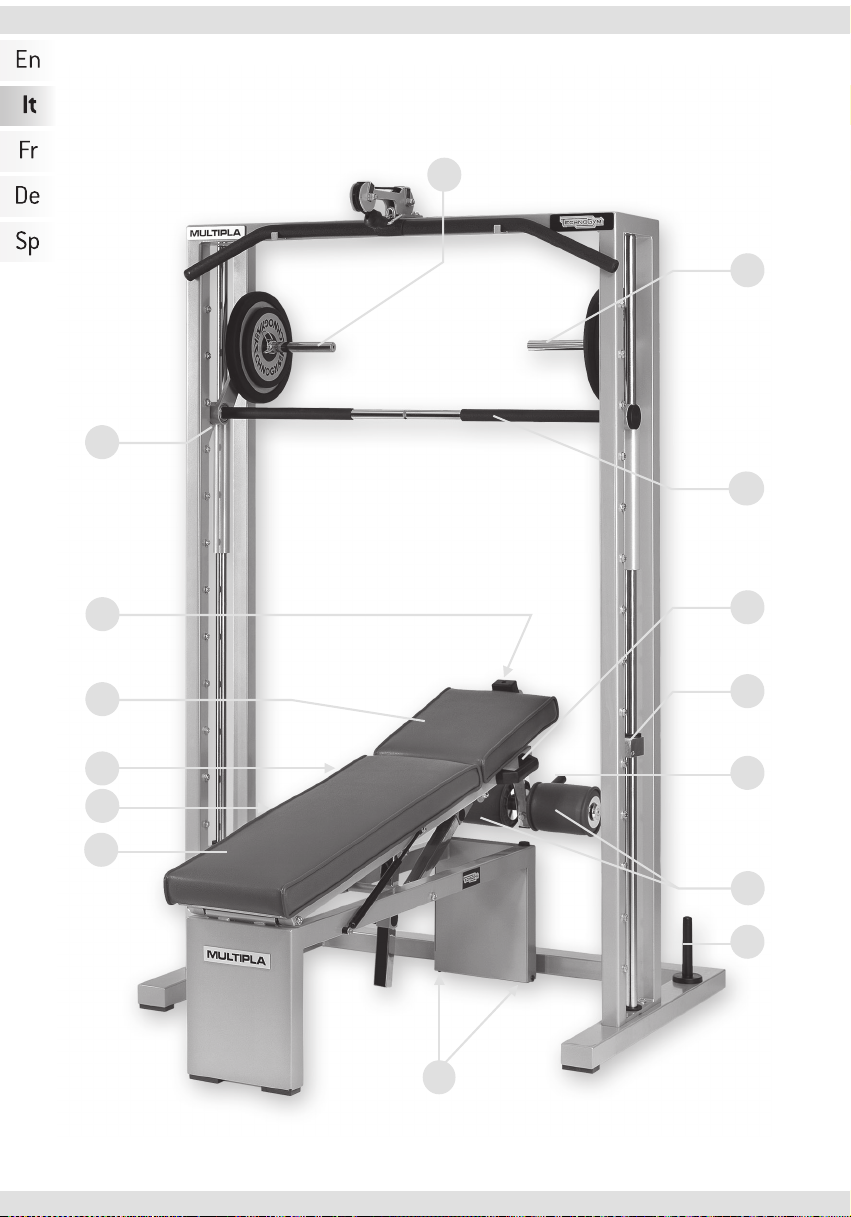
1.2.2 Componenti principali
8
9
9
7
12
2
14
13
1
Multipla - Manuale per l’utente
70
3
10
6
5
11
4
foto_componenti principali_grigio
Page 71
1 - panca, con inclinazione regolabile per mezzo del pomello a scatto (13 )
2 - schienale imbottito, regolabile per mezzo del pomello a scatto (14)
3 - maniglie, utili per inclinare la panca e per eseguire gli esercizi per gli
addominali
4 - ruote per il trasporto della panca
5 - rulli imbottiti per le gambe
6 - perno per l’inserimento dei dischi tra i rulli imbottiti, per esercizi come
flessioni ed estensioni delle gambe
7 - bilanciere
8 - ganci per bloccare e sbloccare il bilanciere sui supporti; sono manovra-
ti con la rotazione del polso
9 - perni per l’inserimento dei dischi sul bilanciere
10 - fermi di sicurezza, per selezionare il punto più basso a cui può arrivare
il bilanciere
11 - perni portadischi
12 - fermo per regolare la posizione dei rulli
1.2 Descrizione dell’attrezzo
71
Page 72
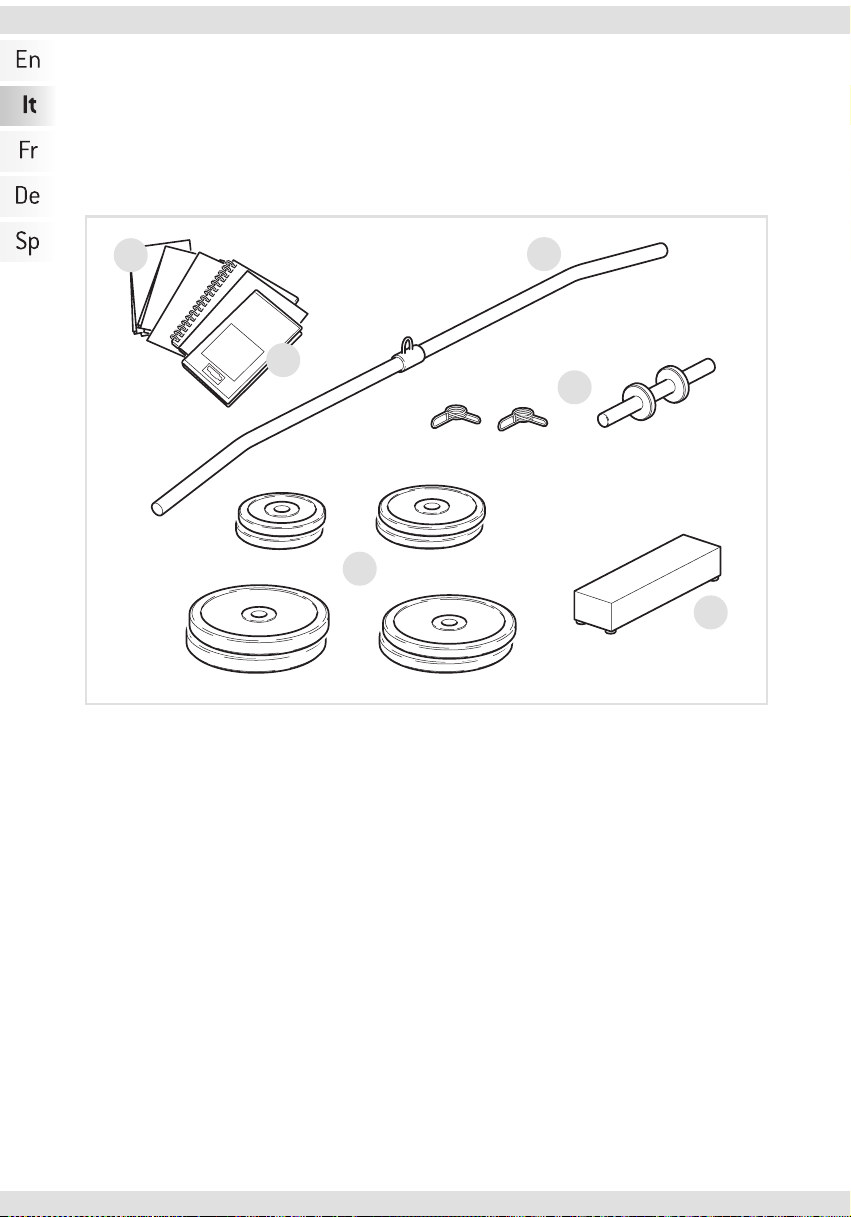
1.2.3 Accessori
In dotazione con l’attrezzo sono forniti i seguenti accessori:
20
16
19
17
15
15 - dischi in acciaio gommato, da 10 kg , 5 kg, 2,5 kg, 1,25 kg
16 - barra lat
17 - manubri, con appositi ganci di sicurezza per i dischi
18 - rialzo, per l’esercizio dello squat e l’estensione dei polpacci
19 - manuale per l’utente
20 - certificato di garanzia
18
03195001
72
Multipla - Manuale per l’utente
Page 73
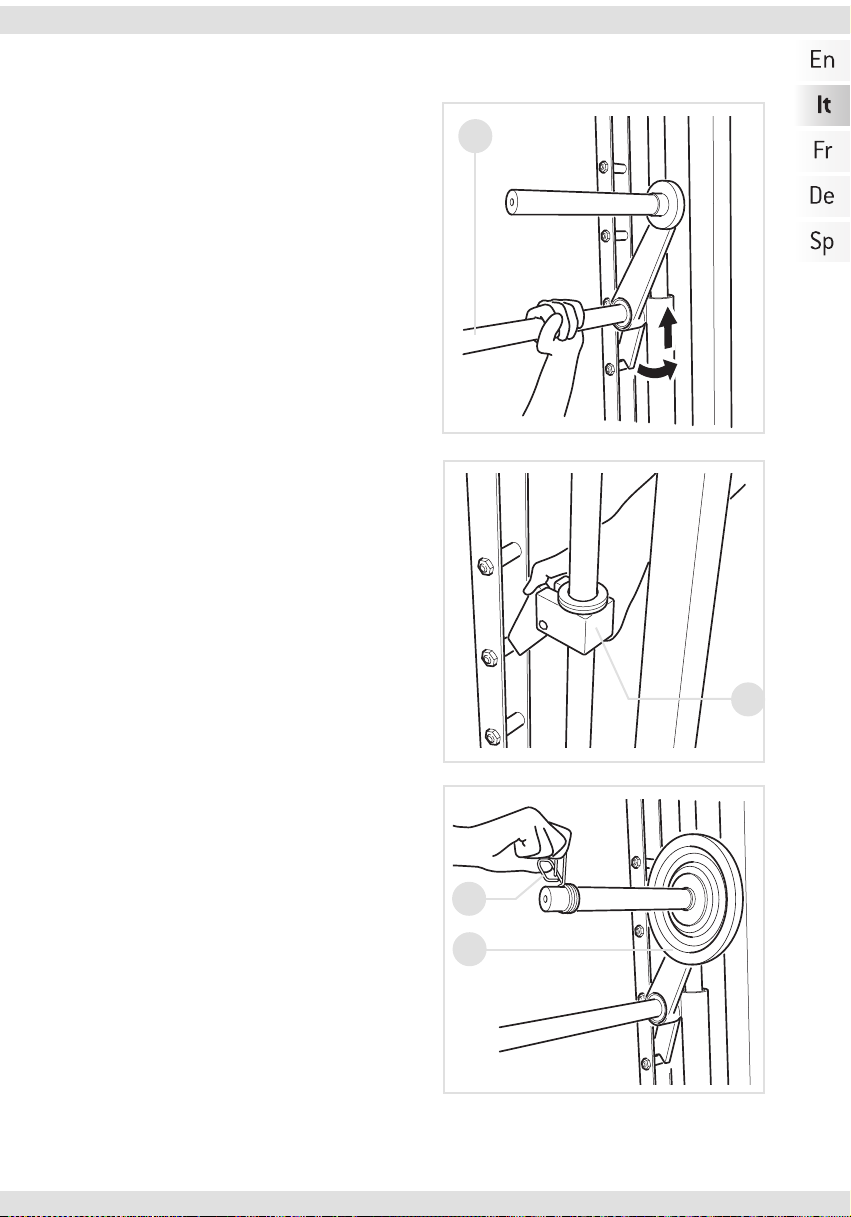
Sgancio e aggancio del bilanciere (7)
Inserimento dei fermi di sicurezza del
bilanciere (10 )
7
03195002
10
Inserimento dei dischi (15) e del gan-
cio di sicurezza (17) nel bilanciere
17
15
03195004
03195003
1.2 Descrizione dell’attrezzo
73
Page 74
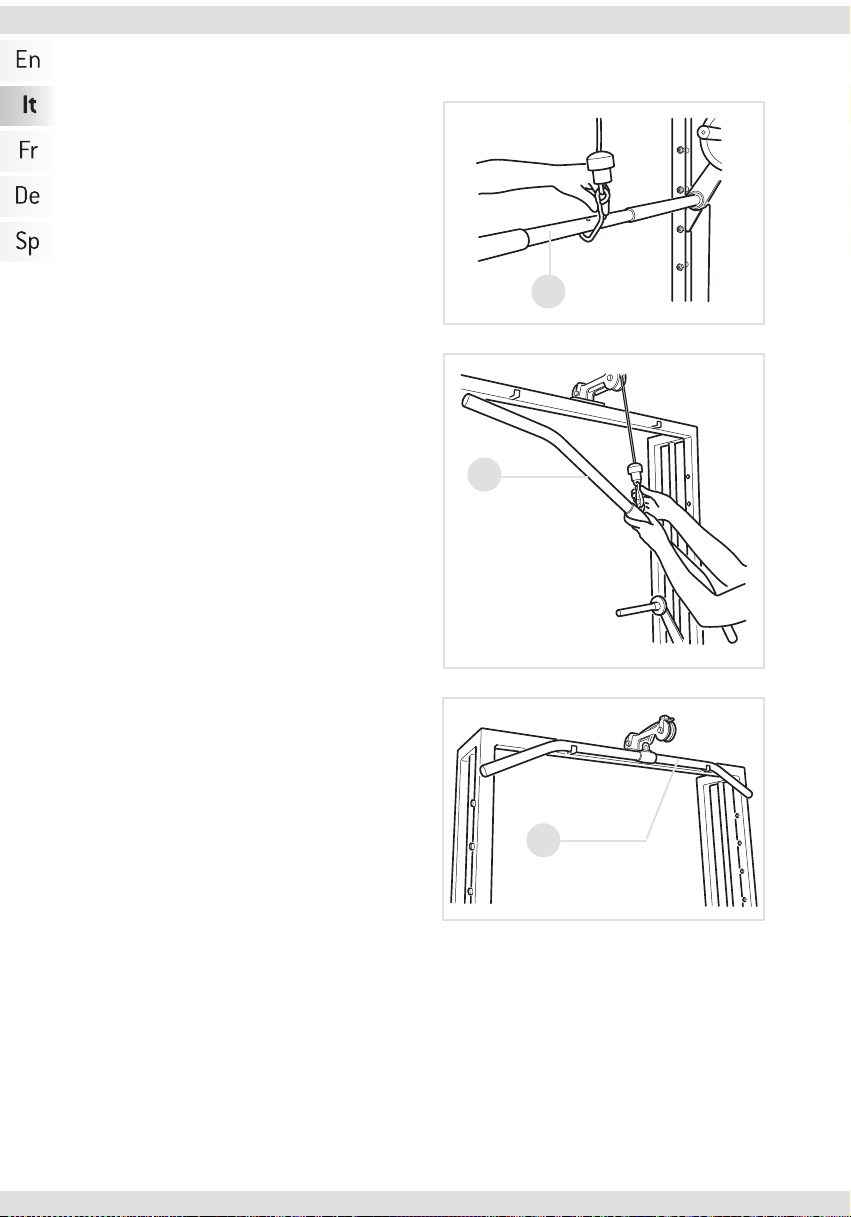
Aggancio del cavo al bilanciere (1), per
l’uso della barra lat (16)
Montaggio della barra lat (16 ) al cavo
alto
Inserimento della barra lat (16) negli
appositi supporti
03195005
16
03195006
1
03195007
16
Multipla - Manuale per l’utente
74
Page 75
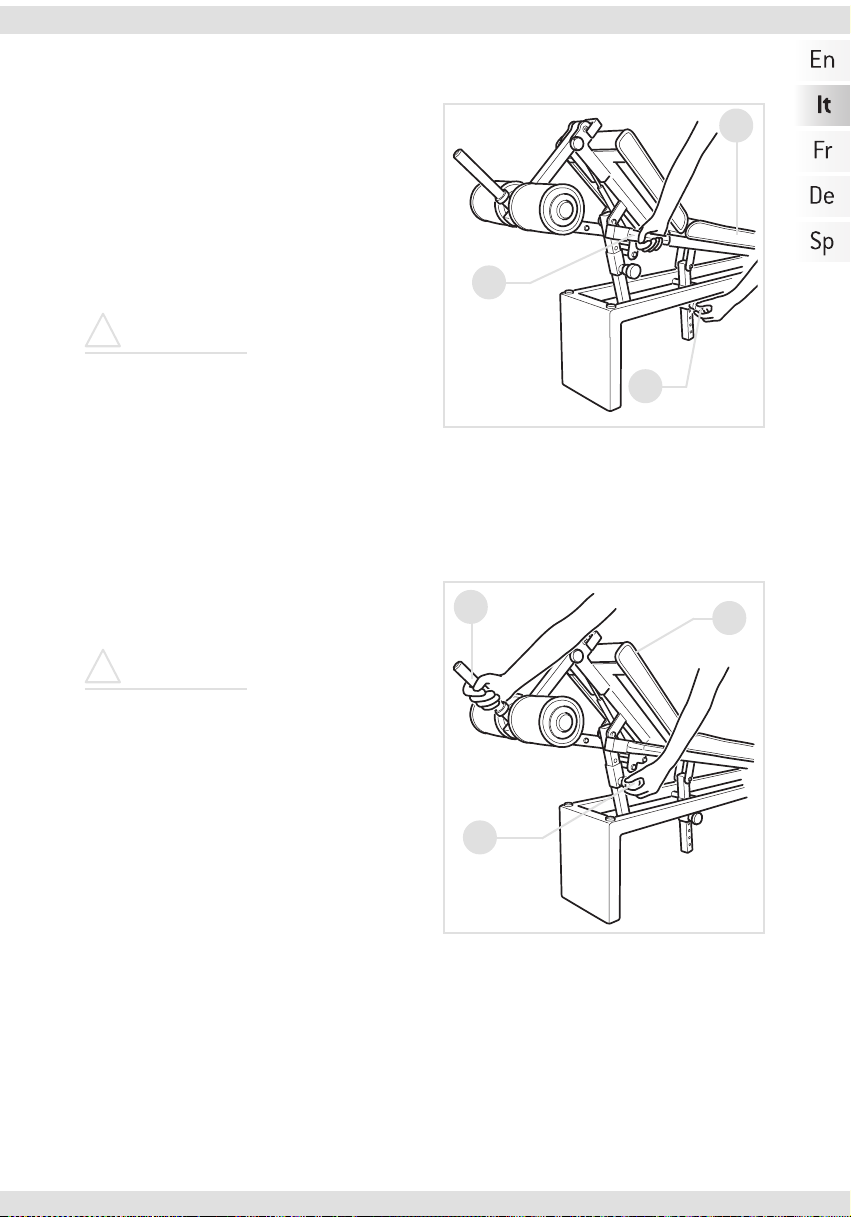
Inclinazione della panca (1): per inclinare la panca è sufficiente sollevarla con l’ausilio delle maniglie; il pomello (13 ) consente di aumentare l’inclinazione. Per riportare la panca in posizione orizzontale occorre sbloccarla col pomello (13 )
!
Attenzione
Appena si sblocca il pomello (13) la panca scende rapidamente verso il basso.
Accompagnare sempre la
panca tenendola per la maniglia (3).
1
3
13
03195038
Inclinazione dello schienale (2) con il
pomello (14)
!
Attenzione
Appena si sblocca il pomello (14) lo schienale sale rapidamente verso l’alto.
Accompagnare sempre lo
schienale tenendolo per il
perno (6).
6
2
14
03195039
1.2 Descrizione dell’attrezzo
75
Page 76
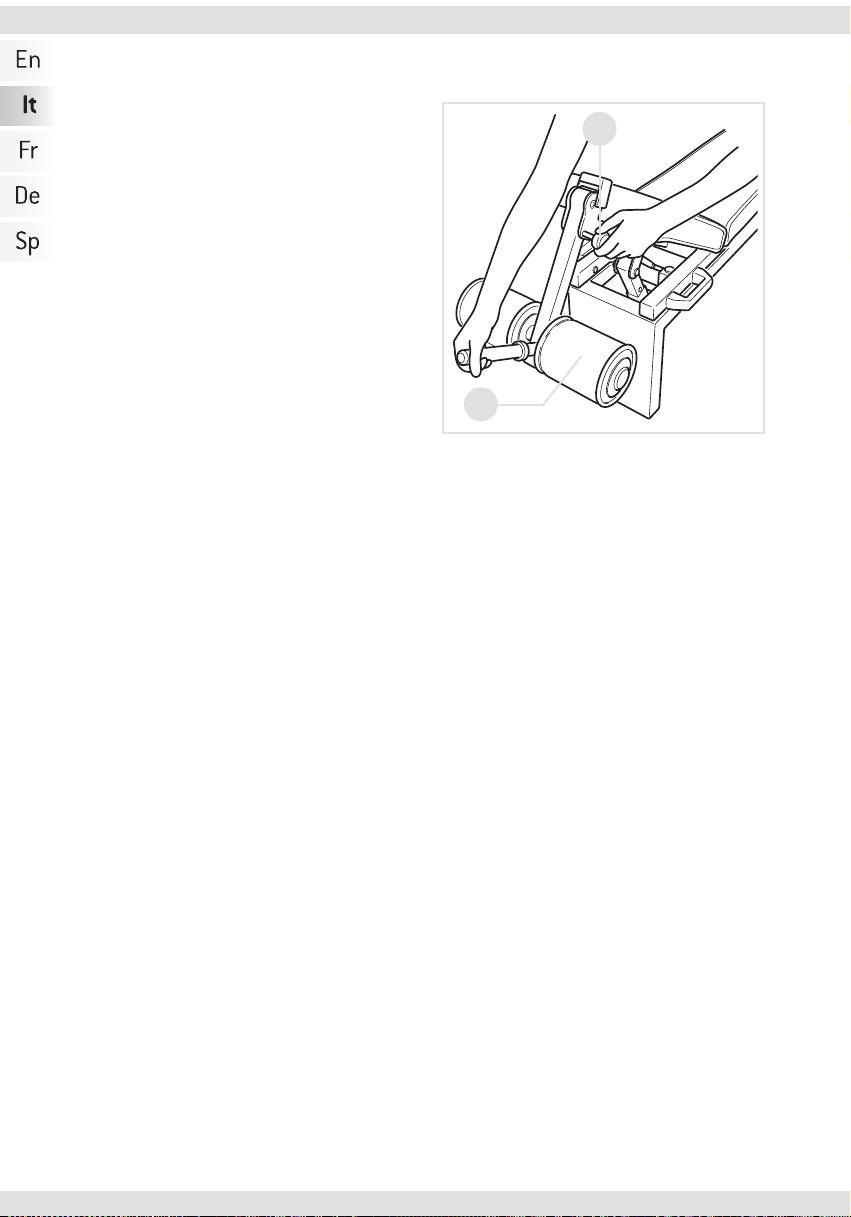
Inserimento del fermo (12) per regolare la posizione dei rulli imbottiti (5)
12
5
03195040
Multipla - Manuale per l’utente
76
Page 77
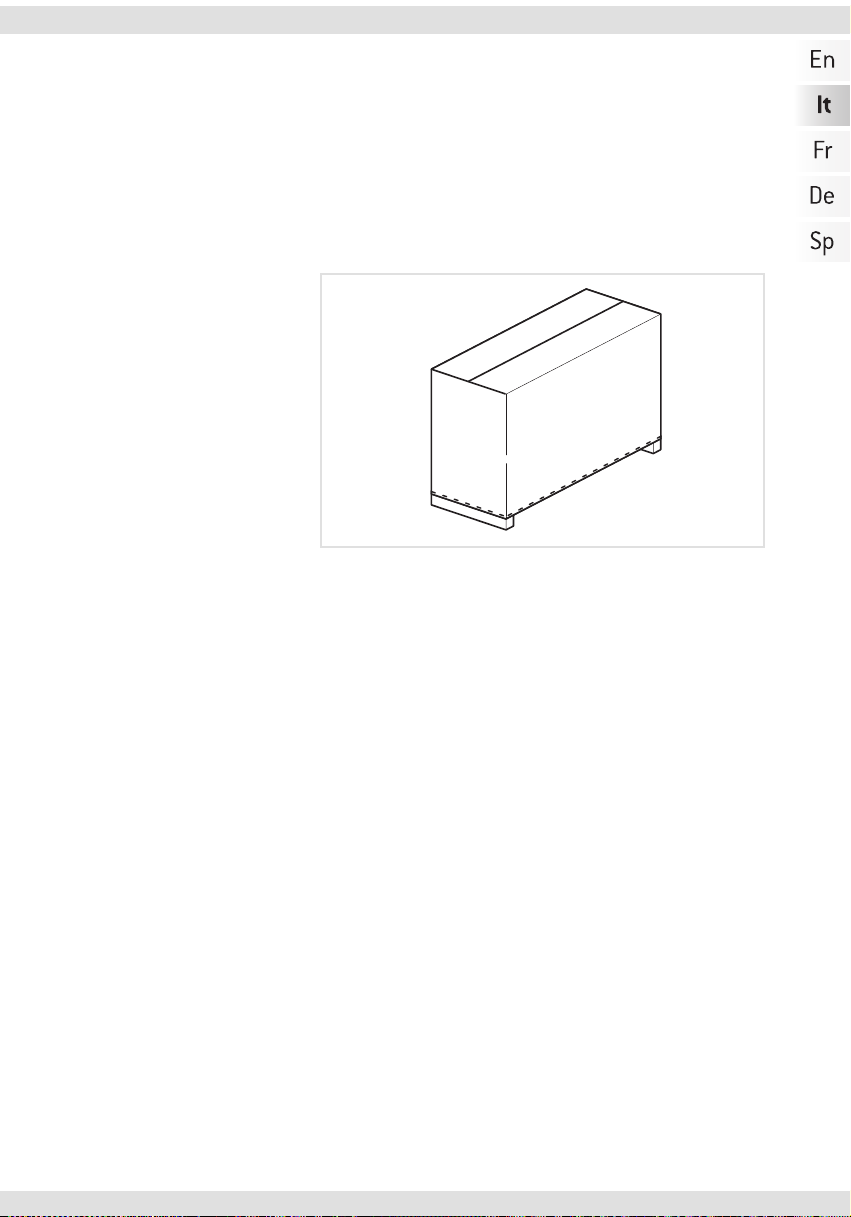
1.3 Installazione e imballo
1.3.1 Descrizione dell’imballo
L’attrezzo è fornito parzialmente montato e
racchiuso in apposito
imballo, su pallet.
All’interno dell’imballo
sono racchiusi tutti gli
accessori.
1.3.2 Sollevamento e trasporto del materiale imballato
Sollevamento e trasporto sono eseguibili con i normali mezzi di sollevamento.
03180037
Al fine di tutelare l’incolumità delle persone e delle cose occorre valutare attentamente, in relazione al luogo di destinazione dell’attrezzo, quali mezzi normali
di sollevamento e trasporto devono essere utilizzati.
Le istruzioni per il sollevamento e il disimballo sono riportate sull’imballo
stesso.
1.3 Installazione e imballo
77
Page 78
1.3.3 Ambiente di installazione
Si consigliano una temperatura tra 10° e 25° e valori di umidità dell’aria compresi tra il 20% e il 90%.
Per motivi di sicurezza è opportuno prevedere un’ampia fascia di spazio libero
tutto intorno all’attrezzo, che preveda gli ingombri durante il movimento.
Se l’attrezzo sarà installato in un luogo pubblico di intrattenimento, l’ambien-
te dovrà possedere tutti i requisiti di idoneità richiesti dalle leggi vigenti in
materia.
1.3.4 Disimballo
Tagliare le cinghie di nylon che fissano i cartoni al pallet (si vedano
le istruzioni riportate sull’imballo stesso).
i
Informazioni
Si consiglia di conservare l’imballo, per poter imballare di nuovo l’attrezzo nelle stesse condizioni in caso di trasloco.
Gli elementi dell’imballo (scatole, sacchetti, ecc.) non devono essere lasciati
alla portata dei bambini, in quanto potenziali fonti di pericolo; né devono essere
abbandonati nell’ambiente.
Multipla - Manuale per l’utente
78
Page 79
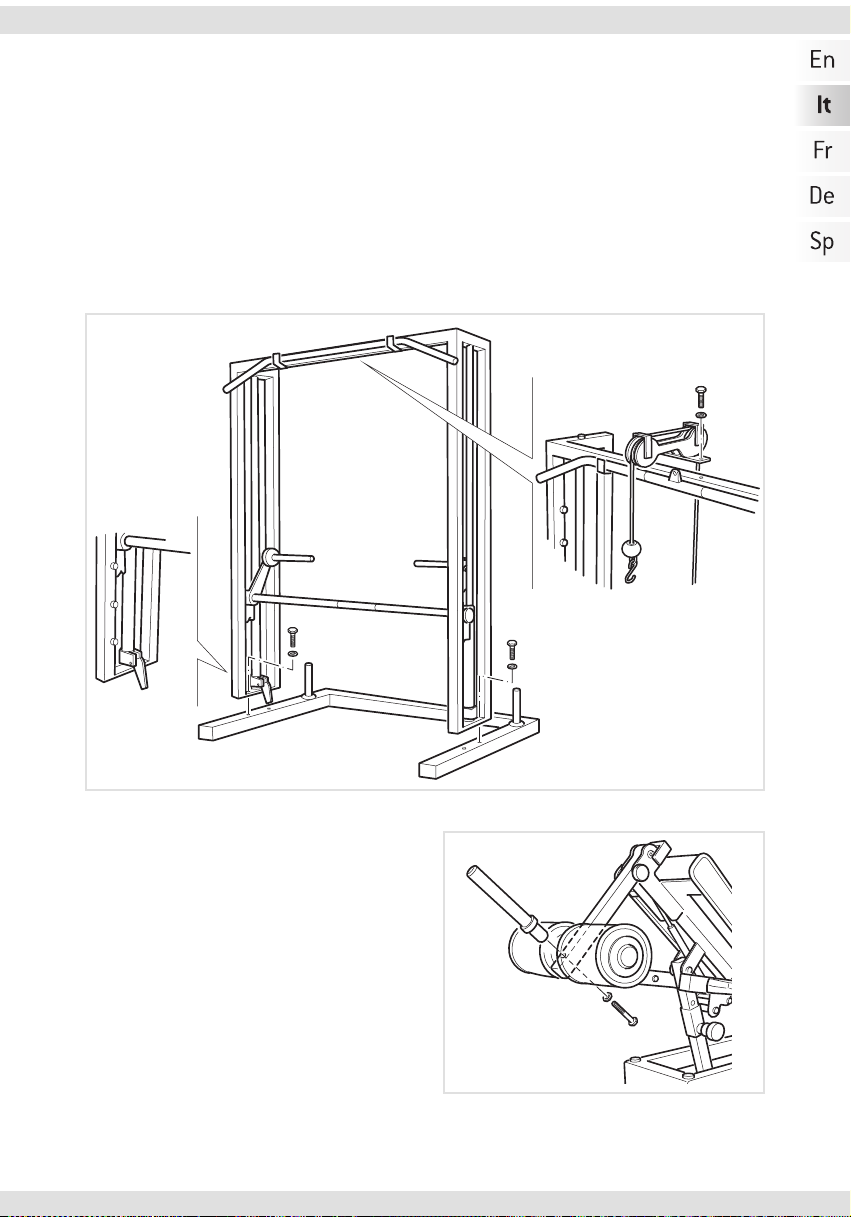
1.3.5 Montaggio
Posizionare i fermi di sicurezza completamente in basso.
Abbassare il bilanciere in basso e appoggiarlo sui fermi di sicurezza.
Montare il telaio sul piedistallo e fissarlo con le rondelle e le apposite viti (TE 10x25).
Posizionare il supporto delle carrucole e fissarlo con le rondelle e le due apposite
viti (TE 10x25).
03195043
03195042
Posizionare il perno per i dischi tra i
rulli imbottiti e fissarlo con la rondella
e la vite (TE 10x25).
03195 041
03195044
1.3 Installazione e imballo
79
Page 80
1.4 Manutenzione
1.4.1 Manutenzione ordinaria
È bene mantenere l’attrezzo sempre pulito e privo di polvere, nel rispetto delle
più comuni norme igienico-sanitarie, soprattutto se è utilizzato all’interno di
un centro sportivo o da più di una persona.
Per la pulizia delle parti imbottite utilizzare un panno umido o una spugna e
sapone neutro.
Per interventi di manutenzione non descritti nel presente manuale rivolgersi
al Servizio di Assistenza Tecnica Technogym.
Multipla - Manuale per l’utente
80
Page 81
1.4.2 Assistenza tecnica
Il Servizio di Assistenza Tecnica Technogym prevede:
- consulenze telefoniche
- definizione degli interventi di assistenza in garanzia e a pagamento
- servizio di assistenza sul posto
Servizio Assistenza Tecnica
Technogym®
Via G. Perticari, n. 20
- invio di parti di ricambio originali.
47035 Gambettola (Forlì) ITALY
tel: 0547 650650
fax: 0547 650150
email: [email protected]
Quando si chiama il Servizio di Assistenza Tecnica Technogym bisogna specificare i seguenti dati:
- modello dell’attrezzo
- data di acquisto
- numero di serie
- indicazioni precise sul problema riscontrato.
Avvertenze
Interventi sull’attrezzo effettuati da personale non autorizzato da
Technogym ne invalidano la garanzia.
1.4 Manutenzione
81
Page 82
1.5 Immagazzinamento
In caso di lunga inattività, si consiglia di immagazzinare l’attrezzo:
- in luogo asciutto e pulito, coperto da un telo per proteggerlo dalla polvere;
- in ambiente con temperatura compresa tra i 10°C e i 25°C e umidità compresa tra il 20% e il 90%.
1.6 Smaltimento
È sempre bene controllare che Multipla non possa in alcun modo divenire
fonte di pericolo, ed evitare quindi di abbandonarla ai giochi dei bambini.
È vietato abbandonare l’attrezzo nell’ambiente, in aree pubbliche o private
soggette ad uso pubblico.
Multipla è costituita di materiali riciclabili, quali acciaio, alluminio e plastiche,
che devono essere smaltiti nei modi previsti dalle norme vigenti per rifiuti
urbani e assimilabili.
Multipla - Manuale per l’utente
82
Page 83
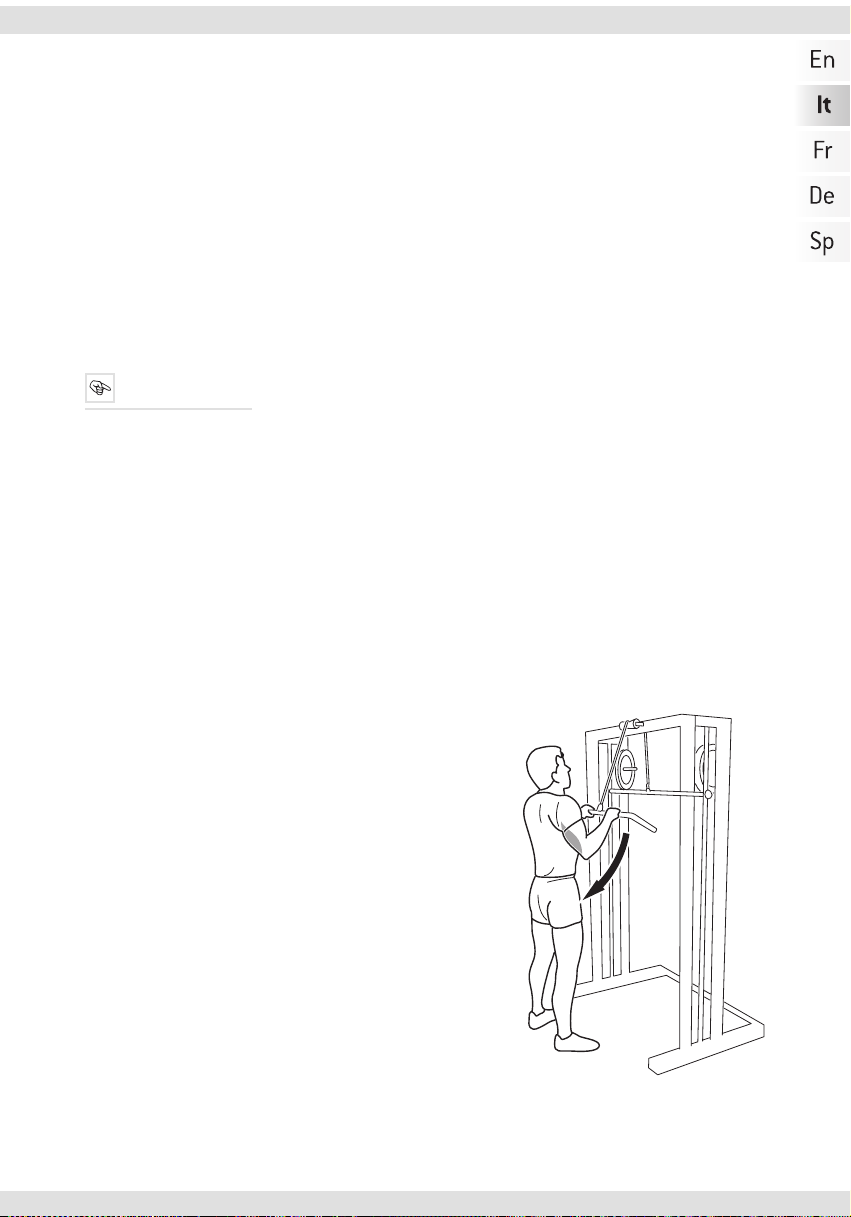
2 Usare Multipla
2.1 Esercizi
Avvertenze
Si raccomanda di controllare attentamente le illustrazioni degli esercizi e di prestare particolare attenzione alla posizione da assumere
sull’attrezzo.
Braccia: estensioni
È un esercizio di estensione delle braccia, indispensabile negli sport di lancio, in cui è richiesta potenza negli arti superiori.
Muscoli impegnati: tricipite
Movimento:
- agganciare il cavo al bilanciere
- agganciare la barra lat al cavo alto
- posizionare il bilanciere in basso, a fine corsa
- caricare i dischi sul perno del bilanciere in maniera simmetrica e bloccarli con i ganci di sicurezza
- afferrare la barra lat con il palmo della mano
rivolto verso il pavimento e con le mani distanti tra loro circa 15 cm
03195021
2.1 Esercizi
83
Page 84
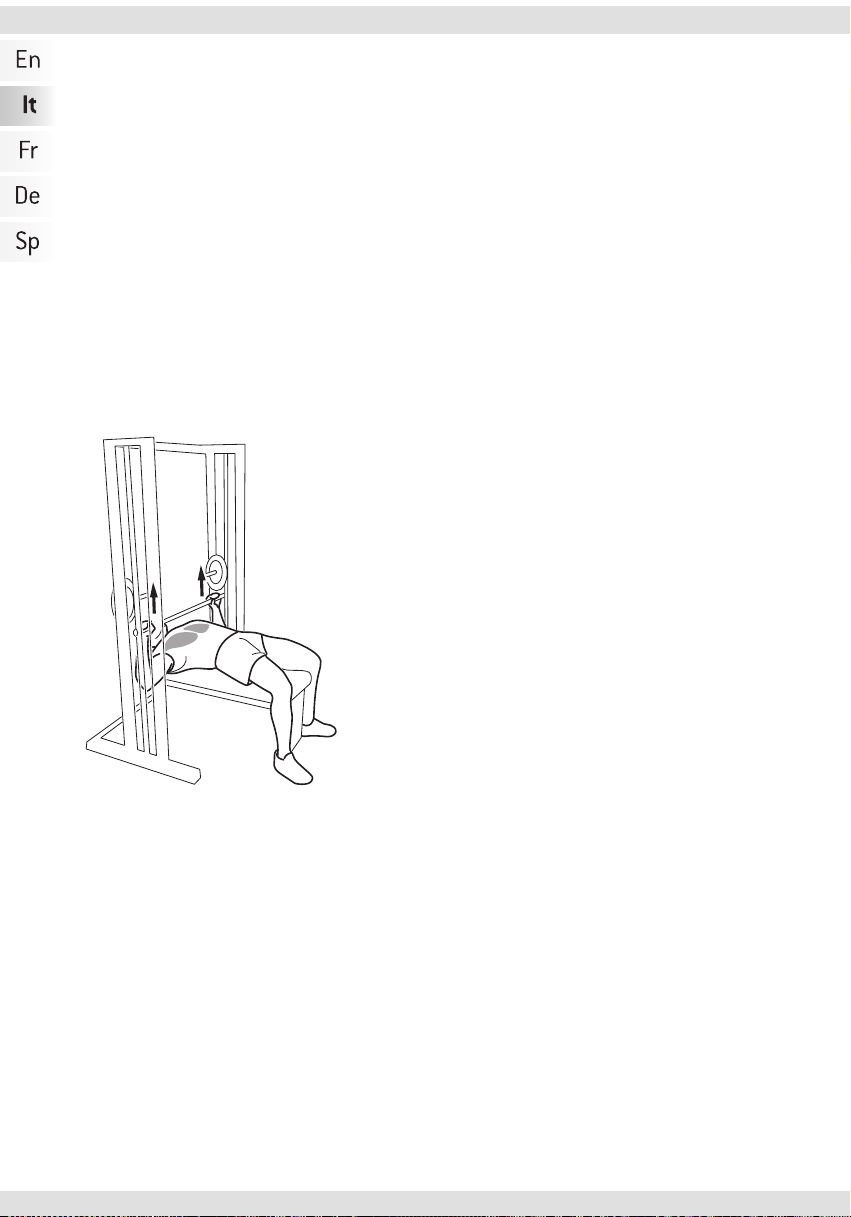
Petto: distensioni
03195008
- mantenendo i gomiti aderenti al busto estendere completamente le braccia, poi tornare in
posizione di partenza; il movimento di ritorno
deve essere più lento di quello di andata.
È il movimento base per il potenziamento del
torace.
Muscoli impegnati: pettorale, deltoide anteriore, tricipite
Movimento:
- sdraiarsi sulla panca con lo schienale in posizione orizzontale
- posizionare il bilanciere a un’altezza leggermente inferiore alla lunghezza del braccio
disteso
- caricare i dischi sul perno del bilanciere in
maniera simmetrica e bloccarli con i ganci di
sicurezza
- sdraiarsi sulla panca e impugnare il
bilanciere con presa larga, al limite esterno
della zona zigrinata
- sganciare il bilanciere ruotandolo in senso
antiorario e portarlo al torace, fino a toccare
la parte alta del muscolo pettorale; i gomiti
sono aperti e distanti dal busto
- spingere in alto il bilanciere mantenendo i
gomiti aperti, poi tornare in posizione di partenza.
Multipla - Manuale per l’utente
84
Page 85
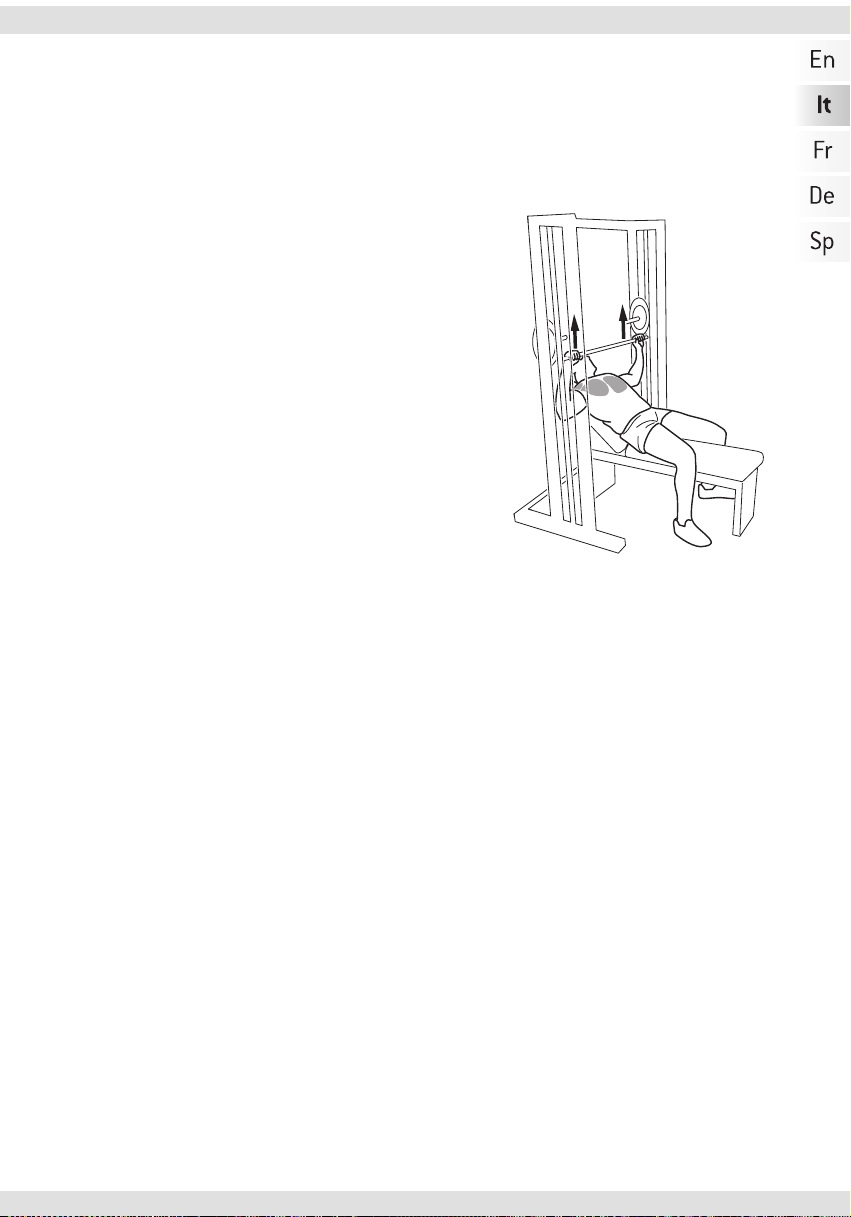
Petto: distensioni su panca inclinata
L’esercizio è simile al precedente, ma l’inclinazione dello schienale localizza maggiormente il
lavoro sulla parte alta del torace.
Muscoli impegnati: pettorale, deltoide anteriore, tricipite
Movimento:
- posizionare lo schienale al secondo foro
- sedersi sulla panca e posizionare il bilanciere
a un’altezza leggermente inferiore alla lunghezza del braccio disteso
- caricare i dischi sul perno del bilanciere in
maniera simmetrica e bloccarli con i ganci di
sicurezza
- sedersi sulla panca con la schiena ben appoggiata allo schienale e impugnare il
bilanciere con presa larga, al limite esterno
della zona zigrinata
- sganciare il bilanciere ruotandolo in senso
antiorario e portarlo al torace, fino a toccare
la parte alta del muscolo pettorale; i gomiti
sono aperti e distanti dal busto
- spingere in alto il bilanciere mantenendo i
gomiti aperti, poi tornare in posizione di partenza; la traiettoria del bilanciere è in corrispondenza della parte alta del torace.
03195009
2.1 Esercizi
85
Page 86
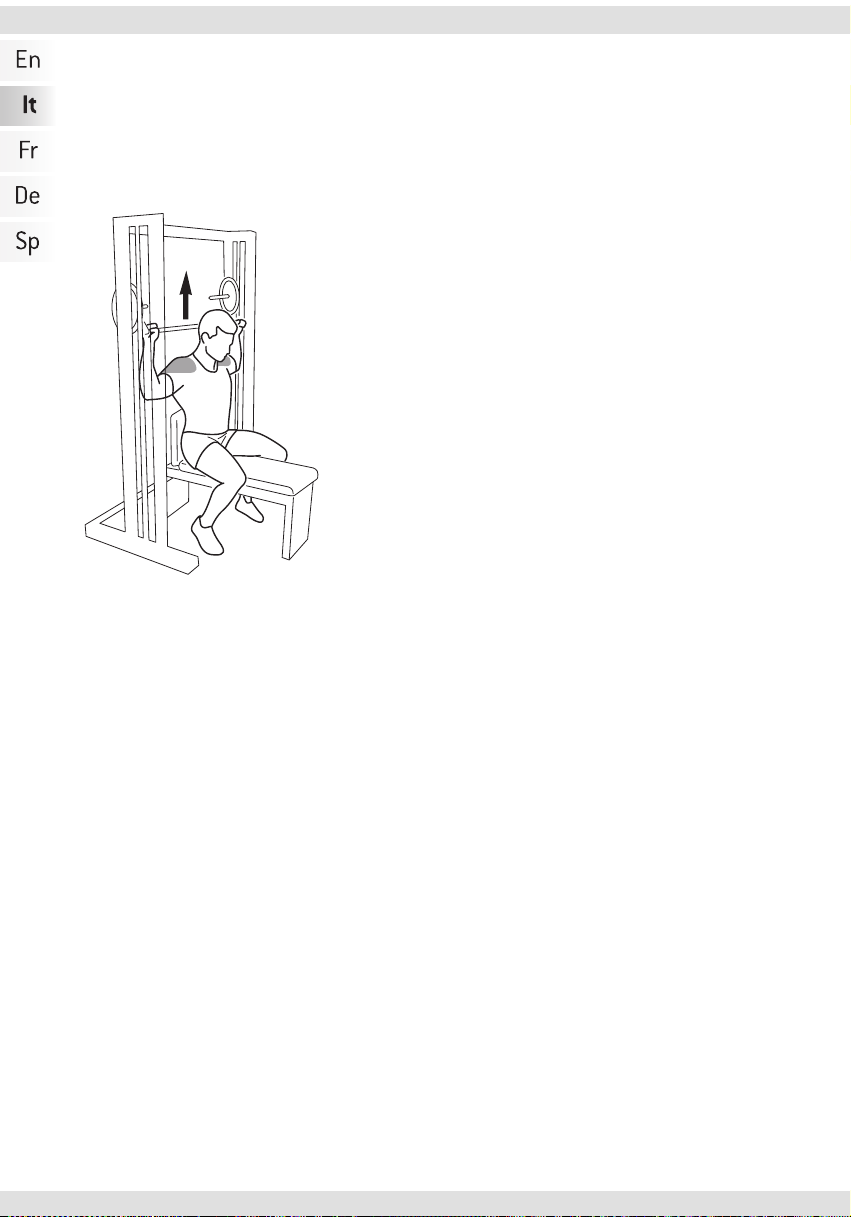
Spalle: distensioni
03195010
È un movimento che interessa la catena di spinta degli arti superiori. Rinforza l’articolazione
scapolo-omerale.
Muscoli impegnati: deltoide, tricipite, trapezio
Movimento:
- posizionare lo schienale all’ultimo foro
- spostare la panca in modo che lo schienale
sia sulla stessa linea del bilanciere
- sedersi sulla panca e posizionare il bilanciere
in modo che le braccia siano completamente
distese
- caricare i dischi sul perno del bilanciere in
maniera simmetrica e bloccarli con i ganci di
sicurezza
- sedersi sulla panca con la schiena ben appoggiata allo schienale e impugnare il
bilanciere con presa larga, al limite esterno
della zona zigrinata
- sganciare il bilanciere ruotandolo in senso
antiorario e portarlo dietro la testa fino alla
base del collo
- spingere in alto il bilanciere mantenendo i
gomiti aperti, poi tornare in posizione di partenza.
Multipla - Manuale per l’utente
86
Page 87
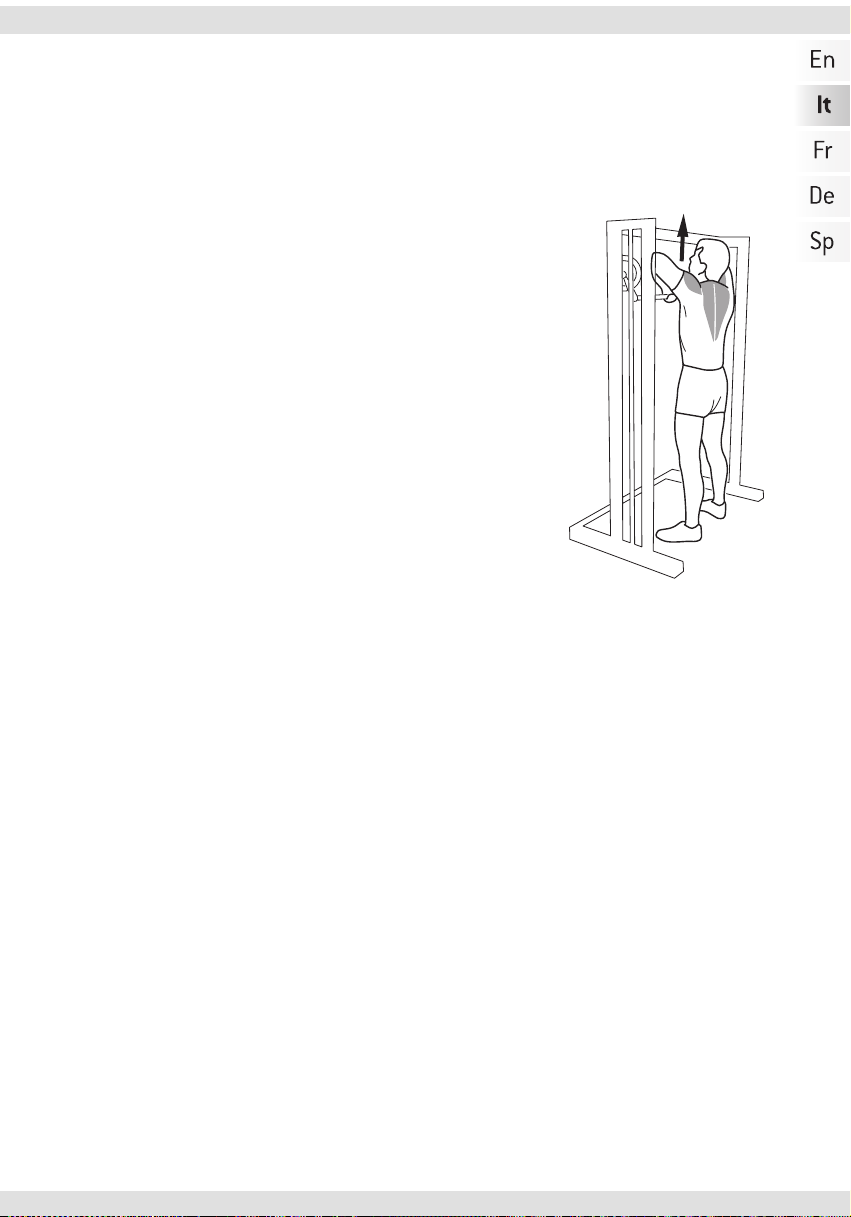
Spalle: trazioni al mento
È un esercizio per l’allenamento della
muscolatura della spalla e della parte alta della
schiena. È importante nella prevenzione dei
dolori della spalla.
Muscoli impegnati: deltoide, trapezio
Movimento:
- in piedi di fronte all’attrezzo, posizionare il
bilanciere in modo da afferrarlo con le braccia distese
- caricare i dischi sul perno del bilanciere in
maniera simmetrica e bloccarli con i ganci di
sicurezza
- impugnare il bilanciere con le mani vicine e
divaricare leggermente le gambe per una
maggiore stabilità
- sganciare il bilanciere ruotandolo in senso
antiorario
- flettere gli avambracci e portare il bilanciere
fino a sfiorare il mento, mantenendo i gomiti
più alti delle spalle; poi tornare in posizione
di partenza.
03195011
2.1 Esercizi
87
Page 88
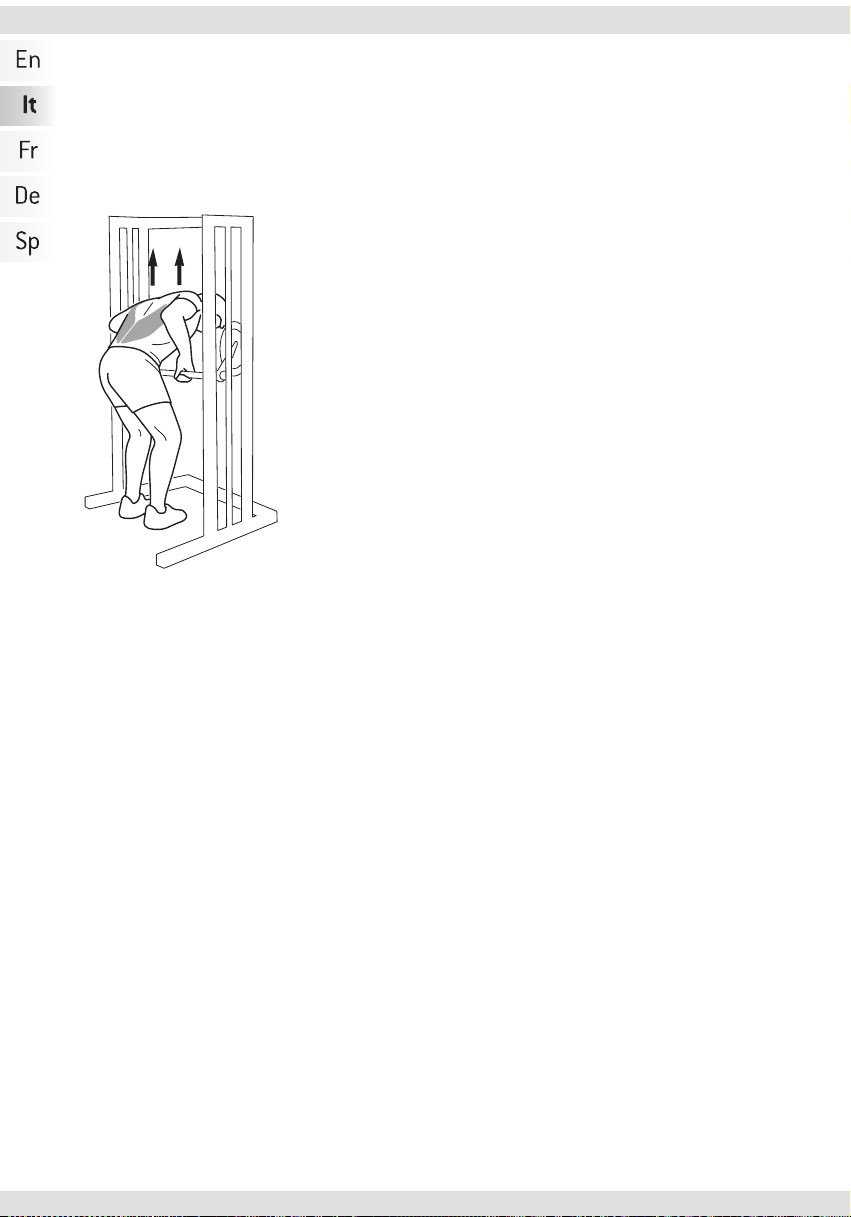
Dorso: rematore
03195 013
È un movimento molto efficace per tonificare e
migliorare la muscolatura dorsale, particolarmente utile in tutti gli sport acquatici.
Muscoli impegnati: gran dorsale
Movimento:
- in piedi di fronte all’attrezzo, posizionare il
bilanciere in basso, a fine corsa
- caricare i dischi sul perno del bilanciere in
maniera simmetrica e bloccarli con i ganci di
sicurezza
- impugnare il bilanciere con le mani alla stessa larghezza delle spalle
- divaricare leggermente le gambe per una
maggiore stabilità; il corpo è piegato in avanti
e le ginocchia sono flesse
- sganciare il bilanciere ruotandolo in senso
antiorario
- sollevare il bilanciere fino all’altezza dello sterno muovendo braccia e spalle e mantenendo i gomiti vicino al busto; poi tornare in posizione di partenza.
Multipla - Manuale per l’utente
88
Page 89
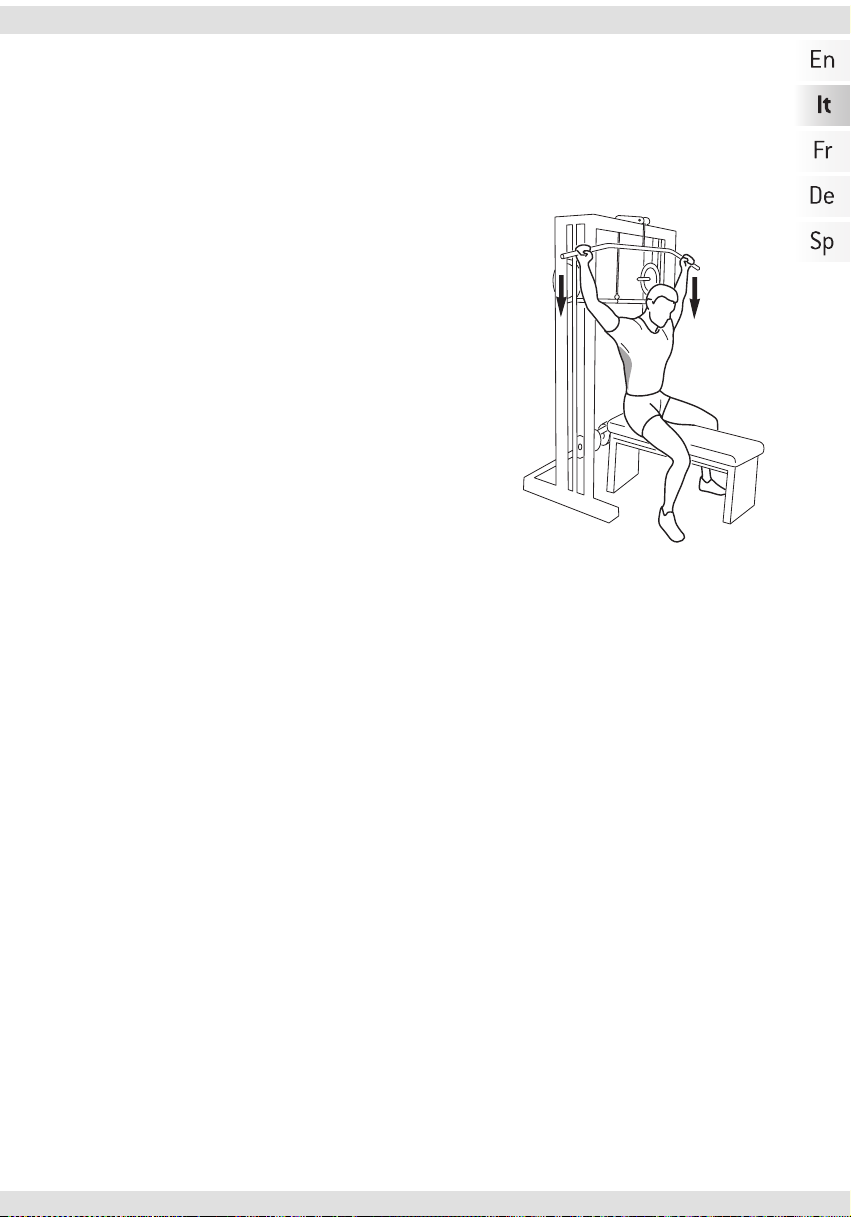
Dorso: trazioni dietro
È l’esercizio base per tonificare i fasci muscolari
superiori della schiena. È indicato nella preparazione atletica di tutti gli sport e nel trattamento di alcuni difetti della postura.
Muscoli impegnati: gran dorsale e bicipite
Movimento:
- agganciare il cavo al bilanciere
- agganciare la barra lat al cavo alto
- posizionare il bilanciere in basso, a fine corsa
- caricare i dischi sul perno del bilanciere in
maniera simmetrica e bloccarli con i ganci di
sicurezza
- afferrare la barra lat con presa larga e sedersi
sulla panca con la schiena rivolta al bilanciere;
lo schienale è in posizione orizzontale
- eseguire una trazione dietro la testa fino alla
base del collo, poi tornare in posizione di partenza; la nuca va leggermente piegata in avanti per favorire il movimento.
03195 014
2.1 Esercizi
89
Page 90
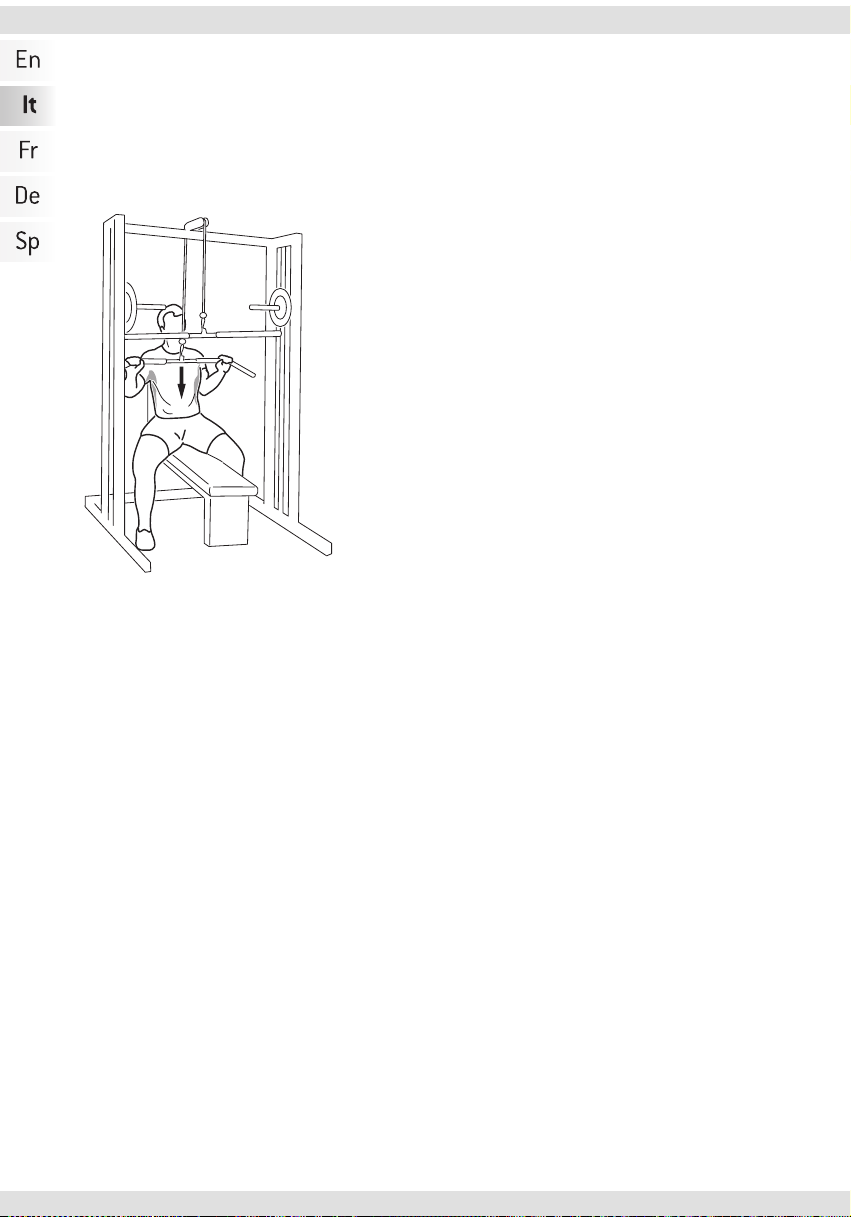
Dorso: trazioni avanti
Come il precedente, è l’esercizio base per tonificare i fasci muscolari superiori della schiena. È
indicato nella preparazione atletica di tutti gli
sport e nel trattamento di alcuni difetti della
postura.
Muscoli impegnati: gran dorsale e bicipite
Movimento:
- agganciare il cavo al bilanciere
- agganciare la barra lat al cavo alto
- posizionare il bilanciere in basso, a fine corsa
03195 015
- caricare i dischi sul perno del bilanciere in
maniera simmetrica e bloccarli con gli appositi ganci
- posizionare lo schienale all’ultimo foro
- afferrare la barra lat con presa media e sedersi sulla panca con la fronte rivolta al
bilanciere
- eseguire una trazione verso il basso fino allo
sterno, poi tornare in posizione di partenza;
la nuca va tenuta leggermente indietro per
favorire il movimento.
Multipla - Manuale per l’utente
90
Page 91
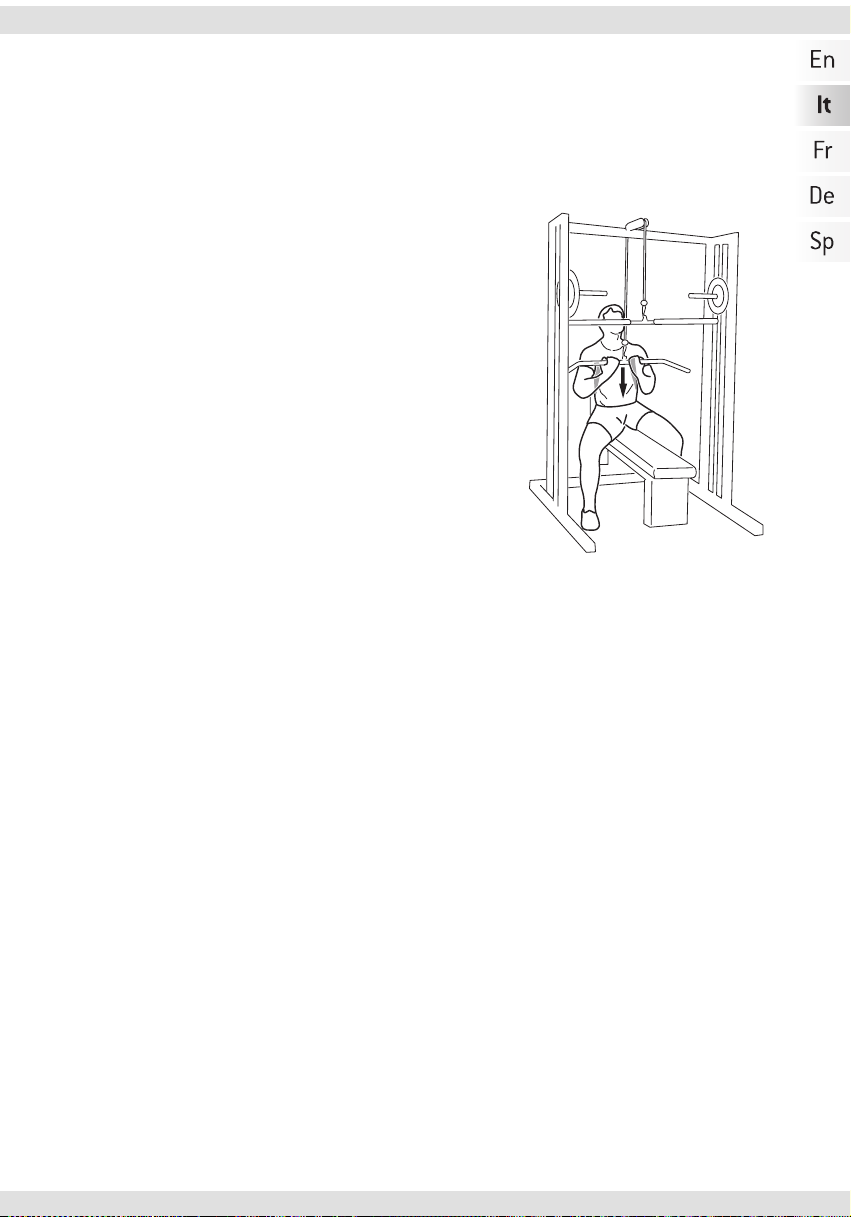
Dorso: trazioni avanti con presa inversa
Come il precedente, è l’esercizio base per tonificare i fasci muscolari superiori della schiena. È
indicato nella preparazione atletica di tutti gli
sport e nel trattamento di alcuni difetti della
postura.
Muscoli impegnati: gran dorsale e bicipite
Movimento:
- agganciare il cavo al bilanciere
- agganciare la barra lat al cavo alto
- posizionare il bilanciere in basso, a fine corsa
- caricare i dischi sul perno del bilanciere in
maniera simmetrica e bloccarli con i ganci di
sicurezza
- posizionare lo schienale all’ultimo foro
- afferrare la barra lat con il palmo della mano
rivolto verso il volto e sedersi sulla panca con
la fronte rivolta al bilanciere
- eseguire una trazione verso il basso fino allo
sterno, poi tornare in posizione di partenza;
la nuca va tenuta leggermente indietro per
favorire il movimento.
03195 016
2.1 Esercizi
91
Page 92
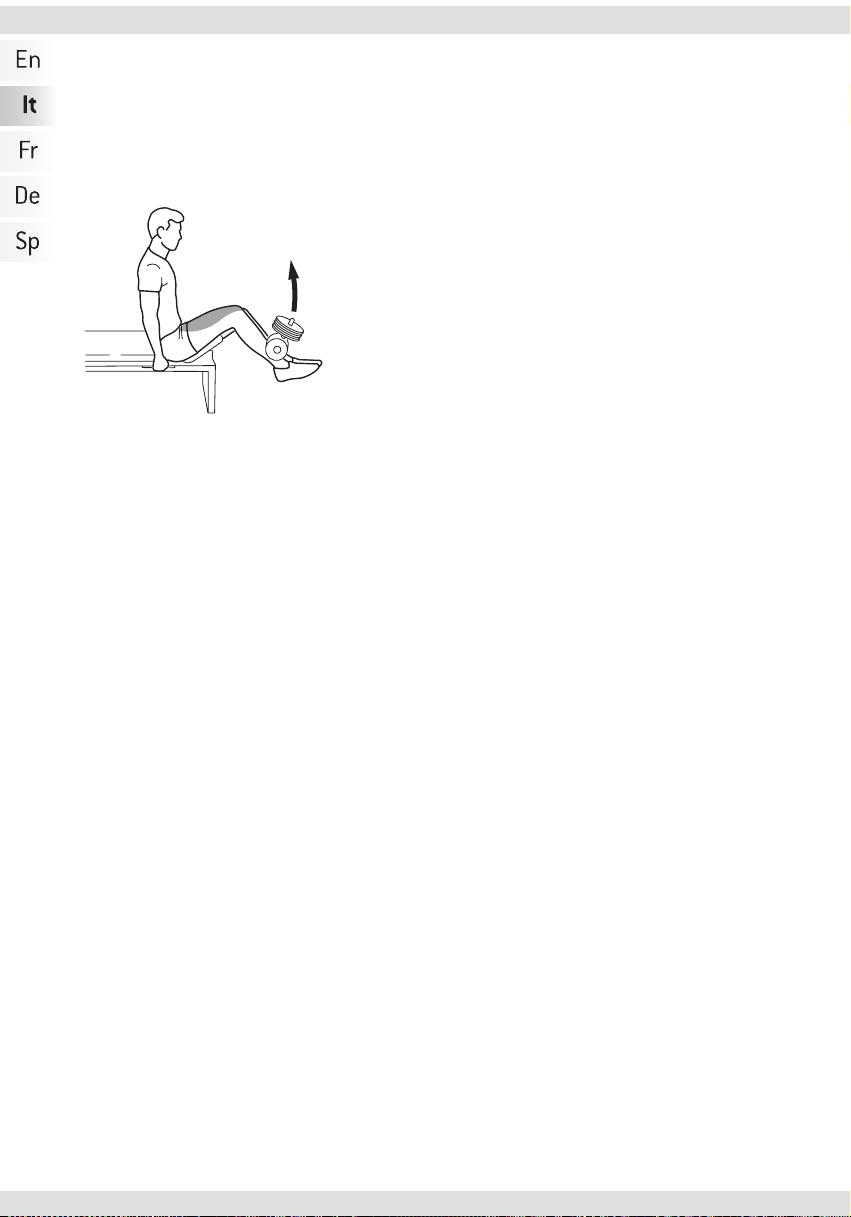
Gambe: estensioni
È il movimento base per l’isolamento del muscolo quadricipite ed è utilizzato, secondo opportune modalità, sia nella preparazione atletica che in riabilitazione.
Muscoli impegnati: quadricipiti
03195018
Movimento:
- posizionare lo schienale al primo foro
- caricare i dischi sul perno tra i rulli imbottiti
- togliere il fermo per regolare la posizione dei
rulli
- sedersi sulla panca, portare i piedi dietro i
rulli e afferrare le maniglie
- spingere con la tibia sui rulli ed estendere le
gambe, poi tornare in posizione di partenza;
il movimento di ritorno deve essere più lento
di quello di andata.
Multipla - Manuale per l’utente
92
Page 93
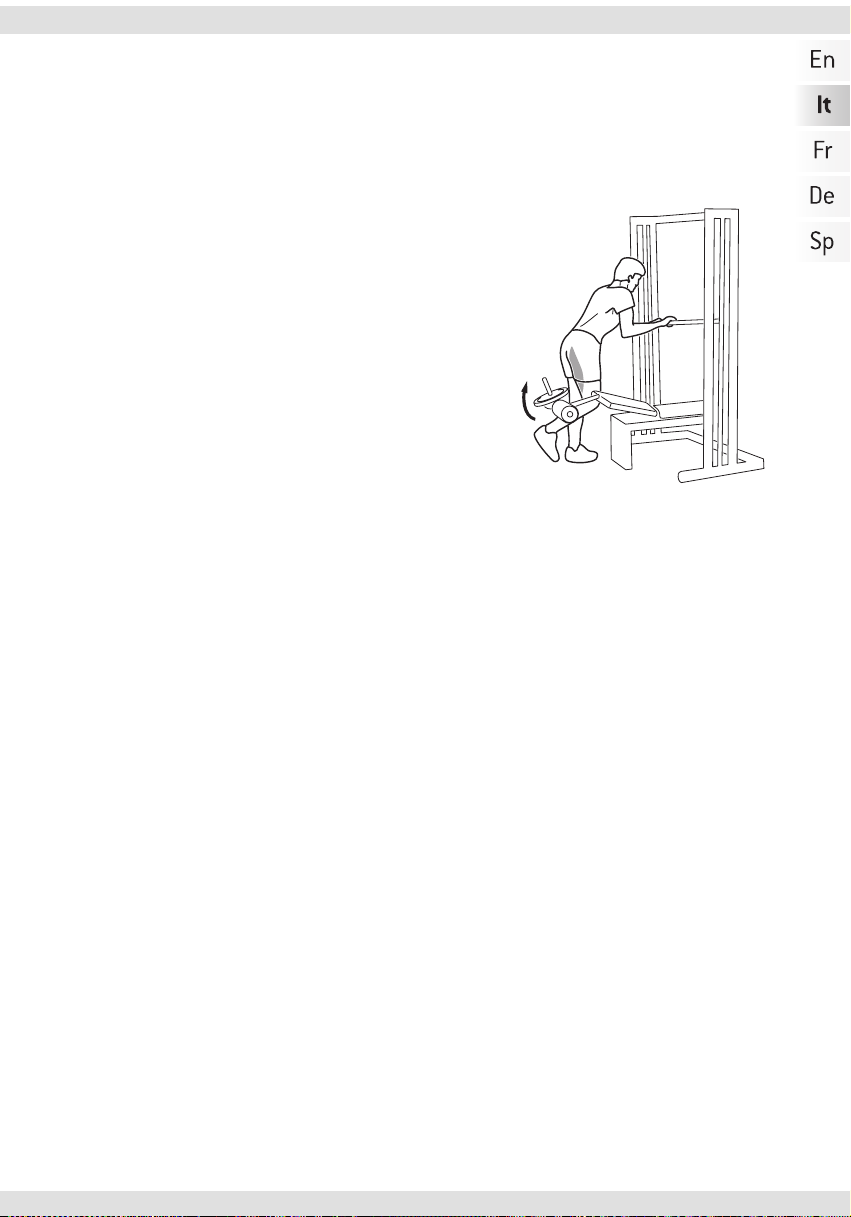
Gambe: flessioni
È il movimento base per tonificare la parte posteriore della gamba.
Muscoli impegnati: bicipite femorale
Movimento:
- posizionare lo schienale al primo foro
- caricare i dischi sul perno tra i rulli imbottiti
- togliere il fermo per regolare la posizione dei
rulli
- avvicinare la panca in modo che sia possibile
usare il bilanciere come appoggio
- portare il tallone della gamba da allenare dietro il rullo imbottito e afferrare il bilanciere
per una maggiore stabilità
- flettere lentamente la gamba, poi tornare in
posizione di partenza.
0319 5019
2.1 Esercizi
93
Page 94
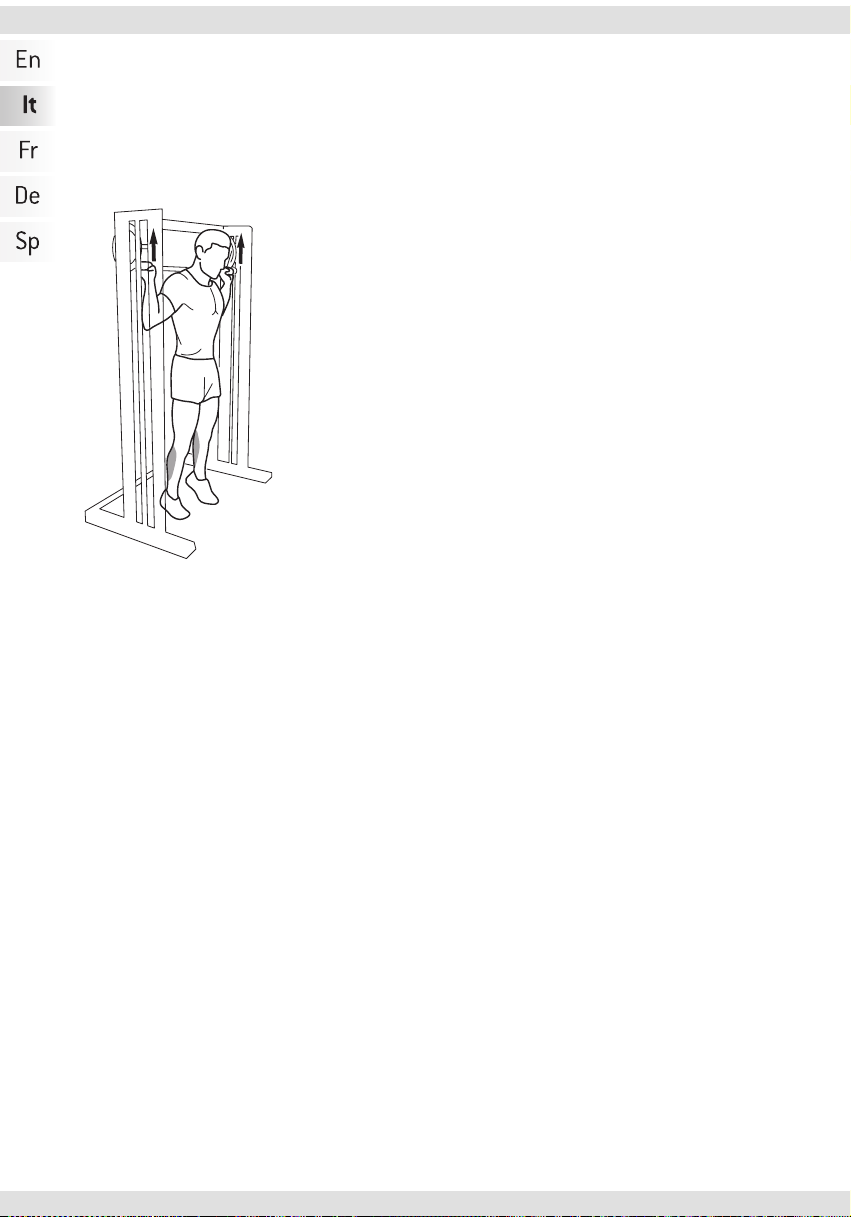
Polpacci: estensioni
È un movimento che potenzia i muscoli del polpaccio, particolarmente usato nella preparazione atletica negli sport di salto e sprint. Eseguito
con carico ridotto e con il rialzo sotto la parte
anteriore del piede migliora la mobilità della caviglia.
Muscoli impegnati: soleo, gastrocnemio
Movimento:
- posizionare il bilanciere a un’altezza legger-
03195020
- caricare i dischi sul bilanciere in maniera sim-
- portarsi sotto il bilanciere e posizionarlo sul
- divaricare le gambe in modo che i piedi siano
- sganciare il bilanciere ruotandolo in senso
- sollevarsi sulla punta dei piedi muovendo
- per aumentare l’escursione del movimento
mente inferiore a quella delle spalle
metrica e bloccarli con i ganci di sicurezza
trapezio, in linea con le spalle
in linea con le anche, con i polpacci in corrispondenza del bilanciere
antiorario
soltanto le caviglie e mantenendo le gambe
tese; poi tornare in posizione di partenza
mettere il rialzo sotto la punta dei piedi.
Multipla - Manuale per l’utente
94
Page 95
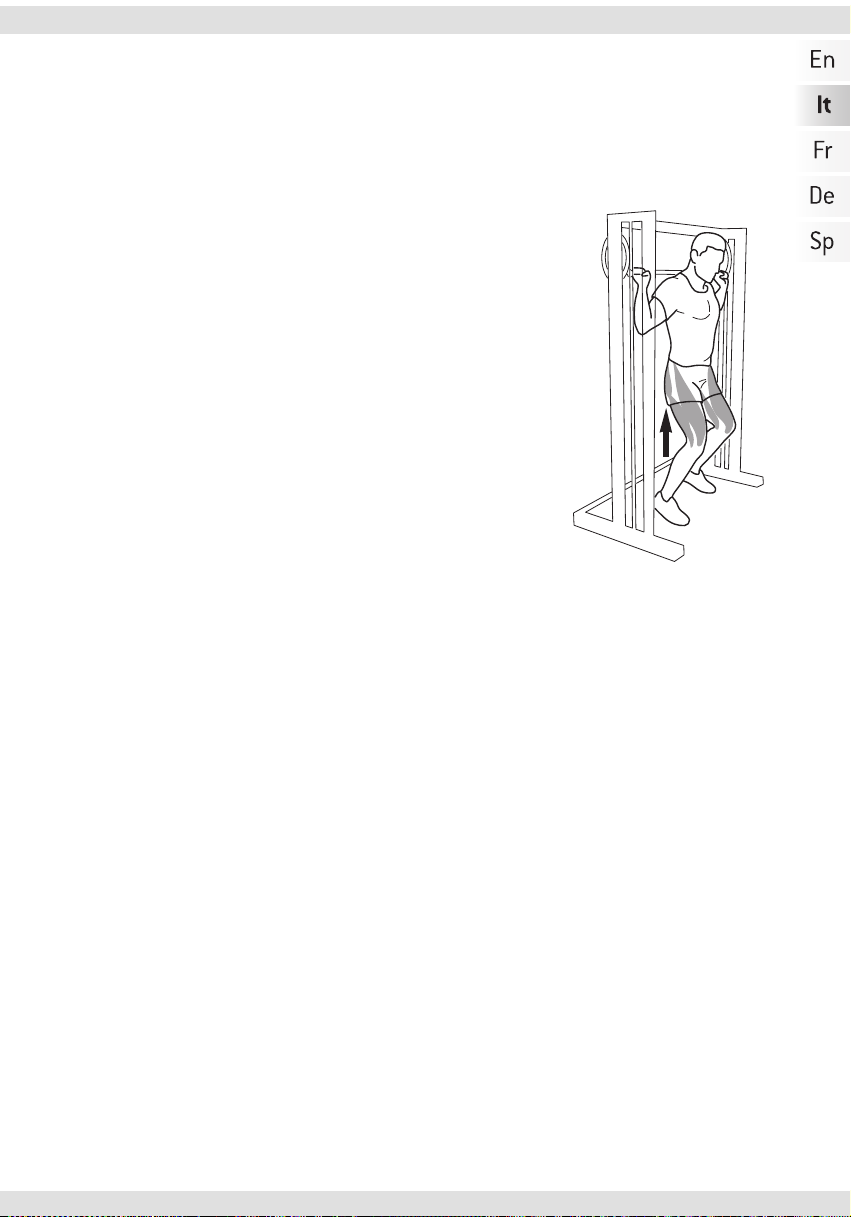
Squat
È il movimento base per il potenziamento degli arti
inferiori. Questo esercizio è indispensabile per tutti gli
sport che richiedono forza nelle gambe; la sua efficacia è strettamente legata a un’esecuzione perfetta.
Muscoli impegnati: quadricipite, gluteo, femorale
Movimento:
- posizionare il bilanciere a un’altezza leggermente inferiore a quella delle spalle
- caricare i dischi sul bilanciere in maniera simmetrica e bloccarli con i ganci di sicurezza
- portarsi sotto il bilanciere e posizionarlo sul
trapezio, in linea con le spalle; la distanza tra
le mani è leggermente superiore a quella tra
le spalle
- divaricare le gambe in modo che i piedi siano
in linea con le anche, con le punte leggermente divaricate
- sganciare il bilanciere ruotandolo in senso
antiorario e distendere completamente le
gambe
- piegare le gambe fino a che le cosce non siano parallele a terra, poi tornare in posizione
di partenza
- durante l’esercizio i talloni rimangono a terra; se si sollevano, ci si può mettere sotto il
rialzo
- durante l’esercizio bisogna prestare attenzione a non inarcare la schiena e a non flettere troppo il busto in avanti; per mantenere
l’assetto più verticale possibile si suggerisce
di fissare un ipotetico punto sopra di sé.
03195017
2.1 Esercizi
95
Page 96
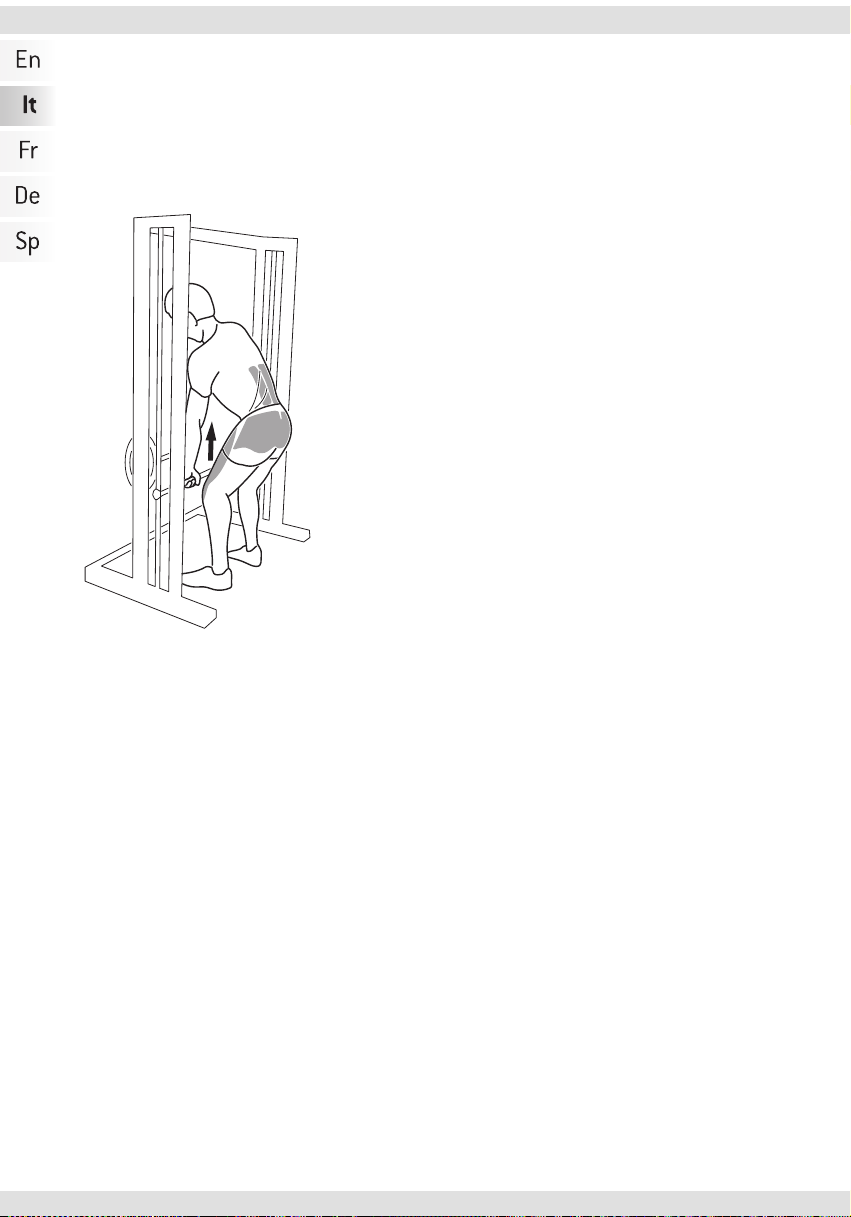
Gambe: stacchi da terra
È un esercizio altamente sinergico, poiché coinvolge diverse masse muscolari. Ottimo sia per
allenare le forza sia per la resistenza.
Muscoli impegnati: lombare, quadricipite, gluteo
Movimento:
- in piedi di fronte all’attrezzo, posizionare il
bilanciere in basso, a fine corsa
- caricare i dischi sul perno del bilanciere in
maniera simmetrica e bloccarli con i ganci di
sicurezza
- impugnare il bilanciere con una mano verso
03195012
l’alto e l’altra verso il basso; le mani hanno tra
loro la stessa larghezza delle spalle
- divaricare leggermente le gambe per una
maggiore stabilità; il corpo è piegato in avanti
e le ginocchia sono flesse
- sganciare il bilanciere ruotandolo in senso
antiorario
- distendere completamente le gambe e allo
stesso tempo raddrizzare il busto e le spalle;
poi tornare in posizione di partenza.
Multipla - Manuale per l’utente
96
Page 97
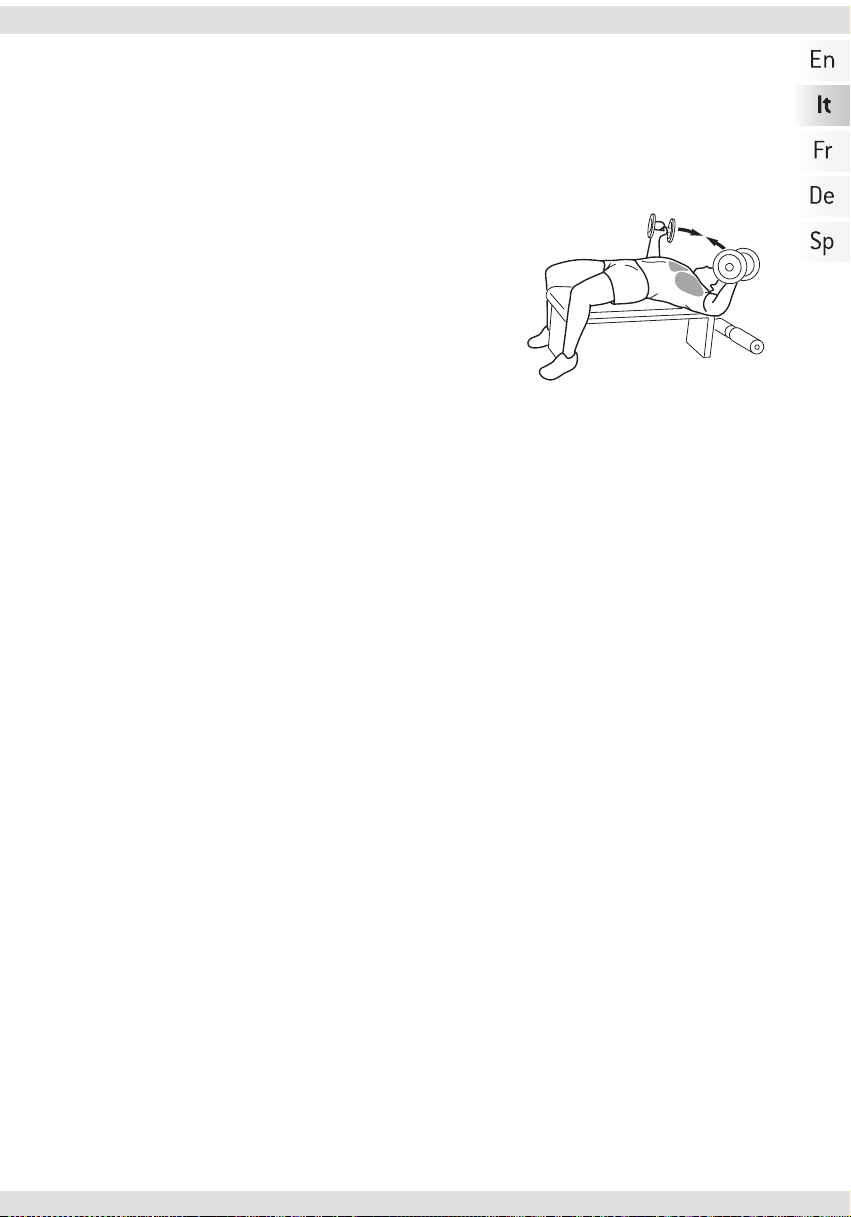
Petto: adduzioni
È un movimento di isolamento per i muscoli
pettorali. Conferisce ampiezza al torace e tono
ai muscoli pettorali.
Muscoli impegnati: pettorale e deltoide anteriore
Movimento:
- sdraiarsi sulla panca con lo schienale in posizione orizzontale; le braccia sono perpendicolari a terra con il gomito leggermente
angolato, le mani una di fronte all’altra
- eseguire un movimento di apertura delle braccia muovendo l’articolazione della spalla
- l’angolo dato in partenza al gomito e la posizione delle mani non dovrebbero mai cambiare durante l’esecuzione dell’esercizio.
03195022
2.1 Esercizi
97
Page 98
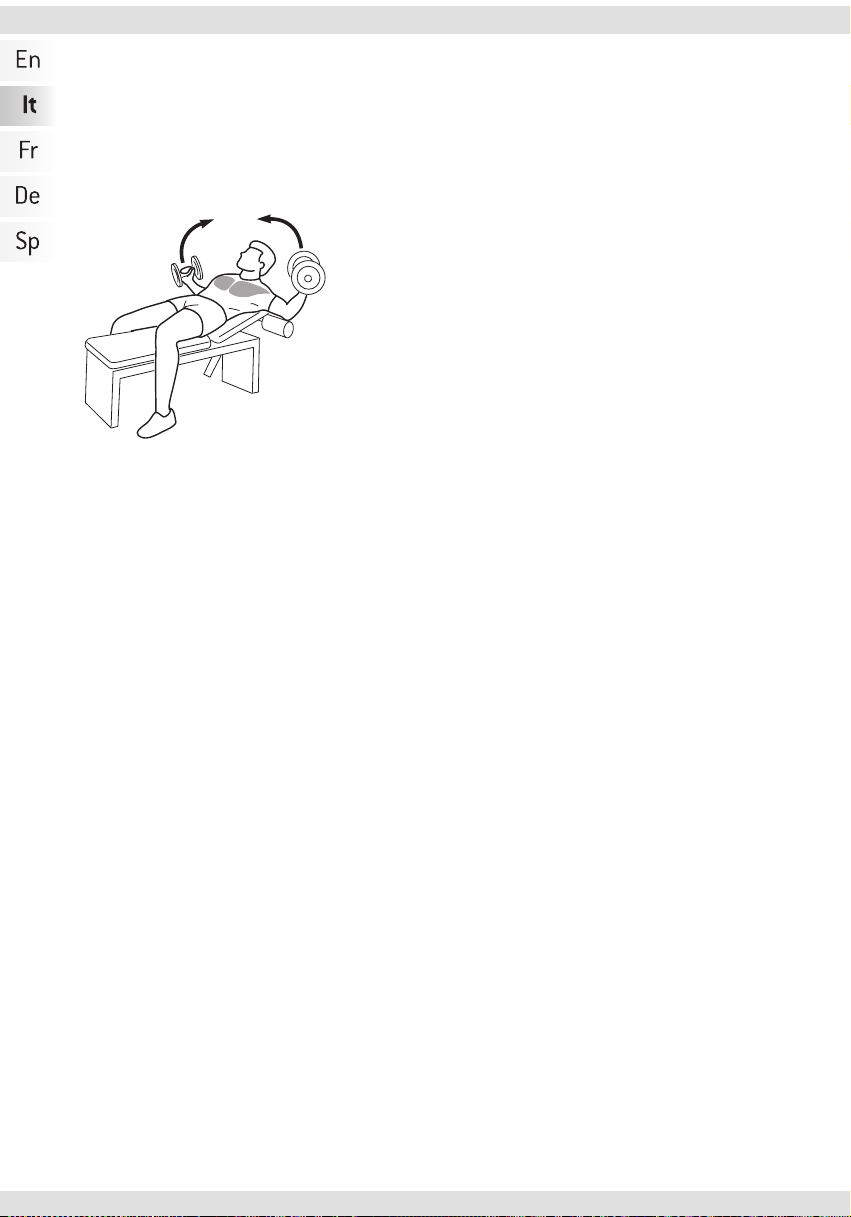
Petto: adduzioni su panca inclinata
L’esercizio è simile al precedente, ma l’inclinazione dello schienale localizza maggiormente il
lavoro sulla parte alta del torace.
Muscoli impegnati: pettorale e deltoide anteriore
Movimento:
03195023
- posizionare lo schienale al secondo foro
- sedersi sulla panca con la schiena ben appoggiata allo schienale; le braccia sono perpendicolari a terra con il gomito leggermente angolato, le mani una di fronte all’altra
- eseguire un movimento di apertura delle braccia muovendo l’articolazione della spalla
- l’angolo dato in partenza al gomito e la posizione delle mani non dovrebbero mai cambiare durante l’esecuzione dell’esercizio.
Multipla - Manuale per l’utente
98
Page 99
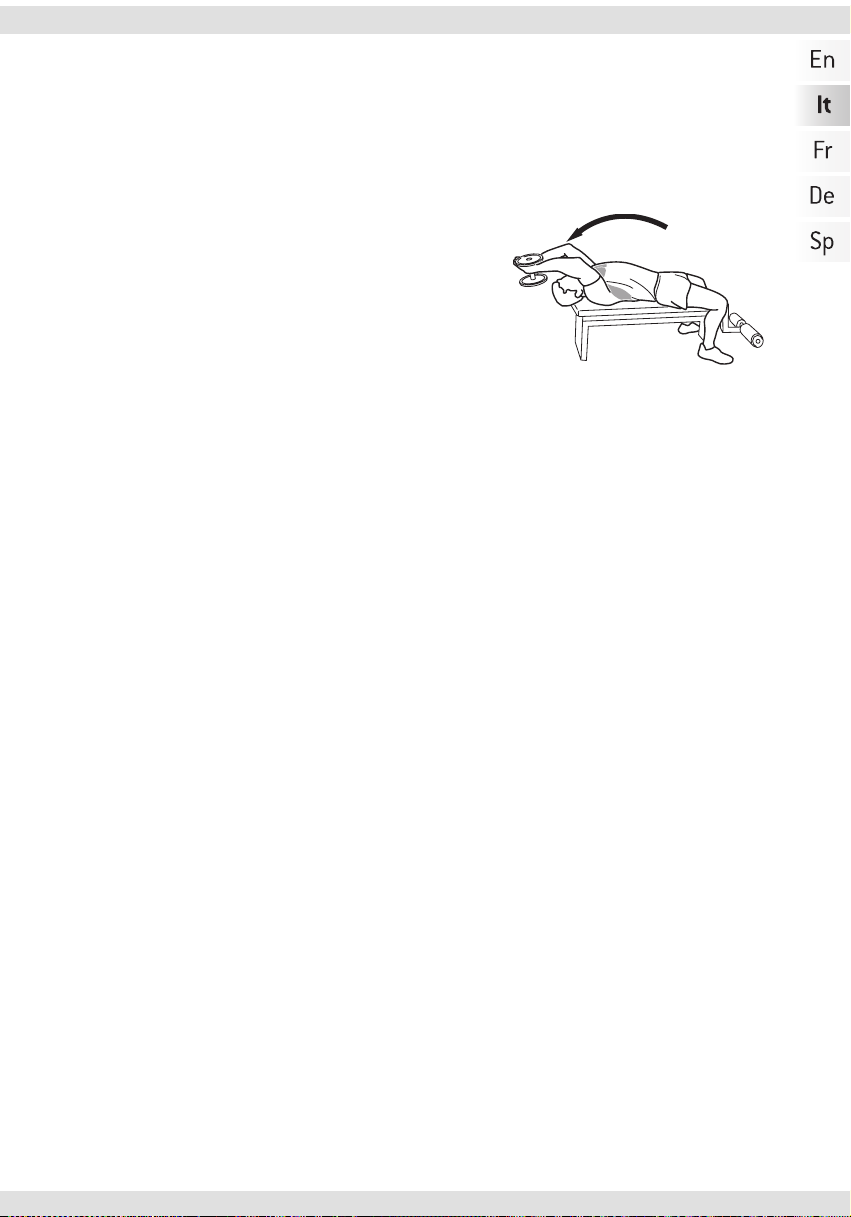
Petto: pull over
È un esercizio che allena tutta la muscolatura
toracica.
Muscoli impegnati: pettorale, dorsale, serrato
Movimento:
- sdraiarsi sulla panca con lo schienale in posizione orizzontale e con la testa sul bordo
dello schienale
- impugnare il manubrio con presa incrociata;
le braccia sono perpendicolari a terra, con i
gomiti leggermente flessi e vicini
- muovendo l’articolazione della spalla portare il manubrio dietro la testa, fino al massimo
punto consentito senza aprire i gomiti; poi
tornare in posizione di partenza
- l’angolo dato in partenza al gomito non dovrebbe mai cambiare durante l’esecuzione
dell’esercizio.
03195024
2.1 Esercizi
99
Page 100
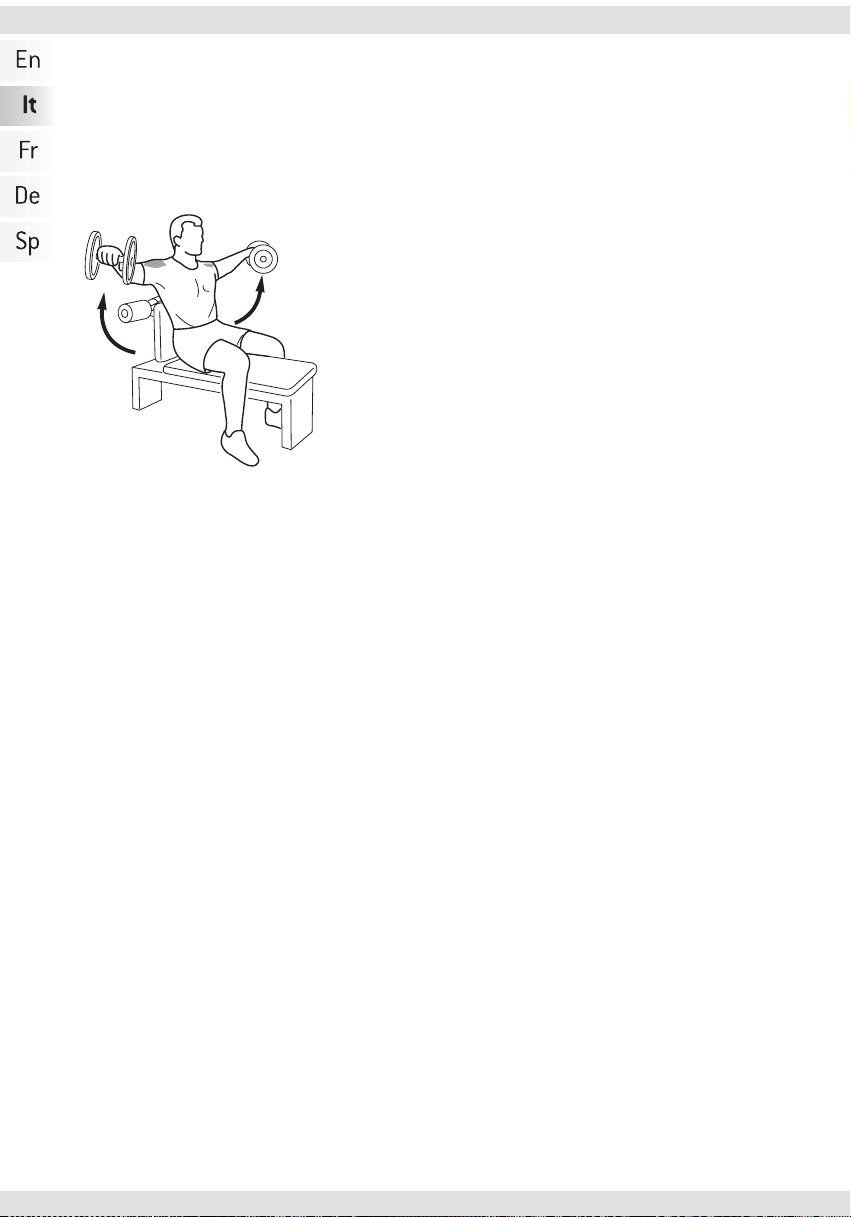
Deltoidi: alzate laterali
È un esercizio di isolamento per la parte centrale delle spalle.
Muscoli impegnati: deltoide medio
Movimento:
- posizionare lo schienale all’ultimo foro
- sedersi sulla panca con la schiena ben appoggiata allo schienale
03195025
- in posizione di partenza le braccia sono aderenti al busto, con i gomiti leggermente flessi
- sollevare le braccia fino a portare i gomiti all’altezza delle spalle; il palmo della mano è
rivolto a terra.
100
Multipla - Manuale per l’utente
 Loading...