

Page 1
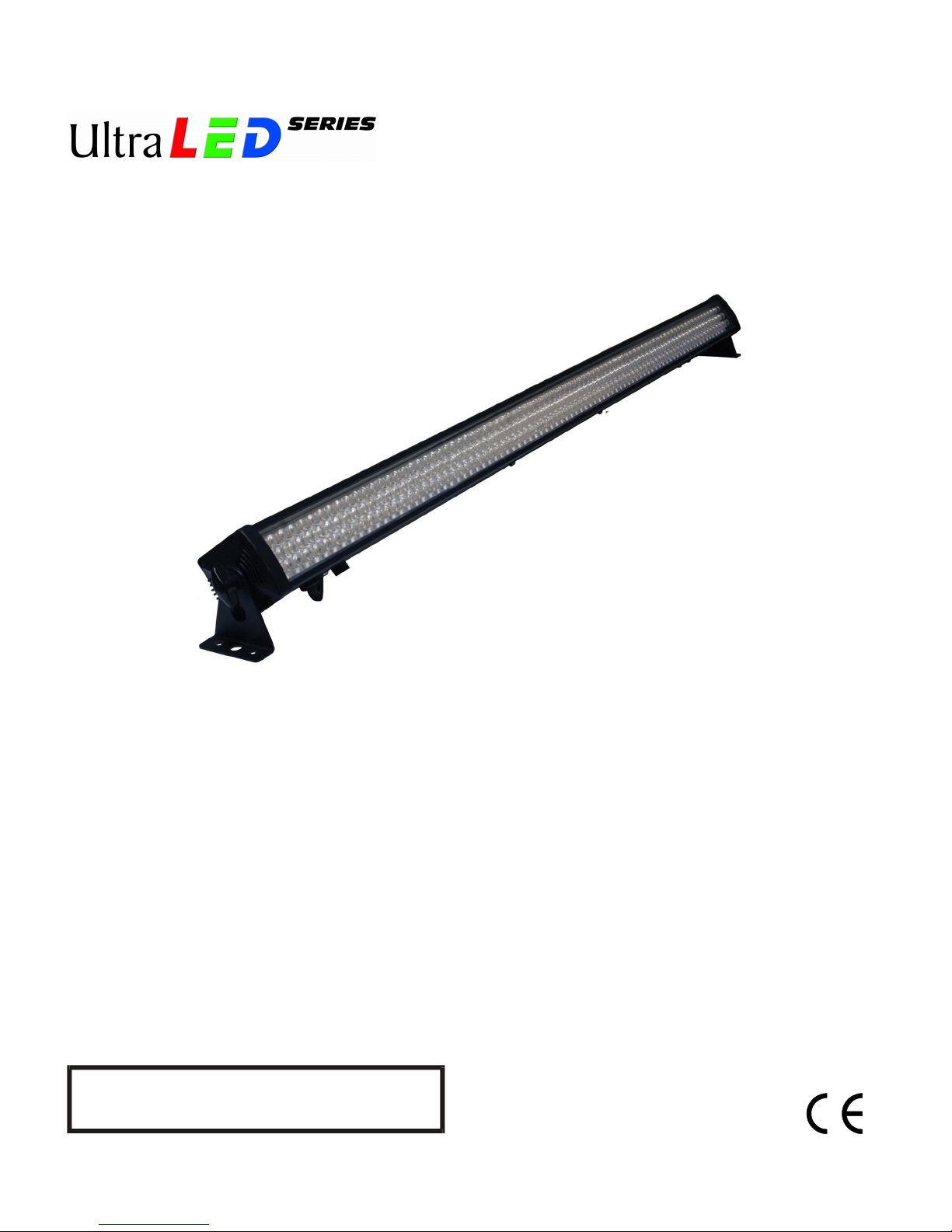
Information specifically for:
DL-BAR10C252
This manual contains important information.
Please read before operating fixture.
V1
Page 2

IMPORTANT INFORMATION
Save original packing and documentation for warranty, service and return issues.
Limited Warranty: This warranty covers defects or malfunctions in this equipment. This warranty lasts for a
period of one year from date of purchase. It is the owner’s responsibility to provide invoices for proof of
purchase, purchase date and dealer or distributor. If purchase date can not be provided, warranty period
will start at manufacture date. It is the sole discretion of Techni-Lux to repair or replace parts or equipment.
All shipping will be paid by purchaser. This warranty does not cover lamps, fuses, belts, power
semiconductors, relays, cleaning, standard maintenance adjustments or normal wear items or any problem
resulting from the following: improper wiring, incorrect voltage (including low or over voltage conditions and
lightning), abuse, misuse, improper maintenance or an act of God or damage resulting from shipping.
Warranty will be null and void if the product is altered, modified, misused, damaged, or subjected to
unauthorized repairs. Lamps are covered by relevant manufacturer warranty. This warranty gives you
specific legal rights, and you may also have other rights which vary from state to state. Any liability for
consequential and incidental damages is expressly disclaimed. No other warranty, expressed or implied is
made. Techni-Lux liability in all events is limited to, and shall not exceed, the purchase price paid.
Returning equipment and Repairs: All returns must be accompanied by a Return Merchandise
Authorization (RMA) number and sent pre-paid. Contact the dealer or Techni-Lux directly to obtain an
RMA. The RMA number must be clearly listed on the shipping label. Due care must be exercised in
packing all merchandise to be returned. All repairs must be accompanied by a written explanation of the
claimed problem or error encountered. Techni-Lux is solely responsible for determining a product’s
eligibility for coverage under warranty. If returning for consideration of credit, all accessories and
documentation, original protective material and cartons must be included and the equipment, packing and
carton must be in new resalable condition. Credit for returned merchandise will be issued at the lowest
current price and is subject to a restocking fee. No returns accepted on discontinued items. Techni-Lux is
not responsible for merchandise damaged in transit and reserves the right to refuse any return that is
damaged by the carrier, not accompanied by a Return Authorization Number (RMA#) or sent by freight
collect.
Claims: All claims must be made within seven (7) days of receipt of merchandise. Any physical damage
must be reported to carrier upon receipt of merchandise.
Please record the following information for future reference:
Model Number (circle): DL-BAR10C252
Serial Number: ________________________________________
Dealer: ______________________________________________
Date of Purchase: ______________________________________
www.Techni-Lux.com
2
Page 3

Table of Contents
Specifications................................................................................................................................. 4
Unpacking....................................................................................................................................... 5
Power .............................................................................................................................................. 5
Mounting ......................................................................................................................................... 5
Basic Reference ............................................................................................................................. 6
Setup & Operation Modes ............................................................................................................. 6
Stand-alone Mode ........................................................................................................................ 6
Sound-active Mode....................................................................................................................... 6
Master / Slave Mode..................................................................................................................... 6
DMX Controlling Mode ................................................................................................................. 6
DMX-512 Control Mode .................................................................................................................. 7
DMX Data Connection.................................................................................................................. 7
Data Terminator............................................................................................................................ 7
Adapter 5-to-3 pin......................................................................................................................... 7
DMX Start Address....................................................................................................................... 8
DMX Channel Assignment............................................................................................................. 9
DMX Function Table – Based on first channel ............................................................................. 9
Maintenance ................................................................................................................................. 10
Accessory Items (sold separately) ............................................................................................. 10
Troubleshooting........................................................................................................................... 11
DMX-512 Background .................................................................................................................. 11
3
Page 4

Specifications
Fixture Overview
• RGB color mixing with intensity and strobe effects
• 252 ultra bright 10mm LEDs: 48 red, 108 green, 96 blue
• Long Life LED light source
• Controllable as one bar or in 3 segments of 1/3 sections
• Operating modes: DMX, Color Changing, Sound Active, Master/Slave
• Floor standing with side brackets or hanging
• Beam angle: approximately 30 degrees
• DMX512 using up to 12 channels maximum
• DMX input/output via 3 pin XLR
• Dip switch for settings
Physical
Color Black
Size 41.5" x 2.5" x 3.5"
Weight 6 lbs (2.7 kg)
Environmental
Location Indoor
Max. ambient temperature 105°F (40°C)
Min. distance to flammable surface 3.3ft (1m)
Min. distance to illuminated surface 1ft (0.3m)
Electrical
Voltage Auto-Ranging 100-230vAC, 50-60Hz
Rated Power 30W
Fuses 2A Mini Size: 5x20mm
Control
Digital Protocol USITT DMX512 (1990)
Channels 2, 3, 4, 5, 6, 12 (12 maximum)
Data I/O 3 Pin XLR (Cannon)
Modes DMX512 or Stand-Alone
Optics
Light Source 252 High Output 10mm RGB LED Elements
Beam Angle 30 degrees
Rigging
Orientation Any
Mounting Points Angle adjustable bracket with 1/2” (13mm) mounting hole
4
Page 5

Unpacking
Immediately upon receipt, carefully unpack and inspect the fixture to verify that all parts are
present and have been received in good condition. If any parts appear damaged from shipping or
the shipping carton shows signs of mishandling, notify the shipper immediately. Retain carton and
all packing material for inspection. In the event that the merchandise is to be returned, the original
carton and packing must be used. The customer will be billed for a new carton and packing if
merchandise is received without the original carton and packing.
Claims
Physical damage must be reported to the Freight Carrier or Shipping Company upon receipt
of merchandise. Damage incurred in shipping is the responsibility of the Freight Carrier or
Shipping Company. It is the customer’s obligation in the event that merchandise is received
damaged, to notify the Freight Carrier or Shipping Company immediately. All other claims
not related to damage incurred during shipping must be made to the Dealer or Distributor
within 7 days of receiving merchandise.
Returns
Returned merchandise must be in the original packing with a Return Merchandise
Authorization number (RMA) clearly listed on the shipping label. Items sent by Freight
Collect or without a RMA number will be refused. Call your sales person and request a
RMA prior to shipping. Be prepared to provide the model number, serial number and
description of the nature of the return. Shipping damage resulting from inadequate
packaging is the customer’s responsibility. Customer will be charged additional shipping
charges to return products received in non original packing and or cartons.
Power
Do not apply power to the fixture until power source is verified.
For protection against electric shock, fixture must be connected to suitable earth ground.
Make sure fixture is disconnected from power mains before any service.
This fixture automatically adjusts to mains voltage and frequency 110-240vac 50/60Hz. The listed
power rating is its average wattage under normal conditions. All fixtures must be powered directly
from a switched circuit. This fixture cannot be run on a rheostat or dimmer circuit even if used
solely for a 0% to 100% switching. Before applying power to a fixture, check that the fixture’s input
voltage matches the power source voltage. Consult a qualified electrician if there are any
concerns about proper connection to power.
Mounting
Always consult a qualified professional when rigging. Consider access for routine maintenance
when selecting a mounting position. This fixture may be mounted in any position provided there is
adequate room for movement and ventilation. Mount the fixture securely using a mounting clamp
and a safety cable. Do not mount where the fixture will be exposed to rain, high humidity, extreme
temperature changes or restricted ventilation. Do not obstruct any vents.
5
Page 6

Basic Reference
Setup & Operation Modes
For this fixture to operate correctly you must first set the dip switches to the desired operation
mode. This tells the fixture how it is to perform and what signals (if any) it is to respond to. When
DIP Switch #10 is in the OFF position, the remaining switches Dips 1-9 can be used to set the
fixture in various stand-alone modes. Stand-alone refers to using the fixture without a controller.
Stand-alone Mode
With Dip 9 OFF & Dip 10 OFF:
Dip 1 - Dip 4 to select different built-in running programs.
Dip 5 – Dip 6 allows adjustment of the color change speed.
Dip 7 – Dip 8 adjusts the strobe flash speed.
Sound-active Mode
With Dip 9 ON and Dip 10 OFF:
Dip 1 – Dip 4 set the sound sensitivity.
Master / Slave Mode
With Dip 10 set to ON, and all other dipswitches set to OFF, the unit will go into SLAVE
mode and follow the master unit. Standard DMX interconnect cables between fixtures is
required for this mode to operate.
DMX Controlling Mode
Set Dip 10 to ON, and use Dips 1-9 to set the start address. Refer to the section titled,
“DMX Control Mode”.
6
Page 7

DMX-512 Control Mode
DMX-OUT
2
3
- Ground
- Signal (-)
- Signal (+)
XLR Connector - Socket:
DMX-IN
1 2 3
- Ground
- Signal (-)
- Signal (+)
XLR Connector - Plug:
Fixtures require a "Start Address" from 1 to 512, setting the first DMX channel containing data for
the fixture (see DMX Background). Before addressing fixtures, consult the manual of the system’s
DMX controller to select a desirable addressing scheme. Valid Start Addresses range from 1 to
512. Fixtures requiring more than one channel for control will read subsequent channels up to the
total number of channels required. Since this fixture requires 12 channels maximum of DMX, if set
to a Start Address of 7 it would use data from channels: 7, 8, 9, 10, 11, 12, 13, 14, 15, 16, 17 and
18. Choose a Start Address so the channels used do not overlap with other fixtures. In some
cases, it may be desirable to set two or more same type fixtures to the same Start Address. In this
case, the fixtures will be slaved together and respond to the same data. Because all fixtures see
the same data, fixtures may be set to any address without concern for the physical order they are
connected by the DMX cables. This fixture has multiple DMX channel settings, 12 channels being
the maximum and offering the maximum controllability over the fixture. Other more conservative
DMX modes that use fewer DMX channels are available. All examples given are based on using
the maximum feature set of 12 DMX channels.
DMX Data Connection
This fixture uses 3 pin XLR type connectors and shielded twisted pair cable approved for
EIA-422/EIA485 use. Fixtures are connected in Daisy Chain topography: Connection is
made from the controller to the DMX-IN of the first light, then from the DMX-OUT to the
DMX-IN of the next light and so on. Only one data source can be on a chain and no
branching is allowed. The physical order in which the fixtures are connected is not
important, use the most convenient.
1
Data Terminator
A Data Terminator can be connected to the DMX-OUT of the last fixture
to reduce the effects of signal noise; it is not required for all installations.
To make a Terminator, connect a 120-ohm ¼ watt resistor across pin 2,
Data Negative (S-) and pin 3, Data positive (S+). A qualified technician
can determine if a Data Terminator is needed.
Adapter 5-to-3 pin
Systems using 5 pin DMX interfaces can be accommodated by purchasing 3-to-5 pin
adapters or building adapter cables. Numbers designating each pin can be found on
connectors. Converting between the two XLR types is done in a pin-to-pin fashion.
Connect the shields to pin 1, then connect pin 2 to pin 2 and pin 3 to pin 3, regardless of
either connector’s gender or pin count. No connection is made to Pins 4 & 5.
7
Page 8

5Pin
XLR (Plug)
Pin 1: GND(Sheild)
5 Pin XLR (Socket)
Pin 1: GND(Sheild)
Pin 2: Signal(-)
Pin 3: Signal(+)
Pin 4: N/C
Pin 5: N/C
3 XLR (Plug)
Pin
Pin 1: GND(Sheild)
Pin 2: Signal(-)
Pin 3: Signal(+)
3 XLR (S)
Pin ocket
Pin 1: GND(Sheild)
Pin 2: Signal(-)
Pin 3: Signal(+)
Pin 2: Signal(-)
Pin 3: Signal(+)
Pin 4: N/C
Pin 5: N/C
DMX Start Address
To place the fixture in DMX mode, DIP Switch #10 is set ON. Next, set the start
address using the other DIP Switches located on the back of the fixture. Each
switch has an associated value. Adding the value of each switch in the ON
position gives the start address. Determining which switches to toggle ON given
a specific start address is accomplished by subtracting the largest switch value
possible from the selected start address which does not cause a negative
number. Continue this process until zero is reached, always subtracting the
largest possible value that does not cause a negative.
DIP Switch Values
Switch Value
1 1
2 2
3 4
4 8
5 16
6 32
7 64
8 128
9 256
10 DMX
Function
Example1: DIP Switch settings for the address of 90: Listed with each
switch is its associated binary value. The first switch has a value of 1 and each following switch
doubles in value. Do not confuse the switch with its value. Start by subtracting the largest switch
value possible that doesn’t cause a negative result: 90–64=26.
Continue by subtracting the next largest switch value possible
until zero is reached: 26–16=10, 10–8=2, 2–2=0. Set the
switches corresponding to the values 64, 16, 8 and 2 to the ON
position: switch # 7, switch # 5, switch # 4 and switch # 2 – plus
the DMX switch #10.
Addressing multiple fixtures of the same type is accomplished by
simply adding the number of channels required to the start address of the first fixture to yield the
start address of the next fixture. Although this fixture can be used in modes that occupy less than
12 channels, it is highly recommended that the units are still addressed 12 channels apart. This
reduces the chances of data overlapping if the console or control is to become temporarily misconfigured or unstable.
Example2 Select Start Addresses for 4 fixtures each requiring 12 channels of DMX.
For this example, start with the first unit set to the first possible Start Address = 1. This fixture
occupies DMX channels 1 thru 12. The next DMX channel available for a Start Address is found by
adding the previous fixture’s Start Address to its channel requirement: 1+12=13. To maximize
channel usage, we will leave no empty channels between fixtures so the second Start Address is set
to DMX channel 13 and that fixture occupies channels 13 thru 24. The third fixture will be
addressed 13+12=25 and occupy channels 25 thru 36. The last fixture is addressed 25+12=37 and
will occupy channels 37 thru 48. Thus, 4 fixtures using 12 channels each have Start Addresses of
1, 13, 25 and 37 and the next free channel in the system is 37+12=49.
8
Page 9

DMX Channel Assignment
DMX Function Table – Based on first channel
The DMX channel functions in the table below depend on the value of channel 1. Channel 1
of the fixture which is also the start address, sets what the rest of the channels will do. If
you wish to use this fixture in the most versatile mode, channel 1 would be set to a DMX
value between 1 to 15 from your DMX controller. The table below applies to the fixture
when function Dip switch # 10 is set to ON and a start address is set using Dips 1-9.
CH1 CH2 CH3 CH4 CH5 CH6 CH7 CH8 CH9 CH10 CH11 CH12
000 Blackout Blackout Blackout Blackout Blackout Blackout Blackout Blackout Blackout Blackout Blackout
1-15
16-31
32-47
Red
48-63
Green
64-79
Blue
80-95
Purple
96-111
Yellow
112-127
Cyan
128-143
White
144-159
Color
change
160-175
Color
chase
176-191
Color fade
Master
dimmer
0-255
Master
dimmer
0-255
Flash
Flash
Flash
Flash
Flash
Flash
Flash
Speed
0-255
Speed
0-255
Speed
0-255
Flash
0-255
Flash
0-255
0-255
0-255
0-255
0-255
0-255
0-255
0-255
Flash
0-255
Flash
0-255
Flash
0-255
Red
Section1
0-255
Red
Sections
1,2,3
0-255
Green
Section1
0-255
Green
Sections
1,2,3
0-255
Blue
Section1
0-255
Blue
Sections
1,2,3
0-255
Red
Section2
0-255
Green
Section2
0-255
Blue
Section2
0-255
Red
Section3
0-255
Green
Section3
0-255
Section3
Blue
0-255
192-207
Multi color
chase
208-223
Fading
flow
224-239
Two color
flow
240-255
Sound
control
Speed
0-255
Speed
0-255
Speed
0-255
Sensitivity
0-255
Flash
0-255
Flash
0-255
Flash
0-255
Color
select
0-255
Color
select
0-255
Color
select
0-255
9
Page 10

Maintenance
Make sure fixture is cool and disconnected from power mains before any service.
Weekly operating hours and environmental conditions will establish how often the fixtures need
cleaning. Fixtures should be cleaned and inspected at least once a month to maintain optimum
performance. Accumulation of dust and fog residue increases heat build up, can lead to
malfunctions, overheating and reduction in maximum light output, reduced fixture life and over all
performance. Before conducting any maintenance, disconnect fixture from power mains.
1) Disconnect fixture from power mains.
2) Use a vacuum with a soft brush to remove dust collected on external vents and internal
components. If using an air compressor, use low pressures and extreme care to prevent
damaging any internal parts or effects.
4) Clean all optical elements when the fixture is cold. Use a soft lint free cotton cloth or tissue and
cleaner safe for plastics.
5) Inspect clamps and safety cables to ensure fixture is secure and safe.
Accessory Items (sold separately)
Order Code Description
CLAMP-C Medium Duty C-Clamp
CLAMP-MEGA/B Mega Clamp – Heavy Duty – Black for 1” to 2” diameter pipe
CLAMP-MINI/B Mini Clamp Black for 3/4" - 2"
CLAMP-CBHALF/N Half Cheeseborough Coupler Narrow 300kg Max Load
SAFETYCABLE18B Safety Cable Black 18”
SAFETYCABLE18S Safety Cable Silver 18”
CA-XLR3/1 Pre-made 1’ 3-pin XLR Cable
CA-XLR3/5 Pre-made 5’ 3-pin XLR Cable
CA-XLR3/10 Pre-made 10’ 3-pin XLR Cable
CA-XLR3/25 Pre-made 25’ 3-pin XLR Cable
CA-XLR3/50 Pre-made 50’ 3-pin XLR Cable
CA-XLR3/100 Pre-made 100’ 3-pin XLR Cable
CO-XLR3M XLR Connector 3-pin Male
CO-XLR3F XLR Connector 3-pin Female
CO-XLR5M XLR Connector 5-pin Male
CO-XLR5F XLR Connector 5-pin Female
CO-XLRTERM3 XLR 3 Pin Data Terminator
CO-XLR3MTO5F XLR 3 Pin Male to 5 Pin Female Adapter
CO-XLR5MTO3F XLR 5 Pin Male to 3 Pin Female Adapter
10
Page 11

Troubleshooting
Symptom Possible Cause / Solution
Check for power on mains No Power
Check main fuse and fuse holder
Erratic / No response to DMX
Check data cables: connection and proper wiring
Check DIP Switch settings (#10 set to on)
Check Start Address
Incorrectly responds to DMX
(Diagnostic technique for DMX issues: Set
suspect fixture’s Start Address the same as a
correctly functioning fixture. If both units then
function correctly, issue is programming)
Check Start Address
Check for overlapping addresses
Check DIP Switch settings
Check Data cables (faults and proper wiring)
DMX-512 Background
DMX-512 is a digital data transmission standard developed by the United States Institute for Theater Technology
(USITT). It is designed to enable control of lighting equipment. DMX deals solely with the formatting of data for
transmission and does not dictate how the data is created or used.
Under DMX, signals are transmitted in much the same way a computer modem transmits data. The Data, divided into
channels, is "Framed" using a start bit, high (1), eight data bits and finally, two stop bits, both high (1). DMX uses no
parity to check the integrity of the signal. Instead, DMX relies on the ultra low probability of an error occurring in the
same place when the data is resent. The rate at which data is sent is fixed at 250k bps, almost four and a half times
faster that a 56k modem. This speed allows all data on a DMX chain to be updated more than 44 times every second.
The transmitted data follows a specific format. DMX allows for 512 channels each with eight data bits, giving each
channel the possibility of 256 values. When a data "Packet" is sent, all channels are transmitted one after another.
Even if the data on a specific channel has not been changed, it must be sent. In a packet, a "start code" of all zeros is
sent before the data to identify the signal as a Standard DMX transmission. This start code is transparent to the user
and is handled by the controller.
The physical signals are transmitted using a twisted pair of wires and a common shield, a configuration called
Balanced. The controller and all receiving equipment are connected using a “Daisy Chain" connection. The signal is
jumped from the controller to a piece of DMX equipment. From there, the signal is jumped to the next piece of
equipment and so on until the last piece of equipment is connected. No branches are allowed and the signal does not
come back to the controller. The final piece of equipment will have only one cable connection. As a result, all
equipment connected to the chain will see exactly the same signal whether it is first or last. When connecting
equipment, no particular attention needs to be paid to the order in which the equipment is connected. Depending on
the conditions and equipment, a line terminator may be required. If there is any question, in most circumstances the
addition of a terminator will not degrade the signal. To make a terminator, attach a 120-ohm resistor between the
Signal Data Negative and Signal Data Positive pins of a connector in the last piece of equipment in the chain.
The DMX Standard uses 5 pin XLR connectors. However, it is common to see
fixtures with 3 pin XLR connectors as these types of balanced or “Lo-Z” cables are
common in the audio industry. In either case, pin numbers are the same and carry
the same signals.
10900 Palmbay Drive • Orlando, FL 32824 U.S.A.
www.techni-lux.com
Pin Connection
1 Common (Shield)
2 Data Negative (S- or Cold)
3 Data Positive (S+ or Hot)
4 n/c (not used)
5 n/c (not used)
11
 Loading...