

Page 1

WOOD MOISTURE METER WIP-22D
USERS MANUAL
1. Application
Wood Moisture Meter WIP-22D is designed for quick
and non-damaging measurement of moisture contents in
wood. The device measures the dielectric constant (SIC) of
the material. The wood is penetrated by the electromagnetic
field generated by the device. The Moisture Meter is
equipped with knobs for setting the density and thickness of
the wood. It can be used to measure wood planks 10 mm to
60 mm thick and of density within the range of 0.3 to 1.1
g/cm³. The measuring range is 4% to 60% of moisture
contents.
2. Technical data
Range 4% - 60%
Max. depth of penetration 60 mm
Display LCD, 12.7 mm
Resolution 0.1
Settings range:
• density 0.3 – 1.1 g/cm³
• thickness 10 – 60 mm
Minimal settings’ step:
• density 0.02 g/cm³
• thickness 2 mm
Page 2

- 2 -
Power battery 6F22, 9V
Battery life approx. 5000 meas.
Low power indication yes
Size
device 165 * 80 * 33 mm
case 270 * 180 * 55 mm
3. Description of the controls
There are two control knobs on the front panel:
upper – to select the operating function,
OFF – power off
DENSITY – setting the density with the lower
knob
THICKNESS – setting the thickness with the
lower knob
SETTINGS CHECK – alternately displaying the
previously set density and thickness
MEASURE – automatic calibration (approx. 4
sec.) and measurement
lower – to set the density and thickness of the wood. This
knob is active when the upper knob is set to
DENSITY or THICKNESS.
GUARANTEE
The manufacturer guarantees the correct functioning of
the Wood Moisture Meter WIP-22D under normal use for a
period of 12 months:
Serial number ..............................................
Production date ..........................................
Page 3

- 14 -
12. Producer
TANEL Electronics
PL, 44-100 Gliwice, ul. Kopernika 121
tel./fax +48 32 234-96-15; 238-16-15
http://www.tanel.com.pl/
- 3 -
4. Preparing the instrument
a) Preparing the instrument without the change in settings
In this case quickly switch the upper control to
SETTINGS CHECK. The LCD will display the density and
thickness set during the previous measurements (e.g. 0.56
and 42). Hold the device in the air (fig. 1), switch the upper
control knob to MEASURE. The device will calibrate
automatically (the display shows - - -). The end of
calibration is indicated by the number 4.0 (the lower range
limit) displayed on the LCD. The device is ready for
measurements.
Fig. 1
Page 4

- 4 -
b) Preparing the instrument and changing the settings
Follow these steps:
• set the upper control knob to DENSITY and then
set the required density using the lower control
knob,
• set the upper control knob to THICKNESS and set
the required thickness with the lower control knob,
• set the upper control knob to SETTINGS CHECK.
The LCD will display the density and thickness
alternately,
• hold the instrument in the air (fig. 1) and set the
upper control knob to MEASURE. The device will
calibrate automatically (the display shows - - -).
The end of calibration is indicated by the number
4.0 (the lower range limit) displayed on the LCD.
The device is ready for measurements.
A table with the density values for the most popular wood
types is on the back of the moisture meter.
- 13 -
10. Changing the battery
The device is equipped with a power level control
circuit. When the power drops below acceptable level a
sign ”LO BAT” appears on the left side of the LCD. This
indicates that the battery has expired and should be replaced
with a new one.
To replace the battery unscrew the screw on the back of
the instrument and carefully remove the back panel.
Store the device in a dry place.
11. Service
The Wood Moisture Meter WIP-22D has a 12 months
guarantee.
• all repairs during the guarantee period will be done
within 10 days from the date of delivery,
• all other repairs will be done within 14 days from the
date of delivery.
Page 5

- 12 -
For the example values given in a, b and c the result is:
62 100
g = x = 0.56
94.2 100 + 17.2
e) now you can use the calculated density (e.g. 0.56) for
any future measurements of this type of timber.
9. Errors
If the instrument can not calibrate properly it indicates
the following error:
-AIr - generator voltage too low
AIr - generator voltage too high
In such case power off the device, check the geometry of
the electrodes, clean the electrodes, make sure the device is
dry and then start the calibration again (see chapter 4).
If the instrument still reports error contact the
producer.
- 5 -
Density values for other (also exotic) wood types are in
chapter 7 of the users manual.
5. Measurements
The measurements should be conducted in at least
several places. These places should be as flat, smooth and
clean as possible. The actual result of the measurements is
the arithmetic average of all the measurements. A line
drawn between the electrodes should be perpendicular to
the fibres. If the timber is too thin, place the electrodes
parallel to the fibres.
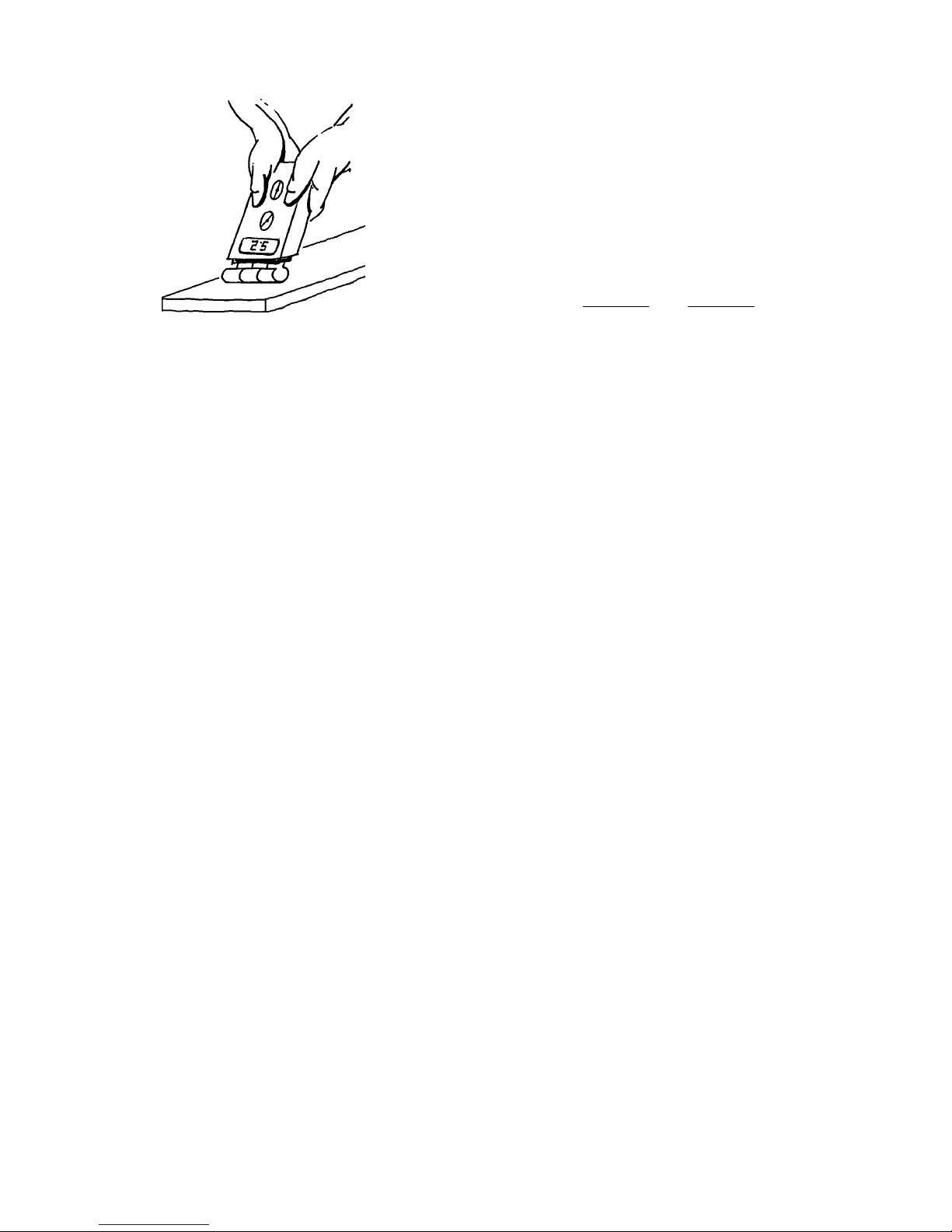
Hold the device as shown on fig 2. Press the electrodes
hard against the wood. Read the result.
There should not be any metal elements, wet wood or
concrete etc under the timber. It’s best if the timber is
supported only by it’s ends or placed on a layer of
Styrofoam several centimetres thick.
The instrument is equipped with an automatic power
off which activates 5 minutes after the last change in upper
control knob setting. It can be switched off instantly by
setting the upper control knob to OFF.
Page 6
- 6 -
Fig. 2
6. Remarks
The size of the timber should not be less than 80 x 40
mm. Measuring moisture contents of smaller pieces leads to
results lower than the real moisture contents.
The electrodes are made of special silicon bronze and
during normal operation should not get deformed. If due to
excess force or accidental fall the electrodes get deformed,
they should be bend to their original shape. Deformed or
misplaced electrodes are the
- 11 -
b) weight the cube with the accuracy of 1 gram; note the
result G in grams (e.g. 62g)
c) measu re the approximate moisture contents with Wood
Moisture Meter WIP-22D setting:
• thickness –according to h,
• density – based on your expertise or tables
Note the result W % (e.g. 17.2%)
d) calculate the density with the following formula:
G 100
g = x
V 100 + W
where:
G – weight of the sample (g)
V – volume of the sample (cm
3
)
W – moisture contents (%)
g – density (g/cm
3
)
Page 7
- 10 -
8. Calculating wood density
Calculating the density of a wood type can be
necessary when the wood type is not in the table in chapter
7 or when it is suspected that the local wood has the density
considerably different from the average for this type.
Follow these steps to calculate the density of the wood
type:
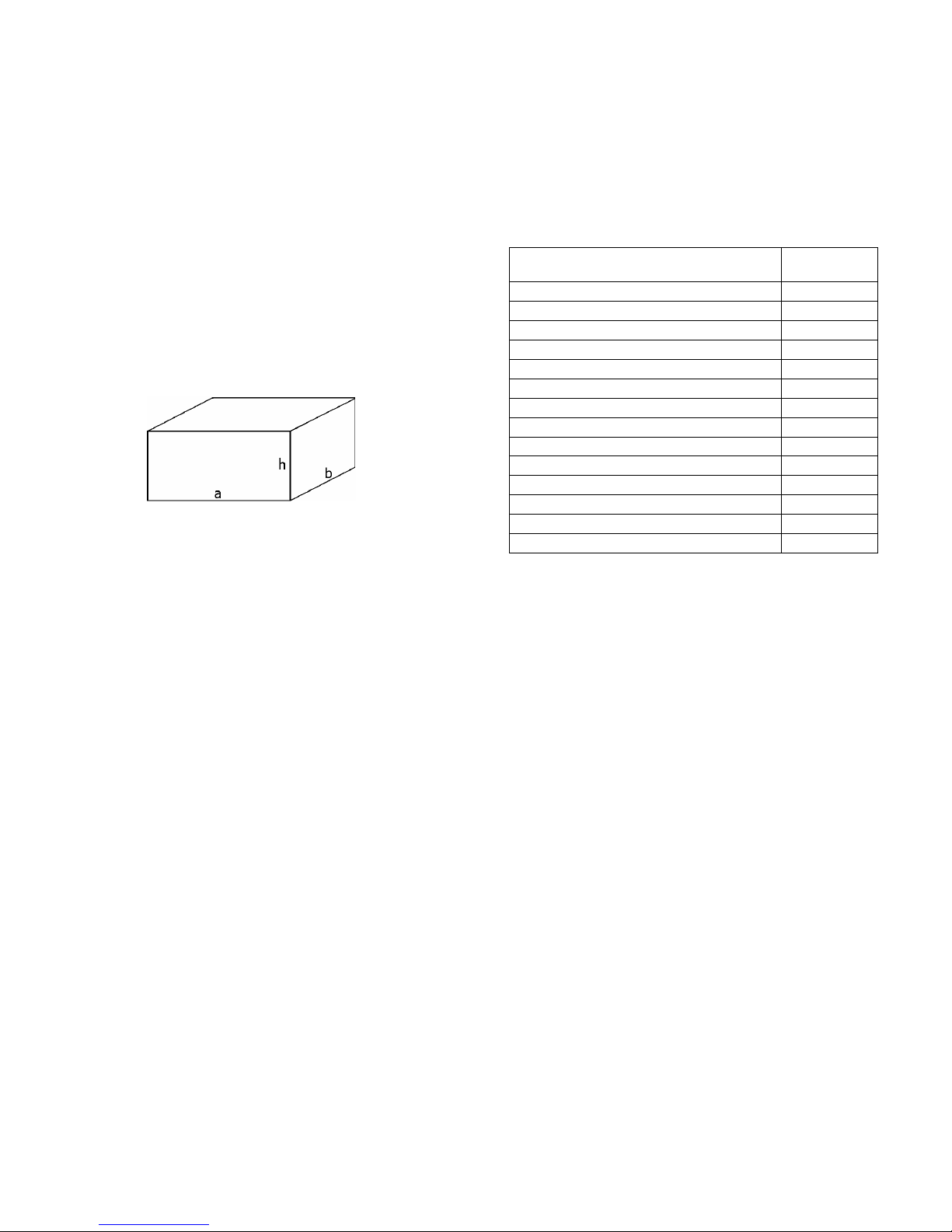
a) cut a regular cube of the wood and measure it’s size
with the accuracy of 1 mm (e.g. 46 * 64 * 32) mm;
calculate it’s volume (in cm
3
)
V = a * b * h (e.g. 94.2 cm3)
- 7 -
source of errors and in extreme cases can prevent proper
calibration of the device.
Avoid measurements when the timber or the operator
of the device are loaded with high electrostatic charges.
Such charges (sparks) make measurements difficult and can
damage the instrument.
7. Density of selected wood types
Wood type(brand name)
Density
(g/cm
3
)
Abacji 0,35
Abura 0,53
Afara white 0,52
Afrormosia 0,65
Alder, Blackalder 0,51
Alerce 0,34
Ash common 0,65
Ash japanese 0,61
Ash white 0,64
Aspen, Poplar 0,45
Balsa 0,08
Basswood, Lime 0,49
Beech 0,68
Birch common 0,61
Page 8
- 8 -
Californian Redwood 0,39
Mountain Cherry 0,54
Chestnut, Sweet 0,55
Douglas Fir, Oregon 0,47
Eberesche 0,73
Ebony Macassar 1
Elm 0,64
European Cherry 0,55
Spruce European 0,43
Hickory, White heart 0,76
Hornbeam common 0,79
Iroko 0,63
Larch European 0,55
Larch japanese 0,49
Lauan White 0,52
Locust black 0,74
Mahogany Broad 0,55
Mahogany Grand, Bassam 0,47
Mansonia 0,6
Maple 0,59
Maple 0,58
Maple sugar 0,63
Maple soft 0,47
- 9 -
Meranti dark red 0,67
Meranti White 0,82
Merbau 0,77
Niangon, Wishma 0,6
Oak, European 0,65
Oak, White 0,74
Okoume, Gaboon 0,41
Pear 0,7
Pine insignis 0,4
Pine, Weymouth 0,37
Pine, Europ. Black 0,53
Pine, Redwood 0,49
Popular Black Populus nigra 0,41
Ramin 0,56
Rubberwood 0,49
Redoak, Northern 0,66
Sapele 0,62
Silver Fir 0,41
SpruceW.H. Alaska pine, 0,44
Teak 0,63
Utile 0,59
Walnut 0,64
 Loading...