

Page 1
SERVICE MANUAL
27" COLOR TELEVISION
6427TE/SST4274
Page 2

IMPORTANT SAFETY NOTICE
Proper service and repair is important to the safe, reliable operation of all
Funai Equipment. The service procedures recommended by Funai and described in this service manual are effective methods of performing service
operations. Some of these service special tools should be used when and
as recommended.
It is important to note that this service manual contains various CAUTIONS
and NOTICES which should be carefully read in order to minimize the risk of
personal injury to service personnel. The possibility exists that improper
service methods may damage the equipment. It also is impo rtant to understand that these CAUTIONS and NOTICES ARE NOT EXHAUSTIVE. Funai
could not possibly know, evaluate and advice the service trade of all conceivable ways in which service might be done or of the possible hazardous
consequences of each way. Consequently, Funai has not undertaken any
such broad evaluation. Accordingly, a servicer who uses a service procedure or tool which is not recommended by Funai must first use all precautions thoroughly so that neither his safety nor the safe operation of the
equipment will be jeopardized by the service method selected.
TABLE OF CONTENTS
Specifications........................................................ 1-1
Important Safety Precautions................................ 2-1
Standard Notes for Servicing................................ 3-1
Cabinet Disassembly Instructions......................... 4-1
Electrical Adjustment Instructions......................... 5-1
Block Diagrams..................................................... 6-1
Schematic Diagrams / CBA's and Test Points...... 7-1
Schematic Diagrams............................................. 7-3
CBA Views and Test Points..................................7-11
Waveforms ..................................................... ....... 8-1
Wiring Diagram...................................................... 9-1
IC Pin Functions .................................................. 10-1
Cabinet Exploded Views...................................... 11-1
Packing Exploded Views ..................................... 11-3
Mechanical Parts List .......................................... 12-1
Electrical Parts List.............................................. 13-1
Page 3
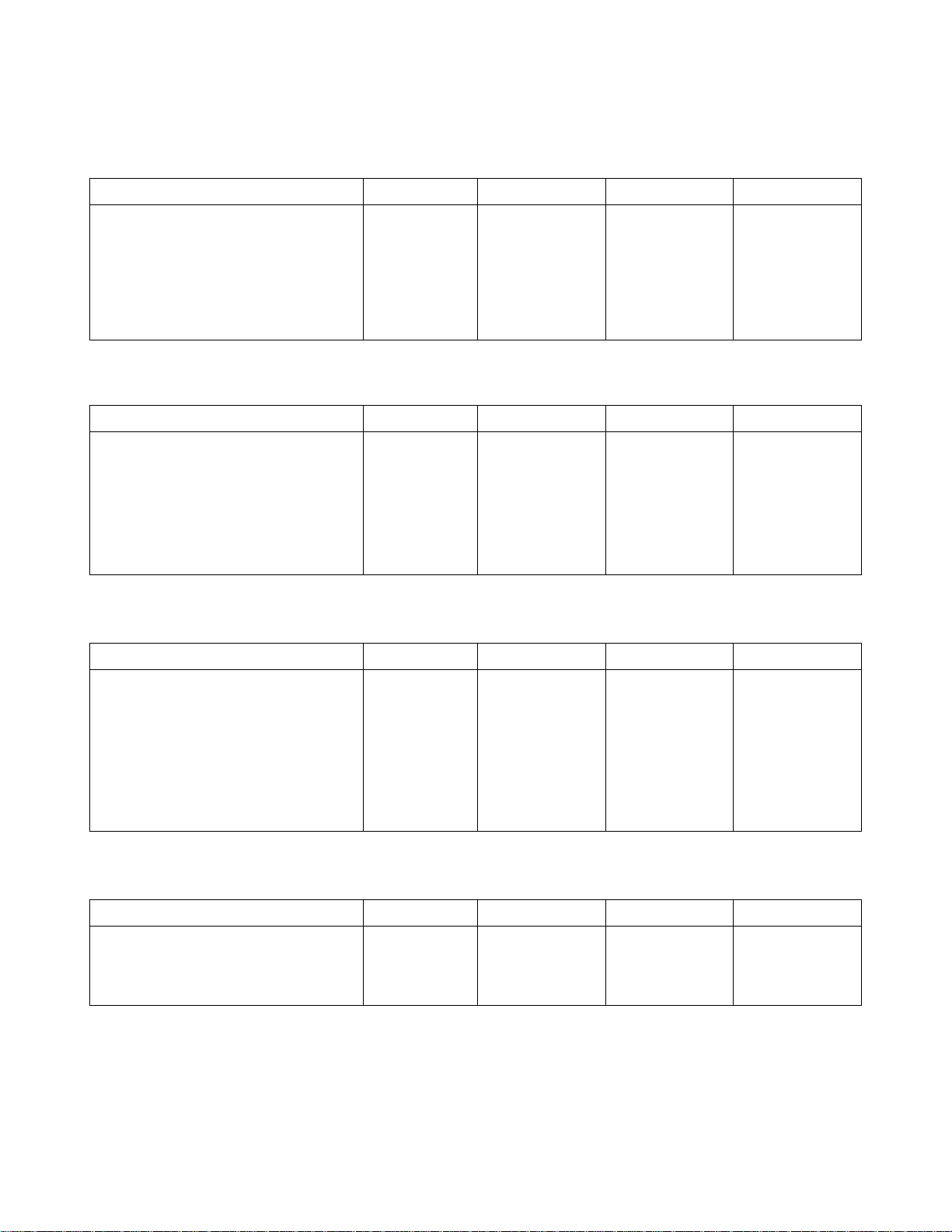
SPECIFICATIONS
<TUNER> ANT. Input ------------------- 75ohm Unbal., F type
Reference Level ----------- 20Vp-p (CRT Green Cathode)
Test Input Signal ---------- 400Hz 30% modulation
Description Condition Unit Nominal Limit
1. Intermediate Freq. Picture
Sound
2. Peak Picture Sens VHF
CATV
UHF
3. AFT Pull In Range (10mV input)
-
<DEFLECTION>
Description Condition Unit Nominal Limit
1. Deflection Freq. Horizontal
Vertical
2. Linearity Horizontal
Vertical
3. Over Scan
4. High Voltage
-
-
<VIDEO & CHROMA>
Description Condition Unit Nominal Limit
MHz
MHz
dBµv
dBµv
dBµv
MHz ±2.0 ±0.7
KHz
Hz
%
%
%10
KV 29
45.75
41.25
15
15
15
15.734
60
-
-
-
30
30
40
-
-
±15
±10
-
-
1. Misconvergence Center
Side
Corner
2. Brightness APL 100% Ft-L 25 15
3. Color Temperature
4. Resolution Horizontal
<AUDIO>
Description Condition Unit Nominal Limit
1. Audio Output Power 10% THD W 1 0.8
2. Audio Distortion (w/LPF) 500mW % 2 7
3. Audio Freq. Response -3dB Hz 70~11K
Note:
Nominal specifications represent the design specifications. All units should be able to approximate
these. Some will exceed and some may drop slightly below these specifications. Limit specifications
represent the absolute worst condition that still might be considered acceptable. In no case should
a unit fail to meet limit specifications.
All items are measured across 8Ω load at speaker output terminal.
-
Vertical
mm
mm
mm
°K 9200°K
Line
Line
-
-
-
250
300
0.4
1.5
2.1
-
-
-
-
1-1 L6200SP
Page 4
IMPORTANT SAFETY PRECAUTIONS
Prior to shipment from the fact ory, our products are stri ctly insp ected for recogni zed pr oduct sa fety and elec trical
codes of the countries in which they are to be sold. Howev er, in order to ma intain such c ompliance, it is equally
important to implement the following precautions when a set is being serviced.
Safety Precautions for TV Circuit
1. Before returning an instrument to the custom -
er, alwa ys make a safety check of the entire instru-
ment, including, but not limited to, the following
items:
a. Be sure that no built-in protective devices are de-
fective and have been defeated during servicing.
(1) Protective shields ar e p rovid ed o n thi s ch ass i s
to protect both the technician and the customer.
Correctly replace all missing protective shields, including any removed for servicing convenience. (2)
When reinstalling the chassis and/or other assembly in the cabinet, be sure to pu t back in place all
protective devices, including but not limited to,
nonmetallic control knobs, insulating fishpapers,
adjustment and com part ment covers/shields, and
isolation resistor/capacitor networks. Do not oper-
ate this instrument or permit it to be operated
without all protective devices correctly installed and functioning. Servicers who defeat
safety features or fail to perform safety checks
may be liable for any resulting damage.
b. Be sure that there are no cabinet openings through
which an adult or child might be able to insert their
fingers and contact a hazardous voltage. Such
openings include, but are not limited to, ( 1) spacing between the picture tube and the cabinet
mask, (2) excessively wide cabinet ventilation
slots, and (3) an improperly fitted and/or incorrectly
secured cabinet back cover.
c. Antenna Cold Check - With the instrument AC
plug removed from any AC source, connect an
electrical jumper acr oss the two AC plug prongs.
Place the instrument AC switch in the o n position.
Connect one lead of an oh mmeter to the A C plug
prongs tied together and to uch the other ohmme ter lead in turn to each tuner antenna input exposed terminal screw and, if applicable, to the
coaxial connector. If the measured resistance is
less than 1.0 mego hm or greater than 5 .2 megohm, an abnormality exists that must be corrected
before the instrument is r eturne d to the cu stomer .
Repeat this test with the ins trument AC switch in
the off position.
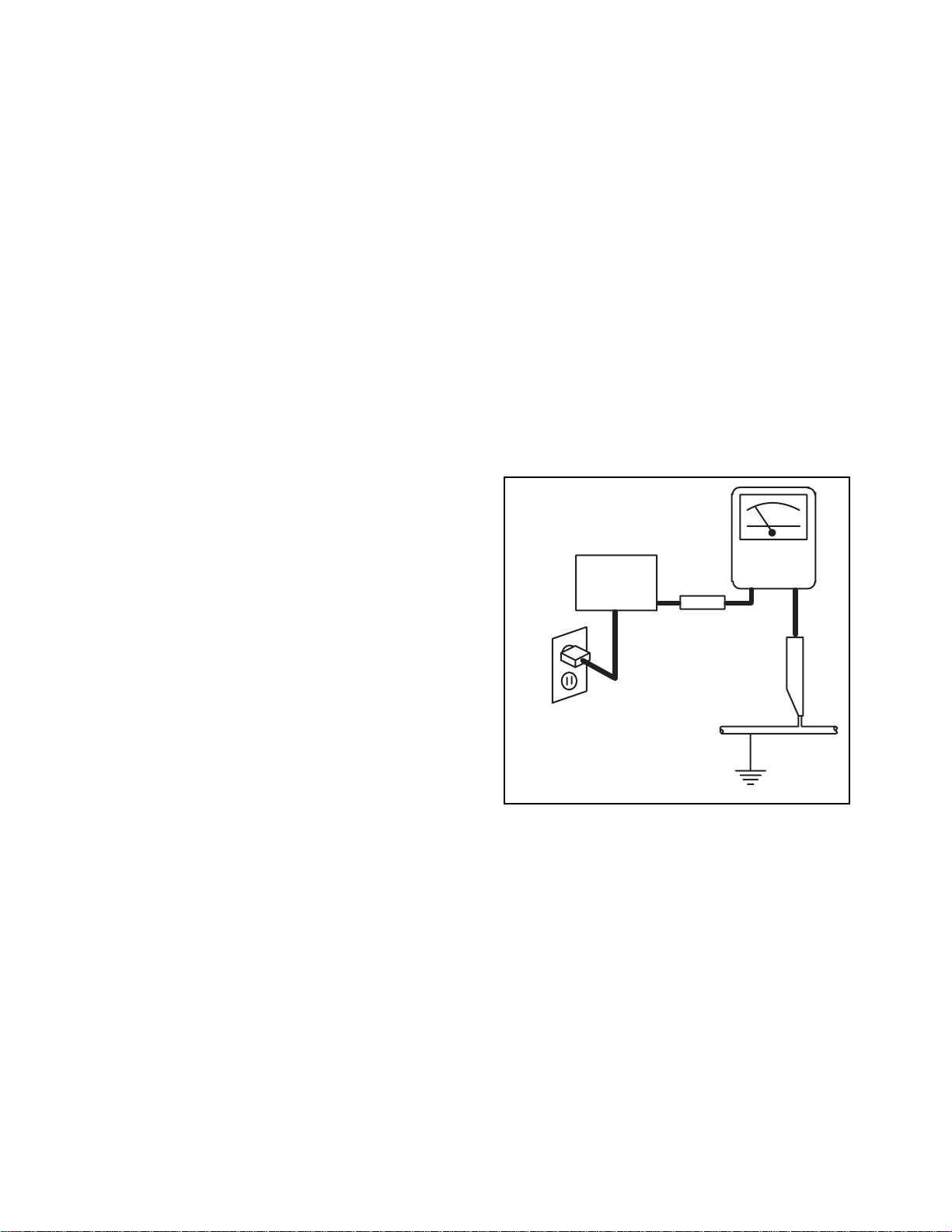
d. Leakage Current Hot Check - With the instru-
ment completely reassembled, plug the AC line
cord directly into a 120V AC outlet. (Do not use an
isolation transformer d uring thi s test.) Use a leak-
age current tester or a me tering syst em that com plies with American National Standards Institute
(ANSI) C101.1 Leakage Current for Appliances
and Underwriters Laborat ories (UL) 1410, (50.7).
With the instrument AC switc h first in the on posi tion and then in the o ff position, measure from a
known earth ground (metal water pipe, conduit,
etc.) to all exposed metal parts of the instrument
(antennas, handle br ackets, metal cabi net, screw
heads, metallic overlay s, control shafts, etc.), es pecially any exposed metal parts that offer an electrical return path to the chassis. Any current
measured must not excee d 0.5 milli-ampere. Re verse the instrument power cord plug in the outlet
and repeat the test.
READING SHOULD
NOT BE ABOVE 0.5 mA
LEAKAGE
DEVICE
BEING
TESTED
TEST ALL EXPOSED
METAL SURFACES
ALSO TEST WITH
PLUG REVERSED
USING AC
ADAPTER PLUG
AS REQUIRED
ANY MEASUREMENTS NO T WITHIN THE LIMITS
SPECIFIED HEREIN INDICATE A POTENTIAL
SHOCK HAZARD THAT MUST BE ELIMINATED
BEFORE RETURNING THE INSTRUMENT TO
THE CUSTOMER OR BEFORE CONNECTING
THE ANTENNA OR ACCESSORIES.
e. X-Radiation and High Voltage Limits - Because
the picture tube i s the prim ary potentia l source of
X-radiatio n in solid- state TV receiver s, it is s pecially constructed to prohibit X-radiation emissions.
For continued X-radiation pr otection, the replacement picture tube must be the same type as the
original. Also, because the picture tube shields
and mounting hardware perform an X-radiation
protection function, they must be correctly in place.
High voltage must be mea su re d ea ch tim e s er vic -
CURRENT
TESTER
+
EARTH
GROUND
_
2-1 L6115IMP
Page 5

ing is performed that inv olves B+, horizontal deflection or high voltage. Correct operation of the Xradiation protection circuits also must be reconfirmed each time they are serviced. (X-radiation
protection circuits also may be called "horiz ontal
disable" or "hold do wn.") R ead a nd a ppl y th e hi gh
voltage limits a nd, if the chassis is so e quipped,
the X-radiation protection circuit specifications given on instrument labe ls and i n the P roduct S afety
& X-Radiation Warning note on the service data
chassis schematic. High voltage is maintained
within specified limits by close tolerance safety-related components/adjus tme nts in th e hig h-vo lta ge
circuit. If high voltage exceeds specified limits,
check each component specified on the chassis
schematic and take corrective action.
2. Read and comply with all caution and safety-related notes on or inside th e receiver cabi net, on the
receiver chassis, or on the picture tube.
3. Design Alteration Warning - Do not alter or add
to the mechanical or electrical design of this TV receiver. Design alterations and additions, including,
but not limited to circuit modificatio ns and the addition of items such as auxiliary audio and/or video
output connections, mig ht alter the safety ch aracteristics of this receiver and create a hazard to the
user. Any design alter ations or addition s will void
the manufacturer's warr anty and may make you,
the servicer, responsible for personal injury or
property damage resulting therefrom.
4. Picture Tube Implosion Protection Warning -
The picture tube in this receiver employs integral
implosion protection. For continued implosion protection, replace the pic ture tube only with one of
the same type numbe r. Do not rem ove, install , or
otherwise handle the picture tube in any ma nner
without first putting on shatterproof goggles
equipped with side shields. People not so
equipped must be ke pt safely away while p icture
tubes are handled. Keep the picture tube away
from your body. Do not handl e the pictur e tu be b y
its neck. Some "in-line" picture tubes are equipped
with a permanently at tached deflection yoke ; because of potential hazard, do not try to remove
such "permanently attached" yokes from the picture tube.
5. Hot Chassis Warning -
a. Some TV receiver chassis are electrically connect-
ed directly to one conduc tor of th e AC powe r cor d
and maybe safety-serviced without an isolation
transformer only i f the AC power plug i s inserted
so that the chassis is connected to the ground side
of the AC power source. To confi rm that the AC
power plug is ins erted correctly, with an AC voltmeter, measure between the chassis and a known
earth ground. If a voltage reading in excess of 1.0V
is obtained, remove and reinsert the AC power
plug in the opposite polarity and again measure
the voltage potential between the chassis and a
known earth ground.
b. Some TV receiver chassis normally have 85V
AC(RMS) between ch assis and earth ground regardless of the AC plug polarity. This chassis can
be safety-serviced only with an isolation transformer inserted in the power line between the receiver
and the AC power so urce , for both pers onnel and
test equipment protection.
c. Some TV receiver chassis have a secondary
ground system in addition to the main chassis
ground. This se conda ry gro und s ystem is no t iso lated from the AC power line. The two ground systems are electrically separated by insulation
material that must not be defeated or altered.
6. Observe original lead dress. Take extra care to assure correct lead dress in the following areas:a.
near sharp edges,b. near thermally hot parts-be
sure that leads and components do not touch thermally hot parts, c. the AC supply,d. high voltage,
and,e. antenna wir ing. Always insp ect in all ar eas
for pinched, out of plac e, or frayed wiring. C heck
AC power cord for damage.
7. Components, parts, and/or wiring that app ear to
have overheated or are otherwise damaged
should be replaced with components, parts, or wiring that meet origin al specifications. Additiona lly,
determine the cause of ov erheating and/or damage and, if nece ss ar y, ta ke corre ct i ve ac ti o n to remove any potential safety hazard.
8. Product Safety Notice - Some electrical and mechanical parts have s pecia l safety- relat ed char acteristics which are often not evident from visual
inspection, nor can the protection they give necessarily be obtained by replaci ng them with components rated for higher voltage, wattage, etc.. Parts
that have special safety characteristics are identified by a ( # ) on schematics and in parts lists. Use
of a substitute replacement that does not have the
same safety characteristics as the recommended
replacement part might create sh ock, fire, and/or
other hazards. The product's safety is under review continuously and new instructions are issued
whenever appropriate . Prior to shi pment from the
factory, our products are strictly inspected to confirm they comply with the recognized product safety and electrical codes of the countries in which
they are to be sold. Howev er, in orde r to mai ntain
such compliance , it is equally i mportant to imple ment the following precautions when a set is being
serviced.
2-2 L6115IMP
Page 6

Precautions during Servicing
A. Parts identified b y the ( # ) symbo l are c ritica l for
safety.
Replace only with part number specified.
B. In addition to safety, othe r parts and assemblies
are specified for conformance with regulations applying to spurious radiati on. These must also be
replaced only with specified replacements.
Examples: RF converters, RF cables, noise blocking capacitors, and noise blocking filters, etc.
C. Use specified internal wiring. Note especially:
1) Wires covered with PVC tubing
2) Double insulated wires
3) High voltage leads
D. Use specified insulating materials for hazardous
live parts. Note especially:
1) Insulation Tape
2) PVC tubing
3) Spacers
4) Insulators for transistors.
E. When replacing AC primary side components
(transformers, power cord, etc.), wrap ends of
wires securely abo ut the terminals before so ldering.
F. Observe that the wires do not contact heat produc-
ing parts (heatsinks, oxide metal film resistors, fusible resistor s, etc.)
G. Check that replaced wires do not contact sharp
edged or pointed parts.
H. When a power cord has been replaced, check that
5~6 kg of force in any direction will not loosen it.
I. Also check areas surrounding repaired locations.
J. Use care that foreign objects (screws, solder drop-
lets, etc.) do not remain inside the set.
K. Crimp type wire connector
The power transform er uses crimp type connec-
tors which connect the power cord and the primary
side of the transformer. When replacing the trans-
former, follow these step s carefully and precis ely
to prevent shock hazards.
Replacement procedure
1) Remove the old connector by cutti ng the wires at
a point close to the connector.
Important: Do not re-use a connector (discard it).
2) Strip about 15 mm of the insulation fro m the end s
of the wires. If the wires are stranded, twist the
strands to avoid frayed conductors.
3) Align the lengths of the wires to be connected. Insert the wires fully into the connector.
4) Use the crimping tool to crimp the metal sleeve at
the center position . Be sure to crimp fully to the
complete closure of the tool.
L. When connecting or disconnecting the internal
connectors, first, discon nect the AC plug from the
AC supply outlet.
2-3 L6115IMP
Page 7
Safety Check after Servicing
Examine the area surrounding the repaired location
for damage or deterioration. Observe that screws,
parts and wires have been returned to original positions. Afterwards, perform the following tests and confirm the spec ified values in or der to verify comp liance
with safety standards.
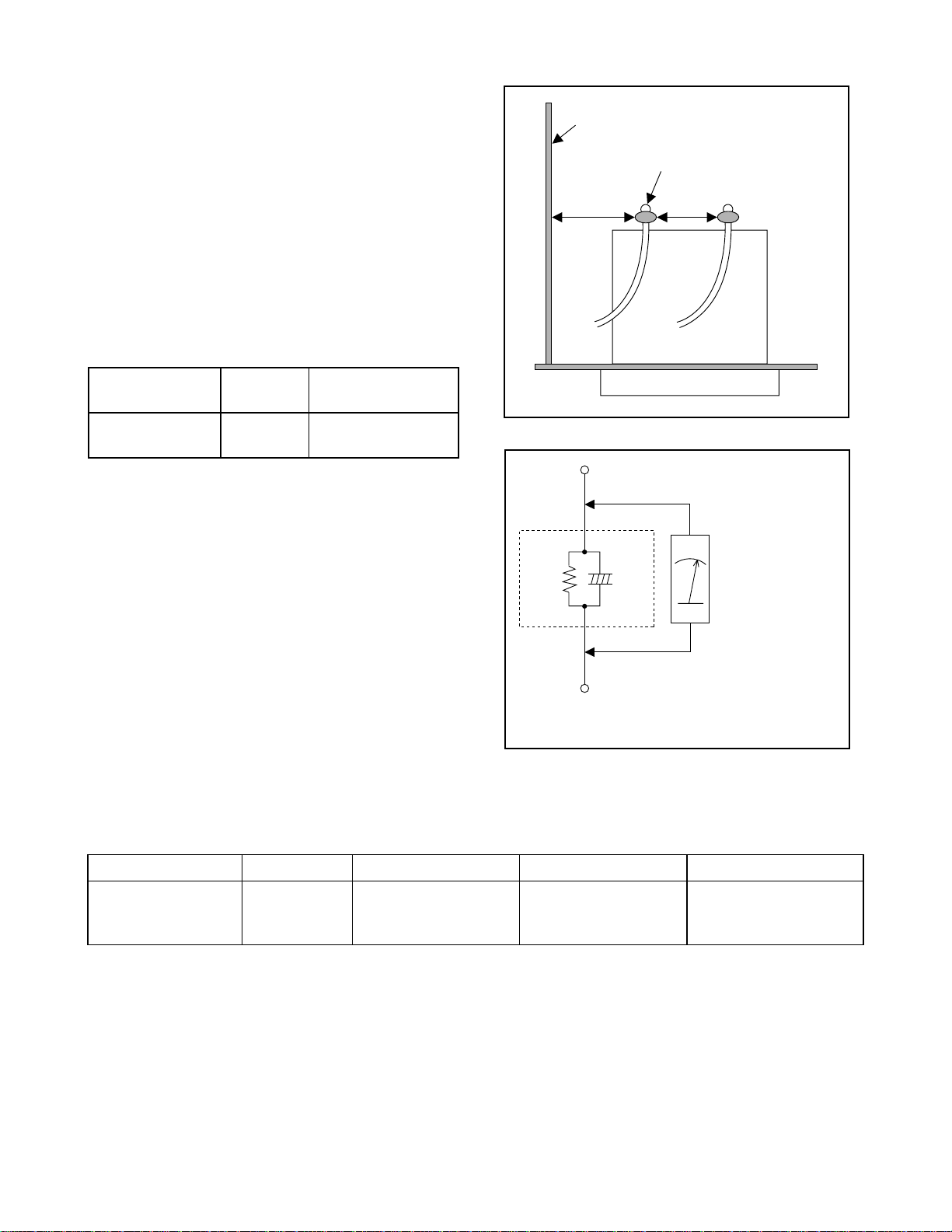
1. Clearance Distance
When replacing primary circuit components, confirm
specified clearance distance (d) and ( d') between sol dered terminals, and between terminals and surrounding metallic parts. (See Fig. 1)
Table 1 : Ratings for selected area
AC Line Voltage Region
110 to 130 V
Note: This table is unofficial and for reference only. Be
sure to confirm the precise values.
USA or
CANADA
Clearance
Distance (d) (d')
≥ 3.2 mm
(0.126 inches)
2. Leakage Current Test
Confirm the specified (or lower) leakage current between B (earth ground, power cord plu g prongs) and
externally exposed accessible parts (RF terminals,
antenna terminal s, vi deo and audio input and output
terminals, mi crophone jacks, earphone jacks, etc.) is
lower than or equal to the spe cified value in the table
below.
Measuring Method : (Power ON)
Insert load Z between B (earth ground, power cord
plug prongs) and exposed accessible parts. Use an
AC voltmeter to measure across both terminals of load
Z. See Fig. 2 and following table.
Z
1.5kΩ
Chassis or Secondary Conductor
Primary Circuit Terminals
dd'
Exposed Accessible Part
AC Voltmeter
0.15µF
Earth Ground
B
Power Cord Plug Prongs
(High Impedance)
Fig. 1
Fig. 2
Table 2 : Leakage current ratings for selected areas
AC Line Voltage Region Load Z Leakage Current (i) Earth Ground (B) to:
0.15µF CAP. & 1.5kΩ
110 to 130 V USA
Note: This table is unofficial and for reference only. Be sure to confirm the precise values.
RES. connected in
parallel
2-4 L6115IMP
i≤0.5mA rms
Exposed accessible
parts
Page 8
STANDARD NOTES FOR SERVICING
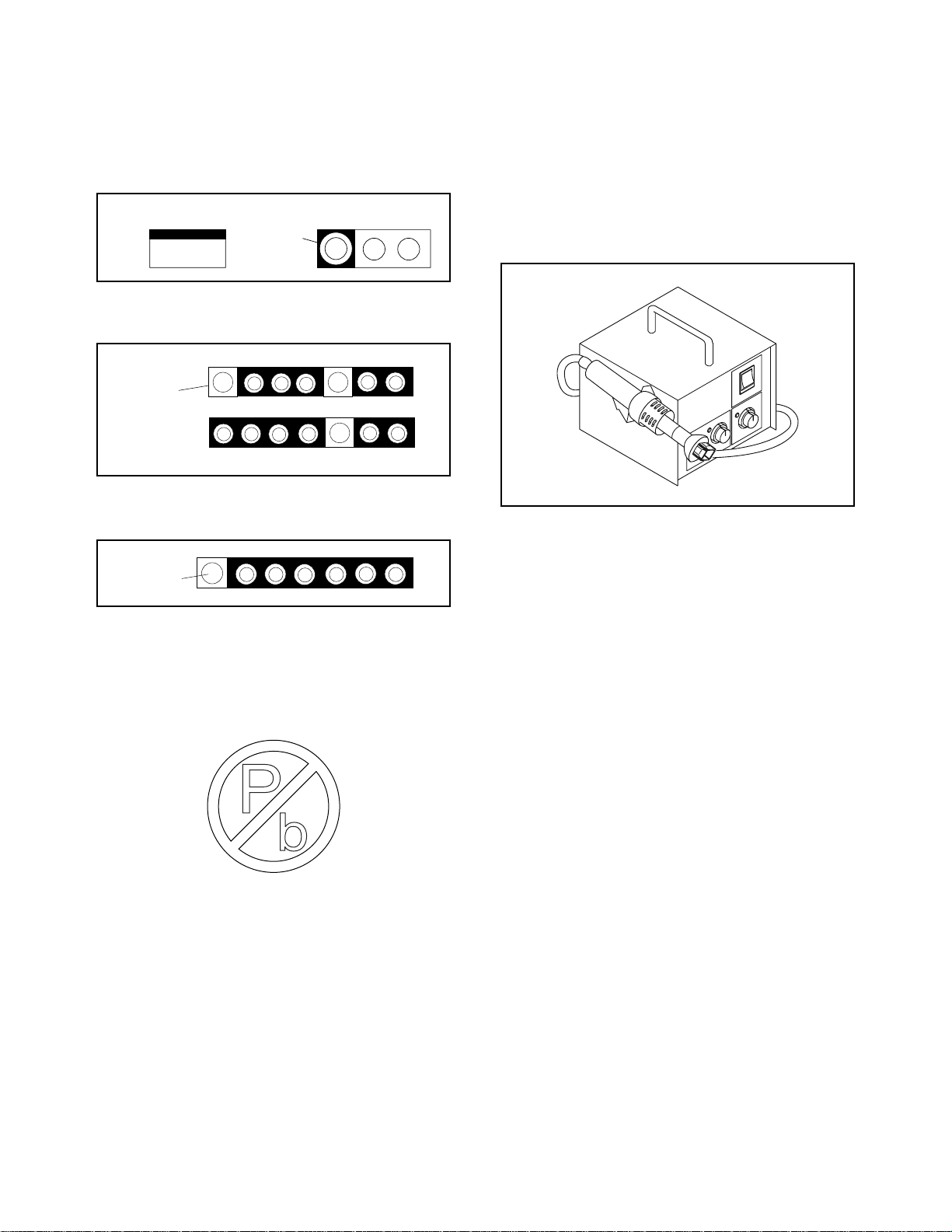
Circuit Board Indications
a. The output pin of the 3 pin Regulator ICs is indicat-
ed as shown.
Top View
Out
b. For other IC s, pin 1 and every fifth pin are in dic at -
ed as shown.
Pin 1
c. The 1st pin of every male connector is indicated as
shown.
Pin 1
Input
In
Bottom View
5
10
Pb (Lead) Free Solder
Pb free mark will be found on PCBs used Pb free
solder. (Refer to figure.) For PCBs with Pb free
mark, be sure to use Pb free solder. For PCBs
without Pb free mark, use standard solder.
Pb free mark
How to Remove / Install Flat Pack-IC
1. Removal
With Hot-Air Flat Pack-IC Desoldering Machine:
(1) Prepare the hot-air flat pack-IC desoldering ma-
chine, then apply hot air to the Flat Pack-IC (about
5 to 6 seconds). (Fig. S-1-1)
Fig. S-1-1
(2) Remove the flat pack-IC with tweez ers while ap-
plying the hot air.
(3) Bottom of the flat pack -IC is fix ed with glu e to the
CBA; when removing entire flat pack-IC, first apply
soldering iron to center of the flat pack-IC and heat
up. Then remove (glue will be melted). (Fig. S-1-6)
(4) Release the flat pack-IC from the CBA using twee-
zers. (Fig. S-1-6)
Caution:
1. The Flat Pack-IC shape may differ by models. Use
an appropriate hot-air flat pack-IC desoldering machine, whose shape matches that of the Flat PackIC.
2. Do no t supply hot air to the ch ip parts aroun d the
flat pack-IC for over 6 seconds because damage
to the chip parts may occur. Put masking tape
around the flat pack-IC to protec t other par ts from
damage. (F ig. S-1-2)
3-1 L14STA
Page 9
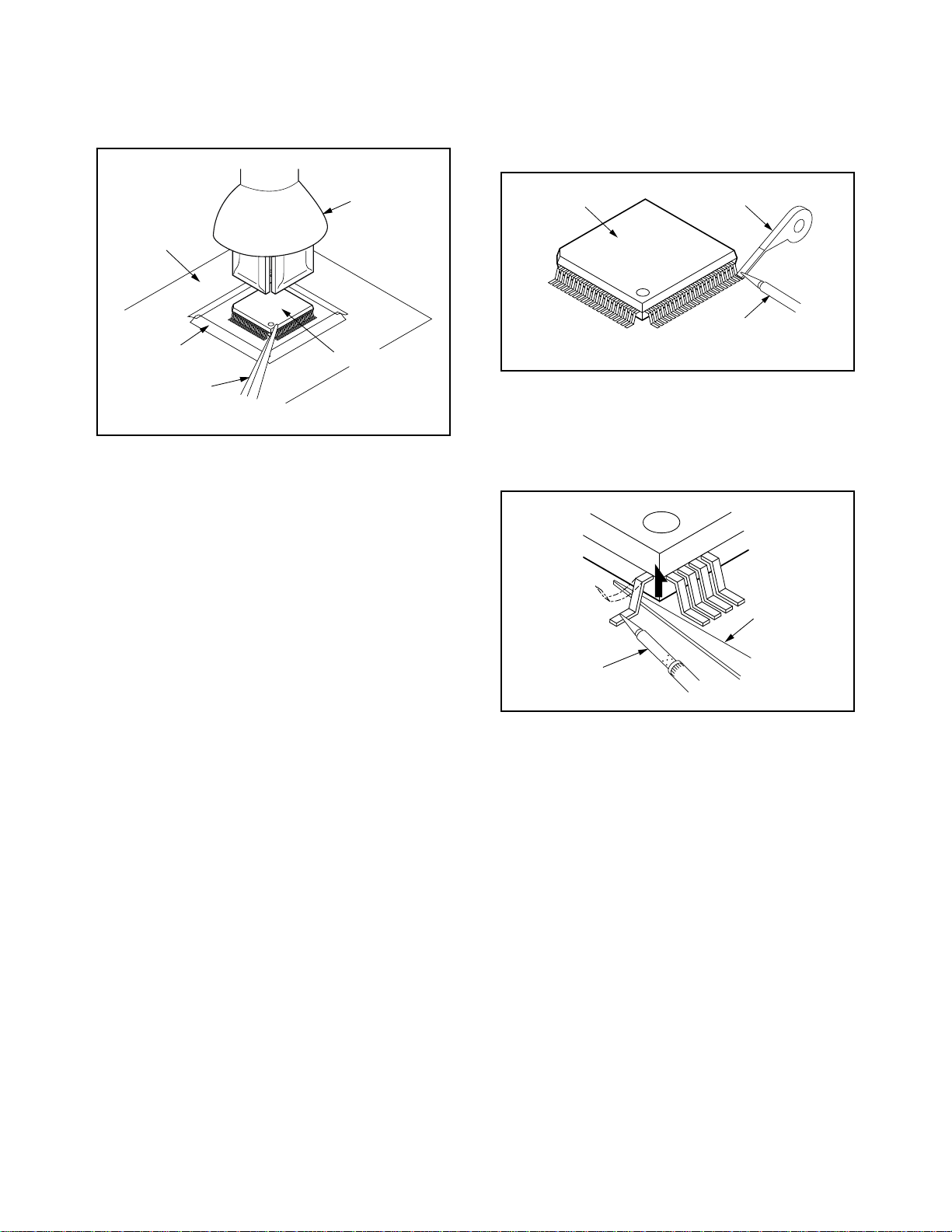
3. The flat pack-IC on the CBA is affixed with glue, so
be careful not to bre ak or d ama ge the f oil of each
pin or the solder l ands under the IC when remov ing it.
With Soldering Iron:
(1) Using desoldering braid, r emove the solder from
all pins of the flat pack-IC. When you use solder
flux which is applie d to al l pins o f th e flat pac k-IC,
you can remove it easily. (Fig. S-1-3)
CBA
Masking
Tape
Tweezers
Hot-air
Flat Pack-IC
Desoldering
Machine
Flat Pack-IC
Fig. S-1-2
Flat Pack-IC
Desoldering Braid
Soldering Iron
Fig. S-1-3
(2) Lift each lead of the flat pack-IC up ward one by
one, using a sharp pin or wi re to which solder will
not adhere (iron wire). When heating the pins, use
a fine tip soldering iron or a hot air desoldering machine.(Fig. S-1-4)
Sharp
Pin
Fine Tip
Soldering Iron
(3) Bottom of the flat pack -IC is fix ed with glu e to the
CBA; when removing entire flat pack-IC, first apply
soldering iron to center of the flat pack-IC and heat
up. Then remove (glue will be melted). (Fig. S-1-6)
(4) Release the flat pack-IC from the CBA using twee-
zers. (Fig. S-1-6)
With Iron Wire:
(1) Using desoldering braid, r emove the solder from
all pins of the flat pack-IC. When you use solder
flux which is applie d to al l pins o f th e flat pac k-IC,
you can remove it easily. (Fig. S-1-3)
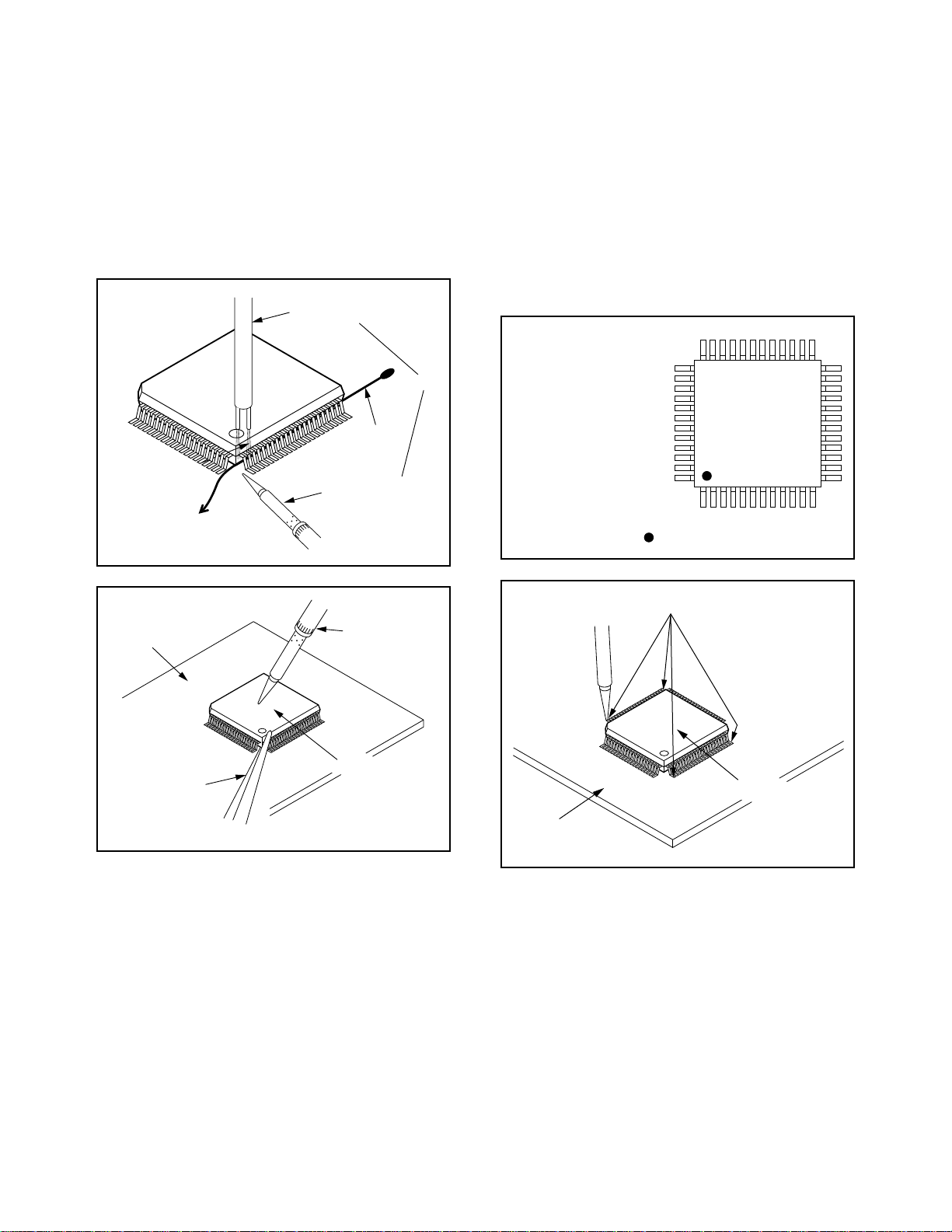
(2) Affix the wire to a workbench or solid mounting
point, as shown in Fig. S-1-5.
(3) While heating the pins using a fine tip so ldering
iron or hot air blower, pull up the wire as the solder
melts so as to lift the IC leads fr om the CBA contact pads as shown in Fig. S-1-5.
(4) Bottom of the flat pack -IC is fix ed with glu e to the
CBA; when removing entire flat pack-IC, first apply
Fig. S-1-4
3-2 L14STA
Page 10
soldering iron to center of the flat pack-IC and heat
up. Then remove (glue will be melted). (Fig. S-1-6)
(5) Release the flat pack-IC from the CBA using twee-
zers. (Fig. S-1-6)
Note:
When using a soldering iron, care must be taken to
ensure that the flat pack-IC is n ot being held by
glue. When the flat pack-IC i s removed from the
CBA, handle it gently because it may be damaged
if force is applied.
Hot Air Blower
or
Iron Wire
Soldering Iron
2. Installation
(1) Using desoldering braid, r emove the solder from
the foil of each pin of the fla t pack-IC o n the CBA
so you can install a replacement flat pack-IC more
easily.
(2) The "I" mark on the fl at pack-IC indicates pin 1.
(See Fig. S-1-7.) Be sure this mark matches the 1
on the PCB when positioning for installation. Then
pre- solder the four corners of the flat pack-IC.
(See Fig. S-1-8.)
(3) Solder all pins of the flat pack-IC. Be sure that
none of the pins have solder bridges.
Example :
To Solid
Mounting Point
CBA
Tweezers
Fig. S-1-5
Fine Tip
Soldering Iron
Flat Pack-IC
Fig. S-1-6
Pin 1 of the Flat Pack-IC
is indicated by a " " mark.
Presolder
CBA
Fig. S-1-7
Flat Pack-IC
Fig. S-1-8
3-3 L14STA
Page 11
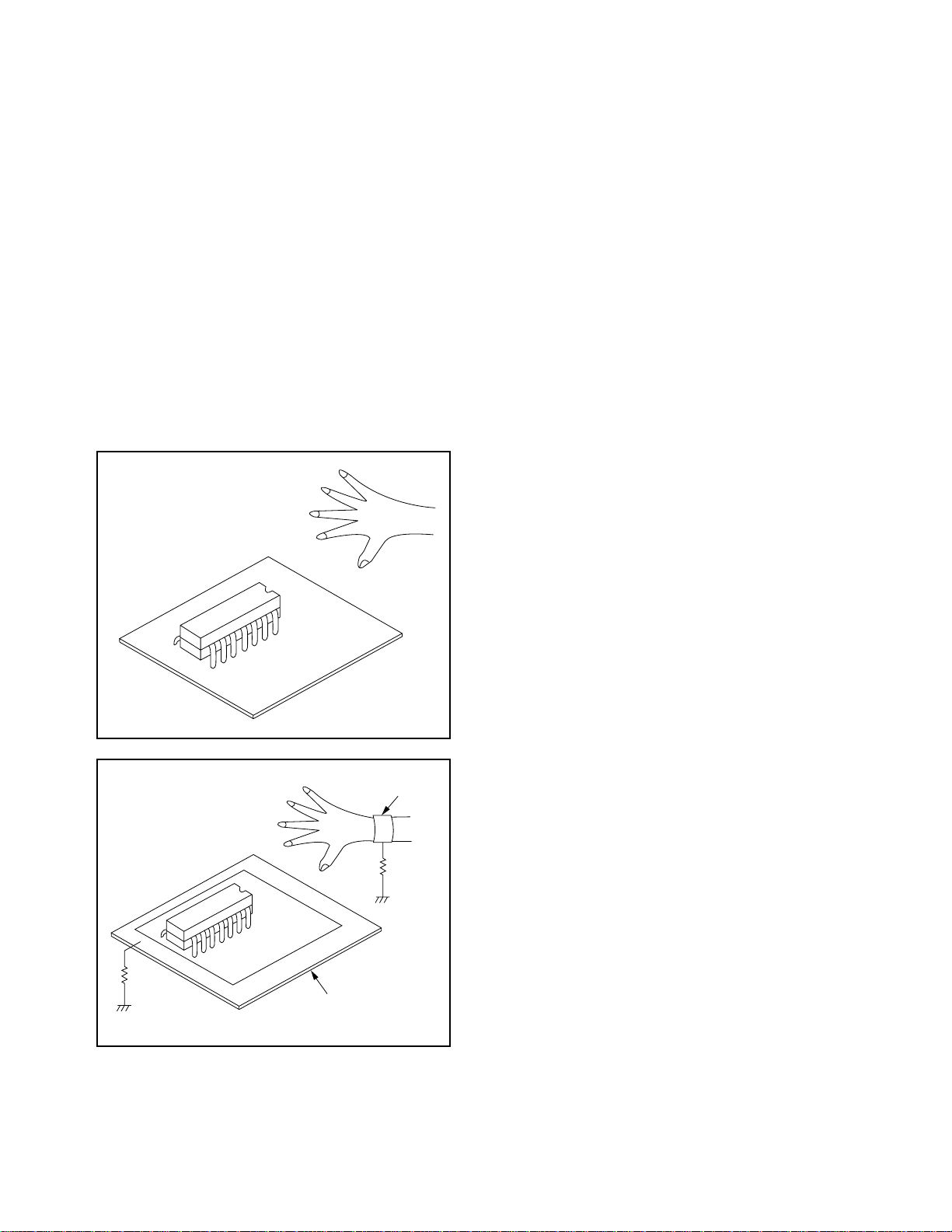
Instructions for Handling
Semiconductors
Electrostatic breakdown of the semiconductors may
occur due to a potential difference caused by electro static charge during unpacking or repair work.
1. Ground for Human Body
Be sure to wear a grounding band (1MΩ) that is prop erly grounded to rem ove any static electricity that may
be charged on the body.
2. Ground for Workbench
Be sure to place a conductive sheet or copper plate
with proper grounding (1MΩ) on the workbench or
other surface, where the semiconductors are to be
placed. Because the st atic electr icity charge on clothing will not escape through the body grounding band,
be careful to avoid contacting semiconductors with
your clothing.
<Incorrect>
<Correct>
1MΩ
CBA
Grounding Band
1MΩ
CBA
Conductive Sheet or
Copper Plate
3-4 L14STA
Page 12
CABINET DISASSEMBLY INSTRUCTIONS
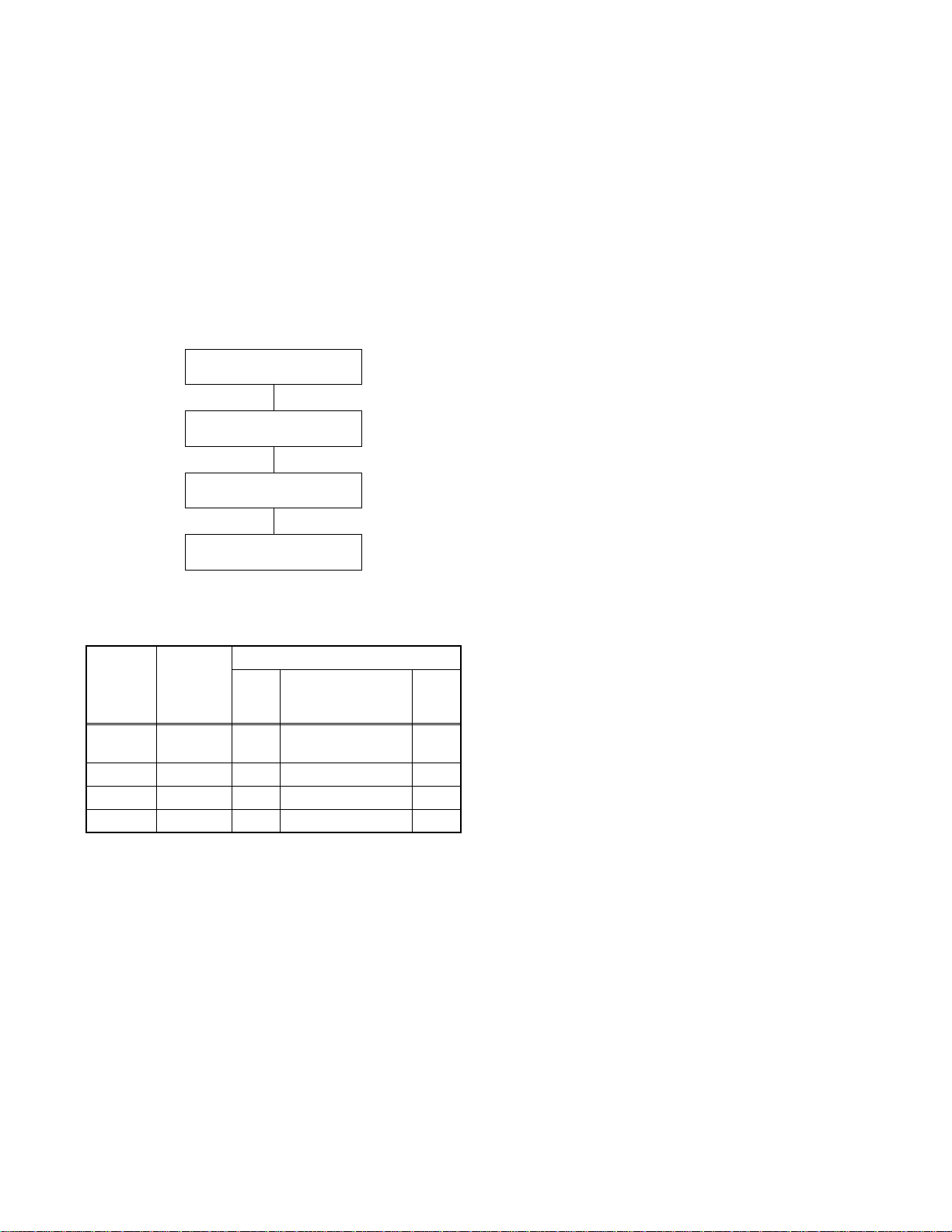
1. Disassembly Flowchart
This flowchart indicates the disassembly steps for the
cabinet par ts, and the CBA in order to gain ac cess to
item(s) to be se r vic ed. W hen r eass embling, follow the
steps in reverse order. Bend, route and dress the
cables as they were.
Caution !
When removing the CRT, be sure to discharge the
Anode Lead of the CRT with the CRT Ground Wire
before removing the Anode Cap.
[1] Rear Cabinet
[2] CRT CBA
[3] Main CBA
[4] CRT
2. Disassembly Method
Note :
(1) Order of steps in procedu re. When reas sembling,
follow the steps i n reverse or der. These n umbers
are also used as the Identification (location) No. of
parts in figures.
(2) Parts to be removed or installed.
(3) Fig. No. showing procedure of part location
(4) Identification of part to be removed, unhooked, un-
locked, released, unplugged, unclamped, o r des-
oldered.
S=Screw, P=Spring, L=Locking Tab, CN=Con-
nector, *=Unhook, Unlock, Release, Unplug, or
Desolder
2(S-2) = two Screws (S-2)
(5) Refer to the following "Reference Notes in the
Table."
Reference Notes in the Table
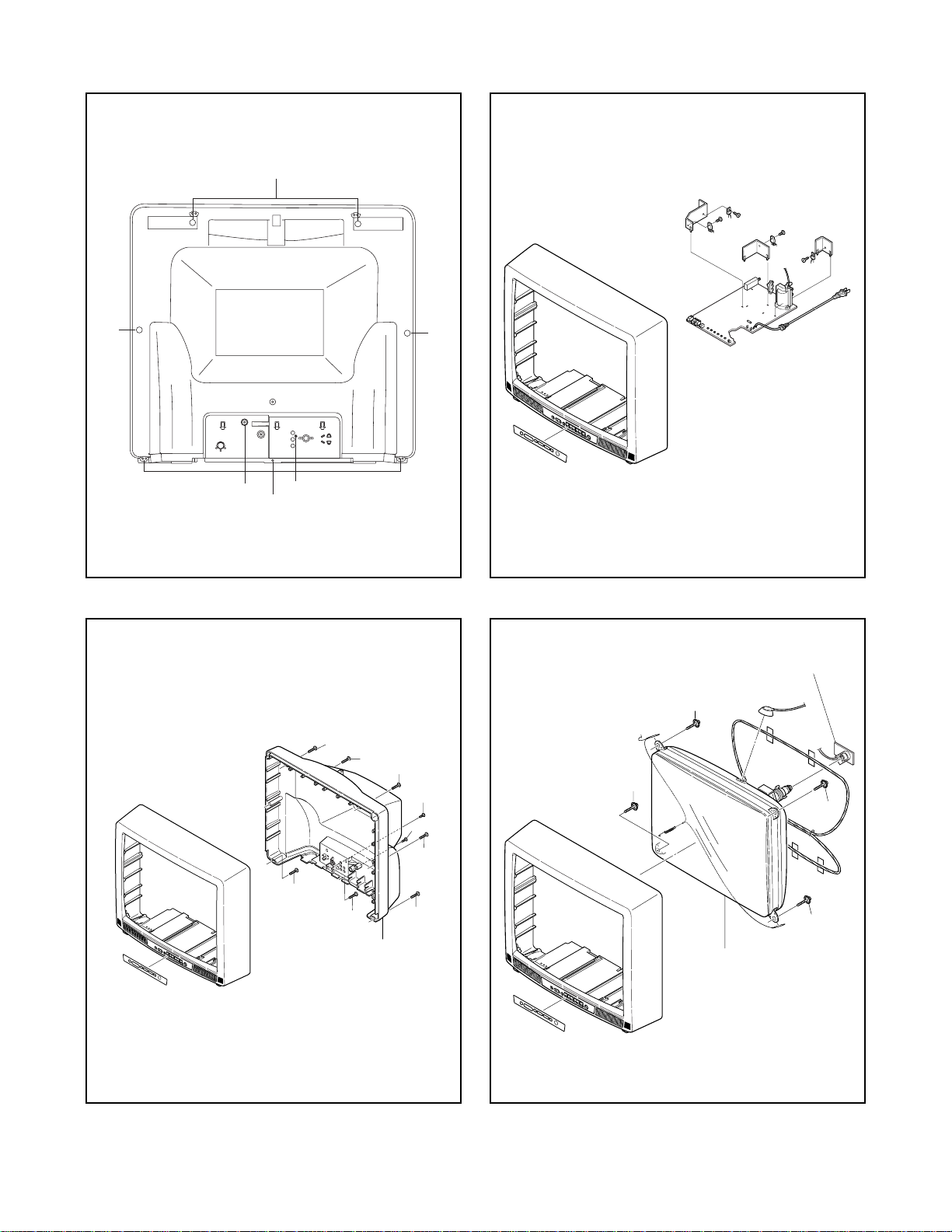
1. Removal of the Rear Cabinet. Remove screws
7(S-1), 1(S-2) and 1(S-4) then slide the Rear Cab-
inet backward.
2. Removal of the CRT CBA. Disconnect CN1501
then pull the CRT CBA backward.
3. Removal of the Main CB A. Disconne ct CN571 on
the Main CBA then slide the Main CBA backward.
Removal
Step/
Loc. No.
[1]
[2] CRT CBA 4,5 CN501 2
[3] Main CBA 3,5 CN571 3
[4] CR T 4 4(S-3), Anode Cap 4
Part
Rear
Cabinet
Fig.
No
1,2
Remove/*unlock/
release/unplug/
unclamp/desolder
7(S-1), 1(S-2),
1(S-4)
Note
1
↓↓↓↓↓
(1) (2) (3) (4) (5)
Caution:
Discharge the Anode Lead o f the CRT with the CRT
Ground Wire before removing the Anode Cap.
4. Removal of the CR T. Remo ve sc rews 4(S- 3) and
Anode Cap. then slide the CRT backward.
4-1 L2701DC
Page 13
S-1
S-1
S-4
S-1
S-2
[1] Rear Cabinet
S-1
S-1
S-1
S-1
Fig. 1
S-2
S-4
S-3
[3] Main CBA
[2] CRT CBA
Anode Cap
S-3
Fig. 3
S-3
S-1
S-1
[1] Rear Cabinet
S-1
S-1
Fig. 2
S-3
[4] CRT
Fig. 4
4-2 L2701DC
Page 14
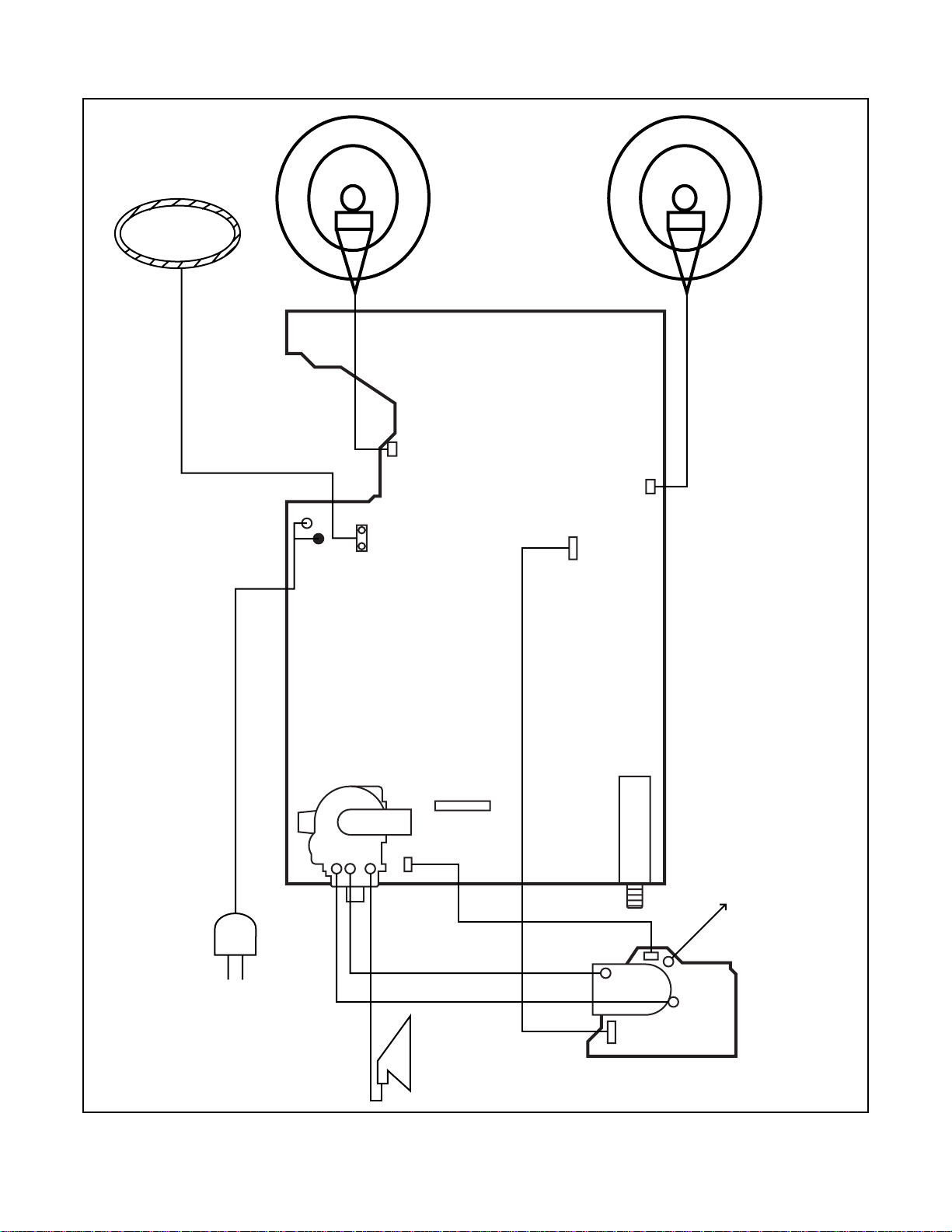
TV Cable Wiring Diagram
DG691
DEGAUSSING COIL
SP802
SP801
CLN802
CN691
CN802
MAIN CBA
CLN801
CN801
WH301A
AC601
AC CORD
FLYBACK
TRANSFORMER
T571
WH501A
CN571
FOCUS
SCREEN
ANODE
TU11
TUNER
TO CRT GROUND
WH501B
CN1501
JK1501
WH301B
Fig. 5
4-3 L2701DC
Page 15
ELECTRICAL ADJUSTMENT INSTRUCTIONS
General No te :
"CBA" is abbreviation for "Circuit Board Assembly."
NOTE:
Electrical adjustm ent s ar e r equ ired after replacing
circuit components a nd certain mechanic al parts.
It is important to perform these adjustm ents only
after all repairs and replacements have been completed.
Also, do not attempt these adjustments unless the
proper equipment is available.
Test Equipment Required
1. NTSC Pattern Generator (Color Bar W/White
Window, Red Color, Dot Pattern, Gray Scale,
Monoscope, Multi-Burst)
2. DC Voltmeter
3. Oscilloscope: Dual-trace with 10:1 probe,
V-Range:0.001~50V/Div,
F-Range: DC~AC-60MHz
4. Plastic Tip Driver
5. Remote control unit: Part No. N0108UD, N0132UD,
NE121UD or NE122UD
6. DC power supply 13.2V/5A
How to set up the service mode:
Service mode:
1. Use the service remote control unit.
2. Turn the power on. (Use main power on the TV
unit.)
3. Press "SLEEP" button on the service remote control unit. Version of m icro co mpu ter wi ll dis pl ay on
the CRT. (Ex: 058-0.06)
4. Check the display on the lower left is "2640" and if
it is not "2640," set it at "2640" according to "2. Initial Setting."
1. +B Adjustment
Purpose: To obtain correct operation.
Symptom of Misadjustment: The picture is dark and
the unit does not operate correctly.
Test Point Adj. Point Mode Input
TP601(+B)
TP300(GND)
Tape M. EQ. Spec.
--- DC Voltmeter +120±0.5V DC.
VR661 --- ---
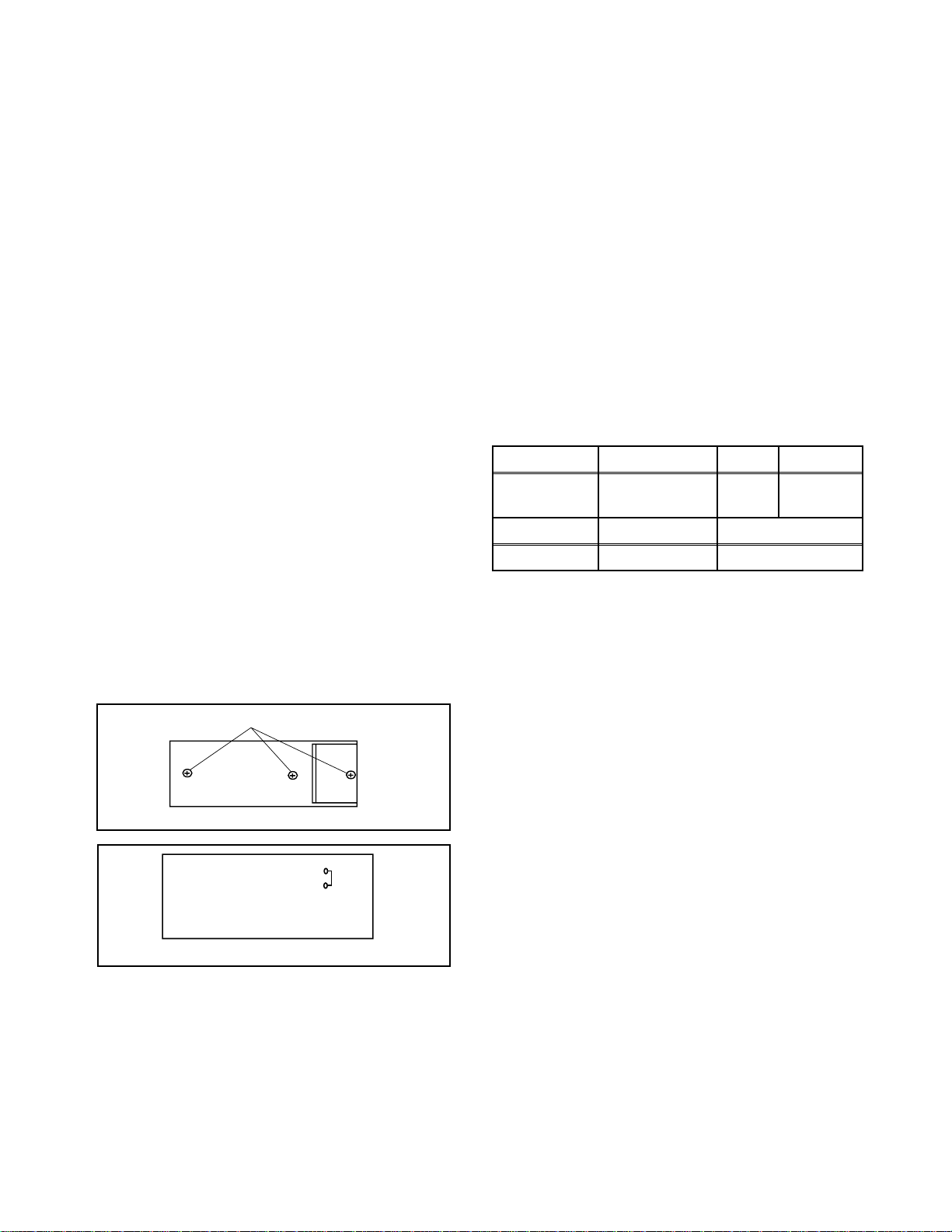
How to make Service rem ote control unit:
1.
Prepare normal remote control unit. (
N0108UD, N0132UD, NE121UD or NE122UD)
Remove 3 Screws from the back lid. (Fig. 1-1)
2 . Add J1 (Jumper Wire) to the remote control CBA.
(Fig. 1-2)
SCREWS
REMOTE CONTROL UNIT
J 1
REMOTE CONTROL CBA
Part No.
Fig. 1-1
Fig. 1-2
Note: TP601, TP300(GND), VR661 --- Main CBA
1. Connect DC Volt M ete r t o TP6 01 an d TP300 (GN D).
2. Adjust VR661 so th at the voltage o f TP60 1 becomes
+120±0.5V DC.
5-1 L2701EA
Page 16

2. Initial Setting
General
1. Enter the Service mode. (See page 5-1)
2. Press "VOL p" button on the service remote control
unit. Display changes "C/D," "7F," "LANGUAGE,"
"ACCESS CODE," "SOUND TYPE," "VIDEO
TONE," "FM MODE," "V-OUT," "VIDEO," "AV
MEMO," "STABLE SOUND," "FILTER," "500,"
"YUV MEMORY," "NO SIG BRT," "A-MUTE POL,"
and "V-MENU" cyclically when "VOL p" button is
pressed.
3. To set the following each data value, press "CH o
/ p" buttons on the service remote control unit.
7F --- Set to "FF."
LANGUAGE --- Set to "SPA/FRA."
ACCESS CODE --- Set to "OFF ."
SOUND TYPE --- Set to "MTS."
VIDEO TONE --- Set to "ON."
FM-MODE --- Set to "O FF."
V-OUT --- Set to "OFF."
VIDEO --- Set to "V1."
AV MEMO --- Set to "OFF."
STABLE SOUND --- Set to "OFF."
FILTER --- Set to "OFF."
CLR
1. P ress "MENU" b utton on the service remote control unit. Then select "COLOR" (CLR) display.
2. Press "CH o/p " buttons on the service remote
control unit so that the val ue of "COLOR" (CLR)
becomes 56.
TNT
1. P ress "MENU" b utton on the service remote control unit. Then select "TINT" (TNT) display.
2. Press "CH o/p " buttons on the service remote
control unit so that the value of "T INT" (TNT) becomes 58.
V-TNT
1. Press "MENU" button on the service remote control unit. Then select "V-TINT" (V-TNT) display.
2. Press "CH o/p" buttons on the service remote
control unit so that the value of "V- TINT" (V-TNT )
becomes 59.
SHARP
1. P ress "MENU" b utton on the service remote control unit. Then select "SHARPNESS" (SHARP) display.
2. Press "CH o/p " buttons on the service remote
control unit and select "47."
Note: BRIGHT data value does not need to be adjust-
ed at this moment.
Adjusting the monitoring time --- Set to "500."
YUV MEMORY --- Set to "OFF."
NO SIG BRT --- Set to "0."
A-MUTE POL --- Set to "H."
V-MENU --- Set to "OFF."
3. Setting for BRIGHT, CONTRAST,
COLOR, TINT, and SHARPNESS
data Values
General
1. Enter the Service mode. (See page 5-1)
2. Press "MENU" button on the service remote control
unit. Display changes "BRT," "CNT," "CLR," "TNT,"
"V-TNT" and "SHARP" cyclically when "MENU"
button is pressed.
CNT
1. Press "MENU" button on the service remote control
unit. Then select "CONTRAST" (CNT) display.
2. Press "CH o/p" buttons on the service remote
control unit so that the value of "CONTRAS" (CNT)
becomes 84.
4. H f0 Adjustment
Purpose: To get correct horizontal frequency.
Use service remote control unit.
1. Press "2" button on the service remote control unit.
and select H-ADJ m ode. (By pressing "2" button
the display will change from TV AGC to H-ADJ.)
2. Press "CH o/p" button on the service remote con-
trol unit so that display will change "0" ~ "7". At this
moment, Choose "4".
3. Turn the power off and on again. (Main Power button on the TV unit.)
5-2 L2701EA
Page 17
5. Black Stretch Control Adjustment
Purpose: To show the fine black color.
Symptom of Misadjustment: Black color will not
appear correctly.
Note: Use service remote control unit.
1. Enter the Service mode. (See page 5-1)
2. Press "6" button on the service remote control unit.
"B-S" is indicated.
3. Press "CH o / p" bu ttons on the service remote con trol unit so that display will change "OFF," "0," and
"1." Then choose "B-S OFF."
4. Press "6" button on the service remote control unit.
"B-S2" is indi cated.
5. Press "CH o / p" buttons on the service remote
control unit so that display will change "0" and "1."
Then choose "B-S2 0."
6. Turn the power off and on again, using the mai n
power button on the TV unit.
6. Purity Check
1. Enter the Service mode. (See page 5-1)
2. Press "7" button o n the remote control uni t. Each
time pressing 7" button on the remote control unit,
display changes Red mode, Green mode, Blue
mode, and White mode cyclically.
3. Select White mode.
4. Turn the power off and on again. (Main power button on the TV unit.)
7. SD Check Mode
1. Enter the Service mode. (See page 5-1)
2. Press "1" button on the remote control un it. The
unit enter the SD-Check mode.
3. The unit starts selecting the added channe l from
first channel according to the memorized CH ADD/
DELL data and CATV/TV data in RAM.
SD Check mode (Factory mode)
Press "1" buton.
7
Please wait
OSD color:
Magenta
13
Please wait
There are SD
in all channel.
When SD-Check starting,
there is no ADD channel.
OSD color:
Magenta
26
OK
OSD color:
Magenta
ADD nothing
OSD color:
Magenta
There is no SD after
selecting channel.
30
NG
OSD color:
Magenta
5-3 L2701EA
Page 18

8. H. Position Adjustment
Purpose: To obtain correct horizontal position of
screen image.
Symptom of Misadjustment: If H. Position is incor-
rect, horizontal posit ion of image on the screen may
not be properly displayed.
10. V. Position Adjustment
Purpose: To obtain correct vertical width of screen
image.
Symptom of misadjustment: If V. Position is incor-
rect, vertical height of image on the screen may not be
properly displayed.
Test Point Adj. Point Mode Input
---
Tape M. EQ. Spec.
--- Monoscope 90±5%
Note: Use service remote control unit
1. Operate the unit for at least 20 minutes.
2. Enter the Service mode. (See page 5-1)
3. Receive the monoscope pattern.
4. Press "8" button on the remote control unit.
"H-P" is indicated.
5. Press "CH o/p" buttons on the service remote
control unit so that the m onoscope pattern will be
90±5% of display size and the circle is round.
6. Turn the power off and on again. (Main power button on the TV unit.)
CH o / p
buttons
RF
Mono-
scope
9. V. Size Adjustment
Purpose: To obtain correct vertical width of screen image.
Symptom of Misadjustment: If V. Size is incorrect, vertical
size of image on the screen may not be properly displayed.
Test Point Adj. Point Mode Input
---
Tape M. EQ. Spec.
--- Monoscope See below.
Note: Use service remote control unit
1. Operate the unit for at least 20 minutes.
2. Enter the Service Mode. (See page 5-1)
3. Receive the monoscope pattern.
4. Press "9" b utton on the serv ice rem ote cont rol un it
and select "V -P" mo de. ( Dis play ch an ge "V -S" a nd
"V-P" cyclically when "9" button is pressed).
5. Press "CH o/p " buttons on the service remote
control unit so that the top and bottom of the monoscope pattern will be equal of each other.
6. Turn the power off and on again. (Main power button on the TV unit.)
CH o / p
buttons
RF
Mono-
scope
11. Software Reset
To reset software, press “5” button on t he rem ote c on trol unit for at least 5 seconds after pressing “CH
RETURN” button on the remote control unit.
Test Point Adj. Point Mode Input
---
Tape M. EQ. Spec.
--- Monoscope 90±5%
Note: Use service remote control unit.
1. Operate the unit for at least 20 minutes.
2. Enter the Service mode. (See page 5-1)
3. Receive the monoscope pattern.
4. Press " 9" button o n the ser vice remo te cont rol unit
and select "V-S" mode. (Display changes "V-S" and
"V-P" cyclically wh en "9" butt on is pre sse d).
5. Press "CH o/p" buttons on the service remote
control unit so that the m onoscope pattern will be
90±5% of display size and the circle is round.
6. Turn the power off and on again. (Main power button on the TV unit.)
CH o / p
buttons
RF
Mono-
scope
12. H. Size Adjustment
Purpose: To obtain correct horizontal size of screen
image.
Symptom of Misadjustment: If H. Size is incorrect,
horizontal size of image on the screen may not be
properly displayed.
Test Point Adj. Point Mode Input
--- VR562 RF
Tape M. EQ. Spec.
--- Monoscope 90±5%
Note: Use service remote control unit
1. Operate the unit for at least 20 minutes.
2. Receive the Monoscope Pattern.
3. Adjust V R562 so that the monoscop e pattern will
be 90±5% of display size and circle is round.
4. Turn the Power off and on again. (Main power button on the TV unit.)
Mono-
scope
5-4 L2701EA
Page 19

13. PIN Cushion Adjustment
Purpose: To obtain correct straight vertical line of
screen image.
Symptom of Misadjustment: If H.Pin cushion is incorrect, vertical line of image on the sc reen may not be
properly displayed.
Test Point Adj. Point Mode Input
--- VR561 RF
Tape M. EQ. Spec.
--- Cross hatch
Note: Use service remote control unit
1. Operate the unit for at least 20 minutes.
2. Receive the Cro ss hatch Pattern.
3. Adjus t VR561 so that the cross hatc h pattern will
be straight line of display.
4. Turn the Power off and on again. (Main power button on the TV unit.)
Cross
hatch
14. Cut-off Adjustment
Purpose: To adjust the beam cur rent of R, G, B, and
screen voltage.
Symptom of Misadjustment: White color may be
reddish, greenish or bluish.
Test Point Adj. Point Mode Input
Screen-Control
---
Tape M. EQ. Spec.
---
CH o / p
buttons
Pattern
Generator
Figure
PATTERN GENERATOR
RF
See Reference
Notes below.
Black
Raster
EXT. INPUT
Note: Screen Control FBT --- Main CBA
F.B.T= Fly Back Transformer
Use service remote control unit
1. Degauss the CRT and allow CRT to operate for 20
minutes before starting the alignment.
2. Input the Black Raster Signal from RF Input.
3. Enter the Service mode. (See page 5-1)
4. Press "VOL p " button on the service remot e control unit and sele ct " C/D" m ode. ( Disp lay chang es
"C/D," "7F," "LANGUAGE," "ACCESS CODE,"
"SOUND TYPE," "VIDEO TONE," "FM MODE,"
"V-OUT," "VIDEO," "AV MEMO," "STABLE
SOUND," "FILTER," "500," "YUV MEMORY," "NO
SIG BRT," "A-MUTE PO L," and "V-MENU" cyclically when "VOL p button is pressed.) then press
"1." The display will mo mentaril y sho w "CUT OFF
R" (R= Red). Now there should be a horizontal line
across the center of the picture tube. If needed
gradually turn the screen control on the flyback,
clockwise until the horiz ontal line appears. Adjust
the Red Cut of f by pressi ng the "CH o/p" buttons.
Proceed to Step 5 when th e Red Cut off adjustment is done.
5. Press the "2" button. The display will momentarily
show "CUT OFF G" (G=Green). Adjust the Green
Cut off by pressing the "CH o/p" buttons. Proceed
to step 6 when the Green Cut off a djustment is do ne.
6. Press the "3" button. The display will momentarily
show "CUT OFF B" (B=Blue). Adj ust the Blue cut
off by pressing the "CH o/p" buttons. When done
with steps 4, 5 an d 6 the ho ri zo nta l lin e s hou ld be
pure white if not, then attempt the Cut o ff adjustment again.
Fig. 2
5-5 L2701EA
Page 20

15. White Balance Adjustment
Purpose: To mix red, green and blue beams correctly
for pure white.
Symptom of Misadjustment: White becomes bluish
or reddish.
16. Sub-Brightness Adjustment
Purpose: To get proper brightness.
Symptom of Misadjustment: If Sub-Brightness is
incorrect, proper brightness cannot be obtained by
adjusting the Brightness Control.
Test Point Adj. Point Mode Input
White
Screen
Tape M. EQ. Spec.
---
Note: Use service remote control unit
1. Operate the unit more than 20 minutes.
2. Face the unit to eas t. D e ga uss t h e C RT usi n g Degaussing Coil.
3. Input the White Raster (APL 100%).
4. Set the colo r ana ly zer to th e CHROMA m ode a nd
after zero point calibration, bring the optical receptor to the center on the tube surface (CRT).
5. Enter the Service mode. Press "VOL p" button on the
service remote con trol unit and select "C/D" m ode.
(Display changes "C/ D, " "7F , " " LA N GU A GE ," "A C CESS CODE," "SOUND TYPE," "VIDEO TONE,"
"FM MODE," "V-OUT," "VIDEO," "AV MEMO,"
"STABLE SOUND," "FILTER," "500," "YUV MEMORY," "NO SIG BRT," "A-MUTE POL," and "VMENU" cycl ic all y when "VOL p" button is pressed .)
then Press No. 8 button on the service remote control
Unit.
6. Press No. 4 button on the service remote control
unit for Red adjustment. Press N0. 5 button on the
service remote control unit for Blue adjustment.
7. In each color mod e, Press "C H o/p" button to adjust
the values of color.
8. Adjusting Red and Blue color so that the temperature
becomes 9200K (x: 286 / y: 294)±3%.
9. At this time, Re-check that Horizontal line is white.
If not, Re-adjust Cut-off Adjustment unti l the Horizontal Line becomes pure white.
10. Turn off and on again to retur n to no rmal mod e. Re ceive APL 100% white signal and Check Chroma
temperatures become 9200K (x: 286 / y: 294)±3%.
Note: Confirm that Cut Off Adj. is correct after this
adjustment, and at tem pt Cut Off Ad j. if n eed ed.
CH o / p
buttons
Pattern
Generator,
Color analyzer
Figure
Color Analyzer
RF
Raster
(APL
100%)
See below
Fig. 3
Test Point Adj. Point Mode Input
---
Tape M. EQ. Spec.
---
White
Note:
IQW Setup lev el --- 7.5 IRE
Use service remote control unit
1. Enter the Service mode. (See page 5-1)
Then input IQW signal from RF Input.
2. Press "MENU" button on the service remote control
unit and Select "BRT" mode. (Display changes
"BRT," "CNT," "CLR," "TNT," "V- TNT," and "SHARP"
cyclically when "MENU" button is pressed). Press
"CH o/p" buttons so that the bar is just visible (See
above figure).
3. Turn the power off and on again. (Main power button on the TV unit.)
CH o / p
buttons
Pattern
Generator
Figure
RF IQW
See below
Black
This bar
just
visible
Fig. 4
17. Focus Adjustment
Purpose: Set the optimum Focus.
Symptom of Misadjustment: If Focus Adjustment is
incorrect, blurred images are shown on the display.
Test Point Adj. Point Mode Input
--- Focus Control ---
Tape M. EQ. Spec.
---
Note: Focus VR (FBT) - Main CBA,
FBT=Fly Back Transformer
1. Operate the unit more than 30 minutes.
2. Face the unit to the East and Degauss the CRT
using Degaussing Coil.
3. Input the Monoscope Pattern.
4. Adjust the Focus Control on the FBT to obtain
clear picture.
Pattern
Generator
Mono-
scope
See below
5-6 L2701EA
Page 21

The following adjustments normally are not
attempted in the field. Only when replacing the
CRT then adjust as a preparation.
18. Purity Adjustment
Purpose: To obtain pure color.
Symptom of Misadjustment: If Color Purity Adjust-
ment is incorrect, large areas of color may not be
properly displayed.
Tes t Point Adj. Point Mode Input
Deflection
---
Yoke Purity
---
Magnet
Tape M. EQ. Spec.
---
Pattern
Generator
See below.
Figure
GREEN RED BLUE
1. Set the unit facing east.
2. Operate the unit for over 30 minutes before adjusting.
3. Fully degauss the unit using an external degaussing coil.
4. Loosen the screw on the Deflection Yoke Clamper
and pull the Deflection Yok e back away from the
screen. (See Fig. 6)
5. Loosen the Ring Lock and adjust the Purity Magnets so that a red fie ld is obt ain ed at th e c ent er of
the screen. Tighten Ring Lock. (See Fig. 5,6)
6. Slowly push the Deflection Yoke toward bell of
CRT and set it where a uniform red field is obtained.
7. Tighten the clamp screw on the Deflection Yoke.
Red
Color
Fig. 5
19. Convergence Adjustment
Purpose: To obtain proper convergence of red, gr een
and blue beams.
Symptom of Misadjustment: If Convergence Adjust-
ment is incorrect, the edge of white letters may have
color edges.
Tes t Point Adj. Point Mode Input
C.P. Magnet
(RB),
---
C.P. Magnet
---
(RB-G),
Deflection Yoke
Tape M. EQ. Spec.
---
Pattern
Generator
Figures
CRT
COIL
DY WEDGE
DEFLECTION YOKE
PURITY
SCREW
COIL CLAMPER
C.P. MAGNET
C.B. MAGNET (RB-G)
RB
G
Dot Pattern
or
Crosshatch
See below.
RB-GRB
RING LOCK
SCREW
C.P. MAGNET CLAMPER
Fig. 6
Fig. 7
RB
G
Fig. 8
1. Loosen the Ring Lock and align red with blue dots
or Crosshatch at the center of the screen by rotating (RB) C.P. Magnets. (See Fig. 7)
2. Align red / blue with green dots at the center of the
screen by rotating (RB-G) C.P. Magnet. (See Fig. 8)
3. Fix the C.P. Magnets by tightening the Ring Lock.
4. Remov e the DY Wedges and slightly tilt the Deflection Yoke horizontal ly and vertically to obtain
the best overall convergence.
5. F ix the Deflection Yoke by carefully inserting the
DY Wedges between CRT and Deflection Yoke.
5-7 L2701EA
Page 22

BLOCK DIAGRAMS
System Control Block Diagram
TO
IF/VIDEO BLOCK
INPUT0
Q161
TO
AUDIO BLOCK
INPUT0
VOLUME
A-MUTE
DG-ON-H
+5V-CTRL
TO
POWER SUPPLY
+5V-CTRL2
+8V-CTRL
BLOCK
PROTECT-2
PROTECT-1
PROTECT-1
P-ON-H
TO
PROTECT-2
CRT/H.V. BLOCK
PROTECT-3
TV MICON/VIDEO
/AUDIO/CHROMA
/DEFLECTION
IC111
IC151
(MEMORY)
REMOTE
RCV101
70
RCV-IN
72 I2C-OPEN
7
CS
KEY
SENSOR
66
KEY-IN1
SCL
SDA
58
56
6
5
SCL
SDA
SWITCH
69
KEY-IN2
SCL
63
INPUT0
AFT-IN
AGC
73
75
SDA
AGC
AFT-IN
57A-MUTE
62
VOLUME
742818
DG-ON-H
+5V-CTRL
40
+8V-CTRL
+5V-CTRL2
79
P-ON-H
PROTECT-1
676876
PROTECT-2
PROTECT-3
TO
AUDIO BLOCK
TO
6-1
MAIN CBA
IF/VIDEO BLOCK
L2701BLS
Page 23

IF/Video Block Diagram
TO
AUDIO BLOCK
SIF
TO
SYSTEM
AGC
INPUT0
CONTROL
BLOCK
AFT-IN
TO
BLUE5
WH301A
525150
CRT/H.V. BLOCK
WH301B
GREEN4
RED3
TO
CRT/H.V. BLOCK
ACL
H-DRIVE
FBP-IN
RAMP-OUT
5346453837
V-RAMP-F/B
MAIN CBA
CF31
AUDIO SIGNAL
1
EQ
AMP
2
4.5MHz
TRAP
4
VIDEO
DET
CF32
8
SIF
AMP
7
4.5MHz
FILTER
VCO
Q31
6
VCO F/B
LPF
IF AGC DET
AFT
RGB DRIVE
/CUT OFF
/H.V. BLK
13
18
OSD SW
CONTRAST
BRIGHTNESS
RGB MATRIX
LUMINANCE
PROCESS
CIRCUIT
TUNER
LINE
/COLOR CONT
CHROMINANCE
PROCESS
CIRCUIT
LPF
CHROMA COMB
BASEBAND TINT
OSD
H-SYNC
PROCESS
CIRCUIT
V-SYNC
PROCESS
CIRCUIT
X301
3.58MHz
VCXO
IC31 (IF SIGNAL PROCESS)
VIDEO SIGNALRF/IF SIGNAL
SF11
TU11
SCL
/AUDIO/CHROMA
/DEFLECTION
581656
6-2
SDA
32
WF1
26
24
JK701
VIDEO-IN
(FRONT)
JK711
VIDEO-IN
WF2
(REAR)
14
11
L2701BLIF
VIF
AMP
16
17
SAW
FILTER
1115
IF
AGC
4
SCL
RF
AGC
14
WF16
8
SDA
EXT.CLK
AMP
11
TV MICON/VIDEO
IC111
Page 24

Audio Block Diagram
AUDIO SIGNAL
30
L-CH
OFFSET
CANCEL
MATRIX AGC
29
R-CH
OFFSET
CANCEL
WIDE BAND
EXPAND
WIDE BAND
RMS DET
WIDE BAND
FILTER
SPECTRAL
EXPAND
dBX
DE-EMPH
SPECTRAL
RMS DET
SPECTRAL
FILTER
SP801
SPEAKER
L-CH
CLN801
SP-L 1
CN801
SP802
SPEAKER
R-CH
JK801
HEADPHONE
JACK
SP-GND 2
VOLUME
11
AMP
14
AMP
CLN802
SP-R 1
SP-GND 2
CN802
TO
POWER SUPPLY
BLOCK
RF
Q801
5
RF
7
Q811
TO
VOLUME
A-MUTE
SYSTEM CONTROL
BLOCK
INPUT0
SCL
SDA
IC431 (MTS/SAP AUDIO SIGNAL PROCESS)
75uS
DE-EMPH
L+R
FILTER
OFFSET
STEREO
FILTER
VCA
21
SIF
L-R
FILTER
CANCEL
(L-R)/SAP
SW
SAP OUT
FILTER
SAP
DEMOD
SAP
FILTER
I2C
DECORDER
27
24
LINE
IC801 (AUDIO AMP)
1
(L-CH)
TUNER
3
MUTE
WF6
/STANDBY
CONTROL
(R-CH)
LINE
6
TUNER
8
212
MAIN CBA
TO
IF/VIDEO BLOCK
6-3
JK702
AUDIO-IN(L)
(FRONT)
JK703
AUDIO-IN(R)
(FRONT)
AUDIO-IN(L)
(REAR)
JK711
JK711
AUDIO-IN(R)
(REAR)
L2701BLA
Page 25

CRT/H.V. Block Diagram
V-
DRIVEH-DRIVE
DY551 D.Y.
1
3
4
5
CN571
WF12
WF9
H.
Q551,
CONTROL
Q552
VR562VR561
PCC WIDTH
Q547
(SWITCHING)
ANODE
FOCUS
SCREEN
ANODE
JK1501
WH501BWH501A
HEATER33
+200V
11
FOCUS
SCREEN
GND
748
WF14
V501
CRT
RGB
6
HEATER
9
11
10
Q1531
BLUE AMP
WF5 WF13
GND
CN1501
5
THERMAL
PROTECTION
IC551 (V-DEFLECTION CONTROL)
AMP
7
WF11
MAIN CBA
VIDEO SIGNAL
RAMP-OUT
PULSE
UP
1
Q511
(SWITCHING)
V-RAMP-F/B
Q561
(SWITCHING)
6 3
Q512
WF7 WF8
SWITCHING
P-ON-ON
H.OUTPUT
T572
H.DRIVE
Q572 Q571
H-DRIVE
+B
DEF+B
PROTECT-4
F
HV
T571 F.B.T. FOCUS VR
PROTECT-3
PROTECT-1
PROTECT-2
S
X-RAY
11
TP592
TP591
SCREEN VR
810796
315
4
WF10
ACL
FBP-IN
WF4
WF15
Q1511
WF3
WH301B
GREEN AMP
Q1521
RED AMP
3
RED
GREEN 4
CRT CBA
BLUE 5
TO
IF/VIDEO BLOCK
TO POWER
SUPPLY BLOCK
TO
IF/VIDEO BLOCK
TO
TO
SYSTEM CONTROL
BLOCK
IF/VIDEO BLOCK
6-4
WH301A
L2701BLCRT
Page 26

Power Supply Block Diagram
TO
CRT/H.V.
BLOCKTOAUDI O
BLOCK
+B
AL+33V
PROTECT-2
(TO PIN 67 OF IC111)
DEF +B
NOTE :
The voltage for parts in hot circuit is measured using
hot GND as a common terminal.
FOR CONTINUED PROTECTION AGAINST RISK OF FIRE,
REPLACE ONLY WITH SAME TYPE 4 A, 125V FUSE.
CAUTION:
ATTENTION: UTILISER UN FUSIBLE DE RECHANGE DE MÊME TYPE DE 4A, 125V.
4A/125V
MAIN CBA
+B
TP601
7
T601
6
BACK-UP
Q111
Q672
+5V-CTRL2
P-ON+5V
+5V
SWITCHING
SWITCHING
10
(TO PIN 18 OF IC111)
AL+9V
+9V
SWITCHING
Q321
Q673
SWITCHING
8
4
AL+12V
CONTROL
Q681
P-ON+8V
+8V
12
2
+8V-CTRL
(TO PIN40 OF IC111)
SWITCHING
Q682
9
P-ON+5V
+5V
SWITCHING
1 11
PROTECT-1
(TO PIN68 OF IC111)
+5V-CTRL
(TO PIN28 OF IC111)
PROTECT-4
+B ADJ
VR661
OVER
VOLTAGE
PROTECT
Q631
FEED
BACK
Q652
1
4
2
3
RF
RL601
(TO PIN79 OF IC111)
Q674
SWITCHING
P-ON-ON
Q696
SWITCHING
DG-ON-ON
DG-ON-H
(TO PIN74 OF IC111)
P-ON-H
HOT COLD
BRIDGE
RECTIFIER
D605 - D608
L601
LINE
FILTER
CN691
DG691
PS691
DEGAUSSING
COIL
4A/125V
F601
HOT CIRCUIT. BE CAREFUL.
CAUTION !
Fixed voltage ( or Auto voltage selectable ) power supply circuit is used in this unit.
If Main Fuse (F601) is blown, check to see that all components in the power supply
circuit are not defective before you connect the AC plug to the AC power supply.
Otherwise it may cause some components in the power supply circuit to fail.
4A/125V
AC601
AC CORD
SWITCHING
Q601
6-5
Q602
LIMITER
IC601
ERROR
VOLTAGE DET
L2701BLP
Page 27

SCHEMATIC DIAGRAMS / CBA'S AND TEST POINTS
Standard Notes
Many electrical and mechanical parts in this chassis have special characteristics. These characteristics often
pass unnoticed and the protection afforded by them cannot necessarily be obtained by using replacement components rated for higher voltage, wattage, etc. Replacement parts that have these special safety character ist ics are
identified in this ma nual and its supplements; electr ical components having such features are ident ified by the
mark " # " in the schematic diagram and the parts list. Before replacing any of these components, read the parts
list in this manual carefully. The use of substitute replacement parts that do not have the same safety characteristics as specified in the parts list may create shock, fire, or other hazards.
Note:
1. Do not use the part number show n on these drawings for orderi ng. The correct part numbe r is shown in the
parts list, and may be slightly different or amended since these drawings were prepared.
2. All resistance values are indicated in ohms (K=10
3. Resistor wattages are 1/4W or 1/6W unless otherwise specified.
4. All capacitance values are indicated in µF (P=10
5. All voltages are DC voltages unless otherwise specified.
Note of Capacitors:
ML --- Mylar Cap. PP --- Metallized Film Cap. SC --- Semiconductor Cap. L --- Low Leakage type
3
, M=106).
-6
µF).
Temperature Characteristics of Capacitors are noted with the following:
B --- ±10% CH --- 0±60ppm/°C CSL --- +350~-1000ppm/°C
Tolerance of Capacitors are noted with the following:
Z --- +80~-20%
Note of Resistors:
CEM --- Cement Res. MTL --- Metal Res. F --- Fuse Res.
Capacitors and transistors are represented by the following symbols.
CBA Symbols
(Top View) (Bottom View)
+
(Bottom View)
Transistor or Digital Transistor
E C B
(Top View)
NPN Transistor
Electrolytic Capacitor
(Top View)
PNP Transistor
Schematic Diagram Symbols
Digital Transistor
E C B
(Top View)
E C B
NPN Digital Transistor
E C B
(Top View)
PNP Digital Transistor
E C B
7-1 L13SC
Page 28

LIST OF CAUTION, NOTES, AND SYMBOLS USED IN THE SCHEMATIC DIAGRAMS ON
THE FOLLOWING PAGES:
1. CAUTION: FOR CONTINUED PROTECTION AGAINST RISK OF FIRE, REPLACE ONLY WITH SAME
TYPE_A,_V FUSE.
ATTENTION: UTILISER UN FUSIBLE DE RECHANGE DE MÊME TYPE DE_A,_V.
2. CAUTION:
Fixed Voltage (or Auto voltage selectable) power supply circuit is used in this unit.
If Main Fuse (F601) is blown, first check to see that all components in the power supply circuit are not defective
before you connect the AC plug to the AC power supply. Otherwise it may cause some components in the power supply circuit to fail.
3. Note:
(1) Do not use the part number sh own on the dra wings for orde ring. The correc t part number i s shown in the
parts list, and may be slightly different or amended since the drawings were prepared.
(2) To maintain ori ginal func tion and reli ability of repaired u nits, use only origin al replacem ent parts which are
listed with their part numbers in the parts list section of the service manual.
4. Wire Connectors
(1) Prefix symbol "CN" means "connector" (can disconnect and reconnect).
(2) Prefix symbol "CL" means "wire-solder holes of the PCB" (wire is soldered directly).
5. Note: Mark "I" is a leadless (chip) component.
6. Voltage indications on the sch em at ics are as sho wn belo w:
Plug the TV power cord into a standard AC outlet.:
Voltage
7. How to read converged lines
1-D3
Distinction Area
Line Number
(1 to 3 digits)
Examples:
1. "1-D3" means that line number "1" goes to area "D3".
2. "1-B1" means that line number "1" goes to area "B1".
8. Test Point Information
: Indicates a test point with a jumper wire across a hole in the PCB.
: Used to indicate a test point with a component lead on foil side.
: Used to indicate a test point with no test pin.
5.0
(3.0)
231
5.0
(3.0)
Indicates that the voltage
is not consistent here.
Power on mode
Power off mode
Unit: Volts
3
AREA D3
2
1
ABCD
AREA B1
1-D3
1-B1
: Used to indicate a test point with a test pin.
7-2 L13SC
Page 29

Main 1/4 Schematic Diagram
MAIN 1/4
Ref No. Positi o n
IC111
C-2
IC151
A-3
Q111 D-1
Q161 A-4
Q321 E-1
Q361 B-4
ICS
TRANSISTORS
VIDEO SIGNAL
A4
A3
B4
B3
C4
C3
D4
D3
E4
E3
F4
F3
A2
A1
B2
B1
7-3 7-4
C2
C1
D2
D1
E2
E1
F2
F1
L2701SCM1
Page 30

Main 2/4 Schematic Diagram
Ref No. Positi o n
IC431 G-3
IC801 I-3
Q801 J-3
Q811 I-3
CN801
L-4
CN802 L-4
ICS
TRANSISTORS
CONNECTORS
VIDEO SIGNAL
AUDIO SIGNAL
G4
G3
H4
H3
I4
I3
J4
J3
K4
K3
L4
L3
G2
G1
7-5
H2
H1
I2
I1
J2
J1
K2
K1
7-6
L2
L1
L2701SCM2
Page 31

Main 3/4 Schematic Diagram
MAIN 3/4
Ref No. Positi o n
IC31
P-3
IC601
O-1
Q31
P-4
Q601
P-2
Q602
P-1
Q631 O-1
Q652 O-1
Q672 N-2
Q673 N-1
Q674
N-1
Q681
M-2
Q682
M-1
Q696 O-2
CN691
Q-2
TP300
N-4
VR661 O-1
TRANSISTORS
VARI ABL E R ESIST O R
CONNECTOR
TEST PO IN T
ICS
IF SIGNAL
VIDEO SIGNAL
AUDIO SIGNAL
CAUTION !
Fixed voltage ( or Auto voltage selectable ) power supply circuit is used in this unit.
If Main Fuse (F601) is blown, check to see that all components in the power supply
circuit are not defective before you connect the AC plug to the AC power supply.
Otherwise it may cause some components in the power supply circuit to fail.
4A/125V
CAUTION: FOR CONTINUED PROTECTION AGAINST RISK
OF FIRE, REPLACE ONLY WITH SAME TYPE 4A, 125V FUSE.
ATTENTION: UTILISER UN FUSIBLE DE RECHANGE DE
MÊME TYPE DE 4A, 125V.
NOTE :
The voltage for parts in hot circuit is measured
using hot GND as a common terminal.
M4
M3
N4
N3
O4
O3
P4
P3
Q4
Q3
R4
R3
M2
M1
N2
N1
7-7
O2
O1
P2
P1
Q2
Q1
R2
1 NOTE:
*
The Capacitor ( C643 ) is either type A or type B.
These two types are exchangeable and can be
equally used whichever the model is . The difference
between type A and type B is shown in the table below.
Type A
Type B
7-8
R1
C643 C642 JS642
0.01/250V
4700P/250V
0.01/250V
Not Used
Not Used
WIRE
L2701SCM3
Page 32

Main 4/4 & CRT Schematic Diagram
CRT
Ref No. Positi o n
Q1511 W-1
Q1521
W-1
Q1531
X-1
CN1501 X-2
WH301B V-2
WH501B V-3
TRANSISTORS
CONNECTORS
MAIN 4/4
Ref No. Position Ref No. Position
IC
IC551
TRANSISTORS
Q511 S-2 WH501A V-3
Q512 S-2
Q547 U-2 TP591 U-2
Q551 T-3 TP592 U-2
Q552 T-3 TP601 U-2
Q561 U-3
Q571
Q572 T-2 VR562 U-3
CONNECTORS
S-3
U-2 VR561 U-3
CN571
WH301A V-2
TEST PO IN TS
VARI ABL E R ESIST O R S
T-3
VIDEO SIGNAL
S3
S2
T3
T2
U3
U2
V3
V2
W3
W2
X3
X2
S1
7-9
T1
U1
V1
W1
7-10
X1
L2701SCM4
Page 33

Main CBA Top View
MAIN CBA
Ref No. Position
IC31
B-1
IC111
E-1
IC151
E-2
IC431 D-1
IC551
A-1
IC601
D-3
IC801 E-3
Q31
C-1
Q111 F-1
Q161 E-1
Q321 D-1
Q361 D-1
Q511 A-2
Q512 B-2
Q547 B-2
Q551 B-2
Q552 C-2
Q561 C-2
Q571
B-3
Q572
B-2
Q601
B-4
Q602
C-4
Q631 D-2
Q652 D-2
Q672 D-2
Q673 D-2
Q674
D-3
Q681
E-3
Q682
D-3
Q696
D-3
Q801 E-3
Q811 E-3
CN571
A-3
CN691
D-4
CN801
E-1
CN802
E-3
WH301A D-1
WH501A A-3
TP300
A-3
TP591 A-3
TP592 A-3
TP601
B-4
VR561 A-2
VR562 A-2
VR661 A-2
VARIABLE RESI STORS
TRANSISTORS
CONNECTORS
ICS
TEST POI NTS
CAUTION !
Fixed voltage ( or Auto voltage selectable ) power supply circuit is used in this unit.
If Main Fuse (F601) is blown, check to see that all components in the power supply
circuit are not defective before you connect the AC plug to the AC power supply.
Otherwise it may cause some components in the power supply circuit to fail.
TP601
+B
4A/125V
CAUTION: FOR CONTINUED PROTECTION AGAINST RISK
OF FIRE, REPLACE ONLY WITH SAME TYPE 4A, 125V FUSE.
ATTENTION: UTILISER UN FUSIBLE DE RECHANGE DE
MÊME TYPE DE 4A, 125V.
NOTE :
The voltage for parts in hot circuit is measured
using hot GND as a common terminal.
BECAUSE A HOT CHASSIS GROUND IS PRESENT IN THE POWER
SUPPLY CIRCUIT, AN ISOLATION TRANSFORMER MUST BE USED.
ALSO, IN ORDER TO HAVE THE ABILITY TO INCREASE THE INPUT
SLOWLY, WHEN TROUBLESHOOTING THIS TYPE POWER SUPPLY
CIRCUIT, A VARIABLE ISOLATION TRANSFORMER IS REQUIRED.
FOCUS-VR
(UPPER SIDE)
SCREEN-VR
(LOWER SIDE)
TP300
GND
VR661
+B ADJ
VR561
PCC
VR562
WIDTH
7-11
7-12
BL2700F01011-1
Page 34

Main CBA Bottom View
CAUTION !
Fixed voltage ( or Auto voltage selectable ) power supply circuit is used in this unit.
If Main Fuse (F601) is blown, check to see that all components in the power supply
circuit are not defective before you connect the AC plug to the AC power supply.
Otherwise it may cause some components in the power supply circuit to fail.
WF6
PIN 3
OF IC801
4A/125V
CAUTION: FOR CONTINUED PROTECTION AGAINST RISK
OF FIRE, REPLACE ONLY WITH SAME TYPE 4A, 125V FUSE.
ATTENTION: UTILISER UN FUSIBLE DE RECHANGE DE
MÊME TYPE DE 4A, 125V.
NOTE :
The voltage for parts in hot circuit is measured
using hot GND as a common terminal.
BECAUSE A HOT CHASSIS GROUND IS PRESENT IN THE POWER
SUPPLY CIRCUIT, AN ISOLATION TRANSFORMER MUST BE USED.
ALSO, IN ORDER TO HAVE THE ABILITY TO INCREASE THE INPUT
SLOWLY, WHEN TROUBLESHOOTING THIS TYPE POWER SUPPLY
CIRCUIT, A VARIABLE ISOLATION TRANSFORMER IS REQUIRED.
WF8
Q571
Base
WF10
PIN 3
OF WH501A
WF9
PIN 1
OF CN571
WF12
PIN 4
OF CN571
WF7
Q572
Collector
WF11
PIN 7
OF IC551
WF1
PIN 26
OF IC111
WF16
PIN 8
OF TU11
7-13 7-14
WF2
PIN 14
OF IC111
BL2700F01011-1
Page 35

CRT CBA Top View CRT CBA Bottom View
CRT CBA
Ref No. Position
TRANSISTORS
Q1511 A-2
Q1521
Q1531
CONNECTORS
CN1501 B-1
WH301B B-2
WH501B B-1
A-2
A-2
WF14
Q1521
Collector
WF4
Q1521
Base
WF15
Q1511
Collector
WF3
Q1511
Base
WF5
Q1531
Base
WF13
Q1531
Collector
7-15 BL2700F01011-27-16
Page 36

WAVEFORMS
)
WF1 ~ WF16 = Waveforms to be observed at
Waveform check points.
(Shown in Schematic Diagram.)
Input: NTSC Color Bar Signal (with 1kHz Audio Signal)
INITIAL POSITION: Unplug unit from AC outlet for at least 5 minutes.
reconnect to AC outlet and then turn power on.
(Brightness---Center Color---Center Tint --- Center Contrast---Approx 70%
WF1
WF2
1DIV: 0.5V 20µsec
IC 111 Pin 26
1DIV: 0.5V 20µsec
IC 111 Pin 14
GND
WF5
WF6
GND
1DIV: 2V 20µsec
Q 1531 Base
1DIV: 0.2V 20msec
IC 801 Pin 3
WF3
WF4
1DIV: 2V 20µsec
Q1511 Base
1DIV: 2V 20µsec
Q 1521 Base
GND
GND
8-1
WF7
WF8
GND
1DIV: 10V 20µsec
Q 572 Collector
1DIV: 5V 20µsec
Q 571 Base
L2701WF
Page 37

WF1 ~ WF16 = Waveforms to be observed at
Waveform check points.
(Shown in Schematic Diagram.)
Input: NTSC Color Bar Signal (with 1kHz Audio Signal)
INITIAL POSITION: Unplug unit from AC outlet for at least 5 minutes.
reconnect to AC outlet and then turn power on.
(Brightness---Center Color---Center Tint --- Center Contrast---Approx 70%)
GND
WF9
WF10
1DIV: 200V 20µsec
CN 571 Pin 1
1DIV: 5V 20µsec
WH501A Pin 3
GND
GND
WF13
WF14
1DIV: 20V 20µsec
Q 1531 Collector
1DIV: 20V 20µsec
Q 1521 Collector
WF11
WF12
1DIV: 1V 5msec
IC 551 Pin 7
1DIV: 10V 5msec
CN 571 Pin 4
WF15
WF16
1DIV: 20V 20µsec
Q 1511 Collector
1DIV: 0.2V 20µsec
TU 11 Pin 8
L2701WF8-2
Page 38

WIRING DIAGRAM
V501
CRT
GND
CN1501
ANODE
FOCUS
SP801
SPEAKER
L-CH
SP802
SPEAKER
R-CH
SCREEN
CLN801
CLN802
CN801
SP-L
1
SP-GND
2
CN802
SP-R
1
SP-GND
2
CN691
1
2
TU11 TUNER UNIT
MAIN CBA
BL2700F01011-1
T571
FBT
CRT CBA
BL2700F01011-2
WH301B
BLUE
GREEN
RED
GND
+8V
HEATER 3
GND 2
+200V 1
5
4
3
2
1
CLN301
CLN501
DY551
D.Y.
HD
VD
5
4
3
2
1
WH301A
BLUE
GREEN
RED
GND
+8V
WH501AWH501B
HEATER3
GND2
+200V1
CN571
1
2
3
4
5
AC601
9-1
L2701WI
Page 39

IC PIN FUNCTIONS
IC111 (TV Micro Controller)
Pin
Signal Name Function
No.
1 CNVSS GND
2 N.U. Not Used
3 N.U. Not Used
4 N.U. Not Used
5GND GND
6VCC ALL +5V
7 N.U. (GND)
8 FILT FILT
9 HLF Filter for CCD
10 VHOLD VHOLD
11 CVIN Input for Video Signal
12 RESET RESET
MCU RESET
13
OUT
14 Y-SW OUT Composite Signal Output
15 GND GND
16 3.58 X'TAL 3.58MHz Crystal
17 C-APC CHROMINANCE APC
MCU 5.7REG
18
OUT
19 N.U. Not Used
20 N.U. Not Used
21 N.U. Not Used
22 VCC VCC
23 N.U. (GND)
24 CVBS IN2 Composite Signal Input 2
25 N.U. Not Used
26 CVBS IN1 Composite Signal Input 1
27 N.U. Not Used
28 5.7V REG OUT 5.7V Output
29 N.U. Not Used
30 N.U. Not Used
31 V REG VCC DC 8.7V Input
32 FSC OUT Clock Output 3.58MHz
33 N.U. Not Used
34 N.U. Not Used
RESET Signal Output
Micro controller Control
Voltage Output
Pin
Signal Name Function
No.
35 N.U. Not Used
36 N.U. Not Used
37 V RAMP F/B V Ramp Feed Back
38 V RAMP OUT Vertical Output
39 V RAMP CAP V Ramp OSC Capacitor
40 8.7 VREG OUT DC 8.7V Output
41 N.U. Not Used
42 H VCO F/B H Vco Feed Back
43 AFC FILT Horizontal AFC Filter
44 GND GND
45 FBP IN Flyback Pulse Input
46 H-OUT H Pulse Output
47 VCC Vcc
48 VCC Vcc
49 VCC Vcc
50 R OUT Red Output
51 G OUT Green Output
52 B OUT Blue Output
53 ACL IB-Input
54 N.U. Not Used
55 N.U. Not Used
56 SDA
57 A-MUTE Audio Mute
58 SCL
59 N.U. (GND)
60 N.U. Not Used
61 N.U. Not Used
62 VOLUME Volume
63 INPUT0 Input Select 0
64 N.U. Not Used
65 N.U. Not Used
66 KEY-IN 1 Key Input 1 (Main)
67 PROTECT-2 Power Supply Protection
68 PROTECT-1 Power Supply Protection
69 KEY-IN 2 Key Input 2 (Main)
70 RCV-IN Input For Remote Control
I2C-BUS Controller Interface
(Data)
I2C-BUS Controller Interface
(Clock)
10-1 L2701PIN
Page 40

Pin
Signal Name Function
No.
71 MONO-OUT MONO-OUT
72 I2C OPEN
73 AFT-IN AFT Voltage Input
74 DG-ON-H Degaussing Coil Control
75 AGC AGC Voltage Input
76 PROTECT-3 Power Supply Protection
77 N.U. Not Used
78 N.U. Not Used
79 P-ON-H Output for P-ON-H
80 N.U. Not Used
White Balance Adjustm ent
Judgement
10-2 L2701PIN
Page 41

Cabinet
Details for DY551
and surrounding parts
EXPLODED VIEWS
V501-2
SHINWHA
TAPE SGT-730
(WHITE)
SHINWHA
TAPE SGT-730
(BLACK)
V501-1
DY551
L2
L2
L2
A5
L4
SP801
B6
CLN801
L1
B4
CLN551
B2
B1
CLN802
B2
DG691
L1
V501
Scotch T ape #880
DY551
B2
Scotch T ape #880
B2
B5
CRT CBA
B4
L2
L1
B3
B5
L3
L2
L2
L2
A4
L1
B2
L1
B4
SP802
B6
AC601
B7
A2
See Electrical Parts List
for parts with this mark.
A1
MAIN CBA
11-1 11-2 L2701CEX
Page 42

Packing
S2
S6
S2
S3
S3
S4
X1
X3
X2 X5
TAPE
PACKING TAPE
X4
FRONT
S5
S1
11-3 L2701PEX
Page 43

MECHANICAL PARTS LIST
PRODUCT SAFETY NOTE: Products marked with a #
have special characteristics important to safety. Before
replacing any of these comp onents, read carefully the
product safety notice in this service manual. Don't
degrade the safety of the product through improper servicing.
NOTE:
Parts that are not assigned par t numbers (---------) ar e
not available.
Comparison Chart of Models and Marks
Model Mark
6427TE
SST4274
Ref. No. Mark Description Part No.
A1 A FRONT CABINET L2700UA 0EM000827
A1 B FRONT CABINET L2702UC 0EM101436
A2 A CONTROL PLA TE L2701UB 0EM302050
A2 B CONTROL PLA TE L2702UC 0EM302036
A4 REAR CABINET L2705UF 0EM101432
A5# A RATING LABEL L2701UB ---------A5# B RATING LABEL L2702UC ---------B1 SPRING TENSION B0080B0:EM40808 26WH006
B2 SCREW M7 CRT(D22) T7205UF 0EM406573
B4 SPEAKER HOLDER L1200UA 0EM405691
B5 CLO TH L9800UA:95X15XT:0.5 0EM405041
B6 CLOTH(10X30XT1.0) L9814UQ 0EM405137
B3# HOLDER DEGAUSS L1200UA 0EM405869
B7# LABEL CRITICAL P ARTS W ARNING
CLN551 CRT GND WIRE CRT GND WX1L1200- 007
CLN801 WIRE ASSEMBLY SPEAKER
CLN802 WIRE ASSEMBLY WX1L2700-001 WX1L2700-001
DG691# DEGAUSSING COIL F-029 or LLBH00ZTM029
# DEGAUSSING COIL AI-007-00 LLBH00Z5A004
L1 SCREW, P-TI GHT 3X12 BIND HEAD+ GBMP3120
L2 SCREW, P-TI GHT 4X18 BIND HEAD + GBMP4180
L3 SCREW TAPPING M4X14 DBU14140
L4 SCREW, P-TI GHT 3X10 BIND HEAD+ GBKP3100
SP801 SPEAKER S08N04 DSD0808XQ013
SP802 SPEAKER S08N04 DSD0808XQ013
B8007C3:EM41210
WIRE(180MM)
PACKING
S1 A CARTON L2701UB 0EM408914
S1 B CARTON L2702UC 0EM408851
S2 STYROFOAM TOP L6201UB 0EM000645
S3 STYROFOAM BO TT OM L6201UB 0EM000646
S4 SHEET SET PCEC:003502019816 0EM403887
S5 A SER IAL NO . LAB EL L2701 UB --- ------ S5 B SER IAL NO . LAB EL L2702 UC ---------S6 HOLD PAD L6201UB 0EM407287
ACCESSORIES
X1 BAG P OLYETHYLENE 235X 365XT0 .03 0EM408420
A
B
----------
WX1L9800-001
Ref. No. Mark Description Part No.
X2# A OWNER'S MANUAL L2701UB:ENGLISH/
X2# B OWNER'S MANUAL L2702UC:ENGLISH/
X3 A REMOT E CONTROL 130/ERC001/
X3 B REMOT E CONTROL NE121UD NE121UD
X4 DRY BATTERY R6P UM3 or XB0M451GH001
X5 SHEET RETURN STOP L6101UB 0EM407077
Note:
1. V501 (CRT) HAS COUPLE OF SUBSTITUTIONAL P AR TS AND EACH PARTS
ALSO HAS MATCHING COMBINA TION WITH DY551.
PLEASE SEE T ABLE 1 FOR DETAILS OF MA TCHING COMBINATION.
2. DY551 (DEFLECTION YOKE) HAS MA TCHING COMBINA TION WITH V501.
PLEASE SEE T ABLE 1 FOR DETAILS OF MA TCHING COMBINATION.
SP ANISH
SP ANISH
N0108UD or
A REMOTE CONTROL 130/ERC001/
N0132UD
DRY BATTERY R6P/2S or XB0M451T0001
DRY BATTERY(SUNRISE) R6SSE/2S or XB0M451MS002
DRY BATTERY R6P(AR)2PX or XB0M451HU002
DRY BATTERY R6P(AR)2P X ICI XB0M451HU003
0EMN02377
0EMN02357
N0108UD
N0132UD
CRT TYPE A
DY551# DEFLECTION YOKE ODY-C29029 or LLBY00ZQS006
# DEFLECTION YOKE CDY-29029F LLBY00ZQS012
V501# CRT A68 KTB359X(B ) or TCRT19 0QS024
# CRT A68KTB359X(PB ) or TCRT190QS025
# CRT A68KTB259X2 or TCRT190QS021
# CRT A68KTB259X(P) TCRT190QS023
V501-1 PCM JH88DTA XM04000BV010
V501-2 WEDGE FT-00110W or XV10000T4001
WEDGE DB25SR XV10000D9001
CRT TYPE B
DY551# DEFLECTION YOKE CDY-F2927H or LLBY00ZQS014
# DEFLECTION YOKE DHF-2913FU(S) LLBY00ZSM009
V501# CRT A68 QBT892X TCR T190S M028
V501-1 PCM JH88DTA XM04000BV010
V501-2 WEDGE FT-00110W or XV10000T4001
WEDGE DB25SR XV10000D9001
CRT TYPE C
DY551# DEFLECTION YO KE 6150Z- 1046A or LLBY00ZGS008
# DEFLECTION YOKE KD Y4UWE21X LLBY00ZMS026
V501# CRT A68QBC230X TCRT190GS043
V501-1 PCM JH88DTA XM04000BV010
V501-2 WEDGE FT-00110W or XV10000T4001
WEDGE DB25SR XV10000D9001
20040202 12-1 L2701CA
Page 44

Table 1 (V501 and DY551 Combination)
Note 1: Purity and Convergence Adjus tments must be
performed following CRT replacement. Refer to Elec trical Adjustment Instructions.
Note 2: Please confirm CRT Type No. on the CRT
Warning Label which is loc ated on the CRT. Then See
the Table 1 for V501 and DY551 combination chart.
Please refer this CRT, Deflection Yoke combination
chart for parts order.
V501: CRT Type No. V501: CRT Part No.
A68KTB359X(B) TCRT190QS024
A68KTB359X(PB) TCRT190QS025
A68KTB259X2 TCRT190QS021
A68KTB259X(P) TCRT190QS023
A68QBT892X TCRT190SM02 8
A68QBC230X TCRT190GS043
CRT W arning Label Location
CRT Type No.
DY551: Deflection
Yoke Part No.
LLBY00ZQS006
LLBY00ZQS012
LLBY00ZQS006
LLBY00ZQS012
LLBY00ZQS006
LLBY00ZQS012
LLBY00ZQS006
LLBY00ZQS012
LLBY00ZQS014
LLBY00ZSM009
LLBY00ZGS008
LLBY00ZMS026
CRT Warning
Label
CRT
20040202 12-2 L2701CA
Page 45

ELECTRICAL PARTS LIST
PRODUCT SAFETY NOTE: Products marked with a
# have special characteristics important to safety.
Before replacing any of these comp onents, read carefully the product safety notice in this service manual.
Don't degrade the safety of the product through
improper servicing.
NOTES:
1. Pa rts that ar e not assigned par t numbers (---------)
are not available.
2. Tolerance of Capacitors and Resistors are noted
with the following symbols.
C.....±0.25% D.....±0.5% F.....±1%
G.....±2% J......±5% K.....±10%
M.....±20% N.....±30% Z.....+80/-20%
MMA CBA
Ref. No. Description Part No.
MMA-423 CBA 0ESA05768
Consists of the following
MAIN CBA -------------CRT CBA --------------
T571# FL YBA CK TRANSFORMER JF0501-21 67 or LTF00CPXB03 0
# FLYBACK TRANS BW03081 LTF 00CP1H001
MAIN CBA
Ref. No. Description Part No.
MAIN CBA
Consists of the following
CAPACITORS
C11 CERAMIC CAP.(AX) F Z 0.01µF/25V CD A1EZT 0F103
C12 ELECTROLYTIC CAP . 100µF/10V M or CE1AMASTL101
ELECTROLYTIC CAP. 100µF/10V M CE1AMASDL101
C13 ELECTROLYTIC CAP . 4.7µF/50V M or CE1JMASTL4R7
ELECTROLYTIC CAP. 4.7µF/50V M CE1JMASDL4R7
C14 CHIP CERAMIC CAP. B K 0.01µF/50V CHD1JKB0B103
C31 ELECTROLYTIC CAP . 100µF/10V M or CE1AMASTL101
ELECTROLYTIC CAP. 100µF/10V M CE1AMASDL101
C34 ELECTROLYTIC CAP . 0.47µF/50V M or CE1JMASTLR47
ELECTROLYTIC CAP. 0.47µF/50V M CE1JMASDLR47
C35 CHIP CERAMIC CAP. CH J 47pF/50V CHD1JJBCH470
C36 CERAMIC CAP.(AX) B K 1000pF/50V CCA1JKT0B102
C37 ELECTROLYTIC CAP . 1µF/50V M or CE1JMASTL1R0
ELECTROLYTIC CAP. 1µF/50V M or CE1JMASDL1R0
ELECTROLYTIC CAP. 1µF/50V M or CE1JMASDL010
ELECTROLYTIC CAP. 1µF/50V M CE1JMASTL010
C38 CERAMIC CAP.(AX) SL J 47pF/50V CCA1JJTSL470
C49 ELECTROLYTIC CAP . 4.7µF/50V M or CE1JMASTL4R7
------------
Ref. No. Description Part No.
ELECTROLYTIC CAP. 4.7µF/50V M CE1JMASDL4R7
C51 CERAMIC CAP.(AX) B K 1000pF/50V CCA1JKT0B102
C52 CHIP CERAMIC CAP F Z 0. 01µF/25V CHD1EZB0F103
C53 ELECTROLYTIC CAP . 100µF/10V M or CE1AMASTL10 1
ELECTROLYTIC CAP. 100µF/10V M CE1AMASDL101
C54 CHIP CERAMIC CAP. B K 1000pF/50V CHD1JKB0B102
C55 CHIP CERAMIC CAP F Z 0. 01µF/25V CHD1EZB0F103
C56 PCB JUMPER D0.6-P5.0 JW5.0T
C57 FILM CAP.(P) 0.047µF/50V J or CMA1JJS00473
FILM CAP.(P) 0 .04 7µF/50V J CA1J473MS029
C58 FILM CAP.(P) 0.033µF/50V J or CMA1JJS00333
FILM CAP.(P) 0 .03 3µF/50V J CA1J333MS029
C104 ELECTROLYTIC CAP. 10µF/50V M or CE1JMASTL100
ELECTROLYTIC CAP. 10µF/50V M CE1JMASDL100
C111 ELECTROLYTIC CAP. 47µF/16V M or CE1CMASTL470
ELECTROLYTIC CAP. 47µF/16V M CE1CMASDL470
C112 ELECTROLYTIC CAP. 4.7µF/50V M or CE1JMASTL4R7
ELECTROLYTIC CAP. 4.7µF/50V M CE1JMASDL4R7
C113 CHIP CERAMIC CAP. F Z 0.1µF/25V CHD1EZB0F104
C114 FILM CAP.(P) 0.001µF/50V J or CMA1JJS00102
FILM CAP.(P) 0 .00 1µF/50V J CA1J102MS029
C115 ELECTROLYTIC CAP. 0.1µF/50V M or CE1JMASTLR10
ELECTROLYTIC CAP. 0.1µF/50V M or CE1JMASDLR10
ELECTROLYTIC CAP. 0.1µF/50V M CE1JMASDL0R1
C116 CERAMIC CAP.(AX) B K 220pF/50V CCA1JKT0B221
C117 CERAMIC CAP.(AX) Y K 0.01µF/ 16V CDA1CKT0Y 103
C120 ELECTROLYTIC CAP. 100µF/10V M or CE1AMASTL101
ELECTROLYTIC CAP. 100µF/10V M CE1AMASDL101
C122 ELECTROLYTIC CAP. 100µF/10V M or CE1AMASTL101
ELECTROLYTIC CAP. 100µF/10V M CE1AMASDL101
C132 CERAMIC CAP.(AX) F Z 0.1µF/ 50V or CA1J104TU014
CERAMIC CAP.(AX) F Z 0.1µF/ 50V CCA1JZT0F104
C133 CERAMIC CAP.(AX) F Z 0.01µF/25V CDA1EZT0F103
C150 CHIP CERAMIC CAP. F Z 0.1µF/25V CHD1EZB0F104
C151 CERAMIC CAP.(AX) B K 220pF/50V CCA1JKT0B221
C152 CERAMIC CAP.(AX) B K 220pF/50V CCA1JKT0B221
C301 CHIP CERAMIC CAP. CH J 120pF/50V CHD1JJBCH121
C302 ELECTROLYTIC CAP. 1µF/50V M or CE1JMASTL1R0
ELECTROLYTIC CAP. 1µF/50V M or CE1JMASDL1R0
ELECTROLYTIC CAP. 1µF/50V M or CE1JMASDL010
ELECTROLYTIC CAP. 1µF/50V M CE1JMA STL0 10
C303 CERAMIC CAP.(AX) B K 0.015µF/50V CA1J153TU011
C306 ELECTROLYTIC CAP. 100µF/10V M or CE1AMASTL101
ELECTROLYTIC CAP. 100µF/10V M CE1AMASDL101
C309 ELECTROLYTIC CAP. 0.1µF/50V M or CE1JMASTLR10
ELECTROLYTIC CAP. 0.1µF/50V M or CE1JMASDLR10
ELECTROLYTIC CAP. 0.1µF/50V M CE1JMASDL0R1
C322 ELECTROLYTIC CAP. 0.47µF/50V M or CE1JMASTLR47
ELECTROLYTIC CAP. 0.47µF/50V M CE1JMASDLR47
C324 ELECTROLYTIC CAP. 10µF/50V M or CE1JMASTL100
ELECTROLYTIC CAP. 10µF/50V M CE1JMASDL100
C325 CERAMIC CAP.(AX) SL J 12pF/50V CCA1JJTSL120
C328 ELECTROLYTIC CAP. 10µF/50V M or CE1JMASTL100
ELECTROLYTIC CAP. 10µF/50V M CE1JMASDL100
C329 CERAMIC CAP.(AX) F Z 0.01µF/25V CDA1EZT0F103
C330 STACKED FILM CAP. 0.47µF/50V J or CMA1JJS00474
TF CAP . 0.47µF/50V J or CT1J474MS045
20040202 13-1 L2701EL
Page 46

Ref. No. Description Part No.
TF CAP. 0.47µF/50V J CT1J474MS010
C341 CHIP CERAMIC CAP. B K 0.01µF/50V CHD1JKB0B103
C342 EL ECTROLYTIC CAP. 1µF/50V M or CE1JMASTL1R0
ELECTROLYTIC CAP. 1µF/50V M or CE1JMASDL1R0
ELECTROLYTIC CAP. 1µF/50V M or CE1JMASDL010
ELECTROLYTIC CAP. 1µF/50V M CE1JMASTL010
C343 CHIP CERAMIC CAP. B K 0.01µF/50V CHD1JKB0B103
C345 ELECTROL YTIC CAP. 1000µF/10V M or CE1AMASTL102
ELECTROLYTIC CAP. 1000µF/10V M CE1AMASDL102
C353 EL ECTROLYTIC CAP. 1µF/50V M or CE1JMASTL1R0
ELECTROLYTIC CAP. 1µF/50V M or CE1JMASDL1R0
ELECTROLYTIC CAP. 1µF/50V M or CE1JMASDL010
ELECTROLYTIC CAP. 1µF/50V M CE1JMASTL010
C401 EL ECTROLYTIC CAP. 3.3µF/50V M or CE1JMASTL3R3
ELECTROLYTIC CAP. 3.3µF/50V M CE1JMASDL3R3
C402 EL ECTROLYTIC CAP. 3.3µF/50V M or CE1JMASTL3R3
ELECTROLYTIC CAP. 3.3µF/50V M CE1JMASDL3R3
C403 CERAMIC CAP.(AX) F Z 0.1µF/50V or CA1J104TU014
CERAMIC CAP.(AX) F Z 0.1µF/50V CCA1JZT0F104
C404 CERAMIC CAP.(AX) B K 0.022µF/50V CA1J2 23TU0 11
C405 CHIP CERAMIC CAP. F Z 0.1µF/25V CHD1EZB0F104
C406 CHIP CERAMIC CAP. B K 0.033µF/25V CHD1EKB0B333
C411 EL ECTROLYTIC CAP. 4.7µF/50V M or CE1JMASTL4R7
ELECTROLYTIC CAP. 4.7µF/50V M CE1JMASDL4R7
C413 EL ECTROLYTIC CAP. 100µF/10V M or CE1AMASTL101
ELECTROLYTIC CAP. 100µF/10V M CE1AMASDL101
C414 EL ECTROLYTIC CAP. 2.2µF/50V M or CE1JMASTL2R2
ELECTROLYTIC CAP. 2.2µF/50V M CE1JMASDL2R2
C415 CHIP CERAMIC CAP. CH J 150pF/50V CHD1JJBCH151
C416 CHIP CERAMIC CAP. CH J 150pF/50V CHD1JJBCH151
C417 EL ECTROLYTIC CAP. 2.2µF/50V M or CE1JMASTL2R2
ELECTROLYTIC CAP. 2.2µF/50V M CE1JMASDL2R2
C421 EL ECTROLYTIC CAP. 4.7µF/50V M or CE1JMASTL4R7
ELECTROLYTIC CAP. 4.7µF/50V M CE1JMASDL4R7
C422 ELECTROL YTIC CAP. 0.47µF/50V M or CE1JMASTLR47
ELECTROLYTIC CAP. 0.47µF/50V M CE1JMASDLR47
C423 CHIP CERAMIC CAP. B K 4700pF/50V CHD1JKB0B472
C426 EL ECTROLYTIC CAP. 4.7µF/50V M or CE1JMASTL4R7
ELECTROLYTIC CAP. 4.7µF/50V M CE1JMASDL4R7
C427 ELECTROL YTIC CAP. 0.47µF/50V M or CE1JMASTLR47
ELECTROLYTIC CAP. 0.47µF/50V M CE1JMASDLR47
C428 CERAMIC CAP .(AX) X K 4700pF/16V CDA1CKT0X472
C441 EL ECTROLYTIC CAP. 10µF/50V M or CE1JMASTL100
ELECTROLYTIC CAP. 10µF/50V M CE1JMASDL100
C442 EL ECTROLYTIC CAP. 2.2µF/50V M or CE1JMASTL2R2
ELECTROLYTIC CAP. 2.2µF/50V M CE1JMASDL2R2
C444 ELECTROL YTIC CAP. 0.33µF/50V M or CE1JMASTLR33
ELECTROLYTIC CAP. 0.33µF/50V M CE1JMASDLR33
C445 FILM CAP.(P) 0.1µF/50V J or CMA1JJS00104
FILM CAP.(P) 0.1µF/50V J CA1J104MS029
C446 FILM CAP.(P) 0.1µF/50V J or CMA1JJS00104
FILM CAP.(P) 0.1µF/50V J CA1J104MS029
C448 EL ECTROLYTIC CAP. 2.2µF/50V M or CE1JMASTL2R2
ELECTROLYTIC CAP. 2.2µF/50V M CE1JMASDL2R2
C501 FILM CAP.(P) 0.1µF/100V J or CMA2AJS00104
FILM CAP.(P) 0.1µF/100V J TV or CMB2AJS00104
FILM CAP.(P) 0.1µF/100V J CA2A104MS029
C502 CERAMIC CAP .(AX) B K 1000pF/50V CCA1JKT0B102
C503 EL ECTROLYTIC CAP. 47µF/35V M or CE1GMASTL470
ELECTROLYTIC CAP. 47µF/35V M CE1GMASDL470
C504 EL ECTROLYTIC CAP. 1.5µF/50V M LL or CE1JMASLL1R5
Ref. No. Description Part No.
ELECTROLYTIC CAP. 1.5µF/50V LL CE1JMASLH1R5
C505 ELECTROLYTIC CAP. 1000µF/35V M or CE1GMZNTL102
ELECTROLYTIC CAP. 1000µF/35V M or CE1GMZADL102
ELECTROLYTIC CAP. 1000µF/35V M CE1GMZNDL102
C506 ELECTROLYTIC CAP. 470µF/35V M(V R) o r CE1GMZNTL471
ELECTROLYTIC CAP. 470µF/35V M or CE1GMZADL471
ELECTROLYTIC CAP. 470µF/35V M CE1GMZNDL471
C511 ELECTROLYTIC CAP. 100µF/10V M or CE1AMASTL101
ELECTROLYTIC CAP. 100µF/10V M CE1AMASDL101
C520# ELECTROL YTIC CAP. 10µF/5 0V M or CE1JMASTL100
# ELECTROLYTIC CAP. 10µF/50V M CE1JMASDL100
C551 PCB JUMPER D0.6-P7.5 JW7.5T
C555 MET ALIZED PLYESTER CAP. 1µF/100V J or CT2A105MS065
MET ALLIZED POLYESTER CAP 1µF/ 100 J CT2A105HJE25
C556 FILM CAP.(P) 0.1µF/50V J or CMA1JJS00104
FILM CAP.(P) 0.1µF/50V J CA1J104MS029
C561 ELECTROLYTIC CAP. 47µF/35V M or CE1GMASTL470
ELECTROLYTIC CAP. 47µF/35V M CE1GMASDL470
C562 ELECTROLYTIC CAP. 470µF/10V M or CE1AMASTL471
ELECTROLYTIC CAP. 470µF/10V M CE1AMASDL471
C565 FILM CAP.(P) 0.1µF/50V J or CMA1JJS00104
FILM CAP.(P) 0.1µF/50V J CA1J104MS029
C567# PP CAP. 0.0033µF/1.6KV J or CA3C332VC010
# PP CAP . 0. 0033µF/1.6KV J or CT3C332MS039
# PP CAP . 0. 0033µF/1.6KV J or CBH3CJQ00332
# METALLIZED FILM CAP . 0.0033µF/1.6KV J or CT3C332F7002
# METALLIZED FILM CAP . 0.0033µF/1. 6KV J CT3C332F7004
C571# P.P. CA P 0 .3 3µF/200V J or CA2D334VC012
# PP CAP. 0.33µF/250V J or CT2E334MS041
# METALLIZED FILM CAP . 0.33µF/ 200V J or CT2D334F7001
# METALLIZED FILM CAP . 0.33µF/ 200V J CT2D334F700 3
C572# P.P. CA P 0 .1 8µF/200V J or CA2D184VC012
# PP CAP. 0.18µF/250V J or CT2E184MS041
# METALLIZED FILM CAP . 0.18µF/ 200V J or CT2D184F7001
# METALLIZED FILM CAP . 0.18µF/ 200V J CT2D184F700 3
C574# ELECTROL YTIC CAP 10µF/ 250V M or CE2EMZNDL100
# ELECTROLYTIC CAP. 10µF/250V M CE2EMZPDL100
C577 ELECTROLYTIC CAP. 47µF/35V M or CE1GMASTL470
ELECTROLYTIC CAP. 47µF/35V M CE1GMASDL470
C578 FILM CAP.(P) 0.01µF/50V J or CMA1 JJS00103
FILM CAP.(P) 0 .01 µF/50V J CA1J103MS029
C580# PP CAP. 0.015µF/1.6KV J or CA3C153VC010
# PP CAP. 0.015µF/1.6K V J or CT3C153MS039
# PP CAP. 0.015µF/1.6K V J or CBH3CJQ00153
# METALLIZED FILM CAP . 0.015µF/1.6KV J CT3C153F7004
C582# P.P. CA P. 0 .0 22 µF/200V J or CA2D223VC013
# P. P. C AP. 0. 02 2µF/200V K or CBP2DKD00223
# METALLIZED FILM CAP . 0.022µF/200V J CT2D223F7002
C584# ELECTROL YTIC CAP. 0.47µF /160V M or CE2CMAS TLR47
# ELECTROLYTIC CAP. 0.47µF/160V M CE2CMASDLR47
C588# ELECTROL YTIC CAP. 100µF /160V M o r CE2CMZPTL101
# ELECTROLYTIC CAP. 100µF/160V M CE2CMZNDL101
C594# ELECTROL YTIC CAP. 10µF/5 0V M or CE1JMASTL100
# ELECTROLYTIC CAP. 10µF/50V M CE1JMASDL100
C596 CERAMIC CAP. B K 100pF/500V CCD2JKS0B101
C601# METALLIZED FILM CAP . 0.1µF/250V or CT2E104MS037
# FILM CAP.(MP) 0.1µF/250V K or CT2E104DC011
# METALLIZED FILM CAP . 0.1µF/275V K CT2E104HJE06
C603 CERAMIC CAP.(AX) B K 470pF/50V CCA1JKT0B471
C605 CERAMIC CAP. F Z 0.01µF/500V or CCD2JZP0F103
CERAMIC CAP. 0.01µF/AC25 0V or CCD2EZA0F103
20040202 13-2 L2701EL
Page 47

Ref. No. Description Part No.
CERAMIC CAP. E Z 0.01µF/500V CCD2JZP0E103
C606 CERAMIC CAP. F Z 0.01µF/500V or CCD2JZP0F103
CERAMIC CAP. 0.01µF/AC250V or CCD2EZA0F103
CERAMIC CAP. E Z 0.01µF/500V CCD2JZP0E103
C609 CERAMIC CAP . LB 1000pF/2KV or CA3D102KG004
CERAMIC CAP. BN 1000pF/2KV or CCD3DKA0B102
CERAMIC CAP. 1000pF/2KV or CA3D102P AN04
CERAMIC CAP RB 1000pF/2KV CA3D102TE006
C610# ELECTROL YTIC CAP. 470µF/200V or CA2D471NC013
# EL ECTROLYTIC CAP. 470µF/200V M CE2DMZNDL471
C611 FILM CAP.(P) 0.0056µF/50V J o r CMA1JJS00562
FILM CAP .(P) 0.0056µF/50V J CA1J562MS029
C613 FILM CAP.(P) 0.056µF/50V J or CMA1JJS00563
FILM CAP .(P) 0.056µF/50V J CA1J563MS029
C614 CERAMIC CAP .(AX) X K 2700pF/16V CDA1CKT0X272
C616 FILM CAP.(P) 0.1µF/50V J or CMA1JJS00104
FILM CAP.(P) 0.1µF/50V J CA1J104MS029
C618 FILM CAP.(P) 0.1µF/50V J or CMA1JJS00104
FILM CAP.(P) 0.1µF/50V J CA1J104MS029
If C642 is 0.01µF, then C643 is 0.01µF.
C642# SAFETY CAP . 10000pF/250V or CCG2EMA0F103
# SAF ETY CAP. F M 0.01µF/250V or CCG2EMP0F103
# CERAMIC CAP. 0.01µF F CS CCG2HMN0F103
C643# SAFETY CAP . 10000pF/250V or CCG2EMA0F103
# SAF ETY CAP. F M 0.01µF/250V or CCG2EMP0F103
# CERAMIC CAP. 0.01µF F CS CCG2HMN0F103
If C643 is 4700pF, then JS642( PCB JUMPE R) is use d.
C643# SAFETY CAP . 4700pF/250V KX CA2E472MR050
JS642 PCB JUMPER D0.6-P10.0 JW10.0T
C651 CERAMIC CAP . LB 560pF/2KV or CA3D561KG004
CERAMIC CAP. BN 560pF/2KV or CCD3DKA0B561
CERAMIC CAP. 560pF/2KV or CA3D561PAN04
CERAMIC CAP. RB 560pF/2KV CA3D561TE006
C654# ELECTROL YTIC CAP. 1µF/ 50V M or CE1JMASTL1R0
# EL ECTROLYTIC CAP. 1µF/50V M or CE1JMASDL1R 0
# EL ECTROLYTIC CAP. 1µF/50V M or CE1JMASDL010
# EL ECTROLYTIC CAP. 1µF/50V M CE1JMASTL010
C656# ELECTROL YTIC CAP. 100µF/160V M or CE2CMZPTL101
# EL ECTROLYTIC CAP. 100µF/160V M CE2CMZNDL101
C657# ELECTROL YTIC CAP. 470µF/35V M(VR) or CE1GMZNTL471
# EL ECTROLYTIC CAP. 470µF/35V M or CE1GMZADL471
# EL ECTROLYTIC CAP. 470µF/35V M CE1GMZNDL471
C658# ELECTROL YTIC CAP. 1000µF/16V M(VR/HC) or CE1CMZNTL102
# EL ECTROLYTIC CAP. 1000µF/16V M or CE1CMZPDL102
# EL ECTROLYTIC CAP. 1000µF/16V M CE1CMZADL102
C662# ELECTROL YTIC CAP. 1000µF/25V M or CE1EMZNTL102
# EL ECTROLYTIC CAP. 1000µF/25V M or CE1EMZPDL102
# EL ECTROLYTIC CAP. 1000µF/25V M CE1EMZADL102
C667 EL ECTROLYTIC CAP. 1µF/50V M or CE1JMASTL1R0
ELECTROLYTIC CAP. 1µF/50V M or CE1JMASDL1R0
ELECTROLYTIC CAP. 1µF/50V M or CE1JMASDL010
ELECTROLYTIC CAP. 1µF/50V M CE1JMASTL010
C681 EL ECTROLYTIC CAP. 10µF/50V M or CE1JMASTL100
ELECTROLYTIC CAP. 10µF/50V M CE1JMASDL100
C682 EL ECTROLYTIC CAP. 100µF/10V M or CE1AMASTL101
ELECTROLYTIC CAP. 100µF/10V M CE1AMASDL101
C684 EL ECTROLYTIC CAP. 100µF/10V M or CE1AMASTL101
ELECTROLYTIC CAP. 100µF/10V M CE1AMASDL101
C685 EL ECTROLYTIC CAP. 100µF/10V M or CE1AMASTL101
ELECTROLYTIC CAP. 100µF/10V M CE1AMASDL101
C725 CHIP CERAMIC CAP. B K 1500pF/50V CHD1JKB0B152
Ref. No. Description Part No.
C726 ELECTROLYTIC CAP. 0.47µF/50V M or CE1JMASTLR47
ELECTROLYTIC CAP. 0.47µF/50V M CE1JMASDLR47
C728 CHIP CERAMIC CAP. B K 1500pF/50V CHD1JKB0B152
C729 ELECTROLYTIC CAP. 0.47µF/50V M or CE1JMASTLR47
ELECTROLYTIC CAP. 0.47µF/50V M CE1JMASDLR47
C773 ELECTROLYTIC CAP. 100µF/10V M or CE1AMASTL101
ELECTROLYTIC CAP. 100µF/10V M CE1AMASDL101
C801 ELECTROLYTIC CAP. 220µF/16V M or CE1CMASTL221
ELECTROLYTIC CAP. 220µF/16V M CE1CMASDL221
C802 ELECTROLYTIC CAP. 220µF/16V M or CE1CMASTL221
ELECTROLYTIC CAP. 220µF/16V M CE1CMASDL221
C803 FILM CAP.(P) 0.1µF/50V J or CMA1JJS00104
FILM CAP.(P) 0.1µF/50V J CA1J104MS029
C804 FILM CAP.(P) 0.1µF/50V J or CMA1JJS00104
FILM CAP.(P) 0.1µF/50V J CA1J104MS029
C807 ELECTROLYTIC CAP. 4.7µF/50V M or CE1JMASTL4R7
ELECTROLYTIC CAP. 4.7µF/50V M CE1JMASDL4R7
C811 ELECTROLYTIC CAP. 1000µF/25V M or CE1EMZNTL102
ELECTROLYTIC CAP. 1000µF/25V M or CE1EMZPDL102
ELECTROLYTIC CAP. 1000µF/25V M CE1EMZADL102
C833 ELECTROLYTIC CAP. 100µF/16V M or CE1CMASTL101
ELECTROLYTIC CAP. 100µF/16V M CE1CMASDL101
CONNECTORS
CN571# CONNECTOR BASE, 5P TV -50P-05-V3 or J3TVC05TG002
# CONNECTOR BASE, 5P RTB-1.5-5P or J3RTC05JG001
# CONNECTOR BASE, 5P W-P3005-02 1730812
CN691# CONNECTOR BASE, 2P TV -50P-02-V3 or J3TVC02TG002
# CONNECTOR BASE, 2P RTB-1.5-2P J3RTC02JG001
CN801 STRAIGHT CONNECTOR BASE 00 8283 0212 00
CN802 STRAIGHT CONNECTOR BASE 00 8283 0212 00
000 or
STRAIGHT PIN HE ADER, 2P 17398 1-2 1770258
000 or
STRAIGHT PIN HE ADER, 2P 17398 1-2 1770258
J383C02UG002
J383C02UG002
DIODES
D101 SWITCHING DIODE 1SS133(T -77) or QDTZ001SS133
SWITCHING DIODE 1N4148 NDTZ001N4148
D102 SWITCHING DIODE 1SS133(T -77) or QDTZ001SS133
SWITCHING DIODE 1N4148 NDTZ001N4148
D131 ZENER DIODE MTZJT-775.1B or QDTB0MTZJ5R1
ZENER DIODE DZ-5.1BSBT265 NDTB0DZ5R1BS
D322 SWITCHING DIODE 1SS133(T -77) or QDTZ001SS133
SWITCHING DIODE 1N4148 NDTZ001N4148
D323 ZENER DIODE MTZJT-779.1B or QDTB0MTZJ9R1
ZENER DIODE DZ-9.1BSBT265 NDTB0DZ9R1BS
D326 SWITCHING DIODE 1SS133(T -77) or QDTZ001SS133
SWITCHING DIODE 1N4148 NDTZ001N4148
D351 SWITCHING DIODE 1SS133(T -77) or QDTZ001SS133
SWITCHING DIODE 1N4148 NDTZ001N4148
D352 SWITCHING DIODE 1SS133(T -77) or QDTZ001SS133
SWITCHING DIODE 1N4148 NDTZ001N4148
D353 SWITCHING DIODE 1SS133(T -77) or QDTZ001SS133
SWITCHING DIODE 1N4148 NDTZ001N4148
D501 DIODE FR104-B or NDLZ000FR104
RECTIFIER DIODE ERA22-02 or QDPZ0ERA2202
RECTIFIER DIODE 10ELS2 or QDQZ0010ELS2
DIODE 10ERB20 QDLZ010ERB20
D502# ZENER DIODE MTZJT -7720B or QDTB00MTZJ20
# ZENER DIODE DZ-20BSBT265 NDTB00DZ20BS
D503# SWITCHING DIODE 1SS133(T -77) or QDTZ001SS133
# SWITCHING DIODE 1N4148 NDTZ001N4148
20040202 13-3 L2701EL
Page 48

Ref. No. Description Part No.
D511 ZENER DIODE MTZJT -77 15B or QDTB00MTZJ15
ZENER DIODE DZ-15BSBT265 NDTB00DZ15BS
D545 ZENER DIODE MTZJT-776.8B or QDTB0MTZJ6R8
ZENER DIODE DZ-6.8BSBT265 NDTB0DZ6R8BS
D546 SWITCHING DIODE 1SS133(T-77) or QDTZ001SS133
SWITCHING DIODE 1N4148 NDTZ001N4148
D547 SWITCHING DIODE 1SS133(T-77) or QDTZ001SS133
SWITCHING DIODE 1N4148 NDTZ001N4148
D552# ZENER DIODE MTZJT-7715B or QDTB00MTZJ15
# ZE NER DIODE DZ-15BSBT265 NDTB00DZ15BS
D558 SWITCHING DIODE 1SS133(T-77) or QDTZ001SS133
SWITCHING DIODE 1N4148 NDTZ001N4148
D572 FAST RECOVERY DI ODE ERA22-04 or QDPZ0ERA2204
RECTIFIER DIODE 10ELS4 QDQZ0010ELS4
D580# DIODE ERD07-15 QDLZ0ERD0715
D582# FAST RECOVERY DIODE ERD38-06L AERD3806L000
D583 SWITCHING DIODE 1SS133(T-77) or QDTZ001SS133
SWITCHING DIODE 1N4148 NDTZ001N4148
D584# SWITCHING DIODE 1SS133(T-77) or QDTZ001SS133
# SWITCHING DIODE 1N4148 NDTZ001N4148
D585 SWITCHING DIODE 1SS133(T-77) or QDTZ001SS133
SWITCHING DIODE 1N4148 NDTZ001N4148
D591# ZENER DIODE MTZJT-7736B or QDTB00MTZJ36
# ZE NER DIODE DZ-36BSBT265 NDTB00DZ36BS
D595# SWITCHING DIODE 1SS133(T-77) or QDTZ001SS133
# SWITCHING DIODE 1N4148 NDTZ001N4148
D597 ZENER DIODE MTZJT-776.8B or QDTB0MTZJ6R8
ZENER DIODE DZ-6.8BSBT265 NDTB0DZ6R8BS
D605# DIODE 1N5406 or NDLZ001N5406
# DIODE ERC04-06L3 QD4Z0ERC0406
D606# DIODE 1N5406 or NDLZ001N5406
# DIODE ERC04-06L3 QD4Z0ERC0406
D607# DIODE 1N5406 or NDLZ001N5406
# DIODE ERC04-06L3 QD4Z0ERC0406
D608# DIODE 1N5406 or NDLZ001N5406
# DIODE ERC04-06L3 QD4Z0ERC0406
D609 SWITCHING DIODE 1SS133(T-77) or QDTZ001SS133
SWITCHING DIODE 1N4148 NDTZ001N4148
D611# ZENER DIODE MTZJT-7720B or QDTB00MTZJ20
# ZE NER DIODE DZ-20BSBT265 NDTB00DZ20BS
D612# ZENER DIODE MTZJT-7718B or QDTB00MTZJ18
# ZE NER DIODE DZ-18BSBT265 NDTB00DZ18BS
D613 ZENER DIODE MTZJT-777.5B or QDTB0MTZJ7R5
ZENER DIODE DZ-7.5BSBT265 NDTB0DZ7R5BS
D614 SWITCHING DIODE 1SS133(T-77) or QDTZ001SS133
SWITCHING DIODE 1N4148 NDTZ001N4148
D615# SWITCHING DIODE 1N4148 T -77 QDTZ001N4148
D616# ZENER DIODE MTZJT-7715B or QDTB00MTZJ15
# ZE NER DIODE DZ-15BSBT265 NDTB00DZ15BS
D623 SWITCHING DIODE 1SS133(T-77) or QDTZ001SS133
SWITCHING DIODE 1N4148 NDTZ001N4148
D624 SWITCHING DIODE 1SS133(T-77) or QDTZ001SS133
SWITCHING DIODE 1N4148 NDTZ001N4148
D631 SWITCHING DIODE 1SS133(T-77) or QDTZ001SS133
SWITCHING DIODE 1N4148 NDTZ001N4148
D632 SWITCHING DIODE 1SS133(T-77) or QDTZ001SS133
SWITCHING DIODE 1N4148 NDTZ001N4148
D633 SWITCHING DIODE 1SS133(T-77) or QDTZ001SS133
SWITCHING DIODE 1N4148 NDTZ001N4148
D651# FAST RECOVERY DIODE 30DF6 or QDWZ00030DF6
# FAST RECOVER Y DIODE FE201-6 or QDLZ00FE2016
Ref. No. Description Part No.
# DIODE 30PRA60 QDLZ030PRA60
D652# DIODE FR154 or NDLZ000FR154
# FAST RECOVERY DIODE ERB44-02 QDPZ0ERB4402
D653# DIODE FR154 or NDLZ000FR154
# FAST RECOVERY DIODE ERB44-02 QDPZ0ERB4402
D654# SWITCHING DIODE 1SS133(T -77) or QDTZ001SS133
# SWITCHING DIODE 1N4148 NDTZ001N4148
D656# ZENER DIODE MTZJT-776.8B or QDTB 0MTZJ6R8
# ZENER DIODE DZ-6.8BSBT265 NDTB0DZ6R8BS
D657# DIODE FR154 or NDLZ000FR154
# FAST RECOVERY DIODE ERB44-02 QDPZ0ERB4402
D660 SWITCHING DIODE 1SS133(T -77) or QDTZ001SS133
SWITCHING DIODE 1N4148 NDTZ001N4148
D661# SWITCHING DIODE 1SS133(T -77) or QDTZ001SS133
# SWITCHING DIODE 1N4148 NDTZ001N4148
D666 ZENER DIODE MTZJT -7736B or QDTB00MTZJ36
ZENER DIODE DZ-36BSBT265 NDTB00DZ36BS
D671 SWITCHING DIODE 1SS133(T -77) or QDTZ001SS133
SWITCHING DIODE 1N4148 NDTZ001N4148
D672 SWITCHING DIODE 1SS133(T -77) or QDTZ001SS133
SWITCHING DIODE 1N4148 NDTZ001N4148
D675 SWITCHING DIODE 1SS133(T -77) or QDTZ001SS133
SWITCHING DIODE 1N4148 NDTZ001N4148
D676 ZENER DIODE MTZJT -7715B or QDTB00MTZJ15
ZENER DIODE DZ-15BSBT265 NDTB00DZ15BS
D680# DIODE 1ZC36 or QDQZ0001ZC36
# ZENER DIODE RD39FB QDQZ000RD39F
D685# SWITCHING DIODE 1SS133(T -77) or QDTZ001SS133
# SWITCHING DIODE 1N4148 NDTZ001N4148
D686# SWITCHING DIODE 1SS133(T -77) or QDTZ001SS133
# SWITCHING DIODE 1N4148 NDTZ001N4148
D696# SWITCHING DIODE 1SS133(T -77) or QDTZ001SS133
# SWITCHING DIODE 1N4148 NDTZ001N4148
D801 ZENER DIODE MTZJT-773.0B or QDTB0MTZJ3R0
ZENER DIODE DZ-3.0BSBT265 NDTB0DZ3R0BS
D841# SWITCHING DIODE 1SS133(T -77) or QDTZ001SS133
# SWITCHING DIODE 1N4148 NDTZ001N4148
D842# ZENER DIODE MTZJT-775.1B or QDTB 0MTZJ5R1
# ZENER DIODE DZ-5.1BSBT265 NDTB0DZ5R1BS
ICS
IC31 IC:VIF/SIF M61113FP QSZBA0SHT019
IC111 IC M61271M8-058FP-71 QSZAA0RMB182
IC151 IC:MEMORY S524C20D21 or NSZBA0SSM028
IC:MEMORY AT24C02N-10SC or NSMMA0SAZ012
IC(EEPROM) M24C02-MN6 or NSMMA0SSS028
IC:MEMORY BR24C02F-W or QSMBA0SRM003
IC:MEMORY BR24C02F or QSMMA0SRM003
IC:EEPROM CA T2 4WC02JI or NSZBA0SBG001
IC(EEP-ROM) M24C02-WMN6 NSZAA0SSS004
IC431 IC:MTS DECORDER AN5832SA-E1 QSZBA0TMS003
IC551# IC:VERTICAL OUTPUT LA78041-E QSZBA0SSY006
IC601# PHOTOCOUPLER PS2501-1W or QPEW0PS25011
# PHOTO COUPLER PS2 501-1L or QPEL0PS25011
# PHOTOCOUPLER L TV-817B-F or NPEB0L TV817F
# PHOTOCOUPLER L TV-817C-F NPEC0L TV817F
IC801 IC AN17812A QSZBA0SMS017
COILS
L12 INDUCTOR 22µH-K-5FT or LLARKBSTU220
INDUCTOR 22µH-K LLARKDQKA220
L32 INDUCTOR 15µH-J-26T or LLAXJ ATTU150
20040202 13-4 L2701EL
Page 49

Ref. No. Description Part No.
INDUCTOR 15µH-K-26T LLAXKDTKA150
L34 INDUCTOR 18µH-J-26T or LLAXJATTU180
INDUCTOR 18µH-K-26T LLAXKDTKA180
L51 INDUCTOR 100µH-K-5FT o r LLARKBSTU101
INDUCTOR 100µH-K LLARKDQKA101
L112 INDUCTOR 22µH-K-5FT or LLARKBSTU220
INDUCTOR 22µH-K LLARKDQKA220
L301 PCB JUMPER D0.6-P5.0 JW5.0T
L551 LINEARITY COIL ELH5L6136N or LLBD00PMS008
LINEARITY COIL ST0108 LLBD00ZY2005
L562 LINEARITY COIL ST02LN or LLBD00ZY2003
CHOKE COIL ELC13B102L or LLC102KMS001
CHOKE COIL CSA-LF048 LLBD00ZSA003
L588 CHOKE COIL 47µH-K or LLBD00PKV007
POT COIL 47µH K LLBD00DQE00 1
L601# LINE FIL TER JLB2808 or LLBG00ZXB004
# L INE FILTER MS036 or LLBG00ZY2009
# L INE FILTER CSA-LF032 LLBG00ZSA007
TRANSISTORS
Q31 RES. BUIL T-IN TRANSISTOR BA1F4M-T or QQSZ00BA1F4M
RES. BUIL T-IN TRANSISTOR KRC103M NQSZ0KRC103M
Q111# TRANSISTOR 2SC2785(F) or QQSF02SC2785
# TRANSISTOR 2SC2785(H) or QQSH02SC2785
# TRANSISTOR 2SC2785(J) or QQSJ02SC2785
# TRANSI STOR KTC3199(G R) or NQS10KTC3199
# TRANSI STOR KTC3198(G R) or NQS40KTC3198
# TRANSISTOR 2SC3331(T)-AANP or 2SC3331TZ
# TRANSISTOR 2SC3331(U)-AANP or 2SC3331UZ
# TRANSI STOR 2SC18 15-GR(TPE2) QQS102SC1815
Q161 RES. BUIL T-IN TRANSISTOR BA1F4M-T or QQSZ00BA1F4M
RES. BUIL T-IN TRANSISTOR KRC103M NQSZ0KRC103M
Q321 TRANSISTOR 2SC2785(F) or QQSF02SC2785
TRANSISTOR 2SC2785(H) or QQSH02SC2785
TRANSISTOR 2SC2785(J) or QQSJ02SC2785
TRANSISTOR KTC3199(GR) or NQS10KTC3199
TRANSISTOR KTC3198(GR) or NQS40KTC3198
TRANSISTOR 2SC3331(T)-AANP or 2SC3331TZ
TRANSISTOR 2SC3331(U)-AANP or 2SC3331UZ
TRANSISTOR 2SC1815-GR(TPE2) QQS102SC1815
Q361 TRANSISTOR 2SC2785(F) or QQSF02SC2785
TRANSISTOR 2SC2785(H) or QQSH02SC2785
TRANSISTOR 2SC2785(J) or QQSJ02SC2785
TRANSISTOR KTC3199(GR) or NQS10KTC3199
TRANSISTOR KTC3198(GR) or NQS40KTC3198
TRANSISTOR 2SC3331(T)-AANP or 2SC3331TZ
TRANSISTOR 2SC3331(U)-AANP or 2SC3331UZ
TRANSISTOR 2SC1815-GR(TPE2) QQS102SC1815
Q511 RES. BUIL T-IN TRANSISTOR BA1F4M-T or QQSZ00BA1F4M
RES. BUIL T-IN TRANSISTOR KRC103M NQSZ0KRC103M
Q512 RES. BUIL T-IN TRANSISTOR BA1F4M-T or QQSZ00BA1F4M
RES. BUIL T-IN TRANSISTOR KRC103M NQSZ0KRC103M
Q547 TRANSISTOR 2SC2785(F) or QQSF02SC2785
TRANSISTOR 2SC2785(H) or QQSH02SC2785
TRANSISTOR 2SC2785(J) or QQSJ02SC2785
TRANSISTOR KTC3199(GR) or NQS10KTC3199
TRANSISTOR KTC3198(GR) or NQS40KTC3198
TRANSISTOR 2SC3331(T)-AANP or 2SC3331TZ
TRANSISTOR 2SC3331(U)-AANP or 2SC3331UZ
TRANSISTOR 2SC1815-GR(TPE2) QQS102SC1815
Q551 TRANSISTOR 2SA1175(F) or QQSF02SA1175
Ref. No. Description Part No.
TRANSISTOR KTA1267(GR) or NQS10KT A1267
TRANSISTOR KTA1266(GR) or NQS40KT A1266
TRANSISTOR 2SA1318(T)-AANP or 2SA1318TZ
TRANSISTOR 2SA1318(U)-AANP or 2SA1318UZ
TRANSISTOR 2SA1015-GR(TPE2) QQS102SA1015
Q552# TRANSIST OR 2SD 1666R or QQER02SD1666
# TRANSISTOR 2SD166 6S or QQES02SD1666
# TRANSISTOR KTD2059(O) or NQ400KTD2059
# TRANSISTOR KTD2059(Y) or NQ4Y0KTD2059
# TRANSISTOR 2SD1825 Q2SD1825****
Q561 TRANSISTOR 2SC2785(F) or QQSF02SC2785
TRANSIST OR 2 SC2 785( H) or QQSH02SC27 85
TRANSISTOR 2SC2785(J) or QQSJ02SC2785
TRANSISTOR KTC3199(GR) or NQS10KTC3199
TRANSISTOR KTC3198(GR) or NQS40KTC3198
TRANSISTO R 2 SC3 331(T)- AAN P or 2SC3331TZ
TRANSISTOR 2SC3331(U)-AANP or 2SC3331UZ
TRANSISTOR 2SC1815-GR(TPE2) QQS102SC1815
Q571# TRANSIST OR 2 SC5 978 or QQZZ02SC5978
# TRANSISTOR TT2190LS or QQZZTT2190LS
# TRANSISTOR TT2142 QQZZ00TT2142
Q572 TRANSISTOR 2SC1627Y-TPE2 QQSY02SC1627
Q601# MOS FET 2SK3561 QFWZ02SK3561
Q602# TRANSISTOR 2SC2120-O-TPE2 o r QQS002SC2120
# TRANSISTOR 2SC2120-Y(TPE2) QQSY02SC2120
Q631 TRANSISTOR 2SA1175(F) or QQSF02SA1175
TRANSISTOR KTA1267(GR) or NQS10KT A1267
TRANSISTOR KTA1266(GR) or NQS40KT A1266
TRANSISTOR 2SA1318(T)-AANP or 2SA1318TZ
TRANSISTOR 2SA1318(U)-AANP or 2SA1318UZ
TRANSISTOR 2SA1015-GR(TPE2) QQS102SA1015
Q652# TRANSISTOR 2SC2785(F) or QQSF02SC2785
# TRANSISTOR 2SC278 5(H) or QQSH02SC2785
# TRANSISTOR 2SC2785(J) or QQSJ02SC2785
# TRANSISTOR KTC3199(GR) or NQS10KTC3199
# TRANSISTOR KTC3198(GR) or NQS40KTC3198
# TRANSISTOR 2SC3331( T)-A ANP or 2SC3331TZ
# TRANSISTOR 2SC3331(U)-AANP or 2SC3331UZ
# TRANSISTOR 2SC1815-GR(TPE2) QQS102SC1815
Q672# TRANSISTOR 2SA1175(F) or QQSF02SA1175
# TRANSISTOR KTA126 7(GR) or NQS10KTA1267
# TRANSISTOR KTA126 6(GR) or NQS40KTA1266
# TRANSISTOR 2SA1318(T)-AANP or 2SA1318TZ
# TRANSISTOR 2SA1318(U)-AANP or 2SA1318UZ
# TRANSISTOR 2SA1015-GR(TPE2) QQS102SA1015
Q673 TRANSISTOR 2SC2785(F) or QQSF02SC2785
TRANSIST OR 2 SC2 785( H) or QQSH02SC27 85
TRANSISTOR 2SC2785(J) or QQSJ02SC2785
TRANSISTOR KTC3199(GR) or NQS10KTC3199
TRANSISTOR KTC3198(GR) or NQS40KTC3198
TRANSISTO R 2 SC3 331(T)- AAN P or 2SC3331TZ
TRANSISTOR 2SC3331(U)-AANP or 2SC3331UZ
TRANSISTOR 2SC1815-GR(TPE2) QQS102SC1815
Q674 TRANSISTOR 2SC2785(F) or QQSF02SC2785
TRANSIST OR 2 SC2 785( H) or QQSH02SC27 85
TRANSISTOR 2SC2785(J) or QQSJ02SC2785
TRANSISTOR KTC3199(GR) or NQS10KTC3199
TRANSISTOR KTC3198(GR) or NQS40KTC3198
TRANSISTO R 2 SC3 331(T)- AAN P or 2SC3331TZ
TRANSISTOR 2SC3331(U)-AANP or 2SC3331UZ
TRANSISTOR 2SC1815-GR(TPE2) QQS102SC1815
20040202 13-5 L2701EL
Page 50

Ref. No. Description Part No.
Q681 TRANSISTOR 2SC2120-O-TPE2 or QQS002SC2120
TRANSISTOR 2SC2120-Y(TPE2) QQSY02SC2120
Q682 TRANSISTOR 2SD400(E) or QQUE002SD400
TRANSISTOR 2SD400(F) or QQUF002SD400
TRANSISTOR KTC3205(Y) or NQSY0KTC3205
TRANSISTOR KTC3205OAT NQS00KTC3205
Q696 RES. BUIL T-IN TRANSISTOR BA1F4M-T or QQSZ00BA1F4M
RES. BUIL T-IN TRANSISTOR KRC103M NQSZ0KRC103M
Q801 TRANSISTOR 2SC2785(F) or QQSF02SC2785
TRANSISTOR 2SC2785(H) or QQSH02SC2785
TRANSISTOR 2SC2785(J) or QQSJ02SC2785
TRANSISTOR KTC3199(GR) or NQS10KTC3199
TRANSISTOR KTC3198(GR) or NQS40KTC3198
TRANSISTOR 2SC3331(T)-AANP or 2SC3331TZ
TRANSISTOR 2SC3331(U)-AANP or 2SC3331UZ
TRANSISTOR 2SC1815-GR(TPE2) QQS102SC1815
Q811 TRANSISTOR 2SC2785(F) or QQSF02SC2785
TRANSISTOR 2SC2785(H) or QQSH02SC2785
TRANSISTOR 2SC2785(J) or QQSJ02SC2785
TRANSISTOR KTC3199(GR) or NQS10KTC3199
TRANSISTOR KTC3198(GR) or NQS40KTC3198
TRANSISTOR 2SC3331(T)-AANP or 2SC3331TZ
TRANSISTOR 2SC3331(U)-AANP or 2SC3331UZ
TRANSISTOR 2SC1815-GR(TPE2) QQS102SC1815
RESISTORS
R12 PCB JUMPER D0.6-P5.0 JW5.0T
R31 CHIP RES.(1608) 1/10W J 2.2k Ω RRXAJB5Z0222
R32 CARBON RES. 1/4W J 390 Ω RCX4J ATZ0391
R33 CHIP RES.(1608) 1/10W J 270 Ω RRXAJB5Z0271
R34 CHIP RES.(1608) 1/10W J 220 Ω RRXAJB5Z0221
R37 CHIP RES.(1608) 1/10W J 220 Ω RRXAJB5Z0221
R38 CHIP RES.(1608) 1/10W J 12k Ω RRXAJB5Z0123
R39 CHIP RES.(1608) 1/10W J 27k Ω RRXAJB5Z0273
R44 CHIP RES.(1608) 1/10W J 100 Ω RRXAJB5Z0101
R51 CHIP RES.(1608) 1/10W J 220k Ω RRXAJB5Z0224
R52 CARBON RES. 1/4W J 220k Ω RCX4JAT Z022 4
R54 CARBON RES. 1/4W J 22k Ω RCX4JA T Z022 3
R101 CARBON RES. 1/4W J 100 Ω RCX4JATZ0101
R102 CHIP RES.(1608) 1/10W J 1.5k Ω RRXAJB5Z0152
R103 CHIP RES.(1608) 1/10W J 2.2k Ω RRXAJB5Z0222
R104 CHIP RES.(1608) 1/10W J 2.7k Ω RRXAJB5Z0272
R105 CHIP RES.(1608) 1/10W J 4.7k Ω RRXAJB5Z0472
R106 CHIP RES.(1608) 1/10W J 8.2k Ω RRXAJB5Z0822
R108 CHIP RES.(1608) 1/10W J 10k Ω RRXAJB5Z0103
R109 CHIP RES.(1608) 1/10W J 10k Ω RRXAJB5Z0103
R111 CARBON RES. 1/4W J 100 Ω RCX4JATZ0101
R112 CHIP RES.(1608) 1/10W J 10k Ω RRXAJB5Z0103
R113 CHIP RES.(1608) 1/10W J 270k Ω RRXAJB5Z0274
R114 CHIP RES.(1608) 1/10W J 1k Ω RRXAJB5Z0102
R116 CHIP RES. 1/10W J 0 Ω RRXAJB5Z0000
R121 CHIP RES.(1608) 1/10W J 100 Ω RRXAJB5Z0101
R122 CHIP RES.(1608) 1/10W J 100 Ω RRXAJB5Z0101
R123 CHIP RES.(1608) 1/10W J 1k Ω RRXAJB5Z0102
R131 CHIP RES.(1608) 1/10W J 470 Ω RRXAJB5Z0471
R133 CHIP RES. 1/10W J 0 Ω RRXAJB5Z0000
R134 CHIP RES.(1608) 1/10W J 22k Ω RRXAJB5Z0223
R135 CHIP RES.(1608) 1/10W J 2.2k Ω RRXAJB5Z0222
R136 CHIP RES.(1608) 1/10W J 100k Ω RRXAJB5Z0104
R137 CHIP RES.(1608) 1/10W J 100 Ω RRXAJB5Z0101
R138 CHIP RES.(1608) 1/10W J 220k Ω RRXAJB5Z0224
Ref. No. Description Part No.
R139 CARBON RES. 1/4W J 22k Ω RCX4JATZ0223
R140 CHIP RES.(1608) 1/ 10W J 1k Ω RRXAJB5Z0102
R141 CHIP RES. 1/10W J 0 Ω RRXAJB5Z0000
R150 CHIP RES. 1/10W J 0 Ω RRXAJB5Z0000
R153 CHIP RES.(1608) 1/ 10W J 100 Ω RRXAJB5Z0101
R154 CHIP RES.(1608) 1/ 10W J 100 Ω RRXAJB5Z0101
R161 CHIP RES.(1608) 1/ 10W J 470 Ω RRXAJB5Z0471
R162 CHIP RES.(1608) 1/ 10W J 10k Ω RRXAJB5Z0103
R163 CHIP RES.(1608) 1/ 10W J 470 Ω RRXAJB5Z0471
R164 CHIP RES.(1608) 1/ 10W J 10k Ω RRXAJB5Z0103
R165 CHIP RES.(1608) 1/ 10W J 4.7 k Ω RRXAJB5Z0472
R167 CHIP RES.(1608) 1/ 10W J 2.7 k Ω RRXAJB5Z0272
R168 CHIP RES.(1608) 1/ 10W J 4.7 k Ω RRXAJB5Z0472
R170 CHIP RES.(1608) 1/ 10W J 10k Ω RRXAJB5Z0103
R171 CHIP RES.(1608) 1/ 10W J 560 Ω RRXAJB5Z0561
R172 CHIP RES. 1/10W J 0 Ω RRXAJB5Z0000
R173 CHIP RES.(1608) 1/ 10W J 22k Ω RRXAJB5Z0223
R174 CHIP RES.(1608) 1/ 10W J 10k Ω RRXAJB5Z0103
R176 CHIP RES.(1608) 1/ 10W J 100 Ω RRXAJB5Z0101
R177 CHIP RES.(1608) 1/ 10W J 100 Ω RRXAJB5Z0101
R301 CHIP RES.(1608) 1/ 10W J 22k Ω RRXAJB5Z0223
R302 CHIP RES.(1608) 1/ 10W J 100 Ω RRXAJB5Z0101
R303 CHIP RES.(1608) 1/ 10W J 470 Ω RRXAJB5Z0471
R320 CHIP RES.(1608) 1/ 10W J 10k Ω RRXAJB5Z0103
R323 CARBON RES. 1/4W J 2.2k Ω RCX4J ATZ0222
R326 CHIP RES.(1608) 1/ 10W J 100 Ω RRXAJB5Z0101
R327 CHIP RES. 1/10W J 0 Ω RRXAJB5Z0000
R328 CHIP RES.(1608) 1/ 10W J 3.3 k Ω RRXAJB5Z0332
R329 CHIP RES.(1608) 1/ 10W J 47k Ω RRXAJB5Z0473
R330 CHIP RES.(1608) 1/ 10W J 1k Ω RRXAJB5Z0102
R342 CHIP RES. 1/10W J 0 Ω RRXAJB5Z0000
R344 CHIP RES.(1608) 1/ 10W J 6.8 k Ω RRXAJB5Z0682
R345 CHIP RES.(1608) 1/ 10W J 10k Ω RRXAJB5Z0103
R346 CHIP RES.(1608) 1/ 10W J 1k Ω RRXAJB5Z0102
R348 CARBON RES. 1/4W J 27k Ω RCX4JATZ0273
R349 CHIP RES.(1608) 1/ 10W J 3.3 k Ω RRXAJB5Z0332
R355 CHIP RES.(1608) 1/ 10W J 33k Ω RRXAJB5Z0333
R356 CHIP RES.(1608) 1/ 10W J 100 Ω RRXAJB5Z0101
R357 CHIP RES.(1608) 1/ 10W J 100 Ω RRXAJB5Z0101
R358 CHIP RES.(1608) 1/ 10W J 100 Ω RRXAJB5Z0101
R361 CHIP RES.(1608) 1/ 10W J 10k Ω RRXAJB5Z0103
R362 CARBON RES. 1/4W J 100 Ω RCX4J ATZ0101
R363 CHIP RES.(1608) 1/ 10W J 47k Ω RRXAJB5Z0473
R417 CHIP RES.(1608) 1/ 10W J 180 k Ω RRXAJB5Z0184
R422 CHIP RES.(1608) 1/ 10W J 8.2 k Ω RRXAJB5Z0822
R423 CHIP RES.(1608) 1/ 10W J 3.9 k Ω RRXAJB5Z0392
R427 CHIP RES.(1608) 1/ 10W J 8.2 k Ω RRXAJB5Z0822
R428 CHIP RES.(1608) 1/ 10W J 3.9 k Ω RRXAJB5Z0392
R445 CHIP RES.(1608) 1/ 10W J 3.3 k Ω RRXAJB5Z0332
R503 CARBON RES. 1/4W J 68k Ω RCX4JATZ0683
R504 CARBON RES. 1/4W J 3.3 Ω RCX4JATZ03R3
R505 CARBON RES. 1/4W J 1k Ω RCX4JATZ0102
R506 CARBON RES. 1/4W J 2.7 Ω RCX4JATZ02R7
R507 CARBON RES. 1/4W J 2.7 Ω RCX4JATZ02R7
R508 CARBON RES. 1/4W J 2.7 Ω RCX4JATZ02R7
R511 CARBON RES. 1/4W J 33k Ω RCX4JATZ0333
R513# METAL O XIDE FILM RES. 2W J 5.6 Ω or RN025R6ZU001
# METAL O XIDE FILM RES. 2W J 5.6 Ω RN025R6DP004
R514 CARBON RES. 1/4W J 2.7k Ω RCX4J ATZ0272
R515 CHIP RES.(1608) 1/ 10W J 33k Ω RRXAJB5Z0333
R520# CHIP RES.(160 8) 1/10 W J 22k Ω RRXAJB5Z0223
20040202 13-6 L2701EL
Page 51

Ref. No. Description Part No.
R522 CARBON RES. 1/4W J 22k Ω RCX4JA T Z0223
R535 CARBON RES. 1/4W J 470 Ω RCX4JATZ0471
R541 CARBON RES. 1/4W J 680 Ω RCX4JATZ0681
R542 CARBON RES. 1/4W J 680 Ω RCX4JATZ0681
R543 CARBON RES. 1/4W J 680 Ω RCX4JATZ0681
R544 CARBON RES. 1/4W J 1k Ω RCX4JA TZ0 102
R545 CHIP RES.(1608) 1/10W J 6.8k Ω RRXAJB5Z0682
R546 CHIP RES.(1608) 1/10W J 2.2k Ω RRXAJB5Z0222
R547 CHIP RES.(1608) 1/10W J 2.7k Ω RRXAJB5Z0272
R548 CHIP RES.(1608) 1/10W J 47k Ω RRXAJB5Z0473
R549 CARBON RES. 1/4W J 1.5k Ω RCX 4JATZ0152
R551 MET AL O XIDE FILM RES. 2W J 680 Ω or RN02681ZU001
MET A L O XIDE FILM RES . 2W J 68 0 Ω RN02681DP004
R552# METAL OXIDE FILM RES. 1W J 8.2 Ω or RN018R2ZU001
# METAL OXIDE FILM RES. 1W J 8.2 Ω RN018R2DP003
R553 CARBON RES. 1/4W J 2.2k Ω RCX 4JATZ0222
R554 CARBON RES. 1/4W J 3.9k Ω RCX 4JATZ0392
R555 CARBON RES. 1/4W J 2.2k Ω RCX 4JATZ0222
R556 CARBON RES. 1/4W J 47k Ω RCX4JA T Z0473
R557 CARBON RES. 1/4W J 18k Ω RCX4JA T Z0183
R558 CHIP RES.(1608) 1/10W J 220 Ω RRXAJB5Z0221
R559 CARBON RES. 1/4W J 22k Ω RCX4JA T Z0223
R560 CHIP RES.(1608) 1/10W J 22k Ω RRXAJB5Z0223
R561 CARBON RES. 1/4W J 1.2k Ω RCX 4JATZ0122
R562 CARBON RES. 1/4W J 100k Ω RCX4JA T Z010 4
R563 CARBON RES. 1/4W J 10k Ω RCX4JA T Z0103
R564 CHIP RES.(1608) 1/10W J 180k Ω RRXAJB5Z0184
R566 CARBON RES. 1/4W J 8.2k Ω RCX 4JATZ0822
R568 CHIP RES.(1608) 1/10W J 1k Ω RRXAJB5Z0102
R575# CARBON RES. 1/4W J 15 Ω RCX4JA T Z015 0
R576 CHIP RES.(1608) 1/10W J 1k Ω RRXAJB5Z0102
R577 CARBON RES. 1/4W J 330 Ω RCX4JATZ0331
R578# CARBON RES. 1/4W J 15 Ω RCX4JA T Z015 0
R579# CARBON RES. 1/4W J 15 Ω RCX4JA T Z015 0
R581 PCB JUMPER D0.6-P5.0 JW5.0T
R583# METAL OXIDE FILM RES. 2W J 6.8 Ω or RN026R8ZU001
# METAL OXIDE FILM RES. 2W J 6.8 Ω RN026R8DP004
R584# CARBON RES. 1/4W J 1k Ω RCX4J ATZ0102
R588# CARBON RES. 1/4W J 56k Ω RCX4JATZ0563
R589 CARBON RES. 1/4W J 56k Ω RCX4JA T Z0563
R590 CARBON RES. 1/4W J 220k Ω RCX4JA T Z022 4
R591# CARBON RES. 1/4W J 180k Ω RCX4JAT Z018 4
R592# CARBON RES. 1/4W J 180k Ω RCX4JAT Z018 4
R593# CARBON RES. 1/4W J 82k Ω RCX4JATZ0823
R594# CARBON RES. 1/4W J 56k Ω RCX4JATZ0563
R596 CARBON RES. 1/4W J 12k Ω RCX4JA T Z0123
R597 CARBON RES. 1/4W J 8.2k Ω RCX 4JATZ0822
R598# CARBON RES. 1/4W J 33k Ω RCX4JATZ0333
R599# CARBON RES. 1/4W J 15k Ω RCX4JATZ0153
R601# CEMENT RES. 5W K 0.56 Ω or RW05R56DP007
# CEMENT RES. 5W K 0.56 Ω or RW05R56PG001
# CEME NT RESIST OR 5 W J 0.56 Ω R W05R56PAK10
R602# CARBON RES. 1/4W J 820k Ω RCX4JAT Z082 4
R603 CARBON RES. 1/4W J 820k Ω RCX4JA T Z082 4
R604 CARBON RES. 1/4W J 820k Ω RCX4JA T Z082 4
R605 CARBON RES. 1/4W J 820k Ω RCX4JA T Z082 4
R607 CARBON RES. 1/4W J 220 Ω RCX4JATZ0221
R608 CARBON RES. 1/4W J 220 Ω RCX4JATZ0221
R609 CARBON RES. 1/4W J 820k Ω RCX4JA T Z082 4
R613# METAL OXIDE FILM RES. 2W J 0.27 Ω or RN02JZLZ0R27
# METAL RES 2W J 0.27 Ω RN02JZPZ0R27
Ref. No. Description Part No.
R614 CARBON RES. 1/4W J 47 Ω RCX4J ATZ0470
R616 CARBON RES. 1/4W J 10k Ω RCX4JATZ0103
R618 CARBON RES. 1/4W J 390 Ω RCX4J ATZ0391
R621 CARBON RES. 1/4W J 1.5k Ω RCX4J ATZ0152
R622 CARBON RES. 1/4W J 47 Ω RCX4J ATZ0470
R623 CARBON RES. 1/4W J 39 Ω RCX4J ATZ0390
R630 CHIP RES.(1608) 1/ 10W J 120 k Ω RRXAJB5Z0124
R631 CARBON RES. 1/4W J 22k Ω RCX4JATZ0223
R632 CHIP RES.(1608) 1/ 10W J 10k Ω RRXAJB5Z0103
R641 PCB JUMPER D0.6-P5.0 JW5.0T
R650# PCB JUMPER D0.6-P5.0 JW5.0T
R651# METAL RESISTOR 2W J 18k Ω or RN02183ZU001
# METAL O XIDE FILM RES. 2W J 18k Ω RN02183DP004
R652 CARBON RES. 1/4W J 10k Ω RCX4JATZ0103
R653 CARBON RES. 1/4W J 18k Ω RCX4JATZ0183
R654# CARBON RES. 1/4W J 1.8k Ω RCX 4 J ATZ0182
R655 CARBON RES. 1/4W J 1k Ω RCX4JATZ0102
R656 CHIP RES.(1608) 1/ 10W J 15k Ω RRXAJB5Z0153
R657 CHIP RES.(1608) 1/ 10W J 15k Ω RRXAJB5Z0153
R658 CARBON RES. 1/4W J 470k Ω RCX4JATZ0474
R659 CHIP RES.(1608) 1/ 10W J 10k Ω RRXAJB5Z0103
R660 CARBON RES. 1/4W J 1k Ω RCX4JATZ0102
R661# CARBON RES. 1/4W J 68k Ω RCX4JATZ0683
R662# CARBON RES. 1/4W J 82k Ω RCX4JATZ0823
R663# PCB JUMPER D0.6-P5.0 JW5.0T
R664# CARBON RES. 1/4W J 12k Ω RCX4JATZ0123
R665# CARBON RES. 1/4W J 5.6k Ω RCX 4 J ATZ0562
R666 CARBON RES. 1/4W J 3.3k Ω RCX4J ATZ0332
R667# CARBON RES. 1/4W J 27k Ω RCX4JATZ0273
R668# CARBON RES. 1/4W J 33k Ω RCX4JATZ0333
R669# CARBON RES. 1/4W J 27k Ω RCX4JATZ0273
R670# CARBON RES. 1/4W J 100k Ω RCX4J ATZ010 4
R671 CARBON RES. 1/4W J 3.3k Ω RCX4J ATZ0332
R672 CARBON RES. 1/4W J 3.3k Ω RCX4J ATZ0332
R673 CARBON RES. 1/4W J 100k Ω RCX4JATZ0104
R674 CHIP RES.(1608) 1/ 10W J 22k Ω RRXAJB5Z0223
R675 CARBON RES. 1/4W J 15k Ω RCX4JATZ0153
R676 CHIP RES.(1608) 1/ 10W J 10k Ω RRXAJB5Z0103
R677 CARBON RES. 1/4W J 68k Ω RCX4JATZ0683
R678 CHIP RES.(1608) 1/ 10W J 47k Ω RRXAJB5Z0473
R680 CHIP RES.(1608) 1/ 10W J 10k Ω RRXAJB5Z0103
R681# CARBON RES. 1/4W J 12 Ω RCX4 J ATZ0120
R682# METAL O XIDE FILM RES. 2W J 47 Ω or RN02470ZU001
# METAL O XIDE FILM RES. 2W J 47 Ω RN02470DP004
R683# METAL O XIDE FILM RES. 2W J 47 Ω or RN02470ZU001
# METAL O XIDE FILM RES. 2W J 47 Ω RN02470DP004
R684# PCB JUMPER D0.6-P5.0 JW5.0T
R685# PCB JUMPER D0.6-P5.0 JW5.0T
R686 CARBON RES. 1/4W J 47 Ω RCX4J ATZ0470
R687 CARBON RES. 1/4W J 10 Ω RCX4J ATZ0100
R694 CARBON RES. 1/4W J 4.7k Ω RCX4J ATZ0472
R696 CARBON RES. 1/4W J 10 Ω RCX4J ATZ0100
R721 CHIP RES.(1608) 1/ 10W J 75 Ω RRXAJB5Z0750
R724 CHIP RES.(1608) 1/ 10W J 47k Ω RRXAJB5Z0473
R725 CHIP RES.(1608) 1/ 10W J 33k Ω RRXAJB5Z0333
R726 CHIP RES.(1608) 1/ 10W J 18k Ω RRXAJB5Z0183
R727 CHIP RES.(1608) 1/ 10W J 47k Ω RRXAJB5Z0473
R728 CHIP RES.(1608) 1/ 10W J 33k Ω RRXAJB5Z0333
R729 CHIP RES.(1608) 1/ 10W J 18k Ω RRXAJB5Z0183
R801 CARBON RES. 1/2W J 100 Ω or RCX2JZQZ0101
CARBON RES. 1/2W J 100 Ω or RCX2101KA013
20040202 13-7 L2701EL
Page 52

Ref. No. Description Part No.
CARBON RES. 1/2W J 100 Ω RCX2JZPZ0101
R802 CARBON RES. 1/2W J 100 Ω or RCX2JZQZ0101
CARBON RES. 1/2W J 100 Ω or RCX2101KA013
CARBON RES. 1/2W J 100 Ω RCX2JZPZ0101
R803 CARBON RES. 1/4W J 100 Ω RCX4JATZ0101
R804 CARBON RES. 1/4W J 100 Ω RCX4JATZ0101
R811 CHIP RES.(1608) 1/10W J 10k Ω RRXAJB5Z0103
R812 CHIP RES.(1608) 1/10W J 82k Ω RRXAJB5Z0823
R813 CHIP RES.(1608) 1/10W J 1k Ω RRXAJB5Z0102
R814 CHIP RES.(1608) 1/10W J 10k Ω RRXAJB5Z0103
R841 MET AL O XIDE FILM RES. 1W J 1.2 Ω or RN011R2ZU001
MET AL OXIDE FILM RES. 1W J 1.2 Ω RN011R2DP003
R842# PCB JUMPER D0.6-P5.0 JW5.0T
R843# CHIP RES.(1608) 1/10W J 2.2k Ω RRXAJB5Z0222
R862 CHIP RES. 1/10W J 0 Ω RRXAJB5Z0000
R863 CHIP RES.(1608) 1/10W J 10k Ω RRXAJB5Z0103
SWITCHES
SW101 TACT SWITCH SKQSAB or SST0101AL038
T ACT SWI TCH KSM0612B or SST0101HH003
T ACT SWI TCH SKHHAM or SST0101AL029
T ACT SWITCH TC-1104(H=5.0) SST0101DNG02
SW102 TACT SWITCH SKQSAB or SST0101AL038
T ACT SWI TCH KSM0612B or SST0101HH003
T ACT SWI TCH SKHHAM or SST0101AL029
T ACT SWITCH TC-1104(H=5.0) SST0101DNG02
SW103 TACT SWITCH SKQSAB or SST0101AL038
T ACT SWI TCH KSM0612B or SST0101HH003
T ACT SWI TCH SKHHAM or SST0101AL029
T ACT SWITCH TC-1104(H=5.0) SST0101DNG02
SW104 TACT SWITCH SKQSAB or SST0101AL038
T ACT SWI TCH KSM0612B or SST0101HH003
T ACT SWI TCH SKHHAM or SST0101AL029
T ACT SWITCH TC-1104(H=5.0) SST0101DNG02
SW105 TACT SWITCH SKQSAB or SST0101AL038
T ACT SWI TCH KSM0612B or SST0101HH003
T ACT SWI TCH SKHHAM or SST0101AL029
T ACT SWITCH TC-1104(H=5.0) SST0101DNG02
SW106 TACT SWITCH SKQSAB or SST0101AL038
T ACT SWI TCH KSM0612B or SST0101HH003
T ACT SWI TCH SKHHAM or SST0101AL029
T ACT SWITCH TC-1104(H=5.0) SST0101DNG02
MISCELLANEOUS
AC601# AC CORD LA-2413 WAC0172LW007
B2 HEA T SINK(PIJ)ASSEMBLY L2700UA 0EM408529
B3 HEA T SINK(PIH)ASSEMBLY L2700UA 0EM408525
B4 HEA T SINK(PII)ASSEMBLY L2700UA 0EM408527
BC11 BEAD INDUCTORS FBR07HA121TB-00 LLBF00ZTU021
BC571 BEAD INDUCTORS FBA04HA600VB-00 LLBF00STU026
BC602 PCB JUMPER D0.6-P5.0 JW5.0T
BC603 BEAD INDUCTORS FBR07HA121TB-00 LLBF00ZTU0 21
BC652 BEAD INDUCTORS FBR07HA121TB-00 LLBF00ZTU0 21
BC653 BEAD INDUCTORS FBR07HA121TB-00 LLBF00ZTU0 21
BC654 BEAD INDUCTORS FBR07HA121TB-00 LLBF00ZTU0 21
BC655 BEAD INDUCTORS FBR07HA121TB-00 LLBF00ZTU0 21
BC657 BEAD INDUCTORS FBR07HA121TB-00 LLBF00ZTU0 21
BC691 BEAD INDUCTORS FBR07HA121TB-00 LLBF00ZTU0 21
CF31 CERAMIC TRAP 4.5MHz or FBE455PMR003
CERAMIC TRAP 4.5MHz FBE455PMS002
CF32 CERAMIC FILTER SFSRA4M50CF00-B0 or FB B455PMR004
CERAMIC FIL TER 4.5MHz FBB455PMS001
Ref. No. Description Part No.
CLN301 WIRE ASSEMBLY WX1L1200-102 WX1L1200-102
CLN501 WIRE ASSEMBLY WX1L1200-103 WX1L1200-103
F601# FUSE 4A/125V 237 TYPE or PAGJ20CA G402
# FUSE STC4A125V U/CT or PAGE20CW3402
# FUSE 4.00A/125V P A GG20 CNG402
FH601 FUSE HOLDER MSF-015 or XH01Z00L Y001
FUSE HOLDER FH-V-03078 or XH01Z00DK001
HOLDER, FUSE CNT41-0014 1790424
FH602 FUSE HOLDER MSF-015 or XH01Z00L Y001
FUSE HOLDER FH-V-03078 or XH01Z00DK001
HOLDER, FUSE CNT41-0014 1790424
GP641# GAP. FNR-G3.10D FAZ000LD6005
J118 CHIP RES. 1/10W J 0 Ω RRXAJB5Z0000
J120 CHIP RES. 1/10W J 0 Ω RRXAJB5Z0000
J135 CHIP RES. 1/10W J 0 Ω RRXAJB5Z0000
J180 CHIP RES. 1/10W J 0 Ω RRXAJB5Z0000
J196 CHIP RES. 1/10W J 0 Ω RRXAJB5Z0000
J242 CHIP RES. 1/10W J 0 Ω RRXAJB5Z0000
JC704 CHIP RES. 1/10W J 0 Ω RRXAJB5Z0000
JC812 CHIP RES. 1/10W J 0 Ω RRXAJB5Z0000
JC814 CHIP RES. 1/10W J 0 Ω RRXAJB5Z0000
JC815 CHIP RES. 1/10W J 0 Ω RRXAJB5Z0000
JC816 CHIP RES. 1/10W J 0 Ω RRXAJB5Z0000
JC817 CHIP RES. 1/10W J 0 Ω RRXAJB5Z0000
JK701 RCA JACK 1P(YELLOW)WITH SWITCH AV1-09S-
JK702 RCA JACK 1P(WHITE)WITH SWITCH AV1-09S-4 orJYRL010RP0 10
JK703 RCA JACK 1P(RED)WITH SW ITCH AV1-09S-2 or JYRL010RP008
JK711 RCA JA CK 3P (S W) MSP- 213-V2 -432 or JYRL030LY008
JK801 HEADPHONE JACK MSJ-035-10A B or JYSL020LY002
JS571 PCB JUMPER D0.6-P7.5 JW7.5T
JS573 PCB JUMPER D0.6-P7.5 JW7.5T
JS702 PCB JUMPER D0.6-P17.5 JW17.5T
L1 SCREW, B-TIGHT M3X8 BIND HEAD+ GBMB3080
PS691# THERMISTOR ZPB58BL7R0F QNQZ58BL7R0F
RCV101 REMOCON RECEIVE UNIT PIC-26042SR-2 or USESJRSKK032
RL601# POWER RELAY SDT-S-112LMR or MRNDC12QN014
# POWER RELAY RPEF-12-901 or MRNDC12KB002
# RELA Y ALKS321 MRNDC12MS013
SA601# SURGE ABSORBER PVR-07D471KB or NVQZ07D471KB
# SURGE ABSORBER CNR-07D471K or NVQZR07D471K
# SURGE ABSORBER AVR- S07D471KAAS or QVQZ0AVRS07D
# SURGE ABSORBER JVR-07N471K or NVQZVR07N471
# VARISTOR ENC471D-07A QVQZ0471D07A
SF11 SAW FILTER SAF HM45M7VAAZ00B03 FBB456PMR010
T571# FL YBA CK TRANSFORM ER JF0501-216 7 or L TF0 0CPXB030
# FLYBACK TRANS BW030 81 LTF00CP1 H001
T572 HORIZONT AL DRAIVE TRANS CSA-LF327A LTH00CPSA006
T601# SWITCHING TRANS KD-03710 or LTT00CPKT115
# SWITCHING TRANS CSA-SW0390A LTT00CPSA150
TP300 PCB JUMPER D0.6-P12.5 JW12.5T
TP591 PCB JUMPER D0.6-P5.0 JW5.0T
TP592 PCB JUMPER D0.6-P5.0 JW5.0T
TP601 PCB JUMPER D0.6-P20.0 JW20.0T
3 or
RCA JACK(YELLOW) MTJ-032-06A-20 JYRL010L Y013
RCA JACK (WHITE) MTJ-03 2-06A-2 2 JYRL01 0LY015
RCA JAC K(RED) MTJ-03 2-06A-2 1 JYRL010LY014
RCA JACK 3P(SW) DA3-19A1N1S001 JYRL030RP014
HEADPHONE JACK DP3-26-7-001 JYSL020RP001
REMOCON RECEIVE UNIT PIC-37042SR USESJRSKK034
JYRL010RP0 09
20040202 13-8 L2701EL
Page 53

Ref. No. Description Part No.
TU11 TUNER UNIT TEQH9-001A or UTUNNTUAL032
TUNER B9015AF UTUNNTUSP025
VR561 CARBON P .O. T. 30k Ω B or VRCB303KA011
CARBON P.O.T . 30k Ω B VRCB303HH014
VR562 CARBON P .O. T. 5k Ω B or VRCB502KA011
CARBON P.O.T . 5k Ω B VRCB502HH014
VR661# CARBON P .O.T. 50k Ω B or VRCB503KA011
# CARBON P.O.T . 50k Ω B VRCB503HH014
X301 X'TAL 3.579545 MHz or FXD355LLN003
X'TAL 3.579545MHz(30PPM) FXD355LCHE01
CRT CBA
Ref. No. Description Part No.
CRT CBA
Consists of the following
CAPACITORS
C1502 ELECTROL YTIC CAP. 10µF/50V M or CE1JMASTL100
ELECTROLYTIC CAP. 10µF/50V M CE1JMASDL100
C1510 CERAMIC CAP . B K 1000pF/2KV or CCD3DKD0B102
CERAMIC CAP. B K 1000pF/2KV or CCD3DKP0B102
CERAMIC CAP. 1000pF/2KV or CA3D102P AN04
CERAMIC CAP. 1000pF/2KV CCD3DKN0B102
C1511 CERAMIC CAP .(AX) B K 270pF/50V CCA1JKT0B271
C1521 CERAMIC CAP .(AX) B K 270pF/50V CCA1JKT0B271
C1531 CERAMIC CAP .(AX) B K 270pF/50V CCA1JKT0B271
CONNECTOR
CN1501 PIN CONNECTOR 005P-51 00 JTEA001TG001
DIODES
D1511 SWITCHING DIODE 1S S133( T-77) or QDTZ001SS133
SWITCHING DIODE 1N4148 NDTZ001N4148
D1521 SWITCHING DIODE 1S S133( T-77) or QDTZ001SS133
SWITCHING DIODE 1N4148 NDTZ001N4148
D1531 SWITCHING DIODE 1S S133( T-77) or QDTZ001SS133
SWITCHING DIODE 1N4148 NDTZ001N4148
COIL
L1501 PCB JUMPER D0.6-P5.0 JW5. 0T
TRANSISTORS
Q1511 TRANSISTOR KTC3503Y or NQWY0KTC3503
TRANSISTOR 2SC3619 QQ9Z02SC3619
Q1521 TRANSISTOR KTC3503Y or NQWY0KTC3503
TRANSISTOR 2SC3619 QQ9Z02SC3619
Q1531 TRANSISTOR KTC3503Y or NQWY0KTC3503
TRANSISTOR 2SC3619 QQ9Z02SC3619
RESISTORS
R1501 CARBON RES. 1/4W J 10 0 Ω RCX4JATZ0101
R1502 CHIP RES.(1608) 1/10W J 100 Ω RRXAJB5Z0101
R1503 CARBON RES. 1/4W J 10 0 Ω RCX4JATZ0101
R1510# MET AL RESIST OR 3W J 10k Ω or RN03103ZU001
# FI XED METAL O XIDE FILM RES . 3W J 10k Ω RN03103DP005
R1511 CARBON RES. 1/4W J 1.5k Ω RCX4JATZ0152
R1512 CARBON RES. 1/4W J 1.5k Ω RCX4JATZ0152
R1515 CARBON RES. 1/4W J 2.7k Ω RCX4JATZ0272
R1518 CARBON RES. 1/4W J 33 0 Ω RCX4JATZ0331
R1519 CHIP RES.(1608) 1/10W J 100 Ω RRXAJB5Z0101
R1520# MET AL RESIST OR 3W J 10k Ω or RN03103ZU001
# FI XED METAL O XIDE FILM RES . 3W J 10k Ω RN03103DP005
R1521 CARBON RES. 1/4W J 1.5k Ω RCX4JATZ0152
R1522 CARBON RES. 1/4W J 1.5k Ω RCX4JATZ0152
R1525 CARBON RES. 1/4W J 2.7k Ω RCX4JATZ0272
------------
Ref. No. Description Part No.
R1528 CARBON RES. 1/4W J 330 Ω RCX4JATZ033 1
R1529 CHIP RES. (1608) 1/10W J 1 00 Ω RRXAJB5Z0101
R1530# METAL RESISTOR 3W J 10k Ω or RN03103ZU001
# FIXED METAL OXIDE FILM RES. 3W J 10k Ω RN03103DP005
R1531 CARBON RES. 1/4W J 1.5k Ω RCX4JATZ0152
R1532 CARBON RES. 1/4W J 1.5k Ω RCX4JATZ0152
R1535 CARBON RES. 1/4W J 2.7k Ω RCX4JATZ0272
R1538 CARBON RES. 1/4W J 330 Ω RCX4JATZ033 1
R1539 CHIP RES. (1608) 1/10W J 1 00 Ω RRXAJB5Z0101
MISCELLANEOUS
BC1501 BEAD INDUCTORS FBR07HA121TB-00 LLBF00ZTU021
JK1501# CRT SOCKET ISHS40ST or JSCC290PK006
# CRT SOCKET HPS0521-012212 JSCC290HD012
JS1511 PCB JUMPER D0.6-P5.0 JW5.0T
JS1521 PCB JUMPER D0.6-P5.0 JW5.0T
JS1531 PCB JUMPER D0.6-P5.0 JW5.0T
20040202 13-9 L2701EL
Page 54

6427TE/SST4274
L2701UB/L2702UC
2004-02-10
 Loading...