

Page 1
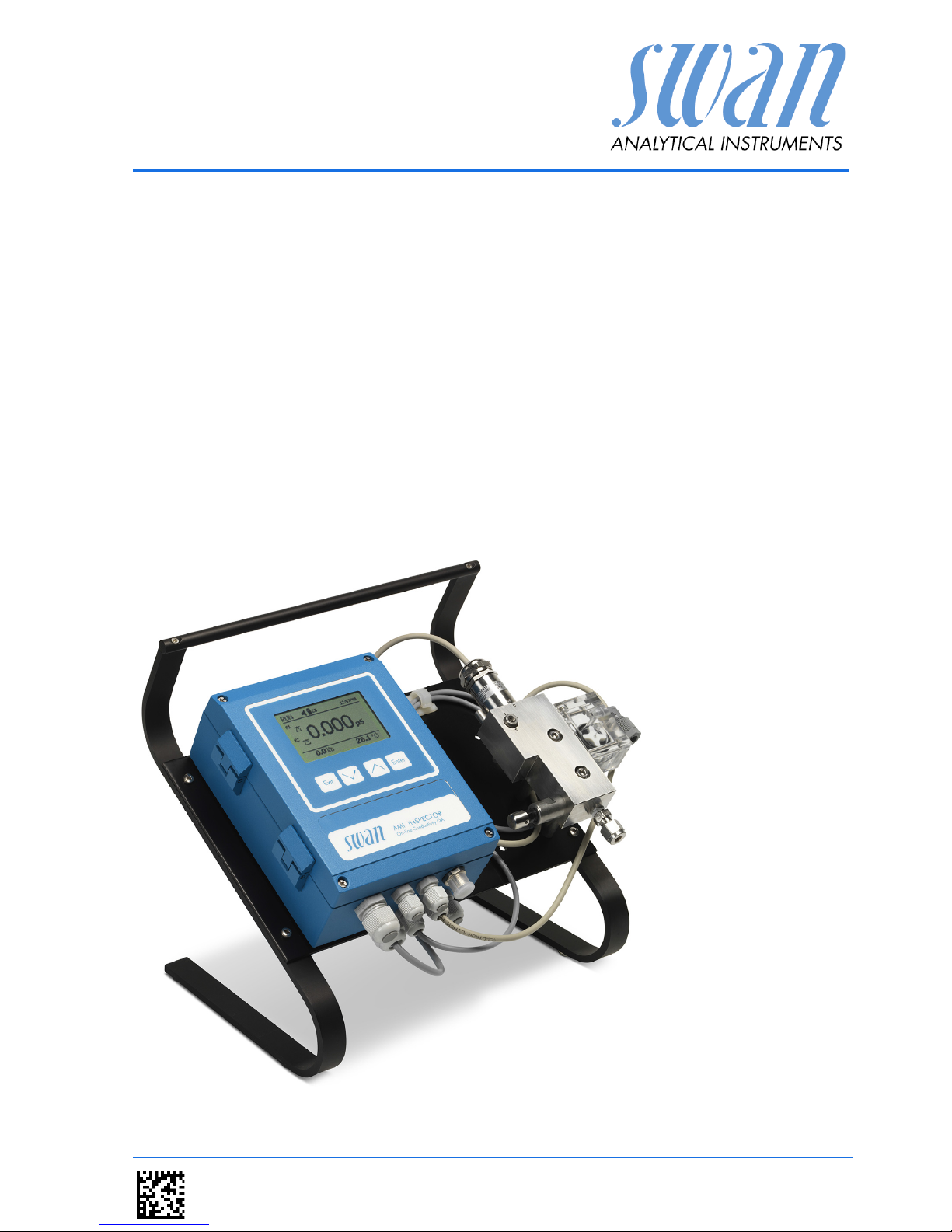
AMI INSPECTOR
Conductivity
Version 6.00 and higher
A-96.250.611 / 120617
Operator’s Manual
Page 2
© 2016, SWAN ANALYTISCHE INSTRUMENTE AG, Switzerland, all rights reserved
subject to change without notice
Customer Support
SWAN and its representatives maintain a fully trained staff of technical specialists
around the world. For any technical question, contact your nearest
SWAN representative, or the manufacturer:
SWAN ANALYTISCHE INSTRUMENTE AG
Studbachstrasse 13
8340 Hinwil
Switzerland
Internet: www.swan.ch
E-mail: support@swan.ch
Document Status
Title:
Monitor AMI INSPECTOR Conductivity Operator’s Manual
ID:
A-96.250.611
Revision Issue
00 April 2010 First Edition
01 August 2014 New mainboard V 2.4, update to Firmware version
V5.30
02
January 2016
AMI Inspector Version 2-A (with AMIAKKU mainboard) and Firmware version 6.00
Page 3

AMI INSPECTOR Conductivity
A-96.250.611 / 120617 1
Table of Contents
1. Safety Instructions . . . . . . . . . . . . . . . . . . . . . . . . . . . . . . . . . . . 3
1.1. Warning Notices . . . . . . . . . . . . . . . . . . . . . . . . . . . . . . . . . . . . . . 4
1.2. General Safety Regulations . . . . . . . . . . . . . . . . . . . . . . . . . . . . . 6
2. Product Description . . . . . . . . . . . . . . . . . . . . . . . . . . . . . . . . . . 7
2.1. Description of the System. . . . . . . . . . . . . . . . . . . . . . . . . . . . . . . 7
2.2. Instrument Overview. . . . . . . . . . . . . . . . . . . . . . . . . . . . . . . . . . . 11
2.3. Technical Data . . . . . . . . . . . . . . . . . . . . . . . . . . . . . . . . . . . . . . . 12
3. Installation. . . . . . . . . . . . . . . . . . . . . . . . . . . . . . . . . . . . . . . . . . 14
3.1. Installation Check List. . . . . . . . . . . . . . . . . . . . . . . . . . . . . . . . . . 14
3.2. Connecting Sample Inlet and Outlet. . . . . . . . . . . . . . . . . . . . . . . 15
3.2.1 Swagelok Fitting Stainless Steel at Sample Inlet . . . . . . . . . . . 15
3.2.2 Sample Outlet . . . . . . . . . . . . . . . . . . . . . . . . . . . . . . . . . . . . . . 15
3.3. Electrical Connections . . . . . . . . . . . . . . . . . . . . . . . . . . . . . . . . . 16
3.4. Connection Diagram. . . . . . . . . . . . . . . . . . . . . . . . . . . . . . . . . . . 17
3.4.1 Power Supply . . . . . . . . . . . . . . . . . . . . . . . . . . . . . . . . . . . . . . 18
3.5. Relay Contacts . . . . . . . . . . . . . . . . . . . . . . . . . . . . . . . . . . . . . . . 20
3.5.1 Input . . . . . . . . . . . . . . . . . . . . . . . . . . . . . . . . . . . . . . . . . . . . . 20
3.5.2 Alarm Relay. . . . . . . . . . . . . . . . . . . . . . . . . . . . . . . . . . . . . . . . 20
3.5.3 Relay Contacts 1 and 2 . . . . . . . . . . . . . . . . . . . . . . . . . . . . . . . 21
3.6. Signal Output . . . . . . . . . . . . . . . . . . . . . . . . . . . . . . . . . . . . . . . . 21
4. Instrument Setup . . . . . . . . . . . . . . . . . . . . . . . . . . . . . . . . . . . . 22
4.1. Programming . . . . . . . . . . . . . . . . . . . . . . . . . . . . . . . . . . . . . . . . 22
5. Operation. . . . . . . . . . . . . . . . . . . . . . . . . . . . . . . . . . . . . . . . . . . 23
5.1. Keys . . . . . . . . . . . . . . . . . . . . . . . . . . . . . . . . . . . . . . . . . . . . . . . 23
5.2. Display . . . . . . . . . . . . . . . . . . . . . . . . . . . . . . . . . . . . . . . . . . . . . 24
5.3. Software Structure . . . . . . . . . . . . . . . . . . . . . . . . . . . . . . . . . . . . 25
5.4. Changing Parameters and values . . . . . . . . . . . . . . . . . . . . . . . . 26
6. Maintenance . . . . . . . . . . . . . . . . . . . . . . . . . . . . . . . . . . . . . . . . 27
6.1. Maintenance Schedule . . . . . . . . . . . . . . . . . . . . . . . . . . . . . . . . . 27
6.2. Stop of Operation for Maintenance. . . . . . . . . . . . . . . . . . . . . . . . 27
6.3. Maintenance of the Sensor. . . . . . . . . . . . . . . . . . . . . . . . . . . . . . 28
6.4. Quality Assurance of the Instrument . . . . . . . . . . . . . . . . . . . . . . 29
6.4.1 Activate SWAN Quality assurance procedure. . . . . . . . . . . . . . 30
6.4.2 Pre-test . . . . . . . . . . . . . . . . . . . . . . . . . . . . . . . . . . . . . . . . . . . 31
6.4.3 Connecting sample lines . . . . . . . . . . . . . . . . . . . . . . . . . . . . . . 31
Page 4

2 A-96.250.611 / 120617
AMI INSPECTOR Conductivity
6.4.4 Carry out comparison measurement . . . . . . . . . . . . . . . . . . . . . 33
6.4.5 Completion of the measurement . . . . . . . . . . . . . . . . . . . . . . . . 34
6.5. Calibration. . . . . . . . . . . . . . . . . . . . . . . . . . . . . . . . . . . . . . . . . . . 34
6.6. Replacing Fuses . . . . . . . . . . . . . . . . . . . . . . . . . . . . . . . . . . . . . . 36
6.7. Replacing the Battery . . . . . . . . . . . . . . . . . . . . . . . . . . . . . . . . . . 37
6.8. Longer Stop of Operation . . . . . . . . . . . . . . . . . . . . . . . . . . . . . . . 37
7. Error List . . . . . . . . . . . . . . . . . . . . . . . . . . . . . . . . . . . . . . . . . . . 38
8. Program Overview . . . . . . . . . . . . . . . . . . . . . . . . . . . . . . . . . . . 41
8.1. Messages (Main Menu 1) . . . . . . . . . . . . . . . . . . . . . . . . . . . . . . . 41
8.2. Diagnostics (Main Menu 2) . . . . . . . . . . . . . . . . . . . . . . . . . . . . . . 42
8.3. Maintenance (Main Menu 3) . . . . . . . . . . . . . . . . . . . . . . . . . . . . . 43
8.4. Operation (Main Menu 4) . . . . . . . . . . . . . . . . . . . . . . . . . . . . . . . 43
8.5. Installation (Main Menu 5). . . . . . . . . . . . . . . . . . . . . . . . . . . . . . . 44
9. Program List and Explanations . . . . . . . . . . . . . . . . . . . . . . . . . 46
1 Messages. . . . . . . . . . . . . . . . . . . . . . . . . . . . . . . . . . . . . . . . . . 46
2 Diagnostics . . . . . . . . . . . . . . . . . . . . . . . . . . . . . . . . . . . . . . . . 46
3 Maintenance . . . . . . . . . . . . . . . . . . . . . . . . . . . . . . . . . . . . . . . 48
4 Operation . . . . . . . . . . . . . . . . . . . . . . . . . . . . . . . . . . . . . . . . . . 49
5 Installation . . . . . . . . . . . . . . . . . . . . . . . . . . . . . . . . . . . . . . . . . 50
10. Default Values . . . . . . . . . . . . . . . . . . . . . . . . . . . . . . . . . . . . . . . 63
11. Index. . . . . . . . . . . . . . . . . . . . . . . . . . . . . . . . . . . . . . . . . . . . . . . 66
12. Notes . . . . . . . . . . . . . . . . . . . . . . . . . . . . . . . . . . . . . . . . . . . . . . 67
Page 5

AMI INSPECTOR Conductivity
Safety Instructions
A-96.250.611 / 120617 3
AMI INSPECTOR Conductivity Operator’s Manual
This document describes the main steps for instrument setup, operation and maintenance.
1. Safety Instructions
General The instructions included in this section explain the potential risks
associated with instrument operation and provide important safety
practices designed to minimize these risks.
If you carefully follow the information contained in this section, you
can protect yourself from hazards and create a safer work environment.
More safety instructions are given throughout this manual, at the
respective locations where observation is most important.
Strictly follow all safety instructions in this publication.
Tar get
audience
Operator: Qualified person who uses the equipment
for its intended purpose.
Instrument operation requires thorough knowledge of applications,
instrument functions and software program as well as all applicable
safety rules and regulations.
OM Location The AMI Operator’s Manual shall be kept in proximity of the instru-
ment.
Qualification,
Training
To be qualified for instrument installation and operation, you must:
read and understand the instructions in this manual as well as
the Material Safety Data Sheets.
know the relevant safety rules and regulations.
Page 6
4 A-96.250.611 / 120617
AMI INSPECTOR Conductivity
Safety Instructions
1.1. Warning Notices
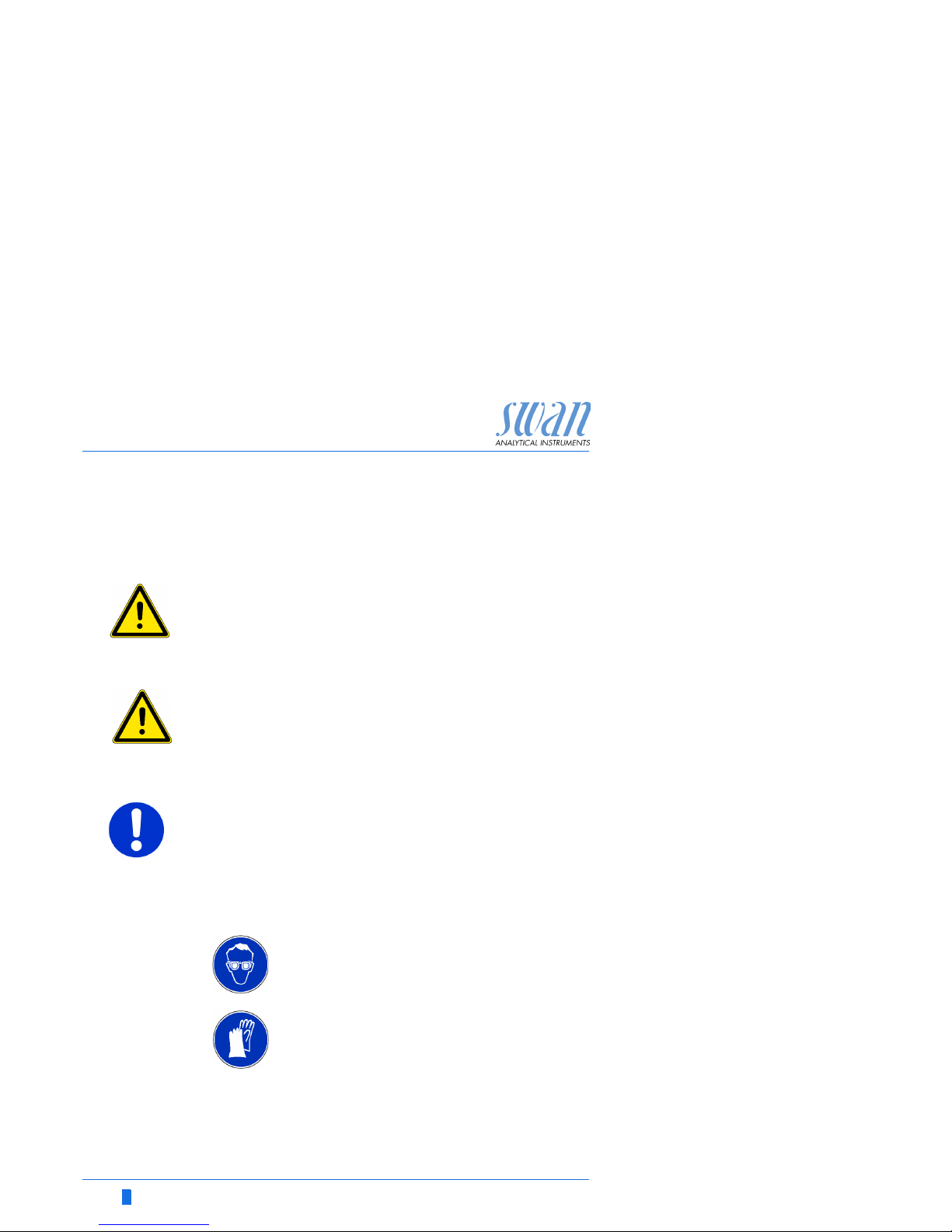
The symbols used for safety-related notices have the following significance:
DANGER
Your life or physical wellbeing are in serious danger if such
warnings are ignored.
Follow the prevention instructions carefully.
WARNING
Severe injuries or damage to the equipment can occur if such
warnings are ignored.
Follow the prevention instructions carefully.
CAUTION
Damage to the equipment, minor injury, malfunctions or incorrect process can be the consequence if such warnings are ignored.
Follow the prevention instructions carefully.
Mandatory
Signs
The importance of the mandatory signs in this manual.
Safety goggles
Safety gloves
Page 7
AMI INSPECTOR Conductivity
Safety Instructions
A-96.250.611 / 120617 5
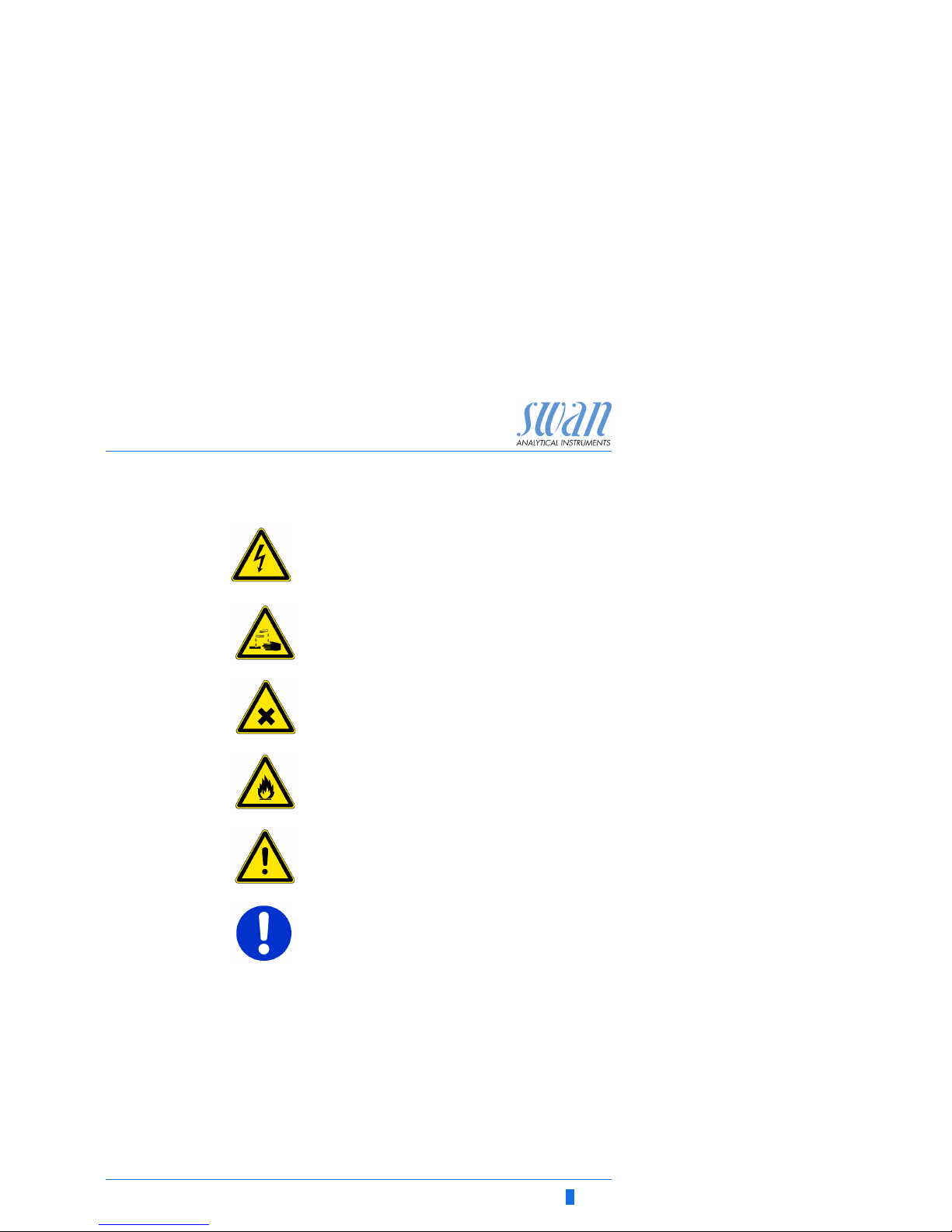
Warning Signs The importance of the warning signs in this manual.
Electrical shock hazard
Corrosive
Harmful to health
Flammable
Warning general
Attention general
Page 8
6 A-96.250.611 / 120617
AMI INSPECTOR Conductivity
Safety Instructions
1.2. General Safety Regulations
Legal
Requirements
The user is responsible for proper system operation.
All precautions must be followed to ensure safe operation
of the instrument.
Spare Parts
and
Disposables
Use only official SWAN spare parts and disposables. If other parts
are used during the normal warranty period, the manufacturer’s
warranty is voided.
Modifications Modifications and instrument upgrades shall only be carried out by
an authorized Service Technician. SWAN will not accept responsibility for any claim resulting from unauthorized modification or alteration.
WARNING
Risk of Electrical Shock
If proper operation is no longer possible, the instrument must be
disconnected from all power lines, and measures must be taken
to prevent inadvertent operation.
To prevent from electrical shock, always make sure that the
ground wire is connected.
Service shall be performed by authorized personnel only.
Whenever electronic service is required, disconnect instru-
ment power and power of devices connected to.
–relay 1,
–relay 2,
– alarm relay
WARNING
For safe instrument installation and operation you must read
and understand the instructions in this manual.
WARNING
Only SWAN trained and authorized personnel shall perform the
tasks described in this document.
Page 9

AMI INSPECTOR Conductivity
Product Description
A-96.250.611 / 120617 7
2. Product Description
This chapter contains technical data, requirements and performance data.
2.1. Description of the System
The portable AMI INSPECTOR instrument is a complete monitoring
system mounted on a small panel with supporting stand and a rechargeable battery for stand-alone operation (>24h), designed as
an inspection equipment for quality assurance of online process
monitors.
Application
Range
The conductivity is a parameter for the total quantity of ions present
in the solution. It can be used for the monitoring of:
the condition of waters
water purification
water hardness
completeness of ion analysis
Features General Features of AMI INSPECTORs are:
Battery life after full charge:
– >24h at full load (use of 3 relays, USB, signal output, logger)
– >36h at minimum load (use of logger only)
Charging time: approx. 6 hours
Controlled shut-down if battery is empty.
Display of remaining battery life in hours.
For longer battery life the back light of the LC Display is dis-
abled.
Continuous operation using power adapter. The battery
should be discharged at least once a month (normal usage
until the monitor automatically shuts down).
Battery The Li-Ion battery is located in the housing of the AMI transmitter.
See chapter Power Supply, p. 18 regarding power supply and
charging of the battery.
USB interface Built-in USB interface for logger download. Use the USB stick sup-
plied by Swan only (other USB sticks can dramatically reduce battery life).
Page 10

8 A-96.250.611 / 120617
AMI INSPECTOR Conductivity
Product Description
Special
Features
Many temperature compensation curves for specific conductivity
measurement:
none
Coefficient
Neutral salts
High-purity water
Strong acids
Strong bases
Ammonia, Eth. am.
Morpholine
Signal Output
(optional)
One signal output programmable for measured values (freely
scaleable, linear or bilinear) or as continuous control output (control
parameters programmable).
Current loop: 0/4–20 mA
Maximal burden: 510
Relay Two potential-free contacts programmable as limit switches for
measuring values, controllers or timer for system cleaning with automatic hold function.
Maximum load: 100 mA/ 50 VAC
Alarm Relay One potential free contact.
Alternatively:
Open during normal operation, closed on error and loss of
power.
Closed during normal operation, open on error and loss of
power.
Summary alarm indication for programmable alarm values and instrument faults.
Input For potential-free contact to freeze the measuring value or to inter-
rupt control in automated installations (hold function or remote-off)
Safety features No data loss after power failure, all data is saved in non-volatile
memory. Over voltage protection of in- and outputs.
Galvanic separation of measuring inputs and signal outputs.
Sensor Swansensor UP-Con1000 SL high precision two-wire electrode
made of stainless steel with integrated NTC temperature probe.
Page 11

AMI INSPECTOR Conductivity
Product Description
A-96.250.611 / 120617 9
Measuring
Principle
The conductivity of high purity water is determined with a sensor
consisting of two metal electrodes. The characteristics of each sensor is expressed as cell constant. An alternating voltage (to minimize polarization effects) is applied to two electrodes. Depending
on the concentration of ions in the sample, a signal results between
the electrodes which is proportional to the conductivity of the water.
The measuring result is indicated as conductivity.
Temperature
compensation
The mobility of ions in water increase with higher temperature
which enlarges the conductivity. Therefore, the temperature is measured simultaneous by an integrated Pt1000 temperature sensor
and the conductivity is compensated to 25 °C. Several temperature
compensation curves, designed for different water compositions,
can be chosen.
After cation exchanger (cation conductivity), the temperature compensation curve strong acids has to be set.
For more information see: Influence of Temperature on Electrical
Conductivity, PPChem (2012)
Standard
Temperature
The displayed conductivity value is compensated to 25 °C standard
temperature.
Page 12
10 A-96.250.611 / 120617
AMI INSPECTOR Conductivity
Product Description
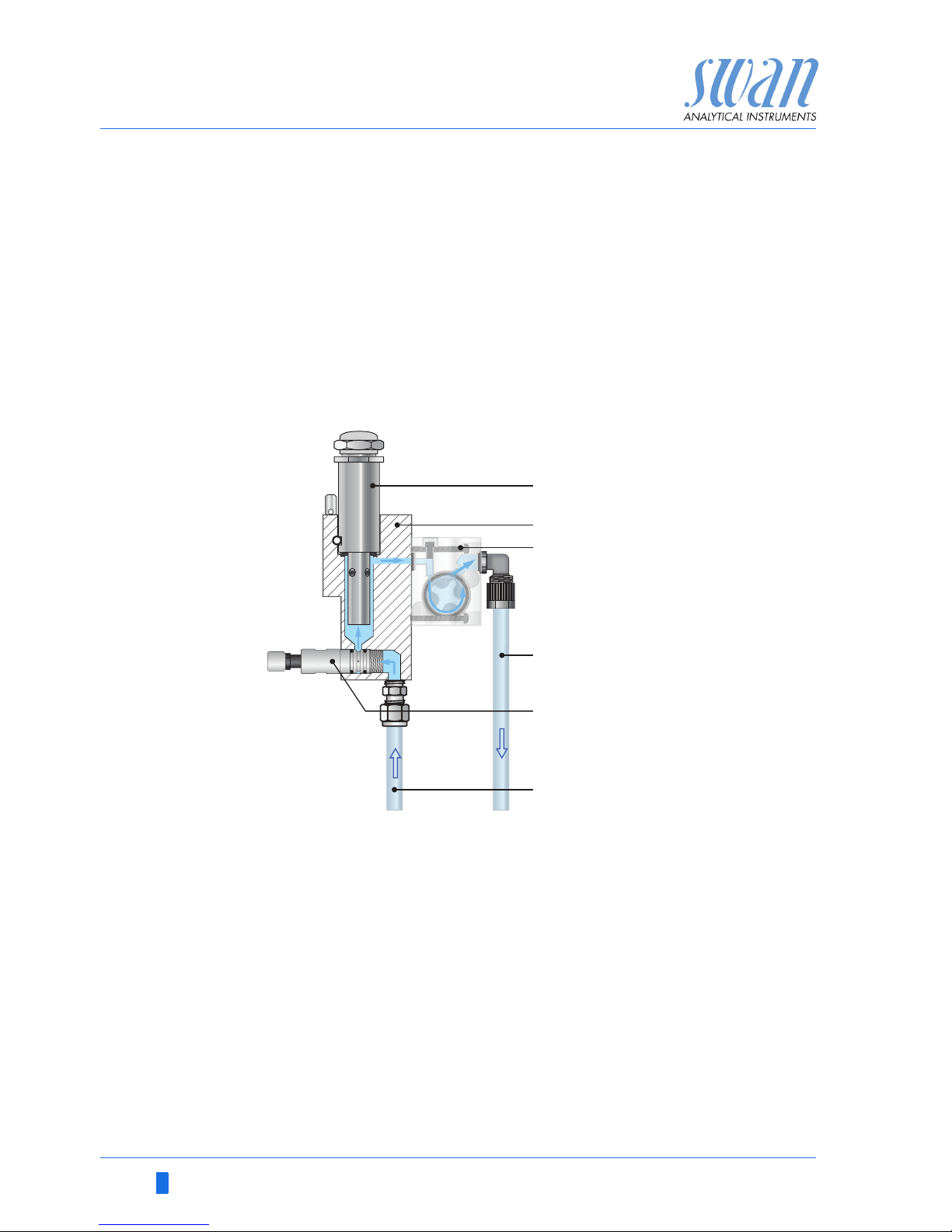
Fluidics The flow cell QV-Flow UP-Con SL consists of the flow cell block [B],
the flow sensor [C] and the flow regulating valve [E].
The Swansensor UP-Con1000 SL [A] with integrated temperature
sensor is inserted into the flow cell block [B].
The sample enters at the sample inlet [F]. It flows through the flow
regulating valve [E], where the flow rate can be adjusted. Then the
sample flows through the flow cell block were the conductivity and
temperature of the sample is measured.
The sample leaves the flow cell block via flow meter through the
sample outlet [D].
A
B
C
Swansensor Up-Con1000 SL
Flow cell block
Flow sensor
D
E
F
Sample outlet
Flow regulating valve
Sample inlet
A
B
C
D
E
F
Page 13
AMI INSPECTOR Conductivity
Product Description
A-96.250.611 / 120617 11
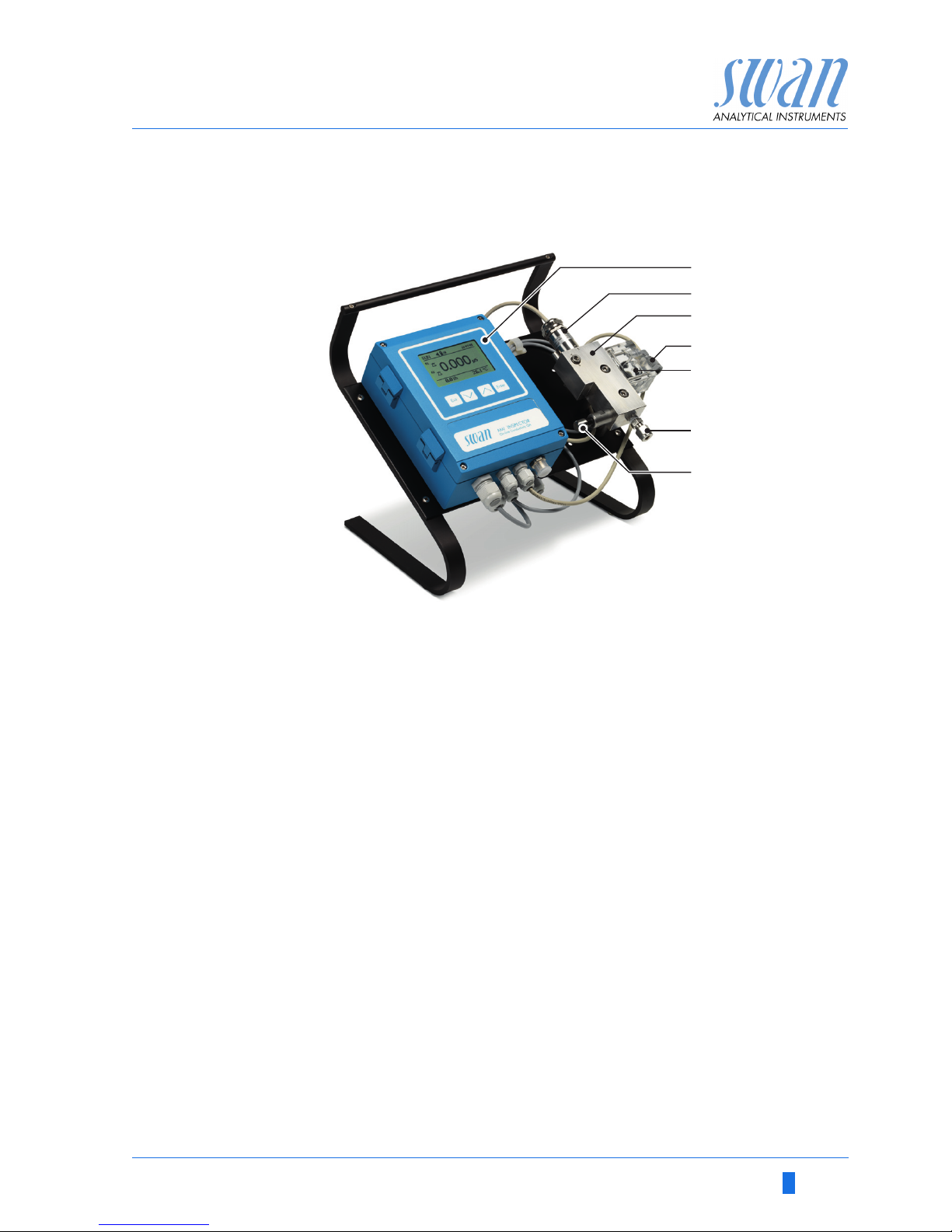
2.2. Instrument Overview
A
B
C
D
E
F
G
AMI Transmitter
Swansensor UP-Con1000 SL
Flow cell QV-Flow UP-Con SL
Sample outlet
Flow meter
Sample inlet
Flow regulating valve
A
B
C
D
E
F
G
Page 14

12 A-96.250.611 / 120617
AMI INSPECTOR Conductivity
Product Description
2.3. Technical Data
Power Supply
Battery
Use original, supplied power adapter only.
Voltage:
Power consumption:
Charging time:
Battery type:
85–265 VAC, 50/60 Hz
max. 20 VA
6h
Li-Ion
During charging protect from heat impact and keep splash-proof
(not IP66).
Operating time
Stand-alone (Battery):
Connected adapter:
> 24h
continuous
Controlled shut-down when battery is empty, remaining time is displayed.
Electronics
Aluminium with a protection degree of IP 66 / NEMA 4X
housing
Ambient temperature:
Humidity:
Display:
-10 to +50 °C
10–90% rel., non condensing
backlit LCD, 75 x 45 mm
Sample
requirements
Flow rate:
Temperature:
Inlet pressure:
Outlet pressure:
5–20 l/h
up to 50 °C
up to 2 bar
pressure free
On-site
The analyzer site must permit connections to:
requirements
Sample inlet:
Sample outlet:
Max. Altitude:
1/4” Swagelok tube adapter
flexible tube 6x 8 mm
2000 m above sea level
Measuring
Range
Range:
0.055 to 0.999 s/cm
1.00 to 9.99 s/ cm
10.0 to 99.9 s/cm
100 to 1000 s/cm
Resolution
0.001 s/cm
0.01 s/cm
0.1 s/cm
1 s/cm
Accuracy
Automatic range switching.
±1% of measured value ±1 digit
Values for the cell constant 0.0415 cm
-1
Swansensor
UP-Con1000 SL.
Page 15
AMI INSPECTOR Conductivity
Product Description
A-96.250.611 / 120617 13
Sensor
UP-Con1000 SL
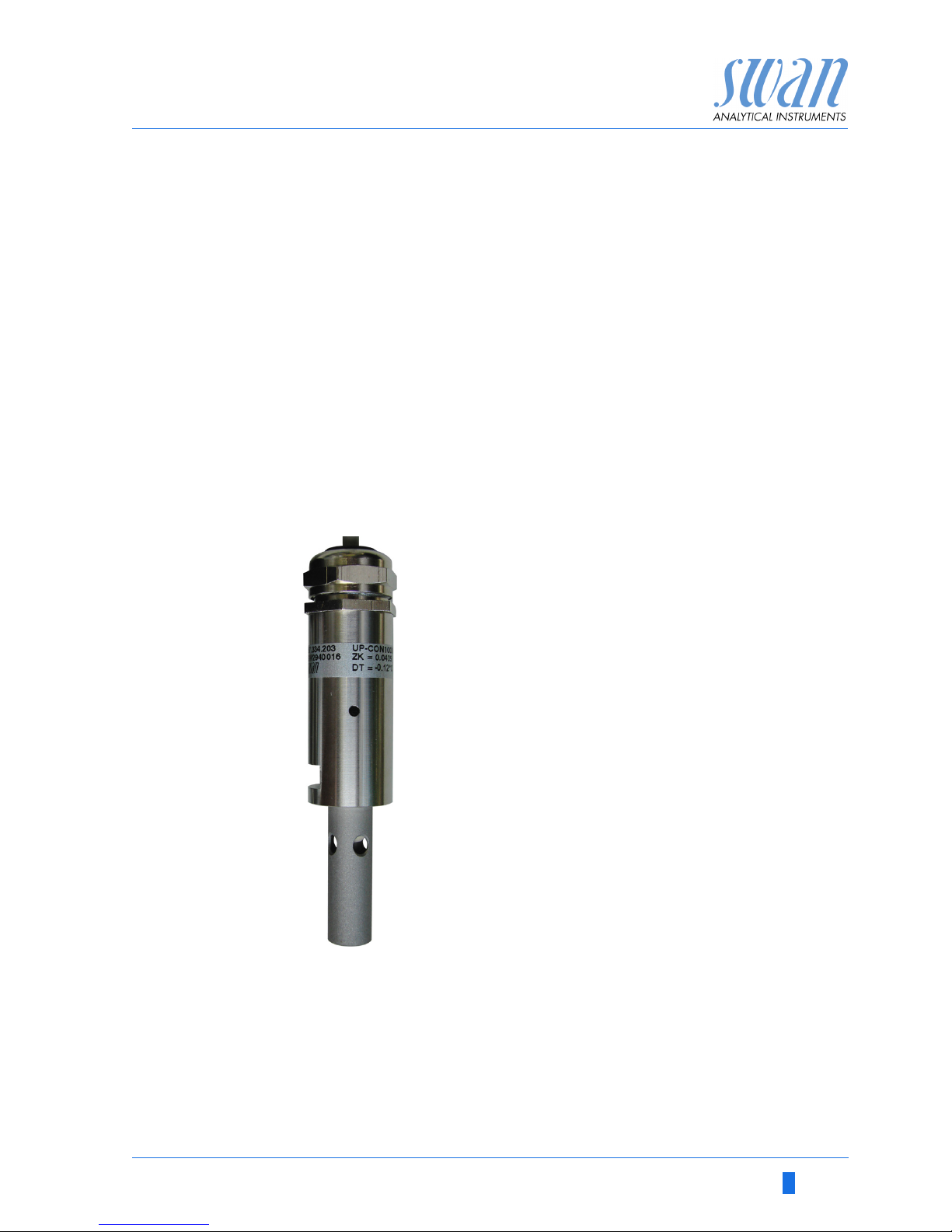
The Swansensor UP-Con1000 SL is a 2-electrode conductivity
sensor for the continuous measurement of specific and acid conductivity with a built-in temperature sensor.
Sensor Cell Constant k:
Temperature sensor:
~ 0,04 cm
-1
Pt1000
Materials
Shaft:
Electrode:
Isolation:
SS 316L, stainless steel
Titanium
PEEK
Operating
Conditions
Continuous temperature:
Max. temperature:
Max. pressure:
100 °C at 6,5 bar
120 °C at 6,5 bar
30 bar at 25 °C
The cell constant (ZK) and the temperature
correction (DT) are written on the sensor label.
Page 16

14 A-96.250.611 / 120617
AMI INSPECTOR Conductivity
Installation
3. Installation
3.1. Installation Check List
Check
Instrument’s specification must conform to your AC power
ratings. See External power adapter, p. 19.
Check if the battery is fully charged.
Site requirements
Sample line with sufficient flow and pressure, see Sample
requirements, p. 12
Installation
Connect the sample and waste line.
Electrical
connections
Connect all external devices like limit switches and current
loops, see Connection Diagram, p. 17.
Power-up
Turn on sample flow
Switch on power
Adjust the sample flow to 5 – 20 l/h
Instrument
Setup
Program all sensor specific parameters (cell constant, temp.
correction, cable length).
Program all parameters for external devices (interface,
recorders, etc.).
Program all parameters for instrument operation (limits,
alarms, etc.).
Run-in period
Let the instrument run continuously for 1 h.
NOTICE: If the conductivity value of the sample is very low,
the sensor might need some time until the correct reading is
displayed
Page 17
AMI INSPECTOR Conductivity
Installation
A-96.250.611 / 120617 15
3.2. Connecting Sample Inlet and Outlet
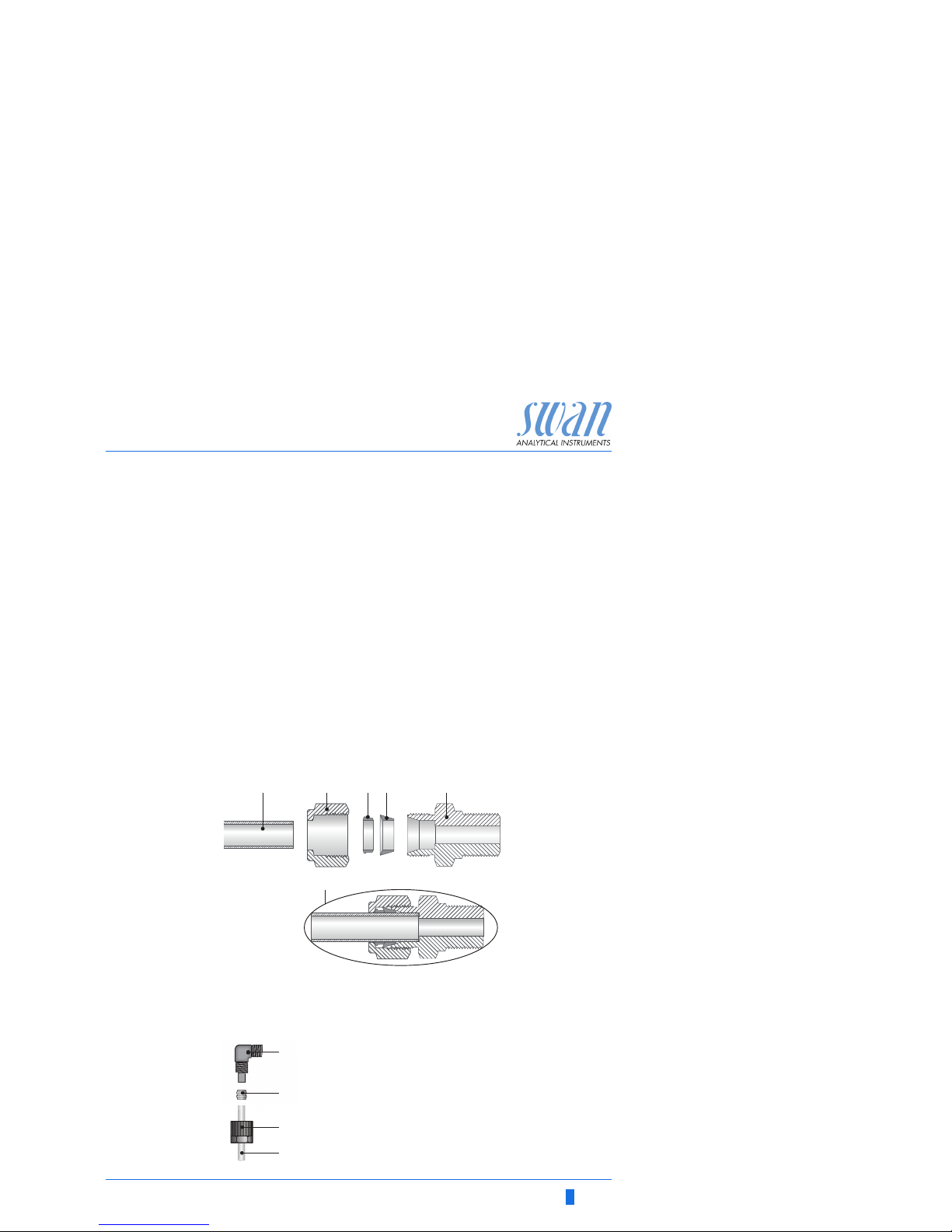
3.2.1 Swagelok Fitting Stainless Steel at Sample Inlet
Preparation Cut the tube to length and deburr it. The tube must be straight and
free from blemishes for approximately 1,5 x tube diameter from the
end.
Lubrication with lubricating oil, MoS2, Teflon etc. is recommended
for the assembly and reassembly of bigger sized unions (thread,
compression cone).
Installation 1 Insert the compression ferrule [C] and the compression cone
[D] into the union nut [B].
2 Screw on the union nut onto the body, do not tighten it.
3 Push the stainless steel pipe through the union nut as far as it
reaches the stop of the body.
4 Tighten down the union nut 1¾ rotation using an open ended
spanner. Hold Body from turning with a second wrench.
3.2.2 Sample Outlet
Flexible tube 8x 6 mm. Connect the tube to the serto elbow union
and insert it into a pressure free drain of sufficient capacity.
A
B
C
D
E
F
Tube
Union nut
Compression
ferrule
Compression
cone
Body
Tightened
connection
ABCDE
F
A
B
C
D
Elbow union
Compression ferrule
Knurled nut
Flexible tube
B
C
D
A
Page 18
16 A-96.250.611 / 120617
AMI INSPECTOR Conductivity
Installation
3.3. Electrical Connections
WARNING
Always turn off DC power before manipulating electric parts.
Make sure the power specification of the instrument corresponds to the power on site.
Cable
thicknesses
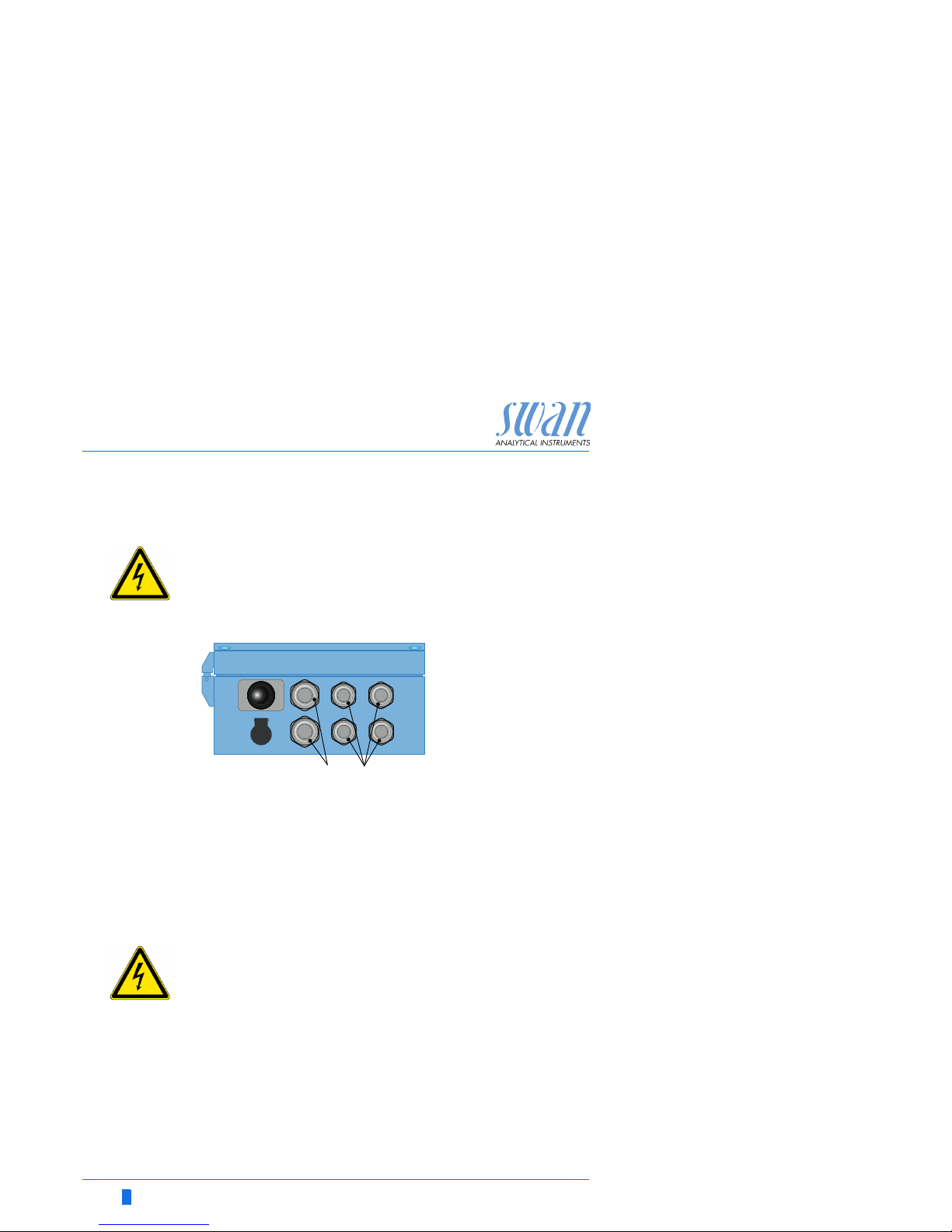
In order to comply with IP66, use the following cable thicknesses
NOTICE: Protect unused cable glands
Wire For Relays: Use max. 1.5 mm2 / AWG 14 stranded wire with
end sleeves.
For Signal Outputs and Input: Use 0.25 mm
2
/ AWG 23
stranded wire with end sleeves.
WARNING
External Voltage.
External supplied devices connected to relay 1 or 2 or to the
alarm relay can cause electrical shocks.
Make sure that the devices connected to the following con-
tacts are disconnected from the power before continuing the
installation.
–relay 1
–relay 2
– alarm relay
ABPG 9 cable gland: cable Ø
outer
4–8 mm
PG 7 cable gland: cable Ø
outer
3–6.5 mm
ON
OFF
AB
Page 19
AMI INSPECTOR Conductivity
Installation
A-96.250.611 / 120617 17
3.4. Connection Diagram
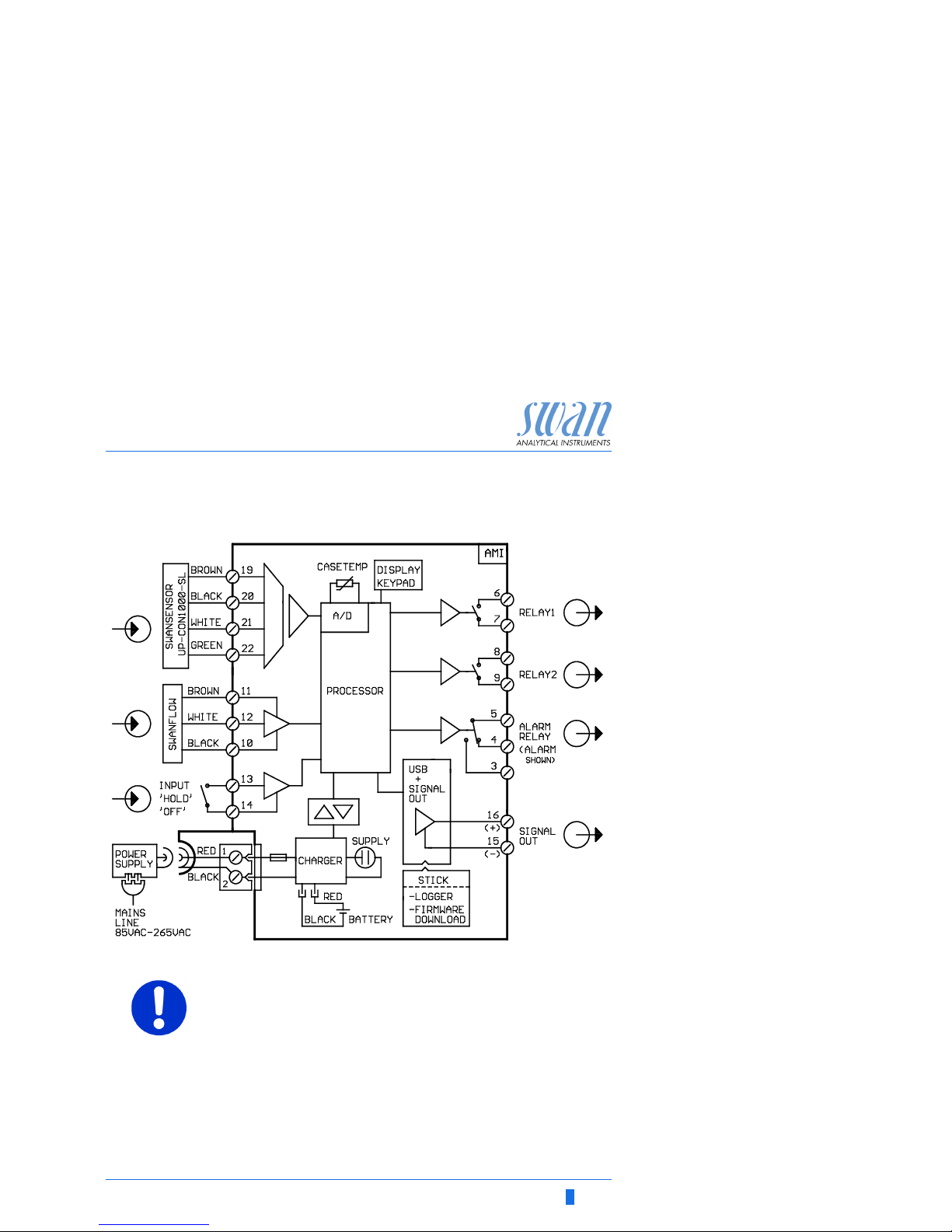
CAUTION
Use only the terminals shown in this diagram, and only for the
mentioned purpose. Use of any other terminals will cause short
circuits with possible corresponding consequences to material
and personnel.
Page 20
18 A-96.250.611 / 120617
AMI INSPECTOR Conductivity
Installation
3.4.1 Power Supply
Contrary to all other Swan online process monitors the AMI INSPECTOR transmitter is supplied with power by battery only. The
rechargeable battery (Li-Ion) enables a stand-alone operation for at
least 24 hours.
WARNING
Do not provide power directly to the transmitter as this will destroy the motherboard. All AMI INSPECTOR transmitters are
supplied with power by battery only.
Charging Use the original supplied power adapter to charge AMI INSPEC-
TOR only. Charging time: approx 6h.
Fully charged a stand-alone operating time of at least 24h is guar-
anteed:
>24h at full load (use of 3 relays, USB, signal output, logger)
>36h at minimal load (use of logger only)
In case that the battery is discharged completely the firmware will
automatically shut down.
Switch Power
ON - OFF
Switch the instrument ON or OFF using the toggle switch on the
transmitter.
Continuous
operation
For continuous operation use the power adapter as well.
CAUTION
If the AMI powers ON and then immediately shuts OFF, the
battery is empty. Do not hold the toggle switch in ON position,
as this can damage the battery.
CAUTION
During charging protect from heat impact and keep splash-
proof (plug of power adapter is not IP66).
Do not supply external devices, e.g. pumps, magnetic valves
or any other current consumers with AMI INSPECTOR
CAUTION
Use the original supplied power adapter to charge AMI IN-
SPECTOR only. Use of any other power adapter can damage
the battery or cause malfunction
Page 21
AMI INSPECTOR Conductivity
Installation
A-96.250.611 / 120617 19
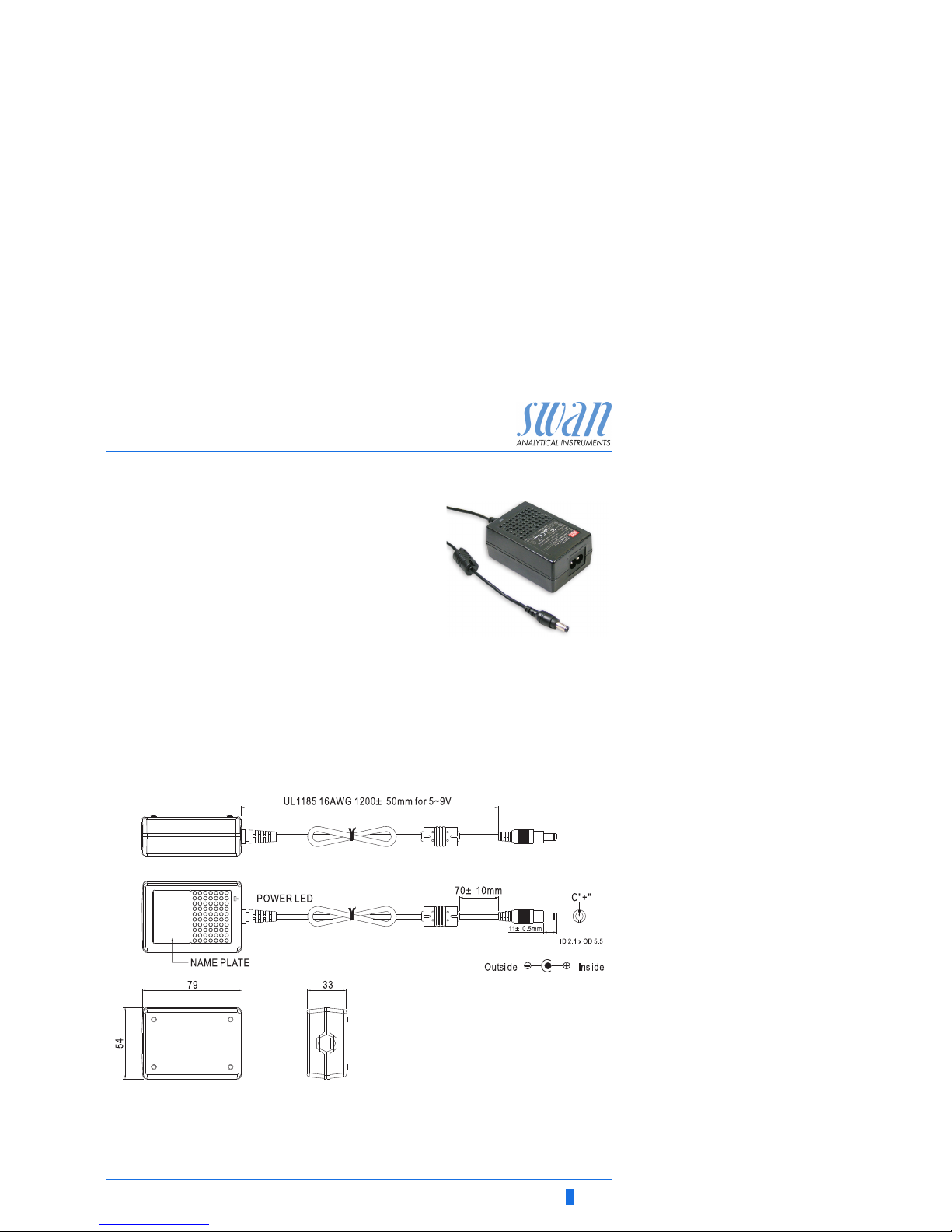
External
power adapter
Universal input range
85 - 265 VAC
Continuous short circuit protection
Over voltage protection
LED indicator for power on
2-pin AC inlet (IEC 320-C8) for
detachable country-specific power
cord
Power cords Two different power cords are supplied:
Power cord with type C plug (Europlug)
Power cord with type A plug (NEMA-1)
If a different plug type is needed, please purchase a suitable power
cord from your local supplier.
NOTICE: Do not use any plug adapters.
Dimensions
Unit: mm
Page 22

20 A-96.250.611 / 120617
AMI INSPECTOR Conductivity
Installation
3.5. Relay Contacts
Programming of the relay contacts see 5.3 Relay Contacts, p. 60
3.5.1 Input
NOTICE: Use only potential-free (dry) contacts.
The total resistance (sum of cable resistance and resistance of
the relay contact) must be less than 50 Ω.
Terminals 13/14
If signal output is set to hold, measurement is interrupted if input is
active.
For programming see menu 5.3.4, p. 66.
3.5.2 Alarm Relay
NOTICE: For resistive loads only; do not use with capacitive or
inductive loads. Max. load 1 A / 250 VAC.
Alarm output for system errors.
Error codes see Error List, p. 42
Programming see menu 5.3.1, p. 60
NOTICE: With certain alarms and certain settings of the AMI
transmitter the alarm relay does not switch. The error, however,
is shown on the display.
1) usual use
Ter min als Description Relay connection
NC
1)
Normally
Closed
5/4 Active (opened) during normal
operation.
Inactive (closed) on error and
loss of power.
NO
Normally
Open
5/ 3 Active (closed) during normal
operation.
Inactive (opened) on error and
loss of power.
4
3
5
0V
1)
4
3
5
0V
Page 23

AMI INSPECTOR Conductivity
Installation
A-96.250.611 / 120617 21
3.5.3 Relay Contacts 1 and 2
NOTICE:
For resistive loads only; do not use with capacitive or
inductive loads
. Rated load 100 mA / 50 VAC.
For programming see Menu Installation 5.3.2 and 5.3. 3, p. 62
3.6. Signal Output
The optional signal output 0/ 4 – 20 mA PCB can be plugged onto
the USB interface PCB.
NOTICE: Max. burden 510
Terminals 16 (+) and 15 (-).
For programming see menu 5.2 Signal Outputs, p. 55
Terminals Description
Relay connection
NO
Normally
Open
6/ 7: Relay 1
8/ 9: Relay 2
Inactive (opened) during normal
operation and loss of power.
Active (closed) when a programmed function is executed.
ABSignal output 0/4–20 mA PCB
USB interface
A B
6/8
0V
7/9
Page 24

22 A-96.250.611 / 120617
AMI INSPECTOR Conductivity
Instrument Setup
4. Instrument Setup
4.1. Programming
Sensor
parameters
Program all sensor parameters in Menu 5.1.2, <Installation> <Sensors> <Sensor parameters>:
Enter the:
Cell constant [cm
-1
]
Temperature correction in °C
Cable length
Temperature compensation
The sensor characteristics are printed on the label of each sensor.
Cable length Set the cable length to 0.0 m if the sensor is installed in the flow cell
of the AMI INSPECTOR Conductivity.
Tem p.
Compensation
Menu 5.1.3
Choose between:
none
Coefficient
Neutral salts
High-purity water
Strong acids
Strong bases
Ammonia, Ethanolamine
Morpholine
Measuring unit Menu 5.1.1.2
Set the <Measuring unit> according to your requirements:
S/cm
S/m
External
devices
Program all parameters for external devices (interface, recorders,
etc.) See program list and explanations 5.2 Signal Outputs, p. 51
and 4.2 Relay Contacts, p. 49.
Limits Alarms Program all parameters for instrument operation (limits, alarms).
See program list and explanations 4.2 Relay Contacts, p. 49.
87-344.203 UP-Con1000SL Sensor type
SW-xx-xx-xx ZK = 0.0417 Cell constant
SWAN AG DT = 0.06 °C Temperature correction
Page 25

AMI INSPECTOR Conductivity
Operation
A-96.250.611 / 120617 23
5. Operation
5.1. Keys
Program
Access, Exit
A to exit a menu or command (rejecting any changes)
to move back to the previous menu level
B to move DOWN in a menu list and to decrease digits
C to move UP in a menu list and to increase digits
D to open a selected sub-menu
to accept an entry
Exit Enter
BCDA
25.4°C
RUN
9 l/h
14:10:45
R1
0.178 S
R2
1
Installation
Operation
Diagnostics
Messages
Maintenance
Main Menu
Enter
Exit
Page 26

24 A-96.250.611 / 120617
AMI INSPECTOR Conductivity
Operation
5.2. Display
Relay status, symbols
A
RUN normal operation
HOLD input closed or cal delay: Instrument on hold (shows
status of signal outputs).
OFF input closed: control/limit is interrupted (shows status
of signal outputs).
B
ERROR Error Fatal Error
C
Battery status (remaining operating time in h)
D
Keys locked, transmitter control via Profibus
E
Time
F
Process values
G
Sample temperature
H
Sample flow
I
Relay status
upper/lower limit not yet reached
upper/lower limit reached
control upw./downw. no action
control upw./downw. active, dark bar indicates control intensity
motor valve closed
motor valve: open, dark bar indicates approx. position
timer
timer: timing active (hand rotating)
RUN
15:20:18
R1
R2
12 l/h 21.8°C
0.178
µS
15
AB E
F
G
I
H
DC
Page 27

AMI INSPECTOR Conductivity
Operation
A-96.250.611 / 120617 25
5.3. Software Structure
Menu Messages 1
Reveals pending errors as well as an event history
(time and state of events that have occurred at an
earlier point of time).
It contains user relevant data.
Menu Diagnostics 2
Provides user relevant instrument and sample data.
Menu Maintenance 3
For instrument calibration, relay and signal output
simulation, and to set the instrument time.
It is used by the service personnel.
Menu Operation 4
User relevant parameters that might need to be
modified during daily routine. Normally password
protected and used by the process-operator.
Subset of menu 5 - Installation, but process-related.
Menu Installation 5
For initial instrument set up by SWAN authorized
person, to set all instrument parameters. Can be
protected by means of password.
1
Messages
Operation
Maintenance
Diagnostics
Main Menu
Installation
1.1
Pending Errors
Messages
Message List
2.1
Interface
I/O State
Sample
Identification
Sensors
Diagnostics
3.1
Simulation
Maintenance
Set Time 23.09.06 16:30:00
Calibration
4.1
Logger
Relay Contacts
Sensors
Operation
5.1
Interface
Miscellaneous
Relay Contacts
Sensors
Signal Outputs
Installation
Page 28

26 A-96.250.611 / 120617
AMI INSPECTOR Conductivity
Operation
5.4. Changing Parameters and values
Changing
parameters
The following example shows how to set the Q-Flow sensor:
Changing
values
1 Select the parameter you want to
change.
2 Press [Enter]
3 Press [ ] or [ ] key to
highlight the required parameter.
4 Press [Enter] to confirm the selec-
tion or [Exit] to keep the previous
parameter.
The selected parameter is
indicated but not saved yet.
5 Press [Exit].
Yes is highlighted.
6 Press [Enter] to save the new pa-
rameter.
The system reboots, the new
parameter is set.
5.1.1
Sensors
Flow None
Sensor parameters
Quality Assurance
Temp. Compensation
Sensor parameters
Quality Assurance
Temp. Compensation
5.1.1
Sensors
Flow None
Flow
None
Q-Flow
5.1.1
Sensors
Flow Q-Flow
Sensor parameters
Quality Assurance
Temp. Compensation
Sensor parameters
Quality Assurance
Temp. Compensation
5.1.1
Sensors
Flow Q-Flow
No
Save ?
Yes
1 Select the value you want to
change.
2 Press [Enter].
3 Set required value with [ ] or
[] key.
4 Press [Enter] to confirm the new
value.
5 Press [Exit].
Yes is highlighted.
6 Press [Enter] to save the new val-
ue.
5.3.1.1.1
Alarm High 300mS
Alarm Conductivity
Alarm Low 0.000 S
Hysteresis 1.00
S
Delay 5 Sec
5.3.1.1.1
Alarm Conductivity
Alarm Low 0.000
S
Hysteresis 1.00
S
Delay 5 Sec
Alarm High 120 mS
Page 29

AMI INSPECTOR Conductivity
Maintenance
A-96.250.611 / 120617 27
6. Maintenance
WARNING
Stop operation before maintenance.
Stop sample flow.
Shut off power of the instrument.
6.1. Maintenance Schedule
Preventive maintenance frequency depends on water quality, on
the application, and on national regulations.
Control of certain set-point: Swimming pools, sanitary water:
6.2. Stop of Operation for Maintenance
1 Stop sample flow.
2 Shut off power of the instrument.
Monthly
Check sample flow.
If required
Clean conductivity sensor
Page 30

28 A-96.250.611 / 120617
AMI INSPECTOR Conductivity
Maintenance
6.3. Maintenance of the Sensor
Remove the Sensor from the Flow Cell
To remove the sensor from the flow cell proceed as follows:
1 Stop the sample flow.
2 Press the locking pin [C1] down.
3 Turn the locking screw [D] with a 5 mm allen key counterclock-
wise 180°.
The locking pin remains down.
4 Remove the sensor.
Cleaning If the sensor is slightly contaminated, clean it with soapy water and
a pipe cleaner. If the sensor is strongly contaminated, dip the tip of
the sensor into 5% hydrochloric acid for a short time.
Install the Sensor into the Flow Cell
1 Make sure that the locking mechanism is in unlocked position,
locking pin in position [C].
2 Put the sensor into the flow cell with the alignment marks [B] in
line.
3 Turn the locking screw with a 5 mm allen key clockwise 180°.
The locking pin moves up in lock position [C1].
A
B
C
C
1
D
E
F
Conductivity sensor
Alignment marks
Locking pin unlocked
Locking pin locked
Locking screw open
Flow cell
Flow regulating valve
A
C
1
F
E
B
B
C
D
Page 31

AMI INSPECTOR Conductivity
Maintenance
A-96.250.611 / 120617 29
6.4. Quality Assurance of the Instrument
Every SWAN on-line instrument is equipped with integrated, autonomous quality assurance functions to survey the plausibility of each
measurement.
For AMI Powercon Specific and AMI Powercon Acid these are:
continuous monitoring of sample flow
continuous monitoring of the temperature inside the transmit-
ter case
periodic accuracy test with ultra high precision resistors
Further a manual, menu driven inspection procedure can be carried
out using a certified reference instrument. Running at the same
sampling point as an inspection equipment, the AMI Inspector Conductivity, verifies the measuring results. After enabling the quality
assurance procedure, by defining the quality assurance level, the
instrument reminds the user periodically to run the procedure and
results are stored in a history for review.
Quality
assurance
level
Central feature of the quality assurance function is the assignment
of the monitored process to a Quality assurance level.
There are three predefined levels plus a user level. Hereby the inspection interval, the deviation limits of temperature and measuring
result between the inspection equipment and the monitoring instrument are defined.
Level 1: Tre nd; Measurement used as an additional informa-
tion to follow the process indicating trends.
Level 2: Standard; Monitoring of conductivity. In case of in-
strument failure, other parameters can be used for process
monitoring.
Level 3: Crucial; Monitoring of critical processes, value is
used for control of another part or subsystem (valve, dosing
unit, etc.).
Additional level:
Quality level 4: User; User defined inspection interval, maxi-
mal deviation of temperature and measuring result.
Page 32

30 A-96.250.611 / 120617
AMI INSPECTOR Conductivity
Maintenance
Limits and intervals for the AMI Powercon
Procedure The standard workflow contains following procedures:
1 Activate SWAN Quality assurance procedure
2 Pre-test
3 Connect instruments
4 Carry out comparison measurement
5 Completion of the measurement
NOTICE: The procedure should only be carried out through
qualified personnel.
6.4.1 Activate SWAN Quality assurance procedure
Enable quality assurance procedure at each instrument by selecting the quality level in menu 5.1.4.1
The corresponding submenus are then activated.
NOTICE: The activation is necessary the first time only.
Quality Level
max. deviation
temperature [°C]
a)
max. deviation
result [%]
min. inspection
interval
0: Off
Off Off
Off
1: Trend
0.5 °C 10 %
annual
2: Standard
0.4 °C 5 %
quarterly
3: Crucial
0.3 °C 5 %
monthly
4: User
0 - 2 °C 0 - 20 %
annual, quarterly,
monthly
a) sample temperature must have 25 °C +/- 5 °C.
Page 33

AMI INSPECTOR Conductivity
Maintenance
A-96.250.611 / 120617 31
6.4.2 Pre-test
Reference instrument: AMI INSPECTOR Conductivity
– Check certificate; reference instrument certificate not older
than one year.
– Check battery; Battery of the AMI INSPECTOR
Conductivity should be completely charged. Remaining
operating time on display minimum 20 hours.
– Disable temperature compensation (set to “none”)
On-line instrument: Monitor AMI Powercon:
– Good order and condition; Flow cell free of particles,
Sensor surface free of deposits.
– Check message list; Review the message list in menu 1.3
and check for frequently occurring alarms (as for example
flow alarms). If alarms occur frequently remove cause
before starting the procedure.
6.4.3 Connecting sample lines
See corresponding chapter in the manual of the process monitor
which shall be checked with a reference instrument.
The choice of sampling depends strongly on local conditions on
site. Possible sampling:
via sample point,
via T-fitting or
via piggyback/downstream
NOTICE:
• avoid ingress of air, use screwed fitting,
• sample as near as possible to the process monitor,
• wait approx. 10 minutes, whilst measurement is running, until
measurement value and temperature are stabilized.
Example As an example following picture shows the connection of the refer-
ence instrument via T-fitting to the process monitor.
Page 34

32 A-96.250.611 / 120617
AMI INSPECTOR Conductivity
Maintenance
1 Stop sample flow to the monitor AMI Powercon by closing the
appropriate valve, e.g. back pressure regulator, sample preparation or flow regulating valve at flow cell.
2 Connect sample line of the Monitor AMI Powercon [A] with the
sample inlet of the reference instrument AMI INSPECTOR Conductivity. Use the supplied tube, made of FEP.
3 Connect sample outlet of the reference instrument AMI IN-
SPECTOR Conductivity to the sample outlet funnel of the monitor.
4 Switch on AMI INSPECTOR Conductivity. Open the flow regu-
lating valve and regulate the sample flow to 5–10 l/h. The actual flow is shown on the transmitter.
A
B
C
Monitor AMI Powercon
Online flow cell
AMI Inspector Conductivity
D
E
F
Reference flow cell
Sample inlets with T-fitting
Sample outlets
A
B
C
D
E
F
Page 35

AMI INSPECTOR Conductivity
Maintenance
A-96.250.611 / 120617 33
6.4.4 Carry out comparison measurement
The comparison measurement is menu driven. Start by selecting
Quality assurance in menu 3.4 of the monitor AMI INSPECTOR
Conductivity
1 Navigate to menu <Maintenance> /<Quality Assurance>.
2 Press [Enter].
3 Follow the dialog on the Display.
4 Carry out pre test preparations
Connect instruments.
Regulate sample flow to 10 l/h using the appropriate valve.
5 Wait 10 minutes whilst measure-
ment is running.
Press [Enter] to continue.
6 Read the S value of the reference
instrument and enter under “Inspector.” by using the [ ] or
[ ] keys.
7 Press [Enter] to confirm.
8 Read temperature value of the ref-
erence instrument and enter under “Inspector Temp.” by using the
[ ] or [ ] keys.
9 Press [Enter] to confirm.
10 Press [Enter] to continue.
The results are saved in QA-
History regardless if successful
or not
3.4.5
Quality Assurance
- carry out preparations
- install Inspector
- sample flow to 10 l/h
<Enter> to continue
3.4.5
Quality Assurance
Value Cond. 0.078
S
Value Temp. 25 C
Wait 10 Minutes
<Enter> to continue
3.4.5
Quality Assurance
Value Cond. 0.078
S
Value Temp. 24.8 C
<Enter> to continue
Inspector Cond 0.073
S
Inspector Temp. 25 C
3.4.5
Quality Assurance
Value Cond. 0.078
S
Value Temp. 24.8 C
<Enter> to continue
Inspector Cond. 0.073
S
Inspector Temp. 25 C
3.4.5
Quality Assurance
Max. Dev. Cond 0.5 %
Max. Dev. Temp. 0.4
QA-Check succesful
Dev. Cond 0.1 %
Dev. Temp. 0.16
Page 36

34 A-96.250.611 / 120617
AMI INSPECTOR Conductivity
Maintenance
If QA-Check is not successful it is recommended to clean the sensor, see Maintenance of the Sensor, S. 28. If QA-Check fails again
contact your local SWAN distributor for support.
6.4.5 Completion of the measurement
1 Stop the sample flow to the AMI INSPECTOR Conductivity by
closing the appropriate valve, e.g. back pressure regulator,
sample preparation or flow regulating valve at flow cell again.
2 Close flow regulating valve of the AMI Inspector.
3 Disconnect the AMI Inspector by removing the tubes and con-
nect the sample outlet of the Monitor AMI INSPECTOR Conductivity to the sample outlet funnel again.
4 Start sample flow again and regulate sample flow.
5 Shutdown the AMI INSPECTOR Conductivity.
For longer stop of operation see Longer Stop of Operation, S. 37.
6.5. Calibration
If you use a UP-Con1000 sensor it is not necessary to calibrate the
instrument. A zero measurement is automatically performed every
day at 00:30 AM.
A calibration is necessary if the cell constant of a sensor is not
known. To perform a calibration proceed as follows:
1 Stop the sample flow.
2 Navigate to menu Maintenance /Calibration.
3 Press [Enter] and follow the dialog on the Display.
4 Remove the sensor from the flow cell.
5 Clean the sensor carefully and rinse it with clean water, see
Maintenance of the Sensor, S. 28.
6 Use a one liter beaker and fill it with one liter calibration solu-
tion.
7 Put the sensor into the beaker filled with calibration solution.
Page 37

AMI INSPECTOR Conductivity
Maintenance
A-96.250.611 / 120617 35
NOTICE: The temperature algorithm of the 1.413 mS/ cm at 25
°C calibration solution is stored in the AMI INSPECTOR
Conductivity transmitter. Provided that the calibration solution
has a temperature between 5 °C and 50 °C, and the built-in
temperature sensor is in temperature equilibrium with the
solution by waiting at least 5 minutes, a correct calibration will
be done (independent of the chosen temperature compensation
set in menu 5.1.3.1). During calibration control is interrupted.
The signal outputs are frozen if hold has been programmed
(menu 4.2.4.2). Otherwise the outputs track the measuring
value. Hold after calibration is indicated by Hold in the display.
8 Wait at least 5 minutes to permit
temperature equilibration between
sensor and calibration solution.
9 Start the calibration procedure.
10 Press [Enter], to save the values if
the calibration was successful.
11 Install the sensor into the flow cell.
3.1.5
Calibration
Clean the sensor
and place it in
standard solution
<Enter> to continue
3.1.5
Calibration
Sensor must have a
min. distance of 3 cm
from the beakers edge
<Enter> to continue
3.1.1
Calibration
Standard solution 1.41 mS
Current Value 10.07 S
Cell constant0.406 cm
-1
Progress
Page 38

36 A-96.250.611 / 120617
AMI INSPECTOR Conductivity
Maintenance
6.6. Replacing Fuses
WARNING
External Voltage.
External supplied devices connected to relay 1 or 2 or to the
alarm relay can cause electrical shocks.
Make sure that the devices connected to the following con-
tacts are disconnected from the power before continuing the
installation.
–relay 1
–relay 2
– alarm relay
Find and repair the cause for the short circuit before replacing the
fuse. Use tweezers or needle-nosed pliers to remove the defective
fuse.
Use original fuses provided by SWAN only.
A 1.25 AF/250V Instrument power supply
A
Page 39

AMI INSPECTOR Conductivity
Maintenance
A-96.250.611 / 120617 37
6.7. Replacing the Battery
1 Switch the AMI Inspector off.
2 If connected, disconnect the power adapter from the power
jack.
3 Open the transmitter housing.
4 Pull out the ribbon cable [C] from the mainboard.
5 Disconnect battery plug [B] and replace the battery.
6.8. Longer Stop of Operation
1 Stop sample flow.
2 Shut off power of the instrument.
3 Unscrew and remove the sensor.
4 Empty and dry the flow cell
A
B
C
Battery
Battery plug
Ribbon cable
CBA
Page 40

38 A-96.250.611 / 120617
AMI INSPECTOR Conductivity
Error List
7. Error List
Error
Non-fatal Error. Indicates an alarm if a programmed value is exceeded.
Such Errors are marked E0xx (bold and black).
Fatal Error (blinking symbol)
Control of dosing devices is interrupted.
The indicated measured values are possibly incorrect.
Fatal Errors are divided in the following two categories:
Errors which disappear if correct measuring conditions are re-
covered (i.e. Sample Flow low).
Such Errors are marked E0xx (bold and orange)
Errors which indicate a hardware failure of the instrument.
Such Errors are marked E0xx (bold and red)
Error or fatal Error
Error not yet acknowledged.
Check Pending Errors 1.1.5 * and
take corrective action.
Press [ENTER].
Navigate to menu Messages.
Press [ENTER].
Navigate to menu Pending Errors.
Press [ENTER].
Press [ENTER] to acknowledge the
Pending Errors. The Error is reset and
saved in the Message List.
* Menu numbers see
Program Overview, p. 41
25.4°C
HOLD
8 l/h
14:10:45
R1
7.04 pH
R2
1
Installation
Operation
Diagnostics
Messages
Maintenance
Main Menu
1.1
Message List
Pending Errors
Maintenance List
Messages
1.1.5
Pending Errors
Error Code E002
Alarm low
<Enter> to Acknowledge
Page 41

AMI INSPECTOR Conductivity
Error List
A-96.250.611 / 120617 39
Error Description Corrective action
E001 Alarm high
– check process
– check programmed value, see 5.3.1.1.1,
p. 55
E002 Alarm low
– check process
– check programmed value, see
5.3.1.1.25, p. 55
E007 Sample Temp. high
– check process
– check programmed value, see 5.3.1.3.1,
p. 56
E008 Sample Temp. low
– check process
– check programmed value, see
5.3.1.3.25, p. 56
E009 Sample Flow high
– check Inlet pressure
– readjust sample flow
– check programmed value, see 5.3.1.2.2,
p. 56
E010 Sample Flow low
– check Inlet pressure
– readjust sample flow
– clean flow cell
– check programmed value, see
5.3.1.2.35, p. 56
E011 Temp. shorted
– Check wiring of sensor, see Connection
Diagram, p. 17
– Check sensor
E012 Temp. disconnected
– Check wiring of sensor, see Connection
Diagram, p. 17
– Check sensor
E013 Case Temp. high
– check case/environment temperature
– check programmed value, see 5.3.1.4,
p. 56
Page 42

40 A-96.250.611 / 120617
AMI INSPECTOR Conductivity
Error List
E014 Case Temp. low
– check case/environment temperature
– check programmed value,
see 5.3.1.5, p. 56
E017 Control Timeout
– check control device or programming in
Installation, Relay contact, Relay 1/2
see 5.3.2 and 5.3.3, p. 57
E024 Input active
– See If Fault Yes is programmed in Menu
see 5.3.4, p. 60
E026 IC LM75
– call service
E030 EEProm Frontend
– call service
E031 Calibration Recout
– call service
E032 Wrong Frontend
– call service
E033 Power-on
– none, normal status
E034 Power-down
– none, normal status
Error Description Corrective action
Page 43

AMI INSPECTOR Conductivity
Program Overview
A-96.250.611 / 120617 41
8. Program Overview
For explanations about each parameter of the menus see Program
List and Explanations, p. 46.
Menu 1 Messages is always accessible for everybody. No
password protection. No settings can be modified.
Menu 2 Diagnostics is always accessible for everybody. No
password protection. No settings can be modified.
Menu 3 Maintenance is for service: Calibration, simulation of
outputs and set time/date. Please protect with password.
Menu 4 Operation is for the user, allowing to set limits, alarm
values, etc. The presetting is done in the menu Installation
(only for the System engineer). Please protect with password.
Menu 5 Installation: Defining assignment of all inputs and
outputs, measuring parameters, interface, passwords, etc.
Menu for the system engineer. Password strongly recommended.
8.1. Messages (Main Menu 1)
Pending Errors Pending Errors 1.1.5* * Menu numbers
1.1*
Message List Number 1.2.1*
1.2* Date, Time
Page 44

42 A-96.250.611 / 120617
AMI INSPECTOR Conductivity
Program Overview
8.2. Diagnostics (Main Menu 2)
Identification Designation AMI Powercon * Menu numbers
2.1* Version V6.00-11/15
Factory Test Instrument 2.1.3.1*
2.1.3* Motherboard
Front End
Operating Time Years / Days / Hours / Minutes / Seconds 2.1.4.1*
2.1.4*
Sensors Cond. Sensor Current value
2.2* 2.2.1* Raw value
Cell constant
Cal. History Number, Date, Time 2.2.1.5.1*
2.2.1.5*
Miscellaneous Case Temp. 2.2.2.1*
2.2.2*
Sample Sample ID 2.3.1*
2.3* Temperature
(Pt1000)
Sample Flow
Raw value
I/O State Alarm Relay 2.4.1*
2.4* Relay 1/2 2.4.2*
Input
Signal Output 3
Interface Protocol 2.5.1* (only with RS485
2.5* Baud rate interface)
Page 45

AMI INSPECTOR Conductivity
Program Overview
A-96.250.611 / 120617 43
8.3. Maintenance (Main Menu 3)
8.4. Operation (Main Menu 4)
Calibration Follow instructions 3.1.5* *Menu numbers
3.1*
Simulation Alarm Relay 3.3.1*
3.2* Relay 1 3.3.2*
Relay 2 3.3.3*
Signal Output 3 3.3.4*
Set Time (Date), (Time)
3.4*
Sensors Filter Time Const. 4.1.1*
4.1* Hold after Cal 4.1.2*
Relay Contacts Alarm Relay Alarm Conductivity Alarm High 4.2.1.1.1*
4.2* 4.2.1* 4.2.1.1* Alarm Low 4.2.1.1.23*
Hysteresis 4.2.1.1.33*
Delay 4.2.1.1.43*
Relay 1/ 2 Setpoint 4.2.x.100*
4.2.2*/ 4.2.3* Hysteresis 4.2.x.200*
Delay 4.2.x.30*
Input Active 4.2.4.1*
4.2.4* Signal Outputs 4.2.4.2*
Output / Control 4.2.4.3*
Fault 4.2.4.4*
Delay 4.2.4.5*
Logger Log Interval 4.3.1*
4.3* Clear Logger 4.3.2* * Menu numbers
Eject USB Stick 4.3.3
Page 46

44 A-96.250.611 / 120617
AMI INSPECTOR Conductivity
Program Overview
8.5. Installation (Main Menu 5)
Sensors Flow None *Menu numbers
5.1* 5.1.1* Q-Flow
Sensor parameters Cell Constant 5.1.2.1*
5.1.2* Temp. Corr. 5.1.2.2*
Cable length 5.1.2.3*
Meas. unit 5.1.2.4
Temp.Compensation Comp. none
5.1.3* 5.1.3.1* Coefficient
Neutral salts
High-purity water
Strong acids
Strong bass
Ammonia, Etham
Morpholine
Quality Assurance Level 0: Off
5.1.4* 5.1.4.1* 1: Trend
2: Standard
3: Crucial
Signal Outputs Signal Output 3 Parameter 5.2.1.1*
5.2* 5.2.1* Current Loop 5.2.1.2*
Function 5.2.1.3*
Scaling Range Low 5.2.1.40.10*
5.2.1.40 Range High 5.2.1.40.20*
Relay Contacts Alarm Relay Alarm Conductivity Alarm High 5.3.1.1.1*
5.3* 5.3.1* 5.3.1.1* Alarm Low 5.3.1.1.23*
Hysteresis * 5.3.1.1.33
Delay 5.3.1.1.43*
Sample Flow Flow Alarm 5.3.1.2.1*
5.3.1.2* Alarm High 5.3.1.2.2
Alarm Low 5.3.1.2.33
Sample Temp. Alarm High 5.3.1.3.1*
5.3.1.3* Alarm Low 5.3.1.3.23*
Case Temp.high 5.3.1.4*
Case Temp.low 5.3.1.5*
Page 47

AMI INSPECTOR Conductivity
Program Overview
A-96.250.611 / 120617 45
Relay 1/ 2 Function 5.3.2.1/ 5.3.3.1*
5.3.2/ 5.3.3* Parameter 5.3.2.20/ 5.3.3.20*
Setpoint 5.3.2.300 / 5.3.3.300*
Hysteresis 5.3.2.400/ 5.3.3.400*
Delay 5.3.2.50/ 5.3.3.50*
Input Active 5.3.4.1*
5.3.4* Signal Outputs 5.3.4.2*
Output/ Control 5.3.4.3*
Fault 5.3.4.4*
Delay 5.3.4.5*
Miscellaneous Language 5.4.1*
5.4* Set defaults 5.4.2*
Load Firmware 5.4.3*
Password Messages 5.4.4.1*
5.4.4* Maintenance 5.4.4.2*
Operation 5.4.4.3*
Installation 5.4.4.4*
Sample ID 5.4.5*
Interface Protocol 5.5.1*
Page 48

46 A-96.250.611 / 120617
AMI INSPECTOR Conductivity
Program List and Explanations
9. Program List and Explanations
1 Messages
1.1 Pending Errors
1.1.5 Provides the list of active errors with their status (active, acknowledged). If an active error is acknowledged, the alarm relay is active
again. Cleared errors are moved to the Message list.
1.2 Message List
1.2.1 Shows the error history: Error code, date / time of issue and status
(active, acknowledged, cleared). 65 errors are memorized. Then
the oldest error is cleared to save the newest error (circular buffer).
2 Diagnostics
In diagnostics mode, the values can only be viewed, not modified.
2.1 Identification
Desig.: Designation of the instrument.
Ver sion : Firmware of instrument (e.g. V6.00-11/15)
2.1.4 Factory Test: Test date of the Instrument, Motherboard and Fron-
tend
2.1.5 Operating Time: Years / Days / Hours / Minutes / Seconds
2.2 Sensors
2.2.1 Cond. Sensor
Current value in µS
Raw value in µS
Cell Constant
2.2.1.4 QA History: Shows the QA values
Number
Date, Time
Deviation Conductivity
Deviation Temperature
of the last quality assurance procedures. Only for diagnostic purpose. Max. 65 data records are memorized.
Page 49

AMI INSPECTOR Conductivity
Program List and Explanations
A-96.250.611 / 120617 47
2.2.1.5 Cal. History: Review diagnostic values of the last calibrations.
Only for diagnostic purpose.
Number
Date, Time
Cell constant
Max. 64 data records are memorized. One process calibration corresponds to one data record.
2.2.2 Miscellaneous:
2.2.2.1 Case Temp: Shows the current temperature in °C inside the transmitter.
2.3 Sample
2.3.1 Sample ID:
Shows the identification assigned to a sample. This identification
is defined by the user to identify the location of the sample.
Temperature: Shows the current sample temperature in °C.
(Pt 1000): Shows the current temperature in Ohm.
Sample Flow: Shows the current sample flow in l/h
(Raw Value) in Hz.
The Sample flow must be above 5 l/h.
2.4 I/O State
Shows current status of all in- and outputs.
2.4.1/2.4.2
2.5 Interface
2.5.1 Protocol USB Stick.
Alarm Relay:
Active or inactive.
Relay 1 and 2:
Active or inactive.
Input:
Open or closed.
Signal Output 3:
Actual current in mA (if option is installed)
Page 50

48 A-96.250.611 / 120617
AMI INSPECTOR Conductivity
Program List and Explanations
3 Maintenance
3.1 Calibration
Follow the commands on the screen. Save the value with the [Enter] key.
3.2 Simulation
To simulate a value or a relay state, select the
alarm relay,
relay 1 and 2
signal output 3 (signal outputs 1 and 2 are deactivated)
with the [ ] or [ ] key.
Press the [Enter] key.
Change the value or state of the selected item with the [ ] or
[] key.
Press the [Enter] key.
The value is simulated by the relay / signal output.
At the absence of any key activities, the instrument will switch back
to normal mode after 20 min. If you quit the menu, all simulated values will be reset.
3.3 Set Time
Adjust date and time.
3.4 Quality Assurance
3.4.5 Follow the commands on the screen. Save the value with the
[Enter] key.
3.2.1
3.2.2
3.2.3
3.2.4
Alarm Relay:
Relay 1:
Relay 2
Signal Output 3
Active or inactive.
Active or inactive.
Active or inactive.
Actual current in mA (if option is installed)
Page 51

AMI INSPECTOR Conductivity
Program List and Explanations
A-96.250.611 / 120617 49
4 Operation
4.1 Sensors
4.1.1 Filter Time Constant: Used to damp noisy signals. The higher the
filter time constant, the slower the system reacts to changes of the
measured value.
Range: 5–300 Sec
4.1.2 Hold after Cal.: Delay permitting the instrument to stabilize again af-
ter calibration. During calibration plus hold-time, the signal outputs
are frozen (held on last valid value), alarm values, limits are not active.
Range: 0–6‘000 Sec
4.2 Relay Contacts
See Relay Contacts, p. 20
4.3 Logger
The instrument is equipped with an internal logger. The data can be
copied to a PC with the installed USB stick.
The logger can save approx. 1500 data records. The Records consists of: Date, time, alarms, measured value, measured value uncompensated, temperature, flow.
4.3.1 Log Interval: Select a convenient log interval. Consult the table be-
low to estimate the max logging time. When the logging buffer is
full, the oldest data record is erased to make room for the newest
one (circular buffer).
Range: 1 Second to 1 hour
4.3.2 Clear Logger: If confirmed with yes, the complete logger data is de-
leted. A new data series is started.
4.3.3 Eject USB Stick: With this function all logger data are copied to the
USB stick before the USB stick is deactivated.
Interval 1 s 5 s 1 min 5 min 10 min 30 min 1 h
Time 25 min 2 h 25 h 5 d 10 d 31 d 62 d
Page 52

50 A-96.250.611 / 120617
AMI INSPECTOR Conductivity
Program List and Explanations
5 Installation
5.1 Sensors
5.1.1 Flow:
None
Q-Flow
Select “Q-Flow” if the sample flow should be monitored and shown
on the display and when using a QV-Flow cell.
5.1.2 Sensor parameters
5.1.2.1 Cell Constant: Enter the cell constant printed on the sensor label.
5.1.2.2 Temp. Corr: Enter the temperature correction printed on the sensor
label.
5.1.2.3 Cable length: Enter the cable length. Set the cable length to 0.0 m if
the sensors are installed in the flow cell on the AMI monitor.
5.1.2.4 Meas. unit: Select the measuring unit as s/ cm or as s/m.
5.1.3 Temp. comp:
5.1.3.1 Comp.: Available compensation models are:
none
Coefficient
Neutral salts
High purity water
Strong acids
Strong bases
Ammonia, Eth.am.
Morpholine
5.1.4 Quality Assurance:
5.1.4.1 Level.: Choose the quality level according to your requirements.
0: Off; Quality Assurance is not active.
1: Trend (details see Quality assurance level, p. 29)
2: Standard (details see Quality assurance level, p. 29)
3: Crucial (details see Quality assurance level, p. 29)
4: User; edit user specific limits in menu 5.1.4.2 - 5.1.4.4
Page 53

AMI INSPECTOR Conductivity
Program List and Explanations
A-96.250.611 / 120617 51
5.2 Signal Outputs
5.2.1 Signal Output 3 (signal outputs 1 and 2 are deactivated)
5.2.1.1 Parameter: Assign one of the process values to the signal output.
Available values:
Conductivity
Temperature
Sample flow
Cond. uc
5.2.1.2 Current Loop: Select the current range of the signal output.
Make sure the connected device works with the same current
range.
Available ranges: 0–20 mA or 4– 20 mA
5.2.1.3 Function: Define if the signal output is used to transmit a process
value or to drive a control unit. Available functions are:
Linear, bilinear or logarithmic for process values.
See As process values, p. 51
Control upwards or control downwards for controllers.
See As control output, p. 53
As process
values
The process value can be represented in 3 ways: linear, bilinear or
logarithmic. See graphs below.
ABlinear
bilinear
X Measured value
20
0.0 0.1 0.2 0.3 0.4 0.5
10 12
(0 - 20 [mA])
0 / 4
(4 - 20 [mA])
[mA]
X
AB
Page 54

52 A-96.250.611 / 120617
AMI INSPECTOR Conductivity
Program List and Explanations
5.2.1.40 Scaling: Enter beginning and end point (Range low & high) of the
linear or logarithmic scale. In addition, the midpoint for the bilinear
scale.
Parameter Conductivity:
5.2.1.40.10 Range low: 0 S–300 mS
5.2.1.40.20 Range high: 0 S–300 mS
Parameter Temperature
5.2.1.40.11 Range low: -25 to +270 °C
5.2.1.40.21 Range high: -25 to +270 °C
Parameter Sample flow
5.2.1.40.12 Range low: 0 –50 l/h
5.2.1.40.22 Range high: 0 –50 l/h
Parameter Cond. uc:
5.2.1.40.13 Range low: 0 S–300 mS
5.2.1.40.23 Range high: 0 S–300 mS
X Measured value (logarithmic)
20
1
01234
10 100 1’000 10’000
10 12
(0 - 20 [mA])
0 / 4
426
(4 - 20 [mA])
[mA]
X
Page 55

AMI INSPECTOR Conductivity
Program List and Explanations
A-96.250.611 / 120617 53
As control
output
Signal outputs can be used for driving control units. We distinguish
different kinds of controls:
P-controller: The controller action is proportional to the devia-
tion from the setpoint. The controller is characterized by the
P-Band. In the steady-state, the setpoint will never be
reached. The deviation is called steady-state error.
Parameters: setpoint, P-Band
PI-controller: The combination of a P-controller with an
I-controller will minimize the steady-state error. If the reset
time is set to zero, the I-controller is switched off.
Parameters: setpoint, P-Band, reset time.
PD-controller: The combination of a P-controller with a
D-controller will minimize the response time to a fast change
of the process value. If the derivative time is set to zero, the
D-controller is switched off.
Parameters: setpoint, P-Band, derivative time.
PID-controller: The combination of a P-, an I - and a D-con-
troller allows a proper control of the process.
Parameters: setpoint, P-Band, reset time, derivative time.
Ziegler-Nichols method for the optimization of a PID controller:
Parameters: Setpoint, P-Band, Reset time, Derivative time
The point of intersection of the tangent with the respective axis will
result in the parameters a and L.
Consult the manual of the control unit for connecting and programming details. Choose control upwards or downwards.
A
B
X
Response to maximum control output
Tangent on the inflection point
Time
Xp
Tn
Tv
= 1.2/a
= 2L
= L/2
X
Y
B
A
L
a
Page 56

54 A-96.250.611 / 120617
AMI INSPECTOR Conductivity
Program List and Explanations
Control upwards or downwards
Setpoint: User-defined process value for the selected parameter.
P-Band: Range below (upwards control) or above (downwards con-
trol) the set-point, within the dosing intensity is reduced from 100%
to 0% to reach the setpoint without overshooting.
5.2.1.43 Control Parameters: if Parameters = Conductivity
5.2.1.43.10 Setpoint
Range: 0 S–300 mS
5.2.1.43.20 P-Band:
Range: 0 S–300 mS
5.2.1.43 Control Parameters: if Parameters = Temperature
5.2.1.43.11 Setpoint
Range: -25 to +270 °C
5.2.1.43.21 P-Band:
Range: 0 to +100 °C
5.2.1.43 Control Parameters: if Parameters = Sample flow
5.2.1.43.12 Setpoint
Range: 0 –50 l/ h
5.2.1.43.22 P-Band:
Range: 0 –50 l/ h
5.2.1.43 Control Parameters: if Parameters = Cond. uc.
5.2.1.43.13 Setpoint
Range: 0 S–300 mS
5.2.1.43.23 P-Band:
Range: 0 S–300 mS
5.2.1.43.3 Reset time: The reset time is the time till the step response of a sin-
gle I-controller will reach the same value as it will be suddenly
reached by a P-controller.
Range: 0–9’000 sec
5.2.1.43.4 Derivative time: The derivative time is the time till the ramp re-
sponse of a single P-controller will reach the same value as it will
be suddenly reached by a D-controller.
Range: 0–9’000 sec
5.2.1.43.5 Control timeout: If a controller action (dosing intensity) is constantly
over 90% during a defined period of time and the process value
does not come closer to the setpoint, the dosing process will be
stopped for safety reasons.
Range: 0–720 min
Page 57

AMI INSPECTOR Conductivity
Program List and Explanations
A-96.250.611 / 120617 55
5.3 Relay Contacts
5.3.1 Alarm Relay: The alarm relay is used as cumulative error indicator.
Under normal operating conditions the contact is active.
The contact is inactive at:
Power loss
Detection of system faults like defective sensors or electronic
parts
High case temperature
Process values out of programmed ranges
Program alarm levels, hysteresis values and delay times for the following parameters:
Alarm Conductivity
Sample Flow
Sample Temp.
Case Temp. high
Case Temp. low
5.3.1.1 Alarm Conductivity
5.3.1.1.1 Alarm High: If the measured value rises above the alarm high val-
ue, the alarm relay is activated and E001, is displayed in the message list.
Range: 0 S–300 mS
5.3.1.1.25 Alarm Low: If the measured value falls below the alarm low value,
the alarm relay is activated and E002 is displayed in the message
list.
Range: 0 S–300 mS
5.3.1.1.35 Hysteresis: Within the hyst. range, the relay does not switch. This
prevents damage of relays contacts when the measured value fluctuates around the alarm value.
Range. 0 S–300 mS
5.3.1.1.45 Delay: Duration, the activation of the alarm relay is retarded after
the measuring value has risen above/fallen below the programmed
alarm.
Range: 0–28‘800 Sec
Page 58

56 A-96.250.611 / 120617
AMI INSPECTOR Conductivity
Program List and Explanations
5.3.1.2 Sample Flow: Define at which sample flow an alarm should be issued.
5.3.1.2.1 Flow Alarm: Program if the alarm relay should be activated if there
is a flow alarm. Choose between yes or no. The flow alarm will
always be indicated in the display, pending error list, saved in the
message list and the logger.
Available values: Yes or no
NOTICE: Sufficient flow is essential for a correct measurement.
We recommend to program yes.
5.3.1.2.2 Alarm High: If the measuring values rises above the programmed
value E009 will be issued.
Range: 10–50 l/ h
5.3.1.2.35 Alarm Low: If the measuring values falls below the programmed
value E010 will be issued.
Range: 0–9 l/h
5.3.1.3 Sample Temp.
5.3.1.3.1 Alarm High: If the measured value rises above the alarm high val-
ue, the alarm relay is activated and E007, is displayed in the message list.
Range: 30–200 °C
5.3.1.3.25 Alarm Low: If the measured value falls below the alarm low value,
the alarm relay is activated and E008 is displayed in the message
list.
Range: -10 to + 20 °C
5.3.1.4 Case Temp. high
Alarm high: Set the alarm high value for temperature of electronics
housing. If the value rises above the programmed value E013 is issued.
Range: 30–75 °C
5.3.1.5 Case Temp. low
Alarm low: Set the alarm low value for temperature of electronics
housing. If the value falls below the programmed value E014 is issued.
Range: -10 to +20 °C
Page 59

AMI INSPECTOR Conductivity
Program List and Explanations
A-96.250.611 / 120617 57
5.3.2 and 5.3.3 Relay 1 and 2: The function of relay contacts 1 or 2 is defined by
the user.
NOTICE: The navigation in the menu <Relay 1> and <Relay 2>
is identical. For reason of simplicity only the menu numbers of
Relay 1 are used in the following.
1 First select the functions as:
- Limit upper/lower,
- Control upwards/downwards,
- Timer
- Fieldbus
2 Then enter the necessary data depending on the selected func-
tion. The same values may also be entered in menu 4.2 Relay
Contacts, p. 49
When the relays are used as upper or lower limit switches, program
the following:
5.3.2.20 Parameter: select a process value
5.3.2.300 Setpoint: If the measured value rises above respectively falls below
the set-point, the relay is activated.
5.3.2.400 Hysteresis: within the hysteresis range, the relay does not switch.
This prevents damage of relay contacts when the measured value
fluctuates around the alarm value.
5.3.2.1 Function = Limit upper/lower:
Parameter Range
Conductivity 0 S– 300 mS
Temperature - 25 to +270 °C
Sample flow 0– 50 l / h
Cond. uc 0 S – 300 mS
Parameter Range
Conductivity 0 S– 300 mS
Temperature 0 to +100 °C
Sample flow 0– 50 l / h
Cond. uc 0 S – 300 mS
Page 60

58 A-96.250.611 / 120617
AMI INSPECTOR Conductivity
Program List and Explanations
5.3.2.50 Delay: Duration, the activation of the alarm relay is retarded after
the measuring value has risen above/fallen below the programmed
alarm.
Range. 0–600 Sec
The relays may be used to drive control units such as solenoid
valves, membrane dosing pumps or motor valves. When driving a
motor valve both relays are needed, relay 1 to open and relay 2 to
close the valve.
5.3.2.22 Parameter: Choose one of the following process values.
Conductivity)
Temperature
Sample Flow
Cond. uc
5.3.2.32 Settings: Choose the respective actuator:
Time proportional
Frequency
Motor valve
Examples of metering devices that are driven time proportional are
solenoid valves, peristaltic pumps.
Dosing is controlled by the operating time.
5.3.2.32.20 Cycle time: duration of one control cycle (on/off change).
Range: 0–600 sec.
5.3.2.32.30 Response time: Minimal time the metering device needs to react.
Range: 0–240 sec.
5.3.2.32.4 Control Parameters
Range for each Parameter same as 5.2.1.43, p. 54
Examples of metering devices that are pulse frequency driven are
the classic membrane pumps with a potential free triggering input.
Dosing is controlled by the repetition speed of dosing shots.
5.3.2.32.21 Pulse frequency: Max. pulses per minute the device is able to re-
spond to. Range: 20–300/min.
5.3.2.1 Function = Control upwards /downwards:
5.3.2.32.1 Actuator = Time proportional
5.3.2.32.1 Actuator = Frequency
Page 61

AMI INSPECTOR Conductivity
Program List and Explanations
A-96.250.611 / 120617 59
5.3.2.32.31 Control Parameters
Range for each Parameter same as 5.2.1.43, p. 54
Dosing is controlled by the position of a motor driven mixing valve.
5.3.2.32.22 Run time: Time needed to open a completely closed valve
Range: 5–300 Sec.
5.3.2.32.32 Neutral zone: Minimal response time in % of the runtime. If the requested dosing output is smaller than the response time, no
change will take place.
Range: 1–20 %
5.3.2.32.4 Control Parameters
Range for each Parameter same as 5.2.1.43, p. 54
The relay will be activated repetitively depending on the programmed time scheme.
5.3.2.24 Mode: Operating mode (interval, daily, weekly)
5.3.2.340 Interval/Start time/Calendar: Dependent on options operating
mode.
5.3.2.44 Run time: time the relay stays active.
Range: 5–32’400 Sec
5.3.2.54 Delay: during run time plus the delay time the signal and control
outputs are held in the operating mode programmed below.
Range: 0–6’000 Sec
5.3.2.6 Signal Outputs: select the behavior of the signal outputs when the
relay closes. Available values: cont., hold, off
5.3.2.7 Output/Control: select the behavior of the control outputs when the
relay closes. Available values: cont., hold, off
The relay will be switched via the Profibus input. No further parameters are needed.
5.3.2.32.1 Actuator = Motor valve
5.3.2.1 Function = Timer:
5.3.2.1 Function = Fieldbus:
Page 62

60 A-96.250.611 / 120617
AMI INSPECTOR Conductivity
Program List and Explanations
5.3.4 Input: The functions of the relays and signal outputs can be defined depending on the position of the input contact, i.e. no function,
closed or open.
5.3.4.1 Active: Define when the input should be active:
5.3.4.2 Signal Outputs: Select the operation mode of the signal outputs
when the relay is active:
5.3.4.3 Output/Control: (relay or signal output):
5.3.4.4 Fault:
5.3.4.5 Delay: Time which the instrument waits, after the input is deactivat-
ed, before returning to normal operation.
Range: 0–6‘000 Sec
No: Input is never active.
When closed Input is active if the input relay is closed
When open: Input is active if the input relay is open
Continuous: Signal outputs continue to issue the measured
value.
Hold: Signal outputs issue the last valid measured value.
Measurement is interrupted. Errors, except fatal
errors, are not issued.
Off: Set to 0 or 4 mA respectively. Errors, except fatal
errors, are not issued.
Continuous: Controller continues normally.
Hold: Controller continues on the last valid value.
Off: Controller is switched off.
No: No message is issued in pending error list and the
alarm relay does not close when input is active.
Yes: Message E024 is issued and stored in the mes-
sage list. The Alarm relay closes when input is
active.
Page 63

AMI INSPECTOR Conductivity
Program List and Explanations
A-96.250.611 / 120617 61
5.4 Miscellaneous
5.4.1 Language: Set the desired language.
Available settings: German /English / French / Spanish
5.4.2 Set defaults: Reset the instrument to factory default values in three
different ways:
Calibration: Sets calibration values back to default. All other
values are kept in memory.
In parts: Communication parameters are kept in memory. All
other values are set back to default values.
Completely: Sets back all values including communication
parameters.
5.4.3 Load Firmware: Firmware updates should be done by instructed
service personnel only.
5.4.4 Password: Select a password different from 0000 to prevent unauthorized access to the menus “Messages”, “Maintenance”, “Operation” and “Installation”.
Each menu may be protected by a different password.
If you forgot the passwords, contact the closest SWAN representa-
tive.
5.4.5 Sample ID: Identify the process value with any meaningful text,
such as KKS number.
Page 64

62 A-96.250.611 / 120617
AMI INSPECTOR Conductivity
Program List and Explanations
5.5 Interface
Select one of the following communication protocols. Depending on
your selection, different parameters must be defined.
5.5.1
Protocol: Profibus
5.5.20
Device address:
Range: 0–126
5.5.30
ID-Nr.:
Range: Analyzer; Manufacturer; Multivariable
5.5.40
Local operation:
Range: Enabled, Disabled
5.5.1
Protocol: Modbus RTU
5.5.21
Device address:
Range: 0–126
5.5.31
Baud Rate:
Range: 1200–115
200 Baud
5.5.41
Parity:
Range: none, even, odd
5.5.1
Protocol: USB-Stick:
Only visible if an USB interface is installed. No further settings are
possible.
Page 65

AMI INSPECTOR Conductivity
Default Values
A-96.250.611 / 120617 63
10. Default Values
Operation:
Sensors: Filter Time Const.: ................................................................. 10 sec
Hold after Cal.:..................................................................... 300 sec
Relay Contacts Alarm Relay.................................................. same as in Installation
Relay 1and 2 ................................................ same as in Installation
Input.............................................................. same as in Installation
Logger: Logger Interval:.............................................................. 30 Minutes
Clear Logger:................................................................................no
Installation:
Sensors Flow:........................................................................................ None
Sensor Parameters; Cell Constant...............................0.0415 cm
-1
Sensor Parameters; Temp. corr. ...........................................0.00 °C
Sensor Parameters; Cable length ........................................... 0.0 m
Sensor Parameters; Meas. unit............................................. µS/cm
Temp. Compensation; Comp. ................................................... none
Quality Assurance; Level ......................................................... 0: Off
Signal Output Parameter:.................................................................... Conductivity
Current loop:................................................................ 0 / 4 –20 mA
Function:.................................................................................. linear
Scaling: Range low:............................................................0.000 µS
Scaling: Range high: ................................................................1 mS
Alarm Relay: Alarm Conductivity:
Alarm high: ...........................................................................300 mS
Alarm low:...........................................................................0.000 µS
Hysteresis:............................................................................1.00 µS
Delay: ......................................................................................5 Sec
Sample Flow:
Flow Alarm.................................................................................. yes
Alarm high: ..............................................................................20 l/h
Alarm low:..................................................................................5 l/h
Sample Temp:
Alarm High:............................................................................160 °C
Alarm Low:.................................................................................0 °C
Case Temp. high:.....................................................................65 °C
Case Temp. low: ........................................................................ 0 °C
Page 66

64 A-96.250.611 / 120617
AMI INSPECTOR Conductivity
Default Values
Relay 1 and 2 Function: .......................................................................... limit upper
Parameter: .................................................................... Conductivity
Setpoint:................................................................................. 30 mS
Hysteresis: .............................................................................. 10 µS
Delay:.....................................................................................30 Sec
If Function = Control upw. or dnw:
Parameter: .................................................................... Conductivity
Settings: Actuator: ...........................................................Frequency
Settings: Pulse Frequency: ............................................ 120/ min.
Settings: Control Parameters: Setpoint: ............................. 30 mS
Settings: Control Parameters: P-band:................................ 10 µS
Settings: Control Parameters: P-band:................................. 1 mS
Settings: Control Parameters: Reset time: ...........................0 Sec
Settings: Control Parameters: Derivative Time: ...................0 Sec
Settings: Control Parameters: Control Timeout:................... 0 Min
Settings: Actuator:.................................................Time proportional
Cycle time: .............................................................................60 s
Response time: ..................................................................... 10 s
Settings: Actuator.......................................................... Motor valve
Run time: ............................................................................... 60 s
Neutral zone: ...........................................................................5%
If Function = Timer:
Mode:.................................................................................... Interval
Interval:.................................................................................1 min
Mode: ....................................................................................... daily
Start time: ........................................................................00.00.00
Mode:.....................................................................................weekly
Calendar; Start time: .......................................................00.00.00
Calendar; Monday to Sunday: .................................................. Off
Run time: ...............................................................................10 Sec
Delay:.......................................................................................5 Sec
Signal output:............................................................................. cont
Output/Control: ..........................................................................cont
Page 67

AMI INSPECTOR Conductivity
Default Values
A-96.250.611 / 120617 65
Input: Active............................................................................ when closed
Signal Outputs........................................................................... hold
Output/Control .............................................................................. off
Fault.............................................................................................. no
Delay .....................................................................................10 Sec
Miscellaneous Language:............................................................................. English
Set default: ................................................................................... no
Load firmware:.............................................................................. no
Password:........................................................... for all modes 0000
Sample ID:....................................................................... - - - - - - - -
Interface Protocol: ...........................................................................USB Stick
Page 68

AMI INSPECTOR Conductivity
Index
66 A-96.250.611 / 120617
11. Index
A
Alarm Relay . . . . . . . . . . 20
C
Cable thicknesses . . . . . . 16
Changing parameters
. . . . 26
Changing values
. . . . . . . 26
Charging. . . . . . . . . . . . 18
Cleaning
. . . . . . . . . . . . 28
D
Default Values . . . . . . . . 63
E
external devices . . . . . . . 18
F
Fluidics . . . . . . . . . . . . 10
I
Input . . . . . . . . . . . . . . 20
Instrument Setup . . . . . . . 14
L
Longer Stop of Operation . . 37
M
Measuring Range . . . . . . 12
Measuring unit
. . . . . . . . 22
O
On-site requirements . . . . 12
P
Power adapter . . . . . . . . 18
Power ON - OFF
. . . . . . . 18
Power Supply
. . . . . . 12, 20
R
Relay Contacts 1 and 2 . . . 21
S
Sample requirements . . . . 12
Sensor parameters. . . . . . 22
shut-down
. . . . . . . . . . . 18
Signal Outputs . . . . . . . . 21
Software . . . . . . . . . . . . 25
Special Features
. . . . . . . . 8
Standard. . . . . . . . . . . . . 9
Standard Temperature . . . . 9
T
Temperature compensation. . 9
Terminals
. . . . . . 17, 20–21
W
Wire . . . . . . . . . . . . . . 16
Page 69

AMI INSPECTOR Conductivity
Notes
A-96.250.611 / 120617 67
12. Notes
Page 70

68 A-96.250.611 / 120617
AMI INSPECTOR Conductivity
SWAN
is represented worldwide by subsidiary companies
and distributors.
cooperates with independent representatives
all over the world.
SWAN Products
Analytical Instruments for:
High Purity Water
Feedwater, Steam and Condensate
Potable Water
Pool and Sanitary Water
Cooling Water
Waste Water and Effluents
Made in Switzerland
 Loading...