

Page 1

DUO
-a phono-preamplication instrument by Sutherland Engineering
Page 2

DUO...the short and long of it
The short story is:
The DUO is derived from the cost-no-object Phono Blocks and the cost-optimized
20/20.
The long story is:
No expense was spared in the design and construction of the Phono Blocks. The
Phono Blocks are at the pinnacle of phono preamp performance. It just doesn’t get
any better.
The 20/20 was designed to get the most performance possible at its predetermined
price point. To get there, extra was spent to get premium parts and circuitry into the
signal path. Consequently, some expenses were squeezed out of less important areas. Those trade-offs have worked very well. The 20/20 has delivered an extremely
high level of performance at a reasonable price. It is an incredible performance value.
What if all the price constraints in the 20/20 were lifted ? The price goes up, the performance goes up. It starts looking a lot like the Phono Blocks.
The actual signal path of the 20/20 is quite good. It uses a circuit very similar to the
Phono Blocks. In critical positions, it also uses the same premium quality (and high
cost) components. Very little was held back in that area.
The opportunity for upgrade is focused on a more rened power supply, improved circuit board properties and dual chassis construction.
Enter the DUO...
Page 3
The Powers That Be:
The 20/20 uses external, bench-top power supplies. They are cost effective, reliable
and offer good performance. Each supply’s output is extensively ltered and regulated
into one +/- 15 volt source for both of the gain stages.
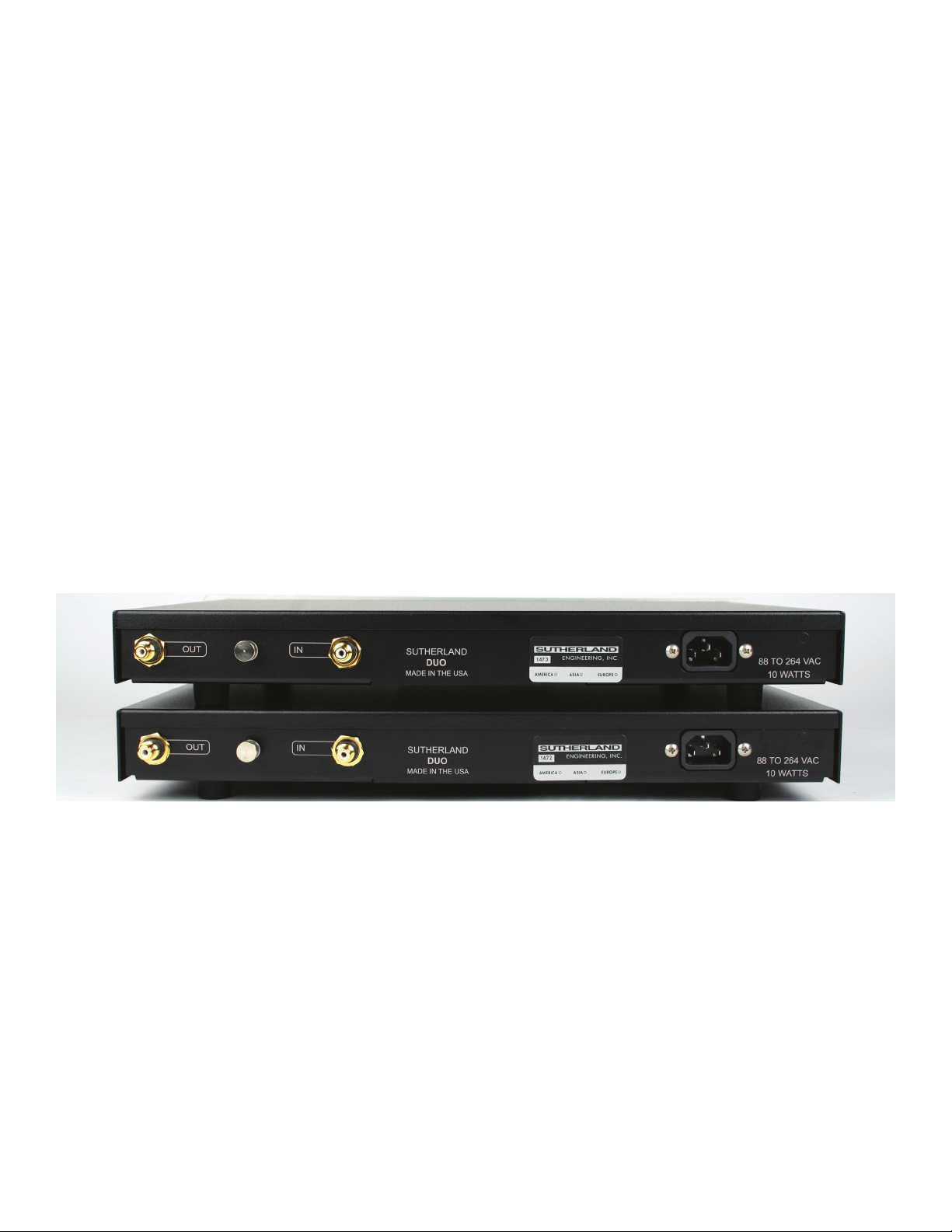
The Phono Blocks have built in AC power supplies. There is an IEC power inlet on
each chassis to accommodate the user's personal power cord choice. Two completely
separate power sections (each providing isolated +/- 15 volts) are provided for each
channel. One for each of the two gain stages. Each is independently ltered and
regulated to provide the ultimate foundation for the gain stages.
Each DUO has a built in AC power supply. There is an IEC power inlet on each chassis to accommodate the user's personal power cord choice. The shielded power supply module has one output. That output is split into two branches. One for each of the
two gain stages. Each of those branches is independently ltered and regulated to
provide a substantial foundation for the gain stages.
Circuit board properties:
Circuit board dielectric properties can introduce detail damaging artifacts into the
signal.
The DUO mitigates circuit board dielectric properties using the same approach that has
worked so well in the Phono Blocks. Circuit board thickness is doubled from the standard 1/16” thickness to 1/8” thickness. Not only is dielectric absorption addressed, but
further advantages are realized with an extremity rigid platform for component mounting. It is the cost-no-object, preferred way to go.
Page 4

DUO Dodges Dielectric Distress
Anytime two conductors are at a different voltage potential, there is an electric eld
generated between them. The dielectric (the insulation between conductors) within
that eld becomes involved in charge storage. If not carefully considered, that extra
charge storage can time smear details of a musical signal. Circuit board material is
a dielectric. With normal double-sided construction, there are copper conductors on
each side of the board. Unintentionally, a new capacitor is introduced into the circuit,
formed by top surface copper, bottom surface copper and the circuit board dielectric
sandwiched between the two. It is NOT the quality of capacitor we want to have in a
high-end signal path. Some manufactures make the situation even worse by going to
multi-layer boards in the analog audio sections. Instead of two layers of copper, there
are four or more layers of copper. Even worse than that, the dielectric between layers
is much thinner and the undesired capacitive effect is inversely proportional to thickness. At best, some manufactures make small, incremental improvements by using
exotic board material.
The Duos addresses the issue of circuit board dielectric by doubling the thickness of
an FR4 berglass circuit board. Just that one choice reduces electric eld strength
by one-half. Additionally, the area of copper interacting with board dielectric is also
reduced in critical regions. Signal lines are kept narrow. Power lines are extremely
wide. Such choices get us rened performance. Good solid advantages based up the
application of good solid physics.
Page 5
PARTS QUALITY
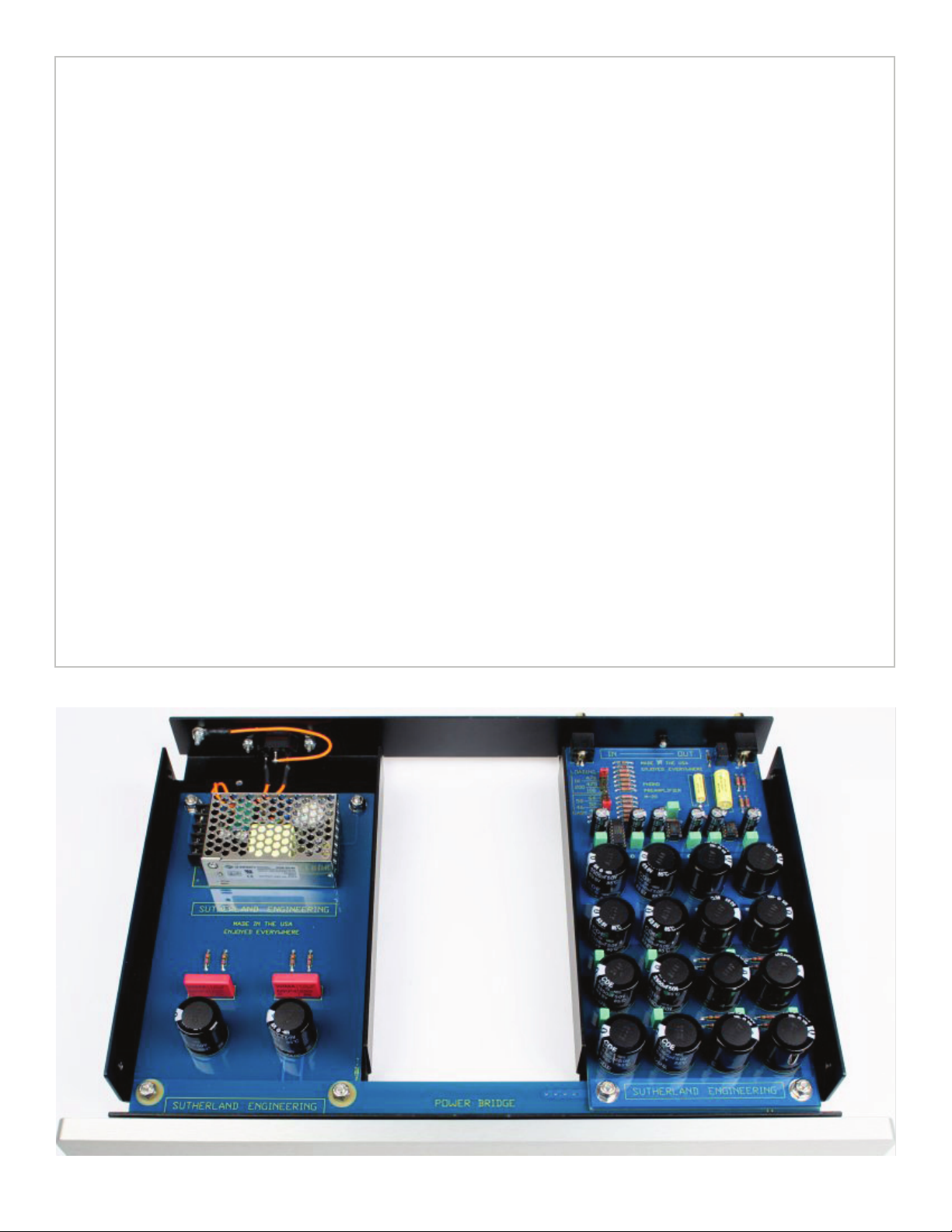
FR-4 berglass circuit boards, Double-sided with plated thru holes.
1/8” thick for extra rigidity and minimal dielectric inuence.
Dale/Vishay 1% metal lm resistors
Wima Polypropylene capacitors for power supply by passing and DC servo
Custom wound, 1% polystyrene lm capacitors for equalization
14 gage cold rolled steel base
baked epoxy powder coat nish
1/2 “ thick anodized aluminum panel
anodized in front panel artwork
gold plated, Teon insulated RCA connectors
gold plated conguration headers and shunts
Page 6
OWNER’S MANUAL INFO
Initial Set Up
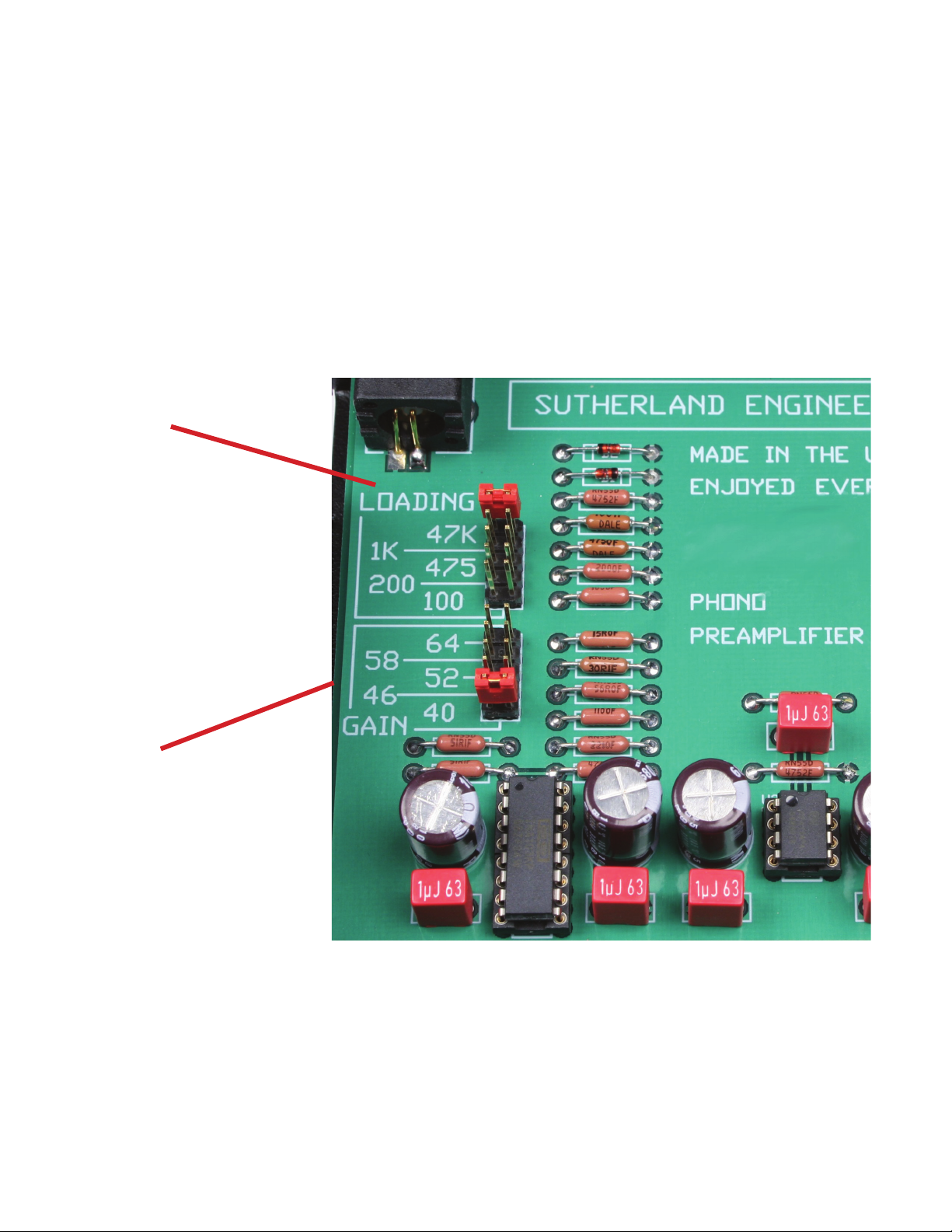
Release the top cover by removing the four knurled screws. Audio boards are located
on the right side of the enclosure. On the left side of each circuit board you will nd
headers for receiving the plug-in conguration shunts. Legends printed on the circuit
board clearly indicate position and function.
Loading Options
47 k Ohms
1 k Ohms
475 Ohms
200 Ohms
100 Ohms
Gain Options
64 dB
58 dB
52 dB
46 dB
40 dB
Make sure that loading and gain options are set so that each
chassis has identical settings.
Page 7

SIZE:
17” x 2 ½” x 12” each DUO
23” x 18” x 9” each DUO, packed in shipping box
WEIGHT:
11 pounds each DUO
19 pounds each DUO, packed in shipping box
Page 8
DUO
www.sutherlandengineering.com
 Loading...