

Page 1
USER MANUAL
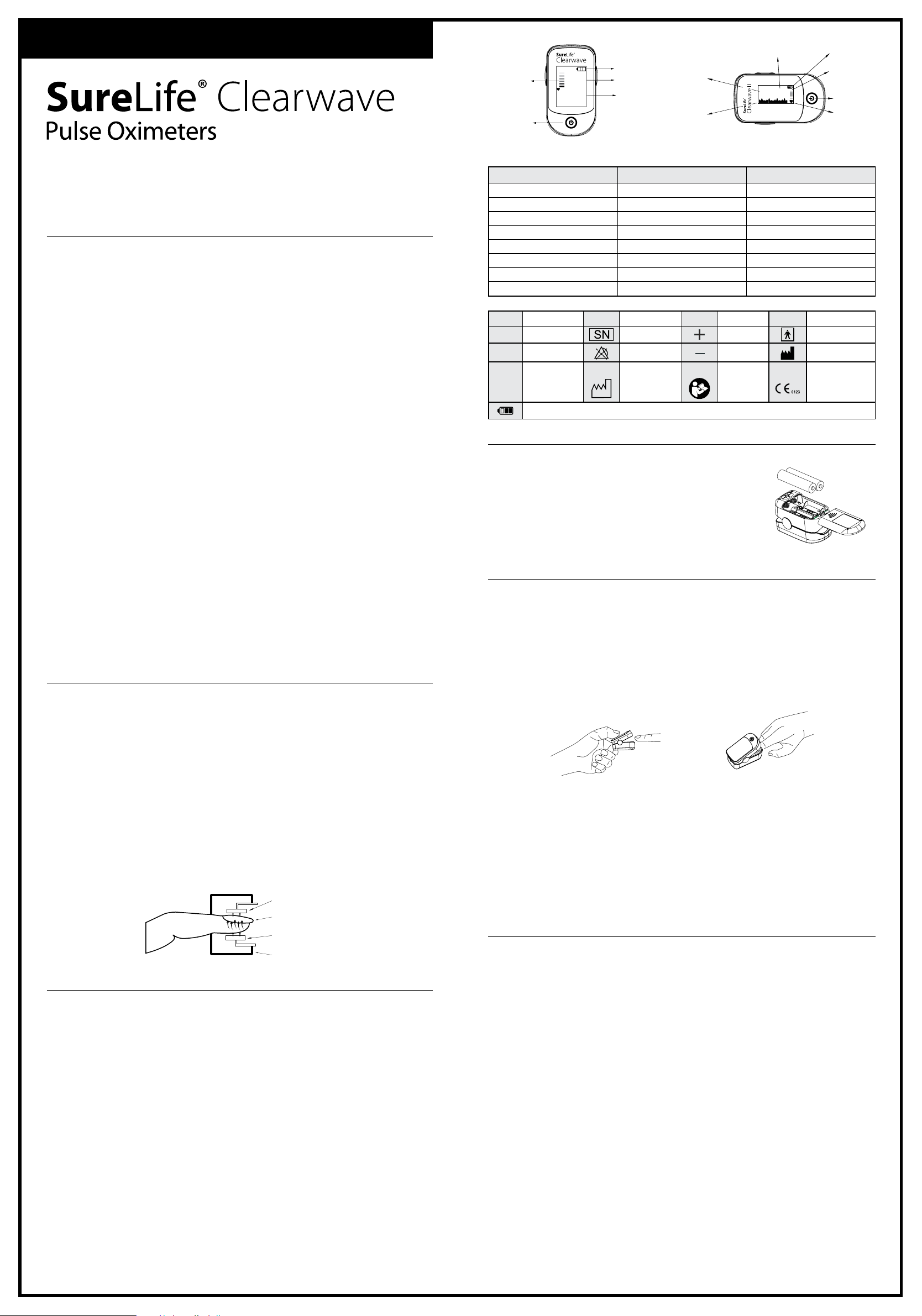
3.3 Front View
Pulse Bar Graph
Power Button
%SpO
PR bpm
2
99
70
Power Indication
SpO
Value
2
Pulse Rate Value
Value
SpO
2
Pulse Waveform
Pulse Rate Value
PRbpm
2
%SpO
70
99
Pulse Oximeter
Power Indication
Pulse Bar Graph
Power Button
Heartbeat Mark
Thank you for purchasing the SureLife Pulse Oximeter. This manual contains the instructions necessary
to operate the product safely and in accordance with its function and intended use. Observance of this
manual is a prerequisite for proper product performance and correct operation and ensures patient and
operator safety. Read this manual carefully before using the ngertip pulse oximeter. This product is a
reusable medical device. The lifespan of the product is 2 years. This device is a prescription use device.
1 - SAFETY
1.1 Contraindications
Do NOT use oximeter in a magnetic resonance (MR or CT) environment.
1.2 Warnings
Keep the oximeter away from young children. Small parts such as the battery door, battery, and lanyard
may be choking hazards.
1.3 Cautions
• Do not use the oximeter in the presense of flammable anesthetics.
• The oximeter needs to be used according to information provided in this user manual.
• The equipment is NOT intended for neonate and infant.
• Do not use a damaged oximeter as it may affect measurement performance.
• Do not place the oximeter on the same hand/arm when using a blood pressure monitor or cuff.
• Do not use the oximeter for more than 5 minutes without relocating the device to another finger.
• Do not place the oximeter on edema or fragile tissues.
• Do not use the oximeter as the only basis for making medical decisions, it is intended only to be used
as additional information that you can give to your licensed health care professional.
• Do not use the oximeter in high frequency environments such as near electro-surgical equipment.
• Do not place the oximeter in liquid.
• Follow local disposal and recycling laws for the oximeter and its components, including the batteries.
• Do not stare at the light (infrared is invisible) emitted from the oximeter as it is harmful to the eyes.
• For clinical limitations and contraindications, please carefully review the medical literature
• The equipment is just a clinical diagnosis of auxiliary equipment. The physiological data displayed on
the equipment are for reference only and can not be directly used for diagnostic interpretation.
• Not suitable for the users with arrhythmia/heart failure/Low perfusion (PI<0.3)/finger trembling.
• Not suitable for the users with large finger size or exceeding pulse oximeter’s finger measurement
cavity size.
• Please don’t use the thumb and tail finger to measure.
• Discomfort or pain may appear if using the equipment ceaselessly, especially for microcirculation
barrier patients, it recommended that the equipment should not be used on the same finger more
than 5 minutes.
• The oximeter is designed to measure the percentage of arterial oxygen saturation of functional
hemoglobin. Any of the following conditions may reduce the performance of the oximeter:
Flickering or very bright light Moisture in the oximeter
Body weight less than 44lbs (20kgs) Weak pulse quality (low perfusion)
Venous pulsations Low hemoglobin
Cardiogreen and other intra-vascular dyes Carboxyhemoglobin
Methemoglobin Dysfunctional hemoglobin
Articial nails or ngernail polish - The nger is too cold
Patients with abnormal circulation of nger endings caused by copd.
2 - THE BASICS
The pulse oxygen saturation is the percentage of HbO2 in the total Hb in the blood, so-called the O2
concentration in the blood. It is an important bio-parameter for respiration. A number of diseases relating
to the respiratory system may cause the decrease of SpO
in the blood, furthermore, some other causes
2
such as the malfunction of the human body’s self-adjustment, damages during surgery, and the injuries
caused by some medical checkups would also lead to the diculty of oxygen supply in human body.
The corresponding symptoms would appear as a consequence, such as vertigo, impotence, vomit etc.
Some symptoms may be serious enough to cause signicant harm. Therefore, prompt information
concerning the patients SpO2 can help doctors discover potential problems, and is of great importance
in the clinical and medical eld.
2.1 Principle
The Principle of the oximeter is as follows: an experience formula of data process is established making
use of the Lambert Beer law according to Spectrum Absorption Characteristic of Reductive hemoglobin
(Hb) and oxyhemoglobin (HbO
) in glow & near-infrared zones. The operation principle of the device
2
is: Photoelectric Oxyhemoglobin Inspection Technology is adopted in accordance with Capacity Pulse
Scanning Recording Technology, so that two beams of dierent wavelengths of light can be focused
onto the human nail tip through a perspective clamp nger-type sensor. The signal is obtained and
measured by a photosensitive element. The information acquired will be shown on screen through
treatment in electronic circuits and microprocessor.
Photo Detector
Finger
Light Emitting Diode
Probe Body
Figure 1. Oximeter Schematic Diagram
3 - INTRODUCTION
3.1 Intended Use
The Pulse Oximeter is a portable, convenient, non-invasive device, used to monitor arterial
hemoglobin oxygen saturation (SpO
(weight: >66lbs (30kgs)) and pediatric patients (weight: 44-66lbs (20-30kgs)). We recommend using
the index finger, middle finger, or ring finger as suitable positions for the monitor. It is intended for
spot-checking or attended-care monitoring in home health care and medical facilities.
WARNING:
• This pulse oximeter is intended to be used only by clinical professionals or under their guidance.
It must only be used by persons who have received adequate training in its use. Anyone unauthorized
or untrained must not perform any operation on it.
CAUTIONS:
• This pulse oximeter is intended for use in hospitals, clinical institutions, or healthcare communities.
• The pulse oximeter is NOT designed for a newborn or infant. For adults and children, a finger thickness
between 8 - 25.4mm is recommended.
NOTES:
• The probe is the opening in the middle of the equipment in which the finger is inserted.
• The probe is the Applied Part of the equipment.
3.2 Features
• The pulse oximeter is small in size, lightweight, and easy to carry.
• Easy, one-button operation.
• There are two modes: sleep and measure.
• Automatic sleep mode after 8 seconds with no signal.
NOTES:
• Press the power button to activate oximeter (measure mode) from sleep mode.
) and pulse rate. The personal application are adult patients
2
Figure 2. Front View of Clearwave (FS10D)
Figure 2. Front View of Clearwave II (FS20D)
3.4 Functions
Function Clearwave (FS10D) Clearwave II (FS20D)
Display LED OLED
SpO2 parameter measurement Y Y
Pulse rate parameter measurement Y Y
Bar graph display Y Y
Battery display Y Y
Automatically enters sleep mode Y Y
Pulse waveform display Y
Four direction display Y
3.5 Symbols
Symbol Denition Symbol Denition Symbol Denition Symbol Denition
The Pulse Oxygen
% SpO
2
Saturation (%)
PR Pulse Rate (BPM)
The Product is
Protected Against
IPX2
Harmful Eects of
Dripping Water per
IBC 60529.
Serial Number
The Device has no
Alarm System
Date of
Manufacturer
Power indication (some models have no battery capacity indicator, but have low battery indicator)
Battery Positive
Electrode
Battery Cathode
Electrode
Caution, Consult
Accompanying
Documents
BF Type Applied Part
Manufacturer
This Item is Compliant
with Medical Device
Directive 93/42/EEC
4 - BATTERY INSTALLATION
1. Put the two AAA batteries into battery compartment in correct polarities.
2. Push the battery cover horizontally along the arrow shown in figure 3.
WARNINGS:
• Battery polarities should be correctly installed,
otherwise, damage may be caused to the equipment.
-
-
+
+
• Please remove the batteries if the oximeter will be stored
for more than 30 days.
• Please remove the batteries if you want turn off the oximeter.
Otherwise it is always in sleep mode.
• Battery may leak or explode if used or disposed off improperly.
Figure 3. SureLife Oximeter
Battery Installation
5 - OPERATING GUIDE
5.1 Application Method
1. Remove the battery cover, and insert the two AAA batteries following polarity markings indicated
inside of the battery compartment, then reposition the cover.
2. Hold the oximeter with the display facing toward you, slide your finger into the opening probe of the
device as shown below (Figure 4), until the fingertip touches the built-in stop guide. For best results,
make sure the finger is centered within the finger guide.
3. Press the button to activate the oximeter from sleep mode. The measurement interface will appear
in 3 seconds.
4. The measurement result will appear on the screen within 10 seconds. Wait for an additional 30 seconds
for the reading to stabilize. The reading will continue to update every second.
5. The oximeter will turn to sleep mode automatically within 8 seconds after the finger is removed.
1. Press the bottom to open the probe 2. Insert the nger into the bottom of machine
3. Press the operating button to activate the oximeter
Figure 4. Operation Guide
5.2 Notes for Operation
• The index finger, middle finger, and ring finger are suitable positions for the monitor.
• Excessive or rapid movement may affect measurement.
• Improper sensor placement may affect the measurement accuracy.
• The oximeter can be reused after cleaning and disinfection.
• The measurement is most accurate when the oximeter and the heart are at the same level.
• (Only for Clearwave II) The plethysmogram can be used as pulse intensity indicator.
The displayed parameters might be unreliable with the disorderly plethysmogram.
• (Only for Clearwave) The bar graph can be used as pulse intensity indicator.
The displayed parameters might be unreliable with un-periodic bar change.
• The displayed parameters will show invalid indicator as ‘---’ if signal quality is very low.
• The displayed parameters will show invalid indicator as ’---’ if oximeter fault occurs.
• The oximeter will shut down after 5 minutes if continuous testing.
6 - SPECIFICATIONS
6.1 Classification
Type of protection against electric shock............................ II (Internally powered equipment)
Degree of protection against electric shock....................... Type BF-Applied part (non-debrillation proof )
Operating mode............................................................................ Spot checking
Degree of protection against hazards of explosion......... Ordinary equipment: Not protected
Equipment type............................................................................ Fingertip oximeter
6.2 Measurement Specifications
SpO2 declared accuracy
Range(σ*)............................................................................ 70% ~ 99% ± 2 digits
0% ~ 69%: unspecied
Resolution........................................................................... 1%
Update Period.................................................................... 1 sec
Averaging Time................................................................. 8 sec
PR declared accuracy
Range(σ*)............................................................................ 25 ~ 250 : ± 3 digits
Resolution........................................................................... 1bpm
Update Period.................................................................... 1 sec
Averaging Time................................................................. 8 sec
6.3 Power Requirements
Specication of alkaline batteries............................................ Two 1.5V (AAA)
Operating voltage..........................................................................DC 2.5-3V
6.4 Environmental Specifications
Temperature
Operating............................................................................ +41° to + 104°F / 5° to +40°C
Storage/Transportation................................................. -4° to + 140°F / -20° to +60°C
Humidity
Operating............................................................................ 10 ~ 95%, non-condensing
Storage/Transportation................................................. 10 ~ 95%, non-condensing
Atmosphere Pressure
Operating............................................................................ 70 ~ 106kpa
Storage/Transportation................................................. 50 ~ 107.4kpa
Page 2
6.5 Physical Specifications
Width x Height x Depth............................................................... 33x36x58mm
Weight................................................................................................ about 60g (including the batteries)
6.6 Display
Display
Type
Display
Content
6.7 LED Wavelengths - Probe LED Specications
Clearwave Clearwave II
LED OLED, 0.96”, 128x64 pixel
%, Pulse rate,
SpO
2
Battery indicator,
Bar graph
SpO2%, Pulse rate, Battery indicator,
Bar graph, Pulse waveform,
Heartbeat mark
Wavelength Radiant Power
RED 660 ± 6nm 1.8 mW
IR 905 ± 10nm 2.0 mW
7 - TECHNICAL DESCRIPTION
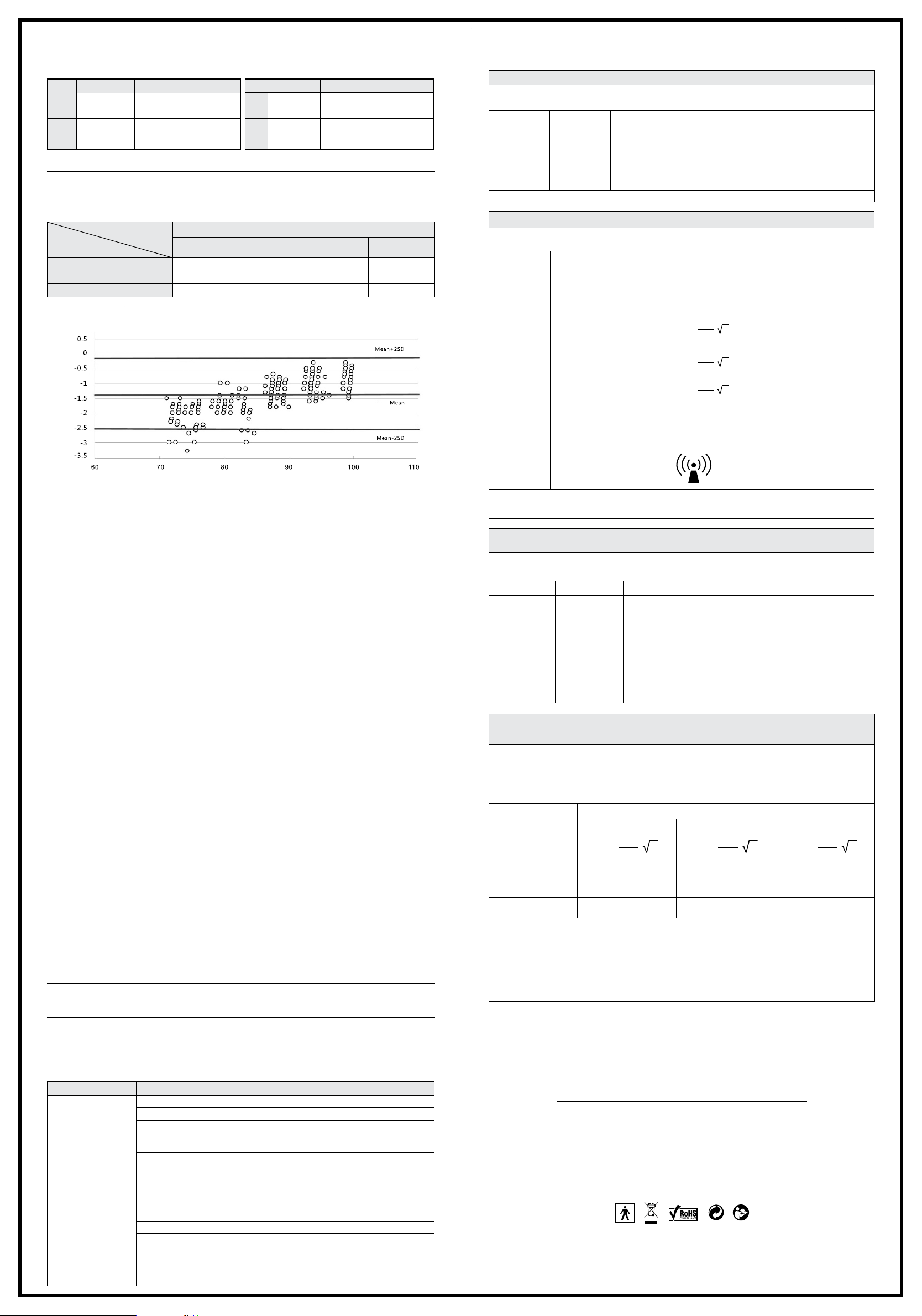
The table below shows a statistic conclusion of an invasive controlled desaturation study which guided by
‘IS080601-2- 61, Annex EE, Guideline for evaluating and documenting SpO
The statistic result displayed the accuracy distribution between the range of 70% ~ 100%,
which may be helpful to user.
SpO
- Clearwave
2
Pulse Oximeters
Mean Bias (
Precision (sres) 2 1.55 0.98 1.53
Accuracy (Arms) 1.98 1.53 0.96 1.52
Bias Analysis
70 - 80 (%) 80 - 90 (%) 90 - 100 (%) 70 - 100 (%)
Bs) 1.94 1.45 0.89 1.4
- Radiometer ABL800 FLEX-CO - Oximeter
SaO
2
Below is the Bland-Altman graphical plot of samples from invasive controlled desaturation study.
Bland-Altman Graph for SaO2-SpO
2
- SpO
2
Standard Deviation SaO
Accuracy in human subjects’.
2
2
APPENDIX A
The equipment complies with the requirement of standard EN 60601-1-2 “Electromagnetic
Compatibility - Medical Electrical Equipment”.
Guidance and Manufacturer’s Declaration - Electromagnetic Immunity
The SureLife Pulse Oximeters is intended for use in the electromagnetic environment specied below. The customer or the user of the
SureLife Pulse Oximeters should ensure that is used in such an environment.
Immunity Test
Electrostatic dis-
charge (ESD)
IEC 61000-4-2
Power frequency
(50/60 Hz)
magnetic eld
NOTE: UT is the a.c. mains voltage prior to application of the test level.
The SureLife Pulse Oximeters are intended for use in the electromagnetic environment specied below. The customer or the user of the
SureLife Pulse Oximeters should ensure that is used in such an environment.
Immunity Test
Conducted RF
IEC 6100-4-6
Radiated RF
IEC 6100-4-3
IEC 60601
Test Level
±8 kV contact
±8 kV, ±15 kV air
30 A/m 30 A/m
Guidance and Manufacturer’s Declaration - Electromagnetic Immunity
IEC 60601
Test Level
3 Vrms
150 kHz to 80 MHz
10 V/m
80 MHz to 2.7 GHz
Compliance
Level
±8 kV contact
±8 kV, ±15 kV air
Compliance
Level
3 Vrms
150 kHz to 80 MHz
10 V/m
Electromagnetic Environment - Guidance
Floors should be wood, concrete, or ceramic tile. If oors are covered
with synthetic material, the relative humidity should be at least 30%.
Power frequency magnetic elds should be at levels characteristic of a
typical location commercial or hospital environment.
Electromagnetic Environment - Guidance
Portable and mobile RF communications equipment should be used no
closer to any part of the SureLife Pulse Oximeters, including cables, than
the recommended separation distance calculated from the equation
applicable to the frequency of the transmitter.
3.5
V1
3.5
E1
7
E1
]
P
]
P
]
P
80 MHz to 800 MHz
800 MHz to 2.7 GHz
d = [
d = [
d = [
Where “P” is the maximum output power rating of the transmitter in
watts (W) according to the transmitter manufacturer and “D” is the
recommended separation distance in meters (m). Field strengths from
xed RF transmitters, as determined by an electromagnet.
Mean SaO2-SpO
2
8 - MAINTENANCE, CLEANING, & DISINFECTION
8.1 Maintenance
The equipment’s design life expectancy is about 2 years, keep your equipment and accessories free of
dust and dirt, and follow these rules:
A. Please clean the equipment before use according to section 8; Remove the batteries inside the battery
cassette if the equipment will not be operated for more than 30 days.
B. Replace the batteries when the low battery indicator says it is necessary.
C. It is recommended that the equipment should be kept in a dry environment with no corrosive
gases and good ventilation. Storing the oximeter improperly will affect its lifespan and damage
the equipment.
D. It is best to preserve the product in a place where the temperature is between -4 to 140˚F (-20 to 60°C)
and the relative humidity is less than 95%.
E. The packed equipment can be transported by ordinary conveyance. The equipment may not be
transported with toxic, harmful, or corrosive materials.
WARNING:
• No modification of this equipment is allowed.
8.2 Disposal
Dispose of the pulse oximeter in accordance with local environment and waste disposal laws
and regulations
9 - CLEANING / DISINFECTION
CAUTIONS
• Never immerse or soak the oximeter.
• It is recommended that the oximeter be cleaned and disinfected after every use as determined by your
hospital’s policy to avoid long term damage to the oximeter.
• Never use cleaning agents/disinfectants other than the types recommended.
• The sensor component is not cleaned and disinfected during testing.
9.1 Cleaning
The recommended cleaning agent is water.
1. Shut down the pulse oximeter and remove the batteries.
2. Clean the oximeter with cotton or a soft cloth moistened with water.
3. After cleaning, wipe off the water with a soft cloth.
4. Allow the oximeter to air dry.
9.2 Disinfection
The recommended disinfectants include: ethanol 70%, isopropanol 70%.
1. Shut down the pulse oximeter and remove the battery.
2. Clean the oximeter as instructed above.
3. Disinfect the oximeter with cotton or soft cloth moistened with one of the recommended disinfectants.
4. After disinfection, be sure to wipe off the disinfectant left on the oximeter with a soft cloth moistened
with water.
5. Allow the oximeter to air dry.
10 - INCLUDED ACCESSORIES
• One lanyard • Two AAA batteries • One user manual • One certicate card
11 - TROUBLESHOOTING
11.1 Troubleshooting
WARNINGS
• Necessary maintenance must be performed by qualified service personal ONLY.
• Users are NOT permitted to maintain the equipment by themselves.
• There are NO replaceable components in the equipment.
Trouble Possible Reason Solution
The oximeter can’t turn to
measure mode.
The display is o suddenly.
The SpO2 and Pulse Rate
readings are unstable.
The SpO2 and PR are not
displayed normally.
The batteries are completely exhausted. Please replace the batteries.
An incorrect battery installation. Verify and correct the batteries installation.
The oximeter may be broken. Please contact local service.
The device will turn into sleep mode automatically
if there is no signal in 8 seconds.
The batteries are completely exhausted. Please replace the batteries.
The luminescent or photoelectric window is
sheltered by some object.
Excessive movement. Stop moving nger, hand and body.
The nger is not placed inside deep enough. Place the nger properly and try again.
Finger size is not within the recommended range. Change to another nger.
Excessive ambient light. Avoid the excessive light.
Pulse rate value of the cyclical uctuations.
The nger is not properly positioned. Place the nger properly and try again.
The patient’s Sp02 is too low to be detected.
Press the button again to reactivate the oximeter.
Check the luminescent and photoelectric window.
The measurement is normal, and the patient has
arrhythmia.
Try again, go to a hospital for a diagnosis if you are
sure the device works properly.
NOTE 1: At 80 MHz and 800 MHz, the higher frequency range applies.
NOTE 2: These guidelines may not apply in all situations. Electromagnetic propagation is aected by absorption and reection from
structures, objects and people.
Guidance and Manufacturer’s Declaration - Electromagnetic Emissions
The SureLife Pulse Oximeters are intended for use in the electromagnetic environment specied below. The customer or the user of the
SureLife Pulse Oximeters should ensure that is used in such an environment.
Emissions Test Compliance Electromagnetic Environment - Guidance
RF Emissions
CISPR 11
RF Emissions
CISPR 11
Harmonic Emissions
IEC 61000-3-2
Voltage Fluctuations
Flicker Emissions
IEC 61000-3-3
Recommended separation distances between portable and mobile RF communications
The SureLife Pulse Oximeters are intended for use in an electromagnetic environment in which radiated RD disturbances are controlled.
The customer or the user of the Medical SureLife Pulse Oximeters can help prevent electromagnetic interference by maintaining a
minimum distance between portable and mobile RF communications equipment (transmitters) and the SureLife Pulse Oximeters as
recommended below, according to the maximum output power of the communications equipment.
Rated maximum output
power of transmitter (W)
Group 1
Class B
N/A
N/A
equipment and the Medical SureLife Pulse Oximeters
d = [
0,01 0.12 0.04 0.07
0,1 0.37 0.12 0.23
1 1.17 0.35 0.7
10 3.7 1.11 2.22
100 11.7 3.5 7.0
For transmitters rated at a maximum output power not listed above, the recommended separation distanced in meters (m) can be
estimated using the equation applicable to the frequency of the transmitter, where P is the maximum output power rating of the
transmitter in watts (W) according to the transmitter manufacturer.
NOTE 1: At 80 MHz and 800 MHz, the separation distance for the higher frequency range applies.
NOTE 2: These guidelines may not apply in all situations. Electromagnetic propagation in aected by absorption and reection from
structures, objects, and people.
The SureLife Pulse Oximeters use RF energy only for thier internal function. Therefore, their
RF emissions are very low and are not likely to cause any interference in nearby electronic
equipment.
The SureLife Pulse Oximeters are suitable for use in all establishments, including domestic
establishments and those directly connected to the public low-voltage power supply
network that supplies buildings used for domestic purposes.
Separation Distance According to Frequency of Transmitter (m)
150 kHz to 80 MHz 80 MHz to 800 MHz 800 MHz to 2.7 GHz
7
E1
]
3.5
V1
]
P
d = [
3.5
E1
]
P
d = [
Applicable Models: Clearwave (FS10D), Clearwave II (FS20D)
NOTES:
• The illustrations used in this manual may differ slightly from the appearance of the actual product.
• The specifications are subject to change without prior notice.
MHC Medical Products, LLC
8695 Seward Road, Faireld, OH 45011
Made in China. Distributed by MHC Medical Products.
SureLife® is a trademark of MHC Medical Products, LLC.
Manufactured in accordance with
FDA and International Standards
AD-091820.5
File Ver: 2.2
Release Date: September 2020
P
 Loading...