

Supero 6026TT-HDTRF, 6026TT-HDIBXRF, 6026TT-HDIBQRF, 6026TT-D6IBXRF, 6026TT-D6IBQRF User Manual
...Page 1
®
SUPER
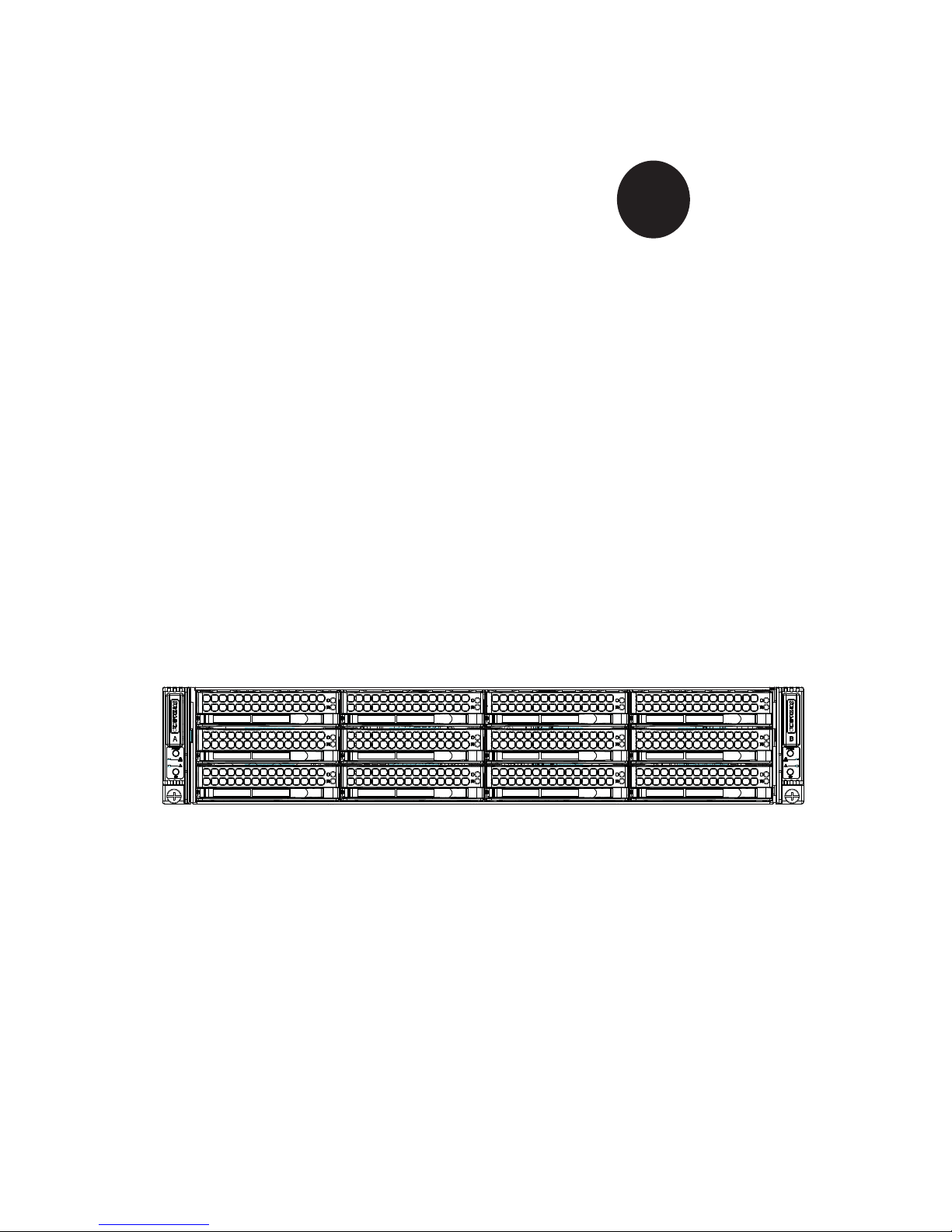
SuperServer 6026TT-HDTRF
SuperServer 6026TT-HDIBXRF
SuperServer 6026TT-HDIBQRF
SuperServer 6026TT-D6RF
SuperServer 6026TT-D6IBXRF
SuperServer 6026TT-D6IBQRF
USER’S MANUAL
Revision 1.0c
Page 2

The information in this User’s Manual has been carefully reviewed and is believed to be accurate.
The vendor assumes no responsibility for any inaccuracies that may be contained in this document,
makes no commitment to update or to keep current the information in this manual, or to notify any
person or organization of the updates. Please Note: For the most up-to-date version of this
manual, please see our web site at www.supermicro.com.
Super Micro Computer, Inc. ("Supermicro") reserves the right to make changes to the product
described in this manual at any time and without notice. This product, including software and documentation, is the property of Supermicro and/or its licensors, and is supplied only under a license.
Any use or reproduction of this product is not allowed, except as expressly permitted by the terms
of said license.
IN NO EVENT WILL SUPERMICRO BE LIABLE FOR DIRECT, INDIRECT, SPECIAL, INCIDENTAL,
SPECULATIVE OR CONSEQUENTIAL DAMAGES ARISING FROM THE USE OR INABILITY TO
USE THIS PRODUCT OR DOCUMENTATION, EVEN IF ADVISED OF THE POSSIBILITY OF
SUCH DAMAGES. IN PARTICULAR, SUPERMICRO SHALL NOT HAVE LIABILITY FOR ANY
HARDWARE, SOFTW ARE, OR DA TA STORED OR USED WITH THE PRODUCT, INCLUDING THE
COSTS OF REPAIRING, REPLACING, INTEGRATING, INSTALLING OR RECOVERING SUCH
HARDWARE, SOFTWARE, OR DATA.
Any disputes arising between manufacturer and customer shall be governed by the laws of Santa
Clara County in the State of California, USA. The State of California, County of Santa Clara shall
be the exclusive venue for the resolution of any such disputes. Super Micro's total liability for all
claims will not exceed the price paid for the hardware product.
FCC Statement: This equipment has been tested and found to comply with the limits for a Class A
digital device pursuant to Part 15 of the FCC Rules. These limits are designed to provide reasonable
protection against harmful interference when the equipment is operated in a commercial environment. This equipment generates, uses, and can radiate radio frequency energy and, if not installed
and used in accordance with the manufacturer’s instruction manual, may cause harmful interference
with radio communications. Operation of this equipment in a residential area is likely to cause harmful
interference, in which case you will be required to correct the interference at your own expense.
California Best Management Practices Regulations for Perchlorate Materials: This Perchlorate warning applies only to products containing CR (Manganese Dioxide) Lithium coin cells. “Perchlorate
Material-special handling may apply. See www.dtsc.ca.gov/hazardouswaste/perchlorate”
WARNING: Handling of lead solder materials used in this
product may expose you to lead, a chemical known to the
State of California to cause birth defects and other reproductive harm.
Manual Revision 1.0c
Release Date: November 19, 2013
Unless you request and receive written permission from Super Micro Computer, Inc., you may not
copy any part of this document.
Information in this document is subject to change without notice. Other products and companies
referred to herein are trademarks or registered trademarks of their respective companies or mark
holders.
Copyright © 2013 by Super Micro Computer, Inc.
All rights reserved.
Printed in the United States of America
Page 3
Preface
About This Manual
This manual is written for professional system integrators and PC technicians. It
provides information for the installation and use of the SuperServer 6026TT-HDTRF/
HDIBXRF/HDIBQRF/6026TT-D6RF/D6IBXRF/D6IBQRF. Installation and maintenance should be performed by experienced technicians only.
The SuperServer 6026TT-HD/D6 series server is a 2U Twin (two serverboards/
nodes in a 2U chassis) rackmount server based on the SC827HD-R1400B server
chassis and four Super X8DTT-HF+/X8DTT-HIBXF+/X8DTT-HIBQF+ serverboards.
The "(H)" in the product name indicates that the system is cableless.
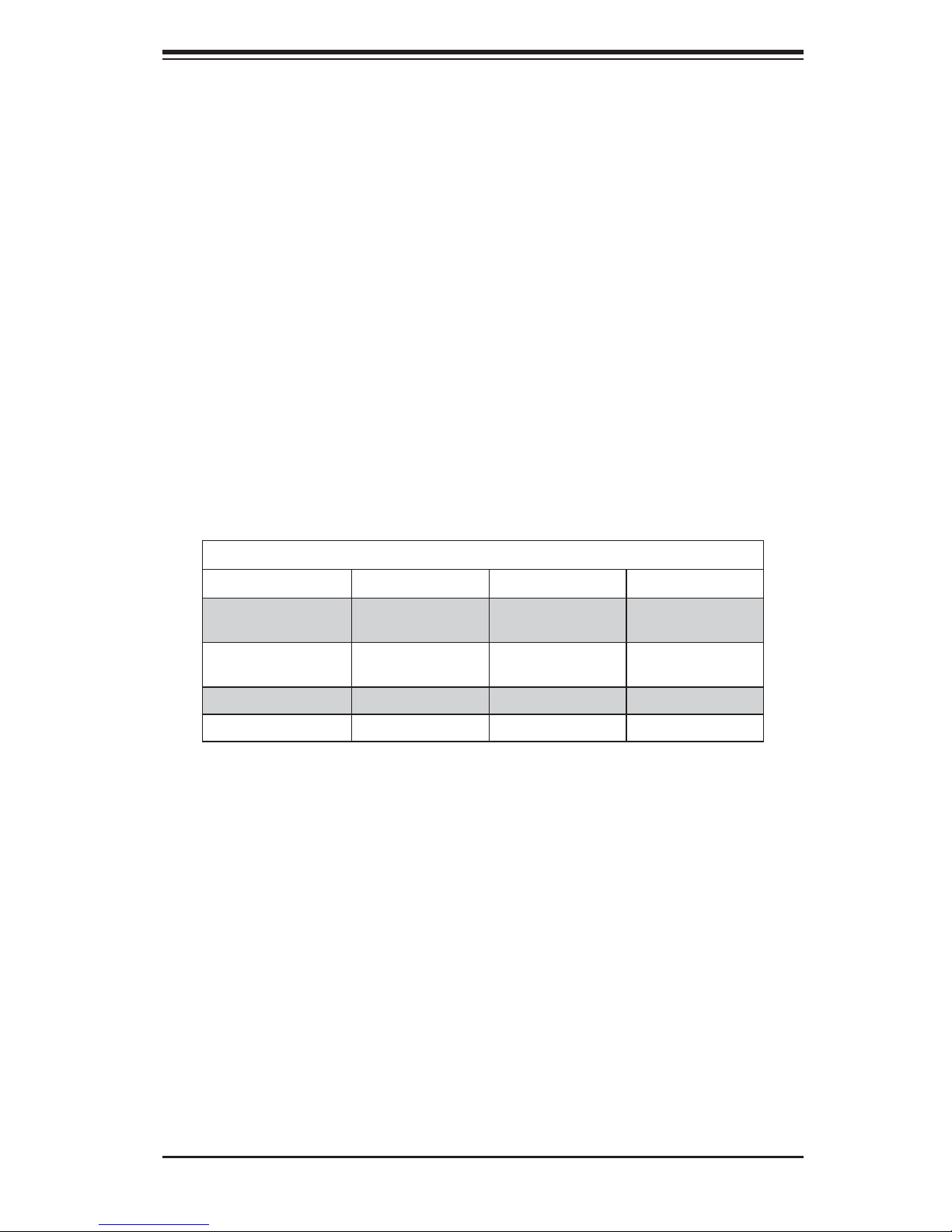
The D6 models feature the inclusion of a daughter card with an LSI 2108 SAS 2.0
controller in each node. The main differences between the various serverboards
and the servers they are in is shown in the table below:
Preface
Model Variations (Differences between X8DTT-x Models)
X8DTT-HF+ X8DTT-HIBXF+ X8DTT-HIBQF+
IPMI 2.0 w/ KVM
Over LAN
Infi niBand
Connection
DDR IB No Yes No
QDR IB No No Yes
Yes Yes Yes
No Yes Yes
Manual Organization
Chapter 1: Introduction
The fi rst chapter provides a checklist of the main components included with the
server system and describes the main features of the Super X8DTT-HF+/X8DTTHIBXF+/X8DTT-HIBQF+ serverboard and the SC827HD-R1400B chassis.
Chapter 2: Server Installation
This chapter describes the steps necessary to install the SuperServer 6026TTHDTRF/HDIBXRF/HDIBQRF into a rack and check out the server confi guration
prior to powering up the system. If your server was ordered without the processor
iii
Page 4

SUPERSERVER 6026TT-HD/D6 Series User's Manual
and memory components, this chapter will refer you to the appropriate sections of
the manual for their installation.
Chapter 3: System Interface
Refer to this chapter for details on the system interface, which includes the functions
and information provided by the control panel on the chassis as well as other LEDs
located throughout the system.
Chapter 4: Standardized Warning Statements
You should thoroughly familiarize yourself with this chapter for a general overview
of safety precautions that should be followed when installing and servicing the
SuperServer 6026TT-HD/D6 series server.
Chapter 5: Advanced Serverboard Setup
Chapter 5 provides detailed information on the X8DTT-HF+/X8DTT -HIBXF+/X8DTT HIBQF+ serverboard, including the locations and functions of connectors, headers
and jumpers. Refer to this chapter when adding or removing processors or main
memory and when reconfi guring the serverboard.
Chapter 6: Advanced Chassis Setup
Refer to Chapter 6 for detailed information on the SC827HD-R1400B 2U rackmount
server chassis. You should follow the procedures given in this chapter when installing, removing or reconfi guring SATA or peripheral drives and when replacing system
power supply units and cooling fans.
Chapter 7: BIOS
The BIOS chapter includes an introduction to BIOS and provides detailed information on running the CMOS Setup Utility.
Appendix A: BIOS Error Beep Codes
Appendix B: Installing Windows
Appendix C: System Specifi cations
iv
Page 5

Notes
Preface
v
Page 6

SUPERSERVER 6026TT-HD/D6 Series User's Manual
Table of Contents
Chapter 1 Introduction
1-1 Overview .........................................................................................................1-1
1-2 Serverboard Features .....................................................................................1-2
Processors ......................................................................................................1-2
Memory ...........................................................................................................1-2
Serial ATA ........................................................................................................1-2
SAS .................................................................................................................1-2
PCI Expansion Slots .......................................................................................1-3
Ethernet Ports .................................................................................................1-3
Onboard Controllers/Ports ..............................................................................1-3
Graphics Controller .........................................................................................1-3
Other Features ................................................................................................1-3
Infi niBand ........................................................................................................1-3
1-3 Server Chassis Features ................................................................................1-5
System Power ................................................................................................. 1-5
SATA Subsystem .............................................................................................1-5
Control Panel .................................................................................................. 1-5
Rear I/O Panel ................................................................................................ 1-5
Cooling System ...............................................................................................1-5
1-4 2U Twin: System Notes ...................................................................................1-6
Nodes ..............................................................................................................1-6
System Power ................................................................................................. 1-6
Backplane/Drives ............................................................................................1-6
1-5 Contacting Supermicro ....................................................................................1-7
Chapter 2 Server Installation
2-1 Overview .........................................................................................................2-1
2-2 Unpacking the System .................................................................................... 2-1
2-3 Preparing for Setup ......................................................................................... 2-1
Choosing a Setup Location ............................................................................. 2-1
2-4 Warnings and Precautions .............................................................................. 2-2
Rack Precautions ............................................................................................ 2-2
Server Precautions .......................................................................................... 2-2
Rack Mounting Considerations ....................................................................... 2-3
Ambient Operating Temperature ................................................................ 2-3
Reduced Airfl ow ......................................................................................... 2-3
Mechanical Loading ................................................................................... 2-3
vi
Page 7

Table of Contents
Circuit Overloading ..................................................................................... 2-3
Reliable Ground ......................................................................................... 2-3
Removing the Protective Film ......................................................................... 2-4
2-5 Rack Mounting Instructions ............................................................................. 2-5
Separating the Sections of the Rack Rails ..................................................... 2-5
Installing the Inner Rail Extensions ................................................................2-6
Outer Rack Rails ............................................................................................. 2-7
2-6 Checking the Serverboard Setup .................................................................... 2-9
2-7 Preparing to Power On ................................................................................. 2-10
Chapter 3 System Interface
3-1 Overview .........................................................................................................3-1
3-2 Control Panel Buttons ..................................................................................... 3-1
3-3 Control Panel LEDs ........................................................................................ 3-2
3-4 Hard Drive Carrier LEDs ................................................................................. 3-2
Chapter 4 Standardized Warning Statements for AC Systems
4-1 About Standardized Warning Statements .......................................................4-1
Warning Defi nition ...........................................................................................4-1
Installation Instructions .................................................................................... 4-4
Circuit Breaker ................................................................................................ 4-5
Power Disconnection Warning ........................................................................ 4-6
Equipment Installation ..................................................................................... 4-8
Restricted Area ................................................................................................ 4-9
Battery Handling ............................................................................................ 4-10
Redundant Power Supplies ..........................................................................4-12
Backplane Voltage ........................................................................................ 4-13
Comply with Local and National Electrical Codes ........................................ 4-14
Product Disposal ........................................................................................... 4-15
Hot Swap Fan Warning ................................................................................. 4-16
Power Cable and AC Adapter ...................................................................... 4-18
Chapter 5 Advanced Serverboard Setup
5-1 Handling the Serverboard ............................................................................... 5-1
Precautions .....................................................................................................5-1
5-2 I/O Ports ..........................................................................................................5-2
Unpacking .......................................................................................................5-2
5-3 Processor and Heatsink Installation................................................................5-3
Installing LGA1366 Processors ....................................................................... 5-3
Installing a CPU Heatsink ............................................................................... 5-5
5-4 Installing Memory ............................................................................................ 5-6
vii
Page 8

SUPERSERVER 6026TT-HD/D6 Series User's Manual
5-5 Adding PCI Cards ...........................................................................................5-8
5-6 Serverboard Details ........................................................................................ 5-9
Serverboard Quick Reference.......................................................................5-10
5-7 Connector Defi nitions .....................................................................................5-11
5-8 Jumper Settings ............................................................................................5-15
5-9 Onboard Indicators ........................................................................................5-17
5-10 SATA and SAS Ports ..................................................................................... 5-18
5-11 Installing Additional Drivers ...........................................................................5-19
SuperDoctor III .............................................................................................. 5-20
5-12 Onboard Battery ............................................................................................5-22
Chapter 6 Advanced Chassis Setup
6-1 Static-Sensitive Devices ..................................................................................6-1
Precautions .....................................................................................................6-1
Unpacking .......................................................................................................6-1
6-2 Control Panel ..................................................................................................6-2
6-3 System Fans ...................................................................................................6-2
Fan Confi guration ............................................................................................ 6-3
System Fan Failure ......................................................................................... 6-3
6-4 Hard Drive Installation/Removal......................................................................6-4
Overview .........................................................................................................6-4
Installing and Removing Hard Drives ............................................................. 6-4
6-5 Node Installation/Removal ..............................................................................6-7
6-6 Installing the Air Shrouds ................................................................................ 6-9
Air Shrouds ..................................................................................................... 6-9
6-7 Power Supply .................................................................................................. 6-9
Chapter 7 BIOS
7-1 Introduction ......................................................................................................7-1
7-2 Main Setup ...................................................................................................... 7-2
7-3 Advanced Setup Confi gurations...................................................................... 7-4
7-4 Security Settings ...........................................................................................7-23
7-5 Boot Confi guration ........................................................................................ 7-24
7-6 Exit Options ................................................................................................... 7-26
7-7 BIOS Recovery ............................................................................................. 7-26
Appendix A BIOS Error Beep Codes
Appendix B Installing Windows
Appendix C System Specifi cations
viii
Page 9

Chapter 1: Introduction
Chapter 1
Introduction
1-1 Overview
The SuperServer 6026TT-HDTRF/HDIBXRF/HDIBQRF/D6RF/D6IBXRF/D6IBQRF
is a "2U Twin" server comprised of the SC827HD-R1400B 2U chassis and two
X8DTT-HF+/X8DTT-HIBXF+/X8DTT-HIBQF+ serverboards. Please refer to our
web site for information on operating systems that have been certifi ed for use with
the server.
In addition to the serverboard and chassis, various hardware components may have
been included with the system, as listed below.
• Four passive CPU heatsinks (SNK-P0038PS; two for each node))
• Four 8-cm cooling fans (FAN-0111L4)
• Two air shrouds (MCP-310-82708-0B)
• SATA Accessories:
Twelve hard drive carriers (six per node) (MCP-220-00075-0B)
One internal HDD backplane (BPN-SAS-827HD)
• Two PCI Express riser cards (RSC-R2UT-2E8R)
• Two daughter cards with LSI 2108 SAS 2.0 controller (BPN-ADP-SAS2-H6IR,
D6 server series only, one per node)
• Rackmount rails kit (MCP-290-00053-0N)
• One CD containing drivers and utilities
• SuperServer 6026TT-HD/D6 series User's Manual
Note: The SuperServer 6026TT-HD/D6 series system is cableless and does not
need or come with SATA/SAS cables.
For your system to work properly, please follow the links below to download all
necessary drivers/utilities and the user’s manual for your server.
• Supermicro product manuals: http://www.supermicro.com/support/manuals/
• Product drivers and utilities: ftp://ftp.supermicro.com
1-1
Page 10

SUPERSERVER 6026TT-HD/D6 Series User's Manual
• Product safety info: http://super-dev/about/policies/safety_information.cfm
• If you have any questions, please contact our support team at:
support@supermicro.com
1-2 Serverboard Features
At the heart of the SuperServer 6026TT are four X8DTT-HF+/X8DTT-HIBXF+/
X8DTT-HIBQF+ dual processor serverboards, which are based on Intel's 5520
(North Bridge) + ICH10R (South Bridge) chipset. Below are the main features of
the serverboards. Note that the features on each board are doubled for the server,
which includes two nodes.
Processors
Each X8DTT-HF+/X8DTT-HIBXF+/X8DTT-HIBQF+ supports two Intel® 5600/5500
Series processors in LGA1366 sockets. Please refer to our web site for a complete
listing of supported processors (www.supermicro.com).
Memory
Each X8DTT-HF+/X8DTT-HIBXF+/X8DTT-HIBQF+ has twelve DIMM sockets that
can support up to 192 GB of registered ECC DDR3-1333/1066/800 SDRAM, or 48
GB of unbuffered non-ECC 1333/1066/800 SDRAM. See Chapter 5 Section 6 for
more details on installing memory into the system.
Serial ATA
The Sout h Br idg e (ICH10R) of the c hips et inc lude s a Ser ial ATA contr olle r for s ix
Gb/s SATA d rives. The hot-swappable SATA drives are connected to a backplane
that provides power, bus termination and confi guration settings. RAI D 0, 1, 10 and
5 are suppo r ted. Refe r to the su ppo r t area o f our web si te for p roc edur es on s etting up RAID on your system.
SAS
The D6 series servers (6026TT-D6RF/D6IBXRF/D6IBQRF) include a daughter
card w ith an LSI 2108 SAS co ntroller i n rach node, wh ich suppo rts six S AS 2.0
por t s (12 ports fo r th e syste m). The hot-swappable SAS drives are connected to a
backplane that provides power, bus termination and confi guration settings.
1-2
Page 11

Chapter 1: Introduction
PCI Expansion Slots
Each X8DTT-HF+/X8DTT-HIBXF+/X8DTT-HIBQF+ has included riser cards that
allow it to support two full-sized PCI Express 2.0 x8 expansion cards (in x16 slots),
or four total for the server.
Ethernet Ports
An Intel® network controller is integrated into each of the serverboards to support
two Gigabit LAN ports (100/1000Base-T/1000BaseTX, RJ45 output).
Onboard Controllers/Ports
Onboard I/O backpanel ports on each serverboard include one COM port, a VGA
port, two USB ports, a dedicated IPMI LAN port and two Gigabit LAN (NIC) ports.
An Infi niBand port is also included on the X8DT T- HIBXF+/HIB QF+ serverboards
(the 6026TT-HDIBXRF and 6026TT-HDIBQRF only). Up to four USB 2.0 (Universal
Seria l Bus) connec tions (2 Rear US B Por ts and 1 Type A Header w/2 U SB con necti ons suppor ted) are on eac h of the ser vers. There are four sets of I/O ports
included in the server (one set for each serverboard).
Graphics Controller
The X8DTT-HF+/X8DTT-HIBXF+/X8DTT-HIBQF+ features an integrated Matrox
G200eW graphics chip, which includes 16 MB of DDR2 memory.
Other Features
Other onboard features that promote system health include voltage monitors, autoswitching voltage regulators, chassis and CPU overheat sensors, virus protection
and BIOS rescue.
Infi niBand
The 6026TT-HDIBXRF, 6026TT-D6IBXRF, 6026TT-HDIBQRF and 6026TTD6IBQRF include an Infi niBand port at DDR (dual data rate) and QDR (quad
data rate) speeds, respectively. Infi niBand is a scalable serial communications
link intended for connecting processors with high-speed peripherals. (Infi niBand
requires a QSFP connector.)
1-3
Page 12
SUPERSERVER 6026TT-HD/D6 Series User's Manual
#1
#1
#1
DDR3 DIMM
QSFP
#2
#2
#2
A
B
C
DDR3 DIMM
MT25408
Connect-X IB
PCI-E Gen2/DDR or QDR
(For 36D Only)
A
B
PROCESSOR#0
C
PCI-E
x16 Slot
PCI
QPI
IOH
5520/5500
36-D/24-D
PROCESSOR#1
ICH10R
LPC
#2
#2
#2
E
DDR3 DIMM
Intel
82574
Intel
82574
4 SATA
Hotswap Connector
SPI
DD
E
FF
RJ-45
RJ-45
#1
#1
DDR3 DIMM
AT25
DF321
#1
DDR II
BMC/VGA
LPCIO W83527
RMII
VGA CONN
RTL8201N PHY
Dedicated LAN
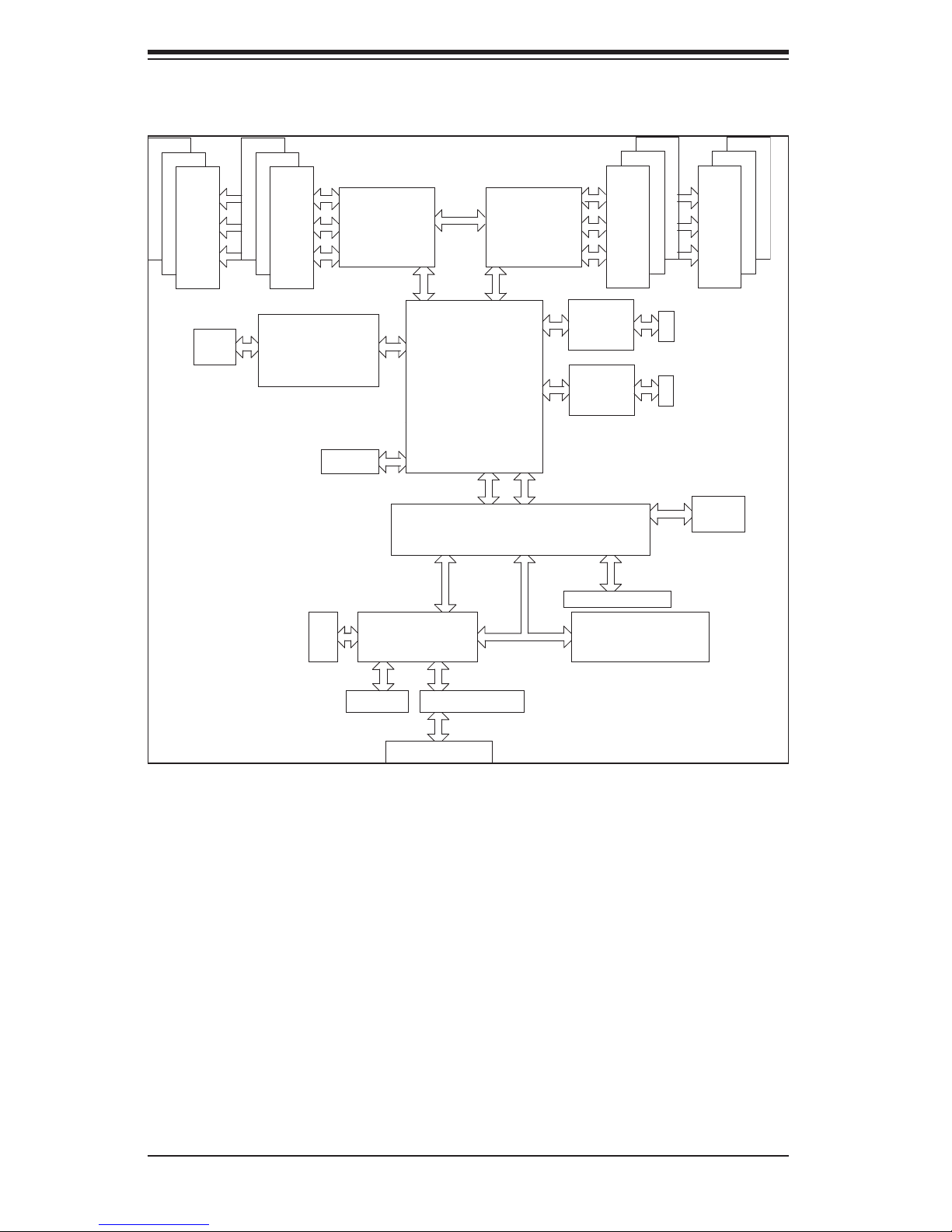
Figure 1-1. Intel 5520 Chipset:
System Block Diagram
Note1: This is a general block diagram. Please see Chapter 5 for details.
Note2: The Intel 5500 (IOH-24D) chipset is available for OEM only.
1-4
Page 13

Chapter 1: Introduction
1-3 Server Chassis Features
The following is a general outline of the main features of the SC827HD-R1400B 2U
chassis. Details on the chassis can be found in Chapter 6.
System Power
When confi gured as a SuperServer 6026TT-HD/D6 series server, the SC827HD-
R1400B includes a redundant (dual) 1400W power supply, which provides power
to all four serverboards (nodes). If either power supply failes, the other will allow
the system to continue to run.
SATA Subsystem
The SC827HD-R1400B chassis was designed to support twelve SATA hard
drives , which a re hot- swappabl e units. T here are s ix hard dr ives pe r node in t he
system.
Control Panel
The SC827HD-R1400B features two independant control panels associated with
each serverboard (node) in the chassis. Each control panel has LEDs to indicate
power on, network activity, power fail, fan fail, system overheat conditions and the
UID LED. Each control panel also includes a main power button and a UID button.
Rear I/O Panel
The SC827HD-R1400B is a 2U rackmount chassis. The rear of the chassis provides
slots for four full-height, full-length PCI Express x8 expansion cards (in x16 slots),
two COM ports, four USB ports, two VGA ports and four Gb Ethernet ports. See
Chapter 6 for details.
Cooling System
The SC827HD-R1400B chassis has an innovative cooling design that features four
8-cm high-performance fans. A fan speed control setting in BIOS allows fan speed
to be determined by system temperature. See Chapter 6 for details.
1-5
Page 14

SUPERSERVER 6026TT-HD/D6 Series User's Manual
1-4 2U Twin: System Notes
As a 2U Twin confi guration, the 6026TT-HD/D6 series is a unique server system.
With two system boards incorporated into a single chassis acting as two separate
nodes, there are several points you should keep in mind.
Nodes
Each of the two serverboards act as a separate node in the system. As independant
nodes, each may be powered off and on without affecting the others. In addition,
each node is a hot-swappable unit that may be removed from the rear of the chassis.
The nodes are connected to the server backplane by means of an adapter card.
System Power
The server has an additional 1400W power supply module (two total) for power
redundancy. If a power supply module fails the other backup module will keep the
system running until it can be replaced.
Backplane/Drives
As a system, the 6026TT-HDx and 6026TT-D6x servers supports the use of twelve
SA T A and SAS drives, respectively. A single backplane works to apply system-based
control for power and fan speed functions, yet at the same time logically connects
a set of six SATA drives to each serverboard. Consequently, RAID setup is limited
to a six-drive scheme (RAID cannot be spread across all twelve drives). See the
Drive Bay Installation/Removal section in Chapter 6 for the logical hard drive and
node confi guration.
1-6
Page 15

1-5 Contacting Supermicro
Headquarters
Address: Super Micro Computer, Inc.
980 Rock Ave.
San Jose, CA 95131 U.S.A.
Tel: +1 (408) 503-8000
Fax: +1 (408) 503-8008
Email: marketing@supermicro.com (General Information)
support@supermicro.com (Technical Support)
Chapter 1: Introduction
Web Site:
Europe
Address: Super Micro Computer B.V.
Tel: +31 (0) 73-6400390
Fax: +31 (0) 73-6416525
Email: sales@supermicro.nl (General Information)
Asia-Pacifi c
Address: Super Micro Computer, Inc.
www.supermicro.com
Het Sterrenbeeld 28, 5215 ML
's-Hertogenbosch, The Netherlands
support@supermicro.nl (Technical Support)
rma@supermicro.nl (Customer Support)
3F, No. 150, Jian 1st Rd.
Zhonghe Dist., New Taipei City 23511
Taiwan (R.O.C)
Tel: +886-(2) 8226-3990
Fax: +886-(2) 8226-3992
Web Site:
Technical Support:
Email: support@supermicro.com.tw
Tel: +886-(2)-8226-3990
www.supermicro.com.tw
1-7
Page 16

SUPERSERVER 6026TT-HD/D6 Series User's Manual
Notes
1-8
Page 17
Chapter 2: Server Installation
Chapter 2
Server Installation
2-1 Overview
This chapter provides a quick setup checklist to get the system up and running. Following these steps in the order given should enable you to have the system operational within a minimum amount of time. This quick setup assumes that your system
has come to you with the processors and memory preinstalled. If your system is
not already fully integrated with a serverboard, processors, memory etc., please
turn to the chapter noted in each step for details on installing specifi c components.
2-2 Unpacking the System
You should inspect the box the system was shipped in and note if it was damaged
in any way. If the server itself shows damage you should fi le a damage claim with
the carrier who delivered it.
Decide on a suitable location for the rack unit that will hold the server. It should be
situated in a clean, dust-free area that is well ventilated. Avoid areas where heat,
electrical noise and electromagnetic fi elds are generated. You will also need it placed
near a grounded power outlet. Be sure to read the Rack and Server Precautions
in the next section.
2-3 Preparing for Setup
The server should include the rackmount hardware needed to install the system into
the rack. Follow the steps in the order given to complete the installation process in
a minimum amount of time. Please read this section in its entirety before you begin
the installation procedure outlined in the sections that follow.
Choosing a Setup Location
• Leave enough clearance in front of the rack to enable you to open the front
door completely (~25 inches).
• Leave approximately 30 inches of clearance in the back of the rack to allow for
suffi cient airfl ow and ease in servicing.
• This product is for installation only in a Restricted Access Location (dedicated
equipment rooms, service closets and the like).
2-1
Page 18

SUPERSERVER 6026TT-HD/D6 Series User's Manual
• This product is not suitable for use with visual display work place devices ac-
cording to §2 of the the German Ordinance for Work with Visual Display Units.
2-4 Warnings and Precautions
Rack Precautions
• Ensure that the leveling jacks on the bottom of the rack are fully extended to
the fl oor with the full weight of the rack resting on them.
• In single rack installation, stabilizers should be attached to the rack.
• In multiple rack installations, the racks should be coupled together.
• Always make sure the rack is stable before extending a component from it.
• You should extend only one component at a time - extending two or more si-
multaneously may cause the rack to become unstable.
Server Precautions
• Review the electrical and general safety precautions in Chapter 4.
• Determine the placement of each component in the rack before you install the
rails.
• Install the heaviest server components on the bottom of the rack fi rst, and then
work up.
• Use a regulating uninterruptible power supply (UPS) to protect the server from
power surges, voltage spikes and to keep your system operating in case of a
power failure.
• Allow the hard drives and power supply modules to cool before touching them.
• Always keep the rack's front door and all panels and components on the servers
closed when not servicing to maintain proper cooling.
• Make sure all power and data cables are properly connected and not blocking
the chassis airfl ow. See Chapter 5 for details on cable connections.
2-2
Page 19
Chapter 2: Server Installation
Rack Mounting Considerations
Ambient Operating Temperature
If installed in a closed or multi-unit rack assembly, the ambient operating temperature of the rack environment may be greater than the ambient temperature of the
room. Therefore, consideration should be given to installing the equipment in an
environment compatible with the manufacturer’s maximum rated ambient temperature (Tmra).
Reduced Airfl ow
Equipment should be mounted into a rack so that the amount of airfl ow required
for safe operation is not compromised.
Mechanical Loading
Equipment should be mounted into a rack so that a hazardous condition does not
arise due to uneven mechanical loading.
Circuit Overloading
Consideration should be given to the connection of the equipment to the power
supply circuitry and the effect that any possible overloading of circuits might have
on overcurrent protection and power supply wiring. Appropriate consideration of
equipment nameplate ratings should be used when addressing this concern.
Reliable Ground
A reliable ground must be maintained at all times. To ensure this, the rack itself
should be grounded. Particular attention should be given to power supply connections other than the direct connections to the branch circuit (i.e. the use of power
strips, etc.).
Warning! To prevent bodily injury when mounting or servicing this unit in a
rack, you must take special precautions to ensure that the system remains
stable. The following guidelines are provided to ensure your safety:
• This unit should be mounted at the bottom of the rack if it is the only unit in
the rack.
• When mounting this unit in a partially fi lled rack, load the rack from the bottom
to the top with the heaviest component at the bottom of the rack.
• If the rack is provided with stabilizing devices, install the stabilizers before
mounting or servicing the unit in the rack.
2-3
Page 20
SUPERSERVER 6026TT-HD/D6 Series User's Manual
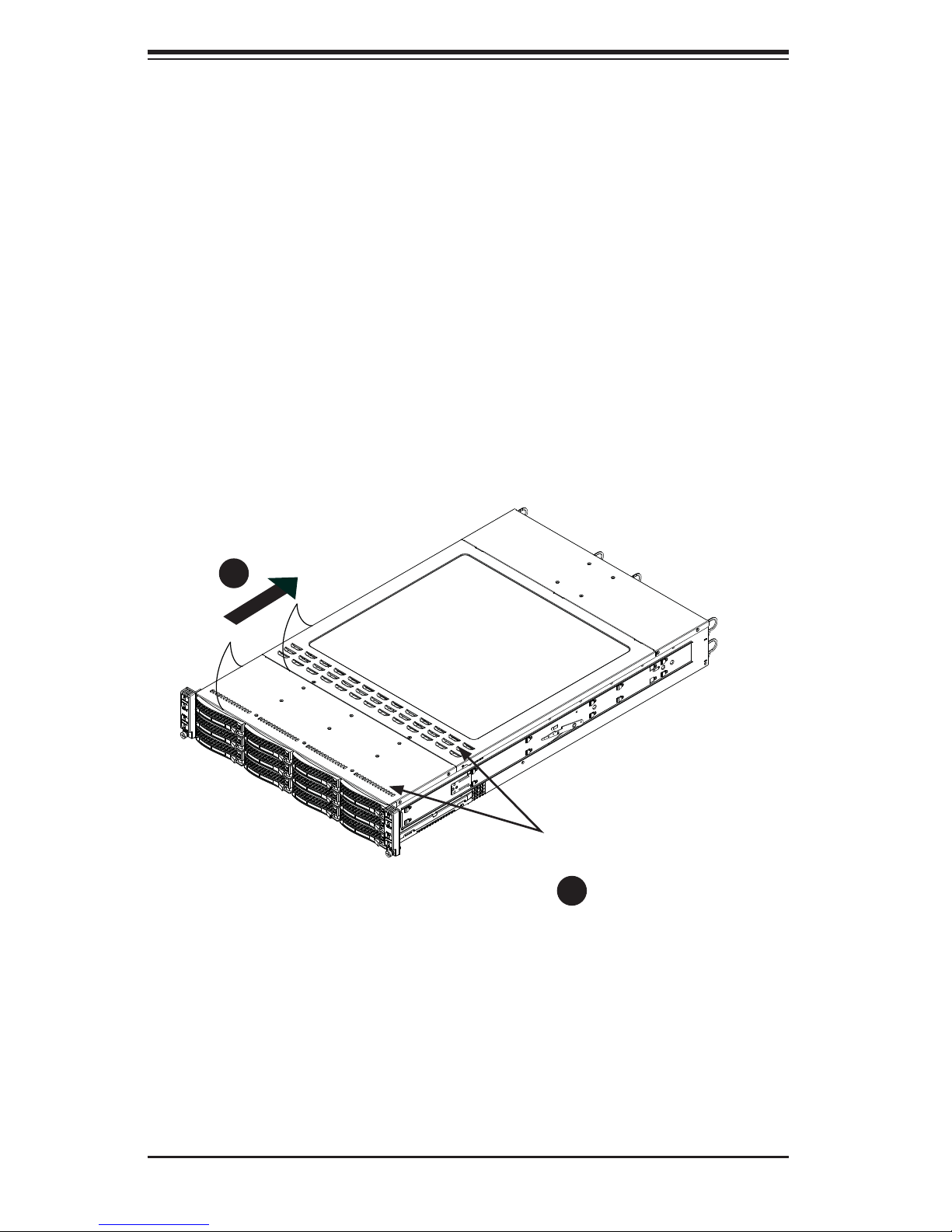
Removing the Protective Film
Before operating the server for the fi rst time, it is important to remove the protec-
tive fi lm covering the top of the chassis, in order to allow for proper ventilation and
cooling.
Removing the Protective Film
1. Peel off the protective fi lm covering the top cover and the top of the chassis
2. Check that all ventilation openings on the top cover and the top of the chassis
are clear and unobstructed.
Figure 2-1. Removing the Protective Film
1
1
Check Ventilation
Openings
2
1
Warning: Except for short periods of time, do NOT operate the server without the
cover in place. The chassis cover must be in place to allow proper airfl ow and prevent
overheating.
2-4
Page 21
Chapter 2: Server Installation
2-5 Rack Mounting Instructions
This section provides information on installing the SC827 chassis into a rack unit
with the quick-release rails provided. There are a variety of rack units on the market,
which may mean the assembly procedure will differ slightly. Y ou should also refer to
the installation instructions that came with the rack unit you are using.
Note: This rail will fi t a rack between 26" and 33.5" deep.
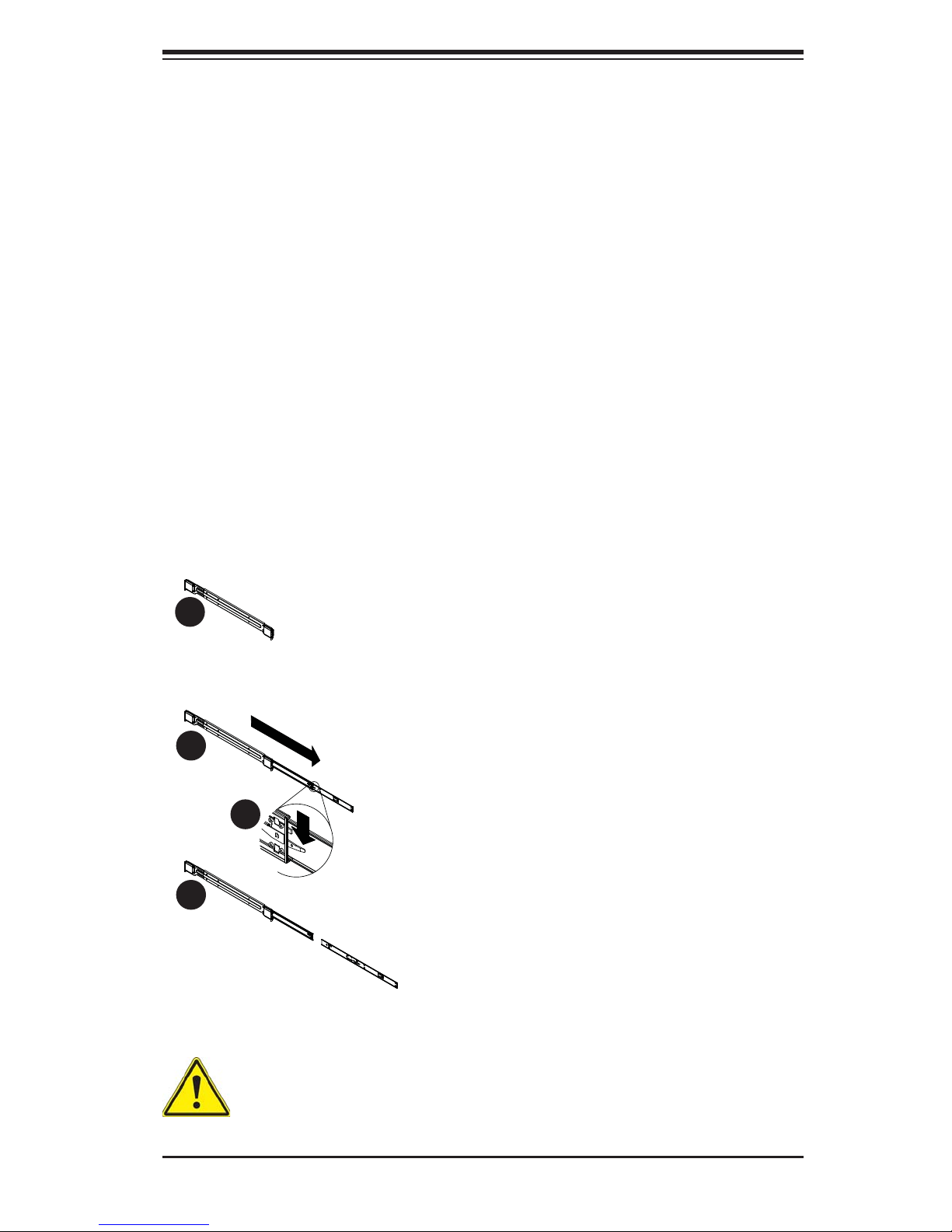
Separating the Sections of the Rack Rails
The chassis package includes two rail assemblies in the rack mounting kit. Each
assembly consists of two sections: an inner fi xed chassis rail that secures directly
to the server chassis and an outer fi xed rack rail that secures directly to the rack
itself.
Figure 2-2. Separating the Rack Rails
1
1
2
1
3
1
4
1
Rail Assembly
Extending the Rails
Quick-Release
Tab
Separating the Inner
Rail Extension
Separating the Inner and Outer Rails
1. Locate the rail assembly in the chassis
packaging.
2. Extend the rail assembly by pulling it
outward.
3. Press the quick-release tab.
4. Separate the inner rail extension from
the outer rail assembly.
Warning: do not pick up the server with the front handles. They are designed to pull the system from a rack only.
2-5
Page 22
SUPERSERVER 6026TT-HD/D6 Series User's Manual
Installing the Inner Rail Extensions
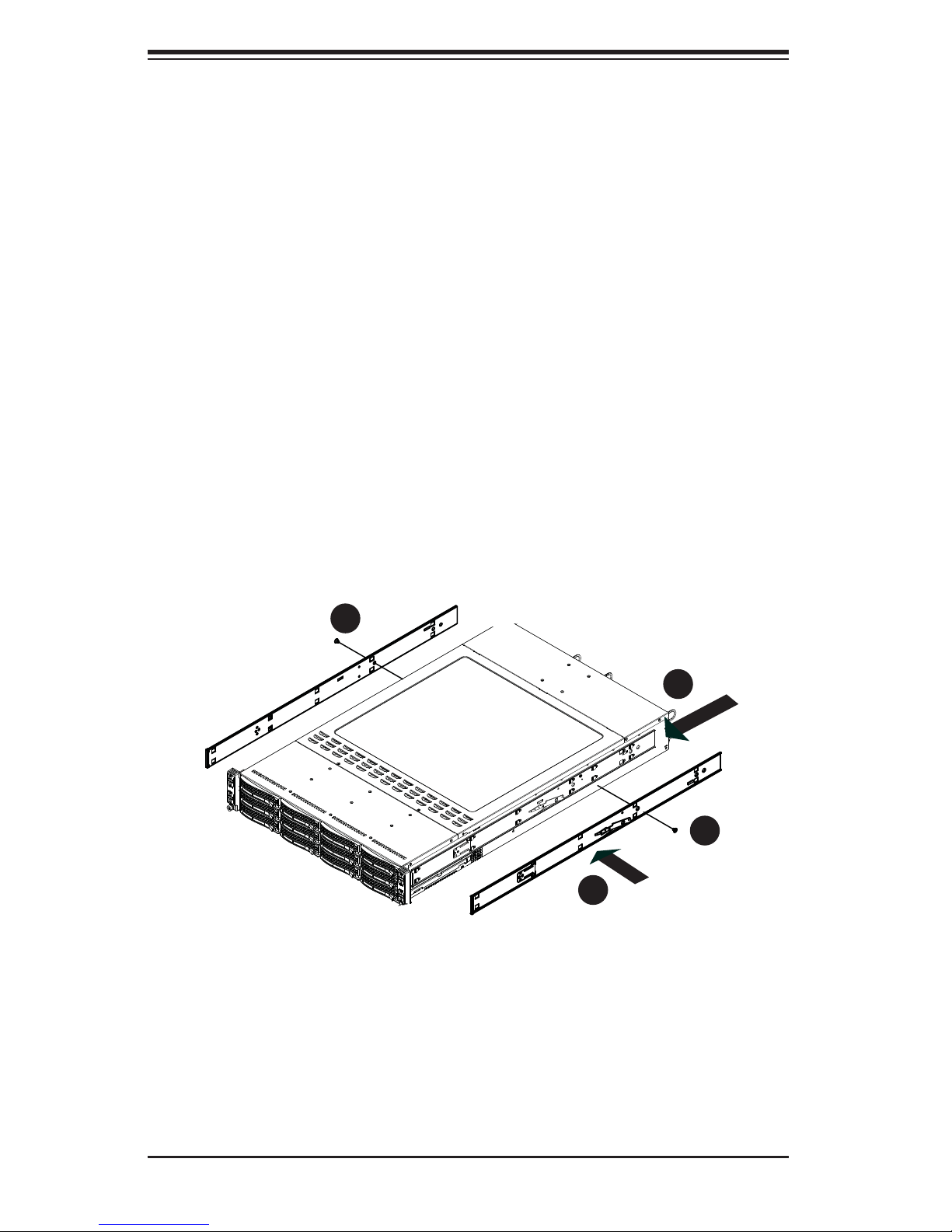
The SC827 chassis includes a set of inner rails in two sections: inner rails and inner
rail extensions. The inner rails are pre-attached to the chassis, and do not interfere
with normal use of the chassis if you decide not to use a server rack. The inner rail
extension is attached to the inner rail to mount the chassis in the rack.
Installing the Inner Rails
1. Place the inner rail extensions on the side of the chassis aligning the hooks
of the chassis with the rail extension holes. Make sure the extension faces
"outward" just like the pre-attached inner rail.
2. Slide the extension toward the front of the chassis.
3. Secure the chassis with 2 screws as illustrated. Repeat steps for the other
inner rail extension.
Figure 2-3. Installing the Inner Rail Extensions
3
1
1
1
2
1
3
1
2-6
Page 23
Chapter 2: Server Installation
3
1
1
1
2
1
Figure 2-4. Assembling the Outer Rails
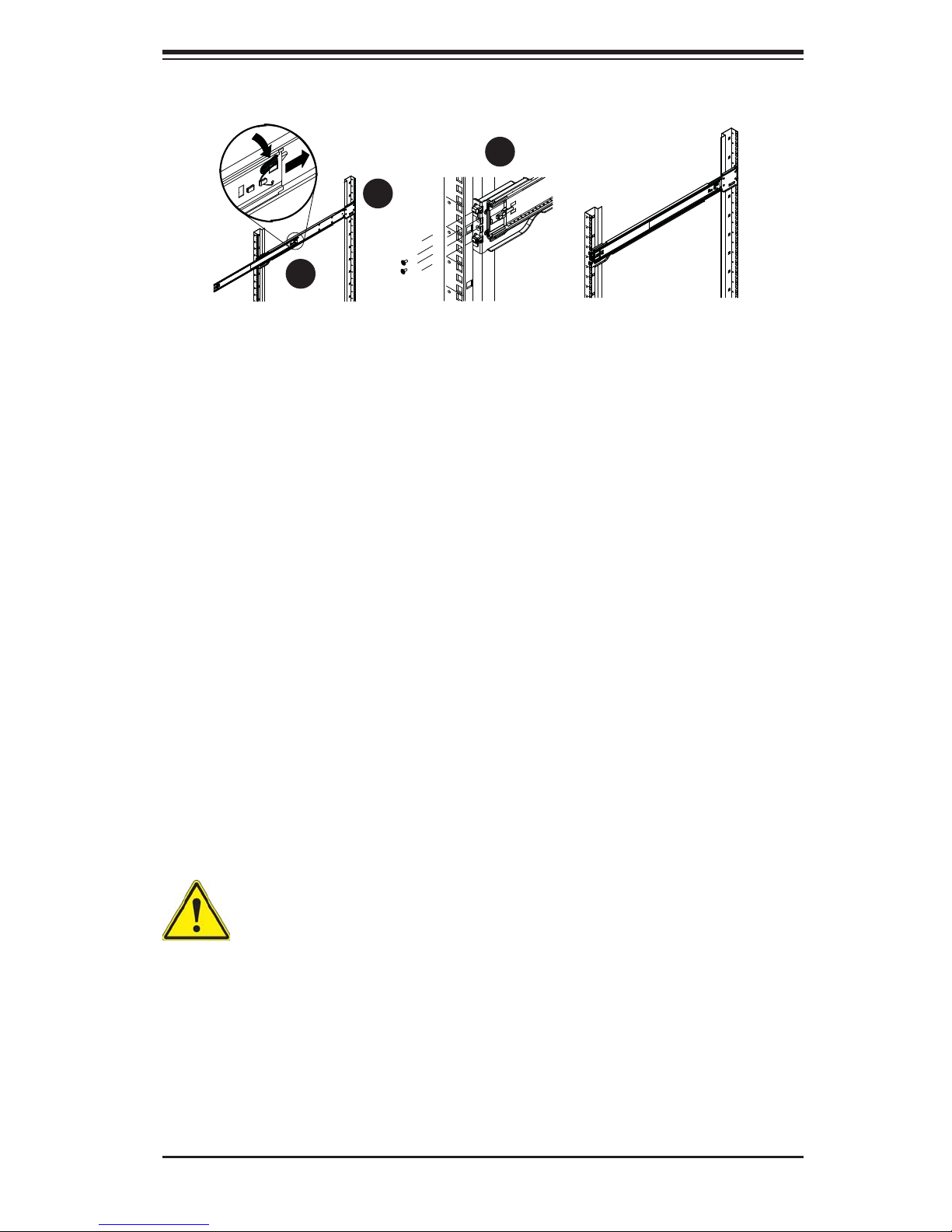
Outer Rack Rails
Outer rails attach to the rack and hold the chassis in place. The outer rails for the
SC827 chassis extend between 30 inches and 33 inches.
Installing the Outer Rails to the Rack
1. Secure the back end of the outer rail to the rack, using the screws provided.
2. Press the button where the two outer rails are joined to retract the smaller
outer rail.
3. Hang the hooks of the rails onto the rack holes and if desired, use screws to
secure the front of the outer rail onto the rack.
4. Repeat steps 1-3 for the remaining outer rail.
Stability hazard. The rack stabilizing mechanism must be in place, or the
rack must be bolted to the fl oor before you slide the unit out for servicing.
Failure to stabilize the rack can cause the rack to tip over.
2-7
Page 24
SUPERSERVER 6026TT-HD/D6 Series User's Manual
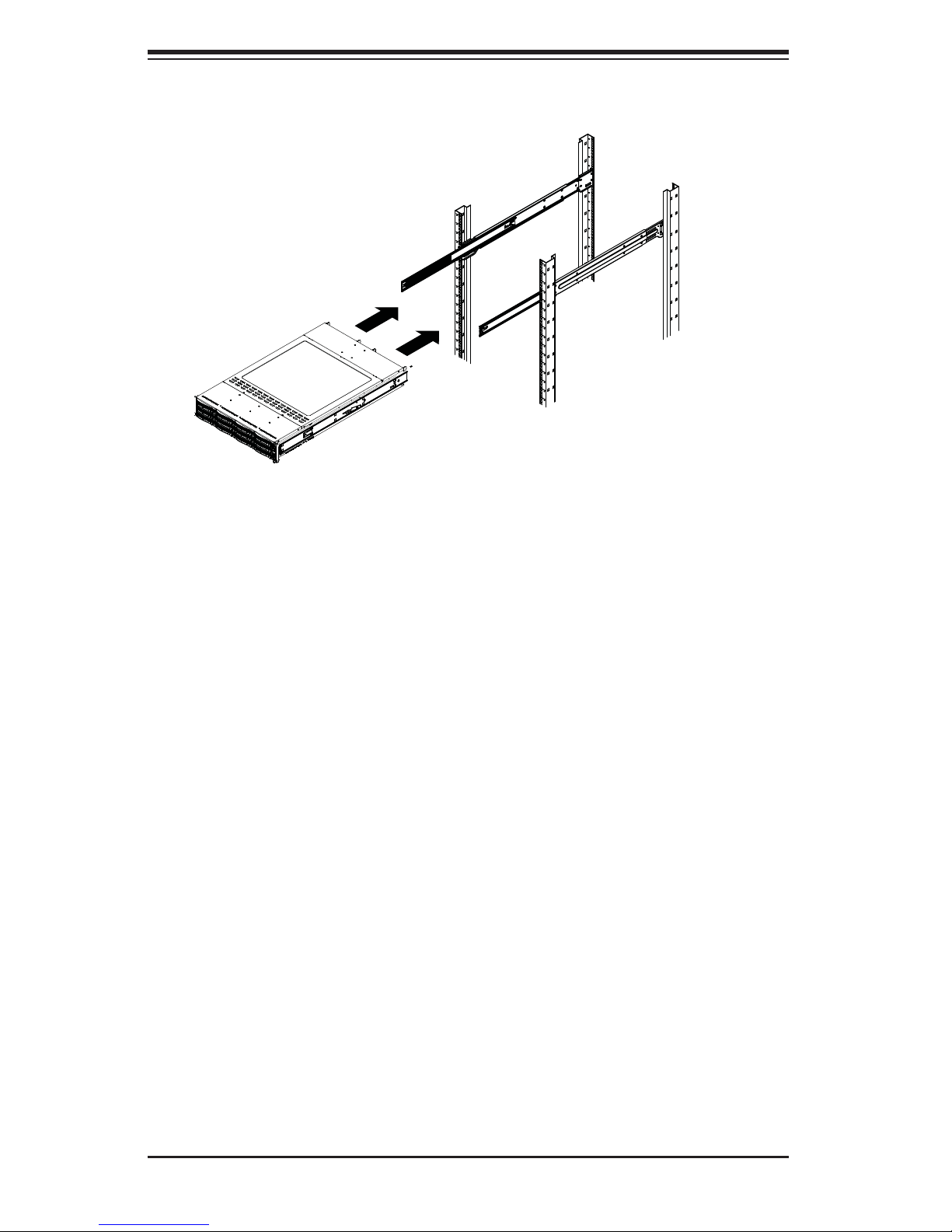
Figure 2-5. Installing Into the Rack
Installing the Chassis into a Rack
1. Extend the outer rails as illustrated above.
2. Align the inner rails of the chassis with the outer rails on the rack.
3. Slide the inner rails into the outer rails, keeping the pressure even on both
sides. When the chassis has been pushed completely into the rack, it should
click into the locked position.
4. Optional screws may be used to secure the to hold the front of the chassis to
the rack.
Note: this fi gure is for illustrative purposes only. Always install servers to the bot-
tom of a rack fi rst.
2-8
Page 25

Chapter 2: Server Installation
2-6 Checking the Serverboard Setup
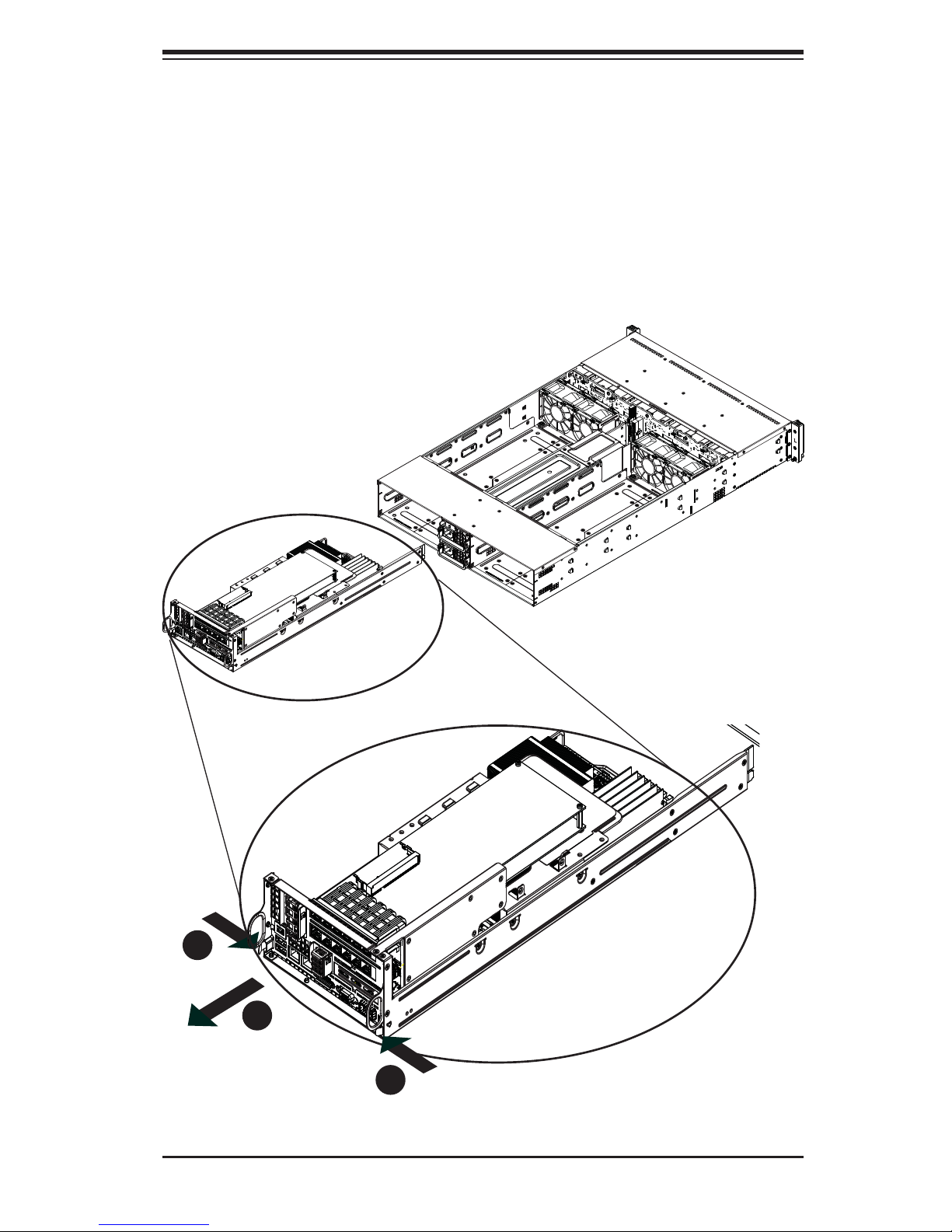
After you install the system in the rack, you will need to access the inside of the
nodes to make sure the serverboard is properly installed.
Accessing the Inside of a Node (Figure 2-6)
1. Before removing a node, unplug all the cables that connect to that node.
2. To remove a node, fi rst push the two latches (located near the handles)
inward.
3. Grasp the handles and pull the node out from the rear of the chassis.
4. To remove the system from the rack completely, depress the locking tabs in
the chassis rails (push the right-side tab down and the left-side tab up) to
continue to pull the system out past the locked position.
Checking the Components and Setup
1. You may have one or two processors already installed in each of the two
serverboards. Each processor needs its own heatsink. See Chapter 5 for
instructions on processor and heatsink installation.
2. Your server system may have come with system memory already installed.
Make sure all DIMMs are fully seated in their slots. For details on adding
system memory, refer to Chapter 5.
3. You can install two add-on cards to each node for a total of four for the
system. See Chapter 5 for details on installing PCI add-on cards.
4. Make sure all power and data cables are properly connected and not blocking
the chassis airfl ow. See Chapter 5 for details on cable connections.
2-9
Page 26

SUPERSERVER 6026TT-HD/D6 Series User's Manual
2-7 Preparing to Power On
Next, you should check to make sure the SA TA drives and the backplane have been
properly installed and all connections have been made.
Checking the Hard Drives
1. The hard drives are accessable from the front of the server and can be
installed and removed from the front of the chassis without removing the top
chassis cover.
2. Depending upon your system's confi guration, your system may have one
or more drives already installed. If you need to install SATA or SAS drives,
please refer to Chapter 6.
Checking the Airfl ow
1. Airfl ow is provided by four 8-cm PWM fans and (for each serverboard) one
air shroud. The system component layout was carefully designed to direct
suffi cient cooling airfl ow to the components that generate the most heat.
2. Note that all power and data cables have been routed in such a way that they
do not block the airfl ow generated by the fans.
Providing Power
1. Plug the power cords from the power supplies unit into a high-quality power
strip that offers protection from electrical noise and power surges.
2. It is recommended that you use an uninterruptible power supply (UPS).
3. Finally, depress the power on button on the front of the chassis.
2-10
Page 27
Chapter 2: Server Installation
Figure 2-6. Removing a Node from the System
1
1
2
1
1
1
2-11
Page 28

SUPERSERVER 6026TT-HD/D6 Series User's Manual
Notes
2-12
Page 29
Chapter 3: System Interface
Chapter 3
System Interface
3-1 Overview
There are LEDs on the control panels and on the hard drive carriers to keep you
constantly informed of the overall status of the system as well as the activity and
health of specifi c components. There are also two buttons on each control panel.
This chapter explains the meanings of all LED indicators and the appropriate response you may need to take. Note that the server has two control panels, one for
each serverboard (node) installed in the system. This allows each severboard to
be controlled independently of the other.
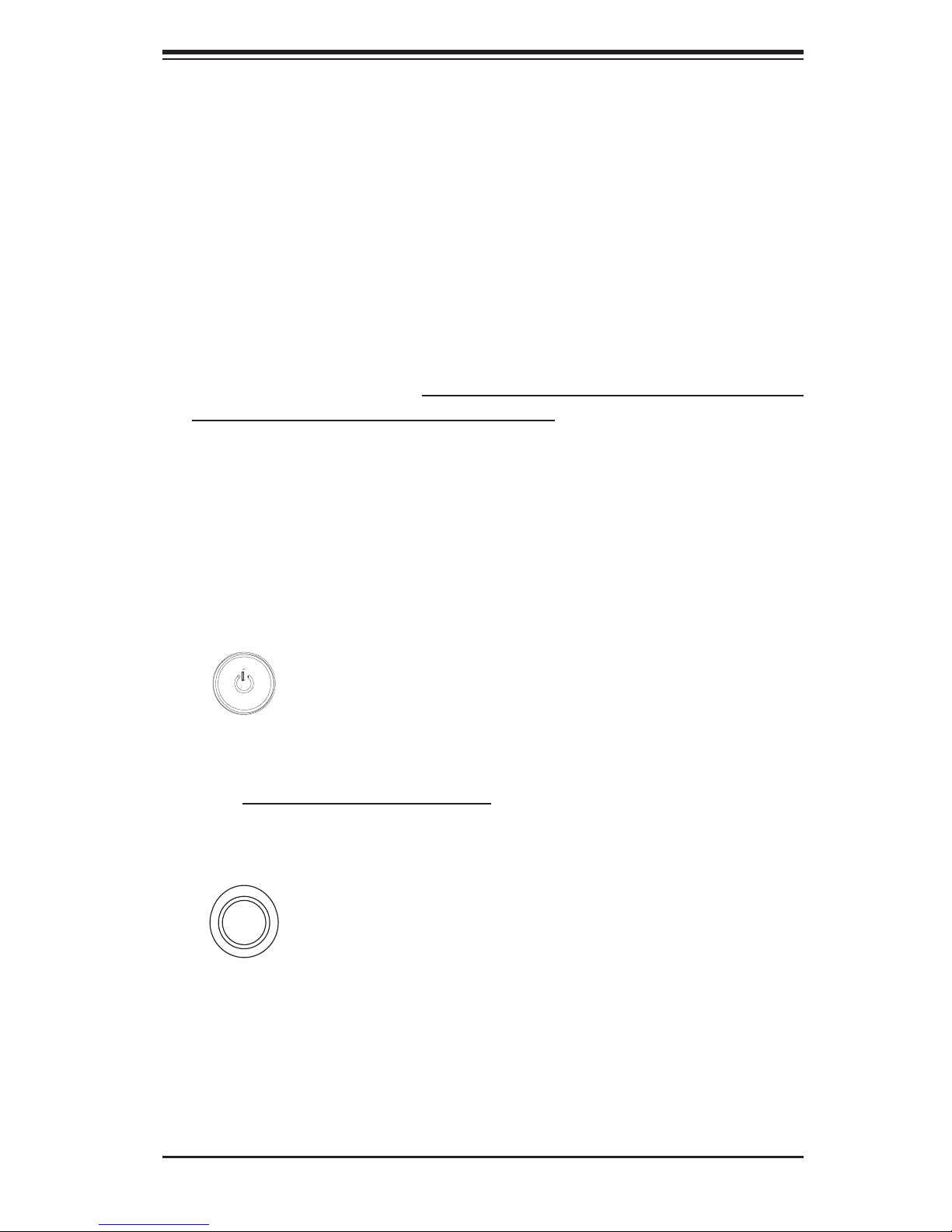
3-2 Control Panel Buttons
There are two push-buttons located on each control panel: a power on/off button
and a UID button.
Power
This is the main power button, which is used to apply or turn off the main system
power only to the node it is connected to. Depressing this button removes the main
power but keeps standby power supplied to the serverboard. This button has an
LED built into it, which will illuminate when its node is powered on.
UID
Depressing the UID (unit identifi er) button illuminates an LED on both the front and
rear of the chassis for easy system location in large stack confi gurations. The LED
will remain on until the button is pushed a second time. Another UID button on the
rear of the chassis serves the same function. This button has an LED built into it,
which will illuminate when either the front or rear UID button is pushed.
3-1
Page 30
SUPERSERVER 6026TT-HD/D6 Series User's Manual
3-3 Control Panel LEDs
In addition to the LEDs built into the power and UID buttons, each of the four control
panels located on the front of the SC827HD-R1400B chassis has two LEDs that
provide you with critical information related their own node. This section explains
what each LED indicates when illuminated and any corrective action you may need
to take.
Overheat/Fan Fail
When this LED is solid on it indicates an overheat condition. When it fl ashes quickly
(~ once every second), it indicates a fan failure. When it fl ashes slowly (~ once every
four seconds) on the node A control panel, it indicates a power supply failure. An
overheat condition may be caused by cables obstructing the airfl ow in the system
or the ambient room temperature being too warm. Check the routing of the cables
and make sure all fans are present and operating normally. You should also check
to make sure that the chassis cover is properly installed. Finally, verify that the
heatsinks are installed properly (see Chapter 5). This LED will remain fl ashing or
on as long as the indicated condition exists.
NIC
Indicates network activity on any of the LAN ports when fl ashing
3-4 Hard Drive Carrier LEDs
Each hard drive carrier has two LEDs.
• Green: When illuminated, the green LED on the front of the drive carrier indi-
cates drive activity. A connection to the backplane enables this LED to blink on
and off when that particular drive is being accessed.
• Red: The red LED serves two functions:
• When solid on (not fl ashing), this LED indicates a hard drive failure.
• When this LED fl ashes on and off it indicates the HDD is rebuilding.
3-2
Page 31

Chapter 4: Warning Statements for AC Systems
Chapter 4
Standardized Warning Statements for AC Systems
4-1 About Standardized Warning Statements
The following statements are industry standard warnings, provided to warn the user
of situations which have the potential for bodily injury. Should you have questions
or experience difficulty, contact Supermicro's Technical Support department
for assistance. Only certifi ed technicians should attempt to install or confi gure
components.
Read this appendix in its entirety before installing or confi guring components in the
Supermicro chassis.
These warnings may also be found on our web site at http://www.supermicro.com/
about/policies/safety_information.cfm.
Warning Defi nition
Warning!
This warning symbol means danger. You are in a situation that could cause bodily
injury. Before you work on any equipment, be aware of the hazards involved with
electrical circuitry and be familiar with standard practices for preventing accidents.
警告の定義
この警告サインは危険を意味します。
人身事故につながる可能性がありますので、いずれの機器でも動作させる前に、
電気回路に含まれる危険性に注意して、標準的な事故防止策に精通して下さい。
此警告符号代表危险。
您正处于可能受到严重伤害的工作环境中。在您使用设备开始工作之前,必须充分
意识到触电的危险,并熟练掌握防止事故发生的标准工作程序。请根据每项警告结
尾的声明号码找到此设备的安全性警告说明的翻译文本。
此警告符號代表危險。
您正處於可能身體可能會受損傷的工作環境中。在您使用任何設備之前,請注意觸
電的危險,並且要熟悉預防事故發生的標準工作程序。請依照每一注意事項後的號
碼找到相關的翻譯說明內容。
4-1
Page 32

SUPERSERVER 6026TT-HD/D6 Series User's Manual
ןונקת תורהצהאהרהז
Warnung
WICHTIGE SICHERHEITSHINWEISE
Dieses Warnsymbol bedeutet Gefahr. Sie befi nden sich in einer Situation, die zu
Verletzungen führen kann. Machen Sie sich vor der Arbeit mit Geräten mit den
Gefahren elektrischer Schaltungen und den üblichen Verfahren zur Vorbeugung
vor Unfällen vertraut. Suchen Sie mit der am Ende jeder Warnung angegebenen
Anweisungsnummer nach der jeweiligen Übersetzung in den übersetzten
Sicherheitshinweisen, die zusammen mit diesem Gerät ausgeliefert wurden.
BEWAHREN SIE DIESE HINWEISE GUT AUF.
INSTRUCCIONES IMPORTANTES DE SEGURIDAD
Este símbolo de aviso indica peligro. Existe riesgo para su integridad física. Antes
de manipular cualquier equipo, considere los riesgos de la corriente eléctrica y
familiarícese con los procedimientos estándar de prevención de accidentes. Al
fi nal de cada advertencia encontrará el número que le ayudará a encontrar el texto
traducido en el apartado de traducciones que acompaña a este dispositivo.
GUARDE ESTAS INSTRUCCIONES.
IMPORTANTES INFORMATIONS DE SÉCURITÉ
Ce symbole d'avertissement indique un danger. Vous vous trouvez dans une
situation pouvant entraîner des blessures ou des dommages corporels. Avant
de travailler sur un équipement, soyez conscient des dangers liés aux circuits
électriques et familiarisez-vous avec les procédures couramment utilisées pour
éviter les accidents. Pour prendre connaissance des traductions des avertissements
fi gurant dans les consignes de sécurité traduites qui accompagnent cet appareil,
référez-vous au numéro de l'instruction situé à la fi n de chaque avertissement.
CONSERVEZ CES INFORMATIONS.
ןה תואבה תורהצהא ינפמ שמתשמה תא ריהזהל תנמ לע ,היישעתה ינקת יפ לע תורהז הלבח
ה וא תולאש שיו הדימב .תירשפא תיזיפי ,יהשלכ היעבב תולקתרוציל שי הכימת תקלחמ םע רשק
רידגהל וא ןיקתהל םיאשר דבלב םיכמסומ םיאנכט .ורקימרפוס לש תינכט תאה .םיביכר
תרדגה וא תנקתה ינפל ואולמב חפסנה תא
אורקל שי .ורקימרפוס יזראמב םיביכרה
4-2
Page 33

Warning Statements for AC Systems
. ﻲﻓ ﻚﻧﺍ ﻥﺃ ﻦﻜﻤﻳ ﺔﻟﺎﺣ ﻲﻓ ﺐﺒﺴﺘﺗ ﺔﺑﺎﺻﺍ ﺔﻳﺪﺴﺟ ﺰﻣﺮﻟﺍ ﺍﺬﻫ ﻲﻨﻌﻳ ﺮﻄﺧ !ﺮﻳﺬﺤﺗ
ﻥﺃ ﻞﺒﻗ ﻱﺃ ﻰﻠﻋ ﻞﻤﻌﺗ ﺕﺍﺪﻌﻣ،ﻛﻢﻠﻋ ﻰﻠﻋ ﻦ ﻦﻋ ﺔﻤﺟﺎﻨﻟﺍ ﺮﻁﺎﺨﻤﻟﺎﺑ ﺮﺋﺍﻭﺪﻟﺍ
ﺔﻴﺋﺎﺑﺮﻬﻜﻟﺍ
ﻛﻭﺔﻳﺍﺭﺩ ﻰﻠﻋ ﻦ ﺭﺎﻤﻤﻟﺎﺑﺕﺎﺳ ﺔﻴﺋﺎﻗﻮﻟﺍ ﻟ ﻊﻨﻤﻉﻮﻗﻭ ﻱﺃﺙﺩﺍﻮﺣ
ﻢﻗﺭ ﻡﺪﺨﺘﺳﺍ ﻥﺎﻴﺒﻟﺍ ﺹﻮﺼﻨﻤﻟﺍ ﺔﻳﺎﻬﻧ ﻲﻓ ﺮﻳﺬﺤﺗ ﻞﻛ ﺭﻮﺜﻌﻠﻟ ﺎﻬﺘﻤﺟﺮﺗ
안전을 위한 주의사항
경고!
이 경고 기호는 위험이 있음을 알려 줍니다. 작업자의 신체에 부상을 야기 할 수
있는 상태에 있게 됩니다. 모든 장비에 대한 작업을 수행하기 전에 전기회로와
관련된 위험요소들을 확인하시고 사전에 사고를 방지할 수 있도록 표준
작업절차를 준수해 주시기 바랍니다.
해당 번역문을 찾기 위해 각 경고의 마지막 부분에 제공된 경고문 번호를
참조하십시오
BELANGRIJKE VEILIGHEIDSINSTRUCTIES
Dit waarschuwings symbool betekent gevaar. U verkeert in een situatie die
lichamelijk letsel kan veroorzaken. Voordat u aan enige apparatuur gaat werken,
dient u zich bewust te zijn van de bij een elektrische installatie betrokken risico's
en dient u op de hoogte te zijn van de standaard procedures om ongelukken te
voorkomen. Gebruik de nummers aan het eind van elke waarschuwing om deze te
herleiden naar de desbetreffende locatie.
BEWAAR DEZE INSTRUCTIES
4-3
Page 34

SUPERSERVER 6026TT-HD/D6 Series User's Manual
Installation Instructions
Warning!
Read the installation instructions before connecting the system to the power source.
設置手順書
システムを電源に接続する前に、設置手順書をお読み下さい。
警告
将此系统连接电源前,请先阅读安装说明。
警告
將系統與電源連接前,請先閱讀安裝說明。
Warnung
Vor dem Anschließen des Systems an die Stromquelle die Installationsanweisungen
lesen.
¡Advertencia!
Lea las instrucciones de instalación antes de conectar el sistema a la red de
alimentación.
Attention
Avant de brancher le système sur la source d'alimentation, consulter les directives
d'installation.
אורקל שי רוקמל תכרעמה רוביח ינפל הנקתה תוארוה תאחתמ.
ﻟﺍ ﺕﺍﺩﺎﺷﺭﺇ ﺮﻗﺍﺐﻴﻛﺮﺘ ﻞﻴﺻﻮﺗ ﻞﺒﻗ ﻰﻟﺇ ﻡﺎﻈﻨﻟﺍ ﺔﻗﺎﻄﻠﻟ ﺭﺪﺼﻣ
시스템을 전원에 연결하기 전에 설치 안내를 읽어주십시오.
Waarschuwing
Raadpleeg de installatie-instructies voordat u het systeem op de voedingsbron
aansluit.
4-4
Page 35

Chapter 4: Warning Statements for AC Systems
Circuit Breaker
Warning!
This product relies on the building's installation for short-circuit (overcurrent)
protection. Ensure that the protective device is rated not greater than: 250 V, 20 A.
サーキット・ブレーカー
この製 品は 、短絡(過電流)保護装置がある建物での設置を前提としています。
保護装置の定格が250V、20Aを超えないことを確認下さい。
警告
此产品的短路(过载电流)保护由建筑物的供电系统提供,确保短路保护设备的额定电
流不大于250V,20A。
警告
此產品的短路(過載電流)保護由建築物的供電系統提供,確保短路保護設備的額定電
流不大於250V,20A。
Warnung
Dieses Produkt ist darauf angewiesen, dass im Gebäude ein Kurzschluss-
bzw. Überstromschutz installiert ist. Stellen Sie sicher, dass der Nennwert der
Schutzvorrichtung nicht mehr als: 250 V, 20 A beträgt.
¡Advertencia!
Este equipo utiliza el sistema de protección contra cortocircuitos (o sobrecorrientes)
del edifi cio. Asegúrese de que el dispositivo de protección no sea superior a: 250
V, 20 A.
Attention
Pour ce qui est de la protection contre les courts-circuits (surtension), ce produit
dépend de l'installation électrique du local. Vérifi ez que le courant nominal du
dispositif de protection n'est pas supérieur à :250 V, 20 A.
¥²¢¢¥§²±¯°³«¢©§¥¦¢©§³©°³§©¥«£§³ª§±¯§
60VDC, 20A§±³¢¥¢¥§²±¯°¢©§¨§±¢²¤§
ϩΕϱ
ΏΙΕ
ϡΕ ϱΕϝ
ΓέϱιϕϝέΉ
20A, 250VDC :ϥϡ
ϭΩϝϩϡΕϱϡ
έΙϙαϱϝϱΉϕϭϝ
4-5
Ρϝ
ΙΩωϡ
ίϩΝϝ
ϯϝω ΩϡΕωϱΝΕϥϡϝΫ
ϯϥΏϡϝ
ϡϱϱϕΕ
ϥ ϥϡ ΩϙΕ
ϩ
Page 36

SUPERSERVER 6026TT-HD/D6 Series User's Manual
경고!
이 제품은 전원의 단락(과전류)방지에 대해서 전적으로 건물의 관련 설비에
의존합니다. 보호장치의 정격이 반드시 250V(볼트), 20A(암페어)를 초과하지
않도록 해야 합니다.
Waarschuwing
Dit product is afhankelijk van de kortsluitbeveiliging (overspanning) van
uw electrische installatie. Controleer of het beveiligde aparaat niet groter
gedimensioneerd is dan 220V, 20A.
Power Disconnection Warning
Warning!
The system must be disconnected from all sources of power and the power cord
removed from the power supply module(s) before accessing the chassis interior to
install or remove system components.
電源切断の警告
システムコンポーネントの取り付けまたは取り外しのために、シャーシー内部にアクセス
するには、
システムの電源はすべてのソースから切断され、電源コードは電源モジュールから取り
外す必要があります。
警告
在你打开机箱并安装或移除内部器件前,必须将系统完全断电,并移除电源线。
警告
在您打開機殼安裝或移除內部元件前,必須將系統完全斷電,並移除電源線。
Warnung
Das System muss von allen Quellen der Energie und vom Netzanschlusskabel
getrennt sein, das von den Spg.Versorgungsteilmodulen entfernt wird, bevor es
auf den Chassisinnenraum zurückgreift, um Systemsbestandteile anzubringen oder
zu entfernen.
4-6
Page 37

Chapter 4: Warning Statements for AC Systems
ילמשח קותינ ינפמ הרהזא
!הרהזא
¡Advertencia!
El sistema debe ser disconnected de todas las fuentes de energía y del cable
eléctrico quitado de los módulos de fuente de alimentación antes de tener acceso
el interior del chasis para instalar o para quitar componentes de sistema.
Attention
Le système doit être débranché de toutes les sources de puissance ainsi que de
son cordon d'alimentation secteur avant d'accéder à l'intérieur du chassis pour
installer ou enlever des composants de systéme.
למשחה תורוקמ לכמ תכרעמה תא קתנל שי ריסהל שיו קפסהמ ילמשחה לבכ תא
נקתה ךרוצל זראמה לש ימינפה קלחל השיג ינפלת רסה ואת .םיביכר
ﻞﺼﻓ ﺐﺠﻳ ﻡﺎﻈﻨﻟﺍ ﻊﻴﻤﺟ ﻦﻣﺭﺩﺎﺼﻣ ﺔﻗﺎﻄﻟﺍ ﺔﻟﺍﺯﺇﻭ ءﺎﺑﺮﻬﻜﻟﺍ ﻚﻠﺳ ﻦﻣ ﺓﺪﺣﻭ ﺩﺍﺪﻣﺍ
ﺔﻗﺎﻄﻟﺍ ﻞﺒﻗ
ﺯﺎﻬﺠﻟﺍ
경고!
시스템에 부품들을 장착하거나 제거하기 위해서는 섀시 내부에 접근하기 전에
반드시 전원 공급장치로부터 연결되어있는 모든 전원과 전기코드를 분리해주어야
합니다.
Waarschuwing
Voordat u toegang neemt tot het binnenwerk van de behuizing voor het installeren
of verwijderen van systeem onderdelen, dient u alle spanningsbronnen en alle
stroomkabels aangesloten op de voeding(en) van de behuizing te verwijderen
ﻰﻟﺇ ﻝﻮﺻﻮﻟﺍ ﺔﻴﻠﺧﺍﺪﻟﺍ ﻖﻁﺎﻨﻤﻟﺍ ﻟﻞﻜﻴﻬﻠ ﺔﻟﺍﺯﺇ ﻭﺃ ﺖﻴﺒﺜﺘﻟ ﺕﺎﻧﻮﻜﻣ
4-7
Page 38

SUPERSERVER 6026TT-HD/D6 Series User's Manual
Equipment Installation
Warning!
Only trained and qualifi ed personnel should be allowed to install, replace, or service
this equipment.
機器の設置
トレーニングを受け認定された人だけがこの装置の設置、交換、またはサービスを許可
されています。
警告
只有经过培训且具有资格的人员才能进行此设备的安装、更换和维修。
警告
只有經過受訓且具資格人員才可安裝、更換與維修此設備。
Warnung
Das Installieren, Ersetzen oder Bedienen dieser Ausrüstung sollte nur geschultem,
qualifi ziertem Personal gestattet werden.
¡Advertencia!
Solamente el personal califi cado debe instalar, reemplazar o utilizar este equipo.
Attention
Il est vivement recommandé de confier l'installation, le remplacement et la
maintenance de ces équipements à des personnels qualifi és et expérimentés.
!הרהזא
שר דבלב ךמסומ תווצתא ףילחהל ,ןיקתהל יא .דויצה רובע תוריש תתל וא דויצה
ﻦﻴﺑﺭﺪﻤﻟﺍﻭ ﻭ ﺐﻴﻛﺮﺘﻟﻝﺍﺪﺒﺘﺳﺍ ﻭﺃ ﺔﻣﺪﺧ ﺯﺎﻬﺠﻟﺍ ﺍﺬﻫ ﺢﻤﺴﻳ ﻥﺃ ﺐﺠﻳ ﻂﻘﻓ ﻦﻴﻠﻫﺆﻤﻟﺍ ﻦﻴﻔﻅﻮﻤﻠﻟ
경고!
훈련을 받고 공인된 기술자만이 이 장비의 설치, 교체 또는 서비스를 수행할 수
있습니다.
4-8
Page 39

Chapter 4: Warning Statements for AC Systems
Waarschuwing
Deze apparatuur mag alleen worden geïnstalleerd, vervangen of hersteld door
geschoold en gekwalifi ceerd personeel.
Restricted Area
Warning!
This unit is intended for installation in restricted access areas. A restricted access
area can be accessed only through the use of a special tool, lock and key, or other
means of security. (This warning does not apply to workstations).
アクセス制限区域
このユ ニットは、アクセス制限区域に設置されることを想定しています。
アクセス制限区域は、特別なツール、鍵と錠 前、その他のセキュリティの手段を用いての
み出入りが可能です。
警告
此部件应安装在限制进出的场所,限制进出的场所指只能通过使用特殊工具、锁和
钥匙或其它安全手段进出的场所。
警告
此裝置僅限安裝於進出管制區域,進出管制區域係指僅能以特殊工具、鎖頭及鑰匙
或其他安全方式才能進入的區域。
Warnung
Diese Einheit ist zur Installation in Bereichen mit beschränktem Zutritt vorgesehen.
Der Zutritt zu derartigen Bereichen ist nur mit einem Spezialwerkzeug, Schloss und
Schlüssel oder einer sonstigen Sicherheitsvorkehrung möglich.
¡Advertencia!
Esta unidad ha sido diseñada para instalación en áreas de acceso restringido.
Sólo puede obtenerse acceso a una de estas áreas mediante la utilización de una
herramienta especial, cerradura con llave u otro medio de seguridad.
Attention
Cet appareil doit être installée dans des zones d'accès réservés. L'accès à une
zone d'accès réservé n'est possible qu'en utilisant un outil spécial, un mécanisme
de verrouillage et une clé, ou tout autre moyen de sécurité.
4-9
Page 40

SUPERSERVER 6026TT-HD/D6 Series User's Manual
תלבגומ השיג םע רוזא
!הרהזא
תרזעב תנתינ השיגה .השיג תלבגה םהב שיש םירוזאב הדיחיה תא ןיקתהל שי
.('דכו לוענמ ,חתפמ) דבלב החטבא ילכ
. ﺺﻴﺼﺨﺗ ﺓﺪﺣﻮﻟﺍ ﻩﺬﻫ ﻲﻓ ﺎﻬﺒﻴﻛﺮﺘﻟ ﻖﻁﺎﻨﻣ ﺓﺭﻮﻈﺤﻣ ﻢﺗ
ﺻﻮﻟﺍ ﻦﻜﻤﻳﻰﻟﺇ ﻝﻮ ﺔﻘﻄﻨﻣ ﺓﺭﻮﻈﺤﻣ ﻂﻘﻓ ﻡﺍﺪﺨﺘﺳﺍ ﻝﻼﺧ ﻦﻣ ،ﺔﺻﺎﺧ ﺓﺍﺩﺃ
ﻭﺃ ﻱﺃ ﻼﻟ ﻯﺮﺧﺃ ﺔﻠﻴﺳﻭﻥﺎﻣﻷ ﺡﺎﺘﻔﻣﻭ ﻞﻔﻗ
경고!
이 장치는 접근이 제한된 구역에 설치하도록 되어있습니다. 특수도구, 잠금 장치 및
키, 또는 기타 보안 수단을 통해서만 접근 제한 구역에 들어갈 수 있습니다.
Waarschuwing
Dit apparaat is bedoeld voor installatie in gebieden met een beperkte toegang.
Toegang tot dergelijke gebieden kunnen alleen verkregen worden door gebruik te
maken van speciaal gereedschap, slot en sleutel of andere veiligheidsmaatregelen.
Battery Handling
Warning!
There is the danger of explosion if the battery is replaced incorrectly. Replace the
battery only with the same or equivalent type recommended by the manufacturer.
Dispose of used batteries according to the manufacturer's instructions
電池の取り扱い
電池交換が正しく行われなかった場合、破裂の危険性があります。交換する電池はメー
カーが推奨する型、または同等のものを使用下さい。使用済電池は製造元の指示に従
って処 分して下 さい 。
警告
电池更换不当会有爆炸危险。请只使用同类电池或制造商推荐的功能相当的电池更
换原有电池。请按制造商的说明处理废旧电池。
警告
電池更換不當會有爆炸危險。請使用製造商建議之相同或功能相當的電池更換原有
電池。請按照製造商的說明指示處理廢棄舊電池。
4-10
Page 41

Chapter 4: Warning Statements for AC Systems
!הרהזא
Warnung
Bei Einsetzen einer falschen Batterie besteht Explosionsgefahr. Ersetzen Sie die
Batterie nur durch den gleichen oder vom Hersteller empfohlenen Batterietyp.
Entsorgen Sie die benutzten Batterien nach den Anweisungen des Herstellers.
Attention
Danger d'explosion si la pile n'est pas remplacée correctement. Ne la remplacer
que par une pile de type semblable ou équivalent, recommandée par le fabricant.
Jeter les piles usagées conformément aux instructions du fabricant.
¡Advertencia!
Existe peligro de explosión si la batería se reemplaza de manera incorrecta.
Reemplazar la batería exclusivamente con el mismo tipo o el equivalente
recomendado por el fabricante. Desechar las baterías gastadas según las
instrucciones del fabricante.
תנכס תמייקץוציפ .הניקת אל ךרדב הפלחוהו הדימב הללוסה לש ףילחהל שי
גוסב הללוסה תא מ םאותה תרבחלמומ ןרציתצ.
תוללוסה קוליס תושמושמה עצבל שי .ןרציה תוארוה יפל
ﺮﻄﺧ ﻙﺎﻨﻫ ﻦﻣ ﻝﺍﺪﺒﺘﺳﺍ ﺔﻟﺎﺣ ﻲﻓ ﺭﺎﺠﻔﻧﺍ ﺔﻳﺭﺎﻄﺒﻟﺍ ﺔﺤﻴﺤﺻ ﺮﻴﻏ ﺔﻘﻳﺮﻄﺑ ﻚﻴﻠﻌﻓ
ﺔﻳﺭﺎﻄﺒﻟﺍ ﻝﺍﺪﺒﺘﺳﺍ
ﻂﻘﻓ ﻉﻮﻨﻟﺍ ﺲﻔﻨﺑ ﺎﻬﻟﺩﺎﻌﻳ ﺎﻣ ﻭﺃ ﺎﻤﻛﺖﺻﻭﺃ ﺔﻌﻨﺼﻤﻟﺍ ﺔﻛﺮﺸﻟﺍ ﻪﺑ
ﺕﺎﻳﺭﺎﻄﺒﻟﺍ ﻦﻣ ﺺﻠﺨﺗ ﻟ ﺎﻘﻓﻭ ﺔﻠﻤﻌﺘﺴﻤﻟﺍﺔﻌﻧﺎﺼﻟﺍ ﺔﻛﺮﺸﻟﺍ ﺕﺎﻤﻴﻠﻌﺘ
경고!
배터리가 올바르게 교체되지 않으면 폭발의 위험이 있습니다. 기존 배터리와
동일하거나 제조사에서 권장하는 동등한 종류의 배터리로만 교체해야 합니다.
제조사의 안내에 따라 사용된 배터리를 처리하여 주십시오.
Waarschuwing
Er is ontploffi ngsgevaar indien de batterij verkeerd vervangen wordt. Vervang de
batterij slechts met hetzelfde of een equivalent type die door de fabrikant aanbevolen
wordt. Gebruikte batterijen dienen overeenkomstig fabrieksvoorschriften afgevoerd
te worden.
4-11
Page 42

SUPERSERVER 6026TT-HD/D6 Series User's Manual
דחא קפסמ רתוי םייק םא
!הרהזא
Redundant Power Supplies
Warning!
This unit might have more than one power supply connection. All connections must
be removed to de-energize the unit.
冗長電源装置
このユニットは複数の電源装置が接続されている場合があります。
ユニットの電源を切るためには、すべての接続を取り外さなければなりません。
警告
此部件连接的电源可能不止一个,必须将所有电源断开才能停止给该部件供电。
警告
此裝置連接的電源可能不只一個,必須切斷所有電源才能停止對該裝置的供電。
Warnung
Dieses Gerät kann mehr als eine Stromzufuhr haben. Um sicherzustellen, dass
der Einheit kein trom zugeführt wird, müssen alle Verbindungen entfernt werden.
¡Advertencia!
Puede que esta unidad tenga más de una conexión para fuentes de alimentación.
Para cortar por completo el suministro de energía, deben desconectarse todas las
conexiones.
Attention
Cette unité peut avoir plus d'une connexion d'alimentation. Pour supprimer toute
tension et tout courant électrique de l'unité, toutes les connexions d'alimentation
doivent être débranchées.
.קפס לש דחא רוביחמ רתוי שי הדחיל תא ריסהל שיןקורל תנמ לע םירוביחה לכ
חיה תאי.הד
4-12
Page 43

Chapter 4: Warning Statements for AC Systems
. ﺪﻗ ﺍﺬﻬﻟ ﻥﻮﻜﻳ ﻟﺍﺯﺎﻬﺠ ﺕﻻﺎﺼﺗﺍ ﺓﺪﻋ ﺕﺍﺪﺣﻮﺑ ﺔﻗﺎﻄﻟﺍ ﺩﺍﺪﻣﺍ
ﺔﻟﺍﺯﺇ ﺐﺠﻳ ﺕﻻﺎﺼﺗﻻﺍ ﺔﻓﺎﻛ ﻝﺰﻌﻟ ﻟﺍﺓﺪﺣﻮ ﻦﻋ ءﺎﺑﺮﻬﻜﻟﺍ
경고!
이 장치에는 한 개 이상의 전원 공급 단자가 연결되어 있을 수 있습니다. 이 장치에
전원을 차단하기 위해서는 모든 연결 단자를 제거해야만 합니다.
Waarschuwing
Deze eenheid kan meer dan één stroomtoevoeraansluiting bevatten. Alle
aansluitingen dienen verwijderd te worden om het apparaat stroomloos te maken.
Backplane Voltage
Warning!
Hazardous voltage or energy is present on the backplane when the system is
operating. Use caution when servicing.
バックプレーンの電圧
システムの稼働中は危険な電圧または電力が、バックプレーン上にかかっています。
修理する際には注意ください。
警告
当系统正在进行时,背板上有很危险的电压或能量,进行维修时务必小心。
警告
當系統正在進行時,背板上有危險的電壓或能量,進行維修時務必小心。
Warnung
Wenn das System in Betrieb ist, treten auf der Rückwandplatine gefährliche
Spannungen oder Energien auf. Vorsicht bei der Wartung.
¡Advertencia!
Cuando el sistema está en funcionamiento, el voltaje del plano trasero es peligroso.
Tenga cuidado cuando lo revise.
Attention
Lorsque le système est en fonctionnement, des tensions électriques circulent sur
le fond de panier. Prendre des précautions lors de la maintenance.
4-13
Page 44

SUPERSERVER 6026TT-HD/D6 Series User's Manual
ירוחאה לנפב חתמ
ךלהמב רהזיהל שי .תכרעמה לועפת ןמזב ירוחאה לנפב חתמ תנכס תמייק
זא!הרה
.הדובעה
ﻙﺎﻨﻫ ﺮﻄﺧ ﻦﻣ ﻲﺋﺎﺑﺮﻬﻜﻟﺍ ﺭﺎﻴﺘﻟﺍ ﻰﻠﻋ ﺓﺩﻮﺟﻮﻤﻟﺍ ﺔﻗﺎﻄﻟﺍﻭﺃ ﺔﺣﻮﻠﻟﺍ
ﻥﻮﻜﻳ ﺎﻣﺪﻨﻋﻡﺎﻈﻨﻟﺍ ﻞﻤﻌﻳ ﺪﻨﻋ ﺍﺭﺬﺣ ﻦﻛ ﺔﻣﺪﺧ ﺯﺎﻬﺠﻟﺍ ﺍﺬﻫ
경고!
시스템이 동작 중일 때 후면판 (Backplane)에는 위험한 전압이나 에너지가 발생
합니다. 서비스 작업 시 주의하십시오.
Waarschuwing
Een gevaarlijke spanning of energie is aanwezig op de backplane wanneer het
systeem in gebruik is. Voorzichtigheid is geboden tijdens het onderhoud.
Comply with Local and National Electrical Codes
Warning!
Installation of the equipment must comply with local and national electrical codes.
地方および国の電気規格に準拠
機器の取り付けはその地方および国の電気規格に準拠する必要があります。
警告
设备安装必须符合本地与本国电气法规。
警告
設備安裝必須符合本地與本國電氣法規。
Warnung
Die Installation der Geräte muss den Sicherheitsstandards entsprechen.
¡Advertencia!
La instalacion del equipo debe cumplir con las normas de electricidad locales y
nacionales.
4-14
Page 45

Chapter 4: Warning Statements for AC Systems
יצראה למשחה יקוח םואית
Attention
L'équipement doit être installé conformément aux normes électriques nationales
et locales.
!הרהזא
תנקתה םייצראהו םיימוקמה למשחה יקוחל תמאות תויהל תבייח דויצה.
ﺕﺍﺪﻌﻤﻟﺍ ﺐﻴﻛﺮﺗ ﺔﻴﺋﺎﺑﺮﻬﻜﻟﺍ ﻠﻟ ﻞﺜﺘﻤﻳ ﻥﺃ ﺐﺠﻳ ﻦﻴﻧﺍﻮﻘﺔﻴﻨﻁﻮﻟﺍﻭ ﺔﻴﻠﺤﻤﻟﺍ ﺔﻘﻠﻌﺘﻤﻟﺍ
ءﺎﺑﺮﻬﻜﻟﺎﺑ
경고!
현 지역 및 국가의 전기 규정에 따라 장비를 설치해야 합니다.
Waarschuwing
Bij installatie van de apparatuur moet worden voldaan aan de lokale en nationale
elektriciteitsvoorschriften.
Product Disposal
Warning!
Ultimate disposal of this product should be handled according to all national laws
and regulations.
製品の廃棄
この製品を廃棄処分する場合、国の関係する全ての法律・条例に従い処理する必要が
あります。
警告
本产品的废弃处理应根据所有国家的法律和规章进行。
警告
本產品的廢棄處理應根據所有國家的法律和規章進行。
Warnung
Die Entsorgung dieses Produkts sollte gemäß allen Bestimmungen und Gesetzen
des Landes erfolgen.
4-15
Page 46

SUPERSERVER 6026TT-HD/D6 Series User's Manual
רצומה קוליס
¡Advertencia!
Al deshacerse por completo de este producto debe seguir todas las leyes y
reglamentos nacionales.
Attention
La mise au rebut ou le recyclage de ce produit sont généralement soumis à des
lois et/ou directives de respect de l'environnement. Renseignez-vous auprès de
l'organisme compétent.
!הרהזא
ו תויחנהל םאתהב תויהל בייח הז רצומ לש יפוס קוליס.הנידמה יקוח
ﻲﺋﺎﻬﻨﻟﺍ ﺺﻠﺨﺘﻟﺍ ﻦﻣ ﺞﺘﻨﻤﻟﺍ ﺍﺬﻫ ﻪﻌﻣ ﻞﻣﺎﻌﺘﻟﺍ ﻲﻐﺒﻨﻳ ﻟ ﺎﻘﻓﻭ ﻊﻴﻤﺠﺔﻴﻨﻁﻮﻟﺍ ﺢﺋﺍﻮﻠﻟﺍﻭ ﻦﻴﻧﺍﻮﻘﻟﺍ ﺪﻨﻋ
경고!
이 제품은 해당 국가의 관련 법규 및 규정에 따라 폐기되어야 합니다.
Waarschuwing
De uiteindelijke verwijdering van dit product dient te geschieden in overeenstemming
met alle nationale wetten en reglementen.
Hot Swap Fan Warning
Warning!
The fans might still be turning when you remove the fan assembly from the chassis.
Keep fi ngers, screwdrivers, and other objects away from the openings in the fan
assembly's housing.
ファン・ホットスワップの警告
シャーシから冷却ファン装置を取り外した際、ファンがまだ回転している可能性がありま
す。ファンの開口部に、指、ドライバ ー、およびその他のものを近づけないで下さい。
警告
当您从机架移除风扇装置,风扇可能仍在转动。小心不要将手指、螺丝起子和其他
物品太靠近风扇
4-16
Page 47

Chapter 4: Warning Statements for AC Systems
警告
當您從機架移除風扇裝置,風扇可能仍在轉動。小心不要將手指、螺絲起子和其他
物品太靠近風扇。
Warnung
Die Lüfter drehen sich u. U. noch, wenn die Lüfterbaugruppe aus dem Chassis
genommen wird. Halten Sie Finger, Schraubendreher und andere Gegenstände
von den Öffnungen des Lüftergehäuses entfernt.
¡Advertencia!
Los ventiladores podran dar vuelta cuando usted quite ell montaje del ventilador
del chasis. Mandtenga los dedos, los destornilladores y todos los objetos lejos de
las aberturas del ventilador
Attention
Il est possible que les ventilateurs soient toujours en rotation lorsque vous retirerez
le bloc ventilateur du châssis. Prenez garde à ce que doigts, tournevis et autres
objets soient éloignés du logement du bloc ventilateur.
!הרהזא
יקלח תא םיריסמ רשאכ שי .םידבוע ןיידע םיררוואמהו ןכתי ,זראמהמ ררוואמה
קיחרהללררוואמה ךותב םיחתפהמ םינוש הדובע ילכו תועבצאה תא חוטב קחרמ
ﻦﻜﻤﻤﻟﺍ ﻦﻣ ﺡﻭﺍﺮﻤﻟﺍ ﻥﺃ ﻝﺍﺰﺗ ﻻ ﺔﻟﺍﺯﺇ ﺪﻨﻋﺭﻭﺪﺗ ﺔﻠﺘﻛ ﺔﺣﻭﺮﻤﻟﺍ ﻞﻜﻴﻬﻟﺍ ﻦﻣ ﺐﺠﻳ ءﺎﻘﺑﺇ
ﻊﺑﺎﺻﻷﺍ ﻭﻲﻏﺍﺮﺒﻟﺍ ﺕﺎﻜﻔﻣ
. ءﺎﻴﺷﻷﺍ ﻦﻣ ﺎﻫﺮﻴﻏﻭ ﺍﺪﻴﻌﺑ ﻦﻋ ﺕﺎﺤﺘﻔﻟﺍ ﻲﻓ ﺔﻠﺘﻛ ﺔﺣﻭﺮﻤﻟﺍ
경고!
섀시로부터 팬 조립품을 제거할 때 팬은 여전히 회전하고 있을 수 있습니다. 팬
조림품 외관의 열려있는 부분들로부터 손가락 및 스크류드라이버, 다른 물체들이
가까이 하지 않도록 배치해 주십시오.
Waarschuwing
Het is mogelijk dat de ventilator nog draait tijdens het verwijderen van het
ventilatorsamenstel uit het chassis. Houd uw vingers, schroevendraaiers
en eventuele andere voorwerpen uit de buurt van de openingen in de
ventilatorbehuizing.
4-17
Page 48

SUPERSERVER 6026TT-HD/D6 Series User's Manual
Power Cable and AC Adapter
Warning!
When installing the product, use the provided or designated connection cables,
power cables and AC adaptors. Using any other cables and adaptors could cause
a malfunction or a fi re. Electrical Appliance and Material Safety Law prohibits the
use of UL or CSA -certifi ed cables (that have UL/CSA shown on the code) for any
other electrical devices than products designated by Supermicro only.
電源コードとACアダプター
製品を設置する場合、提供または指定された接続ケーブル、電源コードとACアダプター
を使用下さい。他のケーブルやアダプタを使用すると故障や火災の原因になることがあ
ります。電気用品安全法は、ULまたはCSA認定のケーブル(UL/CSEマークがコードに表
記)をSupermicroが指定する製品以外に使用することを禁止しています。
警告
安装此产品时,请使用本身提供的或指定的连接线,电源线和电源适配器.使用其它线
材或适配器可能会引起故障或火灾。除了Supermicro所指定的产品,电气用品和材
料安全法律规定禁止使用未经UL或CSA认证的线材。(线材上会显示UL/CSA符号)。
警告
安裝此產品時,請使用本身提供的或指定的連接線,電源線和電源適配器.使用其它線
材或適配器可能會引起故障或火災。除了Supermicro所指定的產品,電氣用品和材
料安全法律規定禁止使用未經UL或CSA認證的線材。(線材上會顯示UL/CSA符號)。
Warnung
Bei der Installation des Produkts, die zur Verfügung gestellten oder benannt
Anschlusskabel, Stromkabel und Netzteile. Verwendung anderer Kabel und Adapter
kann zu einer Fehlfunktion oder ein Brand entstehen. Elektrische Geräte und
Material Safety Law verbietet die Verwendung von UL-oder CSA-zertifi zierte Kabel,
UL oder CSA auf der Code für alle anderen elektrischen Geräte als Produkte von
Supermicro nur bezeichnet gezeigt haben.
¡Advertencia!
Al instalar el producto, utilice los cables de conexión previstos o designados, los
cables y adaptadores de CA. La utilización de otros cables y adaptadores podría
ocasionar un mal funcionamiento o un incendio. Aparatos Eléctricos y la Ley de
Seguridad del Material prohíbe el uso de UL o CSA cables certifi cados que tienen
UL o CSA se muestra en el código de otros dispositivos eléctricos que los productos
designados por Supermicro solamente.
4-18
Page 49

Chapter 4: Warning Statements for AC Systems
אתמו םיילמשחמ י
Attention
Lors de l'installation du produit, utilisez les bables de connection fournis ou désigné.
L'utilisation d'autres cables et adaptateurs peut provoquer un dysfonctionnement
ou un incendie. Appareils électroménagers et de loi sur la sécurité Matériel interdit
l'utilisation de UL ou CSA câbles certifi és qui ont UL ou CSA indiqué sur le code
pour tous les autres appareils électriques que les produits désignés par Supermicro
seulement.
AC
!הרהזא
AC רשא
םימאתמו םיקפס ,םילבכב שמתשהל שי ,רצומה תא םיניקתמ רשאכ
וא הלקתל םורגל לוכי רחא םאתמ וא לבכ לכב שומיש .ךכ םשל וקפוסו ודעונ
טב יקוחו למשח ירישכמב שומיש יקוח יפ לע .ילמשח רצק רוסיא םייק ,תוחי
UL ב וא- CSA לש דוק םהילע עיפומ ראשכ)
ב םיכמסומה םילבכב שמתשהל-
UL/CSA( רחא ילמשח רצומ לכ רובע.דבלב ורקימקרפוס ידי לע ןיוצ אלש
ﺐﻴﻛﺮﺗ ﺪﻨﻋ ﻡﺍﺪﺨﺘﺳﺍ ﺐﺠﻳ ﺯﺎﻬﺠﻟﺍ ﻭ،ﻞﻴﺻﻮﺘﻟﺍ ﺕﻼﺑﺎﻛ ﺔﻴﺋﺎﺑﺮﻬﻜﻟﺍ ﺕﻼﺑﺎﻜﻟﺍ
ﺕﻻﻮﺤﻣﻭ ﺩﺩﺮﺘﻤﻟﺍ ﺭﺎﻴﺘﻟﺍ
. ﻥﺃ ﻱﺃ ﻡﺍﺪﺨﺘﺳﺍ ﺕﻼﺑﺎﻛ ﺕﻻﻮﺤﻣﻭ ﻯﺮﺧﺃ ﺐﺒﺴﺘﻳ ﻲﻓ ﻞﻄﻋ ﺙﻭﺪﺣ ﻖﻳﺮﺣ ﻭﺃ . ﻲﺘﻟﺍ
ﻚﻟ ﺎﻫﺮﻴﻓﻮﺗ ﻢﺗ ﺞﺘﻨﻤﻟﺍ ﻊﻣ
UL ﻭﺃ CSA ﺔﻴﺋﺎﺑﺮﻬﻜﻟﺍ ﺓﺰﻬﺟﻷﺍ ﺩﺍﻮﻣﻭ ﻥﻮﻧﺎﻗ ﺔﻣﻼﺴﻟﺍ ﻡﺍﺪﺨﺘﺳﺍ ﺮﻈﺤﻳ ﺕﻼﺑﺎﻜﻟﺍ
ﻞﺒﻗ ﻦﻣ ﺓﺪﻤﺘﻌﻣ
Supermicro ﺓﺰﻬﺟﺃ ﻯﺮﺧﺃ ﺔﻴﺋﺎﺑﺮﻬﻛ ﺮﻴﻏ ﺕﺎﺠﺘﻨﻤﻟﺍ ﺔﻨﻴﻌﻤﻟﺍ ﻞﺒﻗ ﻦﻣ ﻱﻷ
(UL/CSA ﻞﻤﺤﺗ ﻲﺘﻟﺍﺔﻣﻼﻋ )
경고!
제품을 설치할 때에는 제공되거나 지정된 연결케이블과 전원케이블, AC어댑터를
사용해야 합니다. 그 밖의 다른 케이블들이나 어댑터들은 고장 또는 화재의 원인이
될 수 있습니다. 전기용품안전법 (Electrical Appliance and Material Safety
Law)은 슈퍼마이크로에서 지정한 제품들 외에는 그 밖의 다른 전기 장치들을
위한 UL또는 CSA에서 인증한 케이블(전선 위에 UL/CSA가 표시)들의 사용을
금지합니다.
Waarschuwing
Bij het installeren van het product, gebruik de meegeleverde of aangewezen kabels,
stroomkabels en adapters. Het gebruik van andere kabels en adapters kan leiden
tot een storing of een brand. Elektrisch apparaat en veiligheidsinformatiebladen wet
verbiedt het gebruik van UL of CSA gecertifi ceerde kabels die UL of CSA die op
de code voor andere elektrische apparaten dan de producten die door Supermicro
alleen.
4-19
Page 50

SUPERSERVER 6026TT-HD/D6 Series User's Manual
Notes
4-20
Page 51

Chapter 5: Advanced Serverboard Setup
Chapter 5
Advanced Serverboard Setup
This chapter covers the steps required to install the X8DTT-HF+/X8DTT-HIBXF+/
X8DTT-HIBQF+ serverboard into the SC827HD-R1400B chassis, connect the data
and power cables and install add-on cards. All serverboard jumpers and connections
are also described. A layout and quick reference chart are included in this chapter for
your reference. Remember to completely close the chassis when you have fi nished
working with the serverboard to better cool and protect the system.
5-1 Handling the Serverboard
Electrostatic Discharge (ESD) can damage electronic com ponents. T o prevent damage to any printed circuit boards (PCBs), it is important to handle them very carefully
(see previous chapter). To prevent the X8DTT-HF+/X8DTT -HIBXF+/X8DTT -HIBQF+
serverboard from bending, keep one hand under the center of the board to support
it when handling. The following measures are generally suffi cient to protect your
equipment from electric static discharge.
Precautions
• Use a grounded wrist strap designed to prevent Electrostatic Discharge
(ESD).
• Touch a grounded metal object before removing any board from its antistatic
bag.
• Handle a board by its edges only; do not touch its components, peripheral chips,
memory modules or gold contacts.
• When handling chips or modules, avoid touching their pins.
• Put the serverboard, add-on cards and peripherals back into their antistatic
bags when not in use.
• For grounding purposes, make sure your computer chassis provides excellent
conductivity between the power supply, the case, the mounting fasteners and
the serverboard.
5-1
Page 52

SUPERSERVER 6026TT-HD/D6 Series User's Manual
Unpacking
The serverboard is shipped in antistatic packaging to avoid electrostatic discharge.
When unpacking the board, make sure the person handling it is static protected.
5-2 I/O Ports
The I/O ports are color coded in conformance with the PC 99 specifi cation. See
Figure 5-1 below for the colors and locations of the various I/O ports.
Figure 5-1. I/O Ports
1
54
6
7
8
2
3
I/O Ports
1. Dedicated IPMI LAN 6. COM1 Port
2. USB Port 1 7. VGA Port
3. USB Port 0 8. Infi niBand Port
4. LAN1 9. UID Button
5. LAN2
Note: The Infi niBand ports are included on the 6026TT-HDIBXRF, 6026TT-
D6IBXRF, 6026TT-HDIBQRF and 6026TT-D6IBQRF only.
9
5-2
Page 53

Chapter 5: Advanced Serverboard Setup
5-3 Processor and Heatsink Installation
Warning: When handling the processor, avoid placing direct pressure on the label
area of the fan. Also, do not place the serverboard on a conductive surface, which can
damage the BIOS battery and prevent the system from booting up.
Notes:
• Always connect the power cord last and always remove it before adding, re-
moving or changing any hardware components. Make sure that you install the
processor into the CPU socket before you install the CPU heatsink.
• If you buy a CPU separately, make sure that you use an Intel-certifi ed multi-
directional heatsink only.
• Make sure to install the serverboard into the chassis before you install the CPU
heatsinks.
• When receiving a serverboard without a processor pre-installed, make sure that
the plastic CPU socket cap is in place and none of the socket pins are bent;
otherwise, contact your retailer immediately.
• Refer to the Sup ermi cro web s ite for upd ates on CPU su ppor t.
Installing LGA1366 Processors
1. Starting with CPU1, press the
socket clip to release the load
plate, which covers the CPU
socket, from its locked position.
2. Gently lift the socket clip to open
the load plate.
3. Hold the plastic cap at its north
and south center edges to remove
it from the CPU socket.
Socket Clip Load Plate
Plastic Cap
Note: The photos on this page and
succeeding pages are for illustration
purposes only. They do not necessarily
refl ect the exact product(s) described
in this manual.
Holding the north & south edges
5-3
Page 54

SUPERSERVER 6026TT-HD/D6 Series User's Manual
1. After removing the plastic cap, use
your thumb and the index fi nger
to hold the CPU at the north and
south center edges.
2. Align the CPU key (the semi-circle
cutout) with the socket key (the
notch below the gold color dot on
the side of the socket).
3. Once the CPU and the socket are
aligned, carefully lower the CPU
straight down into the socket.
Do not rub the CPU against the
surface of the socket or its pins to
avoid damaging the CPU or the
socket.
4. With the CPU in the socket,
inspect the four corners of the
CPU to make sure that it sits level
and is properly installed.
CPU
CPU Socket
CPU
Align CPU keys with socket keys.
5. Once the CPU is securely seated
in the socket, lower the CPU load
plate to the socket.
6. Use your thumb to gently push the
socket clip down to the clip lock.
7. Repeat for the CPU2 socket for a
dual-processor confi guration.
Important! Please save the plastic
cap. The serverboard must be shipped
with the plastic cap properly installed to
protect the CPU socket pins. Shipment
without the plastic cap properly installed
may cause damage to the socket pins.
Load Plate
5-4
Page 55

Installing a CPU Heatsink
1. Remove power from the system
and unplug the AC power cord
from the power supply.
2. Do not apply any thermal grease
to the heatsink or the CPU die;
the required amount has already
been applied.
3. Place the heatsink on top of the
CPU so that the four mounting
holes are aligned with those
on the (preinstalled) heatsink
retention mechanism.
Chapter 5: Advanced Serverboard Setup
4. Screw in two diagonal screws (i.e.
the #1 and the #2 screws) until
just snug. Do not fully tighten the
screws or you may damage the
CPU.)
5. Add the two remaining screws
then fi nish the installation by fully
tightening all four screws.
Removing the Heatsink
1. Unscrew and remove the heatsink screws from the serverboard in the sequence
as show in the picture above.
2. Hold the heatsink and gently wriggle the heatsink to loosen it from the CPU. (Do
not use excessive force when wriggling the heatsink!!)
3. Once the heatsink is loose, remove it from the CPU socket.
4. Clean the surface of the CPU and the heatsink to get rid of the old thermal
grease. Reapply the proper amount of thermal grease on the surface before you
re-install a heatsink.
Note: see Chapter 6 for details on installing the air shroud.
5-5
Page 56

SUPERSERVER 6026TT-HD/D6 Series User's Manual
5-4 Installing Memory
Warning: Exercise extreme care when installing or removing DIMM modules to prevent
any possible damage.
Memory Support
The X8DTT-H+ series motherboard supports up to 192 GB of registered ECC or 48
GB of unbuffered ECC/non-ECC DDR3-1333/1066/800 MHz in 12 DIMM slots (max.
of 16 GB of registered ECC and 4 GB of unbuffered memory per DIMM slot.).
Note: Check the S uper micro we b site for r ecom mende d DIM Ms.
Installing Memory Modules
1. Insert each memory module vertically into a slot following the charts below.
Pay attention to the notch along the bottom of the module to prevent inserting
it incorrectly.
2. Gently press down on the DIMM until it snaps into place in the slot (see
Figure 5-2).
3. Repeat for all DIMMs. See tables below and on following pages.
Populating Memory for Optimal Performance
(Single CPU Confi guration)
O Branch 0 Branch 1 Branch 2
3 DIMMs P1 DIMM1A P1 DIMM2A P1 DIMM3A
6 DIMMs P1 DIMM1A P1 DIMM1B P1 DIMM2A P1 DIMM2B P1 DIMM3A P1 DIMM3B
Populating Memory for Optimal Performance
(Dual CPU Confi guration)
CPU1 CPU2
Branch 0 Branch 1 Branch 3 Branch 0 Branch 1 Branch 3
6 DIMMs 1A 2A 3A 1A 2A 3A
12
DIMMs
1A 1B 2A 2B 3A 3B 1A 1B 2A 2B 3A 3B
5-6
Page 57

Chapter 5: Advanced Serverboard Setup
DIMM Population Table
DIMM
Slots per
Channel
2 1 Reg. DDR3 ECC 800,1066,1333 SR or DR
2 1 Reg. DDR3 ECC 800,1066 QR
2 2 Reg. DDR3 ECC 800,1066 Mixing SR, DR
2 2 Reg. DDR3 ECC 800 Mixing SR, DR,QR
DIMMs
Populated
per Channel
DIMM Type (Reg.=
Registered)
Speeds (in MHz)
Ranks per DIMM
(any combination;
SR=Single Rank,
DR=Dual Rank,
QR=Quad Rank)
Figure 5-2. DIMM Installation
To In sta l l: Insert module
vert ic ally a nd pre ss
down unt il it sn aps in to
place. Pay a tte ntio n to
the ali gnme nt notc h at
the bottom.
To Remove:
Use your thumbs to
gently push the release
tabs near both ends of
the module. This should
release it from the slot.
Notch
Release Tab
Note: Notch should
align with the receptive
key point on the slot.
Top View of DDR3 Slot
Notch
Front View
Release Tab
5-7
Page 58

SUPERSERVER 6026TT-HD/D6 Series User's Manual
Due to the memory allocation to system devices, the amount of memory that
remains ava il ab l e fo r o p er at i on al u s e wi ll b e r ed uced when 4 GB of R A M i s us e d.
The redu ctio n in mem or y availabi lity i s dispr opor ti onal. Refe r to the ta ble bel ow.
Possible System Memory Allocation & Availability
System Device Size
Firmware Hub
fl ash memory
(System BIOS)
Local APIC 4 KB 3.00 3.99
Area Reserved
for the chipset
I/O APIC (4
Kbytes)
PCI Enumeration
Area 1
PCI Express (256
MB)
PCI Enumeration
Area 2 (if needed)
Aligned on 256MB boundary-
VGA Memory 16 MB 2.85 2.85
TSEG 1 MB 2.84 2.84
Memory available
to OS & other
applications
1 MB 3.00 3.99
2 MB 3.00 3.99
4 KB 3.00 3.99
256 MB 3.00 3.76
256 MB 3.00 3.51
512 MB 3.00 3.01
Physical Memory Remaining
(Available)
(3 GB Total System Memory)
2.84 2.84
Physical Memory Remaining
(Available)
(4 GB Total System Memory)
5-5 Adding PCI Cards
PCI Express Slot
The 6026TT-HD/D6 series servers include two preinstalled riser cards designed
specifi cally for use in the SC827HD-R1400B 2U rackmount chassis (one card for
each node). These riser cards each support two (four total for the system) full-height,
full-length PCI Express x8 cards.
PCI Card Installation
A riser card has already been preinstalled into each serverboard. Perform the following steps to add a PCI add-on card:
1. Remove the PCI slot shield on the chassis by releasing the locking tab.
2. Insert the add-on card into the riser card.
3. Secure the add-on card with the locking tab.
5-8
Page 59

5-6 Serverboard Details
Figure 5-3. X8DTT-H+ Series Serverboard Layout
LEB2
LEB1
LE4
SW1
JRST1
JWD
JNMI1
Slot 1 PCI-E 2.0 x16
InfinBand
Connector
Intel ICH10R
South Bridge
VGA
InfiniBand
CTRL
X8DTT-HF+
JSPK1
JBT1
CLEAR
CMOS
BIOS
Chapter 5: Advanced Serverboard Setup
LE2
COM1
JBMC1
Winbond
WPCM450
JLPC80
Intel 5520 (IOH-36D)
Intel 5500 (IOH-24D)
(For OEM only)
LAN2
LAN CTRL1
IPMB
LAN1
JPG1
JPL1
LAN CTRL2
USB0/1
IPMI_LAN
PHY
Battery
JBAT1
JPL2
JUSB2
C384
JUSB2
I-SATA1
FP CTRL
JF2
PWR Supply
P1 DIMM3A
P1 DIMM3B
CPU2
P1 DIMM2B
P1 DIMM2A
P1 DIMM1A
P1 DIMM1B
P2 DIMM1A
P2 DIMM1B
P2 DIMM2B
P2 DIMM2A
CPU1
P2 DIMM3A
P2 DIMM3B
FAN1
LE1
LE3
5-9
Page 60

SUPERSERVER 6026TT-HD/D6 Series User's Manual
Serverboard Quick Reference
Jumper Description Default Setting
JBT1 CMOS Clear (See Section 5-8)
JPG1 VGA Enable/Disable Pins 1-2 (Enabled)
JPL1/JPL2 LAN1/2 Enable/Disable Pins 1-2 (Enabled)
JWD1 Watch Dog Enable/Disable/Reset Pins 1-2 (Reset)
Connector Description
COM1 COM1 Serial Port
FAN 1 Cooling Fan Header
Infi niBand Infi niBand Connector (X8DTT-HIBX/HIBXF/HIBQ/HIBQF)
IPMB IPMB Header (for an IPMI Card) (X8DTT-HF/-HIBXF/-HIBQF)
JF2 SMC Proprietary Slot for Power, FP Control & I-SATA
Connections
JNMI1 NMI (Non-Maskable Interrupt) Header
JRST1 System Reset Header
JSPK1 Internal Speaker/Buzzer Header
LAN1/2 Gigabit Ethernet (RJ45) Ports
LAN (IPMI dedicated) LAN (RJ45) Port for IPMI 2.0 (X8DTT-HIBXF+/-HIBQF+ only
Slot 1 PCI-E 2.0 x16 slot
SW1 Unit Identifi er Switch
USB 0/1 Universal Serial Bus (USB) Ports 0/1
USB 2/3 (JUSB2) Front Accessible USB connections
VGA Video Port
LED Description
LE1 Onboard Standby PWR warning LED Indicator
LE2 BMC Heartbeat LED Indicator
LE3 HDD/SATA LED Indicator
LE4 (Rear) Unit Identifi er (UID) LED Indicator
LEB1 Infi niBand Link LED (X8DTT-HIBXF+/HIBQF+)
Note: Jumpers not indicated are for test purposes only.
5-10
Page 61

Chapter 5: Advanced Serverboard Setup
5-7 Connector Defi nitions
Front Panel Accessible Add-on Card Header (JF2)
The JF2 add-on card header provides front access to the power supply, Serial ATA
and Front Panel Control connections for the X8DTT-H Series motherboard. Plug
an Add-On card into this header to use the functions indicated above. This header
is designed specifi cally for a hot plug 2U daughter card.
NMI Header
The non-maskable interrupt header is located at JNMI1. Refer to the table on the
right for pin defi nitions.
Internal Buzzer
The Internal Buzzer, located at JSPK1, can
be used to provide audible alarms for various
beep codes. See the table on the right for
pin defi nitions..
NMI Button
Pin Defi nitions
Pin# Defi nition
1 Control
2 Ground
Internal Buzzer
Pin Defi nitions
Pin# Defi nitions
Pin 1 Pos. (+) Beep In
Pin 2 Neg. (-) Alarm Speaker
IPMB I2C SMB
A System Management Bus header for the
IPMI slot is located at IPMB. Connect the
appropriate cable here to use the IPMB I2C
connection on your system. See the table on
the right for pin defi nitions..
SMB Header
Pin Defi nitions
Pin# Defi nition
1 Data
2 Ground
3 Clock
4 No Connection
5-11
Page 62

SUPERSERVER 6026TT-HD/D6 Series User's Manual
Fan Header
The X8DTT-H series motherboard has
one fan header on the motherboard. This
4-pin header is backward compatible with
traditional 3-pin fans, however, fan speed
control is only available for 4-pin fans. The
fan speeds are controlled by Thermal Management via Hardware Monitoring in the
Advanced Setting in the BIOS. (The default
setting is disabled.) See the table on the right
for pin defi nitions.
Universal Serial Bus (USB)
Two Universal Serial Bus ports (USB0/1) are
located on the I/O back panel. In addition,
another two USB connections (USB2/3) are
located at JUSB2 to provide front chassis
access. Connect USB cables to these USB
ports/headers to use USB connections. (USB
cables are not included). See the tables on
the right for pin defi nitions.
Fan Header
Pin Defi nitions
Pin# Defi nition
1 Ground
2 +12V
3 Tachometer
4 PWR Modulation
Back Panel USB0/1
Pin Defi nitions
Pin# Defi nition Pin# Defi nition
1 +5V 5 +5V
2 USB_PN1 6 USB_PN0
3 USB_PP1 7 USB_PP0
4 Ground 8 Ground
Front Panel USB2/3
Pin Defi nitions
USB 2
Pin # Defi nition
1 +5V 6 +5V
2 USB_PN2 7 USB_PN3
3 USB_PP2 8 USB_PP3
4 Ground 9 Ground
5 No
Connection
USB 3
Pin # Defi nition
10 Key
Video Connector
A Video (VGA) connector is located next
to the COM Port on the IO backplane. This
connector is used to provide video and CRT
display.
5-12
Page 63

Chapter 5: Advanced Serverboard Setup
Ethernet Ports
Two Ethernet ports are located next to
USB0/1 on the IO Backplane. In addition,
an IPMI Dedicated LAN is located above
USB0/1. These ports accept RJ45 type
cables. See the table on the right for pin
defi nitions.
Note 1: Please refer to the LED Indicator
Section for LAN LED information.
Infi niBand Connection (X8DTT-HIBXF+/
HIBQF+)
The onboard Infi niBand connector is located
on the backplane on the motherboard. This
switch is primarily used for High-performance
computing. See the table on the right for pin
defi nitions.
S4
S8
S6
S3
S1
S5
S2
G2G3G4G5G6G7G8
G1
S7
S9
S10
S11
S13
S12
S14
S15
S16
G9
LAN Ports
Pin Defi nitions
Pin# Defi nition Pin# Defi nition
1 P2V5SB 10 SGND
2 TD0+ 11 Act LED
3 TD0- 12 P3V3SB
4 TD1+ 13 Link 100 LED
5 TD1- 14 Link 1000 LED
6 TD2+ 15 Ground
7 TD2- 16 Ground
8 TD3+ 17 Ground
9 TD3- 88 Ground
(NC: No Connection)
(Yellow, +3V3SB)
(Yellow, +3V3SB)
Infi niBand
Pin Defi nitions
Pin # Defi nition Pin # Defi nition
S1 Input
Pair0:Pos
S2 Input
Pair0:Neg
S3 Input
Pair1:Pos
S4 Input
Pair1:Neg
S5 Input
Pair2:Pos
S6 Input
Pair2:Neg
S7 Input
Pair3:Pos
S8 Input
Pair3:Neg
S9 Output
Pair3:Pos
S10 Output
Pair3:Neg
S11 Output
Pair2:Pos
S12 Output
Pair2:Neg
S13 Output
Pair1:Pos
S14 Output
Pair1:Neg
S15 Output
Pair0:Pos
S16 Output
Pair0:Neg
Infi niBand Ground Pins
(G1~G9) Pin Defi nitions
Pin# Defi nitions
G1~G9 Ground
5-13
Page 64

SUPERSERVER 6026TT-HD/D6 Series User's Manual
Serial Ports
One serial port is included on the serverboard.
The COM port is located beside the VGA
port. See the table on the right for pin defi ni-
tions.
System Reset
If System Reset (JRST1) is connected to
a switch, then the system reset feature is
enabled. See the table on the right for pin
defi nitions.
Unit Identifi er Switches
Two Unit Identifi er (UID) switches and LED
indicators are located on the motherboard.
The Front Panel UID Switch is located at pin
16 on JF2. The Rear UID Switch is located at
SW1 next to the Infi niBand Connector. The
Front Panel UID LED is located at pin 17 of
JF2, and the Rear UID LED is located at LE4.
When you press the UID switch on the front
panel or on the back panel, both Rear UID
LED and Front Panel UID LED indicators will
be turned on. Press the UID switch again to
turn off both LED Indicators. These UID Indicators provide easy identifi cation of a system
unit that may be in need of service. See the
table on the right for pin defi nitions.
Note: UID LED is supported by the physical
switch or the BMC. When it is controlled by
the physical switch, it will stay solid. When it
is controlled by the BMC, it will blink.
Serial Port Pin Defi nitions
Pin Defi nitions
Pin # Defi nition Pin # Defi nition
1 DCD 6 DSR
2 RXD 7 RTS
3 TXD 8 CTS
4 DTR 9 RI
5 Ground 10 NC
(NC: No Connection)
Alarm Reset
Pin Defi nitions
Pin# Defi nition
Pin 1 3.3V
Pin 2 Ground
UID Switch
Pin Defi nitions
Pin# Defi nition
1 Ground
2 Ground
3 Button In
4 Ground
UID Switches & LEDs
Description Location
FP Switch Pin 16 on JF2
Rear Switch SW1
FP UID LED
(Blue LED)
Rear UID LED LE4
Pin 17 on JF2
5-14
Page 65

Chapter 5: Advanced Serverboard Setup
5-8 Jumper Settings
To modify the operation of the serverboard,
Connector
Pins
3 2 1
jumpers can be used to choose between
optional settings. Jumpers create shorts
between two pins to change the function
Jumper
of the connector. Pin 1 is identifi ed with
a square solder pad on the printed circuit
board. See the serverboard layout pages
Setting
3 2 1
for jumper locations.
Note: On a two-pin jumper, "Closed" means
the jumper is on both pins and "Open" means
the jumper is either on only one pin or completely removed.
CMOS Clear
JBT1 is used to clear CMOS (which will also clear any passwords). Instead of pins,
this jumper consists of contact pads to prevent accidentally clearing the contents
of CMOS.
To Clear CMOS
1. First power down the system and unplug the power cord(s).
2. With the power disconnected, short the CMOS pads with a metal object such
as a small screwdriver.
3. Remove the screwdriver (or shorting device).
4. Reconnect the power cord(s) and power on the system.
Note: Do not use the PW_ON connector to clear CMOS.
5-15
Page 66

SUPERSERVER 6026TT-HD/D6 Series User's Manual
LAN1/LAN2 Enable/Disable
Change the setting of jumper JPL1/JPL2
to enable or disable the LAN1 and LAN2
ports respectively. See the table on the right
for jumper settings. The default setting is
enabled.
Watch Dog Enable/Disable
JWD1 enables the Watch Dog function, a
system monitor that takes action when a
software application freezes the system.
Jumping pins 1-2 will have Watch Dog reboot
the system if a program freezes. Jumping
pins 2-3 will generate a non-maskable interrupt for the program that has frozen. See the
table on the right for jumper settings. Watch
Dog must also be enabled in BIOS.
LAN1/2 Enable/Disable
Jumper Settings
Jumper Setting Defi nition
Pins 1-2 Enabled
Pins 2-3 Disabled
Watch Dog
Jumper Settings
Jumper Setting Defi nition
Pins 1-2 Reset
Pins 2-3 NMI
Open Disabled
Note: When Watch Dog is enabled, you must
write your own application software to disable the
Watch Dog Timer.
VGA Enable/Disable
JPG1 allows you to enable or disable the
VGA port. The default position is on pins 1
and 2 to enable VGA. See the table on the
right for jumper settings.
VGA Enable/Disable
Jumper Settings
Jumper Setting Defi nition
Pins 1-2 Enabled
Pins 2-3 Disabled
5-16
Page 67

5-9 Onboard Indicators
Chapter 5: Advanced Serverboard Setup
LAN1/LAN2 LEDs
The Ethernet ports (located beside the COM
port) have two LEDs. On each Gb LAN port,
one LED indicates activity when blinking
while the other LED may be green, amber or
off to indicate the speed of the connection.
See the table on the right for the functions
associated with the connection speed LED.
Infi niBand LED Indicators (LEB1/LEB2)
Two Infi niBand LEDs (LEB1/LEB2) are in-
cluded on the motherboard. The green LED
(LEB1) is the Infi niBand Link LED. The yel-
low LED (LEB2) indicates activity. Refer to
the tables on the right for details.
LAN1/LAN2 LEDs
(Connection Speed
Indicator)
LED Color Defi nition
Off No connection or
10 Mb/s
Green 100 Mb/s
Amber 1 Gb/s
Infi niBand Link LED
(LEB1)
Color Status Defi nition
Green Solid Infi niBand
Connected
Off Off No connection
Infi niBand Activity LED
(LEB2)
Color Status Defi nition
Yellow Solid Infi niBand: Active
Yellow Dim Infi niBand:
Connected,
Activity: Idle
Off Off No connection
Onboard Power LED
An Onboard Power LED is located at LE1 on
the motherboard. When this LED is on, the
system power is on. Be sure to turn off the
system and unplug the power cord before
removing or installing components. See the
table at right for more information.
5-17
Onboard PWR LED
LED Color Defi nition
Off System Off (PWR
Green System On
Green:
Flashing
Quickly
cable not connected)
ACPI S1 State
Page 68

SUPERSERVER 6026TT-HD/D6 Series User's Manual
BMC Activity LED (LE2)
A BMC Heartbeat LED is located at LE2
on the motherboard. When LE2 is on,
BMC (Baseboard Management Controller)
is active. See the table at right for more
information.
HDD/SATA LED (LE3)
An HDD/SATA LED is located at LE3 on the
motherboard. This LED indicates the status
of hard drive activitiy or SATA activity supported by the South Bridge.
Rear UID LED (LE4)
The Rear UID LED is located at LE4 on
the motherboard. Refer to Section 5-7 for
details.
BMC Heartbeat LED
On BMC is normal
HDD/SATA LED
(LE3)
Status Defi nition
On HDD/SATA
Connected
Off No connection
5-10 SATA and SAS Ports
SATA Connections
A Front Panel Add-On Card header is located
at JF2 on the motherboard. This header
provide onboard SATA support. Plug an
add-on card in JF2 to use SA TA connections.
These connections provide serial-link signal
transmission, which is faster than that of the
traditional Parallel ATA.
SAS Connections
SAS is supported on the 6026TT-D6 series of
servers only with the addition of pre-installed
daughter cards. These cards include an LSI
2108 SAS controller for SAS support.
5-18
Page 69

Chapter 5: Advanced Serverboard Setup
5-11 Installing Additional Drivers
The Supermicro ftp site contains drivers and utilities for your system at ftp://ftp.
supermicro.com. Some of these must be installed, such as the chipset driver.
After accessing the ftp site, go into the CDR_Images directory and locate the ISO
fi le for your motherboard. Download this fi le to create a CD/DVD of the drivers and
utilities it contains. (You may also use a utility to extract the ISO fi le if preferred.)
Another option is to go to the Supermicro Website at
products/. Find the product page for your motherboard here, where you may down-
load individual drivers and utilities.
After creating a CD/DVD with the ISO fi les, insert the disk into the CD/DVD drive
on your system and the display shown in Figure 5-4 should appear.
http://www.supermicro.com/
Figure 5-4. Driver/Tool Installation Display Screen
Note: Click the icons showing a hand writing on paper to view the readme fi les
for each item. Click the computer icons to the right of these items to install each
item (from top to the bottom) one at a time. After installing each item, you must
re-boot the system before moving on to the next item on the list. The bottom
icon with a CD on it allows you to view the entire contents.
5-19
Page 70

SUPERSERVER 6026TT-HD/D6 Series User's Manual
SuperDoctor III
The SuperDoctor® III program is a web-based management tool that supports
remote management capability. It includes Remote and Local Management tools.
The local management is called SD III Client. The SuperDoctor III program allows
you to monitor the environment and operations of your system. SuperDoctor III
displays crucial system information such as CPU temperature, system voltages
and fan status. See the fi gures below for examples of the SuperDoctor III interface.
Note: The default User Name and Password for SuperDoctor III is ADMIN / ADMIN.
Note: When SuperDoctor III is fi rst installed, it adopts the temperature threshold
settings that have been set in BIOS. Any subsequent changes to these thresholds
must be made within SuperDoctor III, as the SuperDoctor III settings override the
BIOS settings. To set the BIOS temperature threshold settings again, you would
fi rst need to uninstall SuperDoctor III.
Figure 5-5. SuperDoctor III Interface Display Screen (Health Information)
5-20
Page 71

Chapter 5: Advanced Serverboard Setup
Figure 5-6. SuperDoctor III Interface Display Screen (Remote Control)
Note: The SuperDoctor III program and User ’s Manual can be downloaded from
the Supermicro web site at http://www.supermicro.com/products/accessories/soft-
ware/SuperDoctorIII.cfm
. For Linux, we recommend that you use the SuperDoctor
II application instead.
5-21
Page 72

SUPERSERVER 6026TT-HD/D6 Series User's Manual
5-12 Onboard Battery
Please handle used batteries carefully. Do not damage the battery in any way; a
damaged battery may release hazardous materials into the environment. Do not
discard a used battery in the garbage or a public landfi ll. Please comply with the
regulations set up by your local hazardous waste management agency to dispose
of your used battery properly.
Figure 5-7. Installing the Onboard Battery
5-22
Page 73

Chapter 6: Advanced Chassis Setup
Chapter 6
Advanced Chassis Setup
This chapter covers the steps required to install components and perform maintenance on the SC827HD-R1400B chassis. For component installation, follow the
steps in the order given to eliminate the most common problems encountered. If
some steps are unnecessary, skip ahead to the step that follows. The only tool you
will need to install components and perform maintenance is a Philips screwdriver.
6-1 Static-Sensitive Devices
Electrostatic Discharge (ESD) can damage electronic com ponents. To prevent
damage to any printed circuit boards (PCBs), it is important to handle them very
carefully. The following measures are generally suffi cient to protect your equipment
from ESD discharge.
Precautions
• Use a grounded wrist strap designed to prevent static discharge.
• Touch a grounded metal object before removing any board from its antistatic
bag.
• Handle a board by its edges only; do not touch its components, peripheral chips,
memory modules or gold contacts.
• When handling chips or modules, avoid touching their pins.
• Put the serverboard, add-on cards and peripherals back into their antistatic
bags when not in use.
• For grounding purposes, make sure your computer chassis provides excellent
conductivity between the power supply, the case, the mounting fasteners and
the serverboard.
Unpacking
The serverboard is shipped in antistatic packaging to avoid static damage. When
unpacking the board, make sure the person handling it is static protected.
6-1
Page 74

SUPERSERVER 6026TT-HD/D6 Series User's Manual
Figure 6-1. Chassis Front View
Node A Control Panel Node B Control Panel
Hard Drives
Figure 6-2. Chassis Rear View
Dedicated IPMI LAN Port
LAN Ports
USB Ports COM Port VGA Port
Power SupplyPCI-Express x8 Cards PCI-Express x8 Cards
Infi niBand Port*
Dedicated IPMI LAN Port
LAN Ports
USB Ports COM Port VGA Port
Infi niBand Port*
*The Infi niBand ports are included on the 6026TT-HDIBXRF, 6026TT-D6IBXRF,
6026TT-HDIBQRF and 6026TT-D6IBQRF only.
6-2 Control Panel
Each control panel on the front of the chassis must be connected to the JF2 connector on its associated serverboard to provide you with system control buttons
and status indicators.
These wires have been bundled together in a ribbon cable to simplify the connection.
Connect the cable from JF2 on the serverboard to the control panel PCB (printed
circuit board). Make sure the red wire plugs into pin 1 on both connectors. Pull all
excess cabling out of the airfl ow path. The LEDs inform you of system status for
the serverboard it is connected to. See Chapter 3 for details on the LEDs and the
control panel buttons.
6-3 System Fans
The system has four hot-swappable 8-cm PWM fans to provide the cooling for both
nodes. The fans connect directly to the backplane but receive their power from the
serverboard they are connected to logically. Fan speed may be controlled by a
setting in BIOS (see Chapter 7).
6-2
Page 75

Chapter 6: Advanced Chassis Setup
Fan Confi guration
In the 2U Twin, each node (serverboard) controls the two fans that reside on its
side of the chassis. If the fan speed settings in BIOS are set to different values for
each two node, the BIOS setting with the higher fan speed will apply to both. In the
event that one of the serverboard drawers is removed, then the remaining node/
serverboard will operate both fans.
Note: Due to this confi guration, both nodes on the same side of the chassis as the
failed fan must be powered down before replacing the fan.
System Fan Failure
If a fan fails, the remaining fans will ramp up to full speed and the overheat/fan fail
LED on the control panel will blink on and off (about once per second). Replace
any failed fan at your earliest convenience with the same type and model. See
note above about powering down the nodes associated with the failed fan before
replacing.
Changing a System Fan
1. If necessary, open the chassis while the power is running to determine which
fan has failed. (Never run the server for an extended period of time with the
chassis cover open.)
2. Remove the failed fan's wiring from the backplane.
3. Lift the fan housing up and out of the chassis.
4. Push the fan up from the bottom and out of the top of the housing.
5. Place the replacement fan into the vacant space in the housing while making
sure the arrows on the top of the fan (indicating air direction) point in the
same direction as the arrows on the other fans.
6. Confi rm that the fan is working properly before replacing the chassis cover.
6-3
Page 76

SUPERSERVER 6026TT-HD/D6 Series User's Manual
6-4 Hard Drive Installation/Removal
Overview
The hard drives are mounted in drive carriers to simplify their installation and
removal from the chassis. These carriers also help promote proper airfl ow for the
system. For this reason, even empty carriers without drives installed must remain
in the chassis.
Because of their hot-swap capability, you do not need to access the inside of the
chassis or power down the system to install or replace hard drives.
Note: The operating system you use must have RAID support to enable the hotswap capability of the hard drives.
Warning: Use caution when working around the hard drive backplane. Do not touch
the backplane with any metal objects and make sure no cables touch the backplane.
Also, regardless of how many drives are installed, all twelve drive carriers must remain
in the chassis to maintain proper airfl ow.
Warning: Be aware that powering down a node will power down all the hard drives
that are logically associated with it (as shown in Figure 6-6).
Installing and Removing Hard Drives
Installing a Hard Drive into the Drive Carrier
Empty drive carriers have pre-installed dummy drive trays. This dummy tray needs
to be removed before installing an actual hard drive (see Figure 6-3).
1. Remove the screws (2) holding connecting the drive tray the carrier.
2. Remove the tray from the carrier.
Mounting a Hard Drive in a Carrier
1. Install the drive into the carrier with the printed circuit board side facing down
so that the mounting holes align with those in the carrier.
2. Secure the drive to the carrier with six screws, as shown in Figure 6-4.
3. Use the open handle to replace the drive carrier into the chassis. Make sure
to fully close the drive carrier handle.
6-4
Page 77

Chapter 6: Advanced Chassis Setup
Figure 6-3. Removing a Dummy Drive Tray
1
1
1
1
Figure 6-4. Mounting a Hard Drive in a Carrier
Hard Drive
2
1
2
1
Drive Carrier
Installing/Removing Hot-swap Drives
1. To remove a carrier, push the release button located beside the drive LEDs.
2. Swing the handle fully out and use it to pull the unit straight out (see Figure
6-5). See the following pages for the logical layout of the hot-swap drives.
Warning: Enterprise level hard disk drives are recommended for use in Supermicro
chassis and servers. For information on recommended HDDs, visit the Supermicro
Web site at http://www.supermicro.com/products/nfo/storage.cfm
6-5
Page 78

SUPERSERVER 6026TT-HD/D6 Series User's Manual
Figure 6-5. Removing a Hard Drive
Figure 6-6. Drives and Nodes: Logical Confi guration
Node A
A
1
B
1
Node B
Note: see Figure 6-1 for the locations of the control panels that are associated
with each node.
6-6
Page 79

Chapter 6: Advanced Chassis Setup
Figure 6-7. Drive Bay Logical Layout
2
1
1
1
0
1
Node A Drives
5
1
4
1
3
1
2
1
1
1
0
1
Node B Drives
5
1
4
1
3
1
6-5 Node Installation/Removal
As with any server system, power must be removed from the serverboard when
upgrading or installing memory or processors. In the 2U Twin server, the serverboards (nodes) are capable of being hot-swapped from the chassis, allowing one
to be powered down for servicing while the other continues operating.
Warning: Removing a node from the server affects the airfl ow throughout the system.
For this reason, nodes should be removed, serviced and replaced as quickly as possible. Also note that powering down a node will power down all the hard drives that
are logically associated with it.
Removing a Node
1. Depress the power button on the control panel to power down the node.
2. There are two latches located below the handles at the rear of the node tray.
Push both of these inward.
3. While pushing the latches inward, grasp both handles and pull the node from
the chassis.
4. Perform any service needed to the node in a timely manner.
5. Reinstall the node by pushing it into its bay until fi rmly seated.
6-7
Page 80

SUPERSERVER 6026TT-HD/D6 Series User's Manual
Figure 6-8. Removing a System Node
1
1
2
1
1
1
6-8
Page 81

Chapter 6: Advanced Chassis Setup
6-6 Installing the Air Shrouds
Air Shrouds
Air shrouds concentrate airfl ow to maximize fan effi ciency. The SC827 chassis air
shrouds do not require screws to set up. Two identical air shrouds are required,
one for each serverboard/node.
Installing an Air Shroud
1. Confi rm that all four fans are in place and working properly
2. Place an air shroud into the serverboard drawer, positioning it behind the
system fans and over the serverboard and its components.
3. Repeat the procedure for the remaining serverboard drawer.
6-7 Power Supply
The system has two 1400 watt power supply modules to provide redundant power
for the system. If either of the two power supply modules fail, the other module will
take the full load and allow the system to continue operation without interruption.
The LED on the control panel for node A will fl ash slowly (about 4 seconds on and
4 off) and remain fl ashing until the failed unit has been replaced. Replacement units
can be ordered directly from Supermicro (see contact information in the Preface).
The power supply units have a hot-swap capability, meaning you can replace the
failed unit without powering down the system.
Removing/Replacing the Power Supply (Figure 6-9)
1. Disconnect the AC power cord from the failed module.
2. Push the colored release tab to the side and pull the power module out with
the handle provided.
3. Replace the failed power supply module with the exact same model from
Supermicro.
4. Carefully insert the new module into position in the chassis and push it in until
fully seated. You should see the LED on the rear of the module turn amber
showing that power (from the backup module) is present.
5. Reconnect the AC power cord to the new module.
6-9
Page 82

SUPERSERVER 6026TT-HD/D6 Series User's Manual
Figure 6-9. Removing the Power Supply
Release Tab
6-10
Page 83

Chapter 7: BIOS
Chapter 7
BIOS
7-1 Introduction
This chapter describes the AMI BIOS Setup Utility for the X8DTT-HF+/HIBXF+/
HIBQF+. The AMI ROM BIOS is stored in a Flash EEPROM and can be easily
updated. This chapter describes the basic navigation of the AMI BIOS Setup Utility
setup screens.
Starting BIOS Setup Utility
To enter the AMI BIOS Setup Utility screens, press the <Delete> key while the
system is booting up.
Note: In most cases, the <Delete> key is used to invoke the AMI BIOS setup screen.
There are a few cases when other keys are used, such as <F1>, <F2>, etc.
Each main BIOS menu option is described in this manual. The Main BIOS setup
menu screen has two main frames. The left frame displays all the options that can
be confi gured. Grayed-out options cannot be confi gured. Options in blue can be
confi gured by the user. The right frame displays the key legend. Above the key
legend is an area reserved for a text message. When an option is selected in the
left frame, it is highlighted in white. Often a text message will accompany it. (Note:
the AMI BIOS has default text messages built in. Supermicro retains the option to
include, omit, or change any of these text messages.)
The AMI BIOS Setup Utility uses a key-based navigation system called "hot keys".
Most of the AMI BIOS setup utility "hot keys" can be used at any time during the
setup navigation process. These keys include <F1>, <F10>, <Enter>, <ESC>, arrow keys, etc.
Note: Options printed in Bold are default settings.
How To Change the Confi guration Data
The confi guration data that determines the system parameters may be changed by
entering the AMI BIOS Setup utility. This Setup utility can be accessed by pressing
<Del> at the appropriate time during system boot.
7-1
Page 84

SUPERSERVER 6026TT-HD/D6 Series User's Manual
Starting the Setup Utility
Normally, the only visible Power-On Self-Test (POST) routine is the memory test.
As the memory is being tested, press the <Delete> key to enter the main menu of
the AMI BIOS Setup Utility. From the main menu, you can access the other setup
screens. An AMI BIOS identifi cation string is displayed at the left bottom corner of
the screen below the copyright message.
Warning! Do not upgrade the BIOS unless your system has a BIOS-related
issue. Flashing the wrong BIOS can cause irreparable damage to the
system. In no event shall Supermicro be liable for direct, indirect, special,
incidental, or consequential damages arising from a BIOS update. If you
have to update the BIOS, do not shut down or reset the system while the
BIOS is updating. This is to avoid possible boot failure.
7-2 Main Setup
When you fi rst enter the AMI BIOS Setup Utility , you will enter the Main setup screen.
You can always return to the Main setup screen by selecting the Main tab on the
top of the screen. The Main BIOS Setup screen is shown below.
System Overview
The following BIOS information will be displayed:
System Time/System Date
Use this option to change the system time and date. Highlight System Time or System Date using the arrow keys. Enter new values through the keyboard. Press the
<Tab> key or the arrow keys to move between fi elds. The date must be entered in
7-2
Page 85

Chapter 7: BIOS
Day MM/DD/YY format. The time is entered in HH:MM:SS format. (Note: The time
is in the 24-hour format. For example, 5:30 P.M. appears as 17:30:00.)
Supermicro X8DTT/-F/-IBX/-IBXF/-IBQ/-IBQF
BIOS Build Version
This item displays the BIOS revision used in your system.
BIOS Build Date
This item displays the date when this BIOS was completed.
AMI BIOS Core Version
This item displays the revision number of the AMI BIOS Core upon which your
BIOS was built.
Processor
The AMI BIOS will automatically display the status of the processor used in your
system:
CPU Type
This item displays the type of CPU used in the motherboard.
Speed
This item displays the speed of the CPU detected by the BIOS.
Physical Count
This item displays the number of processors installed in your system as detected
by the BIOS.
Logical Count
This item displays the number of CPU Cores installed in your system as detected
by the BIOS.
Micro_code Revision
This item displays the revision number of the BIOS Micro_code used in your
system.
System Memory
This displays the size of memory available in the system:
Size
This item displays the memory size detected by the BIOS.
7-3
Page 86

SUPERSERVER 6026TT-HD/D6 Series User's Manual
7-3 Advanced Setup Confi gurations
Use the arrow keys to select Boot Setup and hit <Enter> to access the submenu
items:
BOOT Features
Quick Boot
If Enabled, this option will skip certain tests during POST to reduce the time needed
for system boot. The options are Enabled and Disabled.
Quiet Boot
This option allows the bootup screen options to be modifi ed between POST mes-
sages or the OEM logo. Select Disabled to display the POST messages. Select
Enabled to display the OEM logo instead of the normal POST messages. The options are Enabled and Disabled.
AddOn ROM Display Mode
This sets the display mode for Option ROM. The options are Force BIOS and
Keep Current.
Bootup Num-Lock
This feature selects the Power-on state for Numlock key. The options are Off
and On.
Wait For 'F1' If Error
This for ce s the sys tem to wai t until t he ' F1' key is pressed i f an er ror o cc urs . The
option s are Dis able d and Enabled.
7-4
Page 87

Chapter 7: BIOS
Hit 'Del' Message Display
This feature displays "Press DEL to run Setup" during POST. The options are
Enabled and Disabled.
Interrupt 19 Capture
Interrupt 19 is the software interrupt that handles the boot disk function. When this
item is set to Enabled, the ROM BIOS of the host adaptors will "capture" Interrupt
19 at boot and allow the drives that are attached to these host adaptors to function
as bootable disks. If this item is set to Disabled, the ROM BIOS of the host adaptors will not capture Interrupt 19, and the drives attached to these adaptors will not
function as bootable devices. The options are Enabled and Disabled.
Power Confi guration
Power Button Function
If set to Instant_Off, the system will power off immediately as soon as the user
hits the power button. If set to 4_Second_Override, the system will power off
when the user presses the power button for 4 seconds or longer. The options
are Instant_Off and 4_Second_Override.
Restore on AC Power Loss
Use this feature to set the power state after a power outage. Select Power-Off
for the system power to remain off after a power loss. Select Power-On for the
system power to be turned on after a power loss. Select Last State to allow the
system to resume its last state before a power loss. The options are Power-On,
Power-Off and Last State.
Watch Dog Timer
If enabled, the Watch Dog T imer will allow the system to reboot when it is inactive
for more than 5 minutes. The options are Enabled and Disabled.
Processor and Clock Options
This submenu allows the user to confi gure the Processor and Clock settings.
Ratio CMOS Setting
This option allows the user to set the ratio between the CPU Core Clock and the FSB
Frequency. (Note: if an invalid ratio is entered, the AMI BIOS will restore the setting
to the previous state.) The default setting depends on the type of CPU installed on
the motherboard. The default setting for the CPU installed in your motherboard is
[16]. Press "+" or "-" on your keyboard to change this value.
7-5
Page 88

SUPERSERVER 6026TT-HD/D6 Series User's Manual
C1E Support
Select Enabled to use the feature of Enhanced Halt State. C1E signifi cantly reduces
the CPU's power consumption by reducing the CPU's clock cycle and voltage during
a "Halt State." The options are Disabled and Enabled.
Hardware Prefetcher (Available when supported by the CPU)
If set to Enabled, the hardware pre fetcher will pre fetch streams of data and instructions from the main memory to the L2 cache in the forward or backward manner to
improve CPU performance. The options are Disabled and Enabled.
Adjacent Cache Line Prefetch (Available when supported by the CPU)
The CPU fetches the cache line for 64 bytes if this option is set to Disabled. The
CPU fetches both cache lines for 128 bytes as comprised if Enabled.
Intel® Virtualization Technology (Available when supported by the CPU)
Select Enabled to use the feature of Virtualization T echnology to allow one platform
to run multiple operating systems and applications in independent partitions, creating mult iple " vi r tu al" sy stems i n one p hysic al c o mput er. The opti ons ar e Enabled
and Dis abled. Not e: If there is any change to this setting, you will need to power
off an d restart the system f or the chan ge to take effect. Please refer to Intel’s web
site for detailed information.
Execute-Disable Bit Capability (Available when supported by the OS and
the CPU)
Set to Enabled to enable the Execute Disable Bit which will allow the processor
to designate areas in the system memory where an application code can execute
and where it cannot, thus preventing a worm or a virus from fl ooding illegal codes
to overwhelm the processor or damage the system during an attack. The default is
Enabled. (Refer to Intel and Microsoft Web Sites for more information.)
Simultaneous Multi-Threading (Available when supported by the CPU)
Set to Enabled to use the Simultaneous Multi-Threading Technology, which will
result in increased CPU performance. The options are Disabled and Enabled.
Active Processor Cores
Set to Enabled to use a processor's Second Core and beyond. (Please refer to
Intel's web site for more information.) The options are All, 1 and 2.
Intel® EIST Technology
EIST (Enhanced Intel SpeedStep Technology) allows the system to automatically
adjust processor voltage and core frequency in an effort to reduce power consump-
7-6
Page 89

Chapter 7: BIOS
tion and heat dissipation. Please refer to Intel’s web site for detailed information.
The options are Disable (Disable GV3) and Enable (Enable GV3).
Intel® TurboMode Technology
Select Enabled to use the Turbo Mode to boost system performance. The options
are Enabled and Disabled.
Intel® C-STATE Tech
If enabled, C-State is set by the system automatically to either C2, C3 or C4 state.
The options are Disabled and Enabled.
C-State package limit setting
If set to Auto, the AMI BIOS will automatically set the limit on the C-State package
register. The options are Auto, C1, C3, C6 and C7.
C1 Auto Demotion
When enabled, the CPU will conditionally demote C3, C6 or C7 requests to C1 based
on un-core auto-demote information. The options are Disabled and Enabled.
C3 Auto Demotion
When enabled, the CPU will conditionally demote C6 or C7 requests to C3 based
on un-core auto-demote information. The options are Disabled and Enabled.
Clock Spread Spectrum
Select Enable to use the feature of Clock Spectrum, which will allow the BIOS to
monitor and attempt to reduce the level of Electromagnetic Interference caused by
the components whenever needed. The options are Disabled and Enabled.
Advanced Chipset Control
The items included in the Advanced Settings submenu are listed below:
CPU Bridge Confi guration
QPI Links Speed
This feature selects QPI's data transfer speed. The options are Slow-mode, and
Full Speed.
QPI Frequency
This selects the desired QPI frequency. The options are Auto, 4.800 GT,
5.866GT, 6.400 GT.
7-7
Page 90

SUPERSERVER 6026TT-HD/D6 Series User's Manual
QPI L0s and L1
This enables the QPI power state to low power. L0s and L1 are automatically
selected by the motherboard. The options are Disabled and Enabled.
Memory Frequency
This feature forces a DDR3 frequency slower than what the system has detected.
The available options are Auto, Force DDR-800, Force DDR-1066, and Force
DDR-1333.
Memory Mode
The options are Independent, Channel Mirror, Lockstep and Sparing.
• Independent - All DIMMs are available to the operating system.
• Channel Mirror - The motherboard maintains two identical copies of all data
in memory for redundancy.
• Lockstep - The motherboard uses two areas of memory to run the same
set of operations in parallel.
• Sparing - A preset threshold of correctable errors is used to trigger fail-over.
The spare memory is put online and used as active memory in place of the
failed memory.
Demand Scrubbing
A memory error-correction scheme where the Processor writes corrected data
back into the memory block from where it was read by the Processor. The options are Enabled and Disabled.
Patrol Scrubbing
A memory error-correction scheme that works in the background looking for and
correcting resident errors. The options are Enabled and Disabled.
NUMA Support
Select Enabled to use the feature of Non-Uniform Memory Access to improve
CPU performance. The options are Enabled and Disabled.
Memory ECC Error Threshold
This feature allows the user to set the threshold for the ECC memory errors.
The default setting is 2047.
7-8
Page 91

Chapter 7: BIOS
Throttling - Closed Loop/Throttling - Open Loop
Throttling improves reliability and reduces power in the processor by automatic
voltage control during processor idle states. Available options are Disabled and
Enabled. If Enabled, the following items will appear:
Hysteresis Temperature
Temperature Hysteresis is the temperature lag (in degrees Celsius) after the
set DIMM temperature threshold is reached before Closed Loop Throttling
begins. The options are Disabled, 1.5oC, 3.0
o
C, and 6.0oC.
Guardband Temperature
This is the temperature which applies to the DIMM temperature threshold.
Each step is in 0.5
o
C increment. The default is [006]. Press "+" or "-" on
your keyboard to change this value.
Inlet Temperature
This is the temperature detected at the chassis inlet. Each step is in 0.5
o
C
increment. The default is [070]. Press "+" or "-" on your keyboard to change
this value.
Temperature Rise
This is the temperature rise to the DIMM thermal zone. Each step is in
o
0.5
C increment. The default is [020]. Press "+" or "-" on your keyboard to
change this value.
Air Flow
This is the air fl ow speed to the DIMM modules. Each step is one mm/
sec. The default is [1500]. Press "+" or "-" on your keyboard to change
this value.
Altitude
This feature defi nes how many meters above or below sea level the system
is located. The options are Sea Level or Below, 1~300, 301~600, 601~900,
901~1200, 1201~1500, 1501~1800, 1801~2100, 2101~2400, 2401~2700,
2701~3000.
DIMM Pitch
This is the physical space between each DIMM module. Each step is in
1/1000 of an inch. The default is [400]. Press "+" or "-" on your keyboard
to change this value.
7-9
Page 92

SUPERSERVER 6026TT-HD/D6 Series User's Manual
North Bridge Confi guration
This feature allows the user to confi gure the settings for the Intel IOH chip.
Crystal Beach/DMA (Direct Memory Access)
This feature works with the Intel I/O AT (Acceleration Technology) to accelerate
the performance of TOE devices. (Note: A T OE device is a specialized, dedicated
processor that is installed on an add-on card or a network card to handle some
or all packet processing of this add-on card.) When this feature is set to Enabled,
it will enhance overall system performance by providing direct memory access
for data transferring. The options are Enabled and Disabled.
Intel VT-d
Select Enabled to enable Intel's Virtualization Technology support for Direct I/O
VT-d
by reporting the I/O device assignments to VMM through the DMAR ACPI
Tables. This feature offers fully-protected I/O resource-sharing across the Intel
platforms, providing the user with greater reliability, security and availability in
networking and data-sharing. The settings are Enabled and Disabled.
IOH PCIE Max Payload Size
Some add-on cards perform faster with the coalesce feature, which limits the
payload size to 128 MB; while others, with a payload size of 256 MB which inhibits the coalesce feature. Please refer to your add-on card user guide for the
desired setting. The options are 256 MB and 128MB.
PCI-E Port 1 Link Select
This feature allows the user to confi gure the IOH link settings for the PCI-E Port
1. The options are X4X4X4X4, X4X4X8, X8X4X4, X8X8, and X16.
SouthBridge Confi guration
This feature allows the user to confi gure the settings for the Intel ICH South
Bridge chipset.
USB Functions
This feature allows the user to decide the number of onboard USB ports to be
enabled. The Options are: Disabled, 2 USB ports, 4 USB ports, 6 USB ports, 8
Ports, 10 Ports and 12 USB ports.
Legacy USB Support
Select Enabled to use Legacy USB devices. If this item is set to Auto, Legacy
USB support will be automatically enabled if a legacy USB device is installed on
the motherboard, and vise versa. The settings are Disabled, and Enabled.
7-10
Page 93

Chapter 7: BIOS
USB 2.0 Controller
Select Enabled to activate the onboard USB 2.0 controller. The options are
Enabled and Disabled.
USB 2.0 Controller Mode
This setting allows you to select the USB 2.0 Controller mode. The options are
Hi-Speed (480 Mbps) and Full Speed (12 Mbps).
BIOS EHCI Hand-Off
Select Enabled to enable BIOS Enhanced Host Controller Interface support to
provide a workaround solution for an operating system that does not have EHCI
Hand-Off support. When enabled, the EHCI Interface will be changed from the
BIOS-controlled to the OS-controlled. The options are Disabled and Enabled.
IDE/SATA Confi guration
When this submenu is selected, the AMI BIOS automatically detects the presence
of the IDE devices and displays the following items:
SATA#1 Confi guration
If Compatible is selected, it sets SATA#1 to legacy compatibility mode, while selecting Enhanced sets SATA#1 to native SATA mode. The options are Disabled,
Compatible and Enhanced.
Confi gure SATA#1 as
This feature allows the user to select the drive type for SATA#1. The options are
IDE, RAID and AHCI. (When the option-RAID is selected, the item-ICH RAID
Code Base will appear. When the option-AHCI is selected, the item-SATA AHCI
will be available.)
ICH RAID Code Base (This feature is available when the option-RAID is
selected)
Select Intel to enable Intel's SATA RAID fi rmware to confi gure Intel's SATA RAID
settings. Select Adaptec to enable Adaptec's SATA RAID fi rmware to confi gure
Adaptec's SATA RAID settings. The options are Intel and Adaptec.
SATA AHCI (This feature is available when the option-AHCI is selected)
Select Enable to enable the function of Serial ATA Advanced Host Interface.
(T ake caution when using this function. This feature is for advanced programmers
only.) The options are Enabled and Disabled. If the option-Enabled is selected,
the following item will display.
7-11
Page 94

SUPERSERVER 6026TT-HD/D6 Series User's Manual
Hot Plug (This feature is available when the option-Enabled is
selected)
Select Enable to enable the hot plug function for the SATA devices. The
options are Enabled and Disabled.
SATA#2 Confi guration
Selecting Enhanced will set SA T A#2 to native SA TA mode. The options are Disabled,
and Enhanced.
Primary IDE Master/Slave, Secondary IDE Master/Slave, Third IDE Master,
and Fourth IDE Master
These settings allow the user to set the parameters of Primary IDE Master/Slave,
Secondary IDE Master/Slave, Third and Fourth IDE Master slots. Hit <Enter> to
activate the following submenu screen for detailed options of these items. Set the
correct confi gurations accordingly. The items included in the submenu are:
Type
Select the type of device connected to the system. The options are Not Installed,
Auto, CD/DVD and ARMD.
LBA/Large Mode
LBA (Logical Block Addressing) is a method of addressing data on a disk drive.
In the LBA mode, the maximum drive capacity is 137 GB. For drive capacities
over 137 GB, your system must be equipped with a 48-bit LBA mode addressing.
If not, contact your manufacturer or install an ATA/133 IDE controller card that
supports 48-bit LBA mode. The options are Disabled and Auto.
Block (Multi-Sector Transfer)
Block Mode boosts the IDE drive performance by increasing the amount of data
transferred. Only 512 bytes of data can be transferred per interrupt if Block Mode
is not used. Block Mode allows transfers of up to 64 KB per interrupt. Select
Disabled to allow data to be transferred from and to the device one sector at
a time. Select Auto to allow data transfer from and to the device occur multiple
sectors at a time if the device supports it. The options are Auto and Disabled.
PIO Mode
The IDE PIO (Programmable I/O) Mode programs timing cycles between the
IDE drive and the programmable IDE controller. As the PIO mode increases, the
cycle time decreases. The options are Auto, 0, 1, 2, 3, and 4.
Select Auto to allow the AMI BIOS to automatically detect the PIO mode. Use
this value if the IDE disk drive support cannot be determined.
7-12
Page 95

Chapter 7: BIOS
Select 0 to allow the AMI BIOS to use PIO mode 0. It has a data transfer rate
of 3.3 MBs.
Select 1 to allow the AMI BIOS to use PIO mode 1. It has a data transfer rate
of 5.2 MBs.
Select 2 to allow the AMI BIOS to use PIO mode 2. It has a data transfer rate
of 8.3 MBs.
Select 3 to allow the AMI BIOS to use PIO mode 3. It has a data transfer rate
of 11.1 MBs.
Select 4 to allow the AMI BIOS to use PIO mode 4. It has a data transfer bandwidth of 32-Bits. Select Enabled to enable 32-Bit data transfer.
DMA Mode
Select Auto to allow the BIOS to automatically detect IDE DMA mode when the
IDE disk drive support cannot be determined.
Select SWDMA0 to allow the BIOS to use Single Word DMA mode 0. It has a
data transfer rate of 2.1 MBs.
Select SWDMA1 to allow the BIOS to use Single Word DMA mode 1. It has a
data transfer rate of 4.2 MBs.
Select SWDMA2 to allow the BIOS to use Single Word DMA mode 2. It has a
data transfer rate of 8.3 MBs.
Select MWDMA0 to allow the BIOS to use Multi Word DMA mode 0. It has a
data transfer rate of 4.2 MBs.
Select MWDMA1 to allow the BIOS to use Multi Word DMA mode 1. It has a
data transfer rate of 13.3 MBs.
Select MWDMA2 to allow the BIOS to use Multi-Word DMA mode 2. It has a
data transfer rate of 16.6 MBs.
Select UDMA0 to allow the BIOS to use Ultra DMA mode 0. It has a data transfer
rate of 16.6 MBs. It has the same transfer rate as PIO mode 4 and Multi Word
DMA mode 2.
Select UDMA1 to allow the BIOS to use Ultra DMA mode 1. It has a data transfer
rate of 25 MBs.
Select UDMA2 to allow the BIOS to use Ultra DMA mode 2. It has a data transfer
rate of 33.3 MBs.
Select UDMA3 to allow the BIOS to use Ultra DMA mode 3. It has a data transfer
rate of 66.6 MBs.
Select UDMA4 to allow the BIOS to use Ultra DMA mode 4. It has a data transfer
rate of 100 MBs.
7-13
Page 96

SUPERSERVER 6026TT-HD/D6 Series User's Manual
Select UDMA5 to allow the BIOS to use Ultra DMA mode 5. It has a data transfer
rate of 133 MBs.
Select UDMA6 to allow the BIOS to use Ultra DMA mode 6. It has a data transfer
rate of 133 MBs. The options are Auto, SWDMAn, MWDMAn, and UDMAn.
S.M.A.R.T. For Hard disk drives
Self-Monitoring Analysis and Reporting Technology (SMART) can help predict
impending drive failures. Select Auto to allow the AMI BIOS to automatically detect hard disk drive support. Select Disabled to prevent the AMI BIOS from using
the S.M.A.R.T. Select Enabled to allow the AMI BIOS to use the S.M.A.R.T. to
support hard drive disk. The options are Disabled, Enabled, and Auto.
32Bit Data Transfer
Select Enable to enable the function of 32-bit IDE data transfer. The options are
Enabled and Disabled.
IDE Detect Timeout (sec)
Use this feature to set the time-out value for the BIOS to detect the ATA, ATAPI
devices installed in the system. The options are 0 (sec), 5, 10, 15, 20, 25, 30, and
35.
PCI/PnP Confi guration
Clear NVRAM
This feature clears the NVRAM during system boot. The options are No and Yes.
Plug & Play OS
Selecting Yes allows the OS to confi gure Plug & Play devices. (This is not required
for system boot if your system has an OS that supports Plug & Play.) Select No to
allow the AMI BIOS to confi gure all devices in the system.
PCI Latency Timer
This feature sets the latency Timer of each PCI device installed on a PCI bus. Select
64 to set the PCI latency to 64 PCI clock cycles. The options are 32, 64, 96, 128,
160, 192, 224 and 248.
PCI IDE BusMaster
When enabled, the BIOS uses PCI bus mastering for reading/writing to IDE drives.
The options are Disabled and Enabled.
7-14
Page 97

Chapter 7: BIOS
Load Onboard LAN1 Option ROM/Load Onboard LAN2 Option ROM
Selec t Enabled to ena b le the onboard LAN1 or LAN2 Option RO M. This is to boot
computer using a network interface. The options are Enabled and Disabled.
Super IO Device Confi guration
Serial Port1 Address/ Serial Port2 Address
This option specifi es the base I/O port address and the Interrupt Request address
of Serial Port 1 and Serial Port 2. Select Disabled to prevent the serial port from
accessing any system resources. When this option is set to Disabled, the serial port
physically becomes unavailable. Select 3F8/IRQ4 to allow the serial port to use 3F8
as its I/O port address and IRQ 4 for the interrupt address. The options for Serial
Port1 are Disabled, 3F8/IRQ4, 3E8/IRQ4, 2E8/IRQ3. The options for Serial Port2
are Disabled, 2F8/IRQ3, 3E8/IRQ4, and 2E8/IRQ3.
Remote Access Confi guration
Remote Access
This allows the user to enable the Remote Access feature. The options are Disabled
and Enabled.
If Remote Access is set to Enabled, the following items will display:
Serial Port Number
This feature allows the user decide which serial port to be used for Console Redirection. The options are COM 1 and COM 2.
Serial Port Mode
This feature allows the user to set the serial port mode for Console Redirection.
The options are 115200 8, n 1; 57600 8, n, 1; 38400 8, n, 1; 19200 8, n, 1; and
9600 8, n, 1.
Flow Control
This feature allows the user to set the fl ow control for Console Redirection. The
options are None, Hardware, and Software.
Redirection After BIOS POST
Selec t Disable d t o t u rn off Console Re d i r ection after Power- On Self-Test (POST).
Selec t Always to kee p Cons ole Re direc tio n acti ve all the t ime af ter P OST. (Note:
This setting may not be supported by some operating systems.) Select Boot Loader
to keep Con sole Redirec tion active du ring POST and B oot Loader. The option s
are Disa bled, B oot Loade r, and Always.
7-15
Page 98

SUPERSERVER 6026TT-HD/D6 Series User's Manual
Terminal Type
This feature allows the user to select the target terminal type for Console Redirection. The options are ANSI, VT100, and VT-UTF8.
VT-UTF8 Combo Key Support
A terminal keyboard defi nition that provides a way to send commands from a remote
console. The options are Enabled and Disabled.
Sredir Memory Display Delay
This feature defi nes the length of time in seconds to display memory information.
The options are No Delay, Delay 1 Sec, Delay 2 Sec, and Delay 4 Sec.
Hardware Health Monitor
This feature allows the user to monitor system health and review the status of each
item as displayed.
CPU Overheat Alarm
This option allows the user to select the CPU Overheat Alarm setting which determines when the CPU OH alarm will be activated to provide warning of possible
CPU overheat.
Warning! 1.Any temperature that exceeds the CPU threshold temperature predefi ned by the CPU manufacturer may result in CPU overheat or
system instability. When the CPU temperature reaches this predefi ned
threshold, the CPU and system cooling fans will run at full speed. 2. To
avoid possible system overheating, please be sure to provide adequate
airfl ow to your system.
The options are:
• The Early Alarm: Select this setting if you want the CPU overheat alarm (includ-
ing the LED and the buzzer) to be triggered as soon as the CPU temperature
reaches the CPU overheat threshold as predefi ned by the CPU manufacturer.
• The Default Alarm: Select this setting if you want the CPU overheat alarm
(including the LED and the buzzer) to be triggered when the CPU temperature
reaches about 5
manufacturer to give the CPU and system fans additional time needed for CPU
and system cooling. In both the alarms above, please take immediate action
as shown below.
o
C above the threshold temperature as predefi ned by the CPU
7-16
Page 99

Chapter 7: BIOS
CPU Temperature/System Temperature
This feature displays current temperature readings for the CPU and the System.
The following items will be displayed for your reference only:
CPU Temperature
The CPU thermal technology that reports absolute temperatures (Celsius/Fahrenheit) has been upgraded to a more advanced feature by Intel in its newer
processors. The basic concept is each CPU is embedded by unique temperature
information that the motherboard can read. This ‘Temperature Threshold’ or ‘Temperature Tolerance’ has been assigned at the factory and is the baseline on which
the motherboard takes action during different CPU temperature conditions (i.e., by
increasing CPU Fan speed, triggering the Overheat Alarm, etc). Since CPUs can
have different ‘Temperature Tolerances’, the installed CPU can now send information to the motherboard what its ‘Temperature Tolerance’ is, and not the other way
around. This results in better CPU thermal management.
Supermicro has leveraged this feature by assigning a temperature status to certain
thermal conditions in the processor (Low, Medium and High). This makes it easier
for the user to understand the CPU’s temperature status, rather than by just simply
seeing a temperature reading (i.e., 25
o
C). The CPU Temperature feature will display
the CPU temperature status as detected by the BIOS:
Low – This level is considered as the ‘normal’ operating state. The CPU temperature
is well below the CPU ‘Temperature Tolerance’. The motherboard fans and CPU will
run normally as confi gured in the BIOS (Fan Speed Control).
User intervention: No action required.
Medium – The processor is running warmer. This is a ‘precautionary’ level and
generally means that there may be factors contributing to this condition, but the CPU
is still within its normal operating state and below the CPU ‘Temperature Tolerance’.
The motherboard fans and CPU will run normally as confi gured in the BIOS. The
fans may adjust to a faster speed depending on the Fan Speed Control settings.
User intervention: No action is required. However, consider checking the CPU fans
and the chassis ventilation for blockage.
High – The processor is running hot. This is a ‘caution’ level since the CPU’s ‘Temperature Tolerance’ has been reached (or has been exceeded) and may activate
an overheat alarm.
7-17
Page 100

SUPERSERVER 6026TT-HD/D6 Series User's Manual
User intervention: If the system buzzer and Overheat LED has activated, take action
immediately by checking the system fans, chassis ventilation and room temperature
to correct any problems.
Notes:
1. The system may shut down if it continues for a long period to prevent
damage to the CPU.
2. The information provided above is for your reference only. For more
information on thermal management, please refer to Intel’s Web site at www.
Intel.com.
System Temperature: The system tem peratu re will be d isplayed (i n degre es in
Celsiu s and Fahrenh eit) as it is detec ted by the BI OS.
Fan Speed Control Monitor
This feature allows the user to decide how the system controls the speeds of the
onboard fans. The CPU temperature and the fan speed are correlative. When
the CPU on-die temperature increases, the fan speed will also increase, and vice
versa. Select Workstation if your system is used as a Workstation. Select Server if
your system is used as a Server. Select “Disabled, (Full Speed @12V)” to disable
the fan speed control function and allow the onboard fans to constantly run at the
full speed (12V). The Options are: 1. Disabled (Full Speed), 2. Server Mode, 3.
Workstation Mode.
Fan1 ~ Fan 4 Reading
This feature displays the fan speed readings from fan interfaces Fan1 through
Fan5.
CPU1 Vcore, CPU2 Vcore, +5Vin, +12Vcc (V), VP1 DIMM, VP2 DIMM, 3.3Vcc (V),
and Battery Voltage.
ACPI Confi guration
Use this feature to confi gure Advanced Confi guration and Power Interface (ACPI)
power management settings for your system.
ACPI Version Features
The options are ACPI v1.0, ACPI v2.0 and ACPI v3.0. Please refer to ACPI's website
for further explanation: http://www.acpi.info/.
ACPI APIC Support
Select Enabled to include the ACPI APIC Table Pointer in the RSDT (Root System
Description Table) pointer list. The options are Enabled and Disabled.
7-18
 Loading...