

Page 1
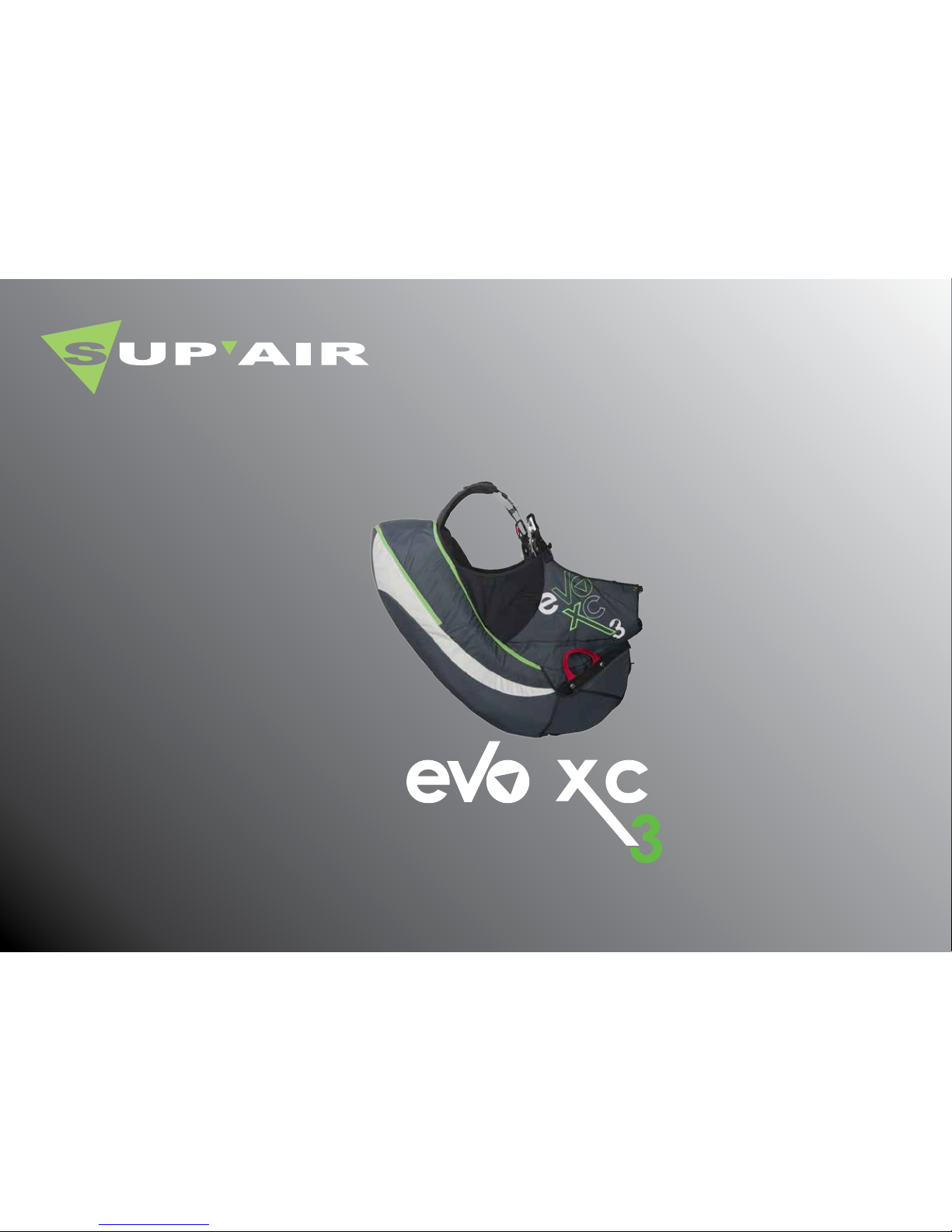
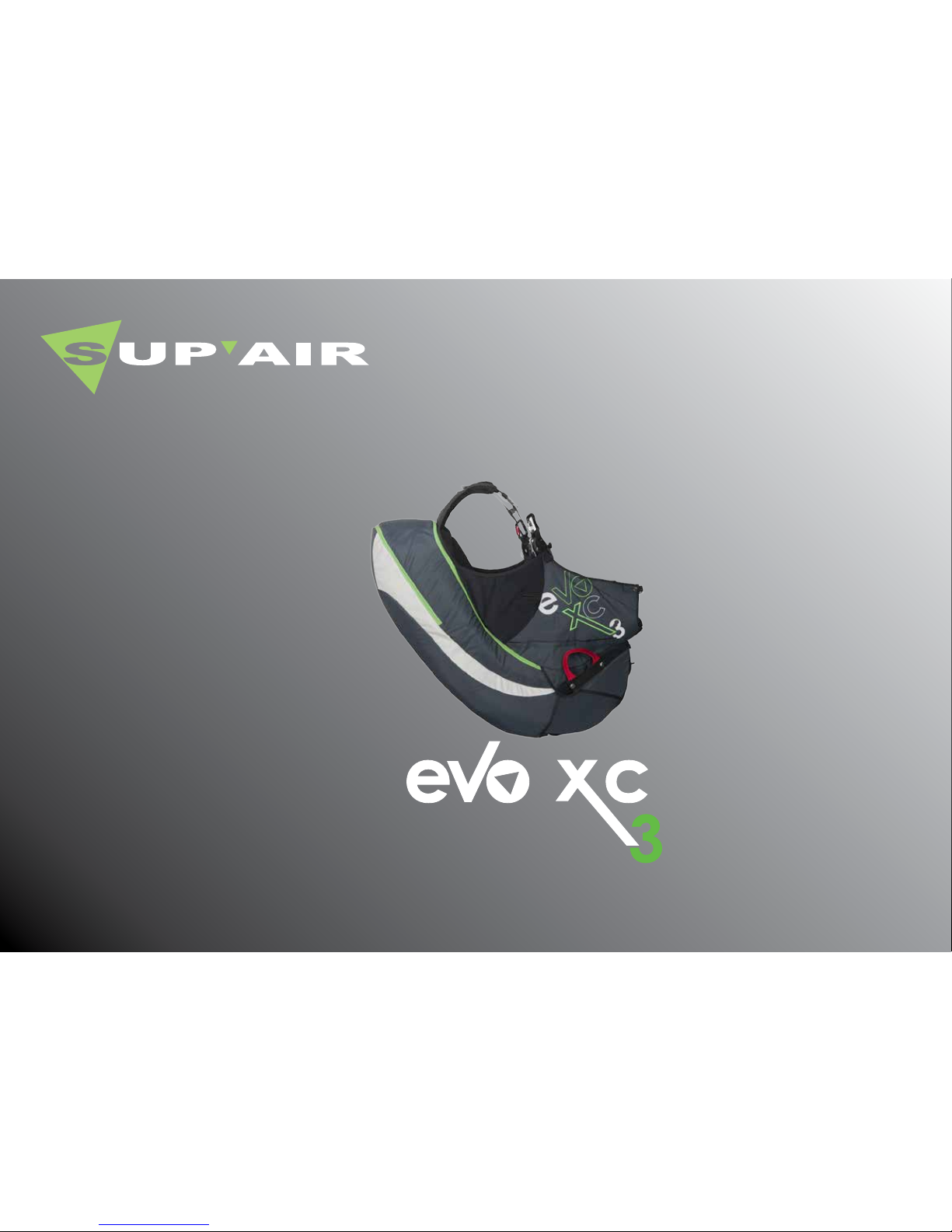
Harness EVO XC3
User’s manual
SUP’AIR - VLD
34 rue Adrastée
Parc Altaïs
74650 CHAVANOD
FRANCE
45°54.024’N / 06°04.725’E
English
Revision index: 29/07/2016
Page 2
SUP’AIR manufactures its products in Europe. Most of the components used are Made in Europe.
SUP’AIR_EVO XC3 Page2
User’s manual EVO XC3
Thank you for choosing an EVO XC3 ! We are proud to join you on your journey in our
common passion: paragliding.
SUP’AIR has been designing producing and selling accessories for free flying activities
since 1984. By choosing a SUP’AIR product you benefit from almost thirty years of expertise innovation and listening to customer feedback. This is also our philosophy: working
endlessly to develop better products and to maintain a high quality production in Europe.
We trust that you will find this manual comprehensive, explicit and hopefully pleasant to
read. We advise you to read it carefully !
On our website www.supair.com, you will find the lastest updated information about this
product. If you have any further questions, feel free to ask one of our retailers. And of
course, the entire SUP’AIR team is at your disposal through [email protected]
We wish you many safe flights, enjoyable hours and happy landings.
The SUP’AIR team
Pilote : Jérome Maupoint, SUP’AIR
Page 3
SUP’AIR manufactures its products in Europe. Most of the components used are Made in Europe.
SUP’AIR_EVO XC3 Page3
User’s manual EVO XC3
Introduction 4
Technical specifications 5
Size choice 6
Nomenclature 7
Harness overview 8
Seat plate assembly 9
BUMPAIR assembly 10
Speed-bar system 11
Foot-rest (Option) 12
Reserve parachute installation 13
Speedbag + optional cockpit assembly 18
Shoulder straps adjustments 22
Behavior in flight 25
Pre-Flight check 26
In flight 27
Complements/Accessories 26
Maintenance 31
Cleaning and harness maintenance 31
Storage and transport 31
Product lifespan 31
Repairs 32
Materials 32
Recycling 32
Respecting the environment 33
Disclaimer 33
Pilot’s gear 33
Service Book 34
Contents
Pilot : Jérome Maupoint, SUP’AIR.
Page 4
SUP’AIR manufactures its products in Europe. Most of the components used are Made in Europe.
SUP’AIR_EVO XC3 Page4
User’s manual EVO XC3
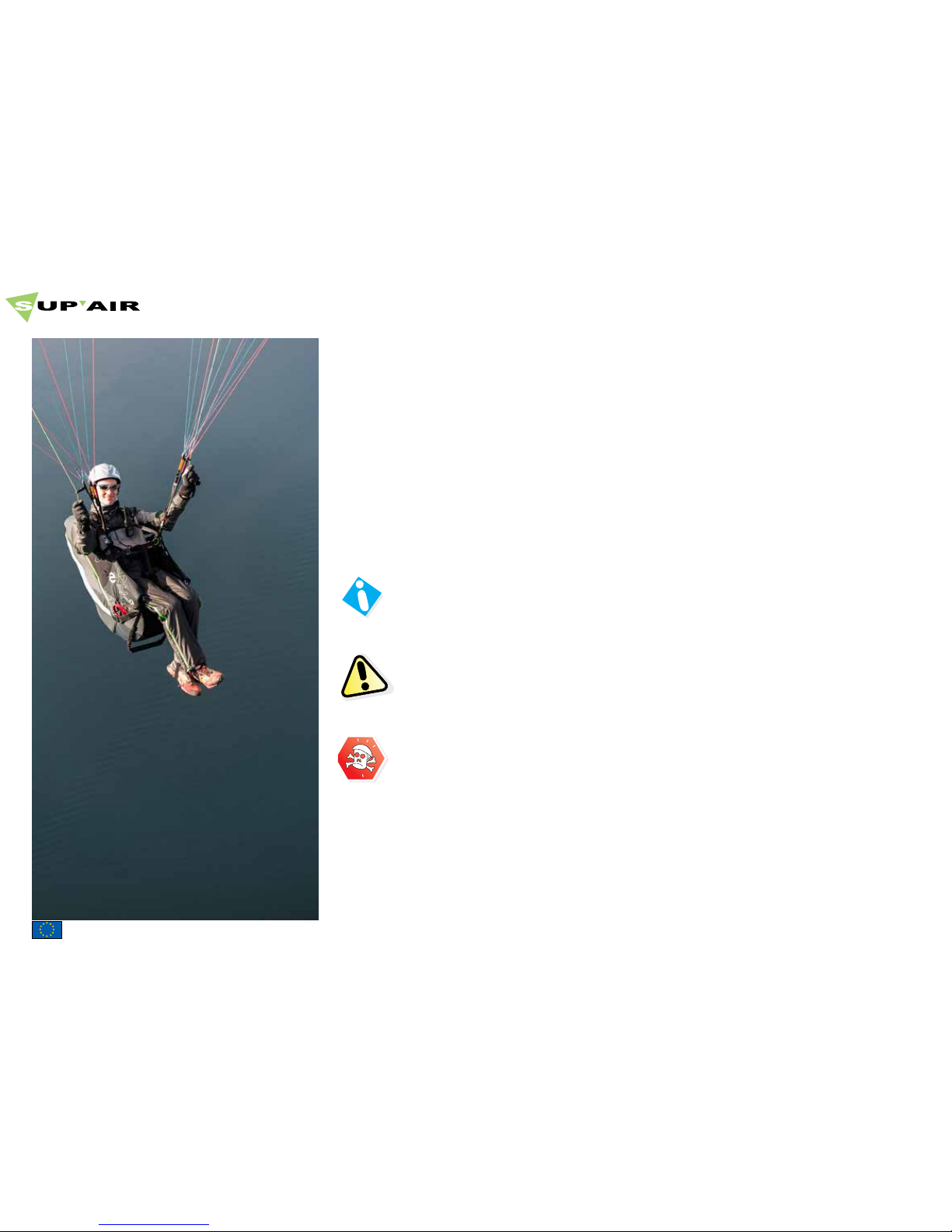
Welcome to the world of paragliding ! With the EVO XC3 you are equipped with a complete product to help you broaden your horizons and let you discover new Cross Country thermal flights.
With its great comfort level, a BUMPAIR 17 cm, and a reserve parachute pocket under the seat,
you will be able to handle any kind of soaring condition anywhere.
Introduction
After reading this manual, we suggest you check your harness by conducting a hang-test prior to
your intitial flight with it.
N.B : Three important icons will help you understand this manual :
Advice.
Caution !
Danger !!
Page 5
SUP’AIR manufactures its products in Europe. Most of the components used are Made in Europe.
SUP’AIR_EVO XC3 Page5
User’s manual EVO XC3
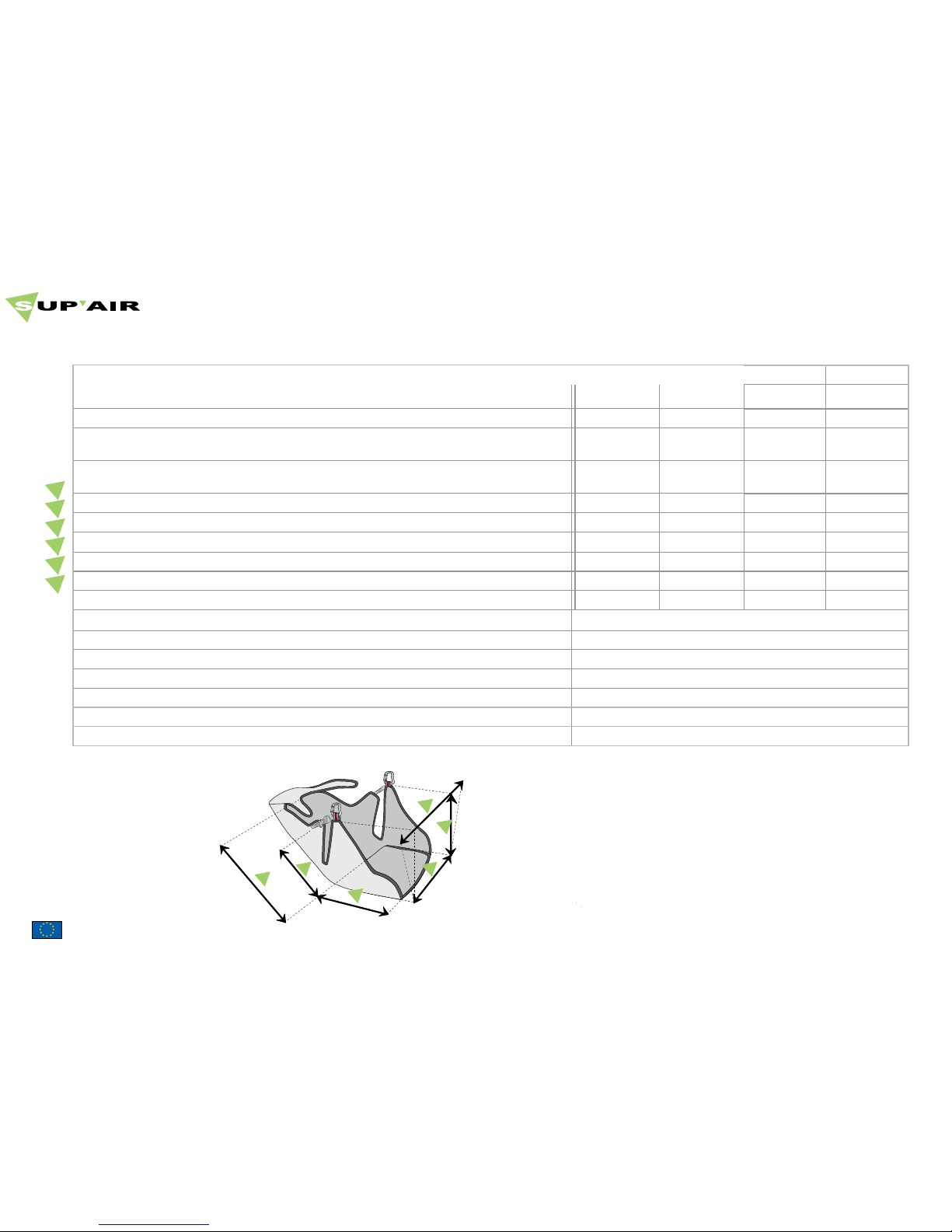
S M L XL
Pilot size
160-175 cm 165-185 cm 175-195 cm 195-205 cm
Pilot weight 50-75 kg 60-90 kg 70-100 kg 80-110 kg
Harness weight in standard version ( Bumpair
17cm, wooden seat plate, two self-locking
carabiners )
4560 g 4640 g 4940 g 5005 g
Harness weight in « + » version
( Bumpair 17cm, carbon fiber seat plate, foot-rest, risers, two
self-locking carabiners )
4315 g 4395 g 4695 g 4760 g
Backrest height (cm) 65 67 70 75
Reclined seating height (cm) 37 38 39 40
Seat length (cm)
44 48 49 51
Seat width (cm) 33 35 37 39
Carabiners height (cm). 44 44 44 44
Carabiners distance between the two (cm) 39-50 39-50 39-50 39-50
Impact damping system : Airbag (Volume)
No
Impact damping system : Bumpair (Thickness) Yes
Certification EN 1651 - LTF
Flight : tandem (Pilot- Passenger) Possible
Flight : acrobatic flying No
Take-off : Winching - towing Yes
Jettisoning carabiners compatibility No
Technical specifications
A
B
C
D
E
F
A
B
C
D
E
F
Hauteur du dos
Hauteur réglage de
l'inclinaison du
dossier
Longueur d'assise
Largeur d'assise
Hauteur des points
Distance entre les
points
A
B
C
D
E
F
Page 6
SUP’AIR manufactures its products in Europe. Most of the components used are Made in Europe.
SUP’AIR_EVO XC3 Page6
User’s manual EVO XC3
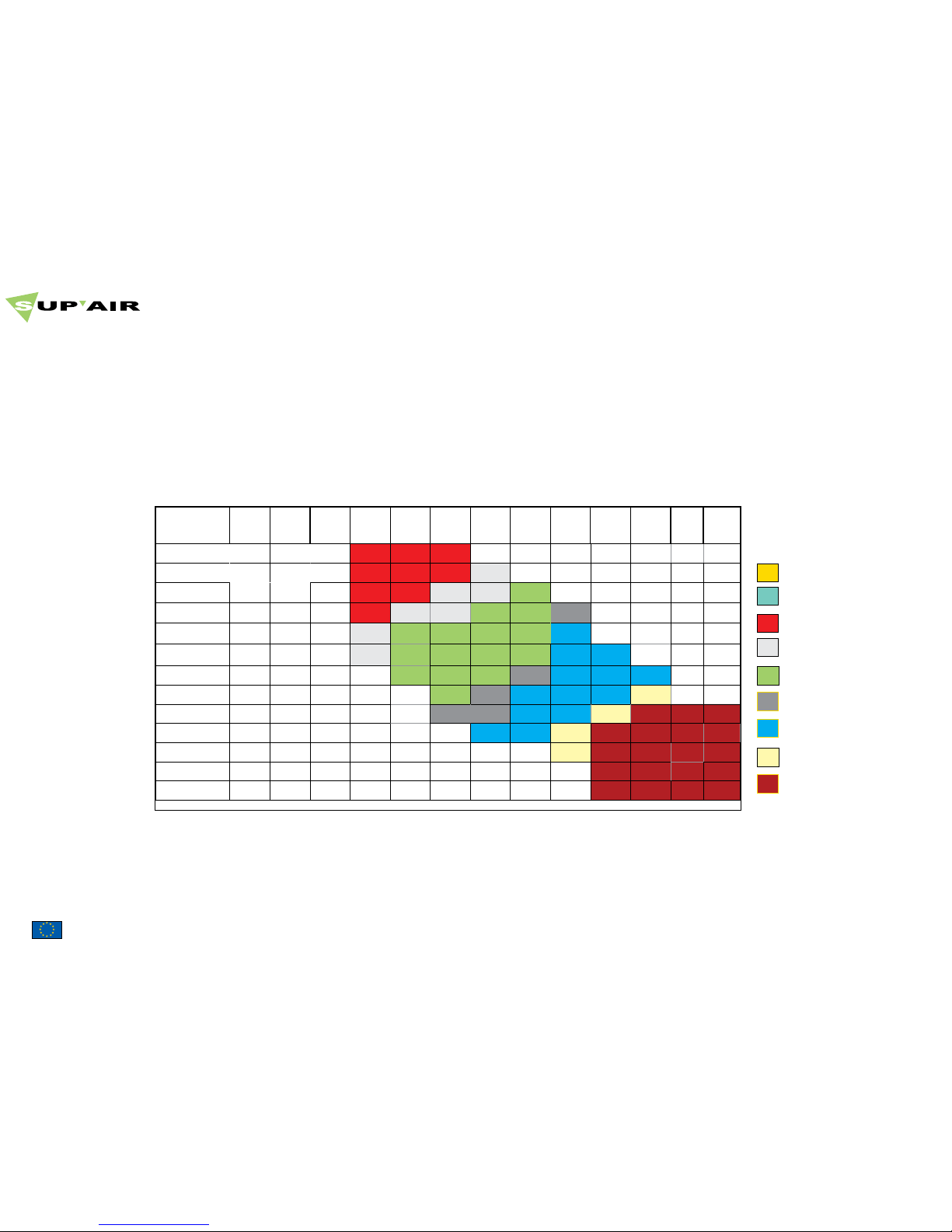
Size
Weight
1m45 1m50 1m55 1m60 1m65 1m70 1m75 1m80 1m85 1m90 1m95 2m 2m05
50 S S S
55 S S S
60 S S M
65 S M M
70 M M M M L
75 M M M M L L
80 M M M L L L
85 M L L L
90 L L XL XL XL
95 L L XL XL XL XL
100 XL XL XL XL
105 XL XL XL XL
110 XL XL XL XL
Choosing your harness size is important. You will find below a measurement chart to help with your
selection. We recommend you to try out the harness in different sizes during a hang test at the nearest SUP’AIR dealers location for proper fitting.
For a complete list of our retailers please click here : www.supair.com
Size choice
M
M/L
L
L/ XL
XL
S/M
S
XS/S
XS
Preliminary test under hanging device.
Page 7
SUP’AIR manufactures its products in Europe. Most of the components used are Made in Europe.
SUP’AIR_EVO XC3 Page7
User’s manual EVO XC3
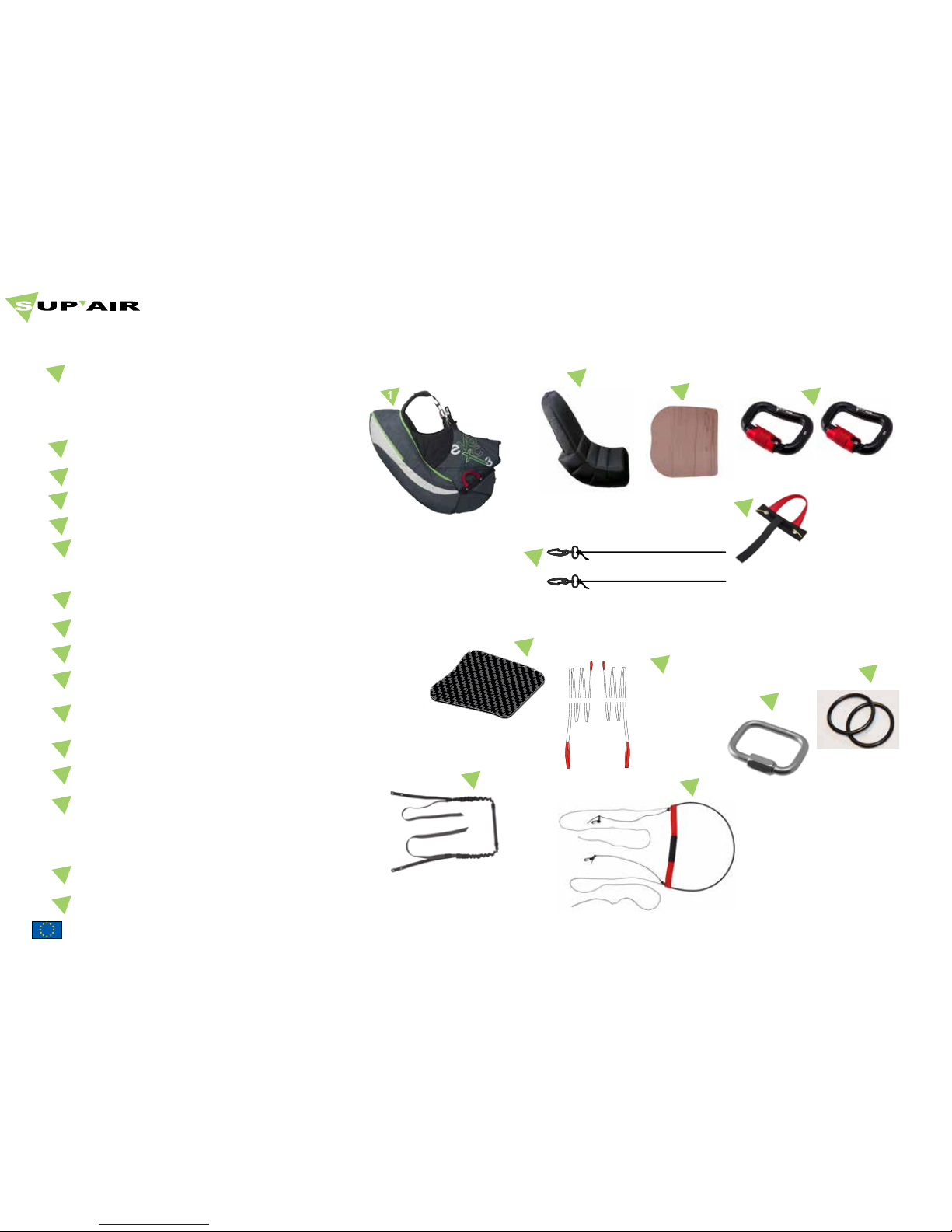
1
5
EVO XC3 harness
Carbon fiber seat plate, see corresponding size on page
9
30mm Zicral Self-locking carabiners
Reserve parachute handle ( ref : E2 )
Standard double stage speedbar
Self-retractable foot-rest 20mm
Nomenclature
Options
1
3
Solo Dyneema individual risers
7mm Maillon Rapide®
Toric ring ( x2 )
7
Standard version.
2
Wooden seat plate ( see corresponding
size on page 9 )
3
30 mm Self-locking Zicral
Version +
4
Reserve parachute handle ( ref : E2 )
BUMPAIR 17 XC
BUMPAIR 17 XC
EVO CX3 Speedbag
2
4
6
5
8
7
8
2
5
4
6
9
10
11
12
13
elastic cord for speedbar return
9
10
11
12
Page 8
SUP’AIR manufactures its products in Europe. Most of the components used are Made in Europe.
SUP’AIR_EVO XC3 Page8
User’s manual EVO XC3
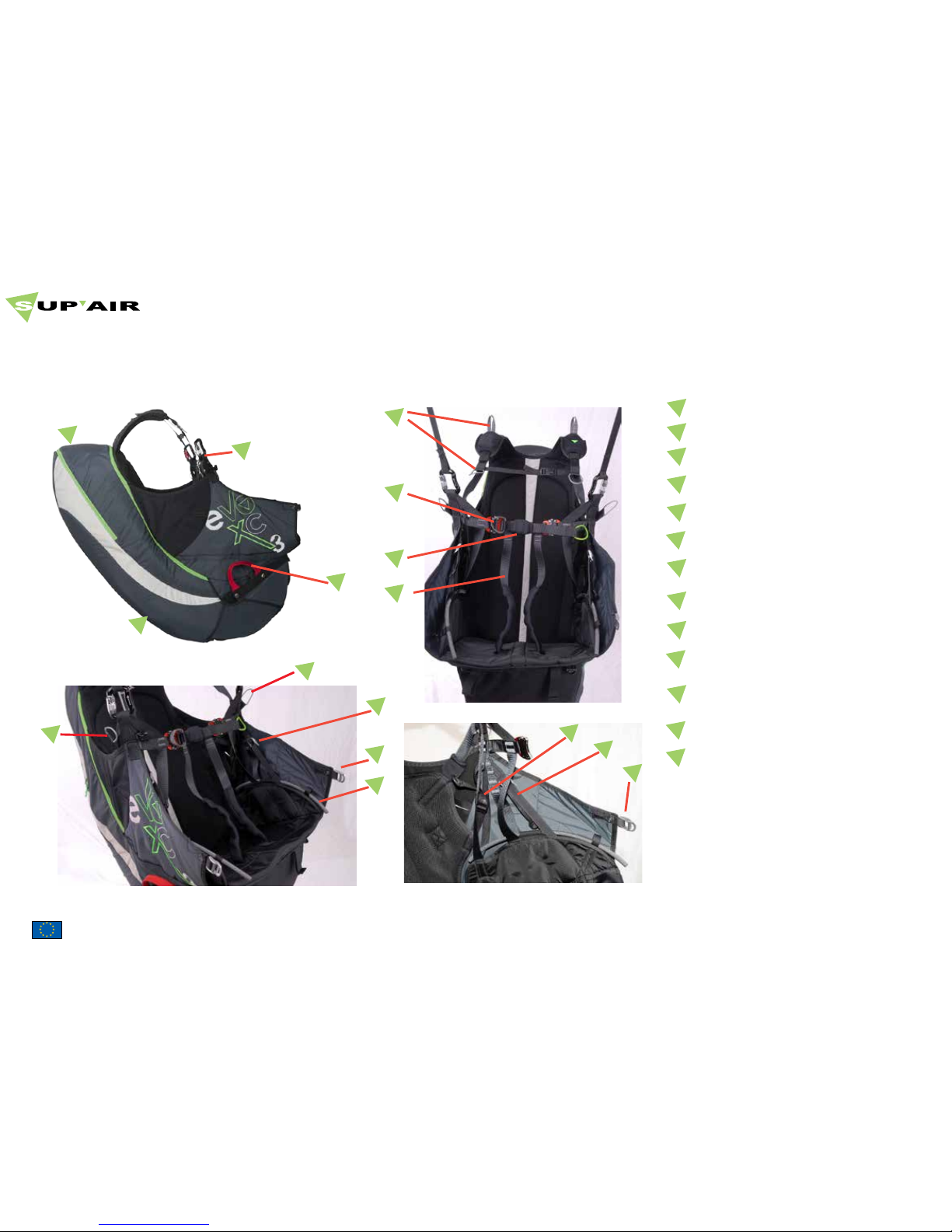
Harness overview
This illustration will help you understand the manual content.
1
8
2
3
4
5
7
6
Attachment points.
Main buckles.
Chest strap adjustment.
Leg straps.
Backrest tilt adjustment.
Shoulder straps adjustments.
Seat plate angle adjustment.
9
10
Seat depth adjustment.
Foot-rest buckle.
Speed-bar guide.
Reserve parachute handle.
Dorsal pocket.
11
12
3
1
BUMPAIR placement.
1
2
3
4
5
5
6
7
7
8
9
10
9
11
12
3
1
Page 9
SUP’AIR manufactures its products in Europe. Most of the components used are Made in Europe.
SUP’AIR_EVO XC3 Page9
User’s manual EVO XC3
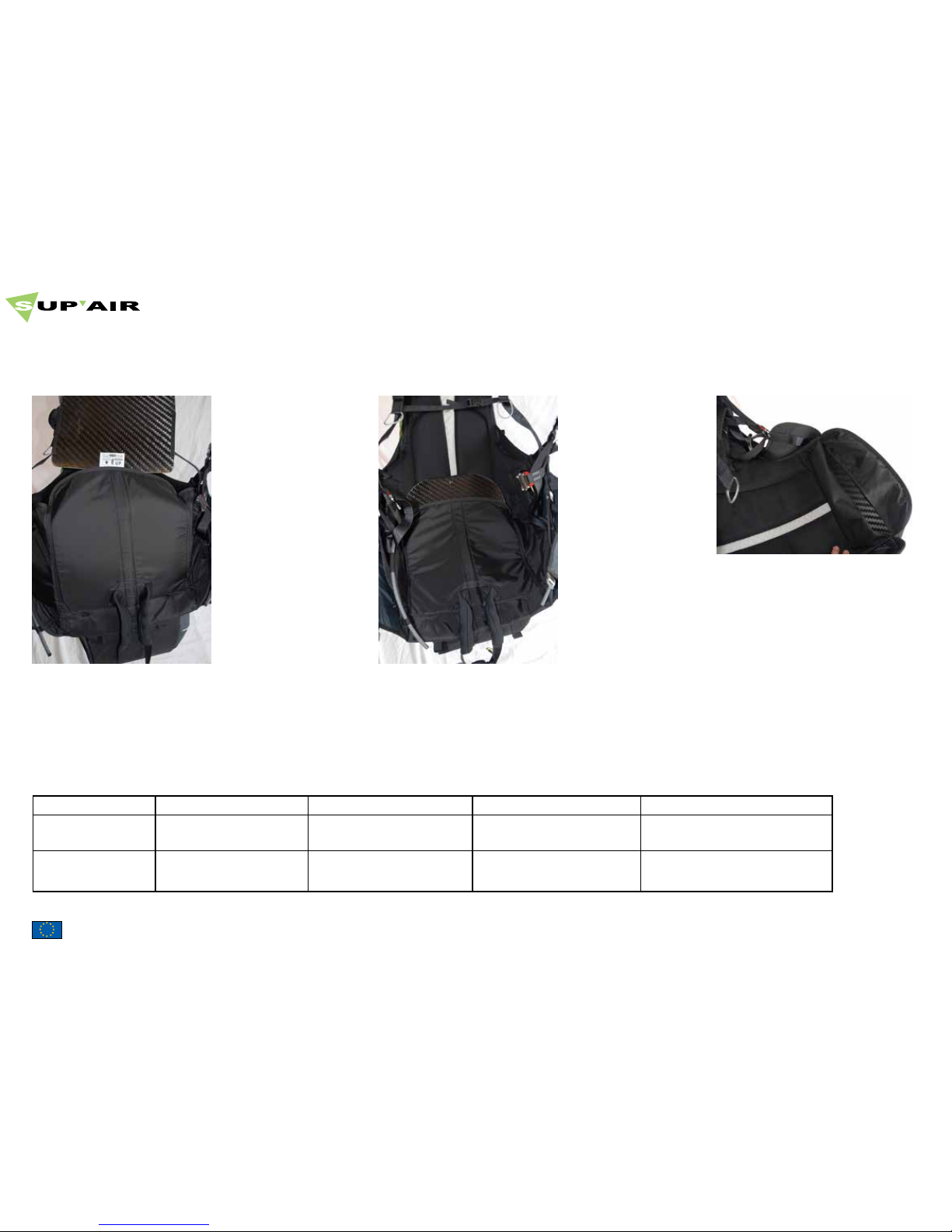
Installing the seat-plate.
The EVO XC3 can be equipped with a wooden or a carbon fiber seat plate to loose overall harness weight.
Lift the rear end of the seat
fabric, and insert the seat
plate leading edge first.
Push the seat plate all the way
to the end of the housing.
Once the seat plate is fully inserted in its housing, fold the hood
over it.
Size S Size M Size L Size XL
Wooden seat
plate.
Wooden seat plate. S 33x34
Ref. ( Reference ). : MPPL017
Wooden seat plate. M 35x37
Ref. ( Reference ). : MPPL018
Wooden seat plate. L 37x37
Ref. ( Reference ). : MPPL019
Wooden seat plate. XL 39x37
Ref. ( Reference ). : MPPL020
Carbon fiber seat
plate.
Carbon fiber seat plate. S
33x34
Ref. ( Reference ). : MPPL005
Carbon fiber seat plate. M 35x37
Ref. ( Reference ). : MPPL006
Carbon fiber seat plate.
L 37x37
Ref. ( Reference ). : MPPL007
Carbon fiber seat plate. XL 97x37
Ref. ( Reference ). : MPPL008
Corresponding seat plates for the various harness sizes.
Page 10
SUP’AIR manufactures its products in Europe. Most of the components used are Made in Europe.
SUP’AIR_EVO XC3 Page10
User’s manual EVO XC3
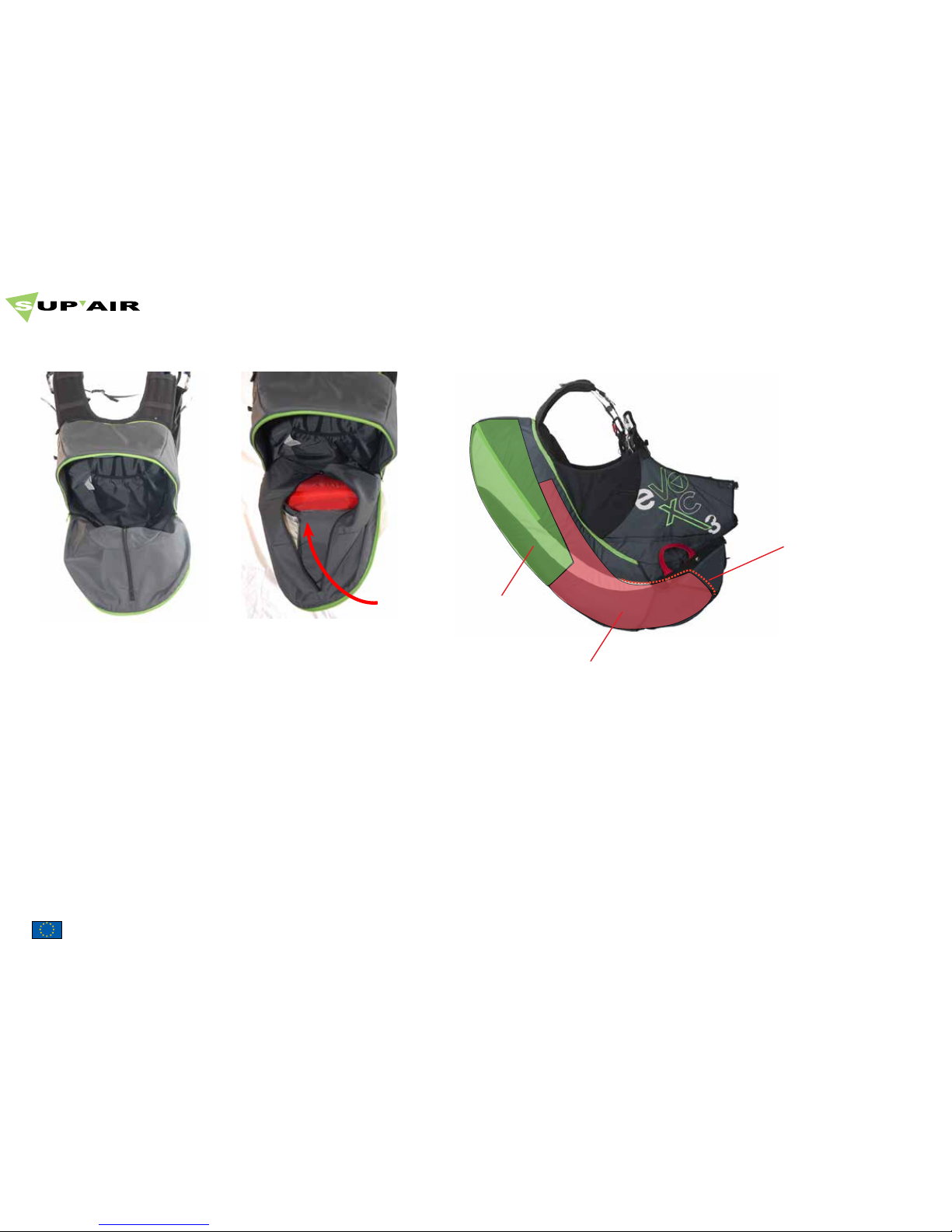
BUMPAIR assembly.
Inside the dorsal pocket :
open the vertical zip.
Insert the BUMPAIR 17XC
inside the slot.
Push the BUMPAIR between the exterior of the container and the BUMPAIR housing.
Once the BUMPAIR is fully inserted inside its housing,
push behind the dorsal pocket.
Once the BUMPAIR is fully inserted inside its housing,
close the vertical zipper.
BUMPAIR housing.
Dorsal pocket.
BUMPAIR 17 XC.
Page 11
SUP’AIR manufactures its products in Europe. Most of the components used are Made in Europe.
SUP’AIR_EVO XC3 Page11
User’s manual EVO XC3
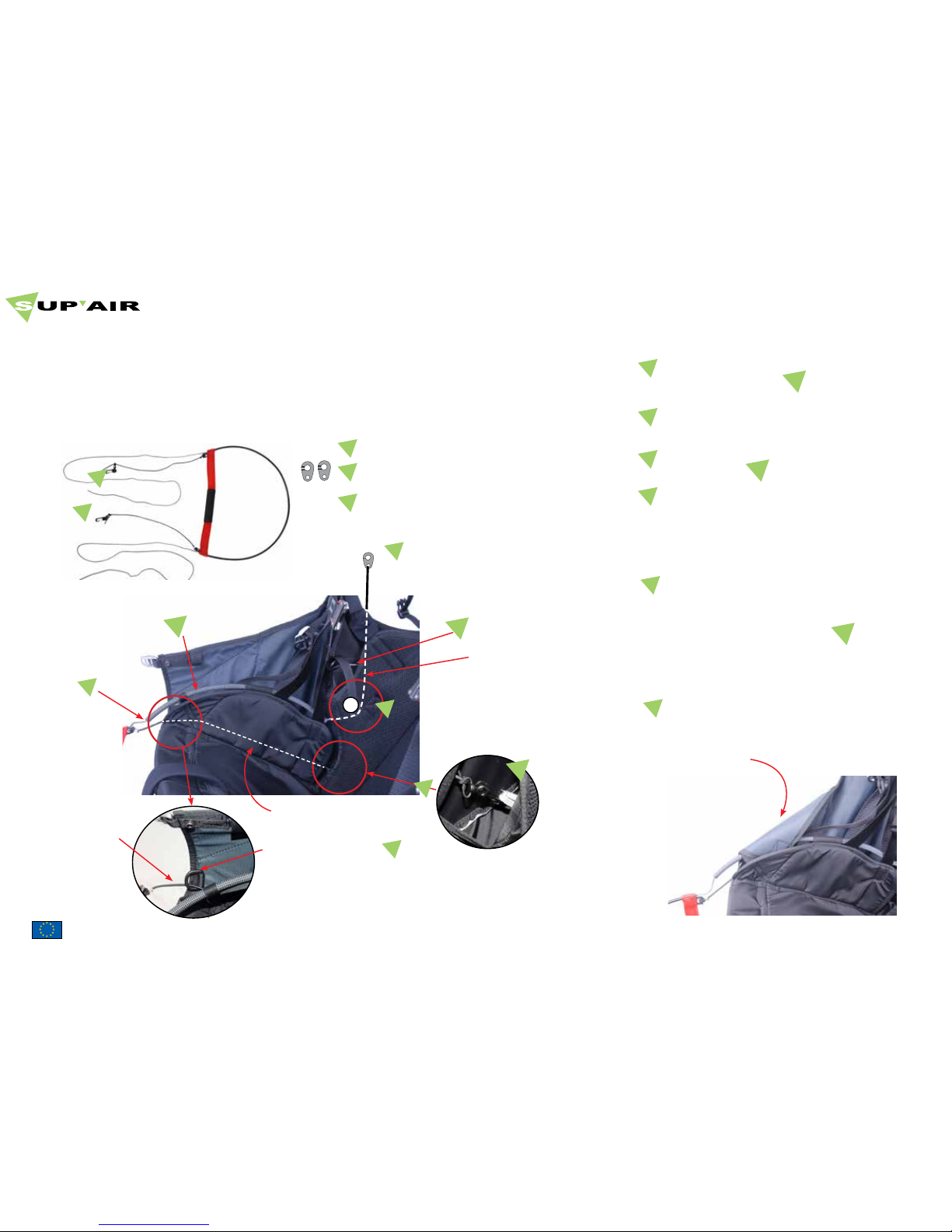
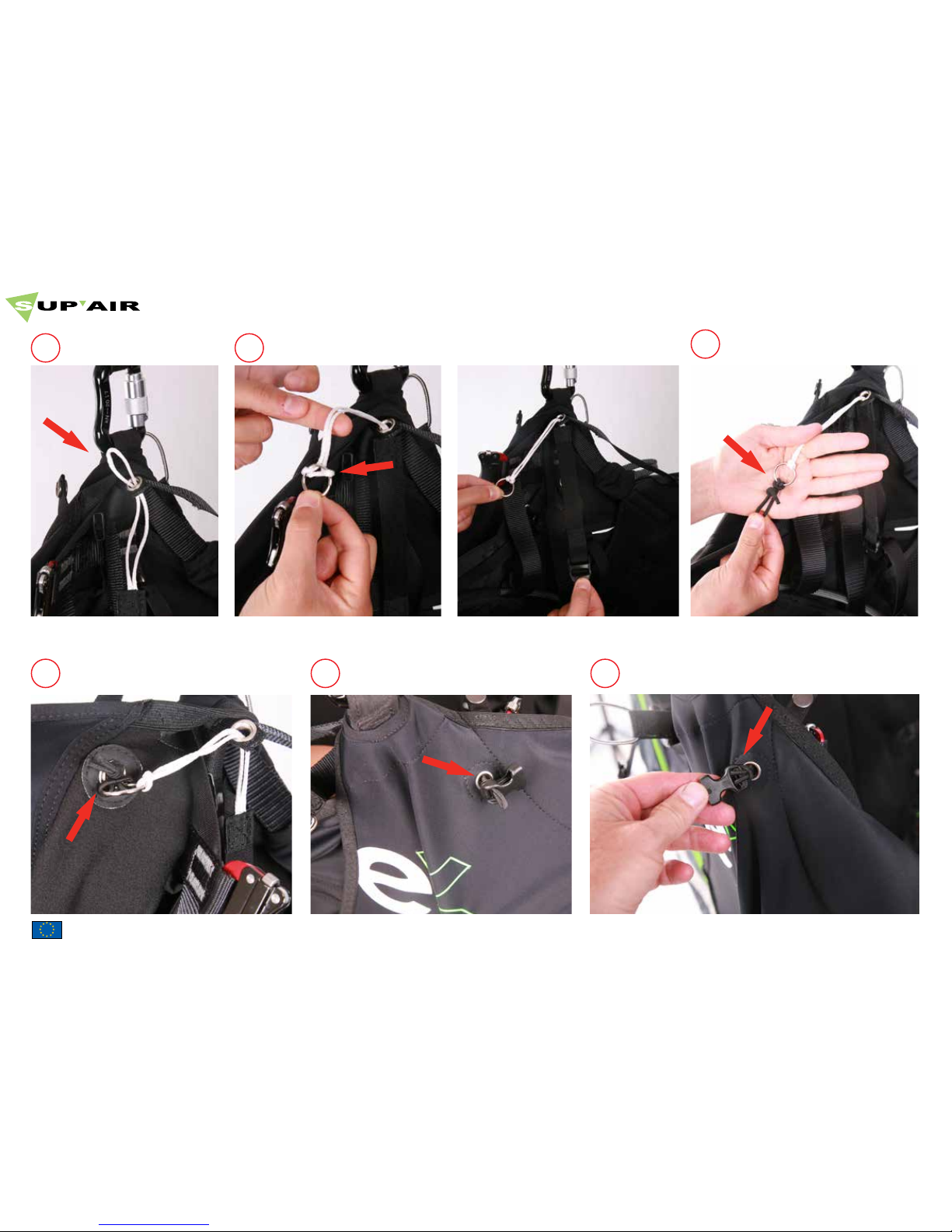
Push the accelerator cord through the lateral skirt slot.
Installing the speed-bar system.
The EVO XC3 is pre-equipped to use a speed-bar as most of our harness models are. Within
the SUP’AIR gear lineup, the standard speed-bar is the most adaptable for being the lightest and self-retractable.
4
3
2
1
Push the accelerator cord through the
guiding tube.
Push the speed-bar line through the pulley.
Attach the end of the speed-bar lines to the
crimped hooks which is to be connected to
the riser’s crimped hooks. Adjust the lines
length and securely knot it.
A
Lines
B
C
Crimped hooks
Elasticated self-retractable speed-system
Self-retracting speed-system: push the
elastic cords through the ( D ) ring to connect them to the white loop stitched on the
inner sides of the harness.
5
A
C
If the foot rest is not used, the lateral skirt
can be folded over and around the guiding tube and close by pressing the button.
6
E
1
3
4
5
2
D
F
D
E
(D) shaped buckle.
Elasticated
recoil cord.
Elasticated recoil cord.
Speed-bar cord.
F
5
Page 12
SUP’AIR manufactures its products in Europe. Most of the components used are Made in Europe.
SUP’AIR_EVO XC3 Page12
User’s manual EVO XC3
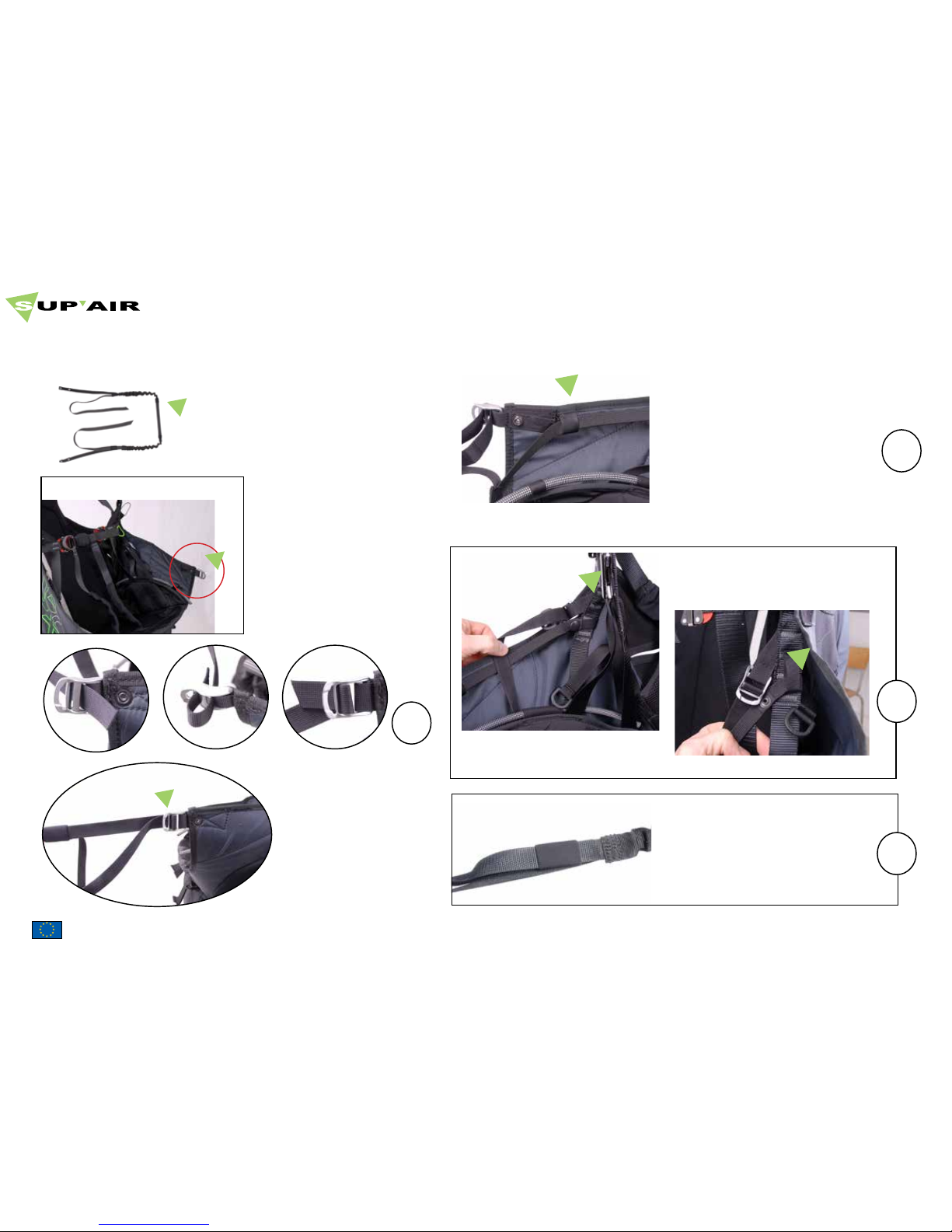
Foot-rest installation (Option).
The EVO XC3 is pre-equipped
to accept a retractable footrest 20mm (A).
B
B
A
Push the foot-rest strap
through buckle (B) located
at the front of the harness
side skirt.
Push the elastic under the
guide (C).
Wrap and connect the elastic
around the main strap while
pushing it through buckle (D).
Adjust the foot-rest length during
a hang-test, and stow away the
straps excess in the elasticated
holder.
1
2
3
4
C
D
D
Inner view.
Outer view.
Page 13
SUP’AIR manufactures its products in Europe. Most of the components used are Made in Europe.
SUP’AIR_EVO XC3 Page13
User’s manual EVO XC3
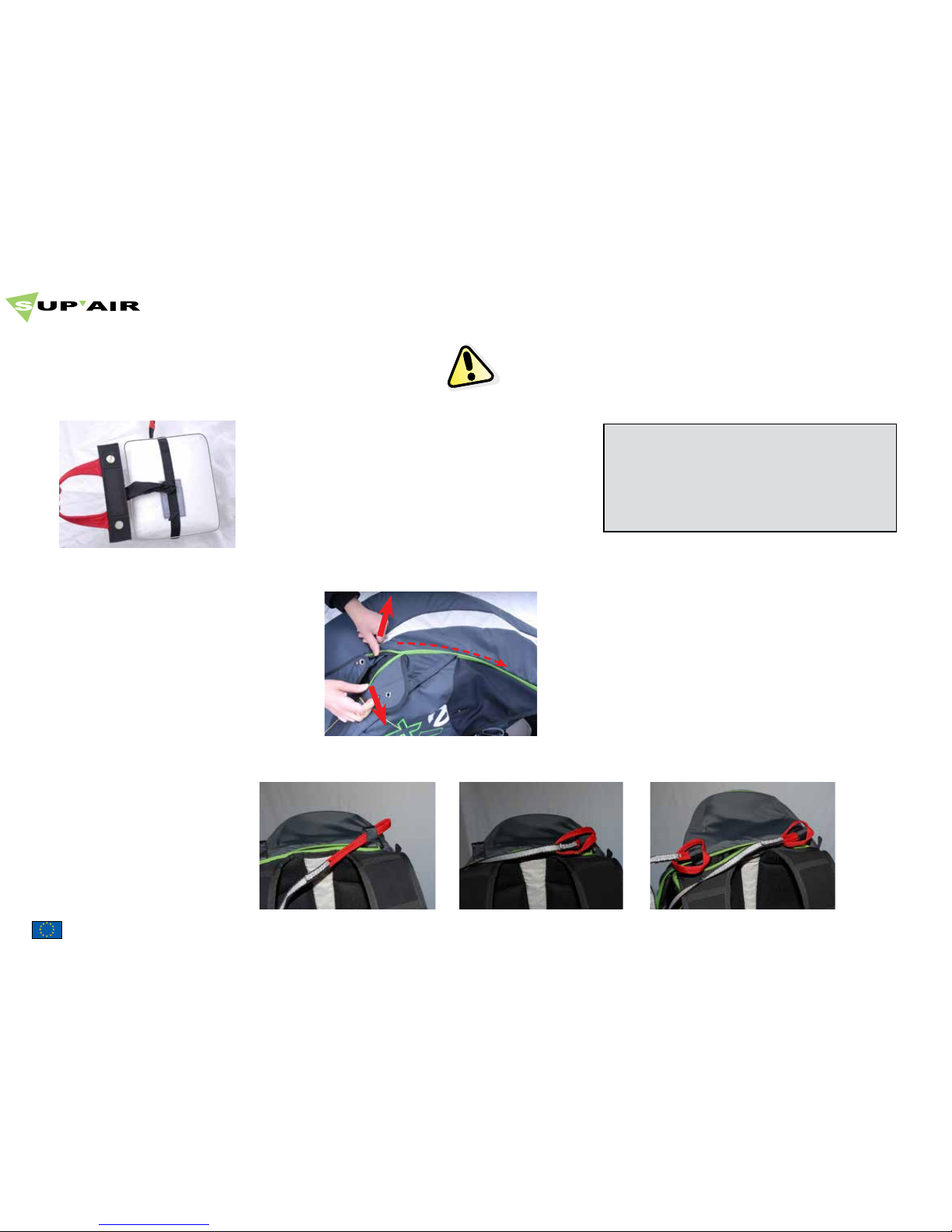
Thank you for carefully reading the following! We advise you to have
the initial rescue parachute installation done by someone knowledgeable with the process.
Rescue parachute setup assembly.
Connecting the handle to the rescue parachute’s deployment bag.
1. Place the handle inside the middle webbing
loop and make a lark’s head knot with the handle.
2. Fasten tightly the lark’s head knot, and verify
the solidity of the link.
The handle must be connected to the central
loop, except for large reserve parachutes ( use
side loop ). Must be checked at the end of the
installation procedure by gently pulling on the
handle, and make certain to disengage both
safety pins held in place
Setting up the reserve parachute risers guiding sleeves.
Completely open the reserve parachute
risers guiding sleeve zipper.
Connecting the risers to the harness.
Make a lark’s head knot configuration with each Dyneema
riser on the harness parachute
connections.
Page 14
SUP’AIR manufactures its products in Europe. Most of the components used are Made in Europe.
SUP’AIR_EVO XC3 Page14
User’s manual EVO XC3
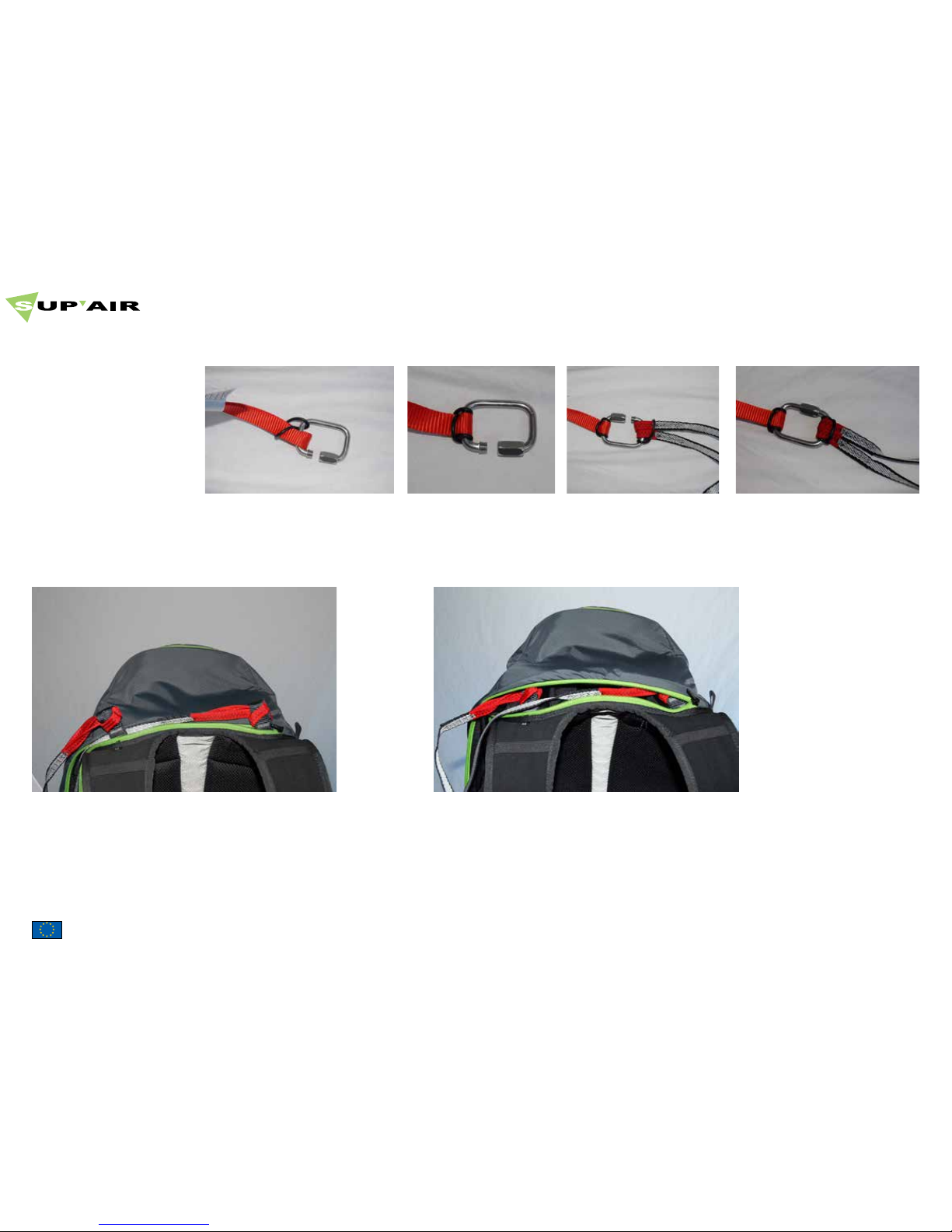
Connected risers to the harness ( lark’s
head knot connection ).
Tuck the risers away in the riser sleeve.
Connecting the reserve parachute to the Dyneema risers
Connecting the reserve
parachute with the parachute risers using the
7mm carabiners ( Maillon Rapide® ). Secure the
bridles in place, using the
toric elasticated rings.
Page 15
SUP’AIR manufactures its products in Europe. Most of the components used are Made in Europe.
SUP’AIR_EVO XC3 Page15
User’s manual EVO XC3
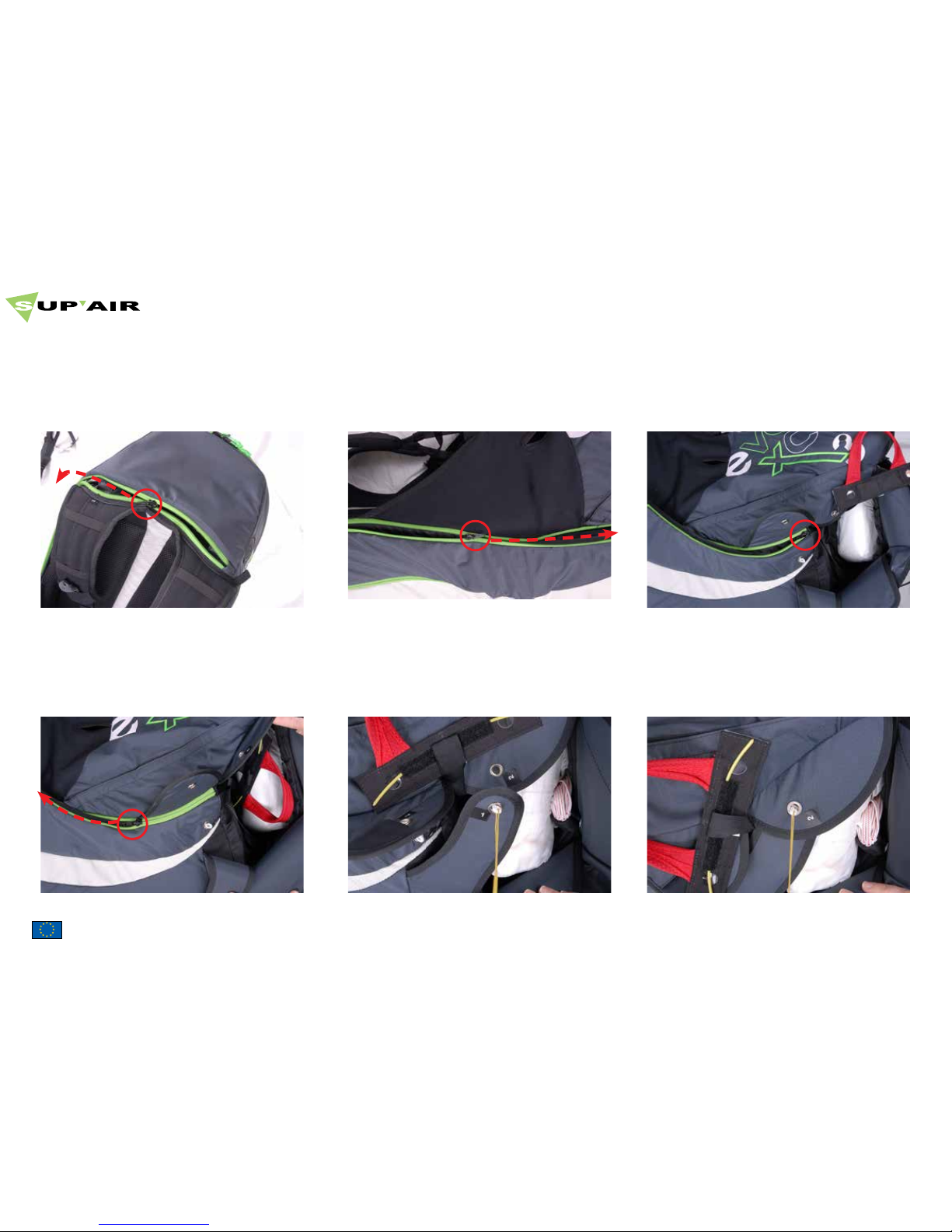
To close the protective riser sleeve... … lower the zipper tab down to the reserve parachute pocket level...
Once the tab can not move further and
aligned with the reserve parachute pocket ;
bring it up to close the zipper.
Place the POD in the pocket. Reserve handle
on the seat plate side, lines and risers facing
outward.
With a small cord : hook the loop - #1 marker.
Push the cord and the loop through grommet #2.
Page 16
SUP’AIR manufactures its products in Europe. Most of the components used are Made in Europe.
SUP’AIR_EVO XC3 Page16
User’s manual EVO XC3
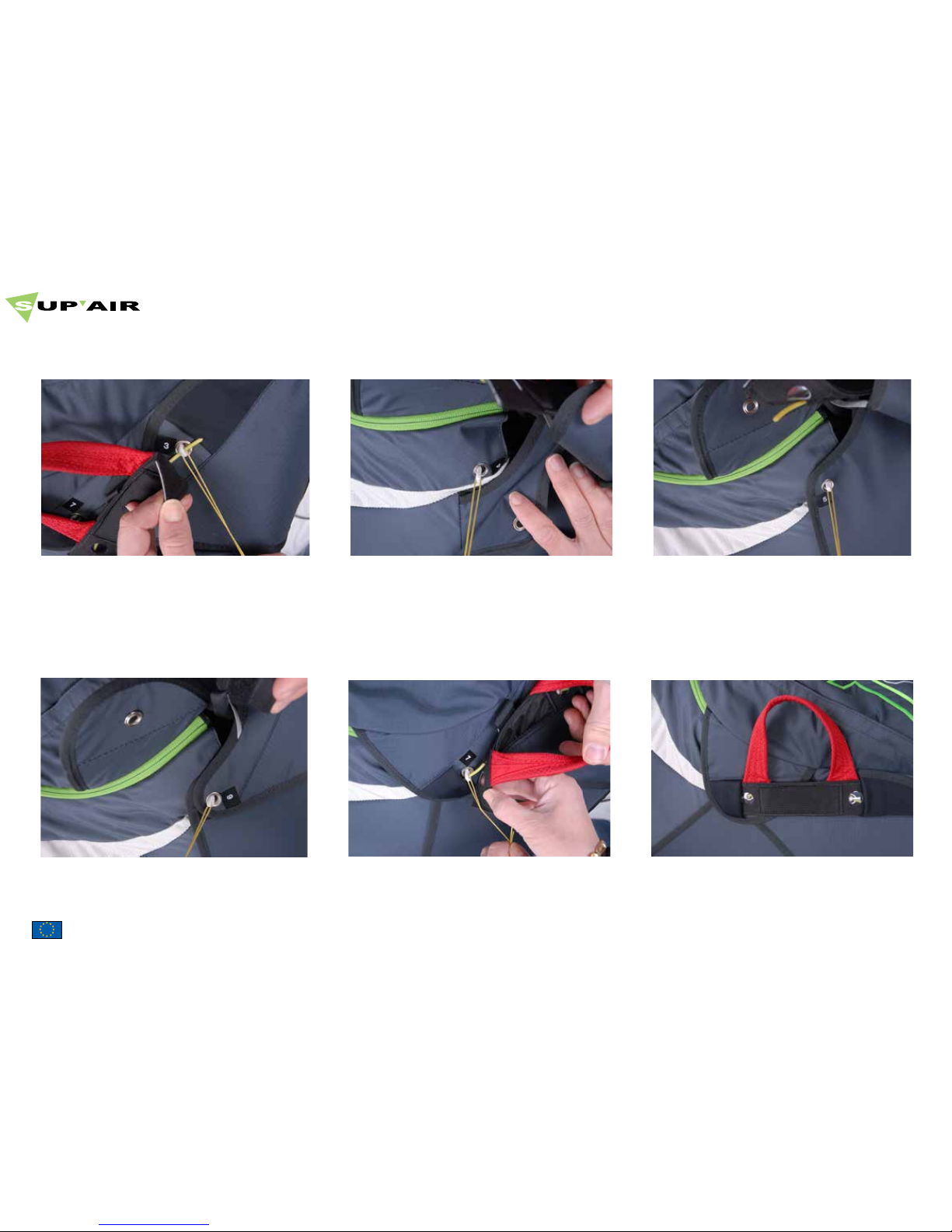
Push the cord with the loop through grommet #3, and push the handle’s pin through
the loop. Then tuck away the pin with the
handle’s end behind the neoprene flap #3.
Push the cord with the loop through grommet #7, and push the handle’s pin through
the loop.
With a small cord : hook the loop #4 marker. Push the cord and the loop through grom-
met #5.
Push the cord and the loop through grommet #6.
Then tuck away the pin with the handle’s
end behind the neoprene flap #7.
Page 17
SUP’AIR manufactures its products in Europe. Most of the components used are Made in Europe.
SUP’AIR_EVO XC3 Page17
User’s manual EVO XC3
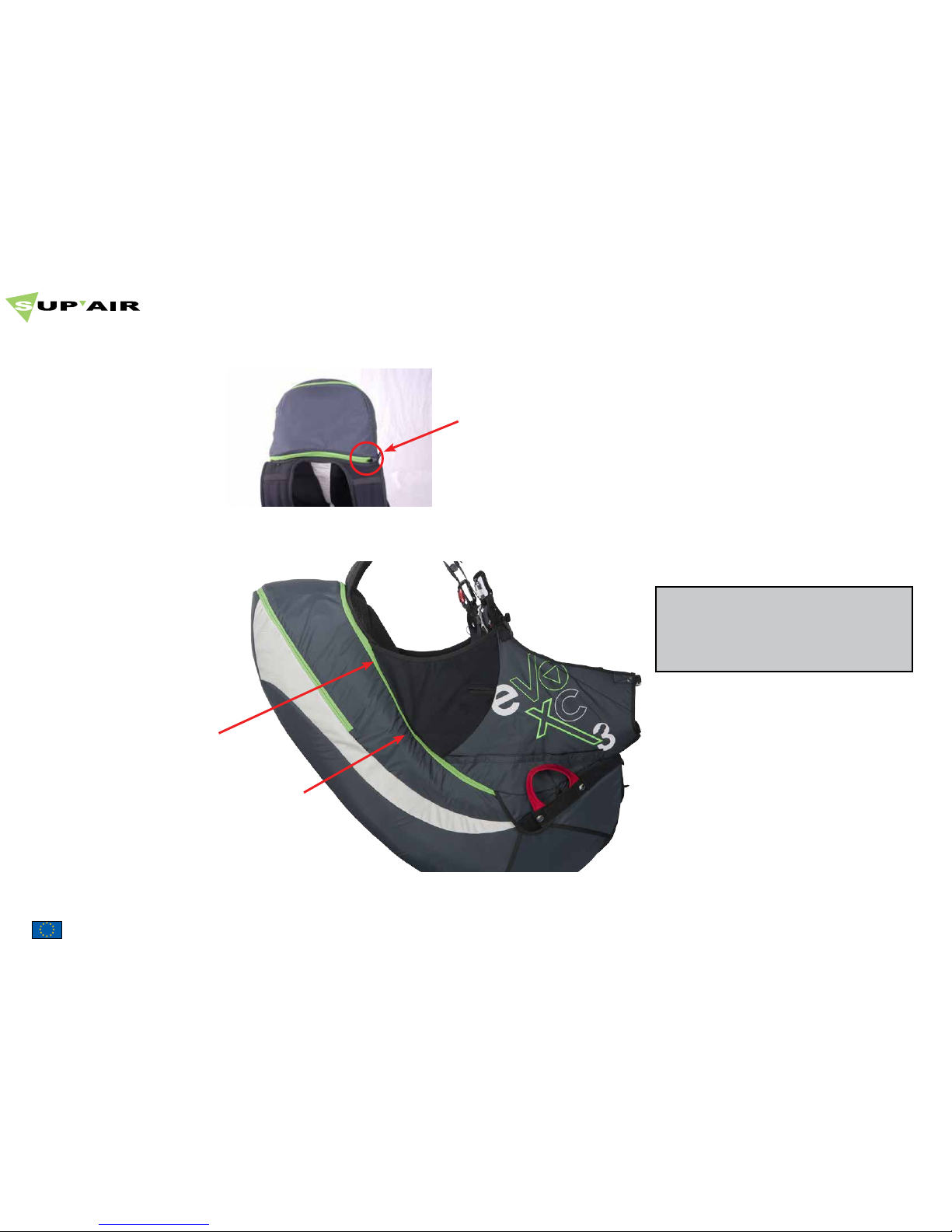
Upon setup completion, conduct an
extraction sequence during a hang-test
to verify that all works properly before
repeating the installation procedure.
Harness with reserve parachute overview.
Reserve parachute riser
protective sleeves.
The tab is located at the end of the zipper on the bridle side ( inside the fabric
sleeve ).
Zip up the reserve parachute
riser sleeve.
Top view
Page 18
SUP’AIR manufactures its products in Europe. Most of the components used are Made in Europe.
SUP’AIR_EVO XC3 Page18
User’s manual EVO XC3
1
5
6
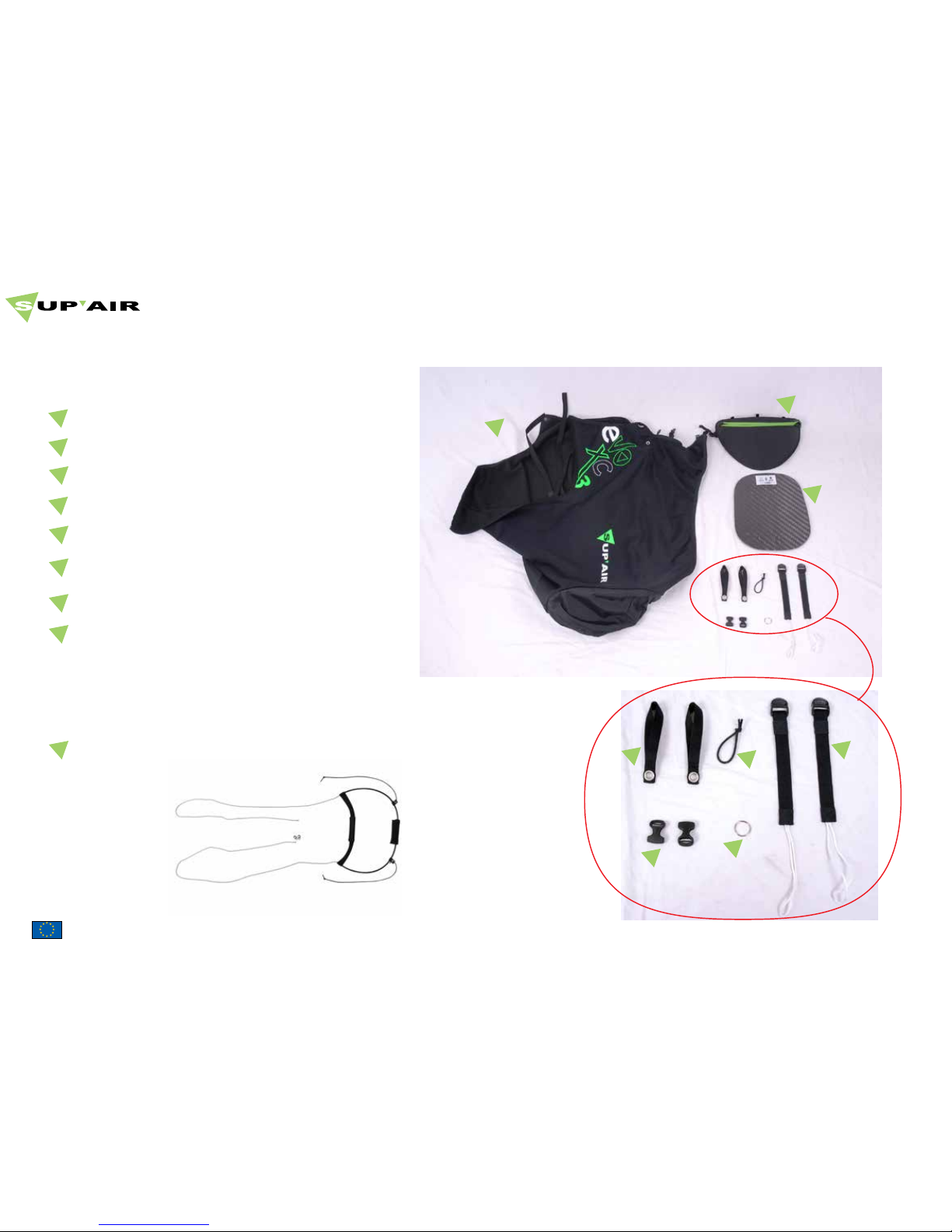
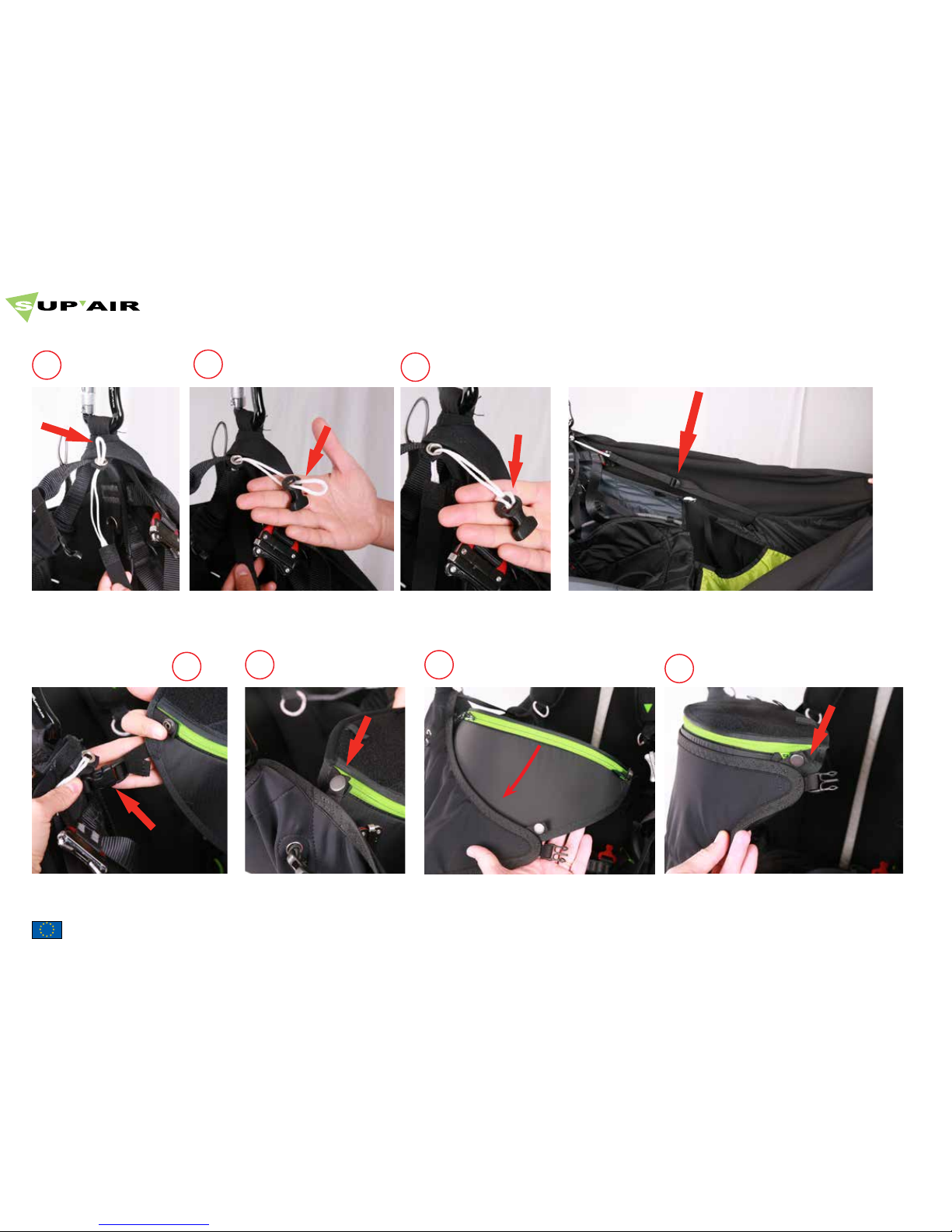
SPEEDBAG EVO XC3
Connecting elastic
Double stage speedbar
SPEEDBAG
Option
Female quick buckle 15mm
Connecting ring
7
8
9
2
SPEEDBAG plate.
3
Tape Loop
4
Weebing adjustment
COCKPIT XC
3
2
4
5
1
7
6
8
Page 19
SUP’AIR manufactures its products in Europe. Most of the components used are Made in Europe.
SUP’AIR_EVO XC3 Page19
User’s manual EVO XC3
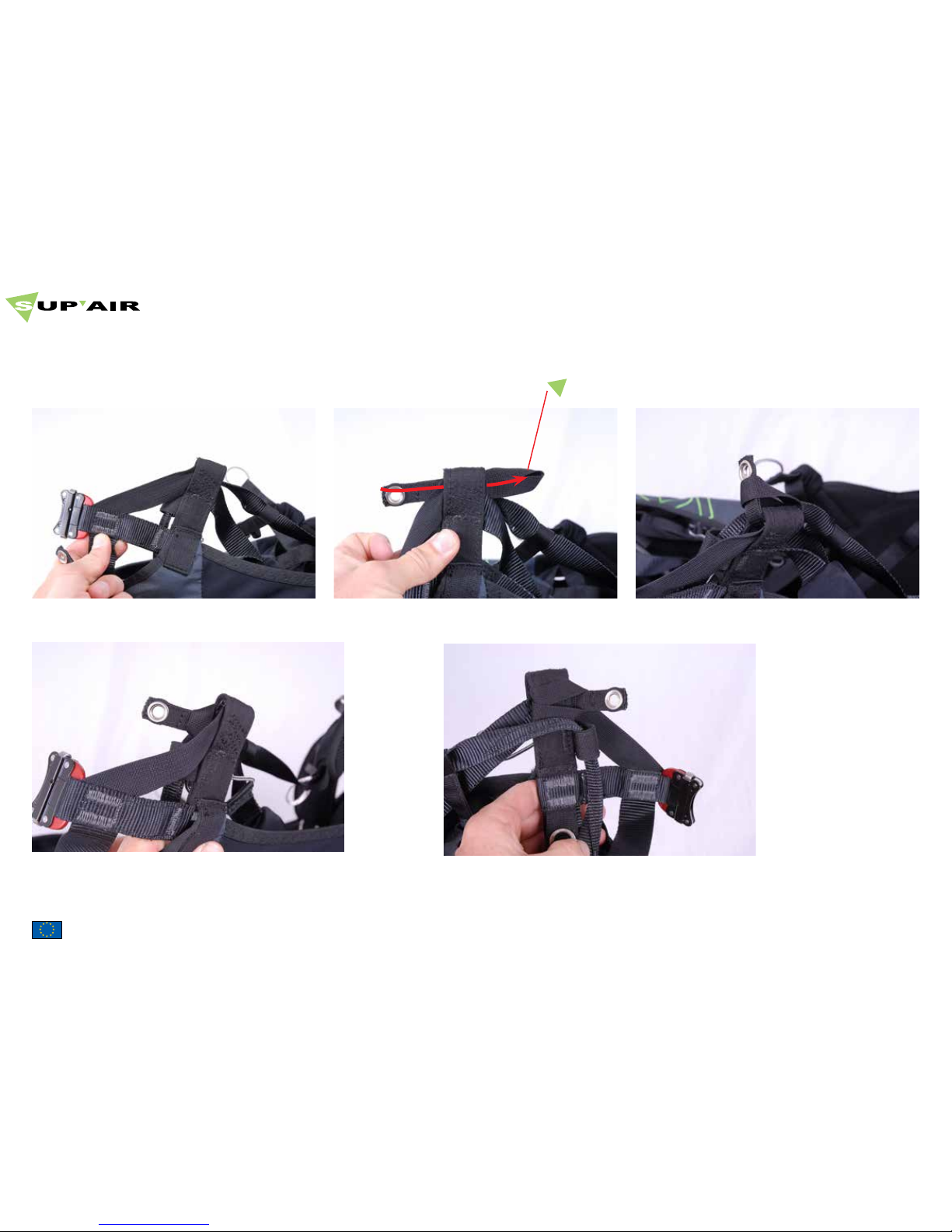
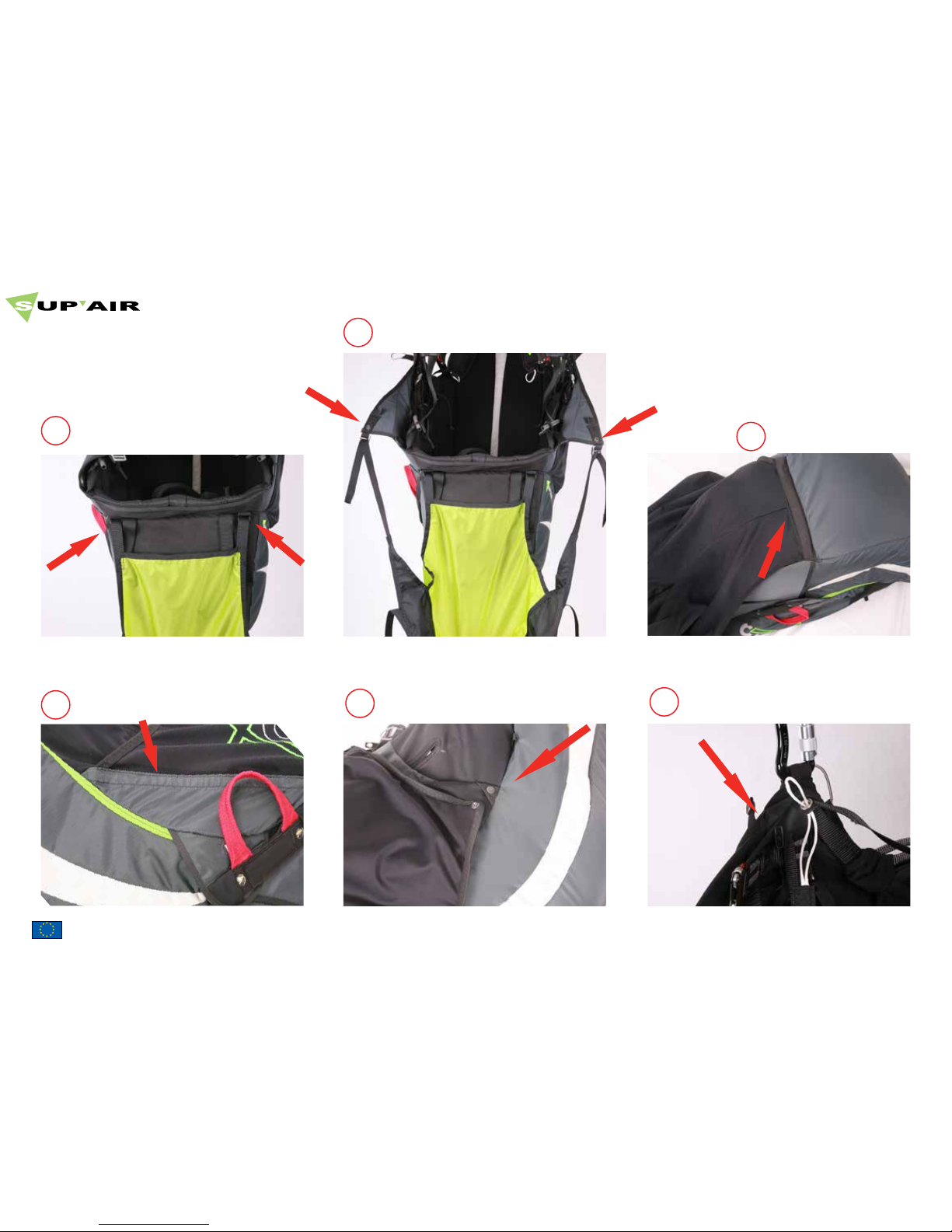
Installation
Install one tape loop N°4 on each side.
4
Outside view. Installation nished.
Inside view. Installation nished.
Page 20
SUP’AIR manufactures its products in Europe. Most of the components used are Made in Europe.
SUP’AIR_EVO XC3 Page20
User’s manual EVO XC3
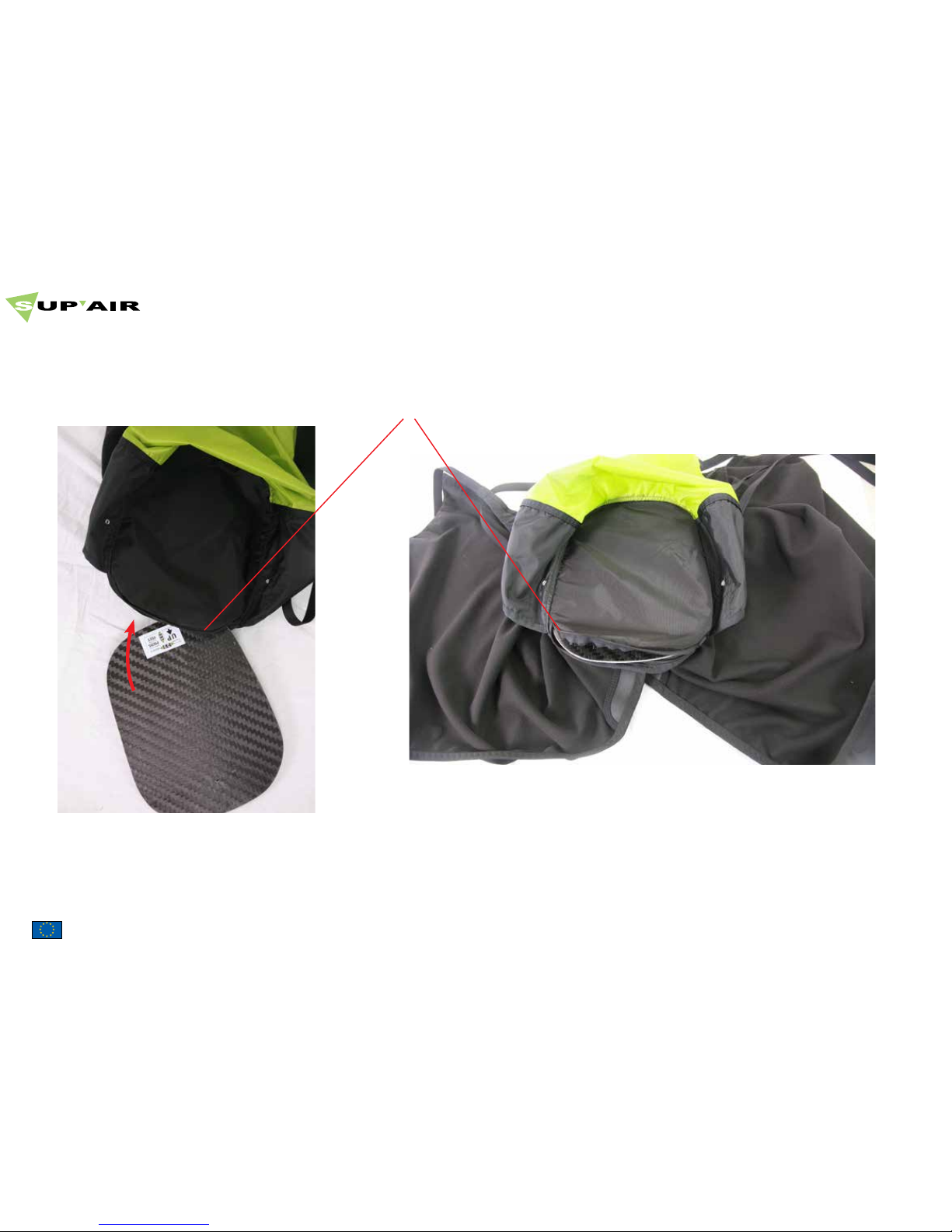
Zip
Speedbag plate installation
Page 21
SUP’AIR manufactures its products in Europe. Most of the components used are Made in Europe.
SUP’AIR_EVO XC3 Page21
User’s manual EVO XC3
1
2
3
4
5
6
Page 22
SUP’AIR manufactures its products in Europe. Most of the components used are Made in Europe.
SUP’AIR_EVO XC3 Page22
User’s manual EVO XC3
Right side
1 2
3
4 5 6
Inside Outside
Page 23
SUP’AIR manufactures its products in Europe. Most of the components used are Made in Europe.
SUP’AIR_EVO XC3 Page23
User’s manual EVO XC3
Left side
1
2
3
On each side
Cockpit
1
2 3
4
Page 24
SUP’AIR manufactures its products in Europe. Most of the components used are Made in Europe.
SUP’AIR_EVO XC3 Page24
User’s manual EVO XC3
1
2
3
4
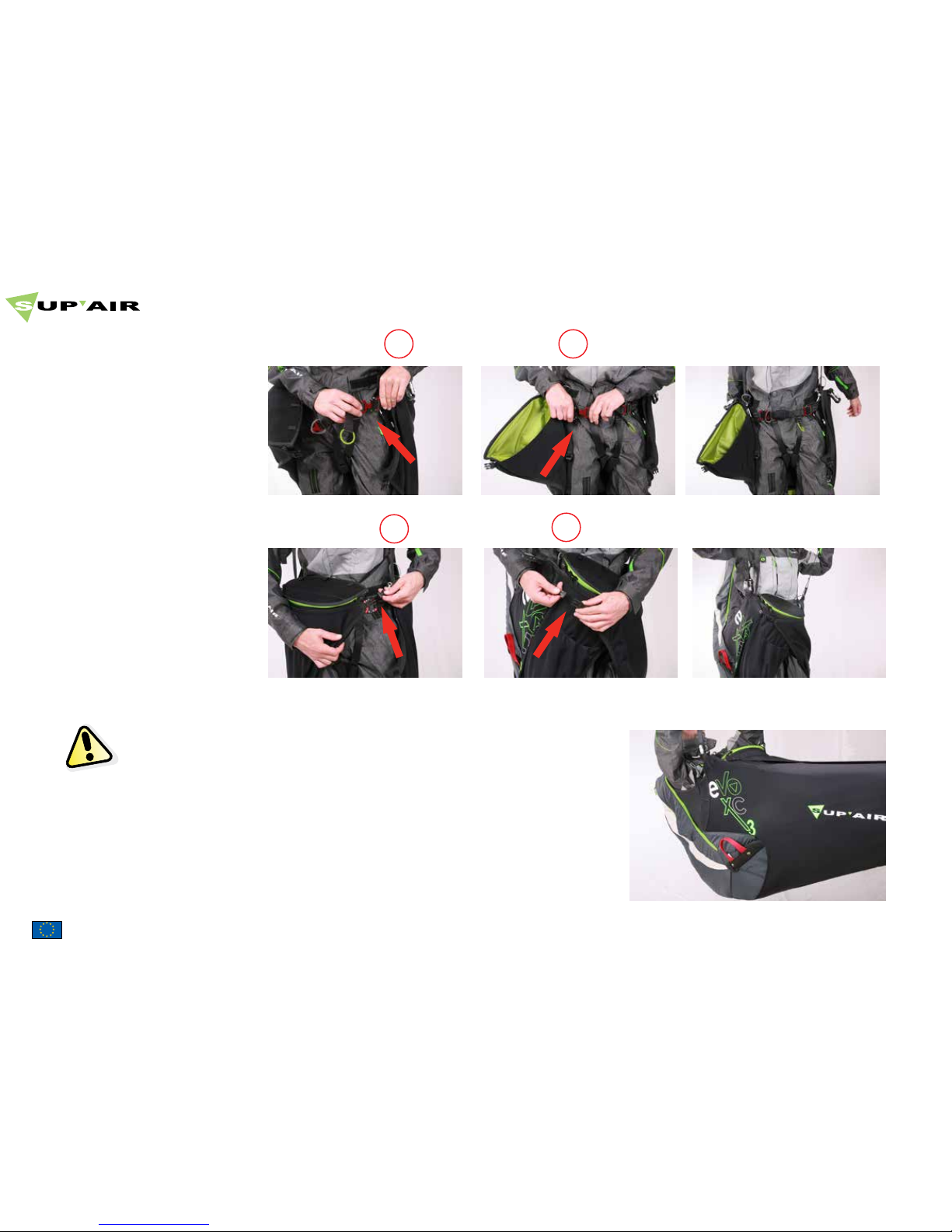
Harness installation
Setting your position inside the harness before taking-off is extremely important.
Page 25
SUP’AIR manufactures its products in Europe. Most of the components used are Made in Europe.
SUP’AIR_EVO XC3 Page25
User’s manual EVO XC3
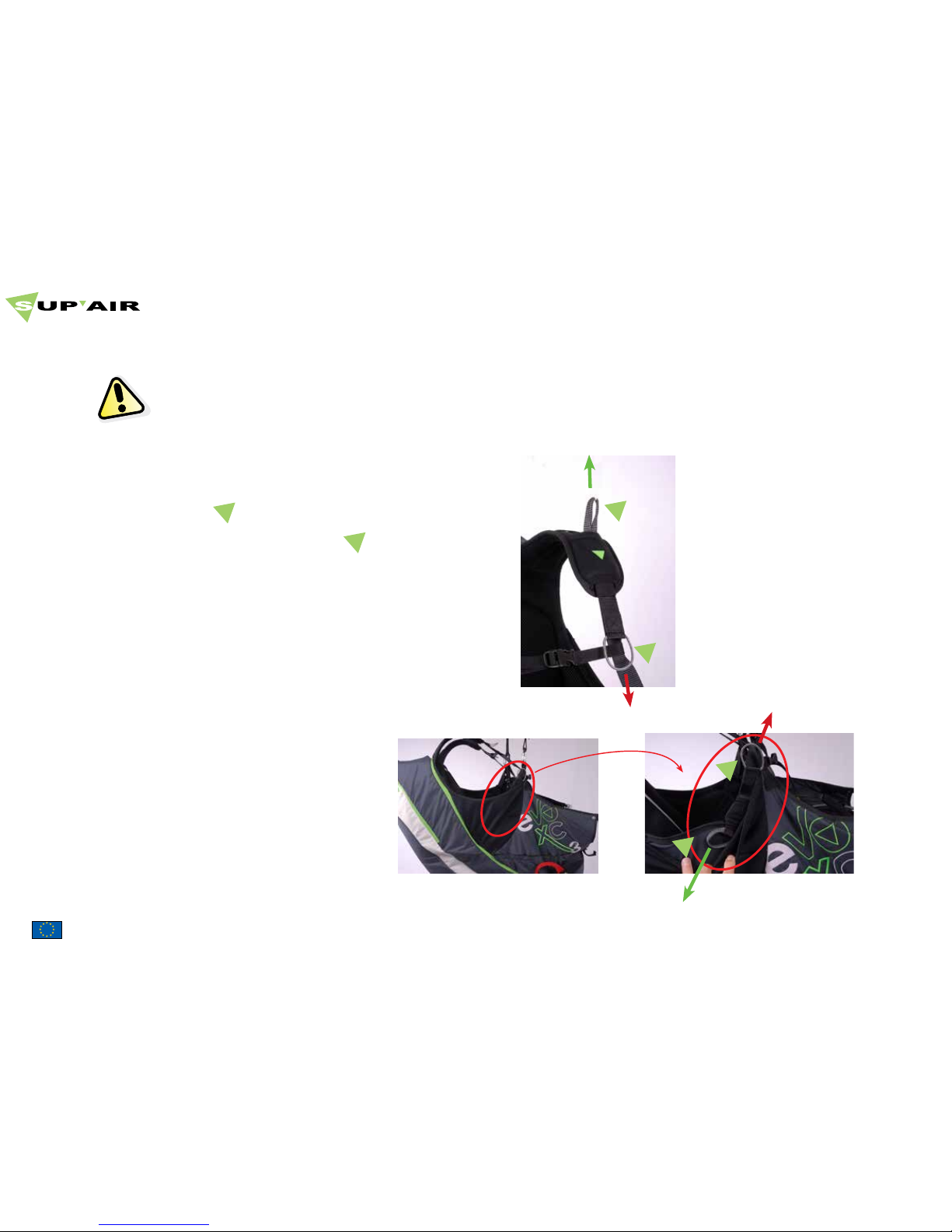
Tighten the shoulder straps using the small looped cord by pulling forward
(or downward).
Loosen by pulling the checkered strap reward.
Resting precisely on the shoulder straps improves comfort. You must find the
perfect equilibrium between the side/lateral trim straps adjustments and the
shoulder straps.
In a reclined seating position, the shoulder straps also participate to the
overall comfort by supporting the upper torso/shoulder area.
2
All those adjustments must be conducted while seating in a hang-test device, and before the initial flight.
Harness adjustments.
2
1
Shoulder straps adjustments.
1
Loosen
Tighten
3
4
Tighten
Loosen
Change the backrest angle by pullling the loop.
Backrest angle adjustment.
Page 26
SUP’AIR manufactures its products in Europe. Most of the components used are Made in Europe.
SUP’AIR_EVO XC3 Page26
User’s manual EVO XC3
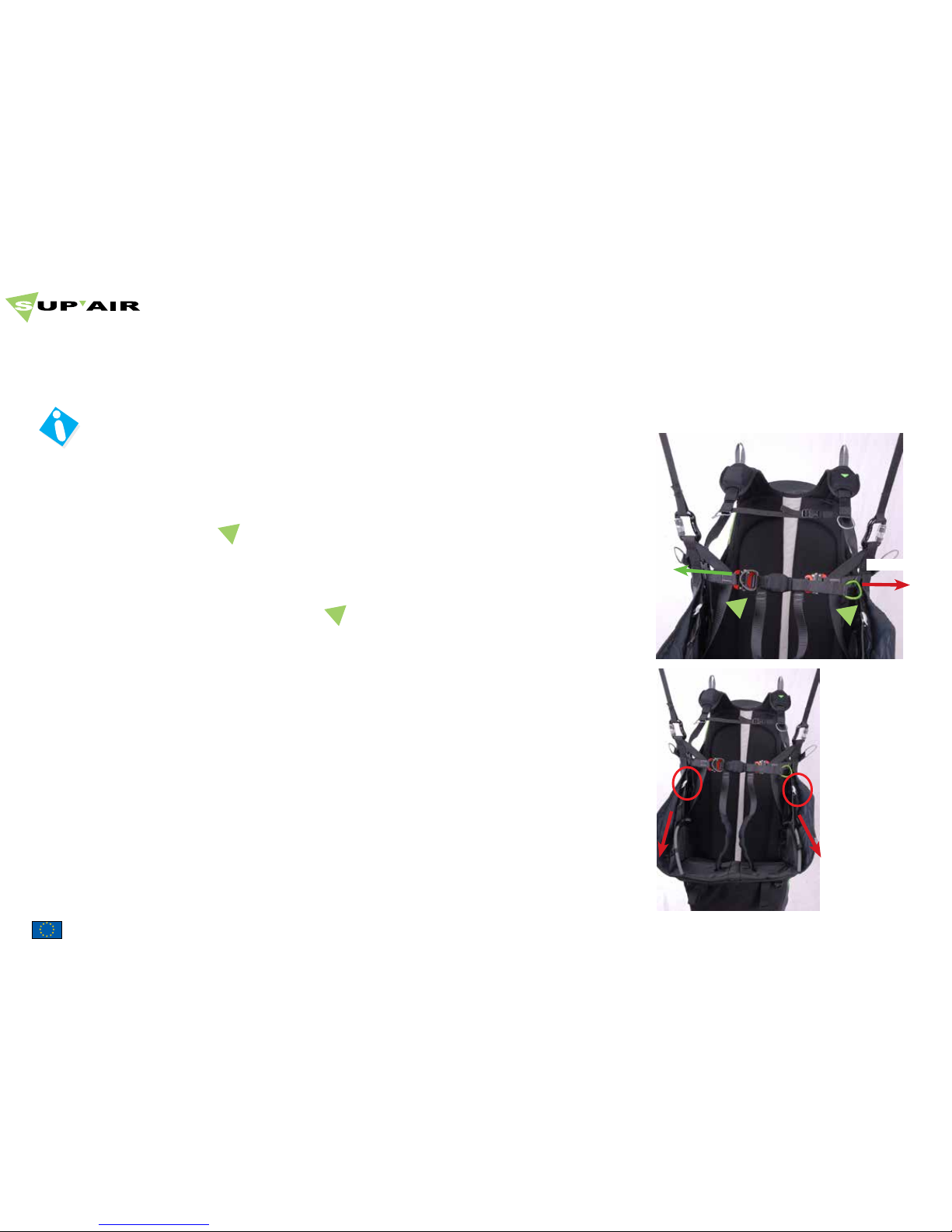
This adjustment is important for acting on the ABS and the harness overall stability. The tighter
the more stable. The opposite is true while still enabling weight-shift steering.
To tighten the chest strap:
Place your left hand in front of the risers, and grab the right carabiner.
With the right hand shorten the distance by, grabing the chest strap finger-loop and pull it to
tighten the chest strap.
To loosen the chest strap:
Place your left hand in front of and pass the risers to grab the right carabiner.
Using the left hand, shorten the distance between the risers and pull the finger-loop in the opposite direction to loosen the chest strap.
1
2
1
Chest strap adjustment.
2
2
loosen
tighten
Seat plate adjustment.
This adjustment enables leg support variations toward to front of the seating area. Comfort and seating posture can be improved for pilots with long legs.
To tighten and increase leg support to the front of the seat plate : bringing the legs upward will reduce tension on the adjustment buckles, and decrease the effort required to
pull the end straps upward.
To loosen the tension : raising the legs upward will reduce tension on the adjustment
buckles, and decrease the effort required to unlock them with an upward tilt.
Tightening
Tightening
Page 27
SUP’AIR manufactures its products in Europe. Most of the components used are Made in Europe.
SUP’AIR_EVO XC3 Page27
User’s manual EVO XC3
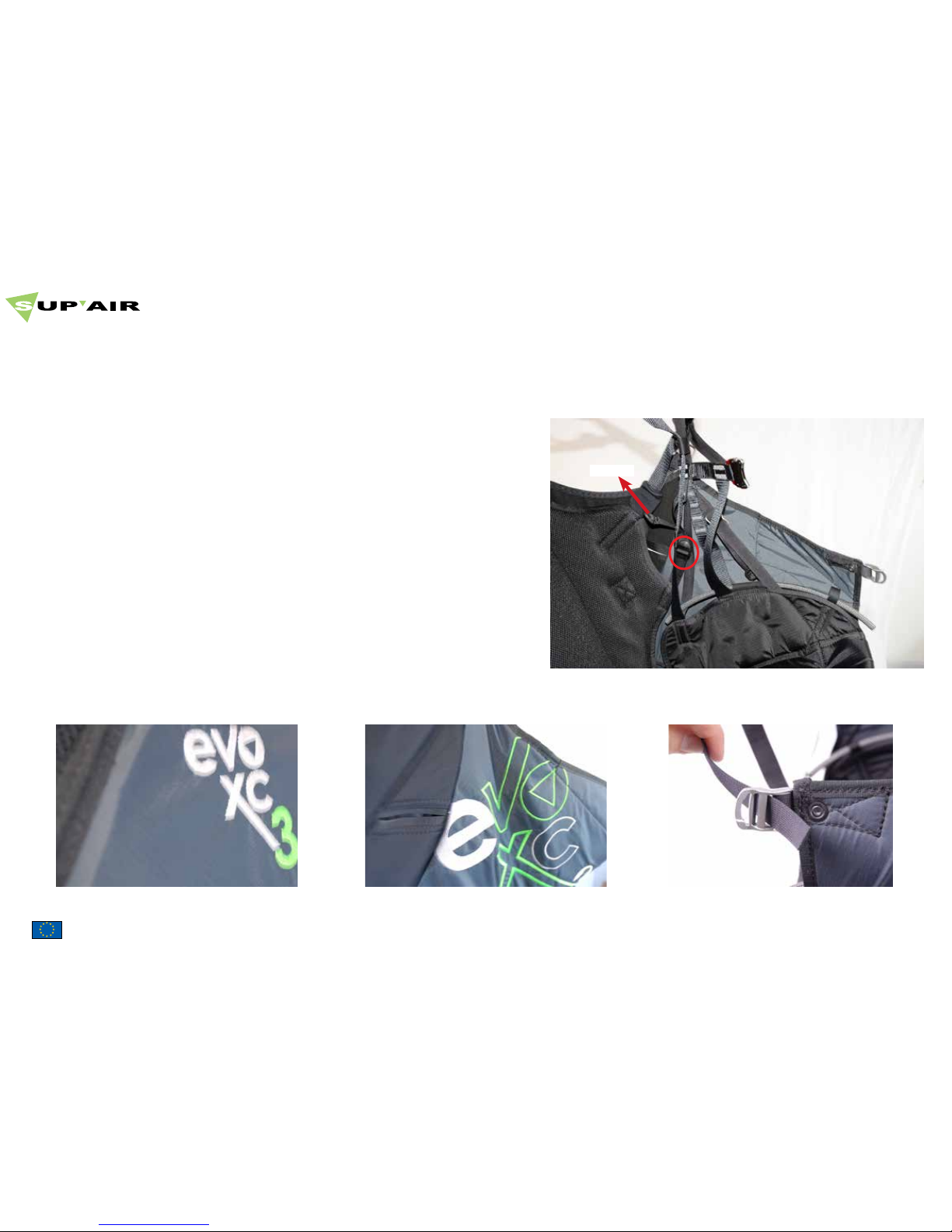
Seat depth adjustment.
This adjustment enables the seat depth to be adjusted. It can be an asset
when flying with feet on the foot-rest in a more reclined posture. On the other
hand, it is not necessary to reduce the seat depth for an adopted upright seating flying posture.
To reduce the seat depth : raise your hips while pressing on the foot-rest ( this
action reduces the tension on the buckles), and the pull exerted on the adjustment straps ends.
To loosen the support : tilt the adjustment buckles and relax the adjustment
straps.
tighten
Page 28
SUP’AIR manufactures its products in Europe. Most of the components used are Made in Europe.
SUP’AIR_EVO XC3 Page28
User’s manual EVO XC3
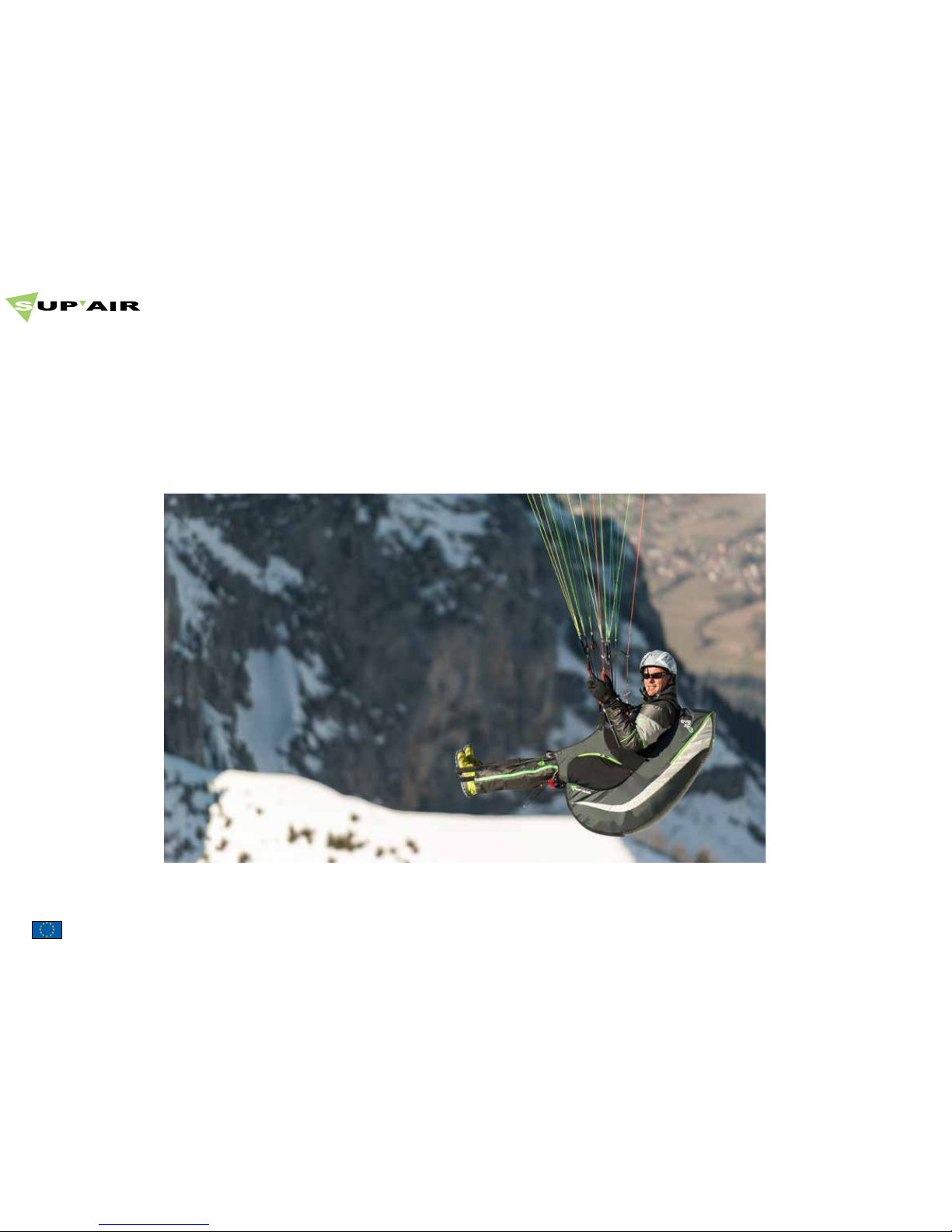
Inflight behavior.
The harness geometry creates a very good symbiosis ou correlation between the wing and seat stability
(especially when tightening the chest strap).
The EVO XC3 is a stable and dampened harness.
The backrest is stiffened thus enabling a better pressure distribution on the entire dorsal area during for
long comfortable flights.
The EVO XC3 structural design brings an excellent correlation between the wing and the harness (noticeably when tightening the chest strap).
Page 29
SUP’AIR manufactures its products in Europe. Most of the components used are Made in Europe.
SUP’AIR_EVO XC3 Page29
User’s manual EVO XC3
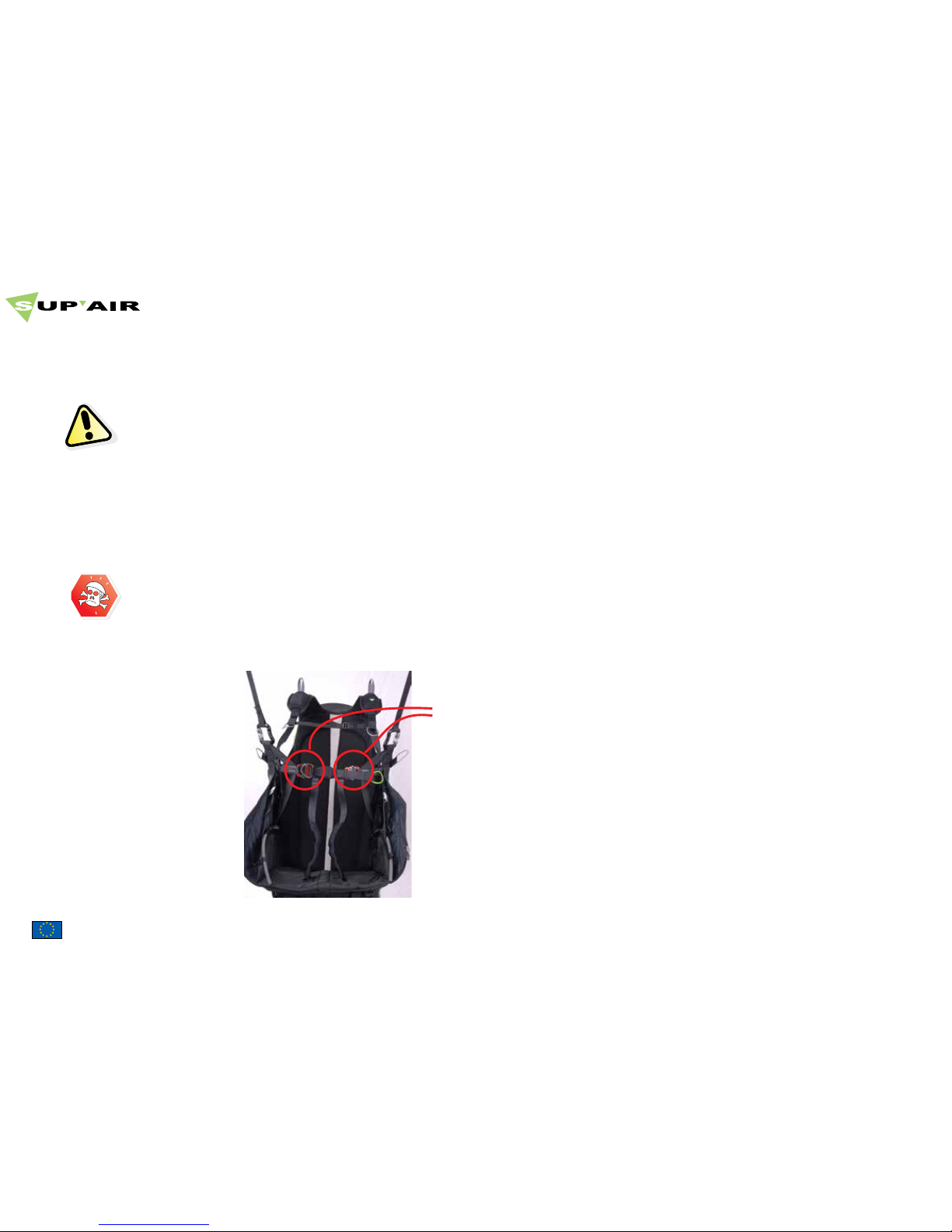
Prior each takeoff, conduct a pre-flight verification by running through the following list :
Only after a thorough weather conditions analysis, can the decision to wether fly or not be made and to outfit yourself with
the harness.
• Properly and securely fasten the leg / chest strap buckles.
• Double check that all buckles are fully locked and secured by pulling firmly on them. Check that no line, tab or cloth is
stuck / jammed in the buckles.
• Be absolutely certain for the reserve parachute handle to work freely without anything impeding its proper functioning.
Main buckles.
• Check that the harness and the carabiners are not damaged.
• Be certain for the reserve parachute pocket to be properly closed with its handle securely in place.
• Check that your personal settings have not been modified.
• Check the connexion risers / harness as well as the self-locking carabiners ( locked and secured ).
• Check your speed-bar system if your harness is equipped with one.
Pre-Flight check.
Page 30
SUP’AIR manufactures its products in Europe. Most of the components used are Made in Europe.
SUP’AIR_EVO XC3 Page30
User’s manual EVO XC3
Flight phases
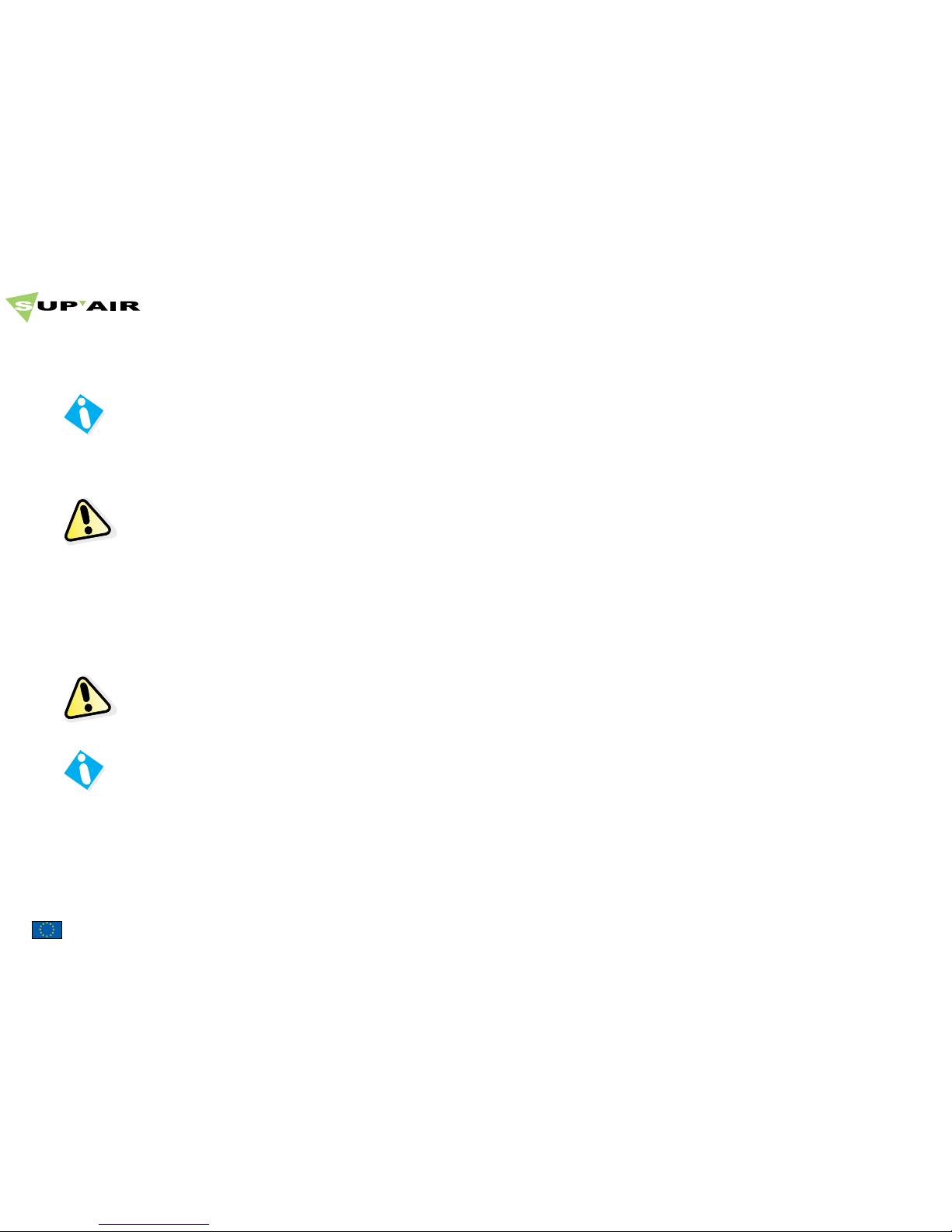
The takeoff phase is easily conducted.
Once air borne, the transition from running to seating is smooth and effortless.
Never keep your steering toggles in hands to push yourself inside the harness, and risk stalling the glider for flying too slow.
Never let go the steering toggles when flying close to obstacles.
In flight :
Once in flight, the harness is very instinctive and precis to handle.
Please set the distance between the two carabiners according to aerology conditions, and to the wing manufacturer’s guide lines.
Tightening the chest strap provides more stability but less harness piloting efficiency. Beware of the increased risk of riser twisting. The
reverse is true, and enables more piloting control, but could become dangerous in turbulent air, with the risk of falling toward the collapsed side of the wing without being able to actively counteract.
Flight phases
Page 31
SUP’AIR manufactures its products in Europe. Most of the components used are Made in Europe.
SUP’AIR_EVO XC3 Page31
User’s manual EVO XC3
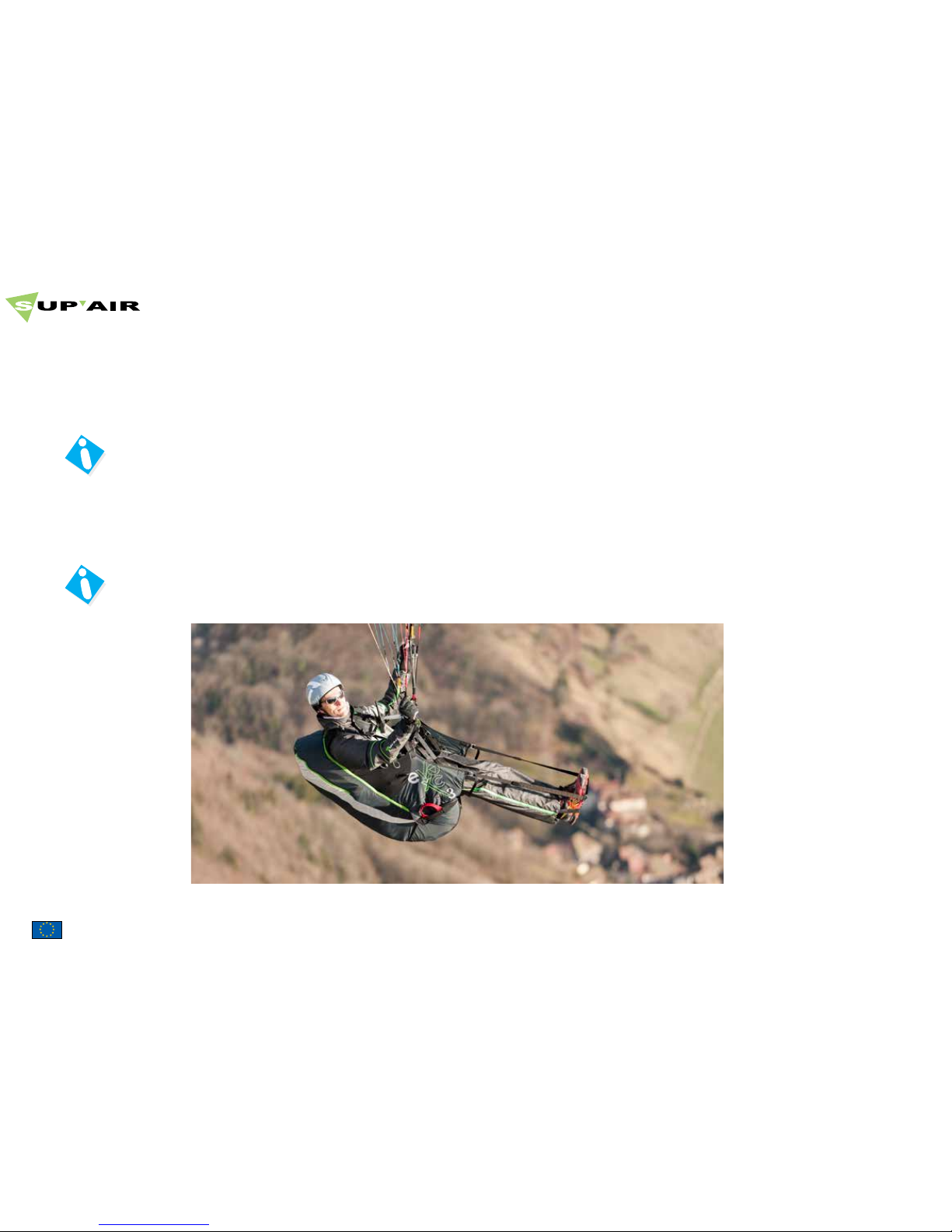
Speedbar use.
We recommend a careful use of the speed-bar due of an increased risk of a potential frontal collapse. Please, carefully read the
manufacturer’s recommendations in the glider manual for more detailed information.
Using the optional foot-rest.
Using the foot-rest enables the pilot to have a harness more in tune with the wing while increasing leg comfort during extended flights.
Page 32
SUP’AIR manufactures its products in Europe. Most of the components used are Made in Europe.
SUP’AIR_EVO XC3 Page32
User’s manual EVO XC3
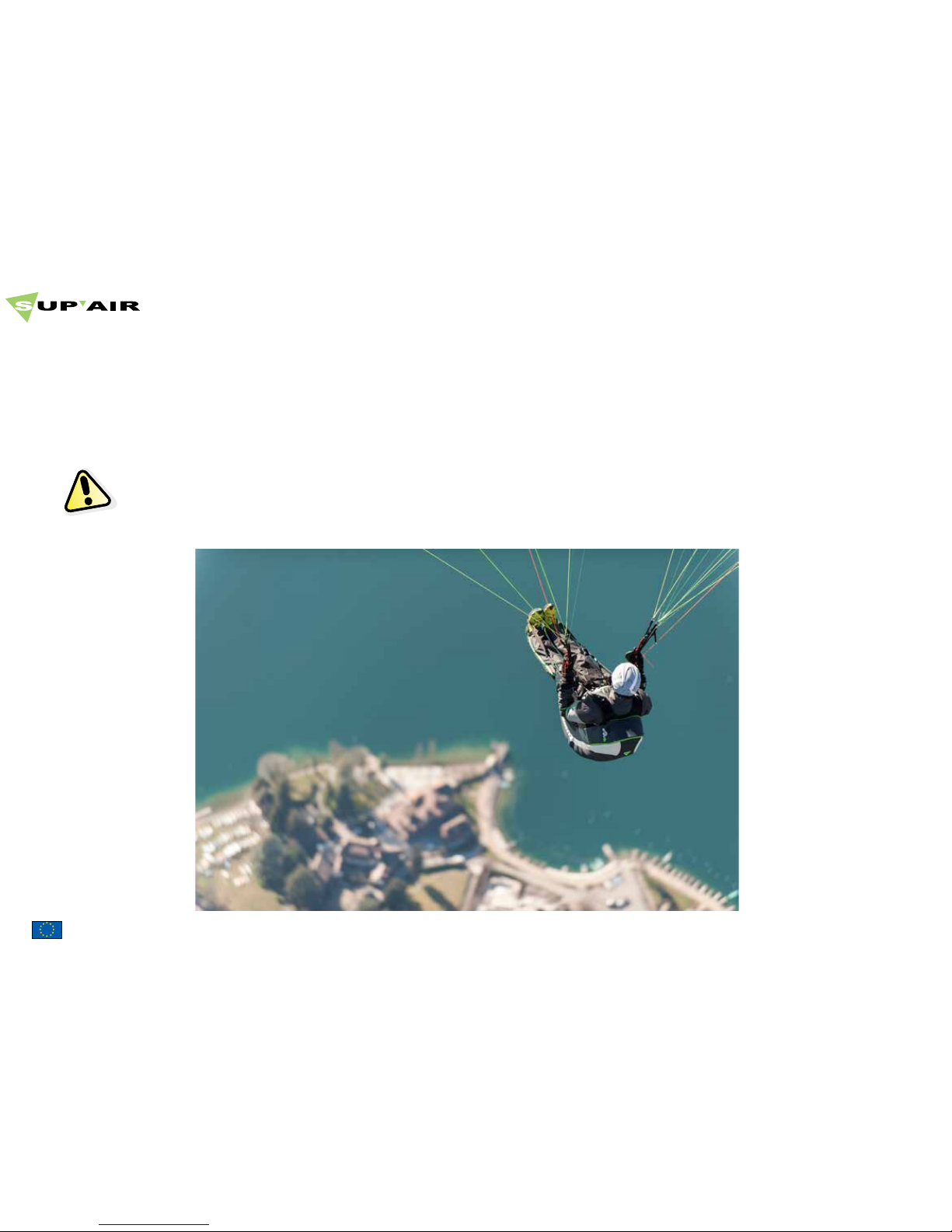
Landing
Straighten yourself in your harness, and adopt a running posture to dissipate the horizontal speed after touchdown.
Never land while seating ! It is dangerous !
Page 33
SUP’AIR manufactures its products in Europe. Most of the components used are Made in Europe.
SUP’AIR_EVO XC3 Page33
User’s manual EVO XC3
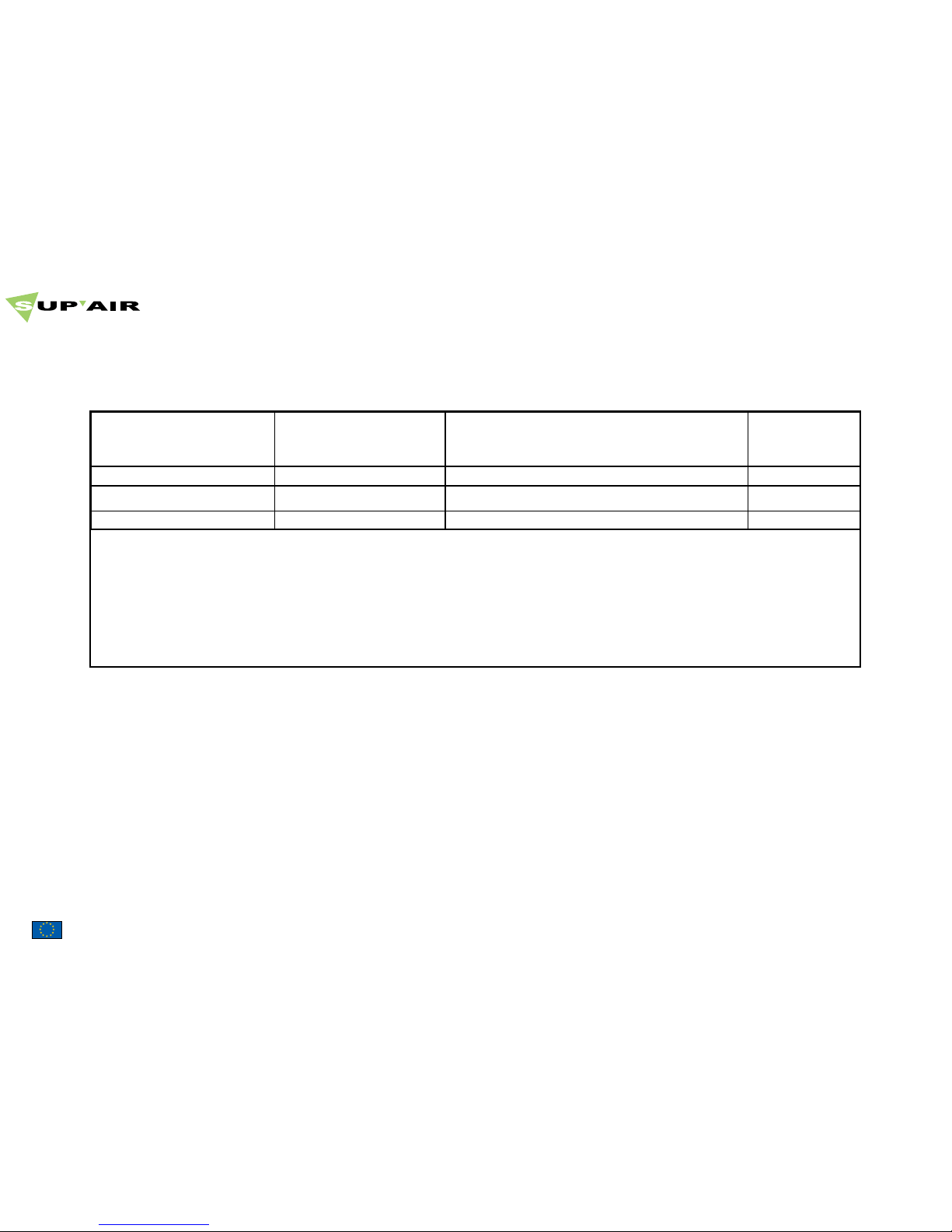
Complements/Accessories
Optional fully compatible accessories are available for your EVO XC3 harness.
Function Code Description Weight
Accelerator/Speed-bar. ACCELSOUPLE Thin double stage speed-bar. 100 g
20mm self-retractable foot-rest. CALEPIEDRETRACT 20mm self-retractable foot-rest. 150 g
All necessary technical information comes with the product and/or can be accessed through our website at www.supair.com
Page 34
SUP’AIR manufactures its products in Europe. Most of the components used are Made in Europe.
SUP’AIR_EVO XC3 Page34
User’s manual EVO XC3
Maintenance
Cleaning and harness maintenance.
It is a good idea to wash your harness from time to time. We recommend using a mild solvent (such as soap) with a soft brush.
Rinse thoroughly.
DO NOT use chemicals agents such as aggressive detergents or strong solvents potentially harmful to the webbing stitching, and
harness fabrics.
Product longevity.
The threads making the webbing and fabrics used in the EVO XC3 have been selected to offer the best possible light weight to
longevity ratio. Nonetheless, in some conditions, after long term exposure to UV and/or significant abrasion or exposure to chemicals, it is compulsory to have your harness’s integrity checked at a certified repair centre. Your safety depends on it.
Zippers should be lubricated from time to time using a silicon spray only.
These carabiners must never be used for anything else than paragliding (not for climbing, towing etc.).
Storage and transport.
When not using your harness, store it inside your paragliding rucksack in a dry cool and clean place protected from UV exposure.
If your harness is wet, please dry it thoroughly before storing.
During transport protect the harness from any mechanical or UV deterioration (use a bag). Please avoid long transports in wet
or humid conditions.
Independently from the pre-flight checks you must open and unfold your rescue parachute once every 6 months.
A full compulsory maintenance harness check must be conducted every two years :
• Carbon fiber seat plate : no cracks or splinters.
• webbings (no wear tear or material unraveling - no unwanted folds).
• The buckles and self-locking carabiners (no hairline cracks, apparent damage, and functioning properly).
Page 35

SUP’AIR manufactures its products in Europe. Most of the components used are Made in Europe.
SUP’AIR_EVO XC3 Page35
User’s manual EVO XC3
Materials
Recycling
All our materials are selected for their technical and environmentally friendly characteristics. Most of them are recyclable.
If you estimate that your harness has reached the end of its lifespan you can then separate the plastic from the metallic parts and apply up-to-date sorting rules in effect in your community. As for the fabric parts, we would advise you to contact your local specialized
recycling center(s).
Fabrics
CORDURA® light
Webbings
Polyamide 20 mm (500 DaN)
Polyester 25 mm (1250 DaN)
Repairs
SUP’AIR also offers the possibility for its products to be repaired beyond the end of the warranty period. Please contact us by either telephone or E-mail [email protected] in order to receive a quotation.
Though we use the highest quality materials it is possible that your harness may eventually deteriorate through general use. If showing any signs of significant wear and tear, you should have it inspected and eventually repaired at a certified repair centre if necessary.
Page 36
SUP’AIR manufactures its products in Europe. Most of the components used are Made in Europe.
SUP’AIR_EVO XC3 Page36
User’s manual EVO XC3
Environmental friendly practices
We highly recommend you to respect the environment when paragliding. Do not wander outside marked trails. Do not make unwanted noise, and do not disturb nature as a whole. Please be mindful of the environment at all times.
Paragliding is an activity requiring specific skills, knowledge, and sound judgement. Learn the basics in a certified school. Carry an
adequate insurance policy as well as a flying licence, and use common sens as to wether or not fly based on your experience level.
Be humble ! SUP’AIR can not be held responsible for your paragliding decisions or activities.
Disclaimer
This SUP’AIR product has been designed exclusively for paragliding. Any other activity such as skydiving or BASE jumping is absolutely forbidden.
Pilot’s gear.
It is essential for your personal safety to wear a helmet, suitable boots, and adequate clothing for the activity. Having a reserve parachute properly connected to your harness when flying is not an option but rather, a mendatory part of your safety gear.
Page 37
SUP’AIR manufactures its products in Europe. Most of the components used are Made in Europe.
SUP’AIR_EVO XC3 Page37
User’s manual EVO XC3
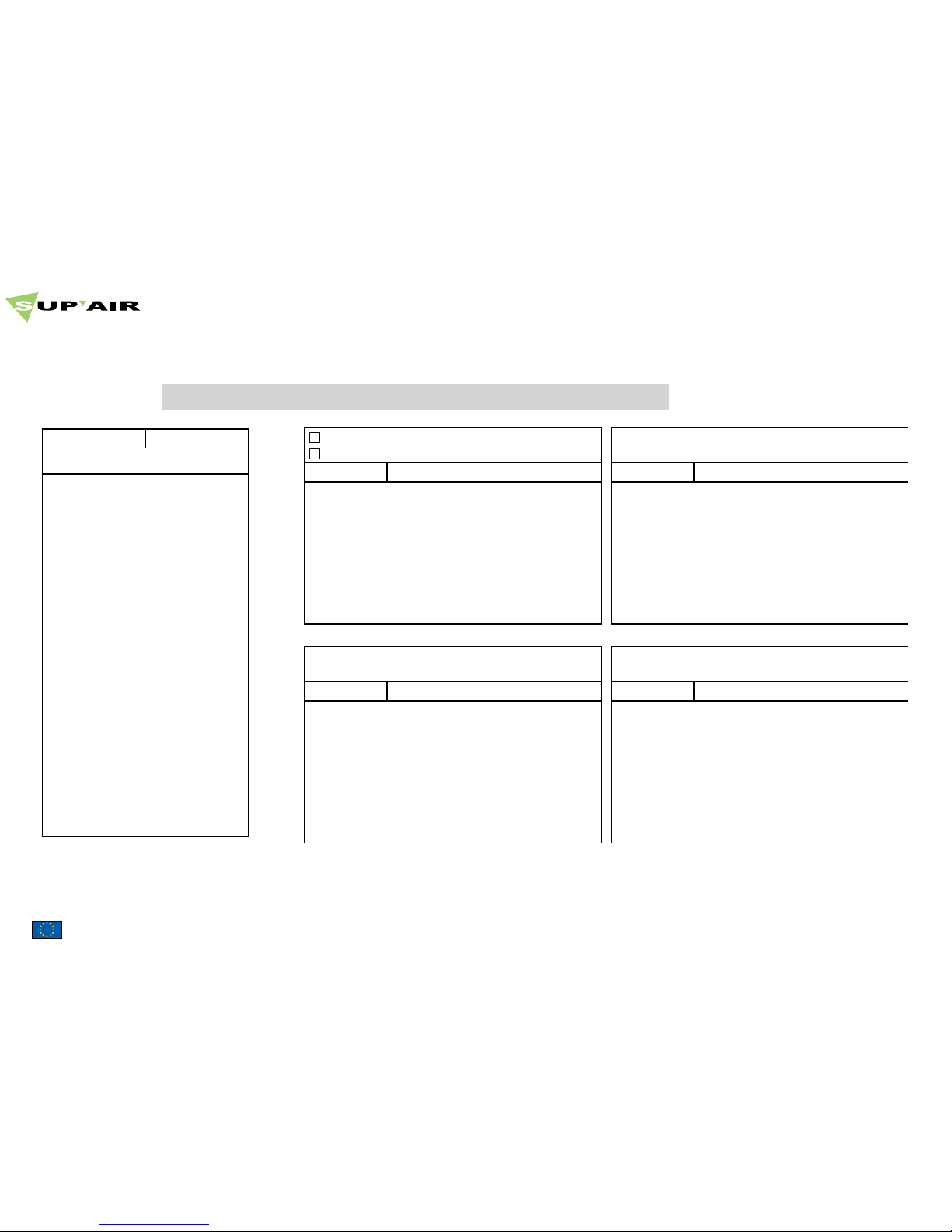
Maintenance Book
This page will help you to record all the life stages of your EVO XC3 harness.
Purchase date
Owner’s name
Shop’s name and stamp.
Care
Resale
Date
Workshop’s name/ Buyer’s name
Serial number :
Care
Resale
Date
Workshop’s name/ Buyer’s name
Care
Resale
Date
Workshop’s name/ Buyer’s name
Care
Resale
Date
Workshop’s name/ Buyer’s name
Page 38
 Loading...