

Page 1

Sun StorageTekTM T9840D
Tape Drive
Security Policy
Part Number 316055201
Revision: AA
Sun Microsystems, Inc.
February 5, 2010
Copyright Sun Microsystems 2009. May be reproduced only in its original entirety [without revision].
Page 2

Sun Microsystems Sun StorageTek ™ T9840D Tape Drive Security Policy February 5, 2010
TABLE OF CONTENTS
1 MODULE OVERVIEW .............................................................................................................................. 4
2 SECURITY LEVEL ................................................................................................................................... 5
3 MODES OF OPERATION (AREA 1) ........................................................................................................ 6
3.1 APPROVED ALGORITHMS ............................................................................................................................ 6
3.2 NON-APPROVED ALGORITHMS ...................................................................................................................... 7
3.3 DETERMINING FIPS MODE ......................................................................................................................... 7
3.4 CONFIGURING THE DRIVE IN FIPS MODE ........................................................................................................ 8
4 PORTS AND INTERFACES ................................................................................................................... 10
5 IDENTIFICATION AND AUTHENTICATION POLICY ............................................................................ 12
5.1 ASSUMPTION OF ROLES ............................................................................................................................. 12
6 DEFINITION OF CRITICAL SECURITY PARAMETERS (CSPS) .......................................................... 14
6.1 DEFINITION OF PUBLIC KEYS ...................................................................................................................... 15
7 ACCESS CONTROL POLICY ................................................................................................................ 15
7.1 ROLES AND SERVICES .............................................................................................................................. 15
8 OPERATIONAL ENVIRONMENT (AREA 6) .......................................................................................... 18
9 SECURITY RULES ................................................................................................................................. 18
9.1 FIPS 140-2 SECURITY REQUIREMENTS ...................................................................................................... 18
10 PHYSICAL SECURITY ......................................................................................................................... 19
10.1 PHYSICAL SECURITY MECHANISMS ............................................................................................................ 19
11 MITIGATION OF OTHER ATTACKS POLICY ..................................................................................... 19
12 REFERENCES ...................................................................................................................................... 19
13 DEFINITIONS AND ACRONYMS ......................................................................................................... 21
Page 2
Page 3

Sun Microsystems Sun StorageTek ™ T9840D Tape Drive Security Policy February 5, 2010
TABLE OF TABLES
TABLE 1: MODULE SECURITY LEVEL SPECIFICATION........................................................................5
TABLE 2: PORTS AND INTERFACES DESCRIPTION............................................................................10
TABLE 3: ROLES AND REQUIRED IDENTIFICATION AND AUTHENTICATION...................................12
TABLE 4: STRENGTHS OF AUTHENTICATION MECHANISMS............................................................13
TABLE 5: DESCRIPTION OF CRITICAL SECURITY PARAMETERS (CSPS)........................................14
TABLE 6: DESCRIPTION OF PUBLIC KEYS WITHIN THE ETD.............................................................15
TABLE 7: SERVICES AUTHORIZED FOR ROLES..................................................................................15
TABLE 8: UNAUTHENTICATED SERVICES............................................................................................18
Release History
Date Rev Description Name
02/05/10 AA Initial version of Security Policy. Engineering Change: EC001056 Matt Ball
Page 3
Page 4
Sun Microsystems Sun StorageTek ™ T9840D Tape Drive Security Policy
1 Module Overview
The Sun StorageTekTM T9840D Tape Drive (“Encrypting Tape Drive”, or ETD) (HW P/N:315479501;
Firmware Version: 1.44.710) is a hardware cryptographic module with a multi-chip standalone physical
embodiment as defined by FIPS 140-2. The primary purpose of this device is to provide FIPS 140-2 Level
1 security to data on magnetic tape.
The ETD is intended to be used in conjunction with the Sun Key Management System (KMS), which
provides centralized key management. The Sun StorageTek Crypto Key Management System (version
2.1 and higher), consists of two or more Key Management Appliances (KMAs). Key Management
Appliances are the individual components within the system and in the context of this FIPS 140-2 Security
Policy, can be viewed as Key Loaders. For more information on these system components please see the
website http://docs.sun.com and browse under Hardware->Tape Storage->Tape Drives.
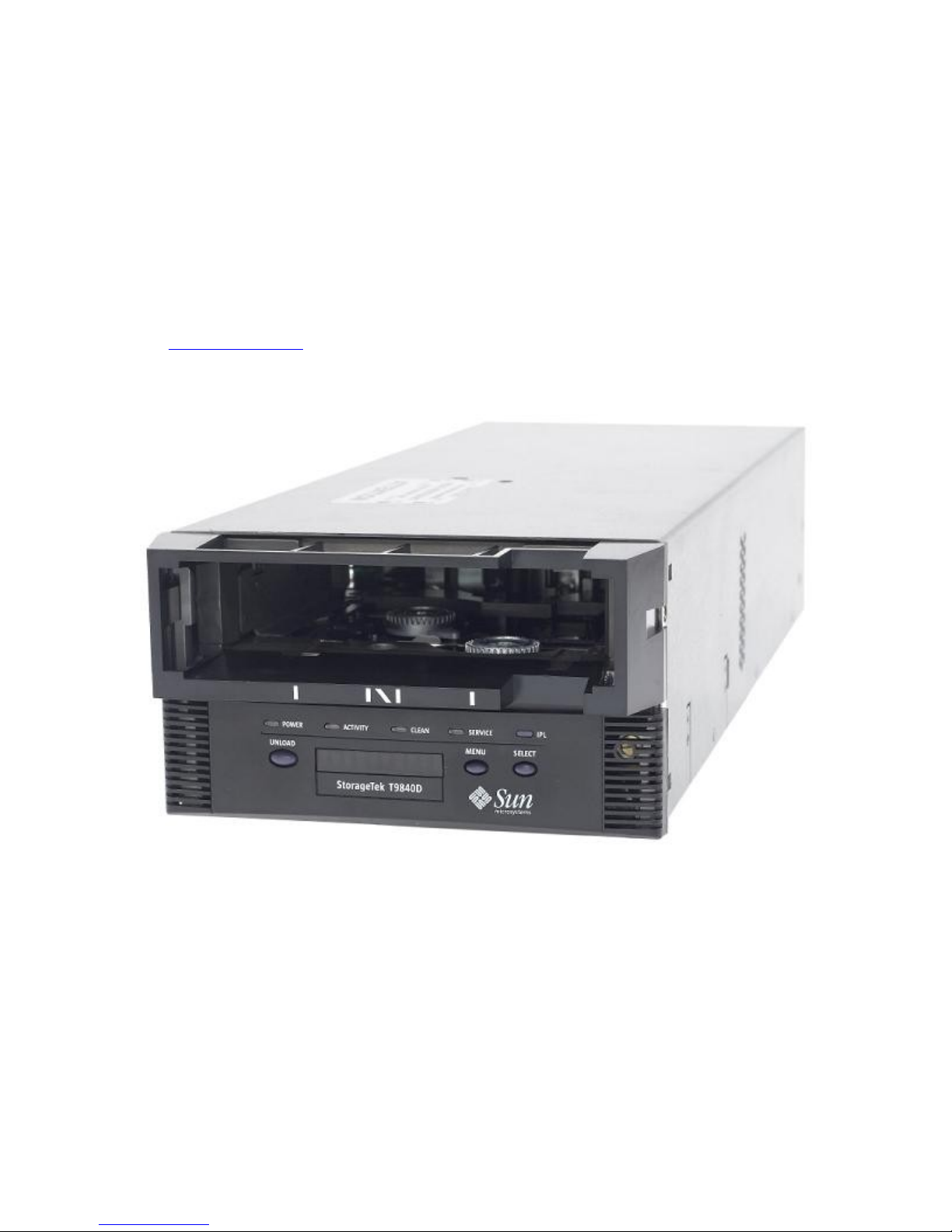
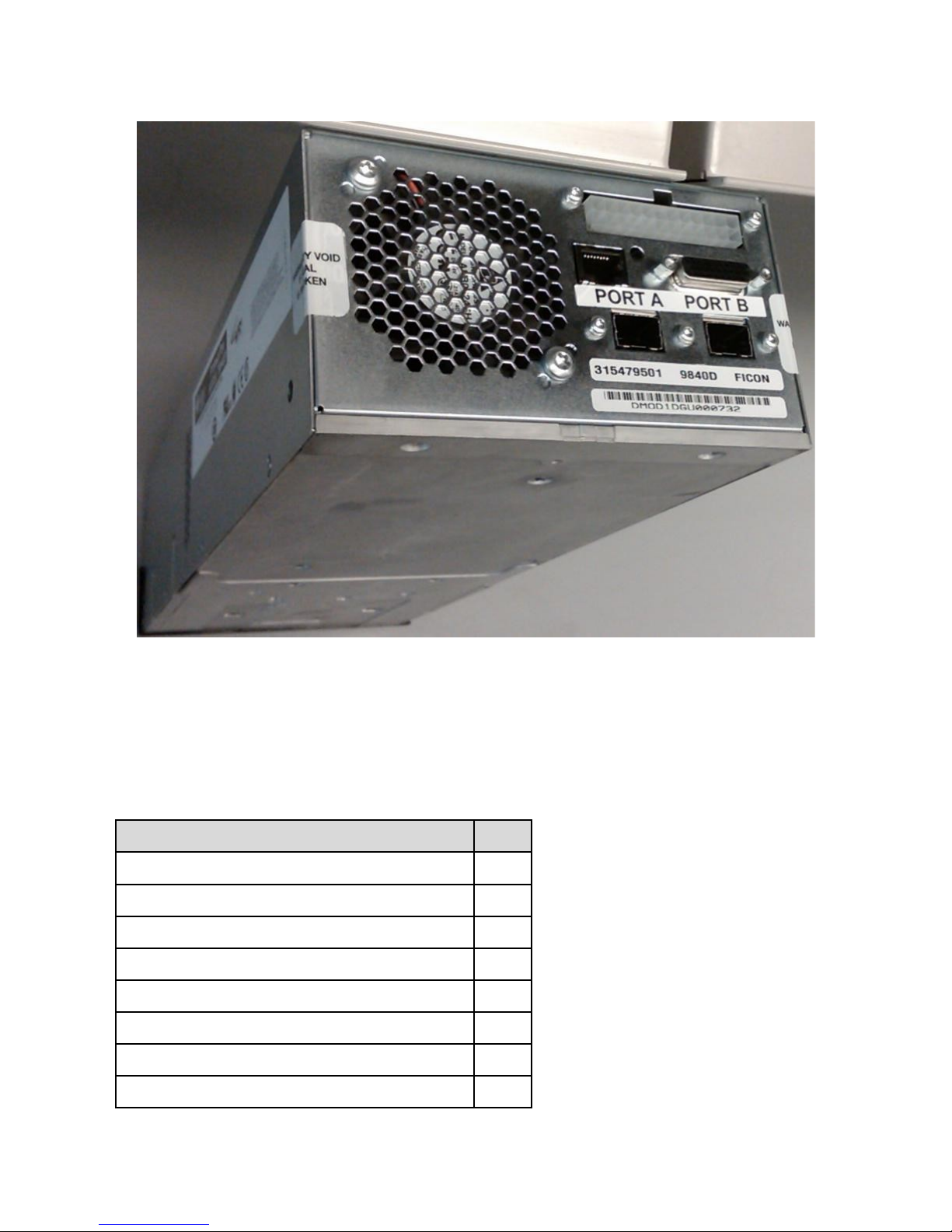
The cryptographic boundary of the ETD is the external surface of the tape drive’s commercial-grade
metallic enclosure. Figure 1.1 and Figure 1.2 illustrate the cryptographic boundary as defined:
Figure 1.1: Front, side, and top of T9840D
Feb 5, 2010 Part 316055201, Rev: AA Page 4
Page 5
Sun Microsystems Sun StorageTek ™ T9840D Tape Drive Security Policy
Figure 1.2: Back, side and bottom cover of T9840D
Note: Figure 1.2 appears to be upside-down to show bottom plate.
2 Security Level
The ETD meets the overall requirements applicable to Level 1 security of FIPS 140-2, as is detailed in
Table 1.
Table 1: Module Security Level Specification
Security Requirements Section Level
Cryptographic Module Specification 3
Module Ports and Interfaces 1
Roles, Services and Authentication 1
Finite State Model 1
Physical Security 1
Operational Environment N/A
Cryptographic Key Management 1
EMI/EMC 1
Feb 5, 2010 Part 316055201, Rev: AA Page 5
Page 6

Sun Microsystems Sun StorageTek ™ T9840D Tape Drive Security Policy
Security Requirements Section Level
Self-Tests 1
Design Assurance 1
Mitigation of Other Attacks N/A
3 Modes of Operation (Area 1)
3.1 Approved Algorithms
Once configured per the procedures as defined in Section 3.4 the module is only able to operate in a FIPS
140-2 Approved Mode of operation. Within the FIPS 140-2 Approved Mode of operation the following
Approved algorithms are available:
• AES CCM supporting 256-bit keys in both hardware (AES Certificate # 495) and firmware (AES
Certificate # 1063)
• AES ECB encryption (AES Certificate # 1059) as used in CCM encryption in firmware (AES
Certificate # 1063)
• RSASSA-PKCS1-v1_5 supporting 2048-bit keys (RSA Certificate # 503) for digital signature
verification (firmware load test)
• HMAC SHA-1 (HMAC Certificate # 597) to create the challenge response as part of the certificate
service of the KMS 2.x Agent Toolkit.
• SHA-1 (SHS Certificate # 1005) for the following:
o as part of digital signature verification for the firmware
o as part of HMAC-SHA-1 (HMAC certificate # 597)
o for hashing passwords used for authentication
• AES ECB (AES Certificate # 1060) supporting 256-bit keys. Used as part of the AES Key Wrap
algorithm to securely establish keying material.
• SP 800-90 CTR DRBG (DRBG Certificate # 11) for generating random numbers used for nonce
values and cryptographic keys
• AES CTR (AES Certificate # 1061) as part of the SP 800-90 CTR DRBG.
• AES CBC mode with 256-bit key (AES Certificate # 1062), used within TLS session between ETD
and KMS 2.x.
• HMAC-SHA-1 (HMAC Certificate # 598)with 160-bit key used to protect the integrity of TLS
communications between the ETD and KMS 2.x.
• SHA-1 (SHS Certificate #1006)
o as part of the TLS Key Derivation Functionality
o as part of HMAC SHA-1 (HMAC Certificate # 598)
3.2 Non-Approved Algorithms
The cryptographic module supports the following Non-Approved algorithms that are allowed for use within
FIPS Approved mode: MD5 as used within the TLS1.0 Key Derivation Function. (see [TLS1.0])
• AES Key Wrap (AES Certificate #1060) used to securely establish media keys (Vendor Affirmed,
Feb 5, 2010 Part 316055201, Rev: AA Page 6
Page 7

Sun Microsystems Sun StorageTek ™ T9840D Tape Drive Security Policy
key establishment methodology provides 256 bits of strength)
• RSAES-PKCS1-V1_5 supporting 2048-bit keys, for RSA public key encryption used to provide
FIPS 140-2 allowed key transport within the TLS protocol. Key establishment methodology
provides 112 bits of security.
• Non-Deterministic Random Number Generator (NDRNG) (provides entropy input to the SP800-90
DRBG, and random values for use within the TLS protocol)
• MD5, as used in the TLS protocol.
3.3 Determining FIPS Mode
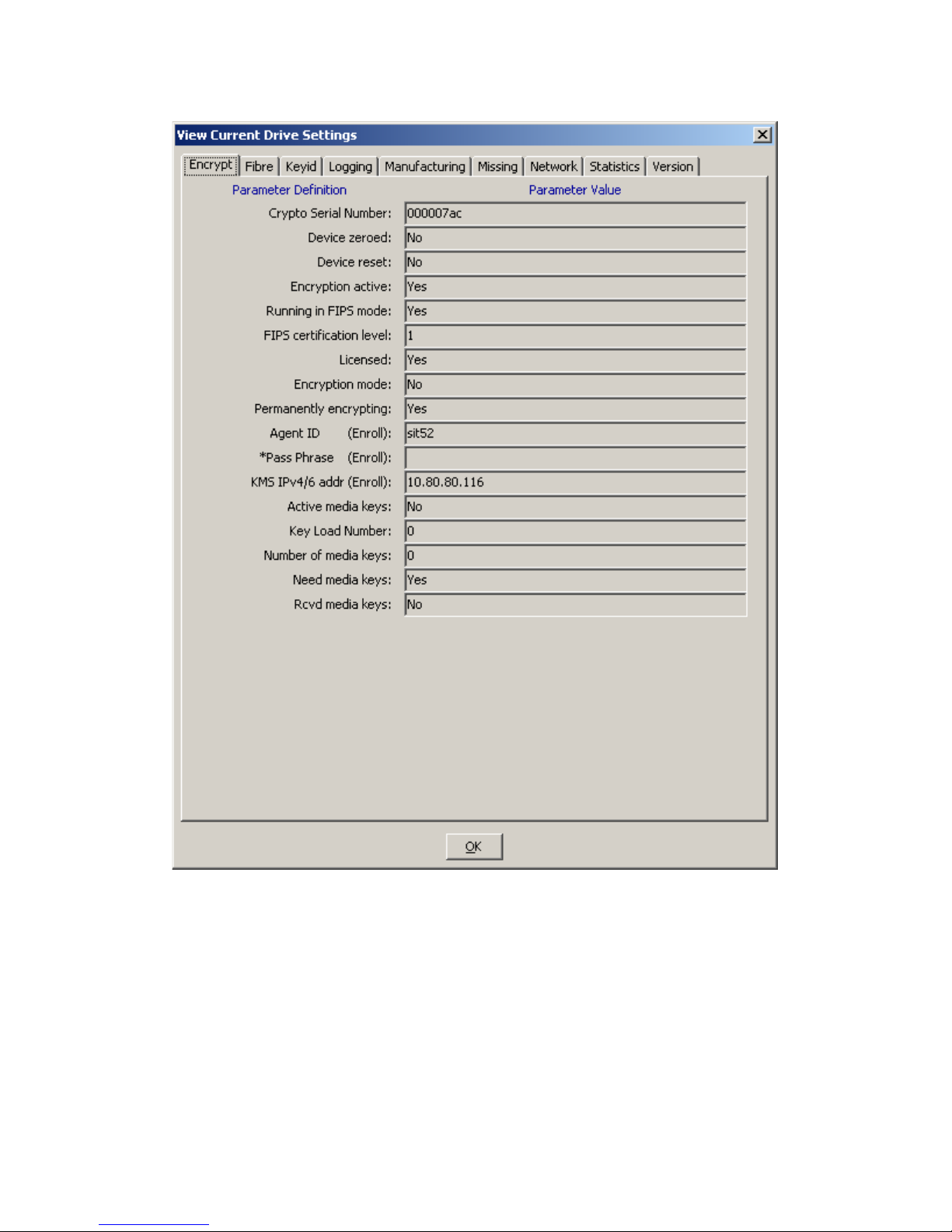
The user can determine whether the ETD is operating in FIPS mode by examining the VOP (Virtual
Operator Panel). VOP is an external software application and the primary ETD remote management tool.
VOP utilizes ETD services remotely. VOP is described in more detail in the document "Virtual Operator
Panel User's Guide" (see [VOPUG]).
Figure 3.1 shows the "View Current Drive Settings" of the VOP application (Drive Operations → View
Drive Data). The user can tell if the ETD has selected an Approved mode of operation by verifying that
the labels "Encryption active" and "Running in FIPS mode" are both set to "Yes". If either of these labels
is set to "No" then the ETD is not in a FIPS Approved mode.
Feb 5, 2010 Part 316055201, Rev: AA Page 7
Page 8
Sun Microsystems Sun StorageTek ™ T9840D Tape Drive Security Policy
Figure 3.1: VOP: View Current Drive Settings
3.4 Configuring the Drive in FIPS mode
An ETD can only be configured for FIPS mode as a one-time decision taken during the encryption
enrollment process. Once an ETD is licensed for encryption, it will remain in either FIPS mode or non
FIPS compliant mode.
FIPS 140-2 configuration of ETD with VOP requires the presence of both a Sun service representative
and the customer. In addition they will need to follow the licensing process as outlined in [KMS2IM] (KMS
2.x Installation and Service Manual), under “License and Enroll the Tape Drives” in Chapter 3 “T-Series
Tape Drives”.
Feb 5, 2010 Part 316055201, Rev: AA Page 8
Page 9

Sun Microsystems Sun StorageTek ™ T9840D Tape Drive Security Policy
Both the Sun service representative and the customer (in the role of the Crypto-Officer) shall perform the
following actions to enable FIPS mode through VOP:
1. The service representative shall examine the hardware part number on the rear label of the Tape
Drive to ensure that it matches the part number as listed in Section 1 of this document.
2. The service representative shall, using VOP, click on the menu item Drive Operations → View
Drive Data.
3. The service representative shall select the Version Tab and verify that the firmware version listed
is that listed in Section 1 of this document.
4. The service representative shall license the tape drive for encryption using the process from
[KMS2IM].
5. The service representative shall set the drive offline by selecting Drive Operations → Set Offline.
6. The service representative shall add the ETD to the KMS 2.x cluster (see [KMS2IM]).
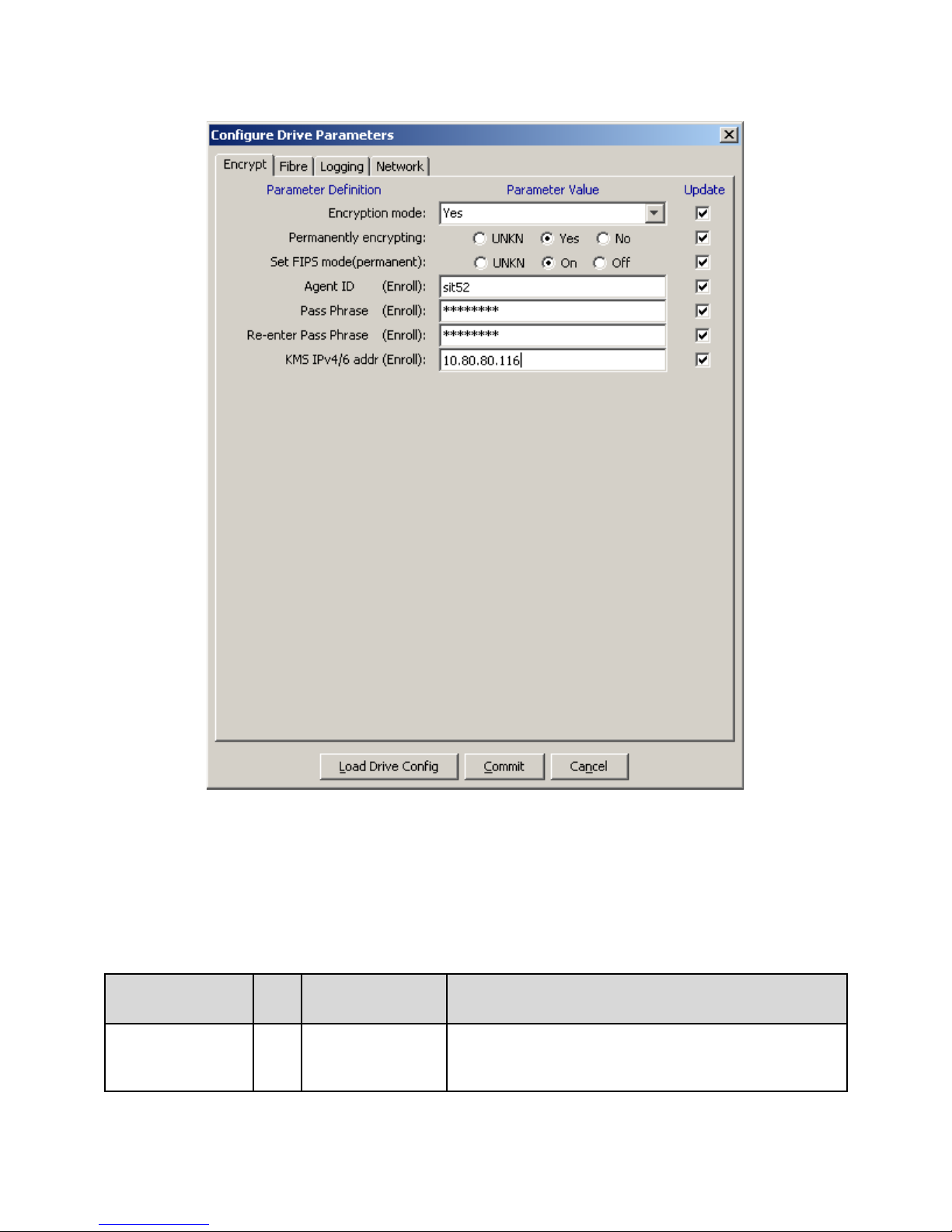
7. The service representative shall bring up the “Configure Drive Parameters” Window (see Figure
3.2) by selecting “Drive Data” from the Configure menu of the main VOP window, and in this
window the customer (in the role of the Crypto-Officer) shall perform the following:
a) Set the ”Encryption Mode” field to “Yes”.
b) Set the “Permanently encrypting” field to “Yes”.
c) Set the “Set FIPS mode(permanent)” field to “On”.
d) Enter a valid Agent ID, Pass Phrase, and KMS 2.x IP address (see [KMS2IM]).
8. Click on the “Commit” button. The ETD will then reboot and come up in permanent FIPS mode.
9. Verify that FIPS mode was correctly set by examining the FIPS status (see 3.3 ).
Feb 5, 2010 Part 316055201, Rev: AA Page 9
Page 10
Sun Microsystems Sun StorageTek ™ T9840D Tape Drive Security Policy
Figure 3.2: VOP: "Configure Drive Parameters" Window
4 Ports and Interfaces
This section describes all ports and interfaces supported by the Encrypting Tape Drive. Table 2 below
provides a listing of the following physical ports and logical interfaces(see [ETDOG] for details).
Table 2: Ports and Interfaces Description
Physical Port Qty Logical interface
definition
DB15(RS232) 1 data output,
status output,
control input
Feb 5, 2010 Part 316055201, Rev: AA Page 10
Technical Specification
Primarily used for tape library communications.
Page 11

Sun Microsystems Sun StorageTek ™ T9840D Tape Drive Security Policy
Physical Port Qty Logical interface
definition
Host Interface 2 data input,
data output,
status output,
control input
Tape head 1 data input,
data output
Technical Specification
This interface is used to transfer user data between the
ETD and the host. When the host transfers user data to
the ETD through this interface, the ETD encrypts and
writes the data to the magnetic media. When the host
receives user data from the ETD through this interface,
the ETD delivers data read from the magnetic media
that has been decrypted by the ETD. For details, see
[ETDIM].
The interface can be configured to support one of two
protocols:
1) Fibre Channel, in accordance with the Fibre
Channel Protocol-3 (FCP-3), SCSI Primary Commands3 (see [SPC-3]), and SCSI Stream Commands (SSC-3)
specifications (see [SSC-3])
2) FICON, in accordance with the Fibre Channel
Single-Byte Command Code Sets-3 Mapping Protocol
(FC-SB-3), Revision 1.6 specification (see [FC-SB-3])
Provides the interface to the magnetic tape media,
where the user data to be encrypted is written to, and
where the data to be decrypted is read from.
Tape media resides in six possible cartridge types:
1) Standard Data
2) SPORT (reduced length) Data
3) VolSafe (write-once) Data
4) Sport VolSafe Data (reduced length, write-once)
5) Cleaning
6) Diagnostic (used by a service representative).
Operator Panel 1 status output,
control input
The front of the ETD has an Operator Panel with the
following interface:
1. Four LED’s to provide status output:
1. Power Indicator
2. Activity Indicator
3. Clean Indicator
4. Service Indicator
2. An LCD display is used to display ETD status
and configuration menu text.
3. Four push button micro-switches.
1. IPL Switch
2. Unload Switch
3. Menu Switch
4. Select Switch
4. Manual Unload Device – screwdriver interface
for manually unloading a cartridge.
Power Interface 1 power input 100-240 VAC @ 50-60 Hz
Feb 5, 2010 Part 316055201, Rev: AA Page 11
Page 12

Sun Microsystems Sun StorageTek ™ T9840D Tape Drive Security Policy
Physical Port Qty Logical interface
definition
Drive Status LED 1 status output Provides status on the overall state of the ETD
Encryption Status
LED
RJ45(Ethernet) 1 data input,
1 status output Provides status on the encryption configuration of the
data output,
status output,
control input
Technical Specification
ETD.
This primary uses of this interface are to:
1) Configure the ETD
2) Deliver encryption keys to the ETD
3) Obtain ETD status and diagnostic data
4) Download firmware to the ETD
5) Deliver status information to an SNMP server.
5 Identification and Authentication Policy
5.1 Assumption of roles
The ETD cryptographic module supports two distinct operator roles, User and Crypto-Officer (C.O.).
Table 3 shows these roles.
Table 3: Roles and Required Identification and Authentication
Role Type of Authentication Authentication Data
User Role-based operator
authentication.
Crypto-Officer Role-based operator
authentication.
The following Authentication Mechanism (see Error: Reference
source not found) is allowed for authenticating to the User Role:
1. CA_Cert Private Key: 2048-bit RSA Private key
Note: No authentication mechanism is claimed for FIPS 140-2
Any of the following Authentication Mechanisms (see Error:
Reference source not found) are allowed for authenticating to
the Crypto-Officer Role:
1. VOP Password: 7 byte shared secret.
2. Passphrase: 8 byte shared secret.
3. PC_Key: 256-bit AES key
4. FSRootCert: 2048-bit private RSA key
Note: No authentication mechanism is claimed for FIPS 140-2
6 Definition of Critical Security Parameters (CSPs)
Table 4 describes the CSPs that are contained within the ETD.
Feb 5, 2010 Part 316055201, Rev: AA Page 12
Page 13

Sun Microsystems Sun StorageTek ™ T9840D Tape Drive Security Policy
Table 4: Description of Critical Security Parameters (CSPs)
CSP Description/Usage
Preset
Communication Key
(PCKey)
Media Key (MEKey) Media Keys are 256-bit AES CCM keys which are generated outside the Tape
Passphrase This is an 8-byte character string supplied independently to both the ETD and the
VOP Password
(TelnetPW)
CTR_DRBG AES-256 key used by SP 800-90 CTR DRBG, along with the 128-bit value V, and
AES Key Wrap Key
(AKWK)
The Preset Communication Key is a 256-bit AES key loaded into the ETD during
manufacturing and is used for encryption licensing.
Drive by the KMS 2.x. An ETD uses a MEKey to encrypt and decrypt the customer
bulk data it processes.
KMS 2.x cluster as part of the enrollment process in the KMS 2.x configuration.
The Passphrase must contain characters from at least three of the four character
classes, and has a minimum length configurable by the end user. The Passphrase
is used to mutually authenticate the ETD and KMS 2.x during first time
authentication, and is erased from drive memory when the enrollment process
completes.
A 7-byte shared secret used to authenticate an operator the Crypto-Officer Role.
reseed counter. Used to random numbers used for nonce values and cryptographic
keys
An AES Key Wrap Key is a 256-bit AES ECB key used to protect the ME_Keys with
AES Key Wrap as they enter the ETD. Transported wrapped with the
KWKPublicKey, which provides 112 bits of encryption strength
Dump Encryption
Key (DEKey)
Tape Drive Private
Key (TDPrivKey)
CA_Private Key The CA_Cert Private Key is for authentication of the appliance during TLS1.0
FSRootCert Private
Key
TLS_PM Premaster Secret for the TLS session. It consists of 2 bytes of version number
TLS_MS Master Secret for the TLS session; 48 bytes of pseudo-random data generated
TLS_EMK Encrypt MAC Key for TLS, used with HMAC-SHA-1 (160 bits)
TLS_DMK Decrypt MAC Key for TLS, used with HMAC-SHA-1 (160 bits)
TLS_ECK Encrypt Crypto Key for TLS. 256-bit key used in AES-CBC mode to encrypt TLS
TLS_DCK Decrypt Crypto Key for TLS. 256-bit key used in AES-CBC mode to decrypt TLS
A Dump file encryption key is a 256-bit AES CCM key used for encrypting the dump
files during generation and storage. Transported wrapped with the KWKPublicKey,
which provides 112 bits of encryption strength
The Tape drive Private Key is a 2048-bit RSA private key used during the TLS
handshake to authenticate the Tape Drive to an appliance within a KMS 2.x cluster.
communication between the ETD and a KMS 2.x cluster.
The FSRootCert Private Key is used to authenticate the firmware updates by
authenticating the final firmware signing key in a certificate chain.
concatenated with 46 bytes of random data.
according to TLS, based on a hash of the premaster secret and nonces
data.
data.
Feb 5, 2010 Part 316055201, Rev: AA Page 13
Page 14

Sun Microsystems Sun StorageTek ™ T9840D Tape Drive Security Policy
6.1 Definition of Public Keys
Table 5 describes the public keys stored with the ETD.
Table 5: Description of Public Keys within the ETD
Public Key Name Description
CA_Cert CA Certificate public key self-signed by a KMS 2.x cluster. Contains a 2048-bit
RSA Public Key for each appliance in a KMS 2.x cluster. Used by the ETD to
authenticate the appliance during the TLS handshake.
Tape Drive Public
Key (TDPubKey)
Key Wrap Key Public
Key (KWKPublicKey)
Dump Encryption
Public Key
(DEPubKey)
Firmware Signature
Public Key
(FSPubKey)
Firmware Signature
Root Certificate Key
(FSRootCert)
The Tape drive Public Key is a 2048-bit RSA key used by TLS. The ETD sends
this key to the KMS 2.x cluster to authenticate the Tape Drive during the TLS
handshake. It is stored within an X.509 certificate within the ETD.
The Key Wrap Key Public Key is a 2048-bit RSA public key used to wrap the AES
Key Wrap Key.
The Dump Encryption Public Key is a 2048-bit RSA public key used to wrap the
DEKey. It is stored stored in an X.509 certificate
The Firmware Signature Public Key is a 2048-bit RSA key used to validate any
uploaded firmware.
The Firmware Signature Root Certificate Key is a 2048-bit RSA key within a PEM
encoded certificate used to validate the certificate chain within the candidate
firmware image.
7 Access Control Policy
7.1 Roles and Services
Table 6 shows the services available to each authorized role and CSP access (Crypto-Officer (C.O.), or
User). See section 6 for a description of the keys and CSPs.
Table 6: Services Authorized for Roles
Name of
Service
Enroll ETD Authenticates an
Feb 5, 2010 Part 316055201, Rev: AA Page 14
Service Description Available
external management
system acting on
behalf of the CryptoOfficer (KMS 2.x
cluster) to the ETD
using the Passphrase.
on:
RJ45(Ether
net)
Available in
FIPS mode
Yes Yes C.O. Uses
Available
in nonFIPS
mode
Role
Access to
Keys/CSPs
Passphrase;
Writes and uses
CA_Cert;
Writes
TDPrivKey;
Writes TDPubKey
Page 15

Sun Microsystems Sun StorageTek ™ T9840D Tape Drive Security Policy
Name of
Service Description Available
Service
License
ETD
This service is used in
the VOP to enable the
ETD encryption feature
Load
Firmware
updates the ETD
firmware.
Reset This service erases all
keys, other than the
PCKey, from ETD
memory (volatile and
non-volatile).
Zeroize This service erases all
Critical Security
Parameters (CSPs)
stored in ETD memory
(volatile and nonvolatile).
on:
RJ45(Ether
net)
RJ45(Ether
net), Tape
Head,
Host
Interface
RJ45(Ether
net)
RJ45(Ether
net)
Available in
FIPS mode
Available
in non-
Role
Access to
Keys/CSPs
FIPS
mode
Yes Yes C.O. Uses PCKey;
Uses VOP
Login/passsword;
Yes Yes C.O. Writes and Uses
FSPubKey;
Uses
FSRootCert;
Writes public
keys stored in
firmware
Yes Yes C.O. Zeroizes all CSPs
except the PCKey
Yes Yes C.O. Zeroizes all CSPs
VOP Login Log in to the Virtual
Operator's Panel
(VOP) and authorizes
the operator to the
Crypto-Officer Role,
providing access too
all VOP commands
Encrypt
Data to
Tape
Decrypt
Data from
Encrypts data from the
Host Interface on to
the tape cartridge.
Decrypts data from the
tape cartridge
Tape
Create
Dump
Creates an encrypted
diagnostic dump file
and saves it to
EEPROM. Afterwards,
the ETD performs an
Initial Program Load
(IPL)
RJ45(Ether
net)
Tape Head,
Host
Interface
Tape Head,
Host
Interface
RJ45(Ether
net)
Yes Yes C.O. Accesses VOP
Password
Yes Yes User Uses MEKey
Yes Yes User Uses MEKey
Yes Yes C.O. Uses and
Modifies
CTR_DRBG;
Generates and
Uses DEKey;
Uses DEPubKey
Feb 5, 2010 Part 316055201, Rev: AA Page 15
Page 16

Sun Microsystems Sun StorageTek ™ T9840D Tape Drive Security Policy
Name of
Service
Establish
TLS
Session
Export
AKWK
Service Description Available
on:
Establishes a TLS 1.0
(Transport Layer
RJ45(Ether
net)
Security) session
between the ETD and
a KMS 2.x cluster
Exports the AES Key
Wrap Key (AKWK) to
RJ45(Ether
net)
the KMS 2.x cluster,
protected with RSA
Encryption
Available in
FIPS mode
Available
in non-
Role
Access to
Keys/CSPs
FIPS
mode
Yes Yes User Uses and
Modifies
CTR_DRBG;
Generates
TLS_PM;
Derives TLS_MS,
TLS_EMK,
TLS_DMK,
TLS_ECK,
TLS_DCK;
Uses CA_Cert;
Uses TDPubKey;
Uses TDPrivKey
Yes Yes User Uses and Writes
CTR_DRBG;
Generates
AKWK;
Uses
KWKPublicKey;
Uses TLS_EMK;
Uses TLS_ECK;
Input
KWKPubli
cKey
Inputs the
KWKPublicKey from a
KMS 2.x cluster into
the ETD
Input
ME_Key
from KMS
2.x
Inputs one or more
ME_Keys (protected
with AES Key Wrap)
into the ETD from the
KMS 2.x cluster
ETD
Configurati
Allows configuration of
the ETD
on
Initial
Program
Load (IPL)
Causes tape drive to
reinitialize and perform
Power-Up Self-Tests
Audit Log Allows the viewing,
downloading, deletion
of the ETD Audit Log
View Drive
Data
Allows read access to
ETD configuration data
RJ45(Ether
net)
RJ45(Ether
net)
RJ45(Ether
net)
RJ45(Ether
net)
RJ45(Ether
net)
RJ45(Ether
net)
Yes Yes User Writes
KWKPublicKey;
Uses TLS_DMK;
Uses TLS_DCK
Yes Yes User Writes ME_Key;
Uses TLS_DMK;
Uses TLS_DCK;
Uses AKWK;
Yes Yes C.O. Not Applicable
Yes Yes C.O Not Applicable
Yes Yes C.O. Not Applicable
Yes Yes C.O. Not Applicable
Feb 5, 2010 Part 316055201, Rev: AA Page 16
Page 17

Sun Microsystems Sun StorageTek ™ T9840D Tape Drive Security Policy
Name of
Service
Error Log Allows the viewing,
Delete
Dump
Delete
Perms
Tape
Managem
ent
Run
Diagnostic
s
Access Type Definitions:
Service Description Available
downloading, deletion
of the ETD Error Log
Deletes a dump file
currently stored on the
ETD
Deletes errors
currently stored on
ETD
Loads and/or Unloads
a tape cartridge
Perform ETD
Diagnostics
on:
RJ45(Ether
net)
RJ45(Ether
net)
RJ45(Ether
net)
RJ45(Ether
net)
RJ45(Ether
net)
Available in
FIPS mode
Yes Yes C.O. Not Applicable
Yes Yes C.O. Not Applicable
Yes Yes C.O. Not Applicable
Yes Yes C.O. Not Applicable
Yes Yes C.O. Not Applicable
Available
in nonFIPS
mode
Role
Access to
Keys/CSPs
Use: The CSP is used within an ETD security function or authentication mechanism.
Write: The CSP is written to internal volatile or persistent memory of the ETD. This is done during
the input of a new CSP or the modification of an existing.
Generates: Generates the CSP using the FIPS Approved SP800-90 DRBG.
Derives: The CSP is derived using the Allowed TLS1.0 Key Derivation Function.
The ETD supports the unauthenticated services listed below in Table 7. None of the services modify,
disclose, or substitute cryptographic keys and CSPs, or otherwise affect the security of the ETD.
Table 7: Unauthenticated Services
Unauthenticated services are accessible to both User and Crypto-Officer roles, as well as unauthenticated
operators. Unauthenticated services do not allow the modification, disclosure, or substitution of keys and
CSPs, or otherwise affect the security of the module.
Name of Service Service Description Available On:
Show Status Provides the current status of the ETD. Drive Status LED,
Encryption Status LED,
Operator Panel,
RJ45(Ethernet),
Host Interface,
DB15(RS232)
Power-Cycle/Perform
Self-Tests
Feb 5, 2010 Part 316055201, Rev: AA Page 17
When the ETD is power-cycled, the ETD exercises
the cryptographic hardware and firmware tests for the
FIPS Approved algorithms, as listed in 9.1 .
Power Interface
Page 18

Sun Microsystems Sun StorageTek ™ T9840D Tape Drive Security Policy
Name of Service Service Description Available On:
Fibre Channel Interface
Management
Library Management Provides non-security relevant ETD management
Operator Panel Provides non-security relevant ETD management
Provides non-security relevant ETD management
and status output (see [ETDIM]).
and status output of the ETD.
and status output. See [ETDOG] for details.
Host Interface
DB15 (RS232)
Operator Panel
8 Operational Environment (Area 6)
The FIPS 140-2 Area 6 Operational Environment requirements are not applicable because the ETD
functions in a limited operational environment. As such, the module performs a firmware load test (RSA
signature verification) to verify the authenticity and integrity of any newly loaded code (Note: New code
images running on the hardware platform must be FIPS 140-2 validated as a single module).
9 Security Rules
9.1 FIPS 140-2 Security Requirements
This section documents the security rules enforced by the ETD cryptographic module
1) The cryptographic module shall provide two distinct operator roles. These are the User role and the
Crypto-Officer role.
2) When the module has not been placed in a valid role, the operator does not have access to any
cryptographic services.
3) The cryptographic module shall encrypt and decrypt sensitive data using the AES-256 CCM algorithm
4) The cryptographic module shall perform the following tests:
a) Power-up Self-tests
i) Cryptographic algorithm tests:
(1) AES ECB KAT (Encrypt/Decrypt)
(2) AES Key Wrap KAT (Wrap/Unwrap)
(3) AES CBC (Encrypt/Decrypt)
(4) AES CCM Firmware Implementation KAT (Encrypt/Decrypt)
(5) AES CCM Hardware Implementation KAT (Encrypt/Decrypt)
(6) SP800-90 CTR DRBG KAT
(7) SHA-1 KAT
(8) HMAC SHA-1 KAT
(9) HMAC SHA-1(TLS) KAT (SHA-1 as used within this HMAC is tested as part of this KAT)
(10) RSASSA-PKCS1-v1_5 Known Answer Test
ii) Firmware Integrity Test (32 bit CRC)
b) Conditional Self-tests:
i) Firmware Load Test: 2048 bit RSA PKCS1 digital signature verification
ii) SP800-90 DRBG Continuous Test
iii) NDRNG Continuous Test
5) An operator may command the module to perform the power up self-test by initiating a power cycle of
the module.
6) The cryptographic module inhibits data output during self-tests, zeroization, and error states.
7) Status information does not contain CSPs or sensitive data that if misused could lead to a
compromise of the module.
8) The module supports concurrent operators.
Feb 5, 2010 Part 316055201, Rev: AA Page 18
Page 19

Sun Microsystems Sun StorageTek ™ T9840D Tape Drive Security Policy
The operator can determine whether the power-on self-tests tests have passed or failed by observing the
Operator Panel (See [ETDOG], Table 2-1 “Operator Panel Indicators”). If the Power Indicator is solid
green, then all the power-on self tests have completed successfully. If a power-on self-test fails, then the
Power Indicator LED will continue to flash, and the ETD will report an error and collect dump data, which
includes turning on the Service Indicator LED (either flashing or solid).
10 Physical Security
10.1 Physical Security Mechanisms
The ETD multi-chip standalone cryptographic module includes the following physical security
mechanisms:
• Production-grade components
• Production-grade metal enclosure
NOTE: The two security stickers on the ETD do not provide FIPS-approved security.
11 Mitigation of Other Attacks Policy
The module has not been designed to mitigate any specific attacks.
12 References
[1619.1] IEEE Std 1619.1-2007, IEEE Standard for Authenticated Encryption with Length
Expansion for Storage Devices. May 2008.
[CCM] NIST Special Publication 800-38C, Recommendation for Block Modes of Operation: The
CCM Mode for Authentication and Confidentiality. U.S. DoC/NIST, May 2004. Available at
http://csrc.nist.gov/publications/nistpubs/index.html
[ETDIM] T9x40 Tape Drive: Interface Reference Manual (April 2008, Rev. N). Available at
http://docs.sun.com/app/docs/doc/95784N
[ETDOG] StorageTekTM T9840 Tape Drive User’s Reference Manual (Sept 2008 rev YA), Available
at http://docs.sun.com/app/docs/doc/95739revYA1.
[FC-SB-3] Fibre Channel Single-Byte Command Code Sets-3 Mapping Protocol (FC-SB-3), Revision
1.6 specification.
[KMS2IM] KMS 2.0 Installation and Service Manual (Rev. BA), Part Number 316194903BA, Sun
Microsystems. June 2008. Available at
http://docs.sun.com/app/docs/doc/316194903BA.
[SPC-3] SCSI Primary Commands-3 (SPC-3)
[SSC-3] SCSI Stream Commands (SSC-3)
[TLS1.0] RFC 2246: “The TLS Protocol Version 1.0”.
Feb 5, 2010 Part 316055201, Rev: AA Page 19
Page 20

Sun Microsystems Sun StorageTek ™ T9840D Tape Drive Security Policy
[VOPUG] Virtual Operator Panel User's Guide (Customer) rev JA, Sun Microsystems, Part Number
96179JA, April 2008. Available at http://docs.sun.com/app/docs/doc/96179revJA.
13 Definitions and Acronyms
AES Advanced Encryption Standard
CO Crypto-Officer
Data-At-Rest Data that is stored on non-network attached media. Data-At-Rest in the context of the
EDRS system is data stored on magnetic tape.
EDRS Encrypted Data at Rest Solution
ETD The Sun StorageTekTM T9840D Encrypting Tape Drive.
IPL Initial Program Load. The process that brings up the ETD after a power-on or reset.
KMA Key Management Applicance
KMS Key Management System, which consists of two or more KMAs.
TLS Transport Layer Security, v1.0, as defined by IETF RFC 2246
User Data Arbitrary data which is being written to or read from magnetic tape.
VOP Virtual Operator Panel – Software used to configure the ETD
Feb 5, 2010 Part 316055201, Rev: AA Page 20
 Loading...