

Page 1
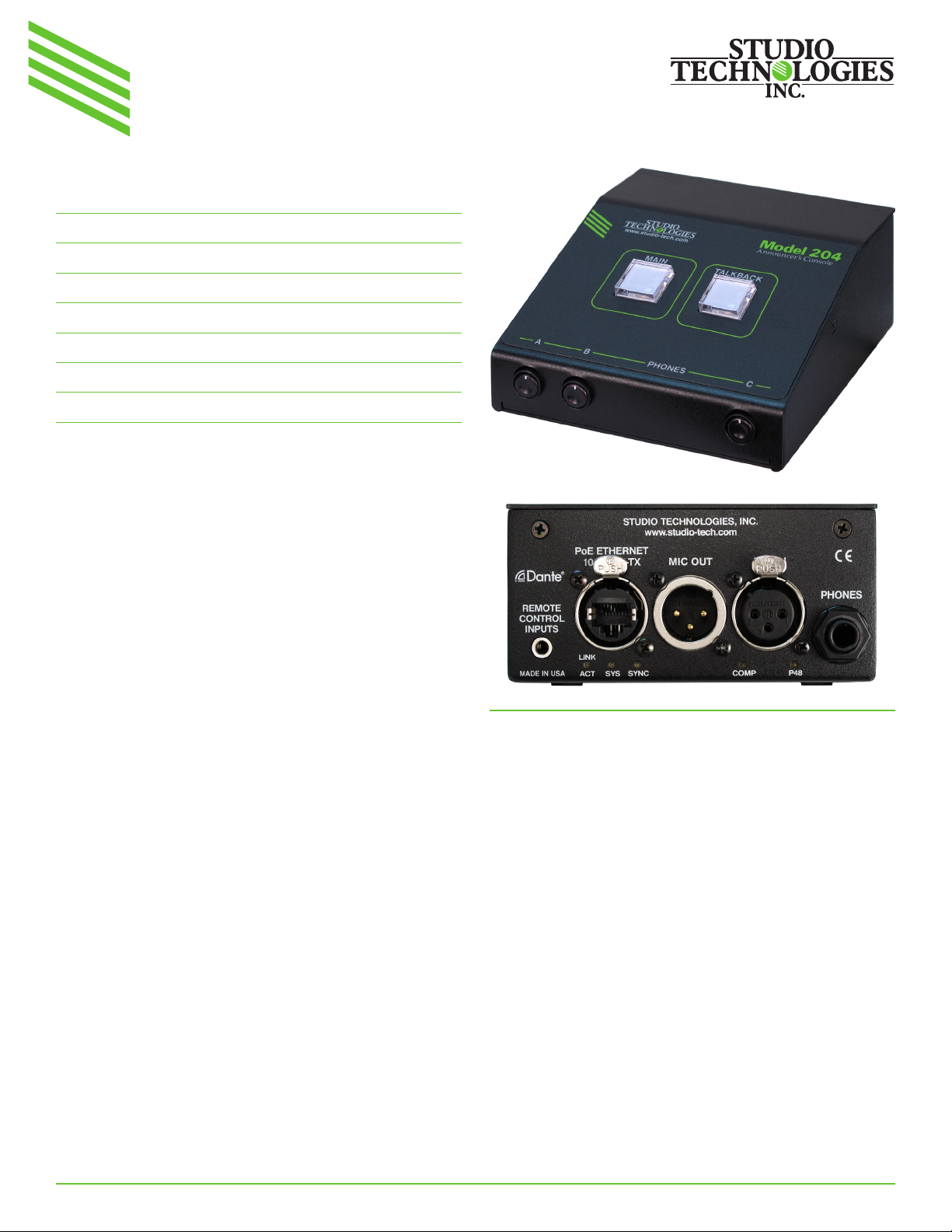
Model 204 Announcer’s Console
Featuring Dante® Technology
Key Features
• Dante audio-over-Ethernet technology
• Digital audio and direct-microphone outputs
• One main and one talkback output channel
• Highly-flexible 2-channel headphone output
• Compact unit supports one on-air location
• Excellent audio quality
• Uses STcontroller for configuration
• Power-over-Ethernet (PoE) powered
Introduction
The Model 204 Announcer’s Console offers a unique combination of analog and digital audio resources for use in broadcast
sports, eSports, live event, entertainment, and streaming broad
cast applications. The unit is housed in a compact, rugged steel
enclosure that’s intended for table-top use. Calling the Model
204 “cute” or “cool” would be accurate; its nicely proportioned
but diminutive size makes it ideal for use in space-constrained
locations. The Model 204 supports Dante® audio-over-Ethernet
digital media technology with AES67 compatibility for integration
into contemporary applications. The unit is extremely simple to
deploy, is “pro” quality throughout, and provides an intuitive user
experience. The Model 204’s audio quality is excellent, with low
distortion, low noise, and ample headroom. Careful circuit design
and rugged components ensure long, reliable operation.
The Model 204 integrates directly into both Dante audio-overEthernet and standard analog audio environments. With just a
Power-over-Ethernet (PoE) connection, a microphone, and a pair
of headphones or an earpiece, a complete broadcast on-air posi
tion can be created. And by using the Model 204’s microphone
output a direct connection to an analog microphone-level input
on an associated camera, remote I/O interface, or audio console
can be supported. Two remote control inputs allow external
switches or contact closures to activate the main and talkback
button functions.
Model 204 operating features are configured using the STcon
troller personal computer software application. An extensive
set of parameters allows the unit’s functions to be tailored to
meet the needs of many applications. STcontroller, compatible
with version 7 and later of the Windows® operating system, is
a fast and simple means of confirming and revising the unit’s
operating parameters.
-
-
-
Applications
The Model 204 on its own can provide an “all-Dante” solution
for one on-air talent location. A wide range of applications can
be supported, including sports and entertainment TV and radio
events, streaming broadcasts, corporate and government AV
installations, and post-production facilities. The unit’s small size
makes it ideal for live-sports applications, such as basketball,
where physical space for personnel is very limited. Four Dante
receiver (audio input) channels supply the user with their tal
ent cue (IFB) signals. Should the cue signal be “mix-minus”
an integrated sidetone function can provide the user with a
microphone confidence signal. Two Dante audio output chan
nels, one designated as main and the other as talkback, are
routed via an associated local-area network (LAN) to inputs on
Dante-compatible devices. Two pushbutton switches, main and
talkback, provide the user with direct control over audio routing.
The audio switching is performed in the digital domain and is
virtually “click-free.”
-
-
50638-0518, Issue 1
Page 2
By providing the main audio signal in two forms, Dante digital
audio and analog microphone level, the Model 204 makes
integration into a wide range of on-air environments easy to
accomplish. The talkback audio channel is available as a Dante
output channel which makes routing to an input on a variety of
devices, such as matrix intercom systems, audio consoles, and
monitor loudspeaker systems, simple and flexible.
Some applications may benefit from not utilizing the Model 204’s
Dante main output channel. This typically won’t be an issue of
inadequate audio quality but rather a need to match work-flow
requirements. For example, for lip-sync or transmission purposes it may be optimal to have the on-air audio transported
as an embedded signal along with the associated camera video.
Alternately, all on-air audio sources may need to connect to in
puts on an audio console or console-related I/O unit. Supporting
these scenarios is not a problem as the Model 204 supplies a
microphone output connection that’s specifically intended for
this purpose. Simply connect the unit’s microphone output connection to the desired analog input, such as the mic/line input
on an ENG-style camera—that’s it!
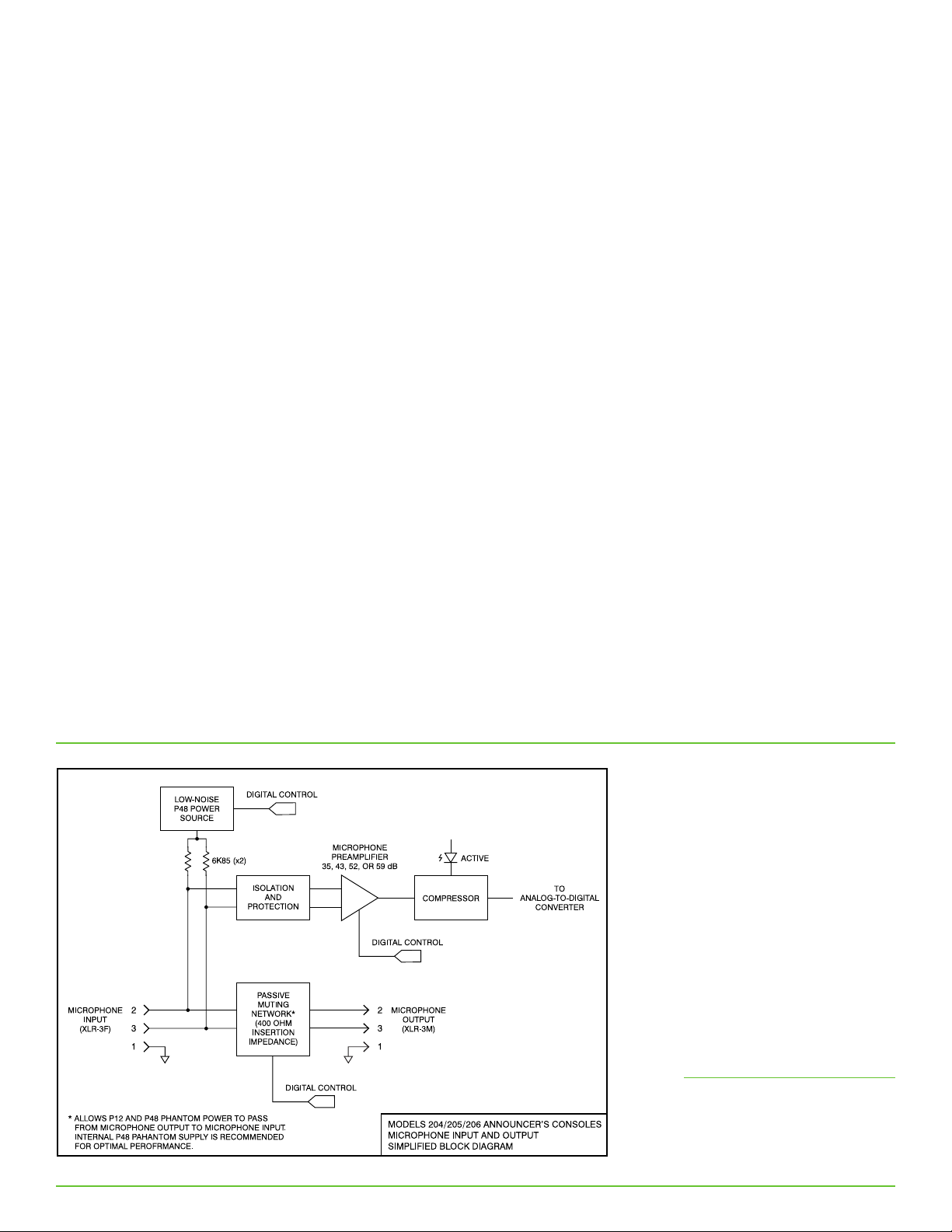
The circuitry associated with the Model 204’s analog microphone
output is very simple, essentially a passive path that routes a
signal connected to the microphone input connector directly to
the microphone output connector. A solid-state circuit, in series
with the mic in-to-mic out path, allows muting of the signal on the
microphone output connector whenever the Dante main output
channel is muted. Having both the Dante main output and the
microphone outputs work in tandem can be a valuable resource,
allowing one to serve as the primary on-air signal source while
the other serves as the backup.
Setup and Operation
Set up, configuration, and operation of the Model 204 is simple.
An etherCON® RJ45 jack is used to interconnect with a stan
dard twisted-pair Ethernet port associated with a PoE-enabled
network switch. This connection provides both power and bidi
rectional digital audio. A broadcast headset or handheld (“stick”)
microphone can be directly connected to the unit’s 3-pin XLR mic
input connector. The input is compatible with dynamic or con
denser microphones. The integrated P48 phantom power source
provides support for a wide range of condenser microphones. A
3-pin XLR microphone output connector provides a “direct mic
out” function for integration with microphone inputs on related
devices. Stereo headphones, the headphone connections from
a stereo or monaural headset, or even a monaural earpiece can
be connected to the phones output jack. External switches or
contact closures can be connected to the Model 204’s remote
control inputs to allow activation of the main and talkback but
ton functions. The STcontroller software application is used to
configure the wide range of Model 204 operating parameters.
This allows the unit’s performance to be optimized to meet the
needs of specific applications.
The user is presented with two pushbutton switches and three
push-in/push-out rotary level potentiometers. This makes it
easy to control the status of the main and talkback outputs as
well as adjusting the signals that are sent to the headphone
channels.
-
-
-
-
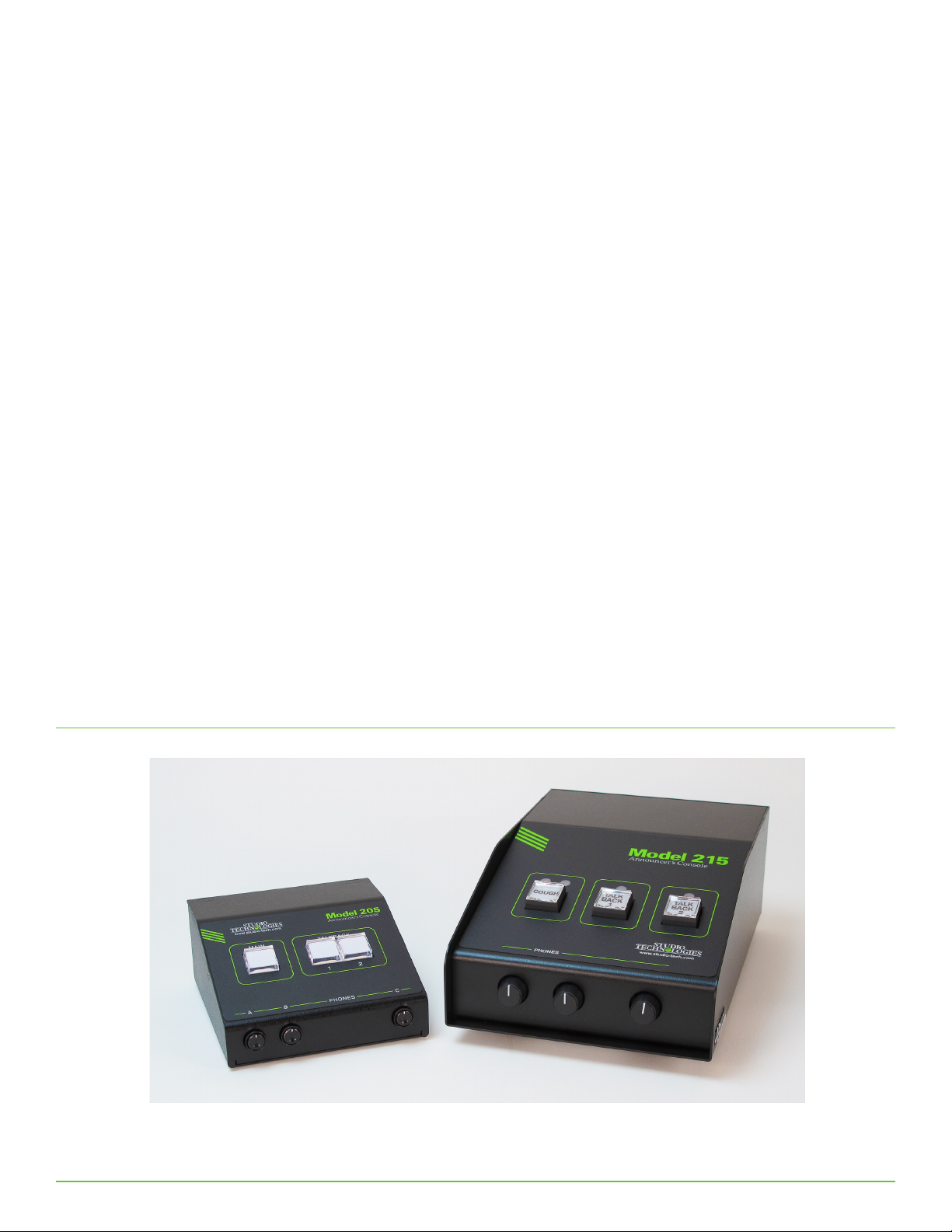
Model 205 Announcer’s Console size comparison to Model 215 Announcer’s Console
(size comparison is identical for Model 204 vs Model 214 Announcer’s Consoles)
Studio Technologies, Inc. Model 204 Announcer’s Console, Issue 1, Page 2
Page 3

Ethernet Data and PoE
The Model 204 connects to a local area network (LAN) by
way of a standard 100 Mb/s twisted-pair Ethernet interface.
The physical 100BASE-TX interconnection is made by way of
a Neutrik® etherCON RJ45 connector. While compatible with
standard RJ45 plugs, etherCON allows a ruggedized and locking
interconnection for harsh or high-reliability environments.
The Model 204’s operating power is provided by way of the
Ethernet interface using the 802.3af Power-over-Ethernet (PoE)
standard. This allows fast and efficient interconnection with the
associated data network. To support PoE power management,
the Model 204’s PoE interface enumerates (reports) to the
power sourcing equipment (PSE) that it’s a class 2 (low power)
device. If a PoE-enabled Ethernet port can’t be provided by
the associated Ethernet switch a low-cost PoE midspan power
injector can be utilized.
Dante Audio-over-Ethernet
Audio data is sent to and received from the Model 204 using the
Dante audio-over-Ethernet media networking technology. As a
Dante-compliant device, the Model 204’s two Dante transmitter
(audio output) channels and four Dante receiver (audio input)
channels can be assigned (routed or “subscribed”) to other
devices using the Dante Controller software application. The
Dante transmitter and receiver channels are limited to support
ing four Dante flows, two in each direction. The digital audio’s
bit depth is up to 24 with a sampling rate of 44.1 or 48 kHz.
Two bi-color LEDs provide an indication of the Dante connection
status. An additional LED displays the status of the associated
Ethernet connection.
The Model 204 is compatible with the AES67 interoperability
standard. In this mode the two transmitter (output) channels
will function in multicast; unicast is not supported. In addition,
the unit is compatible with the Dante Domain Manager™ (DDM)
software application.
-
Audio Quality
The Model 204’s audio performance is completely “pro.” A
low-noise, wide dynamic-range microphone preamplifier and as
sociated voltage-controlled-amplifier (VCA) dynamics controller
(compressor) ensures that mic input audio quality is preserved
while minimizing the chance of signal overload. The output of the
microphone preamp and compressor is routed to an analog-todigital conversion (ADC) section that supports sampling rates
of 44.1 and 48 kHz with a bit depth of up to 24. The audio signal,
now in the digital domain, routes through a 32-bit microprocessor
and on to the Dante interface section where it is packetized and
prepared for transport over Ethernet.
-
Audio input signals arrive via the four Dante receiver channels
and pass into the Model 204’s microprocessor. The supported
sampling rates are 44.1 and 48 kHz with a bit depth of up to 24.
Channel routing, headphone level control, and sidetone creation
are performed within the digital domain. This provides flexibility,
allows precise control, and keeps the three level potentiometers
from having to directly handle analog audio signals. The audio
channels destined for the phones outputs are sent to a highperformance digital-to-analog converter and then on to robust
driver circuitry. High signal levels can be provided to a variety
of headsets, headphones, and earpieces.
Configuration Flexibility
The Model 204 can be configured to meet the needs of specific
applications and user preferences. All configuration choices are
performed using the STcontroller personal computer software
application which is compatible with version 7 and later of the
Windows operating systems. There are no mechanical switch
settings or button-press sequences required to configure how
the unit functions. Selectable parameters include microphone
preamplifier gain, P48 phantom power on/off, button opera
tion, remote control inputs, headphone output mode, sidetone
operation, and overall unit operation. The gain of the microphone
preamplifier can be selected from among four choices. This al
lows the Model 204 to match the output sensitivity of a range
of handheld and headset-associated microphones. A low-noise
source of P48 phantom power can be enabled if required to
support condenser (capacitor) microphones.
The main and talkback pushbutton switches can be individually
configured. The main button can be selected to operate from
among four modes while the talkback button can be selected
from among three. These choices allow the Model 204’s opera
tion to be tailored to meet the specific needs of many applica
tions. As an example, for on-air sports applications the main
button would typically be configured to provide a push to mute
(cough) function. The microphone signal on the Dante main
output channel and the microphone output connector would
remain active unless the talent needs to momentarily disable
it. The talkback button would most likely be set to the push to
talk mode as its use would be intermittent.
The Model 204 provides two remote control inputs. Configura
tion choices allow these to be assigned to work in parallel with
the main or talkback pushbutton switches. In this way activation
of a remote control input will emulate a user pressing its associ
ated pushbutton switch.
The audio sources and the way in which they are assigned to
the headphone output channels can be configured from among
five choices. These unique choices allow almost any required
-
-
-
-
-
-
Studio Technologies, Inc. Model 204 Announcer’s Console, Issue 1, Page 3
Page 4

headphone monitoring situation to be implemented. Whether for
use in on-air sports, an awards show broadcast, or as a produc
tion support tool, the Model 204 should be able to achieve the
desired configuration.
Following the mode number is an abbreviated description of
what signal or signals are assigned to the three potentiometers
(pots) and on to the two headphone output channels. The
potentiometers are labeled, from left to right, A, B, and C.
The format would equate to Mode
x
equals the mode number.
x
– pot A/pot B/pot C where
• Mode 1 – Ch1L/Ch2R/SidetoneLR: Provided for broadcast
applications where two monaural channels of talent cueing
audio (“IFB”) need to be independently sent to the left and
right headphone output channels. It would be common for
program audio with director interrupt to enter the Model 204
by way of Dante input (receiver) channel 1 and be sent to the
left headphone output. Program-only audio, entering the unit
by way of Dante input channel 2, would be sent to the right
headphone output. Pots A and B are used to adjust the level
of those signals. Pot C is used for the sidetone function where
microphone audio is sent to both the left and right channels
of the headphone output.
• Mode 2 – Ch1LCh2R/BalanceLR/SidetoneLR: Intended
for applications where a stereo signal enters the Model 204
by way of Dante inputs 1 and 2 and is routed in stereo to the
left and right channels of the headphone output. In this mode
pot A controls the overall level of this stereo signal and pot
B controls its left/right level balance. Pot C is used by the
sidetone function.
• Mode 3 – Ch1LCh2R/Ch3LCh4R/SidetoneLR: Allows
two stereo signals to be routed as stereo pairs to the two
headphone output channels. In this mode pot A adjusts the
level of the stereo pair entering the unit by way of Dante
inputs 1 and 2 while pot B adjusts the level of the stereo
pair entering on Dante inputs 3 and 4. Pot C is used by the
sidetone function.
• Mode 4 – Ch1L/Ch2R/Ch3LCh4R: Allows two monaural
input signals to be independently routed to the left and right
headphone output channels. These audio signals would enter
the Model 204 by way of Dante input channels 1 and 2. Pots
A and B are used to control the levels of the signals as they
are sent to the left and right headphone output channels. A
stereo input signal, entering the unit by way of Dante inputs
3 and 4, are routed to the left and right headphone outputs.
This stereo pair has its level controlled by pot C.
• Mode 5 – Ch1LR/Ch2LR/Ch3LCh4R: Allows two monau
ral input audio channels to be sent to both the left and right
headphone output channels. Dante inputs 1 and 2 are used
to bring these audio signals into the Model 204. Pots A and
B are used to control the level of the signals as they are sent
to the headphone output channels. Pot C is used to control
the level of a stereo input signal as it is routed to the left and
right channels of the headphone output. This stereo pair enters
the unit by way of Dante inputs 3 and 4.
The integrated sidetone function can be configured to operate
from among four choices. This allows audio associated with the
microphone input and microphone preamplifier to be returned to
the headphone output. This is important as different applications
may provide a “full mix” or a “mix-minus” talent cue signal. If
a full mix cue signal is provided then sidetone audio will not be
needed and the function can be disabled. In the case where a
mix-minus signal is present, providing the user with sidetone at
the appropriate time(s) can be an important means of confirming
the signal that’s coming from the connected microphone.
The headphone gain range configuration helps to provide an
optimized audio level to Model 204 users. The appropriate set
ting will depend on the specific audio sources provided to the
unit as well as user preference.
Three system modes select the overall way in which the Model
204 functions. The on-air mode is optimized for applications
where users will be on-air talent that must maintain strict separa
tion between on-air and production audio channels. Other appli
cations will benefit from the two available production modes.
Future Capabilities and Firmware
Updating
The Model 204 was designed so that its capabilities and performance can be enhanced in the future. A USB connector,
located on the unit’s main circuit board (underneath the unit’s
cover), allows the application firmware (embedded software) to
be updated using a USB flash drive.
The Model 204 uses the Audinate Ultimo™ integrated circuit to
implement the Dante interface. The firmware in this integrated
circuit can be updated via the Ethernet connection, helping to
ensure that its capabilities remain up to date.
-
-
-
-
Studio Technologies, Inc. Model 204 Announcer’s Console, Issue 1, Page 4
Page 5
Model 204 Specifications
Power Source:
Power-over-Ethernet (PoE): class 2 (low power, ≤6.49 watts)
Network Audio Technology:
Type: Dante audio-over-Ethernet
AES67-2013 Support: yes
Dante Domain Manager (DDM) Support: yes
Bit Depth: up to 24
Sample Rate: 44.1 and 48 kHz
Number of Transmitter (Output) Channels: 2 (main, talkback)
Number of Receiver (Input) Channels: 4 (Headphone Ch1,
Headphone Ch2, Headphone Ch3, Headphone Ch4)
Dante Audio Flows: 4; 2 transmitter, 2 receiver
Network Interface:
Type: 100BASE-TX, twisted-pair Ethernet, Power-over-Ethernet
(PoE) supported
Data Rate: 100 Mb/s (10 Mb/s and 1000 Mb/s “GigE” Ethernet
not supported)
Microphone Input:
Compatibility: dynamic or phantom-powered microphones
Type: balanced, capacitive coupled
Impedance: 3.1 k ohms, nominal
Gain: 35, 43, 52, 59 dB, selectable
Frequency Response: 25 Hz to 20 kHz, –3 dB
Distortion (THD+N): <0.018%, measured at 35 dB of gain
Dynamic Range: 98 dB, A-weighted
Phantom Power: P48 per IEC 61938 standard, on/off selectable
with status LED
Compressor:
Application: applies to Dante main and talkback transmitter
(output) channels
Threshold: 1 dB above nominal level (–19 dBFS)
Slope: 2:1
Status LED: compressor active
Microphone Output:
Type: passive via two 200 ohm resistors from microphone input
(will pass phantom power in either direction)
Muting: solid-state relay contacts, 60 dB attenuation @ 1 kHz
Headphone Output:
Type: 2-channel (stereo)
Compatibility: intended for connection to stereo (dual-channel)
or monaural (single-channel) headphones, headsets, or earpieces with nominal impedance of 50 ohms or greater
Maximum Output Voltage: 3.0 Vrms, 1 kHz, 150 ohm load
Frequency Response: 20 Hz to 20 kHz, +0/–1 dB
Distortion (THD+N): <0.008%
Dynamic Range: >102 dB
Remote Control Inputs: 2
Functions: mimics the action of the main and talkback button
functions
Type: active low, 1 mA maximum, inputs pull up to 3.3 volts DC
Connectors:
Microphone Input: 3-pin female XLR
Microphone Output: 3-pin male XLR
Headphone Output: 3-conductor ¼-inch jack
Remote Control Inputs: 3-conductor 3.5 mm jack
Ethernet: Neutrik etherCON RJ45
USB: type A receptacle (located inside Model 204’s enclosure
and used only for updating firmware)
Configuration: requires Studio Technologies STcontroller
personal computer application, version 1.05.00 and later
(STcontroller compatible with Windows® version 7 and later)
Dimensions (Overall):
4.3 inches wide (10.9 cm)
2.1 inches high (5.4 cm)
5.1 inches deep (13.0 cm)
Deployment: intended for tabletop applications
Weight:
1.2 pounds (0.55 kg)
Specifications subject to change without notice.
Studio Technologies, Inc.
Skokie, Illinois USA
© by Studio Technolog
studio-tech.com
ies, Inc., May 2018
Studio Technologies, Inc. Model 204 Announcer’s Console, Issue 1, Page 5
 Loading...