

Page 1

tm
User’s Manual
Stream Flow (F1)
Page 2

Stream Drinking Water Systems
Thank you for choosing a Stream filtration system. It is our commitment to provide our valued customers
the very best in water quality and we look forward to serving you for many years. Here’s how to connect
Stream and begin enjoying quality water for less.
Table of Contents
A-100713
Sec.
01
01
02
Sec.
02
02
03
Sec.
03
03
General Information, 3
A. Operation & Maintenance
Specifications
B. Installation Overview & Parts
Preparing the Housing, 5
A. Filter Cartridge Installation
Countertop Installation, 6
A. Connect the Hose and Diverter Valve
06
Sec.
07
05
07
Sec.
08
06
08
Sec.
09
07
Performance Certification, 8
Performance Data Sheets, 9
A. Aesthetic Effects
B. Operational Specifications
C. California Certification
Troubleshooting & FAQs, 13
A. Troubleshooting & FAQs
B. Maintenance Problems
Start-up and Use, 7
04
Sec.
04
04
2 Table of Contents
A. Start-up of the Stream Flo Drinking
Water System
B. Filter Life
Stream Laboratories, Inc.
2520 Shell Road Ste B
Georgetown, TX 78628
Phone: (888)-615-5733
Page 3

General Information
A. Operation & Maintenance Specifications
Sec.
01
Model Name:
Replacement Filter Type:
Housing Composition:
Rubber Items:
Approximate Filter Capacity:
Approximate Flow Rate at 60 psi:
Maximum Working Pressure:
Minimum Working Pressure:
Maximum Operating Temeprature:
Minimum Operating Temeprature:
Inlet:
Outlet:
Particle Retention Size:
tested for:
Notes
Stream Flow (F1)
Stream Flow Cartridge (FC1)
Stainless Steel
Nitrile
750 gallons
0.75 gpm
100 psi / 8.8 kg/cm
30 psi / 2.1 kg/cm
100˚F / 38˚C for cold water use only
32˚F / 0˚C for cold water use only
1/4” NPTF x 1/4” tube
1/4” NPTF x 1/4” tube
sub micron (0.5 micron)
CA Dept. of Public Health : Cert: #13-2190
1. The Stream Flow Drinking Water System sits on the kitchen
countertop and connects to your existing faucet with a hose and
diverter valve.
2
2
2. Replacement filters can be purchased from your dealer. Filter life
will vary in proportion to the amount of water used and the level of
impurities in the water being processed.
Replace the filter cartridge when the first of the following occurs:
(a) annually; (b) when the system’s rated capacity is reached;
(c) the flow rate diminishes; or (d) the filter becomes saturated
with bad tastes and odors. The rated capacity of the filter
cartridges is shown above.
3. This system is not intended to be used where the water is
microbiologically unsafe or with water of unknown quality without
adequate disinfection before or after the unit. Systems tested for
cyst reduction may be used on disinfected waters that may
contain filterable cysts.
4. Do not allow water to freeze in the unit. If unit is exposed to
freezing temperatures, drain water from unit and remove filter.
5. Do not allow water to sit in unit for extended periods of time
(10 or more days) without being used. If unit is to be left unused
for more than 10 days, drain all water from the system and remove
the filter
continue use. In the event water does sit in the unit for 10 or more
days, the system should be flushed by allowing water to flow to
waste for about 3 minutes; then continue use as normal.
. Upon your return, reconnect the filter in the housing and
3General Information
Page 4
1
2
3
4
5
6
7
8
9
10
1
2
3
4
5
6
7
8
9
10
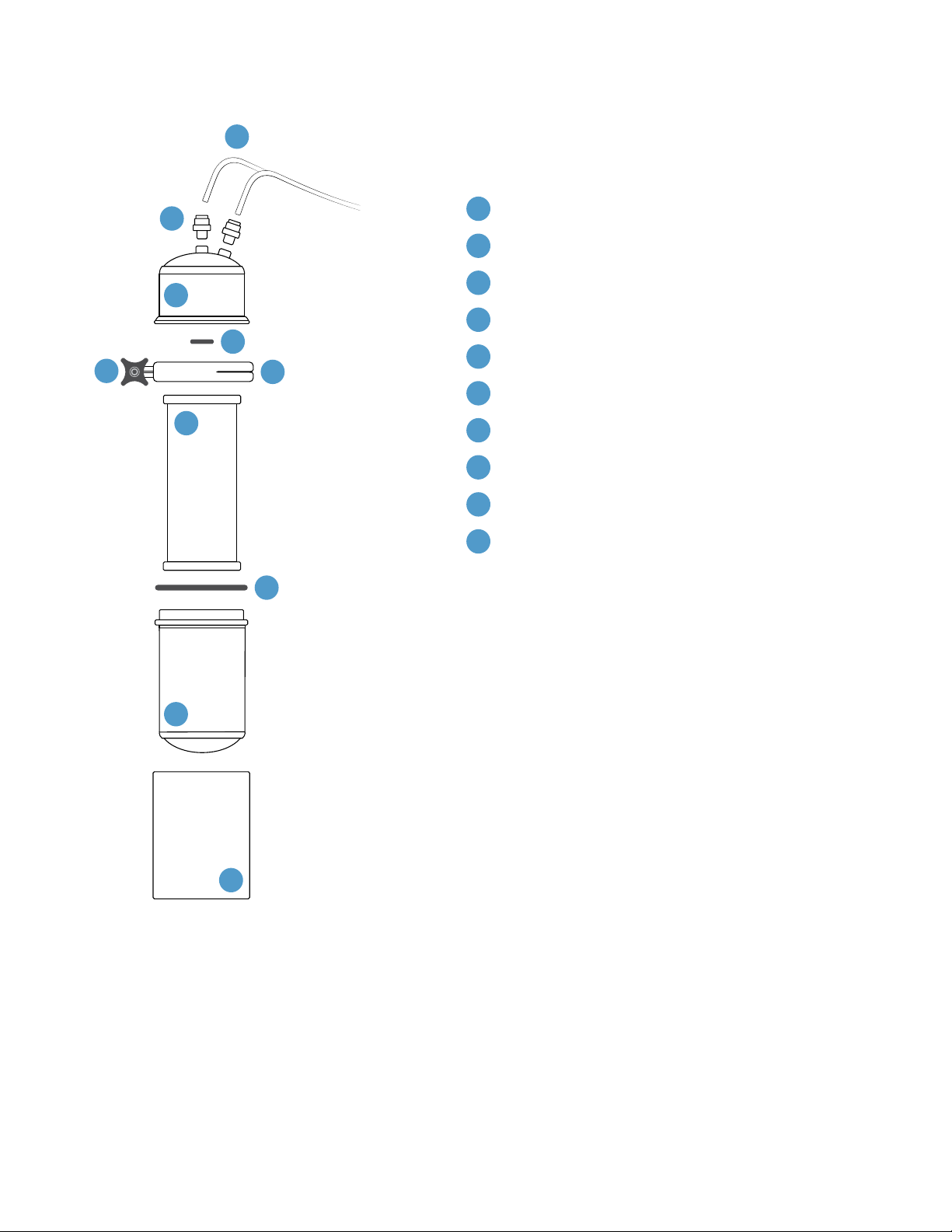
Diverter Valve Assembly
Inlet and Outlet Adapters
Housing Top
Black Rubber Cushion (inside housing top)
V-band Knob
V-band
Carbon Block Filter
O-ring
Housing Bottom
Acrylic Sleeve
B. Installation Overview & Parts
Stream Drinking Water Systems have been tested so you know that they will perform at the highest level
possible. Please read this manual before installing your Stream Flow System, as installation, operation, and
maintenance will aide in your System’s performance. Not following these instructions carefully could lead
to product failure or possible damage.
If you need help or assistance, feel free to contact your dealer or representative.
4
General Information
Page 5
Preparing the Housing
Be sure to gather the recommended tools for the Stream Flow countertop installation before you begin.
A. Filter Cartridge Installation
The filter cartridge is shipped outside of the unit housing
(in most cases) to protect your filter and drinking water
system from damage during shipping. Be sure to insert the
filter cartridge into the drinking water system housing before
proceeding with the installation.
First, remove the plastic wrapper and instruction wrap from
around the filter.
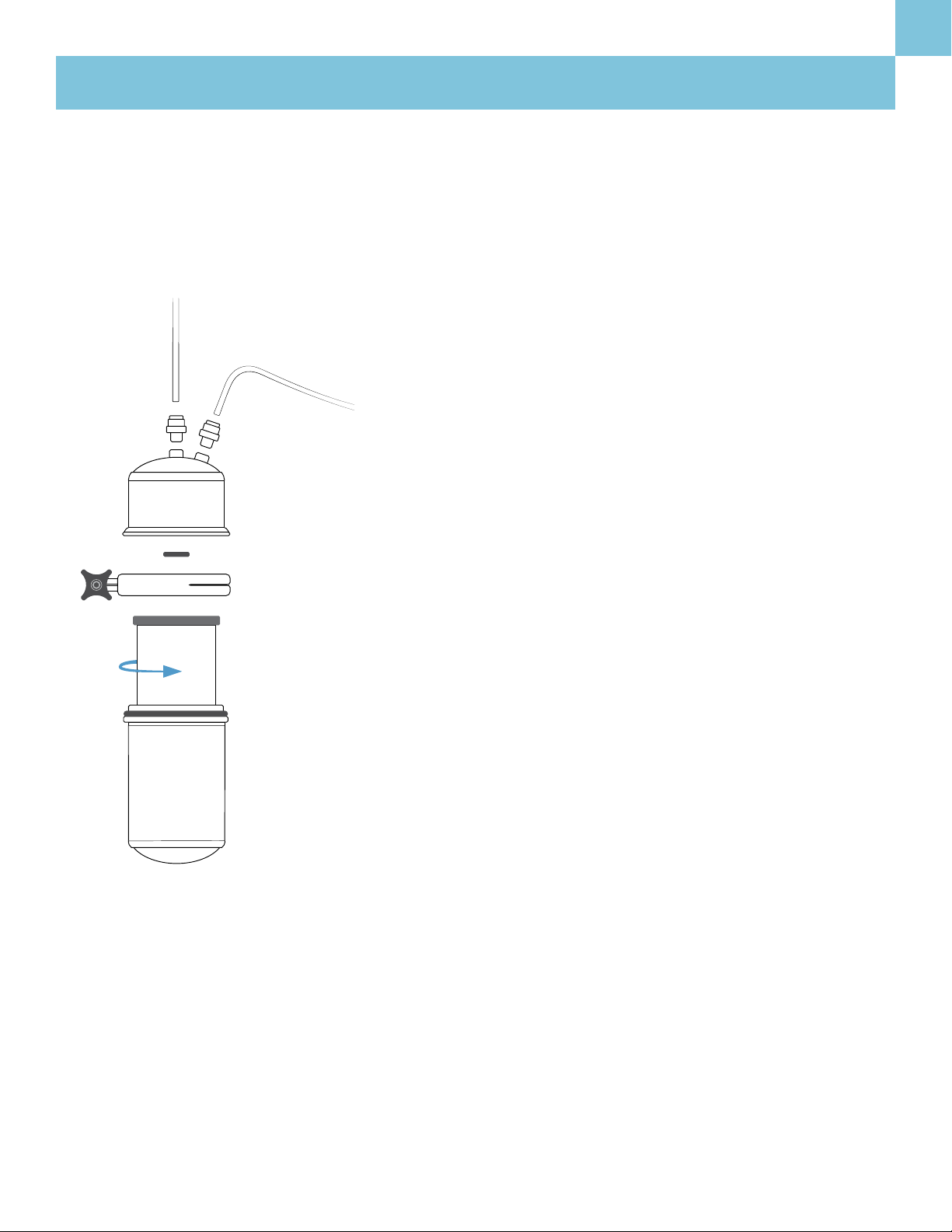
1. With the housing positioned upright, open the unit by
unscrewing the black knob on the locking v-band.
To p
Spread it apart and remove the v-band.
Sec.
02
V-band
Bottom
Turn to
connect
2. Separate the unit, leaving the black rubber o-ring in place
on the housing.
3. Screw the new filter (cartridge) in the housing top, turning it
until firm. Filter needs to make 4-5 complete revolutions in order
to ensure a firm seal. Be sure that the filter has been screwed in
STRAIGHT. DO NOT OVER TIGHTEN.
4. Reconnect the housing top with bottom and replace locking
v-band; replace black knob and turn until tight. Be sure that the
locking v-band is fastened tightly by:
a. Checking the v-band to confirm that it is secured evenly
around the housing top and bottom.
b. Hand-tightening the black knob on the v-band until it is
as tight as possible.
Preparing the Housing
5
Page 6
Sec.
03
Countertop Installation
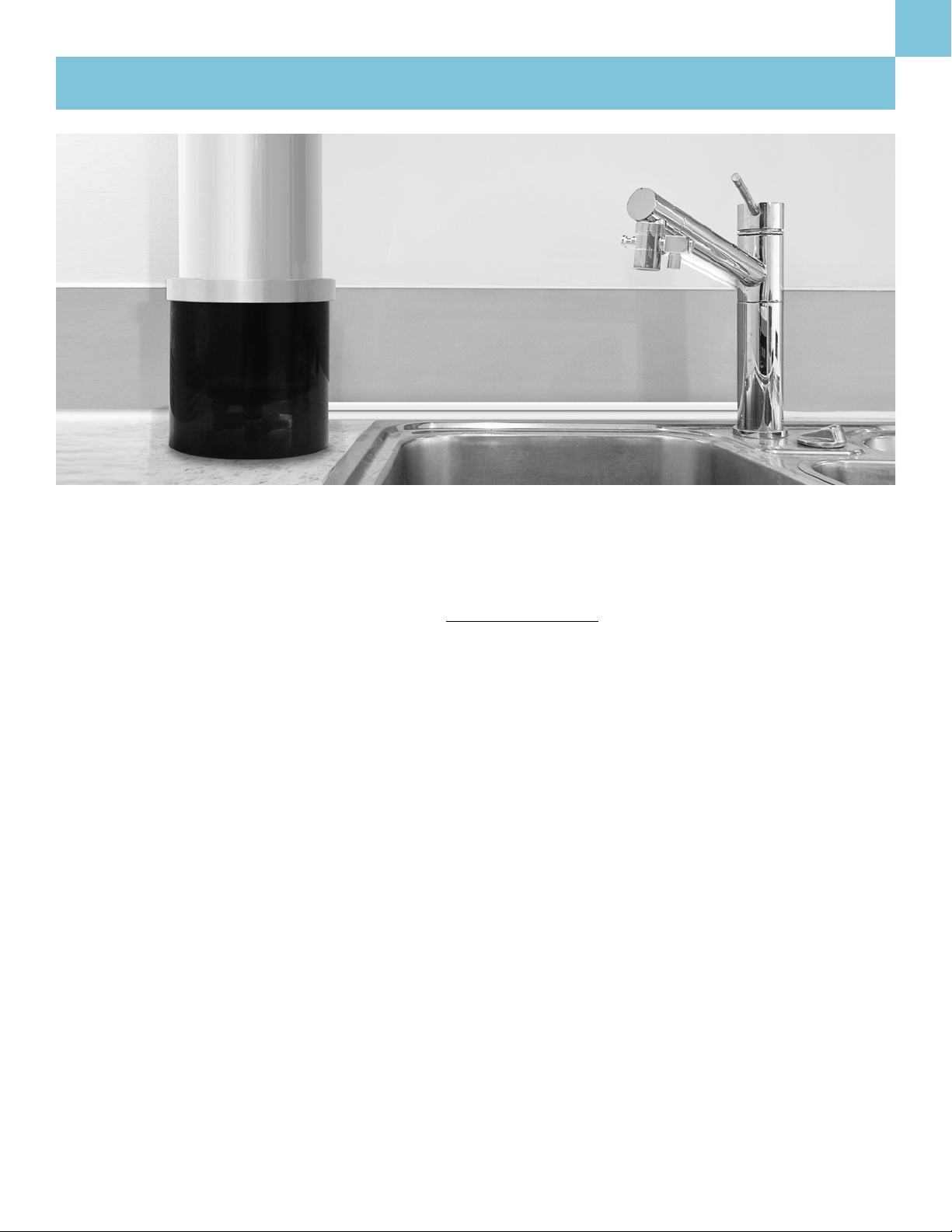
The Stream Flow model sits on the counter next to the sink and is connected to your existing faucet with
a hose and diverter valve. Stream Flow comes with the hose and diverter valve attached to its housing.
Make sure to read Section 2 on Preparing the Housing before installing the System.
A. Connect the Hose and Diverter Valve
*
1. Turn off the water to your sink.
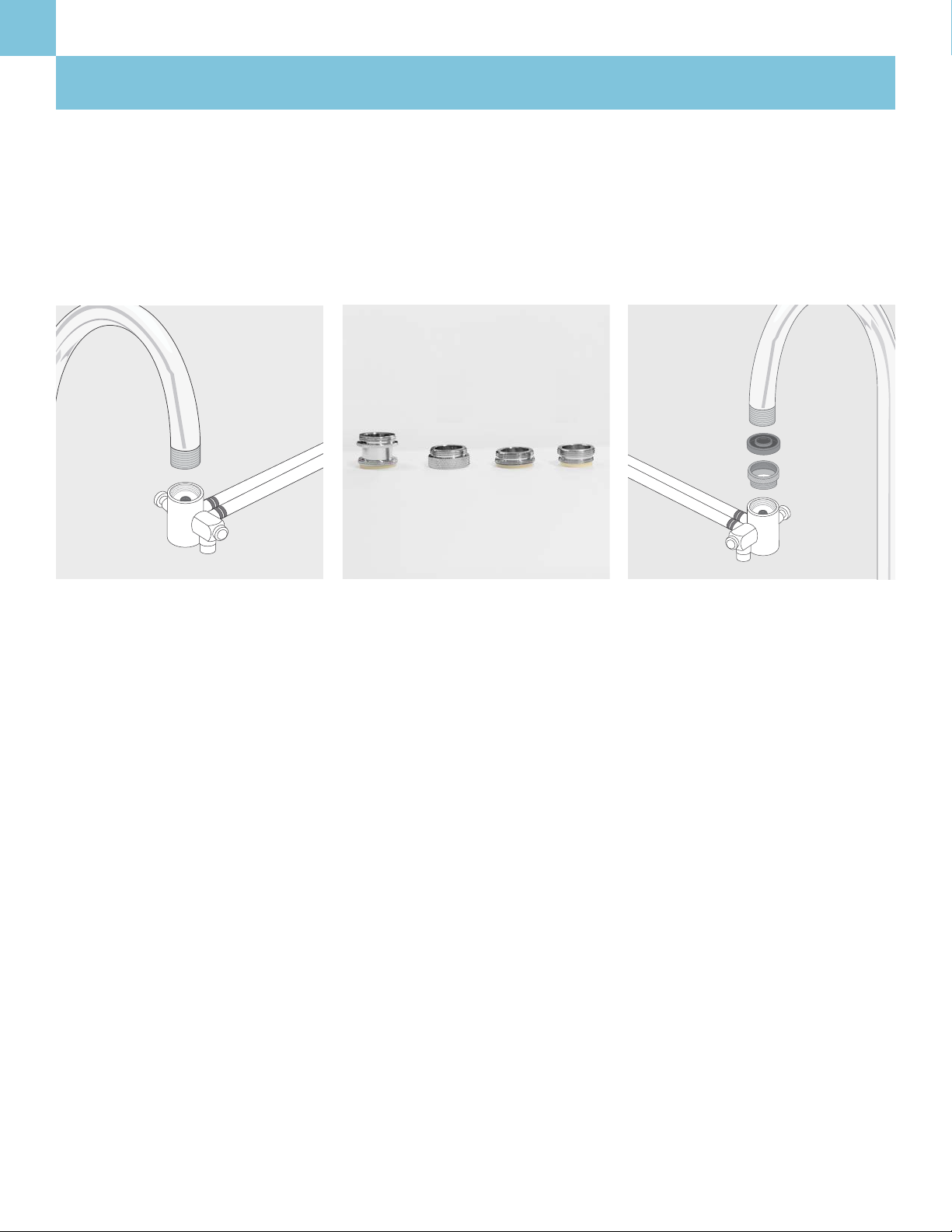
2.Remove the screen from the end of your faucet.
3.Attach the diverter valve directly to the faucet spout. If the threads of the diverter valve don’t match the
threads of your faucet, you can use one of the adapters that came with your unit.
a. For faucets with outside threads: Attach the diverter valve directly to the faucet, or if the diverter
valve is smaller than your faucet, use the adapter with inside threads (SF206).
b. For faucets with inside threads: Use one of the two adapters with outside threads: SF207 or SF208.
Choose the one of the appropriate size and attach it to your faucet. Then attach the diverter
valve to the adapter.
c. For faucets with no threads: Measure the inside neck diameter of the faucet and contact your
dealer with this information. They’ll be happy to provide you with an expandable adapter
in exchange for the one shipped with your unit.
d. For faucets with oddly sized threads: If your faucet does not fit any of the adapters provided with
your unit, contact your dealer.
e. For faucets that need more clearance for the connection, like a sprayer hose faucet,
use the long adapter (SF357).
4. Turn on the water and push the diverter valve’s bypass lever so water will flow through the unit.
6 Countertop Installation
Page 7
Start-up and Use
Sec.
04
A. Start-up of the Stream Flow Drinking Water System
1. Dry off all the connections and the drinking water unit.
2. Make sure that all the connections are tight, but do not over tighten.
3. Turn the water onto COLD.
4. Push the bypass lever to let the water flow through the unit.
5. Allow the water to run through the unit for about 5 minutes so that all air can escape.
6. Push the bypass lever inward to stop the flow through your Stream Flow System.
Then you can turn off your faucet.
7. Flush system for 30 minutes.
8. Turn the unit upside down to let out any trapped air.
9. Check all connections to make sure there aren’t any leaks.
B. Filter Life
Filter life will vary depending on the amount of water used and the amount of impurities being
processed in your water. If your Stream Flow filter clogs, it may be because it is protecting you from the
contaminants and physical matter in your drinking water. If this happens, see Section I.A Operation and Maintenance Specifications.
For the best performance possible and to maintain your warranty, you should replace your filter
when the first of the following occurs: (a) annually; (b) when you’ve reached the unit’s rated capacity;
(c) the flow rate slows or lessens; or (d) the filter starts to taste or smell bad.
7Start-up and Use
Page 8

Sec.
05
Performance tested
Stream Drinking Water Systems Product Performance Tested
Stream Drinking Water System Tested to
the reduction of claims specified below.
Standard 42, Aesthetic Effects
• Chloramine
• Chlorine taste and odor
• Nominal Particulate Reduction,
Class I
NSF International Standards 42 and 53 for
Standard 53, Health Effects
• Asbestos
• Chlordane
• Cyst
• Lead
• Mercury
• MTBE
• PCB
• Toxaphene
• Turbidity
• VOC (listed below)
MODEL - F1
Volatile Organic Chemicals (VOC) Include:
Disinfection By-Products
• chloropicrin
• haloacetonitriles (HAN):
- bromochloroacetonitrile
- dibromoacetonitrile
- dichloroacetonitrile
- trichloroacetonitrile
• haloketones (HK):
- 1,1-dichloro-2-Propanone
- 1,1-trichloro-2-Propanone
• trihalomethanes (THMs; TTHMs):
- bromodichloromethane
- bromoform
- chloroform
- dibromochloromethane
• tribromoacetic acid
Pesticides
• carbofuran
• dibromochloropropane (DBCP)
• o-dichlorobenzene
• p-dichlorobenzene
• endrin
• ethylene dibromide (EDB)
• heptachlor
• heptachlor epoxide
• lindane
• methoxychlor
Herbicides
• alachlor
• atrazine
• 2,4-D
• dinoseb
• pentachlorophenol
• 2,4,5-TP (silvex)
Chemicals
• benzene
• carbon tetrachloride
• chlorobenzene
• 1,2-dichloroethane
• 1,1-dichloroethylene
• cis-1,2-dichloroethylene
• 1,2-dichloropropane
• cis-1,3-dichloropropylene
• ethylbenzene
• hexachlorobutadiene
• hexachlorocyclopentadiene
• simazine
• styrene
• 1,1,2,2-tetrachloroethane
• tetrachloroethylene
• toluene
• trans-1,2-dichloroethylene
• 1,2,4-trichlorobenzene
• 1,1,1-trichloroethane
• 1,1,2-trichloroethane
• trichloroethylene
• xylenes (total)
8 Performance
tested
Page 9

Sec.
06
Performance Data Sheets
Stream Drinking Water Systems have been tested according to NSF/ANSI Standard No. 53 for reduction of the
substances listed below. The concentration of the indicated substances in water entering the system was reduced to
a concentration less than or equal to the permissible limit for water leaving the system, as specified in NSF/ANSI 53
Health Effects.
Substance
ALACHLOR*
ASBESTOS*
ATRAZINE*
BENZENE*
BROMODICHLOROMETHANE (TTHM)*
BROMOFORM (TTHM)*
CARBOFURAN (Furadan)*
CARBON TETRACHLORIDE*
CHLORDANE
CHLOROBENZENE (Monochlorobenzene)
CHLOROPICRIN*
CHLOROFORM (TTHM)* (surrogate chemical)
Cryptosporidium (CYST)
CYST (Giardia; Cryptospordium; Entamoeba;
Toxoplasma)
2, 4-D*
DBCP (see Dibromochloropropane)*
1, 2-DCA (see 1, 2-DICHLOROETHANE)*
1, 1-DCE (see 1, 1-DICHLOROETHYLENE)*
DIBROMOCHLOROMETHANE (TTHM;
Chlorodibromomrthane)*
DIBROMOCHLOROPROPANE (DBCP)*
o-DICHLOROBENZENE (1, 2 Dichlorobenzene)*
p-DICHLOROBENZENE (para-Dichlorobenzene)*
1, 2-DICHLOROETHANE (1, 2-DCA)*
1, 1-DICHLOROETHYLENE (1, 2-DCE)*
CIS-1, 2-DICHLOROETHYLENE*
TRANS-1, 2-DICHLOROETHYLENE*
1, 2-DICHLOROPROPANE (Propylene Dichloride)*
CIS-1, 3-DICHLOROPROPYLENE*
DINOSEB*
EDB (see ETHYLENE DIBROMIDE)*
ENDRIN*
Entamoeba (see CYSTS)
ETHYLBENZENE*
ETHYLENE DIBROMIDE (EDB)*
Furadan (see CARBOFURAN)*
Giardia Lamblia (see CYST)
** Percent reduction reflects actual performance of Stream product as specifically tested (at 200% of capacity). Percent reduction
shown for VOCs* reflects the allowable claims for volatile organic chemicals/compounds as per tables. Chloroform was used as
a surrogate for VOC reduction claims; the Stream Systems actual reduction rate of chloroform was >99.8% as tested.
Percent
Reduction
>98%
>99%
>97%
>99%
>99.8%
>99.8%
>99%
98%
>99.4%
>99%
99%
>99.8%
99.95%
99.95%
98%
>99%
95%
>99%
>99.8%
>99%
>99%
>98%
95%
>99%
>99%
>99%
>99%
>99%
99%
>99%
99%
99.95%
>99%
>99%
>99%
>99.95%
Influence
Challenge
Concentration
0.05
107 to 108 fibers/L
0.1
0.081
0.3
0.3
0.19
0.078
0.04 +/- 10%
0.077
0.015
0..300 +/- .30
minimum 50,000/ml
minimum 50,000/ml
0.110
0.052
0.088
0.083
0.300
0.052
0.08
0.04
0.088
0.083
0.17
0.086
0.08
0.079
0.17
0.044
0.053
minimum 50,000/ml
0.088
0.044
0.19
minimum 50,000/ml
MODEL - F1
Maximum
permissible product
water concentration
0.001
99% reduction requirement
0.003
0.001
0.015
0.015
0.001
0.0018
0.002
0.001
0.0002
0.015
99.95%
99.95%
0.0017
0.00002
0.0048
0.001
0.015
0.00002
0.001
0.001
0.0048
0.001
0.0005
0.001
0.001
0.001
0.0002
0.00002
0.00059
99.95%
0.001
0.00002
0.001
99.95%
Performance Data Sheets
9
Page 10

HALOACETONITRILES (HAN)*:
BROMOCHLOROACETONITRILE
DIBROMOACETONITRILE
DICHLOROACETONITRILE
TRICHLOROACETONITRILE
HALOKETONES (HK)*:
1, 1-DICHLORO-2-PROPANONE
1, 1, 1-TRICHLORO-2-PROPANONE
HEPTACHLOR*
HEPTACHLOREPOXIDE*
HEXACHLOROBUTADIENE (Perchlorobutadiene)*
HEXACHLOROCYCLOPENTADIENE*
LEAD (pH 6.5)
LEAD (pH 8.5)
LINDANE*
MERCURY (pH 6.5)
MERCURY (pH 8.5)
METHOXYCHLOR*
Methylbenzene (see TOLUENE)*
Monochlorobenzene (see CHLOROBENZENE)*
MTBE (methyl tert-butyl ether)
POLYCHLORINATED BIPHENYLS (PCB, Aroclor 1260)
PCE (see TETRACHLOROETHYLENE)*
PENTACHLOROPHENOL*
Perchlorobutadiene (see HEXACHLOROBUTADIENE)*
Propylene Dichloride (see 1, 2-DICHLOROPROPANE)*
SIMAZINE*
Silvex (see 2, 4, 5-TP)*
STYRENE (Vinylbenzene)*
1, 1, 1-TCA (see 1, 1, 1-TRICHLOROETHANE)*
TCE (see TRICHLOROETHYLENE)*
1, 1, 2, 2-TETRACHLOROETHANE*
TETRACHLOROETHYLENE*
TOLUENE (Methylbenzene)*
TOXAPHENE
Toxoplasma (see CYSTS)
2, 4, 5-TP (Silvex)*
TRIBROMOACETIC ACID*
1, 2, 4 TRICHLOROBENZENE*
1, 1, 1-TRICHLOROETHANE (1 ,1, 1-TCA)*
1, 1, 2-TRICHLOROETHANE*
TRICHLOROETHYLENE (TCE)*
TRIHALOMETHANES (TTHM) (Chloroform; bromoform;
bromodichloromethane; dibromochloromethane)
TURBIDITY
Unsym-Trichlorobenzene*
Vinylbenzene (see STYRENE)*
XYLENES (TOTAL)*
98%
98%
98%
98%
99%
96%
>99%
98%
>98%
>99%
>99.3%
>99.3%
>99%
96.6%
96.8%
>99%
>99%
>99%
96.6%
97.2%
>99%
>99%
>98%
>99%
>97%
99%
>99%
95%
>99%
>99%
>99%
>99%
>92.9%
99.95%
99%
>99%
95%
>99%
>99%
>99.8%
98.8%
>99%
>99%
>99%
0.022
0.024
0.0096
0.015
0.0072
0.0082
0.025
0.0107
0.044
0.060
0.15 +/- 10%
0.15 +/- 10%
0.055
0.006 +/- 10%
0.006 +/- 10%
0.050
0.078
0.077
0.015 +/- 20%
0.01 +/- 10%
0.081
0.096
0.044
0.080
0.120
0.270
0.15
0.084
0.180
0.081
0.081
0.078
0.015 +/- 10%
minimum 50,000/ml
0.270
0.042
0.160
0.084
0.150
0.180
0.300 +/- .30
11 +/- 1 NTU
0.160
0.150
0.070
0.0005
0.0006
0.0002
0.0003
0.0001
0.0003
0.00001
0.0002
0.001
0.000002
0.010
0.010
0.00001
0.002
0.002
0.0001
0.001
0.001
0.005
0.0005
0.001
0.001
0.001
0.001
0.004
0.0016
0.0005
0.0046
0.0010
0.001
0.001
0.001
0.003
99.95%
0.0016
0.001
0.0005
0.0046
0.0005
0.0010
0.015
0.5 NTU
0.0005
0.0005
0.001
Note: This addresses the U.S. Environmental Protection Agency (USEPA) Primary and Secondary Drinking Water Regulations in effect
at its time of publication, as they relate to Stream’s performance in conformance to the industry performance criteria. These regulations
are continually being updated at the Federal level. Accordingly, this list of MCLs will be reviewed and amended when appropriate.
Page 11

A. NSF/ANSI 42 - AESTHETIC EFFECTS
The system has been tested according to NSF/ANSI 42 for reduction of the substances listed below. The
concentration of the indicated substances in water entering the system was reduced to a concentration less
than or equal to the permissible limit for water leaving the system, as specified in NSF/ANSI 42.
CHLORAMINE as Aesthetic Effect (As Monochloramine)
CHLORINE as Aesthetic Effect
PARTICULATE, (Normal Particulate Reduction, Class I,
Particles 0.5 TO <1 UM
1. Stream Drinking Water Systems have been tested by NSF International for compliance to NSF/
>97%
>97%
Class I >99%
3.0 mg/L +/- 10%
2.0 mg/L +/- 10%
At Least 10,000
particles/mL
0.5 mg/L
> or = 75%*
> or = 85%*
ANSI
Standard Nos. 42 and 53.
2. Chloroform was used as a substitute for claims of reduction of VOCs, where the Stream System’s actual
reduction rate of chloroform was greater than 99.8% when tested at 200% capacity. Stream Drinking Water
Systems have been certified by the State of California Department of Public Health for the reduction of specific contaminants listed herein.
3. Do not use with water that is microbiologically unsafe or of unknown quality without adequate disinfection before or after the system. Systems tested for cyst reduction may be used on disinfected waters
that may contain filterable cysts.
4.Stream’s housing is warranted for a lifetime (with annual cleaning); all exterior hoses and attachments to
the System are warranted for one year. Please see the owner’s manual for complete product guarantee and
warranty information.
5.Please see the owner’s manual for installation and operating procedures.
6.In compliance with New York law, New York residents should have their water supply tested to determine
their actual water treatment needs before purchasing a water treatment system. Please compare the capabilities of the Stream unit with your actual water treatment needs.
7. While testing was performed under standard laboratory conditions, actual performance may vary.
8.The list of substances that this device reduces does not necessarily mean that they are present in your tap
water.
B. Operational Specifications
Model Number: Stream Flow (F1)
Replacement Filter Type: Stream Flow Cartridge (FC1)
Approximate Filter Capacity:
Approximate Flow Rate at 60 psi:
Maximum Working Pressure:
Minimum Working Pressure:
Maximum Operating Temperature:
Minimum Operating Temperature:
750 gallons
0.75 gpm
100 psi / 8.8 kg/cm
30 psi / 2.1 kg/cm
2
2
100˚F / 38˚C for cold water use only
32˚F / 0˚C for cold water use only
11Performance Data Sheets
Page 12

C. California Certification Department of Public Health
Alachlor
Endrin
PCB
Cysts
California Department of Public Health Certification Number #13-2190. For conditions of use, health
claims certified by the CA Department of Public Health, and replacement parts, see Product Data
Sheet/Owner’s Manual.
e of California Department of Public Health
Stat
Water Treatment Device
Certificate Number
13-2190
Date Issued: October 3, 2013
Trademark/Model Designation Rep
lacement Elements
Stream Flow FL FC1
Stream Flow Plus FPL FC1
Manufacturer: Stream Laboratories, Inc.
The water treatment device(s) listed on this certificate have met the testing requirements pursuant to
Section 116830 of the Health and Safety Code for the following health related contaminants:
Microbiological Contaminants and Turbidity Inorgani
Turbidity
Organ
ic Contaminants
Atrazine
Benzene
Carbofuran
Carbon Tetrachloride
Chlorobenzene
Chloropicrin
2,4-D
DBCP
o-Dichlorobenzene
p-Dichlorobenzene
1,2-Dichloroethane
1,1-Dichloroethylene
cis-1,2-Dichloroethylene
trans-1,2-Dichloroethylene
1,2-Dichloropropane
cis-1,3-Dichloropropylene
Dinoseb
Lindane
Ethylbenzene
EDB
Haloacetonitriles
Bromochloroacetonitrile
Dichloroacetonitrile
Dibromoacetonitrile
Trichloroacetonitrile
Haloketones (HK)
1,1-Dichloro-2-Propanone
1,1,1-Trichloro-2-Propanone
Heptachlor
Heptachlor Epox ide
Hexachlorobutadiene
Hexachlorocyclopentadiene
Lindane
Methoxychlor
MTBE
Pentachlorophenol
Rated Service Capacity: 750 gallons Rated Service Flow: 0.75 gpm
Simazine
Styrene
1,1,2,2-Tetrachlorethane
Tetrachloroethylene
Toluene
Toxaphene
2,4,5-TP (Silvex)
Tribromoacetic Acid
1,2,4-Trichlorobenzene
1,1,1-Trichloroethane
1,1,2-Trichloroethane
Trichloroethylene
Trihalomethanes (THM’s)
Bromodochloro methane
Bromoform
Chloroform
Chlorodibromomethane
Xylenes
c/Radiological Contaminants
Asbestos
Lead
Mercury
Conditions of Certification
Do not use where water is microbiologically unsafe or with water of unknown quality, except that systems
for cyst reduction may be used on disinfected waters that contain filterable cysts.
California tested - Department of Public Health
12
Stream Laboratories, Inc.
2520 Shell Road Ste B
Georgetown, TX 78628
Phone: (888)-615-5733
Page 13

Troubleshooting & FAQs
A. Troubleshooting & FAQs
Sec.
07
Question Answer
When should I replace my filter cartridge? Filter life will vary depending on the
Where do I get a replacement filter? N/A
Will low pH or acidic water affect the
Stream filter?
affect Stream water?
automatic ice maker?
Can the Stream System be used during an
emergency or when the water is turned
off?
You should replace your filter annually or
when the capacity is reached, whichever
occurs first (for rated capacity see Section
I.A).
You can order replacement filters
from your local water treatment dealer.
No
.
No.Does de-ionized water or soft water
No.Can the Stream Flow be connected to an
Yes, you can hand pump or siphon water
through the Stream System during an
emergency. But remember, the Stream
System isn’t meant to be used where the
water is microbiologically unsafe or with
water of unknown quality.
Comments
amount of water used and the amount of
impurities in the water.
Mineral components expressed as
acidity and alkalinity determines the pH.
Neutrality is 7; below 7 is acidity; and
above 7 is alkalinity.
N/A
This unit cannot be connected to
an ice maker.
If your water source might be
contaminated, it should be disinfected
before use. Add 1/4 tsp of household
bleach per gallon of water; the Stream
System will remove this solution from
the water. Hand pump kits are available
from Stream.
What causes “white” particles to appear in Stream water when it is frozen or
boiled?
Why does the Stream System reduce
volatile organic chemicals, but not
natural minerals?
Should I remove sediment with a standard
filter before using Stream?
Why is the compressed activated carbon
block filtration system more efficient than
loose granular systems?
When water is frozen, the natural minerals
solidify and they can appear as white
flakes or specks when the ice melts.
Minerals are totally dissolved in the solution
and do not have an actual physical size,
and so the minerals pass through the
filter unchanged.
If you are in an area with excessive
sedimentation in the water, pre-filtering
can help extend the life and efficiency of
your Stream cartridge, but in most areas
this is not necessary.
Stream’s solid carbon block filters are
compacted into a dense structure so
that every molecule of water will be forced
through tiny pores of carbon. This reduces
a wide range of hazardous contaminants,
as well as tastes and odors, not typically
removed by loose granular systems.
Natural minerals are good for you in
normal quantities, and so when you see
them in your drinking water, don’t be
alarmed. If you’d like, you can remove
these minerals with reverse osmosis
technology; just ask your dealer.
The materials used in Stream Drinking
Water Systems are specially designed to
react with chemicals in the water, but not
with natural minerals that are actually
good for you.
The Stream System contains a triple
filter. The outside material is a pre-filter
that helps protect the solid carbon block
surface from clogging with large sediment.
The Water Quality Association reports
that “an activated carbon filter can reduce
organics and solid particles, as well as
offensive tastes and odors. Only pre-coat
and solid carbon block filters are designed
to provide 0.5 micron mechanical filtration
with efficient adsorption on very fine sized
activated carbon particles.”
13Troubleshooting & FAQs
Page 14

Troubleshooting & FAQs
Question Answer
What is the difference between a “water
softener” and the Stream Drinking Water
System?
Can the Stream System be used on untreated water?
smell or taste bad?
What does it mean if my water starts to
smell like rotten eggs?
Softeners are not used to treat drinking
water; they are used only to change the
water’s “hardness.” They put sodium into
the water in exchange for magnesium
or calcium ions. Stream Drinking Water
Systems don’t remove dissolved minerals
so the pH is not changed.
If the water source is questionable, you
should disinfect it before use. Just add 1/2
tsp of bleach per gallon of water; then the
Stream System will remove this solution
from the water. Ask your nearest public
water utility for assistance or guidelines on
the proper treatment of untreated water.
Change your filter. What should I do if my water starts to
This is typically a sign of hydrogen sulfide
gas, which is not uncommon and can occur
at any time.
Comments
Soft water is good for bathing, laundering,
and may extend the life of hot water
heaters and boilers. However, soft water
should not be used for watering plants
or lawns. You should not use a water
softener when using your Stream
Drinking Water System.
Stream Systems are designed to be
used on treated water systems; they are
not meant to be used where the water is
unsafe or with water of unknown quality
without first disinfecting the water.
However, systems tested for
cyst reduction can be used on water
that may contain fi
The carbon block filter may adopt the
tastes and odors that it is absorbing.
You should keep 2 filters on hand. When
one begins to smell, remove it and let it dry
upside down on a paper towel. Once the
sulfur smell dissipates, you can reuse the
filter. Rotating filter cartridges like this will
also help extend the life of your filters.
lterable cysts.
What does it mean if there is a “milky”
color in my water?
What do I do if the flow rate is too slow? The filter is designed to slow and
What should I do if my water is black? The black color is from carbon dust
Turn on the water to simply reduce the
flow of water slightly through the diverter
valve.
restrict flow when the filter is clogged
with contaminants. When the flow rate
slows, it is time to change your filter.
Allow the water to run through the unit for
about 30 minutes.
This milky color is actually just small
bubbles, caused by a higher than normal
water pressure flowing through the
system. This won’t affect the performance
of the System.
You should replace your filters at least
every twelve months, or when its capacity
is reached, whichever comes first. You can
also try turning up the water pressure or
turning off other faucets or sprinklers that
may be on.
and is nothing to worry about.
Simply flush the system.
14 Troubleshooting & FAQs
Page 15

B. Maintenance Problems
Flushing/Disinfecting Unit Housing: You should not let water sit for more than 10 days without being used.
If you do, the System may need to be flushed or disinfected before you start using it again.
1. Make sure the water to the unit is turned off.
2. Remove and throw out the used filter.
3. Rinse out the inside of the unit’s housing.
4. Add 5 to 7 drops of bleach, like Clorox™ or Purex™, to the bottom canister.
5. Reconnect the housing top and bottom without the replacement filter.
6. Turn on the water and let the unit housing fill up with the water/bleach
solution.
7. Let the unit soak for at least 30 minutes.
8. After the housing has soaked for 30 minutes, disassemble the top and bottom and pour out the water/
bleach solution; then rinse out the inside of the housing.
9. Replace the filter (cartridge).
10. Once the new filter is installed, follow the instructions to reconnect and flush your unit.
15Troubleshooting & FAQs
Page 16

Warranty
Stream believes in improving your water and your life, which is why we’ve tailored our warranty for you—
to make your life just a little bit easier.
Stream will repair or replace any System at absolutely no charge (baring the transportation to Stream
headquarters) during the warranty period. On top of that, all exterior hoses and attachments to the
System are warranted for defects in material and workmanship for one year, and your Drinking Water
System Housing is warranted for a lifetime, while you’re changing the filter once a year.
That’s a lifetime of clean water.
The Stream solid carbon block filters are warranted for defects in material and workmanship under
normal care.
Unless it is expressly stated above, Stream Corporation makes no warranties, expressed or implied, arising
by law or otherwise. This includes the implied warranties of merchantability and fitness for a particular
purpose, to any person. This limited warranty may not be changed or extended unless it is expressly
executed by Stream Corporation. The repair or replacement as provided under this limited warranty is
exclusive. In no event will Stream Corporation be liable for any consequential or incidental damages to
any person, including in cases of manufacturer negligence. This includes, without limitation, damages of
loss of use, cost of substitution, property damage, or other monetary loss.
The warranty is only valid if the Drinking Water System is operated within conditions listed herein.
Page 17

Stream Laboratories, Inc.
2520 Shell Road Ste B
Georgetown, TX 78628
Phone: (888)-615-5733
 Loading...