

Page 1
DEUTSCH
D
Silent 40 Batt
8211-3453-02
Page 2
S
33
SVENSKA
R
R
1 1
OP
22
M
LL
M
I
K
4
J
K
4
I
J
5
N
1.
2
2
230 V
2.
3.
Page 3
SVENSKA
A
S
BC
4.
6.
5.
7.
8. 9.
36 mm
10.
19 mm
11.
Page 4

ENGLISH
SYMBOLS
The following symbols are displayed on the machine in order to remind you about the safety precautions and attention necessary when using the
machine.
The symbols mean:
Warning! Read the Instruction Book and
Safety Manual before using the machine.
GB
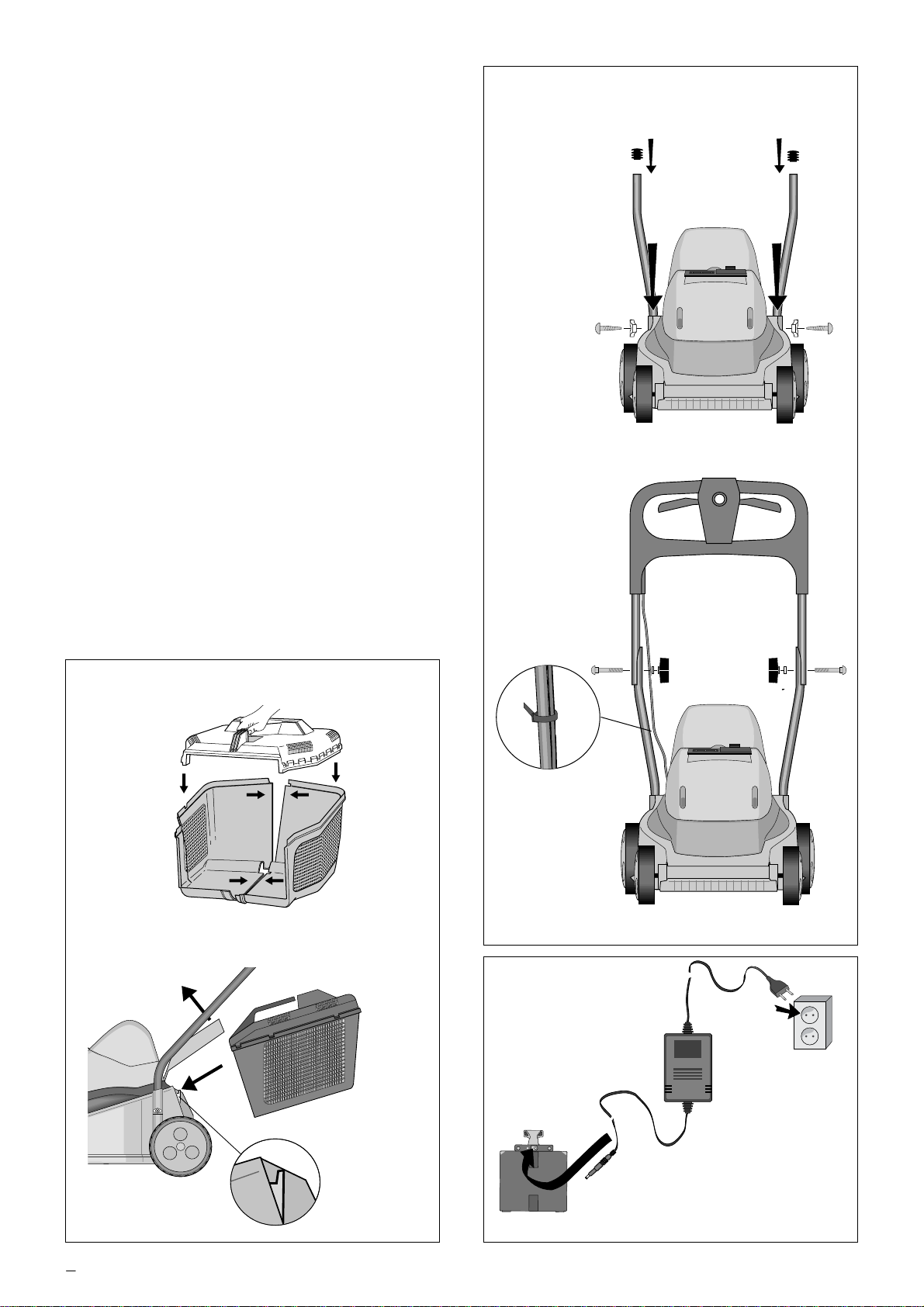
GRASS COLLECTOR (fig. 2)
1. Snap-together the grass collector's upper and
lower parts.
2. Open the cover on the machine and hook the
grass collector onto the chassis.
Note! The lawn mower can be used without the
grass collector. The grass will then collect in a
bead behind the machine.
BATTERY
Warning! Keepspectatorsaw ay.Bewareof
objects being flung out.
Warning! Take out the safety key before
any type of maintenance is carried out.
W arning! Do not put hands or feet under
thecover of the machinewhen itis running.
Warning! The blades continue to rotate
even after the machine has been switched
off.
STOP
When a red lamp lights up on the mower’s
control panel and/or a sound signal is activated, take out the safety key.
ASSEMBLY
STEERING (fig. 1)
GENERAL
Before starting the mower for the first
timeandafter winter storage, youshould
charge thebattery for 1-2 days otherwise
the battery can be damaged.
In order for the battery to maintain its
capacity and to give optimum performance, it is important that the charging
andstorageinstructionsarecarefullyfollowed.
• The battery used in this machine is a lead-acid
type battery. This type of battery must always
be stored fully charged.
• Always charge the battery indoors, in a garage,
etc. where the battery is dry and protectedfrom
the weather.
• Only charge the battery when the tempe rature is
at least 0° C and not over +40° C. Charging in
lowerorhighertemperaturescandamagethe
battery.
• Always keep the mower battery away from water, sources of heat (ovens, radiators ,open fires,
etc.) and hazardous chemicals.
1. Press the plugs intothe steering sockets.Ensure
that the plugs are inserted in the correct end.
2. Press the steering sockets into the holes in the
chassis.
3. Fit the screws. Tighten securely.
4. Attach the handlebar to the steering sockets using screws, washers and locking knobs. The
handlebar can be tilted forward by loosening
thelocking knobs slightly. Themower willthen
take up less space during transportation.
5. Fix the electrical cable using a cable tie.
• Always use the accompanying genuine Stiga
charger. Never use the charger for any other
product.
• Neverusethechargerifitisdamagedinanyway.
A damaged lead or charger should immediately
be replaced at an authorised service workshop
• Take care of the leads. Never carry the charger
by thelead. When charging is complete pull out
the plug not the lead. If an extension cable is
used, use a robust sort suitable for outdoor use,
even if the battery is never charged outdoors.
Page 5

ENGLISH
GB
• The charger alwaysfeels warm to touch, during
the first hours of charging.
CHARGING INSTRUCTIONS
The battery must always be charged
directlyafter finishingmowingandas
soon as it has cooled down (after
about 30 minutes).
1. Charge the battery outside of the mower in a
dry and cool place.
2. First connecttheround plugfrom the chargerto
the battery (fig. 3).
3. Then connect the charger to a wall socket
(~220/230V).
4. Chargefor 1- 2days, depending on how long
themachine has been used.Whilstthebattery
ischarging,theredcharginglamponthebattery is continuously lit, for as long as the battery charger is connected
5. Finishchargingby firstlypullingout theplug
from the wall socket.
If the charger is first removed from
the battery, the plug leads can shortcircuitiftheycomeintocontactwith
conductivematerial.
STARTING/STOPPING THE MOWER
Keep hands and feet well away from the
rotating blade(s). Never put your hand
or foot under the blade casing or in the
grass ejector unit while the motor is
running.
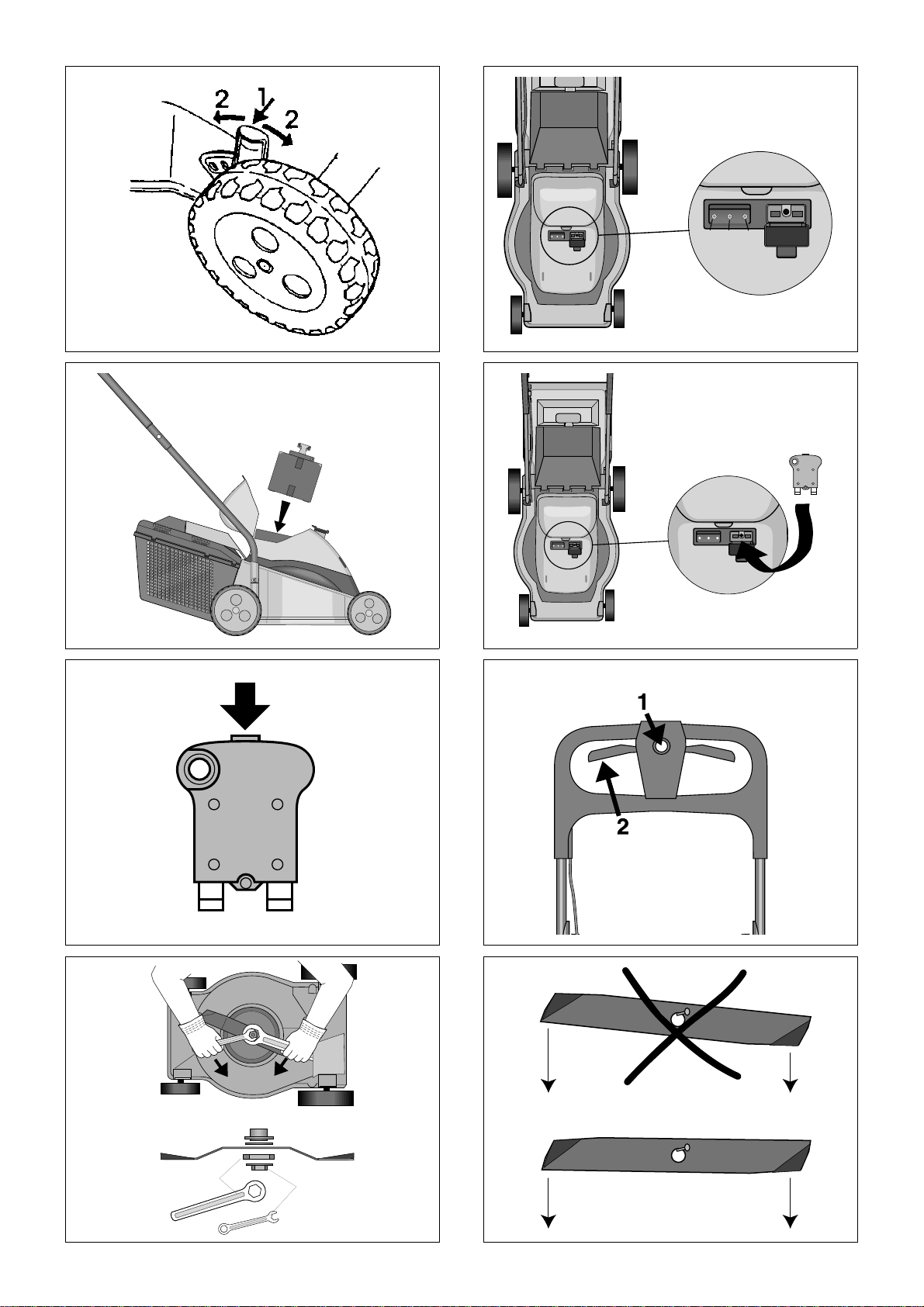
1. Fix the battery in place in the mower (fig. 6).
2. Insert the safety key into the control panel (fig.
7). When the safety key is in place, the green
lampwill belit. If it is not, check that the engine
protection on the safetykey ispressed in (fig.8)
and that the battery is fully charged.
3. Press down the handle to lift the front wheels off
thegrass,therebyreducinggrass resistanceinthe
starting moment.
4. Press in the power on/off button 1 (fig. 9). Start
the engine by pressingin the safety handle2.To
stop, release the safety handle.
After finishing mowing:
1. Removethe safety key and keep it outofreachof
children.
2. Clean the mower (see the “Maintenance” section under the heading “Cleaning”).
3. Recharge the battery once it has cooled down
(after about 30 minutes).
CHARGING BEFORE WINTER
STORAGE
The battery should always be stored fully charged.
1. Take the battery out of the mower.
2. Carefully wipe off the battery.
3. Store the battery outside of the mower in a dry
and cool place.
USING THE MOWER
CUTTING HEIGHT (fig. 4)
Individual wheel height adjustment.
Note! The same cutting height should be set on all
four wheels.
If the safety handle has stopped working, remove the safety key and take the
mower to an authorised service workshop to be repaired.
CONTROL PANEL (fig. 5)
The control panel has the following functions:
1. Itincludesthe socketforthe safety key.Thesafety key also has an in-built engine protection. If
the engine protection has been activated, remove
the safety key and reset the engine protection
(fig.9).
2. It includes three lamps which indicate the battery’s charge level:
A Green = the battery is charged to between 30%
and 100% of full capacity.
B Yellow= the battery’s power has reduced.Be-
tween 5% and 30% remains.
C Red = 5% or less of the battery power remains.
The machine will begin to beep and will switch
itselfoff automatically. Stop mowing and re-
Page 6

ENGLISH
damage (fig. 11).
GB
charge thebatteryonceit has cooleddown(after
about 30 minutes). Do not use the mower again
until the battery is fully charged.
Important: do not allow the battery powerto completelyrundownas thismaydamagethebatteryand
shorten its operational life.
MOWING TIPS
For best cutting results and to ensure that the battery lasts as long as possible, the following rules
should be followed:
• Drive the mower at a slow and even pace
• Try to avoid excessivestarting and stopping, as
this draws a lot of current.
• Make surethatthe motor isrunning at full speed
at all times when mowing.
• Mow regularly and often, especially when the
grassisgrowingquickly. Do notmow more than
a third of the total height of the grass during one
mowing session.
• Always use a sharp blade.
Blunt and/ordamaged blades tear off the grass and
make the lawn look ugly after mowin g.New, wellsharpened blades cut off the grass andensure thatit
looks green and fresh after it has been mown.
Remove the battery. Put the accompanying wrench
(36 mm) on the hexagon holder. Loosen the blade
nut with an adjustable wrench or another type of
fixed wrench (19 mm) (fig. 10). Turn the blade nut
inan anti-clockwise direction in order to remove the
blade.
Fitthe new bladeand refitall the otherpartsexactly
as they were before they were dismantled, see fig.
10. Tighten the blade nut fully.
SHARPENING THE BLADE
W ater grinding with whetstone or a grinding stone
shouldbe used to sharpen the blade.
For safety reasons, the blade should not be sharpened on an emery wheel. Too high a temperature
can result in the blade becoming brittle.
If the blade is sharpened, it must be balanced afterwards to avoid vibration
• Do not use the mower when itis raining or when
the grass is wet.
• Make surethat the undersideof the cutting deck
is kept clean.
MAINTENANCE
Take out the safety key and remove the
battery beforeany typeofmaintenance is
carried out.
CLEANING
The mowershould be cleaned after each use. Use a
moistenedcloth or sponge and a mild soap solution.
Do not clean with water or solvents. Remove all
grass clippings which might have gathered on the
underside of the deck and in the ejector.
The grass collector, although not the mower it-
self, can be cleaned with water. Grass collectionefficiency is reduced if the holes are blocked.
CHANGING THE BLADE
Check,before and after eachuse,that the
blade is tightly fixed and that it is not
damaged. A bent or damaged blade
should immediatelybereplaced.Use protective gloves to avoid cutting injuries.
Page 7

ENGLISH
Problem Possible causes
GB
1. Mower does not start when safety
key is inserted and the safety handle is pressed in
2. Mower stops while mowing (for
reason other than releasing the
safety handle).
3. Mower vibrates excessively or
makes excessive noise.
4. Mower runs but cutting performance is unsatisfactoryand/or there
is a loss of powe r while mowing.
A. Check to make sure the safety key has been properly inserted and that the
engine protection is pressed in.
B. Remove safety key, turn mower over on side and check that blade is not
obstructed.
C. Is battery fully charged? Plug in charger and check lamps.
A. The engine protection in the safety key has cut off power to protect
engine. Wait a couple of seconds for it to cool and then press in the
engine protection.
B. Remove safety key.Turnmower over and check that blade is free to turn.
Also check deck and ejector for clogging.
C. Mover is trying to cut too much grass. Raise it to higher cutting height
and try to start again.
D. Check to see if battery needs to be recharged.
A. Remove safety key. Turn mower over to check if blade is properly tight-
ened.
B. Remove safety key. Turn mower over to check if blade has been bent,
damaged or worn out. Replace with an original blade.
C. Remove safety key. Turn mower over to check m ower deck for damage.
If damaged, contact an authorised service dealer.
D. If no visible damage to mower or blade, return mower to an authorised
service dealer.
A. Was battery fully charged at the start?
B. Remove safety key. Turn mower over to check if:
-blade is correctly attached.
-blade is sharp.
-blade is bent, loose or damaged.
-deck and/or ejector and/or grass collector are clogged
C. Cutting height may be set too low, causing heavy strain on motor by try-
ing to cut too much grass. Raise to a higher cutting position.
5. Mower is hard to push. A. Mower is trying to cut too much grass (See problem 4, Cause C.)
B. Remove safety key. Turn mower over to check if all wheels rotate freely
and check them for damage. Obtain original replacement wheels from an
authorised service dealer.
6. Mower engine w ill not stop when
the safety handle is released.
7. Mower cannot finish cutting the
lawn on a single charge any more.
8. Mower (in grass collectionmode)
is collecting grass poorly.
9. Red lamp on charger does not
come on when charger is plugged
into wall outlet.
If the mower still doesn't work, despite measures taken according to this table, contact an authorised service dealer.
A. Remove safety key to shut off motor. Mower can not then be started.
Contact an authorised service dealer.
A. Was battery fully charged at the start?
B. Mower is trying to cut too much grass (See problem 4, C ause C.)
C. Contact an authorised service dealer for battery check.
A. Grass collector is full.
B. Remove safety key. Turn mower over and check deck and ejector for
clogging.
C. Is the right blade attached? Is the blade sharp?
A. Wall outlet does not have power. (Verify with another electric device.)
B. The charger fuse m ay need to be replaced. Contact an authorised service
dealer
C. Charger or cord may be defective. C ontact an authorised service dealer.
 Loading...