

Page 1
FANCYHEAT CORPORATION SAFETY DATA SHEET
. PRODUCT IDENTIFIER
PRODUCT NAME ----------------------->
PRODUCT NUMBER(S)---------------> 17900-F900, F905, F910, F915, F920, F925.
F930, F935
TRADE NAMES AND SYNONYMS--> Solid Fuel, Chafing Dish Fuel
RECOMMENDED USE: A gelled ethyl alcohol food warming fuel.
USES ADVISED AGAINST: No information available
DETAILS OF THE SUPPLIER OF THE SAFETY DATA SHEET
Company:
Address: 40 VERONICA AVENUE
Telephone: 1-973-589-1450 (General)
1-973-968-3412 (Office)
Fax: 1-732-249-0087
Emergency Telephone Number
Emergency Phone: 1-800-424-9300 (CHEMTREC)
FANCYHEAT CORPORATION
SOMERSET, NJ 08873
. HAZARDS IDENTIFICATION
Classification of the substance or mixture
GHS Classification in accordance with 29CFR 1910 (OSHA HCS)
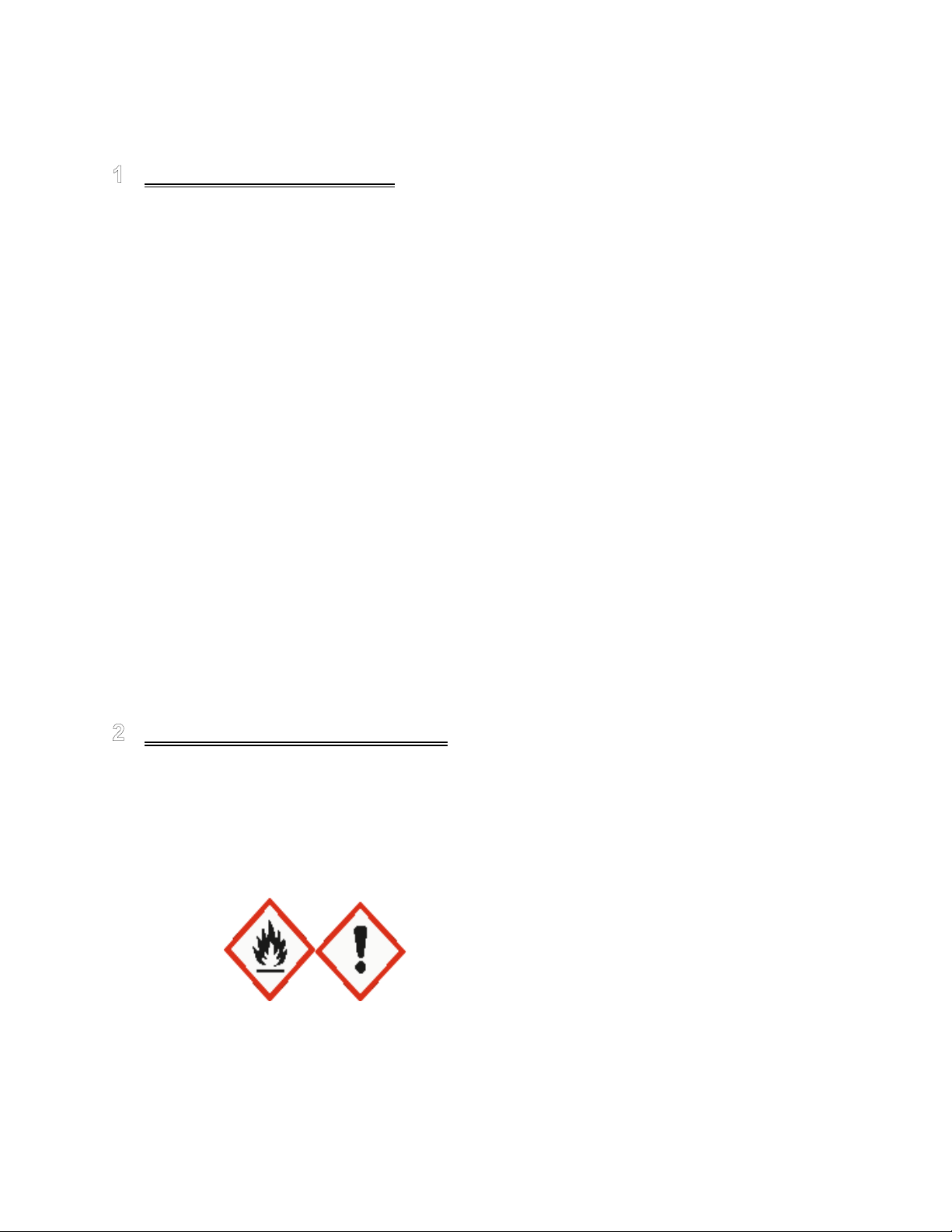
Flammable liquids (Category 2), H225
GHS Label elements, including precautionary statements
FancyHeaT Ethanol Red
Pictogram
Page 2

Hazard statement(s)
H225 Highly flammable liquid and vapor.
Precautionary statement(s)
P210 Keep away from heat/sparks/open flames/hot surfaces. - No smoking.
P233 Keep container tightly closed.
P240 Ground/bond container and receiving equipment.
P241 Use explosion-proof electrical/ ventilating/ lighting/ equipment.
P242 Use only non-sparking tools.
P243 Take precautionary measures against static discharge.
P280 Wear protective gloves/ protective clothing/ eye protection/ face
protection.
P303 + P361 + P353 IF ON SKIN (or hair): Remove/ Take off immediately all
contaminated clothing. Rinse skin with water/ shower.
P370 + P378 In case of fire: Use dry sand, dry chemical or alcohol-resistant foam
for extinction.
P403 + P235 Store in a well-ventilated place. Keep cool.
P501 Dispose of contents/ container to an approved waste disposal plant.
Hazards not otherwise classified (HNOC) or not covered by GHS - none
INGREDIENTS
Ingredient CAS No. % by WT. CLASSIFICATION
Range
------------------------------------------------------------------------------------------------------------- | |
Ethanol 64-17-5 | 68-70|
EC No. 200-578-6 | |
Index No. 603-002-00-5 | |
| |
| |
WATER 7732-18-5 | |
EC-NO. 231-791-2 | |
| |
All other hazardous components are less than 1.0%
-------------------------------------------------------------------------------------------------------------
Flammable liquids (Category 2),
| |
Page 3

. FIRST-AID PROCEDURES
INHALATION: ETHYL ALCOHOL
**FIRST AID- Remove form exposure area to fresh air immediately. If
breathing has stopped, perform artificial respiration, if breathing is
difficult, maintain airway and blood pressure and give oxygen. Keep
person warm and at rest. Administration of oxygen should be
performed by qualified personnel. Treat symptomatically and
supportively. Get medical attention immediately.
SKIN CONTACT: ETHYL ALCOHOL
**FIRST AID- Remove contaminated clothing and shoes immediately.
Wash affected area with soap or mild detergent and large amounts of
water until no evidence of chemical remains (approximately 15-20
minutes). Get medical attention immediately.
EYE CONTACT: ETHYL ALCOHOL
**FIRST AID- Wash eyes immediately with large amounts of water or
normal saline, occasionally lifting upper and lower lids, until no
evidence of chemical remains (approximately 15-20 minutes). Remove
contact lenses, if worn, after initial flush. Continue irrigating with
normal saline until the ph has returned to normal (30-60 minutes).
Get medical attention immediately
INGESTION: ETHYL ALCOHOL
**FIRST AID- Do not induce vomiting. Never give anything by mouth to
an unconscious person. Rinse mouth with water.
Get medical attention immediately.
To Remove Ethanol:
emesis (Dreisbach, Handbook of Poisoning, 11th ed.) or by gastric lavage with
warm water or 3-5% sodium bicarbonate solution unless two hours or more have
passed since ingestion (Gosselin, Clinical Toxicology of Commercial Products).
Syrup of ipecac may be given promptly following ingestion. Gastric Lavage
should be performed by qualified personnel.
**ANTIDOTE:**
The following antidote has been recommended. However, the decision as to
whether the severity of poisoning requires administration of any antidote and
actual dose required should be made by qualified medical personnel.
ETHANOL POISONING
Naloxone, 0.01 MG/KG, intravenously, has an arousal effect in acute alcoholic
coma (Dreisbach, Handbook of Poisoning, 11th ed.).
Remove ethyl alcohol by gastric lavage with tap water or
:
Page 4

. FIRE FIGHTING MEASURES
SPECIFIC HAZARDS ARISING FROM THE CHEMICAL:
FIRE AND EXPLOSION HAZARD: DANGEROUS FIRE HAZARD WHEN EXPOSED
TO HEAT OR FLAME. VAPORS ARE HEAVIER THAN AIR AND MAY TRAVEL A
CONSIDERABLE DISTANCE TO A SOURCE OF IGNITION AND FLASH BACK.
Flash Point: 78 Deg. F TCC LEL %:3.9
UEL %:19.6
SUITABLE EXTINGUISHING MEDIA:
Water-fog--> x Other-->
CONDITIONS OF FLAMMABILITY
ignition when the temperature is above the flash point.
ADVICE FOR FIREFIGHTERS
away; isolate hazard area and deny entry. Avoid breathing vapors, stay upwind
Do not spray pool fires directly. A solid stream of water or foam directed into hot
burning liquid can cause frothing. Move container from fire area if you can do it
without risk. Apply cooling water to sides of containers that are exposed to
flames until well after fire is out. For massive fire in cargo area, use unmanned
hose holder or monitor nozzles; if this is impossible, withdraw from area and let
fire burn. Withdraw immediately in case of rising sound from venting safety
device or any discoloration of tank due to fire. Water fog may be used to cool
closed containers to prevent pressure build up and possible auto ignition or
explosion when exposed to extreme heat. Cool containers with water-fog from as
far a distance as possible. Wear NIOSH approved self-contained breathing
apparatus for confined spaces. Use full fire-fighting protective clothing. If
protective equipment is not available or not used, fight fire from a protected
location or safe distance.
: Shut off source. Keep unnecessary people
UNUSUAL FIRE AND EXPLOSION HAZARDS
exposed to heat. Flashback along vapor trail may occur. Vapor may explode if
ignited in an enclosed area.
COMBUSTION PRODUCTS
complex mixture of airborne solids, liquids, and gases including carbon
monoxide, carbon dioxide, carbon oxides, nitrogen oxides and other unidentified
organic compounds evolve when this material undergoes combustion.
: Highly dependent on combustion conditions. A
x CO2--> x Dry Chemical--> x
: Flammable in the presence of a source of
: Dangerous fire hazard when
Page 5

. ACCIDENTAL RELEASE MEASURES
PERSONAL PROTECTIVE MEASURES
the vicinity of the spill or released vapor. Immediately evacuate all nonessential
people. Verify that responders are properly trained and wearing appropriate
respiratory equipment and fire resistant protective clothing during cleanup
operations.
METHODS FOR CONTAINMENT AND CLEAN UP
and equipment that can withstand the corrosive nature of this product. Shut off
valves, contain spill, keep out of water sources and sewers, for smaller spills add
non-flammable absorbent in spill area. For large spills use foam on spill to
minimize vapors clean up by vacuuming then using non-flammable absorbent.
Place all saturated absorbent, using non-sparking tools, in an approved container
for disposal. Minimize breathing vapors and skin contact, ventilate confined
areas, open all windows and doors, assure conformity with applicable
government regulations.
. HANDLING AND STORAGE
PERSONAL PRECAUTIONARY MEASURES
Invisible vapor spreads easily and can be set on fire by many sources, such as
pilot lights, welding equipment, and electrical motors and switches. Vapor is
heavier than air and can travel considerable distance to a source of ignition and
flash back. Avoid breathing vapors in top of shipping container. Use with
adequate ventilation. Avoid contact with eyes, skin and clothing
HANDLING INFORMATION
components in the atmosphere. Avoid contaminating soil or releasing material
into sewage and drainage systems. Use non-sparking tools to open or close
containers. : Keep away from heat, sparks and flame. Keep container tightly
closed and upright to prevent leakage. Use only with adequate ventilation.
Prevent buildup of vapors. Extinguish all pilot lights and turn off heater, non
explosion-proof electrical equipment and other sources of ignition during use
and until all vapors are gone. Avoid contact with eyes. Avoid prolonged or
repeated breathing of vapor. Avoid prolonged or repeated contact with skin.
Wash hands thoroughly after handling.
STATIC HAZARD
condition when handling this material. To minimize this hazard, bonding and
grounding may be necessary but may not be sufficient. For more information
refer to OSHA Standard 29CFR 1910.106 “Flammable and Combustible Liquids”
and National Fire Protection Association (NFPA 77) “Recommended Practice on
Static Electricity”.
: Electrostatic charge may accumulate and create a hazardous
: Avoid work practices that may release volatile
: Flammable; Eliminate ignition sources in
: This material presents a fire hazard.
: Use explosion proof equipment
Page 6

CONDITIONS FOR SAFE STORAGE: Follow maximum allowed pile heights
specified in the BOCA codes or the NFPA manual. Local fire authorities should
be notified for storage of this material in any quantity. Local permits are required
for storage in warehouse quantities. Store in a well ventilated place, away from
sources of ignition and direct sunlight. Store at 15 to 30°°°°C (59 to 86 °°°°F). In
laboratory quantities, store away from oxidizing material, mineral acids, and
chloroform. In Warehouse quantities, follow NFPA and BOCA guidelines for
storage of flammable liquids. Store denatured alcohol in areas equipped with
automatic sprinklers or fire extinguishing system. All denatured alcohol storage
and transfer equipment should be electrically grounded and bonded to prevent
possible ignition from static sparks. Use spark resistant equipment to store
denatured alcohol. So not use air pressure to unload denatured alcohol from
containers. Containers of this material may be hazardous when empty. Since
emptied containers retain product
CONTAINER WARNINGS:
pouring. Avoid free fall of liquid in excess of a few inches. Empty containers
release residue and can be dangerous. Do not pressurize, cut, weld, braze,
solder, drill, or expose such containers to heat, sparks, static electricity or other
sources of ignition. Do not attempt to clean. "Empty" drums should be
completely drained, properly bunged and promptly returned to a drum reconditioner. Assume emptied containers to have the same hazard qualities as
full containers.
. EXPOSURE CONTROL (PERSONAL PROTECTION)
EXPOSURE GUIDELINES
Ingredient CAS No. % by WT. Exposure
Range Limits
------------------------------------------------------------------------------------------------------------- | |
Ethanol 64-17-5 | 68-70 |1000ppm TLV(ACGIH))
| |1000ppm TWA(NIOSH)
| |1000ppm TWA(OSHA)
| |3300ppm IDLH
| |
| |
WATER 7732-18-5 | |
EC-NO. 231-791-2 | |
| |
All other hazardous components are less than 1.0% |
------------------------------------------------------------------------------------------------------------Key: (PEL) = Permissible Exposure Limit OSHA
(TLV) = Threshold Limit Value OSHA & ACGIH
(STEL) = Short Term Exposure Limit ACGIH
Containers should be Bonded and Grounded when
:
Page 7

(WEEL) = USA. Workplace Environmental Exposure Levels
(TWA) = Time Weighted Average
CAS = Chemical Abstracts Registry Number
IDLH = Immediate Danger to Life and Health
N.E. = Not Established
EXPOSURE GUIDELINES
2), applicable exposure limits, job activities, and other substances in the work
place when designing engineering controls and selecting personal protective
equipment. If engineering controls or work practices are not adequate to prevent
exposure to harmful levels of this material, the personal protective equipment
listed below is recommended.
ENGINEERING CONTROLS
in volume and pattern to keep concentrations within permitted exposure limits.
All areas should be ventilated in accordance with OSHA Regulation 29 CFR Part
1910. Explosion proof motors should be used in mechanical ventilation.
RESPIRATORY PROTECTION
exposure. For vapor concentrations 1 to 10 times ACGIH TLV an air purifying
NIOSH/MSHA Approved respirator with full face-piece and organic vapor
cartridges. For concentrations over 10 times ACGIH TLV, in confined areas,
and/or where vapor concentrations are unknown use a NIOSH approved positive
pressure full face-piece supplied air respirator.
BODY CLOTHING
conditions. However employees must wear appropriate protective (impervious)
clothing and equipment to prevent repeated or prolonged contact with this
substance. Use chemical resistant apron or other impervious clothing. Remove
and wash contaminated clothing before reuse.
SKIN PROTECTION
conditions. However employees must wear appropriate protective gloves to
prevent contact with this substance. Rubber or neoprene chemical resistant
gloves.
EYE/FACE PROTECTION
conditions. However employees should use safety eyewear with splash guards or
face shield.
Emergency shower and eyewash should be easily accessible to the work area.
: No protective equipment is needed under normal use
: No protective equipment is needed under normal use
: Consider the potential hazards of this material (Section
: Provide general dilution or local exhaust ventilation
: No respirator required for normal use and
: No protective equipment is needed under normal use
Page 8

. PHYSICAL AND CHEMICAL PROPERTIES
APPEARANCE, COLOR AND ODOR: A red gelled ethyl alcohol with a mild
alcohol odor.
Odor Threshold------------------------------- > No data available
pH-------------------------------------------------- > 7.5 – 8.5
Volatile-------------------------------------------> 98%
Melting/Freezing Point---------------------- > No data available
Boiling Range --------------------------------- > 165-180°F
Specific Gravity------------------------------- > 0.802 @20°C
Vapor Pressure------------------------------- > 49mmHg@20"C
Vapor Density (air=1)------------------------ > No data available
Water Solubility------------------------------- > Soluble
Partition Coefficient n-Octanol/Water- > No data available
Evaporation Rate (Butyl Acetate=1)---- > 1.7
Flash Point--------------------------------------> 78°F - closed cup
Upper Flammability Limit-------------------> 19.6% (V)
Lower Flammability Limit-------------------> 3.9% (V)
Auto-Ignition Temperature-----------------> No data available
Decomposition Temperature--------------> No data available
Viscosity------------------------------------------> No data available
Explosive Properties-------------------------> No data available
Oxidizing Properties--------------------------> No data available
Other Information: No data Available
. STABILITY AND REACTIVITY INFORMATION
CHEMICAL STABILITY
POSSIBILITY OF HAZARDOUS REACTIONS:
with air.
CONDITIONS TO AVOID
Flame.
INCOMPATIBLE MATERIALS
sodium hypochlorite, inorganic acids e.g. hydrochloric acid and hydrogen
peroxide.
: Unstable ( ) Stable ( X )
Vapors may form explosive mixtures
: Heat, Sparks, Pilot Lights, Static Electricity, and Open
: Strong oxidants such as liquid chlorine, oxygen,
Page 9

HAZARDOUS DECOMPOSITION PRODUCTS: Fumes, Smoke, Carbon Monoxide,
Aldehydes and other decomposition products where combustion is not complete.
HAZARDOUS POLYMERIZATION
. TOXICOLOGICAL INFORMATION
Routes of Entry: Inhalation--> x Skin--> x Ingestion--> x
ACUTE HEALTH EFFECTS:
Effects of overexposure:
Eye> Splashes may cause temporary pain and blurred vision. Direct contact with
the liquid may cause immediate burning and stinging, with reflex closure of the
lids, tearing, temporary injury of the corneal epithelium, and hyperemia of the
conjunctiva. Healing is usually spontaneous and complete.
Skin> Irritation to skin results in cracking and flaking due to de-fatting action of
the alcohol. Sensitization has occasionally been reported to occur in some
individuals resulting in allergic contact dermatitis
Inhalation> Burn product in a well ventilated area; Upon exposure to fumes
Irritation of mucus membranes, eyes, nose, throat and membranes of the upper
respiratory tract. Exposure of humans to 1000-10,000 PPM has caused temporary
irritation of the upper respiratory tract and coughing; and if continued, central
nervous system depression with headache, stupor, fatigue, dizziness,
drowsiness, dullness, lassitude and loss of appetite may occur.
Ingestion> Central nervous system depression resembling intoxication by ethyl
alcohol. Excitation is followed by impaired motor coordination, slurred speech,
sensory disturbances such as blurred and double vision, drowsiness, loss of
appetite an inability to concentrate. Other symptoms may include flushing of the
face, dilated pupils, rapid pulse, nausea, vomiting, sweating, and diuresis.
Ingestion of large amounts may cause confusion, disorientation, loss of motor
nerve control, shallow respiration, involuntary defecation and urination,
drowsiness, stupor, and possibly coma.
Chronic: Reports have associated repeated and prolonged occupational
overexposure to solvents with permanent brain and nervous system damage.
Intentional misuse by deliberately concentrating and inhaling the contents may
be harmful or fatal.
Typical symptoms are cardiovascular disorders, sweetish taste in the mouth,
nausea, vomiting, loss of appetite, strong thirst, burning of eyes and bleeding
from the nose. Damage may occur to the kidney or liver.
Medical Conditions Aggravated by Exposure> Skin contact may aggravate an
existing dermatitis.
: May occur ( ) Will not occur ( X )
Page 10

ACUTE TOXICITY:
The effects of overexposure shown in Section II are based on acute toxicity
profiles. Typical values are:
Ingredient |Oral LD50(Rat)|Skin LD50(Rabbit)|Inhalation LC50|
---------------------------------------------------------------------------------------------------------------- | | | |
Ethanol | 7060mg/kg | |20000ppm/10hr|
| | | |
| | | |
Tert-Butyl Alcohol | 2743mg/kg | 2000mg/kg | |
| | | |
| | | |
| | | |
------------------------------------------------------------------------------------------------------------------
ETHANOL:
MUTAGENIC EFFECTS: No data available
Tumorigenic: Equivocal tumorigenic agent by RTECS criteria. Liver: Tumors.
Blood: Lymphomas including Hodgkin's disease.
CARCINOGEN STATUS: No component of this product present at levels greater
than or equal to 0.1% is identified as probable, possible or confirmed human
carcinogen by IARC, NTP, OSHA or ACGIH.
REPRODUCTIVE TOXICITY: Human - female - Oral
Effects on Newborn: Apgar score (human only). Effects on Newborn: Other
neonatal measures or effects. Effects on Newborn: Drug dependence.
Specific target organ toxicity (STOT-SE)- single exposure (Globally Harmonized
System): Inhalation - May cause respiratory irritation.
Specific target organ toxicity (STOT-RE) - repeated exposure (Globally
Harmonized System): no data available
ASPIRATION HAZARD: No data available
ADDITIONAL INFORMATION: Central nervous system depression, narcosis,
Damage to the heart.
. ECOLOGICAL INFORMATION
No information on this gelled product is available at this time.
Page 11

For Ethanol: The following is available
AQUATIC TOXICITY
LC50 96-hour (Rainbow Trout) 12900-15300mg/L;
LC50 24-hour (Rainbow Trout) 11200mg/L;
EC50 5-30minutes (Phytobacterium phosphoreum) 34900mg/L
WATERFOWL TOXICITY
PERSISTANCE AND DEGRADABILITY
biodegrade and leach into ground water, but no data on rates of these processes
could be found. When released into water it will volatilize and probably
biodegrade. When released into the atmosphere it will photodegrade in hours in a
polluted atmosphere to an estimated range of 4 to 6 days in a less polluted
atmosphere.
BIOACCUMULATION:
BIOCONCENTRATION FACTOR
BIOLOGICAL OXYGEN DEMAND (BOD)
FOOD CHAIN CONCENTRATION POTENTIAL
. DISPOSAL CONSIDERATIONS
WASTE TREATMENT METHODS:
stream classification can change with product use. Accordingly it is the
responsibility of the user to determine the proper storage, transportation,
treatment and or disposal methodologies for spent materials and residues at time
of disposition. Dispose in accordance with all applicable disposal regulations.
Incinerate under controlled conditions in a permitted facility.
CONTAMINATED PACKAGING:
The information offered here is for the product as shipped. Use and/or
alterations to the product such as mixing with other materials may significantly
change the characteristics of the material and alter the RCRA classification and
the proper disposal method.
RCRA: The unused product is a RCRA hazardous waste if discarded. The RCRA
ID numbers are: D001.
If the waste is a spent solvent, the appropriate spent solvent code should be
used.
:
: No data available
: When spilled on land it is apt to volatilize,
No data available
(BCF): No data available
: No data available
: None
Hazard characteristic and regulatory waste
Dispose of as unused product
Page 12

DISPOSAL MUST BE IN ACCORDANCE WITH STANDARDS APPLICABLE TO
GENERATORS OF HAZARDOUS WASTE, 48 CFR 262
. TRANSPORT INFORMATION
USDOT Shipping Name---------> Consumer Commodity ORM-D
No Hazmat Required 173.150; Exceptions
For Class 3 (flammable and combustible liquids)
USDOT Hazard Classification----> ORM-D “Consumer Commodity”
Emergency Response Guide--> 127
Marine Pollutant-------------------> No
. REGULATORY INFORMATION
SARA TITLE III (Superfund Amendment and Reauthorization Act)
SECTION 302 AND 304: Extremely Hazardous Substance List (40 CFR 355)- Not
Listed
SECTION 313: Toxic Chemicals Listing (40 CFR 372.65)- Listed
Tert Butyl Alcohol CAS 75-65-0 0.085% by wt.
SECTION 311/312: Hazard Categorization (40 CFR 370)- Acute Health, Chronic
Health, and Fire
CERCLA
Act)
SECTION 102(A) Hazardous Substances (40 CFR 302.4)- Not Listed
Reportable Quantity - None
SECTION 101(14) Reportable Quantity: None
Massachusetts Right To Know Components
Ethanol CAS-No. 64-17-5
tert-Butyl alcohol CAS-No. 75-65-0
Denatonium Benzoate CAS 3734-33-6
Pennsylvania Right To Know Components
Ethanol CAS-No. 64-17-5
tert-Butyl alcohol CAS-No. 75-65-0
Denatonium Benzoate CAS 3734-33-6
New Jersey Right To Know Components
Ethanol CAS-No. 64-17-5
tert-Butyl alcohol CAS-No. 75-65-0
Denatonium Benzoate CAS 3734-33-6
(Comprehensive Environmental Response, Compensation, and Liability
Page 13

California Prop. 65 Components
This product does not contain any chemicals known to State of California to
cause cancer, birth defects, or any other reproductive harm.
TSCA (Toxic Substance Control Act)
Ethanol CAS-No. 64-17-5; tert-Butyl alcohol CAS-No. 75-65-0; Denatonium
Benzoate CAS 3734-33-6 are listed on the TSCA Inventory.
. OTHER INFORMATION:
HMIS (Hazardous Materials Identification System)
Hazard Rating:
4-Extreme
3-High
2-Moderate
1-Slight
0-Insignificant
HMIS RATINGS (SCALE 0-4): Health=2 Fire=3 Reactivity-0
NFPA RATINGS (SCALE 0-4): Health=2 Fire=3 Reactivity=0 PPE=G
Date of preparation-----------> May 30, 2014
Revision Number--------------> 1.3
Replaces Revision Date-----> February 25, 2015
Prepared by---------------------> T.G. Fenstermaker, Jr.
Acronyms:
ACGIH - American Conference of Governmental Industrial Hygenists
AIHA - American Industrial Hygiene Association
ANSI - American Nation Standards Institute
API - American Petroleum Institute
CERCLA - Comprehensive Emergency Response, Compensation, and Liability Act
DOT - U.S. Department of Transportation
EPA - U.S. Environmental Protection Agency
HMIS - Hazardous Materials Information System
IARC - International Agency For Research On Cancer
MSHA - Mine Safety and Health Administration
NFPA - National Fire Protection Association
NIOSH - National Institute of Occupational Safety and Health
NOIC - Notice of Intended Change (Proposed change to ACGIH TLV)
NTP - National Toxicology Program
OPA - Oil Pollution Act of 1990
OSHA - U.S. Occupational Safety & Health Administration
PEL - Permissible Exposure Limit (OSHA)
RCRA - Resource Conservation and Recovery Act
REL - Recommended Exposure Limit (NIOSH)
SARA - Superfund Amendments and Reauthorization Act of 1986 Title III
SCBA - Self-Contained Breathing Apparatus
STEL - Short-Term Exposure Limit (generally 15 minutes)
TLV - Threshold Limit Value
TSCA - Toxic Substances Control Act
TWA - Time Weighted Average (8hr.)
WHMIS - Canadian Workplace Hazardous Materials Information System
Page 14

This information is furnished without warranty, representation, inducement of license of any kind,
except that it is accurate to the best of FancyHeat's knowledge, or obtained from sources believed
by FancyHeat, Inc. to be accurate, and FancyHeat, Inc. does not assume any legal responsibility
for use or reliance upon same. Users are encouraged to conduct their own tests. Before using any
product, read its label. User has the sole responsibility to determine the suitability of the materials
for any use and the manner of use contemplated. User must meet all applicable safety and health
standards.
 Loading...