

Page 1
AMPS
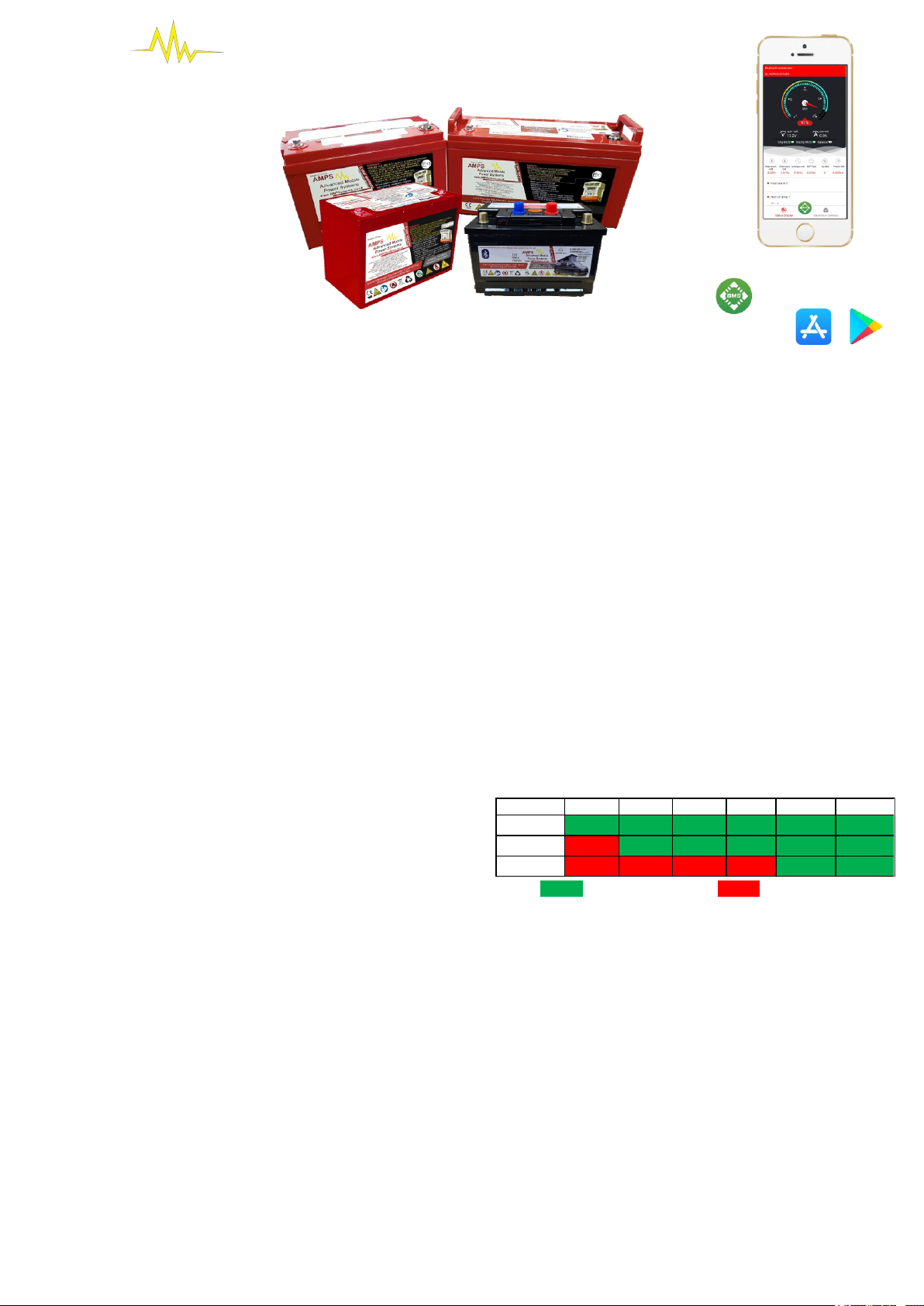
60Ah 100Ah 120Ah 2x 60Ah 2x 100Ah 2x 120Ah
BB1230
BB1260 x
BBW12120 x x x x
A M P Sdvanced obile ower ystems
check our website for latest instructions
www.ampsystems.co.uk
LiFePO4
60Ah /100Ah / 80Ah / 120Ah
12.8V (nominal).
Lithium deep cycle battery.
Automotive applications
READ ENTIRE MANUAL BEFORE USE
Lithium batteries general overview
The advantages of lithium batteries are well known over conventional batteries.
They are superior on every level - everyone wants them. However installing them
on vehicles was not simple and required a lot of knowledge because they have a
very specific envelope for their charging and discharging curves. Failure to operate
within these parameters will reduce the performance ability and life of the battery. It
may even destroy the battery and even cause a fire. This fear has led to many
people backing off from the whole idea of lithium batteries.
For many years people have wanted a simple easy solution to installing lithium
batteries in the automotive industry: Including commercial vehicles, campervans,
caravans, military, police and ambulances However, due to the specific
incompatibility with charging voltages and currents on board the vehicles and the
requirements of the battery, the two things simply could not safely be brought
together without a very elaborate intermediary system linked into a BMS for the
lithium battery. All this is not gone: today we have lithium batteries with built in BMS
and automatic shutdown systems that take care of the extreme faults that may be
presented to a lithium battery. With the simple addition of a Battery to Battery
charger the correct voltage and current profile is provided to the battery from the
vehicle's alternator with no integration fuss. This means, when your alternator
voltage is low, the battery to battery charger increases the voltage and when your
alternator's voltage is too high the battery to battery charger decreases it. Also,
when you have too much current, the battery to battery charger reduces the
current, thus, presenting the lithium battery with its ideal safe voltage and current
requirements. This has never been so important than with the modem Euro 5/6
vehicle applications. The first, all in one - simple to install - package that removes all
fears with this technology for application on vehicles.
Key installation points and advantages - using 100Ah model, as
example.
Performance: Because a 100Ah lithium battery allows total access to the full
100Ah as opposed to a normal lead acid 100Ah battery which realistically only
allows access to 50% - about 50 Ah. Therefore, you get the equivalent of 2 x 100Ah
standard batteries to 1 lithium.
Battery weight: Battery size to battery size lithium is about 112 the weight of a
conventional lead acid battery. However, because you get 2 x the power from the
same battery, in fact, a lithium battery is about 1/4 the weight - power for power.
Charge performance: A lithium battery can charge much faster and fuller. I.e.
when a normal lead acid battery is reaching its capacity the power intake tapers off
very quickly. Not so much with lithium, it can sustain the charge curve for much
longer. It also holds its output voltage longer ensuring maximum performance for
the products attached to the battery.
Life expectancy economics: / A typical lithium battery will last between 1020
times longer than a conventional battery making them very economical.
The Safety, warranty and handling guidelines:
This battery has a 5 year guarantee as long as the following criteria are met.
Charging battery (on vehicle application)
1) Use a Sterling battery to battery charger to control the voltage and current for
the battery charging
2) Maximum charge voltage 14.6V, nominal charge voltage 14.4V. Float voltage
13.8V
3) Maximum charge current, continuous charge current. 0.7C charge and 1.5C
discharge.
4) Continuous discharge current vary between the battery types
Handling guidelines to prevent damage / fire explosions /
1) Fuse main output cable appropriately.
2) Do not reverse polarity the battery.
3) Use only lithium rated battery chargers.
4) Do not expose to large static electric fields or magnetic fields as this could
damage the internal electronics.
5) Do not over heat or set fire to the battery as high risk of explosion.
6) Do not short circuit the battery.
7) Do not use the battery as a step.
Unlimited 12V parallel battery bank
Maximum series connection
= 4 x 12 V = 48 V
Download this app
Smart BMS
8) Do not pierce the battery case or in any other way damage or destroy the
integrity of the case.
9) In the event of any smell being detected from this battery, cease all
operations involving charge and discharging and remove the battery
immediately.
10) In the event of any leakage of any substances from the battery, use gloves
to handle the unit. If any of the substance get onto your skin or eyes flush with
copious quantities of water and see a doctor immediately.
11) Long term storage it Is advised to discharge the battery and re charge it
every 3 months.
12) If battery is being wrapped then only use non-conductive paper.
13) After use, dispose of the battery in compliance with local country laws.
14) Do not crush the battery.
Installation:
This battery and charging system should be installed by a
professional. This product should be handled / treated like you would
any other battery.
Before installing ensure your charging profiles and discharging requirements
fall within the specification of the battery. If your requirements exceed the rating
of the battery, the battery will simply shut down for and stop operating for safety
reasons.
If charging from a vehicle (especially a new Euro 6 ) you must use a Sterling
Power Battery to Battery Charger to ensure correct charging voltages and
current limits are adhered to.
How to choose your Battery to Battery Charger:
okay to use do not use
Check your total C rating for the battery. If the continuous C rating is 0.7 for a
100Ah battery then 70A is the maximum input current. The maximum Battery to
Battery Charger you could use would be the BB1260 (BB1260 is 60A input and
around 50A output, going into your lithium battery). If you have 2 batteries then
the C rating remains the same but the total would be 140A charge. This is the
maximum size product. However, you can use the small sizes. There are 20A or
30A models if you are not in a rush to charge. Ensure all cables are of the correct
size (see chart over leaf) and the cables connected to the battery are all
correctly fused both input and output wires (see fuse requirement over page).
Negative returns - most people put the negative to the chassis of the vehicle.
We find that this is unreliable and not a great connection, we recommend you
return the negative back to the negative of the starter battery using cable. You
can also connect to the chassis if you wish but the main current would be going
down the cable.
Ensure the battery is well secured and cannot move about when vehicle is in
motion.
Position in a well protected, cool, dry environment.
Any worries / concerns installing this battery please contact AMPSystems.
Page 2
Page 3
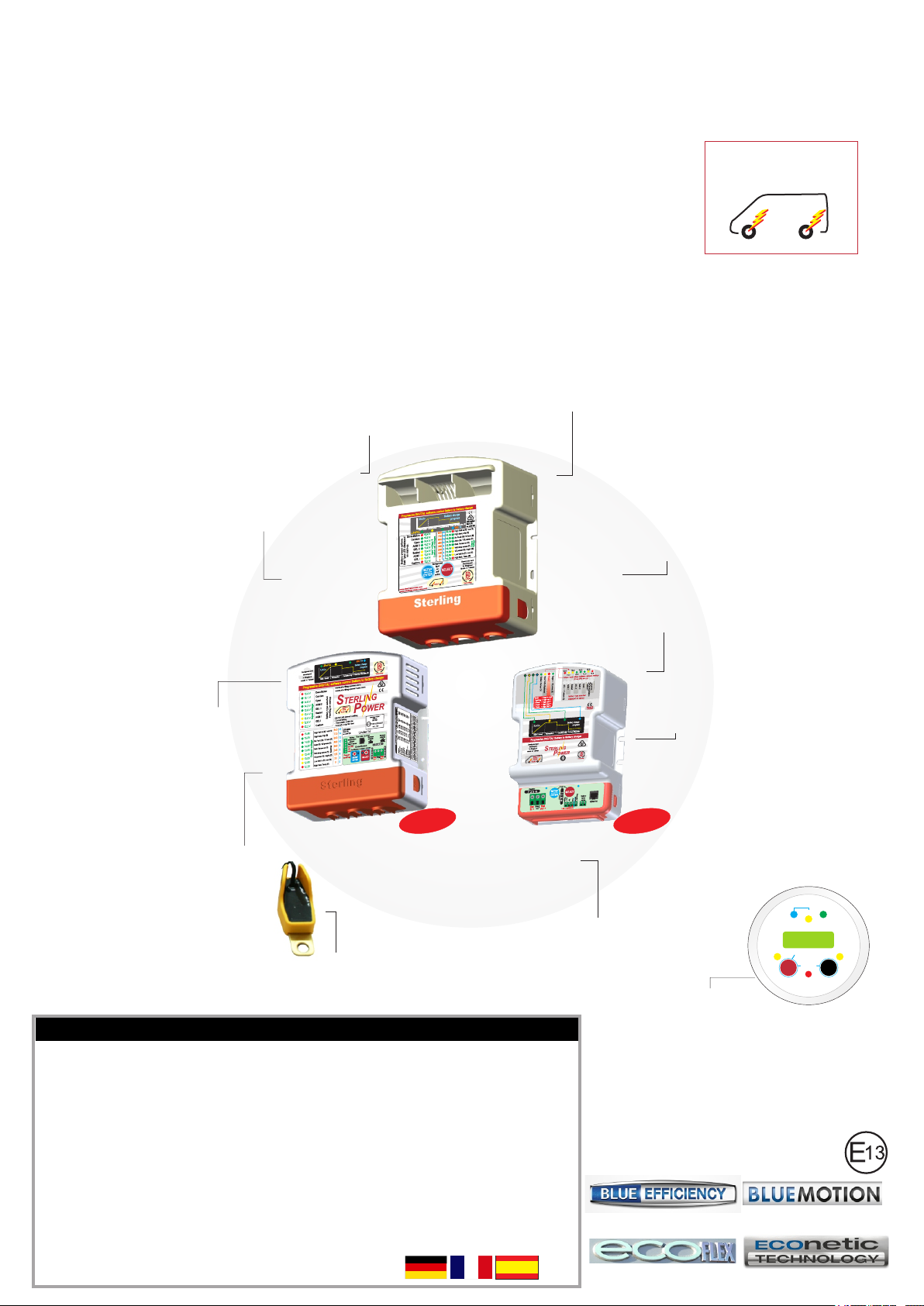
Battery to Battery Chargers
DC V (in) DC V (out) Current (A) Weight (Kg) L x W x D mm Code
12V 12V 20A input 0.9 160 x 96 x 55 BB1220
12V 12V 30A input 1.2 190 x 160 x 50 BB1230
12V 12V 60A input 1.4 190 x 160 x 70 BB1260
12V 24V 70A input 1.4 190 x 160 x 70 BB122470
12V 36V 70A input 1.4 190 x 160 x 70 BB123670
12V 48V 70A input 1.4 190 x 160 x 70 BB124870
24V 24V 35A input 1.4 190 x 160 x 70 BB242435
24V 12V 35A input 1.4 190 x 160 x 70 BB241235
Remote w/ 10m cable BBURC
German, French, Spanish main label overlay sticker
Non Waterproof (Drip Proof IP21)
Euro 6+ friendly
Sterling’s range of Battery to Battery Chargers (B2Bs) has grown significantly over the past few
years. Offering a product range in this market un surpassed by anyone in both power and
flexibility. This is in an effort to supplement the ever growing demand from the commercial
vehicle, recreational vehicle and marine industries. The B2Bs have become extremely popular
as they fast charge batteries as you cruise along without the need for complex wiring, touching
your alternator, voiding the alternator’s warranty and tampering with the electronic control units
(ECUs). You can provide the onboard batteries with a fast 4 stage charging profile with a very
simple and speedy installation. All of the benefits of advanced charging without any of the draw
backs. Simply connect the B2B between the battery being charged and the battery you wish to
charge.
3 activation modes:
1) Automatic - Default, operates on
input voltage (13.3V / 26.6V on) and
complements regenerative braking
with low voltage timer. No ignition
feed required.
2) Ignition feed with timer. As
above, however, requires a live
ignition feed to operate. Input voltage
figures and timings, as above.
3) Ignition feed without timer. As
above, however, the timer does not
kick in, so it can potentially stay on
indefinitely provided input voltage
stays above a certain low threshold.
Output charging at 12V, 24V,
36V and 48V. Input voltages
at 12V and 24V. Up to 800W
rating. Much larger model
up to 3000W coming soon.
No risk off starter battery
discharge. Current is NOT
taken from the input battery
and given to the output battery
except during the low voltage
timer for regenerative braking
mode. This time frame can be
increased in length or brought
down to 0 seconds.
Safety features:
Ÿ 100% fire proof plastic box
Ÿ no screws to corrode
Ÿ thermal power reduction
Ÿ multi stage fan cooling
Dynamic thermal charging, the
charging voltage fluctuates based
on the temperature of the sensor
(included ->).
1 x temperature sensor (TSAY) included
in all units except the BB1215 where is
can be purchased as a optional extra.
The default mode, which is Automatic
Regenerative Braking Friendly, does not
require an ignition feed to operate. It
works on input voltage and timing algorithms
(These values can be customised on the
unit). This is ideal for most setups as ignition
feeds are getting increasingly hard to find on
modern vehicles, this new unit is therefore
simple to install.
BB1230
NEW
Unit is current limiting ,
prevents large current flow
and requires less cable
thickness.
Adjustable current limit. The
current limit can be reduced to
50%.
12V | 24V | 36V | 48V
15A-70A Input Models
(larger units overleaf)
Read about regenerative
braking and the test that
Sterling did. Page 15.
Regenerative
raking riendly B F
R.B.F
Very simple to install. No Electronic Control
Unit (ECU) issues. No complex wiring. No
Warranty issues. Fully prepared for smart
alternators (Regenerative braking). 95% off
installations are simply out off the box with no
setup .
4 stage battery charging. The
B2B charges batteries between
5-20 times faster than a stand
alone alternator.
OEM lock: the unit can be locked by
the installer to prevent tampering and
misuse of the product by the operators.
BB1260
BB122470
BB241235
BB242435
BB123670
BB124870
BB1220
Boost / Reduce Charging. The B2Bs
ensure batteries get the correct charging
profile irrespective of high or low input
voltages.
Night time setting allows
the unit to run at ½ power so
the fan noise is kept down.
Remote Control (Optional)
Displays: Voltage / Warnings / Temperatures.
Can be used as an independent voltmeter
measuring input battery voltage and output
battery voltage.
Can remotely modify the Batt. the Batt. Charger:
- Force the unit to float
- Force the unit to 1/2 current limit
- Force the unit to standby
- Force the unit off
- Force the unit to Night Mode
- Reset both Remote and Charger
54mm diameter
® Trademark of
Mercedes Benz
® Trademark of
Vauxhall / Opel
By locking the BB, you secure all
previous settings in place and prevent
subsequent tampering.
9 preset battery chemistry
options including AGM,
LiFePO4, Gel, flooded and
sealed lead acid.
Customizable profile - choose
your your own charging profile
on the front panel.
B2B turns on at 13.6V and
turns off at 13.3V (x2 for
24V). Thus, does not drain
input battery. Regenerative
braking mode shall allow
the input voltage to drop to
NEW
12.2V (x2 for 24V).
In / Unit
® Trademark of
Volkswagen
® Trademark of
Ford
Absorption
Cond.
H Charge
Float
Sterling Power Products
V
12.2
Audible alarm on/off
hold > 3 sec
Temp
On / Off
Volts
Menu
hold>3 sec
Select
Change
Fault
Out / Rem
Batt.
E marked.
Suitable for
OEM fitting.
Page 4
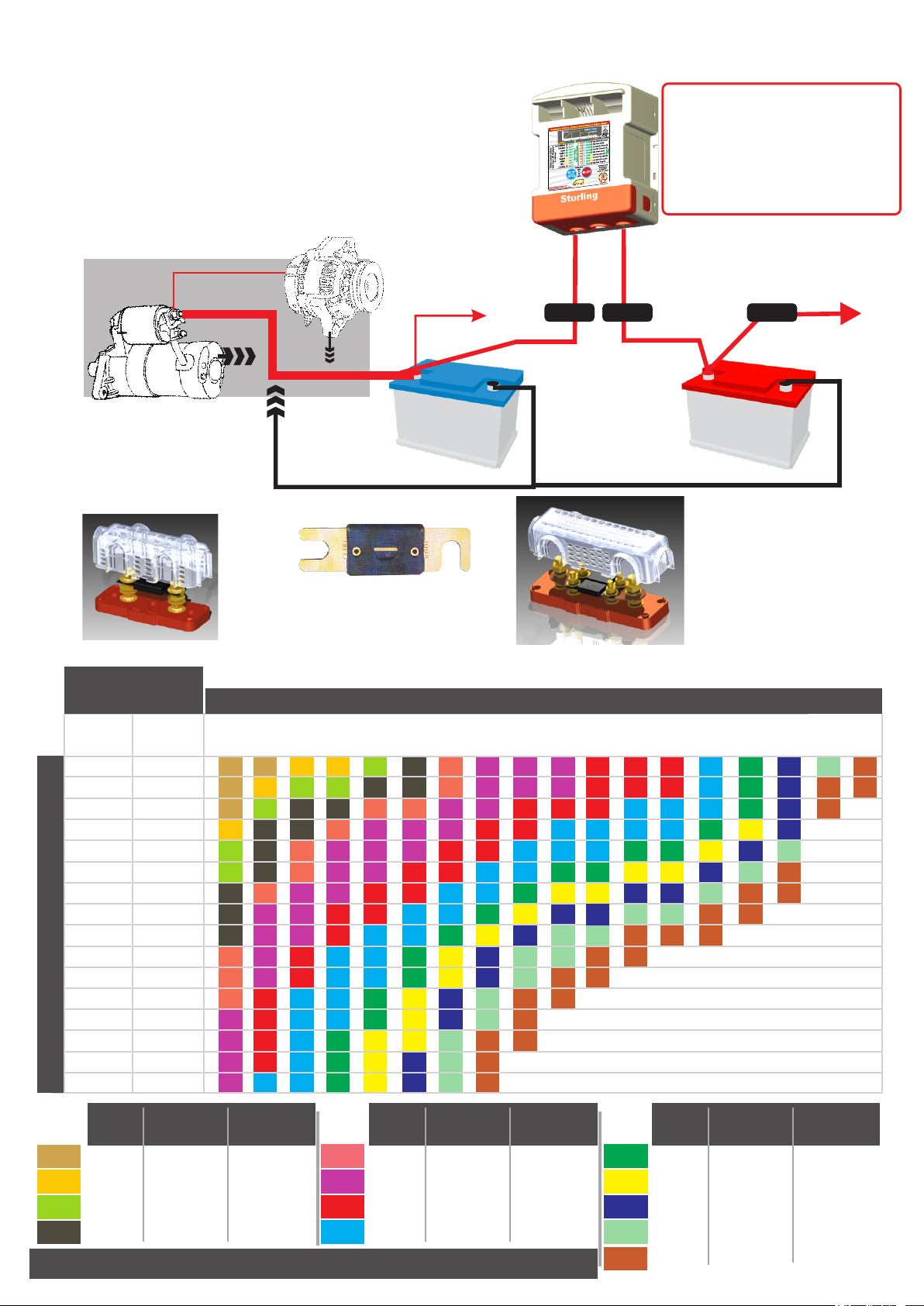
All cables connected to any battery must be correctly installed. They
must be fused as close to the battery source as possible. Each fuse
should be correctly rated for the individual applications and should
be about 30% higher current than the maximum expected current.
For example, assuming a 12-12V 60A battery to battery charger on a
100Ah lithium battery supplying a typical camper van with a 60A
output demand:
A) Battery to battery charger input - 100A fuse.
B) Battery to battery charger output - 100A fuse.
C) Auxiliary system - 150A fuse for 100A and 150A for 120A.
An extrapolation of this, is depicted below.
Alternator
Vehicle Engine
Negative
To vehicle electrics
Fuses and cables
Warning:
Lithium batteries have very
specific overload limits
which should not be
exceeded. Battery will shut
down in event off overload.
Sterling
Battery to battery charger
A B C
Fuse Fuse
to auxiliary
system
Fuse
Starter motor
+
_
Lead acid
Battery
Part No: GFH8
8 mm stud up to
single ANL fuse holder
500A
1 FUSE GANL PER P
ACK
Part No: GANL /?AMPS
Mica window
80A 250A 100A 300A
size 145L 55W 53H mm
Voltage drop
specification
Higher voltage drop
Lights, pumps
Non Critical
equipment
0-6
6-9
9-15
15- 19
19-24
24-30
30-40
40-51
51-61
Cable length meters
AWG
American
Wire
Gauge
Low voltage drop
inverters chargers
Critical equipment
0-2
2-3
3- 4.5
4.5- 6
6-7.5
7.5-9
9-12
12-15
15-18
18-21
21-24
24-27
27-30
30-33
33-37
37-40
Copper
diameter mm
Safety regulations demands any cable directly connected to a battery source must be fused
Required Current based at approx 60 deg C 12V
This chart for general reference only, cables sizes vary with ambient temperatures and other aspects
5A 10A 15A 20A 25A 30A 40A 50A 60A 70A 80A 90A 100A 120A 150A 200A 300A 400A
Cross sectional
16 1.29 1.5
14 1.63 2.5
12 2.05 4.0
10 2.59 6.0
For unknown cable simply measure copper conduit diameter and equate to the above chart.
do not measure the cable insulation diameter. The mm sq figure is rounded up for Euro cables.
150A 350A 200A 400A
500A
Copper
mm sq
size 200L
Use only multi strand cable not solid core cable.
AWG
American
Wire
Gauge
Copper
diameter mm
Copper
Cross sectional
mm sq
8 3.26 10.0
6 4.11 16.0
4 5.19 25.0
2 6.54 35.0
+
_
Lithium Battery
with built in BMS
and safety shutdown
Part Nos: GFH12
12 mm stud up
twin ANL
66W 69H mm
Warning: this is total cable length not distance to product
remember to add the pos and neg cable length as total
1000A
fuse holder
Sterling Power
Products
Copyright
AWG
American
Wire
Gauge
Copper
diameter mm
1 7.35 50.00
0 8.25 60.00
00 9.27 70.00
000 10.40 95.00
0000 11.68 120.00
Copper
Cross sectional
mm sq
Page 5
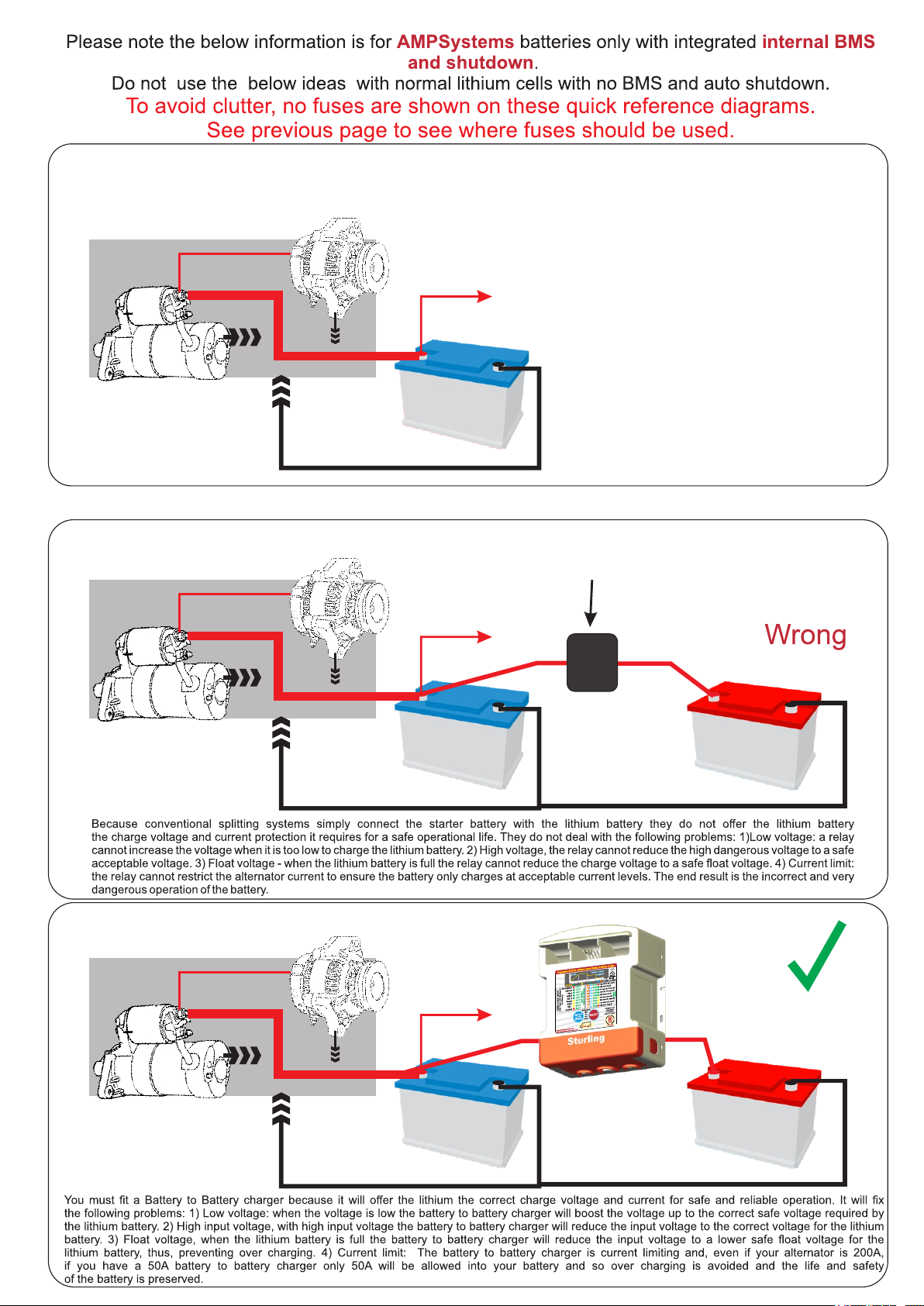
Standard engine / alternator charge system
Alternator
Vehicle Engine
Negative
To vehicle electrics
Conventional boat or car engine setup.
The alternator output connects to the starter
battery, usually at the starter's motor terminal
(for convenience only). Some alternator's
cables go direct to the starter battery.
Starter motor
+
Lead acid
How and add an auxiliary lithium battery bankto not to
How NOT to install a lithium battery
Alternator
Vehicle Engine
Negative
To vehicle electrics
Starter motor
+
Lead acid
Battery
Battery
_
_
Split charge Relay or Diode
or other conventional device
and safety shutdown
x
+
Lithium Battery
with built in BMS
_
Correct way to install a lithium battery
Alternator
Vehicle Engine
Negative
To vehicle electrics
Starter motor
+
Lead acid
Battery
_
Sterling
Battery to battery charger
Correct
+
Lithium Battery
with built in BMS
and safety shutdown
_
Page 6
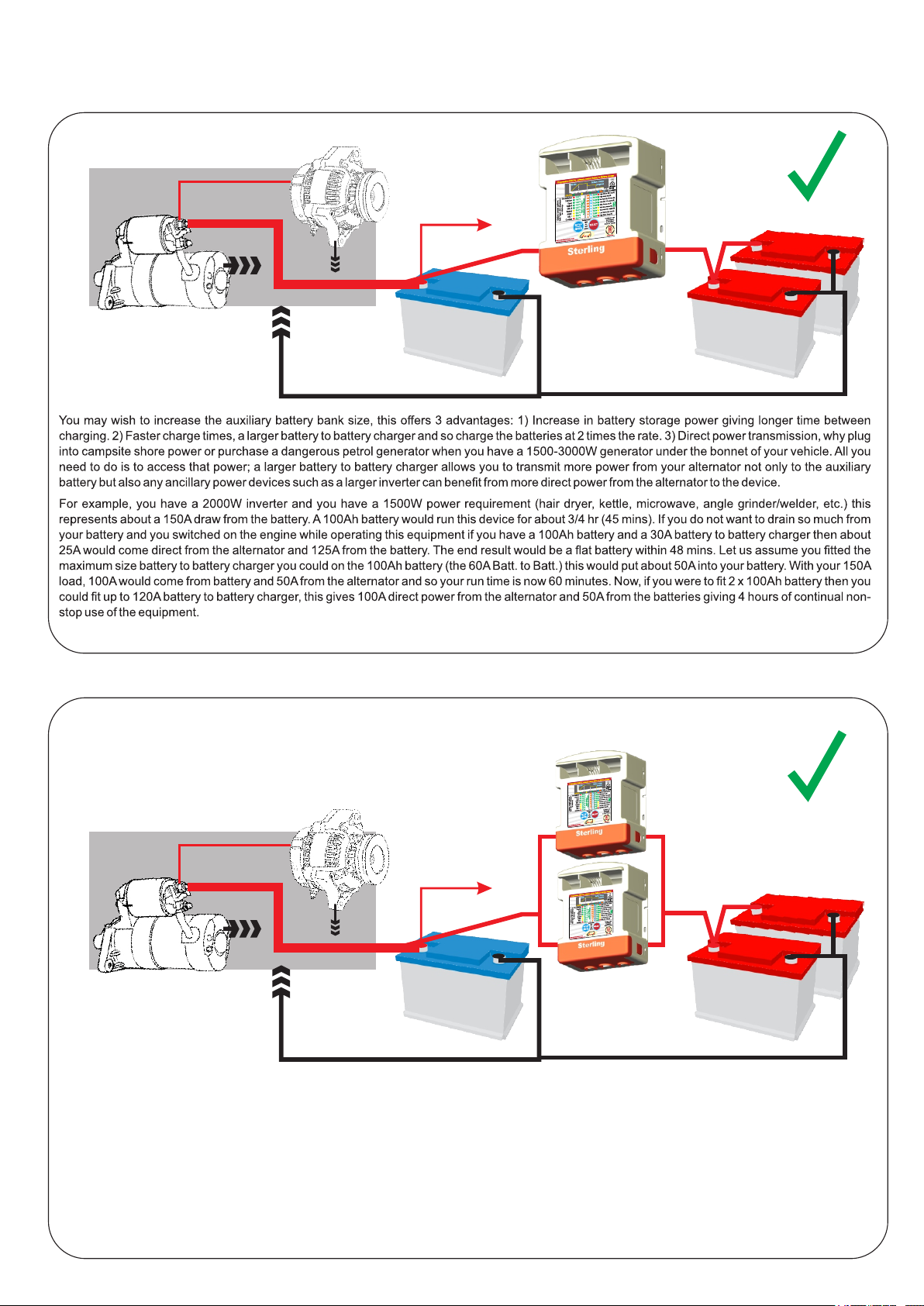
Correct way to install larger battery banks / parallel operation a lithium battery.
Add as many batteries as you wish
Vehicle Engine
Negative
Alternator
To vehicle electrics
Sterling
Battery to battery charger
Correct
Starter motor
+
Lead acid
Battery
_
+
Lithium Battery
with built in BMS
and safety shutdown
Correct way to install larger battery banks / parallel operation of the
Battery to Battery chargers
_
Correct
_
Vehicle Engine
Negative
Starter motor
Alternator
To vehicle electrics
+
Lead acid
Battery
_
Sterling
Battery to battery charger
12-12V
+
Lithium Battery
with built in BMS
and safety shutdown
You may already have a single battery to battery system and wish to add another battery to battery charger to reduce your charge time or allow more
through power. Rather than purchasing a larger battery to battery charger it is may be more economical to simply supplement the one you already have.
The battery to battery chargers are digitally controlled so they do not worry if there are more of them in parallel. The only important thing to bear in mind is
that the total output combined current of the battery to battery charger does not exceed the C rating of the lithium battery bank. If you have a 100Ah lithium
battery bank, rated at a continuous charge C of 0.7 (which is 70A) then the total of the battery to battery charger's outputs cannot exceed 50A. This can be
increased by adding an extra 100Ah lithium battery in parallel to make 200Ah. In this case the 0.7 C is now 140A and so 2 x 60A battery to battery chargers
can be safely used. Remember, a 60A battery to battery charger is the input power, the output is more like 50A).
Page 7
Vehicle Engine
Negative
Correct
Lithium through
power enhancer
Alternator
To vehicle electrics
Inverter
Starter motor
+
Lead acid
Battery
_
Sterling
Battery to battery charger
12-12V
+
Lithium Battery
with built in BMS
and safety shutdown
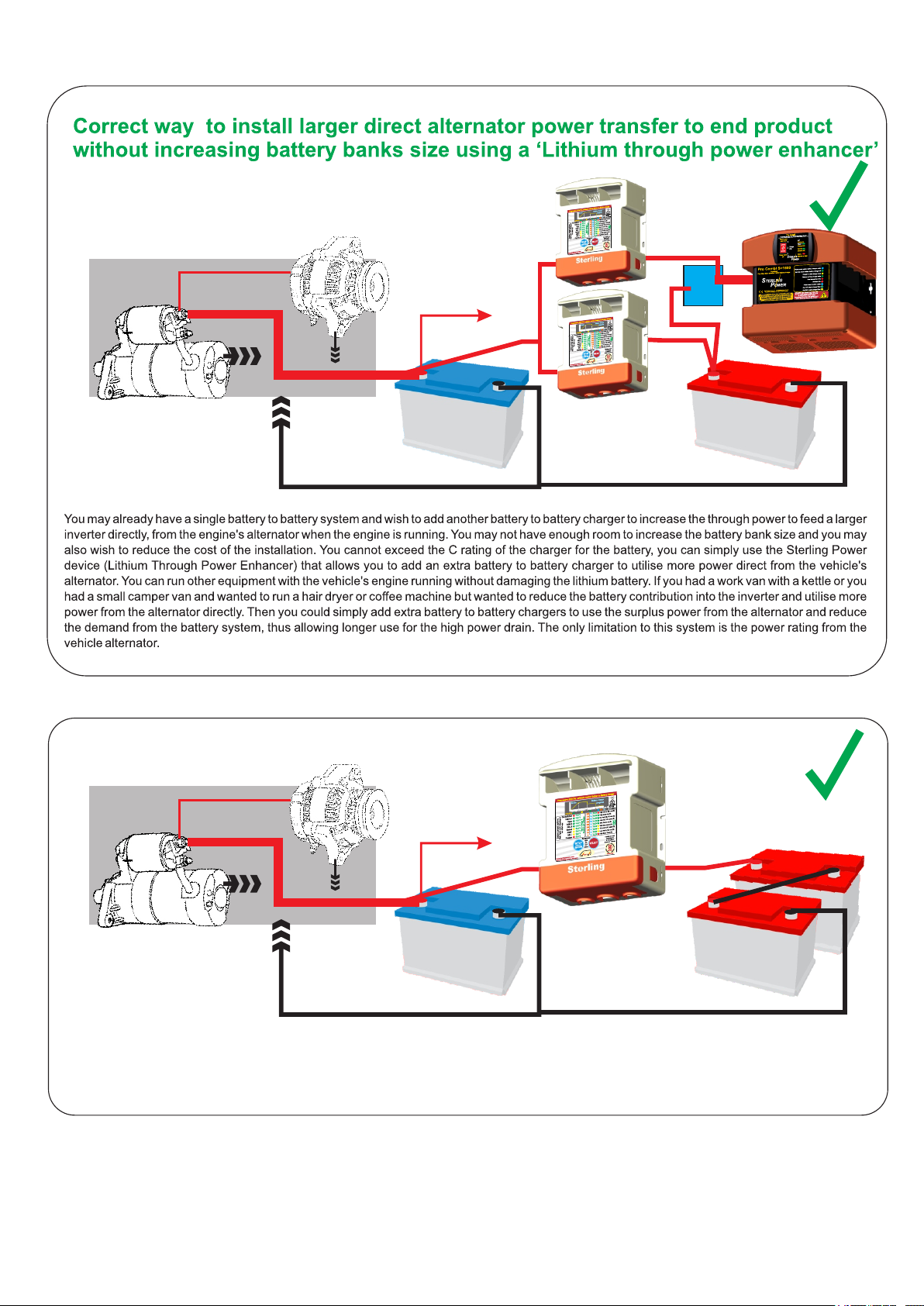
Correct way to install varger voltage battery banks / series operation
12V in 24V out
Vehicle Engine
Negative
Alternator
To vehicle electrics
24V
12V
Correct
Starter motor
Maximum:
Series operation
4 x lithium
+
Lead acid
Battery
_
Sterling
Battery to battery charger
12-24V
+
Lithium Battery
with built in BMS
and safety shutdown
_
12 V x 4 = 48V
You may have a 12V-24V requirement, a 12V-36V or 12V-48V. All options are available with the correct battery to battery charger. The maximum
is 48V. No more than 4 batteries in series are allowed.
Page 8
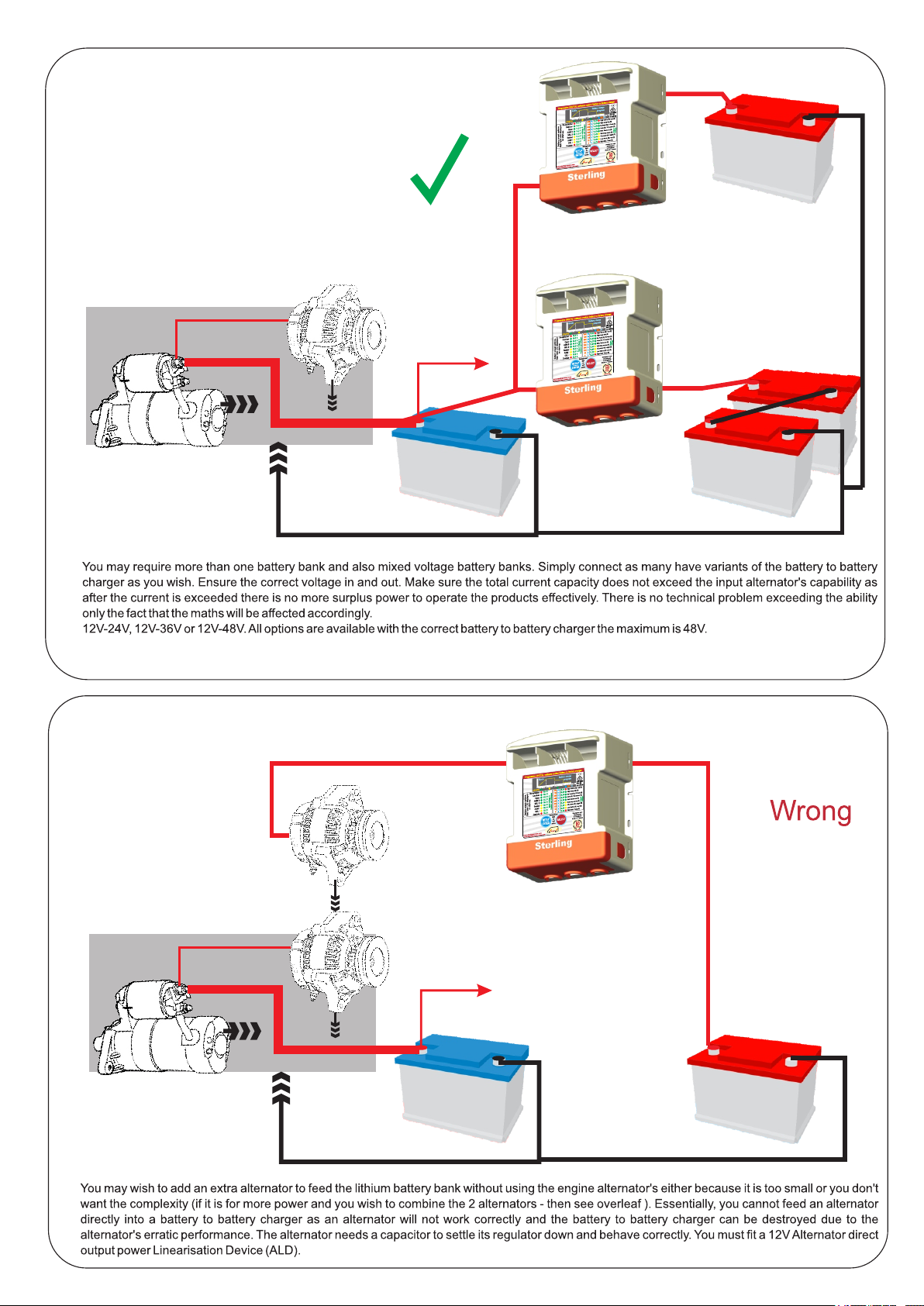
Correct way to install multiple
battery banks. 12V and 24V bank
Correct
Sterling
Battery to battery charger
12-12V
+
Lithium Battery
with built in BMS
and safety shutdown
_
Vehicle Engine
Alternator
Negative
Starter motor
Maximum:
Series operation
4 x lithium
12 V x 4 = 48V
Extra alternator install
To vehicle electrics
12V
+
Lead acid
Battery
_
Sterling
Battery to battery charger
12-24V
Sterling
Battery to battery charger
24V
+
Lithium Battery
with built in BMS
and safety shutdown
_
Vehicle Engine
Negative
Starter motor
Extra auxiliary Alternator
Engine Alternator
To vehicle electrics
+
Lead acid
Battery
Sterling
Battery to battery charger
_
x
+
Lithium Battery
with built in BMS
and safety shutdown
Page 9
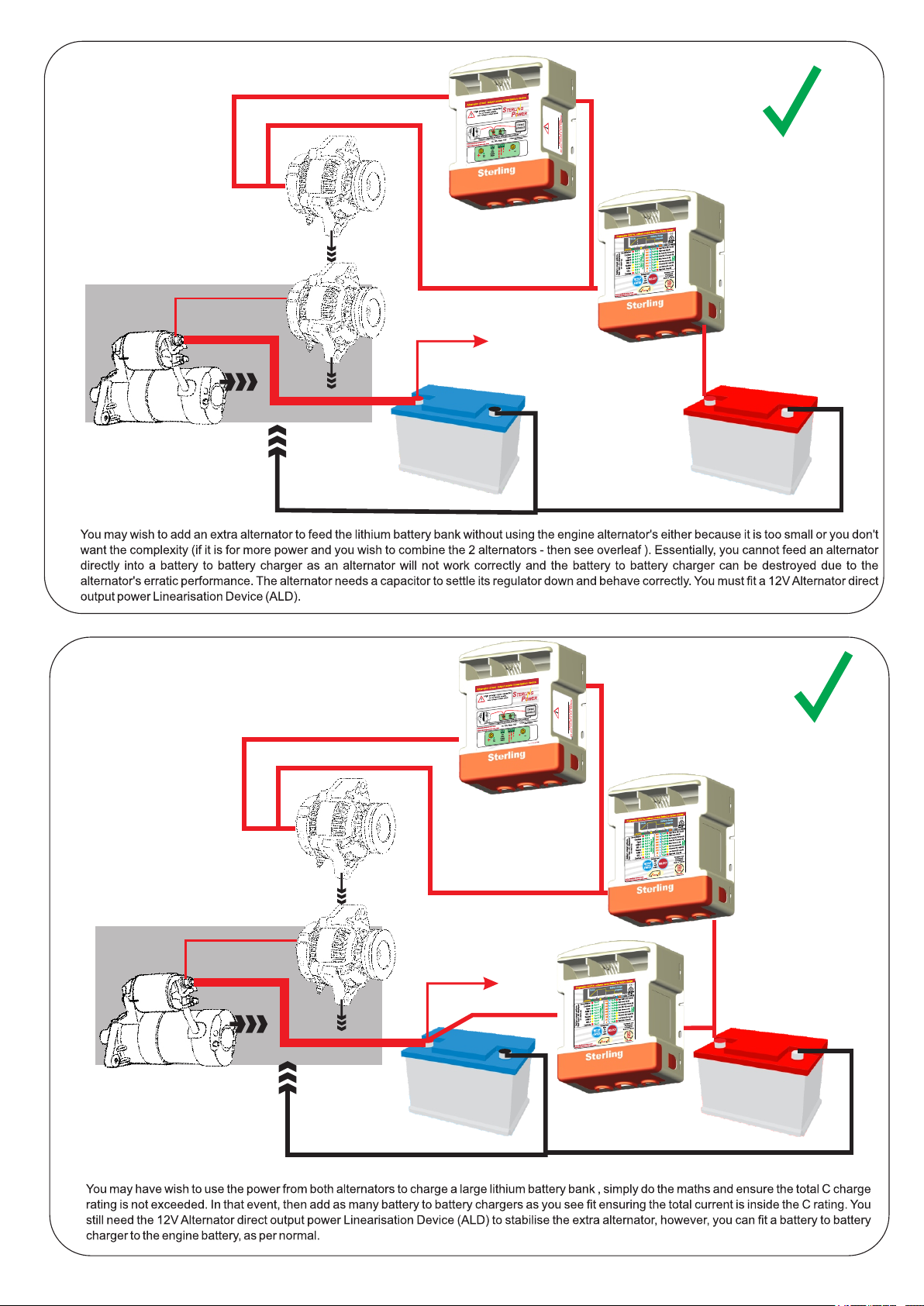
Extra alternator install using a
Sterling Power
linearisation
device (ALD)
Extra auxiliary Alternator
Correct
Sterling 12V Power
Linearisation Device (ALD)
Vehicle Engine
Engine Alternator
Negative
Starter motor
Extra alternator install
using both alternator
To vehicle electrics
+
Lead acid
Battery
_
Sterling
Battery to battery charger
Lithium Battery
with built in BMS
and safety shutdown
+
Vehicle Engine
Negative
Starter motor
Extra auxiliary Alternator
Engine Alternator
Sterling 12V Power
Linearisation Device (ALD)
To vehicle electrics
+
Lead acid
Battery
_
Sterling
Battery to battery charger
Correct
Sterling
Battery to battery charger
+
Lithium Battery
with built in BMS
and safety shutdown
Page 10
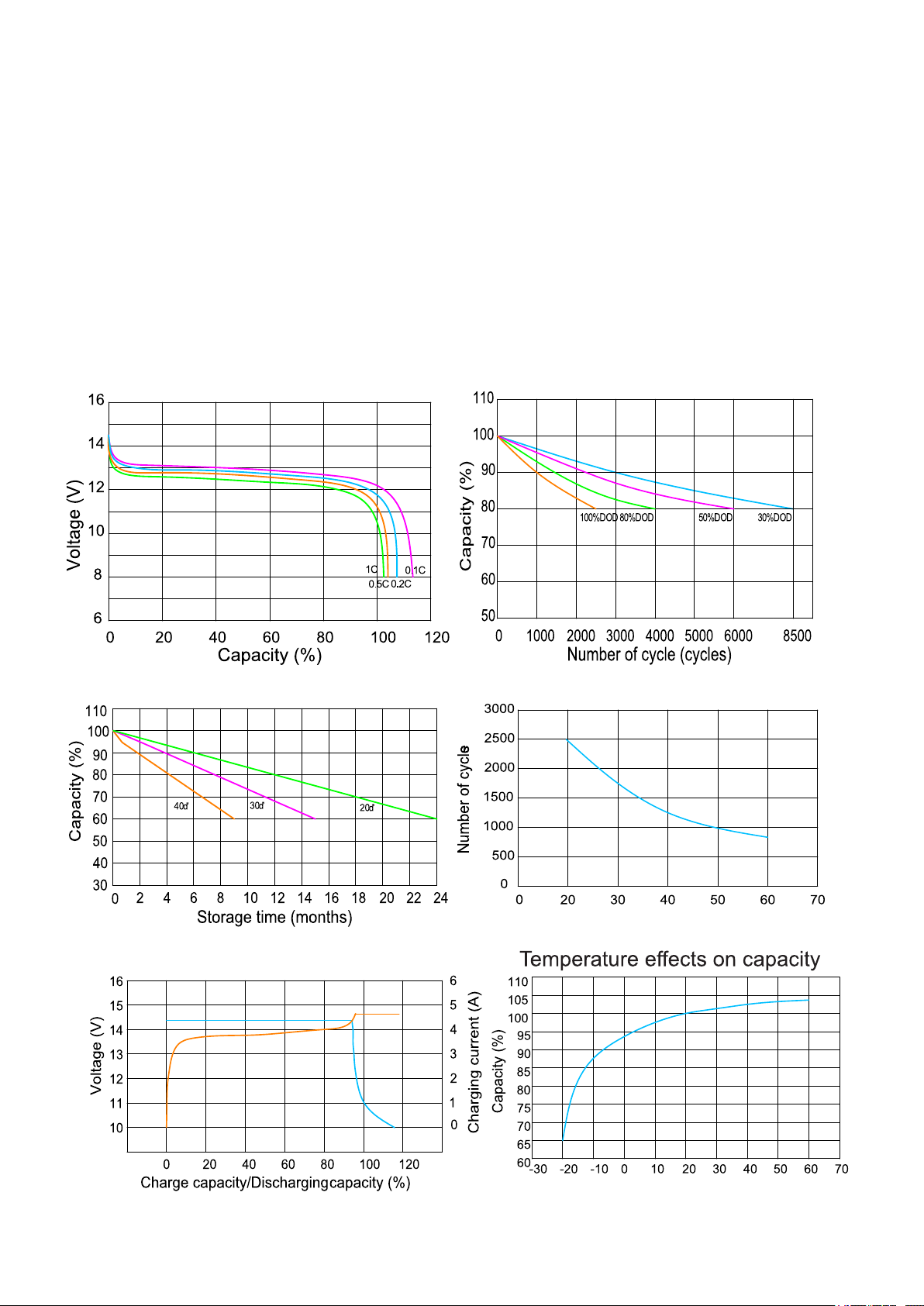
Safe operation conditions to obtain maximum performance and life from battery
LifePO4 12V (nominal). 60Ah, 80Ah, 100Ah and 120 Ah battery at 25 deg C Lithium Deep cycle battery
Maximum continuous charge rate 0.7C (~50A for 60Ah, ~60A for 80Ah, 70A for 100Ah and 80A for 120Ah)
Maximum continuous discharge rate 1.5C ( 100A for 60Ah, ~120A for 80Ah 150A for 100Ah and ~150A for 120Ah)
Battery must be safely charged within units parameters, a Battery to Battery charger must be used.
Max charge voltage 14.6V
Recommended charge voltage 14.4V
Float voltage 13.8V
Cut off voltage 10V / cut off temperature 50 deg C
Charge Curve style CC/CV
Operational temperature -20 to 60 deg C
internal consumption : Operational = 10 mA , Dormant 0.1 mA
Discharge performance at room temp.
Self-discharge characteristic Cycle life versus temperature
Cycle life versus depth of discharge
Constant voltage charging characteristics
Temperature deg C
Temperature deg C
Page 11

Battery Specification Table
Made in China
Specification: All integrated BMS and safety shutdown 60 Ah 80Ah 100 Ah 120 Ah
Nominal Voltage 12.8 VDC
Nominal Amp Hrs 60-66 ~80 100-115 120-130
Nominal Wh power 760 ~1024 1280 1536
Maximum continuous charge rate Amps 50 (0.8C) ~60 (0.8C) 70 (0.7C) 80 (0.7C)
Maximum continuous discharge rate Amps 120 (2C) ~120A (1.5C) 150 (1.5C) 150 (1.3C)
Battery must be safely charged within units parameters Cell type Prismatic Fire retardant plastic case
Max charge Voltage V=14.8V,
Recommended Charge and float V 14.6V Charge, Float V=13.8V
Cut off voltage 10V
cutoff temperature 50 deg C
Charge Curve style CC/CV
Operational temperature -20 to 60 deg C
Internal consumption: Operational = 10mA, Dormant 0.1mA
E13 marking. 10R00-10R05-14430-00
Dimensions L x W x H cm 28 x 17.2 x 17.6 26 x 21 x 16 33 x 21.5 x 17 41 x 23.5 x 17
Weight Kg 8 10 13 14.5
Part Number AL1260 L1280 AL12100 AL12120
Customer Service & Warranty
Your 100 % satisfaction is our goal. We realise that every customer and circumstance is unique. If you have a problem, question, or comment please do
not hesitate to contact us. We welcome you to contact us even after the warranty and return time has passed.
Product Warranty:
Each battery comes with a 5 year limited factory warranty.
- The original receipt or proof of purchase must be submitted to claim warranty. If proof cannot be located a warranty is calculated from the date
of manufacture.
- Our warranty covers manufacture and material defects. Damages caused by abuse, neglect, accident, alterations and improper use are not
covered under our warranty.
- Warranty is null and void if damage occurs due to negligent repairs.
- Customer is responsible for inbound shipping costs of the product to AMPS.
- AMPS will ship the repaired or warranty replacement product back to the purchaser at the purchasers cost.
If your order was damaged in transit or arrives with an error, please contact us ASAP so we may take care of the matter promptly and at no expense to you.
This only applies for shipping which was undertaken by our company and does not apply for shipping organised by yourself. Please do not throw out any
shipping or packaging materials.
All returns for any reason will require a proof of purchase with the purchase date. The proof of purchase must be sent with the returned shipment. If you
have no proof of purchase call the vendor who supplied you and acquire the appropriate documentation.
To make a claim under warranty, call our customer care line at ( England 01905 771771). We will make the best effort to repair or replace the product, if
found to be defective within the terms of the warranty. AMPS will ship the repaired or warranty replacement product back to the purchaser, if purchased
from us.
Please review the documentation included with your purchase. Our warranty only covers orders purchased from AMPS. We cannot accept warranty claims
from any other AMPS distributor. Purchase or other acceptance of the product shall be on the condition and agreement that AMPS Ltd shall not be liable for
incidental or consequential damages of any kind. Additionally, AMPS neither assumes nor authorizes any person for any obligation or liability in connection
with the sale of this product. This warranty is made in lieu of all other obligations or liabilities. This warranty provides you specific legal rights and you may
also have other rights, which vary from state to state. This warranty is in lieu of all other, expressed or implied.
Page 12
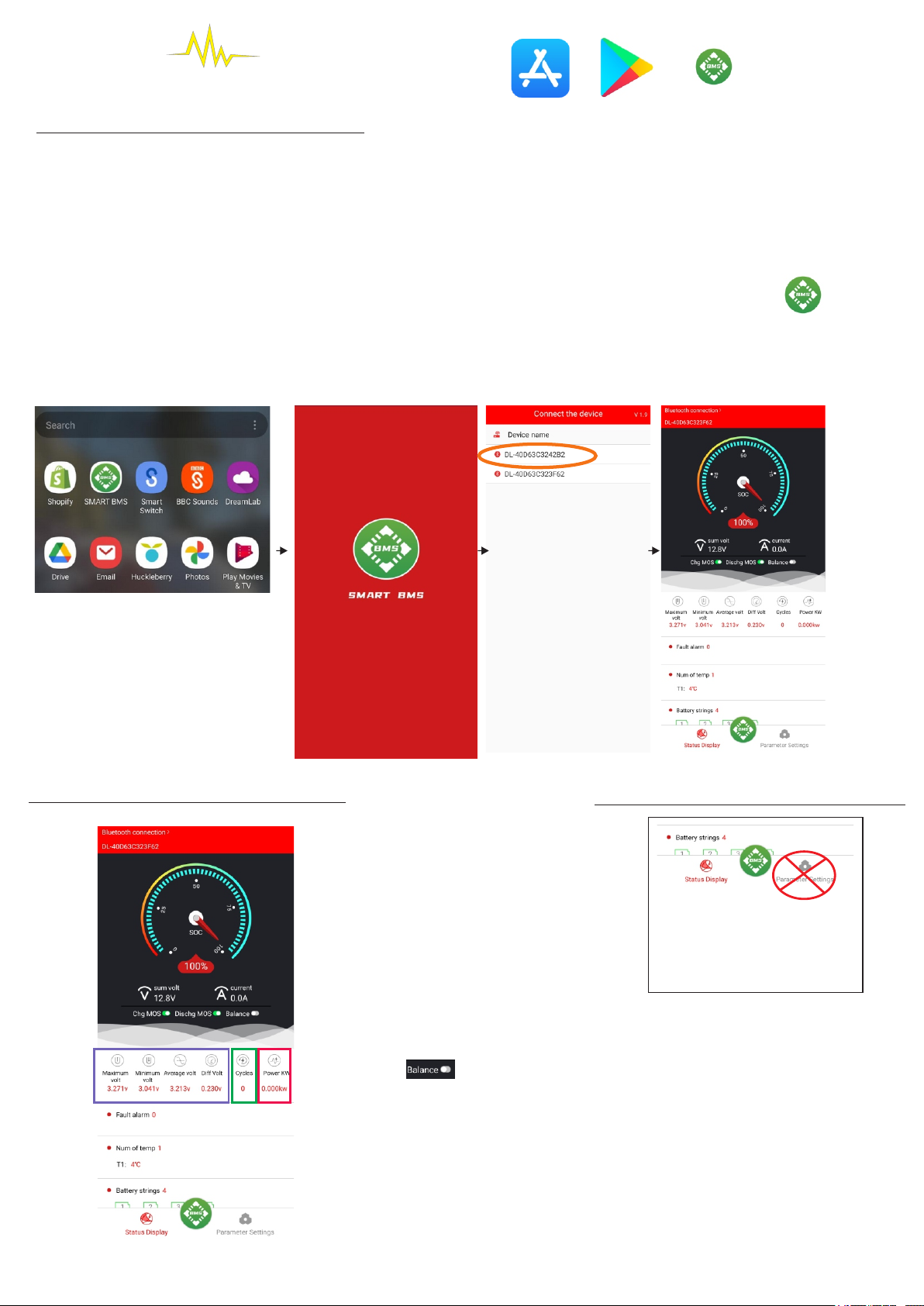
Download this app
AMPS
A M P Sdvanced obile ower ystems
Bluetooth BMS function and features
Please ensure your battery is Bluetooth compatible - there should be a round sticker on the top of
the battery with a BLUETOOTH code on it. We began rolling out the bluetooth compatible models
around the 2020/2021 winter period.
Smart BMS
looks like this
1) Please go onto the Play Store or the APP Store and download the free ‘Smart BMS’ app
2) Ensure you have Bluetooth activated on your phone.
looks like this
3) Open the App on your phone follow the steps below:
The sticker on the top of the
battery should have an Alpha Numeric code. Please select
this code on this list. If you
only have 1 battery then there
should only be 1 code on this
list. 1 code per 1 battery. If it
does not appear. Please apply
~1 4V ac ro ss yo ur batter y
terminal. This should wake up
the battery’s BMS. The signal
distance should be fairly long.
However, please get as close
as possible to th e battery
itself.
Smart BMS
Main Status Display / What it means
This is the main Status Display of the Smart BMS.
The main features that shall be of greatest interest
are as follows:
1) SOC (state of charge) - this is given as a % figure.
This is a fairly accurate capacity figure of your battery.
2) sum volt (total battery voltage). This is the voltage
of your battery.
3) current. Current going into the battery shall appear
1
2
4
5 6
as a positive number and current leaving the battery
shall appear negative.
4) The area in purple. The battery is made up of 4x
3
strings of 3V cells. The string that has the highest
voltage is displayed, the lowest voltage displayed, the
average voltage and the differential voltage. The job
of the balancer is to keep the differential voltage as
low as possible and during charge cycle the balance
slider shall turn green, if the balancer has engaged.
There is no need to manually engage this - it should
do it automatically.
5) Cycles. This is the number of discharge and charge
cycles the battery has had. The higher the number the
more the battery has been charged and discharged
(used). Even if the battery is brand new this number
may be 1 or 2 as it may have been tested first.
6) Power KW. This is a simple P=IV calculation. The
sum volt x the current. This gives an indication of the
power being supply or drawn from the battery.
Parameter Settings (out of bounds)
The Parameter Setting s are out of
bounds to the gener al publi c. The
fea tur es with in here are password
locked. If parameters are altered without
our permission th is shall void a ny
warranty. These parameters are set by
us, at AMPS.
 Loading...