

Page 1
Steiss
TM
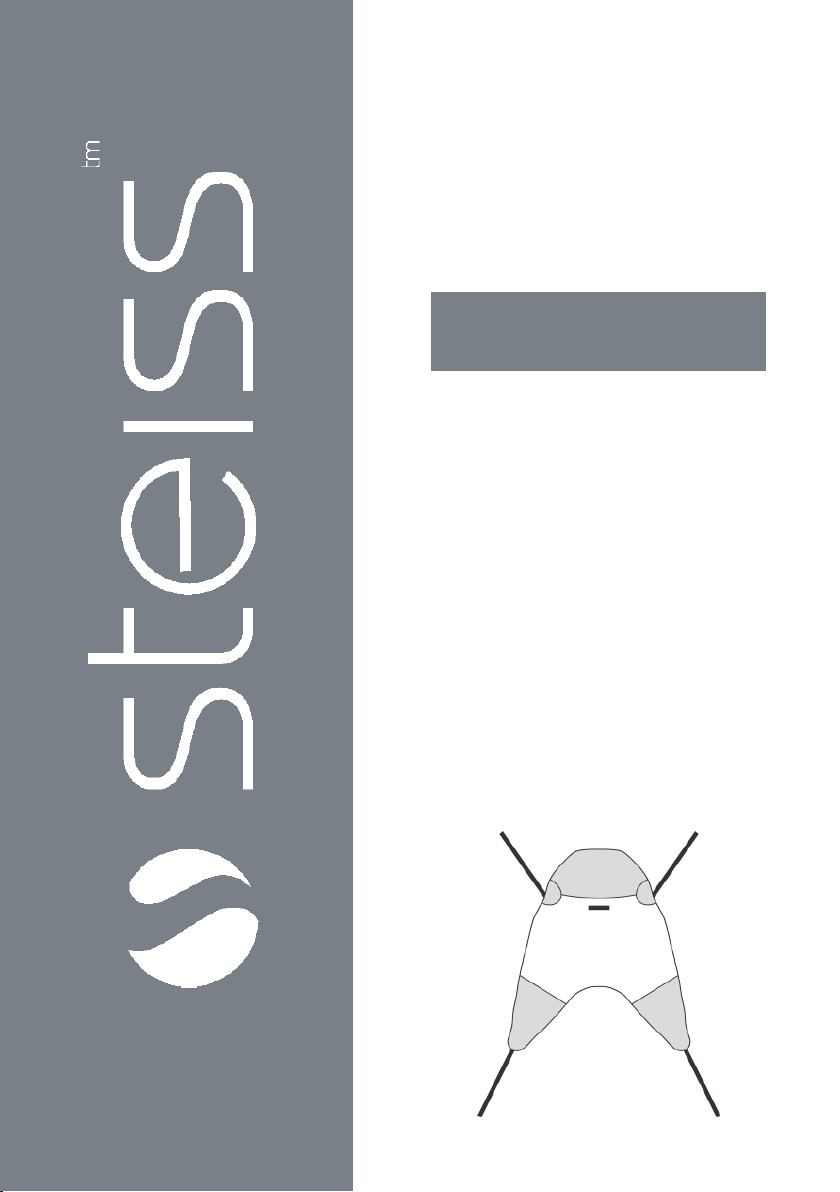
Pivot with Loops Sling
USER MANUAL
Page 2
Pivot with Loops Sling
Introduction
The Steiss Pivot with Loops sling is a general-purpose sling with integrated head support and padded legs,
offering excellent comfort and support for clients. Quick and easy to apply, this sling has looped attachment
points for use on passive hoists with a spreader bar conguration.
Special Sling Orders
On occasions, material, dimensional and other changes outside of the standard specication are requested.
Please be advised, that aside of any model specic references, tting, washing and safety guidelines
remain applicable. If you are in any doubt, please contact Blueleaf Ltd.
Statement of Intended Use
A sling is an item of moving and handling equipment that is used with a mechanical lift in order to facilitate
the transfer of a patient. It comprises a specially designed and constructed piece of fabric that is placed
under and/or around a patient before being attached to the spreader bar/cradle of a lift to raise, transfer and
lower the patient. When selected and used correctly, a sling and lift combination will achieve a safer transfer
and reduce the risks associated with manual handling.
It is the responsibility of a competent person to conduct a thorough risk assessment prior to using any
sling, to ensure that the sling choice, method of positioning in the sling and procedure for transfer has been
correctly determined for the patient. For further guidance, please contact Blueleaf Ltd.
FOR USE WITH PASSIVE LIFTS ONLY.
Expected Service Life
The expected service life of a Steiss sling will vary dependent on use and following the care and washing
instructions provided in the user guide. Factors such as wash temperature, detergents, frequency of use
and patient weight will impact on the lifetime of your sling. Blueleaf Ltd recommends that slings are checked
each and every time prior to use to ensure the safety of the patient. Bleached, torn, cut, frayed or broken
slings are unsafe and must be discarded and replaced. It is a requirement under LOLER (Lifting Operations
and Lifting Equipment Regulations 1998) that slings are thoroughly checked and passed t for use. For
further advice, please contact Blueleaf Ltd.
WARNING
• For the safety of the patient and carer; before using a sling a full risk assessment must be
conducted to ensure that the correct sling choice, method of positioning in the sling and
procedure for transfer has been determined for the patient.
• CHECK sling and stitching before each use. Using bleached, torn, cut, frayed or broken
slings is unsafe and could result in serious injury or death to the patient.
• DO NOT alter slings. Destroy and discard worn slings.
• NEVER leave a patient unattended.
• DO NOT exceed the rated capacity of the sling or lift.
• DO NOT attempt to re-position a patient by pulling on the sling loops.
2
Page 3
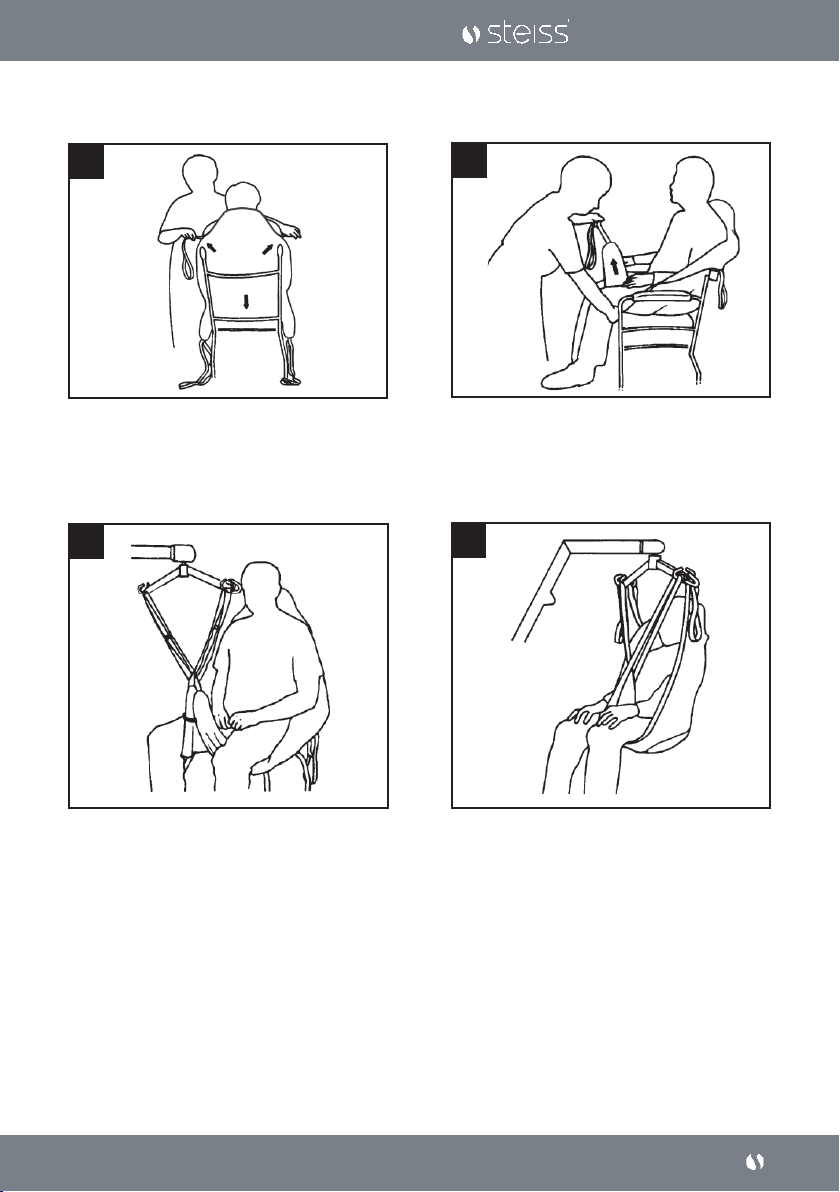
Fitting the Sling from a Seated Position
Pivot with Loops Sling
1
Ensure the label and handle are on the outside and
feed the sling down the back of the client, leaving
the top of the commode aperture at the base of the
spine. Check the sling is square at the shoulders.
3
2
Raise the client’s leg and carefully feed the padded
leg piece under and up between the legs. Ensure that
the sling is not twisted or creased under the thigh.
Repeat this procedure for the other leg.
4
To maintain patient dignity, feed the right leg support
through the modesty loop on the left leg support.
Cross over the leg straps by passing one through the
other and attach to the front hooks on the spreader
bar. Ensure the same loops are used on both straps.
Raise the spreader bar to a convenient height to allow
attachment of the shoulder straps as shown. Again,
ensure the same loops are selected and securely
attached before raising the client. Ensure the client
is positioned both safely and comfortably prior to
commencing any planned transfer activity.
NOTE: The longer you attach the shoulder straps,
the more reclined the client will be.
3
Page 4
Pivot with Loops Sling
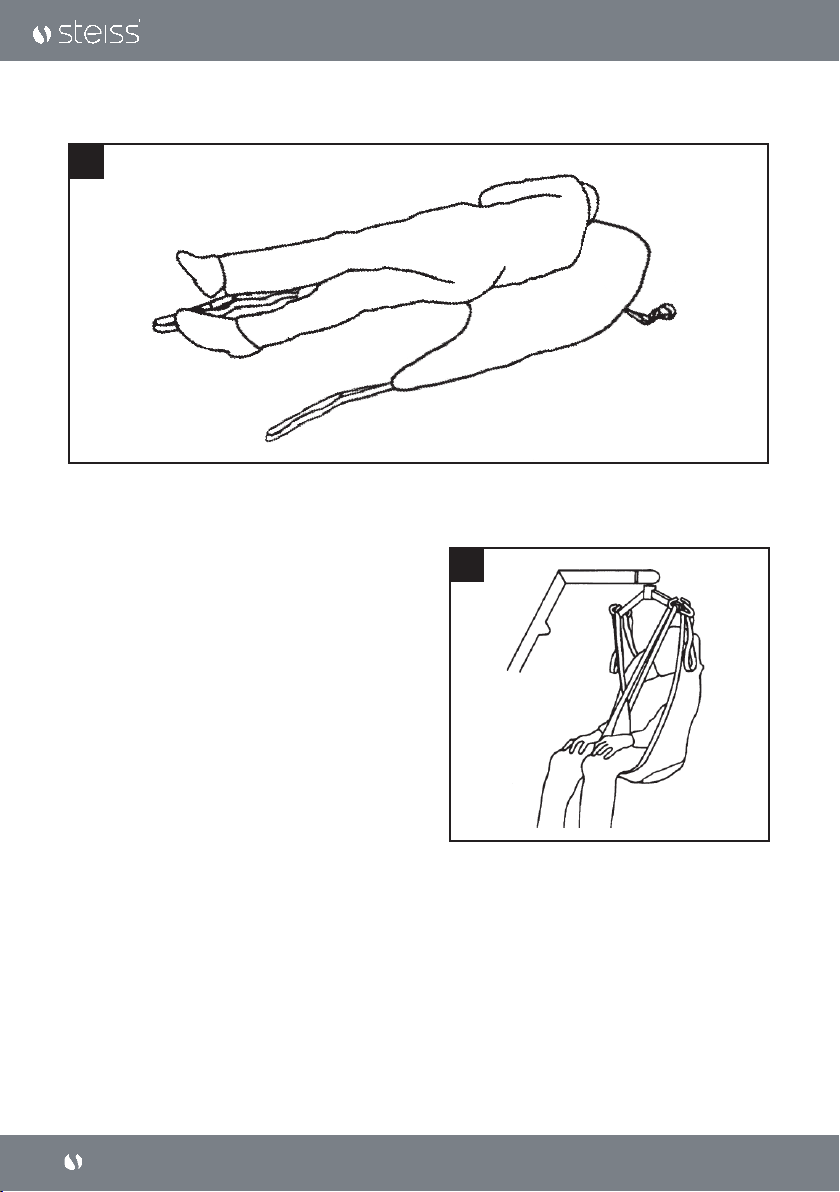
Fitting the Sling from a Lying Position
1
Safely position the client onto the sling, ensuring that the top of the commode aperture is at the base of the spine.
Carefully feed the leg sections under and up between the
patient’s legs, ensuring that the sling is positioned comfortably
and not twisted or creased under the thighs. Congure the
leg straps in the same manner as with the seated position
(step 3). Next, proceed to attach the sling to the spreader
bar in the same manner as with the seated position (steps
3 and 4).
NOTE: The longer you attach the shoulder straps, the more
reclined the client will be.
2
4
Page 5
Technical Specifications
STANDARD BS EN ISO 10535
Sizing & Safe Working Load
SIZE SAFE WORKING LOAD
PAEDIATRIC (BROWN) 500Ibs / 227kg
SMALL (RED) 500Ibs / 227kg
MEDIUM (YELLOW) 500Ibs / 227kg
LARGE (GREEN) 500Ibs / 227kg
EXTRA LARGE (BLUE) 600Ibs / 284kg
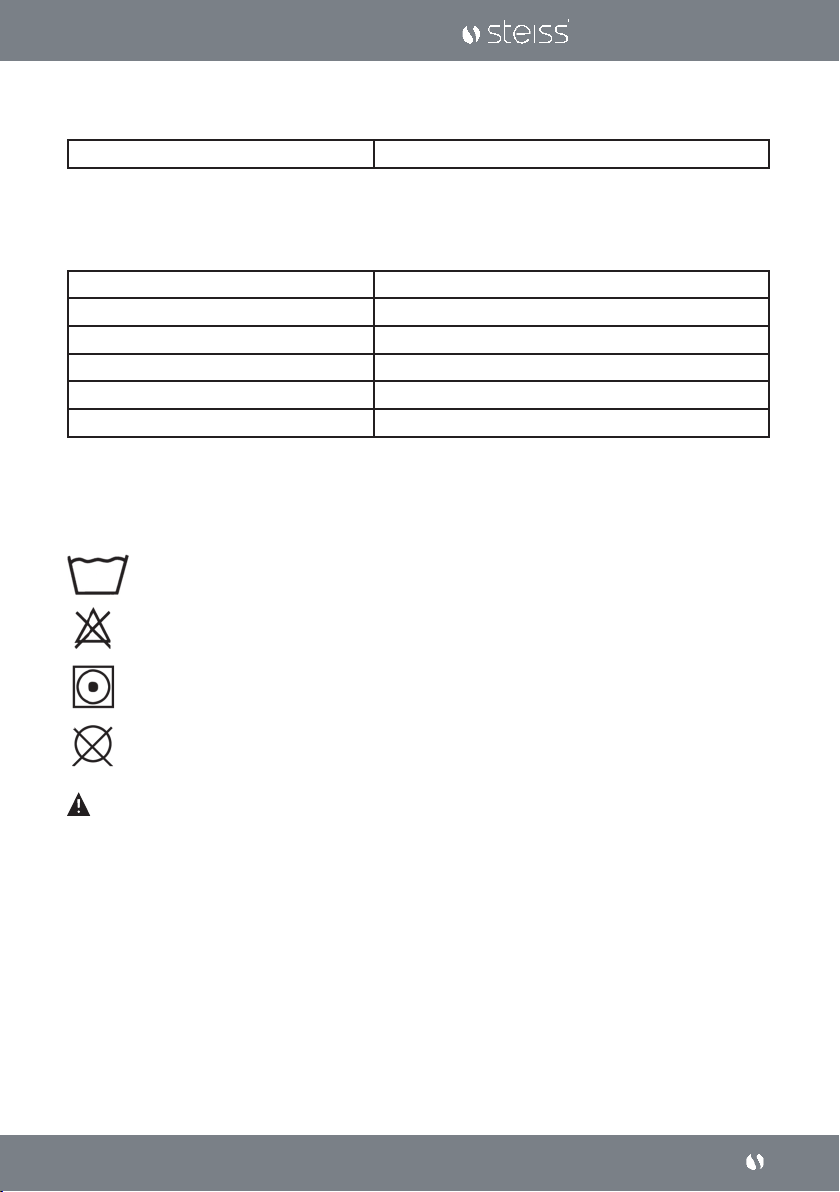
Washing Instructions
Pivot with Loops Sling
85ºC
Machine wash at 85ºC.
DO NOT wash with bleach. Bleach will damage the sling’s material and make it unsafe for use.
Cool tumble dry, air dry or dry at very low temperature.
DO NOT dry clean.
WARNING
Slings can suffer damage during washing and drying and should be checked carefully before
each use.
PLEASE NOTE: Additional slings are available to meet individual patient needs. We advise that
you always seek the advice of a trained clinician or Blueleaf Ltd prior to purchase or use.
5
Page 6
Pivot with Loops Sling
Additional Important Safety Information
Following Medical Device Alerts on other manufacturers’ slings, it is important that users of Steiss slings
always follow the instructions in the user manuals provided with each sling and also the labels which are
stitched into each sling.
In particular, it is critical to the safety of the patient that the sling is checked each and every time prior to use.
Failure to do so may result in patient injury.
If any of the following faults are identied, the sling should not be used and immediately destroyed:
• There are signs of general wear and tear
• There is loose or broken stitching on any part of the sling (including the straps)
• There are worn areas on the attachment points
• There are discoloured areas
• There are areas of frayed or torn material
• There are areas of bleached material
• The label is illegible
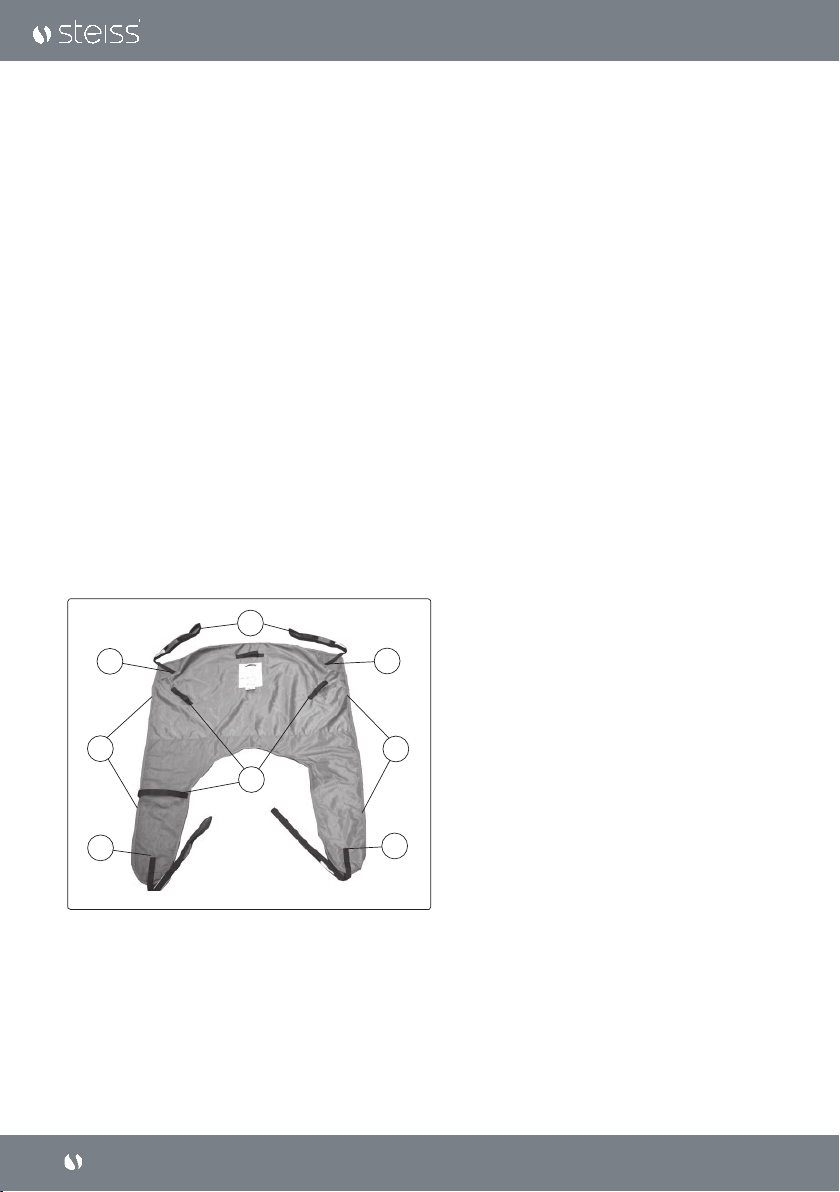
Inspection is required on all areas of the sling. The following information provides some guidance on key
areas for inspection:
Example of a sling:
4
1
2
3
1
6
1
2
1
Key areas for inspection include:
1. Sling strap attachment point
2. Seams
3. Handle attachment points
4. End loops on sling straps
Page 7
Pivot with Loops Sling
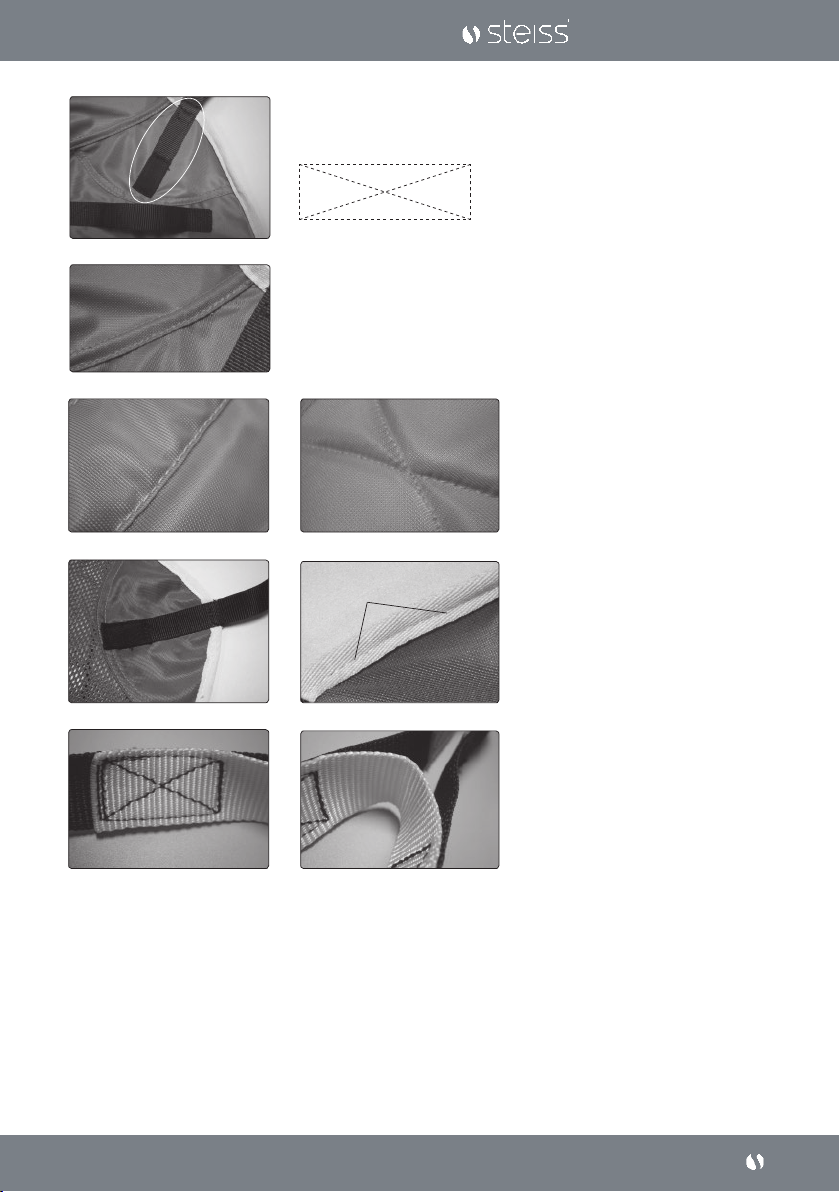
• Stitching on the sling straps on the sling body should be secure.
• Stitching is cross-stitched and not to be frayed.
Cross Stitching
• Typical seam stitching.
• Photograph shows example of correct stitching in place and not
frayed.
• Typical stitching on the main body of
the sling.
• Photographs show examples of
correct stitching in place and not
frayed.
A. Attachment of the strap to a net
Stitching
style sling.
B. Example of correct stitching on
the colour binding.
A B
• Typical stitching of the end loops on
the sling straps.
• Stitching is cross-stitched and not to
be frayed.
• Ensure end loops are not worn or
frayed.
Cleaning Instructions are clearly detailed in the user manual and on the label stitched on the back of the sling.
Failure to follow these instructions may result in the sling becoming damaged and unsafe for use.
If you have any questions regarding these instructions please contact Blueleaf Ltd.
7
Page 8

Blueleaf Ltd
Charwood House, Wilberforce Way,
Oakhurst Business Park, Southwater,
Horsham, West Sussex
RH13 9RT United Kingdom
Tel: 0330 055 2288
[email protected] • www.blueleafcare.com
Joerns Healthcare Ltd
Worcestershire, WR10 2AG
6110359 Rev B • DCO19-0037
 Loading...