

Page 1

DE
GB
3
Bedienungsanleitung
Batterie Ladegerät SH-3.170
Instruction Manual
Battery Charger SH-3.170
Article no. 331700
Page 2

Batterie Ladegerät SH-3.170
DE
Artikel-Nr. 331700
Bestimmungsgemäße Verwendung
Das Batterie Ladegerät SH-3.170 ist für das Auaden von 6 V und 12 V
Blei-Akkus sowie 12 V Lithium-Akkus (LiFePO
managementsystem (BMS) geeignet. Es wurde für die Pege von Auto- und
Motorradbatterien optimiert. Eine andere Verwendung als zuvor beschrieben
führt zur Beschädigung dieses Produktes, darüber hinaus ist dies mit Gefahren, wie z.B. Kurzschluss, Brand, elektrischer Schlag etc. verbunden.
Lieferumfang
Batterie Ladegerät SH-3.170
Adapterkabel mit Batterieklemmen
Adapterkabel mit Ringösen
Bedienungsanleitung in DE, GB
Sicherheits-/Warnhinweise
Die nachfolgenden Sicherheits- und Gefahrenhinweise dienen sowohl zum
Schutz des Geräts als auch zum Schutz Ihrer Gesundheit. Lesen Sie sich also
bitte die folgenden Punkte aufmerksam durch.
Allgemein
Aus Sicherheits- und Zulassungsgründen (CE) ist das eigenmächtige
Umbauen und/oder Verändern des Produkts nicht gestattet.
Das Ladegerät darf nur an einer Netzspannung von 100 – 240 V AC bei
50/60 Hz betrieben werden.
Das Produkt ist kein Spielzeug. Es ist nicht für Kinderhände geeignet.
Das Produkt darf nur an einer solchen Stelle aufgestellt, betrieben oder
gelagert werden, an der es für Kinder nicht erreichbar ist. Lebensgefahr!
Das Produkt ist ausschließlich zum Auaden von 6 V bzw. 12 V Blei-
Akkus und 12 V Lithium-Akkus (LiFePO
Versuchen Sie niemals, andere Akkus (z.B. NiCd, NiMH, LiPo) oder Batterien aufzuladen! Es besteht Brand- und Explosionsgefahr!
Wartungs-, Einstellungs- oder Reparaturarbeiten dürfen nur von einem
Fachmann/Fachwerkstatt durchgeführt werden. Zur Reparatur dürfen nur
original Ersatzteile verwendet werden. Die Verwendung abweichender
Ersatzteile kann zu erheblichen Sach- und Personenschäden führen!
Lassen Sie das Verpackungsmaterial nicht achtlos liegen. Dieses könnte
für Kinder zu einem gefährlichen Spielzeug werden!
Wenn Sie Beschädigungen feststellen, so darf das Ladegerät nicht mehr
betrieben werden. Bringen Sie das Produkt in eine Fachwerkstatt oder
entsorgen Sie es umweltgerecht.
) mit integriertem Batterie-
4
) mit integriertem BMS geeignet.
4
Betrieb
Der Betrieb unter widrigen Umgebungsbedingungen ist unter allen
Umständen zu vermeiden. Widrige Umgebungsbedingungen sind:
Umgebungstemperaturen über 40 °C, brennbare Gase, Lösungsmittel,
Dämpfe, Staub sowie Luftfeuchtigkeit über 80 % rel. Luftfeuchte.
Das Ladegerät darf auch nicht in der Nähe von entzündlichen Materialien
oder Gasen betrieben werden.
Achten Sie auf ausreichende Belüftung während der Betriebsphase.
Decken Sie das Ladegerät niemals ab.
Laden Sie Blei-Akkus niemals in Behältern oder in schlecht belüfteten
Räumen. Beim Laden von Blei-Akkus können explosive Gase entstehen!
Halten Sie Ladegerät und Akku fern von Zündquellen oder offenem
Feuer, rauchen Sie nicht während des Umgangs mit Ladegerät und Akku!
Es besteht Explosionsgefahr!
Verwenden Sie das Produkt niemals gleich dann, wenn es von einem
kalten Raum in einen warmen Raum gebracht wurde. Dabei entsteht
Kondenswasser, dies kann nicht nur zu Funktionsstörungen führen,
sondern es besteht auch die Gefahr eines lebensgefährlichen elektrischen Schlages!
Akkuhinweise
Beachten Sie alle Sicherheits- und Ladehinweise des Akkuherstellers.
Trennen Sie immer zuerst den Masseanschluss vom Akku ab und erst
danach den Pluspol.
Achten Sie beim Anschluss eines Akkus an das Ladegerät auf die richtige
Polarität (rote Klemme = Plus/+, schwarze Klemme = Minus/-).
Blei-Akkus enthalten aggressive ätzende Säuren. Vermeiden Sie Haut-
und Augen kontakt mit Flüssigkeiten aus dem Blei-Akku! Waschen Sie
betroffene Hautpartien gründlich mit Wasser und Seife ab. Ist Säure ins
Auge gelangt, waschen Sie dieses sofort unter ießendem, klarem und
kaltem Wasser aus! Suchen Sie danach sofort einen Arzt auf!
Akkus dürfen nicht kurzgeschlossen oder ins Feuer geworfen werden.
Brand- und Explosionsgefahr!
Zerlegen Sie niemals Ihren Akku!
Durch unsachgemäße Handhabung oder Nichtbeachtung dieser
Bedienungsanleitung bzw. der hier aufgeführten Sicherheitshinweise erlischt die Garantie. Für Sach-, Personen- und
Folgeschäden, die dadurch verursacht werden, übernehmen
wir keine Haftung.
/ 03Weitere Informationen unter www.ivt-hirschau.de/ 02 3 Jahre Hersteller-Garantie. Akkus und Batterien ausgeschlossen.
Page 3
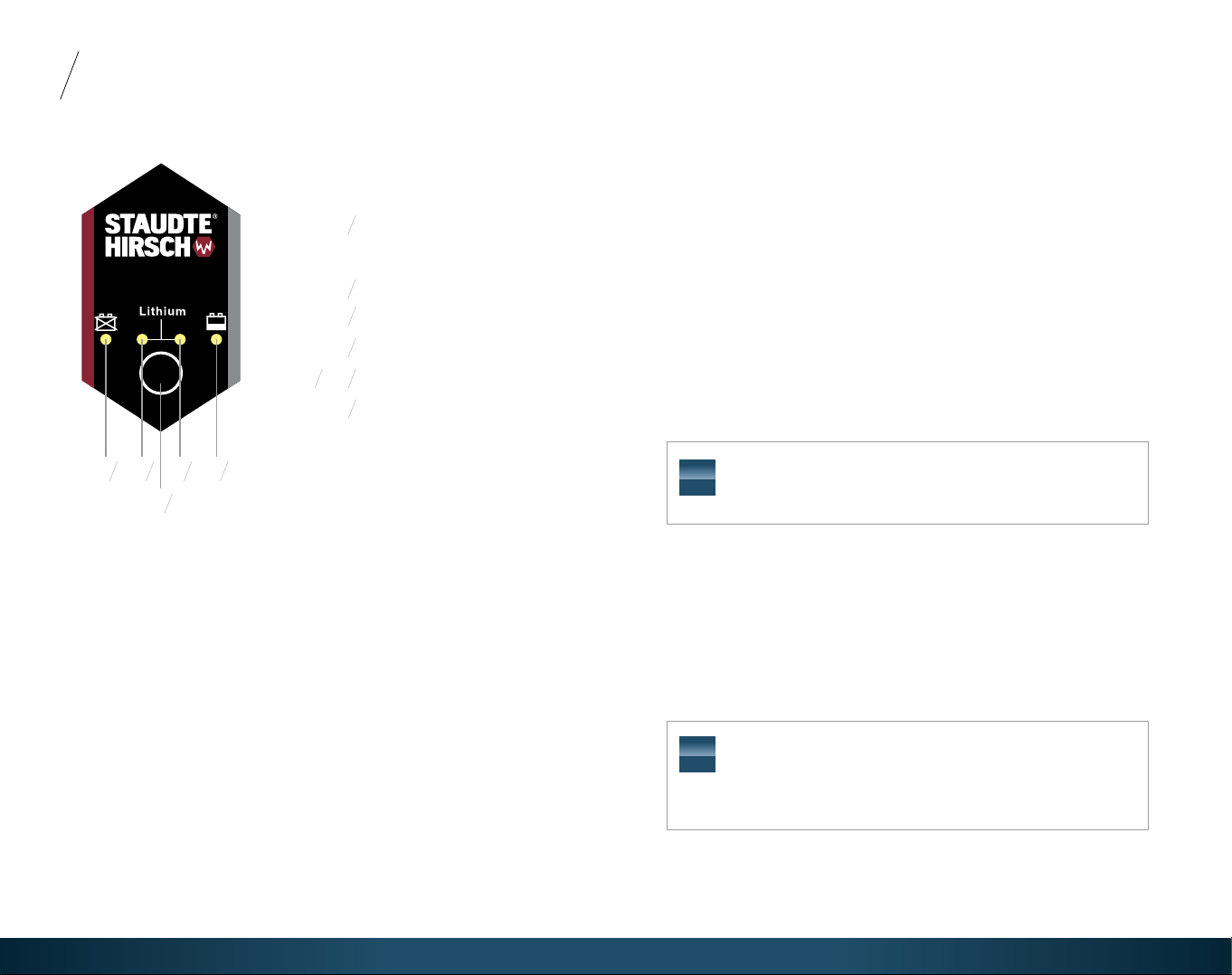
Bedien- und Anzeigeelemente
124
5
3
DE
1
2
3
4
4
2
5
Das Batterie Ladegerät SH-3.170 ist mit einem übersichtlichen Bedien-
und Anzeigepanel ausgestattet. Die LEDs geben Ihnen jederzeit Auskunft
über den gewählten Betriebsmodus, den Ladezustand des Akkus sowie
einen defekten, kurzgeschlossenen oder verpolt angeschlossenen Akku.
Fehleranzeige
(Akku defekt, Kurzschluss,
Batterie Ladegerät
6V/12V 2A
6V 12V
MODE
Verpolung)
6 V Blei-Modus
Modus-Auswahl
12 V Blei-Modus
+
12 V Lithium-Modus
Ladezustandsanzeige
12 V Lithium-Modus
Der 12 V Lithium-Modus eignet sich zum Laden von LiFePO
integriertem Batteriemanagementsystem (bitte beachten Sie die Angaben
des Akkuherstellers). Drücken Sie die MODE-Taste (3), so oft bis die LEDs
(2) und (4) blinken. Nach ca. 2 Sekunden leuchten die LEDs konstant und der
Ladebetrieb beginnt. Der maximale Ladestrom beträgt 2 A. Die Ladeschlussspannung beträgt 14,4 V. Der Ladestatus wird durch LED (5) angezeigt. Wenn
der Akku voll ist, leuchtet die LED konstant und das Ladegerät wechselt
automatisch in den Erhaltungslademodus.
Regenerationsmodus
Wenn ein tiefentladener Akku an das Ladegerät angeschlossen wird, startet
zuerst der Regenerationsmodus. Über einen geringen Ladestrom wird versucht, den tief entladenen Akku wieder auf eine Akkuspannung zu bringen,
bei der die normale Ladefunktion gestartet werden kann.
Defekte, kurzgeschlossene oder verpolt angeschlossene Akkus
Defekte, kurzgeschlossene bzw. verpolt angeschlossene Akkus werden
vom Ladegerät automatisch erkannt. In diesen Fällen wird das gewählte
Ladeprogramm nicht gestartet. LED (1) leuchtet.
-Akkus mit
4
Beschreibung der Betriebsmodi
6 V Blei-Modus
Der 6 V Blei-Modus eignet sich zum Laden von 6 V Blei-Akkus (bitte beachten
Sie die Angaben des Akkuherstellers). Drücken Sie die MODE-Taste (3), so oft
bis LED (2) blinkt. Nach ca. 2 Sekunden leuchtet die LED konstant und der
Ladebetrieb beginnt. Der maximale Ladestrom beträgt 2 A. Die Ladeschlussspannung beträgt 7,2 V. Der Ladestatus wird durch die LED (5) angezeigt.
Wenn der Akku voll ist, leuchtet die LED konstant und das Ladegerät wechselt automatisch in den Erhaltungslademodus.
12 V Blei-Modus
Der 12 V Blei-Modus eignet sich zum Laden von 12 V Blei-Akkus (bitte beachten
Sie die Angaben des Akkuherstellers). Drücken Sie die MODE-Taste(3), so oft
bis LED (4) blinkt. Nach ca. 2 Sekunden leuchtet die LED konstant und der
Ladebetrieb beginnt. Der maximale Ladestrom beträgt 2 A. Die Ladeschlussspannung beträgt 14,4 V. Der Ladestatus wird durch die LED (5) angezeigt.
Wenn der Akku voll ist, leuchtet die LED konstant und das Ladegerät wechselt automatisch in den Erhaltungslademodus.
3 Jahre Hersteller-Garantie. Akkus und Batterien ausgeschlossen.
Auaden des Akkus
Das Ladegerät verfügt über eine Auto-Memory-Funktion. Nach
i
Ausfall der Versorgungsspannung kehrt das Gerät automatisch
in den zuvor gewählten Lademodus zurück.
Stellen Sie zuerst sicher, dass es sich um einen Blei-Akku mit einer
Spannung von 6 V bzw. 12 V oder einen Lithium-Akku (LiFePO
mit einer Spannung von 12 V handelt. Akkus mit anderen Spannungen
können nicht geladen werden!
Trennen Sie alle Verbraucher vom Akku ab.
Ist der Akku in einem Fahrzeug eingebaut, so schalten Sie die Zündung
und alle Verbraucher aus.
Beachten Sie unbedingt die Informationen und Sicherheitshinweise zum Fahrzeug und wie der Fahrzeug-Akku geladen werden
i
darf. Moderne Fahrzeuge verfügen über empfindliche Elektronikbestandteile und Steuergeräte, die bei falscher Vorgehensweise
beschädigt werden!
Schließen Sie zuerst das Ladegerät an das Stromversorgungsnetz
(100 – 240 V AC, 50/60 Hz) an.
) mit BMS
4
/ 05Weitere Informationen unter www.ivt-hirschau.de/ 04
Page 4

Anschließend können Sie zwischen den verschiedenen Funktionen durch
Batteriespannung
Ladestufe
1 2 3 4 5
Batteriespannung
Batteriespannung
Ladestufe
DE
Betätigung der MODE-Taste (3) wählen. Beachten Sie bitte bei der Auswahl
des richtigen Betriebsmodus unbedingt die Angaben des Akkuherstellers
bezüglich zulässiger Ladeschlussspannung und maximalem Ladestrom.
Schließen Sie nun das Ladegerät polungsrichtig an den Akku an. Ein
defekter Akku sowie eine kurzgeschlossene oder verpolt angeschlossene
Anschlussleitung werden durch die LED (1) angezeigt.
Trennen Sie nach dem Ladevorgang das Ladegerät von der Netzspannung.
Entfernen Sie anschließend die Klemme vom Minuspol des Akkus und
danach vom Pluspol.
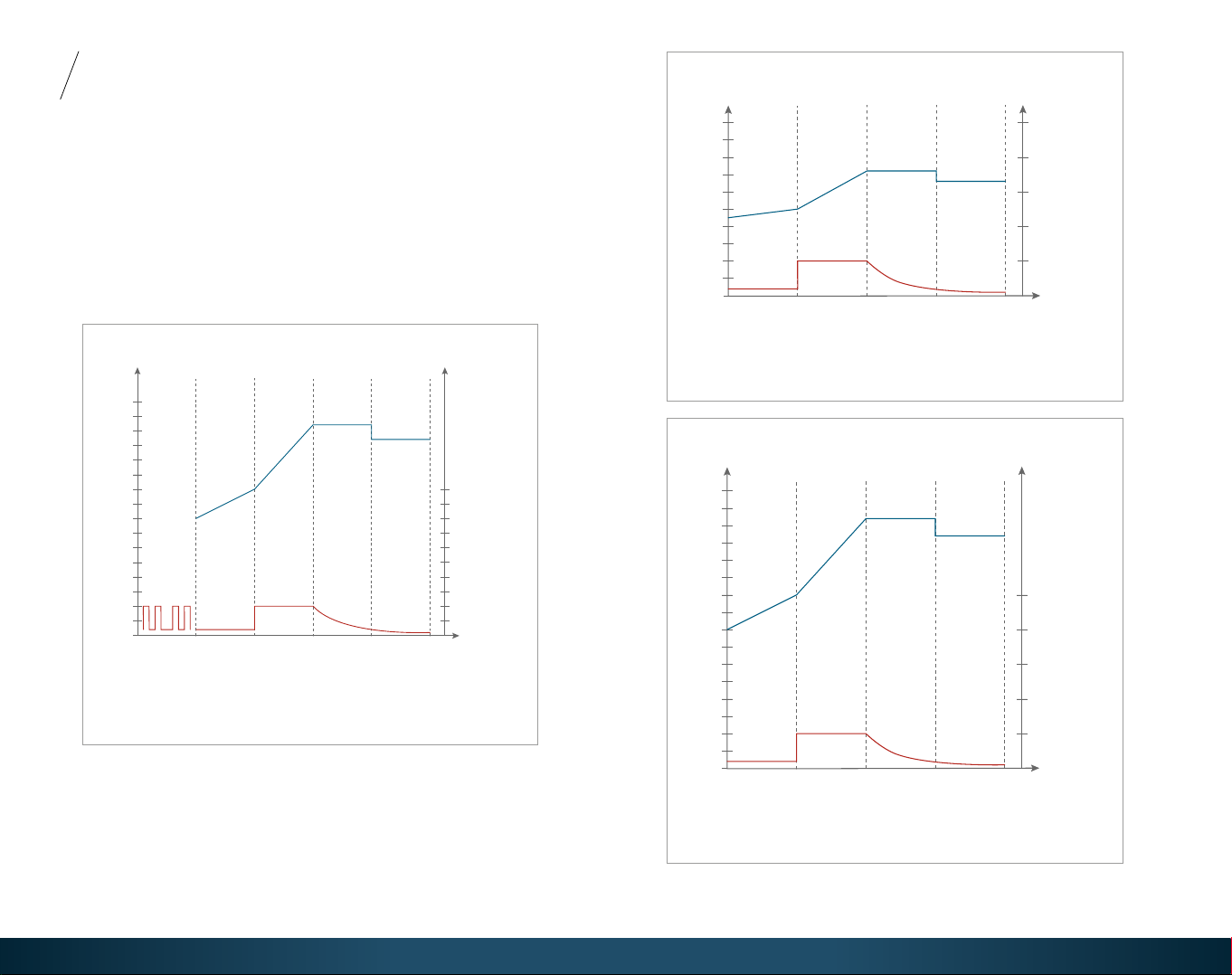
Ladekurven
12 V Lithium-Modus – Ladekurve und Ladeverfahren
6 V Blei-Modus – Ladekurve und Ladeverfahren
10 V
7,2 V 7,2 V
5 V
0 V
Stufe 1 Softstartphase
Stufe 2 Konstantstromphase
Stufe 3 Konstantspannungsphase
Stufe 4 Erhaltungsladung
5,0 V
2,0 A
0,4 A
1 2 3 4
10 A
8 A
6,6 V
6 A
4 A
Ladestrom
2 A
Ladestufe
15 V
10 V
8,0 V
5 V
0 V
Stufe 1 Prüfphase
Stufe 2 Softstartphase
Stufe 3 Konstantstromphase
Stufe 4 Konstantspannungsphase
Stufe 5 Erhaltungsladung
3 Jahre Hersteller-Garantie. Akkus und Batterien ausgeschlossen.
0,4 A
10,0 V
14,4 V 14,4 V
2,0 A
13,4 V
12 V Blei-Modus – Ladekurve und Ladeverfahren
10 A
8 A
6 A
Ladestrom
4 A
2 A
15 V
10 V
10,0 V
5 V
0,4 A
0 V
1 2 3 4
Stufe 1 Softstartphase
Stufe 2 Konstantstromphase
Stufe 3 Konstantspannungsphase
Stufe 4 Erhaltungsladung
14,4 V 14,4 V
2,0 A
13,4 V
10 A
8 A
6 A
4 A
2 A
Ladestrom
/ 07Weitere Informationen unter www.ivt-hirschau.de/ 06
Page 5
DE
Technische Daten
Eingang
Betriebsspannung 100 – 240 V AC, 50/60 Hz
Eingangsstrom
Leistungsaufnahme
max. 0,62 A
max. 45 VA
Ausgang
Geeignete Akkuspannung 6 V, 12 V
Ladestrom max. 2,0 A ± 10 %
Auadbarer Akkutyp 6 V und 12 V Blei-Akkus Säure, Gel, AGM
Akkukapazität ab 2,0 Ah
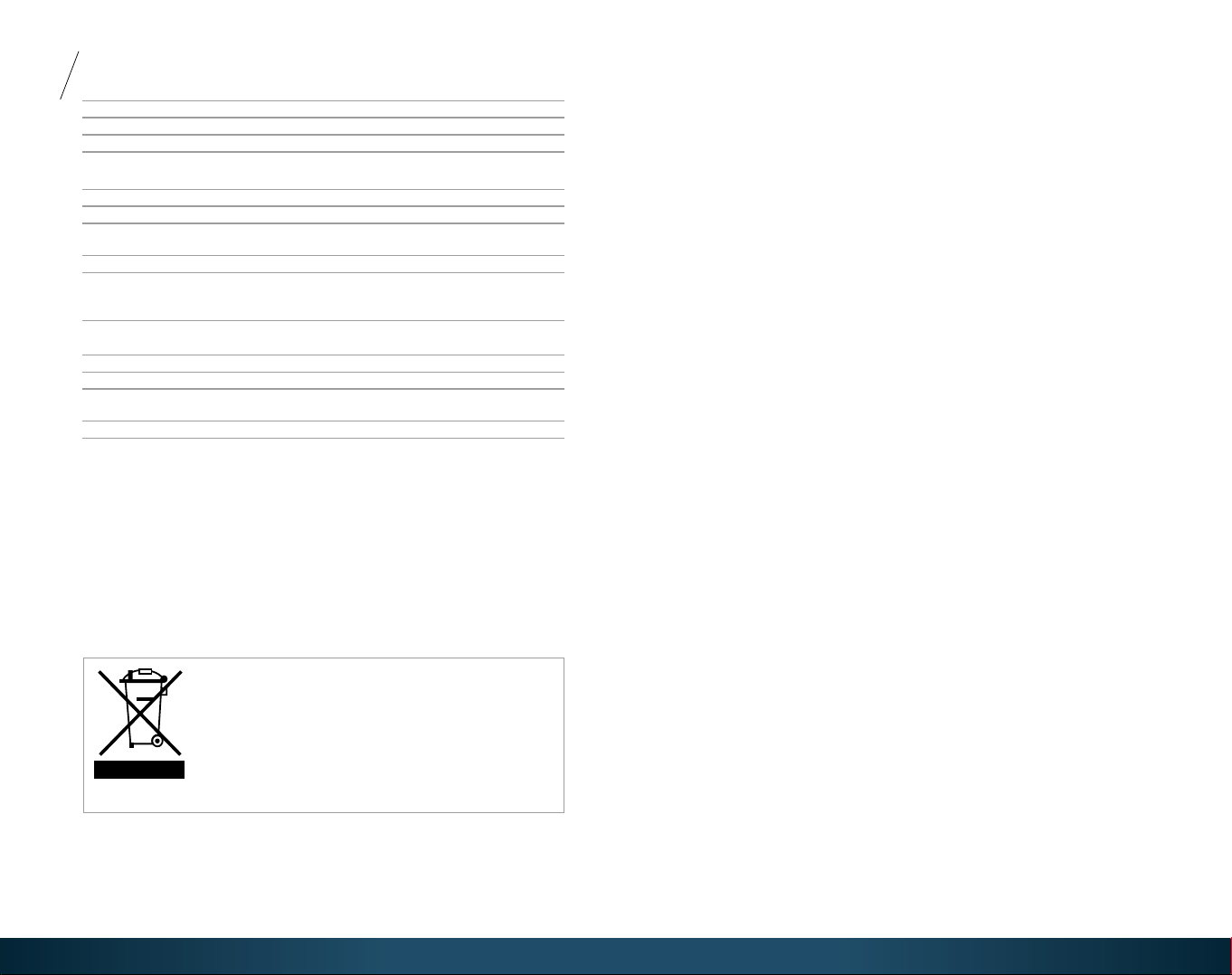
12 V LiFePO
-Akkus
4
Ladeschlussspannung 7,2 V ± 0,25 V 6 V Blei-Modus
14,4 V ± 0,25 V 12 V Blei-Modus
14,4 V ± 0,25 V 12 V Li-Modus
Allgemein
Rückstrom < 0,5 mA
Schutzart IP 20
Kabellänge 1,70 m (Netzkabel)
1,60 m (Anschlusskabel inkl. Adapter)
Abmessungen 110 x 70 x 40 mm
Gewicht
80 g (ohne Zubehör)
2
380 g (mit Zubehör)
Hinweis zum Umweltschutz
Dieses Produkt darf am Ende seiner Lebensdauer nicht über den
normalen Haushaltsabfall entsorgt werden, sondern muss an
einem Sammelpunkt für das Recycling von elektrischen und
elektronischen Geräten abgegeben werden. Das Symbol auf dem
Produkt, der Gebrauchsanleitung oder der Verpackung weist
darauf hin. Die Werkstoffe sind gemäß ihrer Kennzeichnung
wieder verwertbar. Mit der Wiederverwendung, der stofichen
Verwertung oder anderen Formen der Verwertung von Altgeräten
leisten Sie einen wichtigen Beitrag zum Schutze unserer Umwelt.
Bitte erfragen Sie bei der Gemeindeverwaltung die zuständige
Entsorgungsstelle.
Technische Änderungen vorbehalten. Für Druckfehler übernehmen wir keine Haftung.
V01_12/2019.
Die CE-Erklärung für dieses Produkt können Sie über den IVT-Service anfordern.
IVT Innovative Versorgungstechnik GmbH, Dienhof 14, D-92242 Hirschau
Tel: 09622-719910; Fax: 09622-7199120; [email protected]; www.ivt-hirschau.de
3 Jahre Hersteller-Garantie. Akkus und Batterien ausgeschlossen.
/ 09Weitere Informationen unter www.ivt-hirschau.de/ 08
Page 6
GB
Battery Charger SH-3.170
Article no. 331700
Intended use
he Battery Charger SH-3.170 is suitable for charging 6 V and 12 V
T
lead batteries as well as 12 V lithium batteries (LiFePO
battery management system (BMS). It was optimised for maintaining car and
motorcycle batteries. Any other use than described before may damage this
product. In addition, improper use may result in serious hazards, such as
short-circuit, re, electrical shock etc.
Delivery content
Battery Charger SH-3.170
Adapter cable with battery clamps
Adapter cable with eyelet rings
Instruction manual in DE, GB
Safety instructions
The following safety notes and hazard warnings serve for the protection
of both the device and your health. So please read the following points
thoroughly.
General
For safety and technical approval reasons (CE), any unauthorized
conversion and/or modication of the product is inadmissible.
The charger may only be operated on mains voltage of 100 – 240 V AC
at 50/60 Hz.
The product is no toy. It should be kept away of children.
The product must only be set up, operated and stored in a place which
is out of the reach of children. Danger of life!
The product is only suitable for charging 6 V and 12 V lead batteries as
well as 12 V lithium batteries (LiFePO
to charge other rechargeable or non-rechargeable batteries (e.g. NiCd,
NiMH, LiPo)! Fire and explosion hazard!
Maintenance, installation or repair works may only be performed by an
expert/qualied workshop. Use only original spare parts for repair work.
The use of any other spare parts may lead to serious damage to property
and personal injury!
Do not leave packing materials unattended. It could become a hazardous
toy for children!
If you recognise damages, stop using the charger. Bring the product to
a qualied workshop or dispose of it in an environmentally compatible
manner.
) with integrated BMS. Never try
4
) with integrated
4
Operation
The use of the product under unfavourable environmental conditions
must be avoided under all circumstances. Unfavourable environmental
conditions include: ambient temperatures above 40 °C, ammable
gases, solvents, vapours, dust and relative humidity in excess of 80 %.
The charger may not be operated in the presence of ammable
materials or gases.
Ensure proper ventilation during the operational phase, never cover
the charger.
Never charge lead-acid batteries in containers or in poorly ventilated
rooms. Charging lead-acid batteries may lead to the production of
explosive gases!
Keep charger and rechargeable battery away from ignition sources or
open re, do not smoke while using charger and rechargeable battery!
Explosion hazard!
Never start the device immediately after having taken it from a cold into
a warm room. Condensation water may be generated leading not only to
malfunctioning, but there is also a risk of perilous electric shock!
Notes on the rechargeable battery
Please observe all safety and charging information of the battery
manufacturer.
Please remember to always disconnect the ground connection from
the rechargeable battery rst and only then the positive terminal.
Observe correct polarity when connecting a rechargeable battery to
the charger (red terminal = plus/+, black terminal = minus/-).
Lead-acid batteries contain aggressive corrosive acids. Avoid eye and
skin contact with liquids from the lead-acid battery! Wash the parts
of the skin affected thoroughly with water and soap. If acid enters the
eye, immediately ood the eye with running, clear and cool water!
Then seek medical help immediately!
Never short-circuit rechargeable batteries or toss them into re.
Fire and explosion hazard!
Never disassemble your battery!
In case of improper handling or non-observance of these
operating instructions or the safety notes stated herein, the
warrant/guarantee shall lapse. We do not assume liability
for any personal injury, damage to property or subsequent
damage that can be attributed to this.
/ 011More information at www.ivt-hirschau.de/ 010 3 years manufacturer’s warranty. Rechargeable batteries and batteries excluded.
Page 7
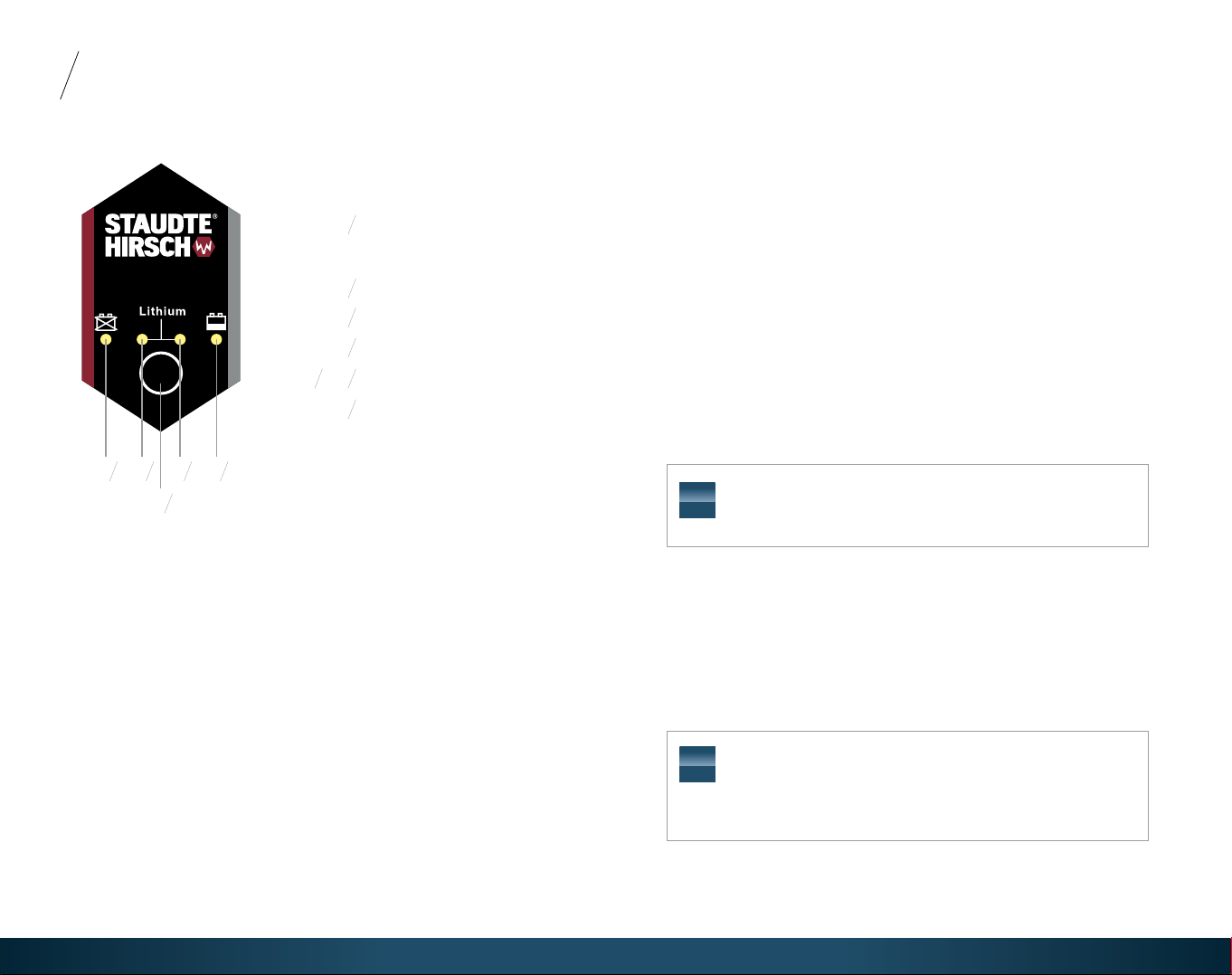
Operation and display elements
124
5
3
GB
1
2
344
2
5
The Battery Charger SH-3.170 is equipped with a clear operation and
display panel. The LEDs inform you about the chosen operating mode,
the charging status of the rechargeable battery as well as a defective,
short-circuited or reverse-poled rechargeable battery at any time.
Fault indicator
(battery defective, short
Batterie Ladegerät
6V/12V 2A
6V 12V
MODE
Description of the operating modes
6 V Lead mode
The 6 V Lead mode is suitable for charging rechargeable 6 V lead batteries
(please observe the information of the manufacturer of the battery).
Continue to press the MODE button (3) until LED (2) ashes. After approx.
2 seconds the LED is constantly on and the charging procedure starts. The
charging current is 2 A. The nal charge voltage is 7.2 V. The charging status
is indicated by LED (5). If the battery is full, the LED is constantly on and
the battery charger automatically switches into Floating phase.
circuit, voltage reversal)
6 V Lead mode
Mode selection
12 V Lead mode
+
12 V Lithium mode
Charging status indicator
12 V Lithium mode
The 12 V Lithium mode is suitable for charging rechargeable 12 V LiFePO
batteries with integrated battery management system (please observe the
information of the manufacturer of the battery). Continue to press the MODE
button (3) until LEDs (2) and (4) ash. After approx. 2 seconds, the LEDs are
constantly on and the charging procedure starts. The charging current is 2 A.
The nal charging voltage is 14.4 V. The charging status is indicated by
LED (5). If the battery is full, the LED is constantly on and the battery
charger automatically switches into Floating phase.
Regeneration mode
If a deep discharged rechargeable battery is connected to the charger, the
regeneration mode is the rst mode to start. Low charging currents are used
to try and bring the deep discharged rechargeable battery to a normal battery
voltage again. When the battery reaches a normal voltage, the charger will
continue charging using the regular process.
Defective, short-circuited or reverse-poled rechargeable batteries
The charger recognises defective reachrgeable batteries, a short circuit or a
battery which has been connected with wrong polarity automatically. In this
case the selected charging programme will not be started. LED (1) is on.
The battery charger has an Auto-Memory-Function. Following a
i
supply voltage failure, it ensures that the device will automatically
return to the previously selected mode after power is restarted.
Charging the battery
First ensure that it is a lead battery with a voltage of 6 V resp. 12 V or a
lithium battery (LiFePO
batteries with other voltages cannot be charged!
Disconnect all consumers from the rechargeable battery.
If the rechargeable battery is built into a vehicle, switch off the
ignition and all consumers.
) with BMS with a voltage of 12 V. Rechargeable
4
4
12 V Lead mode
The 12 V Lead mode is suitable for charging rechargeable 12 V lead batteries
(please observe the information of the manufacturer of the battery).
Continue to press the MODE button (3) until LED (4) ashes. After approx.
2 seconds the LED is constantly on and the charging procedure starts. The
charging current is 2 A. The nal charge voltage is 14.4 V. The charging
status is indicated by LED (5). If the battery is full, the LED is constantly
on and the battery charger automatically switches into Floating phase.
Please strictly observe any and all information and safety instructions of the vehicle on how the rechargeable vehicle battery
i
needs to be charged. Modern vehicles are equipped with sensitive
electronic components and control units which will be damaged
when handled improperly!
First, connect the charger to the power supply (100 – 240 V AC, 50/60 Hz).
/ 13More information at www.ivt-hirschau.de/ 12 3 years manufacturer’s warranty. Rechargeable batteries and batteries excluded.
Page 8
GB
Then, you may select from various functions by pressing the MODE button
1 2 3 4 5
Battery voltage
Charging step
Battery voltage
Battery voltage
Charging step
1 2 3 4
(3). Please strictly observe the information of the manufacturer of the
rechargeable battery concerning permissible nal charging voltage and
maximum charging current when selecting the correct operating mode.
Connect the charger to the rechargeable battery observing correct pola-
rity. Short-circuited, reverse-poled and defective rechargeable batteries
are indicated by LED (1).
After charging, disconnect the battery charger from the power supply.
Then remove the terminal from the minus pole of the rechargeable
battery and then from the plus pole.
Charging curves
12 V Lithium mode – Charging curve and charging method
6 V Lead mode – Charging curve and charging method
10 V
5 V
0 V
5.0 V
0.4 A
1 2 3 4
Step 1 Softstart phase
Step 2 Bulk phase
Step 3 Absorption phase
Step 4 Floating phase
7.2 V 7.2 V
2.0 A
6.6 V
Charging step
10 A
8 A
6 A
4 A
Charging current
2 A
15 V
10 V
8.0 V
5 V
0 V
Step 1 Check phase
Step 2 Softstart phase
Step 3 Bulk phase
Step 4 Absorption phase
Step 5 Floating phase
0.4 A
10.0 V
14.4 V 14.4 V
2.0 A
13.4 V
12 V Lead mode – Charging curve and charging method
10 A
8 A
6 A
Charging current
4 A
2 A
15 V
10 V
10.0 V
5 V
0.4 A
0 V
Step 1 Softstart phase
Step 2 Bulk phase
Step 3 Absorption phase
Step 4 Floating phase
14.4 V 14.4 V
2.0 A
13.4 V
10 A
8 A
6 A
4 A
2 A
Charging current
/ 15More information at www.ivt-hirschau.de/ 14 3 years manufacturer’s warranty. Rechargeable batteries and batteries excluded.
Page 9
GB
Technical data
Input
Operation voltage 100 – 240 V AC / 50/60 Hz
Input current
Power consumption
max. 0.
max. 4
62 A
5 VA
Output
Suitable battery voltage 6 V, 12 V
Charging current max. 2.0 A ± 10 %
Rechargeable battery type 6 V and 12 V lead batteries Acid, Gel, AGM
12 V LiFePO batteries
Battery capacity from 2.0 Ah
Cut-off voltage 7.2 V ± 0.25 V 6 V Lead mode
14.4 V ± 0.25 V 12 V Lead mode
14.4 V ± 0.25 V 12 V Li mode
General
Reverse current < 0.5 mA
Protection type IP 20
Cable length 1.70 m (mains cable)
1.60 m (connection cable incl. adapter)
Dimensions 110 x 70 x 40 mm
Weight
2
80 g (without accessories)
380 g (with accessories)
Environmental protection note
At the end of its useful life, this product may not be disposed of
together with normal household waste, but has to be dropped off
at a collection center for the recycling of electrical and electronic
devices. This is indicated by the symbol on the product, on the
instruction manual or on the packaging.
The materials of which this product is made are recyclable pursuant to their labelling. With the reuse, the recycling of the materials or other forms of scrap usage, you are making an important
contribution to the protection of the environment.
Please ask your local authorities for the appropriate disposal center.
Technical specications subject to change. We assume no liability for typographical errors.
V01_12/2019.
You can request the declaration of conformity for this product from the IVT service-team.
IVT Innovative Versorgungstechnik GmbH, Dienhof 14, D-92242 Hirschau
Tel. +49 9622-719910, Fax +49 9622-7199120, [email protected], www.ivt-hirschau.de
/ 17More information at www.ivt-hirschau.de/ 16 3 years manufacturer’s warranty. Rechargeable batteries and batteries excluded.
Page 10
DE
GB
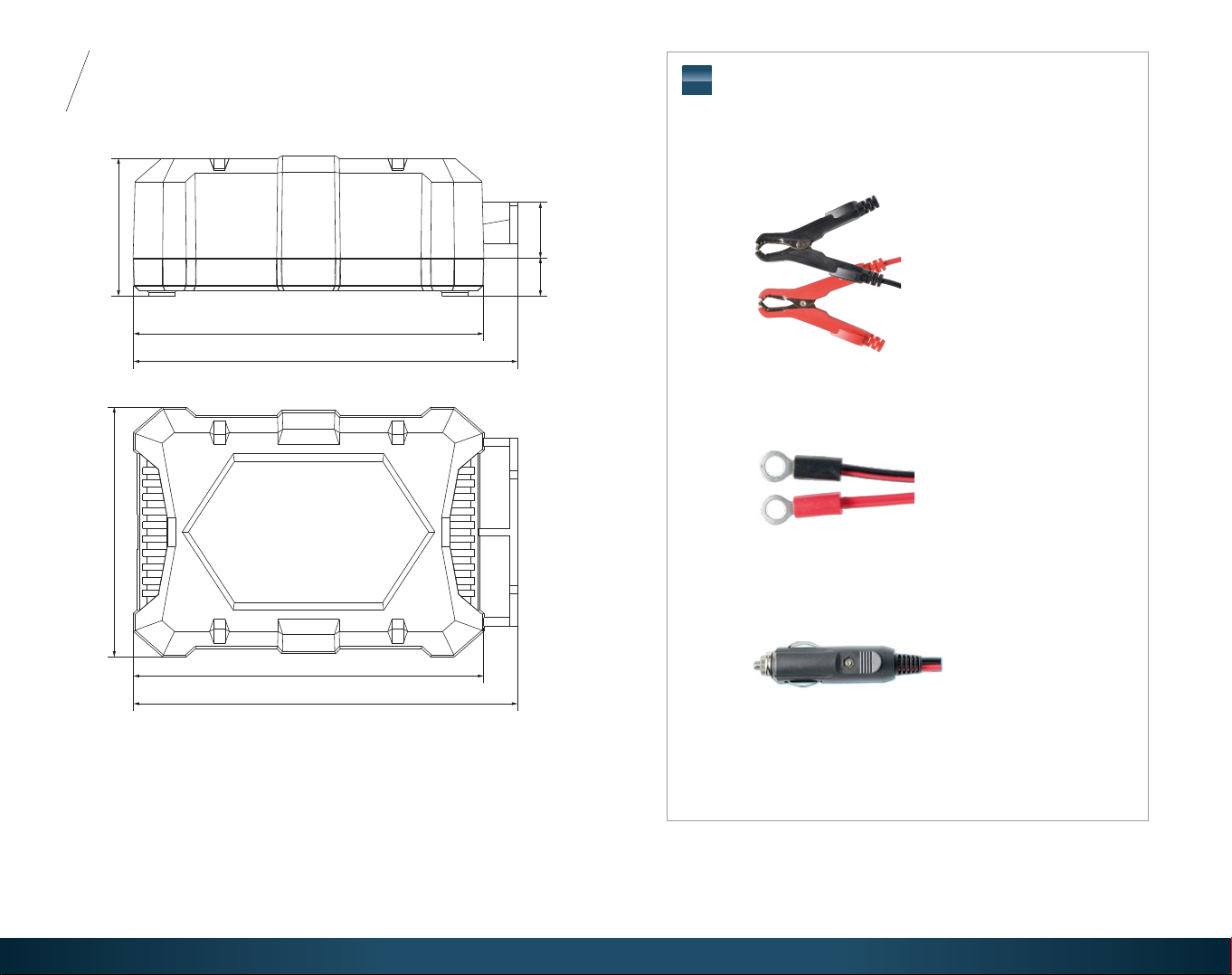
Bemaßungen SH-3.170
Bemaßungen PL-CO01P / SH 1 A, 2 A
Dimensioning SH-3.170
39.5 mm
16 mm 10.9 mm
Die Adapterkabel können auch separat bestellt werden:
i
The adapter cables may also be ordered separately:
Adapterkabel mit Batterieklemmen (Art.-Nr. 911000.K)
Adapter cable with battery clamps (Order no. 911000.K)
71.6 mm
100.5 mm
110.3 mm
Adapterkabel mit Ringösen (Art.-Nr. 911000.O)
Adapter cable with eyelet rings (Order no. 911000.O)
Adapterkabel mit 12 V Stecker (Art.-Nr. 911000.Kfz)
Adapter cable with 12 V plug (Order no. 911000.Kfz)
100.5 mm
110.3 mm
3-teiliges Adapterkabel-Set (Art.-Nr. 911000.A)
3-piece Adapter Cable Set (Order no. 911000.A)
/ 19Weitere Informationen unter www.ivt-hirschau.de/ 18 3 Jahre Hersteller-Garantie. Akkus und Batterien ausgeschlossen.
Page 11

Staudte Hirsch
Designed in Germany.
Powered by IVT.
IVT Innovative Versorgungstechnik GmbH
Dienhof 14
D-92242 Hirschau
fon +49 (0) 9622 71991-0
fax +49 (0) 9622 71991-20
[email protected]
www.ivt-hirschau.de
 Loading...