

Page 1
SQRACING.COM.AU
QUICK START GUIDE
EVO-CHEETAH®125
Josh Pontello - National & multi-state Champion
®
®
Page 2

SQRACING.COM.AU
Index
WARNINGS
GETTING STARTED
SPECIFICATIONS
Page 3

SQRACING.COM.AU
Warnings
THE WARNING NOTICE LABEL BELOW SHOULD BE LOCATED IN THE SEAT. IF THE
WARNING LABEL IS MISSING FOR ANY REASON PLEASE CONTACT [email protected]
AND WE WILL SEND YOU ANOTHER AT NO COST.
This kart and engine package is NOT A TOY, and should only be used on a race circuit by
qualifi ed persons over 18 years or by qualifi ed junior drivers under adult supervision.
Page 4

SQRACING.COM.AU
The purpose of this Quick Start Guide is to provide technical information and drawings as well as
to help the user better understand their race machine.
IMPORTANT
Complete a general check of the kart and engine before doing the fi nal engine checks.
FIRST START OF THE DAY
Follow the steps outlined below for the fi rst start of the day and to prime the engine. The following method minimises load on the starter motor and battery and will consume 75% less electrical
power to do so (12 Amps compared to the fully loaded 50 Amps).
1. RADIATOR FLUID LEVEL CHECK
Use NON ethylene glycol based radiator corrosion inhibitor as most race tracks have
banned glycol based additives. We recommend MOTUL’s Mocool .
The level should be approximately 1 cm below the top of the cap. If the fl uid level is higher
the excess will simply be expelled into the overfl ow bottle once the engine reaches operating temperature. Constantly overfi lling the radiator is a waste of time as the fl uid will be
expelled. If the cooling system is completely empty you will need to fi ll the system. It takes
approximately 1.5 litres of coolant. When adding coolant to a completely empty system,
air locks will occur not allowing the system to be completely fi lled. Loosening the hose at
the top of the engine will allow the air to escape. After the engine has run for more than 20
seconds, the coolant level can be checked again for any further settling.
NOTE: Do not tap the radiator as the SQ CHEETAH® has a built in thermostat and automatically adjusts water fl ow / temperature of the engine in all conditions.
2. CARBURETOR JETS MIXTURE
Set/check the carburetor jet mixture screws
Low jet (closest to the engine) should be 1 ½ turns from completely closed
High jet (T or L shaped screw) should be 1 ½ to 1 ¾ turns from completely closed
Getting started
Page 5

SQRACING.COM.AU
3. SPARK PLUG REMOVAL
Clean the area around the spark plug of any loose dirt so when the spark plug is removed
no foreign material can fall into the engine.
Remove the spark plug from the engine.
IMPORTANT - Place the removed spark plug in the end of the coil lead / spark plug cap
then EARTH the spark plug by laying the spark plug on the top of the engine. This is so
when the engine is turning over you can see if the engine is fi ring / sparking. If this is not
done the coil could be damaged. The discharge spark from the SQ Cheetah CDI is so
strong that it needs to be discharged via the spark plug, if not, the spark will jump internally through the insulation of the coil and if done repeatedly over time could cause coil
failure or high rpm misfi re.
NOTE: A clever feature of the SQ CHEETAH is the ignition system. It is a microprocessor controlled CDI (Capacitor Discharged Ignition). This controls the advance curve while
adding safety features. The drawback is that the CDI is a sensitive device and therefore
the kart should never be re-charged using battery chargers with the ignition turned on, or
try to boost starting power by leaving the charger connected while cranking. The 12volts
output from most chargers is not normally regulated properly and can blow the CDI computer. A simple thing to do is REMOVE the 3 amp fuse (or disconnect the battery) whilst
charging. We recommend the Kartelli Corse 12Volt Kart Battery Charger). Also make sure
all electrical terminals and connections are tight to stop any voltage spikes in the electrical
system.
One of the features of the CDI is the test spark – this will fi re a single spark when you toggle the ON/OFF switch. This will prove the CDI / coil / spark plug are all functioning correctly. If done repeatedly and quickly – the single spark may not happen – this is normal.
3. FUEL:OIL MIX
Make sure you have premixed the fuel (premium unleaded 97 octane or better) and oil
(Shell Advance Racing M) at a ratio of 16 parts petrol to 1 part oil.
e.g. 16 litres petrol to 1 litre of oil or 4 litres petrol to 250ml of oil.
Page 6

SQRACING.COM.AU
STARTING THE ENGINE
The idea is to suck fuel from the fuel tank and into the engine via the carburetor. To increase the
suction effect of the fuel pump inside the carburetor simply CHOKE the engine. This is done by
placing your hand over the two inlet air holes on the air box. Whilst covering these holes and with
the ignition switched on, the spark plug removed and earthed, PRESS THE START BUTTON.
The engine should now be turning over and within 3 or 4 seconds fuel should be seen moving
along the fuel line. If the fuel line is completely empty you will see the fuel fi ll the fuel line and
enter the carburetor. Once fuel has reached the carburetor give another 3 or 4 seconds of the
engine turning over to allow the carburetor to fi ll and also prime the engine.
Stop pressing the start button and turn the ignition switch OFF!
Replace the spark plug and tighten with spanner.
The engine is now ready to start, but safety fi rst.
WARNING
DO NOT ATTEMPT TO START THE KART ON THE GROUND WITHOUT A DRIVER IN
THE SEAT
The throttle could be in the open position or the idle set too high. This is a potential recipe
for disaster.
Either have the kart on a suitable secure kart stand, or have the kart on the ground with a
full safety equipped and prepared qualifi ed driver.
If the engine is brand new a kart stand is the preferred starting position.
Assuming the kart is on a stand, make sure all persons are off the kart and away from all
moving components.
Switch the ignition ON, there is a small potential for a back fi re as the single spark will fi re but this
is normal and may cause a few people to jump, but is completely normal and safe.
Now the engine is primed and with the ignition set to ON, press the starter button for no longer
than 5 seconds or until the engine starts, whichever is the shorter. Normally with a new spark
plug and primed engine it should start within 1 second.
Page 7

SQRACING.COM.AU
SPECIAL NOTE
If your engine is turning over very slowly due to a fl at battery STOP CRANKING THE
ENGINE IMMEDIATELY.
This is very damaging to the starter motor and the starter relay. Turn the ignition off, and
charge the battery. A Kartelli Corse 6Amp battery charger should give the battery a boost
to be able to start within 30 minutes.
If the battery is fl at, instead of the starter motor drawing 50 Amps at 12 Volts to start, a fl at
battery will actually draw 80+ amps at 8 Volts low speed. A fully charged battery makes
engine starting much easier. The Cheetah® engine does have a built in alternator to
keep the battery topped up, but it is NOT a battery charger. It is designed only as a trickle
charger, and to not drain the battery once the engine is started.
Technically, what happens is the battery boosts the spark at starting and whilst idling, and
is actually a very small drain on the battery, but above 5,000 rpm the alternator will give up
to 0.3 amps of charge to the battery. A well charged battery will last a very long time, but
a top up charge from time to time will increase the battery life. If we made the alternator 3
amps then this would take power away from the wheels.
RUNNING THE ENGINE
Now the engine should be running on the stand. If the engine is Revving too fast, turn the engine
off immediately using the OFF/ON Switch. Adjust the idle screw on the carburetor. Turn the ignition back on, and press the start button. As the engine has just been started, it should start again
very easily.
If the engine starts and then STALLS, due to any number of normal reasons, including air in the
fuel system, then another safety feature of the SQ CHEETAH® ignition system will have activated – THE START INHIBIT. The start inhibit feature is to stop accidental pressing of the start
button when the engine is running. Some other brands of engine will actually allow you to press
and engage the starter motor whilst the engine has already started and running. This can cause
catastrophic engine failure. To avoid this SQ implemented a feature into the CDI computer which
disables the starter motor once the engine has started i.e. revving over 1,500 rpm.
Re-enabling the starter motor and to reset the start inhibit, simply switch the start switch to off,
and then on again. The short answer is: If you go to start the engine and it stalls, simply toggle
the on/off switch and press the start button again – easy
Page 8

SQRACING.COM.AU
Now the engine is running and idling on the stand. There should be a lot of smoke from the exhaust as the engine is warming up. This is normal. Also the rear wheels should be turning enabling the water pump to pump coolant through the cooling system.
Tuning the carburetor on the stand under NO LOAD is not valid for the track. By turning the LOW
SPEED carburetor jet in ½ a turn (to a total of 1 turn or slightly less) you will fi nd the engine will
run smoother and may increase in RPM. This is tuning on the carburetor under no load will NOT
work whilst driving, as the engine requires to run richer under the load of acceleration. If you try
and drive the kart with the carburetor this lean the engine will not accelerate off the mark.
Once you have warmed up the engine, examine the engine and the rest of the kart for any leaks,
check the brakes, steering and generally inspect the kart is ready for use.
NEW ENGINE ONLY – RUN IN PROCEEDURE
The run in procedure is simple. The fuel oil ratio and the carburetor tuning is as per standard settings. The supplied B9ES basic spark plug is ok for running in and will help burn the excess oil
from low speed running.
1. For the fi rst 10 minutes do not run the engine above 70% power. Accelerate at 100% but
do not let the kart reach maximum speed. As soon as the kart hits the power band (sudden acceleration point- approximately at 8,000- 9,000 rpm) give it 1 or 2 seconds of power, then brake to slow the kart to approximately 15 km ph. Repeat this over and over for
the fi rst session. It’s like you are stopping and starting without reaching top speed.
2. Fully inspect the engine and kart for anything that may have worked loose and let the kart
cool for 10 minutes.
4. After inspection do a second session this time to 11,000 – 12,000 rpm for 10 minutes then
brake to slow the kart to approximately 15 km ph. Repeat this over and over for the fi rst
session
5. Fully inspect the engine and kart for anything that may have worked loose and let the kart
cool for 10 minutes.
6. Last session 90% full power put DO NOT HOLD maximum rpm. Try and peak the rpm at
14,500. After completing another 10 minute session inspect.
7. Change the spark plug to the correct heat range to suit the outside temperature of the day
and then go for it.
Page 9

SQRACING.COM.AU
BEFORE HITTING THE TRACK
DO NOT ATTEMPT TO LIFT A KART WITH THE ENGINE RUNNING from the stand to the
ground. Always shut down the engine (turn off) and have a fully equipped driver seated and ready
to go before attempting to start and drive the kart.
Once the kart has been removed from the stand and is ready to drive make sure you reset the
carburetor is at least 1 ½ on the low and 1 ½ to 1 ¾ on the high.
Treat the tuning jets on the carburetor like a normal tap. 1/16th of a turn at a time for fi ne tuning.
Anti – Clockwise = RICHER, Clockwise = LEANER
ONLY the driver should start the kart, and once he equipped and ready to go and has been
instructed by any grid offi cial, start the engine by turning on the ignition, and pressing the start
button and the engine should start. If the engine is a bit lazy to start, lightly choke the air box to
give the engine extra fuel.
Once the engine has started, DO NOT IDLE THE KART WHILST STATIONARY, as the water
pump only operates while the rear wheels are turning. Also this will put excess wear on the clutch
and the clutch idler bearings. Simply start the engine and drive, you will warm the engine up
much faster under the load of driving than sitting stationary.
TUNING
SPARK PLUGS
Run-in Plug NGK B9ES (as supplied)
Race Plug (outside temperature below 12 degrees) NGK B9EGV (or equivalent)
Race Plug (from 13 to 25 degrees) NGK B95EGV (or equivalent)
Race Plug (above 26 degrees) NGK B10EGV (or equivalent)
FINE TUNING
On hotter days and tracks at higher sea level you will need to run the carburetor setting slightly
leaner, this means that both the high and low speed needle/jets will need to be turn in ( clockwise approximately 1/16th to 1/8th of a turn on both, and on colder / low lying tracks the opposite
maybe required. Fine tuning is something you feel when driving.
Page 10
SQRACING.COM.AU
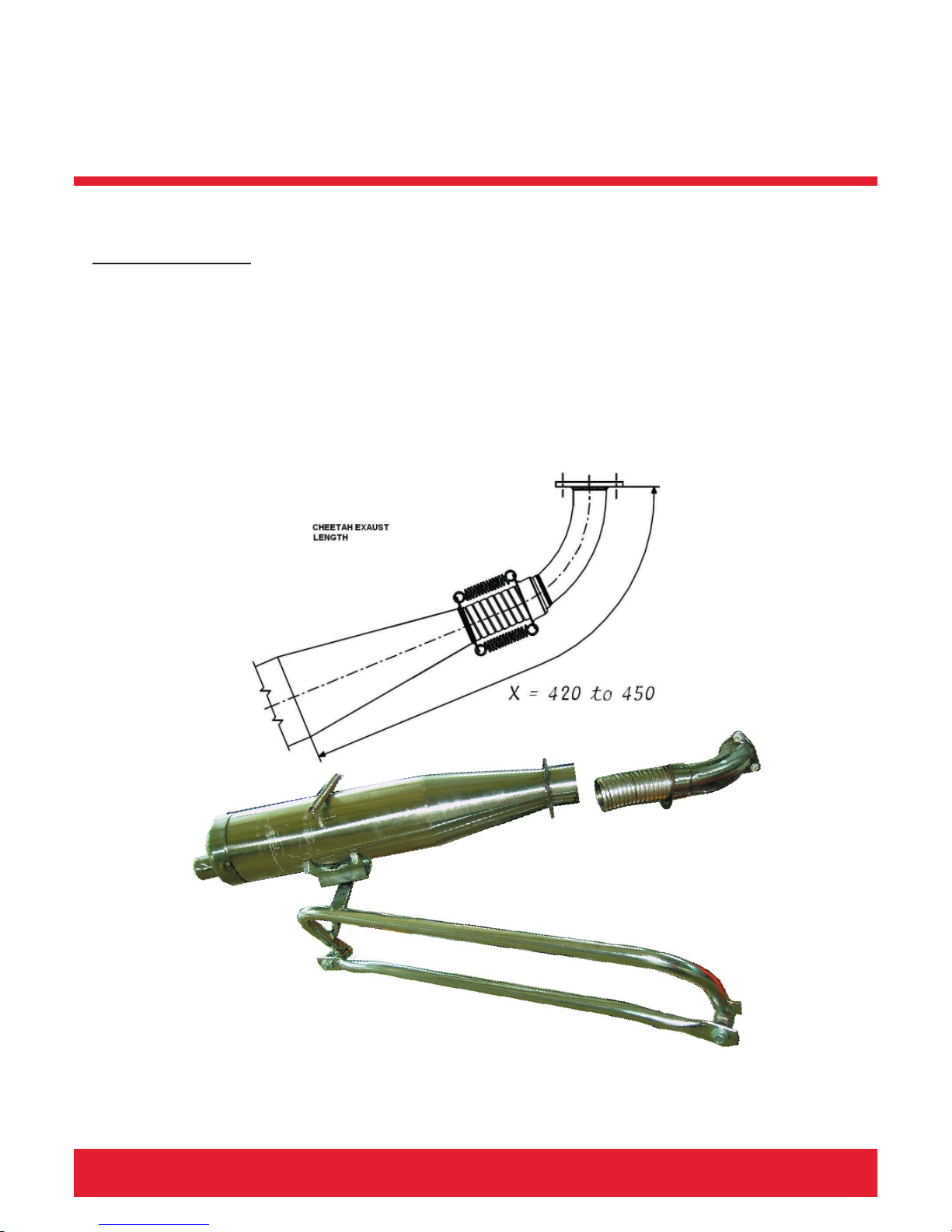
EXHAUST LENGTH
The exhaust length is also a part of the tuning process, the fl ex / piece between the header pipe
and exhaust pipe can be change to increase or decrease overall pipe length.
For reference the pipe is measured from the weld on the header to the weld on the parallel section of the exhaust. This measurement can vary from 410mm to 450mm
450mm give more bottom end mid range power while a pipe around the 420mm will give more
power at high rpm.
Rule of thumb – long pipe for bottom end, shorter pipe to higher rpm.
Page 11

SQRACING.COM.AU
Specifications
Evo 32 Chassis Specifi cations
• Seamless chrome molly steel tube with
CNC bends, notched to close tolerance
• Stress-relieved TIG welded, fi xed posi-
tion/adjustable fl ex front cross-beam
• Bolt-on front nose section, extendable
for taller drivers
• Billet alloy CNC machined and ano-
dised components includings pedals,
bearing hangers, brake master cylinder, disc brake hub, sprocket carrier,
tie rods, steering collar, bar clamps,
radiator and battery box mounts
• Adjustable/removable fourth rail torsion
bar
• Adjustable ride height
• Adjustable ackerman steering geom-
etry
• SQ Racing sticker kit designed by
Kartelli Corse
• Seat sizes available in small, medium,
large and extra large
• Kartelli Corse fuel line, fuel fi lter,
sprocket and other accessories
Cheetah TaG 125 Engine Specifi cations
AKA Homologated for restricted and unrestricted
racing
Type: TaG 125cc water-cooled 2-stroke reed valve
Bore: 54.00 mm Nikasil - over 10 times stronger than steel
Stroke: 54.00 mm
Horsepower: 27.1 HP @ 11,100 rpm dyno proven power (Restri
tor available to limit HP for beginners)
Max RPM: 15,500 RPM with rev limiter set @ 17,100 RPM
Complete spark shut-off at 17,250 RPM
Carburettor: Tillotson (European) 24mm HL-360A carburettor
with integrated fuel pump
Head: Two-piece billet alloy head - specially selected com-
bustion chamber alloy with integrated thermostat
Piston: SQ54 with exhaust bridge lubrication
Dykes “L” shape piston ring (oversizes available)
Induction: Twin reed valves
Ignition: “Bright Spark” CDI ignition microprocessor control-
led advance curve
Exhaust: Race tuned cone style exhaust
Spark Plug: NGK 95ES or 95EGV (or similar - 9 heat range for
cold climates - 10 heat range for hotter climates)
Bearings: SKF and IKO (Japanese)
Starting: Push button electric start with starter motor safety
(cannot engage starter if engine is running - controlled by the CDI)
Battery: 12 volt
Clutch: Automatic centrifugal (European friction material)
Charging: 12 volt alternator chares battery above 6,000 RPM
Oil: Shell Racing M or similar full synthetic 2-stroke race
oil
Oil Ratio: 16:1 Fuel / Oil
Cooling: External water pump/radiator, head mounted stain-
less steel thermostat of optimum performance
Page 5
 Loading...