

Page 1

INSTRUCTION
MANUAL
E-BIKES
ENGLISH
FREE YOUR CYCLIST SPIRIT
Page 2

1
INDEX
Introduction ............................................................................................................................................................... 2
Parts description ........................................................................................................................................................ 3
Daily checks ............................................................................................................................................................... 6
Battery charging ........................................................................................................................................................ 6
Charging tips .......................................................................................................................................................... 6
With the battery removed ..................................................................................................................................... 6
When the battery is charging on the bike ............................................................................................................. 6
Duration of charging .............................................................................................................................................. 7
Warning about charging ........................................................................................................................................ 7
Driving ........................................................................................................................................................................ 8
Minimum saddle height and the way to measure................................................................................................. 8
Important tips while driving .................................................................................................................................. 8
Important tips when parking ................................................................................................................................. 8
How to start up the vehicle ................................................................................................................................... 8
Driving Range ......................................................................................................................................................... 8
Saving battery power and extending your range .................................................................................................. 9
Operation explanations LCD screen ........................................................................................................................ 10
LCD-SW900 operation ......................................................................................................................................... 10
LCD-850-A operation ........................................................................................................................................... 11
Basic maintenance ................................................................................................................................................... 13
Regular self-checks .............................................................................................................................................. 13
Maintenance and cleaning tips ........................................................................................................................... 13
Troubleshooting .................................................................................................................................................. 13
Recommended torque values for threaded fasten ............................................................................................. 14
Wiring diagram with LCD display ............................................................................................................................. 14
Useful tips ................................................................................................................................................................ 15
General Warning ...................................................................................................................................................... 15
Safety notes ............................................................................................................................................................. 15
Notes for parents ................................................................................................................................................. 15
Safety notes before first use ............................................................................................................................... 16
Additional Safety Notes ....................................................................................................................................... 16
Page 3

2
Introduction
Welcome
Thank you for purchasing e-bike from SPICLES. We take pride in bringing you a quality product that will offer you
years of enjoyment.
SPICLES e-bike is featured with, zero emission, battery powered, with stable performance and overall after-service.
Using this Manual
This manual contains details of the product and information on its operation and maintenance. Read it carefully
and familiarize yourself with the e-bike before using it in order to ensure safe use and prevent tragic accidents. Be
sure to retain this manual as reference to product knowledge and safe riding.
The manual includes many Warnings and Cautions concerning the safe operation and consequences if safe
operation is not performed in respect to operation and maintenance of this product. All information in the manual
should be carefully studied and if you have any questions you should contact SPICLES immediately.
Because it is impossible to anticipate every situation or condition which can occur while riding, this manual makes
no representation about the safe use of the bicycle under all conditions. There are risks associated with the use of
and bicycle which cannot be predicted or avoided, and which are the sole responsibility of the rider. You should
save this manual, along with any other documents that were included with your bicycle, for future reference.
However, all content in this manual is subject to change or withdrawal without notice. SPICLES makes every effort
to ensure the accuracy of its documentation and assumes no responsibility or liability for any errors or
inaccuracies that may appear herein.
Page 4

3
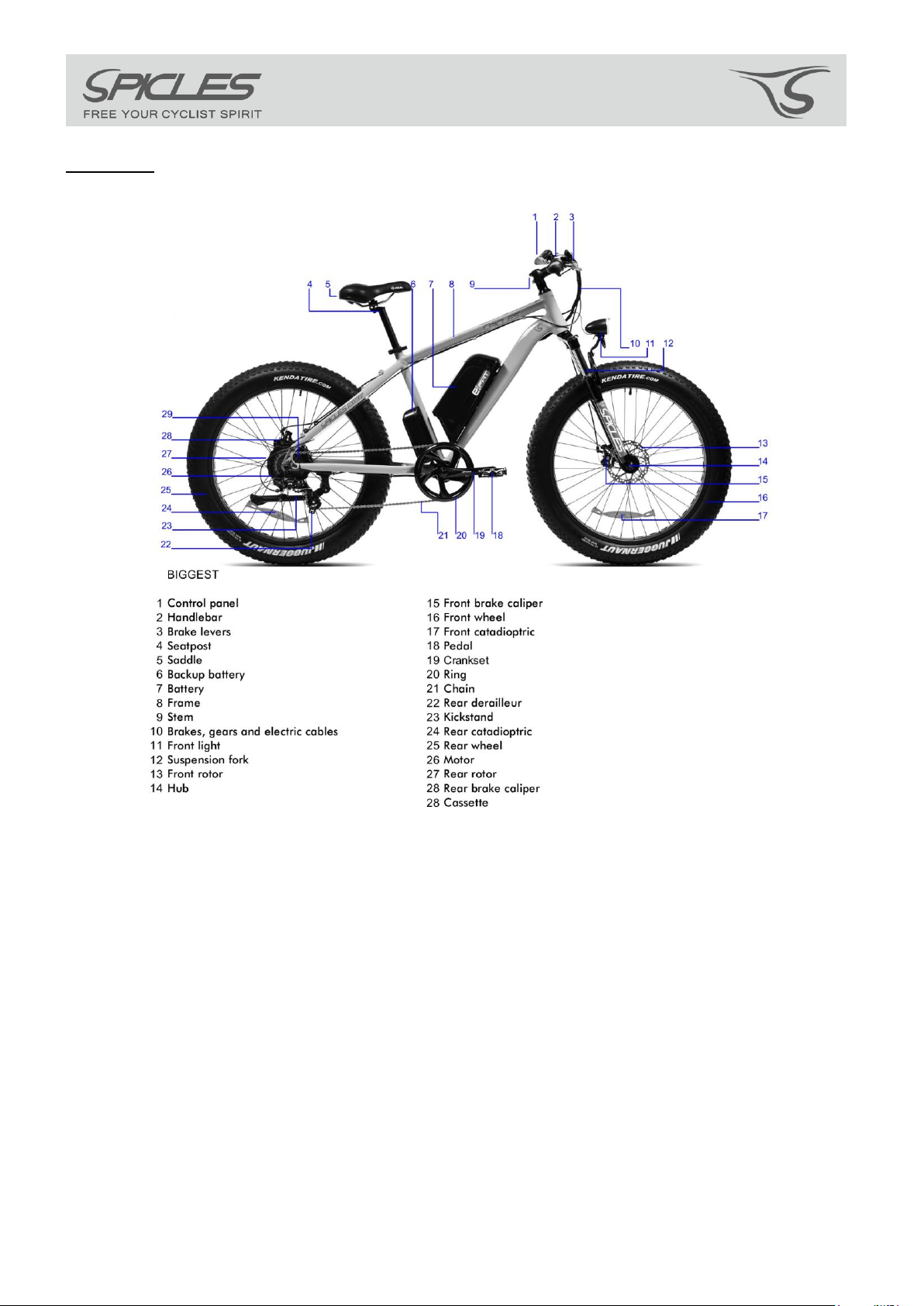
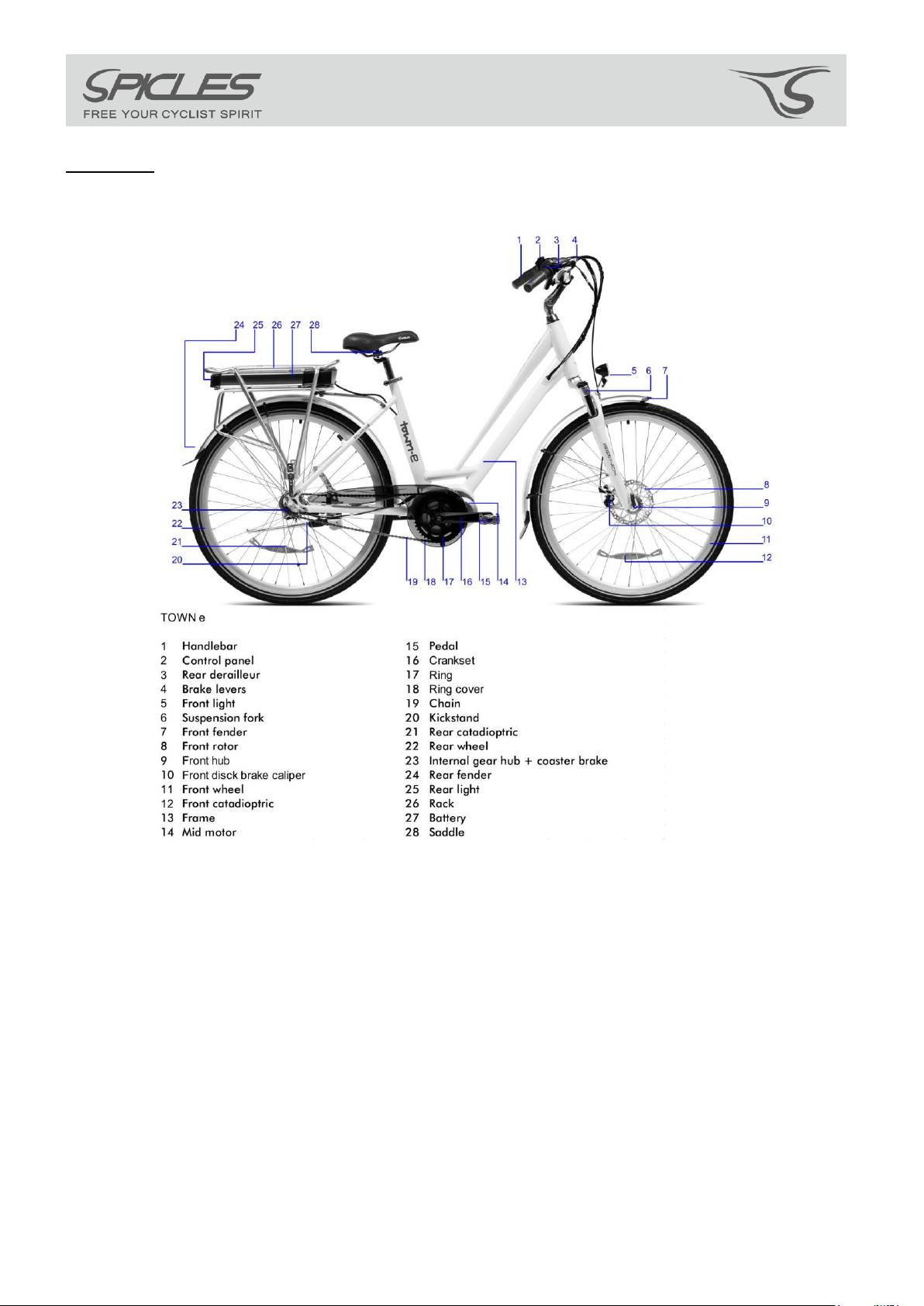
Parts description
SUB 1.0
Page 5
4
BIGGEST
Page 6
5
TOWN-E
Page 7

6
Daily checks
To ensure the safety, make the following functional checks before driving:
1. Normal operation of the light, brake and power cut system
2. Tire pressure (low pressure, will influence both autonomy and speed).
3. Wheel axel tightening.
4. Battery charging level
5. Braking system adjustment.
Battery charging
Charging tips
1. The battery pack should be recharged after each use. There is no memory effect so you can charge the
battery after short periods of use without damage.
2. The battery can be recharged on or off the bike.
3. Remove the battery by turning the key and then pulling forwards and upwards carefully until the pack lifts
off.
4. The charger will automatically stop once the battery pack is full.
5. Always charge in dry conditions and indoors away from direct sunlight.
6. Check charger cables, charger, and battery for damage before beginning each charge.
With the battery removed
1. When the battery is removed, do not touch the “+”and“-”contacts, especially with wet hands or metalic
objects.
2. Do not recharge the battery in the inverted position. If you do, you risk drastically reducing it’s lifespan.
3. Place the charge in a flat, secure place, and connect the output plug to the socket in the battery box.
4. Then, connect the input plug (110V/220V terminal) to the power outlet, and the charging will start.
5. After the charging has finished, first, unplug the input plug (terminal 110V/220V), and then the output
plug.
When the battery is charging on the bike
1. Switch off the power.
2. Plug the output lead of the charger into the socket of the battery case.
3. Plug the AC power input plug into the 110/220 volt household power socket to start charging.
4. After charging unplug from the wall outlet first and then from the bike charger socket.
NOTE: Always charge your battery at temperatures between 50 and 80 degrees Farenheit and battery is not
damaged before charging.
Page 8

7
Duration of charging
1. When the input and output terminal are connected, the red indication light of the charger will be turned
on, showing that the power is being connected.
2. When the battery is charged for the first time, 8-10 hours should be spent for charging. When the yellow
indication light of the charger is turned on, showing that the battery basically full and it will switch to
trickle charge mode to ensure that over-charging will not occur, it takes 2-8 hours for normal charging.
3. This charger has the protection device for over-charging. Long time charging should not be more than 24
hours without affecting the life time of the battery.
Warning about charging
1. Keep the charger in a safe place, away from children.
2. Do not use the battery when not fully charged. That will decrease its lifespan.
3. Do not charge the battery with other charger than the original.
4. The charger works with 110/220V. Please do not open it without permission.
5. Avoid charger contact with liquids and/or metal objects. Always be sure it is safely stored/placed so that it
can not suffer damage from a fall/impact.
6. When in use, the charger should not be covered, to prevent overheating, damage, or fire.
7. The charger is only for indoor use. Please keep it in dry and ventilated place.
8. If you notice a strange smell coming from the charger, or it is too hot, please stop charging, and contact
SPICLES Company.
Page 9

8
Driving
Minimum saddle height and the way to measure
To adjust seat height, use quick release lever to free the seatpost and pull upwards or push downwards to reach
desired height.
Important tips while driving
1. In order to reduce consumption, increase autonomy, and extend the motors lifespan, use the pedals
during the startups and climbs.
2. Do not twist the throttle too fast. The vehicle should accelerate slowly, reducing consumption and risk of
damage to the electrical system. It’s better to use the pedals to avoid sudden stops and startups.
3. To increase security and reduce power consumption, is advised to avoid sudden stops and startups.
4. The vehicle controller has a charge overload protection. If on overload, energy will be cut automatically
and restored when it returns to normal.
5. While driving, avoid using the throttle as you brake, as it may damage the motor.
6. The maximum load is 100-120KGs. Avoid driving with overload. Do not drive too fast.
Important tips when parking
1. When pushing the vehicle manually, turn off the power to avoid accidental acceleration and accidents.
2. It is recommended to park indoors. Do not forget to switch off the power and remove the key.
3. In a public place, the e-bike must be parked in accordance with local traffic rules. Do not forget to switch
off the power and remove the key.
How to start up the vehicle
a. Press the battery ON/OFF button and battery power LED display to see the power capacity.
b. Hold down center button on button cluster until LCD screen turns on.
Option: Please cheek the LCD display manual for details.
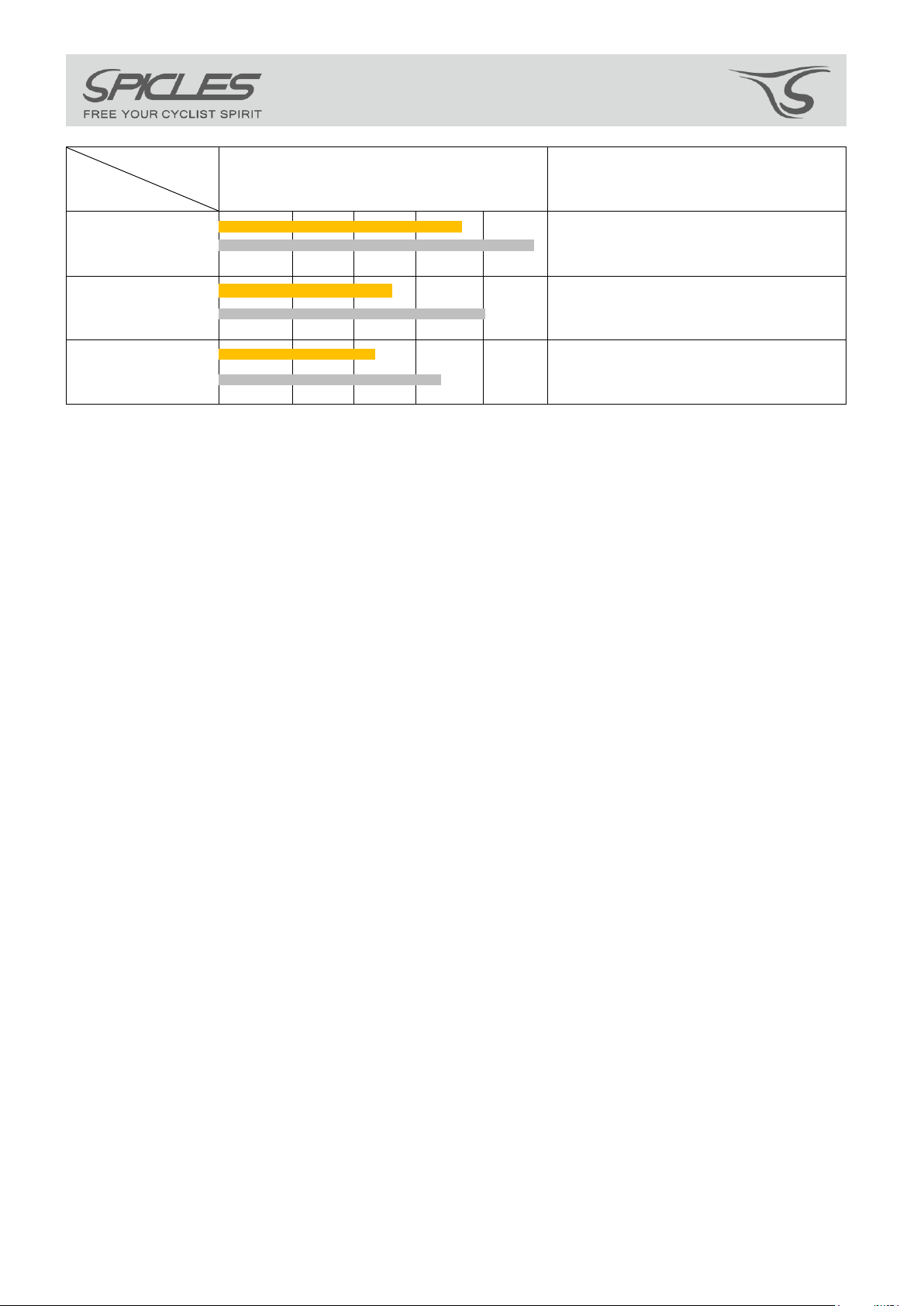
Driving Range
Average distance from one charge: 25-40km (active state) differs from different batteries.
Conditions of testing:
- wind speed: level 2-3
- normal atmosphere temperature: 25ºC
- Rated load: 90kg
- Dead load: ≤30kg
- flat concrete surface
- battery: full
Page 10
9
Range
Surface
10Km 20Km 30Km 40Km
Driving condition
Flat
Wind level:2-3
Normal temperature:25℃
Normal load
Flat
against wind level: 2-3
normal temperature: 25℃
normal load
upslope/downslope
degree of slope≤2 degree; wind level: 2-
3 normal temperature: 25℃
normal load
- Power consumption of one time charge: ≤0.5kw.h
- Economical speed: 18km/h
The load haul is related with road, road surface, times of start-up, times of braking, wind direction,
Atmospheric temperature, air pressure in the tire and correct way of charging, please note this during driving.
Saving battery power and extending your range
Frequent braking and starting, riding uphill against a strong wind, starting from a standstill and riding on rough or
muddy roads, and carrying more than one person, or heavy loads will consume extra battery power and shorten
the range.
A few tips to prolong the battery life during these condition is as frequently.
1. Frequent Braking: try to look ahead and coast rather than stop and go frequently.
2. Riding uphill or against a stiff win: pedal to supliment the battery power.
3. When starting from a standstill: use the pedals to help bring you up to speed.
4. When the battery meter indicates the voltage is low, switch to manual power and avoid using the battery
so you don’t shorten the battery life.
5. If the battery is being stored, remove the battery from the bicycle and recharge it every month.
Page 11
10
Operation explanations LCD screen
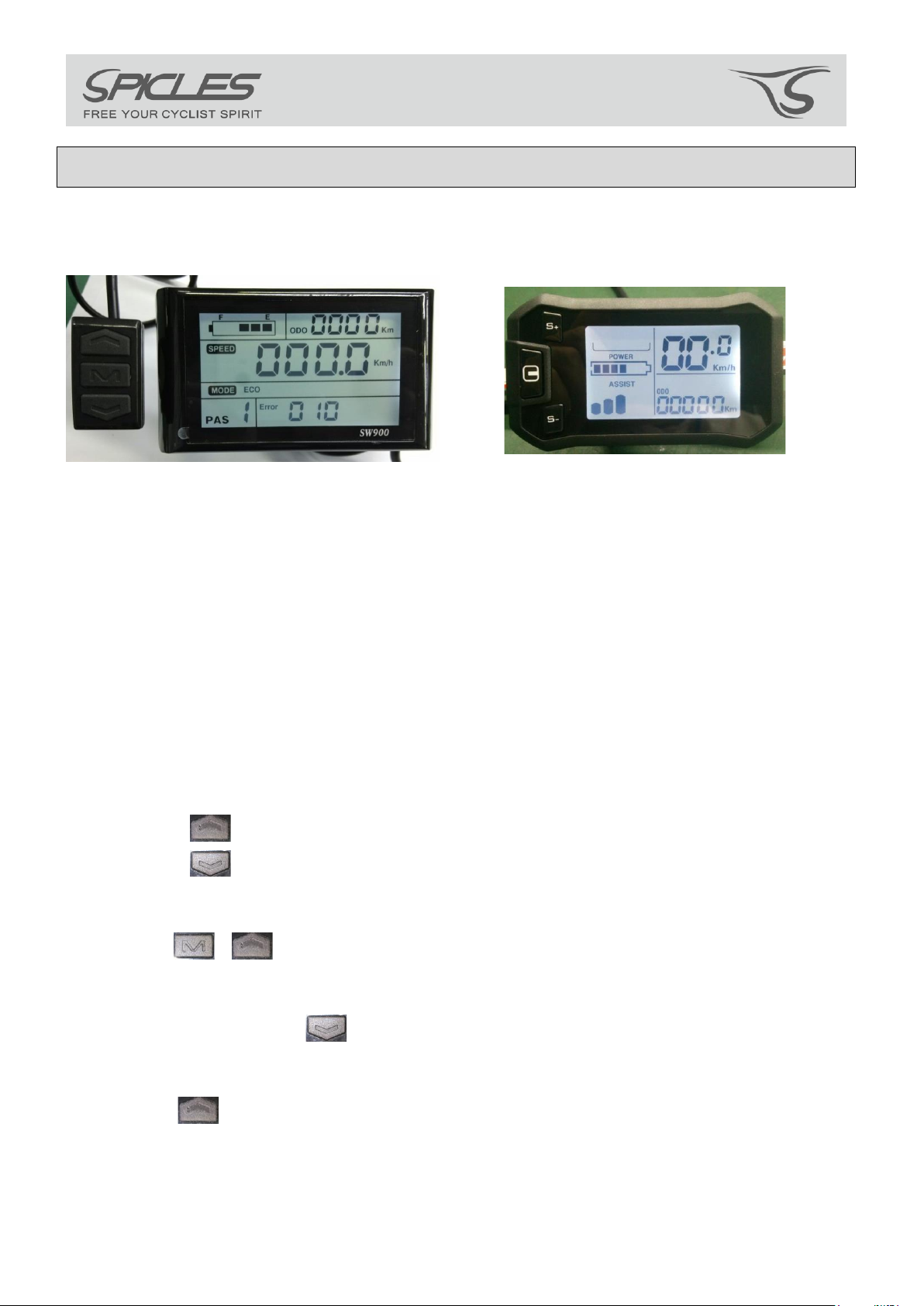
SPICLES electric bicycles mount two types of LCD screens, very similar in operation:
LCD-SW900 LCD-850-A
LCD-SW900 operation
1 ON/OFF the bike
a. Press the battery ON/OFF button and battery power LED display to see the power capacity.
b. Hold down center button on button cluster until LCD screen turns on/off.
2 Change PAS grade
There are 5 PAS levels.
Zero level show distance and pedaling time, with no throttle and motor assistant.
Suppose it’s PAS mode now, and
shortly press , PAS grade +1
shortly press , PAS grade -1
3 Shift the speed display
Long press + ,to shift the way of speed display
4 ON/OFF 6KM/H cruising,
When e-bike stops, long press to enter 6KM/H cruising mode. Stop pressing to exit the cruise mode
5 ON/OFF Headlight
Long press to turn ON/OFF Headlight
Page 12
11
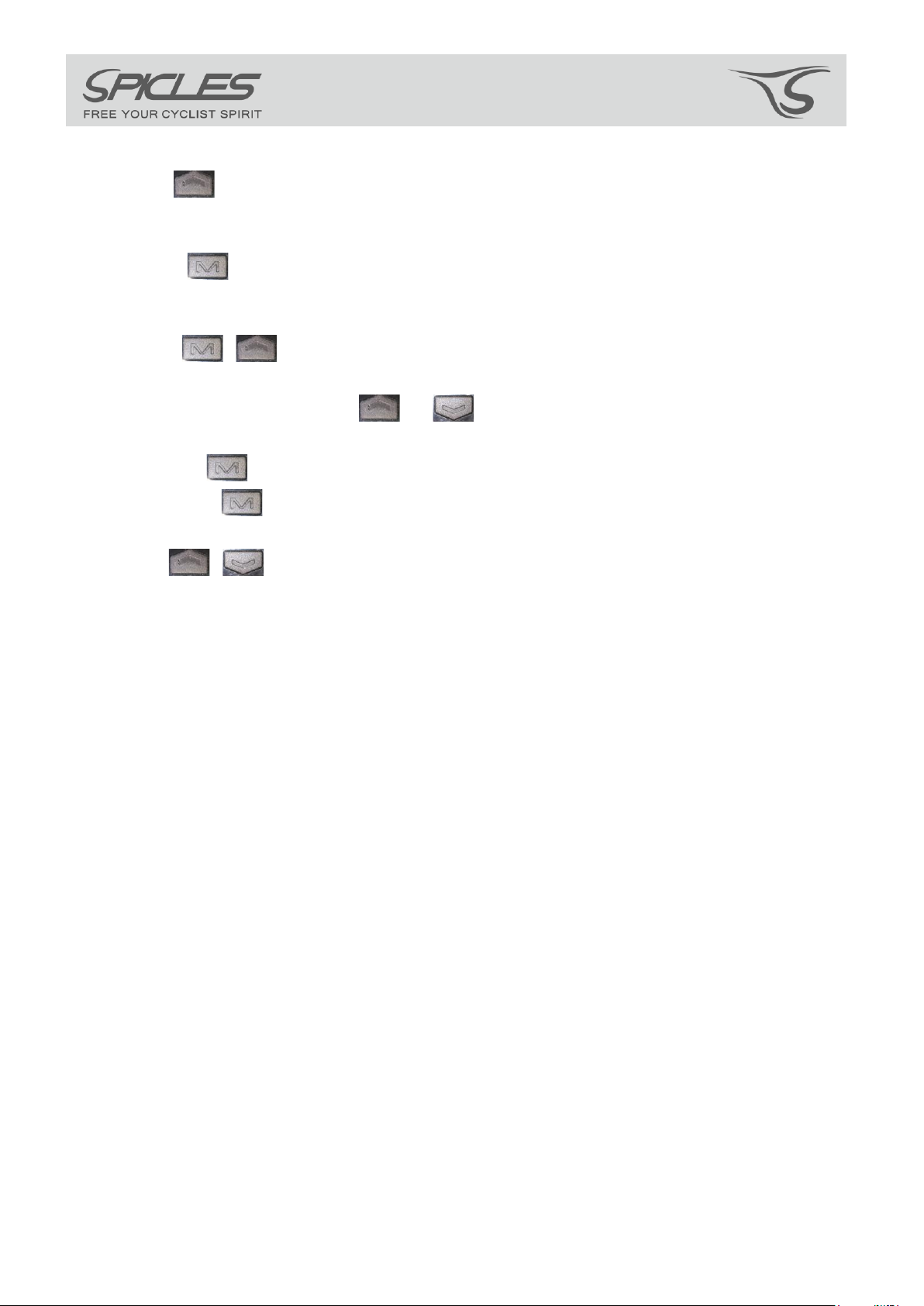
6 Reset ODO
Long press for 5s to reset ODO.
7 Change data in multi-function Area
Shortly press to change data.
8 Parameters setting
Long press + to start setting parameters, such as wheel size(inch),
background luminance
On the setting interface, shortly press , or to plus/minus value. Parameters
would be shining after modifying, choose the ones you prefer,
a) Long press to save the value, the shining would stop.
b) Shortly press to shift to the next parameter, and to save current values
c) at the same time.
d) Press + to exit setting parameters and to save values. If not press these
buttons, it would exit and save parameters modified automatically 10s later.
LCD-850-A operation
1. ON/OFF the bike
c. Press the battery ON/OFF button and battery power LED display to see the power capacity.
d. Hold button ON/OFF C until LCD screen turns on/off.
2. Change PAS grade
There are 5 PAS levels.
Zero level show distance and pedaling time, with no throttle and motor assistant.
Suppose it’s PAS mode now, and
shortly press S+ , PAS grade +1
shortly press S- , PAS grade -1
3. Shift the speed display
Long press C + S+,to shift the way of speed display
4. ON/OFF 6KM/H cruising,
When e-bike stops, long press S- to enter 6KM/H cruising mode. Stop pressing to exit the cruise mode
Page 13

12
5. ON/OFF Headlight
Long press S+ to turn ON/OFF Headlight
6. Reset ODO
Long press S+ for 5s to reset ODO.
7. Change data in multi-function Area
Shortly press C to change data.
8. Parameters setting
Long press C + S+ to start setting parameters, such as wheel size(inch),
background luminance
On the setting interface, shortly press S+ , or S- to plus/minus value. Parameters
would be shining after modifying, choose the ones you prefer,
a) Long press C to save the value, the shining would stop.
b) Shortly press C to shift to the next parameter, and to save current values
c) at the same time.
d) Press S+ + S- to exit setting parameters and to save values. If not press these
buttons, it would exit and save parameters modified automatically 10s later.
Page 14

13
Basic maintenance
To ensure safe riding conditions you must properly maintain your bike. You should follow the basic guidelines
below and see your certified local bike shop seasonally to ensure your bike is safe for using.
Regular self-checks
1. Tightening and correct operation of both wheels, frame and front fork.
2. Tire pressure and conditions.
3. Gearshift correct operation.
4. Bell and reflectors conditions and correct operation.
5. Braking system correct operation.
6. If you do not use the vehicle for long periods of time, charge the battery at least once a month, to avoid
reducing its lifespan.
Maintenance and cleaning tips
1. Do not wash with high pressure jets to prevent water infiltration into the electrical system.
2. Dirt on painted surfaces should be removed with a neutral product. Then, wipe with a dry cloth.
3. Lubricate the vehicle with suitable lubricant, after washing.
4. Do not apply lubricant on the brakes, brake levers, rims, tires, battery and controller
Troubleshooting
Symptoms
Possible causes
Most common solutions
1
It doesn’t work
(1)Insufficient battery power
(2)Faulty connections
(3)Key in wrong position
(1)Charge the battery
(2)Clean the connections
(3)Turn the key into the correct position
2
Irregular acceleration
and/or reduced top
speed
(1)Insufficient battery power
(2)Loose throttle magneto
(3)Damaged throttle spring
(1)Charge the battery
(2)Weld and adjust
(3)Contact an Authorized Service Center
3
When powered on, the
motor doesn’t respond
(1)Loose wiring
(2)Loose throttle magneto
(3)Loose or damaged motor wiring plugs
(1)Repair and/or reconnect
(2)Weld and adjust
(3)Contact an Authorized Service Center
4
Reduced range
(1)Low tire pressure
(2)Low or faulty battery charge
(3)Driving with too many hills, braking, departures,
and/or excessive load
(4)Battery discharged for long period of time,
without regular charges, aged or damaged
(1)Adjust the tire pressure
(2)Check the connections and/or fully charge the battery
(3)Help with the pedals
(4)Replace the battery
(5)Make a prolonged battery charge
5
The battery won’t
charge
(1)Charger not well connected
(2)Battery cases fuse blown
(3)Battery wiring disconected or with a bad contact
(1)Adjust the connections
(2)Replace the fuse
(3)Reconnect/repair the wiring
For your safety, do regular maintenance and tightening checks. If you find any abnormality, repair immediately.
Page 15
14
Recommended torque values for threaded fasten
Parts
Torque required (N.m)
Handlebar
7
Stem
12
Saddle
7
Seatpost
7
Front wheel
16-25
Rear Wheel
25-35
B.B Parts
35-55
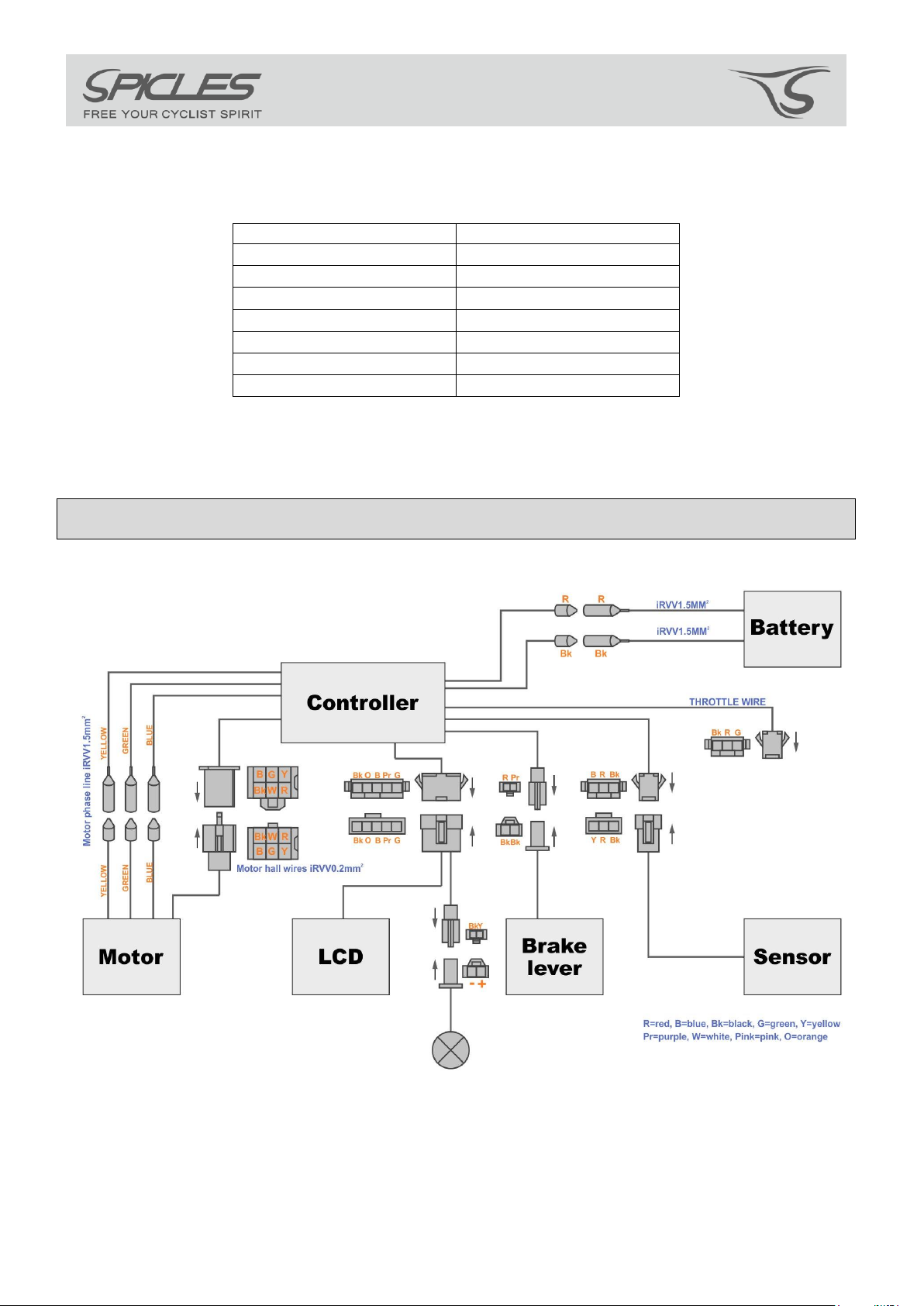
Wiring diagram with LCD display
Page 16

15
Useful tips
1. This user manual should be used only to reference use and functions but should not be used as a
reference for inspection.
2. The images shown may differ from the actual model to technical improvements.
3. We reserve the right to change the model without prior notice due to technical improvements.
4. The vehicle has a top speed limiter. For safety purposes, its removal is strictly prohibited.
5. Ensure pre-ride checks are performed before each and every ride.
6. Only allow others to ride who have already been adequacy trained on the use and operation of this
product
General Warning
Like and sport, bicycling involves risk of injury and damage. By choosing to ride a bicycle, you assume the
responsibility for that risk, so you need to know—and to practice—the rules of safe and responsible riding and of
proper use and maintenance. Proper use and maintenance of your bicycle reduces risk of injury.
Your bicycle is designed for use by persons 16 years old and above.
Riders must have the physical coordination, reaction time and mental capability to ride and manage traffic, road
conditions, sudden situations and also respect the laws governing bicycle use where they ride, regardless of age.
If you have an impairment or disability such as a visual impairment, hearing impairment, physical impairment,
cognitive/language impairment, or a seizure disorder, consult your physician before riding any bicycle.
Safety notes
Notes for parents
Make sure that your child always wears an approved bicycle helmet when riding; but also make sure that your
child understands that a bicycle helmet is for bicycling only, and must be removed when not riding. A helmet
must not be worn while playing, in play areas, on playground equipment, while climbing trees, or at any time
while not riding a bicycle. Failure to follow this warning could result in serious injury or death.
Your electric bicycle is for use by persons 16 years old and older, only. Do not let a child younger than 16 years
old ride the bicycle.
As a parent or guardian, you are responsible for the activities and safety of your child, and that included making
sure that the bicycle is properly fitted to the child; that it is in good repair and safe operating condition; that you
Page 17

16
and your child have learned and understand the safe operation of the bicycle; and that you and your child have
learned, understand and obey not only the applicable local motor vehicle, bicycle and traffic laws, but also the
common sense rules of safe and responsible bicycling. As a parent, you should read this manual, as well as review
its warnings and the bicycle’s functions and operating procedures with your child, before letting your child ride
the bicycle.
Safety notes before first use
-If your bicycle comes with additional documents and manuals the manufactures of the system components you
must also read them before using this product.
-All users must read this manual before first use.
-Ensure that you comprehend with all instruction and safety notes.
-Ensure the bikes fits you properly before first use. You may loose control or fall if your bike is too big or too
small.
-Always wear an approved bicycle helmet while using this product and ensure that the helmet manufacturer´s
instructions for fit and care followed.
-Ensure correct tightening and setup is performed on your bicycle before first use and checked regularly.
-It is your responsibility to familiarize yourself with laws and requirements for the operation of this product in the
area(s) where you ride.
Additional Safety Notes
-Ensure handle bar grips are not damaged and improperly installed. Loose or damaged grips can cause you to
lose control and fall.
-Failure to wear a helmet when riding many result in serious injury or death.
-Do not use this product with standard bicycle trailers, stands, or vehicle bicycle racks. Contact SPICLES to check if
your equipment will work with the bicycle.
-Off-road riding requires close attention and specific skills and present variable conditions and hazards which
accompany the conditions. Wear appropriate safety gear and do not ride alone in remote areas.
-Take extra care while riding in wet conditions. Feet or hands can slip in wet conditions and lead to death or
serious injury from a fall.
-Do not remove front or rear reflectors or the handlebar bell.
-Lights should and must be used in addition to reflectors in most locations.
Page 18

17
-Engaging in extreme riding is extremely dangerous and should be avoided. Although many
articles/advertisements/catalogue depict riders in extreme terrain this not recommended nor permitted and you
can be seriously injured or killed if you perform extreme riding.
-Bicycles and bicycle parts have strength and integrity limitations and extreme riding should not be performed or
you risk damaging the components or becoming seriously injured or killed.
-Failure to confirm proper installation, comparability, proper operation, or maintenance of any component or
accessory can result in serious injury or death.
-After any incident you must consider your bike unsafe to ride until you consult with a certified bicycle service
provider for a comprehensive inspection.
-Failure to properly charge, store, or use your battery will void the warranty and may cause a hazardous situation.
-Extreme care should be taken when using the pedal assistance sensor on this product. Ensure you understand
and are prepared for the power assistance to prepare you as soon as pedaling is underway.
-You should check the operation of the brake inhibitor switches before each side. The brake system is equipped
with an inhibitor which shuts down power to the electric motor whenever the brakes are engaged. Check proper
operation slowly while in a controlled environment by riding slowly with the motor engaged and applying the
brake levers are engaged.
-User must understand the operation of the twist throttle and pedal assist sensors before using, and take care in
their usage in respect to traveling at speeds appropriate for usage area and user experience level. Always use the
lowest assist level until you are comfortable with the bike and feel confident in controlling the power.
-Any changes to the product not expressly approve by SPICLES could void warranty and care while riding.
-Because electric bikes are heavier and faster than normal bicycles, they require extra caution and care while
riding.
-To avoid shock never submerge the electrical components in water or subject to salt water environments.
 Loading...