

Page 1
1
Manuale d’uso utente
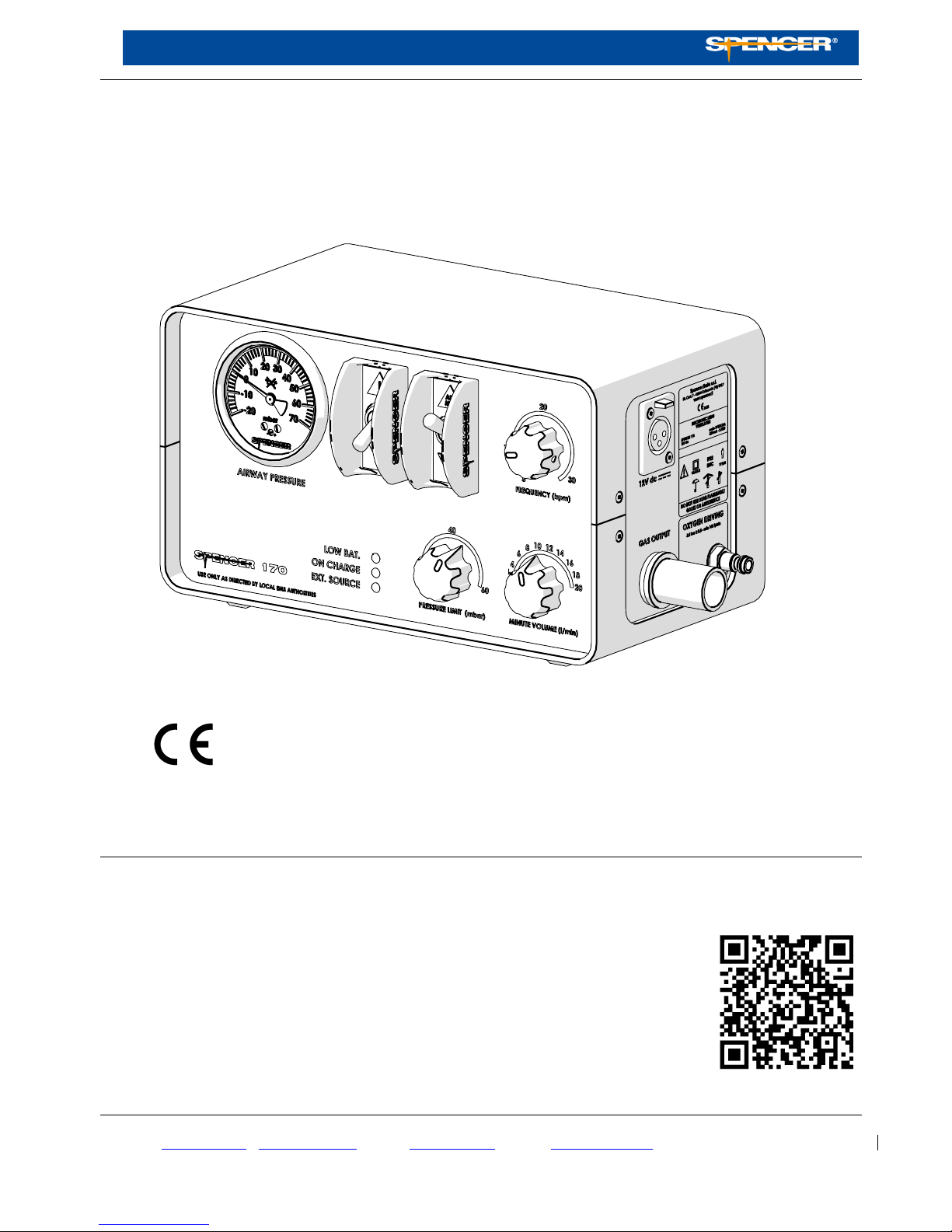
Spencer 170/ Kompak 170/ Portavent 170
Electronic pulmonary ventilator
0123 Class IIb Medical Device, compliant with the Medical device directive 93/42/CE
Warning
The information contained in this manual is subject to change without notice.
The Diagrams are inserted only for reference and may vary slightly from the actual device.
Spencer Italia S.r.l. assumes no responsibility for any errors contained herein or for damage, accidents or consequences connected with the supply,
performance or use of this manual.
First edition: 1998
Rev. 12: 09/03/2015
SPENCER ITALIA SRL – Strada Cavi n° 7 – 43044 Collecchio (PR) - Italy
www.spencer.it | support.spencer.it - e-mail: [email protected] | service: [email protected] |Ph./Tel. +39.0521.541111
Quality System EN ISO 9001 – EN ISO 13485
Page 2

2
INDEX
1. MODELS 3
2. INTENDED USE 3
3. REFERENCE STANDARDS 3
4. INTRODUCTION 3
4.1 Use of the manual 3
4.2 Labelling and tracking control of the device 3
4.3 Symbols 4
4.4 Warranty and support 5
5. WARNINGS 5
6. SPECIFIC WARNINGS 7
6.1 Requirements of operators 8
7. RESIDUAL RISK 8
8. TECHNICAL DATA AND COMPONENTS 9
8.1 Technical data 9
8.2 Components 10
8.3 Pneumatic diagram 11
9. INSTALLATION AND START-UP 11
9.1 Installation 11
9.2 Start - up 13
10. FUNCTIONAL CHARACTERISTICS 14
11. INSTRUCTIONS FOR USE 15
11.1 Principle of operation 15
11.2 Operating modes 15
11.3 Usage 15
11.4 Alarms 15
12. CLEANING AND MAINTENANCE 16
12.1 Cleaning 16
12.2 Precautionary maintenance 16
12.3 Periodic maintenance 18
12.4 Special servicing 18
12.5 Life span 18
13. TROUBLESHOOTING 19
13.1 How to return for servicing 19
14. ACCESSORIES 20
15. SPARE PARTS 20
16. DEMOLITION 20
Warning
The information contained in this document could be modified without any warning and is not to be intended as a commitment on behalf of Spencer Italia S.r.l. Spencer products are
exported to many countries and the same identical regulations are not always valid. For this reason there could be differences between the description here described and the
product actually delivered. Spencer continually strives to reac h the perfection of all items sold. We therefore hope you will understand if we reserve the ri ght, at any time, to modify
the shape, equipment, lay-out or technical aspects that are herein described.
© Copyright Spencer Italia S.r.l.
All rights reserved. No part of this document can be photocopied, reproduced or translated into another language without the written approval of Spencer Italia S.r.l.
Page 3
3
1. MODELS
The standard following models can undergo change, revision and implementation without any notice.
Spencer 170 Electronic pulmonary ventilator
Kompak 170 Resuscitation system
Porta Vent 170 Backpack resuscitation system
The connection standard of the device is the one determined by the customer on the order
2. INTENDED USE
Spencer 170 is a breathing control/assistance volumetric device, with electronic control of the respiratory function, capable of delivering two
different concentrations of medical gas with a single gas supply, equipped with mechanical and electronic safety systems able to monitor
some of the main breathing parameters. The range of volumes, respiratoy frequencies and monitoring systems for the safety of the patient,
allow its use in both adults and children. Is not indicated for use with newborns. The device substitutes temporarily the breathing functions
in those patients who are not able to breathe spontaneously. Spencer 170 is intended to be installed inside a medical vehicle; Kompak and
Portavent are transportable systems, with a time of use strictly related to the battery life time and to the autonomy of the medical gas
supply.
3. REFERENCE STANDARDS
As a distributor or end user of products manufactured and/or marketed by Spencer Italia S.r.l. you are strictly required to have basic
knowledge of any legal requirements applying to the devices contained in this supply that are in power in the goods final destination
Country (including laws and norms regarding technical specifications and/or safety requirements) and therefore you are strict ly required
to have the necessary knowledge to guarantee all aspects regarding the total conformity of the products to the regulations in the relevant
territory.
RIFERIMENTO
TITOLO DEL DOCUMENTO
UNI EN 1789
Medical vehicles and their equipment - Road ambulances
EN 794-3
Lung ventilators. Part 3: Particular requirements for emergency and transport
ventilators.
CEI EN 60601-1
Medical electrical equipment - Part 1: General requirements for basic safety and
essential performance
EN 60601-1-2
Medical electrical equipment - part 1: general requirements for safety 2. Collateral
standard: electromagnetic compatibility - requirements and tests
4. INTRODUCTION
4.1 Use of the manual
This manual is intended to provide the health care operator with the all the necessary information for its safe and appropriate use as
well as adequate maintenance of the device.
Note: The manual is an integral part of the device. It must be kept for the duration of the device and must accompany
the device in case of change of ownership or destination. If the operating instructions received relate to products not
received, you must immediately contact the manufacturer before use.
The Spencer product manuals can be downloaded from the website or can be requested by http://support.spencer.it or by
contacting the manufacturer. Exceptions are items whose essentiality for reasonable and predictable use is such as to make it
unnecessary to prepare instructions in addition to the following warnings and directions on the label.
Regardless of the level of experience gained in the past with similar devices, it is recommended that you carefully read this manual
before installing, operating or using the product or any maintenance
4.2 Labelling and tracking control of the device
Each device has got an identification label positioned on the device itself and/or on its box, which includes identification data about
the manufacturer, the product, the CE mark, the serial number (SN) or lot number (LOT).
It must never be removed or covered.
In case of damage or loss, request a duplicate from the manufacturer. Failure to do so will interrupt the validity of the guarantee as
the device can no longer be traced.
The Directive 93/42/EEC requires manufacturers and distributors of medical devices to keep track of the device location. If the
device was in a different location to the address where it was sent or to where it had been sold, donated, lost, stolen, exported,
or destroyed, permanently removed from use, or if the device had not been delivered directly from Spencer Italia S.r.l., register
your device at http://service.spencer.it or inform the customer (see § 4.4).
Page 4
4
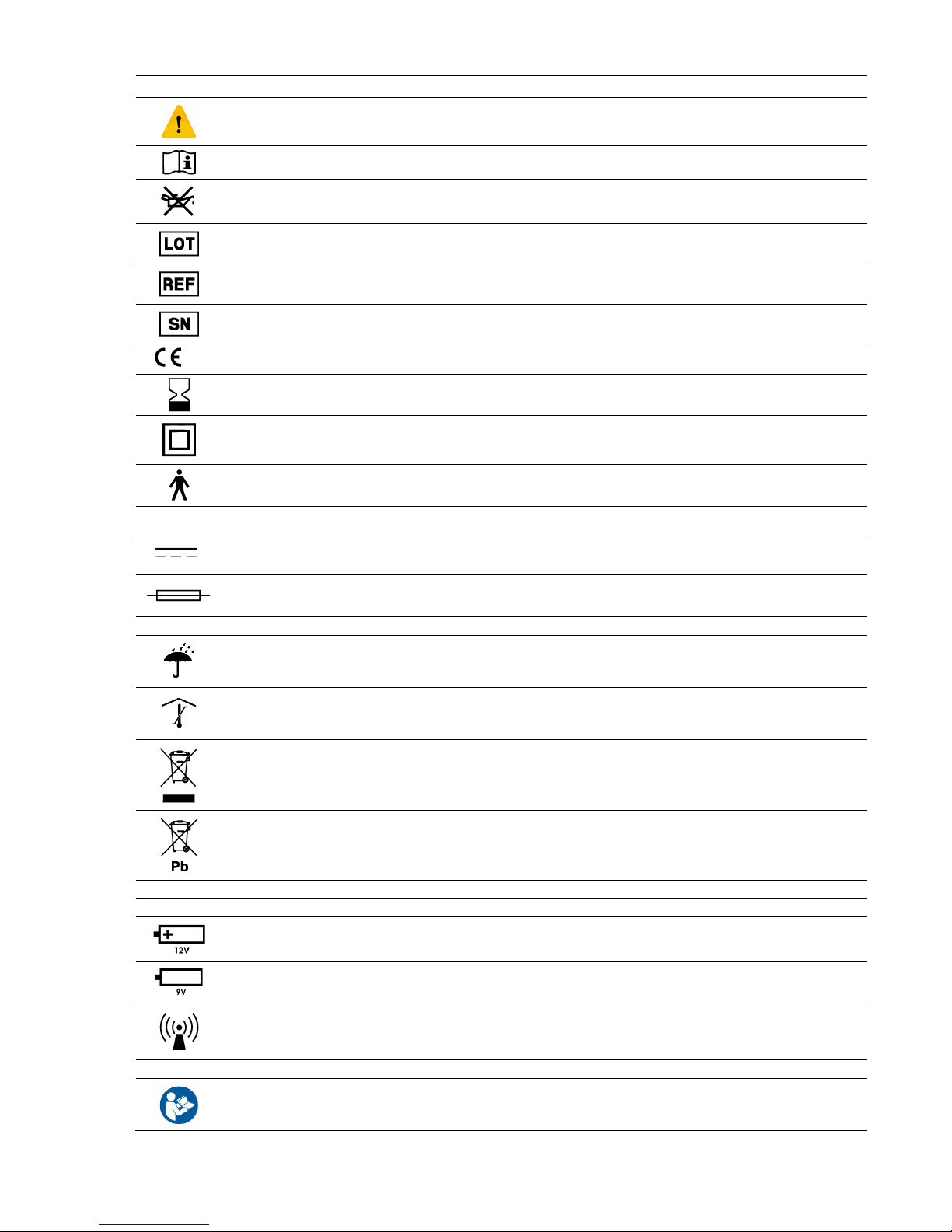
4.3 SYMBOLS
Symbol
Meaning
General or specific warnings
See instructions for use
Do not lubricate
Lot number
Product code
Serial number
0123
Prodotto conforme ai requisiti previsti nella Direttiva 93/42/CEE
The device must be used before the date indicated on the package (Accessories)
Protection against electric shock Class II
B Type device
~
Alternating current
Direct current
Fuse
Hz
Frequency (where applicable)
Keep in a cool and dry place
Storage temperature
Warning for the correct disposal of the product according to the European Directive 2012/19/UE
Information to the users in compliancy with comma 22 of the Italian Legislative Decree of 20 November
2008, n. 188 “Actuation of the Directive 2006/66/CE regarding batteries, accumulators and their wastes
and that repeals Directive 91/157/CEE”
I
ON O OFF
12V Rechargeable battery
9V backup battery
Non-ionising radiation
EMC
Electromagnetic compatibility
Obligation to read operating instructions
12 V DC
Page 5

5
4.4 Warranty and support
Spencer Italia S.r.l. guarantees that products are without defects for a period of one year from the date of purchase.
For any information regarding the correct interpretation of the instruction manual, the use, maintenance, installation and restore of
the product, contact the Spencer customer care service ph. +39.0521.541111, fax +39.0521.541222 or e-mail [email protected].
In order to facilitate the assistance service, please always indicate the lot number (LOT) or serial number (SN) shown on the label
applied on the box or on the device.
Conditions for warranty and assistance can be viewed on http://support.spencer.it.
Note: Record and store; these instructions, lot (LOT) or serial number (SN) if any, date and place of purchase, date of first use, date
servicing, user names and comments.
5. WARNINGS
The warnings, notes and other important safety information are indicated in this section and are clearly visible
throughout the entire manual.
User training
Note: Laboratory testing, post production tests, instruction manuals cannot always consider every possible scenario
for use. This means that in some cases the performance of the product could be notable different from results to date
obtained.
The best instructions consist in continuous practice under the supervision of trained and competent staff.
Regardless of the level of experience gained previously with similar devices, it is recommended that you carefully read this manual
before installing, operating or using the product or carrying out any maintenance. If in doubt, contact Spencer Italia S.r.l. to obtain
the necessary clarifications.
The product must be used by trained personnel only, having attended specific training for this device and not for similar products,
with appropriate clinical knowledge in the field of artificial ventilation in order to correctly set the values available on the device
according to the patient’s clinical status.
The suitability of the user to use the product may be attested by the records of training, where the names of those trained, of the
trainers, dates and place are Indicated. This register which certifies the eligibility of the operators to use the Spencer device must be
kept for a period of 10 years after the disposal of the device itself. This register will be made available to the competent Authorities
and/or manufacturer if requested. In the absence of such documentation, sanctions will be applied.
Do not allow any untrained person to help during the use of the device, because they could cause damage to the patient or to
themselves.
Note: Spencer Italia S.r.l. is always at your disposal to organise product training.
Installers training
The installer of the device must be able to ensure that all equipment, systems, containers and connections comply
with their specific safety standards and regulations. This requires knowledge of all regulations and standards
applicable.
In the particular case of connection to the main supply through a power adapter, this need to be c ompliant with IEC
60601-1, EN 60601-1-2 standards and periodic checks as prescribed by EN 62353 need to be established before the
installation of the device.
If these conditions are not met, safety of the device and for the operators will be compromised.
Product functionality
Use of the device in anyway other than described in this manual is forbidden.
Before each use of device the perfect operating state of the device must be checked as specified in the instruction manual. If any damage
or abnormalities which could in any way influence the correct functioning and the safety of the device are detected, the device must be
immediately removed from service and the manufacturer must be contacted.
If any failure or incorrect functioning of the device is detected, it must be immediately substituted with a similar item so that the rescue
procedures are guaranteed without any interruption.
The appliance must not in any way be tampered with (modification, adjustment, addition, replacement). In such cases all responsibility
will be denied for any malfunctions or injuries caused by the appliance itself; moreover CE certification and product warrant y will be
considered void
Those who modify or have modified, prepare or have prepared medical appliances in such a way that they no longer serve the purpose
for which they were intended, or no longer supply the intended service, must satisfy the valid conditions for the introduction onto the
market.
During use, position and adjust the device taking care not to cause any obstruction to rescuers and or any other rescue equipment.
Ensure that all the necessary precautions are taken in order to avoid the hazards that can arise as the result of contact with blood or
body fluids, when applicable.
Ensure that the fixing system is suitable to keep fixed the device in the medical vehicle in all circumstances.
The warranty seals, where present, must not be removed; in such case, the manufacturer will no longer recognize the product warranty
and will accept no responsibility in case of incorrect operation or damage caused by the product itself.
Avoid contact with sharp objects.
Operating temperature: from -10°C to +40°C
Page 6

6
Stoccaggio
The device should not be exposed to or come into contact with any source of combustion or inflammable agents. Store in a cool, dry,
dark place and do not expose to direct sun.
Do not store the device underneath any heavy objects which could cause structural damage.
Store and transport the device in its original packaging. Failure to do so makes the warranty void.
Storage temperature: from -10°C to + 60°C
Maintenance/cleaning
Spencer Italia S.r.l. disclaims any liability for any damage, direct or indirect, which is a result of improper use of the product and
replacement parts and / or otherwise of any repairs made by an entity other than the authorized Spencer service centres; this will also
invalidate the warranty.
The operator must always wear adequate personal protection such as gloves and mask etc. during all checking, maintenance and
cleaning procedures.
Establish a maintenance program and periodic testing, identifying an employee responsible for overseeing. The person to whom the
ordinary maintenance of the device is entrusted must ensure the basic requirements foreseen by the manufacturer in the user’s manual.
The frequency of inspection is determined by factors such as legal requirements, the type of use, frequency of use, environmental
conditions during use and storage.
Spencer Italia S.r.l. disclaims any liability for any damage, direct or indirect, that is the result of incorrect repairs or use of products made
by Spencer Italia S.r.l. Repairs must necessarily be carried out by an authorized Spencer Italia service centre, which in using original spare
parts will provide a quality repair service in strict accordance with the technical specifications given by the manufacturer. Spencer Italia
S.r.l. disclaims any liability for any damage, direct or indirect, which is a result of improper use of spare parts and/or otherwise of any
repairs made by an entity other than the Spencer service centres authorized to repair or make substitutions on this product and parts
and/or otherwise of any repairs made by an entity other than the Spencer service centres authorized to do so; the warranty will also be
invalidated.
Use only original components, spare parts and or accessories, approved by Spencer Italia S.r.l., in order to carry out any operation
without causing any alteration or modification to the device.
All maintenance and revision must be recorded and documented with the corresponding report for technical assistance; documentation
shall be maintained for at least 10 years from the end of life and must be made available to the competent authorities and/or the
manufacturer if requested.
The cleaning schedule for reusable products must be performed in accordance with the directions provided by the manufacturer in the
user manual, in order to avoid the risk of cross-infection due to the presence of secretions and/or residuals.
The device and all its components, after washing, should be allowed to dry completely before storing.
Regulatory requirements
As a distributor or end user of products manufactured and/or marketed by Spencer Italia S.r.l., you are strictly required to have a basic
knowledge of any legal requirements applying to the devices contained in this supply that are in power in the final destination
Country (including laws and norms regarding technical specifications and/or safety requirements) of the goods and therefore you are
also strictly required to have the necessary knowledge to guarantee all aspects regarding the total conformity of the products to the
regulations in the relevant territory.
Promptly notify Spencer Italia S.r.l. (already during the first product enquiry) when requesting in details regarding any revisions to be
made by manufacturer in order to guarantee the conformity of the products to the territory’s legal specifications (including those
resulting from rules and/or norms of other kind).
Act, with all due care and diligence, and contribute to ensure conformity to general safety requirements of all devices marketed in the
territory, by providing final users with all necessary information for carrying out periodical checks on their devices, exactly as specified in
the relevant user’s manual.
Actively contribute to safety checks on product sold, by communicating any relevant risk analysis information both to the manufacturer
and to any competent authorities so that the necessary action can be promptly taken.
The distributor or final user is aware that in the event of any failure to conform to the above mentioned requirements you will be
deemed fully responsible for all damages that might occur. Therefore Spencer Italia S.r.l. expressly disclaims any responsibility and/or
liability for your non-compliance with the present regulatory provisions.
Avvertenze generali per dispositivi medici
L’utilizzatore deve leggere attentamente, in aggiunta alle avvertenze generali, anche quelle di seguito elencate.
It is not foreseen that the use of the device is prolonged beyond the time necessary for the first responders to the complete their
operation and the subsequent stages of transport to the nearest rescue point.
When the device is being used, the assistance of qualified staff must be guaranteed and at least one operator must be present.
Follow the procedures and protocols approved by the internal organization.
If disposable accessories are used, use only once and for only one patient. Do not wash or sterilize after use. Reuse may cause cross
infection. Some symbols contained in this manual refer to the standard accessories included In the purchased device.
The activities of disinfection and sterilization should be carried out in accordance with the parameters given in the validated cycle as
specified in the technical standards. Sterilization could reduce the lifespan of the devices.
Don’t use accessories after the expiration date indicated on the package, if present.
With reference to the D. Lgs. 24th February 1997, n. 46 emended by D. Lgs. 25/01/2010, n. 37 – Acknowledgement of Directive
93/42/CEE and 2007/47/CE concerning Medical Devices, we remind both public and private operators, , That in the exercise of their
activity detect an accident involving a medical product are required to notify the Ministry of Health, under the terms and in the manner
established by the relative ministerial decrees and also to the manufacturer. Health care providers whether public or private are
Page 7

7
required to communicate to the manufacturer, any other inconvenience that may allow for the adoption of measures to ensure the
protection and health of patients and users
6. SPECIFIC WARNINGS
The device is intended to be used on medical vehicles and not for home therapy.
Don’t use the device in patients between 0 and 18 months and with not drained pneumothorax.
Do not use if the device presents any kind of damage or poor cleaning state.
Ensure that the medical gas supply, is free from condensation, residual materials and/or substances which may compromise the
proper operation of the device and the efficacy of the therapy and that should contaminate the patient.
The device must be used by specialized staff.
Do not wash or clean the device with water jets or pressurized air.
Do not use drying machines
Condensation, water, ice and dust accumulation can affect the correct functioning of the device, making it dangerous for the patient and
for the operators.
Regularly check the status of the fixing system of the device; if altered or yielding is noticed, is necessary to restore its security status
before use the device. Otherwise we assume no responsibility about proper functioning or any damage caused by the device.
Regularly check the status of connections to the medical gas supply system as well as the electric ones.
Before turning on the device, charge the battery for at least 12 hours
The battery should never be completely discharged.
If any failure or incorrect functioning of the device is detected, the ventilation must be immediately restored with a similar item in order
to ensure the life support functions without interruption.
Before each use of device the perfect operating state of the device must be checked as specified in the Instruction manual. If any damage
or abnormalities which could in any way influence the correct functioning and the safety of the device, of the patient and or of the user
are detected, the device must be immediately removed from service and the Manufacturer must be contacted.
When the device is being used, the assistance of qualified staff must be guaranteed.
The device must always be accompanied by a replacement unit and/or by a manual ventilation system to ensure the possibility to
intervene on the patient in any case. Use of Spencer manual resuscitators is suggested.
If connected to the 220V main supply by an adapter, is necessary that its features are like described in this manual, has passed the test
for electromagnetic compatibility according to EN 60601-1-2 and electrical safety according to IEC 60601-1 and IEC 62353 reporting the
specific marking, and does not affect the electrical safety and electromagnetic parameters of the ventilator.
The batteries of the device must be replaced every year regardless of the number of recharge cycles
Do not leave the patient without the assistance of at least one doctor or operator with clinical skills on artifical ventilation when the
device is used.
The device is equipped with warranty seals. If removed , the manufacturer will no longer recognize the product warranty and accepts no
responsibility for improper operation or damage caused by the device.
If the device comes with disposable accessories, these should be used of only one patient. Can not be washed, sterilized or re-sterilized
after use.
If the device comes with accessories with limited lifespan, do not use them after the expiration date.
The device should not be exposed to or come into contact with any source of combustion or inflammable agents.
Store in a cool, dry, dark place and do not expose to direct sun.
Do not store the device underneath any heavy objects which could cause structural damage.
Store and transport the device in its original packaging
Position and adjust the device taking care not to cause any obstruction to rescuers and or any other rescue equipment.
The device must be used in a ventilated environment.
The utilization of the ventilator with power sources and environmental conditions different from the indicated ones compromises the
safety of operating.
Do not lubricate any part of the device. It’s not required by any kind of maintenance and could cause fire hazard.
The artificial ventilation can have side effects. In order to identify the hazards associated with the use of the device related to the c linical
conditions of the patient, its essential the presence of an expert doctor who can evaluate the actual benefits provided by th e artificial
ventilation and able to determine if the ventilator can be used. Side effects are only partially limited by the tim e of use of the device,
which should never exceed the time for the transport of the patient on the ambulance.
For the use of the ventilator, a specialized doctor must be present. The doctor will be able to determine if the technical specifications of
the device make it suitable to be used on a specific patient and will be the sole responsible for the definition and setting of the
ventilation parameters.
Do not use the device in presence of inflammable substances and anesthetics.
Do not use the device if the condition of the paragraph 9 are not met.
Do not use the device if it has not been subjected to scheduled maintenance or maintenance required by a normal use.
Use only accessories approved by the manufacturer.
Do not connect the device to the patient through antistatic conductive tubes.
The installation must be performed ensuring appropriate distances between devices that could have each other electromagnetic
interference as specified in paragraph 9.
Page 8

8
6.1 Requirements of operators
Spencer 170 and its variants Kompak and Portavent, are devices intended for professional use only. Each operator must be trained in
their use and maintenance of good operating conditions. Do not allow untrained people to assist in the use of the product, as this may
cause injury to themselves or others.
Installers and operators must know all the standards applicable to the devices, accessories and systems connected to the
pulmonary ventilator.
Operators must be able to assess the integrity of the connections. They must also be able to evaluate any anomalies of
the supply systems communicating the problem to the responsible figures, interrupting the use of the devices connected
to it.
The abilities of all operators must be considered before determining their role in the employment of the device.
The device can be used only by specialized staff which will be able to determine if the technical specifications of the
device make it suitable to be used on a specific patient and will be the sole responsible for the definition and setting of
the ventilation parameters.
7. RESIDUAL RISK
The residual risks listed below have been identified exclusively in reference to the intended use of the device.
The installation and use without complying with the distances between electrical and electronic devices in reference to
electromagnetic compatibility, could lead to malfunction of such devices.
Installation carried out by untrained personnel can lead to detachment of medical gas pressurized tubes, resulting in damage to
persons or impossibility to carry out rescue operations.
Installation carried out by untrained personnel, could result in inadequate fastening of the device inside the ambulance, with
consequent risks related to its instability or mobility.
The connection to a gas supply having impurities or traces of condensate can compromise the good functioning of the device, altering
its functional characteristics and causing harm to patients.
The connection to a power source with higher voltage than described in this manual can make the device not usable.
The connection to a power source with lower voltage than described in this manual can result in a battery recharge failure and in a
device block.
The use in environmental conditions different from those specified in this manual, can damage the sealing elements resulting in
leakage of gas, deviations from the set flow values or condensation.
The use in presence of flammable and/or anesthetic gas may cause fire risks
A prolonged use without adequate humidification downstream the device, can cause dryness of the patient airways.
The use of Air Mix mode in polluted atmosphere can result in serious damage to the patient
The artificial ventilation can have side effects. In order to identify the hazards associated with the use of the device related to the
clinical conditions of the patient, its essential the presence of an expert doctor who can evaluate the actual benefits provided by the
artificial ventilation and able to determine if the ventilator can be used. The doctor will be able to assess the type and cause of
respiratory insufficiency, ensuring adequate therapy evaluating the actual need and possibility to use the ventilator setting the
proper values in relation to the clinical condition of the patient. The absence of such figure can seriously compromise the patient
safety because of inadequate treatment, ineffective or due to an improper use of the device.
Side effects are only partially limited by the time of use of the device, which should never exceed the time for the transport of the
patient on the ambulance. Risks arising from prolonged use, are closely linked to the side effects of artificial ventilation.
The reuse of unsterilized patient circuits, involves risks of infection for patients and operators.
Page 9
9
8. TECHNICAL DATA AND COMPONENTS
Note: Spencer Italia S.r.l. reserves the right to make changes to specifications without prior notice.
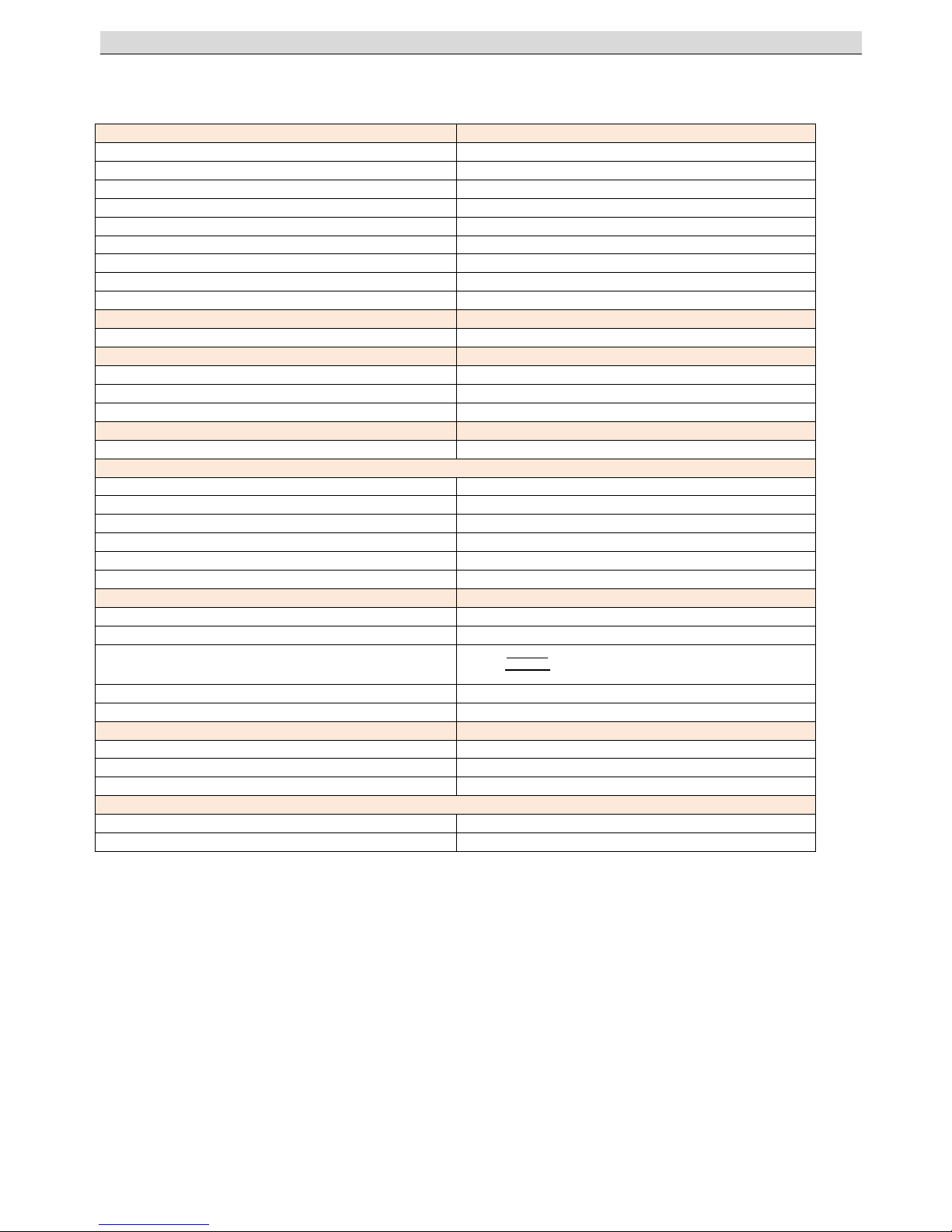
8.1 Technical data
DIMENSIONALS
Width
295 mm
Height
155 mm
Depth
165 mm
Weight
3,68 kg
Patient circuit weight
242 g
Dimensions Kompak 170
480x370x180 mm
Weight Kompak 170 with accessories
12,2 Kg
Dimensions Portavent 170
460x500x250 mm
Weight Portavent 170
14,2 kg
PROTECTION SPCIFICATIONS
Protection against electric shock
Class II
ELECTRICAL VALUES
Voltage
12 Vcc
Current absorption
244 mA
Power consumption
2.93 W
FUSE
F1L250V
Fast Fuse 5x20mm 1A
INTERNAL BATTERY (Should never be completely discharged!)
Type
Pb
Voltage
12 V
Capacity
1,2 Ah
Autonomy (average)
2 h
Charging time
8 h
Remaining operating time after low-battery alarm
5 min
VENTILAZIONE
Volume/minute
from 2 to 20 L/min
Ventilation frequency (F)
from 5 to 30 BpM
Released volume
Oxygen concentration
60% or 100%
I/E Ratio
1/2
MANOVACUOMETER
Campo di misura
from -20 to +70 mbar
Tolleranza nel range da -20 a +10 mbar
2 mbar
Tolleranza nel range da +10 a +70 mbar
5 mbar
DEVIAZIONI MASSIME DAI VALORI IMPOSTATI
Medical gas flow
± 15%
Frequency
± 1 BpM
The pulmonary ventilator Spencer 170 has the following functional safeties:
Mechanical overpressure safety valve
The safety valve limits the maximum pressure of the unit to 60 mbar ± 5%. This value is set by the manufacturer.
The end user can limit the pressure to a lower value by acting on the adjustment knob.
Spontaneous breathing
When the device is switched off or when the electrical or gas supplies are interrupted, the patient can breathe spontaneously. The unit is
equipped with an independently powered alarm (9V battery) that warns about the low battery condition. This alarm works also when the
device is turned off. The device is also equipped with an alarm that warns about the lack of medical gas supply when the device is turned on.
The 9V battery must be checked periodically as specified in paragraph 11.
Page 10
10
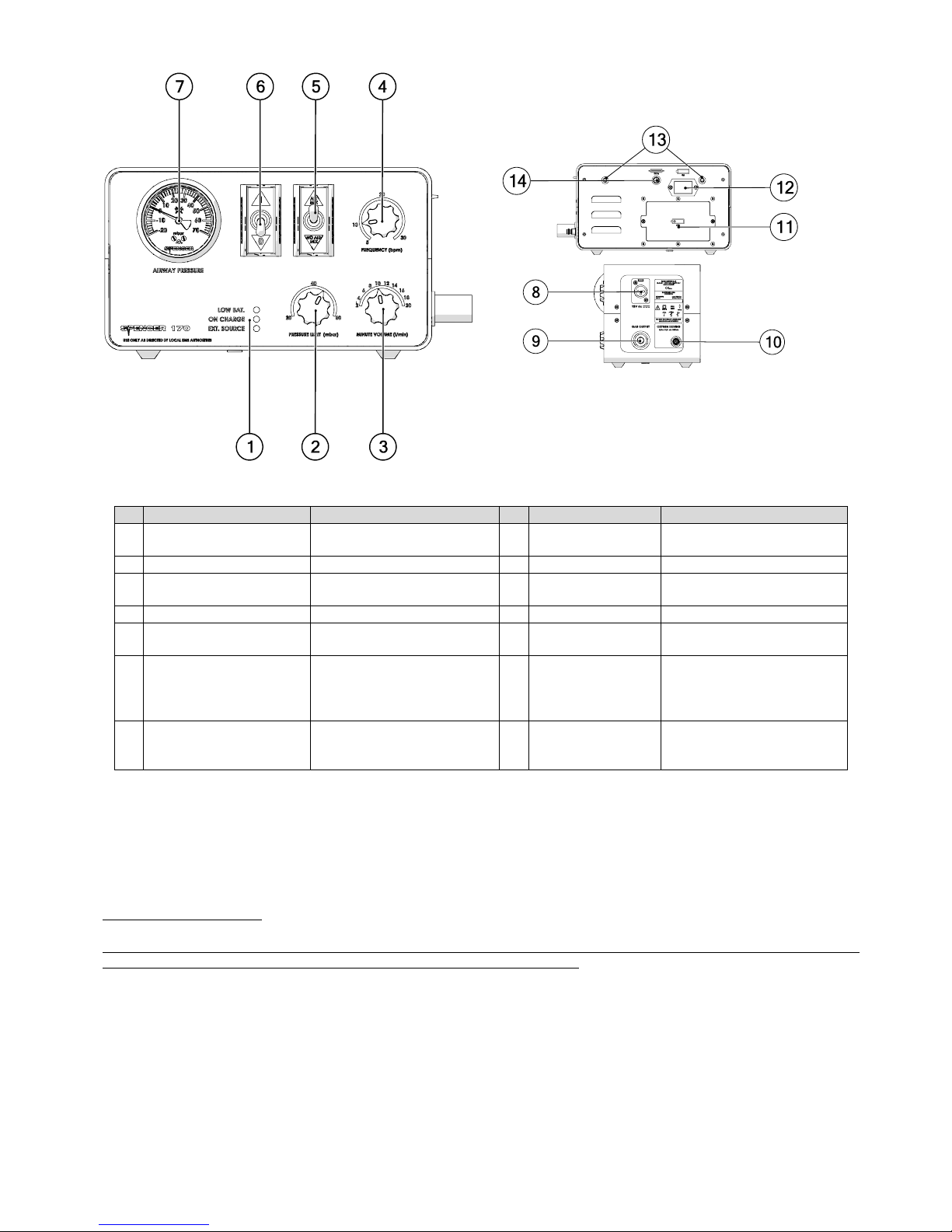
8.2 Components
N°
Description
Material
N°
Description
Material
1
Led battery status, charge
and power supply
Integrated in the PC panel
8
Power connector
Al/Steel/Nichel/Nylon
2
Pressure adjustment knob
Al
9
Medical gas output
Anodized Aluminum
3
Volume/minute adjustment
knob
Al
10
Medical gas inlet
Brass
4
Frequency adjustment knob
Al
11
Battery compartment
/
5
Lever selection Air Mix/No
Air Mix mode
Rubber coated steel
12
9V backup battery
compartment
/
6
Power on/off switch
Rubber coated steel
13
Holes for wall fixing
(a third hole is placed
at the base of the
device)
/
7
Manovacuometer
Copper
alloy/Steel/Al/transparent
plastic
14
Fuse holder
PE
The device comes with the following accessories not shown in this manual:
Patient circuit
It consists of a corrugated tube, face mask, non-rebreathing valve, straight fit and bacterial filter. Patient circuits or their components
approved to be used with the pulmonary ventilator are those listed in paragraph 15.
Oxygen connection tube
Allows the connection of the device to the oxygen supply.
Contains type DINP phtalates.
The component EV20006 (PVC cable gland black ø14,5) contains DEHP phtalates. It doesn’t come in direct contact with the patient or with
the medical gas. For this reason, its presence is not indicated with marking on the device.
Kompak and Portavent systems, in addition to the ventilator, include standard accessories stored in dedicated compartments inside the
systems.
Those standard accessories are:
- 2l oxygen bottle
- Pressure reducer with the connection standard specified in the order.
- Helicoidal mouth opener
- Tongue forceps
- Guedel cannulas
Page 11
11
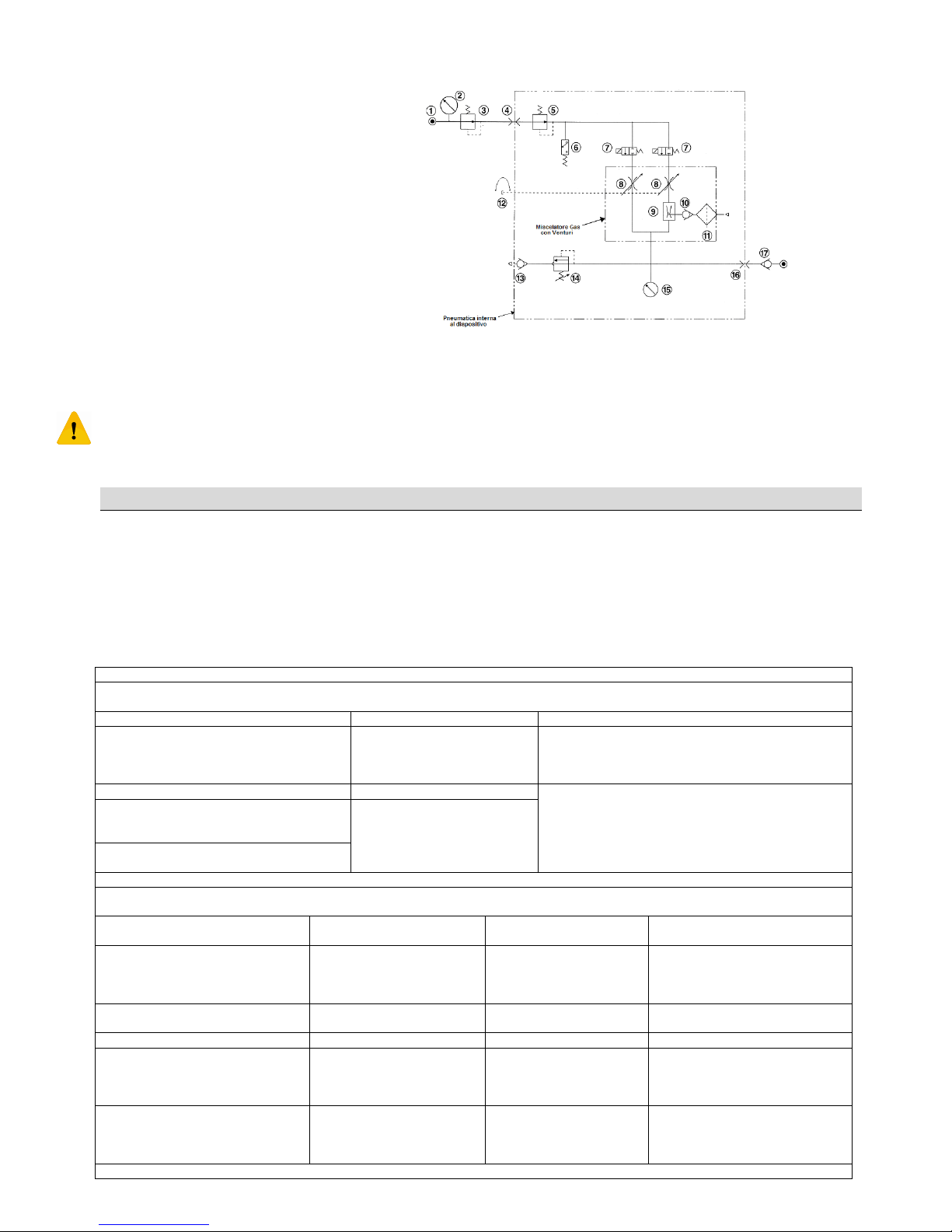
8.3 Pneumatic diagram
The lung ventilator 170, has an internal pneumatic circuit according to the following diagram:
1. High pressure source
2. High pressure gauge
3. Pressure reducer
4. Quick coupling inlet
5. Low pressure reducer
6. Low pressure alarm regulator
7. 2 ways N.C. electrovalve
8. Flow regulator with pre-setted flow
9. Venturi system
10. Non-return valve
11. Aspiration air filter
12. Flow selection knob
13. Overpressure release with non-return valve
14. Overpressure release valve
15. Vacuum gauge
16. Madical gas output – patient tube
17. Non-rebreathing valve
Inside the circuit, the incoming pressurized medical gas, is sent to the mixing block by means of a device operated by a valve controlled by
the electronic circuit of the device. When the device is turned off the pressurized medical gas, even if introduced in the device, is not
delivered because intercepted by the electrovalve in closed position. Everything is controlled by the electronic circuit of the device, chich
also controls the main breathing parameters. This diagram is provided only to illustrate the operation of the device. It is not allowed to
intervene in any way on it as well as on the electronic circuit. If opening of the case of the device or any other type of unauthorized
modification will be found, the warranty would be voided and Spencer Italia will not have any liability related to the functionality and use
of the product.
The pneumatic circuit may be subject to changes without notice.
9. INSTALLATION AND START-UP
9.1 Installation
The installation of the device is a critical step to ensure a proper operation. When the product is recieved, verify that:
The packaging is intact and has no signs of impacts, falls and isn’t wet.
All the items in the accompanying list are present
The device does not show any kind of damage
The device, tested in the laboratory of a notified body, has successfully passed all the electromagnetic test required by the harmonized
standards. It is designed to be used in the electromagnetic environment described below. The customer, installer and user must be able to
ensure that these conditions are always respected.
Guide and Manufacturer's Declaration - Electromagnetic Emissions (IEC 60601-1-2:2007)
170 ventilator is intended for use in the electromagnetic environment specified below. The customer or the user of the ventilator 170 must ensure that it is
used in such an environment.
EMISSION TESTS
Conformity
Guide to the electromagnetic environment
Emissions in RF CISPR 11
Group 1
The 170 ventilator uses RF energy only for its internal
functions. Its RF emissions are therefore very low and unlikely
to cause any interference with electronic equipment nearby.
Emissions in RF CISPR 11
Class B
The 170 ventilator is suitable for use in all environments
including domestic as well as those directly connected to a
low-voltage public network source supply of which supplies
buildings used for domestic purposes.
Harmonic emissions IEC 61000-3-2
Emissions as a result of voltage fluctuations /
flicker-CEI6100 3-3
Emissions as a result of voltage fluctuations /
flicker-CEI6100 3-3
Guide and Manufacturer's Declaration - Electromagnetic Emissions (CEI EN 60601-1-2:2007)
The 170 ventilator is intended for use in the electromagnetic environment specified below. The customer and / or user of the ventilator 170 must ensure
that the device is used in such environment.
IMMUNITY TEST
LEVEL OF CEI EN 60601 TEST
Level of conformity
Guide to the electromagnetic
environment
Electrostatic discharge CEI EN 61000-4-2
± 6kV on contact
± 8 kV in air
± 6kV on contact
± 8 kV in air
Floors should be wood, concrete or
ceramic tile. If the floors are covered
with synthetic material, the relative
humidity should not exceed most 30%
Electrical fast transient/burst
CEI EN 61000-4-4
± 2kV power source
Not applicable
Over voltage CEI EN 61000-4-5
± 1kV differential mode
Not applicable
Buchi di tensione, brevi interruzioni e
variazioni di tensione CEI EN 61000-4-11
5%UT for 0.5 cycle
40%UT for 05 cycle
70%UT for 25 cycle
<5%UT for 5 sec
Not applicable
Magnetic field with network frequency
(50-60 Hz) CEI EN 61000-4-8
3 A/m
3 A/m
The magnetic field should be that
typical of a commercial or hospital
environment.
note UT is the value of the tension of power source
Page 12
12
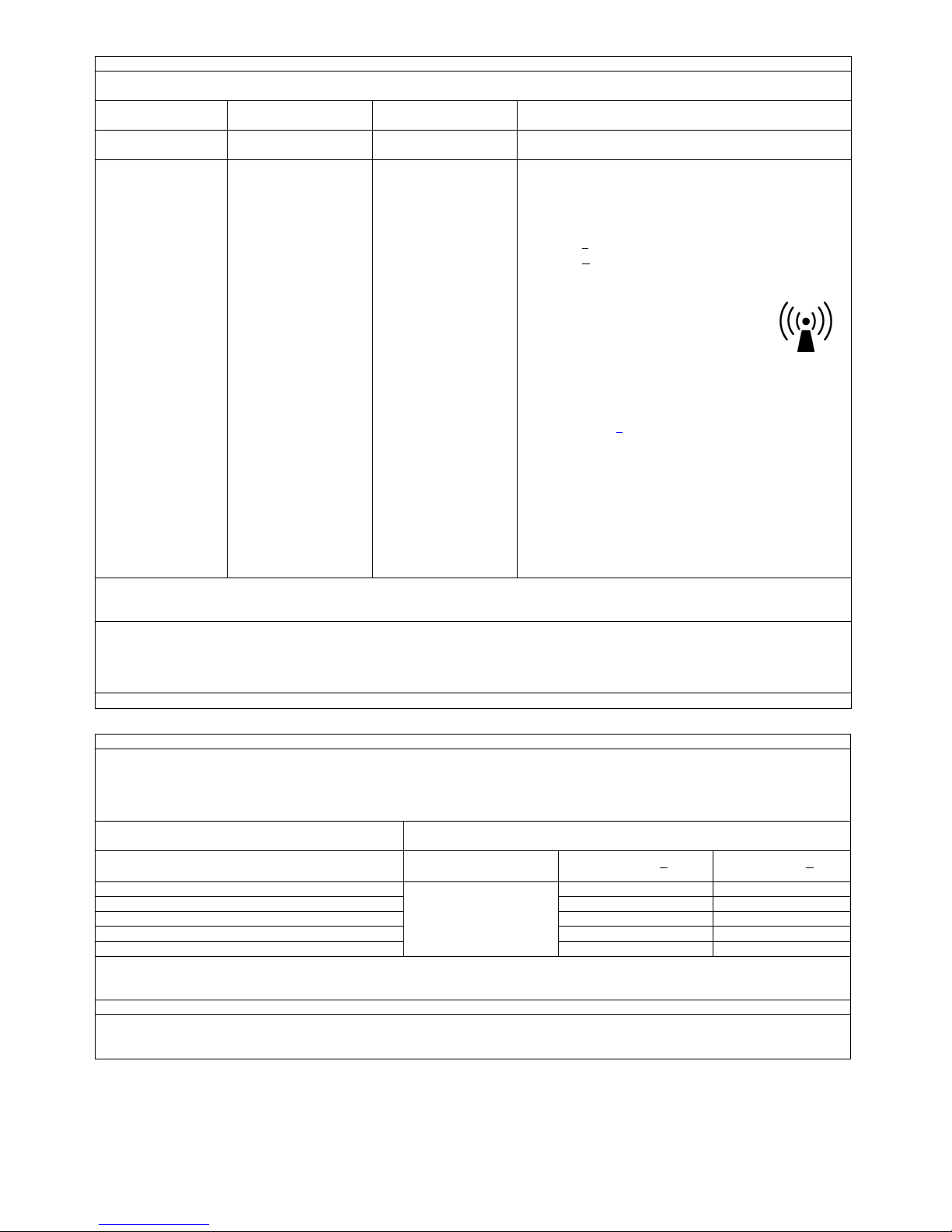
Guide and Manufacturer's Declaration - Electromagnetic Immunity (EN60601-1-2: 2007)
The 170 ventilator is intended for use in the electromagnetic environment specified below. The customer and / or end user of the 170 ventilator must
ensure that the equipment is used in such environment.
IMMUNITY TEST
LEVEL OF CEI EN 60601
TEST
Level of conformity
Guide to the electromagnetic environment
Conduction immunity
CEI EN 61000-4-6
3 Vrms
150kHz to 80MHz
Not applicable
Radiated immunity CEI
EN 61000-4-3
3 V/m
80MHz to 2.5 Ghz
3 V/m
80MHz to 2.5 Ghz
The equipment for communication in portable and mobile radiofrequency (RF) should not be placed near any part of the
appliance, including cables etc. and should be kept at a distance
never less than the recommended and calculated from the
equation applicable to the frequency of the transmitter.
Recommended separation distance
d = 1,166x 80 MHz – 800 MHz
d = 2,333x 800 MHz – 2,5 GHz
where P is the maximum rated power output of
the transmitter in watts (W) according to the
transmitter manufacturer and d is the
recommended separation distance in meters
(m).
Field strengths from fixed RF transmitters, as
determined by an electromagnetic site survey
should be at less than the compliance level in
each frequency range b. Interference may occur
in the vicinity of equipment marked with the
following symbol where P is the maximum
rated power output of the transmitter in watts
(W) according to the transmitter manufacturer
and d is the recommended separation distance
in meters (m).
Field strengths from fixed RF transmitters, as
determined by an electromagnetic site survey
should be at less than the compliance level in
each frequency range b. Interference may occur
in the vicinity of equipment marked with the
following symbol
NOTE 1 At 80 MHz and 800 MHz the separation distance for the range of higher frequency is applied
NOTA 2 These guidelines may not apply in all situations. Electromagnetic propagation is affected by absorption and reflection from structures, objects and
people.
a) Field strengths from fixed transmitters, such as base stations of radio (cellular / cordless) telephones and land mobile radios, amateur radio equipment,
transmitters, AM and FM radio broadcast and TV broadcast theoretically can not be predicted with accuracy. To assess the electromagnetic environment
due to fixed RF transmitters, you should consider an electromagnetic site survey. If the measured field strength in the location in which you use the 170
ventilator exceeds the applicable RF compliance level above, the operation of the 170 ventilator should be placed under observation. If abnormal
performance is observed, additional measures may be necessary such as a different orientation or position of the ventilator 170.
b) The field strength in the frequency range from 150 kHz to 80 MHz should be less than 3 V / m
Recommended separation distances between portable and mobile communications equipment and the ventilator 170.
The 170 ventilator is intended for use in an electromagnetic environment in which radiated RF disturbance is controlled. The customer or the user of the
170 ventilator may prevent electromagnetic interference by maintaining a minimum distance between the communications equipment radio frequency
(RF) Portable and mobile equipment (transmitters) and the 170 ventilator, as described below and in accordance with the maximum output power of the
communication device
Maximum output power rating of the transmitter
Separation distances according to frequency of transmitter (m)
(W)
150 kHz – 80 Mhz
80 Mhz – 800 Mhz
d = 1,166x
800 Mhz – 2,5 Ghz
d = 2,333x
0,01
Not applicable
0,117
0,233
0,1
0,369
0,738
1
1,166
2,333
10
3,687
7,738
100
11,660
23,330
For transmitters rated at a maximum output power not listed above, the separation distance "d" recommended in meters (m) can be estimated using the
equation applicable to the frequency of the transmitter, where P is the power of 'maximum output of the transmitter in watts (W) according to the
manufacturer of the transmitter.
NOTE 1 At 80 MHz and 800 MHz, the separation distance for the higher frequency range is applied.
NOTE 2 These guidelines may not be applicable in all situations. Electromagnetic propagation is affected by absorption and reflection from structures,
objects and people.
If the environmental conditions are appropriate, is possible to install the device verifying that:
The installation floor is leveled and strong enough to withstand accelerations and vibrations to which the device could be su bjected
during use on the medical vehicle. It’s suggested the use of a backplate.
The medical gas supply system has been regularly serviced or, in case of initial startup, the periodic maintenance has been programmed.
Fittings, pipes and all means of connection used in the system, are built according to the specific applicable standards.
Verify that purchased tubes and fittings respect the same standard requested for the device.
Page 13
13
Distances between other electrical and electronic devices are like described in this manual.
Il posizionamento sia tale da non causare alcun tipo di intralcio all’interno del veicolo sanitario.
The power supply has the characteristics described in this manual. The pressure and flow delivered from the medical gas supply system,
have the characteristics specified in this manual.
The device must be installed using one of the specific fasteners indicated in the paragraph 14. Depending on the fixing system purchased,
you will need to refer to the relevant instructions. Any other type of installation, precludes the safety and functionality of the device.
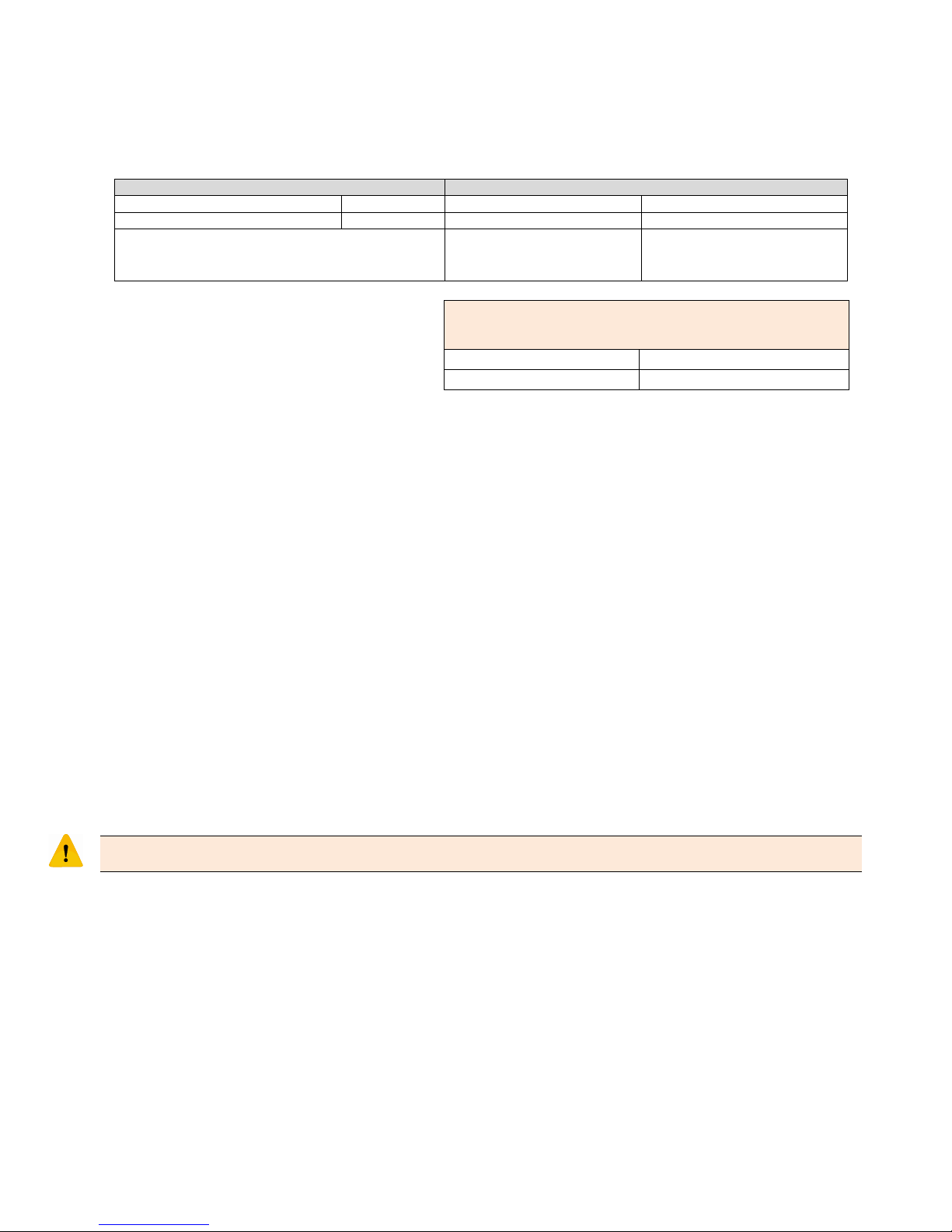
The device must be connected to electrical power supply and to a source of medical gas having the following characteristics:
Power supply
Medical gas supply
Voltage
12 V/DC
Voltage
12 V/DC
Needed current
> 1A
Needed current
> 1A
AC/DC adapter compliant with the standard of electrical
safety and electromagnetic compatibility
Connection standard (If not
otherwise specified on
accompanying documents)
AC/DC adapter compliant with the
standard of electrical safety and
electromagnetic compatibility
The power cord supplied has at one side a 3-pin XLR terminal
which has to be connected to the ventilator, the other side
has a plug to connect to the cigarette lighter inside the
medical vehicle. If you need to connect the device to the
main supply of the vehicle without using the lighter socket,
remove the plug, splice and connect according to the
specifications in the table.
After installation and electrical and pneumatic connections, is necessary to check the proper functioning of the device.
If the ventilator is powered through a power adapter (not supplied) connected to the 220V mains, make sure it has all the characteristics to
ensure a proper working ventilator as described in this manual as well as in compliance with the EMC requirements prescribed by regulations
for the devices, systems and vehicles involved in the environment of use.
9.2 Start - up
For a proper and safe use of the product, proceed as follows:
Ensure that power and gas supplies comply with the specifications in this manual.
Connect the patient circuit and all its components to the unit.
Turn on the device.
Select the breathing frequency
Select the volume/minute (Spencer 170 can deliver a mixture of air/oxygen from 2 to 20 l/min).
Verify that the pressure gauge is on zero position.
Test the overpressure valve in the following way:
Close with the palm of one hand the patient outlet and turn the pressure limiting knob. Verify that the value indicated on the gauge is the
same setted with the knob.
If the values are not the same, put the device out of service and contact the manufacturer or service center.
Once the tests are carried out, is necessary to:
Turn off the Spencer 170 placing the lever in the position “0”
Break off the medical gas supply
If the device is working properly and the conditions above are met, it can be considered ready for use; otherwise put the device out of
service and contact the manufacturer.
The patient circuits to be used in place of the one provided, are to be chosen from those approved by the manufacturer and listed in
paragraph 14.
Do not alter or modify the device arbitrarily; modifications may cause unpredictable operation and damage to the patient or rescuers and
will also void the warranty, relieving the manufacturer from any liability.
Connection specifications
Brown wire
Positive
Blue wire and shielding
Negative
Page 14
14
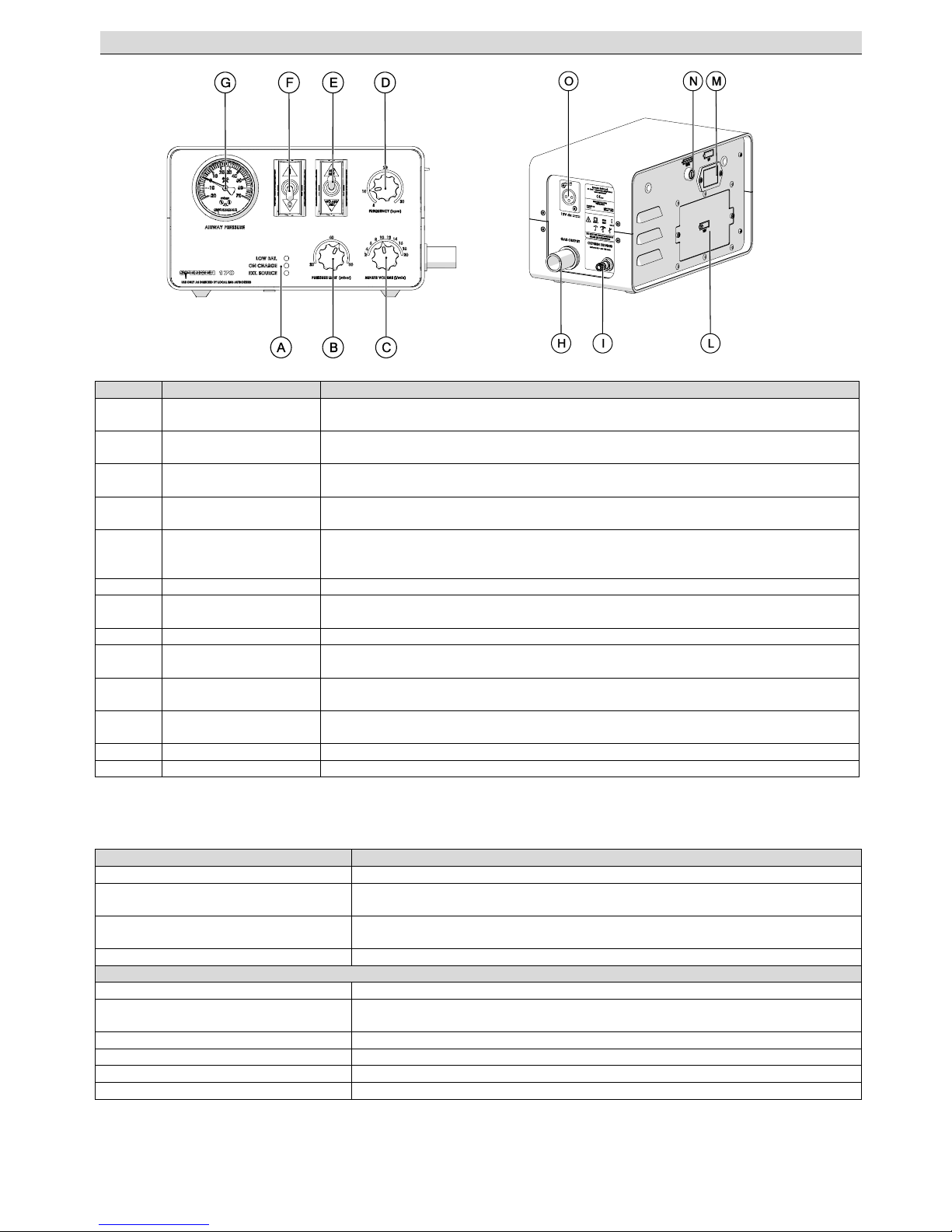
10. FUNCTIONAL CHARACTERISTICS
For their use, the pulmonary ventilators require fundamental accessories that make up the patient circuit, which includes in
the assembly order the Mask, Patient valve, straight fit, antibacterial filter, corrugated tube.
Spencer 170 includes:
Component
Description
Straight fit 22/15
Allows the connection between the filter and the patient valve
Corrugated tube
Canalizes the medical gas flow and connects the devices of the patient circuit. It is directly
connected to the medical gas output placed on the ventilator
Patient valve
Equipped with overpressure and non-rebreathing valves, allows the connection between
the mask and the straight fit
Filter
Antibacterial filter placed between the straight fit and the corrugated tube.
In addition for the versions Kompak and Portavent *
2l Tank
Housed within the Kompak and Portavent systems, is intended to contain the medical gas.
Pressure reducer
Connected directly to the tank, reduces the pressure and the flow at appropriate levels
needed for the correct operation of the ventilator.
Face mask
Terminal part of the patient circuit
Mounder mouth opener
Accessory not needed for the ventilator operation
Collin tongue holder
Accessory not needed for the ventilator operation
Guedel cannulas
Accessory not needed for the ventilator operation
* Supplied accessories may be subject to change without notice
Element
Description
Function
A
Led section
Provide information to following visual alarms:
Power status (battery, charging, powered by external source)
B
Max pressure adjustment
knob
Allows to set the pressure limit at which the medical gas is admistered to the patient
C
Volume/minute
adjustment knob
Allows to set the maximum flow for minute at which the medical gas is administered to the
patient
D
Frequency adjustment
knob
Allows to set the breathing acts per minute
E
AIR MIX/NO-AIR MIX
mode selector
Allows to choose whether to use the medical gas delivered by the medical gas supply system at
100% (NO AIR MIX) or at 60% (AIR MIX), mixing it with air taken from the environment in which is
placed the device.
F
Power on/Off lever
Needed to turn on or off the device
G
Manovacuometer
llows the visualization of the pressure inside the patient circuit
H
Medical gas output
Output at which the patient circuit must be connected
I
Medical gas input
Input at which must be applied the tube connected to the medical gas supply system, by means
of the connectors supplied by the manufacturer
L
Primary battery
compartment cover
Allows the inspection and replacement of the main battery
M
Backup battery
compartment door
Allows inspection and replacement of the backup battery which is needed for the operations of
the alarms even in case of power supply failure
N
Fuse housing
Housing for the 1A fuse
O
Power connector
Necessary for the connection to the power source
Page 15

15
11. INSTRUCTIONS FOR USE
11.1 Principle of operation
When turning on the device, the electronics predisposes the device to operate in the mode described as “controlled”. Starts the cyclical
delivery of medical gas that is sent to the patient at regular intervals according to the frequency set by the operator.
The real pressure in the patient circuit is always monitored by the manovacuometer placed on the front panel.
The selection of “AIR-MIX” or “NO AIR_MIX” mode depends on the patient’s oxygenation needs.
The device has an internal 12V battery which provides an autonomy of about two hours when disconnected from the main power supply.
It’s also present a 9V backup battery needed for the operation of the alarms of the main battery charge status.
11.2 Operating modes
Controlled breathing (IPPV)
This mode is selected by default when the unit is turned on. It consist in the erogation of the medical gas to the patient accor ding to the
parameters set with the adjustment knobs. With this mode, the inspiratory and expiratory time ratio is constantly 1:2.
In conditions of medical gas input failure, the ventilator turns on a continuous acoustic alarm. This alarm, is also activated during normal
use when the source of medical gas is empty.
Air Mix/No Air Mix Selection
The switch placed in the middle of the front panel, is used to activate and deactivate the AIR MIX mode.
If in NO AIR MIX mode, the ventilator delivers only the medical gas coming from the main medical gas supply to which the device is
connected. If the supply system delivers oxygen, the ventilator will deliver to the patient an oxygen concentration of 100%. Selecting the
AIR MIX mode, the ventilator draws 60% of gas from the medical gas supply and the remaining 40% from the environment where the
device used. In this case, if the main gas supply deliver oxygen, the concentration of this gas administered to the patient will be of 60%.
Same considerations apply also if the main supply system delivers medical air.
It is absolutely not appropriate to use AIR MIX mode in polluted atmosphere.
11.3 Usage
The physician who directs rescue operation is responsible for the choice of the device to be used and for the clinical assessments needed
for the proper use of this device.
In standard conditions it is suggested to remove any implants, evaluate the need of bronchoaspiration, hyperextend the patient’s head
and, to ensure that the airways are clear, position the face mask over the mouth and nose checking the adherence of the soft part of the
mask on the patient’s face, in order to obtain a sealed system. The Volume/minute parameter selection knob, has a regulation by steps.
This method of regulation prevents from variations of the set parameters if happens accidental contact with the knob when the device is
used. If the patient is intubated, disconnect the mask from the patient valve. Insert in the free hose the endo-tracheal tube with its
connector. Resistance of the airways due to obstructions or external cardiac massage does not cause a variation of the respir atory volume
and frequency. In case of reduction of the compliance, the ventilator will react with a rise of respiratory pressure at a constant volume
Note:
The medical gas flow is not influenced by pressure. The ventilator does not monitor the oxygen concentration (mechanical mixing). Unless
otherwise specified the parameters are expressed in ATPD (Ambient, Temperature and Pressure Dry).
11.4 Alarms
Each visual or acoustic alarm is caused by an abnormal condition which requires attention and the intervention of the operator. Here are
described the characteristics of the alarms and the interventions to be carried out
Battery
Type of alarm: Visual and intermittent acoustic
Meaning: the internal battery is low
Action: connect the device to an external power source complying with the specifications given in paragraph 4.3 or replace the
battery with the reserve one.
Medical gas
Type of alarm: acoustic
Meaning: the medical gas has not enough pressure
Action: Verify the system and the gas supply .
Here is shown a table for general guidelines about autonomy of bottles of various capacities.
Autonomy expressed in minutes for a tank loaded at 200bar
Tank
capacity
(liters)
Selected flow (l/min)
2 4 6 8
10
12
14
16
18
20
2
200
100
67
50
40
33
29
25
22
20 3 300
150
100
75
60
50
43
38
33
30
5
500
250
167
125
100
83
71
63
56
50
7
700
350
233
175
140
117
100
88
78
70
10
1000
500
333
250
200
167
143
125
111
100
14
1400
700
467
350
280
233
200
175
156
140
Page 16
16
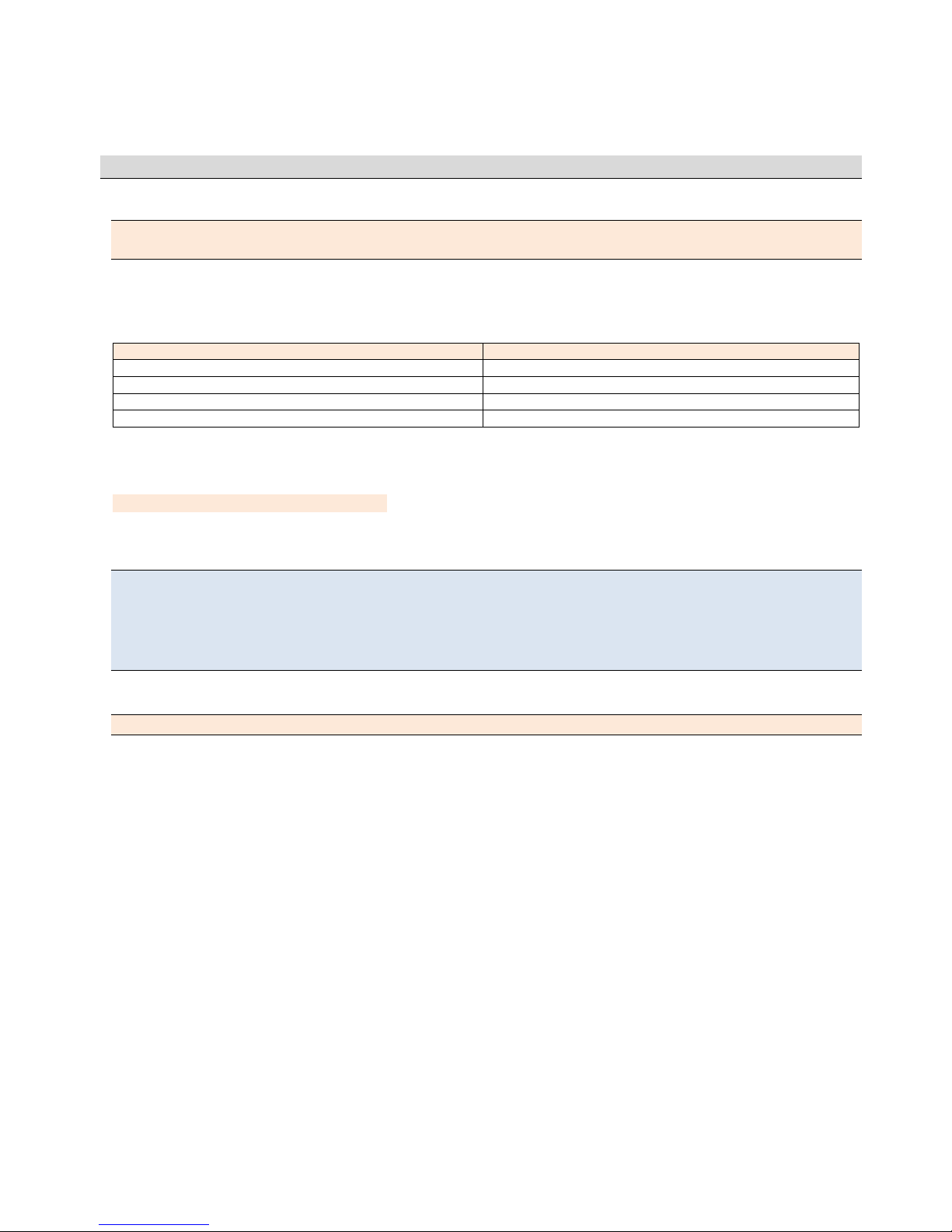
Kompak and Portavent systems have the same operating characteristics as described for the ventilator. The accessories are stored in
compartments. For Kompak versions, the side panel used for the connection to the power supply, is accessible opening the side of the bag
with the zip closure. In Portavent versions, the side pane is accessible only from the frontal part of the device. After charging, be sure that
whole the system has been carefully closed.
The tanks inside Kompak and Portavent must be always closed when the device is not used.
If used in rainy conditions, it is necessary to disconnect the device from the power supply and to close the cases leaving only a small
opening to allow the passage of the patient tube.
12. CLEANING AND MAINTENANCE
12.1 Cleaning
Failure to carry out the correct cleaning routine could increase the risk of cross infection, due to presence of body fluids and/or residuals.
The operator must always wear adequate personal protection such as gloves and mask, etc. during all checking and cleaning procedures.
The described operations must be performed after each use of Spencer 170.
Turn off the device
Isolate it from the power supply (if connected)
The cleaning of the external parts of the device can be carried out using suitable disinfectants for surfaces as described in the table.
USABLE PRODUCTS
NOT USABLE PRODUCTS
Disinfectants with aldehydes
Compounds that release halogens
Disinfectants with alcohol
Strong organic acids
Quaternary ammonic compounds
Compounds that release oxygen
Trichloroethylene
If is used a disposable patient circuit, replace it.
If is used a reusable patient circuit, disassemble every part and sterilize according to a validated procedure.
Similarly, replace or sterilize the mask.
After confirming the ventilator and all accessories are completely dry, is possible to reconnect the device to the power supply.
The use of high pressure water is prohibited, because it should penetrate into the device causing risks of corrosion of components
and risks of electric leakage and short circuits. During every cleaning procedure, check that were not used any kind of lubricants.
12.2 Precautionary maintenance
Establish a maintenance program and periodic testing routine, identifying an employee responsible for this. The person to whom the
ordinary maintenance of the device is entrusted must ensure the basic requirements foreseen by the manufacturer in following paragraphs
are inspected.
All maintenance and periodic servicing activities must be registered and kept together with the servicing reports. These documents have to
be kept for a period of 10 years after the disposal of the device itself. This register will be made available to the competent authorities
and/or manufacturer if requested.
Routine maintenance of the device must be carried out by operators in possession of specific qualifications, trained and expe rienced in the
use and maintenance of the device.
The operator must always wear adequate personal protection such as gloves and mask, etc. during all checking and cleaning procedures.
Checks to be carried out before and after each use and at deadline indicated above, are as follows:
General functionality of the device
Cleanliness of the device (remember that the failure of cleaning may cause the risk of cross infections)
Correct fixation of all nuts, bolts and screws
No structural part is deformed or compromised
12.2.1 Controllo batteria allarmi 9V
The 9 V backup battery must be regularly checked or replaced depending on its use. Using a tester ensure that the voltage on the battery is
not lower than 10%. The correct polarity when connecting the 9 V battery is guaranteed by the seat of the battery holder and the symbols
indicated on the same. For Kompak and Porta Vent systems be careful to remount the ventilator on the chassis without forcing the fixing
screws.
The alarm battery must be replaced once a year even if in good conditions.
12.2.2 Controllo carica batteria interna
The device is powered by a rechargeable battery. A new battery is never fully charged. It will be fully charged only after being charged for
24 consecutive hours before the first use of the device. The battery recharges automatically when the device is connected to the power
supply 12 Vdc or through a 220 Vac adapter connected to the main supply.
With fully charged and in good condition battery, the ventilator can run for about two hours. With old or in poor condition battery will have
shorter autonomy.
If the device is not used for a long time, more than 3 months, you need to recharge the battery. Do not keep the unit in char ge beyond the
time specified. Fully discharge the battery and / or maintain the equipment continuously powered from external source, results in a
significant reduction of the operating life of the battery.
The internal battery must be replaced once a year even if in good conditions.
Page 17
17
12.2.3 Fuse replacing
Spencer 170 uses a fuse type F1L250V (Fuse Fast 5x20mm 1A). The manufacturer assumes no liability related to the use of spare parts not
meeting the specifications provided.
The fuse is a protection mean for the device, which interrupts the flow of current to the ventilator if it exceeds the maximum value
acceptable the device.
If the fuse blows, the device will continue to work with the internal power supply (battery) until it is exhausted, but will not be possible to
recharge it or use it by connecting to an external power.
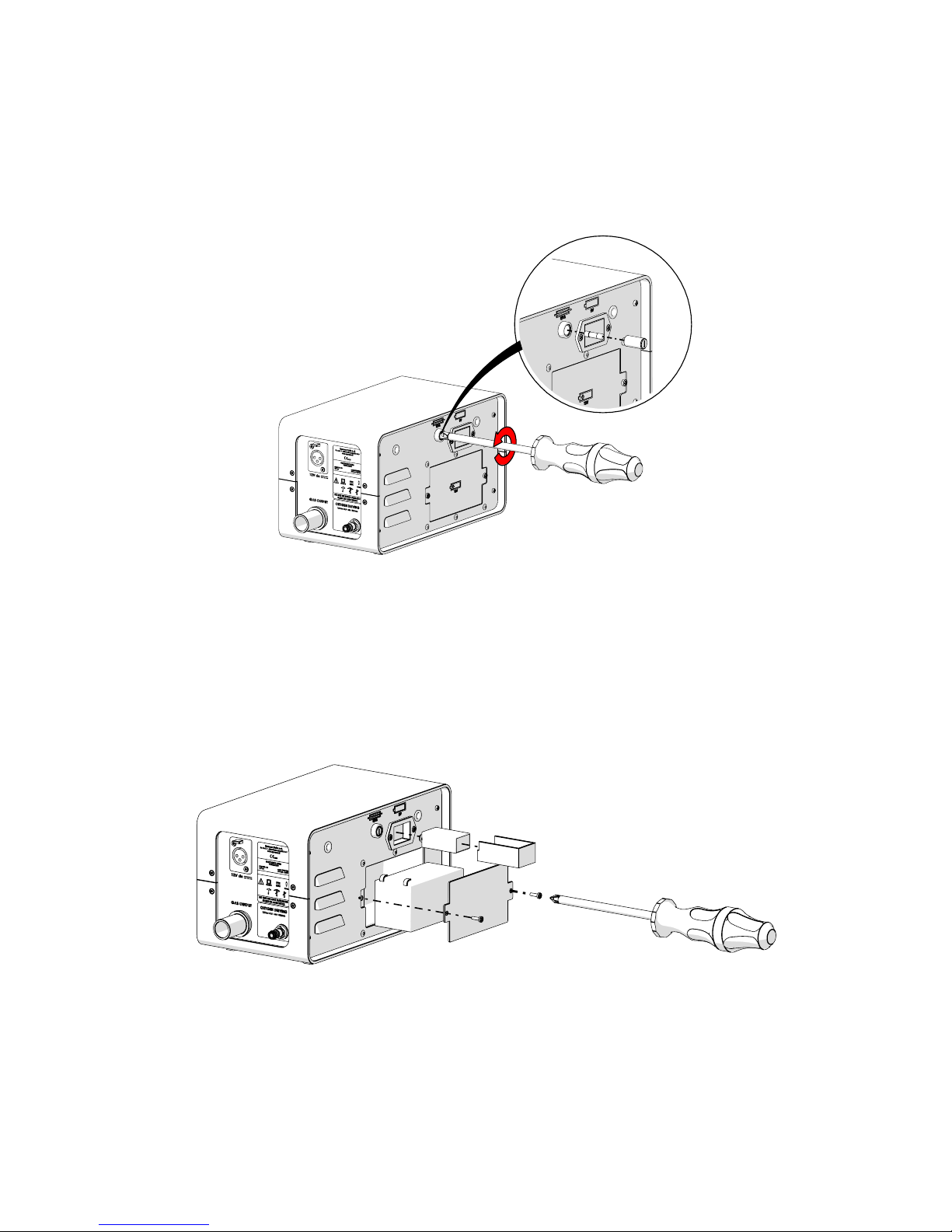
To replace the fuse, unscrew with a flat screwdriver the removable part of the fuse holder.
Verify that the filament is actually broken, so to be sure that the problem is not to be found elsewhere.
Insert the new fuse in the removable fuse holder and screw again.
12.2.4 Battery replacing
The annual maintenance of the device requires, among other activities provided by the manufacturer, the replacement of all b atteries. If is
necessary to replace the batteries before the annual revision, follow these instructions:
Verify that the device is turned off and disconnected from the power supply.
To replace the main battery, unscrew the two screws on the sides of the cover and remove it. Remove the battery and unplug the sockets.
Connect the new battery by putting the red faston on the positive terminal of the battery (also marked with red) and the black faston on
the negative pole. Replace the battery and screw the battery cover.
The backup battery is inserted in a small compartment whose removal requires no tools. Pull it out by holding on recess at the bottom.
The backup battery is the type 6LF22 or 6LR61 9V commercially available. The correct indication of polarity is indicated inside the
removable compartment and must be strictly respected.
.
Page 18

18
In the event of prolonged inactivity periods or before transports, do the following:
Turn of the device by placing the lever on position “O”.
Disconnect the ventilator from the power supply.
Check the charge status of the internal battery and, if necessary, recharge it.
For prolonged inactivity, in addition to the recommendations listed above, the device must be store following other precautions about the
place and time of storage:
Store the device in a closed place.
Protect it from shocks and stresses
Protect it from humidity and wide temperature excursions.
Avoid contact with corrosive substances.
The procedures listed below shall be carried out and checked before each use of the device
To check
Required result
RESPIRATORY SYSTEM
Corrugated Tube
Non-rebreathing valve
PEEP valve (if present)
Face mask
Ventilation test
Disposable filter
Connection
All components have to be in good
conditions and correctly connected
The device or its components must be
correctly cleaned or replaced
ELECTRIC POWER SUPPLY
Turn on the device placing the lever on
position“I”
The device is working
PNEUMATIC POWER SUPPLY
Connection between the oxygen tube and the
device input
Presence of unified plug for connection to
the gas supply or correct connection to the
pressure reducer of the tank (for Kompak
and Portavent systems)
The ventilator is properly connecter to the gas
supply according to the connection standard
requested
The connection to the output of the pressure
reducer is safe
There are no active alarms
Make sure that is always present at least one alternative ventilation unit in order to ensure that the rescue operation can be carried out if
any failure of the device will occur.
The inspection frequency is determined by factors such as legal requirements, the type of use, frequency of use, environmental conditions
during use and storage.
Please note that you must do the cleaning as described in this manual and verify functionality before and after each use. Spencer Italia S.r.l.
declines any responsibility for the improper functioning or damages caused to the patient or user by the use of devices not subject to routine
maintenance and will void the warranty and the compliance to the Medical Device Directive 93/42/CEE.
Use only accessories/original spare parts approved by Spencer Italia S.r.l., otherwise we will accept no responsibility for the incorrect
functioning and/or damage caused by the use of any device which has not been repaired, or certified on expiry date by the man ufacturer or
by one of the manufacturer's authorised service centres. Warranty will be considered void in compliance with the Medical Device Directive
93/42/EEC.
12.3 Periodic maintenance
The device must be serviced by the manufacturer or by an authorised centre, every year.
If the correct revision is not carried out, the CE branding will no longer be considered valid as the product will no longer be compliant with
the 93/42/CE Directive for Medical Devices and consequently it is no longer compliant with the safety standards declared by the
manufacturer at time of purchase.
Spencer Italia S.r.l. will take no responsibility the incorrect functioning or any damage caused by a device that has not undergone regular
revision.
For any operations that are not carried out directly by the manufacturer but by an authorised centre, we have to underline that a report
regarding all operations carried out must be requested. This will permit both Spencer Italia S.r.l. and the end user to keep a log book
regarding the operations carried out on the device.
12.4 Special servicing
Only the manufacturer or centres with written authorisation are authorised to complete any special servicing operations.
For any operations that are not carried out directly by the manufacturer but by an authorised centre, we have to underline that a report
regarding all operations carried out must be requested. This will permit both Spencer Italia S.r.l. and the end user to keep a log book
regarding the operations carried out on the device.
The end user is authorised to replace only the spare parts indicated in the paragraph 15.
12.5 Life span
The device, if used as indicated in the following instruction manual, has an average life span of 5 years
The life span can be expanded only following a general revision of the product that must be carried out by the manufacturer or by a centre
authorised by the manufacturer. Spencer Italia S.r.l. will accept no responsibility for the incorrect functioning and/or damage caused by the
use of any device which has not been repaired, or certified on expiry date by the manufacturer or by one of the manufacturer's authorised
service centres, making void both the guarantee and the conformity to the Medical Devices Directive 93/42/CEE.
Page 19

19
13. TROUBLESHOOTING
PROBLEM
CAUSE
SOLUTION
Medical gas alarm
The device is not connected to a medical gas
supply
Connect the device to a medical gas supply
The oxygen tank is exhausted
Replace with a new tank and prepare the old one for filling
procedures
The delivered pressure is not sufficient (less than
2,8 bar)
Verify the distribution system , or verify the performance of the
pressure reducer by the manufacturer
The patient can’t breath
The patient valve is not correctly positioned or is
damaged
Verify that the patient valve is correctly positioned or replace it
Low Paw (airway pressure)
Non-rebreathing valve is not correctly connected
to the tube or to the mask
Verify the assembly
Low battery
Internal battery with an autonomy less than 5 min
Use an external battery, replace the old one or recharge
immediately
The low battery alarm doesn’t work
The 9V backup battery is discharged
Replace the backup battery
The manovacuometer doesn’t indicate
“0” when the ventilator is not working
The component is damaged
Put the device out of service and contact an authorized service
center
Is not possible to recharge the battery
The electrical connection is not stable
Verify the connection. If anomalies are present, contact an
authorized service center
The battery has reached its life limit
Replace the battery
The fuse is blown
Replace the fuse as described in the manual
The device is not working
Low voltage has caused the block of the
microprocessor
Verify the voltage of the power supply. Turn off the device and
turn on again. If the problem persists, contact a Service center
The quick connector for the input of the
medical gas is not stable
Quick connector damaged or worn
Put the device out of service and contact an authorized service
center
Noises occur caused by vibrations when
driving the medical vehicle
Constant stresses caused a deterioration of the
fasteners or mating surfaces
Ask your installer to check that the conditions for the
installation have been met
The device does not turns on
Anomalies of the internal electronic circuit
Put the device out of service and contact an authorized service
center
13.1 How to return for servicing
In accordance with new European regulations, Spencer Italia S.r.l. lists some key points to preserve the hygiene of the equipment and
operators who use them. Spencer Italia S.r.l. trusts in compliance with these standards in order to ensure hygiene and health to all the
people who work to achieve quality and well-being.
Every device that will be returned to Spencer Italia S.r.l. will undergo health checks before the repair.
If Spencer Italia S.r.l. judges the instrument not suitable for repair because of visible signs of external and/or internal contamination, will
send the device to the customer with specification NOT REPAIRED, attaching a letter of explanation of the defects. Spencer Italia S.r.l. will
decide if contamination is due to a malfunction or incorrect use. If the contamination is due to a malfunction, Spencer Italia S.r.l. will replace
the product only in presence of a SALE RECEIPT. Spencer Italia S.r.l. does not respond for the accessories that show signs of contamination,
then will replace the same charging material costs to the customer. For the above, the device MUST be carefully disinfected on the outer
casing with a cloth moistened with denatured alcohol or solutions containing hypochlorite and accessories immersing them in t he same
disinfectant. Place it in a bag with specified equipment and accessories disinfected. Request to specify the defect in order to carry out the
repair in the shortest possible time. It therefore requires to carefully read the instructions to avoid compromising the device with
inappropriate use. It requires you to specify the kind of fault to give way to the technical Spencer Italy S.r.l to judge whether the fault falls
into the category of warranty.
Page 20
20
14. ACCESSORIES
Standard equipment
EV00106A
Patient circuit
EV20008A
100cm power connection cable
Optionals
EV00102A
Pediatric patient circuit
EV60030C
EVX 30 – PEEP autoclavable with connector
EV60032C
EVX 32 – disposable PEEP VALVE with connector
RM20800A
SPENCER MASK – POLYS. AUTOCL. BLACK FACE MASK SZ.0
RM20802A
SPENCER MASK – POLYS. AUTOCL. BLACK FACE MASK SZ.2
RM20804A
SPENCER MASK – POLYS. AUTOCL. BLACK FACE MASK SZ.4
RM20805A
SPENCER MASK – POLYS. AUTOCL. BLACK FACE MASK SZ.5
RM20810B
SPENCER MASK – KIT 4 SIZES POLYS. AUTOCL. BLACK FACE MASKS
SC60014E
10G wall bracket for ventilators
EV50104E
Wall bracket for Kompak
EV50107
10G Wall bracket for Kompak
15. SPARE PARTS
Spare parts
RIEV001
40cm power connection cable w/lighter plug
RIEV002
100cm power connection cable w/lighter plug
RIEV003
200cm power connection cable w/lighter plug
RIEV004
250cm power connection cable w/lighter plug
RIEV005
400cm power connection cable w/lighter plug
RIEV007
Backup battery 9V
RIEV009
25cm air connection tube for ventilator
RIEV010
100cm air connection tube for ventilator
RIEV011
60cm oxygen connection tube for ventilator
RIEV012
100cm oxygen connection tube for ventilator
RIEV013
240cm oxygen connection tube for ventilator
RIEV014
Internal battery Pb 12V 1,2Ah 170
RIEV015
BATTERY KIT W/FUSE 1A
EV50111
KIT DISPOSABLE FILTERS LATEX FREE. (10 pz)
16. DEMOLITION
The components of the patient circuit, when no longer suitable for use, if they haven’t been contaminated by any particular a gents, they can
be disposed of as normal solid waste, otherwise follow the current regulations for demolition.
WARNINGS FOR THE CORRECT DISPOSAL OF THE PRODUCT IN ACCORDANCE WITH EC DIRECTIVE 2012/19/EU WEEE:
At the end of his life, the product must not be disposed as household waste. Can be taken to special recycling centers provided by local
government, or return it to the dealer on purchase of a new device of the same type and used for the same functions. Dispose of the product
separately avoids possible negative consequences for the environment and human health resulting from inappropriate disposal and allows to
recover the materials in order to obtain significant savings in energy and resources. The symbol on the label indicates separate collection of
electrical and electronic equipment.
Warning: One incorrect disposal of electrical and electronic equipment could result in sanctions.
Information for end users according with comma 22 of Legislative Decree 20 November 2008 n.188 "Implementation of Directive 2006/66
/ EC on batteries, accumulators and their waste and repealing Directive 91/157/EEC"
This symbol on the product indicates that the batteries should not be treated as household waste. Ensuring that the batteries are disposed
correctly, will help prevent potential negative consequences for the environment and human health, which could otherwise be caused by
inappropriate disposal. The recycling of materials will help to conserve natural resources. The batteries must be delivered at the collection
point for recycling. For more detailed information about the disposal of batteries or product you can contact the City, the local waste
disposal service or the company where you purchased the unit.
 Loading...