

Page 1
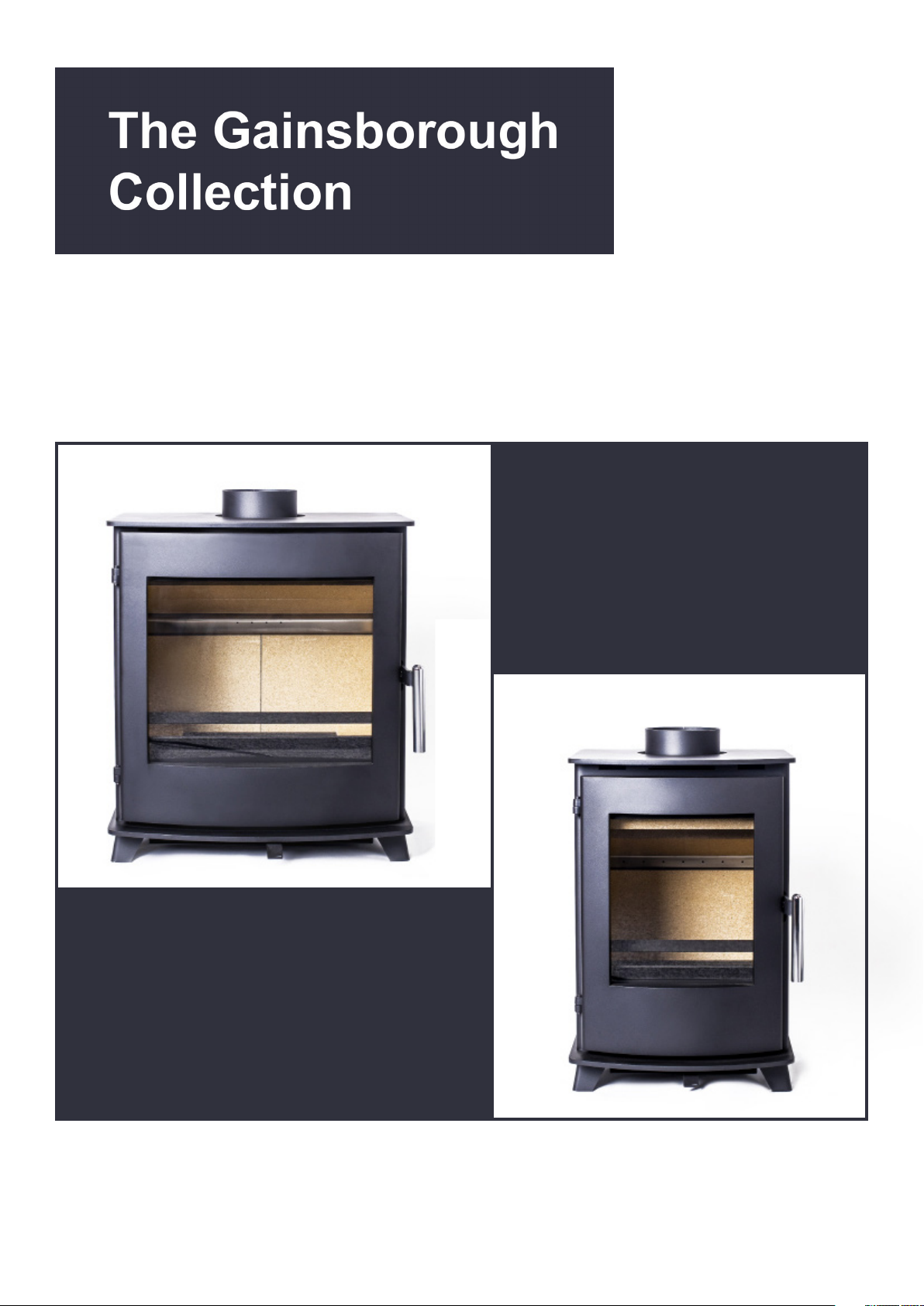
Wood Burning Free Standing Stoves From Specue Ltd
CE and EN13240 Approved
Approved for use in Smoke Control Areas when burning dry wood logs
<
DEVONSHIRE
GILCAR
8 Curzon Road, Chilton Industrial Estate, Sudbury, Suffolk, CO10 2XW
>
Specue Ltd
T: 0333 999 7974 E: sales@specue.com
Page 2
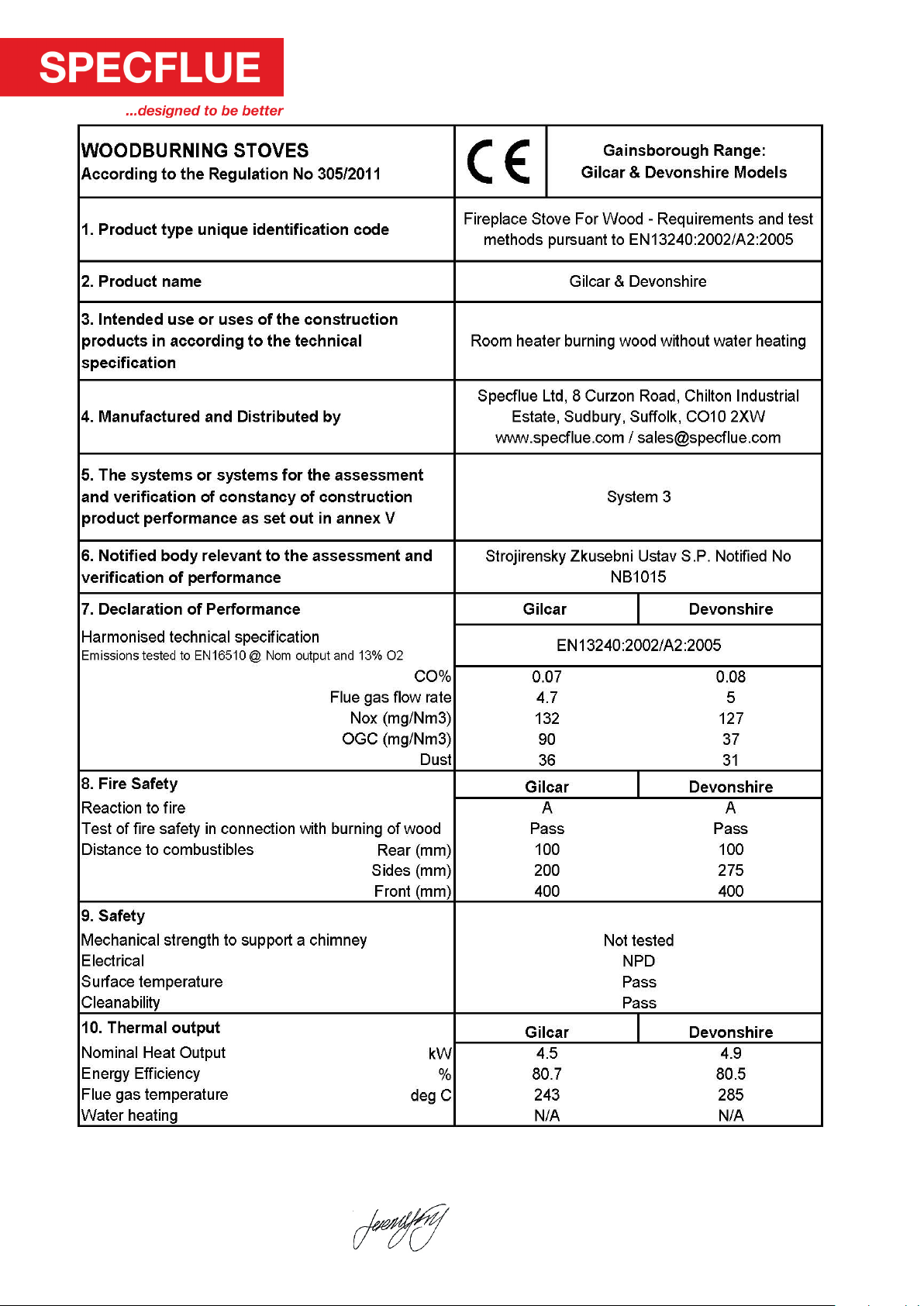
Declaration of Performance
The performance for the products identied in point 2 is in conformity with the declared performance in point 7. This
declaration of performance has been issued under the sole responsibility of the manufacturer as identied in point 4 above.
Signed on behalf of the manufacturer:
Jeremy Fry, Chairman - 15.04.19
page 1 of 12
Page 3

Congratulations on the purchase of your new stove! Your new purchase will provide you with a level
of pleasure and comfort not previously experienced in your home.
The Gainsborough collection of stoves are a heavy duty British designed wood burning stove. They have been designed
for easy installation and ease of use giving a lovely ame pattern when burning wood and a wonderful warm radiant and
convection heat. The stoves are highly efcient with a clean burn rebox and efciencies above 80% (Net) when burning
wood and feature a curved door, large glass window, vermiculite insulated rebox, convector top plate, bolt on adjustable
feet, ergonomic handle and heavy weight steel construction.
Please read and follow the advice and instructions on the safe and efcient operation of your stove to ensure it has a long
trouble free life and also read and follow the installation instructions before installing the stove.
OPERATING INSTRUCTIONS
A wood burning stove is a very efcient heating appliance and must be installed and used safely and wisely. It is important
to understand the working of such an appliance and to understand the process of converting the fuel into heat and its
efcient transfer from the rebox to the room in order to gain the most from the stove.
A stove creates an almost perfect environment to burn wood in. The rebox will run at a very high temperature ideal to
burn the volatiles given off in the burning process and the precise air controls allow minimal heat loss into the ue. These
stoves operate at an efciency of approx 73.2% Gross CV basis (+80.5% Net) and are very much more efcient than an
open re avoiding the wasteful draughts normally associated with that type of appliance.
Burning wood is the natural way to store the sun’s energy to then be released in a carbon neutral process to heat your
house when the need is most. On a cold winter’s night there is nothing to beat the release of heat and ame in a stove to
raise the spirits.
The preparation and burning of wood as a fuel in stoves can be traced back many centuries, however it is a forgotten or
maybe never fully discovered activity in the United Kingdom, we have much to learn from our European and Scandinavian
neighbours whose colder winters have instinctively led them into a natural wood burning culture.
Wood for fuel is probably one of the most environmentally friendly energy sources. It is carbon neutral; trees used for fuel
production regenerate very quickly and it is a pleasant and satisfying job preparing the rewood for the coming winters.
WARNING NOTE
Properly installed, operated and maintained this stove will not emit fumes into the dwelling. Occasional fumes from deashing and refueling may occur. However, persistent fume emission is potentially dangerous and must not be tolerated. If
fume emission persists, then the following immediate action should be taken:
a) Evacuate the property immediately.
b) Open doors and windows to ventilate room as you leave the premises.
c) Let the re go out.
d) Open the doors and windows in your property and ventilate thoroughly.
e) Do not attempt to relight the re until the cause of the fume emission has been identied and corrected. Seek
expert advice e.g. HETAS approved installer/ chimney sweep.
f) If you feel unwell, go to the doctors, call NHS direct on 111 or if urgent call 999 for an ambulance – tell them your
symptom may be relating to carbon monoxide poisoning.
The most common cause of fume emission is ue or chimney blockage. For your own safety these must be kept clean at
all times. Any permanent air vent provided for combustion air must not be blocked off. Care must be taken if an extractor
fan is tted in the same room as the stove as this can cause the stove to emit dangerous fumes into the room.
Your installer should have tted an approved CO alarm in the same room as the appliance. If the alarm sounds
unexpectedly then follow procedures shown above.
CHIMNEY CLEANING
The chimney should be swept a minimum of twice a year for wood burning appliances. It is important that the ue
connection and chimney are swept prior to lighting up after a prolonged shutdown period. If the stove is tted in place
of an open re then the chimney should be swept one month after installation to clear any soot falls which may have
occurred due to the difference in combustion between the stove and the open re.
Installation and Operating Instructions for Gilcar & Devonshire Fresh Air Freestanding Woodburning Stoves Specue v1 - April 2019
page 2 of 12
Page 4

In situations where it is not possible to sweep through the stove the installer will have provided alternative means such as
a soot door. After sweeping the chimney, the stove ue outlet and the ue pipe connecting the stove to the chimney must
be cleaned with a ue brush. Please ensure you use a registered / Approved Chimney Sweep, who will provide you with a
certicate for this work.
It is possible to sweep through these stoves by removing the lower vermiculite bafe and upper steel bafe to gain access
to the ue pipe. The method of removal is described later in the manual.
The connecting ue pipe and stove bafe should be checked monthly to clear any y ash or soot deposits.
USE OF A FIREGUARD
When using the stove in situations where children, aged and/or inrm persons are present a reguard must be used to
prevent accidental contact with the stove. The reguard should be manufactured in accordance with BS 8423:2002.
INSTRUCTIONS FOR USE:
First Firing
The stove has been treated with a heat-resistant coating, which hardens at a temperature of approximately 250 C. This
hardening process causes the production of smoke and malodorous fumes, so the room must be very well ventilated.
During the rst ring, which should be carried out using approximately 1 kg of wood, the door must be left slightly open
and must not be closed until the stove is cold. This is to prevent the sealing rope sticking to the stove. It is important not
to overheat during this rst ring; a stove pipe thermometer can indicate the ue gas temperature.
RECOMMENDED FUELS
The recommended fuel that can be burnt on these stoves is wood logs (Woodsure approved – Ready to Burn).
Correct ring provides optimal heat output and maximum economy. At the same time, correct ring prevents
environmental damage in the form of smoke and malodorous fumes and also reduces the risk of chimney res.
Well seasoned woodfuel is essential for correct use. Make sure your fuel is kept dry. If the fuel is wet, a large proportion
of the heat will be used to vaporize the water, and this energy will disappear up the chimney. It is clearly not only
uneconomical to re with wet fuel but also, as mentioned above, increases the risk of producing soot, smoke and other
environmentally damaging by-products. When wood is used as a fuel, it is important that it is dry, i.e. wood with moisture
content less than 20% - this can be identied through the use of a moisture meter. Ideally rewood needs seasoning for
at least 2 summers, logs should be stacked in a well ventilated situation, and logs over 100mm diameter should be split.
The stack should be protected from rain but remain well ventilated.
Generally dry wood (<20% moisture content) produces 4.5kW/h per kg; semi dry about 3kW/h per kg and wet wood
1kW/h per kg demonstrating that fewer drier logs are required to produce the same amount of heat output.
Appliance Wood Length
Gilcar 26cm
Devonshire 36cm
FUEL CONSUMPTION AT NOMINAL HEAT OUTPUT
Appliance Nominal Output kW Wood kg/hr
Gilcar 4.5 1.35
Devonshire 4.9 1.66
Tested according to the requirements of EN13240. Note that different fuel consumption results may be achieved due to
other factors which include the fuel, chimney draught and atmospheric conditions etc.
The nominal output is the output to which the stove has been tested. In practice, the stove burns with a heat output
range between its minimum and maximum ratings.
Installation and Operating Instructions for Gilcar & Devonshire Fresh Air Freestanding Woodburning Stoves Specue v1 - April 2019
page 3 of 12
Page 5
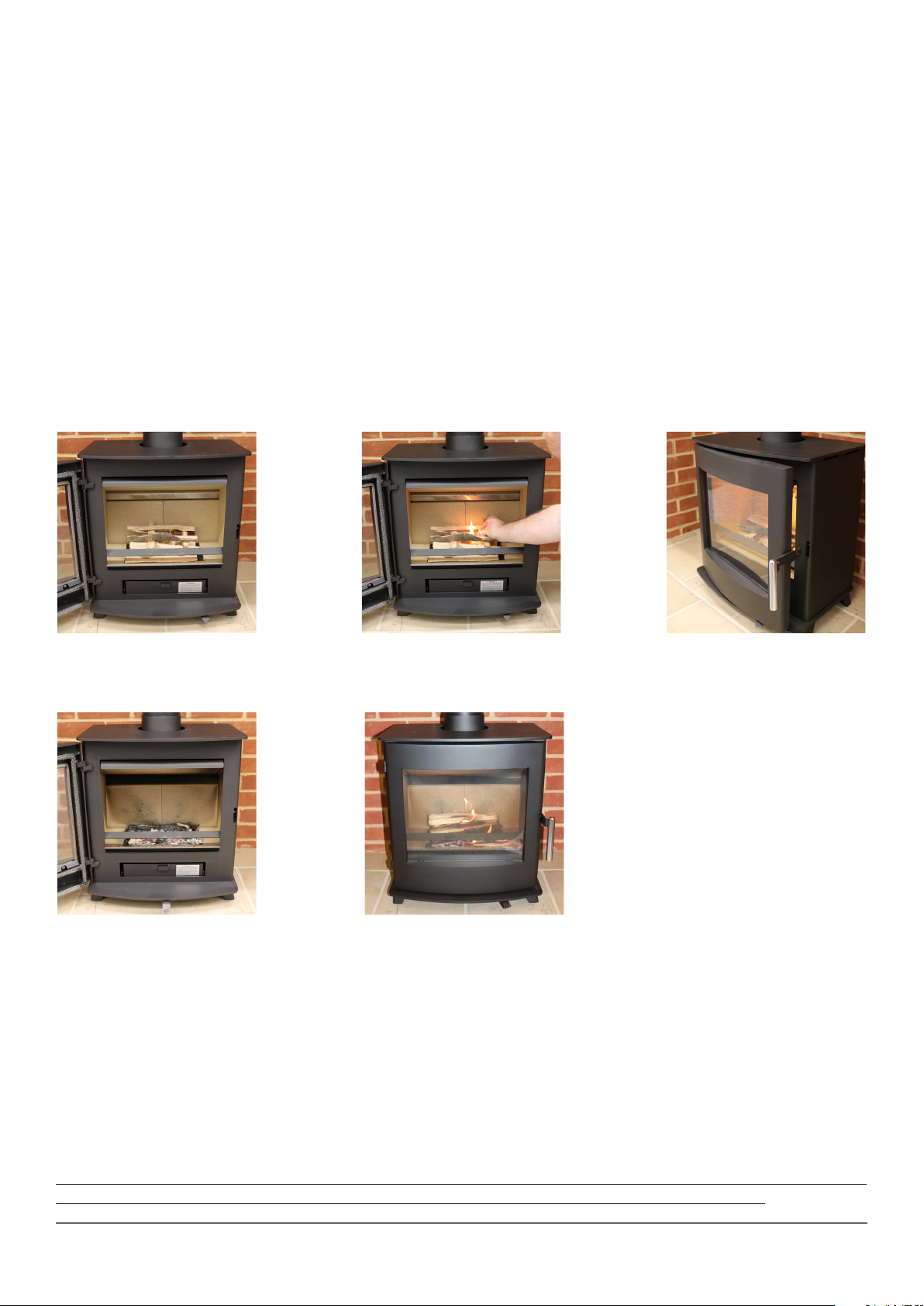
LIGHTING AND COMBUSTION
A single lever air control located underneath the bottom of the door controls the air that enters into the stove through the
rear air inlet. The combustion air ows up the back of the stove preheating before owing the glass window as secondary
air. This secondary air creates an “air-wash” to keep the glass clean and feeding the re; it is this secondary combustion
that completes the burning cycle by turning unburned volatiles into ame. Finally, any remaining un-burnt volatiles,
hydrocarbons and particulates are burnt when preheated tertiary air enters the rebox through the tertiary air diffuser at
the rear of the rebox. In practice, normal running will be with the air lever in the mid-point position.
As much as half of the heat obtainable from wood is achieved from secondary and tertiary combustion. It is important
that the rebox temperature is maintained at a high level as this also aids complete combustion. For example, when rst
lighting a stove it is important to get it really hot before closing the burning rate down. The rebox temperature should
reach 400°C which equates to approximately 250 °C at the ue pipe.
These stoves are designed and fully tested to burn extremely cleanly with very little smoke discharge and are exempt for
use in smoke control areas throughout the UK when burning dry wood logs. To comply, a built-in permanent stop is tted
as standard to the air control mechanism so that it cannot be closed completely (Gilcar 15% open; Devonshire 10% open)
and will always allow air to enter. A permanent amount of primary air must therefore enter the rebox to feed the re
producing negligible amounts of smoke and unburnt hydrocarbons. See Appendix A of this manual for further details.
1. Put 2 small logs on a bed of ash
spaced about 6-7cm apart. Place
1-2 relighters in between and move
air lever to right (fully open)
4. After about 35/45 minutes, when
the last ames have gone out a red
hot ember bed will be left and further
wood can be added
Note:
2. Neatly stack dry kindling on top of
the logs in a # formation of approx
3 layers and light the bottom re
lighters
5. Place 2/3 logs on the hot embers
and ensure that the wood is not
stacked too closely with the air slider
fully open. The wood will ignite in
2/3 minutes. Adjust the air slider for
optimum combustion
3. With the door slightly open the re
will quickly build, warming the stove
and chimney. Once the ames are
established the door can be shut
and the stove can be controlled
by the air slider. Adjust the air
lever to the left to nd the optimal
combustion
If the re dies down completely or embers are smoldering then it will be necessary to place some relighters onto the
grate with some kindling or small pieces of wood to reestablish the re once again. Leave the air slider fully open and
allow the re to build before refueling with larger pieces of wood and then adjust the air slider for optimum combustion.
Refuelling onto a low re bed: If there is insufcient burning material in the rebed to light a new fuel charge, excessive
smoke emission can occur. Refuelling must be carried out onto a sufcient quantity of glowing embers and ash that the
new fuel charge will ignite within a reasonable period. If there are too few embers in the re bed, add suitable kindling to
prevent excessive smoke.
Do not overload the rebox by loading above the tertiary air diffuser at the back of the rebox and ensure that the wood is
retained by the log guard. Always ensure that the wood is not tightly stacked so that air can circulate freely.
Installation and Operating Instructions for Gilcar & Devonshire Fresh Air Freestanding Woodburning Stoves Specue v1 - April 2019
page 4 of 12
Page 6

Do not leave the door open: Operation with the door open can cause excess smoke. The appliance must not be operated
with the appliance door left open except as directed in the instructions.
Do not leave the air sliders completely open: Operation with the air slider permanently open can cause excess smoke.
The appliance must not be operated with air controls or dampers left open except as directed in the instructions.
SLUMBERING A STOVE
Whilst it may seem appealing, slumbering a stove at the end of an evening is not to be recommended. Not only is this
harmful to the environment due to the incomplete combustion of the fuel but there is a potential to create longer term
problems to the stove internal components which also includes the glass door panel and ue components. Incomplete
combustion of the fuel will lead to gas build up in the re chamber potentially including Sulphur, which under certain
conditions can start attacking these components. This practice WILL void all warranties.
SAFETY PRECAUTIONS
A risk of blowback and/or explosion can arise if too much dry wood is placed in the stove and burnt with insufcient
combustion air. This may result in the production of gaseous compounds which can ignite if the intake of primary and
secondary air is insufcient and the rebox temperature too low.
For wood burning it is an advantage always to leave some ash lying in the bottom of the combustion chamber. Take care
when emptying the ash pan, as cinders can continue to burn in the ash for long periods of time.
MAINTENANCE OF MATT BLACK PAINT FINISH
The surface of the stove has been treated with heat-resistant paint. The stove can be cleaned with a soft brush after it
has cooled down. Any damage to the surface in the form of chips or scratches can be repaired using touch-up paint,
which is available in spray cans. If the stove has become grey in colour due to overheating, touch-up paint of this kind
can be used to repaint the stove entirely. Alternatively the stove can be maintained with a traditional type of stove polish
of which there are several proprietary makes available. Do not use an aerosol spray anywhere near the stove when it is
either alight or still hot – allow it to cool down before respraying.
MAINTENANCE OF THE STOVE GLASS
Incorrect ring, for example using wet wood, or slow burning can result in the viewing window becoming covered in
soot. This soot can be easily and effectively removed by using a dry wiper glass cleaner, when the glass is cold. Burning
contaminated, incorrect solid fuels or fuels high in Sulphur may cause permanent damage to the glass, which is not
covered by any warranty.
OPERATIONAL PROBLEMS
In the event of smoke or malodorous fumes being produced, you must rst check to see whether the chimney is blocked.
The chimney must, of course, always provide the minimum draught necessary (12 Pa) to ensure that it is possible to
regulate the re. However, the chimney draught may also be affected by weather conditions. Both wind and temperature
can affect the performance of a chimney.
In cases where the wood burns too quickly, this may be due to excessive chimney draught. You should also check to
make sure that the door seal is intact. If the stove produces too little heat, this may be due to the fact that you are ring
with wet wood. A large proportion of the heat output will be used to dry the wood, resulting in both uneconomical heating
and an increased risk of soot and tar deposits forming in the chimney.
STANDING DOWN AT THE END OF THE SEASON
At the end of the burning season the stove should be prepared for the stand down period, this is to prevent corrosion
both in the stove and ue system.
The stove should be cleared of all ash, the bafe and ue ways cleared of soot and y ash and the chimney swept.
All air vents should be in the open position and it is recommended that the door is left ajar to ventilate the chimney.
This is the ideal time to check for parts that may need replacing and to lubricate door hinges and catches. Also it is
recommended that all screws holding the glass in place are removed and replaced with a high temperature lubricant such
Installation and Operating Instructions for Gilcar & Devonshire Fresh Air Freestanding Woodburning Stoves Specue v1 - April 2019
page 5 of 12
Page 7

as copper slip.
INSTALLATION INSTRUCTIONS
(for UK excluding Scotland where local Building regulations must be conformed to).
It is essential that the installation is carried out by an experienced and competent installer, ideally HETAS registered (see
www.hetas.co.uk) and with reference to BS 8303, Code of Practice for installation of domestic heating and cooking
appliances burning solid mineral fuel. Under England & Wales Building Regulations it is a legal requirement that the
stove is either installed by a competent person, or that the installation is carried out under Local authority building control
approval. Your HETAS installer should install and test all parts of the stove and ue before providing certication for the
property.
CO ALARMS
Building regulations require that whenever a new or replacement xed solid fuel or wood/biomass appliance is installed
in a dwelling a carbon monoxide alarm (to BS EN 50291-1:2018) must be tted in the same room as the appliance.
Further guidance on the installation of the carbon monoxide alarm is available in BS EN 50292:2002 and from the alarm
manufacturer’s instructions. Provision of an alarm must not be considered a substitute for either installing the appliance
correctly or ensuring regular servicing and maintenance of the appliance and chimney system. CO alarms should be
regularly tested and kept free from dust and debris with regular vacuuming.
HEALTH AND SAFETY PRECAUTIONS
Special care must be taken when installing the stove such that the requirements of the Health and Safety at Work Act are
met.
Manual Handling
Adequate facilities must be available for loading, unloading and site handling.
Fire Cement
Some types of re cement are caustic and should not be allowed to come into contact with the skin. In cases of contact,
wash immediately with plenty of water and refer to COSHH data sheets.
Asbestos
This stove contains no asbestos. If there is a possibility of disturbing any asbestos in the course of the installation then
please seek specialist guidance and use appropriate protective equipment.
Metal Parts
When installing or servicing this stove care should be taken to avoid the possibility of personal injury.
ASSESSING THE REQUIREMENTS FOR THE INSTALLATION OF A STOVE
Your supplier or HETAS registered installer will be able to advise you on the individual requirements that are needed to
install a stove safely.
It is most important that the stove is the correct size. This means that the output should match the heat requirements of
the room. Also to be considered is the fuel choice and the provision of suitable and convenient storage with easy access
to the stove.
Having decided on the ideal appliance then the installation should be fully assessed. The chimney requirements should
be carefully assessed. Hearth requirements should be carefully specied, remember the building regulations lay out
the minimum requirements. The chances of damaging a oor or carpet will be much reduced if the depth of a hearth is
extended beyond the minimum. Any combustible materials should be at least 500mm distance from the sides and back
and 800mm clear of the door and should never be allowed to exceed 80 °C. For further advice on chimney and hearth
also see details below.
Assess also the replace surround if any is to be used, it is essential that combustible materials are not used close to the
stove and ue pipe. This requirement may vary depending on the shielding but is advised to keep combustible materials
at least 500mm or preferably 1 metre away from the stove or ue pipe.
Installation and Operating Instructions for Gilcar & Devonshire Fresh Air Freestanding Woodburning Stoves Specue v1 - April 2019
page 6 of 12
Page 8
THE FOLLOWING ITEMS ARE INCLUDED WITH THE STOVE
A pair of leather gloves for operation of door handle and refueling the stove, an ash pan and handle.
HEARTH
The replace and hearth should conform to at least the minimum requirements laid out in the Building Regulations
Approved Document J. The hearth should be able to accommodate the weight of the stove and its chimney if the
chimney is not independently supported.
Stoves must stand on a non-combustible hearth that must extend at least 300mm in front and 150mm to both side and
rear if the ue outlet is from the top.
DIMENSIONS AND CLEARANCES
No Combustible materials should be used in the construction of a replace or within the chimney or used in the installation
of a stove, ue or chimney.
Care should also be taken in the construction of hearths or replaces to ensure that suitable provision is taken to allow for
expansion and contraction of the construction materials.
When installing these stoves in a replace recess, sufcient space must be provided on either side, behind and above to
allow for heat convection and for access for maintenance of stove, ue pipe and chimney:
Minimum clearances in a solid masonary replace recess:
Sides Rear Top
Gilcar & Devonshire 50mm 50mm 150mm
Minimum clearances from non solid masonary in a freestanding situation:
Sides Rear Top
Gilcar 200mm 100mm 200mm
Devonshire 275mm 100mm 250mm
* Recommended minimum clearance to combustible materials 800mm from the front, and 150mm from the rear.
Any combustible materials in the vicinity of an appliance, whether exposed or covered, should be protected to ensure that
the surface temperature does not exceed 65C plus ambient room temperature (approx 86C). The installer is responsible
for ensuring the correct materials and distances are used and maintained.
It is deemed safe to install these stoves on a combustible oor provided it is covered by a non-combustible hearth plate of
at least 12mm thickness and extends at least 300mm in front and 150mm to either side.
Note: un-insulated ue pipe must be installed to local building regulations and ue manufacturer’s installation instructions.
BAFFLE PLATE REMOVAL
These stoves are tted with a twin bafe system to improve efciency and lower CO with the lower one made from
vermiculite and the upper one made from steel. Removal of the steel bafe allows immediate access into the ue system
for sweeping.
Installation and Operating Instructions for Gilcar & Devonshire Fresh Air Freestanding Woodburning Stoves Specue v1 - April 2019
page 7 of 12
Page 9
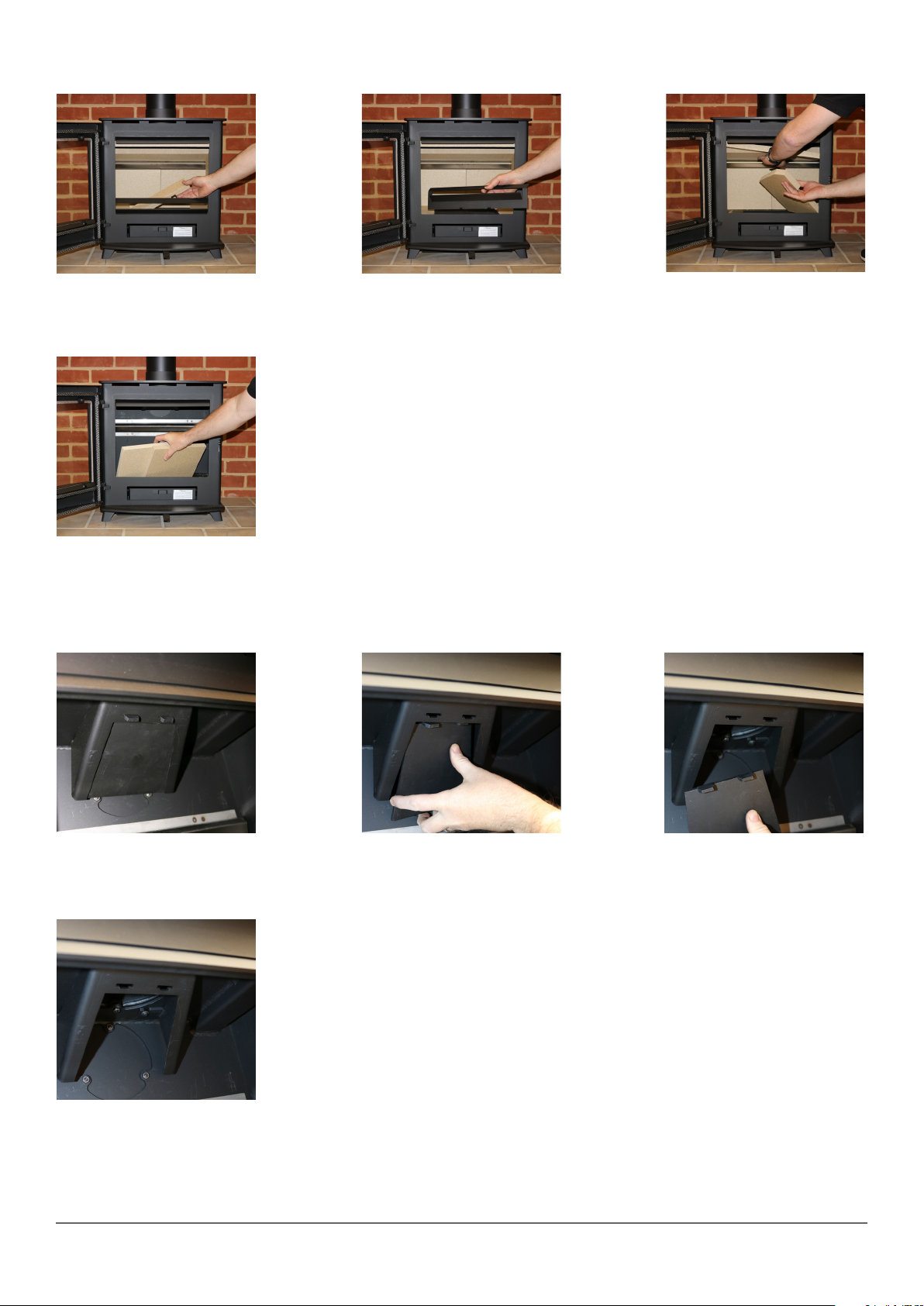
Removal of lower vermiculite bafe:
1. Remove the front base brick part 2. Gently lift the front fence up and
out of the stove followed by the
grate and remaining base bricks
4. Remove the left hand side brick
followed by the 2 rear bricks
Removal of upper steel bafe:
3. Ease the right hand side brick
away whilst supporting the front
bafe section with your other hand.
Carefully manoeuvre both bafe brick
sections out of the stove
1. The upper steel bafe sits in a
bolt-up housing at the top of the
inside of the stove
4. Removal of the bafe gives
immediate access to the ue for
sweeping and maintenance.
Installation and Operating Instructions for Gilcar & Devonshire Fresh Air Freestanding Woodburning Stoves Specue v1 - April 2019
2. Removal is a simple process
of pushing the top of the plate up
which lifts the pegs clear of the
housing
3. Twist the steel bafe as the pegs
disengage from the housing to
remove
page 8 of 12
Page 10

CHIMNEY IMPORTANT WARNING
This stove must not be installed into a chimney that serves any other heating appliance. The chimney must be a minimum
height of 4.5 metres overall height and be in accordance with Building Regulations Approved Document J and reference
should be made to British Standard BS EN 15287-1:2007 design, installation and commissioning of chimneys. Any
chimney, either masonry or a prefabricated stainless steel system must be constructed and installed according to building
regulations. It is recommended that the minimum diameter of the ue liner be 150mm. For new masonry chimneys we
recommend pumice cement liners. A chimney draught of at least .06” (12Pa) is recommended. If it is found that there
is excessive draught in the chimney then a draught stabiliser should be tted (check ventilation requirements). Provision
must be made for easy sweeping of the chimney. A soot door can be built into a masonry chimney and ue pipe is
available with cleaning doors.
Any bend in the chimney or connecting uepipe should not exceed 45º.
THE CHIMNEY CONNECTION
The ue pipe for connecting the appliance to the chimney must be installed according to Building Regulations Approved
Document J and its diameter must be not less than the diameter of the outlet of the appliance. The ue pipe must be
adequately sealed to both the stove and the chimney to avoid any leakage.
ALL CHIMNEYS SHOULD BE SWEPT AND INSPECTED BEFORE INSTALLATION OF ANY APPLIANCE
For relining existing chimneys, 316 or 904 grade stainless steel liners or pumice cement liners in accordance with Building
Regulations Approved Document J should be used. Liners should be suitably insulated. Any chimney relining must be
carried out by an experienced and competent installer who is HETAS registered (see www.hetas.co.uk). The HETAS
Guide to Approved Products and Services lists Chimneys and lining systems suitable for use with solid fuel.
The installer must make allowance for sufcient expansion gap in appliance spigot when connecting to a suitable ue
pipe/ chimney system
SWEEPING THROUGH STOVES
When installed with a top ue outlet it is possible to power/ rotary sweep through these Stoves. Remove the bafes as
described previously, and access can be gained to the ue pipe.
VENTILATION
Permanent ventilation may be required in accordance with the guidelines given in Approved Document J of The Building
Regulations. For houses built before 2008, purpose made ventilation is not required on these stoves. Houses built after
2008 where the air leakage rate is less than 5m3/hour/m2 then a ventilator equivalent to 550mm2 per kW output will be
required (4kW x 550mm = 2200mm2). The person carrying out commissioning should always carried out smoke tests /
spillage tests / re-fueling tests / de-pressurisation test to verify that the stove has met the air supply demand.
COMMISSIONING
The installer should carry out the following checks and ensure that the stove is fully functional. We strongly recommend
that a rst ring is included in the commissioning process:
1. Check all ue pipe connections
2. Check door latch mechanism
3. Check door and glass seals are all intact and secure
4. Warm chimney and check draught
5. Instruct customer in use of stove
6. Leave instructions for customer
7. Check that after initial ring the door seals are not stuck to the body of the stove
WARRANTY
The stove range is automatically covered by a 12 month warranty for safety, performance and construction. Under the
Terms and Conditions, the installation of the stove will need to both comply with the current building regulations and be
installed by a qualied HETAS engineer. Furthermore, the stove has to be serviced and maintained annually by a suitably
qualied HETAS or chimney engineer and the certicate of installation and all records/receipts and annual servicing
records will need to be provided in the event of any claim.
Installation and Operating Instructions for Gilcar & Devonshire Fresh Air Freestanding Woodburning Stoves Specue v1 - April 2019
page 9 of 12
Page 11

Please note, as is normal practice in the industry, bricks, bafes, glass, grate, log retaining fence, ash pan and rope seals
are considered wearing parts requiring replacement during routine maintenance and as such are not covered under any
warranty conditions.
Spare parts can be ordered through the stockist who supplied the stove or directly through Specue Ltd.
In the event of any warranty claim then in the rst instance a claim must be made with the stockist or stove dealer who
supplied the stove and must follow our Terms and Conditions as set out below. It is entirely at Specue Ltd decision
whether to repair or replace any part that it considers are defective. Any repaired or replaced parts are covered only for
the remaining warranty period of the stove unit.
TERMS AND CONDITIONS
Your Gilcar / Devonshire stove is guaranteed against any defects providing:
1. The stove was installed according to our instructions and installation was carried out by a qualied HETAS or an
appropriate Building Control Certicate of Completion was issued which must accompany any claim
2. No damage has occurred during the installation
3. The chimney has either been inspected and repaired as necessary or replaced with a suitable ue system and any high
draught issues have been remedied
4. The serial number of the stove must accompany the claim
5. The stove must be kept in a continuous serviceable condition with no corrosion evident or allowed to have taken place.
If older than 12 months then proof of an annual service record must be provided.
6. There has been no modications made to the construction or internals components or incorrect service parts installed
7. The stove has not been over-red through:
a. Overlling the rebox with fuel and/or burning it continuously with fully open air sliders
b. Burning incorrect or prohibited fuels e.g., house coal, fuels containing high levels of petroleum coke, sulphur,
wet or contaminated wood (paint, varnish, creosotes etc)
8. Excessive ash when burning wood has been removed
9. The stove has not been allowed to slumber continuously overnight
10. The stove is not used in a damp environment
11. The stove has not been used in a commercial environment (rental property, hotel, public barn etc.) where there is
opportunity for the members of the public who are not familiar to the operation to misuse or abuse the safe operation of it
LIMITATION OF WARRANTY
The warranty is not transferrable and will only stay with the original retail purchaser. Copy of the original sales receipt will
need to be seen as proof of purchase. It does not cover such things as unauthorised modications or repairs, misuse or
abuse, accidental damage, illegal installations and if the stove has not been serviced every 12 months.
Specue Ltd will not under any circumstances cover any incidental or consequential loss which includes any commercial
loss, damage to any furnishings, damage to non-related products, removal/reinstallation costs, transports delay or
additional transport costs or any injury to persons or property.
The Specue Ltd warranty does not affect your statutory rights.
Installation and Operating Instructions for Gilcar & Devonshire Fresh Air Freestanding Woodburning Stoves Specue v1 - April 2019
page 10 of 12
Page 12
APPENDIX A
The Clean Air Act 1993 and Smoke Control Areas
Under the Clean Air Act local authorities may declare the whole or part of the district of the authority to be a smoke
control area. It is an offence to emit smoke from a chimney of a building, from a furnace or from any xed boiler if located
in a designated smoke control area. It is also an offence to acquire an “unauthorised fuel” for use within a smoke control
area unless it is used in an “exempt” appliance (“exempted” from the controls which generally apply in the smoke control
area).
In England appliances are exempted by publication on a list by The Secretary of State for Environment, Food and
Rural Affairs in accordance with the changes made to section 20 and 21 of the clean air act 1993 by section 15 of the
deregulation act 2015.
Similarly in Scotland appliances are exempted by publication on a list by Scottish Minister under section 50 of the
Regulatory Reform (Scotland) Act 2014.
In Wales and Northern Ireland these are authorized by regulations made by Welsh Minister and by the Department of the
Environment respectively.
The Gilcar and Devonshire stoves have been recommended as suitable for use in smoke control areas when burning
wood logs.
Further information on the requirements of the Clean Air Act can be found here: https://www.gov.uk/smoke-control-arearules
Your local authority is responsible for implementing the Clean Air Act 1993 including designation and supervision of smoke
control areas and you can contact them for details of Clean Air Act requirements.
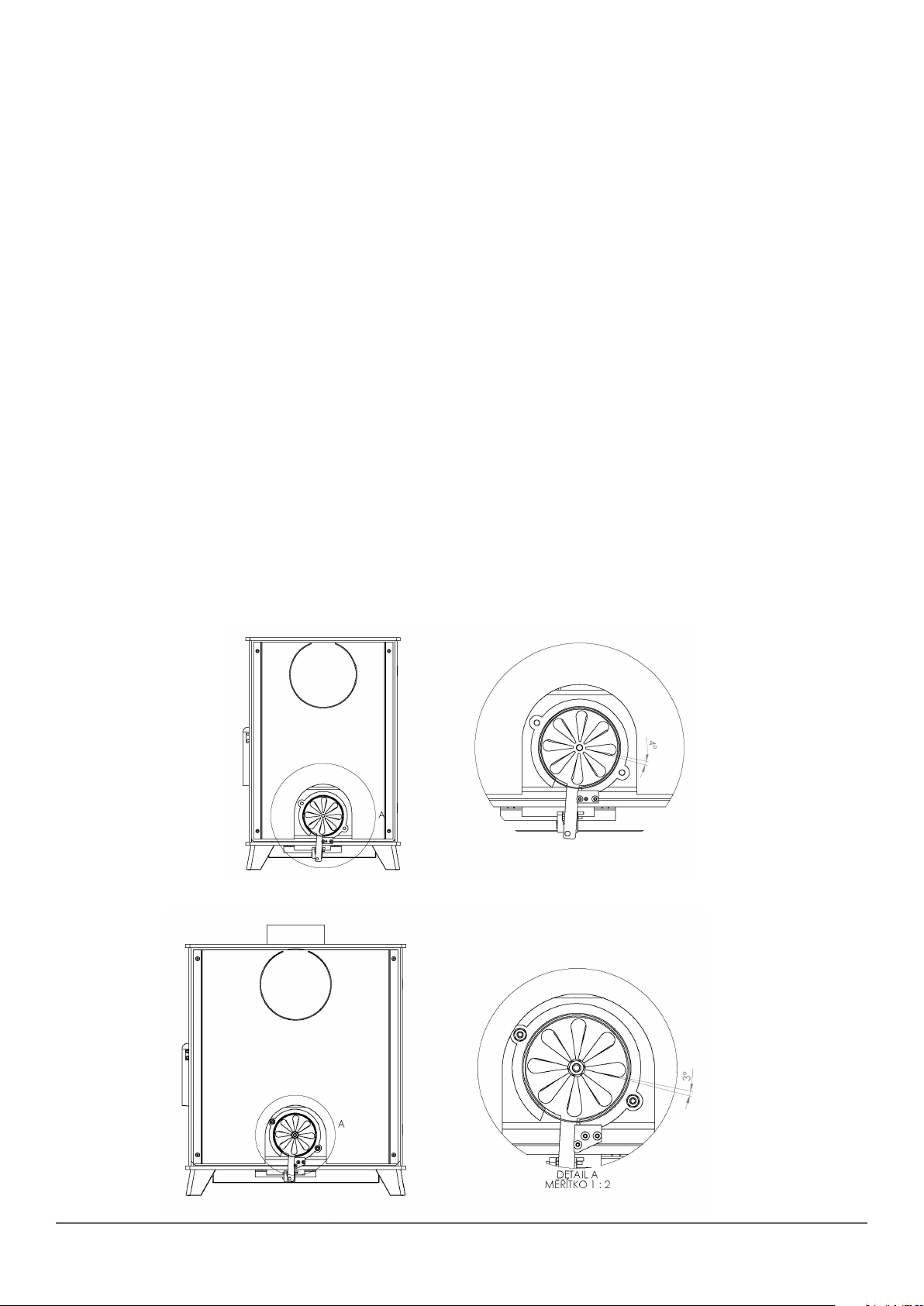
The Gilcar is tted, as standard, with a mechanical stop to prevent closure of the secondary air controls beyond 15%
open.
The Devonshire is tted, as standard, with a mechanical stop to prevent closure of the secondary air control beyond 10%
open.
Installation and Operating Instructions for Gilcar & Devonshire Fresh Air Freestanding Woodburning Stoves Specue v1 - April 2019
page 11 of 12
Page 13
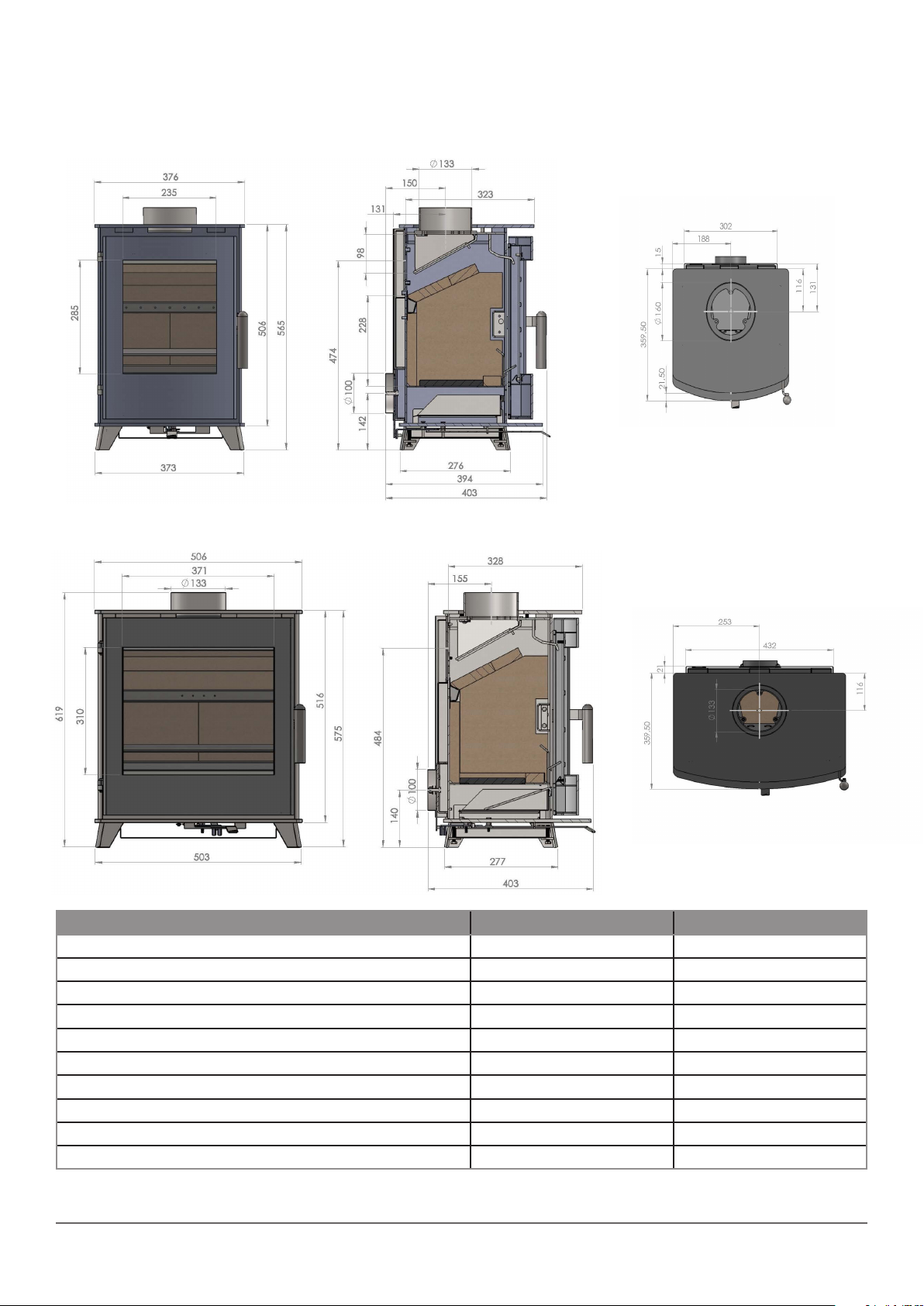
APPENDIX B
Technical Specications for Gilcar & Devonshire Fresh Air Models
GILCAR
DEVONSHIRE
Gilcar Devonshire
Width x max depth x height (mm) 376 x 394 x 565 506 x 403 x 575
Weight (kg) 85 95
Maximum log length (mm) 260 360
Top/ Rear ue diameter (mm) 128 128
Nominal output (kw) 4.5 4.9
Distance from rear of stove to centre of top ue outlet (mm) 140 140
Distance from oor to centre of rear ue outlet (mm) 480 490
Efciency (Net): Wood % 80.72 80.5
Energy efciency label A+ A+
CO% @ 13% O2: Wood 0.07% 0.08%
Installation and Operating Instructions for Gilcar & Devonshire Fresh Air Freestanding Woodburning Stoves Specue v1 - April 2019
page 12 of 12
 Loading...