

Page 1
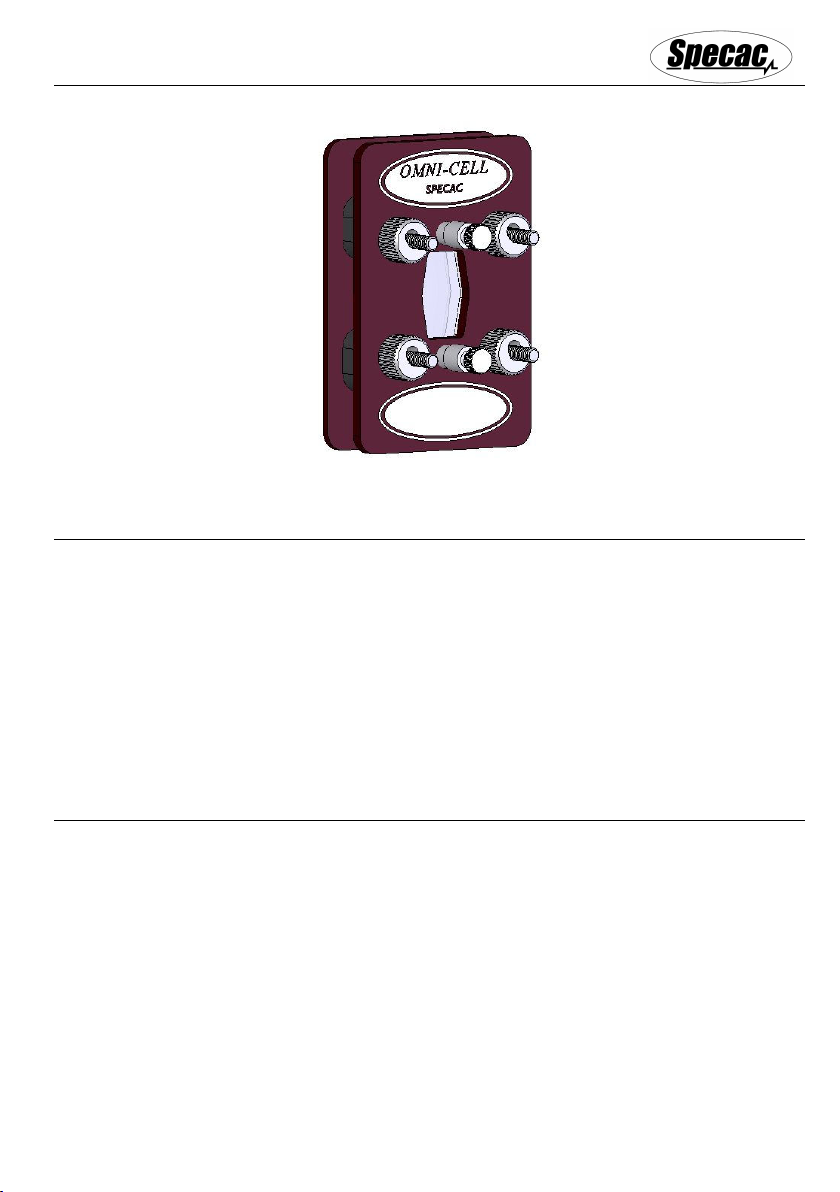
The Omni Cell
User Manual
2I-869-149200-2
1. Introduction
The Omni Cell has been designed to study liquid solutions in demountable or sealed liquid cell
assemblies or as liquid mulls for both Dispersive and FTIR instruments at ambient temperatures and
pressures. The Omni Cell is supplied in separate parts: cell body, spacers and windows for assembly by
the user. The cell body accepts a standard gasket/window/spacer construction, which is contained
between front and back anodised aluminium plates. The plates are of the standard 3” x 2” dimension
allowing the cell to be held in all spectrometer mounting systems via the back plate. Rectangular
windows are used for liquid cell applications, whereas circular windows are used for mull cell
applications.
2. Operation
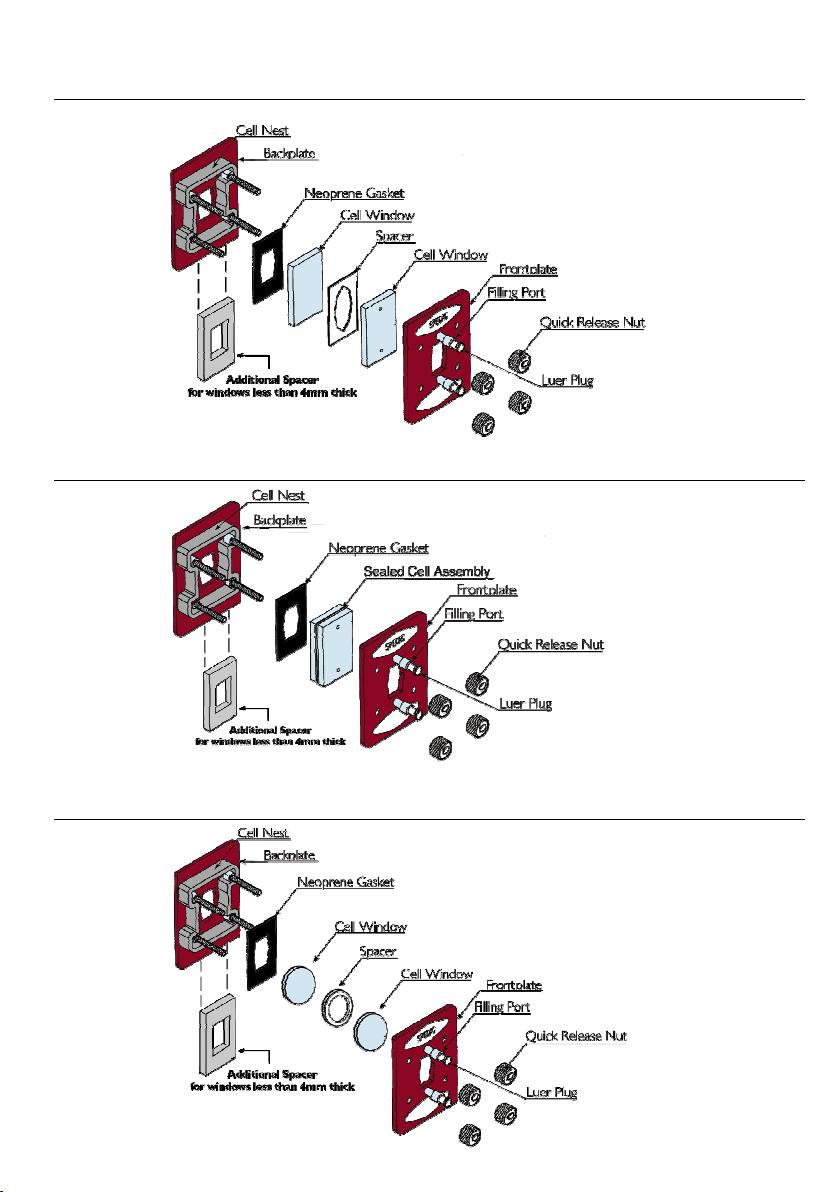
A typical Omni Cell, liquid or mull type, is constructed as shown (Construction, Section 3). Demountable
liquid cells have separate windows and a PTFE spacer and sealed liquid cells have windows
amalgamated to a lead spacer. The mull cell has circular windows and a PTFE spacer. The front plate
has a PTFE gasket permanently bonded into position to allow sealing between the front plate and front
window.
The 4 quick release nuts are tightened to provide a sufficient seal between all of the components but not
over-tightened such that the windows could break. Window materials have their own physical
characteristics; some are soft and can deform, others are hard and brittle. It is a matter of practice and
familiarity with the cells and specific window material that determines the ideal sealing conditions.
A recommended method for assembly is to place the back plate onto a flat surface. Build up the cell
components as in the diagram, but before fixing the quick release nuts, hold the front plate centrally and
apply an even pressure over the whole assembly. Slip on the quick release nuts and tighten until just
holding. The nuts can then be tightened further, but do so in a diagonal sequence.
The rectangular windows used are nominally 4mm thick. ZnSe, ZnS, Fused Silica, AgBr and Si windows
are 2mm thick. With the thinner liquid cell windows it is necessary to use an additional spacer
(P/N 869-161900) placed between the back plate and neoprene gasket shown in all diagrams.
Page 2
3. Construction:
3. Construction:
Demountable Cell
Sealed Cell
3. Construction:
Mull Cell
Page 3

4. Filling the Liquid Cell
Rectangular Liquid Omni Cell Windows
Circular Mull Omni Cell Windows
A Luer Syringe (Specac P/N GS01110) can be used to introduce a solution into the Omni Liquid Cell via
the Luer fittings. Lay the Omni Cell on a flat surface, and remove the PTFE plugs and fit the syringe into
one of the Luer ports. Allow the cell to fill with sample by gentle pressure onto the syringe. (Tip: Holding
the Omni Cell at an upwards angle whilst filling can help remove any trapped air.) When the solution is
visible in the “open” Luer port remove the syringe and replace the PTFE plugs into the Luer ports. Any
seepage around the Luer port when fitting the PTFE plugs can be wiped away with a tissue.
Note: When using fairly viscous solutions with short pathlength cells (less than 0.012mm) care must
taken when filling that there are no trapped pockets of air in the cell. An incomplete filled cell
will show a fringing pattern spectrum. Any trapped air pockets can usually be removed by
pumping the syringe alternatively sucking and blowing the liquid through the cell cavity. Once
the window surfaces have been wetted the liquid will fill the cell.
5. Omni Cell Used for Mulls
A mull is generally a mixture of a solid sample ground to a paste with liquid paraffin (Nujol) or Fluorolube.
This paste is supported between two windows (with an optional pathlength spacer) and a transmission
measurement is made. The Omni Cell mount allows for a mull window assembly to be supported in a
spectrometer. The mull cell is built as a “sandwich” construction. The sample paste is placed on to the
surface of one circular window and is then squashed between this window and another. Avoid
overloading the mull cell as excess sample will be squeezed out and may contaminate the mount. When
clamping the windows between the front and back plates a similar method of tightening as for liquid cells
should be adopted.
6. Care of Windows
The Omni Cell’s performance is only as good as the quality of the windows. To keep the windows in good
and serviceable condition the Specac Polishing Kit P/N GS04000 is recommended. The kit contains all
the essential materials required to clean and repolish NaCl and KBr windows to within a few fringes of
flatness. Repolishing can be achieved efficiently and economically with a minimum degree of skill.
7. Catalogue Part Numbers
All Omni Cell windows are 4mm thick except ZnSe, ZnS, Silica (IR), AgBr and Si, which are 2mm thick.
These thinner window pairs include the additional spacer 869-161900.
P/N 869-159100 Sodium Chloride (NaCl) P/N 869-160300 Sodium Chloride (NaCl)
P/N 869-159200 Potassium Bromide (KBr) P/N 869-160400 Potassium Bromide (KBr)
P/N 869-159300 Calcium Fluoride (CaF2) P/N 869-160500 Calcium Fluoride (CaF2)
P/N 869-159400 Barium Fluoride (BaF2) P/N 869-160600 Barium Fluoride (BaF2)
P/N 869-159500 Zinc Selenide (ZnSe) P/N 869-160700 Zinc Selenide (ZnSe)
P/N 869-159600 KRS-5 P/N 869-160800 KRS-5
P/N 869-159700 Cesium Iodide (CsI) P/N 869-160900 Cesium Iodide (CsI)
P/N 869-160100 Zinc Sulphide (ZnS) P/N 869-161300 Zinc Sulphide (ZnS)
P/N 869-159800 Fused Silica (IR) (SiO2) P/N 869-161000 Fused Silica (IR) (SiO2)
P/N 869-159900 Silver Bromide (AgBr) P/N 869-161100 Silver Bromide (AgBr)
P/N 869-160000 Silicon (Si) P/N 869-161200 Silicon (Si)
(Pair) (41mm x 23mm)
(Pair) (25mm diameter)
Page 4
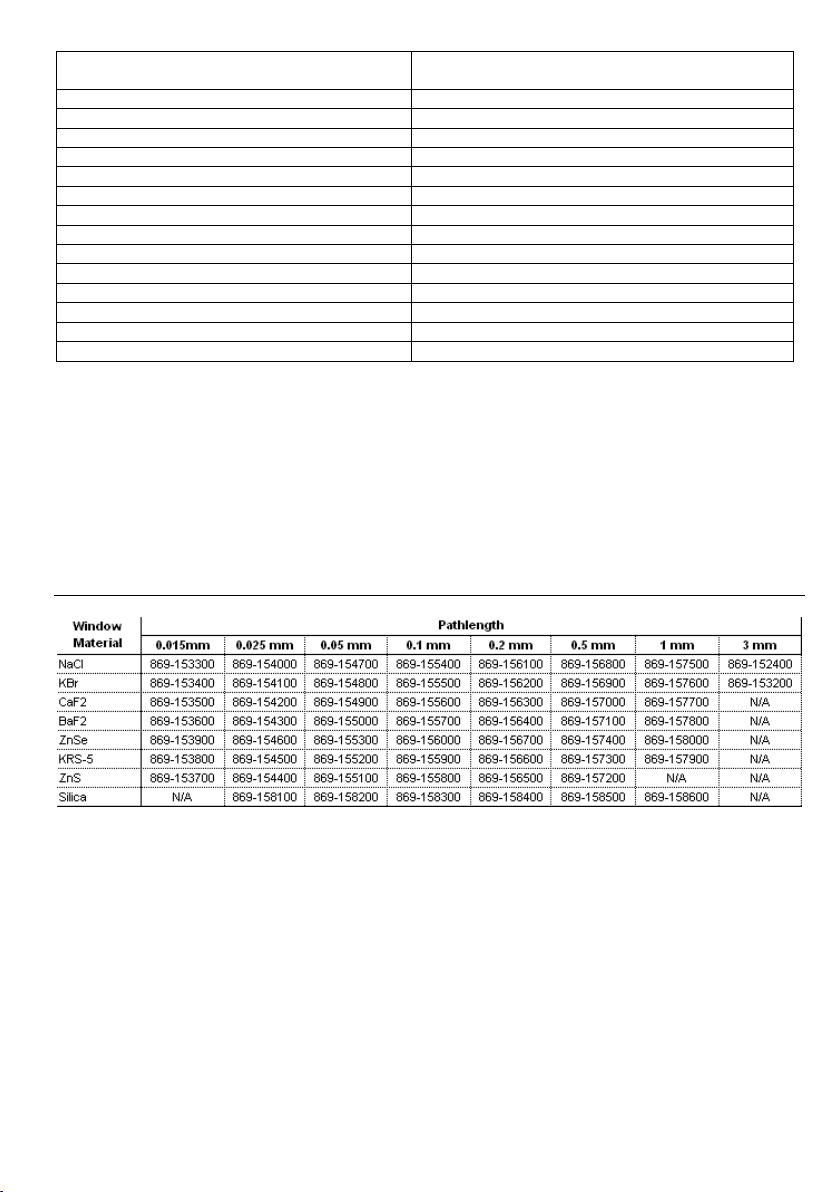
Rectangular Liquid Omni Cell Spacers
Circular Mull Omni Cell Spacers
SPECAC
INC.
Fax: 215 793 4011
SPECAC LTD.
Registered No. 1008689 England
P/N 869-162000 0.05mm PTFE material P/N 869-163400 0.05mm PTFE material
(Packet of 5)
P/N 869-162100 0.10mm PTFE material P/N 869-163500 0.10mm PTFE material
P/N 869-162200 0.20mm PTFE material P/N 869-163600 0.20mm PTFE material
P/N 869-162300 0.50mm PTFE material P/N 869-163700 0.50mm PTFE material
P/N 869-162400 1.00mm PTFE material P/N 869-163800 1.00mm PTFE material
P/N 869-162500 0.025mm Lead material P/N 869-163900 0.025mm Lead material
P/N 869-162600 0.05mm Lead material P/N 869-164000 0.05mm Lead material
P/N 869-162700 0.10mm Lead material P/N 869-164100 0.10mm Lead material
P/N 869-162800 0.20mm Lead material P/N 869-164200 0.20mm Lead material
P/N 869-162900 0.50mm Lead material P/N 869-164300 0.50mm Lead material
P/N 869-163000 1.00mm Lead material P/N 869-164400 1.00mm Lead material
P/N 869-163100 0.006mm Mylar material P/N 869-164500 0.006mm Mylar material
P/N 869-163200 0.012mm Mylar material P/N 869-164600 0.012mm Mylar material
P/N 869-163300 0.025mm Mylar material P/N 869-164700 0.025mm Mylar material
Spares
P/N 869-149200 Omni Cell body mount assembly complete.
P/N 869-161400 Rear neoprene gaskets (Packet of 2).
P/N 869-161500 Quick release nuts (Packet of 4).
P/N 869-161600 Luer port PTFE filling plugs (Packet of 2).
P/N 869-161800 Omni Cell spacers PTFE rectangular assorted (pkt of 16) for liquid cells.
P/N 869-161900 Additional packing spacer for thin windows (1).
(Packet of 5)
8. Permanently Sealed Omni-Cell Window Units
Silicon, AgBr and Polythene are not offered as permanently sealed Omni Cell window units.
Thinner windows (ZnSe, ZnS and Silica) as sealed window units include additional spacer 869-161900.
Brilliant Spectroscopy™
www.specac.com
414 Commerce Drive
Suite 175,
Fort Washington,
PA 19034, USA
Tel: 215 793 4044
River House, 97 Cray Avenue,
Tel: +44 (0) 1689 873134
Fax: +44 (0) 1689 878527
Orpington
Kent BR5 4HE
 Loading...