

Page 1
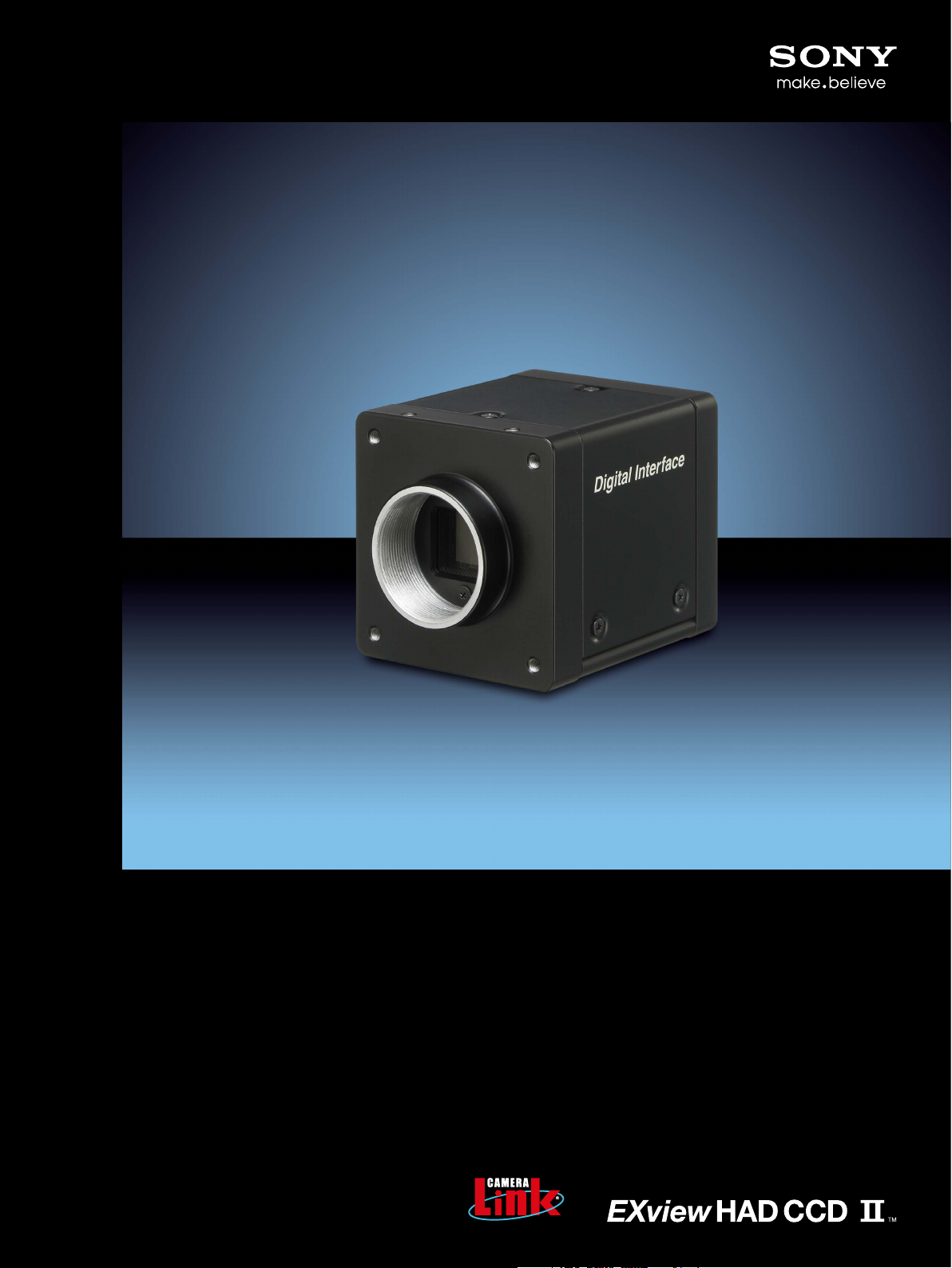
XCL-S Series
Digital Video Camera Module
XCL-S900 (1/1-type CCD, 9M, 18 fps, monochrome)
XCL-S900C (1/1-type CCD, 9M, 18 fps, color)
XCL-S600 (1/1-type CCD, 6M, 27 fps, monochrome)
XCL-S600C (1/1-type CCD, 6M, 27 fps, color)
Page 2
INTRODUCTION
Fan
In response to customer demand, Sony is proud to introduce a new top-of-the-line XCL CameraLink Camera
Series in monochrome and color. With their superb resolution and high frame rates, these new cameras deliver
a level of exceptional picture quality that analog cameras cannot achieve.
The new XCL-S Series cameras incorporate a 1/1-type EXview HAD CCD II™ sensor which provides extremely
high sensitivity. In addition to inheriting many convenient functions from Sony’s XCL Series, such as Bulk Trigger
and Sequential Trigger modes, these new cameras also incorporate some unique features including Shading
Correction, Defect Correction, and Temperature Readout.
These new advanced features and benefits make XCL-S Series cameras ideal when the highest inspection
quality is demanded for display panels, semiconductors, solar panels, PCBs (Printed Circuit Boards), and
pharmaceutical applications.
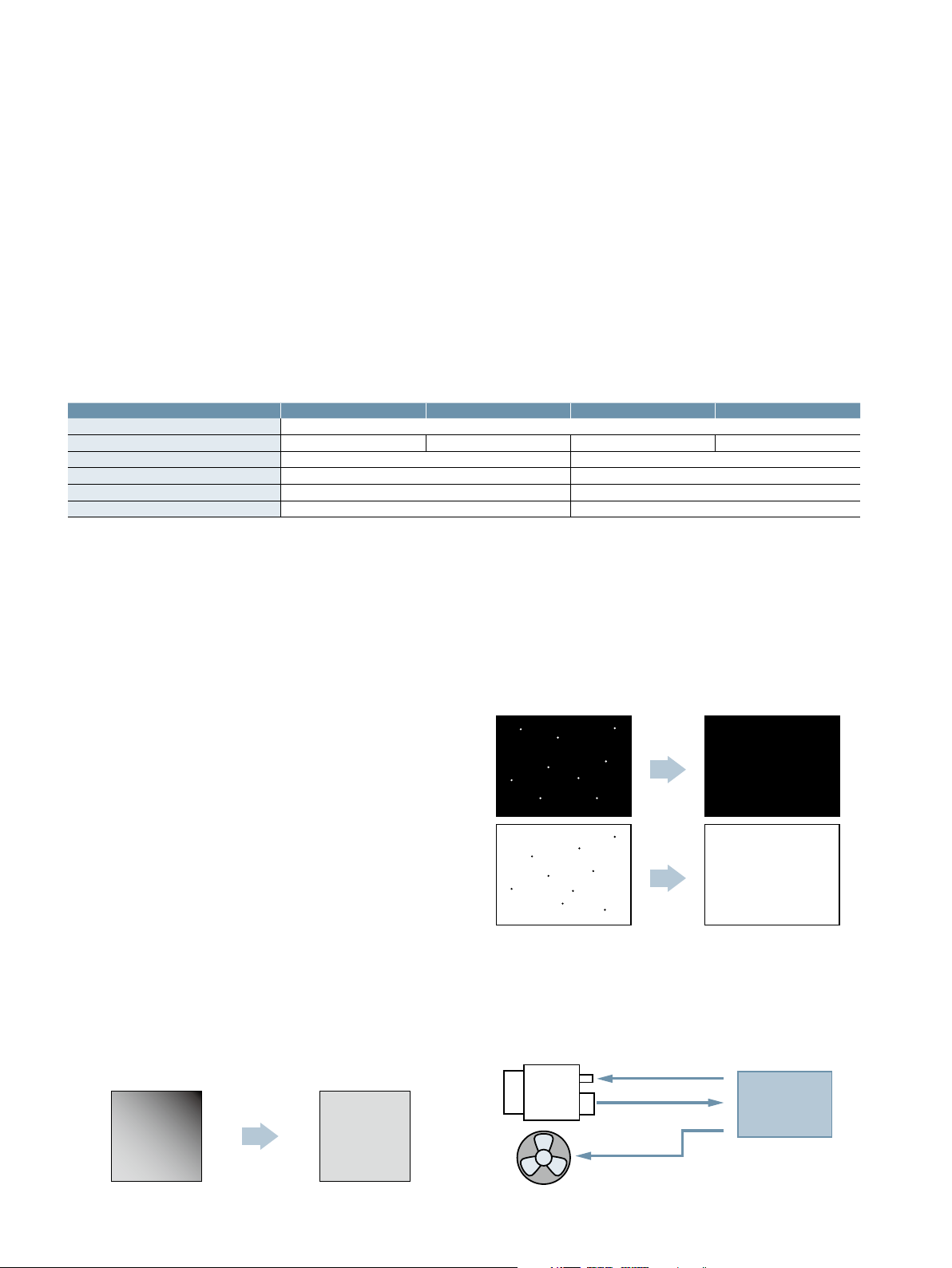
XCL-S900 XCL-S900C XCL-S600 XCL-S600C
Imager sensor
Monochrome / Color
Effective pixels (H x V)
Cell size (μm)
Output pixels (H x V, Full resolution)
Frame rate
Monochrome Color Monochrome Color
3,388 x 2,712 2,758 x 2,208
3.69 x 3.69 4.54 x 4.54
3,388 x 2,712 2,758 x 2,208
18 fps 27 fps
KEY FEATURES
Near-infrared Sensitivity
Utilizing Sony’s EXview HAD CCD II technology enables
XCL-S Series cameras to capture clear images in NIR
(near-infrared) wavelengths. When used with an infrared
strobe, each camera produces outstanding picture quality
especially in low light and NIR inspection applications.
High Frame Rate Image Transfer
XCL-S Series cameras feature a high readout rate of
uncompressed images for smooth and clear results. The
XCL-S600 and XCL-S600C achieve 27 frames per second (fps),
and the XCL-S900 and XCL-S900C achieve 18 fps when fourchannel output is selected. This enables these cameras to
capture fast-moving objects without sacrificing image quality.
1/1-type CCD
Defect Correction
XCL-S Series cameras can automatically minimize defective
pixels (e.g., white and black dots) within the entire imaging
area directly inside the camera. This feature helps simplify
image processing.
Shading Correction
With embedded shading correction, XCL-S Series cameras
minimize the uneven image intensity often caused by lighting
and/or the lens. Their internal hardware processing reduces
the need for external image correction that is normally
performed via a frame grabber board and PC. This handy
function reduces the processing load of the PC, and simplifies
the processing task. In addition, these cameras are equipped
with rich optional lighting settings to capture clear images in
varying lighting conditions.*
* XCL-S600 and XCL-S600C: 10 settings; XCL-S900 and XCL-S900C: 6 settings.
Shading correction OFF Shading correction ON
Temperature Readout
Each camera comes with an internal temperature sensor. The
host device can receive temperature information by issuing
a command. This eliminates the need for a separate sensor,
and simplifies system configuration.
Command
Temperature
Control
Host Device
Page 3
Sensitivity Control
The XCL-S Series is equipped with a saturation signal control
function to allow the amount of saturation signal charge
on the CCD to be increased or decreased via software
commands. For example when capturing dark objects, the
user can increase the amount of saturation signal charge –
this elevates the camera’s sensitivity to improve the picture
quality instead of using a long exposure time.* On the other
hand, by decreasing the amount of saturation signal charge,
the level of smear can be reduced or improved.
* If the saturation signal charge amount exceeds the maximum that can
be transferred into the vertical and horizontal registers, a transfer error will
occur (e.g., smear).
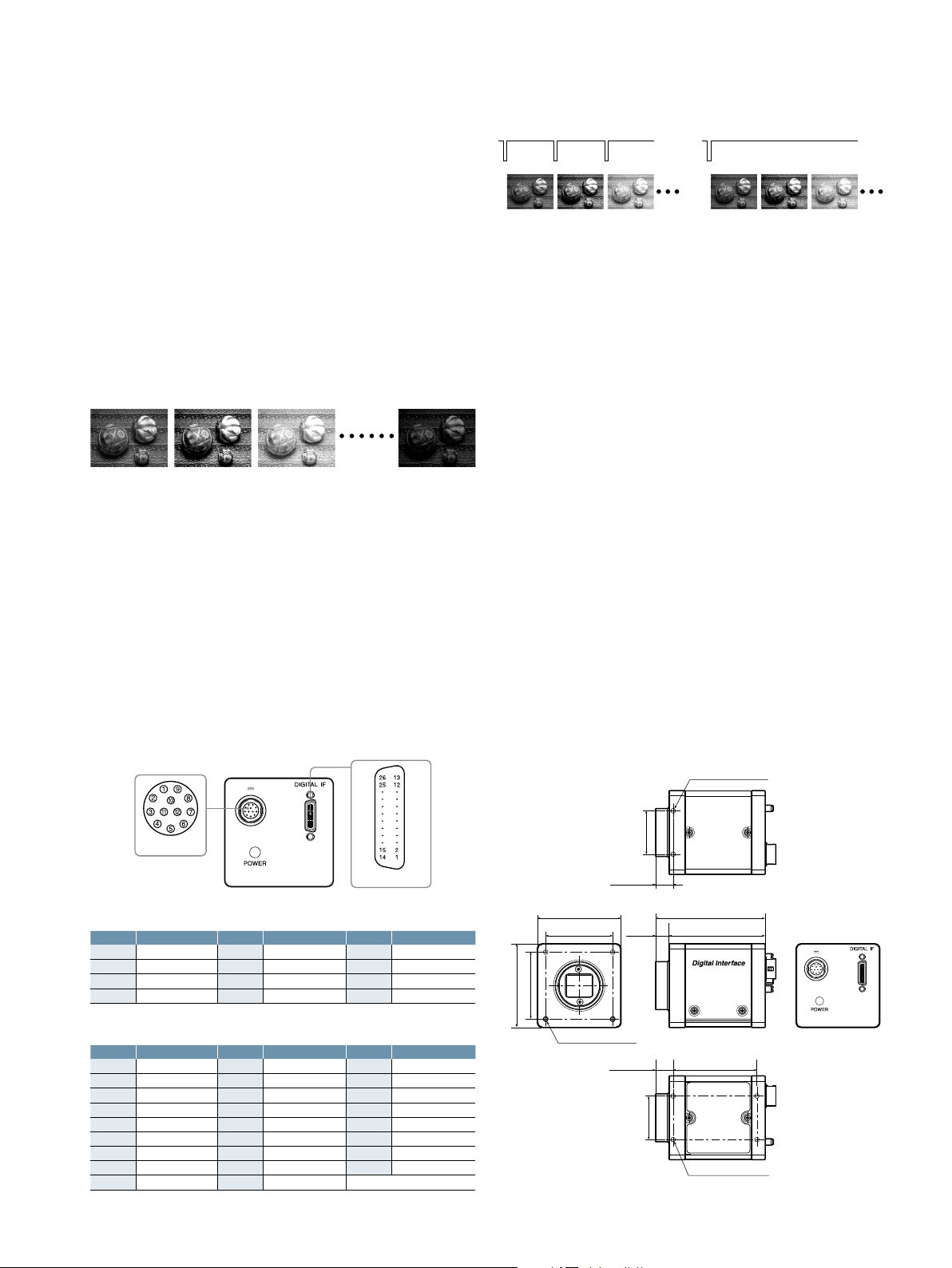
User Set
In addition to factory default settings, up to 16 camera
parameters – including brightness, gamma, shutter, gain, and
trigger mode – can be preset to suit each particular scene.
CH 1 CH 2 CH 3 CH 16
Bulk Trigger Mode & Sequential Trigger Mode
These new XCL-S Series cameras feature advanced
Bulk Trigger and Sequential Trigger modes in addition to a
conventional trigger mode. Each camera can store up to 16
different camera setups (e.g., exposure, and gain).
Bulk Trigger mode allows these cameras to capture up to
16 images in rapid succession using a single software or
hardware trigger.
Sequential Trigger mode allows each camera to capture a
single image using successive setups stored in the user set
with each software or hardware trigger.
1 2 3
CH 1 CH 2 CH 3
1
CH 1 CH 2 CH 3
Sequential Trigger mode Bulk Trigger mode
Look-up Table (LUT)
Each XCL-S Series camera supports a look-up table which
transforms the input luminance signal into the required
digital output. It supports factory presets – Linear, Negative,
Binarization, and Linear Interpolation – as well as a Userdefined LUT (input: 12 bits, output: 12 bits).
Trigger Noise Filtering
With a trigger line filter, these cameras can specify a valid
pulse width for the trigger. This helps avoid unexpected
image capture caused, for example, by triggers from
insignificant noise.
Pulse Train Generator
XCL-S Series cameras are capable of outputting any
rectangular wave from one of the general-purpose outputs.
This pulse train can be programmed for frequencies from
0.5 Hz up to 100 KHz in 1 µs steps to control external devices
such as LED lights, simplifying overall system configuration.
PIN ASSIGNMENTS DIMENSIONS
DC IN
DIGITAL IF
DC IN (DC power input) connector (12-pin)
Pin No. Signal Pin No. Signal Pin No. Signal
Ground
1
DC +12 V
2
ISO Ground
3
GPI1 / GPO1
4
GPO2 (ISO-)
5
GPO2 (ISO+)
6
GPI3 / GPO3
7
GPI4 (ISO-)
8
GPO4 (ISO)
9
GPI4 (ISO+)
10
GPI2
11
ISO Ground
12
DIGITAL IF (Interface) connector (26-pin)
Pin No. Signal Pin.No. Signal Pin.No. Signal
Ground
1
X0–
2
X1–
3
X2–
4
XCLK–
5
X3–
6
Ser TC+
7
Ser TFG–
8
CC1–
9
CC2+
10
CC3–
11
CC4+
12
Ground
13
Ground
14
X0+
15
X1+
16
X2+
17
XCLK+
18
X3+
19
Ser TC–
20
Ser TFG+
21
CC1+
22
CC2–
23
CC3+
24
CC4–
25
Ground
26
50 (2)
/8)
5
40 (1
40 (1 5/8)
4-M3 Depth 4 (3/16)
10.5 (7/16)
50 (2)
10.5 (7/16) 50 (2)
2-M3 Depth 4 (3/16)
/16)
1
26 (1
65.5 (2 5/8)
8
1
/32)
(1
/16)
1
26 (1
57.5 (2 3/8)
4-M3 Depth 4 (3/16)
Unit: mm (inches)
Page 4
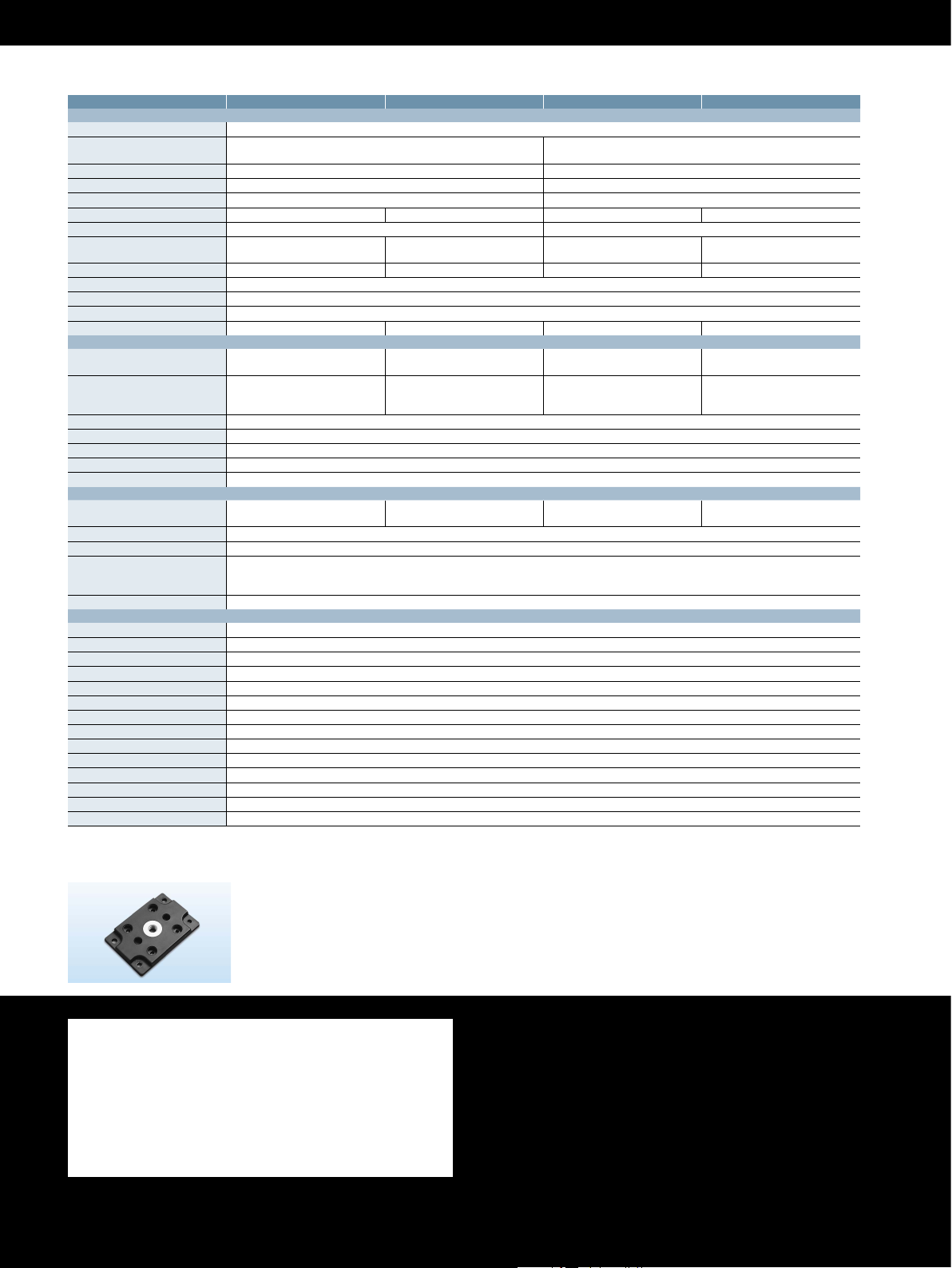
SPECIFICATIONS
Camera
Image sensor
Image sensor
(Number of effective pixels, H x V)
Cell size (H x V)
Output pixels (H x V)
Output pixels (H x V, Full resolution)
Color filter
Frame rate
Minimum illumination (50%)
Sensitivity
S/N ratio
Gain
Shutter speed
White balance
Camera Features
Readout modes
Readout features
Synchronization
Trigger modes
User Set
User memory
Other features
Interface
Video data output
Digital interface
Camera specification
Output data clock
Digital input/output
General
Lens mount
Power requirements
Power consumption
Operating temperature
Performance guarantee temperature
Storage temperature
Operating humidity
Storage humidity
Vibration resistance
Shock resistance
Dimensions (W x H x D)
Mass
Regulations
Supplied accessories
XCL-S900 XCL-S900C XCL-S600 XCL-S600C
1/1-type progressive scan IT CCD
3,388 x 2,712 2,758 x 2,208
3.69 μm x 3.69 μm 4.54 μm x 4.54 μm
3,384 x 2,704 2,752 x 2,200
3,388 x 2,712 2,758 x 2,208
– RGB color mosaic filter – RGB color mosaic filter
18 fps (4ch), 9 fps (2ch), 5 fps (1ch) 27 fps (4ch), 13 fps (2ch), 7.5 fps (1ch)
0.5 lx (Iris: F1.4, Gain: +18 dB,
Shutter: 1/18 s)
F8 (400 lx, Gain: 0 dB) F8 (2000 lx, Gain: 0 dB) F8 (400 lx, Gain: 0 dB) F8 (2000 lx, Gain: 0 dB)
More than 50 dB
Auto, Manual: 0 dB to +18 dB
Auto, Manual: 2 s to 1/100,000 s
– One push WB, Manual – One push WB, Manual
Normal, Binning (2 x 1, 1 x 2, 2 x 2),
Partial scan
Binnarization, Gamma (variable),
Built-in test pattern, LUT, 3 x 3 filter
Hardware trigger, Software trigger
Edge detection, Pulse width detection, Bulk Trigger, Sequential Trigger
16 channels
32 kbytes + 64 bytes x 16ch
Shading correction, Defect correction, Temperature readout
Digital monochrome 8, 10, 12-bit
LVDS
®
CameraLink
4ch: - - - (1 tap), 84 MHz (2 tap)
2ch: 84 MHz (1 tap), 42 MHz (2 tap)
1ch: 27 MHz (1 tap), 27 MHz (2 tap)
IN (x2), OUT (x2), IN/OUT (x2)
C mount
DC +12 V (+10.5 V to +15.0 V)
6.0 W
-10°C to +45°C (14°F to +113°F)
0°C to 40°C (32°F to +104°F)
-30°C to +60°C (-22°F to +140°F)
20% to 80% (no condensation)
20% to 95% (no condensation)
10 G (20 Hz to 200 Hz)
70 G
50 x 50 x 57.5 mm (2 x 2 x 2 3/8 inches) (excluding protrusions)
181 g (5.4 oz)
UL60950-1, FCC Class A, CSA C22.2-No.1, IC Class A Digital Device, CE: EN61326 (Class A), AS EMC: EN61326, VCCI Class A, KCC
Lens mount cap (1), Operating instructions (1)
Version1.2
6 lx (Iris: F1.4, Gain: +18 dB,
Shutter: 1/18 s)
Normal, Partial scan
Binarization, Gamma (variable),
Built-in test pattern, LUT, 3 x 3 filter,
Color matrix
Digital Raw, 8, 10, 12-bit,
RGB Color (8 bit x 3)
0.5 lx (Iris: F1.4, Gain: +18 dB,
Shutter: 1/27 s)
Normal, Binning (2 x 1, 1 x 2, 2 x 2),
Partial scan
Binnarization, Gamma (variable),
Built-in test pattern, LUT, 3 x 3 filter
Digital monochrome 8, 10, 12-bit
6 lx (Iris: F1.4, Gain: +18 dB,
Shutter: 1/27 s)
Normal, Partial scan
Binarization, Gamma (variable),
Built-in test pattern, LUT, 3 x 3 filter,
Color matrix
Digital Raw, 8, 10, 12-bit,
RGB Color (8 bit x 3)
OPTIONAL ACCESSORIES
VCT-ST70I
Tripod Adaptor
Distributed by
MK10999V2YIT13JAN
Reproduction in whole or in part without written permission is prohibited.
©2013 Sony Corporation. All rights reserved.
Features and specifications are subject to change without notice.
The values for weight and dimension are approximate.
Screen images are simulated.
“SONY”, “make.believe” and “EXview HAD CCD II” are
registered trademarks of Sony Corporation.
All other trademarks are the property of their respective owners.
 Loading...